Ask ChatGPT

 The Growth Podcast
24 Sep 2026 · 1h 14m · 30 chapters
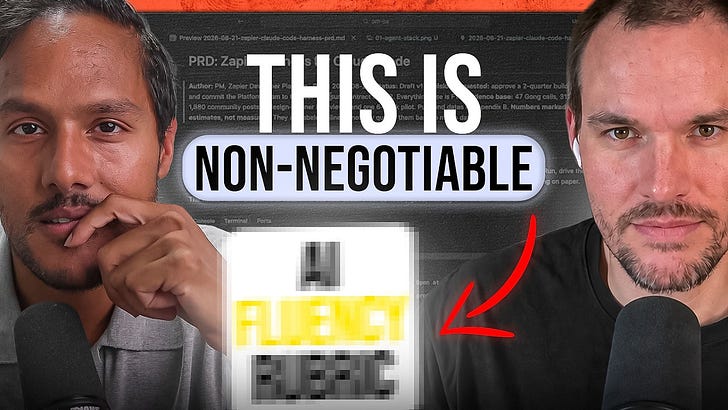
How product managers can earn a “transformative” AI fluency rating in 2026, using Zapier’s AI fluency rubric and examples of AI-powered PM workflows (including “AI slop” avoidance and accountability).
Wade Foster, CEO and co-founder of Zapier (since 2012). He wrote the viral AI fluency rubric that helped start the trend; Zapier publishes an updated V2 rubric (March 31, 2026) and uses it for internal performance expectations.
Written by AI. May contain mistakes.
Wade Foster discusses the significance of AI fluency in product management.
“Looking at Airtable, now it's less than 10 % of that amount.”
Discussion on the AI fluency rubric created by Wade and its impact on PM expectations.
“who've been following on Apple and Spotify podcasts.”
Wade explains how AI fluency is measured and the importance of behavior assessment.
“So I have been dying to do this recording.”
Characteristics of transformative PMs and the evolving role of AI in their work.
“And so maybe this is a product podcast, so let's maybe zoom down here to the product one.”
Discussion about the skills required for PMs and the balance of accountability in AI usage.
“That means you can tap into whole new skills, whether that's data analysis or marketing skill sets or sales skill sets.”
Exploration of how AI affects coding roles and project management expectations.
“That's what it looks like more often than not.”
Wade discusses the concept of a 'company brain' and its impact on productivity.
“It's one of the top AI evals platforms used by all of the top AI teams for a reason.”
Discussion about PM artifacts and how AI can enhance PM work products.
“I've actually gathered some that I created this morning.”
Learn how to structure a Product Requirement Document (PRD) focused on automation workflows.
“Who knows if this is a good idea at all.”
Discover how to evaluate product ideas and the importance of AI fluency in product management.
“And so that's really the problem we're solving.”
Understand the value of customer evidence in shaping product ideas and decisions.
“And it's a lot easier now for a product manager to bring some of these ideas to life.”
Explore how AI fluency and good product thinking are interconnected in modern product management.
“And so by the time you're sort of asking, you know, me or somebody else in the company to be like, hey, let's go put some oomph behind it.”
Learn how to effectively use AI in product management while maintaining quality control.
“They almost come together in a sense in this era.”
Discuss the role of AI-generated content in product management and the acceptance of imperfections.
Understand the importance of setting expectations and being transparent when using AI tools.
Learn about the critical skill of judgment when utilizing AI tools effectively.
“It's okay to not always be transformative with AI as long as you're upfront and transparent about it.”
Explore the process of reviewing a prototype and the importance of constructive feedback.
“So let's go review another work product that I've prepared.”
Discover the features and capabilities of a Zapier harness for cloud code.
“I predicted we should probably start with a prototype.”
Learn how hypotheses and evidence shape the development of AI-driven tools and systems.
“In our community discord over 1800 posts mentioning the MCP and our design partners we had nine interviews where they had built an MCP server.”
Get an overview of the agent stack architecture and the automated processes for insights and product development.
“I think the writing was quite a bit better than the last one.”
Learn how AI can streamline the product development process and decision-making.
“All of that, the triage swarm would just identify for us.”
Explore the shift in roles and responsibilities in product management due to AI integration.
“So if you saw me running a product team like this, how would you grade my output, Wade?”
Understand how different team structures affect the implementation of AI in product management.
“how do they get it, get it working as best as possible.”
Discover how to set up AI agents for everyday tasks to enhance productivity.
“All right, so now you guys have gotten the roadmap.”
Learn how AI can assist in generating relevant agenda items for meetings.
“It's like a managed automation in the cloud, essentially.”
Learn how AI can optimize executive agendas and enhance decision-making.
“So I still audit and sort of approve or disprove these things, but I find that this makes sure our exec agenda is way more relevant than it is in the past.”
Explore the concept of transformative AI fluency and its implications for product leaders.
“I mean, honestly, I think like I'm adoptive in a lot of places.”
Discover how Zapier has navigated its growth and market position since 2021.
“For you at Zapier, you've been around since 2012.”
Discuss the evolution of SaaS products and the role of automation in the future.
“Just talk to us a little bit about that.”
Learn how Zapier differentiates itself in a growing automation market.
“and how do you create that unique space for Zapier, which has been around for so long?”

Get the gist, explore an idea or ask about something said.
 Claude
On The Growth Podcast, what are the key points of this episode?
Searching your listeningAutomatic transcript. May contain errors.
0:00Every PM is about to get graded on AI fluency. Zapier, Shopify, and many others already are.
0:06Wade Foster: If AI was important in 2026, it's just the standard expectation for every job. Wade Foster is the CEO and co-founder of Zapier. He wrote the viral AI fluency rubric that arguably kicked off this trend. There is still something to be said about really understanding the customer problem, really having some intuition around how to go solve those problems. And if you combine those, you get excellence. But if you just let AI kind of just do everything, you're probably going to get mediocrity. You're going to get what people call AI slop. What was capable last year that's now unacceptable? What does a PM that's transformative actually do differently on a Tuesday?
0:42Wade Foster: The line we use at Zapier on slop, you can delegate the work, but you can't delegate the accountability. Looking at Airtable, now it's less than 10 % of that amount. For you at Zapier, you've been around since 2012. Where does Zapier's business sit now? One thing that's unique about Tapir is the valuation thing doesn't matter as much to us. So if you saw me running a product team like this, how would you grade my output? So if I'm spotting things like are obvious to me and not to you, I'm like, ooh, that makes me nervous, right? And I'm like...
1:19Before we get into today's show, please take a second to check that you're subscribed on YouTube who've been following on Apple and Spotify podcasts. If you want access to all of my favorite AI tools, I've gotten them to give you an entire year of their paid plans. Check out bundle.akashg.com for an entire year of both.new, Airtable, Speechify, Descript,
1:41Wade Foster: Magic Patterns, Linear, Dovetail, Arise, and Mobbin. And now into today's show. I've been trying to figure out what AI fluency actually means for PMs inside of companies. How do product leaders, how do CEOs measure you? And I could think of no better person than Wade. Wade published what I think was the first AI fluency rubric online. Many companies modeled it. Since then, Zapier has updated their thinking. How did they update their thinking? What actually matters? Day-to-day, how is Wade actually grading employees? In today's episode, he's not just going to walk through his rubric theoretically.
2:17We'll actually show you some AI behaviors and Wade will give his take on, is this transformative? Is this unacceptable? He'll also talk to you about how these expectations have changed over time so that you can meet the bar at your company or exceed it. Wade, thanks for being on the podcast.
2:38Wade Foster: Yeah, thanks for having me. So I have been dying to do this recording. I think we rescheduled a few times because I think you are the world's best person to talk to us about AI fluency. How do you guys measure AI fluency at Zapier? Sure. Might be most helpful to actually simply just show. So we have an AI fluency rubric. This, published March 31st, 2026, is our updated AI fluency bar at Zapier. So this is the V2. and you can see here we basically break things down into four categories you actually don't see there's a there you see three on the scape the screen here capable adoptive and transformative we also have an unacceptable one which is you know just simply the bar that we choose not to hire at obviously for any company you can tweak and tune these to fit your needs we felt it was really helpful for us to really name some of the skills and behaviors that help people stand out in terms of their AI fluency.
3:45Wade Foster: And so maybe this is a product podcast, so let's maybe zoom down here to the product one. And I'll be the first to share, this is the V2 that we've shared externally, but we've even updated some of these things internally since. This space moves fast, And you do have to constantly be tuning and tweaking what you're doing. And so you can see here some of the characteristics that make someone unacceptable, capable, adoptive, and transformative at this work. And so in 2026, if you're using AI to do simple tasks, summarization, writing, looking up information, generating basic PRDs, things like that, you know that's kind of table stakes i think for most companies at this point in time and so you know we're usually looking for somebody that's operating at a meaningfully higher higher level and so you know we want folks that have like a really structured approach for generating specs prototypes things that they're going to reuse and refine across projects um you know we want people using it to really tap into user insights quant qual being able to operate at a scale that maybe was not prior possible with sort of humans.
4:57Wade Foster: You should be able to generate tons of different working solutions very rapidly. So those are the types of things that end up being sort of table stakes for these roles. I think if you're really trying to start to push the needle, you're starting to stretch into other types of roles. I think PMs are well suited to become sort of like these generalist super builders inside of an organization. That means you can tap into whole new skills, whether that's data analysis or marketing skill sets or sales skill sets. PMs are usually already decent at some of these things, but now you can get to 80%, 90 % as good.
5:37Wade Foster: It makes you way more valuable to be able to work up and down the life cycle of a project. um you know i think you know a lot of this as you sort of move up the stack starts to be about systems building like this is the really critical piece is you're not just thinking about like how is this feature going to work you're really thinking about how do i build this like pipeline of agents that takes in customer feedback generates specs starts to prototype solutions chip fault features you know if you've heard of things like software factories like i think this is where pms start to have like a lot of values you can start to think about like how do we uh build the system that builds the ultimate system.
6:16Wade Foster: And that's where you start to get into this transformative category where it's like, wow, we've actually built a product factory here. And we're really changing the way product works at a fundamental level. And so these are the four stages or phases that we've rubriced out. But like I said, I think you can adopt these to your company. Not everyone has the same standards as us. Maybe you're not as far along, And so you sort of have a different state or maybe you're even more advanced than us. And you're saying, hey, actually for us, like we need more people that are in these categories to really push the envelope.
6:53So what is the distribution that you want to see at Zapier? Where should the ratings fall? For our product crew, like we're generally looking for folks that sort of have, you know, like, you know, sort of the bulk of their skill set is probably here.
7:08Wade Foster: You know, it doesn't mean that they have places where there's gaps like all of us do. You know, there's so much new stuff happening every day that there's new techniques and tactics that people haven't used. And so there's definitely people that are sort of in this bucket. And then, you know, we usually want to see somebody that's like bringing like one example of something that they've done here. You know, most people are not hanging out at Transformative every day. In fact, like it's probably not actually helpful to be like here 100 percent of the time, because if you are, you're not actually getting work done.
7:37Wade Foster: You're constantly just like tweaking your systems and way of working. And so, you know, you're probably hitting this on occasion, but I think kind of like for our PM org, like, you know, we're kind of hanging out in here, like most of the time and occasionally running experiments to sort of like push us, push the envelope. And so that's kind of where I'd say like our bell curve sort of, you know, sits around is like this is sort of the fat middle of the curve. And we have, you know, some folks in here and some folks in here. But, you know, not it's it's I wouldn't label it as like, you know, as a person, you're this.
8:06Wade Foster: It's it's more like most of the time I'm this. But I have sometimes I've got some holes here and I've, you know, sometimes got some things up here like that. That's what it looks like more often than not. that's an interesting way to frame it that maybe you don't actually want to be transformative because you wouldn't have time to do work what does like a transformative do you guys do quarters or halves when you guys give performances reviews to folks uh i guess let's see our performance review is in halves yeah so what does it like if you recall or if you can recall like a transformative half from pm what did that look like well you know i remember uh at the tail end of last year we had all these new uh you know uh models that came out like uh the the latest like opus series the latest gpt series the latest gemini series all came out and the reasoning power was like so much better than before you sort of went from you know hey these ais are you know kind of writing code alongside engineers to over the winter break basically everyone was like i'm not writing any code anymore.
9:15Wade Foster: Like I'm very rarely writing code anymore. Here's a quick word from our sponsors. Building a lot of AI products lately, my job search OS has 16 different agents. My newsletter has a recommendation engine and I kept running into the same problem. I'd ship something, it would work in my testing and then I'd get messages from users saying it's hallucinating or picking the wrong tool. The issue wasn't the prompts or the tools, it was that I wasn't actually evaluating anything. I didn't have a way to see what my agent was actually doing step by step. Every tool call, every decision. That's where Arise comes in.
9:47Let me show you. I'm going to open CloudCode and install Arise with just one command. npx skills add Arise AI, Arise skills skill yes. Now CloudCode already knows how to instrument my agent. I tell it set up tracing to Arise and it automatically analyzes my code base, figures out where the LLM and tool calls are, and adds instrumentation automatically. Now I can see everything. Every trace. Every span. Every decision. And more importantly, I can evaluate it. That's the shift. Trace what's happening, evaluate where it fails, then fix it. This trace right here, my resume feedback agent was supposed to pull the company's tech stack from the job posting, but instead it hallucinated that they use React when the posting said Python.
10:31I never would have caught that without seeing the trace. And here's the part that blew my mind. I asked ClaudeCode to look at these traces and tell me what I should be evaluating. It came back with four eval criteria I hadn't written. Things like picking the right tool and staying grounded in the input. I wrote the evals, ran them, and found that my agent was making the same kind of mistake about 12 % of the time. Claude pushed to fix, I re-ran the evals, and it dropped to under 2%. That whole loop, trace, evaluate, fix, took me about 20 minutes, and now it runs automatically. If you're building AI products and not evaluating them, you're shipping blind.
11:08Try Arise free at Arise.com and get a year free, a$1 ,260 value with my bundle, Arise. Check it out. It's one of the top AI evals platforms used by all of the top AI teams for a reason.
11:22Wade Foster: So alongside of that, a thing that we started to see a lot of folks doing both online, but even inside of Zapier was building these like second brains. And, you know, if you haven't done this, you know, it's a pretty simple thing where you'll create like at least the way it started was like you create like a bunch of markdown files that, you know, might say, here's what I'm here's my goals. here's the way I want you to work with me. You know, just have like a bunch of context. You know, this is a project I'm working on, et cetera. And then, you know, you boot up a coding agent and the coding agent would have access to all that context to go build projects with.
12:05Wade Foster: And so maybe you have your design system in there. Maybe you have your company strategy in there. Maybe you have, you know, coaching files in there where you're like, help me be better at this. You know, things like that. And so, you know, one of our product leaders said, you know what, this second brain concept is pretty interesting, but it's limited if those are individual skills. This should be a company brain. And so he took it upon himself to say, I'm going to go build out the sort of V1 of a company brain and I'm going to sort of put together all this context that would help anyone in the company.
12:43Wade Foster: But he certainly started with a lot of the product leaders and product managers and said, And, hey, we're going to get everybody sort of using this, you know, second brain or company brain to go do the work. And I would say there was like you could sort of feel this like phase shift happen where it was like not just him, but like every product person in Zapier kind of got like a jetpack put on their back when he sort of launched this system. And so that's a great example of like this moment in time where it was like, you know, the models sort of had this like lurch forward in capabilities. And, you know, product leader said, okay, with these new capabilities, I can lurch forward the way we work as well too with it.
13:22All right. So I want to try some PM artifacts. I've actually gathered some that I created this morning. And I want to put you on the spot. And what I really want to do, it's like the final rating doesn't matter as much as how does a CEO look at PM work products, PM using AI, or how might a particular PM who's in a company be being graded on this? So let's start here. What I thought of was what if Zapier had an IDE harness for Cloud Code? Who knows if this is a good idea at all. That's why I wrote a PRD on this. And I want to walk you through this PRD as if I were a PM. And I'd love to hear your thought process as you're looking at this.
14:17Obviously, I've used ChatGPT here and I've given it a few prompts. So I have iterated on it. It's not, you know, my first draft or anything. but uh i i've included the overview i said it's important for automation workflows and we're uniquely positioned to solve this because of our thousands of integrations right and our deep knowledge about how workflows work so we combine cloud code with zapier's automation platform that's my pitch here i feel like the problem is that you might write prompts in cloud code configure apps deploy it, it's all fragmented. Cloud code can make mistakes with the API.
14:55And so what I wanted to do was create a better environment for building these Zapier automations. And I feel like the target is, you know, software engineers, founders. And so specifically for an engineer, as a developer using cloud code, I want to build and test Zapier automations without constantly switching. And so that's really the problem we're solving. We have this proposed solution where users can interact with cloud code a workflow might be that they have this workflow and Claude could easily help them build it we could test it i've come up with some of the key features that we have here and i won't go through too much more of the detail but it'll have ai slop detection i've come up with a little bit of an mvp some metrics that i think you know leadership might care about is the number of workflows successfully deployed through the IDE as sort of our North Star metric.
15:53Of course, developers might prefer cloud code directly, but I don't think there's a huge build cost. And sort of my vision is cloud rights or automation, Zapier helps make sure it actually works. So I wrote this with AI. What do you think of my work? Okay.
16:08Wade Foster: So, you know, it's interesting to think about how you would start to go evaluate this because you know part of your prompt to me was you know how does this grade an AI fluency but there's also a part of this that's just how do you grade the overall like product thinking that's sort of happening here and so the first thing I noticed is one I think this is actually a pretty interesting idea you know I think you know you sort of like like good product intuition you know I would say is like pretty savvy here. Recognizes that there's this new way of building automations or this new way of building.
16:45Wade Foster: There's some value in sort of having the Zapier connective library hooked up to Claude or Claude Code to help go build. And then, you know, one thing I didn't see you say here, but maybe it was in it. I suspect it's in here. I couldn't read quite fast as you were going through this, was there's a lot of value in sort of deploying these things and running them on Zapier because Zapier can run them in a deterministic manner, which allows you to get better costs, better accuracy, all that sort of thing. So there's a lot of stuff in here that I like. Now, where I think a sort of like AI-pilled, AI-maximalist product manager could go further would be in a couple dimensions.
17:27Wade Foster: I think, one, why stop at the PRD. There's an opportunity to go build out the first prototype of what this thing looks like. And so let's go fire up your favorite coding agent of choice and start to see what you can prototype and build. And now the point here is not for product managers to build production level code. The point is that seeing is believing. And it's a lot easier now for a product manager to bring some of these ideas to life. And so, you know, there's that sort of, you know, picture that, you know, says a thousand words. Well, you know, a prototype is, you know, that times 10, right?
18:12Wade Foster: So I think that would be one dimension in which this could be, you know, stronger and, you know, an AI-pilled person would sort of, you know, probably do something impressive there. I think the second dimension where I would try and strengthen this, and this is, you know, I think you could do this sort of in a non-AI way, but certainly I would be using AI to help me, which is, let's go start to figure out two things. Where is our customer evidence behind this? However you can find customer evidence, I would try and find it. I would look through the Zapier gong recordings or Zendesk tickets. I would go sift through subreddits or LinkedIn or X and sort of find like, hey, where are people complaining about stuff like this or expressing a desire for a thing like this to try and figure out, am I getting the shape of this product right?
19:09Wade Foster: Now, like I said, you could do a lot of this stuff without AI, but AI is probably going to make it a lot easier for you to sift through a mountain of data sources that you probably just wouldn't have been able to do in a short period of time in the past. So I think that is a second thing you could do to really beef up the evidence that, like, hey, am I in the right direction here? I think this is a good idea, or our customer is going to think it's the right idea. And what is the pain point that they really care about um you know you pose the question like hey claude could maybe just do some of this so there is a little bit of a question around like well what is like where is the unique value that zapier brings to the table on top of it and i think you know sifting through a lot of those customer details will start to like give build strengthen that intuition around like ah there is something here that you know is uniquely zapier's to own uh and provide value on top of.
20:06Wade Foster: So those are the two sort of like obvious things that I would use to like would encourage somebody to strengthen. And I don't think that either of those things takes that much more time. In the past, they would have been things where it was like either a product would, a PM would have just basically, well, I can't build a prototype. So I just simply can't do it. Or with the customer evidence one, it's like, well, I can do that. But you know, there's a question of like, before I go spend, you know, like a couple of weeks doing it, I kind of want to get some buy-in that this is like even directionally interesting.
20:35Whereas nowadays, you know, that buy-in step
20:38Wade Foster: can happen way later. You can just go so much farther. And so by the time you're sort of asking, you know, me or somebody else in the company to be like, hey, let's go put some oomph behind it. You know, you've built like a mountain of evidence behind it that makes it, you know, a lot more likely that I'm going to say, yes, let's go for it. Or maybe you've already figured out yourself, like, actually, this is just a really bad idea. Like, I thought my intuition was good, but, you know, I put some effort into it and I just can't find something that I like get super excited about. And so you can shelf it.
21:09Wade Foster: And so that's where I think like, you know, an AI powered PM just has these like superpowers that you didn't have in the past. Did you guys realize you were getting a masterclass in how to write good PM documents? It's not just AI fluency. I think Wade just brought up a couple of really, really important points around. It's not just the PRD. And what I tried to do, I tried to engineer this document. it so you would rate it as like a capable in 2024 but almost like an adoptive or unacceptable in 2026 do you feel like that's fair i think so yeah like i think if someone came to me with this like you know in 2026 i would sort of feel like it feels a little old-fashioned like a sort of the answer that i would have it'd be like yeah uh you know some good product intuition some some good thinking, but like, gosh, you really could have gone a lot further.
21:59Wade Foster: Like you, you really, and, and I would almost want to, I'll tell you what my instinct would be. My instinct would be like, just give me the doc and I'll start go doing some of these things. Like I'll literally just take your PRD and like, you know, throw it into cursor and be like, Hey, build this, you know, for me and see what happens. And you know, that feels like, you know, I think, you know, the way that I would sort of, here's an interesting like rule of thumb, like, you know, you probably want to be in your discipline, you probably want to be farther ahead than your CEO is. And, you know, I would say, you know, my AI fluency is like probably, you know, adoptive in most places.
22:41Wade Foster: But, you know, what it means for me to be AI fluent in the PM job, or the marketing job, or the engineering job, like I should be behind you. And so if there's things that I know that you don't know, like that's probably not a great signal. You should be further ahead than me because you wake up and breathe this stuff all day, every day. And so if I'm spotting things that, you know, like are obvious to me and not to you, I'm like, ooh, that makes me nervous, right? And I'm like, hmm, how do we go fix that? Okay, so I think we're aligned there. And one other thing I would just pull out as an insight to triple click for everybody who is listening is it's not easy to just separate AI fluency and good product thinking.
23:27They almost come together in a sense in this era. Like to do good product thinking, you really need to have gone and looked at the gone calls. You need to have gone and looked at the Reddit comments. And now AI can help filter half of that for you. And so you really need to put those two skills together.
23:47Wade Foster: Yes. Like we were talking before the call about AI slap a little bit. And so there is a version of this where you could do all the things that I said, which is like, oh, just take this PRD, slap it into a coding agent, have it build the first prototype. You could sort of have AI do all of those steps. But the output you could come away would be just like pretty mediocre and unexciting. And so this is where the human, like a lot of people call it taste, judgment, like whatever, you know, whatever term we're calling it these days really does matter. And so, you know, there is still something to be said about like really understanding the customer problem, really having some intuition around how to go solve those problems.
24:28Wade Foster: and if you combine those you get excellence but if you just let ai kind of just do everything you're probably going to get kind of mediocrity you're going to get what people call ai slop you're going to look at and go like this is not like i'm not excited about this speaking of slop i want to know what your take is on this framework from dan hockenmeyer over at fair if you don't have good judgment and you use ai you can become a slop cannon but if you have good judgment and use ai you can become a turbo brain is this the right way to think about it uh i mean it's definitely funny and evocative i i think it's a reasonable framework honestly uh i can't think of why this is not i can't think of why i would sort of have an objective to to this like i i can think of folks that i've worked with who are using ai and have except exceptional judgment and just watching them work you're just like wow this is this is incredible to like watch this person work you're It's almost like you're witnessing a new species being invented.
25:27Wade Foster: And then I've also seen folks that are using AI a lot but do not have good judgment. And, you know, there's this old saying kind of like in the social media wars around disinformation where it's like, you know, a lie can go around the world two times before the truth gets out of bed. and I feel like the folks without good judgment who use AI are a little like that where they can just generate so much stuff that like you're just trying to like you know it takes so much just to kind of like swat it out and be like like you know that's not that's not what I'm looking for not what I'm looking for and so it actually ends up being in some ways more challenging to work with those folks than maybe even like the bottom left corner where it's like doesn't have good and it doesn't use AI, well, it's like, well, at least, at least you're quiet.
26:13Wade Foster: Right. So, uh, you know, it's, it's an interesting framework too. I'd probably have to think a little bit more about some of the pros and cons with it, but on the surface, I'm like, yeah, I, I feel this on my own reason. It probably went pseudo viral on my own team. I find that like when somebody sends me something that might fall in the slop category, they're basically they didn't exercise the judgment on their own and they're passing that responsibility to me like they're like saying like oh this might be good can you judge it right and that's like kind of the opposite of what you want to do when you're moving up a corporate hierarchy right you want to give people filtered information that is quality versus what do you think of this yeah i i think you know there's there's almost like some etiquette that i think the workplace is trying to iron out around this right now uh i think i talked to a lot of folks that are sort of dealing with this like you know the rise of slop internally and um you know i think some of the things we are starting to do is like be really honest up front around like hey what's what level of effort has been put into this yet and so you know when i share a document i'll say like hey um you know obviously i have used ai to help draft this i have done a quick skim through and so like i've remove sort of like the most obviously bad stuff inside of here but you know maybe I haven't given it like a thorough once over but I want to share anyway because I think speed is really important now and I think I've gotten this I've gotten some ideas out there and I want you to take a look at it right so that might be one thing I will do or I might say you know what I think this is excellent like I really poured you know so I stand by every statement every sentence like has been like impeccably reviewed by me and so we we kind of have like these stages of like when we're sharing these things to help the reader understand like you know what's the level of like effort that's sort of been put into this um and you know i do think it's okay at times to just share you know what might be pure ai slot but i think you've got to like set the expectation to the reader to go like okay how much you know uh how much should i like like what's the quality level that i should expect out of this and i think that helps so like i don't know and i'm not sure that we totally perfected this to be honest but the the place that is really painful is when you sort of do try and pass it off as like really good but then the the reader can just like quickly tell like you you're just you literally put no effort into this and now you're making me do the chask and it's like you should have just asked me to just do the job anyway versus try and pass it off as your own so one thing that really surprised me so far into this podcast that i definitely wasn't expecting coming in was it sounds like it's okay to use some AI.
28:58It's okay to have a little bit of slop if you're going for speed. It's okay to not always be transformative with AI as long as you're upfront and transparent about it.
29:09Wade Foster: Yeah, I think so. I think these are tools, right? And a lot of it depends on the context. If you're putting out an external product for your customers, like there's a different standard for that versus like hey i got this one quick and dirty task over here and like the level of quality and required for that is maybe different uh and so you know a lot of it comes down to what's on dan's right hand side has good judgment and so you know judgment is like you know kind of the ultimate in a lot of ways it's like one of the main critical skills right now in the ai era is like you've got it you got to turn your brain on and if your brain is on, you're probably going to mostly find yourself in a good camp.
29:51Wade Foster: But if you sort of turn your brain off, you're probably going to find yourself struggling. Awesome. So let's go review another work product that I've prepared. I think we can safely say the last one, we would probably not give that a very high rating in 2026. Let's go check out another one that I worked on before this. And I'm nervous now that it might get a low rating, but that's the point, right? So let's go see what rating I get. I actually decided to use the same feature so that we get, it makes it easier for us to really compare. And so it's again, it's like a Zapier harness for Cloud Code.
30:27I predicted we should probably start with a prototype. So I did come up with a prototype here. Here's what I have for my next layer. I actually did start with a prototype and I tried to create some Zapier branding even. your agent has the connections it just can't reach them it's kind of my pitch right since we hold authenticated access to 8 000 plus apps i think even more now what would it look like if a coding agent could actually use them and so the whole idea is we just cloud plugin install zapier zapier connect we could approve a slack message we'd start to get this exposed area we could even sent out things like Jira delete issue and all that happens so incredibly fast and the whole point is that it found six connections three were selected it looked at 14 custom Jira fields it showed us which tools across our cap which ones were pre-approved it gave a preview of the payload there was this thing that I built in here it happened really fast where the Jira delete was refused so what did we do then and why well it was a destructive action and so it was flagged and so that's one of the things that our harness would be able to add on that like maybe a normal cloud code wouldn't because we have a lot of enterprise customers we could even replay it in Zapier history and so the whole idea here is that this harness would be much more powerful and this is where I started my PRD so I'm gonna keep going and just explain a little bit more the prd behind it too and then let's get your feedback so now if i show the prd this is going to be a markdown file instead of just a chat window this time so we just went through the prototype basically the whole idea is you just install and connect once you just saw that it has a policy file you just saw where it denied an action the loop we're talking we're really talking about it unlocking is let's say there's some sentry issue it can go read it it can go edit it it can go create the jira comment it can go post a slack message all of that can happen using zapier's connections and zapier's policies and so somebody who is super technical can build it or somebody who is not technical we already went through what this is deliberately proving and so we since we talked about this hypothesis i won't talk about it too much but i've written it in kind of like a slightly tighter way this time and I tried to use a little more evidence so I did predict that we needed to use some evidence so I've added in like some gong information like what I from 47 calls from February to July and I found that agent tooling came up unprompted in 34 of these 47 calls this is just an observation on Zendesk I saw we had 312 tickets tagged MCP or AI agent.
33:26In our community discord over 1800 posts mentioning the MCP and our design partners we had nine interviews where they had built an MCP server. Now what did all this information show? What it showed is the bottleneck is permission not connection. It also showed that too many tools make agents worse and users already know it and that there is a real tale. So my hypothesis with a little six design partner pilot that I ran was that devs will let an agent perform rights to production systems if the gate is good. I wasn't sure if this was going to be true, and I did find evidence to support this. Five of six enabled at least one pre-approved right.
34:12I went through several other hypotheses and ultimately looked at it across our strategic fit, and I came up with this idea that we do a Claude plugin. And this plugin, I feel, is really a harness, not a connector. And I've gone through a little bit more detail on that, including the metrics, the risk. And what I think I want to get your permission for in this meeting is that we go through 10 design partners now. We do a legibility bake-off. We start to look at security. So if you approve this, then we'll plan on kind of going forward with a Q4 beta on this project. What do you think of my latest work artifact?
34:55Wade Foster: Well, I mean, based on the critique I gave you in the last one, you basically nailed the two things I called out, which was they should be a prototype and where's the evidence? So like, obviously right off the bat, like this is so much stronger. In fact, it makes me even wonder where I'm like, is Akash actually running this live transcript into a coding agent and it's live fixing this stuff? which I have seen people do at Tapir. And that is always like feels magical where it's literally you're just taking like what the person is telling you and you're literally feeding it right back to them. And so when they see it come up, they're like, oh, great, that's amazing.
35:34Wade Foster: And so I don't know if that's what you did or if you just anticipated that that would be my feedback and, you know, guess it on the way. Either way, like that is the magic of like, you know, good product judgment. so yeah i think you you sort of immediately cleared those things up the next thing uh that is honestly where i would push you is the ask you say hey i i want to prove this i want to ship you know uh i want to get these design partners and i want to get to a q4 beta this is where i'm like why are we waiting for q4 like you've already gotten all this far like can you do it faster uh and i think this is one again one of the things that's pretty magical about these AI tools is you can go from zero to design partner exceptionally fast.
36:22Wade Foster: And so, you know, if we're talking Q4, that's October. And it's like, well, shoot, you got five weeks. Like, you know, what are we doing for five weeks? You might be able to get there a lot faster than that. And so that would be the main thing I would start to push on is like, how do we get these iteration cycles to be going a lot, lot faster? But by and large, like, this is much better than before awesome and i'll just note out a couple things or like what would you give the final rating on this i i think this is like like this this feels to me like solidly adoptive like i would be very happy to have like this caliber of pm work sort of across zapier at this moment in time i do think there are you know like the thing if you were actually like live listening to my feedback and feeding it back in like that's an example where i started to see some people doing it but i don't think that that's a tactic that's like widely used yet that's starting to look pretty transformative so if you were doing that like there i'd say like nicely done uh but by and large this is like very solidly adoptive i would feel like okay i was going for capable i didn't make it the only thing i did uh live was i added in like really clearly what i got from gong and so you can even see that that prompt that came in just a few minutes before there you go to say like pretend should pretend looked at gong calls well that that's what the dead giveaway was was like the it listed out gong and zendesk and i was like those are the tools i cited i was like i i think this is an ai like hyper listening to me because you can kind of you can kind of tell where it's like ai just has that hyper specificity to it uh a lot of the times so the first one was somewhere between adopt unacceptable and adoptive this one hopefully somewhere between adoptive and capable let's see where this last one lands where you can kind of see my agent title kind of gives it away of what i'm trying to achieve and then what we're seeing is if wade actually feels that which i would say for my last one he didn't give it an outright capable so that shows you guys that the bar for capable like even though i built this inside a pretty advanced Claude code harness.
38:33I think the writing was quite a bit better than the last one. There was pretty good evidence. There was a pretty decent prototype. There's still a pretty high bar for capable. So let's see. Can I hit transformative? So what I did here is I created two images to show what my agent stack looks like. So if I go into here, it looks like it's, this is my agent stack. And so the whole idea is that I have this five-layer sort of architecture where I have these skills for our team's recurring work, like PRD, prep, eval, recall, ingest, impact sizing, launch checklist, weekly review, and 37 more. Then we have this orchestration layer where sub-agents fan out in parallel.
39:27so there's engineering design exec legal ux trust and safety and skeptic which argues everything shouldn't ship because we know like we don't want future blow layer three is the tools and mcp so of course we use zendesk and gong which was that was the only update i made once i heard it from you read it i don't know if you guys use amplitude and linear but those are the assumptions i made in terms of analytics and ticketing, Figma for design, although maybe you guys are all into cloud design now, GitHub and Chrome. And then I think this is like the most important thing is that there's this deterministic enforcement in this environment.
40:06And so what happens is it will post any tool use. It will reject a memory file if the evidence has no source. And so everything that we put into memory will have really good sourcing and it will stop the session from ending with our brain being dirty so the brain is like constantly updated and that feeds into this memory layer where we have all these sourcing of everything we're learning in product across the our product team we have this ingestion and automatically our agents are creating these are the hypotheses that are coming let's say of Zendesk plus Gong plus Reddick. These are the decisions that are coming out of, let's say, linear tickets and GitHub PRs.
40:54This is the research that we found from Gong and Reddit. These are what the stakeholders are saying from meeting notes. So this is my agent setup. This is part one. And there's one more thing I want to show you before you give me my rating. So the second part is like the auto pipeline that I've created around it. So I basically have a loop running nightly. So we take our raw customer signals. Then we have these auto agents that run on a nightly cron job. So I call this the triage swarm. They're going to dedupe and cluster by job. They're going to, of course, populate our source folder, which hopefully you understand now why that's so important.
41:39They're going to tag things as observations or interpretation or a hypothesis. They're going to match things versus open hypotheses and flag contradictions. So overnight, for example, we might get like nine clusters of insights from all of our signals in. Maybe two of those are new, like maybe something came up on a Reddit forum. Maybe one even contradicts a bet made in March. All of that, the triage swarm would just identify for us. Then what happens next is using the memory layer, I would come in as the PM and I would say, Do we promote this, right? Are there independent sources? Is it just one person on Reddit?
42:17We don't care. But is Reddit and our amplitude data showing it? Maybe then it's relevant. So in four to five minutes, I look at that. The system itself is going to help me document the hypotheses and decisions. And then I think this is the part that hopefully makes it a little more powerful than what I've shown before, is we have this auto-build system. So each step is going to need the layer above. but first it starts with a quick two-page prd then it does a prd review panel then it creates the prototype then it creates the evals and then it creates the code first draft we get that with the prototype link the user tests the draft pr and the linear tickets and that's when we have the next human gate so human gate one was do we care about this build chain human gate two is do we merge it and if not and once it's done we put it back into the memory and there's some hooks that run it all But the idea is that we can go from, let's say, a 10-day development process to a two-day development process.
43:16So if you saw me running a product team like this, how would you grade my output, Wade? This is definitely starting to get into the transformative territory. This is just not how product and software was built three years ago.
43:33Wade Foster: Not even close. It is a totally different way of working. You know, it looks a lot more like a factory, right? You're sort of saying, hey, my job as a PM or an engineer, whatever your role is in this system, is not to do each of these individual tasks. You've set up agents who are handling these tasks. And now your job is to actually audit the system. Like when the agent fails, okay, why did the agent fail at that task? you know if you think about like a factory right um if a factory produces a failed widget what does the factory person do do they like try and like individually fix the widgets no not really they just sort of discard that batch and they go back and look at the machine and say like why did the machine generate these failed widgets like what's what's going on and they fix that and so you know this is where the job is kind of shifting to it's like oh you know instead of having human machines that are sort of like stamping out, you know, each step of the process, we're replacing those.
44:34Wade Foster: And now the job of, you know, the humans is to sort of audit the overall system and say, hey, is this working or not? It's a very different way of running a software and product team. Now, the question that I think all of us is trying to figure out is what is the right way to run this factory? And that's where I was like listening intently to see like, hey, how are you designing your system here? Because I think it's like, I talked to a lot of folks building these types of things and I don't think there is a consensus yet on like what is the exact best way to run these loops. For example, the thing I was trying to figure out is like where are you putting those human gates and why are you deciding to put those human gates in those places versus other places?
45:14Wade Foster: Maybe this is the correct place to put them, maybe not. Maybe you want to actually take the first human gate out and say actually I want to kick off coding agents for everything and then I'm gonna review all the stuff that sort of comes through. Maybe you don't want to do that because you think actually like a lot of these things are burning lots of tokens and we're spending a lot of money on things that could be wasteful and so it's worth it to have a human gate there even though it might slow the overall system down um but those are things that like i think a lot of teams are trying to figure out is like hey is this the right way to to do this and candidly a lot of people aren't to this yet um but you know it is becoming more and more common so you do see it uh but i think the exact design of this this this loop is what i I see a lot of teams trying to like scratching their heads on, trying to figure out like, how do they get it, get it working as best as possible.
46:04Wade Foster: So like this is starting to tick into the transformative bucket. Awesome. So if a PM really wants to get that rating, although you said at the beginning that you don't actually need to, right? Like maybe if you're in the transformative, you're too focused on the AI tools. But let's say somebody's manager has told them, you know, you should, you should be going for that transformative rating. if in 2026 they start to build a system that operates like this that actually works they are getting to that transformative level yes well and the thing that i would call out is at any at a small company like if you're the only pm at the company then yeah you're probably building out a system like this because who else will do it you have to be the one that does this but if you're getting the company of zapier size where we have you know quite a few pms working here not everyone's job is to sort of come up with this thing, redesign the system.
46:56Wade Foster: You probably have a team that's saying, okay, I'm going to sort of go build this. Or maybe we've got a couple teams doing a few variants of it. And then where the rest of the PMs come in is like, okay, now help me figure out how to run this system, right? And so, you know, you've got a handful of folks that are sort of in the transforming part where they're like, okay, I got to go sort of redo all this stuff. Well, in the meantime, you know, we've kind of got some PMs that are sort of running the old standard playbook and, you know, occasionally sort of coming in and being like the user testers for like this new way of working.
47:27Wade Foster: And you can sort of parallel process like, you know, this new way of working. And so, you know, it sort of just depends a little on like how your organization is set up. But that's where I look at it. I'm like, I don't need all of my PMs to sort of drop everything and rebuild the system. I don't want, you know, I think we have like something like 30 or 40 PMs in Zapier, I don't need 30 systems of this loop running. I actually want one sort of way of doing this stuff, or maybe I want a couple, depending on, there's a few different jobs inside of Zapier, and so they might need to work slightly differently for these different jobs.
48:05Wade Foster: But the goal is not everyone runs their own mini version of this. There is a sort of Zapier product factory that does a lot of this. All right, so now you guys have gotten the roadmap. You understand as a PM how to rate on AI fluency. I want to see a little bit more of Zapier's internal sauce. Can you show us a little bit of your internal agent dashboards and how you guys are starting to work towards these ways of working? Yeah, maybe let me just show some of my like individual use cases. This is what I do the most of with agents today. So these are not like Zapier production systems. These are just like Wade personal agents.
48:46Wade Foster: And so I've built out a little dashboard here that I can sort of show off some of the simple agents that I have set up that sort of span the gamut of simple use cases to maybe more sophisticated. I have, I bucketed them into like, I had my agent build out this demo page for us, but I've kind of bucketed them into a few things. I've got my robot staff. So these are like actual agents that are helping me run my like day-to-day systems. I have this like CEO CRM. This is sort of a lot closer to like kind of the production agent that we showed off just now. I have this AI that argues back. This is kind of like a simple thing that you can do and you probably should do.
49:31Wade Foster: You know, it's akin to the skeptic that you sort of set up in your product loop that you have. And then I have just a bunch of executable skills that I do for like, you know, real-time assistant stuff that's helping me with like a whole variety of cases. Maybe what would be most interesting is we could sort of poke into the robot staff first. What do you think? Yeah, let's do it. So the robot staff. So, you know, here's five of the more commonly things that I have set up. You know, the one that I always sort of suggest for folks who are just getting into this, the place to start, Morning Brief, it's kind of a classic.
50:04Wade Foster: It's, you know, pretty simplistic to set up. You hook up an agent to your calendar, your inbox, your Slack, all that other sort of stuff, and then just say, hey, I want you to go build out a daily brief for me every morning. Very simple place to start, especially if you're not used to building agents or not used to sort of connecting it to tools. It is a very easy one to do. I have mine run at 6 a.m. every morning. You can actually see how it runs inside of Zapier. So the nice thing is I have this running on Zapier. And what is handy about running these workflows on Zapier versus having Cloud Code or Codex or any of these tools run them is that Zapier is going to run them deterministically.
50:45Wade Foster: So you can see it's kicking off at 6 a.m. every day. It's fetching these calendar events. This is not an agent running this. This is code. So you can actually poke over here and see there's code that's running a lot of this stuff. And the reason you want to run these things deterministically is that it's reliable. It runs the same way every single time, and it's way lower cost. These steps, none of this is burning tokens. You only burn tokens right here on this stage where it's trying to summarize and actually draft the daily digest. But then when it posts to Slack, again, that's just a sort of straight-up API call that it's doing.
51:20So, yeah, I think— I think we can double-jad here just so we can understand how people should engineer this, because I think this is actually one of the most important agents people need to get, right? couldn't we this miss out on some context because it just has a google calendar so a lot of what's
51:38Wade Foster: it's actually doing here is uh it's in the code step but it's like hitting um my to-do list uh it's hitting um inside of calendar it also has a lot of times there's like documents added to it so it's clicking through those links fetching those documents so it has that power got it Exactly. It has access to, what else do I have it on? I mean, I think calendar in your to-do list is probably the two biggest things you want to give it access to. But it can sort of click through links and click through attached assets and things like that and then sort of summarize those. So that's where it's, you know, having these sort of like quasi-deterministic agents that can also sort of fall back to using a more like agentic loop, more like inference, are really powerful.
52:29Wade Foster: You get, you know, determinism where you care about it, but you get the power of like an agent reasoning through the task where you need it most. And I think probably the best thing that I've seen with Zapier is you can actually prompt an AI agent to create these workflows for you. So you don't actually need to code it yourself. Exactly. In fact, these are built inside of, I use cursor. And so I'm mostly just talking to cursor and have them build them, but then I'm sort of deploying it to Zapier to run. And so that way I can close my laptop at night. I can have it run deterministically. I don't have to, you know, be doing a lot of the, you know, kind of clunkiness that a lot of these, you know, agent products make you do right now because everything's running locally and it's running, you're burning lots of tokens to do it.
53:12Wade Foster: Yeah. Yeah. It's like a managed automation in the cloud, essentially. You got it. You got it. What else do I have? As much as I tell people to start with the morning brief, because I think it's a simple, easy place to start, I actually think it's only modestly valuable. My favorite is the scribe, which is I have this set up at the end of my day. You can also run it after meetings, but in my case, I'm having it run at 5 p.m. Another way to think about this is this is the daily recap. The daily recap, way more valuable. So this thing loops over all of my outstanding emails, all of the outstanding to save for later messages I have in Slack, and the biggie loops over all of my granola transcripts.
53:58Wade Foster: And it sort of sucks out and says, here's all the things you need to complete based on today. And I'm going to go ahead and draft anything that you need for me. So I'll actually draft the follow-up emails. Like if you and I were talking and you said, Wade, can you intro me to so-and-so? Okay, great. The granola catches that and says, okay, we're going to go ahead and draft the follow-up email for this person. Or this outstanding action item is in your to-do list. Do you want me to go ahead and take a stab at authoring these things? And so the scribe catches all of that stuff from the day and helps me do the end of day cleanup that used to take me gosh it probably took me two hours at the end of every day to just like you know get to most of the the stuff that just kind of piles up i mean pms know this like pms just like you just aggregate to do's all day every day um some are really important some are just like things you want to do to be a good teammate and you know it's like how do you fit those things in and in the past you would just kind of you just kind of muscle through them and so the scribe helps me muscle through those way faster.
55:03Wade Foster: I would say my end of day recap work is now probably 15 minutes instead of two hours. So it is a big like quality of life improvement for me at the end of the day. I was wondering how you managed to keep up with my emails about a podcast as a CEO. There you guys go. There you go. You know, here's a fun one. So, you know, you probably run a, you know, weekly meeting as a PM. And, you know, how do you set the agenda? What's the important things to talk about. Well, I have a human in the loop myself helping with the agenda, but by and large, I'm using AI to help me generate all the agenda items now.
55:39Wade Foster: I do this for our exec meeting, I do this for our board meetings, but basically, it again, it loops over all my granola meetings from the week, it loops over Slack, it loops over email, it loops over all my AI sessions, so like my chat sessions that I have with any of my AI tools, and it says, here are the most important things that are still outstanding that you need to talk about and raise. So I still audit and sort of approve or disprove these things, but I find that this makes sure our exec agenda is way more relevant than it is in the past. And also it generally has better judgment on what are the topics we should be talking about.
56:18Wade Foster: I think one of the toughest things when you're in charge of coming up a weekly agenda is people sort of bring their pet items. But are the pet items actually the most important things? Maybe, maybe not. But if you have it looping over, you know, all the metrics from the last week, the AI is going to say, you know what, your conversion rate for this was really crap last week. You need to talk about this. Don't let people get away with not raising this thing. And so the most important topics tend to be better if you have one of these agents running over all your stuff every week and point it at the right data sources.
56:55Wade Foster: And you give it some ability to sort of call out like these topics need to be addressed. So those are some of the more fun items in my robot staff. Maybe the next one that's worth talking about is this prospector one. But with that, maybe let's go show off the CEO CRM. Because the CEO CRM is one of my more fun little projects. So everyone says, hey, you know, don't, there's that debate online around like, should you vibe code your CRM or not? And I'm very firmly in the camp of don't vibe code your CRM. But yet here I am. I have vibe coded a CRM. Oh man. Now look, this is super basic, right? This is not anywhere close to what you get from like HubSpot or Salesforce or any of that stuff out of the box.
57:41Wade Foster: What this really is, is an agent that handles a very set of specific workflows that I personally care about. Now, you're looking at a demo version of it, but this is what my real sort of CEO CRM looks like. Here's the deal. I don't actually look at this all that often because I actually started by building it as a CRM to look at, but mostly now it runs as agent. And I'm only showing the UI because it's hard to demo agents without showing you something. So what this is, is it kind of, you know, it has access to like, here's all the enterprise accounts we have. Here's how much ARR is going on in them.
58:16Wade Foster: you know kind of flags what needs attention for me based on a whole bunch of different signals like you know is there a renewal coming up is there like usage droppage happening in the account like what's what's going on in these things of course i can poke into you know the account and start to take a look at certain stuff where it'll show me like here are the apps that they're using you know here's a little bit about the account here's the people on it etc but what is really all this context is leading up to is i really just want to be talking to these customers more. And so who should I be talking to and why should I be talking to them?
58:48Wade Foster: And so what this agent really does for me now is every Saturday night it runs. And then when I wake up in the morning, I've got 10 to 20 emails drafted in my inbox for enterprise customers that I want to stay in touch with. And it tells me, here's why I think you should talk to this person this week. You know, it's got a renewal coming up. Usage has gone down or usage has gone up in a lot of ways. and here's what I think you should go talk to them about. So it suggests an email. Now, you're seeing it in the CRM, but what this actually does for me is it's literally a draft in my email inbox. And so all I have to do is just like take a look and say like, yep, that's someone I wanna go talk to and just fire off all these emails.
59:26Wade Foster: And if I make some quick edits, sometimes I will, but by and large, I'm just using this to do what would otherwise be like a pretty cumbersome workflow for me every week. And it helps me keep up with our most important customers and build like a personal relationship with them, which in the past would have been really tough for me to have done because I just, you know, you have a CSM team and the CSM team does all that other stuff. But, you know, our CSMs are great, but what people really love hearing from is they love hearing from the CEO. And so now I can, you know, build a much stronger relationship with some of those most important customers.
1:00:01Wade Foster: And it's in your voice, which is really cool. Like I think that's given our conversation about slop earlier, It's all lowercase. It's written how you would write it. I think that's a key component that people probably need to iterate on their agent setup. If they're going to want to have drafts created, make sure that it's writing to the right level. I'll tell you what, funny enough, that has been the hardest part of this thing. Like building the CRM, getting all the agentic logic, all that stuff is so easy compared to just trying to like bend these agents to write like a human. they just are not very good at that.
1:00:41And so even still, it's doing okay here.
1:00:45Wade Foster: There's still things I think it could do better, but it is really tough. And I do actually have, I don't have it in my demo, but I do have like an agent that is running analytics on this stuff too. That's sort of helping me say like, oh, you know, this type of writing or these types of subject lines tend to be working better than these. Like maybe do more of that versus the other. So, you know, it just gets a lot easier to do these types of things that I think, you know, we all, this is the stuff that I think we all want to be doing. It's like, man, I really want to be spending more time with my customers.
1:01:18Wade Foster: I really want to be, you know, trying to figure out how to write better emails. I really want to be doing this stuff. But, you know, if you're in a product job, you know, there's a million things that you want to be doing, but you just can't do them well enough as one person. And so this is where I get so excited about what these AI and the agents can do for you is you can sort of have a standard in your head of like, well, this is what great looks like. How do I use these tools to help me be great even when I'm just a human? Like I can't, like I just simply can't be that great all the time. So that's where I get really excited about a lot of this stuff.
1:01:54Amazing. That covers it for our show and tell segment. You guys got to see, and you personally only rated yourself as adoptive, right?
1:02:03Wade Foster: Yeah. I mean, honestly, I think like I'm adoptive in a lot of places. I'm, you know, I feel like I'm just like a super generalist with a lot of these things. And I have folks on the team who are way better at many of these things. And, you know, when I'm pushing into transformative, honestly, I'm just stealing from them. I'm just saying like, what are you doing? How are you figuring this thing out? And I'm just taking the tactics and just applying them to my own workflows and my own, you know, things that I'm doing. But, you know, the stuff that we're doing as a company and as a team, there's people who are far smarter and figured out far more than me on not just how to, like, use it themselves, but to build systems out that work for, like, all of our customers and all of our employee base.
1:02:47So, yeah, I feel like I'm, you know, capable or adoptive at times.
1:02:53Wade Foster: and you know the places i'm transformative is like not that many so interesting i think like one thing i'm taking away is like the curve i had in mind like oh maybe 20 30 percent of people can land and transform it's not like that like that you should have a very high bar for that final rating yeah i think there's not that many people who are truly transformative in the world at this stuff like it literally is like to me transformative is like you are literally an n of one you're the first of its kind doing this new thing and you're figuring it out. And so that bar is just exceptionally high, in my opinion.
1:03:30So if I'm a product leader, should I only be handing out on a PM team of 30 to 40, like maybe one transformative rating a half?
1:03:36Wade Foster: Maybe. Yeah. You know, it's a low percentage probably. Okay. So that covers AI fluency. Hopefully you all got a really good deep dive into that we have the ceo and co-founder so we get to ask him the tough questions and the tough question on everybody's mind air table like you guys huge evaluation 2021 although i think in 2021 the five billion dollar mark that came for you guys was actually through like some sort of secondary share sale to sequoia or something but it was a five billion dollar mark that got labeled onto zapier people looking at air table now it's like it's less than 10 percent of that amount.
1:04:17For you at Zapier, you've been around since 2012. You had this amazing high in 2021. Where does Zapier's business sit now? Are you at 10 % of your value? Have you grown since 2021? Talk to us about the numbers and what you can share.
1:04:33Wade Foster: Yeah, I mean, we've grown since 2021. Yeah, we don't, one thing that's unique about Zapier is because we don't, we haven't really raised primary capital since 2012, like the valuation thing doesn't matter as much to us. Like valuations matter really only at one moment in time. And it's when there's a transaction that happens. And our goal has always been to just build incredible automation products for our customers. And we kind of let the rest of that stuff take care of itself. And so for the last, you know, a couple of years, our driving force is like, hey, how do we wield these incredible AI tools to make it a lot easier for folks to build and run automations in this new way.
1:05:14Wade Foster: And so that's where we sort of put the lion's share of our focus. So if you look at the no-code space in general, people are calling it like the no-code apocalypse. And I considered you guys the leaders of that space. So help me reconcile. You guys are growing, but there was this no-code apocalypse. Did you adapt in a particular way that product people can learn? Or is that apocalypse overblown? Well, I think one of the things we've come to believe is that the new no-code is code. One of the demos I was showing, the daily brief, that's code. That's not no-code. That's code under the hood that's running that workflow.
1:05:49Wade Foster: And so I think a lot of what these no-code products have to do is sort of rethink the underlying architecture of how these tools work. And so in a lot of these places, we're trying to expose our capabilities, our trigger infrastructure, our action infrastructure, our runtime environments, our governance layer to coding agents and allowing them to go be the thing that goes and builds on behalf of our customers. Because there's so many people who are non-engineers who are using these tools to write code even though they're never looking at them. I actually don't know what the code underneath my daily brief is actually doing.
1:06:27Wade Foster: I poked it open and showed you just to show you, but I've never actually looked at it. And I don't really care because the daily brief works for me. And so I think that's the key thing that a lot of these, you know, kind of like the SaaS incumbents have to sort of figure out is like, hey, how do you expose these capabilities to these tools so you can generate value on top of them? You know, Benioff is talking about this with Salesforce. Salesforce is headless now. Like that's the value of Salesforce. It's not, you know, the UI that you log into and all that other stuff. It's the APIs and the MCP servers and all that stuff under the hood that exposes those capabilities to a coding agent.
1:07:05Yeah, I think it was a year and a half ago we had Brian on, your CTO and co-founder, talking about the Zapier MCP. Just talk to us a little bit about that. Should all SaaS be going headless? Should every SaaS be creating an MCP? And how did that contribute to the growth of your business?
1:07:20Wade Foster: Well, I think so. I think one of the things that we've long stood for is that no one really wants to show up to work and log into your SaaS product and sit there and do data entry to that tool. All the SaaS that we've had over the last decade, it was still a human doing work. And it's like, I really want software that actually does the work for me. And so, Zapier, that's always what we've been. We've had this workflow automation tool that does work for you. But the one place where a human had to do work to use Zapier was building out this automation. You had to sit down and you'd have to log in and you had to click through a bunch of things.
1:07:59Wade Foster: Heck, you'd have to think about what do I want to automate. Thinking about what to automate is actually harder in some places than building it. And building was hard enough. And the magic now is if you can expose all the context and the intelligence and the tools for building, you know whether you're a tool like zapier or you're a crm like salesforce or you know incident these other tools the user of your software now is the agent the agent is one that comes in and does all that work and so that frees up the human for the things that are distinctly human the judgment parts of the job the like thinking through like well is this actually correct or not you know those are the places where i think the human now gets like elevated in in its work and And if you're thinking of your software as still, oh, I have a human user.
1:08:44Wade Foster: Like the human is going to use my software to do this, that, and the other. I think that's a little backwards, at least for B2B. I think in B2C it's a little different. Like consumers behave a little differently in the way they want to use software and the way they do it. But at work, it's like I want to delegate this stuff to somebody else to go use it for me. And increasingly that's a coding agent. So if your software isn't headless or cannot be run headless, I think you're going to find yourself, you know, sort of swimming against the current a little bit. Hmm. So this is making me think my PRD might not have been aligned with your strategy.
1:09:20Because it was focused on a human user, not an agent user. Very interesting. I'm going to have to think about that a little bit more. I want to talk about kind of this new breed of competitors. So we had the Lindy CEO on, he talked about how Cowork actually did have a pretty big negative impact on their business and they had to reinvent himself. We also, I'm recording with Jan, CEO of N8N as well. They've had a pretty amazing trajectory, 7 million to 40 million ARR, 40 million to 100 million ARR, just raised at a pretty big valuation. when you think about these new competitors, how have you thought about counter positioning against the Lindys, the Coworks, the N8Ms, and how do you create that unique space for Zapier, which has been around for so long?
1:10:08Wade Foster: Yeah. Well, I think what is new for us is that, you know, to your point, we've been doing this for 15 years. And for most of those 15 years, the space was not very crowded. There wasn't a lot of automation players. Now, on one hand, that's nice. Like, you know, hey, we're sort of the only game in town. It allowed us to build this incredible integration library that still nobody has matched. You know, we have over 9 ,000 different tools that we hook into. You know, folks kept saying, oh, it's easier and easier to write an integration code, and yet no one has matched what we've done here. And so that's the nice part.
1:10:44Wade Foster: The flip side, though, is that now there's sort of like a good news, bad news story to this. The good news is the demand for automation, sky high. Like it's never been higher. So the markets are so, so, so big these days compared to, you know, maybe our first decade of existence. Now with big markets also comes new approaches, new ways of doing this stuff. And so there's a lot more competitors. And so I think where this really forces you to put your product head on is you now have to make strategic choices. You have to say, what are we going to really focus on and what are we going to be good at and really make these smart choices for?
1:11:26Wade Foster: I mean, heck, let's use OpenAI and Anthropic as a great example where I think OpenAI kind of was the early dogs in the race, and they were chasing all sorts of different things. Anthropic says, you know what? We're going to focus on code specifically. We're going to be great at code. And you look at what that did for them. That allowed them to sort of stand out and now it's forced OpenAI to be smarter about their strategy. And so you're seeing them get a lot more crisp about who are we for and where do we want to win, et cetera. And so I think that's, you know, we have these markets that are so big and you're going to have many players that are going to be successful.
1:12:00Wade Foster: You have to figure out like, okay, what is our unique value prop and for what set of customers can we go build around? And I think that's what, you know, ourselves, Lindy, N8N, any of us, like, have to go answer those questions. I think for Zapier, increasingly the answer is, you know, we're going to help you run these automations. We're going to help you run them deterministically so you're not burning tokens. You don't have to keep your laptop open. But you still can have a power of an agent that's building them and helping you manage them. So the setup is really easy, and when they break and when they fail in unpredictable ways, the agent can help you recover from that stuff.
1:12:34Wade Foster: and Xamu's going to be really, really good at that. And that's where we've been growing is like helping folks with those types of capabilities. We could talk for another hour and a half, but I need to let you get onto the day job of managing Zapier to growth and success. Wade, thank you so much for being on and teaching us about AI fluency today. Thanks for having me. All right, everyone. If you want more episodes like this with killer CEOs, comment below and we'll see you in the next episode. I hope you learned as much from today's episode as I did. If you can do one thing that's totally free that would help the show, it would be to check that you're following on Apple and Spotify podcasts.
1:13:13Check that you've left ratings and reviews on those platforms. Check that you're subscribed on YouTube. Leave a like and a comment on this video and then share it with your friends. We're trying to make better and better podcasts. After two years, we think we've gotten something pretty good going. So let us know what we can do to make it even better. Who else we should interview? and we will put on the best shows we possibly can. Finally, don't forget my offer for the bundle. You get an entire year of my paid newsletter, plus my favorite AI tools, Bolt.New, Airtable, Speechify, Descript, Magic Patterns, Linear, Dovetail, Arise, and Mobbin.
1:13:49That's$27 ,000 worth of value for just$150. So check that out at bundle.akashi.com if it interests you, and I can't wait to share our next episode soon.
1:14:04Thank you.
Brought to you by
Arize - Ship AI agents and features faster with fewer regressions.
Get a full year of Arize’s paid plan, along with 8 other AI tools, at bundle.aakashg.com.
Today’s episode
I wrote a PRD using ChatGPT, with a considerable number of iterations, and gave it to the CEO of Zapier to grade.
In 2024, that PRD would have killed in any product review.
But Wade Foster called it a little old-fashioned.
In 2026, the work that made you look smart in 2024 is now the bare minimum. Shopify, Meta, and Microsoft have all tied AI to employee evaluations.
Zapier took it a notch higher and published a whole rubric on AI fluency. Then reintroduced another one just 10 months later!
Read the complete update here.
Wade co-founded Zapier and took it to a $5B valuation on roughly $1.4M of venture money. His rubric is the one a lot of companies have modeled their own on.
So I got him to share his grading structure live. If you want to know where you’d be when your company starts grading, I got you.
Key takeaways
1. Basic AI use is the floor, not the bar - Summarizing, drafting, looking things up and generating a basic PRD are table stakes at Zapier in 2026. Everything above that line needs structured, reusable systems for specs, prototypes and research. Wade is looking for people operating at a meaningfully higher level than the tool's default.
2. Adaptive is where the curve should sit - Zapier wants most PMs at adaptive most of the time, with one transformative example to point to. Living at transformative full time means you are tuning your systems instead of shipping. Gaps in the capable band are normal, even for strong PMs.
3. Transformative means an n of one - Wade's bar is that you are the first person doing a new thing and figuring it out as you go. On a team of 30 to 40 PMs, that is roughly one rating a half. He grades his own fluency as adaptive in most places and admits he steals his transformative tactics from his team.
4. You should be ahead of your CEO inside your own discipline - Wade's rule of thumb is that he should be behind his PMs on PM-specific AI fluency. When he spots a technique that is obvious to him and new to the PM, he gets nervous. You breathe this every day and he does not.
5. Never stop at the PRD - A document alone reads old-fashioned in 2026. Fire up a coding agent and build the prototype, even though production code is not the PM's job. A picture is worth a thousand words and a prototype is worth ten of those.
6. Evidence got cheap, so there is no excuse - Sift Gong calls, Zendesk tickets, subreddits, LinkedIn and X before asking anyone for buy-in. AI makes a mountain of sources searchable in the time it used to take to read a handful. The buy-in conversation now happens after you have proof, not before you start.
7. Judgment separates a turbo brain from a slop cannon - AI plus judgment looks like watching a new species get invented. AI without judgment generates so much noise that it is harder to work with than a teammate who uses no AI at all. At least that person is quiet.
8. Label the effort level when you share AI-assisted work - Say whether you skimmed it once or stand behind every sentence. Handing over unreviewed output just moves the judgment onto the reader. Speed is a fine reason to share something rough, as long as you say it is rough.
9. The job shifts from doing tasks to auditing the factory - When agents handle spec, prototype, eval and first-draft code, your job is to ask why the machine produced a bad batch, not to fix widgets by hand. Where the human gates go is the design question nobody has solved. Wade sees teams still scratching their heads on the loop design.
10. The new no-code is code, and the user is now the agent - Wade's daily brief runs on generated code he has never read and does not care about. Zapier's bet is deterministic execution in the cloud, so workflows run reliably without burning tokens or keeping a laptop open. If your software cannot run headless, you are swimming against the current.
Go Deeper
If you ask me, start by shipping your first pull request. Then learn loops to automate your repetitive tasks. Give your system a memory on Claude Code or Hermes or OpenClaw. Then version everything you build for PMs on GitHub. You can also bring the whole org on the same page with an all-in-one team OS. And once the system is running, build your first eval, as auditing is the whole point here.
I’ll see you in the next one :)
If you want to advertise, please email productgrowthppp[at]gmail[dot]com.
PS. Please subscribe on YouTube and follow on Apple and Spotify. It helps!