
In short
The Gstaad Guy Podcast - Episode Overview
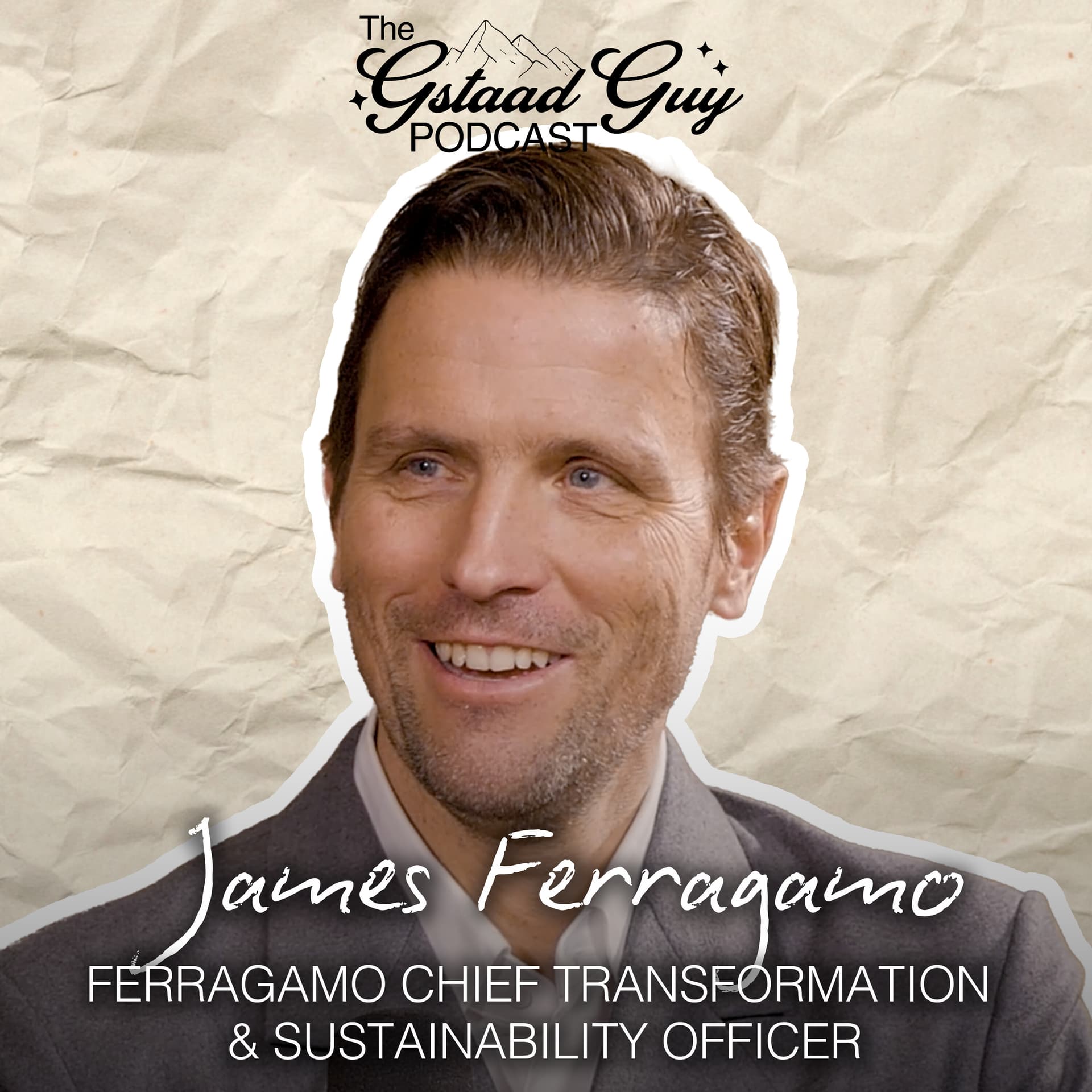
Episode Title Ferragamo Chief Transformation & Sustainability Officer: James Ferragamo – Craftsmanship, Legacy, & The Italian Way of Luxury
Episode Description In this episode, The Gstaad Guy interviews James Ferragamo, Chief Transformation & Sustainability Officer at Salvatore Ferragamo. The discussion revolves around the evolution of a century-old family business while maintaining its core values. James shares insights on craftsmanship, sustainability, and the Italian approach to luxury, highlighting the importance of collaboration, diversity, and consumer relevance.
---
Key Themes and Discussions
- Historical Context
- Palazzo Spini Feroni: A 13th-century building that houses Ferragamo's headquarters. It once served as the town hall of Florence when it was the capital of Italy.
- Founding Legacy: Salvatore Ferragamo's journey from a shoemaker in Naples to a Hollywood favorite and his wife Wanda's critical role in sustaining and growing the business post-1960.
- Company Values
- Craftsmanship and Beauty: Emphasis on the Italian tradition of high-quality craftsmanship and the beauty inherent in Ferragamo's products.
- Collaboration and Inclusion: James discusses the importance of inclusivity in decision-making and fostering a culture that embraces diverse perspectives.
- Sustainability: The brand's commitment to reducing its carbon footprint and engaging in eco-friendly practices, aligning with the Fashion Pact initiative.
- Balancing Tradition and Innovation
- Maintaining core values while adapting to changing consumer preferences and the impact of COVID-19 on lifestyle and purchasing behavior.
- Strategies for integrating sustainability within the traditional framework of luxury craftsmanship.
- Generational Dynamics
- The nuances of managing a family business across multiple generations, addressing the challenges of governance as the Ferragamo family expands.
- Importance of external leadership to guide the company while still valuing family contributions.
- Customer Engagement
- The significance of product touchpoints in enhancing customer experience and brand loyalty.
- Understanding the emotional connection customers have with Ferragamo products, illustrated through examples of iconic figures like Marilyn Monroe and Audrey Hepburn.
- The Future of Ferragamo
- Plans to celebrate the 100-year anniversary and reflect on the brand's journey since its inception.
- The ongoing pursuit of innovation while preserving the essence of the Ferragamo legacy.
---
Noteworthy Quotes
- “A business starts with a certain ideology... What is the underlining value of this brand?” - James Ferragamo
- “Sustainability linked to creativity... moments of complexity and difficulty are often the spurs of innovation.” - James Ferragamo
- "The best way to create a desire is to have an element of unexpected, appreciation, and intrigue." - James Ferragamo
---
Key Takeaways
- The essence of Ferragamo lies in its rich history and commitment to craftsmanship and quality, reflecting the Italian luxury ethos.
- Addressing current consumer needs through collaboration and innovative sustainability practices is vital for maintaining relevance.
- The role of family dynamics in governance and leadership is crucial, especially as the business evolves across generations.
---
Conclusion James Ferragamo’s insights provide a profound understanding of how Ferragamo navigates the complex landscape of luxury fashion, balancing heritage with modern demands. The episode serves as a reminder of the importance of storytelling, craftsmanship, and sustainability in building a timeless brand.
---
For more insights and updates, follow [The Gstaad Guy Podcast on Instagram](https://www.instagram.com/gstaadguypodcast).
Written by AI. May contain mistakes. Listen to the episode to check what was said.
Chapters
Tap a time to open that second in VOThe Legacy of Ferragamo
0:45 to 5:48
Discussion on the history and legacy of the Ferragamo brand.
“away so there was really a first generation of Ferragamo that that went from 1898 when he was born to 2018 when she passed away.”
Business Ideology and Values
5:48 to 8:02
Exploration of the business values and ideology of Ferragamo today.
“Well, it's really an honor to be sitting with you here today as a descendant of this whole story and a big part of this whole story.”
Sustainability and Innovation
8:02 to 11:49
Insights into how sustainability is intertwined with creativity at Ferragamo.
“You know, we always make reference to how people were before and after COVID.”
The Italian Approach to Luxury
11:49 to 14:03
Understanding the unique Italian perspective on luxury and craftsmanship.
“And also from what it sounds like, very much a representation of the Italian way of doing luxury and even more specific to Florence.”
The Italian Concept of Adaptation
14:03 to 14:40
Explore how Italy's cultural influences shape craftsmanship and design.
“In the example I was making in shoes, but it also went into ready-to-wear and in handbags.”
Staying True to Ferragamo's Legacy
14:40 to 15:11
Learn about the balance between tradition and innovation at Ferragamo.
“And so you can see how that has really changed the way of creating and providing different solutions to different needs.”
Sustainability and Innovation in Fashion
15:11 to 16:33
Discover how Ferragamo prioritizes sustainability while embracing innovation.
“But at the same time, I know there's lots of innovation happening within, lots of transformation and a big priority for sustainability, which you're very much involved in.”
The Importance of Customer-Centric Design
16:33 to 18:57
Understand how customer needs drive design decisions at Ferragamo.
“to provide them and he would say he would never put his name to a shoe that was uncomfortable because he wanted to make sure that those products were really quite unique.”
The Evolution of Men's Footwear
18:57 to 22:20
Trace the development of men's shoes and luxury craftsmanship at Ferragamo.
“So we still have control in terms of the family.”
Family Business Dynamics in Ferragamo
22:20 to 28:03
Examine the complexities and beauty of family dynamics within Ferragamo.
“But to me also, Ferragamo was an icon in men's shoes and men's products as well.”
Show all 26 chapters
Family Dynamics and Business Governance
28:03 to 29:58
Explore the complexities of family involvement in a publicly held business and strategies to ensure continuity.
“And that ability to collaborate with family members, non-family members in a very cohesive way.”
Preparing the Next Generation
29:59 to 32:49
Discuss the importance of experiential learning for the next generation in family businesses.
“I actually took an entire class in university that was called Wealth, Creation, Preservation and Destruction.”
The Essence of Luxury and Craftsmanship
32:50 to 36:04
Delve into the philosophy of luxury and the intricate craftsmanship behind luxury products.
“there is a concept of how is the governance in bringing this forward.”
Ferragamo's Expanding Universe
36:05 to 40:04
Learn about Ferragamo's diversification into hospitality and sustainable practices.
“I've had the pleasure of staying at the Portrait Hotel in Milan and also the Il Borro Hotel in Tuscany.”
Values and Heritage in Business
40:05 to 42:00
Examine the values of family heritage and their influence on business and personal life.
“My father would always say, you know, there are three things that were important for my grandmother.”
Balancing Family Values and Work Ethics
42:00 to 45:20
Discover how James Ferragamo manages time between his family and work commitments.
“and because it was also transcended in previous generation.”
Avoiding the Pitfalls of Screen Time
45:20 to 47:20
Learn about the dangers of mislabeling screen time as productive and its impact on efficiency.
“Like the main time wasting for me, and maybe I speak on behalf of the generation or maybe just on behalf of myself, but the main time wasting slippage is happening on a screen for me, for sure.”
The Importance of Problem-Solving Frameworks
47:20 to 51:00
Explore the significance of structured problem-solving in both personal and professional life.
“to a problem that was impossible to achieve.”
Adapting Governance in a Growing Family Business
51:00 to 53:40
Understand the challenges of managing a family business as it grows across generations.
“I think that when you're working in a brand, in a family business, in a publicly held company, in any dimension, there is a problem with a solution.”
Sustainable Practices in Luxury Fashion
53:40 to 57:51
Gain insight into the Caring Fashion Pact and its objectives for sustainability in luxury fashion.
“So there isn't any conflict of, indirect conflict of...”
The Impact of Product Experience
57:51 to 59:59
Explore how product touchpoints and fashion shows enhance consumer engagement.
“So having that exclusivity is something that works really well.”
Craftsmanship and Legacy of Ferragamo
59:59 to 1:01:48
Delve into the rich history and craftsmanship behind the Ferragamo brand.
“So it's also like you're kind of lending those values and that power to anyone who participates in the story or in the products in this Ferragamo universe.”
Understanding the Customer's Why
1:01:48 to 1:04:19
Discuss the importance of understanding customer motivations and brand differentiation.
“is the why as well as the what and how Ferragamo stands out at a brand level among all the other beautiful brands that exist around the world but also in Italy.”
The Game of À la Poubelle vs. Fantastique
1:04:19 to 1:07:15
Engage in a discussion about changes desired in the fashion industry and what to celebrate.
“and understand what is your community and what aggregates people around that why and an appreciation of what you're doing that is unique.”
Messages of Change and Sustainability
1:07:15 to 1:08:56
Learn about the importance of collaboration and sustainable practices in fashion.
“would be much, much appreciated, but also avoid having that stereotypical approach for sure.”
Reflections on Craftsmanship and Gratitude
1:10:00 to 1:10:34
The speaker expresses gratitude for the opportunity to engage with history and craftsmanship.
“Well, I share that same gratitude and beyond.”
Transcript
Automatic transcript. May contain errors.0:00The Gstaad Guy:So is this a typical Tuesday for you? Well, it's Wednesday, but yes, it's a typical... It is Wednesday. You're right. Oh my God, it's Wednesday. The week has flown by. No, it's crazy.
0:13James Ferragamo:I was actually in Davos. I came back last night. Oh, no way. And we went there to see also in terms of marketing and communication, if there was any partnership. And then also with Sally Zellis, I don't know if you know her from the Female Quotient. so we participate in many different things in terms of diversity and inclusion and Ferragamo is all about that you know especially because our founder was Salvatore and then became Wanda and because of their age difference she really guided the company until 2018 when she passed away so there was really a first generation of Ferragamo that that went from 1898 when he was born to 2018 when she passed away.
0:59The Gstaad Guy:Wow.
0:59James Ferragamo:He passed away in 1960, so quite early at the age of 62. But she was 37 at the time, and she sat in his office at the end of this hallway and said, I'm going to make it work. Not even, you know, considering also she had the kids, one of them was my father, which was from between the age of two and 17. so unheard of but she was really she had no sense of not having this as something that she could not achieve, definitely would not accept that as a consequence, extremely determined
1:38The Gstaad Guy:Around the World with your host the Stade Guy, we welcome you back to the Stade Guy podcast sharing stories of excellence with those in the know for those who just know Well, I know you briefly mentioned the hallways here. For those just listening today and not watching, I urge you to at least take a sneak peek at the video portion of this podcast because the room that we're in is absolutely spectacular. It's just a small glimpse of the building that we're in. I've actually never been to an office anywhere close to this beautiful in my life. This is actually beyond the museum or a beautiful home.
2:21The Gstaad Guy:Can you tell us more about the room we're sitting in and the building we're in?
2:25James Ferragamo:So this is Palazzo Spini Ferroni. It's a building that was created in the 13th century. The Spini Ferroni family were also involved also with the Vatican. I believe there were collectors for the church in terms of tax collectors. And so the building has gone through. has changed many different owners in the different years. When Florence was the capital about 160 years ago, capital of Italy, this was the town hall. And then my grandfather, having nothing to lose, being somebody who was born near Naples in a small town on the Irpinia mountains, one of 14 living off 10 acres of land, believed that he was a shoemaker in a past life.
3:19James Ferragamo:He actually writes this in his autobiography. And for him, making shoes was natural, and that's what he wanted to do. He was one of those lucky ones, you know, the ones that don't really go to school, but they already know what they want to do. He actually made his first pair of shoes at the age of nine. And he decided to go to Hollywood. He started making his first shoes in Hollywood. And then after that, because the man grew strong and most of his celebrity were wearing the shoes on scene, but then he also was selling them the shoes off the scene. He decided to come back to Italy and he chose Florence because Florence had that what he was looking for, which was that collaboration, that possibility of working with artisans.
4:00James Ferragamo:And so why not work in a place like this, a 13th century building? And so, you know, my grandmother always thought that this was an incredible risk that he took. But, you know, you take incredible risk when you have nothing to lose. And that's exactly what he had. You know, he had nothing to lose. He actually did go bankrupt several times, twice actually, not several times. But he always came back and he was relentless in terms of pursuing his dream. and unfortunately he passed away very early at the age of 62 but my grandmother which was 37 sat in his office and said we're going to make this work and she did she transformed a company which creative juice had just disappeared into a brand with the responsibility of also bringing up six children and of which one was my father and very clever also managing to understand the family dynamics you know sometimes when you're in a family you step on each other's toes and your approach is very family and so sometimes it's not as professional so she wanted to ensure that they all had the business in their own right and she organized it as they all became of age who was responsible of the product, the three daughters, one on leather, one on ready-to-wear, one on silk, and three sons on the market, one in Asia, one in Europe, and one in the U.S.
5:32James Ferragamo:And they worked as a matrix. They wanted to make sure who was in the U.S. was selling all three product categories and who was on one product category was selling in three regions. So they're all business owners in their own right within Salvatore Ferragamo. And that's how the brand then started.
5:48The Gstaad Guy:That's amazing. Well, it's really an honor to be sitting with you here today as a descendant of this whole story and a big part of this whole story. Giacomo, James, Ferragamo. We'll go by James today, which I know you do go by. You are half English as well. And you have lived in the UK as well as Florence, as well as the US. So you've seen, from what it sounds like, a lot of the different moments of the Ferragamo story, even within your own life, by spending time in the US. spending time in Florence now. Is the business today, in your opinion, a representation of what it means to be a business from Florence?
6:32James Ferragamo:You know, I think that a business starts with a certain ideology. And, you know, when you look at Ferragamo, you have this amazing creativity, you know, the examples of the shoes that we even have on this floor show you that amazing creativity of someone.
6:51The Gstaad Guy:I don't know, I cannot ever stop saying that.
6:54James Ferragamo:I mean, it's 14 ,000 pairs of shoes in our archive. I mean, Maximilian Davis, our creative director, gets lost in there quite often because it's so much ideas that come to life. And so when you have a brand that has pivoted in the second generation to really become a brand rather than a creative brand founded only on shoes, you search for that ideology of the brand. And you say, okay, what is the underlining value of this brand? And so it's definitely the heritage that he left, that creativity, that concept of craftsmanship, that concept of collaboration and making products that are unique. And so today Maximilian finds himself as the creative director, but everyone who works with him to try and maintain those values as non-modifiable, cannot be modified, non-negotiable, let's say.
7:50James Ferragamo:But at the same time, everything changes. You know, you have to find a way to say, where is the customer? What is he doing? What is she doing? How do we serve them in a different way? What is their lifestyle changed? You know, we always make reference to how people were before and after COVID. And it's true, you know, that life has changed completely. the way you interact with them is completely different. I don't think we would have had a podcast before COVID. Even that has spurred in a completely different direction.
8:21The Gstaad Guy:You briefly mentioned values, which is a topic I love to discuss. And from what you've said, both before we turned the cameras on and now, it sounds like those same values are still absolutely true to the business's DNA and what Ferigamo is today. Can you help me define those values?
8:40James Ferragamo:The biggest value, I would say, is that collaboration, that capability of being inclusive, having that inclusive approach, which is something that we cherish a lot. We find that making a decision has a moment of interaction, a moment of, we call it, you know, buy-in, which essentially means, you know, having a possibility and an opportunity to voice your opinion in a wider group. So, of course, you know, we're an Italian organization, so it was never really that perfect. It's always that spontaneity, that element of non-planned. But it's also its strength. It's also its ability to do things in a way that you do have different points of view that otherwise would not come into play.
9:31James Ferragamo:And so the value of being able to have that collaboration is essential in everything that we do. And so we have an amazing ability to put that to work in our creativity in a way of providing a clear message to our customer and understanding how do we create a product that transcends that value to the final customer. So the product that we make today is 100 % made in Italy, which has been with just two exceptions, which one are the watches, which of course are made in Switzerland. And then we have a couple of Espadrille, which we'll leave that to the Spanish, which know how to make them better than the Italians.
10:14James Ferragamo:But the rest is all made in Italy. And because we think that the product that we offer has to have that element of quality and also that ability to narrate that bella vita, which is that concept of the Italians that I really always appreciate and always are in search of things which are beautiful, as we see here in a town like Florence that reminisces the previous Renaissance moments. And so it's always a question of pushing the boundaries of innovation that provides that. Another element is, of course, sustainability. And sustainability linked to creativity. Our founder, Salvatore, was in difficult situations.
11:02James Ferragamo:He found himself during the Second World War where he would not find leather to make the shoes or metal, which was necessary to support the shank of the arch. So he created a shoe made out of cork. So there was a wedge made out of cork. And that was the most light shoe you could ever purchase. He used a sweet wrapping paper that he was able to melt and create an amazing weave of multicolor on the shoe. And all his creations and creativity were spurred by moments of complexity and difficulty. And we cherish that. I think that that's always a lesson. It's always an underlining line that in moments of difficulty, you have that silver lining that provides you the challenge and the capability of thinking in a different way.
11:48The Gstaad Guy:And I love that all of you discussed and all these values are so natural to the DNA of the business. And also from what it sounds like, very much a representation of the Italian way of doing luxury and even more specific to Florence. I'd love to actually paint a picture of what that looks like you did say that there's this Italian love for beautiful things and many cultures love beautiful things like even next door in France but historically I think the Italian way of doing things and the Italian priorities while creating beautiful things are inherently different to the neighboring countries and even different in Florence to other parts of Italy.
12:39The Gstaad Guy:What do you think is unique to the way that artisans in Florence do things and in this part of Italy and even Italy in particular?
12:52James Ferragamo:Well, first of all, you start with geography. So you look at a country which goes from north to south and it's a peninsula, so it's surrounded by water. So just the eco environment that you live in provides you with an amazing change of scenery, true four-season climate, and a concept also of a country which was extremely divided. It was very much divided into different provinces. And that created different needs and different ways of really having the Marchese of the specific area that had some specific abilities or requirements that came from completely different businesses. One example, for example, is also the binding of the books in the Uffizi.
13:53James Ferragamo:And the craft that was in creating those books and those bindings was used by my grandfather in making shoes. So you could adapt that ability of savoir faire in many different creations. In the example I was making in shoes, but it also went into ready-to-wear and in handbags. So that concept of evolution and change, I think, is very synonymous with Italy. And so it's a concept of adaptation, I would say, and a concept also of having a lot of influences as a country from the north, from the south, neighboring countries, of course. And so you can see how that has really changed the way of creating and providing different solutions to different needs.
14:51The Gstaad Guy:it feels today that although the needs are ever-changing and the demands of consumers are ever-changing, the brand, the family, and all participants of the ecosystem have stayed true to what Ferragamo is and always was. And I feel that while being here today. But at the same time, I know there's lots of innovation happening within, lots of transformation and a big priority for sustainability, which you're very much involved in. I'd love to know how you balance the respect and commitment to tradition with that commitment to innovation that you prioritize, particularly in the categories of sustainability while growing.
15:45James Ferragamo:Well, first of all, I would say in terms of a brand, you come up with a definition of what are those value. You define what is the ideology of the brand and you define how to maintain those always relevant in the brand. Then you confront the customer and understand where is the customer going. and you know it's quite incredible if you read the preface of the book written by my grandfather he writes that he dedicated his life to feet not to shoes because for him it was important that those feet which were clients customers they would shine they would find everything that he was able to provide them and he would say he would never put his name to a shoe that was uncomfortable because he wanted to make sure that those products were really quite unique.
16:43James Ferragamo:And so I think that bringing this to today's world, you have a younger generation which I think in some ways needs to be reintroduced to fashion, to luxury. Maybe there's been a lot of interest and a lot of focus on the high net worth And I think it's a concept that needs to be definitely cherished. But at the same time, there needs to be a concept of inclusion. And in a way, a brand is not complete if it's not able to be of relevance to all ages. And so in Ferragamo with Maximilian Davis, our creative director, we really try to make sure that having somebody as young as him as our creative director, we make sure that we are always pushing those boundaries of innovation and creation.
17:32James Ferragamo:And in first place, a concept of sustainability. So sustainability for us means reducing our carbon footprint. And we are part of the fashion pact spirit by the Kering Group. And we're one of 250 different companies that are on that and have made a commitment to net zero by 2050 and are well on to achieving that objective. finding ways of providing innovations in materials and collaborating also with other working groups in finding our suppliers to be less impactful into the environment and having more low climate emitting material in the phases of production. finding ways of also talking about a subject which is quite important at the moment which is compliance of the supply chain and so how do we make things which are done in the correct way how do we empower humans within our organization and and foster that concept of diversity equity and inclusion and belonging to a brand like Ferragamo and to our objective to really do always better with our customers.
18:41James Ferragamo:And of course, our social objectives that we bring forward every year. So those are essentially our pillars that we are currently pushing and trying to bring forward. And we are even a publicly held company since 2011. So we still have control in terms of the family. But this is giving us, in terms of sustainability, also a need to adhere to certain requirements that as a publicly held company, we make sure that we try to do the best. And so as a part of the S &P 500 Sustainability Index, we're also ranked extremely high on that, which was also held by the fact that the market has helped in giving us some guidelines on how to ensure that we're actually achieving those objectives.
19:30The Gstaad Guy:When talking about the priority for feet in the first page of the memoir, the comfort, I think, is definitely a part of the story there. But I think also the feeling that comes with putting on a beautiful pair of shoes is also a big part of the story. And a big part of the early story with dressing people in Hollywood. and a Marilyn Monroe was a very proud wearer of the shoe, for example. What do you think it does to a person and to an outfit to buy a beautiful pair of shoes and to wear something beautiful on one's feet, aside from the comfort, of course?
20:18James Ferragamo:It really depends on the customer. If you take two examples, you take Marilyn Monroe and Audrey Hepburn. okay so Melanie want to be sexy so he was able to make a heel which was slightly had a heel counter slightly higher than the other so she would have that wiggle that she liked to to have and so and that concept of creativity making a shoe with uh all the Swarovski crystals on top that she bought in two colors and use one of them to sing happy birthday to the president for example was because she wanted to have a shoe like that. She wanted to have something which was really quite unique. On the other side, you had Audrey Hepburn.
21:00James Ferragamo:And Audrey was a ballet. She liked to do ballet. She was fairly tall and so wanted to have a shoe which was flat. And he was able to work with the artisan to mold leather in a way that it would create a shell. And onto that shell create the shoe within that resembled the concept of a day shoe as a ballet shoe as a ballerina. And so it really represents the customer always at the center. And if I were to say what is our objective, it's really to be able to give value to our customer. And the value is by giving them something that stands the test of time. And it's always working on that balance.
21:40James Ferragamo:Is it innovative enough? Because it needs to be innovative. You cannot have a product that is always the same. A customer gets bored quite quickly. But at the same time, it needs to test the time. and make sure that she can wear it season after season. And that's why she can have it as a value because it is something that she can transcend. And Ferragamo, you know, to be honest, we always talk about Ferragamo and wherever we talk about Ferragamo, they will say, oh, you know, my mother and my grandmother, they wear Ferragamo. So there's a sense of family and a sense of appreciation in terms of that concept of Ferragamo.
22:19The Gstaad Guy:We spoke about the female icons, the grandmother and the mother. But to me also, Ferragamo was an icon in men's shoes and men's products as well. When did that introduction happen to the story?
22:34James Ferragamo:So the men's shoes actually started later on. Salvatore had a couple of shoes that he created for himself, but was much more focused onto the women's shoes. He had created some shoes for some of the movies in Hollywood. But really the collection started also with Leonardo, our chairman, and he started developing the men's division. And the concept of the men's shoes starts at the top with the concept of true artisanship with the tramezza, which is a double-welted men's shoe, really focused very much on that concept of quality and savoir faire of a shoe that is still today almost all handmade and hand-tanned because you start with a neutral leather that then is colored seven times to give that.
23:21James Ferragamo:All the way down to drivers and even sneakers and different, so a full wardrobe of shoes. So we go from true artisanship to more casual, to dress shoes, so all the different needs that a man might have in his wardrobe.
23:39The Gstaad Guy:I love the shoe you're wearing today, which looks like just one piece of leather. It is.
23:43James Ferragamo:This is actually a tramezza. that we actually just launched this project with Alberto Tomba during the Milan Fashion Week last week. And this is a, yeah, it's a shoe. It's all made by one piece, just one seam at the back. And it's called Angiolo. We give, every shoe has a name. And it's fantastic. It's my sneaker, actually, with them every day. Yeah, it's beautiful. It's like an Aston Martin, just one piece.
24:09The Gstaad Guy:You can't even count the partitions between pieces. It's just one molded piece.
24:15James Ferragamo:Yeah, yeah, yeah.
Read the full transcript
24:16The Gstaad Guy:No, no, they're wonderful. So would you consider, although it is a very large business and it is publicly traded, would you personally think of Ferragamo as a family business?
24:28James Ferragamo:I think so. By definition, I think you can ask anybody and they will say that it is a family business at heart and the passion that is driven, that drives us all. And I would say actually it drives us when we say family, We don't just mean the Ferragamo family, but the family of the people that are within Ferragamo. And the standoff, there's that concept of passion. So it's a passion that transcends within the organization, ensuring that there is always that, those elements that you try to do well if you are a family. So you have respect, you have a certain ethic approach in terms of the way you collaborate as you do also in a family within the organization.
25:16James Ferragamo:So those values, which I would say are values that starts with my grandmother. She was the first one to really have that. But she clearly says that in 1960, if she didn't have some key collaborators, she would have not been able to bring Ferragamo forward after the loss of her husband. And so this is something that for Ferragamo, it's definitely an element that comes natural. It's an element that we understand that is the only way to continue in our pursuit of making Ferragamo brand that is a proposition for the future generations.
25:57The Gstaad Guy:I'm not involved in a family business, but I have friends who are, and I observe the difficulty in those dynamics. There's lots of beauty, lots that can be celebrated, but undeniably lots of challenges. And you said with your grandmother, the key collaborators were a huge part. And I think key collaborators that one is not related to can be sourced, can be invited to join a journey. But when we're talking about people that are related to someone, it's kind of hoping that they are a key collaborator and that the pool of people to choose from is far smaller. So I wonder within the household and your personal experience, did you happen to grow into the role of the key collaborator that you are for all of your colleagues and for Ferragamo?
26:46The Gstaad Guy:Or is it something that your family may have helped guide you into?
26:52James Ferragamo:I would say it's a very good question. I think it's always a combination of the two. You know, I think that my family helped a lot. They were guiding in the different opportunities within my career. It's almost 30 years that I've been in Ferragamo. So at the beginning, I really didn't know what I was doing. I came with some experience, having worked at Saxith Avenue, having had a small moment also in banking at Goldman. But when I arrived, I really didn't have a destination, a clear destination of what was my objective. And I changed many different roles within the organization. And I've had setbacks.
27:36James Ferragamo:I've had moments of more responsibilities. I was actually with the previous CEO given a responsibility more strategy and sustainability. So more away from the business, which was a great opportunity to learn so much more about sustainability. So I think in businesses, you have always that opportunity to learn also in different ways. And I think as a family, we cherish that opportunity of really having those different experiences. And that ability to collaborate with family members, non-family members in a very cohesive way. The fact also that we're a publicly held company has given us as a family directive to have an external CEO.
28:31James Ferragamo:And so since 2006, we've had an external CEO managing the company. But when the family is not involved, I think it's when the CEO finds that he doesn't have that contribution. And so it's always a question of making sure that you have that correct contribution and that correct balance between family and non-family members. Then, you know, it's different when you start with one and then it becomes two with Wanda, then it becomes six with my father and his brothers and sisters, and 23 with me and my cousins, where at the moment we are of our cousins, I think we would probably count between three and four that have a role within Ferragamo, and we have 40 kids.
29:16James Ferragamo:So, you know, it's a completely different concept when you think about 40.
29:23The Gstaad Guy:Asan, forgive my bad math how many generations are we now? So I'm third You're the third generation Third generation, yes I always joke about this
29:33James Ferragamo:because third generation have very bad statistics in terms of business continuity Second generation was very much aware of this and so they wanted to find a solution to avoid the statistics and so we decided to go public diversify and find ways to also have the right governance to ensure that we wouldn't be part of that bad statistics.
29:59The Gstaad Guy:I actually took an entire class in university that was called Wealth, Creation, Preservation and Destruction. But literally about generation three of family businesses. But I'm very happy to see that wasn't the case.
30:12James Ferragamo:Yeah, we're still there. We're independent. We're trying to bring Ferragamo forward to the future generation. and it always changes. You know, it's different when you have six that you have to put together, when you have 23, when you have 40 that have to manage the governance changes. So you also have to adapt the governance of family businesses, which is not any more manageable. Even in terms of size, it's difficult to put 40 people in a room with everybody's agenda, which might not collide. Absolutely.
30:47The Gstaad Guy:Are there any Generation 4 family members of the business yet?
30:51James Ferragamo:No, none, actually. No, I would say at the moment, no, we have different. And also, in terms of family, we're making sure that the fourth generation has that possibility, like we did also with the third generation, to work in other companies. Absolutely. And actually, my daughter is working at another brand, and I suggest that she stays out there for at least 10 years. So that she's, you know, she creates her CV, and she can also be, I mean, maybe it's not a very sexy way of saying it, but a commodity. So if she doesn't like Ferragama, she can always go and work somewhere else. And you never know, you know, with a company which is evolving, and she might not find the fit, but she has built a 10-year of CV before making any trials.
31:39The Gstaad Guy:My friends who have family businesses that they're a part of or that they run have said that less eloquently in a slightly different way where they also say, we'd like our kids to make mistakes on someone else's dime. And then they can join the family
31:55James Ferragamo:once they've learned from those mistakes. True.
31:57The Gstaad Guy:Which is also a strategy. It's also a strategy. So I know you have three beautiful kids who are likely listening today. Do you personally hope that they, at some point, find a home in the family business?
32:09James Ferragamo:Well, yes, I think somebody has to be here tomorrow. I think there has to be somebody that brings forward and is able to do better than what we're doing today. And that's the direction that we always have to bring. So, absolutely. Of course, their objective is to find something that they like and they aspire to. My son loves banking and he wants to be a trader. and my daughter actually wants, the other daughter wants to be a model. She's 16. She doesn't really understand what she really wants to do. So things evolve, but I really hope that they understand what is the value that has to be managed in the future and how to still be close to something which at the end, beside their work preference, there is a concept of how is the governance in bringing this forward.
32:57The Gstaad Guy:Absolutely. I think with a luxury business, there's this internal dialogue that people involved in luxury businesses go through about the meaning of what they're doing because a luxury by definition is is unnecessary but nevertheless beautiful particularly when you have so many emotions tied to something heritage beautiful story and so many people involved with a craft but i think the fact that something is a luxury is always a constant that's that's kind of undeniable so i'd love to know how you feel about taking what you do so seriously but at the same time juggling the awareness that a luxury is
33:43James Ferragamo:indeed a luxury a luxury has to be something which at the end creates that desire so luxury is correlated to a want. And how do you create the want? You have to have an element of unexpected, an element of appreciation, an element of intrigue. So all of those are synonymous with driving that ability of providing that desire for something. And so it's a concept of exclusivity. It's very much linked also to that possibility of creating scarcity, not artificial, but scarcity because of reality, meaning that if you are to produce a tramezza shoe like the ones I'm wearing, it's not easy to make. It's something that has 160 different phases in the production of that shoe.
34:43James Ferragamo:Some of these products really require a certain attention to all of those details. And so you want to create that want but at the same time that want comes with the specific ingredients which is unique for every brand and so I believe every brand has its own space every brand has its own reason of being and that has to be consistent while you innovate but you have to have that philosophy, ideology belief of where you're going always at the center of what you're doing. And I remember some time ago, we had Karl Lagerfeld that came to Florence and he gave a speech during a seminar and he was saying, you know, you have to adapt to times.
35:35James Ferragamo:Times don't necessarily adapt to you. And I think it's very true. But at the same time, he was working in a brand where he was extremely consistent in providing innovation. And I think that that's always true for every brand.
35:51The Gstaad Guy:I like that. You must adapt to times because times can't adapt to you. Right. Makes a lot of sense.
35:56James Ferragamo:Don't necessarily have to adapt to you.
35:58The Gstaad Guy:Don't necessarily. But at all, but at all. I see that today Ferigamo has expanded far beyond shoemaking and the different projects that both the business and the family are involved in to grow beyond the shoemaking are also beautiful. I've had the pleasure of staying at the Portrait Hotel in Milan and also the Il Borro Hotel in Tuscany. And that's just a small glimpse of the Ferragamo universe that exists today. Can you help paint a picture of what that universe looks like now?
36:40James Ferragamo:So I would say that that goes back to the arte del bello. I think it's part of that family appreciation that starts at a very young age. That appreciation of what is beautiful is something you learn at a very early age. It's all around you. So even in the building that we are here, it has that element of beauty with craftsmanship, with some of the things that you see, even this table next to us. It's a special artisan that is able to combine different colors of wood to make a circular construction. So it's that. It's really that concept of having beautiful things. And so my father created this Il Borro concept, which is a place he liked to go hunting.
37:32James Ferragamo:And then from there, it became a production of wine. and from a production of wine also into Réle Château as a hospitality with different restaurants that is also developed in different countries. And so it's a unique product. It's a product of giving time, giving time to our clients that go there that can appreciate all of those elements from fine dining, from horseback riding, from amazing walks in the countryside, in a unique countryside, which the backdrop also was painted in the Mona Lisa by Leonardo da Vinci. So you see the different changing of the season, as we were saying before, and how the entire landscape goes from a vibrant green to covered in snow or to a full summer and so forth, or the falling of the leaves and other amazing moments of the year.
38:36James Ferragamo:And that focus in terms of sustainability also is present there in making everything sustainable. So all of the wine production is done completely sustainable with no use of any pesticides. And some of the fields are actually plowed still by hand with the use of cattle. Then we have the portrait, which is a diversification that we started at the end of the 90s. And we wanted to find a way to diversify in the hospitality. So we started in Florence, and then we expanded to Rome and recently also in Milan. We managed to convince the church to lend us property, which was the second largest monastery in Europe, and made that into a hotel.
39:27James Ferragamo:Well, it took us a little bit of time to convince them. I think it took them about nine years to convince them and build it. But the space is really quite incredible in the center of the fashion district of Milan, having that as something which is really recognized as attention to details, doing something which is really unique and that focus towards the attention towards the customer, but also in an environment which also shows that quality is done in small details in every different things that you see at the portrait. That's really exceptional.
40:03The Gstaad Guy:It's one of the anecdotes that you, I think, left out of the description of the space we're in today and of Ferragam was also the comfort element and the coziness, which maybe can't be seen on camera today because it all looks like a museum but you do get this very homey feeling as well and I think there's this beautiful coziness and hominess to the brand and to these properties so I think maybe that's the family touch that seems natural to you but something that absolutely goes noticed to a customer like me where it really feels like your entering the home in all elements.
40:47James Ferragamo:Right. My father would always say, you know, there are three things that were important for my grandmother. One was the family. The second was the homes. And the third was the business. And she basically, you know, dedicated her life to those three elements. And then it shows, you know, it shows the concept of family that we were saying, the concept of our way of creating the homes and the business, which of course is something which we are striving to always do better. Are those things that are shared by all parties involved today,
41:22The Gstaad Guy:do you think that's something that can be taught or is that something that's just from within? I think it can be taught.
41:29James Ferragamo:I think it starts within. I think it starts with what you inherit and what you inherit, not in terms of inheritance, but how you inherit in terms of DNA. I think your DNA is also inherent in terms of what do you more gravitate to. And so I think that concept of having things which are beautiful is something that you are born in that desire and because it was also transcended in previous generation. but also you learn it as you shape yourself every year and understand what you like more and what you like less. Are there certain things that you make sure exist in the company
42:21The Gstaad Guy:as well as your household as a father? Because I know you do play both these roles and it sounds like there's lots of values shared but I'm curious about what priorities also exist for you in the household as well as at work
42:38James Ferragamo:so you know with uh with my wife she's danish so we are three kids are actually uh so half danish a quarter italian and a quarter english at this point are we always trying to say you know what's important is that you know how to use your time and so I drive my kids crazy so I say you know what's seven times 24 is like why seven times 24 hours seven days you know enough i don't want to hear this anymore so i told him you know you have to dedicate your time in a way that you can generate time i said you know i like to work a lot i put a lot of passion into it so i have uh 12 hours usually so times five that's 60 sleep cannot go without sleep it's important so let's put another a 60, rounding it up from 56, seven times eight.
43:24James Ferragamo:And then you still have, what is that? You know, you had 120. So to 168, you have 48 hours. How do you create those 48 hours to do what you like? And part of that is also family. And so I like to do sports. I do triathlons and everything. And so I slot that very early in the morning where I know everybody else is sleeping, but I wouldn't dare come home and go running because I know that wouldn't work with my wife and my kids because, when they're at home, I like to see them and be together with them. So it's really managing your time in the most effective way possible so that you're not wasting it.
44:01The Gstaad Guy:And that's something that you love to teach your kids.
44:05James Ferragamo:Yeah, I like to teach them because I think that if they get that concept of consistency and concept of understanding how to cherish their time, they can always do better. And, you know, also I think that, you know, in a certain way you have kids, but they don't replicate you. They come with their own built-in ideas of where they want to go. And often that's the great thing because you have somebody that is being developed in a completely different way than you are. and what's important is that then they find ways to dedicate their time to that and so when i find them you know that sometimes they're wasting time or doing too much uh social media or or not using the time in a way that is educational then they're you know wasting it and so waste is something that that happens and sometimes you do want to have the downtime this is important but not too much of it
45:07The Gstaad Guy:I think I understand your kids because I am in a position where the routine that you talk about sounds ideal and amazing. And I think the trouble I go through sometimes is I mislabel wasted time as productive when it's on the screen. Like the main time wasting for me, and maybe I speak on behalf of the generation or maybe just on behalf of myself, but the main time wasting slippage is happening on a screen for me, for sure. And the difficult part, I think, is when you justify bad behavior on the screen of social media or of checking on this thing or even messaging apps or emails as productive when actually it's a distraction from the bigger picture.
45:59The Gstaad Guy:Right. So I love that awareness you have of actually quantifying and budgeting the hours. I think that would make, looking back, would make a much more productive week for me. Because for me, I kind of have a high level of like, oh, I'd like to do this, I'd like to do that. And I end up probably doubling my screen time than it can be and more importantly should be. Yeah.
46:24James Ferragamo:I was actually talking to my brother's son and he's an amazing musician. And he would practice on his piano and his guitar like 16 hours a day. And I was like, Massimo, you need to let go. You need to find a way that you can go for a walk, for anything, you know, play chess, whatever you want to do. but at one point you're going to hit your diminishing returns and so how do you find the way that so you mix it up and and he actually listened to me and he actually found that that was extremely useful so he was able to do other things but then when he went back to it he was extremely more productive i'm sure you everybody has that you know sometimes you get stuck on a problem and it feels like you're struggling through mud that to just get through it and unfortunately the solution is to stop and get back to it a second later.
47:19James Ferragamo:And you find most of the time a fast solution to a problem that was impossible to achieve. So it's that. It's really a sense of understanding how can you be more effective and better use of your time.
47:34The Gstaad Guy:Do you have a framework for problem solving that you apply often, both in your personal life, but also at work?
47:43James Ferragamo:yeah well i i learned a lot in the in this last uh period you know i was very much about let's make a decision let's proceed and nothing happens like that it's not it's not how you achieve things i think it's first of all is understanding where you want to go and then creating a process um that i must say i learned a lot from my father to really create a certain cadence in ensuring its execution. So saying what you want to do is nothing. It's really, maybe it's one from one to 10 is one, but then reaching 10 requires that cadence. And often it changes. So you might not even reach your final objective, but it's not really about the final objective.
48:41James Ferragamo:It's really about creating that journey where you have the right involvement, you have the right collaboration, you have the right cadence in terms of ensuring that there is measurable achievement, small measurable achievements that are brought forward. And that can only be done when you have all the stakeholders involved. The worst is when you try to do something and then you go to somebody which has to execute and they're like, well, I'm not going to do because nobody asked me about it. And while it might feel a little bit childish, and it might be, at the same time, it's something you could have avoided if you had had the chance of actually having that conversation in a moment where you also agree to disagree, but then you commit.
49:26James Ferragamo:But that agree to disagree is paramount in phase one, let's say. whenever actioning things in a big company
49:35The Gstaad Guy:and with lots of stakeholders involved, convincing is often a part of most processes where you need to onboard people on your thought process and your decision-making. How do you onboard people on a new and even contrarian thought that you might have where you need lots of people's buy-in to actually make that thing work?
50:01James Ferragamo:Start small. Start with saying let's have a proof of concept. Let's try something which is just for one region. So it's really a question of lead also by one micro example. Today, in the age of AI, we were able to do a client-telling app that was able to bring a transformational approach in terms of providing the content to our final clients in the best way possible. That was done with the US. We couldn't have done it globally. It would have been too difficult to execute and probably too difficult to have everybody aligned on those objectives. so sometimes it's better to start with something a little bit smaller and then finding from there
50:47The Gstaad Guy:a way to to expand that scale so with a business this size that's constantly evolving and growing across products categories but also with headcount i mean the the size of the the teams have grown massively the number of family members involved has grown massively I'd love to understand how you develop something like governance for this business and how you adapt and grow with such different team sizes involved in so many of the processes and decision making.
51:26James Ferragamo:No, it's a very good question. I think that when you're working in a brand, in a family business, in a publicly held company, in any dimension, there is a problem with a solution. that a solution is always temporary. That solution, because of the dimensions of the business that in our case, for example, started with Salvatore, then it was taken forward by Wanda and her six kids, so second generation. Us from the third generation, 23 of us, us 23 that have 40 kids. It's not the same governance. You cannot use the governance rules that you had for the 6 towards the 23 and the 23 going towards 40.
52:20James Ferragamo:And of the 40, the oldest, I think, is something in the, I would say, probably late 40s. But the average age is already in the 20s. Oh, wow. And so you have the 20s in the fourth generation. You have between the 40s and the 50s in the third generation. and let's average around the 70 in the second generation. And so you need to, you know, and unfortunately we, you know, parents unfortunately are not some parents of the second generation are not with us anymore, so you have to adapt. And so governance has to adapt. And so how you manage a company and how do you manage interest has to adapt. It should never be forced to be part of a family business.
53:06James Ferragamo:You are part of the family, but the business is a business. And so you need to be able to find ways to adapt as the family, I would say, changes in size. In our cases, it keeps on being exponential. In other cases, it might not be like that. But you need to then understand what is the right approach in terms of managing it.
53:29The Gstaad Guy:Are there any family members that have intermarried with other luxury businesses?
53:36James Ferragamo:No, no, not coming off the top of my head at the moment, no. So there isn't any conflict of, indirect conflict of... There's no mergers happening. Not indirect mergers.
53:49The Gstaad Guy:We are keeping our independence. Okay, fine. Can you tell me more about the Caring Fashion Pact that you're a part of?
53:57James Ferragamo:Well, Caring is essentially, it started a fashion pact, which is a pact that was started to ensure that the luxury industry in general, and so part of the fashion pact is Chanel, Old Kering, Intertex, and many different other brands around Florida are part of this to sign on a specific objective. So one of the first objectives was actually founded in 2019 was to reduce carbon emission by 42 % by 2029. And so we've already achieved that objective. Many others have and found solution on the science-based target, which means what is your direct emission by what you actually produce in terms of having the lights on.
54:52James Ferragamo:Second is actually what you buy in terms of, or yeah, the first one is really in terms of what is the heat or emission you make in producing a product. The other one is the electrical grid, what you buy, and are you buying it from sustainable sources? We are 100 % sustainable sources. And the third is your third party. So when you produce, are you producing directly or indirectly? So if it's directly, it's first. Indirectly, it's the third. So our tanneries that produce for us have to be sustainable. Our production of the finished product of all 18 product categories has to be sustainable. And so we work together with the fashion pack to ensure that everything that we do is supported by them in terms of what are some solutions.
55:40James Ferragamo:And these solutions actually create a highway where if Caring is behind it, then Chanel is behind it. We that are of a smaller size are also finding a road that has already been paved. And so we can easily go to the same tanneries, for example, that are already adhering to certain regulation that we also want to ensure that when we buy products, they're controlling the water usage, They're using chemicals that are not harmful for the environment and so forth. And so we're working as a group to ensure that what we are doing is not having an impact on the environment. And actually we are finding ways to be really cautious in terms of what's happening in terms of global warming and finding ways to reduce that.
56:28The Gstaad Guy:There's so many touch points that a customer of Ferragamo can have with the brand. They can hear about it through social media or hear about a product or a specific moment through social media. They can do so through traditional media, through retail, through word of mouth, or even through a physical interaction with a product or with an experience. What do you find to be the most impactful touchpoint with the consumer?
56:59James Ferragamo:I would say definitely the most impactful touchpoint with the consumer is something that involves the product. Product has always been at the center, but the product can also be something which is manifested in a fashion show. And so we invite a lot of RVAC to the fashion show, which really shows our ability to create in a very creative environment. And so it's not just the fashion show, it's also the space that we selected. The last fashion show we had at the Portrait, so in the central square with a circular fashion walk, which was quite unique. And so creating that opportunity of having those products featured in a specific context and giving those customers the possibility of buying the product just for themselves.
57:51James Ferragamo:It might not even go into production. So having that exclusivity is something that works really well. But also at the same time, also having an opportunity to create a product which has those characteristics that reflects the day-to-day and the casualness. and yes, it fits with my lifestyle approach in terms of everything from our shoes, of course, but also into the handbags, like the Hug handbag, which has a certain quality of the materials and recognition and creativity of the product with its two Gansini closures, examples of it, or the leather in our ready-to-wear, without even mentioning a silk and how we, because of Como and because of that capability of creating unique pieces of real artisans.
58:51James Ferragamo:I mean, you have so many different screens, 27 usually different colors that are placed one on top of each other to create a fular, which is really a story by itself, which is very unique and has a lot of appreciation with the customer.
59:07The Gstaad Guy:What's funny is I think that a lot of what you discuss in product actually kind of also ends up becoming a platform for the creativity of others. Like even the Portrait Hotel, what you were saying about the Courtyard becoming your fashion show, it also became that platform for other brands. I had the pleasure of joining Audemars Piguet, the watch manufacturer. for their Shaping Materials exhibition, which was right at the center of the portrait, and it was all about material science and where Audemars is going with the innovation of their watches and the materials used. And a completely different brand, completely different craft, but it fits within the story of product and this story of craftsmanship you're talking about in this historic hall of the Portrait Hotel as well.
59:59The Gstaad Guy:So it's also like you're kind of lending those values and that power to anyone who participates in the story or in the products in this Ferragamo universe.
1:00:13James Ferragamo:Yes, absolutely. You know, and next year we're going to be turning 100. So it's an important anniversary. If we consider when he returned to Italy to be his, when he started as designer, but he actually started in Hollywood before that. But we're using that as an anniversary date. So 1927 is the year. 1927, yeah. And so in that, you know, we're trying to create a journey. And so the journey might start by when he worked in Naples and he was 11 working in a store in Naples selling shoes. or it might start when he was 16 and he arrived in Ellis Island in New York. And so creating different content around those moments would probably be something that we might do.
1:01:05James Ferragamo:Or Los Angeles, we have so much that we could do in terms of what he had achieved in Santa Barbara at the beginning and then moving to Hollywood and opening the Hollywood boot shop. So those are all, as you were saying before, in a platform, in creating products and moments that can resonate with those locations in a meaningful way for our customers, for our brand.
1:01:34The Gstaad Guy:So I think the what is now abundantly clear to me. I understand what the business is up to, what you're up to behind the scenes and what the teams have committed to to make this possible. but I think a big picture question that a lot of people ask themselves is the why as well as the what and how Ferragamo stands out at a brand level among all the other beautiful brands that exist around the world but also in Italy.
1:02:04James Ferragamo:Well, to answer the why, the first thing you have to do is make it difficult. And so how do you make it difficult? Because if you want to make it easy, you talk about the product. But if you make it about the product, you lose the why. You become a little bit too immediate. It's about the comfort. It's about quality. No, it's really understanding that customer. And so why do customers buy from Ferragamo? And why do they buy from Ferragamo in a way that is different from the way that they would buy from somebody else? So what is your unique product proposition? so again without speaking about the product it's really focusing on what is the customer looking for and I think the customer wants to find something that is it's unique, it's about that story about Italy, it's that concept of the Italian soul that is within the product but always being reinvented and so having that as the center of the why and creating that concept of reinvention, which can be, in a way, if you want to be nostalgic, you can talk about the Fellini movie and you can say, yeah, it's like something that comes out of a Fellini movie.
1:03:20James Ferragamo:But at the same time, it's moving forward because if you ask my daughter, she doesn't know who Fellini is. So I need to find a way to make it relevant for her. And so finding a way to understand what is the right approach in that I think it's essential. And then in that, you decorate it with all your products, with all those ability to make sure that that ideology of what is the brand lives every day in the different ways that we can create touch points with the customers. I love that. I think there's space in fashion for any brands, in luxury, there's any brands. As long as you're true to yourself and find a way to cater to your customer.
1:04:04I mean, you know, the products that we're selling
1:04:07James Ferragamo:are not for 8 billion people on this planet. And I don't think you're going to find something that is going to be liked by 8 billion people. So you have to be more specific about what you want to do and understand what is your community and what aggregates people around that why and an appreciation of what you're doing that is unique. And it's not a niche, of course. it's something which luxury by definition might be a little bit of a niche but it has to have that ability of being relevant and appealing in what you're doing.
1:04:39The Gstaad Guy:On this podcast, we always play a game of à la poubelle versus fantastique. As you might know, maybe from your kids because I know they love the videos very kindly. Yeah, me too. À la poubelle is things we throw in the trash we'd like to change and fantastique is things we celebrate and we'd like to see more of. can you share a couple of things from the world that surrounds you that you wish could change and you'd throw à la poubelle maybe a couple of things that you'd love to see more of and that we can call fantastique so à la poubelle
1:05:12James Ferragamo:I would say for sure having I think we're in a generation where you you know you need that alpha I think sometimes alpha is necessary but I think also So that concept of inclusivity is so much more than an alpha. It's so much better in terms of ensuring that we as a team are engaged and it's not just an execution as a chore. So I would say Alapubelle would be more trying to get that alpha to be a little bit more less alpha.
1:05:56The Gstaad Guy:And by the word alpha, do you mean that in the practical productivity setting or in alpha macho?
1:06:02James Ferragamo:Alpha macho, the second, the one who decides and makes all the decisions. I think that sometimes you, yeah, it's easy, it's fast, but it also brings with it sometimes a lot of mistakes. And today we live in a society and in a luxury industry, which I don't think you can afford to make so many unnecessary mistakes because there is another way of doing it. anymore à la poubelle for you? À la poubelle, I would say, well,
1:06:34James Ferragamo:inclusivity is definitely one that, again, I think it's important in terms of making sure you are always finding ways to not have everybody from the same point of view, from the same family, from the same country, from gender mix. So you have to mix it up. So I would definitely avoid having everybody to be that single stereotype because you're weaker. You're not actually, you're singing your own tune and not understanding what is the complete tune. And so a little bit more tolerance would be much, much appreciated, but also avoid having that stereotypical approach for sure. I agree with that.
1:07:25The Gstaad Guy:Well, I assume the inverse is fantastique but would love a couple of things that you'd actually like to see more of as well and celebrate to be fantastique or maybe things that you don't even want to see more of that are already at a great state and that you want to acknowledge.
1:07:41James Ferragamo:So fantastique, I would say we live in a moment of incredible change and fantastic is change. Fantastic is that drive to always question the status quo and being always at the forefront of innovation, of finding different ways. It's fantastic when you as a group, like we do with the Fashion Pact, we collaborate together to find solutions to have less carbon emission. I think that that's a way of ensuring that as a group, we move for an objective together. And that's fantastic. You know, I think when you try to do something by yourself, it's you're on your own. When you're a part of an organization where everyone has their own particularity because every brand wants to be by themselves, but you are committed to a certain objective.
1:08:42James Ferragamo:and that ability to work together and reaching those elements of, in this case, is sustainable and living for a better future, it's fantastique.
1:08:56The Gstaad Guy:Do you have a message that you'd like to leave the audience with today before we sign off?
1:09:03James Ferragamo:Well, I would say, first of all, thank you for this opportunity. Thank you. It's been really wonderful. I'm extremely grateful. to have this opportunity for the Ferragamo family, for the Ferragamo company to talk because it's just one of many elements within Ferragamo that could give this. And so I think one concept I would say is how do you find time to do what you really love and find time to do something that provides you with the possibility of leaving your responsibility in a business, in a sports career, and whatever you do in a way that is always better than, or striving to always bring it to something better than what you started off with.
1:10:01The Gstaad Guy:I love that.
1:10:03James Ferragamo:Yeah.
1:10:03The Gstaad Guy:Well, I share that same gratitude and beyond. I'm so grateful for this opportunity and to be in this amazing space among history, among this incredible products and this beautiful story. And even these moments from history right in between us today, it's a real pleasure and blessing to be here. So thank you so much for the time and the kind words. And I feel empowered to find time to go for a run in the morning as well, instead of trying to squeeze it in and then forgetting to. So thank you so much. All right. Thank you. Thank you very much. Thank you for listening to this episode of the Start Guy podcast.
1:10:41The Gstaad Guy:If you're keen to learn more, please follow along by engaging with our social channels on Instagram, TikTok, Spotify, YouTube and Apple Podcasts. And we look forward to seeing you next week. Merci beaucoup. A la prochaine and a big hug from the Start Guy.
From the publisher
The Gstaad Guy sits down with James Ferragamo, Chief Transformation & Sustainability Officer at Salvatore Ferragamo, to explore how a century-old family business continues to evolve without losing its soul. From Florence and the historic halls of Palazzo Spini Feroni to working closely with artisans and creative teams, James reflects on joining the family business, navigating generational dynamics, and the responsibility that comes with stewarding a global luxury house. He shares how values, governance, and thoughtful risk-taking shape long-term decision making, and why the Italian approach to luxury has always centred around craftsmanship, beauty, and human connection.
The conversation dives into balancing tradition and innovation, sustainability, and diversification while staying attuned to consumer needs and cultural relevance. James discusses diversity, equity, and belonging, the influence of iconic figures like Marilyn Monroe and Audrey Hepburn on Ferragamo’s legacy, and how craftsmanship becomes a product of culture as much as technique. They also explore leadership across generations, time management, and finding space to do what you love while building something that lasts, culminating in reflections on Ferragamo’s 100-year anniversary and the enduring difference between the what and the why.
Filmed at Salvatore Ferragamo’s head office in Florence.
Chapters:
(00:00) Intro ✨🎙️
(01:53) Ferragamo HQ 🏛️👞
(02:21) Palazzo Spini Feroni 🏰✨
(03:17) Becoming A Shoemaker 👞🛠️
(04:54) Family Dynamics 👨👩👦👦🔄
(06:22) Florentine Businesses 🇮🇹🏛️
(08:21) Ferragamo Today 👞✨
(11:50) Luxury The Italian Way 🇮🇹💎
(14:52) Tradition & Innovation 🕰️⚙️
(17:35) Sustainability 🌱♻️
(19:30) Value For Customers 🤝💫
(22:20) Men’s Shoes 👞👔
(24:18) Family Business 👨👩👧👦🏢
(29:25) Generational Work 🧬⏳
(32:00) Joining The Family Business 🚪👞
(32:58) Luxury Businesses 💼💎
(36:01) Diversification 🌐🔀
(42:35) Priorities At Home & Work ⚖️🏡
(45:33) Time Management ⏰📋
(47:55) Problem Solving 🧩💡
(51:10) Developing Governance 🏛️📑
(54:13) The Fashion Pact 🤝🌍
(56:17) Consumer Touch Points 👆✨
(1:00:36) 100 Year Anniversary 🎉💯
(1:01:54) The What vs. The Why ❓🎯
(1:05:00) À La Poubelle vs. Fantastique 🗑️✨
See Privacy Policy at https://art19.com/privacy and California Privacy Notice at https://art19.com/privacy#do-not-sell-my-info.


