Ask ChatGPT
 The Heart of Healthcare | A Digital Health Podcast
21 Sep 2026 · 37m · 18 chapters
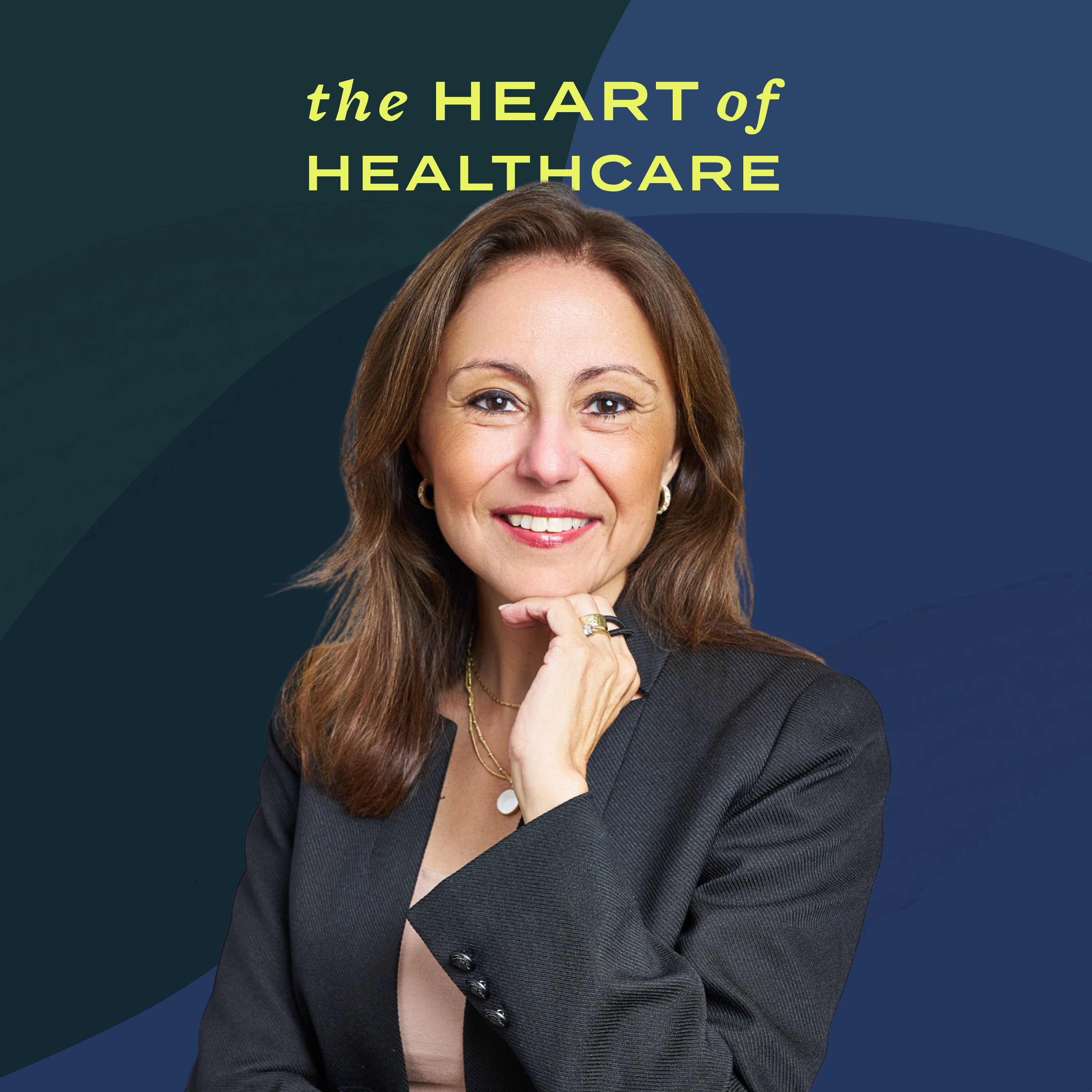
The episode argues that “Quality Revolution 1.0” (checklists, forcing functions, human-led standardization) has hit limits as medical knowledge and patient complexity grow, and that AI should extend quality by automating non-patient-facing follow-up, quality oversight, and care coordination. It also addresses how to bridge gaps between AI technologists and health-system change leaders, and where humans still matter in medicine.
Dr. Azita Hamedani, Chief Clinical Officer at Bunker Hill Health (startup backed by Sequoia and Coastal Ventures). Background: decades in academic medicine and clinical leadership; built the emergency medicine department at University of Wisconsin; senior leadership at UNC.
AI can reduce missed incidental findings and automate quality reporting; health systems need multidisciplinary rollout and AI literacy; AI should offload tasks while physicians provide human judgment and emotional support.
preventing CT scans for pregnant patients via HCG forcing functions; Bunker Hill’s “60,000 studies” thorough imaging follow-up at Cleveland Clinic with 40% imaging volume growth without misses; an AI-driven lung cancer screening case that triggers cardiology referral, e-consult/televisit triage, and pre-visit steps; her personal breast-cancer decision-making contrast between clinician comfort and AI data synthesis.
Written by AI. May contain mistakes.
Explore the challenges faced by the healthcare system and the potential role of AI in enhancing care delivery.
“Healthcare already knows how to deliver much better care than patients consistently receive.”
Dr. Hamedani shares her career path and insights on transitioning from academic medicine to a startup.
“healthcare revolution in quality can do.”
Understand specific healthcare challenges and how AI solutions can address them effectively.
“Because obviously there's always resistance to new things.”
Discuss the importance of collaboration among healthcare leaders and how to effectively manage change.
“Tell me about that mismatch, because we're seeing more AI being deployed in the provider setting than ever before.”
Examine the economic implications of AI on clinician productivity and patient care accessibility.
“And I imagine that we just haven't kept up.”
Explore how AI can automate healthcare quality management and reduce tasks for clinicians.
“For decades, as you said, it's all been protocols, checklists, committees, asking clinicians to remember more things, to do more things.”
Discuss the role of AI in ensuring adherence to radiology quality metrics.
“Well, all of those now can be automated.”
Understand the evolution of EHRs and the continuing challenges in healthcare data management.
“Yet that's not consistently happening, right?”
Discover how ambient listening is becoming an integral part of patient encounters.
“Like what we call it is hunter and gatherer mode of knowledge from the EHR.”
Learn about Bunker Hill's focus on automating non-patient-facing tasks to enhance care delivery.
“So, but those kinds of use cases are different than what Bunker Hill does, right?”
Explore how AI manages patient referrals and enhances clinical workflow efficiency.
“And what does that look like for the clinician when they're logging into – are they logging into the Bunker Hill app or is it through the EMR?”
Discuss the significance of having clinical expertise in AI development and implementation.
“It's the peace of mind that all those things are happening for your patient.”
Understand how Bunker Hill aims to empower health systems for effective AI use.
“We've talked a lot on the show about FDEs because it seems like a role that has just exploded over the last couple of years.”
Learn about Bunker Hill's ability to integrate various healthcare data sources.
“Yeah, they continue to have that, like, services layer.”
Examine the differing perspectives on AI's role in the future of medical practice.
“But I'm sure you saw the recent debate between Vinod Khosla and Zeke Emanuel.”
Discusses how AI and human physicians play different roles in patient care.
“Well, I mean, and that just makes sense from first principles, because if AI is ever sufficiently advanced that it exceeds human performance.”
Explores the balance between technology and holistic medicine in healthcare.
“Now, on the other hand, suppose my treatment choices were either X or Y, and Y included tamoxifen.”
Concludes with a hopeful perspective on AI's potential benefits for healthcare.
“aperture to what it takes to make humans live well rather than just manage diseases?”

Get the gist, explore an idea or ask about something said.
 Claude
On The Heart of Healthcare | A Digital Health Podcast, what are the key points of this episode?
Searching your listeningAutomatic transcript. May contain errors.
0:00I think we're at a point where we've hit the limit of what the healthcare revolution in quality can do, and that's where AI needs to come in. I think the medical knowledge has gotten escalated, patient complexity has escalated. Today on the show, Hallie speaks with Dr. Azita Hamedani, Chief Clinical Officer at Bunker Hill Health.
0:25Welcome to the Heart of Healthcare podcast. I'm Hallie Teko.
0:29Dr. Azita Hamedani: I'm Michael Esquivel. And I'm Steve Krause. And every Monday, we bring you the latest in healthcare innovation as we sit down with entrepreneurs and industry experts. So buckle up and join us as we figure out how to improve healthcare for all.
0:54Healthcare already knows how to deliver much better care than patients consistently receive. The problem is that our labor-intensive system can't execute everything we know for every patient, every time. Can AI finally close the gap between adequate and optimal care? Hello, listeners, and welcome back to the show. I'm Hallie Teko, and today I'm joined by Bunker Hill Health Chief Clinical Officer, Dr. Azita Hamadani. Bunker Hill Health is a fast-growing startup backed by Sequoia and Coastal Ventures. They work with incredible providers, including Intermountain Health, Cleveland Clinic, dozens of other systems.
1:34Azita, welcome to the show. Thank you. Thanks for inviting me. I'm excited to be here. Yes, I'm excited that we get to be the first ones to talk to you since taking this new role. Yes, it was yesterday. Yes, congratulations. Thank you. Thank you. I think we should just dive right in. I mean, you've spent nearly your entire career inside academic medicine, which is its own beast. You built the emergency medicine department at University of Wisconsin. You went on to senior clinical leadership at UNC. and after decades building and running healthcare organizations from the inside, I have to know what made you want to take the leap into startup world.
2:15Honestly, as I've thought about it, it's much less about wanting to join startup as it is going back to my roots, what got me interested in emergency medicine and even administration, which was really my commitment to the quality revolution kind of in healthcare and wanting to take it to the next level. So even before finishing med school, I had the opportunity to hear Don Berwick speak. And this was before To Error Was Human or Crossing the Quality Chasm was published, before he became who he is and before the IHI kind of took center stage. The case example he provided was the CDC being called into a Midwestern neonatal ICU with concern about a superbug really hurting these neonates because they were having hemorrhagic gastroenteritis, which is just bloody diarrhea.
3:04And the assumption was the superbug was like making them septic and there had even been a death. Well, it turns out vitamin E and epinephrine, so one that's safe and one that's deadly, looked very similar in the vials and they were placed right next to each other, right? So as Dr. Burwick would say, that system was perfectly designed to hurt patients and obviously even, you know, harm nurses and doctors because of just all the profound kind of guilt and shame that would come with it. And so when I heard that case, now, mind you, I had gone into medical school assuming I'd be a physician scientist.
3:39My undergraduate degree was in molecular biophysics and biochemistry. My parents are both basic scientists. I assumed that would be my path. But when I heard that case example, I was like, wow, you really can have a bigger impact on improving patient care if you focus on building safer systems. Now, back then, the only tools we had were things like forcing functions, opt-out, checklists, very rudimentary. But even then, for that time, those were considered revolutionary because back then, anything that came close to what would be called cookbook medicine was disparaged as, you know, infringing on physician autonomy, whereas now we know some of that standardization is actually what elevates the quality of care.
4:21So I think we're at a point where we've hit the limit of what the healthcare revolution in quality can do. And that's where AI needs to come in. I think the medical knowledge has gotten escalated. Patient complexity has escalated. And it was probably spring of 2023 when I read Zach Kohaney and Peter Lee's book, The AI Revolution in Medicine. And my immediate thought was, wow, we actually now have the tools that could possibly deliver on the promise we had made for the quality revolution. So it was more about going to that than it was kind of joining a startup. I do want to, at some point in our conversation today, get your insights on how there was a culture shift that needed to happen for the quality revolution and what's going to need to happen now.
5:08Because obviously there's always resistance to new things. So we will get into that. But were there things that you kept trying to fix as a health system leader that you couldn't do that you hope you'll be able to do now? Well, I mean, there are so many. and problems, use cases, as Bunker Hill calls it, that they've tackled already and have started fixing on behalf of health systems. So I'll give you kind of two examples as chair, and I can give you two examples as head of a faculty practice. So one of them that, let's say, Quality Revolution 1.0 solved, and one of them that it didn't, and we're now hoping that AI can solve.
5:44So one of the first kind of quality concerns I came across was there was a low and steady rate of accidentally mentally imaging, CT imaging, previously unknown to be pregnant women, right? So a woman comes in, she's got abdominal pain, we order a CAT scan, it happens, but then the HCG comes back positive, which obviously is an awful feeling for the woman who just potentially exposed her fetus to radiation and obviously to the ordering provider who kind of feels the guilt of that. Well, the quality revolution told us the way you address that is some kind of forcing function, So you can't order the CT unless you put in the HCG.
6:21So that got solved. But here, let me give you another very common example that still hasn't been solved, but AI can solve. And that has to do with incidental findings. So when I first started chairing the department, the adage back then was you order it, you own it. Meaning if you order a CT study, you as the physician would have to follow up, make sure you look at the final read, make sure there isn't any findings that may need follow-up after the fact. Well, imaging has increased so much that we pretty soon got to the point where we had to actually hire PAs to read over all of these imaging reads and follow through on the actionable findings.
7:00But even then, there would be misses. Now, fast forward to one of the most common use cases for Bunker Hill, and I'll give you the example of the Cleveland Clinic. There were 60 ,000 studies behind of this thorough reading of the imaging studies and, you know, kind of following up. Brunker Hill came in. Not only did they close that, you know, that gap, but at the time at which their volume, their imaging volume went up by 40 % without the misses that previously would happen. So that's like a perfect example where, you know, initially we wanted humans to do it. Then we tried to build systems with humans to do it.
7:36And now there's just too much volume, too much complexity for us to do it other than to use kind of AI. And you've said that one of the risks right now is that people who understand AI aren't necessarily the people at hospitals, at clinics who know how to drive change across massive organizations. Tell me about that mismatch, because we're seeing more AI being deployed in the provider setting than ever before. I mean, the rate of adoption of just technology is astounding, but not everybody understands how these tools work or how to really set them up appropriately. So if you could just share a little bit about that.
8:15Sure. I think there's kind of three different kind of forces at play. One is traditional health care leaders that have gone up, let's say, the clinical vertical, you know, gone up to chief medical officer or the operational vertical, gone up to the chief operating officer. Or I think, you know, as you go up that vertical, which is what I did, you have a lot of practice at change management. Like you kind of skin your knees enough time that you realize, you know, how do you shape the path? How do you shrink the change? How do you get people to kind of buy into why this is a better way to do it?
8:46And you ultimately have to make it easier for them to do the right thing. Is that the secret? Just making it as easy as possible? Well, it has to be easier than the default, right? So make it painfully easy to do the right thing and painfully hard to do the wrong thing. And that is literally one thing I had was all my leaders to read Switch by the Heath Brothers, how to make change happen. And it comes down to, as they said, shape the past. If you move from the clinical leaders and operational leaders who've had to grow up learning change management, you now have our information and IS leaders who are dealing with cybersecurity, architecture of kind of data management, things that probably either side don't think much of.
9:29And then you also have engineers that think about like designs of the system and how humans and technology interface. And unfortunately, right now, a lot of that's living in silos. And I think for us to truly kind of benefit from all that technology has to offer, We're going to have to have really good multidisciplinary collaboration around what to adopt and how to roll it out and scale it. Yeah. I mean, AI, though, from a technology standpoint, is so much more sophisticated than kind of the informatics 1.0. And I imagine that we just haven't kept up. I mean, we have a gazillion informatics master's programs and books and everything.
10:13How do you think that these leaders can actually stay up to date and as especially as quickly as things are advancing in AI? You have to kind of look at it two different ways. So, you know, at the highest level, at the level of complication that you're suggesting, I think you're going to need subject matter experts. Right. So there is now, you know, chief AI officers and kind of specific training they're getting. On the flip side, I think what you're also suggesting is there's a level of AI literacy that I think everyone needs to have. And I think that's one of those things that as operational leaders, we have to start working on.
10:47So people start, all the providers start getting an intuitive sense of like, what are the limitations? What are the benefits? How can you harness it? When can you rely on it? When can you not? Yeah, I mean, we have quite a low bar in terms of like user friendliness on a lot of these products. What advice do you have for founders who want to work with health systems and the folks, who should they be talking to? How are these folks making buying and partnership decisions? Yes. So the way to kind of get a health system partner from the outside is not that different from like how from the inside, you know, I or anyone else champion change, which is at the end of the day, we're so matrixed that no one person owns a full P &L on their own and no one person is an end decision maker.
11:39So really kind of you have to make sure you have all of like you've thought about the issue from all angles and you've got all your stakeholders lined up. I may have heard it on your podcast or another podcast, but I heard someone say just because you have a big fan in a health system doesn't mean you have a customer. You need to have many fans in the health system. And usually if your product is user friendly, has obvious value, that happens a lot easier. Yeah. When we hear that AI will make clinicians more productive, what does that actually mean economically? Do you think that one doctor will see more patients and our patient panels will get a lot bigger?
12:18Do you think we'll just hire fewer people or rather we're already facing a scarcity, so maybe that scarcity will go away? Does it mean that doctors can finally have like a 30-hour workday? Where do you think like that productivity within the provider setting will show up? Again, kind of the way I'm most attracted to the potential for AI is more about how it can make better, safer care. But sure, there is a productivity increase. But let's take the Cleveland Clinic example. They were 60 ,000 behind. In the absence of AI, either you just allow unmet needs to sit or you have to hire a whole bunch.
12:57And neither are really tenable, right, for different reasons. And so I don't think you'll, I think it will be an opportunity to meet unmet needs without increasing the cost, right? Like, so if we can - The productivity, yeah, the outcome of the productivity gains isn't, there's so much work to do that like that really we haven't been productive enough is what you're saying. Not only is there so much work to do just where there is care, but we have a huge swath of medically underserved populations in our country. So and the labor economics just isn't making sense right now. We have shortages that are driving such high labor costs that if you look at health systems, the line item for contracted care is pretty significant these days.
13:45And so I think it's almost like it's a necessity for us to be able to stabilize kind of the care we provide and the expense that we're spending. Yeah, yeah. Let's talk about quality. I mean, you've been so passionate about the quality revolution. For decades, as you said, it's all been protocols, checklists, committees, asking clinicians to remember more things, to do more things. So what exactly changes when AI enters the equation? Well, I think as they always say, there's administrative burden to just our reimbursement system. There's also developed an administrative burden to our quality oversight system, right?
14:27So like, let's think about cancer registries or surgical registries. Like, you know, we're hiring humans to make sure they abstract the data, enter the data and make sure we're hitting certain quality metrics. Well, all of those now can be automated. So even the quality management of healthcare can be done much better with AI. And let alone a lot of those metrics that we're following are metrics that are measuring whether or not each patient gets the right care at the right time in the right way, whereas a lot of that can be automated. So, for example, the American College of Radiology has a quality measure that every time a chest CT is done, if there is coronary artery calcification, it should be reported on and then hopefully acted upon.
15:14Yet that's not consistently happening, right? So that's something that we know is an easy use case for agentic AI to address. Yeah. And I mean, we've already spent billions of dollars, decades trying to digitize healthcare, just putting everything in the cloud so that we have all of this information in one place. You know, we think about the$36 billion in meaningful use just to get clinicians to use EHRs in the first place. And we've, you know, seen kind of slowly over the years, different clinical decision support tools added. I mean, we've done, it feels like we've done a lot. do you think that didn't close the gap enough or was that actually that did close the gap and let's keep on going?
15:59I think I think it closed some gaps and then the medical knowledge. Because you gave some good examples of things that have been done that are yeah. Well but even just purely look at let's look at the EHR. So I you know I was a medical student it was paper charts. So when I saw a patient in the Yale emergency department like if you wanted to know what their last hospitalization was, you literally ask for a chart, a paper chart to be fetched from off-site and brought in, which basically makes it useless, right? So then we get to the world where there's an EHR. And early on, the question was like, well, do you do the chart biopsy before or after you go see the patient?
16:37Because those that were most academic and pure about it wanted to do it afterwards so they could make their own impressions. Well, now patients have gotten so complicated, It almost would be cruel and unusual punishment to them not to know some of their history before you walk in. But now we're left with patient charts that are the size of Moby Dick, as Brian Patterson kind of reported in 2024. So I think EHR did what it needed to do up to a certain extent. But medical knowledge explosion and patient complexity has made it where just having digitized record is no longer sufficient. Like what we call it is hunter and gatherer mode of knowledge from the EHR.
17:20So like the information's there, but, you know, kind of that hierarchy of D-I-K-W, data information, knowledge, wisdom. Uh-huh. The EHR has. Yeah, the pyramid. The EHR has the data and the information, but we're getting minimal knowledge and wisdom because we're still in like that hunter and gatherer mode. And that's why chart summarization is one of the first use cases after ambient listening that's kind of been quickly adopted. I mean, it feels like ambient listening went from unheard of to now completely ubiquitous within the patient encounter in a very relative, I mean, maybe two years since we really started to.
18:01So it's been really incredible. What's another tool that you think right now we're just kind of getting started with, but maybe in two years, it'll be ubiquitous for all providers? Well, chart summarization, right? So like my, you know, my husband's a cardiologist and every night before his clinic, he's spending hours like reading to the patient's charts, trying to prep it, make sure when he walks in and that face to face time is optimized. Okay. So, but those kinds of use cases are different than what Bunker Hill does, right? So, like, I consider those kind of the, maybe the sexier use cases at the point of care.
18:36But what I love about Bunker Hill, it's all that non-patient-facing work that has to happen before and after the patient visits, following up on this, getting pre-off on that, making sure the referral happens, all the things that, like, you worry if patients are going to fall through the crack. That, I hope in two years, is ubiquitous, where there's no more handoffs. Anything that could be automated, we have automated so that each patient's getting optimal care, not just standard of care. And what does that look like for the clinician when they're logging into – are they logging into the Bunker Hill app or is it through the EMR?
19:17Like how does – walk us through the product. So again, I think the beauty of kind of the product we have or the agent we have is it's not triggered by providers. It's more kind of event triggered. So I'll give you the perfect example. This is a patient case that our CEO likes to share because it was reported in the Texas Monthly. So there's no HPHI leaking. But this guy, David, he's in his 50s. He's a smoker. So our agent can work with a system to trigger, it's time, you know, he's appropriate for lung cancer screening. Comes in, gets lung cancer screening. Based on knowledge of him, his history, there will be a recommendation based on what's found as to how soon you need follow-up imaging.
20:07That's taken care of not by a human, but by our agent. But also by reviewing that chest CT, they notice he is like coronary calcification, advance for his age high enough to trigger a referral to cardiology? Well, then it can reason, our agent can reason through and say, well, are there contraindications for this referral? Does he already have a cardiologist? Does he have another comorbidity that needs to be addressed first? If not, that referral is automatically generated to cardiology. A letter is automatically sent to the patient. The primary care physician is automatically noted. And sometimes even an AI counter note is automatically written.
20:45Now let's go, so the referral, this patient's, you know, David's cardiology referral has gone to cardiology clinic, but cardiology clinic is overwhelmed. This is an issue all across our country where specialists are really hard to get into, but then they complain that their clinics are filled with patients who could have been seen in another setting. So our agent works with referral triage management, makes sure that like Like if there's a patient that can be handled by an e-consult, they're kind of siphoned off. It can be handled by a televisit. It's siphoned off. Which one goes to a PA? Which one goes to?
21:18And so all of a sudden, the sickest patients get in. So now David's seen the cardiologist. He needs a cath. Well, that needs a pre-off. That's already taken care of. So to me, it's the equivalent of having either the best PA or the best chief resident, one who works all the time, 24-7, 365, doesn't drop the ball. So you have the piece of, so it's not what it will look like to the provider. It's the peace of mind that all those things are happening for your patient. Yeah. It's like the conductor. I'm thinking of like a conductor of the orchestra that's like kind of, you know, making the moves. So no, there's not necessarily reporting to someone or triggered by anything.
21:58It's just kind of knows how to bring all the pieces together. Yeah, exactly. That could be a name of your next product, the conductor. The conductor. And when health systems, and they vary, right? Culturally, they vary when they want humans in the loop. But when they do, the way Bunker Hill has created right back into the EHR, from the end user, like the schedules perspective, it's just another column in Epic. It's just another column in the EHR. So they don't even know they've left that environment, which is optimal for adoption. Yeah. And then who within these clinics is Bunker Hill selling into?
22:35Does that mean it's the CIO or the CMIO? Those are the people who would have the most stake in this working out? So obviously, if there's a chief AI officer or anyone who's been given kind of the task of managing AI strategy across the system, that's kind of our best point person. But usually we work with someone central, so a chief clinical officer or a chief information officer, to someone who sees the ubiquitous of the need and use cases that Bunker Hill can bring to bear. But then our forward deployed team goes in and works with the unit, the more local subject matter experts to customize, to standardize where appropriate, learn best practices from other systems and customize where it's important.
23:19Because if you've seen one academic medical center, if you've seen one health system, you've seen one health system. Right. So so I think we we kind of work in a true hub and spoke model. And then you're the first chief clinical officer that Bunker Hill Health has had. Does that mean that you are working on the product? You're working with the customers, a little bit of everything? You know, I'm shocked they have gotten as far as they have. Well, I was shocked before realizing that they didn't have a clinician on board. But then I spent a week in their offices. And I'm telling you, the forward deployed team we have are like a unique breed.
23:59Like I can hear them speaking to the clinicians in clinical, like clinical cases, clinical scenarios that I'm like, wow, that requires fundamental knowledge of medicine. And then turn around and talk to our deep engineers and kind of cross this chasm between those who are building the system and those who are using it. And so they've clearly gotten far. My job is to be a resource to everyone, but certainly having seen the potential of all the use cases, I like sharing it with people who have more of a quality background or an operations background, since that's my background, rather than necessarily an information background.
24:37We've talked a lot on the show about FDEs because it seems like a role that has just exploded over the last couple of years. I mean, you're kind of giving us an insight into like what they're like. It sounds like they're bilingual in both medicine and technology. Like what else should we know about FDEs? Like who are these people? Like what are their, what did they work in before AI existed? Well, some of them are former Epic, former McKinsey, like people who were clearly had some kind of tech or engineering background who then went to the applied side and then have found kind of a home with us.
25:16And not all four deployed teams are the same. Some kind of sweep in and it's like, well, we'll take care of it. Like we know what to do. We'll take care of it. Well, then that leaves the system dependent, right? You haven't taught them how to fish. Others are like, well, you kind of should have your own clinical applications team. The ethos of our leadership down is we will send our people to partner with you, But eventually, we would love for the tech to be easy enough and for the capacity to have been built in the health system. So we're almost working ourselves out of that need, out of that role, because that's ultimately what's in the best interest of health systems and patients.
25:56And I think that's beautiful, too. But Epic doesn't do that. Don't they continue to have folks? Yeah, they continue to have that, like, services layer. Well, and actually their agent factory right now doesn't, it's just there for your own, if you have that talent in-house to use. So depending on whether I think their new thing was Rangers. So either, you know, either you get, you buy that layer or you have to have your own layer versus we're trying to kind of help you get to the point and help the technology become easy enough to then kind of meet that need. The other thing is Bunker Hill, the EHR is just one of its connectors.
26:37It can go inside and outside all systems, not just EHR, but across pharmacy, across payers, structured, unstructured data. So it's pretty robust for how much information it can ingest and then reason and provide context over time. Let's switch gears a little bit. But I'm sure you saw the recent debate between Vinod Khosla and Zeke Emanuel. Well, they were on one side, not between the two, but they were on one side. And they think that AI will replace doctors. And then the CEO of the AMA, who says absolutely not. I'm curious where you stand on that, given you are a clinician and now you're the CCO of a fast-growing healthcare AI startup.
27:20So I actually listened, I read the article and I also watched the debate that Christina Farr had moderated between them. Yeah. And my understanding of kind of their more nuanced stance is that John White isn't disputing the fact that AI has value. He just thinks, you know, physicians need to be in the loop. So and Zeke Emanuel is arguing that if and when AI is sufficiently advanced, the evidence suggests that performance degrades, degrades by including humans in the loop. Right. And so by first principles, he's not wrong. Right. Like so there's data, right? There's data that shows that the clinician plus AI is sometimes worse than AI alone.
28:03Well, I mean, and that just makes sense from first principles, because if AI is ever sufficiently advanced that it exceeds human performance. If you contaminate it with human performance, then it's obviously going to get degraded. But I think both of them accept the need to focus on the art and humanity of the practice of medicine, right? And so we should offload what can be offloaded to AI and then recruit and develop physicians who can fill kind of that more humanistic need we have in medicine. I'll share a very personal example that really crystallized why AI can do what AI can do, but why we also need physicians for what physicians can do.
28:45So a little over a year ago, I received a breast cancer diagnosis. And so my daughter, my husband, and I went to meet with the surgical oncologist. She provided me my two treatment choices, which were either bilateral mastectomy or lumpectomy with radiation treatment. She explained both. And as soon as she finished explaining, I knew exactly which one resonated with me. But I also realized, wow, if I make the wrong decision and there's complications, like will my family be resentful? Will this hurt them? So even though I simultaneously had a strong preference, I was insecure about my preference.
29:21So I didn't say anything. I turned to my husband and my daughter and I said, what do you guys think? They gave their answer, which fortunately lined up with mine, but I still wasn't sure. And so I turned to Dr. Tracy Ann Mu, who was my surgeon at Sloan Kettering, and I didn't ask her, if you were me, what would you do? That's a question patients often ask, like, well, if you were me, what would you do? Instead, I said, if this was you, what would you do? Now, that's a different question, right? Because the first one says, given all you know about me, tell me what you think I should do. The other one says, I want to know about you.
29:58I want to know about you and how you would go through this decision making. And she didn't hesitate. She gave me the answer. I was so grateful. It was authentic. It was real. She explained her decision making. It made me feel confident in my decision making. And no AI could have provided me that comfort and security that she provided. Now, on the other hand, suppose my treatment choices were either X or Y, and Y included tamoxifen. And I would not want that same wonderful Dr. Mu to be in charge of remembering all of the indications and contraindications, absolute and relative, all my past medical history, maybe my genetic history, maybe my family history, that would say whether or not that was good for me.
30:47I'd rather have an AI aggregate and synthesize that data. So those are just two completely different needs that I think the healthcare system can then provide. Well, thank you for sharing that. And I'm sorry that you had to go through that. And it sounds like you had great care and great family members, which is like all we can wish for in facing scary diagnoses. Thank you. I'm curious, like it kind of sounds like when it comes to precision medicine, and helping know your options, we want the AI. But when it comes to comfort in your decision and feeling like you're going down the right path for you, you're like, ChatGBT could even get close to putting itself in my shoes.
31:34Absolutely. So I think the human touch continues to be very important, but also I think we have to remember how to be human with feelings. So maybe in a future world where AI has offloaded so much of the stress that providers feel, the provider feels comfortable feeling and sharing those emotions. Like there are times in the emergency department where it'd be appropriate to tear up with the patient and pause for that moment. Now it's almost like as providers, you hold it back because you've got the next thing and the next thing and the next thing to do. And so it would be wonderful to be able to offload what you can so you can be more human for the patients you're caring for.
32:18Yeah, I'm curious what you think about what's going to make a great doctor in the future, because for generations, it really meant having good recall, being able to remember an enormous amount of information, to have good bedside manner. But if AI can do, you know, the former, is great bedside manner going to be the thing that matters the most in being a great doctor? Well, I mean, I don't, bedside manner is a little bit different. I mean, I think bedside manner matters tremendously. I mean, how the patient feels about encounter leads to compliance and kind of a host of outcomes. But in my ideal world, kind of if you fast forward with time, if we have helped, if we have harnessed AI to help us really advance and kind of disease management, then maybe that provider can start looking holistically at patients, not even patients, holistically at populations and think more about like what aspects of Eastern medicine can we incorporate?
33:20What aspects of mind-body integration? How do we look at mental health and its impact on productivity and longevity and even physical health? I mean, it's just there's an opportunity to step back and really think about health and wellness in a different way. I know that right now has been a fad, right? And like those within healthcare are kind of trying to ignore the fact that there's a screaming desire for understanding that space better. Yeah. It's a parallel market. It's like not even - It's a parallel market, yeah. It's a huge market, but it's not really within our healthcare system right now.
33:57There's very few touch points of integrative medicine or holistic medicine where the two may touch point, but those are small. And given my own individual journey, my eyes became open. Wouldn't it be wonderful that we can kind of harness all the best we have technologically and scientifically, but still have the opportunity to think a little bit bigger or open up our aperture to what it takes to make humans live well rather than just manage diseases? Well, wouldn't that be nice? Maybe just to close this out, we have had a lot of doom and gloom about AI recently. Folks who've left Anthropic saying that, you know, AI is going to kill us all by 2030 and like a quite scary outlook on the future of AI.
34:44So maybe you can close us by putting AI in a light that you're optimistic about how it's going to change healthcare for the better. Well, so that last clause is where I can hang on because I've got two kids in college and like at least once a week they come and they call some class, something they read. They're like, you know, we're screwed. Like, you know, so I'm not going to opine on the bigger picture because that's still TBD. But as you said, in health care, it's all upside. It's all upside. And even there was a recent study that tried to disparage or kind of looked at like, well, cognitive offloading versus cognitive surrender.
35:26Should we be worried about cognitive surrender? But if you look at the details of that study, what it showed at the end, and this is like their third study, like figure, let's say eight or nine, that if you build systems well, such that like in their example, it was incentives and feedback, then you have the opportunity to gain all the upside of using AI and mitigate some of the downside concerns, right? And so why wouldn't you want to do that? Basically, what their study showed was that if you can provide the right guardrails, then your performance on the upside improves twofold and your downside performance is still the same as baseline without any kind of AI assistance.
36:12So it won't get worse. It won't get worse if you build the right, you know, if you build the right guardrails in place. So to me, it's not a matter of if, it's just a matter of like, okay, let's just figure out how, right? So, and there's the human only brain will not be able to keep up with what we would want technologically and medical advancement to provide us as we go forward. And as you mentioned, precision medicine, just like the explosion of what can happen. it's just too much for any one human to kind of oversee. Yeah. Well, Azita, congratulations on the new role. And thank you so much for joining us.
36:49Thank you. Thank you so much for having me.
36:57Thanks for listening to The Heart of Healthcare. If you enjoyed this episode and you'd like to support the podcast, please leave a rating and review. And don't forget to subscribe. The Heart of Healthcare is produced by Hallie Tecko and hosted by Michael Esquivel, Steve Krauss, and Hallie Tecko. The show is engineered, edited, and mixed by Kyle Moore. Visit our website, heartofhealthcarepodcast.com, for show notes and details.
For decades, healthcare's quality movement gave us checklists, forcing functions, and protocols to catch human error before it reached a patient. It worked, to a point. But as medical knowledge and patient complexity keep outpacing what any human system can track, a new question is emerging: can AI pick up where that movement left off?
In this episode, in her first interview since stepping into the role, we talk with Dr. Azita Hamedani, the newly appointed Chief Clinical Officer at Bunkerhill Health, an AI company backed by Sequoia and Khosla Ventures. After nearly her entire career in academic medicine, Azita made the leap to a startup chasing a promise she's been thinking about since medical school.
We cover:
About our guest:
Azita G. Hamedani, MD, MPH, MBA, is the Chief Clinical Officer at Bunkerhill Health. She joined the company based on the belief that its long-horizon AI agent is the first technology capable of ensuring every patient receives optimal care. She spent 25 years in various leadership roles within large-scale academic health systems. Most recently, she served as President and CEO of UNC Faculty Physicians and Vice Dean for Clinical Affairs at the University of North Carolina School of Medicine. Dr. Hamedani also spent nearly two decades at the University of Wisconsin School of Medicine and Public Health and UW Health, where she founded the Department of Emergency Medicine and chaired it for over a decade, while also leading system initiatives related to quality and innovation. She completed her emergency medicine training at Mass General Brigham, and completed a fellowship in hospital administration at Massachusetts General Hospital. She holds degrees from Yale University and Northwestern’s Kellogg School of Management.
—
📍 Connect with us:
See Privacy Policy at https://art19.com/privacy and California Privacy Notice at https://art19.com/privacy#do-not-sell-my-info.