Ask ChatGPT
 The Heart of Healthcare | A Digital Health Podcast
24 Aug 2026 · 35m · 16 chapters
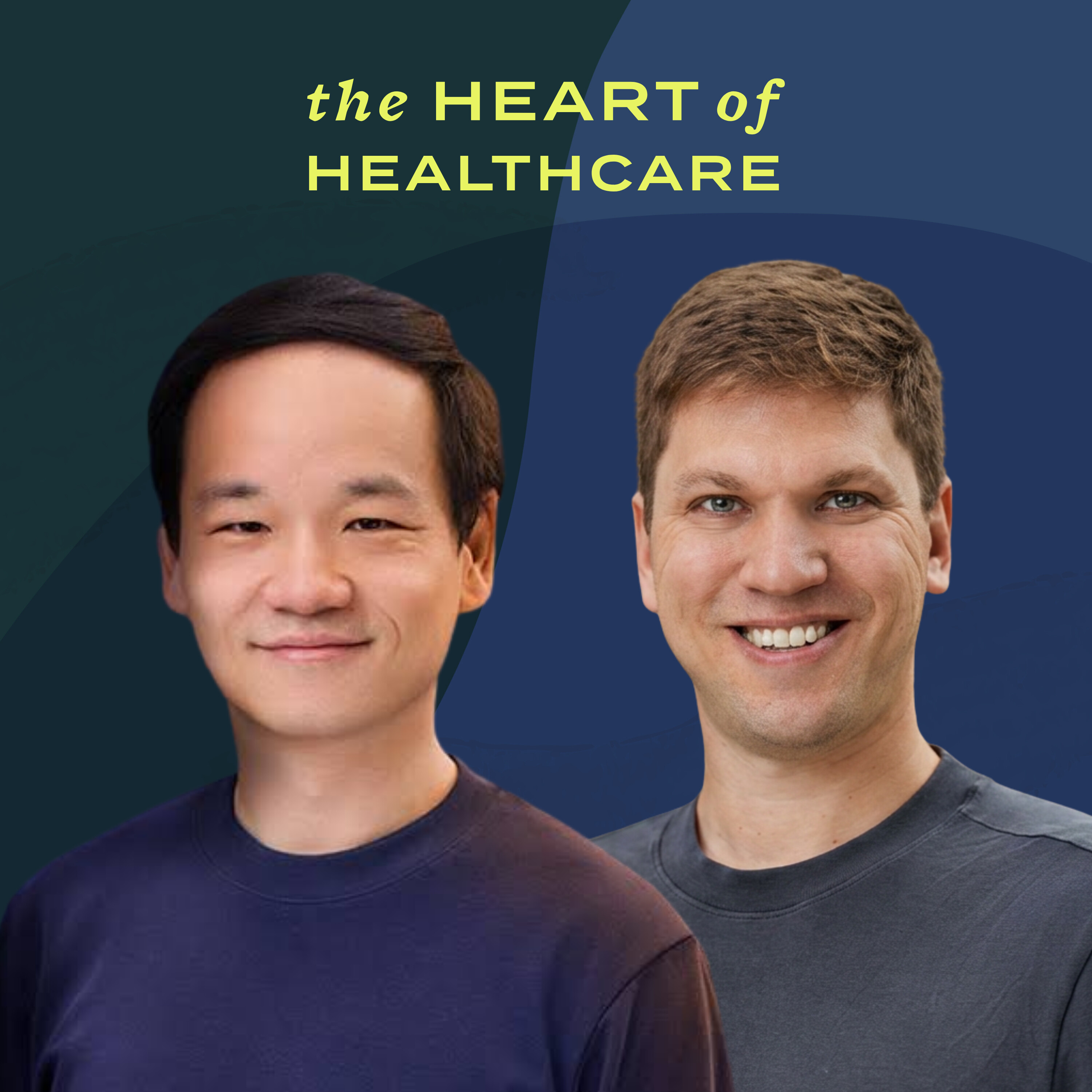
SmarterDx founders Michael Gao and Joshua Golaris discuss how their health AI company evolved from early customer-finding struggles into a “pre-bill” revenue-driving product, and how they built a compounding AI moat, scaled to tens of thousands of employees, and later exited after acquisition by New Mountain Capital.
Both are MDs who met during residency and also worked with data science. Gao worked at New York-Presbyterian on clinical documentation improvement and revenue cycle, using early NLP/“small language models” (BERT precursors) and helped find about $5M for the health system. Golaris did research and co-built the startup while both returned to hospitalist work during COVID.
The “wandering the wilderness” period (about 18 months to first customer) forged their final product. Their AI improves via a customer feedback loop. They reran frontier models and report AUROC ~0.72 for competitors vs ~0.94 internally. They argue AI will automate translation work (clinical notes to ICD-10 codes), improving labor utilization.
Revenue cycle sales were initially slow pre-COVID; during COVID they saw patients as health systems deprioritized unknown vendors. They describe a contingency-payment flywheel to sell faster and gather data. They share an anecdote about building a board deck in Figma on short notice.
Written by AI. May contain mistakes.
Learn how initial challenges shaped the SmarterDX product.
“As painful as that, like, we call it like wandering the wilderness period was, I ended up in retrospect now think it was hugely important for our ultimate success.”
Learn about the backgrounds of Michael Gao and Joshua Geleris.
“Hello, listeners, and welcome back to the Heart of Healthcare.”
Discover the journey of how the founders transitioned to entrepreneurship.
“Hey, guys, I want to start at the beginning.”
Hear about the impact of COVID on their startup journey.
“So then, then it was a full year and a half until we actually got our first customer.”
Learn how customer insights shaped the product development.
“So it was kind of a nice way to also continue having income while further understanding and sort of like building the startup idea.”
Explore how the relationship between the founders has evolved.
“One of the strengths that Mike and I have exhibited is working really hard to understand all of the parts of the business.”
Understand the ups and downs faced during rapid growth.
“Hey, I want to actually ask the co-founding dynamic because one of the things I also really respect about you guys is like, listen, it hasn't always been easy.”
Listen to a humorous account of a unique board meeting setup.
“But it was very factual, including like, Oh my God, we got to fix our models, you know, right now.”
The founders discuss their perceived competitive advantages in the health AI market.
“So he was like asking me to sort and click stuff.”
Insights on the challenges and strategies for staying competitive in the fast-moving AI landscape.
“coming down into your market or the scribing companies.”
Exploration of how AI can alleviate translation tasks in healthcare, enhancing efficiency.
“But I do think we're constantly in a race against time as these things will get better.”
Discussion on the future role of AI in healthcare and its implications for clinical jobs.
“a lot of spend on services, a lot of spend on people.”
A conversation about the potential changes in the roles of doctors due to advancements in AI.
“But it almost certainly is a net benefit to society to have more care delivered without having to scale the administrative costs associated with it.”
Exploration of human mistakes in healthcare and technology's evolving role.
“And then the other thing I would say is humans make a lot of mistakes, you know, as well, right?”
Founders share key lessons learned from their company exit experience.
“I mentioned probably the most successful healthy ad company to date in terms of exit.”
Founders provide critical advice for future healthcare entrepreneurs.
“But the company itself, if you've built a great company, and I think we have, the company itself doesn't really, nothing really changes, right, the next day, right?”

Get the gist, explore an idea or ask about something said.
 Claude
On The Heart of Healthcare | A Digital Health Podcast, what are the key points of this episode?
Searching your listeningAutomatic transcript. May contain errors.
0:00As painful as that, like, we call it like wandering the wilderness period was, I ended up in retrospect now think it was hugely important for our ultimate success. not because it was good for us to not have customers, but the challenge of finding customers, the elevated level that we had to get to in order to rise above the noise, ended up forging what became the ultimate SmarterDX product. This week on the show, Steve talks to SmarterDX founders, Dr. Michael Gao and Dr. Joshua Galaris.
0:43Welcome to the Heart of Healthcare podcast. I'm Hallie Teko. I'm Michael Esquivel. And I'm Steve Krause. And every Monday, we bring you the latest in healthcare innovation as we sit down with entrepreneurs and industry experts. So buckle up and join us as we figure out how to improve healthcare for all.
1:12All right. Hello, listeners, and welcome back to the Heart of Healthcare. This is Steve Krause, and I am super excited to be joined by two amazing entrepreneurs that I've had the privilege to work with. They're also two of my favorite people. Dr. Michael Gao, Dr. Josh Golaris, the co-founders of SmarterDX. I think SmarterDX is probably the fastest growing health AI company still, even post-acquisition by New Mountain Capitals, and also probably the most successful health AI exit to date, which is a remarkable thing. Congrats, guys, and thank you, and welcome to the heart of healthcare. Thanks, Steve.
1:51Hey, guys, I want to start at the beginning. I want to talk about the origin story. I mean, I mentioned you're both doctors. You met in residency. I'm curious, how did you decide you wanted to take the jump to do the entrepreneurial journey? There's this famous kind of well-known photo, I guess, that says we didn't do this because it was easy, but because we thought it would be easy. The background story is I was working at New York Presbyterian. Josh and I, as you said, we met during residency. We were both physicians. We both also had a foot in the data science world as well. So Josh was doing research.
2:31I was working more on the application and operational side of the hospital. Using, at the time, call it small language models with BERT models and kind of the precursors to what we saw today. And at New York Presbyterian, started working within revenue cycle, working in clinical documentation improvement, wrote a little code and found effectively$5 million for the health system. and Josh and I were talking and we were like, oh, well, if you can find money for health systems, why would any health system ever say, no, it must be super easy to sell this to health systems. And that was January of 2020, kind of three months before COVID.
3:26And so at the time we were just like, super easy. we'll just, you know, go out to a bunch of health systems, tell them we can find, you know, additional revenue and this will definitely work and we'll probably be successful in a couple of months time. Six years later. Yeah. Yeah. So then, then it was a full year and a half until we actually got our first customer. Didn't you, you guys quit, you guys like, you didn't quit the startup, but you like went back to work in his hospitalist, right? During COVID? Yeah. I mean, the number of health systems that were trying to buy revenue cycle related products from companies they never heard of instead of ventilators and N95 masks was de minimis.
4:17We went back to seeing patients. We were both hospitalists. It was, you know, a time in New York city where hospitalists were super needed. Yeah. sorely needed as well. So it was kind of a nice way to also continue having income while further understanding and sort of like building the startup idea. Did you guys, were you guys unified even when you went back during the pandemic to work as hospitals? Were you unified as a force that you were definitely going to go back and do smarter? Yeah, I think it was, we did get a handful of conversations even in those first few months that there was some interest.
4:54And so I think we knew we were going to do something and we knew we were going to work on something together, you know, specifically whether the exact smarter idea would be the thing that would work out. As painful as that, like, we call it like wandering the wilderness period was, I ended up in retrospect back now think it was hugely important for our ultimate success not because like it was good for us to not have customers but the challenge of finding customers the elevated level that we had to get to in order to rise above the noise ended up forging what what became the ultimate smarter DX product.
5:41But that honing got us to what became the pre-bill solution, which is sort of a product that exists after all of the existing revenue capture processes and thus is attributable and thus is a much more revenue-driving product and enables both us and the hospital to feel confident in how much value we're delivering. And so that 18-month period, while quite painful and rough, really was critical in shaping the company we became. One of the strengths that Mike and I have exhibited is working really hard to understand all of the parts of the business. We were both on a lot of customer calls. We were both deeply technical in the work.
6:30And what that enabled us to understand is when customers raised objections, we could very quickly and nimbly describe not just what a possible theoretical response to the objection was, but we could describe how we might be able to use the product in a way that answered that objection. And so we were able to kind of steer and create the product through conversation with customers because we both pretty deeply understood what was possible, what was possible technically, what you could do with the data, how to use all the data. And I think that depth was one of the ultimate reasons why we were able to sort that out and come up with an option that worked to answer those objections.
7:25Hey, I want to actually ask the co-founding dynamic because one of the things I also really respect about you guys is like, listen, it hasn't always been easy. In fact, I think Josh once told me this was like an overnight success story, you know, five or six years in the making. And there were lots of ups and downs that we've already talked about. Some you went through growing the company really fast, having to decide whether to sell the company now working at a much larger scale. I mean, like, you know what, how many employees now that you guys are working with 20 ,000 plus something like that?
7:54Yeah. 30 ,000. 30 ,000. Right. When you started as two, Like lots of co-founders out there, but your relationship is just like really stayed strong. How have you managed that? And I joke, you got to have, I mean, at 30 ,000, you have to have different roles. Like, and I appreciate it. You guys are like masters of all, but how have you managed that? I'll say a couple of things. Like one, I think the fact that we've known each other for now, like quite a long time going back 12 years or something like that, like all the way back through residency and And sort of like the relationship we've forged through just that experience was pretty useful through the post-residency world and then in starting the company.
8:40I think the fact that we made it through that wandering the wilderness period itself was probably a pretty strong bonding experience for us. And so, you know, I think we both have a lot of confidence that the thing that we're trying, whatever we're trying to do is in the best interest of the company. Like that's what we're both optimizing for. We have a lot of faith in that. And I think a lot of conflict that I see, you know, in various teams ultimately comes down to misunderstanding priorities or misunderstanding motives or things like that. And so if you can just sort of like take that off the table as a conflict point, you just start from a deeper level of trust and you're willing to listen.
9:36And so that's not to say we haven't fought over things or had disagreements along the way. We certainly have. But I think we both have a pretty trusting relationship on that front. And that's mattered a lot for our ability to move past the superficial disagreement part and really try to think through what the actual issues are. I think we both are quite intellectual and to spend a lot of time just like thinking about problems and understanding them. I like to say from first principles because that's like the popular thing to say. I'm not sure it's totally that, but we like to really like understand problems and really understand everything that's going on.
10:26I think that's right. I think baseline trust is super critical. And if you're worried that the person's optimizing for themselves instead of the company, then that just erodes kind of a ton. And then I think, you know, Josh alluded to this, but there's definitely differences in the way that we think about things. On average, Josh is probably more of a vision first, figure out the path to get there person. And I'm probably more of a, hey, what am I hearing in the market? How, like what are customers interested in? And like, how does that expand into a longer term vision? On average, I think Josh is probably, I think sometimes more risk on and I'm probably sometimes like slightly more, I like to say objective, but others may disagree in terms of, you know, things.
11:27But I think we have, I think, a similar approach to how we think about things, which is I think we both are first principles. And that means that when we're having discussions, we're often really going from like the one foot level to the 10 ,000 foot level and diving into specifics, like trying to understand the facts. sand, I think when we've had disagreements, it's like never been, oh, we're citing a management book or a source of authority or like best practices. And it's always just kind of like, what are the very specific facts of the situation? What's the logical reasoning from that baseline set of facts?
12:10And it's because we haven't read any magic management books. Yeah. Yeah. Yeah. Yeah. That's a whole separate issue, I guess. I think it's a really good lesson. And it's one of the things that I always loved about you guys. There wasn't a lot of bullshit in your board meetings. They're, they're judgment calls. We can get judgment calls right and wrong all the day. Right. But it was very factual, including like, Oh my God, we got to fix our models, you know, right now. So let's hire a team to do that. Wait, can we talk about the Figma board meeting? Oh my God. I don't think we've talked about this story publicly before, but it's like, You go.
12:49Management books will always give you these instructions about how to do a board meeting, prepare a deck weeks in advance, share it with the board, do all these things. We were growing so fast. And there's one board meeting where we literally just didn't have time to prepare or have any conversations ahead of time. And so over the course of the two days before the board meeting, we started outlining the board meeting in Figma. We were just using it like a shared notes app. And over the course of those two days, we just added more and more content into that, including screenshots of our finances and graphs, like screenshots of Excel.
13:36and so the board meeting was Mike logging into Figma and just like zooming around the canvas as as we went from like topic to topic looking through each of the things and like zooming into the Excel finance screenshot it wasn't the most comforting board meeting I'll say it wasn't other than the growth was good that was it was really hard to follow as a user yeah and and because Steve's a boomer. He didn't realize it was a screenshot. So he was like asking me to sort and click stuff. And I was like, look, bro, you just said I'm NGMI, Steve. Oh my God. Oh, that was tough. All right. I'm definitely keeping that in.
14:21I want to edit that out, but I can't keep that in to show our relationship. Okay. I'd be curious on some, some sort of market perspective. And maybe this is for you, Josh or Michael, you guys could, I mean, I referenced you guys have built an incredible technology that continues to compound in the value it creates for the customers and for SmarterDX itself. But like there's this question for the, you know, that's out there for the market, which is like, how big of a moat do you feel you have? Is the moat the product? Is the moat the integrations? Is the moat the deep understanding of the customer?
14:51Like, clearly your moat is compounding, but you got to be worried about the foundational models maybe. or a competitor. I know we've talked a lot about the CDI players coming down into your market or the scribing companies. I mean, there's a lot of theoretical competitors. Like, how have you guys thought about that? You were early, so you had the advantage of being a first mover and moving very quickly, right? But today, how do you think about that question? And kind of how do you advise founders who are creating newer companies to think about that question? Yeah, it's certainly something we spend a lot of time thinking about now.
15:28And part of the challenge and the challenge for any new founders is the world is just moving so much faster than it was even six years ago when we started. It's just moving so, so much faster that you really do have to constantly be thinking about those questions. And Steve, you said we're certainly one of the fastest, if not the fastest growing health AI companies. One thing, you know the market better than I do on that front. But one of the things that I do know for sure is we have the best AI team in the market. And we're constantly thinking about these questions. I think from the product differentiation standpoint, I think where we have landed is really like solving business problems better than anybody else can.
16:26But we do that in a way that uses AI and builds. Everybody's talking about loops now for agents and things like that. But we built from the very beginning a loop that compounds value over time as customers respond to our recommendations. That feeds our AI engine and gets better over time. So actually I had the team rerun the frontier models. So OpenAI and Anthropic models versus it and compare it to our internal models that we do today, just this week. And the AUROC of Fable on some of the tasks that we have right now is about 0.72. And our models have an AUROC of about 0.94. And so, you know, I think there's lots of questions.
17:31That's a great piece of data. But just to link it to your point about the business problem, like that difference, I'm going to make a number up, is like tens of millions of dollars for your customer? Well, it's more than that. I think like it wouldn't be possible to deploy a model with those performance characteristics into the health system because it would result in so much noise that customers would revolt and not use it. And so, you know, we constantly have to be thinking about how to expand the moat. I think we have some advantages right now in the amount of data we have access to, the amount of labels that we're generating on a daily basis that we use, that we, you know, are proprietary, that we use internally to train those models, and how we think about modeling architectures and things like that.
18:23But I do think we're constantly in a race against time as these things will get better. And we have to stay ahead of that and figure out where the next advantage is going to come from. And that's why having a really strong team is so important to our ability to continually innovate. And I think what health systems are really looking for right now is AI partners that can help them navigate the changing landscape in a way that helps them solve business problems, but also sort of brings them into this compounding advantage that the work that they're doing every day could yield if harnessed correctly.
19:12Yeah, I was going to ask you guys, I'm curious of your perspective, because you're now a very scaled company. And when we met back in whatever, when we first met, I guess, in 2020, it was very early days, even though it was maybe five, six years ago, there were a lot less companies out there focused on this space, right? And so on the one hand, there's like a proliferation of companies in every single category in operational AI and probably even specifically in RCM. So that feels like concerning because there could be point solution fatigue to your point, Josh, like hospitals were probably overwhelmed.
19:47On the other hand, I got to believe we're in an inning like of a nine inning ballgame, like inning two. So how do you think how do you see this Mike and Josh like playing out? Because like we're early innings and there's got to be, I mean, there's going to be so much more innovation and value creation. Yet at the same time, like there's this proliferation of companies. Yeah, it's definitely a huge conundrum. I mean, I think this relates to the moat question. One of the reasons I don't love what you picture when talking about a moat is it's kind of this like static sort of thing. And I think maybe the way to kind of think about it is that in any industry, kind of in any given state, there's what you might call natural kinetics.
20:34So what I mean by that is if I create a consumer application, the natural kinetics are how quickly can you sign individual people up to that kind of application. And then social media and friend graphs was really a hack that changed sort of the kinetics. And now people could sign all their friends up and you could grow much, much faster. And so within the context of health care, the natural kinetics of selling to health systems is obviously incredibly slow. And I think what Josh alluded to is we found this flywheel where contingency payments allows us to sell faster. that allows us to get more data, that allows us to build better models.
21:18The other thing I would say on a go-forward basis, one of the challenges with a world that moves faster is the bar for value creation has to be higher. I'm not sure that if we came with a product we created four years ago into health systems today, even though it generates a lot of money, they would even buy it. the bar for value creation is higher now than it was four years ago. And I think that will continue to be the case as there's more and more AI startups because you can't do everything. Like HealthSystem can't do everything. They are getting flooded with potential vendors and things like that.
21:58And so they really have to pick their shots and that the shots that they're going to pick are the ones that yield the most impact. And so it's not just about, you know, finding $5 million for a health system. It's about being in the top decile of value creating opportunities that the health system has. And as there are more and more companies, is like, it's going to be, you know, obviously harder to continue to stay in that top decile of opportunity for value creation. Yeah. Yeah. It's really interesting. Hey, I want to push on one sort of market thesis and ask your guys opinion, because you're right in the middle of it and you've sort of navigated it, which is, you know, there's this whole thesis and hopefully it plays out that the reason AI is so promising for healthcare and it's already proven to be true is like, it's just a very inefficient, laborious industry.
22:55a lot of spend on services, a lot of spend on people. You guys see that in the 30 ,000-person organization you manage now. And that AI is slowly, software is going to replace services. Now, ultimately, taking it to the fullest extent to create value, that means that software will probably replace some of the humans, whether they be operation or clinical. And I think in order for it to be deflationary, one of the things it's going to have to do is kind of drive down the spend on labor in our industry. In some ways, like one way, at SmarterGX, what we've done to date is really augment the health system teams with AI.
23:35So we are actively helping them find more opportunities, not replacing any humans. My take on why we spend so much in this country on this sort of like administrative burden of health care is the tasks that we have to do in order to get paid for delivering care are really translation tasks. And what I mean by that is when a coder is coding a chart, what they're doing is looking at a bunch of text on a screen. The text is the clinician notes, right? The doctor's representation of what happened to the patient. And then they are translating that text into a different ontology, which is the ICD-10 ontology.
24:27that's the set of ICD, that's the set of diagnosis and procedure codes that represent to the payer what the doctor represented in their note, but is compressed down to, instead of being 60 pages of documentation, it's compressed down into 20 or 40 ICD codes. And that translation step, until very recently is something that only humans could do. But that's where AI and at SmarterDX we have models that are now significantly better than humans at this translation task. And we sort of monitor it and measure it internally. And we have this cool looking chart that shows how the models have progressed from being worse than humans a year, 18 months ago to now being like significantly better than at least the average human doing the work.
25:29And so, you know, I do see a lot of promise for AI's ability to automate at least some of that translation work over time. Like, I think that's somewhat inevitable at this point, like it is going to happen. And I think how we respond to it as a society will be interesting. In some ways, like I certainly appreciate the fear that it generates in certain communities about like work being replaced. But at the same time, like most of the people that we work with are nurses and they're doing this translation task instead of taking care of patients, right? And there is certainly going to be continued to be room for them to do different administrative tasks over time and things like that.
26:25But from a allocation of a scarce resource in a nursing shortage period, like it is much better to have those nurses doing things like taking care of patients or at least being closer to clinical care directly than it is to have them like looking through documentation and doing translation steps. And so it's actually net better utilization and I believe will be deflationary in terms of like the overall society's ability to do it. And I think that the challenge is going to be how we manage that transition or disruption over time. But it almost certainly is a net benefit to society to have more care delivered without having to scale the administrative costs associated with it.
27:17Hey, let me ask you a question. You guys made fun of me as an old man VC, but are you still doctors or are you just business people? Do we still have our license? I'm asking seriously because this is a question. We still have our licenses. I think I last saw patients May of last year. Okay. All right. Here's the follow-on question. How optimistic are you with your doctor hats on of these technologies like on the clinical side? At the end of the day, are these technologies, you know, let's fast forward 10, 15 years, are they going to be replacing 50 percent? I mean, of what doctors do? I think we're both pretty AI-pilled.
27:50And we've shown and you've seen it in many other industries, anywhere you can build a verifiable reward, you can quickly achieve superhuman performance. And then the other thing I would say is humans make a lot of mistakes, you know, as well, right? And so driving as an example is where we have a ton of fatalities across the country every year from sort of people being imperfect drivers. And at least for the cognitive domains, I do think that the doctor of three years from now will at least look very, very different in terms of the amount of maybe cognition that they contribute to the actual diagnosis part, as an example.
28:44But then there may be other parts which you know still uh very much benefit from being human i think it'll be a while before i let t800 put in a fully catheter in myself as an example so you know like i think that's probably further out mike does your wife still go to chat gbt before going to you for medical questions very frequently yeah yeah the other day see i don't know if i ever told if i told you mike's getting deprecated as a doctor ellie had some had some like symptoms and like that night i was like we were both sitting in bed and i was like tansy was my wife was typing something at the chat to me i'm like what are you typing she's like oh i'm asking about ellie's symptoms i'm like i'm sitting right here i'm sitting right here there we go the tansy answered my question.
29:40Dan's answered my question to you guys. I mentioned probably the most successful healthy ad company to date in terms of exit. I don't want to talk about that, like the actual details of selling, but I do think there is, given that you're one of the leaders out there, the early, early players, like what would you, what was the one thing you learned about the process or the actual decision itself that you maybe even didn't know beforehand? I mean, you've never done it before. So obviously everything was new, but like, what would you share to someone who's going through that. That was like the one insight we were like, ah, I wish I knew that before I started the process.
30:14I think this part, everybody knows, but it's kind of a prelude to the next part, which is, you know, there's two types of companies, ones that are sold and ones that are bought. You obviously want to be the ones in the category of, of the ones that are bought. And if you're in that category, I think one thing I probably underappreciated was you can negotiate really freaking hard. And you need to negotiate really freaking hard because typically buyers of companies are much more sophisticated because they've done many rounds of buying companies and negotiating. And I think, you know, especially if you're growing super quickly, the buyer is going to be looking at your company and, you know, kind of like internally thinking, hey, every month that goes by, the sort of like price is just going to increase and you have a ton of leverage when doing that.
31:10How about you, Josh? Anything from your perspective? Having now gone all the way through it, one thing that you mentioned that we've like really continued to grow on the other side. One thing that I, when you're leading up to the exit, you're thinking about the exit, it sort of becomes like, I mean, it is obviously a milestone event. It's a big thing that happens. But the company itself, if you've built a great company, and I think we have, the company itself doesn't really, nothing really changes, right, the next day, right? Like, you're still delivering the same service. Your employees are all still the same people.
31:52Part of the reason I think we've done, we've continued to do so well is, one, we had a great business, but also we were very thoughtful and worked with our partners to make sure that any changes that were imposed were constructive and not destructive. And obviously, Mike can tell you, we weren't always perfect in doing that. You can ask any of our employees that. But on the whole, I think we've done a very, very good job of making sure that any external forces acting on the company were positive and created value. And a lot of that was dialogue with the buyer and being creative in how we thought about the future.
32:37All right. Final question. Sort of rapid fire. What would be the one piece of advice sitting here, you know, now having been super successful, now having built a huge company that you'd give to yourself, Jan, Mike, and Josh, whether it be as doctors thinking about starting a company in healthcare, what would be like the one piece of advice you'd offer each of you? Be early to trends. There's the unlock, baby. AI, good. Okay, Josh. It's going to require your deep thought to give us something. and do it earlier. Yeah. I'm getting better at this, but still working on it. When you start a company, you're so emotionally invested in it.
33:22Your identity is so intertwined with the company. For years, it really was SmartDX, and I was like, that just was part of the same thing to me. And so that meant when I had disagreements or there were challenges, I would sometimes handle them much more emotionally because it felt an affront to my identity in a way. And I think, well, I think it's important to have that connection so that you work really hard and try to drive value. It's also important to disassociate a little bit so you can make more measured, have more measured responses to situations that come up. I love that. Well, Mike, Josh, thank you for so many reasons.
34:19I think the listeners could tell why you're such a special team of co-founders. And we're really lucky to have you in our industry. So excited to see what you continue to do. And thanks for coming on the pod. Yeah, thanks for having us, Stephen. Obviously, it was great working with you over those years. And Sophia. And congrats on your Webby. More Sophia, potentially. Thank you, Josh. Thank you, Josh. I appreciate that. All right, guys. All right. We'll see you. See you.
34:55Thanks for listening to The Heart of Healthcare. If you enjoyed this episode and you'd like to support the podcast, please leave a rating and review. And don't forget to subscribe. The Heart of Healthcare is produced by Hallie Tecko and hosted by Michael Esquivel, Steve Krauss, and Hallie Tecko. The show is engineered, edited, and mixed by Kyle Moore. Visit our website, heartofhealthcarepodcast.com, for show notes and details.
We don't talk enough about how hard it actually is to build a healthcare startup. Behind SmarterDx's story, now one of the biggest health AI exits to date, were 18 months without a single customer, a pivot that seemed to make no product sense, and two co-founders who went back to working as hospitalists just to get by.
In this episode, Steve gets the real story from Dr. Michael Gao and Dr. Joshua Geleris about the challenges they faced and what ultimately unlocked real growth and led to their billion+ acquisition by New Mountain Capital.
We cover:
About our guests:
Michael Gao, MD, the CEO and co-founder of SmarterDx. Prior to founding SmarterDx, Dr. Gao was the Medical Director for Transformation at NewYork-Presbyterian, where he led applied AI development, implementation, and strategy for the health system. Dr. Gao holds faculty positions at the Icahn School of Medicine at Mount Sinai and Weill Cornell Medicine. Dr. Gao completed his internship and residency in Internal Medicine at NewYork-Presbyterian.. He received his M.D. from the University of Michigan and a B.S from the University of California Los Angeles.
Josh Geleris, MD, is the Head of Product and co-founder of SmarterDx. Prior to SmarterDx, he was Assistant Professor of Medicine at Columbia University, where he was funded by the National Institutes of Health and the Department of Defense for clinical informatics and data science, and led implementation of Epic for providers. Dr. Geleris completed his MD at the Technion-Israeli Institute of Technology and his Internal Medicine internship and residency at NewYork-Presbyterian.
⸺
📍 Connect with us:
See Privacy Policy at https://art19.com/privacy and California Privacy Notice at https://art19.com/privacy#do-not-sell-my-info.