Ask ChatGPT
 The Heart of Healthcare | A Digital Health Podcast
12 Oct 2026 · 41m · 15 chapters
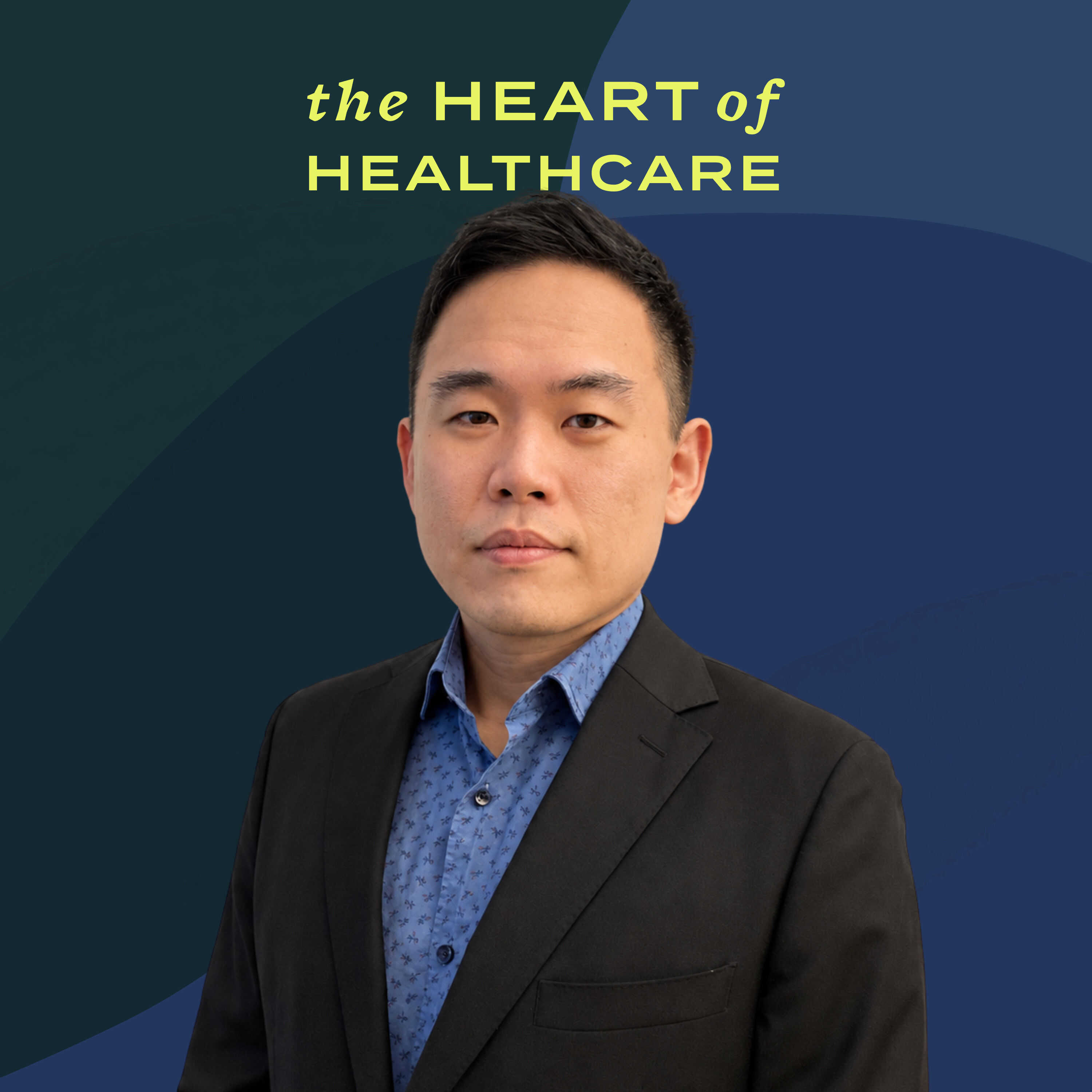
Ortet’s plan to build healthcare-specific foundation models (“universal health model”) that learn from biological, clinical, and operational data in a closed learning loop to reduce “cold start” and improve predictability of care.
Kyunghyun Cho is Ortet founder/CEO; a leading AI researcher and NYU professor. He directs the Global AI Frontier Lab with Yann LeCun. Previously, he helped lead frontier research at Genentech after his startup Prescient Design was acquired by Genentech. Cho studied CS at KAIST, PhD ML/AI at Aalto University, and did postdoc work at the University of Montreal.
Healthcare AI fails when problems/data shift after deployment; foundation models can bootstrap the loop without knowing the exact problem upfront. Ortet differentiates by embedding with stakeholders so proprietary learnings stay in their ecosystem (not just shared via a general-purpose model).
function-guided protein design for therapeutic molecules at Prescient Design; machine translation example (train Korean–Japanese using broader language pairs). Cho shares his thyroid cancer experience to illustrate uncertainty in care.
Written by AI. May contain mistakes.
Introducing Kyunghyun Cho, founder of Orteet, and highlighting his background.
“Hello, listeners, and welcome back to the show.”
Kyunghyun discusses his academic journey and transition to AI in healthcare.
“My husband, Jeff, is a founder and chairman of the company.”
Kyunghyun shares the story of founding Prescient Design and its acquisition by Genentech.
“And then that's the reason why I started to think about the Ortex.”
Kyunghyun explains the complexities of developing AI systems for healthcare.
“And in the case of the biology, that's going to be, in fact, us.”
Discussion on foundation models and their role in healthcare AI.
“And I'll try my best to kind of break it down.”
Explore the difficulties in collecting relevant healthcare data and the role of foundation models.
“And in fact, in many cases, we collect a lot of data and then only later realize that that's not the data we wanted.”
Learn why specialized AI solutions are essential for the healthcare sector compared to general-purpose models.
“Yeah, I mean, you're building a foundation model.”
Understand the importance of partnerships in the development and deployment of AI solutions for healthcare.
“This is in the case where you guys are direct competitors.”
Discover the funding dynamics and trust-building necessary for developing AI in healthcare.
“them to actually build this virtuous cycle of the AI supporting healthcare and then eventually leading to predictably better care.”
Examine the infrastructure challenges and market dynamics in AI adoption for healthcare.
“It is indeed quite expensive as well as the initial investment heavy to build this kind of AI models.”
Learn about the complexities and unpredictability in healthcare transactions.
“And then based on that, I need to decide whether I want to have that lobster or not.”
Explore how new organizations can leverage experience in healthcare.
“And, you know, you guys are building something quite ambitious without a lot of institutional history really on either side.”
Understand the vision for personalized care and its commercialization.
“Now, what is new here is this combination, this combination of Thoreau and Ortec that combines a deep and broad expertise and experience in healthcare.”
Discover the data issues hindering predictive capabilities in healthcare.
“That's the plan that we have, is that we're not solving only the one final, let's say, mission or the goal.”
Envision how healthcare may transform in the next decade with AI integration.
“Casey, you're very good at explaining these complex technical things to laymen like myself.”

Get the gist, explore an idea or ask about something said.
 Claude
On The Heart of Healthcare | A Digital Health Podcast, what are the key points of this episode?
Searching your listeningAutomatic transcript. May contain errors.
0:00Kyunghyun Cho: In my opinion, in particular in computer science, our job is to solve problems. And then our research is on figuring out what is the best way for us to solve problems that exist in the world, so that solving the problem is going to help and then positively affect the whole society. Today, Halle speaks with Kyunghyun Cho, founder and CEO of Orteet.
0:29Welcome to the Heart of Healthcare podcast. I'm Hallie Teko. I'm Michael Esquivel. And I'm Steve Krause. And every Monday, we bring you the latest in healthcare innovation as we sit down with entrepreneurs and industry experts. So buckle up and join us as we figure out how to improve healthcare for all.
0:59Hello, listeners, and welcome back to the show. I'm Hallie Teko, and today I'm speaking with Kyungyoung Cho, the co-founder and CEO of Ortex, a frontier AI lab for health. Kyungyoung is one of the world's leading AI researchers, and his work has helped shape many of the technologies behind modern AI. He is the director of the Global AI Frontier Lab with Jan LeCun, and his last startup, Prescient Design, was acquired by Genentech, where he helped lead the frontier research team until earlier this year. You may have heard about Ortet recently in the news as they raised $500 million from Thoreau, an unusually large amount for an early-stage healthcare company.
1:47And before we dive in, a very quick disclaimer. My husband, Jeff, is a founder and chairman of the company. Casey, welcome to the show.
1:56Kyunghyun Cho: Thank you for the invitation. It is my honor to be here. I'm a big fan of you, your work, and this podcast itself. Thank you. I'm excited for our conversation. I thought we could start by you telling us your story and what brought you to starting Ortet. Yeah, it's a long and somewhat unusual story or the career trajectory I have actually taken. So I was born and raised and educated in Korea until my undergrad years in computer, studying computer science at KAIST. And after that, I went to Finland to start my study grad school in machine learning and artificial intelligence in Aalto University.
2:35Kyunghyun Cho: So I spent five and a half years in Finland studying for my PhD. And do you speak Finnish? I actually did study Finnish for about half a year. But at some point, I realized that, well, now I can order coffee and breakfast. And where is the extra motivation I need? I couldn't find it. Instead, I decided to delve deeper into machine learning instead. Yeah, that makes sense. And after my grad school, after obtaining my PhD, I decided to pursue further my research career by becoming a postdoc fellow in Montreal. At the University of Montreal, I was advised by Professor Joshua Bencho, who is also a very good friend of the Yanukun, who is now my colleague at NYU.
3:18Kyunghyun Cho: And then that's when I started to look more into how to build an AI systems that can handle a highly complex and structured and unstructured combination of the different types of the data altogether, starting with the machine translation. And after spending two years at Montreal as a postdoc, I decided to become a professor. That was never my plan originally, but that's when my years in Montreal really made me feel that the research is something that needs to be done further in order to make AI, that is something that I had been working on long, to matter for real problems. So I decided to come to NYU as a professor.
4:00Kyunghyun Cho: And that was 2015. And then since then, I've been a professor starting from the assistant professor, associate professor, all the way to the full professor here. And during that time, I had a short stint as a part time research scientist at Facebook AI Research, which is now called the Metas Foundational AI Research Group. And then after that, I realized that the research is research, but then research has to be grounded on real problems that matter. And also, wood has a good chance of having the most impact in the society. And that's the reason why I started to move increasingly more toward the AI for healthcare and medicine.
4:38Kyunghyun Cho: And then that actually led me to found the Prussian design together with my colleagues back then. And then at Prussian design, we worked on AI for protein design with particular focus on how to design or optimize the therapeutic molecules. And eventually we got acquired by Genentech and then built what we call a lap-in-the-loop AI molecular design platform within Genentech. And that's how I got here. But then about six months ago, I left Genentech and came back to NYU full time and then started to think about what are the things that we really need to do to think about the health care, not as a collection of the individual problems or the individual or the independent problems, but to look at it as a full system that can actually be improved, not by solving one problem at a time, but by improving the overall system so that everyone benefits.
5:34Kyunghyun Cho: That's how I got here. And then that's the reason why I started to think about the Ortex. Yeah. Well, and let's touch upon prescient design quickly, because you were not at it very long before Genentech knocked on your door and acquired the company. Can you tell us about what happened there? Yeah, I can tell you about it. Yes, indeed, it was a very rapid, let's say, buildup of the company. and an acquisition indeed. It was about 2018 or 17 when I started to realize that the language modeling as well as the machine translation was in fact at the verge of being solved. And then when I say being solved from the academician's perspective, it means that the technology has matured enough to the point that this was going to be productized and it should be productized by industry so that it can be used by a much broader set of people as products rather than as the academic papers.
6:35Kyunghyun Cho: So that's when I realized that I have to think about the other set of the challenging problems that I can ground my own research on. And I did a lot of exploration there. And then one of the areas that I got stuck with by talking with Rich Bono, who was my colleague and co-conspirator for the Prussian design, was the protein design. And then why is that? Because by having a long conversation or a series of the conversations, we realize that there is a common theme that is shared between human language and then the language of life. And then that is that somehow everything is encoded as a string.
7:14Kyunghyun Cho: And then this long string that encodes the information about the biology and the humanity and everything is going to be processed by a highly complex and nonlinear mechanism. It could be our own brain, understanding the text, or it could be, in fact, the biology. So our molecular mechanisms that's going to read and then implement what is written down in the gene sequences. And then they all resorts in a highly functional organisms or the entities. So in the case of the language, that's going to be meaning. And in the case of the biology, that's going to be, in fact, us. So we started to work on this idea of using AI that was developed and then invented for language processing and machine translation for the purpose of understanding how the proteins work.
8:03Kyunghyun Cho: That was about 2018 and 19. And then around 2020, let's say it was a summer 2020, we had a bit of a breakthrough ourselves. We could really see that the technologies that we are developing and creating were able to produce or let us design new proteins that are going to have whatever the properties that we desire them to have. And then that's what we call as a function guided protein design. And, you know, whenever we have a new breakthrough in academia, we have to decide on what we are going to do. And then the first decision criterion is where we are going to get funding from. And of course, the default answer is to write a grant proposal to federal funding agencies, go through the multiple rounds of the reviews, hoping that it's going to be eventually funded, and then start doing the actual research using the funding that we get from these federal agencies.
8:58Kyunghyun Cho: I did some quick back-of-envelope calculation back then, and I wanted to see how long it's going to take for me to see the first protein that's going to be synthesized and that was designed by our algorithm. And then my backup envelope calculation told me that it was going to take about three to four years. And instead, I talked with the rich as well as Vlad, who was the third founder of the pressure and design, that we should go talk to the investors and also we should start making company and then we do it ourselves. And then that's how we started a pressure and design. And as we are developing and then talking to the investors, potential partners, we realize that it's not really just the computers.
9:42Kyunghyun Cho: Any proteins that are designed and are validated in silica on the computers are not proteins. They're not proteins. They're just a series of the bits. So we realize that what we really have to do is to validate it with the real proteins that has been synthesized. And then that's about the time when Genentech, in particular Aviv Regev, reached out to us and then suggested that we do that kind of validation quickly and then also with the potential impact that cannot be higher than that within Genentech. Because at the end of the day, Genentech is where the protein therapeutics was indeed developed or invented.
10:25Kyunghyun Cho: So we had a lot of heated and also the interesting discussions back then. And then eventually I was and then all of us were convinced that there is a right place for us to implement and build this whole platform in the context of the actual synthesis and then testing in the experimental setup. So you're an academic, but an academic that is impatient and ready and willing to partner with industry if that means getting your inventions out in the world faster. Absolutely. In my opinion, in particular in computer science, our job is to solve problems. And then our research is on figuring out what is the best way for us to solve problems that exist in the world so that solving the problem is going to help and then positively affect the whole society.
11:17Kyunghyun Cho: So in that sense, I feel like as an academician in computer science, it's almost my job to do research and then translate the research into something that is more real than academic papers. Yeah. Okay, so you've described what Orte is building as a shared intelligence foundation designed to learn from biological, clinical, and operational data in a closed learning loop. That is technical. That is a mouthful. Can you break that down for our listeners? It is in this mouthful. I agree with you there. And I'll try my best to kind of break it down. And then to do so, I need to actually talk a bit about what we mean by AI or United Machine Learning ML.
12:05Kyunghyun Cho: So when we think about AI, and then if you just read about all those press releases coming out of the frontier AI labs, as well as from universities, it feels like there is a one algorithm that we are going to use to produce one model that's going to work better than before in solving a lot of different problems. But unfortunately, that is not how AI works. AI is, in fact, the platform or the system that consists of trying to figure out what problem we want to solve. And then based on that one, trying to figure out how we are going to evaluate the system that we have built to solve that problem.
12:41Kyunghyun Cho: And also, then we can now think about what kind of data we need in order to build such a system. And then only then this training of big models come in. Once we have trained this model, we need to deploy it in order to ensure that this deployed model indeed solves a problem that we wanted it to solve. And that's often not the case. There are a number of reasons because we have often a very low visibility into what the real problem is. And the second is that by the time we deploy the model, the problem has evolved. problem is not something that stays static. As the world evolves, what problem we want to solve also changes as well.
13:25Kyunghyun Cho: And then what that means is that we need to then come back by collecting more data, evaluating better, sharpening our training algorithms, and then train the model and then deploy it again. So this full loop is what we call as an AI and machine learning. And in doing so, there's one particular problem that is really difficult to tackle. That is the problem of the cold start. So I talked about the collecting data and I talked about the difficulty in understanding what the problem itself is. If we don't understand the problem well enough, how do we know what is the right data to collect so that we can train a model that's going to work well?
14:04Kyunghyun Cho: In fact, it's a very difficult problem. And in fact, in many cases, we collect a lot of data and then only later realize that that's not the data we wanted. because the most important and highest quality data is the data that you collect with the actual purpose. But if you don't know what the purpose is, you cannot really collect the data well. Now, this is a challenge that needs to be tackled. And then the reason why we are talking about this kind of foundational or the foundation model, and then why everyone is excited by the emergence of the foundation model is the fact that these foundation models can help us solve this problem of the cold start.
14:45Kyunghyun Cho: The idea is that we are going to collect as diverse set of data from the broad group of the sources. And then we train one model without any particular direction, but we let this foundation model to capture all the relationships or the associations that exist across the diverse sources of information. And then by doing so, this foundation model captures the information that may be relevant for the downstream task that we really want to solve without realizing precisely what the problem was. And then this allows us to bootstrap our process into the point where we can go into this loop more readily without having to worry about knowing about the problem precisely before we know how to solve it, because those Those two things actually go hand in hand.
15:43Kyunghyun Cho: So at Ortec, our goal is along this line, but much more focused on health. In order to think about all the problems that we will need to solve down the road, that is to provide or to build a predictably better care system for everyone, it's really difficult for us to precisely write down every single detail and then collect exactly the data that is needed for us to solve that problem alone. What we need to do is for us to have a foundation model that's going to capture all the relevant information as well as associations that exist across the entire system. So that later on, when we solve this ultimate problem, this foundation model is going to allow us to bootstrap our process and then go into this virtual cycle earlier rather than later without much of the mistakes at the beginning.
16:36Kyunghyun Cho: So it's a pretty long story. Yeah, I mean, you're building a foundation model. So you're building an open AI or Anthropic for healthcare, specifically to solve healthcare problems. And we've had healthcare leaders from both of those companies on our show, and both are very ambitious about working with hospitals and pharma specifically. So I have to ask you, why won't either of them be Ortex? That's a great question. And then I must say that you're not the first one to ask me that question. Every healthcare AI founder hears that. It's like, why won't OpenAI do this? Yeah, it's an annoying question, but we have to know.
17:22Kyunghyun Cho: Absolutely, absolutely. And then I have to say that I don't think I can say on their behalf that they are not going to do it. And in fact, knowing and then understanding the complexity and then how important this whole problem of health care or just healthy self for everyone is. I would even want them to work along with everyone in this world and in particular in the AI community to lend their support because this is the problem we want to solve. After all, no one can opt out of health care. Everyone gets sick or, you know, they hurt themselves or whatnot without planning. So thereby, we are all part of the healthcare.
18:08Kyunghyun Cho: And then what that means is that we all have the responsibility to contribute to making it better and then making it more predictable. And then if OpenAI and Anthropik, which has an amazing depth and breadth of the talents, as well as the technology, if they could actually lend their support, I definitely want them to do so. But that being said, a hospital is probably going to choose an Anthropic or an Ortet. This is in the case where you guys are direct competitors. So maybe we can like zero in on why you want the stakeholder to choose to work with Ortet and not one of the general purpose foundation models.
18:54Kyunghyun Cho: Yes, that's a great point. And so how I think about it is that being able to solve a problem is only one side of the story. And then the other side of the story is that every organization, every person eventually has to decide and choose which problem to solve. And then what ORTED has decided is to, in fact, choose to work on this particular area that is the health care. And then how we do that is by working with all the stakeholders and embedding ourselves deeply into the entire system. And then by doing so, what we are doing is not to try to sell the product of intelligence to the stakeholders within healthcare, but we want to be part of the healthcare, working together with partnering with the stakeholders so that what they actually benefit from, that is an accumulation of the knowledge, improvements of care, will in fact stay within their own ecosystem that we create together with them.
20:02Kyunghyun Cho: And then thereby, there is a virtuous loop that happens. So we build the initial foundation model in partnership with them. We're going to fine tune or specialize these models to tackle or address the real problems that all the stakeholders like the providers are facing. And then once we deploy this system, as we talked about earlier, we need to close this loop. So the learnings from the deployment will come back to these models that are going to help the providers to provide even better care based on the better model that is created based on their own experience as well as their own knowledge and know-how.
20:42Kyunghyun Cho: And then there will be a kind of accumulation of the knowledge as well as the know-how via Ortex being part of this whole ecosystem. So in that sense, what I believe is that the providers as well as all the stakeholders in healthcare shouldn't think of us as trying to sell our product, but they should think of us as a partner who will enable them to actually build this virtuous cycle of the AI supporting healthcare and then eventually leading to predictably better care. Okay. Let me make sure I understand what you're saying. with a general purpose foundation model, the model, it gets better broadly over time.
21:25So the learning ultimately benefits everyone using it, including potentially your competitors. Whereas you're saying that if I'm a stakeholder working with Artet, partnering with Artet, the learning from my proprietary data and expertise that accrues specifically to me and my organization, I end up with like a custom model that is uniquely mine and not part of a general purpose model that then sells to my competitors?
21:54Kyunghyun Cho: Yes, that's true. Essentially, the know-how and then you have the experience accumulates and then it helps. And then what we do is not just giving them the API access to models or the particular product, but we are going to build up the full stack of the artificial intelligence that goes from the compute infrastructure all the way to the models that we evaluate together with our partners, train together with our partners, deploy together with our partners, and thereby plugging all of them into our partners' direct workflows themselves. Because workflow as well as how they operate will differ from one place to another.
22:34Kyunghyun Cho: And then we actually ensure that it's going to be best for each and everyone's operation and how they actually provide care to the patients. Yeah. Okay. So most of my career, a first round of funding was generally$500 ,000, maybe one or$2 million. We are starting to see massive funding rounds, including our tech. You guys have 500 committed for your very first round. I mean, you guys are really at the beginning of this. Is that because it's just super expensive to build these models? There are two reasons or the aspects to this commitment that we have received from Thoreau. And the first one is more philosophical than practical.
23:24Kyunghyun Cho: The first reason is because healthcare, the mission that we have, that is to enable predictably better care for everyone, is not only challenging, but it's a massive, let's say, mission that we are actually going to achieve. And what this means is that we not only need the capital, but what we need is a confidence and trust from our close partner who is well connected and is embedded into the healthcare system in us. So that is that can we really go into the system, embed ourselves, and then work with the multiple layers and groups of the stakeholders to ensure that we can build this foundation model that we call often as a universal health model that can benefit everyone.
24:12Kyunghyun Cho: And then in order to build this, we need a trust and a confidence from everyone. And Thoreau, the platform is committing$500 million to Ortec, gives us this level of the confidence and confidence that we can gain trust from the stakeholders. So it's really not about whether we need that particular money for buying trust, but this commitment is in fact a show of the trust. And then also having accepted this commitment is our way of saying that we are going to do our best based on the confidence that has been made on us. So that's the first aspect. But of course, I'm not going to say that that's the only reason.
24:56Kyunghyun Cho: It is indeed quite expensive as well as the initial investment heavy to build this kind of AI models. And in doing so, again, we are not talking only about the models or the large models. But what we want to do is to bring the full stack of AI full stack to the healthcare system by being embedded there and then building up the full thing and then provide a transparency. We want to provide visibility not only into which kind of answers these users are going to get by using our model, But we want to provide a visibility into how the model is served, how the model was trained, what kind of data was collected, what kind of data was used, what kind of even the cluster these models are being trained and served from.
25:48Kyunghyun Cho: And then how we are ensuring that these clusters as well as the compute is well secured. So in order to provide the kind of full visibility into the full stack of AI, we actually need to have enough capitalization to have ourselves the visibility and control over all the layers of the stack. That's the reason why we need some early and large scale commitment. And in a past conversation we had, you had a good analogy for helping me understand why compute is so expensive with like the lobster market price. Maybe you can share that with our listeners. Absolutely. We are really at the very beginning of this curve of the adoption of the AI throughout the whole society.
26:34Kyunghyun Cho: But then, fortunately or unfortunately, I mean, it depends on which side you're sitting in, this rapid adoption requires us to have a rapid deployment of the infrastructure. And when it comes to AI, that infrastructure is compute. Now, when I say compute, it refers to GPUs, of course, CPUs, memory, as well as power transformers, cooling equipments and whatnot. But all those things need to be rapidly deployed. And then to the point that everyone needs to do it now, everyone feels like they need to do it. So thereby, the market is such that the demand outstrips the supply so much. Nowadays, in order to just get the GPUs, you cannot simply open your laptop, go to one of these cloud vendor sites, and then just click and then type down how many GPUs you need.
27:25Kyunghyun Cho: And then you see the price, put your credit card number, and then get it. That's not how it works anymore. Unfortunately, due to the limited supplies, we now need to literally go sit there, talk to our vendors, just like we would talk to the server or the restaurant host, and then ask them about what is that MP there on the United menu next to the lobster rolls. And then we are going to hear that, oh, there's a market price. And it changes every day based on the supplies. And I have to ask them, how much is it today? How much will it be next week? And then based on that, I need to decide whether I want to have that lobster or not.
28:05Kyunghyun Cho: And then if I do, I need to pay. So it's a very interesting time, but it's more or less an anomaly in my opinion. It's going to get resolved over time. Yeah, well, and you're buying, like companies are buying futures. They're like buying futures, which is just so wild. Absolutely. Okay. So, or TED is new, Thoreau, you know, your big funding partner is also new. That is like really unusual for a healthcare company. I mean, healthcare companies, those with the most power and money tend to be these large, older incumbents. And, you know, you guys are building something quite ambitious without a lot of institutional history really on either side.
28:46Do you think that being new gives you an advantage?
28:51Kyunghyun Cho: So organizationally, yes, Thoreau is new or TED is new. You're absolutely correct there. However, if you look at who are these people behind both Thoreau as well as your TED, we're not actually new at all. We saw in Thoreau this amazing depth and breadth in healthcare, both the operations as well as all the other aspects. And then Thoreau has this amazing depth. And then Ortead, if you look at the individual founders as well as the founding members and the ones who are going to join over the next few weeks to a few months, We have an extreme depth of the technical expertise as well as the experience in building AI models, creating AI algorithms, and even deploying these AI models over a large-scale compute that we built.
29:40Kyunghyun Cho: And furthermore, many of the founders of the ORTET in particular are the ones who were deploying and using and creating these AI models for life sciences and in particular in pharmaceutical and drug discovery. So I'm going to say that, yes, organizationally, we are very, very new. However, individually, we have very deep expertise as well as experience. So perhaps it's almost like the old but new, let's say, organizations we have built. Now, what is new here is this combination, this combination of Thoreau and Ortec that combines a deep and broad expertise and experience in healthcare. And then the deep and broad expertise in AI.
30:23Kyunghyun Cho: So having these two almost equally combined within this platform is something I believe we're going to bring as a new to the whole ecosystem. Now, what can we do now that we have a deep expertise and experience in both of these? I think that's the new and then that gives us a huge advantage in going forward. So Presume or Tech can help make this shift towards personalized care for everyone, which is the big vision here. What is the pathway from here to there? How will you actually commercialize and monetize this business? Yes. So what we mean by personalized care for individual patients is equivalent to saying that we want to minimize the unpredictability and uncertainty that is everywhere within healthcare.
31:17Kyunghyun Cho: And then when I say healthcare here, I'm going to actually use a blank space between health and care to say that the unpredictability... Oh, no. One word. You're a two-word healthcare person. Okay. I'm going to go for two-word healthcare in this particular answer. So I myself went through some of the health scares as well as the experiences that I did not want to have and I did not predict that I was going to have. So I was diagnosed with thyroid cancer. And then under the excellent care by the care team at NYU Langone, everything went so well. And then, you know, thanks to the amazing medicinal, let's say, I would call it miracle.
31:57Kyunghyun Cho: I don't have a thyroid. So that's a major organ in our body. And still, all I need to do is take just a one tiny pill every day in the morning. And then I can just function as if I still continue to have the thyroid. And then this is amazing. But then during that period, that about six months between the confirmation by the biopsy, and then the end of the radioactive iodine therapy was the most confusing and uncertain period of my life. And then because of the lack of the predictability was really making me confused and also scared at the same time. And then if you think about how the health and care work, is that due to the inherent complexity of biology, as well as even the society and the nature itself, a lot of things are simply unpredictable.
32:48Kyunghyun Cho: Whenever we go to hear about what happens to a particular disease or what happens to particular treatments, there's always a disclaimer put by the experts talking about how there can be a lot of exceptions, how this is only a preliminary resource and whatnot. And then what we want is that by saying personalized care, the predictably better care, we want to lower this level of the unpredictability. And then by lowering this unpredictability, by building universal health model, that knows all about all the relationships within the whole system, the commercialization is going to happen not only at the very end of our mission, but along the way because everyone needs to have a higher level of predictability.
33:33Kyunghyun Cho: Clinicians need to have a higher level of predictability on what's going to happen to the patient based on their providing of the care. Hospitals need to have a much higher predictability in order to operate the hospital in a way that is sustainable. And then that is going to improve the care overall. Payers also need the predictability on how the patients are going to react to different, let's say, treatments. Of course, pharmaceuticals need the predictability on how the molecules that are designed at the early discovery stage to work on the patient directly. And then once we actually resolve all those issues, what we are going to look at is that now with this heightened level of predictability, can we in fact make the system to provide a better care and then pay for the health itself?
34:27Kyunghyun Cho: And in doing so along the way, there will be so many different commercialization opportunities from every possible stakeholder and aspect of the care system. That's the plan that we have, is that we're not solving only the one final, let's say, mission or the goal. But we're going to have so many things that are going to be solved along the way because all these problems share this one common theme, is that we need to have a much higher level of predictability. And from your perspective, what's the right data that we need? And what is the data problem that we face today that's preventing us to have a higher ability to predict outcomes?
35:08Kyunghyun Cho: So I'm going to look back to the very early conversation we had about how AI is about a loop rather than a one-off solution. And then there, what we talked about was the difficulty of starting the whole loop, the cold start issue. And then in order to address the costar issue, we started to see that these foundation models work really well. And how this foundation model started was to train one model, a large model, that's going to learn from all those different sources of information simultaneously in order to find all those bridges. And then in doing so, sometimes some of the sources of the information or the data that we didn't even think they was going to be useful ends up being very useful.
35:54Kyunghyun Cho: One example I often give is on the machine translation side. If I want to build a machine translation system to translate between, let's say, Korean and Japanese, it feels like the right data we need to collect is a lot of the so-called apparel sentences between Korean and translation of Korean in Japanese and vice versa. However, what we have already seen empirically as well as theoretically is that it's better to train a machine translation system using all the translations that include the languages outside Korean and Japanese. Because these systems, these AI models will learn to essentially bridge going over the different languages between Korean and Japanese to learn better about these two languages.
36:40Kyunghyun Cho: And then that's what needs to be done in healthcare as well. So that's why I don't really talk about any one particular problem here, because once I talk about one particular problem, then everyone, including myself, our minds go directly to finding the right data for that problem. That's good for evaluation. But for training and building these foundation models, we need to look at all the other sources of the data so that this AI model or the algorithm has a chance to capture all possible relationships that may be indirect via the other sources. So what we are now working on, together with the support and the partnership with Thoreau, which is very important in this aspect, is to ensure that we are embedded in the system and work with the as diverse set of the stakeholders so that we will be able to work with them and then build an AI system that uses all those often siloed and fragmented data together so that our Ortec Health model is going to have knowledge that is needed to solve all the specialized problems much better than we can.
37:42Kyunghyun Cho: before. Casey, you're very good at explaining these complex technical things to laymen like myself. So thank you. And I'm sure a lot of our listeners that aren't technical also appreciate your very just like plain English explanation of it. To close out our conversation, I'd like to know if your vision for ORTET works out exactly as you wish. What does healthcare look like 10 years from now? How does it look different because of Orte? Yeah, this is a big thing. I mean, what I hope is that there will be a better answer for everyone in a sense that, as I said earlier, I'm going to just repeat it.
38:25Kyunghyun Cho: I learned it throughout my own kind of experience being at hospitals, going through the surgeries and whatnot, that no one opts out of the healthcare. Everyone will need to rely on the care by the society. And then thereby, everyone will have a different answer and then they're going to feel it differently. But what I hope everyone is going to feel is first that they will going to feel less uncertainty about what they are going through and how they think they are going to end up with. So we want to reduce the uncertainty so that the patients will have a much higher degree of confidence on the outcome of their own health.
39:05Kyunghyun Cho: And then clinicians will also have a much higher degree of confidence on what the patient outcome is going to be by working together with the Ortes, let's say, AI platform. Providers are going to have a much higher degree of confidence that the services they are providing are going to be directly related to the better outcome. And then the payers, by the way, when I say payers, it's not only about the insurance companies, because at the end of the day, because no one can opt out of the health care, we as a society, we are all paying for each other. We're all paying for it. So we, the payers, will know that what we are paying for, either for us or everyone else in the society, will again be directly correlated or will actually cause the better health outcome.
39:54Kyunghyun Cho: That is that eventually what we want is that 10 years, 15 years later, our test success will imply that the care, what we pay for, what we actually go through will directly impact or directly lead to a predictably better outcome rather than services. Awesome. I'm down for that future. So good luck with everything. And thank you so much for your time today. Well, thank you very much for the invitation again, and I really enjoyed the conversation.
40:53by Kyle Moore. Visit our website, heartofhealthcarepodcast.com for show notes and details.
One of the world’s leading AI researchers has big plans for healthcare. And Thoreau just committed $500 million to bring that vision to life.
This week, we are the first to sit down with Ortet founder and CEO Kyunghyun Cho to talk about the frontier AI lab for health. After helping shape some of the technologies behind modern AI and selling his last AI startup to Genentech, Kyunghyun is now taking on a much bigger challenge: building a foundation model that can learn across biological, clinical, and operational data to deliver predictably better care.
We cover:
About our guest:
Kyunghyun Cho is the founder and CEO of Ortet and the Glen de Vries Professor of Health Statistics and a professor of computer science and data science at New York University. Through his AI research, he co-developed the attention mechanism and the gated recurrent unit, both foundations of modern AI technology. Prior to founding Ortet, Kyunghyun built an AI platform for lab-in-the-loop molecular design, co-founding Prescient Design and, following its acquisition, establishing Genentech’s frontier research team. He previously served as a research scientist at Facebook AI Research (FAIR) after completing his postdoctoral fellowship at University of Montreal under the supervision of Prof. Yoshua Bengio. He received MSc and PhD degrees from Aalto University under the supervision of Prof. Juha Karhunen, Dr. Tapani Raiko and Dr. Alexander Ilin. Kyunghyun received the Samsung Ho-Am Prize in Engineering in 2021 and has served as a (co-)Program Chair of ICLR 2020, NeurIPS 2022 and ICML 2022, and also on the boards of ICML and ICLR.
📍 Connect with us:
See Privacy Policy at https://art19.com/privacy and California Privacy Notice at https://art19.com/privacy#do-not-sell-my-info.