Ask ChatGPT


 The Indicator from Planet Money
13 Oct 2026 · 9m · 3 chapters
The episode explains what Robert Hall and Michael Woodford won the “Nobel Prize in Economics” for, and how the prize itself was created in 1960s Sweden by the central bank rather than Alfred Nobel’s original will. It traces the shift from Keynesian macro models to New Keynesian economics after the 1970s oil crisis, emphasizing microeconomic foundations and expectations in macro stabilization. It also questions whether it should be called a Nobel Prize, noting its political origins and central-bank funding.
John Hassler, chair of the Economics Prize Committee; Gabriel Söderberg, economic historian at Uppsala University (co-wrote The Nobel Factor).
The prize is “Nobel-like” but not a true Nobel; it helped add scientific credibility to market-liberal ideas; Hall/Woodford rebuilt macro models from micro behavior and expectations.
1970s oil crisis (stagflation); Sweden’s 1968 unveiling and 1969 first award; Royal Swedish Academy of Sciences selecting winners.
Written by AI. May contain mistakes.
Explore the significance and history behind the Nobel Prize in Economics.
“He believed governments could fight recessions by boosting spending and curtail inflation by restraining it.”
Delve into the political and historical backdrop of the economics prize.
“It's Alfred Nobel's home country, where most of the Nobel action takes place.”
Discuss the criticisms of the economics prize and changing perceptions over time.
“Some argue that like, hey, sure, this prize wasn't in Alfred Nobel's original will, but like, who cares?”

Get the gist, explore an idea or ask about something said.
 Claude
On The Indicator from Planet Money, what are the key points of this episode?
Searching your listeningAutomatic transcript. May contain errors.
0:01Michael Woodford: NPR.
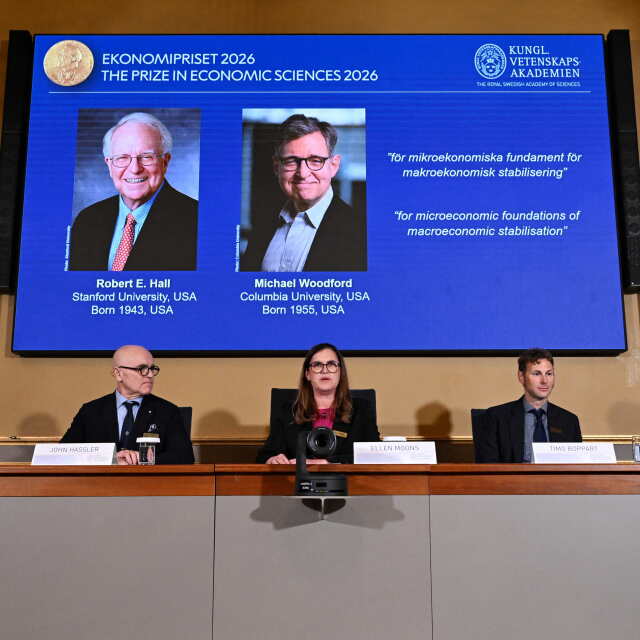
0:05Michael Woodford: This year's Nobel Prize in Economics went to two economists, Robert Hall at Stanford University and Michael Woodford at Columbia University. Ellen Moons, Secretary General of the Royal Swedish Academy of Sciences, said they gave them the award.
0:21Robert E. Hall: For microeconomic foundations of macroeconomic stabilization.
0:28Michael Woodford: That may sound like a lot of mumbo-jumbo, but it's econo-speak for basically a revolution in macroeconomics. That's the study of how the whole economy works and how to stabilize it. You know, make its ups and downs less like a wild roller coaster. The father of macroeconomics was British economist John Maynard Keynes. He believed governments could fight recessions by boosting spending and curtail inflation by restraining it. He inspired a generation of economists who built models that guided policymaking. Here's John Hassler, the chair of the Economics Prize Committee, this Monday morning.
1:06Robert E. Hall: For a long time, the recipes of Keynes seemed to work. But they then failed during the oil crisis in the 1970s, when high unemployment and high inflation took over simultaneously.
1:21Michael Woodford: Enter Hall and Woodford. They helped rebuild macroeconomic models from the ground up, starting with the micro, how people and businesses decide to spend, save, and invest, and how their expectations of tomorrow influence what they do today. Their work helped shape what's known as New Keynesian Economics, which continues to guide policymakers around the world. Many headlines will call this award the Nobel Prize in Economics. But can we really call it that? I'm Ricky Mulvey. And I'm Greg Rozalski. Today on The Indicator, how the heck did we get a Nobel Prize in economics? Can we even really call it that?
2:00Michael Woodford: And what happens when a prize honoring science gets all tangled up in politics? We travel back to the 1960s to get this awards origin story.
2:13Robert E. Hall: Stay tuned for the following announcements and messages from our sponsors. This message comes from Prolon. Want to look and feel your best this fall? Prolon's five-day fasting mimicking diet is a clinically developed nutrition program with the goal of promoting fat loss while protecting lean body mass. Developed at USC's Longevity Institute, it aims to assist the body in entering a fasting-like state that helps reset metabolism, target visceral fat, and support healthy metabolic markers. Get 15 % off plus a bonus gift when you subscribe at prolonlife.com slash NPR. This message comes from Superhuman.
2:49Robert E. Hall: Superhuman brings together connected tools like Grammarly, Docs, and Mail into one productivity suite. Built on the idea that low-value tasks crowd out meaningful focus, Superhuman meets teams where they already work. It operates proactively alongside writing and email workflows to help clear what is in the way. Superhuman, from the makers of Grammarly. Start streamlining your workflows with Superhuman today at superhuman.com. This episode's sponsor is HubSpot, which offers the following message. What if instead of updating your CRM, your CRM updated you? HubSpot's self-updating CRM keeps your customer context current so you can win more deals.
3:31Robert E. Hall: Learn more at HubSpot.com.
3:36Michael Woodford: To understand how economics got its prize, we're heading all the way to Sweden. It's Alfred Nobel's home country, where most of the Nobel action takes place. The prize we tend to call the Nobel Prize in Economics, it actually has a much longer official name. In Swedish, it goes something like this.
3:55Robert E. Hall: So it's Sveriges Riksbank's Prize in Economic Wissenschaft to Alfred Nobel's minne. That's Gabriel Söderberg, an economic historian at Uppsala University in Sweden. He co-wrote a book about the prize titled The Nobel Factor. What he just said translates roughly to the Swedish Central Bank Prize in Economic Sciences in memory of Alfred Nobel.
4:16Michael Woodford: Try putting that in a headline because it's my nightmare. Anyways, the official name of this prize, it tells you something about its origin story.
4:25Robert E. Hall: Because it is a central bank that creates this prize. The story begins back in the 1960s. The Swedish central bank, the oldest central bank in the world, is going to turn 300. And its governor, per Osbrink, he wants to make a big splash.
4:41Michael Woodford: For years, Osbrink has pushed for more independence and prestige for his central bank. In 1957, he actually raises interest rates without consulting the government. And Sweden's elected leaders, they're furious. He almost loses his job over this.
4:56Robert E. Hall: But Osbrink turns out to be quite of an ambitious man and also not afraid to take bold actions in order to promote himself. The bank had extra money to spend, and Osbrink wanted to do something grand for the bank's approaching 300th birthday. You know, like midlife crisis stuff, buying a boat, taking up golf.
5:17Michael Woodford: At first, Osbrink is like, maybe we should like fund some prestigious economist to publish some papers or a book or something. Then he's like, ah, that's pretty boring. And then it hits him.
5:27Robert E. Hall: What if the bank creates a new fancy prize that celebrates leading economists? What if it was a Nobel Prize, one for economics?
5:38Michael Woodford: Why make it a Nobel Prize and why not just make it the Swedish Central Bank Prize?
5:43Robert E. Hall: So this, I think, has to do again with associating yourself with the international prestige of the Nobel Prizes. because already at that time, the Nobel Prize has a huge international prestige. But of course, Osbrink can't just slap Nobel's name on some random award. He needed buy-in from crucial stakeholders.
6:04Michael Woodford: First, the government. Sweden's governing party is the Social Democrats. They're a left-of-center party that supports active government intervention in the economy. This was kind of the peak of Keynesian economics. The idea that government spending and taxes can help fight recessions and keep people employed. It was viewed that economics was a supporting factor of social democracy.
6:27Robert E. Hall: Economics made social democracy scientific.
6:30Michael Woodford: So this is the heyday of technocrats managing the economy.
6:33Robert E. Hall: Yeah, technocrats, social engineering, you got it.
6:37Michael Woodford: So this left-leaning government, it actually sees economics as an ally in their political project, and they get on board. Now Osbrink has to convince the Nobel family. And they actually did not want this prize.
6:51Robert E. Hall: Gabriel and his co-author recount a story from one of Nobel's relatives in their book. After agreeing to set up the new prize, the Nobel Foundation visited the oldest living member of the Nobel family to get her approval. She was 87. She reluctantly accepts. But she insists that this award be given a name that sets it apart from the original Nobel Prizes. What then they agreed to? Let's do a prize in the memory of Alfred Nobel, but it won't be a real Nobel Prize.
7:21Michael Woodford: In May 1968, Ansbrink unveils this prize at the Swedish central bank's 300-year birthday party. The Swedish parliament, it approves it afterward. The first prize in economics, it gets bestowed in 1969. And to this day, the central bank supplies the money for the prize, not the Nobel Foundation. But it doesn't choose the winners.
7:43Robert E. Hall: That's the Royal Swedish Academy of Sciences, the same institution that awards the Nobel Prizes in physics and chemistry.
7:50Michael Woodford: And the economics prize winners are awarded this prize alongside the other Nobel winners. It all takes place at a fancy Nobel ceremony event in Stockholm. They wear these nice suits. Fruk. Is that what, how do you say it? Fruk. Fruk. It's like a type of...
8:08Robert E. Hall: Yeah, a penguin suit.
8:10Michael Woodford: Fruk. It sounds like a curse word.
8:14Robert E. Hall: Some argue that like, hey, sure, this prize wasn't in Alfred Nobel's original will, but like, who cares? It goes through the same rigorous process as other science-related prizes. It's still the most prestigious prize in economics. Does the name really even matter?
8:29Michael Woodford: But Gabriel's criticism of this award goes beyond just the name. In The Nobel Factor, he and his co-author, Oxford economic historian Avner Offer, they argue that the prize ended up helping give a sort of scientific gloss to fundamentally political ideas, ones that favored unbridled capitalism.
8:50Robert E. Hall: What we came to see is that during a time in the history of the Nobel Prize, there was, let's call it a conjunction between, we can call it market liberalism, neoliberalism, and what passed for science in economics.
9:06Michael Woodford: But since the book came out in 2016, Gabriel has actually softened his views on the prize. I've definitely made my peace with it. One reason, the Nobel Prize has increasingly been awarded to people who test theories against real-world evidence and create new theories. Like this year's winners, when old-school macroeconomic theories failed to explain the real world, Robert Hall and Michael Woodford helped update them. Gabriel still has his criticisms of the prize, especially its history. The way he sees it, it was born out of politics and the ego of a Swedish central banker. But he's come to appreciate what it aspires to celebrate.
9:46Michael Woodford: It commemorates the view that social science, and I say social science, not economics,
9:53Robert E. Hall: social science should strive to become scientific. And all science should strive to achieve truth. And I think this is really what is the beautiful kernel about the economics prize.
10:10Michael Woodford: I'm hoping this means that we can call it the Nobel Prize in Economics, because there's no way I'm going to call it the Swedish Central Bank Prize in Economic Sciences in memory of Alfred Nobel. That is like an essay. This episode was produced by Angel Carreras and engineered by Jimmy Keely. Thanks, guys. It was fact-checked by Sierra Juarez. Killing it, Sierra. Kate Kincannon is our editor. Woo! Kate! What's happening? And then the indicator, the indicator, it's a production of NPR.
10:49Robert E. Hall: Stay tuned for the following announcements and messages from our sponsors. This message comes from Google Workspace with Gemini. Ever notice how every new AI tool asks you to explain your business to it all over again? Google Workspace with Gemini skips that. You get Google's AI built right into the premium versions of Gmail, Google Docs, Sheets, and more. No new tools, no extra logins, just one subscription that gives you personalized AI right inside your actual workflow. Try Google Workspace with Gemini at goo.gle slash workspace with Gemini.