Ask ChatGPT


 The Indicator from Planet Money
7 Oct 2026 · 9m · 5 chapters
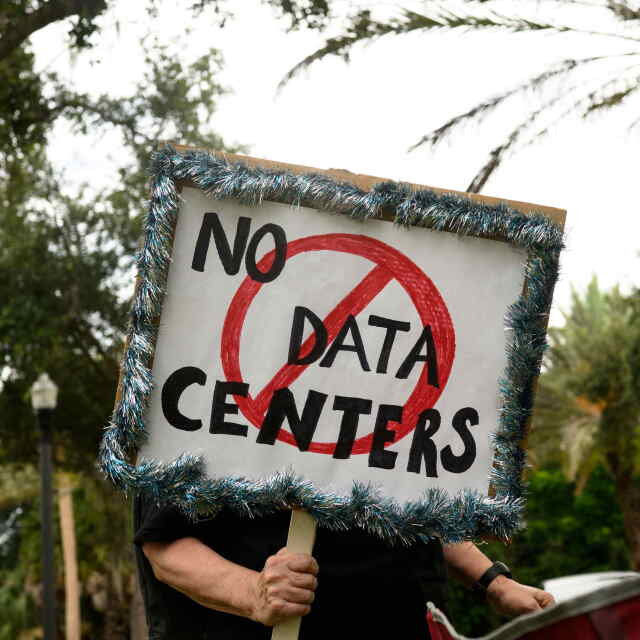
Anxiety that AI data centers will strain local power grids and raise electricity bills; economist Julia Cartwright argues against panic, saying history shows prices can fall when incentives spur innovation.
Julia Cartwright is a senior research fellow at the American Institute for Economic Research, a free-market, limited-government think tank.
The “doomsday” logic is flawed—higher prices signal entrepreneurs to solve problems. Data center energy costs may rise locally short-term, but long-run adaptation should prevent sustained higher electricity prices. Subsidies and tax breaks should be reduced to force efficiency.
1980 Global 2000 Report predicted electricity prices would rise ~150%; by 2000 they fell >25%. Whale oil replaced by kerosene; copper replaced by fiber optics. Private responses include power generation investments by Anthropic, Alphabet, Meta, OpenAI, and Amazon; efficiency gains like Stanford’s reported 280-fold drop in AI query cost over two years.
Written by AI. May contain mistakes.
Discussion on why rising data center usage shouldn't cause panic.
“But today on the show, our guest argues that this isn't a reason to panic.”
Julia Cartwright discusses historical predictions about energy prices.
“They said, hey, we do not have the capacity or resource abundance to meet the demands of particularly electricity in the future.”
Explaining how rising prices can lead to innovation in energy.
“Just to put a little bit of context here, I read one analysis that electricity usage from data centers will double or triple in the next few years.”
Julia discusses how local governments are adapting to data center challenges.
“So Julia believes American ingenuity will help us solve our data center dilemma.”
Discussion on public backlash against data centers and how to engage.
“Obviously, we love economists on this show, but I think you could accuse a lot of economists of having sort of like terminally long run thinking where they say like, well, in the long run, everything works out.”

Get the gist, explore an idea or ask about something said.
 Claude
On The Indicator from Planet Money, what are the key points of this episode?
Searching your listeningAutomatic transcript. May contain errors.
0:00N. P. R.
0:06This is The Indicator from Planet Money. I'm Ricky Mulvey. And I'm Adrian Ma. It can feel rare these days to find a hot-button political issue that unites Americans across the ideological spectrum. But AI data centers might be it. AI data centers. They're big and noisy and they guzzle energy. And in some cities around the country, they're putting a strain on local power grids. No wonder in a recent Pew survey, 50 % of Americans said they think data centers will be mostly bad for home energy bills. Yeah, and at a time when millions of Americans are seeing rising costs for utilities, and a whole lot more, this is just one more thing for them to worry about.
0:45But today on the show, our guest argues that this isn't a reason to panic. When we come back, Economist Julia Cartwright brings us a few examples from history to argue why the current boom in data centers doesn't mean we're doomed to high electricity prices.
1:08Stay tuned for the following announcements and messages from our sponsors. Support for NPR and the following message come from Washington Wise. Decisions made in Washington can affect your portfolio every day. Washington Wise from Charles Schwab is an original podcast that unpacks the stories making news and how they may affect your finances and portfolio. Host Mike Townsend and his guests explore policy initiatives for retirement savings, taxes, trade, and more. Download the latest episode and follow at schwab.com slash Washington Wise or wherever you listen. This message comes from Edward Jones, where they believe rich means opening yourself to new possibilities.
1:49That's why your dedicated financial advisor meets you where you are, helping you move forward with confidence. Let's find your rich. Edward Jones, member SIPC. This episode's sponsor is HubSpot, which offers the following message. What if instead of updating your CRM, your CRM updated you? HubSpot's self-updating CRM keeps your customer context current so you can win more deals. Learn more at HubSpot.com. In 1980, the federal government released a report with a very boring name, the Global 2000 Report to the President. But the contents of this report was anything but boring. They said, hey, we do not have the capacity or resource abundance to meet the demands of particularly electricity in the future.
2:37Julia Cartwright is a senior research fellow at the American Institute for Economic Research, a think tank that advocates for free markets and limited government. So the report says we anticipate that the real price of energy is going to rise about 150 percent. Now, if you think about the consequences of that, if the price of energy goes up, this means the price of everything is going up because energy is such a valuable input into any type of production. The report's authors saw oil prices rising, fossil fuels becoming scarce, and a rapidly growing population. In the end, they said consumers will pay the price for this growing scarcity.
3:15This conclusion seems so dire. Julia says that the media nicknamed this document, dun dun dun, the doomsday report. But by the turn of the century, Julia says, the doomsday predictions didn't pan out. What actually happens is that the real price of electricity did not increase by 150 percent. It actually decreased more than 25 percent in that 25 years. This report, not only was it wrong in magnitude, it was wrong in the direction. So what happened? Well, basically, the report assumed that the energy scarcity of the time would continue. It underestimated how human behavior and technology would adjust to high energy prices.
3:58Things like fuel-efficient cars or new ways of oil and gas drilling that would eventually lead the U.S. to become the world's largest oil producer. So this is, I think, a very exciting and a very important example to illustrate the power of American ingenuity. Julia wrote this in a recent op-ed for The Washington Post. This ingenuity, she thinks, is being undersold when it comes to the concerns about data centers and energy prices. Just to put a little bit of context here, I read one analysis that electricity usage from data centers will double or triple in the next few years. And half of Americans think data centers will result in higher home energy bills.
4:42And the rationale here, classic supply and demand, right? Data centers have huge power requirements. There's limited energy. And that is going to put pressure on prices to rise. You say this fear rests on the same broken assumptions as the doomsday report. What do you mean by that? What I mean by this is that higher prices indicate to entrepreneurs to go into a specific type of industry. If a price is rising, this signals to somebody with an entrepreneurial bone in their body saying, hey, I can actually solve this problem. And this is what I mean by the price. Because there's money to be made here.
5:26Exactly. So I'll just give you a little example. Whale oil used to provide oil for lamps all around the nation, right? How many whales are there in the world, right? There is a limited number of whales, right? Right. And so what happens, right? That price is going up. That price is going up. Boom. Kerosene comes in and makes basically whale oil obsolete. You're saying somebody was like, oh, whale oil is too expensive. What else can we burn? How about kerosene? Exactly. Exactly. And that is the beauty of the price mechanism. Of course, the federal government helped with that by giving kerosene a tax advantage compared to some other forms of fuel at the time.
6:10Either way, Julius says, look at another example, copper wire. Folks were very concerned that the price of copper was going to go so high and we weren't going to be able to build new homes and businesses because the price of copper was prohibitively high. So what happens? Fiber optic comes in and boom, we don't need as much copper anymore. And that is exactly what I anticipate happening in our data center moment. So Julia believes American ingenuity will help us solve our data center dilemma. And on that score, the threat of higher energy prices is already spurring innovation in both the private and public sectors.
6:48So let's start with the private sector. Some of the biggest data centers are hundreds of acres. I mean, just absolutely massive, massive, massive buildings. And so these companies are realizing that they're putting strain on the grid. And so they're investing in bringing their own power. To feed some of their needs for electricity, companies like Anthropic, Alphabet, Meta, OpenAI, and Amazon, they're investing into building new power plants or restarting old ones. They're even investing in building new nuclear power plants. Although we should say a data center can be built in a matter of months, whereas a power plant takes years.
7:28True. And still, that's not the only way companies can bring down costs. The price of computers going up. Therefore, we need to get savvy about how to innovate and bring this down, make things more efficient. And as a result, AI models are getting more efficient fast. Last year, a study from Stanford researchers estimated the cost of running an AI query, and they found that over a two-year period, the cost dropped over 280-fold. I mean, don't tell the stock market that. We need all the costs we can get. It's not just the hyperscalers innovating to deal with rising electricity prices. Julia says local governments are too.
8:05There's also been a big clamoring to try to shore up local grid capacity and also local regulation to try to meet the moment of these data centers. That might mean upgrading local energy infrastructure or municipalities changing the way they deal with data centers. For example, it's long been common for local governments to offer subsidies and tax breaks to companies building these data centers. These subsidies can cost states hundreds of millions of dollars a year in lost revenue. But with the political climate turning against data centers, that's starting to change. Taxpayers are less willing to subsidize these projects, and Julia thinks that's a good thing.
8:45If you're not subsidizing them, you're making them pay their own way, that's even more of an incentive for them to figure out an efficient way to do what they're trying to do. So for all these reasons, Julia says the data center boom may cause energy prices to increase in some places in the short run. But in the long run? I have full confidence in the American entrepreneur to meet this moment. Obviously, we love economists on this show, but I think you could accuse a lot of economists of having sort of like terminally long run thinking where they say like, well, in the long run, everything works out.
9:23Sure. But in the short run, there may be a lot of pain for a lot of people. Yep. What do you say to that? Well, I say get involved with your local government and remind them that your rights and property are just as important as these flashy new data centers and big companies. Don't panic. Get involved. Exactly. Well, easier said than done. Although one thing that's not scarce right now is anger over data centers. In states like Texas, Virginia, Ohio, Georgia, and a bunch of others, the backlash against data centers has resulted in pauses on things like new construction and subsidies or implemented new environmental rules.
10:11Ricky, I feel like economists need to come up with a new supply-demand graph that has a line for anger. It's like the anger session. We've got a new one. Instead of vibe session, we've got anger session. The AI anger curve. This episode was produced by Corey Bridges with engineering by Jimmy Keely. It was fact-checked by Sierra Juarez. Kate and Cannon is our editor in the Indicators and Production of NPR.
10:36Stay tuned for the following announcements and messages from our sponsors. This message comes from Capella University. That spark you feel? That's your drive for more. Capella University's FlexPath learning format lets you earn your degree at your pace, without putting life on pause. Learn more at capella.edu.