
In short
The Influence Factor: How AI is Shaping the Future of Content Creation
Episode Overview Host: Alessandro Bogliari Guest: Vidya Narayanan, Co-founder of Rizzle Main Topics: AI in content creation, video editing, YouTube podcasting, audience engagement, monetization
Key Concepts Discussed
Introduction
- Alessandro introduces Vidya Narayanan and outlines the discussion about AI's impact on content creation, social media platforms, and strategies for audience engagement.
Vidya's Mission and Purpose
- Mission: Build technologies that simplify user experiences while enhancing quality (e.g., Rizzle aims to simplify video editing).
- Achievements:
- Created a short video platform with over 80 million downloads.
- Secured significant financial offers despite market challenges.
- Purpose: Belief in the need for new products to be significantly better than existing ones (10x better).
Role of AI in Content Creation
- Current Use: AI assists in content ideation, video editing, and automating repetitive tasks.
- Satisfaction Level: Many creators are not fully satisfied with existing AI tools but recognize their potential.
- AI as an Assistant: Identified as a tool for post-production tasks, freeing creators to focus on content originality.
Enhancing User Experience with AI
- A/B Testing for Thumbnails: The importance of thumbnails in video success is acknowledged, with AI's role in generating multiple thumbnail options.
- Teasers Creation: AI can analyze video content to create engaging teasers, improving audience engagement on long-form content.
YouTube's Dominance in Podcasting
- Community Engagement: YouTube's strong community aspect and its default status for long-form content contribute to its lead in podcasting.
- Comparison with Other Platforms: While Spotify has significant usage, its lack of community interaction and video optimization hampers its podcasting growth.
Short-form vs. Long-form Content
- Monetization Differences:
- Short-form videos have a lower CPM (6-10 cents) compared to long-form (up to $22).
- Discusses the challenges of converting viewers from short-form to long-form content.
- Intent-based Watching: Viewers’ intent plays a crucial role in ad engagement and monetization opportunities.
Future of Content Creation
- Simplification and Diversity: Expectation that future content creation will become easier and more diverse with tools like personalized avatars.
- AI's Growing Role: As tools evolve, AI will likely take a bigger role in producing high-quality outputs with less manual input.
- Balancing AI and Human Input: The future may see a blend of AI-generated and human-created content, enhancing quality without sacrificing creativity.
Key Takeaways
- AI is transforming content creation, particularly in easing post-production tasks.
- There is a growing need for innovative platforms that can compete with traditional solutions like Adobe Premiere.
- YouTube's community and default status for long-form content positions it strongly in the podcasting realm.
- Creators must leverage short-form content for audience engagement while ensuring that they drive traffic to longer content effectively.
- The content creation landscape is evolving, with AI promising to streamline processes and enhance user engagement.
Conclusion The podcast episode provides valuable insights into the intersection of AI and content creation, highlighting the potential for AI to reshape how creators engage with their audiences and optimize their workflows. As technology continues to advance, the future of content creation looks to be more simplified and diverse, allowing for greater creativity and engagement.
Written by AI. May contain mistakes. Listen to the episode to check what was said.
Transcript
Automatic transcript. May contain errors.0:00It's really important that creators leverage short spread discovery while still putting in a lot of effort to make sure that they maximize that engagement on their long-form video.
0:13Hey, Vidya, welcome to the show. How are you? I'm doing well. Thank you for having me today. Absolutely. Today, you know, we talk about very interesting things going from, you know, AI for creators, what is happening on YouTube, the difference between, you know, typical YouTube videos versus short teasers, podcasting on YouTube like there is a lot you know and I'm very excited about this episode but before we get started they usually what I ask to you know all of our guests is to introduce themselves but instead of like you know just getting like you know about everything about your life and so like sometimes might be a bit difficult right to get everything in in one place so we decided to do this thing called the map that is basically just like three different levels right about yourself and your career so far that is divided in mission so basically what do you to achieve the achievements.
0:57So any notable milestone could be in your life, could be your career, could be both of it. And then the last one is the purpose. So in addition to the mission, the purpose is going to be why you do what. Absolutely, love the format. So I'll start with the mission here. And it's a bit of a mixed mission as in personal plus work type of thing. My mission, especially as it relates to technology, is to build technologies that simplify user experiences while improving the quality of something. It could be the quality of life. It could be the quality of actual outputs, etc. For example, at Rizzle, we're building technology that simplifies video editing while producing videos that rival manual quality outputs, manual quality editing.
1:40So that's what I look at as my mission. Let's go to achievement. I can talk about a couple of notable achievements in my career. And I want to preface this by saying that these achievements I share with my co-founder, Lakshmanath. It's not mine alone. But at the same time, my biggest achievement is having built a short video platform that we took to 80 million plus downloads, took it to number three on Google Play Social on a shoestring budget. I think the next biggest achievement is having brought multiple nine figure offers to the company while we built that short video platform at the peak of our success.
2:13Due to bad market timing, the transaction didn't actually complete, but it'll always be an achievement that we did bring a$300 million plus term sheet to the table. Two achievements that I'm super proud of. Let's see. Purpose. Why do I do what I do? I love building disruptive technologies. I'm always looking for a 10x in something. I'm a big believer in this aspect of if you want to sell something new and make it big, it does need to be 9x better than anything that people are using today. There's, you know, people have talked about this 9x chasm, as in everybody who is using a certain product overvalues it by at least 3x compared to what it actually is.
2:50And whoever is selling a new product overvalues their value proposition by at least 3x. So it creates this 9x gap, which is what a new product has to fill in order to be adopted widely. So I love finding creative ways of solving that 9x gap or rounding up. we call it the 10x effect like if some building something is a 10x better yeah things like that amazing very interesting and uh because you said that right at the beginning helping right you know creators and you know when it comes to making videos make them faster and finding like you know because the creative concept of course it's always important but then there are certain things that you can make it automatic other times you can just like you know get things faster and still getting like you know a good product out of it so of course you know ai has been a big buzzword right for the past couple of years, even more than that, but especially when it comes to content creators in the past year and a half, couple of years.
3:42And so we all know that AI is helping a lot of creators out there. Could be generative AI, could be optimization AI. How do you think that creators are using AI tools right now? Again, is it mostly to generate content? It is to get ideas. It is to make sure that things faster. I'm thinking about video editing, maybe to cutting silence out of a video. Is it a bit of a combination? What are you seeing the result? So it's a bit of a combination, although I think most people are not yet super happy with everything that they're doing with AI. There's a lot of potential, but at the same time, when I talk to creators, it's clear that they're not 100 % satisfied with what's already out there.
4:20And I think the first thing is we should look at AI as an assistant that has the potential to be whatever you want it to be. For the most part, there are obviously some limitations. Like, for instance, if you need help with ideation, AI can help with that. And if you need help with editing, AI can help with that. So it's really about what you want AI to do. But as a creator, I think, you know, given that for most creators, it's their individuality, creativity and personality is at the center of everything that they do and, you know, why people watch what they create. I think AI's best help comes with post-production work, which is all the editing and getting rid of all the repetitive tasks that people have to do in order to make a great video.
5:00And I think that's where, you know, AI can be most helpful today, which is also what we find creators use Rizzle for in terms of figuring out how to take a podcast like this and create clips or highlights from it or add a teaser to the beginning of the podcast and things like that. So there's a lot of potential in terms of how AI can take free-flowing content and help you turn it into highly engaging videos that you can share. for that. And also something else that I've been noticing, finally, I would say that, especially on YouTube, right? You can also now E-B test thumbnails, right? It's one of those things that I've been asking myself, why these things should be in the icon for years, in my opinion.
5:42And finally, now they're testing out and everything. I was like, there is the number one reason of click-through rate, right? It's the thumbnail, even more than the title, right? So finally now YouTube has also this option. How would you use AI in that case? Like, will you just generate 20 different images and then you test like for five minutes and maybe test for one and then you continue? I mean, I know that someone like Mr. Beast done like 100, 200, even more like different thumbnails that they check. How would you approach that when it comes to A-B testing for YouTube and how would you use AI in that case?
6:16Yeah, it's a great question. You're absolutely correct. This is a feature that should have been available for years, given how important it is in order to create that first impression or draw to your video. Now, that said, people have a toughness time creating one thumbnail for their video. It takes a long time to create a great one and also come up with the idea of like multiple thumbnails. It's a very tedious process for people. So to think that people are going to be able to create at least three thumbnails to take advantage of this A-B test feature is a lot to ask from all the creators. Like someone like Mr.
6:48Beast or the larger creators who have a huge editing team can spend an infinite amount of money. That's a very different equation, right? But for everyday creators who are maybe creating it themselves on Canvas, and we've kind of done some studies on this, takes approximately four hours for people to create a thumbnail they're happy with on Canvas. It doesn't really mean that the best, you know, thumbnail, that's kind of the average we've seen. So what I believe AI can do here, it can be quite revolutionary where, you know, directly out of your uploaded video, it's possible to actually create thumbnails automatically that are customized for your video, which means going through the frames and looking for the best action dots in your video and pulling those frames out, automatically removing backgrounds, detecting, you know, speakers, detecting B-roll content, and also understanding your transcript and coming up with that title that goes, I mean, or at least the word that go on your thumbnails for maximizing the impact right these are all things ai can help with and in fact that's one of the most my most favorite feature that we've launched on resolve which is the custom thumbnail feature which uses ai to automatically like you upload your video and then ask ai to create a thumbnail it spits out six different versions of thumbnails for you to choose from and then you can actually download multiple of them and and test it out on on YouTube, right?
8:07So it takes about five minutes to 10 minutes to get your initial cut of the thumbnail. Nice. And is there anything else that you think that it's either missing when it comes to, you know, again, AI tools out there or something that you think that might be even helpful? Again, we said going from four hours to make one thumbnail right to now, a few minutes to generate six or more. Is there anything else that is missing out in the market? I think, you know, for example, some of the things that we are looking at in our roadmap in order to make video editing better and better are how to introduce more media formats for visual diversity.
8:44So for example, you have the speaker video content and then people are quite used to adding B-roll to it so that it looks more interesting. But what types of B-roll could you be adding? Like you could be adding stock media, you could be adding editorial footage if you're talking politics or sports or something. You could also be adding maps and charts and data and infographics and all these things, depending on what you're talking about. So if you're doing geographic or economic storytelling or creating something about the upcoming elections, it's great to tell that story on a map. And it's great to show some charts and data and things like that.
9:18If you're extracting a quote or a tweet from something, it's great to show that in a tweet based format and things like that. So all of these things, I think, progressively will make the outputs richer and richer to a point where you can upload your original video or even a script and then the AI can produce like first cuts of these with complex media formats not just like a simple slideshow of stock media content. So these are some of the things that we're looking at building. We already have some of these and we're adding media formats. Is your brand ready to amplify its reach? Well the influencer marketing factory is here for you.
9:57We are a global influencer marketing agency helping brands ignite their growth. From influencer identification to campaign strategy, handling legalities and agreements, to managing shipping and logistics, we got you all covered. We work with hundreds of brands across different verticals, from Fortune 500 companies to direct-to-consumer brands. And we don't just stop there. With detailed ROI analysis, we help brands like yours measure success, transforming impressions into conversions. You can find us at theinfluencermarketingfactory.com or just searching the influencer marketing factory on Google.
10:32Amazing. No, it makes sense, right? Especially, you know, with, there is all the time, you know, the new social media feature, you know, different generations, like all the time you have to consider, right? Different things happening, right? So from video to image, image to video, as you said, right? It's also like something that may be a bit time consuming right now to go from one format to another. And so, you know, out made whatever possible. It is quite important, I would say. And on that also, something else I wanted to ask you, it is that We all know, right, the short form videos, especially at the beginning, thanks to TikTok and then Instagram Reels and YouTube Shorts, right?
11:03It's helping a lot, you know, to get viral videos going up and everything. But then another big question, especially for, you know, YouTubers these days is how do I bring, right, the audience from the short form video, right, to the long form? And let's start with something that I've been seeing more and more happening that are like, you know, teasers, right? So basically, you just go on YouTube Shorts. there is maybe a little clip of a longer video that you can click right on the button and being brought there any pieces of advice there were created like again a teaser and also do you think that ai can can help in that case or is something that it needs still more editorial work with a human being it is going to select the the right part and and again bringing the audience from short form to the long form we're betting huge on teasers and you may have already noticed that this is on the rise on youtube like some of the top creators have consistently started creating users for their content.
11:55And, you know, when it comes to shorts versus long form, and you would notice that many of the bigger YouTubers still put most of their energy on long form content, mainly because that's where the monetization is. It's 100x more than anything they can see on shorts. Shorts does help with discovery because, you know, people watch it and it's easier to watch, of course. And so YouTube has a growing viewership on shorts, even though monetization continues to live on the long form. So it's really important that creators leverage shorts for discovery while still putting in a lot of effort to make sure that they maximize that engagement on their long form video and draw people to their long form video.
12:35So to that end, adding a teaser to your long form video, we've noticed can improve your engagement by 40 % or more. So basically, an AI is kind of best suited for something like this. So imagine us doing a half an hour podcast and someone having to manually scrub this to create a teaser. It takes two or three passes for people to identify what are the best ways of piecing this together for a teaser. And then they have to make sure that it slows correctly and well and so on and so forth. An AI can do this very, very easily. This is the type of task that is perfect for an AI. Analyze the transcript and pick out the most engaging parts of this video or transcript.
13:15And you can look at many, many dimensions there. You can be analyzing the transcript. You can be analyzing the audio intensity. Like if we're having a heated debate, like, you know, can we pick up the hottest parts of these debates so that you can put that in a teaser? So it's all about like creating that anticipation of getting you to watch the full videos. The first 30 seconds is highly engaging and the first two minutes is highly engaging. So that's what we try to do in a teaser. I would say our teasers right now are pretty good, but we're working on a teaser 2.0, which I think is going to be even better, which includes sound effects and being able to bring the right kind of impact when people say certain words and being even able to send partial sentences, leaving the viewer kind of anticipating what you're going to say next and that type of stuff.
14:00So I think AI is just absolutely perfectly suitable for creating teasers. And something else that you mentioned at the beginning of this question, it was like monetization, right? What is the current status? Because again, we all know that shorts are great to get views, but there are a couple of challenges, right? One, there is still a very small percentage of people going from the short form ride video and clicking action and go to the rear video, the longer video. And number two is monetization, right? Because we can do millions and millions, but the RPMs are definitely a fraction. What is the current?
14:37I don't know if you know the current typical RPM, but just as a ballpark, for people that might not be that up to date with everything that is happening. If we have to compare a YouTube video for every thousand impressions compared to our shorts, what is the current status now? So I think shorts basically is at 6 to 10 cents CPM, whereas on the long-form video, it can be anywhere from$6 to$22 in CPM. So it's just two orders of magnitude at a minimum difference and it could be higher. So creating shorts can also feel easier and less burdensome than creating a long-form video because a long-form video requires more thought and what you're going to say and how are you going to create at least 10 minutes of content.
15:20But it's really critical to keep in mind that the reason the long-form video performs so well compared to the short, it's also easy to skip away from an ad in a short-form video, in a short video feed. But also the most important reason is intent-based watching, which means that in a long-term video, people intended to click on that video to watch it. And so they're going to sit through that ad because they want to watch that video. And that is critical because in shorts, they're just watching whatever the algorithm put in front of them. That intent-based watching is what makes that RPM so attractive.
15:56Because it's just better impressions, better chances of actually watching the ad and getting to the actual video. So I think this is one of the reasons I believe TikTok is really trying to get into the long form game. As much as YouTube's pushing shorts more and more, it's like each other, they're both trying to get into each other's businesses, right? And TikTok understands this really well. And this is one of the reasons they're trying to push for more long form content, really get into the 10 minute plus video ranges and things like that. because I think it's hard to beat that attention when people intended to watch something and they are going to watch it.
16:32No, I agree. You know, it's basically the basics of push versus pull marketing, right? What I want to see versus what is pushed to me. And, you know, especially when it comes to... I'd say that on TikTok, you know, with the SEO game, right, it's changing a little bit, right? Because also people now are like, what to do in New York City for a weekend? How to, you know, do whatever this recipe, right? So there is also a search component, but it's still, of course, a smaller percentage compared to everything else that is primarily going to a for you page. If you ask out there to 100 people, how many of them go to the following page of TikTok versus the for you page?
17:08All the few people are going to tell you like, yeah, I checked the following, right? Because you don't really follow people on TikTok that much. You just go there, right? While on YouTube, this was one of the things that I think that I also heard of Bitcoin a couple of years ago. if you ask anyone 10 youtuber names i might they might remember right if you ask 10 tiktoker names might be a bit more difficult for people right so i think that goes back to again the push in the pull the following someone for the content because you certain youtubers have been there for 10 years 15 years right so you basically you grow up with them while many tiktokers and short-form videos they're more commodities right if tomorrow they're not there anymore it's whatever yeah i think some of that is possibly changing because I think there is the TikTok generation is kind of growing up and there are certainly some TikTok stars that have left a good mark on people but broadly speaking you're absolutely correct like it's easier to remember 10 YouTubers that have over a million subscribers whereas on TikTok you may only know them if they have like over 100 million followers exactly yeah and you know let's also talk about something that is you know quite interesting to see that is podcasting, right?
18:19So this is a podcast that we're recording also with video. It's going to go, of course, on YouTube. It's going to go on Spotify because it also has video. It's going to go on Apple Podcasts. There hasn't a video yet. Who knows if it's going to come there? I don't know yet. Big question mark. YouTube is winning the game of podcasting, right? Is it because everyone is already there and why not also following podcasts? Is it because of something else? Why do you think that there is beating other platforms that are dedicated only for podcasting and YouTube is still, again, a top platform when it comes to podcasting?
18:55Some podcasts are very long, two hours long, and people still continue watching. So why do you think? No, it's a fascinating thing that happened there. During the pandemic, I think that's when YouTube became the place for podcasting where people had more time to start watching podcast video content and that sort of trend grew and people started recording more and uploading to YouTube. Now, Spotify has been a little behind on video. I think they've had a love-hate relationship video. They've done a few experiments. None of their video experiments have really gone well so far. Initially, they experimented with short music videos because they were really worried about discovery for music going away to TikTok.
19:41But while they were worried about it, podcasting went away to YouTube and they were almost like not noticing that. So I think now they're starting to notice that they're trying to push more video on Spotify. But the key thing that YouTube has going for them is really the community. If you look at a recent report that basically showed that YouTube's the top platform for podcasting. They'd also broken it down into what is actually happening. Even though I think 35 % of the people actually watch the video of the podcast, another 30 % or so just have the video on in the background. They're not actively watching the video.
20:16However, they're engaging in the comments and they're like looking at that. Now that community element fully missing from Spotify is a huge problem. If you're watching content, you want to interact with other people. At least And most people, even if they're not writing comments, they're reading them. Like I find myself reading the comments to get a pulse of like what people think about this or what people think about the video and so on. So I think the community combined with the fact that YouTube's kind of the default platform for long form video content, this is a winning combination. It's going to be really hard for Spotify to go from this background app to more of a foreground, you know, I'm watching videos here type of platform.
20:56I don't think it's the scale at all because Spotify has over 400 million monthly users. It's just and also heavily used, right? Like as a background app, it's probably like one of the top session times in terms of number of hours of usage. But it's just that, you know, when it comes to active watching, I ask my kids sometimes like, would you like, well, why would I watch Spotify? I listen to Spotify. right so that kind of so their brand and how it has evolved has been a little bit of a problem we'll see how it goes in future i know they're making a big push for video but i think the the domination of youtube is primarily due to this you know home for long-form content plus the community it's a great point been saying the same for a long time i love spotify being a pink customer for a decade now and i always been saying unfortunately spotify never understood like yet crack the code to become a social app because they did a great thing that is Spotify wrap.
21:55Once a year, there is this influx, this peak, right? Of everyone posting their Spotify wrap on Instagram, great tool, great virality. But on a day to day, they don't have any component. You cannot leave a comment on a single episode of a podcast. You can only give a rating. The same also for Apple podcasts, right? It's amazing to have everything in a library, but you can only review this show you cannot review the episode with spotify yeah you can potentially leave like um there is a q a section i don't know how many people to be honest use that right i didn't even know they had a q a section they have one and uh and uh and the fact that not that many people knows right so again i i agree with you i think that you're already on youtube and sometimes you go there and see like what people thinks about the episode and many times also do the same i never comment on on youtube but read everything that is happening there just to see oh this is an interesting point let's see what also other people see no see exactly right also one one thing i noticed is it takes four or five clicks to actually even find the video on spotify like there may be a podcast video but like it's not anywhere on their three screens that are primary right so you have to go search for it and then you eventually get to the videos video is clearly treated as a second class citizen on spotify and then you know once they figure out how to bump that.
23:14We'll see what happens. And so because of this, what do you think that is going to be? We talk about podcasting, AI tools, testing for thumbnails, different RPMs for short form versus long, teasers that can improve and everything. So because this is what is happening right now, but what is the future when it comes to creating content? Are you noticing anything that we should be aware of? One thing I can say is the future of creating content is going to be much more simplified than where we are today. But at the same time, there's going to be a lot of diversity. So for example, there are all these platforms like Synthesia that are coming up.
23:50Synthesia just released a personalized avatar. So you can create your social media content without actually having to be on camera. Now, it'll be interesting to see how far those get adopted. And there is no sign that there's going to be one platform that's going to win out in this race. There's going to be a handful that people use to achieve a variety of results. You know, we're hoping Grizzle is going to be one of the top three platforms creators adopt for the post-production workflows. Simplifying, we've already had people who have ditched Adobe Premiere Pro to adopt Grizzle as their platform and, you know, would love to see that trend continue because people moved from Photoshop to Canva for a reason.
24:27And I think that area is prime for disruption right now. But similarly, who knows? you know you may be i mean i wouldn't mind using avatars because sometimes i'm too exhausted being an entrepreneur and don't want to be on camera you know just say that's right just tell it what i want to say and you know just say it right so yeah it'll be very interesting to see how we evolve but i i see several technologies like moving forward and in a very very exciting manner uh really Amazing. No, I'm also quite fascinated by everything that is happening. I have my thoughts as well, right? So I can see that the barriers are lower and lower to create content.
25:06As you said, when I started things, I used to have Premiere Pro, After Effects and everything. And these days, you can have an online tool, a SaaS that you just pay monthly. You don't have to install anything. And you can also export things from your phone to your computer and vice versa. So if you should sell it with your phone, everything is connected with the cloud. It's easier. sound effects, audio that you can use with licensing, you know, templates. Think about Capcom, like, and all these things. Like, it's been, like, you know, super easy for everyone to use. So quite fascinated. At the same time, there has been this influx of content.
25:39So I think that it's going to take up also a bit of time for equilibrate a bit, you know, because there is so much more. But at the same time, also, a lot of the things are not quality standards, right, to what people are expecting these days. So I think that is going to be a bit of alignment, right, maybe in the next years. So I agree with you. a lot of new things coming up. Very curious to see how people are going to use them and also what the audience, right, is going to say about this type of content, especially with, you know, faceless YouTube channels, AI-generated content and so on. Yeah, yeah, I think absolutely.
26:08I think it'll be very interesting to see how realistic this becomes and how people adopt. I think you may have already seen that people are kind of okay with this AI voiceover introducing concepts. We've seen this on TikTok for a while. So it's not getting warmed up to the ideas, you know, assisted content at least. Fully generated, maybe not there yet. Exactly. Let's see. Maybe it could be one of the two ways, right? So it's either it's fully adopted or like people are like, you know what? It was nice just as an idea. Let's just do half, you know, half. So it is still the human being with the help of, you know.
26:42That's right. Vidya, thank you so much for joining me today, for sharing, you know, your knowledge with us. Pretty interesting to, you know, go and check some of the features, right? our results to see what you're building, especially we said that like the teaser 2.0. So that is something that's quite interesting. And we're going to also put a link in the description so people can easily click and just. Perfect. Thank you so much for having me. Great chatting with you, Alessandro. Of course. Thank you. And this was the Influence Factor by the Influence Marketing Factory. And I'll see you next week.
From the publisher
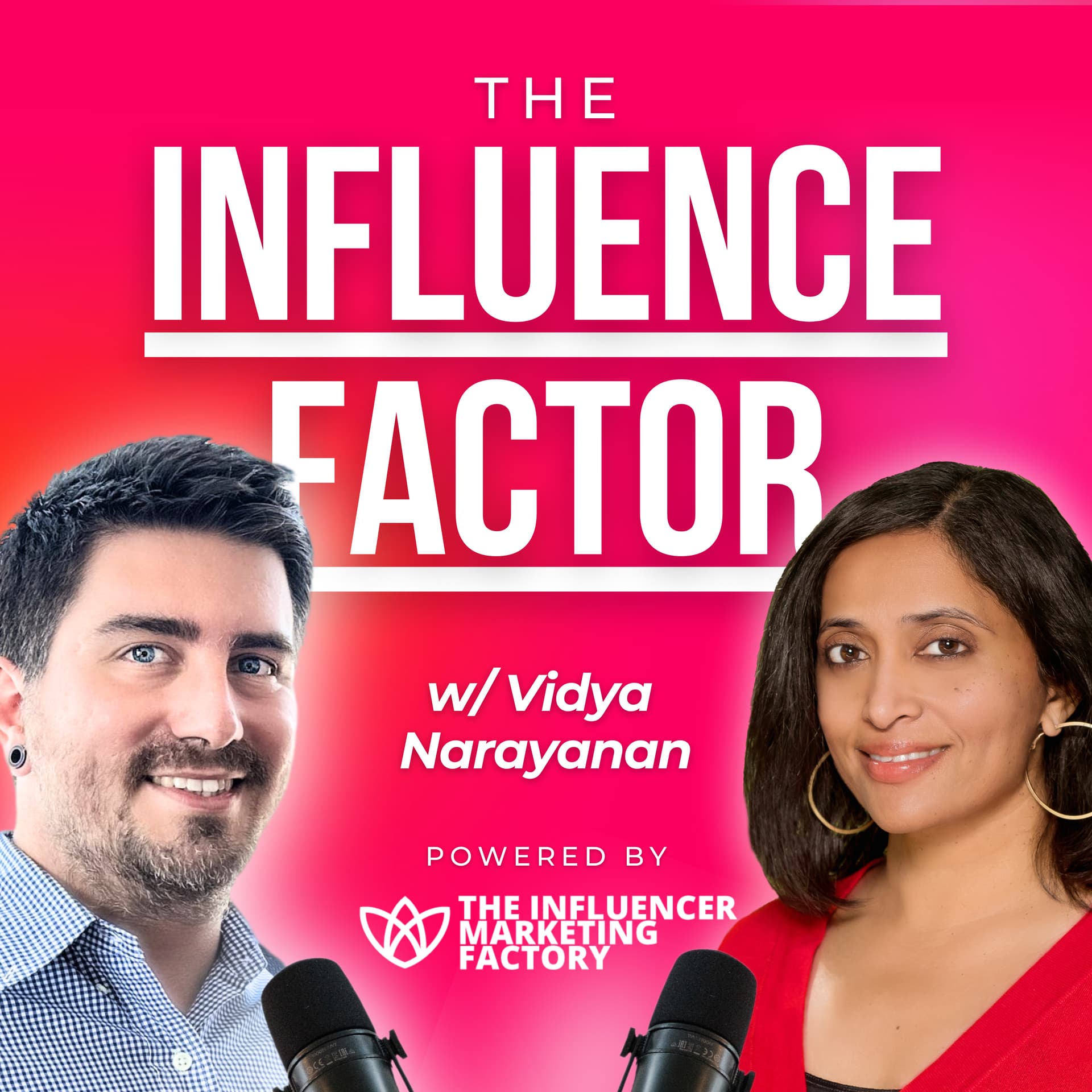
In this episode of The Influence Factor, Alessandro Bogliari, CEO and Co-Founder of The Influencer Marketing Factory, chats with Vidya Narayanan, co-founder of Rizzle.
They explore the role of AI in content creation, from simplifying user experiences to enhancing video editing and teaser creation.
Vidya discusses YouTube's dominance in podcasting, the challenges other platforms face, and how AI will shape the future of content with innovations like personalized avatars and AI-generated content.
🌟 Leave a 5-star rating on Apple Podcasts and Spotify 🚀 Start Your Next Influencer Marketing Campaign: Get In Touch🎙️
Want to be a guest? Apply here
Show Notes:
(01:08) - Introduction to Vidya
(04:05) - AI tools for content creators
(06:20) - A/B testing for thumbnails
(11:45) - Teasers and bringing audiences from short-form to long-form
(19:00) - YouTube's dominance in podcasting
(23:35) - Future of content creation
Check out some of our previous episodes:
- The Creator’s Attorney w/ Tyler Chou
- The New Currency of Marketing w/ Raja Rajamannar (CMO of Mastercard)
- Pay Transparency for Creators w/ Lindsey Lugrin
- How To Protect Your Social Media Accounts w/ Liron Segev
- Future of Online Communities w/ Sara Wilson
- Liquid Death's Unconventional Marketing w/ Greg Fass
- Are Brands Adapting to the Changing Role of Creators w/ Desiree Martinez
- The Secrets Behind ESPN's Social Media Success w/ Maxwell Kelley
- Inside Snap's Playbook w/ Brooke Berry
- Trends at META w/ Jackie Pimentel
- Scaling Miss Excel w/ Kat Norton
- What a Creator-Led Brand Looks Like w/ Bryan Reisberg (Maxine The Fluffy Corgi)
- What Does it Take to Succeed as a Creator w/ Nicky Reardon
- From $400 a Day to a Globally Recognized Brand w/ Calum Watson (Gymshark)
- Mastering Money w/ Vivian Tu (Your Rich BFF)
- The Magic of Interfluence w/ Lubna Mohsin-Haque (Estée Lauder)
- Screen to Cart w/ Collette Winn (NBCUniversal)
- The Inside Scoop on Social Media w/ Jasmine Enberg (Insider Intelligence)
- TikTok's Influence w/ Adrienne Lahens & Sofia Hernandez
- Retaining Influence w/ Conor Begley (CreatorIQ)
- From Clicks to Cash: Unleashing the Power of Linktree for Creator Monetization w/ Michael Bolen
- Funding the Creative Journey w/ Aaron DeBevoise (Spotter)
- Swipe Right on OkCupid Success w/ Michael Kaye
- The Art of Social Media Creativity w/ Jon Youshaei
- Exploring the Influence and Impact of Reddit w/ Will Cady
- New Social Media Subscriptions, Super Bowl's Influencers and Content Creators Trips w/ Lia Haberman
- Turning Your Content Into a Customer Acquisition Channel with Daniel Markovits (Creators + Community @ LinkedIn)


