
 The Influence Factor by The Influencer Marketing Factory
13 Oct 2026 · 26m

 Add vo to ChatGPT or Claude to ask about everything you hear
vo listened to this episode to put together the overview and transcript, so there may be the odd mistake.
The future of travel content—why audiences want trusted curation, how creators should be selected and trained, and how Lonely Planet integrates social/video creators into guidebooks, Journeys trip planning, and its new app.
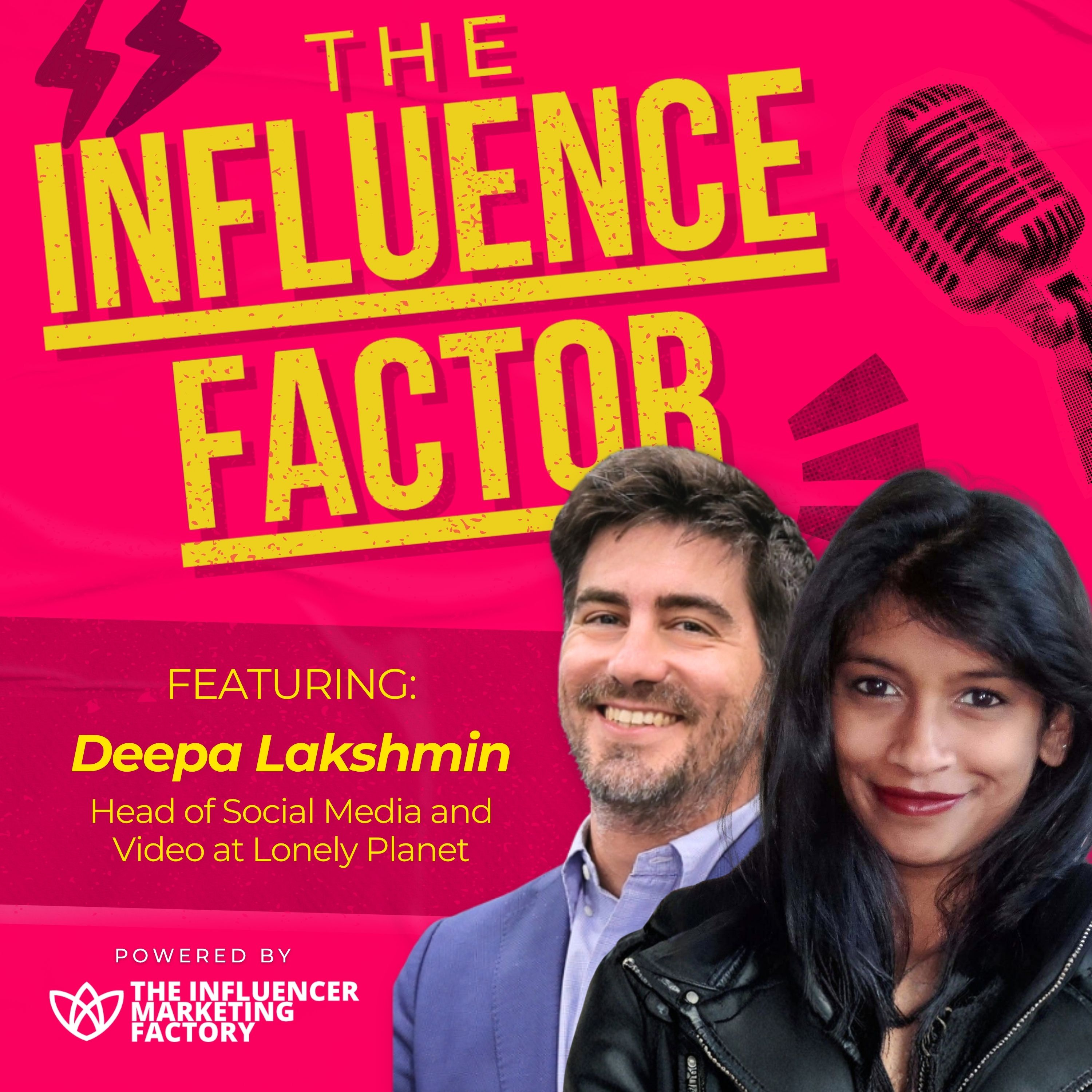
Deepa Lakshmin, Head of Social Media and Video at Lonely Planet. Background includes writing for Lonely Planet (freelance) and being a journalist by trade; she previously wrote for the New York City guidebook.
Creation/influence isn’t new—technology and distribution changed, but influence has always existed. Brands benefit from long-term creator partnerships for iteration and better data. Travel content should emphasize discernment (“taste-making”) and storytelling grounded in fact and local perspective.
Lonely Planet Correspondent Network—creators trained via the writers’ manual, onboarding crash course in travel journalism, pitch/greenlight/film workflow, and specialization by destination or travel type. Integration with Lonely Planet Journeys (bespoke trip logistics) and evergreen content on the app beyond social algorithms.
0:00More than anything, people want that kind of curation and expert and trusted guidance, whether they are opening a book, opening an app or having one of our local experts say, hey, I'm going to do all of the planning for you and you just need to show up at the airport.
0:19Hey, Deepa, welcome to the show. How are you? Hi, thank you so much for having me. amazing today i'm very excited about this episode because you know i i used the only planet myself you know many times and i do still remember when i was many years ago this is like a pre-era of iphone or at least you know like and i was in cuba and i was literally in phone booths with my lonely planet asking for is there a room available today like that that sort of like you know feeling that you're traveling in the real way nothing is booked and lonely planet account for like you know saving you tell you where to go where to stay so you know i i have great memories about that yeah i use that cuba book as well i used it in cuba too it was again now with iphones and everything but again back in the day there was no way to access the internet so there was definitely like you know a great way to to go around uh we're gonna go more into that right what was the only problem before what is now but you know why don't you give us a quick who you are and what is your creator economy hot take well i'm deepa i'm the head of social media and video at Lonely Planet.
1:21And my creator hot take is that this is nothing new, right? The technology, the optionality, the distribution, the scale has changed and evolved over time. But creation and influence have always been a thing. They've always been around. So this is really just an exciting time to be a creator. But also, at the same time, when I see people saying like, oh, this is brand new, where did this come from? It's just a new shape of something that has always been there. I agree. You know, before it was sport of mouth and even before that it was just called influence, right? Like everyone always influenced others from the beginning of time.
1:57So I agree with you on that. The skill is different. There is much more money involved. There is ROI frameworks behind that, but it's always them being always there, right? So I totally agree on that. So, you know, before we get specifically right into Lonely Planet, I wanted to start with something that we start looking, you know, a bit more in terms of data. That is something I'm really curious to hear from you. That is, you know, we analyze in our 2026, you know, Creator Economy Report that, you know, like 45-ish of US-based creators, right? They value stability, right? They want consistency.
2:29Deeper brand, right? Like, you know, alignment and co-creation compared to like an over-day one-off campaigns, right? Because of, you know, they want to create much more of a longer establishment with the partnership, right? We don't want just to get the money once, right? and then go over to the next sponsorship. And even it seems that also their audience, like, you know, something like that. So what is your strategy behind that? Like, first of all, I'm curious if you, whenever you collaborate, right, on that, do you prefer to go over, like, you know, with the same influencers, like strategizing for the year to come?
3:01Are you still doing one-off? It is a bit of a mix. Like, what is the strategy and, yeah, like approach when it comes to that? Yeah, well, I'll just speak broadly before kind of narrowing in on what we do at Lonely Planet specifically. But from my perspective, doing a long-term collaboration with a creator is a win-win on all sides. It's a win for the creator because they obviously have that stability and security. And it's a win from the brand side because you get to know the person that you're working with, right? When you are collaborating with somebody four, five, six times over the course of a year, you're able to analyze what worked, what didn't work.
3:37It gives you opportunity to iterate, try something new, experiment. It gives you kind of like that space and security to see what you can create together. And also just flat out, it gives you more data points to learn and grow from and do 10 % better the next time. And when you have more data points, you're able to use that data to make better, more informed decisions moving forward. You know, I like these when you say about like using more data, right? Because many times, right, you might work with one influencer at a time, one of campaign. it's very like no black and white right because either it went extremely well or like or well or for some reason it flopped right it doesn't mean that that influencer that creator is not a good fit right it could be that it was the right timing of the day maybe they already posted something else right similar to the ab testing right that you do in normal paid media right you want to test multiple times and only use the data on that so at loli planet right you recently kickstarted right something that really gives you even more granular right like viewing this recurring right of creator partnership.
4:41So with selected people that is called the Lonely Planet Correspondent Network. Tell me, tell me a bit more like how this started, how long it took to come with this. How is it going? Because again, people see these things, only the results, right? But people don't know that they're behind the scenes. So tell me more about that. Yeah. I mean, I joined Lonely Planet almost four years ago, and this is something that I've been passionate about for a while now. I would say we started work on it in earnest around two years ago and it really just started with me word vomiting my proposal into a doc and trying to think about like what would it look like if you know Lonely Planet we've got all of these writers all around the world hundreds of them contributing to our guidebooks all of the recommendations and guidance across our services was written or recommended by someone who has actually been to the place and to me it's so great to have that written word but as travel inspiration increasingly becomes a visual thing.
5:35People are going to social media to help decide where to travel next. To me, it felt so important to also have creators who could represent those destinations visually. So that's really where it started. It said, hey, we already have this very robust, trusted network of writers all around the globe. We should also have people who can tell those stories across social. So that's where the Lonely Planet Correspondent Network really came from. All of our correspondents are trained in the writer's manual that our writers are trained in. Every single one goes through onboarding where we kind of like tell them, okay, this is how we cover the world.
6:13These are the things to think about as you're filming content. These are kind of the expectations we have. It's really a crash course in travel journalism, if you will, because myself and my team were all journalists by trade. I actually wrote for the New York City guidebook for Lonely Planet as a freelance writer before I joined full time. So I'm very familiar with the whole kind of process. And it's been really exciting to bring that to the correspondents because they are able to learn and be trained in something that they're interested in. And so we're giving them that opportunity, just like the way our writers will pitch us stories.
6:47And because they're local, they know better than I do necessarily sitting here in New York City. I don't know what's going on halfway across the world if I'm not there myself. They pitch us their stories. So all of our correspondents pitch us their ideas for videos and then we greenlight them and then they go out and film it. So it's very much something where they're telling us what's important about the places they call home. All of our correspondents specialize in a specific type of travel or a specific destination that they're local to. So it's a really great way for us to learn about things that we don't even know that we don't know, which is kind of the beauty of it, right?
7:24Of course. And you know, you say like, you know, crash course. So like, I'm very curious to know, because again, you know, many people that maybe don't breathe, right? The influencer marketing or the creator economy, they might see every creator as others. They don't understand who is a reporter versus like, you know, a field journalist or a creator that became like, so what are the things that you are seeing when maybe someone is a great content creator, or they even have influence on others? They're great at making content maybe for social media, but what are those things that they are missing out or maybe they have to learn in order to become, again, more of a, like, again, part of this network?
7:59Like, what are those either gaps or differences, right, when it comes to content? How they tell a story? Like, I'm just curious, like, what are the things that you're seeing that they'll be like, okay, in order for you to really become part of this network, there are these things to tweak a bit more so that they're, like, part of these, again, crash course and frameworks that they use? Yeah, absolutely. That's a good question. Honestly, what we were looking for for this first class, of course, respondents were people who are already kind of in the weeds doing the kind of storytelling we wanted to see.
8:27So the folks who are already out documenting the world, telling stories, really one of the most important things we looked at when we were going out and inviting people to be part of this first pilot project with us was what is their storytelling ability? How can they captivate an audience? And are they doing that in stories grounded in fact, in the local perspective? What are they bringing to their audience that we think our Lonely Planet audience would be interested in learning from them. So I will say it's like a little bit of a give and take, right? It's we were seeking out people who felt like a strong brand fit and who we thought we could work really well together.
9:06And that is kind of, you know, sometimes people will ask me, like, how did you pick people for this program? Is there a certain number of followers you needed? And the answer is know. This class has a wide range of audience sizes because the thing we were most thoughtful about when we were selecting them was their storytelling ability. And your audience size does not necessarily correspond with your ability to tell a really great story. And that's what we really wanted to be able to amplify. The people who are telling these hidden stories, these things you wouldn't necessarily know about, but that are important and fascinating, we wanted to be able to help use our platform to amplify that because at the end of the day, we have over 14 million followers across channels.
9:47So to us, we've got the audience. We want to be able to bring in folks who are telling cool, compelling stories that we can then help uplift. Hey, if your brand is ready to grow, we are here to help. At the Influencer Marketing Factory, we run full-service influencer campaigns that actually move the needle. We handle everything, creator identification, communication, company strategy, contract, shipping, logistics, you name it. We have supported brands of every size from world recognized Fortune 500 companies to ambitious DTC startups. And with our in-depth ROI tracking, you always know what's working and why.
10:21Just visit the influencer. Marketingfactory.com to learn more and get started. And I'm also curious, how do you go? So traveling is primarily like offline, right? Then the content goes online and from the online then, you know, I've been seeing a lot of uh even even here in new york city right that also like or even you know italy where i'm from i do see people that now are organizing trips right with their audience right so i'm curious like first of all how do you see this again offline to online to offline again or irl right in real life we even did like you know a report about that as well and we do see there is a lot of appetite so i'm curious to see if you're seeing these also like trend especially in the traveling like how influencers and creators are trying to approach this again like i see some of those right but do you think that is something that is going to continue growing?
11:08Or is it difficult to organize? Because again, it's more physical as a thing, right? So you have to logistics and all that. That is way different than the online world. Right. But I think travel is experiential in and of itself. So you can't really separate the two, in my opinion. I think as we're starting to formulate what our next year of this program looks like, integration across all of Lonely Planet's products are going to be really important. So, yes, we have our guidebooks, but we also have a trip planning business called Lonely Planet Journeys that is all about planning bespoke custom trips.
11:40We also have an app that is new, just launched a couple of months ago. And that is really all about taking all of the wealth of knowledge in the guidebooks and turning it into something actionable that you can use in the palm of your hand as you're out in the world exploring and traveling. So to me, it all kind of feeds into the same sort of ecosystem. Lonely Planet is for any traveler, however they prefer to travel. We kind of, you know, started with the guidebooks in the 1970s. It's been over 50 years. Obviously, we had, we talked about this earlier, the way people travel has evolved. The way people plan their trips has evolved.
12:18But at the end of the day, I think more than anything, people want that kind of curation and expert and trusted guidance, whether they are opening a book, opening an app, or having one of our local experts say, hey, I'm going to do all of the planning for you and you just need to show up at the airport, which is also really great. That is personally the way I prefer to travel. I want someone who knows better than me to do the planning for me and just kind of say like, this is what you should do. And I'm like, thank you. I do not need to go through the stress of planning it myself. You have done all of the legwork and I can trust your recommendations.
12:52so for us it's really about plugging in our creators to all of those different things so for example if they are running trips I'm really excited about the opportunity to plug them into our Lonely Planet Journeys business and say hey if you don't want to be dealing with the logistics and the bookings and the like back and forth of dealing with you know what it takes to plan a trip for a group of people we can do that we have the infrastructure for that we work directly with local experts on the ground who know all of that inside and out no way better than I can ever possibly explain because that's not my area of expertise but it's really exciting that now we have this group of creators that we can offer that to them if it is something that they're interested in because to your point experiential and bringing community together in real life is so much of what makes travel so great no yeah you know again that's why I was very curious about that because I've been seeing this much, like, you know, a lot of appetite, right?
13:51From audiences to not only meeting their favorite, like, traveling influencers, but also to meet other people in the community, right? Because they are sharing the same passion, right? So now, like, I belong, right? So I'm going from commenting and liking a video to actually going there in person. I travel with other people with the same, like, passion of mine, same interests. Then I make online content about it, right? So it's this, like, loop, right? That you can use in many, many different ways. And talking about like still like again how we now publish things right and everything before you know before it was google right and just looking for keywords and then you know of course also you know with the physical book and looking for information but in the recent years right with short form videos the way how we really how people discover right travel inspiration changed a lot right the people now go on tiktok and say two days in city right and then you get the videos that tells you you know what to do and there are like the ones for first time that you've got in this city or the one that like this is your fifth time and just like forget all the touristic things and this is what you should do when it comes to these type of videos what is working right now and what do you see in terms of the next big shift when it comes to what audience want to see when it comes to travel inspiration first off i think that there's always going to be a wealth of information out there and kind of the next shift is this curation and the taste making part of it it's how do you know what this person is saying is actually good.
15:14It's this layer of discernment that more and more audiences are learning to build and learning to rely on. And I think what's exciting about that for me is that there's no wrong answer in a lot of trip planning, right? It's, you know, I feel this all the time when I'm trying to decide where am I going to go next? And I get really overwhelmed because there's so many things I want to do and so many places I want to see. And I always have to remind myself there's no wrong answer because wherever you go, you're going to come back and you're going to have like five more places you find out about while you're on the ground there that you're going to want to go to next.
15:48So that's exciting, right? It's endless opportunity to learn something new. And I think the next shift is really just going to be about narrowing things down to do the next thing. And then the next thing is going to lead you to the next thing and to the next thing and so on. And a push I always give our contributors, our correspondents, anyone who's creating content for us that's going to live on longer than just social. Because when we launched the Correspondence Network, we didn't have an app. Now we have an app and that app has video in it. So it's a really great way for us to be able to give all of that juicy content that our correspondents are filming on the ground sort of a longer shelf life because algorithms are going to do their thing.
16:30And, you know, once we post it on social, it's going to eventually get out of the rotation of the algorithm, but on our app, it can have a much longer evergreen life. So every piece of content, I always try to think about what's the angle, what's the story that's going to be more timeless, even if it's something about a festival or something that's seasonal, what is kind of the hook that's going to draw someone in regardless of whether or not they're going to ever be visiting this place. You can still tell a compelling story about a destination or something that's happening, even if the person watching it is never going to necessarily be there.
17:06There's still a way to tell that story that's going to engage them and get them interested. And maybe they will go there someday. So the answer to that question is two parts. One, I think the curation of it. And two, the just sheer storytelling of it. And at Lonely Planet, that means making sure on social we are not just giving guidance. We're also telling the stories of a place and the stories of its people. The Correspondence Network helps us do that at a greater scale than we could do ourselves, just as, you know, a social and video team living in the United States. They just help us be able to cover the world in much greater depth.
17:43And it's those stories that are going to get people interested to get to the point where they're thinking about, where should I stay in this place? Where should I eat? Before they think about where they're going to stay, they need to feel inspired to go there. And the thing that gets people inspired to go somewhere is the people telling, oh, my God, this is what it's like on the ground. Yeah, no, I love, especially when I say about the, you know, the creation part, because I even myself, I find myself, you know, on different social media, I start saving videos about a new country that I want to visit.
18:13And it becomes overwhelming, right? I don't know, again, can I trust this person? Like, yeah, you can read the comments, right? More or less understanding, like, this is a good itinerary. This is not. but I like the idea of, again, curating a bit more because, as you said earlier, there are so many, there is a lot of content, right? It's difficult to know, especially if you've never been in that country, is this legit? Is this, like, touristic trap type of situation? Is this, like, super local? And so, yeah, I think doing something where you can guide it a bit more is definitely needed, especially with travels, because you spend money, you take time off.
18:46Like, it's, you know, it's something where you invest a lot of time, efforts and yeah and then financially speaking right so you want to do it in a way where at the end of the you know the trip you're like satisfied with your choice instead of like being ah you know only if I went to this place I just discovered last last time you know like the last day you know because I didn't do my own work properly or because I saved 20 videos right on my Instagram and then I didn't really check them again because you know that happens all the time sometimes I'm very curious it is that you know so far we talked about primarily you know creators that you work with that they have their own style and everything right so maybe sometimes there is a bit more like you know freedom in terms of how they want to tell a story and so on still within certain boundaries and frameworks right but i'm curious when it comes to working with tourist boards right we also work with them for certain campaigns right and sometimes there are a bit i won't say necessarily stricter right but there are certain like again each tourist board had their words and keywords and other things that you can say other you cannot say right like and there are other times where all in this type of format.
19:49So I'm curious, how do you work with them? Again, knowing that it's a bit more formal, sometimes the process, because of government, because there is an image behind a country. And a country is a brand, right? So you want to be sure that certain guidelines are respected and so on. So I'm curious to know, how is your experience so far working with tourist boards? Yeah, that's a good question. And we work a ton with tourism boards because my team is also responsible for creating any sponsored sold content to our clients. And we work with quite a few of our correspondents for those campaigns. And the way I see it is that those opportunities kind of layer on to the existing long-term partnership we have.
20:32So those are like add-ons to what we're already doing with these really great correspondents. Because of the way we've structured our creator program, It gives us a pool of talent who we can consider kind of the first people we go to when we do have opportunities for additional campaigns. And many of those are, you know, one-off campaigns, right? But because we already sort of have this underlying long-term project we're working on with them, we know how they work. We know what their interests are, their areas of expertise. We are working with their managers and their teams. We know what their upcoming travel schedule is like.
21:09It gives us an easier way to be able to formulate and cast those branded campaigns because we've already got existing relationships across the world with all of these really great creators. We don't always have a one for one transparently. And we do sometimes have to go outside of our existing creator program and long term partnerships. But I will say that there are some folks that we worked with a couple of years ago who were more of a one off campaign that we brought back on a more long term basis. We always try to look for folks that, hey, I think we could work with them on more things than just this one thing.
21:45Because, again, like I said earlier, it's a win for them and it's a win for us because we already know what it's like to work together. And we can kind of like have a much more collaborative two-way conversation as a result of that because we're building upon a relationship we've already established in the first place. So I really see whether it is a partnership with a tourism board or a brand, it's really just a layer upon the projects we're already working on. And that goes back to my earlier point of talking about, hey, we want to integrate creators across all of our different products. It's not just a social media thing.
22:19It's not just a social and video project. It's something that can help elevate all the lines of business we have. So, for example, we've got creators who are also really great writers who are contributing to some of our books that are coming out next year, which is really cool. So it's kind of a way for us to say like, hey, this is a whole group of contributors that we have never really had before. We've always had tons of writers, but now we have these truly social first storytellers that we can tap into across all of our business functions. Social and video obviously is the most visible part of that.
22:53But these are people who can help us tell our story and tell their own stories of the places they call home in a much more dynamic way than I think we're able to do when it's just on the page. Sure. So basically, like no matter the tourism board, the organization, you have to do your homework, let's say, right, before even proposing someone. So you understand the guidelines of each organization board, right? And then you understand the style and the storytelling and the tonal voice of the influencer or the creator or the journalist. And then only once. And then this, I would say, shouldn't be applied only for the travel industry.
23:28I would advise any other industry out there. Instead of shooting in the dark and just proposing randomly to do your homework. Because believe me, everyone will appreciate that this is not just random. But it's a matchmaking where everything kind of makes sense. And then you only, as you said, just go over a bit more like some other information. information, but at least the basics, right? Like the foundations of their relationship start from something that makes sense, right? Because it's based again on the data, the qualitative analysis you did and so on. Exactly, right? It's if we know one of our creators that we've worked with in the past has a really strong interest in art history, and we've got a client that's interested in showcasing art museums, for us it's like, oh, this is again, a win on all sides.
24:14And And the way you're able to kind of cultivate that is by having relationships with creators and knowing what they're interested in and what they want to do for the next sort of phase of their career. Because they're also thinking about how they're going to build and continue to evolve their business as a creator. Love it. Well, I can't wait to see what is up now for year two of the new app. I will definitely check it out for my next trips. I'm very curious to see, again, all the creation part. I need help on that because, again, I get overwhelmed as well. I want to do I got FOMO I want to do a thousand things and so having some days like listen these are the seven things not a thousand you know they will definitely help you know like on that and Deepa thank you so much for joining us today you know for sharing your knowledge it was a very interesting episode you know again covering something that finally right after COVID having people traveling again so I love to see all that and especially like you know content that is again quality based with a lot of creation behind that so thank you so much for sharing the knowledge with us today thank you for having me this was so much fun thanks This was the Influence Factor by the Influence Marketing Factory and I'll see you in the next episode.
In this episode of The Influence Factor, Alessandro Bogliari chats with Deepa Lakshmin, Head of Social Media and Video at Lonely Planet, to explore how travel content creation has evolved, why long-term creator partnerships matter, and what the future of travel inspiration looks like in the digital age.
🌟 Leave a 5-star rating on Apple Podcasts and Spotify🚀 Start Your Next Influencer Marketing Campaign: Get In Touch🎙️Want to be a guest? Apply here
Show Notes:
(01:17) Introduction to Deepa and Lonely Planet
(03:07) Long-Term Collaborations in Influencer Marketing
(04:55) Lonely Planet Correspondent Network: Concept and Implementation
(08:16) Identifying Storytellers and Content Creators in Travel
(11:15) Offline to Online Travel Experience
(15:00) The Future of Travel Inspiration and Content
(20:11) Working with Tourism Boards and Brand Partnerships
Check out some of our previous episodes!
Scan the code with your iPhone camera
Listen in the app.