Ask ChatGPT

 The Influence Factor by The Influencer Marketing Factory
24 Nov 2026 · 23m · 18 chapters
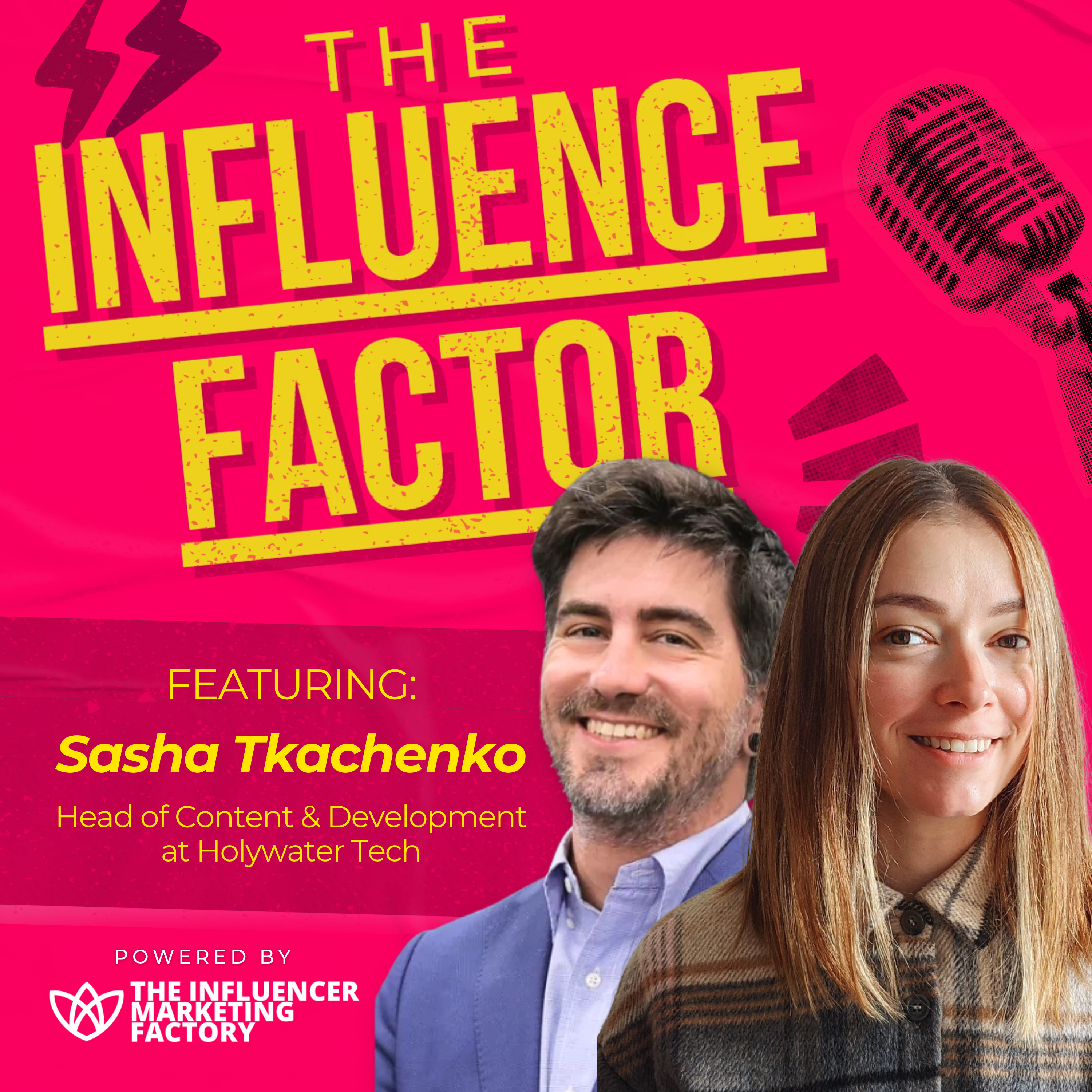
Micro-dramas/vertical series are the next big streaming format, driven by faster production, rapid analytics, and AI-assisted filmmaking.
Sasha Tkachenko, works at Holy Water Tech (Ukraine-origin media IT company). She produces vertical series and previously worked 15+ years in traditional TV/VoD, including scripted and unscripted originals/adaptations.
Vertical content can be tested and re-edited within 12–24 hours using viewer drop-off data; TV takes years and misses opportunities. “Emotion is still emotion,” but vertical pacing must be faster (e.g., 1.5–2x speed comprehension). Chemistry and actor-fan engagement are crucial; AI can be “filmmaking” when directed by trained creatives, not “AI slop.”
Holy Water Tech’s in-house IPs like Secret Society and Spock Nittenderly; AI-only app MyMuse (Android/iOS) vs live-action MyDrama; re-edit launch of “Farmer once a wife” timed with Fox’s linear/VOD US launch; audience includes women 18–54 and paying 30–45, plus LGBTQ+ viewers and some hetero male viewers.
Written by AI. May contain mistakes.
Sasha traces her 15-year TV career and how the 2022 war, her pregnancy, and an airport encounter with vertical video led her into microdramas.
“We're going to get definitely more into that, right?”
She explains how real-time data on drop-offs lets producers re-edit or re-AI episodes quickly, something impossible in linear TV or VOD.
“And I think that everything that vertical space gives to me as a producer and both as a viewer, because I'm not only producing verticals, I'm also watching them.”
Sasha describes her informal test of playing episodes at 1.5x and 2x speed to confirm the story stays clear, and contrasts slow TV pacing with fast vertical storytelling.
“In TV, I mean, everybody were just reheating the pasta, coming back, and they were still talking about the same stuff they did.”
The conversation compares rapid app-style testing with vertical series testing and how the team decides which shows deserve longer runs.
“like, you know, trials in a very fast way, right?”
Sasha argues that audiences fall for actor pairings, and her platform's metrics show chemistry keeps series performing even when plots are weaker.
“And we even have metrics in our platform.”
She breaks down the core demographics by age, region, and genre interest, including the growing share of male viewers and the loyal LGBTQ+ audience.
“on Facebook, is it a mix of things, right?”
They examine how new viewers arrive through paid ads, word of mouth, and search, and how a Fox partnership moved viewers between TV and the app.
“Is it because you're pushing with ads and creators and so on?”
The hosts ask how a platform balances original stories with adaptations of proven books and films, and how it negotiates for successful IP.
“and all these right moments that you can find all people that are either into, you know, sci-fi or like, you know, fantasy world and everything.”
The guest explains how in-house IP moves through a pipeline from the Passion app to MyMuse to live-action MyDrama, with proven hits getting the big budgets.
“But when it comes to our in-house IPs, our pipeline looks like this.”
The guest describes MyMuse as a large vertical-series app where every show is AI-generated, while live action lives on MyDrama.
“You can download it both for Android and for Apple.”
The hosts raise concerns about low-quality AI content flooding the internet, and the guest acknowledges the problem exists.
“It's a mix of some things that has a proof of concept already from my passion.”
The guest argues that AI productions succeed when led by people trained as directors, DOPs, and writers who know framing, lenses, and emotion.
“I mean, I think that the internet is kind of fueled and fooled with that.”
A strong story told well keeps audiences absorbed within minutes, so they stop noticing the tool used to make it.
“But if it is an AI filmmaking, you want to watch it and you want to rewatch it.”
The guest says AI lets good storytellers make work that traditional filmmaking costs have made out of reach.
The hosts ask how the guest's role and the industry will evolve, and the guest names staying curious as the most exciting part.
“And what do you think now is going to be the future of your industry, right?”
The guest predicts AI filmmaking will grow fast while live action remains as premium, talent-driven storytelling.
“So within nearest future, we'll see a lot of AI filmmaking, definitely.”
AI is advancing so quickly that even the guest's mother struggles to tell it from reality, so creators must shift into architects of new workflows.
“And if we are eager to learn, then everything is going to be okay.”
The hosts agree that the industry is moving in one direction whether people like it or not, and that adapting is the better path.
“But if we want to fight the development and to fight the current situation, not to change the mindset, it will be tricky to survive.”

Get the gist, explore an idea or ask about something said.
 Claude
On The Influence Factor by The Influencer Marketing Factory, what are the key points of this episode?
Searching your listeningAutomatic transcript. May contain errors.
0:00I cannot say that I'm not afraid of AI at all, but I think it is a great tool for good directors, good DOPs and good storytellers to do something that they were unable to do before due to the actual pricing of the filmmaking that is like enormous.
0:20Hey Sasha, welcome to the show. How are you? Hello. Thank you. I'm good. It's a pleasant evening up here in Spain and I hope that you have a pleasant morning. Yes, it's so good also here. I can see for the background, you have a sunny day for me as well. You know, like these days are the day for granted when it comes to like, you know, gloomy days in New York City. So I'm very glad, right? It definitely changed my mood for the better. Before we get started with the episode, you know, I would love to know a bit more about who you are and what is your hot take on the creative economy. My name is Sasha.
0:51I work for Holy Water Tech. It's a media IT company origin from Ukraine. My origins are from Ukraine too. And what I do, I do vertical series. I do new media. And my hardest take when it comes to creative economy is that for quite a long time, we've been optimizing for competition. But I think that the main thing for which we need to optimize is for the habit of the viewer. And I think that is the most important thing for what every type of new media and old media is fighting right now. Very interesting. We're going to get definitely more into that, right? Later in the episodes. but I would like to start understanding you know a bit more about you right your story so far and if I'm not mistaken right you were more in the traditional right television right and now you are into this again you know vertical format and looking into drama right at my drama there has been a big influx right of drama shows something that is very quick a lot of you know mini episodes right that you watch on your on your phone so basically I'm I'm interested to know what made you right make this move and then also like was it like a specific moment for you of realizing like okay i want to get into this that it's still the same industry in a way but totally different for many other reasons so i've been working in tv in classical line at tv and vod for more than 15 years i've been doing adaptations of hell's kitchen next stop model a lot of scripted originals a lot of unscripted original and adaptation and i know that exactly four years ago when the war between Ukraine and Russia started.
2:21Two days before that, I was on my seventh month of pregnancy. I was pregnant. And that is why I actually left my native country on one of the last planes. And I was like absolutely sure that I will spend a lovely one week in Riga, in Latvia with my mom and be back. But no, I'm not back. I'm still not back. And when I was in the airport, actually, when I was waiting in Burispo, I saw a girl. She was a little bit younger than me she was like in her 30s I think and she was watching those verticals I think that was the first time when I saw it when I landed I became interested like what the hell is this like I didn't know so I started to I started to browse I started to look into verticals and oh my god I was hooked I was hooked as as a viewer as a pregnant viewer like I think it's the worst it's actually the worst case to get hooked because it's pretty easy to hook on the new media a woman on the seventh month of pregnancy so i get birthed to my daughter she's four years currently and for more than one year i'm working with verticals with something i got hooked way prior to actually the first day when i started and i think that it's someone call it like guilty pleasure but how can a pleasure be guilty if it is something that helps you to live on with your life and helps you to escape the harsh reality without actually, I don't know, hurting anyone.
3:46So yeah, I think that is the best place to be currently. And I think that everything that vertical space gives to me as a producer and both as a viewer, because I'm not only producing verticals, I'm also watching them. Regardless of the actual line in your TV and DOD, you get the data like 12 hours, 24 hours after you actually launch it. And you are able to redo everything things that you want. You see that the hook is not there on the first episode. You see that the conversion of the viewer, you missed it. You do understand that, okay, you've been going amazingly good from episode number one until episode number four, but then there is a drop.
4:24So there should be a problem in content. You can re-edit it or you can re-AI it if you're doing an AI vertical series and upload it once again. That is something I wasn't able to do online in your TV and your VOD. and it creates such a liberty for you as a producer and a filmmaker. Because, yeah, you know, that was one of my questions, right? The shifting mindset when you are producing for TV, right, that I can only imagine between not only bigger budgets, but different layers of approvals. And then everything is lower, right? Because, again, you need to get the analytics and sometimes you don't even have them or you have to, you know, edit past time.
5:03By the time you get things and you want to make changes, it's too late, a competitor got in, or people already are like, you know what, I'm going to watch the next show. And instead, you said now the speed, right? And the granularity of the analysis, right? Similar to what you would do to assess, right? During the onboarding process, you see, oh, people are dropping at this step. Let me fix it. And now you're staying busy. You can kind of do the same, right? Approach also to like, you know, these vertical formats. Yeah, I mean, like when it comes to something that is similar, both for any type of media, like emotion is still emotion if there is a betrayal there should be a betrayal it doesn't really matter like if the screen is smaller or bigger the kiss shouldn't be in the actual start but how do we normally test and what was my mindset shift in tv like you develop the content within six up to eight months then you film it you normally film a pilot then they got approved with a board then you're pregnant again and in two years you might have a show i might not so it's taking it it takes ages like in verticals it takes like three months sometimes it takes six if it's something unique but reiterations are pretty quick and you just see what you want to do you see the call from the audience and you do it like straight ahead but how do i currently test it because in tv tv is not only slow when it comes to production it is also slow when it comes to pacing because you can have an opening scene for five minutes after that you can have another I open and sing for 10 minutes like drama 2g is obviously there but everything is pretty slow when it comes to vertical my test is like that if my mom can do the speed 1.5 and my sister can do the speed 2 and still understand what is going on and while doing that she can brew herself a tea or reheat her pasta, then everything is perfect.
6:57Then the script is perfect. In TV, I mean, everybody were just reheating the pasta, coming back, and they were still talking about the same stuff they did. You didn't really miss anything. And in vertical, despite you might have missed something, you still need to get to the viewer, the main points of interest every four to five to six episodes. so they are going to be still with you and still hooked. They need to understand everything. And so since, right, it seems to me that you can do as many, right, like, you know, trials in a very fast way, right? And this reminds me of many years ago, I was seeing this interview to some Chinese developers of apps.
7:38They say, we do 100 apps a quarter. The majority, they die, but at least we test fast. We do A-B testing and then we double down on what works, right? So it's basically A-B testing at scale, right, for not anymore just ads, but for content, for apps themselves and everything. But because some of them, they burn fast and disappear forever. What makes a difference? Do you know now already, okay, this is going to stick and we're going to see it many different seasons potentially? Do you already know by the beginning? Have you found out a sort of formula or recipe? It is some kind of an A-B testing, both for marketing of vertical series and for series, for vertical series.
8:18But when it comes to something that should be evergreen, we have those. Not all of them lands in that territory, obviously, and unfortunately. But up here, what is interesting is that the classical TV producer gods are working. Because you still need actors with chemistry, and you still need the actors who are ready to support the actual marketing, not only with paid marketing, with paid acquisition, but also on their TikToks, on their Instagrams, etc. But main thing is we need to have a plot and we need to have an amazing chemistry of actors. Like sometimes it's even more there than in classical TV.
8:58Because every time when our viewer falls in love with the actors, what we are trying to do is to get them as much content with that sweet enemies or sweet lovers as we can get. And we even have metrics in our platform. we do understand that like if we pair this girl with this boy even if the plot might be compromised we will still land on the average side so the chemistry is something that is like absolutely important and all of the series that have chemistry inside almost all of them are evergreen and you know who is watching that's something right that i'm very curious because now it's booming right is it is it the same people that are watching tiktoks is it the people that are on Facebook, is it a mix of things, right?
9:45Like, I'm curious to know a bit more about the demographics, the type of behaviors, right? Again, have you noticed if certain audience overlap? Is it a total new type of people that you've never seen in the past? Like, tell me a bit more about that. So the core audience for now, for my drama, those are women, 1854, and the core, the target paying audience is 30, 35 plus up to 45. When it comes to Gio, we are more looking into United States, Canada, and Great Britain. And I think that more than 45 % of consumers of my drama are there. And the biggest amount of profit actually is there. When it comes to the portrait of the viewer, it is your mom, it is your neighbor.
10:25It's not only women who are absolutely exhausted from their work. And they have that amazing man with a belly and one beer in one hand and another beer in another hand who wants just to disconnect. those are also wet pads and book talks readers and that is actually the audience that was neglected by tv and by vod platforms like for ages but they are so loyal i mean they just want to see those men running for them through the woods and saying caroline uh you've been a bad girl and now you're going to be a good girl and something really fun it is definitely something about our traumas but they are very loyal and another territory is that we have exploded and keep on exploring is our LGBTQ plus viewers.
11:08I think that we are the first vertical app when it comes to girls' love and boys' love titles. And we adore that audience because, I mean, they are true fans. And when it comes to LGBTQ plus, I cannot even name the actual target audience in age and in social status because they are just there. Like, you know that you've made it when you do see yourself like the titles that you produce on BL Reddit. But for now, for less, I think, half a year, but it peaked, I think, in the end of April, a lot of hetero male viewers are opening for themselves vertical dramas, mainly AI. But for now, I think that we picked on more than 30 plus percent of male viewing online use.
11:53And that is really interesting. And that is the audience was who we are definitely going to work in the future and are working now. Hey, if your brand is ready to grow, we are here to help. At the Influencer Marketing Factory, we run full-service influencer campaigns that actually move the needle. We handle everything. Creator identification, campaign strategy, contract, shipping, logistics, you name it. We have supported brands of every size, from world-recognized Fortune 500 companies to ambitious DTC startups. And with our in-depth ROI tracking, you always know what's working and why. Just visit the influencermarketingfactory.com to learn more and get started.
12:32How new audience come to a short drama, a micro drama type of app or environment? Is it because you're pushing with ads and creators and so on? Is it something because they heard about it and they got curious and they are the one to go on the app store and look for something? I'm trying to understand, is it push, is it pull? Is it a mix these days? It's mixed, definitely. Obviously, we have paid marketing. Those ads that pop up on TikTok, on Meta, when you're just scrolling your... When you have your aim to scroll. We also have quite a lot of organic views. And when it comes to great IPs that both we developed in-house, for example, Secret Society or Spock Nittenderly, those IPs are pretty big.
13:16And it's some kind of the word of mouth. So people just type them in Google. They're trying to find it outside of my drama to watch them illegally. but then fortunately they are landing on my drama and another thing is opening up big eyed piece that are already known to the actual viewer for example recently we've done a launch of farmer once a wife with fox entertainment with our biggest partner we've done a re-edit of the last season and what an interesting subs that we've actually done we launched it on the same day when Linear and VOD Fox launched it in the United States. So we kind of have a conversion from TV to the app and backwards.
13:59And those were absolutely new viewers, both for us and for them. Because, you know, exactly. This is something I wanted to ask you, right? Even you mentioned earlier, like, you know, book talk and all these right moments that you can find all people that are either into, you know, sci-fi or like, you know, fantasy world and everything. And if I'm not mistaken, right, from your report of the state of mythodrama, around 41 % of viewers said that they would watch even more, right? If there are shows that are adaptation of like books, right? Or movies as is earlier and so on. So I have two questions on these.
14:30First of all, how do you balance between original content and something that comes from, again, things that are already well-known and also do we manage the IP, right? Because there is also another big conversation around like these days, right? Like who owns the IP? How can you use IP and make it a different way and so on. So yeah, but I'm mostly interested in the balance. 41 % is a big number, right? So how do you balance it out in a way that is still also financially speaking makes sense and so on? If it is a successful IP and if we do understand that it has a conversion, a possible conversion, we can't know for sure, of the viewers that are eager to pay, then we will definitely try to negotiate and buy it out.
15:08I mean, obviously. And we do not have a lot of that for now. We are in negotiation and in filming of a couple of IPs right now. I cannot name them, but they will be soon in my drama. Everyone, and we are not an exception, would definitely like to have more huge IPs because it is a proof of concept. But when it comes to our in-house IPs, our pipeline looks like this. Because Hollywater has my passion, its books, my muse, AI series, and my drama, live action series. Obviously, to film a live action, it's the most expensive stuff that we can do. So first we test my passion. If it is a hit, it goes to my news.
15:50If it is a hit, it goes to my drama. So when it comes to something where we want to spend bags of money, we want to understand that at least 50 % up to 60 % of something that comes out in my drama was previously tested. Once again, obviously, we are open to some originals that have never been tested before. But we do understand that the trope is working. But it is wiser to have something that was already published and has a proof of concept as a proof of success. And then invest money into it. So basically, it's like a funnel, right? So you get with a lot of them and then you... Okay, tell me a bit more about My Muse.
16:31What happens there at that point? So MyMuse is a successful huge app. You can download it both for Android and for Apple. It is an app about vertical series. It has vertical series for any type of audience. What is interesting, all of them are AI generated. All of them. You do not have any live action on MyMuse. So if you want to watch live action, you need to download MyDrama. And what are you seeing in terms of, you know, again, because of AI, right? Like, you know, these days we are living around that and, you know, everyone can create their own stories these days and images, even quick clips, right?
17:09These days are not that expensive anymore in terms of tokens and everything. So what type of, like, again, stories are you creating when it comes to AI? Is it also those based on, as you were saying earlier, right, on things that already work out and then you want just to go a bit fast in terms of production and so you use AI? Or is it because, again, maybe you want to do things that you cannot do usually without AI? Like, tell me a bit more about that because, again, you know, like we see so much content out there and it's how do you make it successful in a way that is not the typical AI slope, right, that we are seeing and people are complaining about these days.
17:39It's a mix of some things that has a proof of concept already from my passion. Also, we have some books that were successful on my passion. Let's say about dragons, about werewolves, about fairies. And I mean, we cannot make them as good as we want to make them on live action. And that is why my muse is a better place for them. When it comes to AI Slop, I know what are you talking about. We have a lot of that. I mean, I think that the internet is kind of fueled and fooled with that. But all of the productions with whom we are working and our in-house team that produces content for my views, all of them come from, like, they are classically trained.
18:18So if it is an AI director, he used to be a DOP. He used to be a director. If it is a script writer, she used to write scripts or she used to write books. And for example, when we work with productions, like outside of Hollywood, it is really easy to spot, was it just made by AI engineer? Or was it made by AI director who previously done it physically? So he knows how to frame it. He knows where to put a camera, what lens he wants to use, why this emotion should be framed on a white shot, and this should be a close-up. and it has a great difference when it comes to emotions that an AI title gives to you.
19:02If it is an AI slot, you do not want to watch it back and forth. You don't want to continue. But if it is an AI filmmaking, you want to watch it and you want to rewatch it. And if it is a good dramaturgy, in a couple of episodes, like in three to five minutes, you will just forget that it is AI. You will be just caught in a story. And that is the best thing about AI. I mean, I cannot say that I'm not afraid of AI at all, but I think it is a great tool for good directors, good DOPs and good storytellers to do something that they were unable to do before due to the actual pricing of the filmmaking that is like enormous and keeps on getting more expensive each year.
19:43And what do you think now is going to be the future of your industry, right? Both in your role, right? Is your role going to evolve slash is going to go in a different direction? Because again, you know, every week there is a new regulations, there is a new tool, there is a new, you know, whatever, whatever. And also, where do you think that is the most exciting part, again, in the industry versus the things that we should be cautious about? I think the most exciting part is you cannot get mentally old unless you want to. So hopefully it will keep me physically young as long as I'm going to work in the industry.
20:24When it comes to what is waiting for us there, like currently AI filmmaking is really new and everybody is always eager to jump into something new. So within nearest future, we'll see a lot of AI filmmaking, definitely. but in the end i am absolutely sure that live action is not going anywhere i think ai in our industry will be around 60 maybe 70 but we will still have live action it will be some kind of premium storytelling storytelling focused on talents focused on ips but when it comes to ai it is going to evolve absolutely like amazingly fast because you see what we were doing in February and currently like my mom it is hard for her to distinguish is it AI or is it not AI and it is going to be hard for myself within like I think seven or up to eight months but my role and the role of any type of storyteller and producer I think that we're going to transform into some kind of architects of the process.
21:32And if we are eager to learn, then everything is going to be okay. But if we want to fight the development and to fight the current situation, not to change the mindset, it will be tricky to survive. I agree. It's going no matter if we're lucky or not, right, in a certain direction. So either you can jump on board and balance it out, right, as you wish. But yes, going against, the story It taught us that you cannot win against something that is bigger than you, no matter, again, if you like it or not. And we will see what happens there. And this was very fascinating for me to learn. It's a world that I know only, partially.
22:09So I will definitely look into, again, what has happened right in terms of offering and the future of that. And Sasha, thank you so much for sharing your knowledge and story with us today. Thank you so much for your time. And if you do not have my news and my drama yet, please download it. We're also going to put a link in the description. so for everyone it's going to be way easier to download it. Sachin, thank you so much again. And this was the Influence Factor by the Influencer Marketing Factory and I'll see you in the next episode.
In this episode of The Influence Factor, Alessandro Bogliari chats with Sasha Tkachenko, Head of Content and Development at HOLYWATER TECH, to explore the evolution of entertainment from traditional TV to vertical storytelling.
They discuss the importance of audience engagement, shifting viewer demographics, platform algorithms, and the balance between original content and IP adaptations. Sasha also shares insights on content testing, the growing role of AI in storytelling, and the future of AI-powered filmmaking.
🌟 Leave a 5-star rating on Apple Podcasts and Spotify🚀 Start Your Next Influencer Marketing Campaign: Get In Touch🎙️Want to be a guest? Apply here
Show Notes:
(00:49) Introduction to Sasha
(05:28) Importance of chemistry and audience feedback in series
(09:57) Audience demographics and loyal viewers
(12:55) Impact of platform algorithms and discovery
(14:56) Balancing original content and IP adaptation
(16:33) Testing pipelines for content success
(17:39) AI in content creation and storytelling
(20:11) Future trends: AI filmmaking and live action
Check out some of our previous episodes!