
In short
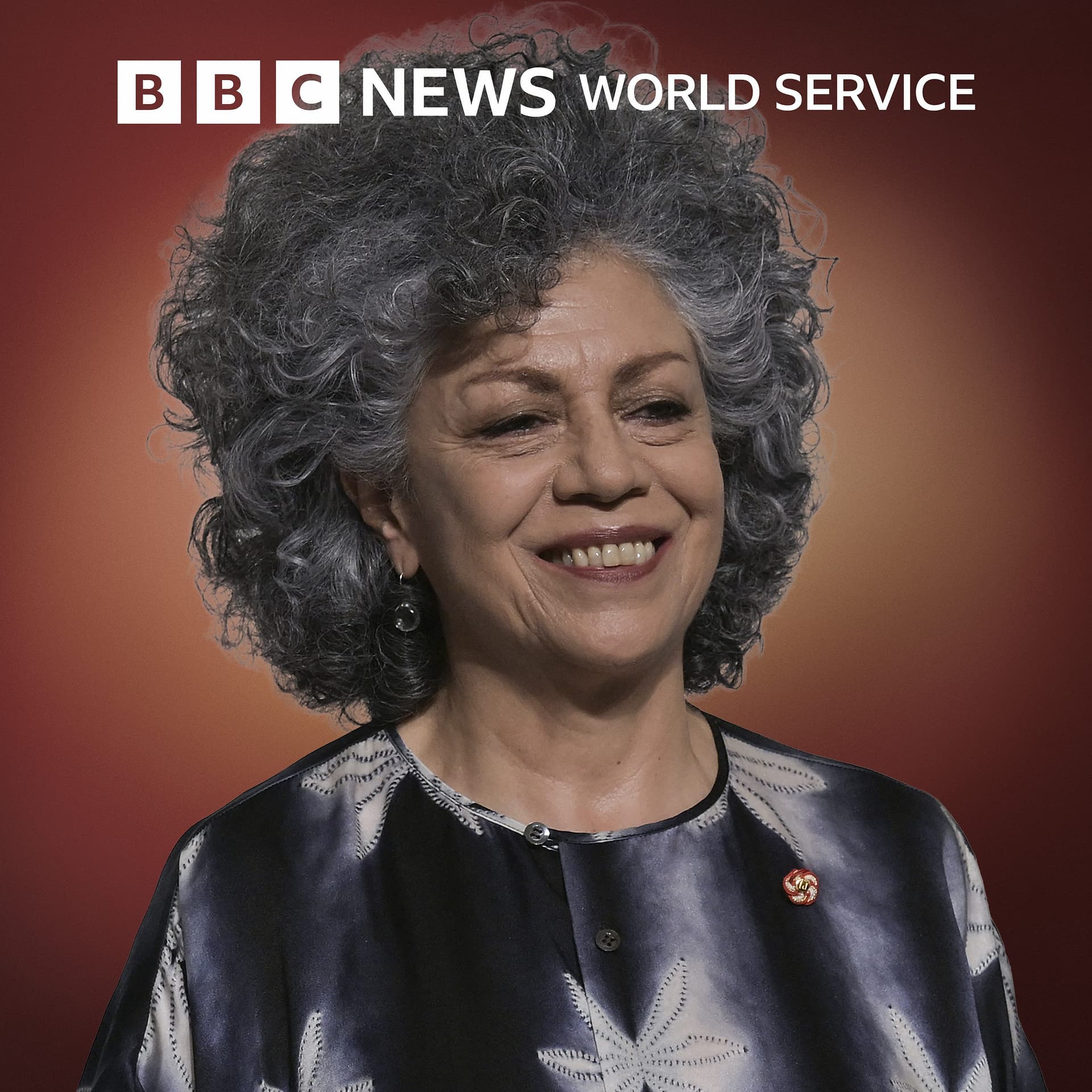
Podcast Summary: The Interview with Doris Salcedo
Podcast Overview
- Title: The Interview
- Description: A series of conversations with influential figures from various fields, including business, politics, culture, and more. The podcast features impactful insights on significant global issues.
Episode Details
- Episode Title: Doris Salcedo, Colombian artist - giving voice to victims of violence
- Presenter: John Wilson
- Producers: Lucy Sheppard, Ben Cooper
- Editor: Richard Fenton-Smith
- Release Schedule: Mondays and Wednesdays at 0700 GMT; available as a podcast twice a week on BBC Sounds and other platforms.
Episode Summary In this episode, John Wilson interviews Doris Salcedo, a prominent Colombian artist known for her powerful sculptures and installations that give voice to the victims of violence in Colombia. Salcedo's work is deeply influenced by her childhood experiences amidst the political turmoil in Colombia and aims to address themes of loss, trauma, and survival.
Key Themes and Discussions
- Background and Influences
- Childhood: Salcedo was born in 1958 in Bogotá, Colombia, during a time of political conflict. Her artistic journey began early, motivated by her family’s political discussions and a lack of cultural resources.
- Art Education: She studied art in Bogotá and later in New York, where she sought to understand Western art history, despite her own culture being underrepresented.
- Art as a Response to Violence
- Salcedo's art reflects the devastation of war and aims to memorialize victims. She engages with survivors and visits sites of violence to inform her work.
- Key Works:
- Atribilius (1992): Focuses on the thousands of Colombia’s disappeared; incorporates personal items (like shoes) to represent the victims.
- Public Installations: Salcedo created a shroud with the names of victims using ashes to commemorate them after a referendum that rejected peace in Colombia.
- Fragments Installation: A permanent installation in Bogotá made from weapons surrendered during the peace process, transformed into a floor by empowering women who were victims of violence.
- The Artistic Process
- Salcedo emphasizes the meticulous nature of her work, often involving communal activities or contributions from victims, which adds layers of meaning and connection.
- Stitching: The act of stitching recurs in her work, symbolizing care, connection, and the act of mending trauma through art.
- Personal Challenges and Creative Drive
- Salcedo discusses her struggle with macular degeneration and how it has influenced her artistic process, leading her to collaborate more with others and embrace collective creation.
- She perceives her condition as a gift that has deepened her commitment to her work and the victims she represents.
- Philosophy of Art and Impact
- Salcedo believes that art operates slowly, enacting change over time rather than through immediate communication. She draws parallels between her work and historical shifts in societal perspectives through art.
- Her motivation is rooted in empathy and political awareness, driving her to address unresolved social issues through her art.
Conclusion Doris Salcedo’s interview exemplifies how art can serve as a powerful medium for addressing and processing violence, memory, and trauma. Her poignant narratives reflect the stories of individuals affected by conflict, making her one of the most significant contemporary artists in exploring the human condition through a socio-political lens.
Key Takeaways
- Art as Voice: Salcedo uses her art to give a voice to the voiceless victims of violence.
- Cultural Underrepresentation: Her experiences highlight the challenges faced by artists from underrepresented backgrounds.
- Empowerment through Creation: Art can empower both the creator and the subjects, transforming narratives of loss into collective memory.
- Long-term Change: The impact of art is gradual, requiring time and persistence to effect societal change.
For more insights, listen to the full episode of *The Interview* on BBC World Service or your preferred podcast platform.
Written by AI. May contain mistakes. Listen to the episode to check what was said.
Transcript
Automatic transcript. May contain errors.0:00This BBC podcast is supported by ads outside the UK. If journalism is the first draft of history, what happens if that draft is flawed? In 1999, four Russian apartment buildings were bombed, hundreds killed. But even now, we still don't know for sure who did it. It's a mystery that sparked chilling theories. I'm Helena Merriman, and in a new BBC series, I'm talking to the reporters who first covered this story. What did they miss the first time? The History Bureau Putin and the apartment bombs Listen on bbc.com or wherever you get your podcasts From the Winter Olympic and Paralympic Games To the European Athletics Championships The 2026 sporting calendar is packed full of big events Keep up with all the action with More Than The Score The podcast that goes beyond the score sheet Join expert BBC sports journalists every Monday to Friday For interviews with sports stars, big talking points and the stories behind the headlines.
1:07More Than The Score from the BBC World Service. Listen now. Search for More Than The Score wherever you get your BBC podcasts.
1:30shaping our world from all over the world. I will come back to Russia. I will participate in the elections. There's an increase in violence according to the coca crop. There's no place in the world where women are equal. I will give away the vast majority of my money. It's my full-time focus for the rest of my life. For this episode, I meet the Colombian artist Doris Saucedo at BBC Broadcasting House in London. You're going to hear about her childhood in a country riven by political violence, with the government at war, with the fart guerrilla movement, and how the devastation of war is represented in the installations and intricate details of her art.
2:14Her work has been shown in galleries and museums across the world, including a major commission for the Kavanagh Turbine Hall of London's Tate Modern. She's the recipient of the Guggenheim Fellowship and the Whitechapel Gallery's 2025 Art Icon Award, amongst other honours. Through her work, Doris Salcedo says she wants to give voice to the victims of violence, talking to survivors and witnesses of conflict, and visiting the sites of war, from concentration camps to mass graves. If your family has been killed, if your house has been destroyed, if your city has been destroyed, if everything you see when you look up and down, north and south, East and West is destruction, then the end of the world has already arrived.
2:58And I want to place myself right there, right there, at that moment where there is nothing, nothing left, nothing but loss. Over the course of our conversation, she tells me stories of the people that she's met, people whose lives have been decimated by violence and the trauma that it's wrought. And she explains how the slow decline of her eyesight has shaped her art as she's turned to others to help as she works. Welcome to the interview from the BBC World Service with Doris Salcedo. Doris Salcedo, you were born in Bogota in 1958, a politically tumultuous time in Colombia, of course. What was your early childhood like?
3:41What are your memories? Well, the Truth and Reconciliation Commission that wrote a proper history of the Colombian conflict. They say that the conflict started in 1958, and as you just said, I was born in 1958. So I've seen war all of my life. But the war was a low-intensity conflict. So it happened in the countryside. So actually, when I was growing up, it was sort of quiet, but with one element. Right now, the world has found a polite way to describe the Global South thing. Well, Global South. But when I was growing up, it was underdeveloped. We were underdeveloped countries with an underdeveloped economy and, of course, an underdeveloped culture.
4:23It is horrific to grow up in a country where you know that your culture, your thinking, your writing, your art, everything is underdeveloped. You're regarded as an underclass by the rest of the world. Yeah, absolutely. And you had that awareness, that sense of your position in the world. Of course. What did your parents do? My father had a small business that was not very successful and my mother was a seamstress. So I came from a really lower middle class background. So we have to work and we have to struggle. But my family was really aware politically. So I think on a daily basis, we had political discussions on the dinner table.
5:00And that was a very important formative aspect. And however little culture there was in Bogota at the time, I was always taken to everything, whatever concerts, whatever shows, whatever. So I had the opportunity to develop my vocation, my call, very early on. I started taking drawing lessons when I was a six-year-old. And you had an aptitude, right, from a young age? Always. And what sort of, you say, I mean, I presume theatre and music, you could go to concerts, but, I mean, not many museums in Bogota at the time. Not many museums, but there were some shows. However, as a young art student, we were taught a class that was universal art history.
5:42And universal art history, of course, was only European. And we don't have museums, so we don't have originals. So it was really late in my life when I was 22, 23 that I had access to actually see an original work of art from that, quote unquote, universal art history. Just give us a sense of how you developed your artistic approach, your aesthetic at this time. I know you studied art at University of Bogota and then went to New York to study art. Why New York, first of all? Well, because if you come from a former colony, we don't have museums. I had no chance to see original works of art. And at that time, there was not a whole lot of contemporary art theory or history being translated into Spanish.
6:27So it was essential to learn English, to have access to information. And it was essential to go to New York and to Europe to see art history, because in spite of the fact that we do not form an essential part of Western culture, Western culture is all there is for us, because our own culture has been destroyed. So you are maybe the last part of the last tale of Western culture. But however, that is the canon in which I have to develop my work. You returned to Columbia after your studies in New York. Were you not tempted to stay in New York? Because developing your language, your sensibility, in tune with what was happening on, going on in New York.
7:10Never, never. I thought at the time, I thought it was useless. I mean, New York's history had been told so many times and our history had never been told. So it was absolutely essential to be an artist, to have a perspective. And that was the perspective from the Global South. So Colombia not only exports cocaine and guerrilla and violence, but we have the capacity to export thought, thinking. So that's why I make the point to make every single piece in Colombia. Oh, so you had a responsibility. You felt an obligation to return. An obligation. Absolutely. Was there a moment when you decided that should be the purpose of your art, to give voice to the victims of violence?
7:53Yes. When I returned in 1985, the Colombian conflict, who had been sort of low intensity, then it blew up. And we had not only the left-wing guerrillas, but then we have a very strong right-wing paramilitary groups aligned with the drug cartels. And so the level of violence was grew exponentially. And then I understood that I knew nothing. What is your life like when the end of the world arrives? how do you feel? How do you continue? How do you make up your life? So I start researching carefully, going to war zones, going to, if a massacre takes place in a place, I will go next day and talk to witnesses and talk to survivors, and then return to see how life has been transformed or deformed.
8:44Well, let's just talk about one of those works that you made in response in 1992. there's a series called Atribilius which seems to address the Colombian Civil War and the thousands of people who died and who were never seen again that disappeared. Just describe those works that we saw in the gallery as a result. At the time when I was making that piece DNA tests were not common. So I started researching one single case of a guerrilla woman that had been disappeared and then I realized that, first of all, women that were disappeared by force, they were kept alive in order to be raped for a long time.
9:26It was worse than for males that were killed right away. I talked to the families of these disappeared women and men, and they kept everything that belonged to that person, like in a shrine. They kept the closet, the clothing, and in some cases, even the mothers set a place in the dining table in case they came back. I met a mother who had not left her home for 20 years in case her son could call. They will never move to another house. It is horrific what happened to these families. So I borrowed the shoes they have kept and I made some niches and then I covered these niches with animal fibre and I stitched that animal fibre with surgical thread.
10:12And you say that the niche is like a sort of rectangular shoebox-sized space, a recess in the wall of the gallery. Yes, yes. In a way, I brought the paint that was inscribed in the private realm of the family, and I wanted to make many niches. So it came to the public sphere to show that in Colombia there was a social problem. We have more than 200 ,000 people who are missing. So that's why I needed to make this a collective social problem. And it's an incredibly emotional thing to see. And because those shoes are so representative, because they are so personal. And as you say, it's about those shoes are put aside in a way because of the uncertainty, not knowing whether those loved ones are ever going to be seen again.
10:57It's interesting how those recesses containing the shoes are sealed with a kind of sliver of pigskin and stitched onto the wall of the gallery. Stitching itself recurs in much of your work. and as you say your mother was a seamstress wasn't she? Yeah. So it goes back, is that a kind of a conscious reference to her? Absolutely. She was really skillful. She made these extraordinary fancy dresses and nine gowns and wedding dresses and things like that and I think I had a lot of ability from her and she encouraged that in me but also because I think it's very important to show care. So my sculptures are carefully made and lovingly made because one thing is to work with violence, and violence is horrific.
11:46But on the other hand, the victim is not horrific. The abject part belongs to the perpetrator, not to the victim. So I want to show that the beauty of that life that was sacrificed, that was wasted, but there is beauty in that. And the stitching, of course, is a communal activity. It reminds me that in 2016, you created another sort of performative piece involving hundreds of volunteers to create a huge white shroud laid out on the floor of the main square in Bogota, bearing the names of victims embossed in ash. And this was in response to a referendum, I believe, that came about that gave people the choice to end the civil war.
12:29Yeah, exactly. A small majority, but however small, they chose war over peace. That was, I guess, the worst day in my life. It was absolutely horrific. So I made a public call for people to write on these shrouds big enough to cover a body, to write with ashes the name of the victims of the Colombian conflict and fill this huge square of Bogota with only 0.7 % of the names of the victims. I mean, in order to write all the names in shrouds, I will need more than the entire city of Bogota. And the names written in ashes. In ashes. Why ashes? Ashes because they are already being forgotten. I had permission to use that square only for 12 hours.
13:19And 10 ,000 people came out. There were amazing moments that day. You're listening to the interview from the BBC World Service, people shaping our world from all over the world. If journalism is the first draft of history, what happens if that draft is flawed? In 1999, four Russian apartment buildings were bombed, hundreds killed. But even now, we still don't know for sure who did it. It's a mystery that sparked chilling theories. I'm Helena Merriman, and in a new BBC series, I'm talking to the reporters who first covered this story. What did they miss the first time? The History Bureau, Putin and the apartment bombs.
14:05Listen on BBC.com or wherever you get your podcasts. From the Winter Olympic and Paralympic Games to the European Athletics Championships. The 2026 sporting calendar is packed full of big events. Keep up with all the action with more than the score. the podcast that goes beyond the score sheet. Join expert BBC sports journalists every Monday to Friday for interviews with sports stars, big talking points and the stories behind the headlines. More Than The Score from the BBC World Service. Listen now, search for More Than The Score wherever you get your BBC podcasts.
14:49For this episode of The Interview, I'm speaking to Doris Salcedo. When she arrived in our studio, Doris was warm, friendly, really engaged, and I was struck by the intensity of her commitment to her work and the poetic intricacy of her ideas about how best to represent these stories of suffering and death. Before we started the interview, she actually warned me that, despite looking forward to the conversation. Talking about the work often made her upset as she relived conversations and remembered the trauma of the people who inspired her art. She's spoken a lot over the years about her influences, and in particular, the Romanian-born poet Paul Celan, whose works reflected his own experiences of surviving the Holocaust.
15:35Okay, let's return to my conversation with Doris Saucedo. So he has a massive influence on the aesthetic. There are also explicit references to Celan in several of the works which borrow titles of his poems, including Unland, which is a piece based on the testimonies of children whose parents were killed in the Colombian Civil War. How did you go about interviewing these children? Oh, it was very difficult. It's a really delicate issue. I found these children in orphanages, and I was visiting them, and I would go on a monthly basis to visit them. And so you establish a relationship with them, but you don't talk about the event.
16:17They all witnessed the murder of their parents. And little by little, they would start willingly mentioning that the first child I interviewed was a little girl. And this girl, every time I went, she was wearing the same dress. And the dress was obviously too small for her. And one day, I was taking on an early flight to Bogota. So I went by the orphanage like at 5 a.m. And she was washing by hand the dress. She was already up. She was already up washing the dress. And then she started talking about the dress. And that dress had been made by her mother. and that was the first time she started talking about the murder and the loss of her mother.
17:02Celan has a poem that was the orphan's tunic and so I made that connection and I was guided by Celan at every step of the way to make the most delicate tunic and I thought of this gigantic loss not only for Celan's life as he lost his parents but the loss of this little girl. So I thought of the waste of life and I started making a piece that was the most wasteful way of working and I start embroidering through wood with hair, going with a needle through wood. Using human hair? Using human hair. These are pieces in which you have two ends of tables, mismatching tables, which are then conjoined and seemingly stitched together, joined with the human hair.
17:58Yeah. I wanted this silk to be part of this domestic element, but also to look like skin almost. And it was a really difficult piece to make. It was three years of embroidering through wood, which is a really painstaking task to honour these losses. Why human hair? It's because the poverty of the children I interview was so extreme. I visited four children whose mother was terribly wounded and she was dying. There was nothing they could do for her. They lived in an empty shack with only one table. And I thought they have nothing, absolutely nothing but their own bodies. So that's why human hair, because they had nothing else but a table and their bodies.
18:51It must have been very traumatic at times for you listening to these stories. It is incredibly painful. And you carry all these stories with you. Once you hear a painful story, it is very much embedded in your heart. It's there forever. I like this image that Greek mythology gives you of this centaur, Kryron, who was wounded in his leg. And then he went into a cave and he was a healer. He never cured anybody. He was unable to cure. Just as art is unable to save lives or to cure a wound. But he did console the victims. So I like this idea of the wounded healer. And that's how I see myself. Have you had responses from any of those people you've worked with?
19:39To the exhibitions themselves? Have they felt, do you get a feeling that they have been touched by what you've done? It is difficult. There is only one instance in which that happens. But usually what people need is to have the name or the photograph or the beloved ones being shown. And I'm unable to provide that in most of the cases. So the only case in which I know I have touched and I have changed people's life is with a permanent installation that I have in Bogota that is called Fragments. It's a piece that I made when the peace process took place. 37 tons of weapons were given to me to make a monument, which I did not make.
20:20I made a counter monument. So I... These were weapons. They were rifles and machine guns. Yeah, they were brand new weapons that the guerrilla gave up. And I invited women who had been raped by armed men, invited them to hammer the metal. and with this I make tiles that are the floor of a contemporary art space in Bogota and there were two changes that this piece provide one is that many people will tell me maybe one of the gangs with which my father, my mother, my son was killed is here, is part of this floor and the other one is these women these women, they change they actually were, I didn't think that that was possible but they were empowered and literally empowered.
21:10When you have been sexually enslaved or raped by armed men, your body does not belong to you. It's like they don't inhabit their own body. And all of a sudden, when they were capable of hammering this metal, destroying these arms, they felt that they were part of Colombian history. All of a sudden, they were included in a monument that is placed in the very heart of Bogota and that people visit. So they felt that they recovered their body. And actually they have formed an NGO and they help other victims of rape. And I have witnessed their change, but only in that occasion. That's a really powerful process of transformation that you affected there.
21:55And you can imagine that another artist, possibly a male artist, would take 37 tons of weapons and create some kind of statue or monument with those weapons. But in fact, you flatten those weapons. You melt them down, you flatten them, you create a floor as you did in the square in Bogota with those shrouds. It's very often about the ground beneath our feet, isn't it, your work? Yeah. And in this case, it's beautiful because it upsets the symbolic relation armed men have with civilian population. Usually they walk on people to whatever they please. And in this case, we civilians, we can all walk as equal to walk on this floor.
22:31So I love that idea that this power relation has been reversed. In recent years, I know you've been struggling with your sight as well, macular degeneration. I think that's the condition that you have. How has that affected the sort of work that you've been making? Well, I was diagnosed when I was 31 years old. So it's something that has been with me all of my life and it has given me time to adjust. I was reading an essay by Jorge Luis Borges, who was blind, and he said that if you are an artist, if you have a destiny in art, everything that life gives you is a gift. And I decided that blindness was also my gift.
23:11When I had eyesight, I used to work by myself in a limited manner. And then I needed help. And then I realized that my work could be much more powerful and much more important if it had a collected character. And so that aspect is very important. And I think it had allowed me to make my work. I don't think my work would have developed the way it has if I had had proper eyesight. So it's been a blessing in a way. That's a long time to have lived and worked with that condition. Has it got worse recently? It gets worse little by little, but it is a slow development. So right now I don't have focal vision.
23:54So if I look straight at your face, I don't see it. So I move my eyes continuously because I have peripheral vision. You've spent 40 years exploring some of the darkest aspects of humanity. Has your art changed anything, do you think? I think art takes forever. I don't think art has a direct communication as language that, but I think art does enact a change, but through centuries. You know, when Caravaggio shows us the first dirty feet of peasants, when Michelangelo shows a human being that is erected and is free, art will always show us other ways of acting, other possibilities of relating to each other.
24:37So I think the idea of presenting a work of art in a fragmentary, incomplete, delicate, nuanced way might teach us a way of facing or a way of resisting the brutality of the totalizing, disgusting political discourse that we're witnessing nowadays. What drives you on creatively? I'm very political. And I think what drives me is more the politics. there are so many issues I have not been able to address because I work very slowly. I spent three or four years making each piece. And I have like a list of crimes that I have not addressed and I have this urge to go through that. So it's more a political and empathic relation with the victims what drives me.
25:25Thank you for listening to The Interview from the BBC World Service. If you enjoyed today's programme, you can listen to The Interview wherever you get your BBC podcasts. Until the next time, goodbye for now.
26:03missed the first time? The History Bureau, Putin and the apartment bombs. Listen on bbc.com or wherever you get your podcasts.
26:33Interviews with sports stars, big talking points and the stories behind the headlines. More Than The Score from the BBC World Service. Listen now, search for More Than The Score wherever you get your BBC podcasts.
From the publisher
In an interview from the BBC’s This Cultural Life, presenter John Wilson speaks to the Colombian artist Doris Salcedo. Her work is a response to the devastation of war, and tells the stories of its victims - tales of loss, trauma and survival. She is recognised as one of the most important living artists, and her powerful sculptures and installations have been shown across the world.
A childhood growing up amid the political violence of Colombia led to career dedicated to giving voice to the victims of conflict, visiting concentration camps, mass graves and abandoned villages. She says she wants to place herself where there is nothing left but loss. The Interview brings you conversations with people shaping our world, from all over the world. The best interviews from the BBC. You can listen on the BBC World Service, Mondays and Wednesdays at 0700 GMT. Or you can listen to The Interview as a podcast, out twice a week on BBC Sounds, or wherever you get your podcasts.
Presenter: John Wilson Producers: Lucy Sheppard, Ben Cooper Editor: Richard Fenton-Smith
Get in touch with us on email TheInterview@bbc.co.uk and use the hashtag #TheInterviewBBC on social media.