
In short
The Logan Bartlett Show - Episode 104: Sam Altman on GPT-4o and the Future of AI
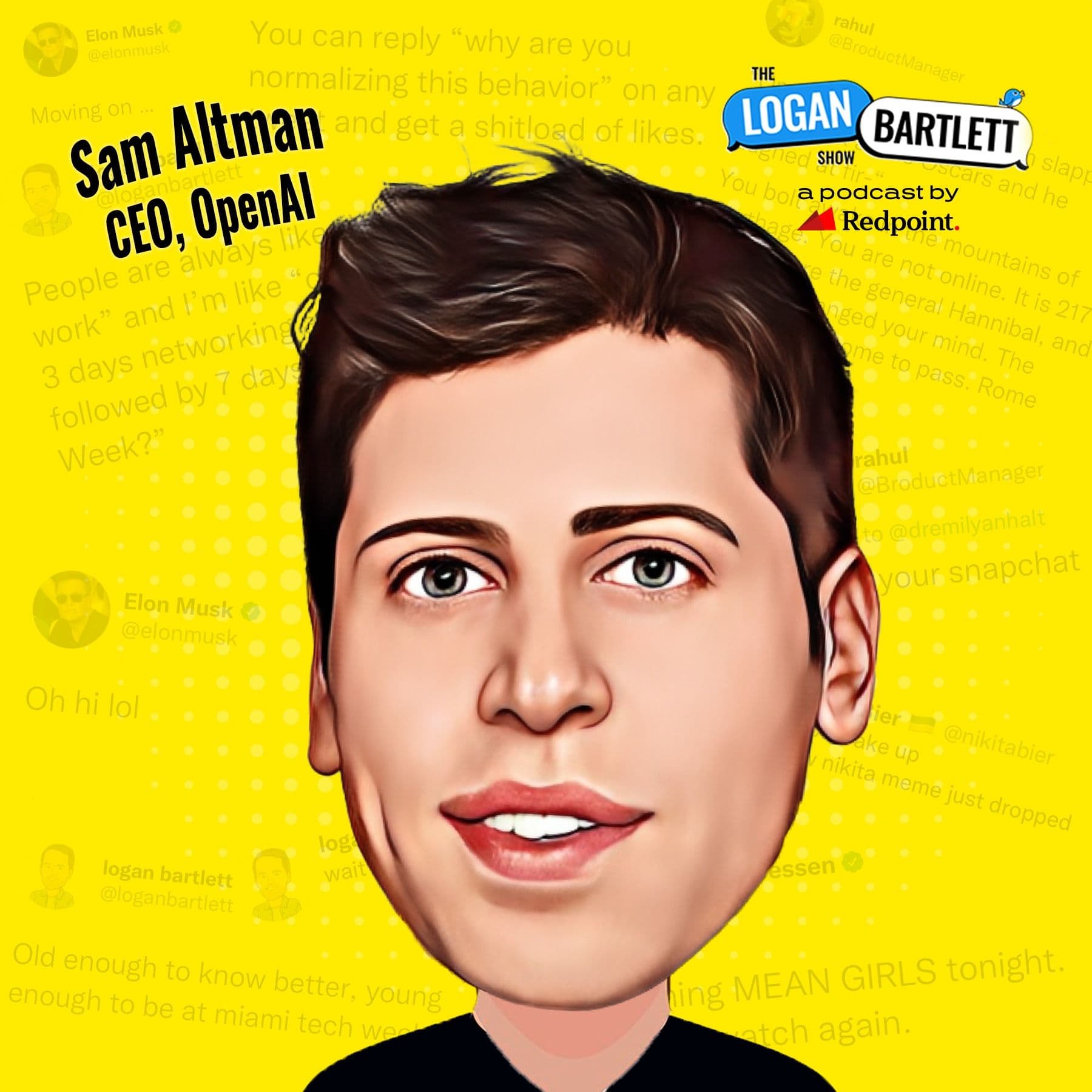
Podcast Overview In this episode of *The Logan Bartlett Show*, host Logan Bartlett engages with Sam Altman, CEO of OpenAI, on the day of the ChatGPT-4o announcement. The discussion encompasses OpenAI's strategic vision, the advancements in AI technology, the implications of AI on society, and predictions regarding the future of artificial intelligence.
---
Key Highlights
- The Personal Impact of Leading OpenAI
- Fame and Isolation: Altman shares his experiences of losing the ability to maintain anonymity in public, which he finds to be isolating.
- Multimodal AI: Introduction of GPT-4o
- Significance of Multimodal AI: GPT-4o integrates text, voice, and vision, enhancing interaction through various modes.
- Use Cases: Early applications include real-time assistance without needing to switch tasks, demonstrating fluidity and efficiency.
- Behind the Technology
- Development Process: Achievements stemmed from years of research, including advancements in audio and visual models and efficient training methodologies.
- Future of AI in Communication and Creativity
- Improvements in Interaction: AI is expected to enhance communication, creativity, and job experiences, making it crucial for future job markets.
- Understanding AGI (Artificial General Intelligence)
- Continuous Journey: Altman discusses the misconception that AGI is a finite goal, emphasizing it as an ongoing process rather than a single event.
- Safety and Ethics in AI
- Navigating Risks: The conversation delves into the ethical implications of AI and the necessity for regulation while balancing innovation and safety.
- Interpretability: Emphasizes the importance of understanding AI decision-making processes.
- Economic Impacts of AI
- Productivity Changes: Altman suggests that while AI has altered expectations, tangible economic impacts are still emerging.
- Future Opportunities: Coding is highlighted as a key area for growth within the next year.
- The Role of AI in Employment
- Job Evolution: Predictions indicate shifts in job roles due to AI integration, especially in creative fields and human connection.
- The Future of AI Infrastructure
- Demand for Infrastructure: Altman predicts an increasing need for AI infrastructure and the necessity for new architectures to handle growing demands.
- Advice for CEOs and Startups
- Embrace AI: Altman advocates for startups to leverage AI as a foundational tool while ensuring their business remains defensible in a competitive landscape.
- Anticipating the Future
- New Job Categories: Altman speculates on emerging job titles that may arise as AI becomes more integrated into daily life, focusing on human interaction and experience.
---
Key Takeaways
- AI is Not Static: The trajectory towards AGI is continuous and iterative, with significant advancements expected to shape the future.
- Collaboration with AI: The relationship between humans and AI should be designed for mutual benefit, maintaining clear distinctions between human and AI roles.
- Innovation Requires Adaptation: Successful businesses will adapt to rapidly evolving technologies, ensuring they utilize AI effectively while maintaining unique value propositions.
Conclusion Sam Altman's insights provide a comprehensive look into the evolving landscape of AI and its implications for society, business, and personal identity. As AI technology continues to advance, the importance of ethical considerations, infrastructure demands, and the human-AI relationship will play a crucial role in shaping the future.
---
*For further information, follow The Logan Bartlett Show on various platforms and stay updated on upcoming episodes.*
Written by AI. May contain mistakes. Listen to the episode to check what was said.
Transcript
Automatic transcript. May contain errors.0:28Welcome to Logan Bartlett Show. On this episode, what you're going to hear is a conversation of things related to artificial intelligence, as well as where open AI is headed, given how topical it is in the news and Sam's perspective on such a leading frontier that is artificial intelligence. You'll hear that discussion with Sam here now. Thanks for doing this. Yeah, of course. All right, I want to start off easy. What's the weirdest thing that's changed in your life in the last four or five years running open AI? Like what's the most unusual shift that's happened? I mean quite a lot of things but the sort of inability to just be like mostly anonymous in public is very very strange I think if I had thought about that I would have said okay this is like a weirder this would be a weirder thing than it sounds like but I didn't really think about it it's like a much weirder thing it's like a strangely isolating way to live you believed in AI and the power of the business so did you just not think through the derivative implications of running something that wasn't that powerful?
1:28didn't think there were all of these other things i'm like oh yeah i was gonna be like really important opening i was gonna be really important company i didn't think i would like not be able to like go out to dinner yeah in my in my own city that's weird that's weird uh you made an announcement earlier today we did multimodal 4-0 yeah that's the omega sign right oh just the like oh like omni yeah omni okay sorry uh it works across text voice vision um can you speak to why this is important? Because I think it's like an incredible way to use a computer. We've had like voice, the idea of like voice-controlled computers for a long time.
2:09You know, we had Siri and we had things before that. They've never to me felt natural to use. And this one, many different reasons, what it can do, the speed, adding in other modalities, the inflection, the naturalness, the fact that you can do things like say, hey, talk faster or talk in this other voice and that it's the fluidity, the pliability, whatever you want to call it. I just can't believe how much I love using it. Yeah, Spike Jonze would be proud. Are there use cases that you've gravitated to? Well, I've only had it for like a week or something. but one surprising one is putting my phone on the table while I'm like really in the zone of working and then without having to like change windows or change what I'm doing, using it as like another channel.
3:03So I'm like working on something I would normally like stop what I'm doing, switch to another tab, Google something, click around or whatever. But while I'm like still doing it to just ask and get like an instant response without changing from what I was looking at on my computer, that's been a surprisingly cool thing. What actually made this possible? Was it an architectural shift or more compute? I mean, it was like all of the things that we've learned over the last several years. We've been working on audio models. We've been working on visual models. We've been working on tying them together.
3:36We've been working on more efficient ways to train our models. It's not like, okay, we unlocked this one crazy new thing all at once, but it was putting a lot of pieces together. Do you think you need to develop like an on-device model to decrease latency to the point for usability? For video, maybe it would be hard to deal with network latency at some point. Like a thing that I've always thought would be super amazing is to put on someday a pair of AR goggles or whatever and just like speak the world in real time and watch things change. And that might get harder over network latency. But for this, you know, 200 or 300 milliseconds of latency feels super, like, it feels faster than a human responding to me in many cases.
4:24Is video, in this case, images? Oh, sorry. I meant video if you wanted, like, generated video, not input video. Got it. Got it. So currently it's working with actual video as is. Well, like frame by frame. Frame by frame. Okay. Got it. You alluded recently to chat GPT, maybe not being, the next big launch not being GPT-5. It feels like there's been sort of an iterative approach to model development that you guys have taken. Is it fair to say that's how we should think about it going forward, that it's not going to be some big launch, here's chat GPT-5, but instead? We honestly don't know yet. But I think that definitely one thing I've learned is that AI and Surprise do not go well together.
5:09And although, you know, the traditional way a tech company launches products, we should probably do something different. Now, we could still call it GPT-5 and launch it in a different way, or we could call it something different. But I don't think we figured out how to do the naming or branding for these things yet. But it made sense to me from GPT-1 to GPT-4 at the launch. Now, obviously, GPT-4 has continued to get much better. We also have this idea that there's going to be like, you know, maybe there's like one underlying kind of like virtual brain. And it can like think harder in some cases than others.
5:48Or maybe it's different models, but maybe these are just a care if they're different or not. So I don't think we know the answer to how we're going to like product market all of this yet. Does that mean maybe that the needs of the compute to make incremental progress on models might be less than what it's been historically? I sort of think we'll always use as much compute as we get. Now, we are finding incredible efficiency gains, and that's really important. The cool thing that we launched today is obviously the voice mode. But maybe the most important thing is we were able to make this so efficient that we're able to serve it to free users.
6:27like best model in the world by a good amount, if you will look at that little thing, served to like anybody who wants to download chat GPT for free. And it was a remarkable efficiency game over GPT-4 and GPT-4 Turbo. And we have a lot more to gain there. I've heard you say that chat GPT didn't actually change the world in and of itself, but maybe just changed people's expectations for the world. Yeah. Like, I don't think you can find much evidence in the economic measurement of your choice that chat GPT really inflected productivity or whatever. Maybe customer support. Maybe some areas. Summarization.
7:02But if you look at global GDP, can you detect when chat GPT launched? Probably not. Is there a point that you think will be able to determine a GDP inflection? Yeah. I don't know if you'll ever be able to say this was the one model that did it, but I think if we look at the graph a couple of decades in the future, we'll be like, hmm, something changed. Are there applications or areas that you think are most promising in the next 12 months? I'm sure I'm biased just because of what we do here, but coding, I think, is a really big one. Kind of related to the bitter lesson. You spent some time recently talking about the difference between deeply specialized models trained on specific data for specific purposes versus generalized models that are capable of true reasoning.
7:45I would bet that it's the generalized model that's going to matter. And what is the most important thing there as you think about, like, someone that's focused singularly on a data set and all the integrations associated with something very narrow? If the model can do generalized reasoning, if it can, like, figure out new things, then if it needs to figure out how to work with a new kind of data, you can feed it in and it can do it. But it doesn't go the other way around. Like a bunch of specialized models that I don't think. A bunch of specialized models put together can't figure out the generalized reasoning.
8:20So the implications for that of coding specific models probably would be? I think a better way of saying this is I think the most important thing to figure out is the true reasoning capability. And then we can use it for all sorts of things. What do you think the principal means of communication between humans and AI is in two years? Natural language seems pretty good. I'm interested in this general idea that we should design a future that humans and AIs can sort of use together, use in the same way. So I'm like more excited about humanoid robots than I am for other forms of robots because I think the world is like very much now designed for humans.
8:58And I don't want that to get reconfigured for some more efficient kind of thing. I like the idea that we talk to AI in language that's very well human optimized and that they even talk to each other that way. Maybe, I don't know. But I think this is generally an interesting direction to push. You said recently something to the effect of the models might ultimately get commoditized over time, but the most important thing would likely be the personalization of the models to each individual. Well, first, do I have that, right? I'm not certain on this, but it's like a thing that would seem like reasonable to me.
9:38Yeah. Then beyond personalization, do you think it's just normal business UI and ease of use that ultimately wins for end users? Those will for sure be important. They always are. You know, I can imagine other things where there's like a sort of marketplace or a network effect of sort that matters where, you know, we want our agents to communicate. There's different companies in an app store. But I sort of think that the rules of business kind of generally apply. And whenever you have a new technology, you're tempted to say they don't. But that's always like fake news and not always, usually fake news.
10:13And all of the traditional ways that you create enduring value will still matter here. When you see open source models like catch up to benchmarks and all of that, what's your reaction to it? I think it's great. I mean, I think that there are, you know, like many other kinds of technology, there will be a place for open source. There will be a place for, like, hosted models, and it's fine. It's good. I'm not going to ask about any specifics related to this, but there have been press reports related to looking to raise major amounts of money. Wall Street Journal, I think, was a credible one to galvanize investment in fabs.
10:57Semi-industry, TSMC, and NVIDIA have been ramping pretty aggressively to meet expectations of the need for AI infrastructure. You recently said that you think the world needs more AI infrastructure, and then you said a lot more AI infrastructure. I do see that. Is there something you're seeing on the demand side that would require way more AI infrastructure than what we're currently getting out of TSMC and NVIDIA? So first of all, I'm confident that we will figure out how to bring costs to deliver current systems way, way down. I'm also confident that as we do that, demand will increase by a huge amount.
11:37And third, I'm confident that by building bigger and better systems, there will be even more demand. We should all hope for a world where intelligence is too cheap to meter. It's just wildly abundant. People use it for all sorts of things. And you don't even think about whether like, oh, you know, do I want this? Do I, you know, do I want this like reading all my emails and responding to them for me? Or do I want this like curing cancer? Of course you pick curing cancer. But the answer is like, you'd love for it to do both things. And I just want to make sure we have enough for everybody to have that.
12:08I don't need you to comment on your own personal efforts here. Although again, if you want to, please let me know. But humane and limitless and some of these like different physical device assistants. What do you think those have gotten wrong? Where do you think the adoption maybe hasn't met user desires just yet? I think it's just early. I have been an early adopter of many types of computing. I had and very much loved the Compaq TC1000 when I was a freshman in college. I thought it was just so cool. And like, that was a long way from the iPad, a long, long way from the iPad. But, you know, it was directionally right.
12:54Then I got a trio. I was like the, I was very not cool college kid. I had like a old Palm Trio. And when it was like a, that was not a thing that kids had. And that was a long way from the iPhone, but we got there eventually. And, you know, these things feel like a very promising direction that's going to take some iteration. You mentioned recently that a number of businesses that are building on top of GPT-4 will be steamrolled, I think was your term, by future GPT. I guess, can you elaborate on that point? And second, what are the characteristics of AI-first businesses that you think will survive GPT's advancement?
13:31it the only framework that i have found that works for this is you you can either build a business that bets against the next model being really good or a model that bets on that happening and benefits from it happening so uh if you're doing a lot of work to make one use case really work that was just beyond the capability of gpt4 gpt4 oh no and then you get it to work but then gpt5 comes out and it does that and everything else really well you're kind of like sad about the effort you put into that one thing to get it to barely work but if you had something that just like kind of worked okay across the board and people were finding things to use for but you didn't put in like tons of work to make this one thing kind of possible and then GPT-5 or whatever we call it comes along and it's just way better at everything you got the rising tide lifted all your boats effect you know what I would suggest is like you're not building an AI business.
14:30In most cases, you're building a business and AI is a technology that you use. In the early days of the app store, I think there were a lot of things that like filled in some very obvious crack. And then eventually Apple fixed that. And there wasn't, you didn't keep needing like a flashlight app from the app store, which is like part of the OS. And that was like going to happen. And then there were, I think, things like Uber that were enabled by having smartphones, but really built a very defensible long-term business. And I think you just want to go for that latter category. I can come up with a lot of incumbent businesses that leverage you all that fit that framework in some ways.
15:11Are there any novel types of concepts that you sort of think is, in that example, the Uber? And it doesn't need to be, it could be a real company if you think of one, or even if it's a toy or just something that's interesting that you think is like enabled in that way? I would actually bet on the new companies for like many of these cases. A very common example people use is trying to build like the AI doctor, like the AI diagnostician. And people talk about, oh, I don't want to do a startup here because, you know, Mayo Clinic or Take Your Pick is going to do it. And I would actually bet it's a new company that does something like that.
15:49Do you have any advice for CEOs beyond that who want to be proactive about preparing for these types of disruptions? I would say like bet that intelligence as a service gets better and cheaper every year. And it is necessary, but not sufficient for you to win. So the big companies that take years to implement this, you can like beat them. But every other startup that's paying attention is going to do this too. And so you still have to figure out like what's the long-term defensibility of my business. Now, the playing field is way more open than it's been in a long time. There's incredible new things to do, but you don't get a pass on like the hard work of building enduring value, even though you can now do it in more ways.
16:38Is there a job title or a type of job responsibility that you could envision existing or being mainstream in five years because of AI that like is maybe niche or non-existent today? That's a great question. And I don't think I've ever gotten it before. People always ask, like, what job is going to go away? The new one is a more interesting question. Let me think for a second. I mean, there's like a lot of things that I could talk about that I think are sort of less interesting or less huge. What I'm trying to do is like come up with the areas of like, what will 100 million people do or 50 million people do?
17:19the broad category of new kinds of art, entertainment, sort of more like human to human connection. I don't know what that job title is going to be, but I think, and I don't know if this like we get there in five years, but I think there's going to be a premium on like human in-person, like fantastic experiences. I don't know what we'll call that, but I could see that being like a very huge category of something new that we do. The most recent public tender of OpenAI was$90 billion or something in and about there. Are there one or two things that you sort of look at as milestones that will get OpenAI to be a trillion-dollar company, short of AGI?
18:01I think if we can just keep improving our technology at the rate we've been doing it and figuring out how to continue to make good products with it and revenue keeps growing like it's growing. And I don't know about specific numbers, but I think we'll be fine. Is the business monetization model today the one that you think creates the$1 trillion equity value? I mean, the chat GPT subscription model really works well for us. Like, surprisingly, I wouldn't have bet on that. I wouldn't have been confident it's going to do as well as it has, but it's been good. Do you think post-AGI, whatever that term actually means, we'll be able to ask?
18:43AGI, what the monetization model is that might be different? Yeah. Yeah. Should be able to. I think we maybe saw in November, not to rehash, that the existing open AI structure left some things to be desired, which I don't think we need to rehash in total. You talked about it enough, I think. But you spoke into making changes along the way. What do you think the appropriate structure is going forward? I think we're close to being ready to talk about that. We've been hard at work on all sorts of conversations and brainstorming there. I think hopefully this year, I think we'll be ready to talk about this calendar year.
19:28Can you tell me first? We'll see. When Larry and Brett Taylor got Battlefield promoted to board directors, I was waiting for, you know, my call never came through. One of the interesting things I think about preconceptions around AI, to your point on the monetization model and all that, is I think we've all, I've heard you speak about it, manual work obviously first, followed by white collar, followed by creative. Obviously, it's proven to be kind of the opposite in some ways. Are there other things that are counterintuitive that you've looked at being like, well, I would have presupposed it to be this way, but it's actually proven to be the exact opposite?
20:04it. That's definitely the mega surprise to me, the one that you mentioned. There's other, like, I don't think I would have expected it to be so good at legal work so early, just because I think of that as like a very precise, complex thing. But no, definitely the big one is the observation of like physical labor, cognitive labor, creative labor. For those that haven't heard you make the point about AGAI and why you dislike the term, Can you elaborate on that point? Because I no longer think it's like a moment in time. I obviously have so many naive conceptions when you start any company, and particularly in a field that's like moving around as much as this one is.
20:46But my naive conception when we started is that we would like get to a moment where we didn't have AGI and then we did. and it would be a real discontinuity. And I still think there's some chance of a real discontinuity, but on the whole, I think it's going to look much more like a continuous exponential curve where what matters is the pace of progress year over year over year. And you and I will probably not agree on the month or even the year that we're like, okay, now that's AGI. we can come up with other tests that we will agree with but even that is harder than it sounds and you know gpt4 is definitely not over a threshold that i think almost anyone would call an agi and i don't expect our next big model to be either but i can imagine that we're like only maybe one or two or some small number of ideas away and a little bit more scale from something we're like this is now kind of different and i think it's important to stay vigilant about that Is there a more modern Turing test, we can call it the Bartlett test, where you think, hey, when it crosses this threshold?
21:59I think when it's capable of doing better research than all of OpenAI put together, even one OpenAI researcher, that is a somehow very important thing that feels like it could or maybe even should be a discontinuity. Does that feel close? Probably not, but I wouldn't rule it out. What do you think the biggest obstacles that you see to reaching AGI? It sounds like you think maybe the scaling laws have run away currently and holding for the next couple of years. Yeah, I think the biggest obstacles are new research. And, you know, one of the things I've had to learn shifting from, like, internet software to AI is research does not kind of work on the same schedule as engineering, which usually means it takes much longer.
22:47doesn't work, but sometimes means it works tremendously faster than anyone could have predicted. What is that? Can you elaborate on that point that it's like not as linear in progress? I think the best way to elaborate on that is like historical examples. I'm going to get the numbers wrong here, but I'm sure no one will try to correct you. Someone will. I think the neutron was first theorized in the early 1900s. It was maybe first detected in the 10s or 20s. and the work on what became the atomic bomb started in the 30s and happened in the 40s. Like, from not really having no idea that such, like, that there was even the idea of a thing like a neutron to being able to, like, make an atomic bomb and just, like, break all of our intuitions about physics, that's, like, wildly quick.
23:45There are other examples that are sort of less pure science. Like there's the famous quote about the Wright brothers. Again, I'm going to get the numbers wrong here, but let's say it was like 1906. They said they thought flight was 50 years away. In 1908, they did it, whatever, something like that. And then many, many other examples throughout the history of science and engineering. There's also plenty of things that we theorize that never happen or take, you know, decades or centuries longer than we thought. But sometimes it does go really fast. Interpretability. Where are we on this path and how important is that long term for AI?
24:22There's different kinds of interpretability. So there's the like, do I understand like every what's happening at like every mechanical layer through the network? And then there's, can I like look at the output and say there's a logical flaw here or whatever? I am excited about the work going on at OpenAI and elsewhere in this direction. And I think that interpretability as a broader field seems promising and exciting. I won't pin you down. I assume you'll have a nice announcement when you're ready to say something. But do you think that that is going to be a requisite to mainstream AI adoption, maybe within enterprises or something?
25:03GBT4 is quite widely adopted at this point. Yeah, that's fair. There's maybe a few things that I think you get asked questions about or maybe accused is too strong of a term, but that people are suspicious about. One of which is I think there's this needle threading that exists between being excited about AGI, but also feels like you have a personal kind of apprehension about you, Sam, OpenAI, generally being the ones to harness it and unilaterally make decisions, which has led to some, you know, some body, some governmental structure where there's elected leaders instead of you. making these decisions?
25:50Yeah, I think for like, I think it'd be a mistake to go regulate, heavily regulate like current capability models. But when the models, which I believe they will, pose significant catastrophic risk to the world, I think having some sort of oversight is probably a good thing. Now there is some needle threading about where you set those thresholds and how you test for it. And it would be a real shame to sort of stop the tremendous upsides of this technology and letting people that want to go train models in their basement be able to do that, that'd be really, really bad. But, you know, if we have international rules for nuclear weapons, I think it's a good thing.
26:31The regulatory capture group, which I'm sure we can think of, which VCs fall into that bucket of accusatory around this regulation, what do you think they don't see about the potential risks inherent in AI. Well, I think they just don't get, I don't think they like on the whole seriously wrestled with AGI. These were also people who like some of the loudest voices about AI regulatory capture were, you know, totally decrying it as a possibility not that long ago, not all. But I do have empathy for where they're coming from, which is like regulation has net been really bad for technology. Like, look what happened to the European technology industry.
27:12Like, I get it. I really do. And yet, I think that there is a threshold that we are heading towards, above which we may all feel a little bit different. Do you think open source models themselves present inherent danger in some ways? No current one does. But I could imagine one that could. I've heard you say that safety is kind of a false framing in some ways, because it's more of a discussion about what we explicitly accept, like airlines? Yeah, it's more like safety is not a binary thing. Like you are willing to get on airplanes because you think they're pretty safe, even though you know they crash once in a while.
27:57And what it takes to call an airline safe is like a matter of some discussion some people have different opinions on. It's a topical point right now. topical point right now. They have gotten just unbelievably safe overall, like triumphantly safe. But safe does not mean no one will ever die in an airplane. Similarly, medicine. We really think the side effects and some people have adverse consequences around it. And then there's the implicit side of safety as well, like social media, right, or things that have negative association. Is there something that you could imagine seeing on the safety paradigm that would cause you to act differently than pushing forward.
28:42Yeah, we have this thing called our preparedness framework that's sort of exactly that, saying that, you know, in these categories, at these levels, we'd act differently. I've had Eliezer on the podcast. How was that? It was wonderful. We sat for the longest podcast I've ever done. I think it was four hours of us. He has more free time than me, so I apologize. I can't go that long. Listen, we can do multiple sessions. We don't need to do them all now. I think that his points, I think, stay fairly consistent. I'm grateful he exists. He's a very interesting guy to sit down with for four hours and talk.
Read the full transcript
29:12We went a bunch of different directions. But I'd be remiss, as a friend of the pod, to not ask a fast takeoff question. I'm curious, like, there's so many different fast takeoff scenarios. And one of the constraints that I think we point to today is just a lack of AI infrastructure, right? And I guess if there was some researcher developed a modification to the current transformer architecture where suddenly the amount of data and hardware scale needed drastically reduced more like human brain or something like that. Is it possible we could see like a fast takeoff scenario? Possible, of course.
29:56And it may not even need a modification. It is still not what I believe is the most probable path, but I don't discount it. And I think it's important that we consider it in the space of what could happen. I think things will turn to be more continuous, even if they're accelerating. I don't think we're likely to go to sleep one day with pretty good AI and wake up the next day with genuine super intelligence. But even if the takeoff happens over a year or a few years, that's still fast in some sense. There's another question about even if you got to this really powerful AGI, how much does that change society on the next day versus the next year versus the next decade?
30:39And my guess is in most ways, it's not a next day or next year thing. But over the course of a decade, then the world will look quite different. I think the inertia of society is like a good, helpful thing here. One of the things I think people also find they have suspiciousness around, I imagine the questions you don't love getting are Elon, equity, and November board structure. Those are probably the three. Which one of those do you like the least? I don't hate any of them. I just don't have anything new to say on any of them. Well, I guess I'm not going to ask the equity one specifically because I think you've answered that in more than enough ways.
31:21Although people still don't seem to like the answer that enough money is a thing. Yeah, if I made a trillion dollars and then gave it away, it would fit with, I think, the expectation or the sort of way it's usually done. There was another Sam I thought about. Oh, that's true. trying that in some ways. Yeah. Comparatively. No, I just mean like most people who make a ton of money. Yeah. What do you feel like your motivations, this pursuit of AGI, like outside of the equity? I think most people take solace in the fact that like, oh, well, even if I have some higher mission, I still get paid for it in some ways.
32:02Like what are your motivations now coming into work every day? Like what's the most fulfillment derived from? Look, I tell people, this all the time. I'm willing to make a lot of other life trade-offs and sacrifices right now because I think this is the most exciting, most important, like best thing I will ever touch. And it's an insane time and I'm happy it won't be forever. Like, you know, someday I get to go retire on the farm and I'll remember this fondly, but be like, oh man, those were stressful, long, long, stressful days. But it's also just incredibly be cool. Like, I can't believe I'm, this is happening to me.
32:40It's like, this is like amazing. Was there a single moment, I guess we go back to the, the, the fame example of not being able to go out in your city or whatever, but has there been a single moment that was most surreal that like, Oh geez, I don't know. Uh, I mean, you've done a podcast with Bill Gates. I'm sure you have your speed dial. If I took your phone right now would have a lot of very interesting people on it. Was there a single moment over the course of the last couple of years that you were like, this is a uniquely surreal moment? And kind of every day there's something that's like, wow, if I could like, if I had like a little bit more mental space to step back, it's like, this would be crazy.
33:16Kind of a fish in water. But yeah, it is kind of like that effect. After all of that, like November stuff happened, you know, like that day or the next day or whatever, I got like, I don't know, 10, 20 texts, I mean like that from like major world, like presidents, prime ministers of countries, whatever. And that was not the weird part uh the weird part was that happened and i was like um you know kind of responding saying like thanks or whatever and it felt like very normal and then i we had these like insane super jammed like four and a half days and just this like crazy state and it was just like weird like not sleeping much not really eating um energy levels like very high very clear very focused, but just like your body was like in some weird, like adrenaline charge state for a long time.
34:05And then it was like, all this happened the week before Thanksgiving. It was kind of crazy, crazy, crazy. Got resolved on Tuesday night. You canceled our podcast. Canceled our podcast. Sorry. I don't usually cancel things. Anyway, then on that Wednesday, like now it's the Wednesday before Thanksgiving, Ali and I drove up to Napa and stopped at this diner. God, it's very good. and on the drive up there I realized I hadn't like eaten in like days and then all of a sudden like kind of like normal it was just like okay you know this is like normally what we'd be doing on weekend heading out like whatever and go to uh gotts order like four entrees like heavy like you know fried like heavy entrees like two milkshakes just for me and I was sat there and eight.
34:52And it was very satisfying. And as I was doing that, one of them, president of this one country texted again and just said like, oh, I'm so happy this all resolved, like great, whatever. And then it hit me that like, oh yeah, like all of these people had texted me and it wasn't weird. And the weird part was like realizing that that had like happened in the middle of it and that that should have been this very weird experience and it wasn't. So that was like one that sticks out. Yeah, that is interesting. My takeaway is human adaptability to almost anything is just like much more remarkably strong than we realize.
35:25And you can get used to anything as the normal, good or bad, pretty fast. And I kind of like over the last couple of years have learned that lesson many times. But I think it says something remarkable about humanity and good for us and good as we stare down this like big transition. I remember post 9-11, I'm sure you remember exactly where, but I was in Summit, New Jersey in our town, you know, whatever, dozens of people passed away. And the, how close the town came together after a terrorist attack happened and it seemed so normal, like that it was just the normalcy of it. Or I have friends in Israel right now and you talk to them about it and they're like, no, it's normal.
36:14I'm like, well, there's a war going. Like, it's got to be surreal. And they're like, well, I mean, what are you going to do? You go about your day, you go get your food, all that. And it's amazing these psychological impacting things. At the end of the day, we need to go get food and we need to, you know, talk to our friends and all this stuff. So it is amazing how much that can happen. It really, like genuinely, that's been my big surprising takeaway to like feel it so viscerally. As you think about like models becoming smarter and smarter, what you kind of touched on this a little bit earlier with the creative element.
36:48Like what do you think remains uniquely human as models start doing more and more capabilities of what we used to consider? I think many, many years from now, humans are still going to care about other humans. I was reading the internet just a little bit, and everyone's like, oh, everyone's going to fall in love with Chachapiti now, and everybody's going to be the Chachapiti girlfriend, whatever, whatever. I bet not. I think we're so wired to care long-term about other humans in all sorts of big and small ways that that's going to remain. are obsessional with other people. Sounds like you hear a lot of conspiracy theories about me.
37:31You probably don't hear a lot of conspiracy theories about AI. You might not care if you did hear one. I think we're not going to watch robots play each other in soccer probably as our main hobby. As you run OpenAI, the company itself, and you built a lot of rules or frameworks at YC on how to run businesses, and then you've broken a lot of them. Some. Are there different types of people you hire for this business than you would have had you started a consumer internet company within the executive ranks or a B2B software company or something? Researchers are very different than product engineers for the most part.
38:15But Brad or Mira or some of the executives, like researchers are unique. But does OpenAI bring in a different type of executive or do you hire for a different trait? So I mostly have not, like I am, sometimes you hire externally for executives, but I'm a big believer that if like you generally promote, it's not, it's probably a mistake to only promote people to be executives because that could reinforce a monoculture. And, you know, I think you want to bring in some new, very senior people. But we mostly like homegrown talent here. And I think that's a positive, given how different what we do is from what you would do somewhere else.
38:52Is there a decision that you've made over the course of OpenAI that felt the most important at the time of making it? And how did you go about making it? It'd be hard to point to just a single one, but the decision that we're going to do what we call iterative deployment, that we're not going to go build AGI in secret and then put it out into the world at once, which was the prevailing wisdom and the LEA's are planning others. I think that was like a quite important decision we made and it felt like a really important one at the time. If another company that... Betting on language models was an important decision and felt like an important one at the time.
39:35I actually don't know the story of betting on language models. How did that come to be originally? Well, we had these other projects. We were doing the robot thing and video games. There was a very small effort. It started with one person looking at language modeling. And Ilya really believed in it. Really believed in the general direction that became language models, let's say. And we did GPT-1 and we did GPT-2. We started to study scaling laws, scaled GPT-3, and then we made a big bet this was what we were going to do. And it was not – it looks so – all of these things look so obvious and retrospectively.
40:16They really don't feel that way at the time. One other thing you brought up recently was there's two approaches to AI, the replication of yourself and then the smartest employee. Oh, it's not AI itself, but like how you want to use it. Like when you imagine using your personal AI. So it was a subtle distinction when you said it, but can you expound on it? Because it seemed like a fairly profound distinction of how at least Sam thinks about the future of AI use cases. So can you explain that point again? Because clearly I misunderstood it. if you're going to text me in five years in the future, I think you want to be clear of whether you're texting me or my AI assistant.
41:03And then if it's my AI assistant that's going to bundle messages together and you'll get a reply later, or if it can easily do something you might ask my human assistant to do, then fine, you'll know that. But I think there will be value in keeping what those things are separate and not that it's like, all right, the AI is truly just an extension of Sam. I don't know if I'm talking to Sam or Sam's AI ghost, but that's okay because it's the same thing. It's this merged entity. I think there will be like Sam and Sam's AI assistant. And also, I want that for myself. I don't want to feel like this thing is just like this weird extension in me, but that it's a separate entity that I can communicate with across a barrier.
41:45You see it in music or creative where it becomes pretty easy to replicate a Drake or a Taylor Swift audio. We probably need some form of validation or some centralization that validates, hey, this is actually the creative work of XYZ person. You're probably going to want some version of that at a personal level too. Yeah, but it's like, you know, the way I think about like open AI is it's I don't like there's different people and I'm asking them to do things and they go off or they ask me to do things and I go off. But it's not a single like board. And I think that's like a way we're all comfortable.
42:22And so so what is that? Can you tie that back? Like the decentralization of letting individuals do their. not well also that but i i meant more just kind of like what is the abstraction of what my personal ai is going to be like got it like do i think of that as this is just me and it's gonna like take over my computer and do what's best and because it's me that's gonna be totally fine it's answering messages on my behalf and it's you know gonna just like i'm slowly gonna like take my hands off the controls that it's slowly gonna like be me or do i think of this as like This is a really great person I work with that I can say, hey, can you do this thing?
43:03Get back and then you're done. But I think of it as not me. As you think about the educational system and as we think about like the class of college class of 2030 or 2035 or whatever, whatever, some group in the future. Are there changes specifically that you think should be made within the college educational system to prepare people for the future we have? The biggest one is I think people should not only be allowed but required to use the tools. There will be some cases where we want people to do something the old-fashioned way because it helps with understanding. I remember sometimes in math class or whatever, there'd be something you can't use.
43:49No calculators on the test. Yeah. But on the whole, in real life, you get to use the calculator. And so you need to understand it, but then you've got to be proficient using the calculator too. And if you did math class and never got to use the calculator, you would be less good at the work you need to do later. If all of the open AI researchers never got to use the calculator, open AI probably wouldn't have happened. Computers at least, you know? We don't try to teach people not to use calculators, not to use computers. And I think we shouldn't train people not to use AI either. It's just going to be an important part of doing valuable work in the future.
44:44Now back to the show. Last one. In planning for AGI and beyond, you wrote the first AGI will be just a point along the continuum of intelligence, which you spoke about earlier. We think it's likely the progress will continue from there, possibly sustaining the rate of progress we've seen over the past decade for a long period of time. Do you ever personally stop and process or visualize what the future will look like in that? Or is it just too abstract to contemplate? all the time I mean I don't visualize it like you know we have these like flying cars in a Star Wars future city and not like that but like definitely what it means when one person can do the work of hundreds or thousands of well coordinated people and what it means when I don't want to say we can discover all of science but kind of what it feels like like what it would feel to us like is if we could discover all of science be pretty cool yeah Sam, thanks for doing this.
45:44Thank you.
46:28We'll see you next week.
From the publisher
On the day of the ChatGPT-4o announcement, Sam Altman sat down to share behind-the-scenes details of the launch and offer his predictions for the future of AI. Altman delves into OpenAI's vision, discusses the timeline for achieving AGI, and explores the societal impact of humanoid robots. He also expresses his excitement and concerns about AI personal assistants, highlights the biggest opportunities and risks in the AI landscape today, and much more.
(00:00) Intro
(00:50) The Personal Impact of Leading OpenAI
(01:44) Unveiling Multimodal AI: A Leap in Technology
(02:47) The Surprising Use Cases and Benefits of Multimodal AI
(03:23) Behind the Scenes: Making Multimodal AI Possible
(08:36) Envisioning the Future of AI in Communication and Creativity
(10:21) The Business of AI: Monetization, Open Source, and Future Directions
(16:42) AI's Role in Shaping Future Jobs and Experiences
(20:29) Debunking AGI: A Continuous Journey Towards Advanced AI
(24:04) Exploring the Pace of Scientific and Technological Progress
(24:18) The Importance of Interpretability in AI
(25:11) Navigating AI Ethics and Regulation
(27:26) The Safety Paradigm in AI and Beyond
(28:55) Personal Reflections and the Impact of AI on Society
(29:11) The Future of AI: Fast Takeoff Scenarios and Societal Changes
(30:59) Navigating Personal and Professional Challenges
(40:21) The Role of AI in Creative and Personal Identity
(43:09) Educational System Adaptations for the AI Era
(44:30) Contemplating the Future with Advanced AI
Executive Producer: Rashad Assir
Producer: Leah Clapper
Mixing and editing: Justin Hrabovsky
Check out Unsupervised Learning, Redpoint's AI Podcast: https://www.youtube.com/@UCUl-s_Vp-Kkk_XVyDylNwLA
🎥 Subscribe on YouTube: https://www.youtube.com/channel/UCugS0jD5IAdoqzjaNYzns7w?sub_confirmation=1
Follow on Socials
📸 Instagram - https://www.instagram.com/theloganbartlettshow
📱 X - https://twitter.com/loganbartshow
🎬 Clips on TikTok - https://www.tiktok.com/@theloganbartlettshow
About the Show
Logan Bartlett is a Software Investor at Redpoint Ventures - a Silicon Valley-based VC with $6B AUM and investments in Snowflake, DraftKings, Twilio, and Netflix. In each episode of The Logan Bartlett Show, we sit down with the people behind today’s most important startups and extract the tactics, lessons, and frameworks they’ve learned the hard way. Conversations span hiring to GTM, product, growth, fundraising and everything in between - collectively forming the ultimate playbook to make you a better CEO, investor or board member.
Tap follow and enable notifications to stay ahead of the game.