
In short
The Logan Bartlett Show - Episode 111 Notes
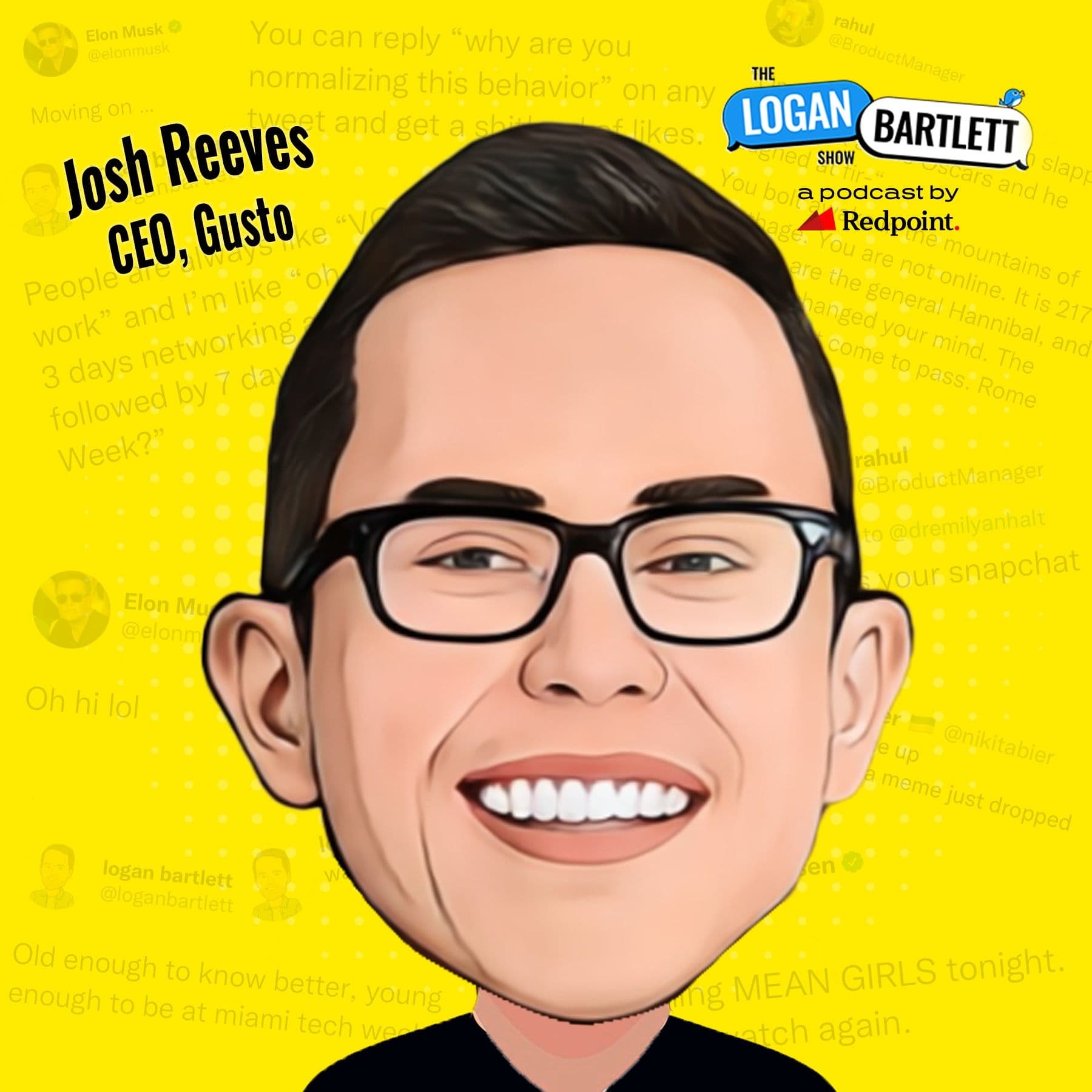
Episode Overview Title: How Josh Reeves (CEO, Gusto) Built a $10B Company Serving Small Businesses Description: Josh Reeves shares insights into Gusto's journey to nearly $10 billion valuation, discussing product-market fit, company culture, hiring, and future opportunities. Key Points:
- Gusto's focus on small business payroll and benefits
- Importance of an intentional company culture
- Lessons learned in hiring and company growth
---
Episode Details 00:00 - Intro
- Introduction to Josh Reeves, CEO of Gusto.
00:36 - Early Days and Product Market Fit
- Gusto founded in 2011, product launched in December 2012.
- Focused on helping small businesses start and succeed, especially in payroll.
01:02 - Building a Scalable Business
- Importance of targeting a narrow niche initially to achieve product-market fit.
01:41 - Gusto's Core Offerings and Customer Focus
- Core offering includes payroll services aimed at small businesses (1-500 employees).
- Emphasis on new employers and simple, user-friendly processes.
02:51 - Challenges and Strategies in Payroll
- Navigating complex payroll regulations across states.
- Initial focus on California, gradually expanded nationwide.
05:40 - Expanding Gusto's Reach
- Importance of geographic expansion and product depth to serve small businesses better.
10:11 - Customer Feedback and Product Development
- Leveraging customer insights to enhance product offerings.
23:03 - Hiring and Company Culture
- Importance of hiring for alignment with Gusto’s values: humility, ambition, and service mindset.
29:23 - Values and Leadership at Gusto
- Company values include kindness, competition, and community.
- Culture encourages open debate and commitment to decisions.
37:14 - Sustaining Passion and Long-Term Vision
- Maintaining a long-term vision while navigating growth and market challenges.
43:27 - Balancing Growth and Sustainability
- Importance of unit economics and sustainability in growth strategies.
46:29 - Balancing Competition and Kindness in Startups
- Competitive spirit should coexist with a culture of kindness.
46:38 - The Importance of Team Collaboration
- Emphasis on teamwork and collaborative success.
47:47 - Navigating Feedback: Kindness vs. Niceness
- Difference between being kind and being nice; the former encourages growth.
48:25 - Hiring for Ambition and Humility
- Importance of humility in ambitious hires.
49:57 - Aligning Company Values with Success
- Values alignment vital for long-term success.
53:11 - Work-Life Integration at Gusto
- Encouragement of a work-life integration culture rather than strict balance.
56:11 - Building a Long-Term Oriented Business
- Commitment to supporting small businesses over the long haul.
57:15 - Mentorship and Learning from Other Founders
- Learning from other successful founders and their experiences.
01:00:09 - Structuring and Scaling Product Teams
- Importance of structured teams for scaling product offerings.
01:06:16 - Organizational Design and Leadership
- Evolving organizational structure to support growth.
01:08:31 - Hiring Executives and Internal Growth
- Strategies for promoting internal talent and hiring external expertise.
01:13:13 - The Journey of Rebranding to Gusto
- Reflections on changing the company name from Zen Payroll to Gusto.
01:21:05 - The Role of a CEO in a Growing Company
- Focus on building teams, setting vision, and enabling execution.
01:28:39 - Fundraising and Investor Relations
- Importance of aligning with the right investors as a long-term partnership.
01:33:14 - Future Goals and Impact of Gusto
- Vision for Gusto as a key player in supporting small business success.
01:35:48 - Conclusion and Final Thoughts
- Emphasis on continued learning, adapting, and supporting business communities.
---
Key Takeaways
- Intentional Culture: Building a company culture that emphasizes humility, ambition, and kindness is crucial for growth and employee satisfaction.
- Customer-Centric Approach: Gusto's offerings evolved based on direct customer feedback and needs, ensuring relevance and effectiveness.
- Hiring Practices: Focus on values alignment and potential for growth is essential in recruitment.
- Long-Term Vision: Emphasizing sustainable growth, supporting small businesses, and maintaining a long-term perspective is vital for ongoing success.
- Rebranding Insights: The transition from Zen Payroll to Gusto was carefully managed to maintain customer trust and align with the company's expanded mission.
---
Final Notes Josh Reeves emphasizes the importance of community, values, and sustained purpose in entrepreneurship. Gusto’s journey reflects a commitment to empowering small businesses through innovative and accessible solutions. The lessons shared provide invaluable insights for founders and leaders across various industries.
Written by AI. May contain mistakes. Listen to the episode to check what was said.
Transcript
Automatic transcript. May contain errors.0:28Welcome to the Logan Bartlett Show. they've wanted to build, hiring executives into the company, as well as scaling into the business that it is today. We also talk about the future of Gusto and the opportunities that are present for the business going forward. A really fun conversation that I wanted to have for a long time with one of the preeminent leaders in Silicon Valley. You'll hear that discussion with Josh now. Josh, thanks for doing this. Yeah, great to be here. Thanks for having me. Yeah, I'm excited. I've wanted to do this for a while. So for people that don't know, Can you describe what Gusto is?
1:01Yeah, so Gusto, we offer a number of products to our customers. We focus on small business. The first product we launched, it's called Payroll from Gusto. It's the least optional part of the stack, but broadly, we think about it as a people platform. And our goal as a company is to help make it easier for companies to get started and succeed. So really trying to stimulate and drive that entrepreneurship is a due north for us. And the ICP or the customer size that you're serving, what is the range or where do you think about the core bread and butter? So we love having folks join Gusto in that 1 to 500 employee range.
1:40But I always love reminding folks out of all the employers in America, over half are less than five employees. And we focus especially on new employers. So some of these new employers, when they start out, are one or two employees. Some will grow larger. Some will stay one to five employees. We love serving both. So founded in 2011? Founded 2011. Product went live December 2012. Which is a long time to be building. Maybe take us through that early journey. One, how did you stumble on this as an insight or an idea to go after? And two, you were in, I don't know if it was actually stealth, but you were in building mode for a while.
2:17Yeah, so I'll cover both. I think the early days are always fun to draw some learnings. Gusto was started by three co-founders. we had all studied electrical engineering back in the day. So you might be wondering, what's the connection between electrical engineering and things like payroll and payments and healthcare? For us, it was more, we had been raised and had grown up with a desire to use the skills and learnings we have to go fix stuff. And we had all run prior startups. So literally I had set up a small business, my prior startup, I had set up payroll, I had set up health benefits, my co-founders had done the same thing.
2:51So that was one way we got exposure to this pain point was literally going through using other incumbent products and feeling in that moment like, wow, this could be made way easier, way simpler. This is too manual. There's too much time being invested. And given our backgrounds, we thought, hey, can we bring modern software to bear in this space and make a product that anyone can use without any training whatsoever? So that was one input. The other was that we had family who had run small business. And that's actually a pattern that's continued for, as we've scaled Gusto to over 2 ,500 teammates.
3:23Not a rule, but a lot of times when people are joining, they either have a family member or a friend or prior experience working in smaller business, which, again, creates a lot of connection and empathy for the customers that we serve. And so then building for a while, how did you define, I mean, payroll's a near-infinite problem, I would say, particularly as you go state-by-state and then you think globally. And so how did you think about getting to that MVP? And what part of the market did you corner off? Let me go through a little bit of the early, early stage. So I think focus is super, super important.
3:54So we actually went live with 10 of our friends' companies first. And at that point, it was purely a back-end system. It did tax filings. It did tax calculations and tax payments. It did, obviously, direct deposit and kind of money movement. But for those first few companies, accuracy, reliability mattered. but there was really no website. You like just call my co-founder on his cell phone and we would go to your house. So that was a way for us to just get more of that backend process going. When we went and did our public launch, we were very open about what we were doing the whole time. But we knew that we had to launch something that was very easy to self-serve set up on because of that focus on small biz.
4:33And so it just took us time to get there. We went live December, 2012 and had over a hundred companies sign up that first month, mostly through inbound, word of mouth, self-serve. And that's when we knew we were onto something interesting because we had actually created something that was useful. People loved it. They told others about it. But we also had a way to grow that was going to be cost-effective and viable given that small business focus. In terms of the refinement of how you thought about the initial ICP, was it geographic in terms of what you were going to serve initially? Yeah, let me give you more dimensions.
5:04So it was only companies in California. They had to be new employers having never run payroll before. They had to have only salaried employees, no hourly. They had to all be full-time, no part-time. They had to be no contractors. I mean, it was a very, very specific audience because we wanted to prove out, again, could we build something useful that was easy, that was effective, accurate. Now we pretty quickly added in additional features and functionality. Once we got to what I would call a more full-featured offering for a smaller business in California, we then spent the next couple of years actually going through a geographic expansion state-by-state.
5:39And we could have done that faster with more of a partial solution, but we really had this due north of how do we just abstract this complexity so that, again, if you've never run a business or you're really intimidated by starting a business, you can go set up on Gusto, run payroll, and it's that simple. As you thought about the prioritization of like depth and full featuredness of the products and getting that in some direction versus the width of states to serve. Yeah. Right. I assume those two things were at somewhat odds. Like how did you sort of think about what is a fully featured product and then going state by state or how did you prioritize those things?
6:17So high level, I think there's three dimensions. There's geographic expansion, company size, and product depth and breadth. And I think those are always ongoing debate topics when it comes to strategy. And there's a tension that exists of resource prioritization right across all of them. Yeah, can't do everything all at once. Focus is super, super important. And I like to think about it more as sequencing. What do we do now versus later? And saying, hey, we're going to do all of it right now is not really strategy. It's just slide right on all of the initiatives. And that doesn't really work. So for us, it was really important in California to prove, because let me just take a step back really quick.
6:50Like small business in particular, big market, has always been a big market. Payroll, not something we invented, obviously around since the concepts of currency and work and pay and taxes have existed for a long, long time. Small business in particular did payroll primarily on pen and paper by hand. And when you look at the incumbents in our space that had some type of technology component, they very much focused on big market, enterprise. This was not a segment that they pursued. And we had a hypothesis that it was for two reasons. One, can you actually build a product that's viable for this segment?
7:22Well, if these are small businesses that don't have offices and or they're not going to go home and install some software on their home family PC when their kid's playing a video game, manual makes sense. But now that you have, and this is starting in 2008, a computer in your pocket, you have the ability to on the go interact with a very, very powerful device. That felt like that was a big shift that we wanted to kind of take advantage of. And then from a go-to-market lens, not just mobile, but also paperless and cloud, obviously, but from a go-to-market lens, it had to be a more inbound engine.
7:56It had to be something where online search and content and people word of mouth referring through social. And all those platforms didn't exist too until the last 10-ish years before Gusto got started. So it was those ingredients that we had a hypothesis on. But to your question, those are all just thoughts. We needed to prove in California with small business that Gusto could build a product that people loved, they told others about, they would grow, that top of funnel would increase. Because we had a Do North as a company that we wanted to have good unit economics from day one. We really felt like we were going to be building Gusto for many decades.
8:31This is more of a mission for us. We wanted to go make it easier to help these small businesses survive. And so we didn't want to just rush that process to get to more revenue for the sake of it. We really had to prove that we had created something useful that we could scale. Once we had that insight, then there was a debate. Do we start doing additional product lines? A couple of years later, we did launch health benefits, and that's become a really important part of our offering. But what we felt at that point was the one thing we're going to focus on is geographic expansion. So for a couple of years there until 2015, the U.S.
9:02is more like 50 countries than 50 states. you have over 10 ,000 different local, state, federal payroll tax rules. We actually went through methodically to go cover every single state, all of those different payroll tax edge cases. And when we got to 50 states, again, another inflection point, we could have decided to go to more countries. At that point, we decided to focus on product depth and breadth. And that's been a big focus of ours since then. Was that something that you had like a unique strategic insight on how to prioritize like going after health benefits at that point versus going more international?
9:37Was that something you heard from customers? How did you sort of think about that? Yeah, I think it's fun to like, I know a lot of people listening are entrepreneurs or aspiring entrepreneurs. You know, we can talk about theory or philosophy or people like to call that stuff strategy. Like it's even more powerful to ground this in once you have a product and customers using it, just concrete feedback. So, you know, we had the idea, even in our seed fundraising deck that, you know, payroll is the least optional part of the stack. If you don't pay someone, they're going to quit. Once we do payroll, we become that system of record for employee data, the transactions and data sit in payroll.
10:09It gives us a chance to kind of build this much more holistic offering. That's a theory. In those three years it took us to get to nationwide coverage for payroll, the number one requested thing we had from customers was, can I do benefits with you? Because the same employee data is required for both systems. At that point, benefits was also very analogously, very manual, very paper-based, lots of face-to-face meetings. and like could we just build a single solution that took the data inside gusto and made that enrollment process that renewal process that adding a dependent process way simpler way easier and then we had to go prove it but that was really what what got us excited about health benefits in particular was uh the customer interest in that product one of the hardest things i found in building a bottoms up sort of SMB or product led growth business is you don't necessarily control all the levers of your growth in the same way that you can sort of linearly model out AEs and leads and you can build, you have a little bit more control of AE hiring, I think, than you have paid acquisition and some of that stuff.
11:19But it is a little harder, I've found, to control and be disciplined about just like the infinite lead bullets you need to really build a product-led company. I'm curious, do you agree with that? And if so, how did you stay disciplined to not just the natural tension that I think investors probably push is like, let's go upmarket. Let's hire some mid-market AEs. Let's go after this 500 employee from the start group. I think, I mean, the reality is all these segments are big opportunities. And with Gusto and our strategy, we want to get these smaller companies. And again, the vast majority will stay smaller.
11:58But trust me, there's a team at Gusto obsessed with retaining growers and making sure that we can be the product they stay on. And a lot of our customers really want to stay on Gusto, given the experience they've had. So I think it comes down to focus more than anything else. And you're right. The traditional playbook, if you will, in B2B SaaS is to move on market and kind of apply the rinse-repeat motion related to more of an outbound high-touch sales motion. I think maybe what helped us was we like to take inputs. We like to learn. We like to understand what's out there. But to use an overused term in tech, first principles, what does this segment need and And how do we successfully serve and reach more of this segment?
12:40I don't know. I actually think small business customer acquisition is very much an engine. Maybe there's not a single motion that works on its own. But as a portfolio, it's highly quantitative. It's very analytical. It starts with you have to build something very useful. I kind of like that as a due north. When products are successful or companies are successful with not great products, that actually is like a consumer of technology and products bothers me because I feel like actually it's not sufficient to be the best product to win, but if you can be a great product and have really great go-to-market execution, like that is clearly the best of both worlds in terms of actually concretely providing value in the world and succeeding as a business.
13:19So for us, it started with, we have to have that high NPS, that high word of mouth that can be instrumented, that can be tracked. You can have specific cohort behavior. You can do attribution against new leads coming in, very quantitative exercise. From there, we have to obsess obviously over conversion and like maintaining retention. We then added in things like content marketing, which can also be fairly quantitative. And then on top of that, it was actually about a year after we launched, we did our first paid acquisition. Because I felt like at least at that time, given our skill sets, there was a pitfall of companies jumping too quickly to paid acquisition, to drive growth, mostly for the optics.
13:58And like something I said then, I'll say now, and I haven't said in a while, but like, it's very easy to turn$5 into$1. It's never, in the grand scheme of things, a good thing or scalable at all. And there's sometimes that game that gets played more at seed early stage, which then makes your cohorts really confusing because it actually isn't a sustainable business. So we started doing paid because that's a logical way for us to reach customers, more as a way to augment that organic engine. And then we've now expanded to many, many different programs. We actually launched a channel program also early on with accounting partners.
14:35And that's been fun. Like we now have over 17 ,000 accounting firms that partner with Gusto. That program started with one accounting firm where I went to a conference, met them, told them about Gusto. And so I would say maybe in small business land, there's more avenues to go and maybe it's more complex in that regard. but if you can prove that you have good LTV to CAC, you have good NDR, you're in a huge segment, you can compound high top-line growth for a long time. My answer to anyone that's like, well, why don't you go shift to larger is simply like we have a great business with smaller companies.
15:12It's a huge market. Like why wouldn't we want to go amplify and bring that to more small business while also strengthening some of our mid-market motion? Yeah, no, I think it's amazingly impressive and the ability to do that. It's just, it requires almost a near infinite set of iterations and incremental progress on what does the onboarding flow look like? What's the time to log in? What's the bounce rate on the homepage? What's the landing page, or the content marketing conversion rates? All the channels, right? It's like email, email, human touch. It's just all of that. And it requires almost like just such a level of discipline and just willingness to chew glass or just constantly iterate and A-B test things when an easier answer I found is, like, let's just go slightly up market, let's hire sales reps, and we'll have our sales reps do it.
16:10And I'm not sure that's always the right. Certainly if you're serving a, you want to serve a one to five, but, you know, employee organization, that's not going to work in that way. But it does start to go to market, can inform the product strategy if you're not careful on how you build the business. There's a tail wag the dog dynamic there. I mean, I think broadly, we're just excited that more companies have built amazing technologies and products for a small business. Because it was a contrarian when you were doing it a little bit. I mean, there wasn't Square, there wasn't Shopify, there wasn't these SMB businesses.
16:43HubSpot has gone more market, but like those - He used to be just into it, right? He was into it. It's nice now to have these five, six, seven reference points. But again, the market has always been there. I always love reminding folks, there's more dentist offices in America than tech startups. And like, you just think about that and you realize if the goal of a, of an entrepreneur or a product or a tech company, like we didn't start Gusto for our benefit. We started it to go fix a problem. And like, if there's so many folks that are in pain, frustrated, waiting to have a better solution or a system, and you know, we made some progress.
17:15We now have over 300 ,000 customers. I don't know. that to me is just a call to action as an entrepreneur to go build something useful and then make sure that there's a scalable way to go acquire and serve. And then that's progress. I mean, we're still early in this journey, in my opinion, but I am proud of the progress. Was there an unlock on that go-to-market engine that you found that could be broadly, I mean, the accountant channel is probably bespoke to your industry, but was there something, if someone's trying to build a product-led business, was there a thing or two that you learned that maybe was counterintuitive or just sort of took a couple iterations to land on?
17:52I mean, just thinking through some of the, I guess, like approaches we took, I mean, a term that mattered then matters now and I hope translates. I think there is like, how do you build a product? You know, at that time there was all like MVP, minimum viable. We actually use the term minimum lovable because the key ingredient to this approach, which you kind of alluded to already is like the product you create has to be something people love. right? Because it needs to be something that doesn't just, you know, the whole vitamin medicine dynamic, like provide some incremental value. It needs to be something that when they use it and they start realizing the benefits of what they can do with it, they have this like, aha, like, oh my God, this is so much better than what I had before that they want to go tell people about it.
18:37So I think instrumenting like what is minimum lovable product for your company, having the instrumentation to measure, track that, obviously there's a ton of stuff around instrumentation, metrics, optimization loops, you know, that matter. Because as a portfolio, things like Matter Augusto matter to any SaaS company. We care a lot about CAC payback. We care a lot about gross margin profile. But yeah, maybe ML, minimum lovable product, MLP would be the one that I would spotlight. Interesting. As you reflect, the journey now, I guess, is 13 years? Yeah, about 12, 12 and a half years. Is there anything that stands out on that that journey i'm sure there's there's countless things but if you were to go back and tell yourself in 2013 14 15 something that you reflect on uh just just that entire journey that you would have done differently or that you just wish you could have told yourself your younger self on how to build a business at the scale that you've gotten to um i mean there's in 12 years with so many changes to society and the economy and navigating you know financial market evolution and interest rates and COVID and pandemic, a bunch of stuff that we've had a chance to go through.
19:47And like our due north is how do we help the small business navigate those things and make their life easier? Some things I would reflect on. I think from a more operational execution lens, frankly, we would do more around kind of our instrumentation, data architecture. Some of the things that we did early on that stopped scaling, we're in the process of updating, revamping. part of that is the journey of company building but that's something that we talk a lot about building the train while running the train and that can be a little bit frustrating I mean there's simple stuff like our data model early on like we've been doing a lot of work to update our member model because the way that you pay a contractor through Gusto versus pay an employee because at the point in time when we did it was like a forked code base and so just work you have to do to go back and do you think you actually would have done that And I guess I'm thinking of the startup founder that's at a business that's 15 people or 50 people or 100 people or whatever it is.
20:45Do you think the way you did it made sense not knowing the inevitability of getting to a$10 billion valuation and the thousands of employees that you guys have today? It was the way you do it, probably the pragmatic decision, given the low probability of the success you've ended up having? Or was it something you would have taken a step back, even not knowing that the future was what it was? I mean, it's hard to, you can't A-B test. Yes, the kind of factual. And like we, I'm very, you know, eager and excited for all the things we're going to go do going forward to help small business. But more so than not, I am proud of the progress we've made and it's hard to attribute any one thing to that.
21:21Yeah. I mean, on the internal, like running the company side, I'd say some of the things that have been, you know, more challenging, difficult, but for every company was navigating the pandemic, the shift to how we work, the shift to the way we collaborate. You know, we were, you know, very in-person centric office company culture with a lot of apprenticeship type exposure, especially for hourly jobs at Gusto that went entirely remote. And then we've navigated, you know, the evolution of that to have more of a hub cluster model. So there's a lot of like where I spend time, frankly, is more on like how we communicate, how we organize, how we make decisions, how we collaborate.
21:57Like we were talking earlier about hiring, team building, knowing who's scaling and or for this next chapter, where do we need to make changes. Those are where I would say, um, as a leader, I spend the bulk of my time and, uh, definitely haven't been perfect. Haven't been, um, uh, a flawless track record there, but the goal is to learn and get better every time. Yeah. Well, I guess maybe, maybe speaking of, uh, of hiring, but I've heard you talk about like in interview process, you're there's, there's maybe three vectors at which you look for skills, alignment, uh, motivation, and, and then, uh, also the values of the individual.
22:34Can you maybe talk about why those are the three things that you look for in a given role? Share about where they came from and how we approached it and try to be as tactical as possible. So we were three people that started the company. We came together at a point in life where we had had these prior companies. We wanted to tackle a big pain point. We wanted to ideally make something useful so we could spend the rest of our perhaps working lives contributing to this mission. So when we were hiring our first employee, it was a really big moment for us. And not just because we needed to hire a designer and wanted to hire an engineer and wanted to go build more product faster, but it was a, hey, like what about the way we're working do we want to keep and maintain?
23:14And it's not just about checking a checkbox on a skillset, it's like the topic of values, right? Like values to me are not personal values, professional values. And if someone's not aligned with Gusto's values, they're not a bad person. It just means they'll do better work in a different company. But we wanted to codify our values. And we did that when we were just three founders, which I think a lot of times I talk to entrepreneurs, you think it's something you should go do and fix later when you get past 100 employees or something. I found it's way more leveraged if you invest the time early on.
23:44And again, it's not a theoretical exercise. Just think through when you're at least just founders. And if you're a solo founder, maybe it's a little bit more challenging. But what about the way you work do you want to maintain? And for us, it was things like service mindset. So much of our due North is we measure success and purpose in life through helping others. That's not a thing that everyone in the world needs to spike in as high as we do, but we wanted to hire folks that did have that spike in terms of their personal professional value system. And so the evolution of how we've interviewed is, you know, first like 50 plus people I interviewed, every single person, we talk about this, you know, three vectors, values, motivation, and skill alignment.
24:24If it's only the first two, we'd have a lot of people cheerleading in the company, right? So skill does matter. We want to make sure someone can join and contribute, but that values piece, which we talked about, and then motivation, people that care about our pain point, right? Not everyone in the world needs to care about helping people start companies and help make healthcare more accessible and help improve that employer-employee relationship, but we want people joining Gusto to care deeply about those topics. So I would focus on those first two that worked up to about 50. Then I deputized two folks on the team who I know did a really good job at that type of interview that got us to like 150, 200.
24:57And then we basically programatized it into what we call the VMA interview. It's a one year commitment. Gusties get nominated, opt in. There's a certain number of hours per week they're committing. Every single hiring panel at Gusto has a VMA interview. And someone from this hiring pool is the person doing that interview. I'm still a part of hiring committee. I look at every offer packet or a lot of offer packets before they go out. And one of the first interviews I look at is that VMA interview. VMA, value, motivation, assessment. Values and motivation alignment. Alignment. Yeah. Not to be confused with the video music awards.
25:31Yeah. I didn't think it was that. I was trying to guess what it would have been. When you're teasing out, I guess maybe let's pick values. Motivations, I assume you're looking for someone that has some unique passion or reason for applying to gusto and it's not, hey, gusto's high profile, but if I don't get this, I'm going to go to Stripe, that's high profile as well, or whatever the other business du jour was that maybe in 2014 they would have been talking to. We want it to be authentic. Again, I think there's nothing wrong with people wanting to join high growth, high potential businesses. Compensation matters.
Read the full transcript
26:08Equity is a big form of compensation. So the potential of the company has a big impact then on one's equity compensation outcome. But we really wanted to figure out, and the way we would ask about motivations, and then I think we'll get to values, is just talk us through what interests you and excites you about what we're doing. Or another angle to it is tell me more about small business in your life and the challenges and issues they're navigating. And in all these questions, And people's first reaction is useful, but usually I just ask why a few times. And you get past the people wanting to say what they think you want to hear, and you get more into them just authentically communicating what matters to them and what they care about in life and why.
26:48And again, there's many things people can care about in life, many missions, many tech companies and non-tech companies out there that could be good for someone. But for us, we want to make sure there's alignment around the pain points that we're trying to fix. It's amazing asking why or continue to drill in on something. you get past the point of anyone's ability to BS. And it's just, if you keep probing on something, you'll get to a truth on it, or you'll be able to realize that they, you know, whatever, it was all kind of made up superficial. One of the main ways to get there is through sharing as an interviewer, your own perspective on a topic.
27:20So I think a lot of it's not just like, these are always two way conversations, right? We think about hiring as a search for alignment, like companies don't convince someone to join. And I don't believe candidates convince a company to hire them. Both parties are trying to figure out, can we go do something great together? And so the more great signal, one of the things I care a lot about is if we don't make an offer to someone, what was the quality of that candidate experience? Would they still recommend someone interview or become a part of our hiring funnel? And that's a feedback loop that's just as important, frankly, as the folks that accept an offering.
27:53How do you go about quantifying that? So we can just, it's all the best we can do with metrics. We track it. So we can look at from our applicant tracking system. Did we make an offer? Did we not make an offer? Why didn't we make an offer? And then we do surveys. I mean, the answer to get the feedback from the individual. Oh, you post an interview survey. Even if it didn't work out, you'll ask them, how was your experience? Yeah, yeah. And I mean, we want to be like, it's not across the board entirely, but we do want to get as much signal as we can. And like, that's a feedback loop. And the more feedback loops, they all aren't weighted equally.
28:26Frankly, in company building, I get asked, what's the best way to get feedback? And my answer is in whatever way you can get it and more is better. But then take it as input and then decide what to do based on it. It's not also doing whatever the feedback tells you. Now, values, maybe can you give, you mentioned one, but what were the service mindset beyond that? What are kind of the core tenets and values of Gusto? And then how do you go about mapping those against a candidate? Yeah. So we were talking earlier about service mindset. And for us, that's like kind of an authentic ability for someone to give example, communicate.
29:00It could be in a professional context, could be in a personal context, but like you can kind of, by asking why a few times, pretty quickly get to the heart of like, does this individual derive a lot of joy, meaning, and purpose from helping others? And so that's a big one for Gusto. Maybe another one I'll spotlight. We really celebrate in Gusto a debate and then commit mindset. So, you know, there's a spectrum there, right? Like people sometimes want to be more accommodating or agreeable. I think that's one pitfall. All values have shadow sides, frankly. And when we talk about Augusto, we want people to be competitive and kind.
29:37We think those two can work together and not be oppositional. From a debate and then commit lens, being kind doesn't mean avoiding a debate. We want people to lean into sharing feedback, into highlighting a different point of view. But then once we've made a decision, we want to move forward with making that decision. And so what's a question in an interview process or like the, and maybe it's just you filibuster and eventually it comes out over the course of a long enough conversation with someone. But how do you probe on something like that? Playstudies. I mean, to me, the best way is to get out of theory and hypothetical and into concrete stories.
30:14And so it's like, tell me more about that situation. You put it on the table. Why did it happen? What did you do? Was there an agreement? Was there a disagreement? How did you navigate the disagreement? What role did you play? Oh, then that thing got burned. Was there follow-up? Was that your responsibility? Was it not your responsibility? Another value we have is around ownership mentality. Examples where people, when it wasn't their responsibility, doing something to go solve a bigger, more holistic problem, like poke at those invisible roles that can form in a company because it's the way it's been done, are a great signal to us as well that someone's going to be a successful part of our culture.
30:48The ownership mentality is an interesting one. So you all, I think, still regularly share financial metrics and try to be pretty transparent within the organization. Is that true? today still? Yeah, we do all hands every two weeks. I help facilitate the way that gets operationalized today is we share a business metric summary on a monthly basis. But even more powerful in my mind than just trend lines and dashboards, what we're trying to go do, what our priorities and focus areas are. We use OKRs as our framework. But if you want to go trace by team what a team's priority and focus is and how we're going to measure success in the next quarter or a year, or we do these three-year planning arcs.
31:30You can go see that. And we do planning to make sure those are aligned. But day-to-day execution is what matters. And so people can go see those plans. They can see the goals. They can see the progress against those goals. They can see where we're on track, off track. And then even more valuable, what are we doing about it? We want to amplify something we're doing well. We want to go get better at something we're not doing well. And we talk about that in all hands as well. So the ownership mentality and the actual enablement. I understand hiring for it and maybe the different ways you could tease it out of someone, hey, when have you seen smoke and yelled fire within an organization or whatever?
32:07There's probably a bunch of different manifestations of it that you could think about. But then there's the empowering of the ownership mindset. And it almost requires enabling different levels of autonomy within an organization and inevitably some type of decentralization, right? So how does that structure kind of play through? And how do you think through the balance of autonomy and, I don't know, consistency and centralization on the other side? I mean, I think maybe to share a mental model, and again, I'll frame it through the lens of gusto today at 2 ,500 plus employees, and we can get back to different stages where it might have manifest slightly differently.
32:47But I really think hopefully every Gusty feels like they wear, we call ourselves Gustys, three different hats. One is that they're on a cross-functional team. It's likely a five or 10, maybe 15-person team. No project initiative day-to-day work should require someone to work with more people than that. And that's them advancing a specific customer-facing benefit or project or initiative or operations activity. Then there's the craft hat they wear. So they could be in sales, they could be in engineering, they could be in design, and it's how does someone grow and develop and gain more skill in the craft.
33:24And then we're all gusties. We're all here because we share what we talked about earlier, the aligned value system and shared passion for this mission. And so I think all three matter. Sometimes in debate, when companies becomes like, which one is more important? Like first, just they all matter. They're all valuable. And then how much time do you spend on each probably becomes more of the operational question. Most of the time we spend is in our cross-functional execution hat, right? There's a smaller percentage spent on things like craft and honing and developing one's ability within that craft.
33:59And then the broader company-wide mostly manifests in things like all hands or big planning moments, etc. I get the feeling you guys uniquely care about your values and building a value-centric organization that's mission-aligned. Are there ways outside of just who you hire, who you fire, who you promote? I think that's probably the biggest manifestation of a culture. Are there ways that you have continued to reward or reiterate or emphasize the values within the organization that might just be interesting tactically for any entrepreneur listening and trying to empower it? Yeah, I mean, at the risk of oversimplifying, we're kind of alluding to just the employee lifecycle, right?
34:45So like how we approach recruiting or the process we've been talking about, which is who are we going to invite to join and who's going to accept, leads directly to onboarding and what that first 30, 60, 90 looks like and what's done by a smaller team in a more decentralized way, which should be the default for most things, but also what needs to be centralized, like what is common across every Gusty onboarding to Gusto. One thing that's common is like founders doing a welcome and Q &A session, for example, or a walkthrough of our three-year strategy and what we're focused on, for example. But then there's a ton of parts of onboarding that are very specific to the nature of whatever team or job the person is taking on.
35:24And then it becomes the ongoing journey of how do you align people's growth and development and people join, like we hire for people that are very curious. They are ambitious. They want to grow in their career. They want to grow in their impact. They want to be at a company that's having lots of impact. And so done right, people can grow and develop in alignment with the company benefiting. It doesn't have to be oppositional if there's lots of opportunities, new products to build, larger customer sets to go serve. And then the last piece is obviously how that connects to feedback and promotion and compensation.
35:59And if these are not in sync, and if you're not thinking about it with a holistic philosophy, especially on the compensation side then like values don't mean anything um and or you just have a different shadow incentive system in the company that's driving other behaviors so we try to think about it holistically we try to think about where and how values would show up in every step of this process we're not perfect by any stretch we always want to iterate and improve but that's kind of a high level way that we think about it and to what you said earlier like why does why do these topics matter to me i mean i think people probably hopefully get that like Gusto building the people platform and like our entire mission being about how companies approach the employer-employee relationship, make that easier, have people stay longer, have companies be more productive and successful is like a very obvious reason why I care so much about it.
36:48I've dedicated like my entire now working life to going forward, trying to make these problems better, not just for Gusto, but for actually all the companies we serve. And I also think when I talk to a lot of leaders, like the reality is the bulk of a leader's job is about navigating how do you unlock the potential of the people on your team. You know, there's obviously moments in time when we're making big strategy choices, we're making big shifts in like a budget allocation, we're greenlighting a new product project. But outside of those moments, most of the day and time is spent like hiring, equipping people to be successful, people surfacing frustrations, blocks, barriers, me being a sounding board trying to help problem solve.
37:31And that's actually a fun part of building if it resonates with the person. A tactical, I guess, question around this is, are values actually one of the components around like an end of year performance review? And do people get mapped against like the values and how well they espoused it? Or how does that actually work? So I think it, first off, I think there's a pitfall to make things overly algorithmic. So no, it's not like there's a formula to know if a human at Gaston is meeting those things or not it's more having it be in the conversation yeah and whether it's an individual contributor in the company or a manager in the company we have this concept called people empowerment is kind of our way of talking about management and people leadership um inside those frameworks we have kind of clear expectations that align with our values of what it means to be like a great pe or manager for example we we've we've talked about this or we've um we i guess alluded to your unique passion for this problem.
38:25And I know you didn't have that at your prior business that you started. There wasn't the same level of enthusiasm around it. I guess one of the things I heard you say, which is an interesting one, is just as a founder, you're going to need to say and describe your business. At this point, you must be in the hundreds of thousands of times, at which maybe more that you've described Augusto is. Can you speak to the point about having that unique enthusiasm for describing the problem set and why, if you're a founder thinking of an idea, why you should really zoom out to the 10 ,000th or the 100 ,000th time you're pitching it and see if you have the same enthusiasm or consideration around it?
39:09Yeah. What I'm authentic to is my journey, my approach to entrepreneurship and starting a business. There's obviously many approaches and reasons why people start companies. Maybe I'll just quickly add, because I really want to get across why I care so much about this. I think most people, frankly, connect with this because we spend the bulk of our time working. Think about work as a huge time investment and thing that we're dedicating hours and ultimately thousands of hours and hundreds of thousands of hours of our life towards. Is work just a paycheck? Is it just a means to go live life elsewhere.
39:46And I have a belief, we have a belief that like work can be more than just a paycheck. It can be a place of meaning and purpose. It can be a place of community. And that's not just in the context of Gusto and Gusties. Like we see that every day in small business, especially when we interact with a five person, a small company, you know, it's not even a thing we have to try to persuade them about. Like they get better than we do even that this is their team. This is, you know, their community. This is something where they want to like check in on the status of someone they just had a kid what what's happening in their life um so i think it's just like a great reminder we can talk about like pnls and capitalism and all the different transactional aspects of building a business but like it's actually something small businesses get in spades that the people are the foundation um to your um to your question though uh something that i reflected on a lot after my last startup and what led directly to the starting of gusto was thinking about when in my life I had been so excited and consumed by my work that I couldn't stop thinking about it.
40:50I wanted to tell everyone about it. I didn't even think about it as a job per se. It was just something I wanted to go move forward on. And it was when I had had a nonprofit in college and just cared so much about what we were trying to do that it just became something I wanted to talk about all the time. And so the lesson I had there was start with the problem. Start with the thing that's broken or not working that you want to make better. And in an ideal world, someone's starting a company, if they want to approach it this way, not because they want to have a company, but because they're so obsessed with fixing that problem.
41:26They've banged their head against the wall for so long to have someone else fix it, that it's almost like, fine, I'll start a company to go fix it type headspace. And then, you know, the goal is to go make that problem go away or get better. You know, success is obviously measured through the impact you have on a customer that has that pain point. And so if that's the core, if that's the driver, the thing that you kind of keep tapping into, the well of energy that motivates you as an entrepreneur, I think it can enable you to build a company for decades. I think other reasons tend to tap out. So yeah, the exact way I frame it to folks is like, if you're an entrepreneur or aspiring entrepreneur, imagine it's the 10 ,000, the time you're describing your business, will you be as authentically and sincerely excited as the first time?
42:11And if not, you know, it's probably going to show. And if it shows at 10 ,000, how will it show at 20 ,000? And if you're the one that's evangelizing and building a team and trying to have someone join you and you show up as like, not authentically even caring about the purpose of this company, it's going to start negatively affecting the business. so it's just a thought exercise obviously i've talked about gusto a lot over the last 12 years but like i tap into the pain point the problem we're trying to go fix and it's you know i'm more excited now than i was even when we started yeah that's that's amazing um one of the things i think uh i also heard you say is uh heroism doesn't scale and heroes become martyrs uh and i think that's an operating principle maybe or what's your philosophy behind that yeah i think look, this is a spectrum topic.
42:56Related comments are things like it's a marathon, not a sprint. I think the reality is if you're a high-tech founder in a big market raising venture capital to go shortcut, collapse time and get to your goals faster, you have to work hard. There's urgency, there's intensity, and that's just hopefully for the profile of the person that's joining a company like Gusto or someone else in this bucket, that's exciting and motivating. I think there is a way where it can go overboard, where the growth at all cost or the earlier comment about a negative gross margin business or a horrible CAC profile and grow, get there, make it up at volume or at scale, maybe gamble a bit with lots of VC dollars and then try to fix the business model after.
43:48I guess maybe that can work for some folks. I think of that broadly as more of a gambling dynamic. And so with Gusto, we've tried to strike a balance. We haven't been perfect about it, but of being thoughtful about unit economics, business model, hiring intentionality so that we can have a chance to go do this for decades and decades. And so, yeah, I mean, really believe in those principles. The heroism doesn't scale. Heroes become martyrs. It's just a really like direct comment about if we have people saving the day like for whatever sale scale we're at let's say we're at 100 000 customers um back in the day like definitively that approach will not work for 200 000 companies so how do we think about yes if in the moment something had to happen like how do we programatize it how do we systematize it how do we build it into our like operating principles and or into our technology or into our you know operations stack so that it can scale to 3x, 5x, 10x volume.
44:50You mentioned earlier, I forget if the phrase you used was kind and competitive. I don't know what the right terminology was. Those things aren't necessarily at odds with one another. We don't think so. Yeah. We think one make the other better. Yeah. And it seems like you're an individual that carries both those traits. And it seems, I've heard your culture has been able to codify that or make that happen. Generally, when I think of competitive, oftentimes there's some element of like sharp elbowed or it feels like it naturally kind of gravitates to some level of individualism. it can. How do you go about balancing those two things and making sure, I think everyone would say they would prefer to have the kind and competitive quadrant, right?
45:44But at times, some startups just gravitate to the competitive at the expense of the kind. So how do you think about that tension and figuring it out? I mean, maybe there's a short-term, long-term treadoff here. I mean, I'll use, I guess, as an analogy, but a personal story. Like when I was in high school on a rowing team, you know, eight people in the boat, four on each side, you know, the coxswain helping to steer. And like, you know, we wanted to win, right? We were committed spending, you know, 30 hours a week training. Like we wanted to give every single thing we possibly could to succeeding and winning.
46:16But like, this is the analogy to business or maybe the connection to business. It's very hard for any company to succeed based on an individual's work. It's really about how teams collaborate and work with each other, just like the boat, right? Like if I'm rolling and pulling faster, harder, or out of sync than my teammate on the side of me here, like we're just going to go in circles. We're actually not going to go in a straight line. So I think there's just a great connection there to like, people need to hone their craft, be great at what they do, put in the hard work and effort, but there needs to be, and should be, if truly someone agrees with me on like, it's a team effort to help a company succeed and grow.
46:54Like, how do you interact with your team? How do you actually, when you have disagreements, navigate those choices? And I'll be clear, kind to me is different than nice, right? Nice to me is a pitfall. Nice can be a way, an excuse to not give feedback. Nice can be a reason to, someone's not performing, not tell them that you're off, like it's not working. But then what do you do about it, right? Kind is like, I'm going to help you get better. And maybe not unlimited, right? There's going to be ultimately a feedback loop if someone's not performing long enough to have them be exited. but it's a backdrop of how can we help each other be more successful.
47:30And so we've just found that kind and competitive can be very mutually beneficial. And similarly, we have a kind of other principle around like being really ambitious. We want to hire people that really want to go make their mark and have big impact, but also have humility about like, I think you can be ambitious, but you don't need to be arrogant, right? Like we can, you know, acknowledge when we make mistakes, We can ask customers for feedback and input. We can iterate to get better. We can believe that we're not perfect. I think those are principles, again, that have been really helpful in our journey.
48:02I'm going to ask a near possible question to answer, but I'm going to ask it anyway, and then just get how you think about it. These things, I imagine you can build confidence in each of these buckets on some spectrum or some dimension. if you hire someone and you're trying to get the kind versus nice, that's an interesting, I would have thought they were more synonymous, but it makes sense the way you articulated it, right? And the humble but ambitious, they're not necessarily at odds with one another. And I know tons of people that are both, but there's some tension that exists there for sure.
48:42Do you rotate in the interview process and thinking about bringing in employees, are you willing to take a chance hey this person's ambitious we're not sure on the humble side uh but let's figure it out and if it proves out let's manage them out because their skill sets fit exactly what we want to need or is this something actually going through the process you actually need full-ish fidelity and confidence not that you're going to be perfect on it but that they meet all these traits so i think um to your point like it's it's like we can't go inside people's brains and interview processes do their very best to assess the potential for success.
49:21Because the reality is if someone joins and doesn't map to our value system, like any company, hopefully that has a kind of codified, consistent, intentional value system, it probably means the person will be less successful. And either that's like a good feedback loop to like making the interview process better, or if the company is not succeeding, that's a feedback loop to change the values, right? Like values are a method around being consistent, but ultimately the scorecard is the company reaching its potential. And again, I share all of our learnings from the lens of, I really believe our values have helped us be successful to this point because having that customer obsession, having that eagerness to iterate and get better, like ambition to me with the like low ego piece of it just means growth mindset, like to use an overused term also, So like people that realize no matter how hard we try or how good we are at something, there is a way to get better.
50:14There is an opportunity to improve further. To have that statement, I think someone has to have humility, right? Otherwise, you know, especially in tech and with, you know, some degree of success, it's easy to start believing that, you know, one's actions are always going to be correct or ideal. And that's how big companies get stuck in innovative dilemma. That's how big companies that are successful for a while get stuck in like, you know, inertia or complacency. And I want us to maintain that like eagerness and hunger to go get better and do better. That's really where the ambition and low humility or having humility comes from.
50:50So it sounds like maybe some level you want, obviously they need to meet the requisite skills for the job. And so that's like a minimum viable materiality threshold. But if they're not aligned with our values and motivation, we won't hire them. I mean, to be specific, only having one of the three, like that's what we will discuss in hiring committees sometimes, right? Like if you really need to fill and roll, and this is especially more relevant when you're smaller and like 20 people, like one person joining is going to meaningfully improve your capacity and capabilities. If they're really out of sync or not aligned with your mission or your value system, you know, I would, I would strongly say they might add value in the short term, but it's going to create a lot more complexity in the medium term on like, what does your company stand for and why are people here and what do they care about?
51:35Because anyone that joins is going to have a pretty quick impact if you're on a good path to like then hiring more people or being a part of hiring more people. And, you know, that's a fast path if you relax the values and motivation filter to just having a company that doesn't stand for anything. It's just a whole bunch of different values and motivations. And again, that might work for some companies for a period of time. But if you want to build something for decades and have it be this long, long-term oriented business, I think there's a lot of history and example out there around having that aligned values and motivation mattering for those companies to be around for a long time.
52:10And you can talk about companies that are around for over 100 years. That's about living well past the founder's involvement. And how does a company that's around for over 100 years stand for something? I can't think of a way beyond having codified values and motivation to align the team that's working there. And maybe this ties into this, but I get the feeling you've done or you've prided yourself or Gusto has prided itself on maybe being thoughtful about the balance of work and life and family and all of that. You have how many kids? We have four kids, five and under. Four kids, five and under.
52:46So you've been prolific. We've been on a high growth rate. Yes. Scaling at a meaningful rate. No more kids. We're done. You're done. Okay. Gusto will keep growing at a high velocity. Yeah, that's good. The family is now. Yeah, yeah, yeah. The five-year startup that was on. But I assume it's important to you to spend time with your family as well. Do you think like on this work-life balance point, which I think we maybe swung pretty hard towards the balance point maybe over the course of 2020 and 2021, and now as the economy's been a little bit more jittery. I think people are pushing a little bit more on the, no, we need everyone in, working long hours and all that stuff.
53:31Do you think of that and being a company, I think, that espouses that balance? Is that just the long-term mindset that we were just talking about of, hey, we're not going to burn you out in the first two years and then churn you? We want to make sure that you're going to stay here for 10 if it's the right fit for you and your skill set? I'm just signing three cards yesterday for three Gusties that are at their tenure at Gustoversy. Wow. Gustoversy? Yeah, yeah. So I would say, first off, I don't use the term work-life balance very much, if at all, at Gusto. Because I think there's an assumption in the framing there that goes back to kind of a belief I have and part of why we started Gusto, that you don't work to go live life separate from work.
54:16It's like a coexistence, right? I care deeply about my family. I care deeply about my friends. I care deeply about exercise and fitness. I care about travel. I care about my purpose through work and how I can impact small businesses and make their life better. I get a lot of joy from helping people. I get a lot of joy from using technology that gives us leverage to help more people. These are all things I care about personally. Not everyone needs to care about these things. And so we're all facing this puzzle of where and how do we allocate time across these things, but I don't view them as entirely MISI swim lanes.
54:48Yeah, it's not a compartmentalization of one. Yeah, like back to the work topic, you know, not just at Gusto, when we talk to our customers, like people more so than not want to derive some type of purpose or meaning through their work versus just have it be a paycheck. They also, almost across the board, develop relationships, friendships, have community, have connection to who they see in the workplace. Sometimes that leads to great long-term friendships. Sometimes it just leads to great near-term collaboration. Obviously, we don't have a formula for that. It's just whatever organically happens.
55:26And so I would say maybe the backdrop here is we want Gusto to be a successful long-term business. That means that we live into our potential in terms of market share and product development. That means Gusties, if they're growing and learning and contributing, choose to stay at Gusto longer, right? That's just good for the business. And it means our customers, if we're delivering real value, stay on the platform, stay on the product, and then use more from Gusto over time. So I think there is a maybe alternate path that's like about, you know, extracting as much value from a teammate, like maybe that churn and burn philosophy where there's lots and lots of turnover.
56:05Like I can't imagine, and it's just so far from authentic to me, like how that would be better because then you're spending even more time hiring and even more time onboarding. And that's already such a big time commitment. Like Gusties that have been here two, three, four, five years and they're contributing and they're hungry and they're eager, like are hugely valuable to the performance of our company. And I think that's probably the case in most companies. Has there been a mentor or someone like from a business standpoint, I know your parents have been hugely influential. But as you've built this company, have there been people that have had disproportionate voices to you and how to shape and think through all these things?
56:46Because it does seem, not to use that same cliched term, first principled, but it does seem like you built this business in a very first principled way. And so I'm curious, who have been the big influences outside of Gusto for you? So I'll list out a couple sources because I wouldn't say there's like one person. You know, I'm really grateful when we did our seed round of financing. Like we had over 15 founders and CEOs that were our investors. Frankly, I would have, you know, given these folks money to give us advice. Instead, they gave us money. Now they got an equity position. Their stock has grown a lot in value.
57:23But these are folks that all bring something different to the table. So to be specific, like having the founders of Stripe and PayPal and, you know, Eventbrite and Box and Dropbox and Instagram and all these incredible folks that have been builders in creating companies. You know, early on, like I would meet with them individually and talk about very tactical stuff. Like, hey, I'm building out our first hire on our sales team. Or if you were in SaaS, that was a relevant question. Or I'm thinking about how do we approach the concept of brand and what does that even mean? And, you know, talking to a consumer tech company founder was really helpful.
57:59So that's one bucket. it. I would say, you know, my own leadership team, like this is maybe a tactical piece of advice for folks. Like when I was hiring our first, you know, and I'll use the term executive to mean someone who's coming from probably a larger company, has run large teams, and, you know, has a lot of experience being a leader. I had never done that before, right? Every time I hired, our first time hiring a CFO, hiring a CMO, hiring a CPO, hiring all these different executive roles was the first time I was hiring for those roles. I view that as a chance to meet incredible folks from all those fields, like not just one, I can meet like 10 and ask them tons of questions, learn a lot about that function, how they approach it, what are the different approaches to it, you know, what makes someone successful.
58:50I can then take from that my own mental model of what would be right for Gusto, for example. So like interviewing can seem intimidating a lot of times to founders when they're doing it for roles they never had exposure to. It's just a chance, almost like a blank check to meet the best people in that field and learn from them. And then hopefully the outcome is, yes, there being a moment of alignment and then someone joining because the outcome of them joining and contributing is the ultimate goal. But that was a big part of how I learned was meeting folks through interview processes. That was a huge part of my growth and development.
59:25So today, as the business stands, you have multiple products, different customer segments. You're going increasingly international as well. I guess I'm curious, how is the product structure and the end structure and I guess go-to-market as well evolved as these things have gotten a little bit more discreet? And I guess the specific question I'm most curious about is like you're launching benefits, for example. And how do you stand up that group? How do you empower them to get to the MVP? But then you also have some expectation now. You're no longer doing the wireframes back in the day just for the California, you know, with no UI around it, right?
1:00:08There's some credibility that Gustano has that you can't be bare bones in that way. So how maybe using that as an example, how do you structure that and then go to market around it? So I would say first off, the goal here is like start with the customer, right? Like these are small businesses for the most part. They have many different pain points. A lot of these things they're doing still on pen and paper. If they're already working with Gusto, they give us feedback all the time on could you help me with X? Could you help me with Y? Wouldn't it be amazing if you did Z? and if we can prove a better together thesis because of what we do already for that customer, it's not just us helping them and us doing it in more of a one-stop shop.
1:00:50It's actually also doing it in a way that no one else can do it because they're using us for something like payroll or health benefits actually went live in 2015. So that was our second product we launched and now has become a pretty big driver of revenue for us. And so our due north in doing this and being a multi-product company, which you don't have the right to do until you have a successful scaling and continuing to scale first product is actually how do we make Guston more powerful and useful for our customer while making it stay just as simple and easy to use. And that's actually the hard part because the two by two of like growing more powerful and growing more complex is the more like default outcome.
1:01:34And like you can keep something simple by just doing one thing, right? But how do we continue to personalize Gusto so that for your specific use case, we give you exactly what you need. But for someone else who has a different set of needs, we give them what they need. That's part of how we're approaching it is it shouldn't be your job to navigate a menu of many, many choices like being in a supermarket. If you want to go with that analogy, small businesses are super busy. They're wearing 20 different hats. We're their partner. we should be guiding slash maybe be that more like personal shopper that just does it for you or gives you the like oh this is what you need yes click oh you got it fantastic easy simple um so you know more tactically there's a big choice around like what products do you expand into um what do you do first party versus third party so some of the products we already do today span the gamut health benefits we are a broker we set up small businesses with health care This could be Kaiser, Blue Cross, Blue Shield.
1:02:32We want to make that as simple and easy as possible. We do retirement benefits, 401k specifically, as a third-party solution. We work with a number of partners. It's an integrated experience. We did not build the actual custodian accounts and kind of investment accounts ourselves, but we can leverage these third parties to get to market faster, give real value to our customers. The other big kind of 401k is all spotlight, and each have different kind of solutions, like business insurance, workers' comp, another example of a third-party experience. Time tracking for all these hourly pain points, whether it be clocks in and out or shift management or scheduling, mostly first-party.
1:03:13And then you already talked about earlier international. Even international breaks down into a couple of different dimensions. That was a more organic product that developed inside Gusto where we had small businesses that wanted to hire contractors in other countries. And now we're in over 100 countries, and that's a first-party offering. But we also have some companies that want to go do employer of record hiring, where they actually want to have not yet a full, localized, subsidiary business, but they want to hire an employee. And so EOR is the solution there. And we actually partner with Remote.com as our partner on the back end for an entirely inside gusto experience.
1:03:50So each of these, I mean, maybe the advice to entrepreneurs is that's like the outcome. Like, why are you doing it? Is it a better together thesis? How do you staff it? The team that's involved in a more zero to one incubation stage product is going to be probably different than the team that's scaling something that already has product market fit. And that's actually, maybe we can use benefits as an example or international or whatever it is. But did you, did you deputize one individual as like a GM to go after it and give them kind of a small skunk work team and leave them alone for a while?
1:04:22Like, how did you sort of think about empowering someone to go about doing it? Or was it the same engineering or product org that was? So I'd say the most common approach we've taken, because it's been a little bit nuanced, is decentralized. So definitely give that smaller team the agency and the autonomy once you've aligned on goals to go iterate, execute without any of the, hopefully, baggage and or complexity of being a part of a bigger company. And that's simply because, you know... them being successful navigating Gusto is not what they need to spend time. them being successful, getting the product live, having customers use it, having them love it, and then us collectively working through how we bring it to market is the due north for that team early on.
1:05:09So we do like the kind of more carve out, like give them agency approach. We have done a little bit of M &A to celebrate that at times, which has its own pros and cons in terms of making sure that the team can be successful. And then we increasingly have ecosystem where we can just look at the adoption of different third-party products and decide how to help those be more successful. Interesting. I believe you went through a bit of a reorg in 2021 of how you were structured. Oh yeah, org design stuff. Yeah. Can you talk through where you were previously and what the impetus was to make the change to where you were going?
1:05:45Yeah, my caveat on org design is I think sometimes founders jump to it too quickly, too often. And the reality is there probably isn't the right or the perfect org design for a company and it might change depending on the stage. And it really ties to the talent you have, you know, different talent with an org design that's not working could make that org design work. So all those kind of backdrops aside, we did shift a couple of years ago and it was mainly because we had gone from being a single product to having multiple products being entirely functionally run. And it was just, the thing we wanted to optimize on was swim lanes, where you could be a part of an app team.
1:06:23You could have all of your focus be building out, let's say you're on time, right? Your entire focus, whether it's as an engineer or a designer or a PMM or what have you, is on helping make that app as successful as possible. And that meant changing some of our dotted line, hard line kind of reporting structures and then having the role of app lead become formalized. I think in a lot of companies, there's the debate on, you know do you swing to one extreme or the other i'd say we're more in the middle um there you know gusto cannot should not have our apps be entirely siloed experiences because that would quickly lead down the path of i think showing up to our customer as like kind of just different products and we want it to be this integrated experience um but we do like giving these app leads uh agency and autonomy to go drive their app and help them be as successful as possible so we like that structure.
1:07:19It's been very effective. Think of that as kind of the app layer. And then there's like a product services layer that's there to equip and enable and support them. That's been the right approach, in my opinion, for this phase of development and does scale as we have more and more apps on the platform. You alluded to earlier in the interview process for executives, using that as an opportunity to learn and meet more people along the way and kind of build some calibration around that. I guess any advice to founders thinking through hiring the incremental executive and sort of thinking through if this person's going to fit in?
1:07:56Any learnings that you would point to on that experience? I mean, probably the pitfall I fell into to start is when many people fall into, so I'll share it and then hopefully some founders will avoid it. It's easy to get really excited about a candidate coming from a bigger company that has like done a lot of relevant, you know, even much bigger at scale activities to whatever you're hiring for. Are they taking too far a leap? Maybe someone joining in one of the first leaders I brought in, amazing human, like would have been more successful for gusto two years later. And so what stage are you at?
1:08:33And yes, it's exciting to bring in new skill and ability and pattern matching, but are they going to be effective for what you need to navigate in the next 18 months versus what you might need to navigate 18 to 36 months from now? That sounds like a bit theoretical, but that's just, I think, a very tactical way to think about it. Like write down, codify like what your next 18 months look like, what the key initiatives projects are, what the key unblocks might look like, and like have that be a part of your interview process, do your case studies, do your write-ups, whatever is helpful, and gain confidence that this person is going to be relevant to your company at this stage, it's super easy to get just caught up in the hotshot executive that's done it at 100x volume.
1:09:15And maybe they haven't done it at your volume for 15 years. And actually, they could be so disconnected from your volume that they'd be ineffective until you get to a larger volume. Have you had employees within the org that maybe you think about who have scaled actually from an IC junior into a leadership position? And I assume you have. And if so, what are the characteristics that you've identified in people that have succeeded within Gusto that have been able to scale beyond what would have been obvious from their early days into more manager positions and not forced you to go to the outside for some of these roles.
1:10:00Yeah, we definitely want to balance. I mean, I love having people at Gusto that are five, six, 10 years in, as long as they're contributing, filling the role effectively and doing the work that's important. And I love bringing in new folks. I'd say the biggest ingredient, sounds simple, I guess, but like growth mindset, like the ability maybe to dive deeper, like the ability to reflect through obviously the relationship with the manager, but also just self-reflect on what one needs to learn and get better at. Because the reality is even the same job at 2x volume is a new job. And that's intimidating to some people.
1:10:38The people that have scaled it, Guestim, they'll view that as intimidating. They view that as exciting. They're like, that means I have to learn a bunch of new things. It means I have to grow. It means I have to go source internally and externally all these new skills and abilities to go do this at bigger volume, fantastic. I don't want to be complacent. I don't want to be bored. I don't want to be stuck doing something the same way. So it's this like fervent kind of combination of curiosity and gross mindset of like wanting to improve every moment of every day almost. And then there's still situations where, you know, with all of the best of intent, the role just grows faster than the person.
1:11:16And I think navigating that chat can be tough. doing it directly is super important. We have examples at Gusto of folks that, you know, we've had that chat, they shifted into a different role and then, you know, are still at Gusto and are now growing dramatically in a different swim lane. So it's also not just getting caught up on it being kind of one track, like having folks shift between different parts of the organization can be a key part of that equation as well. Yeah, it's difficult when the pace of the company growth is outgrowing a amazing leader in a certain role. I mean, that's not a failure, right?
1:11:49Like someone growing and gaining new skill and just happens to not be fast enough for what the company needs is not they did something wrong. It's just a hopefully done right, a pretty direct conversation with concrete example of why maybe for that role, we need to hire externally. And if we do that right, and that person now has someone to work with, maybe what they would have learned in the next 10 years can be collapsed to two years because we have the right mentor and leader for them to work with. And then in their next, next chapter, hopefully at Gusto, you know, they're way further along than it would be otherwise.
1:12:21I'd be remiss to ask a question that I think will be deeply appealing to a very small subset of founders and one that you uniquely can weigh in on, which is going through a rebrand. So going from Zen Payroll, which was 2015 to Gusto, I've had so many companies that have thought about it and, you know, what are the pros and cons and picking a new name and all that. One, can you tell us what the thought process was in doing it? And then the methodology by which going and picking a name and landing on it and maybe just some of the considerations and learnings that have gone along with it. Because you're uniquely on the other side of, you know, have nine years later experience to talk it through.
1:13:07but I'm curious like some of the lessons and the you know reasons behind it I actually find I was a we had our accounting conference last week and someone walked up who had been working with Gusto since we was on payroll and um it's fewer and fewer moments because we had 10 ,000 customers when we made the change and now we have well over 300 ,000 so 200 ,000 290 ,000 ish don't don't know or don't really yeah or like don't care they want us to do our job deliver value yeah we've only to change. I'll go back in time. So I think first, just the why. We had been a part of Y Combinator. When the three of us were building out that core initial payroll system, we're spending all of our waking moments building out that system.
1:13:52We knew Demo Day was coming, which is a moment, if folks aren't aware, where you present to investors for the first time. And so we had to choose a name. We had no time to spend doing it. And so I probably spent all of 15 minutes, went on GoDaddy, found Zen Payroll for like eight bucks a month, paid for it and went back to coding, frankly. And so, you know, good reminder of like prioritization, focus, what you spend time on, you know, can't do everything perfect. And I would do it again the way I did it because frankly, I needed to spend time building the product then, not thinking about naming.
1:14:29But we, because of that, always had this idea of like, maybe we should change our name. We hadn't spent any time really thinking through it. And as we even got into talking about other products we could do, we knew that there'd be a limitation, much like Salesforce, frankly, I think is in this category of having a name that's overly specific to a single product. So we actually pretty quickly in that first probably year, we're like, yeah, we'll change our name. But then we had a principle around like, and I'll get into how we chose the new name in a sec, but like just doing a big event or an announcement to change our name felt really awkward.
1:15:04That's like a very us-centric thing. And like, hopefully it's come across clearly that like everyone at Gusto and me think about success and our focus being through the lens of what we do for our customer. And so we actually, once we had chosen the name, held it till the 2015 period when we launched Health Benefits. So that specific moment was us announcing, yes, we are changing our name, but we actually are launching a whole new product to help you that you've been asking for. And we actually, at that point, we had the 10 ,000 customers. The entire company did phone calls for three days straight, all day, to call every single customer and make sure, first off, that they knew we were the same company because we're running payroll.
1:15:46This has to be accurate. It has to be, you know, correct. and we didn't want anyone to be surprised by this company they never heard of called Gusto now debiting funds from their account. But it was also a chance for us to say thank you and also share with them that we now had this new product. Now, in terms of name selection, there's not surprisingly like a whole kind of very analytical way to approach it, like wanting a five-letter word, wanting it to be something that was neutral or positive in terms of its connotations, pronunciation. There had to be the possibility of buying the domain. versus like it might not be accessible.
1:16:23And even the ideation, I mean, like we actually involved, much like feedback, you know, put multiple irons in the fire. We had a process with the whole team and whoever wanted to contribute to being part of those brainstorm convos and whiteboard sessions. We had some folks who call themselves name specialists who kind of just give you long lists of names based on some inputs. For us, at least, Gusto like was just a much, I guess it just clicked. We loved the association with, you could do work with Gusto, you could build your company with Gusto, you could live with Gusto, that energy, that enthusiasm.
1:16:58Our product and our company and our brand always has to be this balance of peace of mind and a transactional reliable system that can process today over half a trillion dollars of payroll, but also something that has humanity and warmth and humanity at the core of it. And so yeah, Gusto met that. We, you know, ripped off the bandaid with the launch, you know, had obviously both logos and names there for a period of transition and then never looked back. Do you remember how long you kept both periods and names of? I feel like there was like a little thing at the top of the page for a couple months maybe, but it wasn't a super long period of time.
1:17:38Part of that might be because of our product. There's a regular reoccurring usage piece to it. So you're running payroll, you're getting pay stubs. So like even after a few weeks, people knew they were using Gusto. And obviously for all new customers, it was just all about Gusto. Did you see a big SEO fall off for a while that you had to build back up around? Yeah. And that's where like in the logic train of like, we're going to build Gusto for decades. Yeah. Didn't matter. Painful in the moment. Not calamitous. Yeah. Yes. All of the, like, not just the SEO value, but like all the people on the team that like had joined Zen Payroll and had told their families they were at Zen Payroll and were proud by what we'd built at Zen Payroll and had swag, you know, for their friends to see about Zen Payroll.
1:18:22It was like a fun kind of but meaningful moment of like, I think there's a pitfall to like, just think of it as a corporate rebrand. Like, what does that even mean? Like, this is people's identity. We're not saying like, goodbye Zen Payroll, you mean nothing to us. there's people still at Gusto that like care about that identity. It's just exciting for this next chapter to have this new identity that layers upon what we've done before, but gives us a chance to go do so much more. And like, again, that comes down with the customer to not talking about your brand and your name, but like backing it up with products.
1:18:56And like, here's how we've made Gusto better for you today and how we're going to keep making it better for you. That's actually what customers cared way more about than us changing our name. One good thing about a name, or whenever I've encouraged a company to think about it or they've asked about it, the ability to have some term that you can describe your employees as, like Gusty's, it's actually just a helpful thing to be able to, I assume you didn't have that with Zen Payroll or do you call them? I mean, these are also things, I have a whole philosophy, like you have values and traditions.
1:19:26Traditions are formed naturally. So like these were terms created by the team. I think someone at one point liked, because we used to go, there was like a roller skating like place near our office like zen payrollers but uh doesn't flow off the time quite the same there was like a brainstorm at one point about like gusties and like gustinauts about like creating a whole new world yeah like experiences but um gusty work i default to like what resonates resonates and the team starts using it and it takes off and like that's how traditions should form in a company. Not very top-down, much more bottom-zone.
1:20:03Leadership today, as you sort of think about the organization, once upon a time, you were screening all resumes. Now, you've gotten to the scale that I assume you're not doing all the interviews anymore. That's a scale beyond that point. How do you sort of think about the job of a CEO of a business that's 2 ,500 in place yeah doing i saw there was a press release or something last year you're north of 500 million in recurring revenue uh what's your job today yeah um so we uh well yeah for me like a couple of things i'll put in the table here proverbial table in front of us here um well there's literally a table yeah jam around if you can see um so i think of my job job is building teams and i think of there being three teams and like some of these are shared responsibility but I build our leadership team, I build our board team, and I build our investor team.
1:21:00And so I like thinking about those all as teams, not just the first one. And so a lot of the day-to-day there is recruiting, hiring, feedback, performance feedback, making changes when necessary, etc. etc. Second thing that is now more on a regular schedule, given the stage of company we're at, is there are points in time related to planning or when we do QBRs, quarterly business reviews, or when we do our quarterly talent assessments, where I play a very active role in asking questions, having opinions, unblocking and resolving decisions if we're not able to make a call on something related to either a customer segment, a new go-to-market motion, a new product to develop.
1:21:42But those shouldn't be things we're talking about or debating all the time. It's like we want to do that through our planning process so that we put stakes in the ground. And then for the rest of the time can be an execution mode. And so when we're in more of that default execution mode, outside of recruiting, my job mostly is being available as a sounding board to my team. I have a hat I wear around bringing together gusto through our all hands and making sure that there are things where we want everyone to be aware and we're navigating changes to the business. But I love having, when I'm not in that planning mode, most of my time being focused on like, what's working, what's not working and how can I be helpful?
1:22:22And I'm gonna focus probably more on the stuff that isn't working and kind of unlocking it being made better than like the stuff that's doing great. If something is working great and we have a leader that's scaling in that area and we're hitting our OKRs and KPIs, fantastic go at it right like i need to scale myself by having leaders around me that can go run with stuff and if it's working you know why should i be involved in terms of becoming a better leader over time like were there things that didn't come naturally to you and if so how would you go about augmenting them either i guess within yourself and getting better do you just think you need to surround yourself with people that actually do that i think first off there's many ways to be a leader.
1:23:06I mean, there's some baseline stuff around like what I would call people leadership and a lot of the topics we've been describing that I just think are the bulk of a leader's job, but then stylistically how you approach it, where you spend time. I spend most of my time, frankly, in product and people land, which probably won't surprise you given the chat we've had. But some other CEOs probably spend time much more in other buckets, categories of the business based on their interests, the business's needs, and their background. For me, I guess it's mostly about first channeling that growth mindset and asking, how can I get better?
1:23:43So there's a feedback loop from my team. I think probably something that's come up on some of these chats, but working with a coach, I like the Warriors a lot. Steph Curry has a coach. Even great players need someone that can help them break through into new abilities and skill sets. So working with a coach has been helpful. We shifted to more of an independent board structure a couple of years ago. These are all operators. Having them as a feedback loop has been super valuable to me as well. But one of the things that comes to mind as like a learning was for me in particular, learning the platinum rule, not just the golden rule.
1:24:16Are you familiar with? Yes, only because I've heard you say it before, but now I can't recall what it is. No worries. I've done your homework. Yeah. I mean, I think for me, getting through change curves happens pretty quickly. Golden rule is treat others the way you want to be treated. Plum rule is treat others the way they want to be treated. And just making sure, you know, moments and times where I process the change and I want to jump to like, how did we get this thing better? What's next? Giving more time and space to a team, processing a change. It could be a change in strategy. It could be a change in how we organize.
1:24:49That was something that I worked on earlier with my coach that I found very helpful and useful, which I channel in multiple parts of my day-to-day. Both your parents were teachers. Yeah. Your mom immigrated to the U.S., dad's from Pennsylvania. Dad was a public school teacher. Yeah, taught high school in San Francisco, unified, like not that far from here in the mission. So I imagine at this point you've built a company that is at a scale and your position in it is worth more than you probably ever would have imagined. I'm curious what motivates you today to keep showing up every day and doing all this?
1:25:32As you really get down to the root of it, what is the joy that you take in all of this that we've been talking about? Well, I'll mention a quick anecdote from my parents. Like you said, my mom was an immigrant, came to the States, not speaking any English, put herself through college, created a whole new life for herself. My dad moved, you know, 3 ,000 miles west. His whole family had worked in the steel and brick factories. So both kind of took a big risk, created a whole new life for themselves. I think of that as very entrepreneurial because to me, entrepreneurship is more of this mindset of taking nothing and turning it into something, frankly.
1:26:11And so for me growing up, there was like a more of a mindset of, it wasn't like why do something, it was why not do something. So to answer the heart of your question, like two things I know that give me a lot of joy as a person helping others and like using technology to give leverage to go do it at big, meaningful scale. Like that's not for everyone. And I don't think it's also unique to me. But those are things that just are really fun, like helping others and then also like seeing teammates grow and develop and like gain new skills and abilities. And so like 12 years in, why I hope to be spending many more decades doing this is because like, that's what I want a meaningful part of my life to be about, like helping others.
1:26:59And when customers give us feedback or accounts and partners give us feedback, like that's what I live for. And like when it's working and we're actually delivering meaningful value, like that's what excites me and motivates me. I think day to day, there's a part of the job that I didn't know I would like, but I actually do like, which is, you know, I'm much more of a systems thinker and like pattern matching. Like I decided not to do the PhD because it would have been too much of a deep dive into one specific topic. And so like the context switching and like being able to think about pricing, but also like how we do engineering product development, but also how we approach like the user experience, but also how we think about throwing a conference for accountants is actually pretty fun.
1:27:39I kind of like having that diversity of activity. Again, maybe not for everyone, but something that's pretty fun for me at this point. I guess as we sort of wind down here, one of the questions I'd be curious about is you've raised $500 million plus? Plus, yeah. Yeah. At this point across a number of venerable firms, individuals as well. are there things you wish you had known in the fundraising journey or process that you would pass along to a founder maybe thinking about going to raise capital for the first time or thinking about bringing on a new board member as an investor things that you've you've kind of internalized over the years yeah so i'll share some advice through the lens of angusta has been pre-cash flow positive for several quarters now so congratulations yeah excited to be able to self-fund and be ambitious with R &D, but just do it through our own cash flow.
1:28:39I think my advice is tinged through my experience. There's obviously many people's experiences out there and many situations that are different. But one thing that was very much in my mind at seed stage and continued was to think about fundraising as hiring. And it's because you're adding someone to your team. If it's just capital, well, you'll realize pretty quickly that an investor being involved, I mean, again, ideally, not as a negative, should be way more than capital. And on the flip side, if someone's not very intentional about that process, then, you know, if a teammate is not working out, there's a misalignment or performance is poor, you know, you can exit them.
1:29:20You know, it's actually not possible or typically very difficult to exit an investor. So even what's funny to me is I meet a founder and they're spending so much time hiring and team building and thinking through like which person should join their small company and then they just like are like yeah i got offered you know and it's just whoever pays the highest price or i haven't met them really but they gave me a term sheet i'm like you need to meet them you need to talk to this investor you need to like understand what motivates them why they care what draws them to your business what are examples of when they've navigated challenges difficulties like companies they've worked with when it's going great fantastic but when there's a when there's a problem or an issue, how do they show up in that moment?
1:30:00So that's one piece of advice. And then maybe the second thing that works with that is, again, pretty tactical. I think it's really hard if someone's fundraising, you want to time-constrained, time-box fundraising to be this single-threaded activity. You can't meet people and run a transaction at the same time. And so even from when we started Gusto, and again, I felt really grateful to have these seed investors give us that seed capital. So I had some time to actually get to know who we would want as a VC investor in our series A. But actually pinging some folks, and I found this worked really well, and I think it translates.
1:30:37Ping an investor, share something about why your business is interesting and has high potential, but then say, I'm not fundraising. I just want to meet you and get your advice, talk through some challenges, issues, but also get to know each other better. And like, I found that a lot of investors who, like, it was almost a breath of fresh air to kind of get that type of message. It wasn't a big time commitment. I would do, you know, certain number of chats every couple of months. And it was a chance to chat. And I could tell when I was talking to them and thinking back to like, again, early stage, like them just realizing I'm not here to ask for something.
1:31:12I really just want to get to know and get their advice and deconstruct and deep dive into like my business just felt like an outlier. So those are kind of two tactical pieces of advice, mostly for earlier stage. I think there's a whole sequence and progression to like what type of investor you need for different stage of company. We've mapped more so than not to probably the general approach of like more of that VC, like classic series A profile early on to then more of that late stage. We went with capital G for series A, we went with general catalyst. And then very much after that, we shifted to public equity investors.
1:31:49Frankly, most of the folks that have bought stock in Gusto in the last five plus years are public folks like T. Rowe and Fidelity, et cetera, who are doing this to start building a position. And if we do our job right, there'll be someone that wants to buy and hold for a long, long time to come. So at this stage, we do and have done for many years quarterly earnings calls, and there's a whole bunch of hygiene and how we run Gusto because of the scale we're at. But a lot of that stuff would not make sense to do when you're earlier and have a much smaller team. As we look forward in the next three, five, 10 years, we're playing this back 10 years from now.
1:32:29What do you hope Gusto's accomplished? What does the business look like at some point in the future that you kind of look towards? Yeah, so we, I mean, I'll measure, I'll share entirely through the lens of impact to our customers. And the good news, by the way, is the more value we give our customers because of our business model, where there's a subscription attached tied to what you use and how many people are using it, that directly translates to revenue and gusto growing in value. So we can just stay obsessed with delivering value to customers, and it works out beautifully for gusto growing and living into our potential.
1:33:09So first off, like being the entrepreneurship platform, like truly moving the needle on the number of new business starts. And there's a historical stat that we want to move the needle on even further. Like only half of new companies make it to year five. And like part of that, not all of it, is how difficult it is to navigate all the different government regulations, requirements, compliance needs, local, state, federal. you know tens of billions of dollars gets spent on a lot of manual process or just fines and penalties when we started gusto close to a third of companies in the u.s would get fines every year for just doing payroll taxes well it was just kind of like the way it is um and it doesn't have to be that way and so you know big metrics for us would be making it easier to start companies having companies survive longer um making health care more accessible to more businesses but also their employees.
1:34:04And then just
From the publisher
Josh Reeves has built Gusto into a nearly $10B company with over $500M in ARR, serving small businesses. In our conversation, Josh delves into Gusto’s 13-year journey, sharing insights on how they achieved product-market fit by initially targeting a very narrow niche. He also highlights the tactics they’ve used to build an intentional culture of humility and helpfulness, along with lessons he’s learned in hiring executives. We also explore the future of Gusto and the opportunities that lie ahead for the business.
(00:00) Intro
(00:36) Early Days and Product Market Fit
(01:02) Building a Scalable Business
(01:41) Gusto's Core Offerings and Customer Focus
(02:51) Challenges and Strategies in Payroll
(05:40) Expanding Gusto's Reach
(10:11) Customer Feedback and Product Development
(23:03) Hiring and Company Culture
(29:23) Values and Leadership at Gusto
(37:14) Sustaining Passion and Long-Term Vision
(43:27) Balancing Growth and Sustainability
(46:29) Balancing Competition and Kindness in Startups
(46:38) The Importance of Team Collaboration
(47:47) Navigating Feedback: Kindness vs. Niceness
(48:25) Hiring for Ambition and Humility
(49:57) Aligning Company Values with Success
(53:11) Work-Life Integration at Gusto
(56:11) Building a Long-Term Oriented Business
(57:15) Mentorship and Learning from Other Founders
(01:00:09) Structuring and Scaling Product Teams
(01:06:16) Organizational Design and Leadership
(01:08:31) Hiring Executives and Internal Growth
(01:13:13) The Journey of Rebranding to Gusto
(01:21:05) The Role of a CEO in a Growing Company
(01:28:39) Fundraising and Investor Relations
(01:33:14) Future Goals and Impact of Gusto
(01:35:48) Conclusion and Final Thoughts
Executive Producer: Rashad Assir
Producer: Leah Clapper
Mixing and editing: Justin Hrabovsky
Check out Unsupervised Learning, Redpoint's AI Podcast: https://www.youtube.com/@UCUl-s_Vp-Kkk_XVyDylNwLA
🎥 Subscribe on YouTube: https://www.youtube.com/channel/UCugS0jD5IAdoqzjaNYzns7w?sub_confirmation=1
Follow on Socials
📸 Instagram - https://www.instagram.com/theloganbartlettshow
📱 X - https://twitter.com/loganbartshow
🎬 Clips on TikTok - https://www.tiktok.com/@theloganbartlettshow
About the Show
Logan Bartlett is a Software Investor at Redpoint Ventures - a Silicon Valley-based VC with $6B AUM and investments in Snowflake, DraftKings, Twilio, and Netflix. In each episode of The Logan Bartlett Show, we sit down with the people behind today’s most important startups and extract the tactics, lessons, and frameworks they’ve learned the hard way. Conversations span hiring to GTM, product, growth, fundraising and everything in between - collectively forming the ultimate playbook to make you a better CEO, investor or board member.
Tap follow and enable notifications to stay ahead of the game.