
In short
Notes on Episode 121: Snowflake CEO Sridhar Ramaswamy on the Future of AI and Data
Podcast Overview
- Podcast Title: The Logan Bartlett Show
- Host: Logan Bartlett
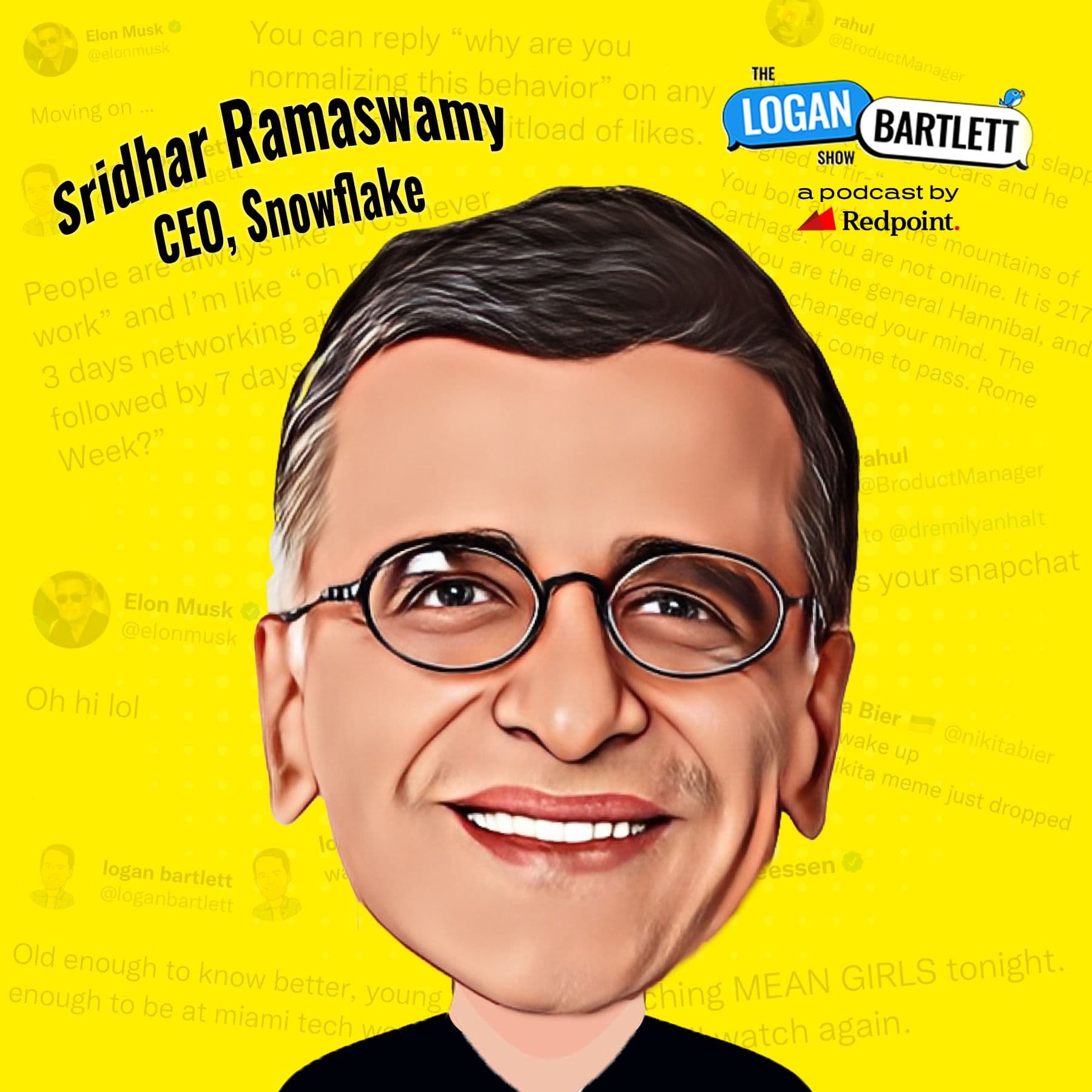
- Guest: Sridhar Ramaswamy (CEO of Snowflake)
- Episode Focus: Discusses Ramaswamy's journey at Snowflake, operational changes, AI predictions, and his evolving leadership style.
Key Topics Discussed
- Sridhar’s Journey to Snowflake
- Ramaswamy transitioned to the role of CEO after Snowflake acquired his company, Neeva.
- Initial role was to craft the AI product vision during the integration phase.
- Emphasis on building an "A player" product in AI and data.
- Snowflake's AI Vision and Cortex AI
- AI is viewed as a horizontal capability applicable across various sectors.
- Cortex AI facilitates seamless interactions between structured and unstructured data.
- Aimed to make AI accessible to any user interacting with Snowflake’s platform.
- Innovative Uses of AI at Snowflake
- Notable use cases include:
- Health providers querying unstructured clinician notes for symptoms using SQL prompts.
- Siemens leveraging AI to search through extensive device manuals.
- Challenges and Future of AI in Business
- Concerns about reliability and trust in AI outputs.
- Importance of maintaining accuracy, especially in high-stakes environments (e.g., financial data).
- Long-Term Aspirations for AI at Snowflake
- Vision to integrate AI throughout data processes, enhancing user experience.
- Aspiration for AI to become a natural part of operations, diminishing the need for users to actively seek AI solutions.
- Leadership and Cultural Foundations
- Transition from a more critical leadership style to one focused on collaboration and constructive dialogue.
- Importance of a culture that encourages experimentation and accepts failure as part of learning.
- Insights on Market Dynamics and AI Evolution
- Discussion on market consolidation and hopes for a diverse set of AI model providers.
- Recognition of the rapid evolution of AI, predicting a shift towards voice interfaces and automated tasks.
Key Takeaways
- Leadership Evolution: Ramaswamy reflects on his growth from a reluctant leader to one who values team dynamics and encourages collaborative problem-solving.
- AI Integration: The future of AI is seen as merging into everyday operations, simplifying complex processes and making powerful capabilities accessible to non-experts.
- Cultural Importance: Establishing a positive, blame-free culture is crucial for innovation and retaining top talent in a competitive landscape.
- Market Insights: The necessity of a healthy competitive landscape for AI technologies is emphasized, advocating against monopolistic tendencies.
- Career Guidance: Ramaswamy advises young professionals to find a balance between their strengths and societal needs, rather than solely chasing passions.
Closing Remarks
- Ramaswamy’s experience underscores the importance of adaptability in leadership and the need for organizations to embrace technological advancements responsibly.
- The episode highlights significant insights into the intersection of AI, data management, and business leadership.
Additional Information
- Production Team: Executive Producer: Rashad Assir; Producer: Leah Clapper; Mixing and Editing: Justin Hrabovsky.
- Social Media Links:
- Instagram: [@theloganbartlettshow](https://www.instagram.com/theloganbartlettshow)
- Twitter: [@loganbartshow](https://twitter.com/loganbartshow)
- YouTube: [The Logan Bartlett Show](https://www.youtube.com/channel/UCugS0jD5IAdoqzjaNYzns7w?sub_confirmation=1)
This episode provides a nuanced understanding of the current landscape of AI and data management, blending strategic insights with personal leadership philosophies from Sridhar Ramaswamy.
Written by AI. May contain mistakes. Listen to the episode to check what was said.
Transcript
Automatic transcript. May contain errors.0:03Welcome to the Logan Bartlett Show. On this episode, what you're going to hear is a conversation. I have a CEO of Snowflake, Sridhar Ramaswamy. Sridhar and I talk about a number of different things, including his transition to leadership at Snowflake, how he's been able to make operational changes to the business to help them execute on shipping product faster, his predictions for the future of AI and where Snowflake sits in that world, as well as how his leadership style has changed from the early days of Google, where he led a major business unit, to Neva, the company that he co-founded, as well as today with Snowflake.
0:38A really fun conversation with a number of different predictions about how AI is going to play out in the future that you'll hear now. Thanks for hosting. This is a cool room. We're in the, what do you call this, the gaming room? This is the game room, yeah. Game room turned podcast studio. It's a hybrid. You don't typically see that. So you've been on board now as CEO for 10 months? 10 months, roughly. And how long at Snowflake? Like, let's see, joined the day after Memorial Day last year, so like 17, 18 months. 17, 18 months. But, you know, especially because you're inside, it's a little bit of an awkward process in that it was not like a formal offer letter.
1:20And so you're sort of like waiting. Guys, are we doing this? When are we doing this? Yeah, when are we doing this? And I also had a few other opportunities that I had to go say no to. And, you know, opportunities don't come all that often. And so saying no to some concrete things while saying this will likely work out, super awkward. So in the original plan, so Snowflake acquired your company and your original plan was to stay on for six months. That was my deal with Frank. that I would stay on until the beginning of December and then go figure out what I was going to do with my life. Was it at the six-month mark that you made the decision to hang on a little bit longer than that, or was it somewhere earlier than that?
2:08I started looking, I would say, I started talking to a few folks October-ish last year. These things take time. Senior roles don't come by that often. What was your initial mandate in that six-month period of time? I was SPP of AI during those six months. And I joke to people that I was like a cabinet position without an actual portfolio. You were kind of an IC, right? No direct reports. No direct reports. But roughly the mission that we set for ourselves was to make sure that Snowflake was kind of an A player when it came to data and AI. It was really to craft that product vision along with Vivek, along with others that came like Barish and Asim about how do we bring AI front and center to Snowflake in a way that stayed true to the product principles of Snowflake.
3:17One product, everything is tightly integrated, stuff just works. And so that was the bar that we set for ourselves. And so it was a lot of product design. And then there was also a lot of talking to customers about AI, what was coming. So that was roughly what I did. And so now, I guess you're 18 months into this AI journey within Snowflake. I'm curious, how would you describe where Snowflake is in AI today? First of all, I think of AI as a horizontal capability with broad application. It's a little bit similar in that sense to, let's say, like the mobile change, where every company that was involved in software, especially if you're a consumer company, knew that you better figure out what mobile meant to your business.
4:15And a different way in which I crystallize how it is a horizontal is by saying that for pretty much the first time in sort of computing's history, there is now a seamless fluid way to go between different kinds of data. whether it is unstructured text to extracting structured information from it or going from an image to the structure of images, same with video. Things that honestly that you had to do software engineering projects for or you had like specialty areas in computer science that just went and did one thing, all of those capabilities are now exposed to you via AI models. So to make it super concrete, let's say we have a health provider as a Snowflake customer, and let's say they have a bunch of clinician notes from years and years of doctors talking to patients.
5:18If you wanted to ask a question like, oh, make me a list of all patients that had, I don't know, cough symptoms, that would be like a custom job. You had to go find some software engineers. They would figure out what model to use. They would tune it. And then maybe three, six months later, you got like this other table that said, okay, this is the list of patients that had cough symptoms. Now a 17-year-old kid can write a little prompt and then run a SQL query on Snowflake. That'll be like, okay, here's your list of patients that had cough symptoms. And so first we said, we want to bring the power of these language models and make it available to anyone that touches Snowflake.
6:00And that is Cortex-AI. It's the model garden, but it's integrated into our Python environment, into our SQL environment, so that you and I can just write SQL and underneath its AI, you don't need to know about where and how the models are hosted, how fast, how slow. We take care of all of that. It's that baseline of capability. And then beyond that, we think in terms of what are key primitives that use language models, that use AI models, but provide additional functionality. So, for example, we implemented search, and this was tech that we had developed at Neva, but it's now part of Snowflake, where you can create an index on, say, a bunch of documents.
6:43We take care of things like chunking it and generating embeddings, being able to do fast retrieval, so on and so forth. But that's a key primitive that makes chatbots possible. Similarly, we have another primitive for how do you go from spoken text or written text to getting back structured information. And so our vision very much is that there is going to be this base layer. There are important primitives, and people can mix and match them to do all kinds of interesting things. They can build applications. They can do data transformations. And those are things that are still evolving. Absolutely, you can do agents, but part of what we're trying to figure out is like what is the boundary of where an agent is still reliable.
7:29We place a lot of emphasis, for example, with the chatbot. If you want a business user to use it, you want to be able to tell them, you know, you can engineer this. Like it'll be right 99 % of the time. And if you make a change, you can verify that it's still right 99 % of the time. Same goes for the analyst. And so, but we think that by building very, very reliable primitives, we unlock the power of AI for business applications. And so I guess as you think about instilling this DNA within the organization, or I guess it's probably pivots too strong of a word, but distilling down a focus on AI, I'm not sure how you would phrase it, what the right phrasing is.
8:07How do you actually do that from a change management standpoint within the organization? You know, when the Neva acquisition happened, we, first of all, you know, made sure that the team and us, me and Vivek, my co-founder, were very clear about sort of our mission. We shut down Neva, the consumer product, and we told our team, our goal is to make snowflake success. Okay, to me, that part is important. where everybody knows that you don't have an agenda, you're here to make things better. And then, you know, the founders, you know, Benoit Thierry, Christian, our product lead, were very cognizant of the power of AI.
8:55I mean, at the end of the day, you know, you don't have to be a rocket scientist to internalize what I just said about AI is like a magic data transformation tool. Like, they get it, and they're like, we need to make sure that it's available. But much of the work that we did, to be honest with you, was a nice and to what the rest of the Snowflake team was doing. It was not like that or this. We very much said, this Cortex AI makes Snowflake SQL better, makes Snowflake better. These operators make it easier for people to use the data that is in Snowflake. And in fact, the thing that I tell our customers is, you know, listen, Snowflake does not compete with OpenAI.
9:37when it comes to foundation models. Let's face it, you're simply nowhere as capable as them. But on the other hand, if you want to use the power of AI to create a chatbot, to do data transformations, to get access to structured data, we'll make it dirt simple for you. And this message of take Snowflake with all of its glory and power and enhance it with AI, it's like there's a positive cultural message. It's not us coming and saying, you people don't know what you're doing and let us show you how. That's the way in which a startup fails. I've had plenty of founders that have come into my teams with that kind of attitude at Google.
10:15And so in many ways, all of the dumb stuff that we did at Google were like good lessons for us in terms of how do you approach change culturally? You know, organizations adapt. And the Snowflake team very much sees this as a yes, and. And that's a message that goes well. At Cortex AI, have there been any non-obvious ways that people are using it that have jumped out to you? Anything you would point to? People are endlessly inventive. And it's the composability that's also super, super cool. We have run into applications, the obvious. Siemens using us because they make 100 ,000 devices and searching through PDF manuals of 100 ,000 devices.
11:03As anyone that's looked for a washing machine manual knows, kind of annoying, kind of hard. In some sense, that's an obvious sort of use case. But even internally, people have done stuff like, oh, we can annotate use cases sitting in Salesforce. This is just like we record every new thing that we want to launch within a customer as a use case. And tagging them with the right product, with the right feature is error prone. And also sometimes our sales teams don't do it. But what used to be difficult before and manual tagging, as I said, it's now like a single SQL prompt to be able to do this. We have hedge funds that are using it to grind through analyst reports.
11:54and say, hey, if this company gets mentioned in this report, we will be able to extract it. There are lots of different ways in which people are mixing and matching what you can do with different kinds of models. We also have great partners like Landing AI, and that is sort of truly magical because they run within our security perimeter, but they can do things like analyze images and extract structured information from it. it's that sort of composability that is incredibly cool to see. You actually launched Arctic, which is your own large language. It's our own MIE Foundation model, and it feels like we did it like 100 years ago.
12:37Is that right? When did it actually launch? I think it was March of this year. Okay. And how much of that was, I guess, a customer pull versus the ability to go in and get some native perspective and increase your bona fides in building your own large language model? 100 % the latter, which is, you know, like, I think that actually knowing how to use language models is a, I would say it's almost a required computing skill for any meaningful, any meaningful, like, infralvel company. Just like, you know, at like the turn of the century, like dealing with big data, like data that could no longer fit in a machine.
13:22Like, you know, you kind of needed to know how to do that. We thought of Arctic very much as what will it take to train a modestly sized model. Okay. We have talked about it. We spent a few million dollars on it. Again, nothing like the billions that are being spent now. But I think it was a very good experience for us. And it also taught us a lot about what does inference mean? What does inference optimization mean? And those skills continue to come in handy. We have folks from teams like VLLM, which pioneered a lot of efficient inferencing work. And so I'm pretty happy that we have expertise up and down the AI stack.
14:05You guys sit in an interesting nexus point and support a lot of different models, including Arctic, but Lama and Mistral, and you have a bunch of great partners, Rekha, a bunch of great partners or solutions that you all work with. Is there anything you're seeing that's interesting on the model selection side or how end customers are kind of choosing to work with different models? I would roughly say for very, very common functions, I don't know, like sentiment detection, people know that small models work just fine and they're sort of happy to go with defaults. It's very inexpensive. But then I would say that when the requirements are a little bit more stringent, people like the name brand markets.
14:51Interesting. Which is sort of, it's a weird setup. I think it's the reason why, for example, OpenAI continues to get like heavy, heavy, heavy usage. Yes, they make the process of working with them easy. But I think people like to go with something that is known and trusted, even if it's just a smidgen beyond what you actually need. But why bother figuring out what you actually need when you can just use the name? Yeah, the default. It's actually an interesting point that I've seen for sure as Anthropic or whoever it is will launch all these new solutions, models, and pick up a percentage point here or there.
15:33But it actually, people just seem to default. I'm sure you saw it in search. human behavior is defaults in some way. Defaults, just like they are very powerful. And it's surprising, but yeah, there's first mover advantage sort of even here. As you sort of look at people trying to get applications into production or leveraging all these different models, what do you see as the biggest pain point in the stack or the value chain to actually get the value or the potential of a lot of these things? I think there is still a big gap when it comes to here is an engineered solution. I think, and I don't think the kind of AI industry, if there is such a term, does itself any favors by simply not talking about things like hallucination rates.
16:26If you look, no one publishes hallucination rates on their models or on their solution. It's like, look, you're so cool. You should just use us. But I think once you, you know, I was actually showing my board members an app that we have that we can ask questions about our financial data. It's pretty cool because I can say things like, hey, how did James Petter, who is our JVP of EMEA, how has he been doing over the past seven days? and it'll give you a table. It'll run the SQL query and show you things like we can make growth and year on year growth and apps, you know, numbers and so on. But before we give it to my CFO, Mike, you know, I'll tell the team, you better be sure that you're doing the right thing.
17:19I think it is that engineering mentality that is still a little bit of an issue. And so the more, part of what we end up doing is educating our customers on, okay, so you need a release process. You need to actually be sure that something like 95 % accuracy is okay for you. Or if you use a chatbot, you need to make sure that you provide the citations or place in the document where you can go verify the answer. Because business use, people take seriously. You can't make mistakes, especially when it comes to critical applications, for example, like the one that queries revenue data on which people can actually make decisions.
18:06I think it's stuff like that, that, you know, continue to be obstacles for broad, broad use. But on the other hand, I think AI has a ton of use cases to solve problems where you will happily accept a certain amount of mistakes. So, for example, if, I don't know, somebody, people send articles all the time, right? I find it annoying. It's sort of virtual signaling. They're like, here's a great article you should read. You know, my head hurts. Why another one? So oftentimes, I'll copy the text in the article, paste it into Cloud or into ChatGPT, and be like, you know, can you give me a summary? If it's off a little bit, I don't really mind.
18:55It's not a huge deal. It's not a huge deal because just the time saving that I get from not actually having to crank through the article. there's like so much value. Similarly, the example that I gave you of my team, I think they updated 5 ,000 different use cases just by running a SQL query, figuring out, you know, a bunch of product categories and updating the underlying table. I could never have persuaded them to do this manually. And they're like, off by a little bit, it's fine. Do you think for mainstream enterprise or business adoption we need to get to a rate of, I mean, is it 99 %? Is it 100 % for it to actually be trusted across an enterprise?
19:37It depends on the application. So for example, with something like a finance chatbot, I'd be like 100%. Please be accurate or begin to think about how errors are evident. Remember, the insidious thing about hallucinations is not that the model is getting 5 % of the answers wrong. It's that you don't know which 5 % is wrong. And that's like a trust issue. And I think so it's going to depend on the application. But the good news for all of us as technologists is that there are just a whole pile of these applications where AI will do stuff that you and I have like zero patience for doing. I love the little, I'm a Gemini subscriber as well.
20:27And I love the little button that I get on my Gmails that says summarize, because for things that I want to read quickly, I will happily take the few problems that I run into. So I think there are lots of places where the stakes are not that high, where AI is already useful. But I think it's also important that we understand that there is a software engineering aspect to how do you create reliable applications in quite a few contexts. When you look off in the future, and I don't know what time horizon you sort of think about with the artificial intelligence industry, it's obviously moving pretty quickly.
21:12But is there a point in time you pick and say, at this point, I want Snowflake to be known as XYZ in two years' time or five years' time when you're sort of setting the vision for what's possible within Snowflake with regard to AI? Our aspiration is to be an end-to-end solution for data. We want to make it easy for people to ingest data, to be able to engineer it, because data that is collected at source systems, for example, logs, logs will never, you know, logs will always have IDs. Why? Because there's a lot of them and you don't want to be putting strings into it. And so we want to be there when people sort of engineer data, make it more usable, and then obviously when they store it and want to run analytics on it, or when they want to get insights with a dashboard or an AI tool.
22:07I think we are well on our way to having AI, first of all, play a role in each and every one of these. How do you make it easier to write a SQL query? How do you make it easy to set up a pipeline? How do you help people generate metadata for a table or update metadata for a table? I want to write a description for a table that says no one. like you just don't like doing stuff like that. How do we have tools that make it easy? And then, yes, how do we have business users get access to the data that is in Snowflake? You know, my take is that just like you and I don't really think I'm doing this on my phone.
22:47Just like do it because it's natural. That's my aspiration for AI with Snowflake. If you feel like you need to do something and AI is the way to do it, you don't actually think about it. You just go do it because it works out of the box. So to set it another way, when we stop talking about AI and it's just embedded into the process of which we do. And it's just embedded into what we do. To me, like, that is actually huge. There are just a whole set of things, again, like in my own work life, personal life, where AI is just embedded. Like, I don't think about it. I'll give you, like, any number of examples.
23:21If I want to generate a meme to make fun of someone or to just say something silly, I don't think twice. I just go write, I'm very good with words. I just go with like, you know, write out a bunch of words and out will come beautiful memes that I can just like text someone. You don't need to think about it anymore. Similarly, like I never ever write sheets or Excel formulae anymore. I don't know if you like writing them. Total pain. I always get them wrong. I just write English descriptions. And these models, all of them are magical at generating code to be able to do stuff. like that well. And so I think it just like blends into the background because a whole lot of especially soft programming things that like you and I always do, it's like so much easier.
24:09You obviously lived through the Google and the internet transformation that society kind of went through. I'm curious as you sort of look at the potential of AI as it currently stands and the the hype that's around it. Do you think we're at a technological point that the hype and the possibility are commiserate with one another right now? Or do you think that we need to make some substantive process on the models or whatever it is to actually meet where we are from a hype standpoint? My first answer to that question is like, I've been around enough to know that there's a lot that's unknowable.
24:48I ask people, like, you know, could you reasonably have predicted Uber from the beginning of the internet? Or even, like, you know, when the BlackBerry was around? It's pretty tough, right? And so I think there's just lots of stuff that is quite unpredictable. But I think that the predictable parts of AI have to do with what I said earlier, which is data transformations of different kinds, new kinds of interfaces. And it's a pretty easy and reasonable prediction that every app on our phone or perhaps the phone itself is going to have a very different interface, like much more of a voice interface.
25:34I mean, think about it. Even the act of saying, I want to go to this location and I want this kind of a car and once I get into the car, like I'm going to text my spouse and say, this is when I'm going to show up. It's like, that's the kind of stuff that is simply going to change in a pretty dramatic way, all driven by voice. I think that kind of, you know, data transformation is going to be different is an easy prediction to make. And I don't think it requires sort of rocket science technology. It's application of like existing models. Yes, with a lot of sweat to integrate them, and put them on the phone, figure out what is running locally versus what is central.
26:17So I think those are the easy predictions. On the other hand, will we evolve into this world of autonomous agents everywhere doing things on our behalf and arguing with each other and suing each other on our behalf? I think that's a little bit harder to predict. I think it's an area that's just evolving so rapidly that some of those things are hard to predict. My favorite one is like, what if you had an AI that was designed to get itself more GPUs so that it could train better versions of itself? Very referential, self-referential in there. Yeah, it's an interesting one. I'm curious, I guess a lot of the companies we referenced, be it Uber or Google, we sort of ended up in a fairly consolidated power or at least like user from a user standpoint.
27:16I'm not sure if the market splits and how it all broke out. Do you think we're headed for more federation in the large language model than what we saw in other technologies? Or do you think we'll sort of follow a similar trend? And, you know, earlier this year, like, I was actually hoping that we would end up with dozens of model makers in the world. Okay. As we get to the close of this year, it looks like, huh, three, maybe four. It's kind of sad. Yeah. I actually do sincerely hope that it goes back to dozens of companies. I just think it's healthier. Yeah. I think whether we like it or not, concentration leads to, yes, it leads to great companies.
28:08I work for Google. They paid for my house. It's like magical. But on the other hand, you know, I think of effectively call it Google, Facebook, and Amazon as kind of like basically a tax on our attention. all around. Like they sort of, just those three companies, you know, collect tax on how we get to information, how we get to entertainment, and how we get to products. You know, like, I just think that more competition is helpful in terms of how to make more of the benefits of technology flow more broadly than what can happen when there is such heavy concentration. Yeah. Yeah. I mean, it sort of comes down to antitrust and consumer harm and all those definitions, because Google, actually, you benefit in a lot of ways for Google being a better, more people using it makes it a better product, which makes it a better service for me.
29:12And Uber, same thing, the density of, but that's in the near term. Over the long term, who knows? I think competition is probably a good thing for all those businesses. That's correct. That's right. I mean, anytime there is massive concentration, I don't think broad society benefits. A small set of people that are part of the company, let's face it, you and I are sometimes part of them, and we're very happy that we are part of them, benefit. But I say that's more of a wish. And these things also seem to change every six months. So, you know, in another six months, hopefully we'll have a different prediction.
29:46Boomerang background, yeah. Yeah. I'm curious, when did you start diving into AI in a meaningful way? I've been in and out in the sense that I wasn't part of the team that created the first, it was a logistic regression model, except that the team that built it didn't know that they were building a logistic regression model. They were just like strung together a feedback loop and said, we want to estimate probability, and here is how we can do it. But I got to be part of the team like probably early 2007, and so I've lived through a number of revisions of how that product evolved. So we were doing 15-minute updates to these models back in 07 because we had to deal with actual problems like massive spam attacks.
30:42We'd have these bots that would just slam us with clicks. And so if you didn't react fast enough, the PCTR models would just go stir crazy. And so you had to do real-time updates. Or we would have launch events where a new product comes along, massive interest. What is your problem? PCTR model do. So we learned a lot. My team also launched the first generation of deep learning models for logistic regression. This was, again, 2011. You know, but by that time, I was also more involved in the business of advertising and commerce and less on the technology of it. But even by 2015, 16, you could begin to tell that there was magic in the air because that's when models started doing completely strange things like being able to translate from, let's say, like English to German while being trained only on translations from English to French and French to German.
Read the full transcript
31:49They were learning something about the structure of languages that even the people that were training the models had no idea. And that's when we knew that there was something magical there. But then I left Google, started this search engine Neva, and a lot of early Neva was really about just the grind, the mechanics of how do you crawl the web, how do you actually have an index that works, how do you make index selection work. And I would say, again, roughly in 2021, we knew that there was, again, something amazing because that's when GPT-2 came out. It's not that impressive. But early GPT-3, even before ChatGPT, it was clear it was like a step change.
32:34Something went off in our heads when we realized that this was the key ingredient for being able to create a truly AI search engine as opposed to a search engine that returned links. So I started spending more time with language models. At Neva, we famously pretty much served the search experience on 7 billion parameter models. We were like, these are cheap. We can run them on eight ends, and it's enough. And so we would fine-tune open source models that we could then use to power the search engines. And I sort of stayed in touch. So I've sort of gone in and out of AI and machine learning for the better part of the last 20 years.
33:26I'm curious if there's any viewpoint that you've changed in a meaningful way about how AI might play out. And so, I mean, we talked about the example of different models. Maybe we'd end up with 12 different models and that being very federated. And it seems like we've centralized around a few. Are there any other things that have just been very different than maybe how you would have projected? I'll give you concrete examples. I think in the spring of 2022, GPT-3 had come out, not for. ChatGPT was still close to nine months away. We started brainstorming on what could AI do for search. Back at the time, you could reliably say, you know, language models can do a pretty good job of what's called abstractive summarization.
34:20Where you take a big hunking piece of text, and instead of extracting words or extracting a sentence as an answer to a question, they do a job of like a first principles summary of like 1 ,500 words. It's like, it's magical. And if you think about it, that's crazy hard. And so we knew that we could make things work at the level of a single page.
34:47and Vivek, others in my team said, but wait, can we summarize like, you know, all 10 of the results that we would want to show for a search page into one answer and better yet provide citations for where each sentence came from. When I first heard about this in August, honestly, it just looked like absurdly difficult. We went nowhere using the best models available at the time. And then ChatGPT came out in December, sort of, you know, like just generated a frenzy of hard work and just like brainstorming even within our team about what is possible. On January 6th, we actually had a, you know, launched a search engine that did citations, but was powered by things like real-time search.
35:42Something could explode on the internet. Five minutes later, you could query it, and you could get an AI answer that had real-time information, that had citations. And honestly, I didn't think this was possible just like five months earlier. I think there is absolutely something about how innovation in one place just spurs on a whole bunch of follow-on things by lots of people. It's interesting. I want to shift gears a little bit to operating and, I guess, running the business of Snowflake. So Frank Sloopman, legendary CEO, I think anyone that's read his book or heard him speak knows he's a very hard-charging, sales-oriented leader.
36:33I've noticed or I've sensed that since you've come in, there's been a real focus on product velocity and shipping in a more meaningful way than maybe there was in the past. my words, not yours, that just focusing on incremental improvements or even launching products in a more meaningful way and just being willing to try things and fail. I'm curious, how do you set the culture of that? And how do you think about taking the risk of launching new things that might not work out? I mean, you asked, you know, I would actually say that my overall message to the Snowflake team is that this is a time of unprecedented change in data as a whole.
37:24First, data is sexy, which means that there's lots of competition always whenever stuff like this happens. And there is a ton of technological change as well. My overall message to the Snowflake team is you got to step it up in every department. and I spend a lot of time with sales. I spend a lot of time with customers. And so, you know, in fact, I would say I am driving a process of being way more quantitative and organized about how the sales team operates. And to me, one of the most difficult skills that only some people end up mastering that I'm proud of, you know, for having developed is how do you do like scaled process management, which is what sales is.
38:17How do you bring the power of computing, the tools that you have to just be a more effective team? And so I would say that sort of, hey, we need to step it up because this is a defining moment is throughout Snowflake. Absolutely. On the product side, I think I want to make sure that we have clear focus. Snowflake came of age at a time when they were like five, six years ahead of everybody else. It was a magical product. Absolutely sold itself. But there's a lot more competition now. For good reason, that is a big market. And so this is part of the reason why I stress that sense of urgency. I also stress very much the need for virtuosity in everything that we do.
39:05What I mean by that is, like, look, there's only so many things that are knowable in the world ahead of time. And the things that great companies, you know, I was part of Google, which is one of the greatest companies ever, is not that we had all the answers. But we were way faster than anyone else in, like, going and seizing that sort of opportunity. And the big difference between cloud computing and shipping CDs was you could do multiple releases every day. And so that just provided. And the entire company, by the way, running a$50 billion business,$100 billion business, would just go update all of its binaries every week from head.
39:56Just like the pace of change was truly incredible, that's again part of what I tell my team here, which is you will not know all the answers, and that's okay, and you got to figure out how to iterate. That doesn't mean that we iterate at the level of storage formats. If you're running a database company, don't mess with my data is rule number one. You have to preserve that. Don't let hackers break in. Also rule number one. So there are some inviolables about how you operate, But for a whole lot of other things, you've got to be really, really nimble at getting things out because you just get more feedback.
40:33You're able to see how customers use your product. You can get feedback from them. You can iterate a whole lot faster. Honestly, it's a lot more fun for the teams as well. I've heard from an accountability standpoint that you ask or force teams to make promises on deliverables for, is it two weeks and three months? or how does that typically work? They get to pick. They get to pick the timer. They get to pick. But I do not want to listen to any, you know, FY26 promises. I'm kind of like, yeah, I don't do that. I'm kind of like, you want to sign up for what you will get done in a quarter? It's fine.
41:13Please do a good job. I like clearly stated goals. I argue a lot about goals, but clearly stated goals. I like responsible individuals. I ask like, is it one person? Is it two people? But your name is against that goal. And your promise date is also against that goal. And then, you know, we touch base every two weeks just to check in on things. How are things going? You know, what needs to be tweaked, so on and so on and so forth. But the first three, the goals, the owners and the dates don't change. If you're late, like, yeah, it's awkward, but it's okay. Deal with it. I've heard you've also, you have a 5 a.m.
41:53email digest that comes through. Is that something you've... That's for our revenue. Absolutely. Every morning. And is that something you've done in the past? I've done in the past. As a joke, a friend of mine and I set up a mailing list at Google called bean counters. We were like, you know, we count the beans. That would come every morning. And it would say how each product category did. It became a little bit of a ritual. It got adorned over time with like sparklines for how things were trending and so on. But we instantly knew if there was a problem in an area or if some area was doing well.
42:35And I instituted that here as well. So we get a report of how the company did. Every day we are a consumption company. We make money when our customers spend money. and so yeah that's that's sort of it's a tradition and a bunch of my sales leaders you know get it it's a little bit of accountability yeah and things go wrong I want people to step up and go dig into it and find out why things are going wrong or if things you know get better as well I think it's just it's it sets a tone of you know we we are a business and paying attention to the things that matter is just what we do. I'm curious, you talked about that as an example of something you did dating back to Google and being counters.
43:24I'm curious, are there notable ways that your leadership style you feel like has changed since Google or with Neva or now within Snowflake, anything that stands out that you wish you could have told yourself way back when? Yeah, I would say one big change from I guess my early, I was a reluctant leader. I used to tell people at Google that, you know, I became a manager or a director so that I didn't have to listen to people tell me what to do. I was like my own ego. And, you know, over time you realize, no, it's actually a responsibility. You're privileged to, you know, to have a team and be able to steer it and get things done that you can never do as an individual.
44:07But I would say the early me was, you know, quick to criticize, quick to set up a lot of like win-lose kind of scenarios, which in my mind just are not, you know, not that helpful. I would say I'm just a whole lot better at not creating unnecessary conflict. If I have a point of view or if I think that something is not going right, being able to surface those in ways where the other person realizes that things can be done better without my having to dictate to them that things are wrong and I am the one that has the solution. I think I'm getting much better at getting people to get to the right answer rather than me being the person that says that either something is wrong or that I have the answer.
45:00I have to credit people like Jeff Huber, who was my boss, gosh, for close to 10 years at Google. He always was a big fan of the Socratic dialogue kind of technique to get people to reach the conclusion that they should be reaching. It's interesting. I'm curious, you've seen hyper scale and hyper growth a few different times in your career. If someone's listening and they're earlier in their journey, but have the aspirations to be the next Google or Snowflake, are there things that you would encourage people to think about today to set the right scaffolding or foundation in the early days so that you're not forced to course correct on down the line?
45:44I think course correction is okay. I think, you know, some things are fatal. I agree. I think like a positive blameless culture, a culture in which the benefit of doubt is always given, a culture in which you expect people to do the right thing because that's the right thing to do. I think those things are foundation. You don't want to blame culture. You don't want, you know, you don't want a suspicious culture. Like, you know, like they're not going to do the right thing. I think those things are a baseline. But beyond that, I think having both a sense of paranoia that success can be fleeting or it can be taken away pretty easily.
46:35and having a sense of, are you really doing the best that you can be? Are you being excellent in how you approach stuff? That ability to self-correct on a continuous basis, I think is important. I think it's also like, you have to accept that, especially in startups, almost by definition, you're doing new things. I think you'll make mistakes. I think it's okay to make mistakes. I place a lot of value in like, accept your mistakes, don't make them again, I used to have a little, you know, like one of these magnets in my cube at Google that would say, like, make new mistakes. And I think having that culture of you will accept failure, you will make mistakes, you will correct, you will learn, and you will work towards a different, better future is what I would tell people.
47:24One last one before I let you hop. I've heard you mention that people shouldn't necessarily follow their passions, but should instead find the intersection of their strengths and what value they can potentially bring to the world. How do you think about if someone's mapping out what their career could look like over the course of the next decade or whatever it is? How do you think about picking a career and pursuits? I'm no expert, but I'll tell you, I'm also painfully aware that we live in a society that sort of idolizes very unique individuals. Okay. Like, let's face it, Steph Curry is our hero.
48:04Yeah. Or, I don't know, Instagram or YouTube influencers with a massive following, Mr. Beast. And my main take is that people's passion often points to these pyramidal structures where you have to be extraordinary to be successful. It's an outdated stat, but it will illustrate the point. point, you know, a few years ago, if you counted the number of creators on YouTube that made like 50K or more a year, as you know, it's hard to make videos. It's hard to get a lot of followers. And$50 ,000 isn't a lot of money if you want to support yourself or a family. The number of creators on YouTube that would make that kind of money wasn't the tens of thousands.
48:58Okay. It's not Not the 5 million lawyers we have or the 6 million software engineers. It's not a scaled occupation. And so to me, it is really important that people steer towards, like, they sort of play the game of life in a way that guarantees at least modest success. Then pursue these elite professions in which, like, let's face it, there's one step. It's really hard to be him. I mean, good for him, but it's really hard to be him. That's sort of more of what I mean by you got to be smart about how do you steer your life to a direction that combines your interests with what society also finds broadly useful.
49:44Otherwise, you end up with like really difficult challenges. Well, thank you for doing this. This is great. Thank you.
49:53Thank you for joining this episode of the Logan Bartlett Show with CEO of Snowflake, Sridhar Aromaswamy. If you enjoyed this discussion, I'd really appreciate it if you subscribed on whatever podcast platform you're listening to us on, as well as share with anyone else that you think might find it interesting. We look forward to seeing you back here with another great guest in the Logan Bartlett Show next week. Have a great weekend, everyone.
50:20Bye.
From the publisher
Nine months into his role as Snowflake’s CEO, Sridhar Ramaswamy sat down for a candid discussion on the journey so far & what’s ahead.
He uncovered details about his transition to Snowflake CEO, the operational changes he’s put in place to accelerate product development, and his bold predictions for AI’s future—along with how he’s guiding a vision for Snowflake to fit into that landscape.
Sridhar also reflects on how his leadership has evolved, from leading a major Google unit to founding Neeva (acquired by Salesforce) and now running Snowflake.
[0:00] Intro
[0:56] Sridhar’s Journey to Snowflake
[3:37] Snowflake's AI Vision and Cortex AI
[10:35] Innovative Uses of AI at Snowflake
[15:49] Challenges and Future of AI in Business
[21:27] Snowflake's Long-Term AI Aspirations
[25:04] Predictable and Unpredictable Aspects of AI
[26:20] Autonomous Agents and AI Predictions
[27:01] Market Consolidation in AI
[29:54] Journey into AI and Early Experiences
[31:21] The Evolution of AI Models
[32:06] Building Neeva and AI Search Engines
[36:16] Leadership and Product Development at Snowflake
[40:45] Setting Goals and Accountability
[43:25] Leadership Style and Cultural Foundations
[47:25] Career Advice and Finding Your Path
Executive Producer: Rashad Assir
Producer: Leah Clapper
Mixing and editing: Justin Hrabovsky
Check out Unsupervised Learning, Redpoint's AI Podcast: https://www.youtube.com/@UCUl-s_Vp-Kkk_XVyDylNwLA
🎥 Subscribe on YouTube: https://www.youtube.com/channel/UCugS0jD5IAdoqzjaNYzns7w?sub_confirmation=1
Follow on Socials
📸 Instagram - https://www.instagram.com/theloganbartlettshow
📱 X - https://twitter.com/loganbartshow
🎬 Clips on TikTok - https://www.tiktok.com/@theloganbartlettshow
About the Show
Logan Bartlett is a Software Investor at Redpoint Ventures - a Silicon Valley-based VC with $6B AUM and investments in Snowflake, DraftKings, Twilio, and Netflix. In each episode of The Logan Bartlett Show, we sit down with the people behind today’s most important startups and extract the tactics, lessons, and frameworks they’ve learned the hard way. Conversations span hiring to GTM, product, growth, fundraising and everything in between - collectively forming the ultimate playbook to make you a better CEO, investor or board member.
Tap follow and enable notifications to stay ahead of the game.