
In short
The Logan Bartlett Show - Episode 123 Summary
Episode Title
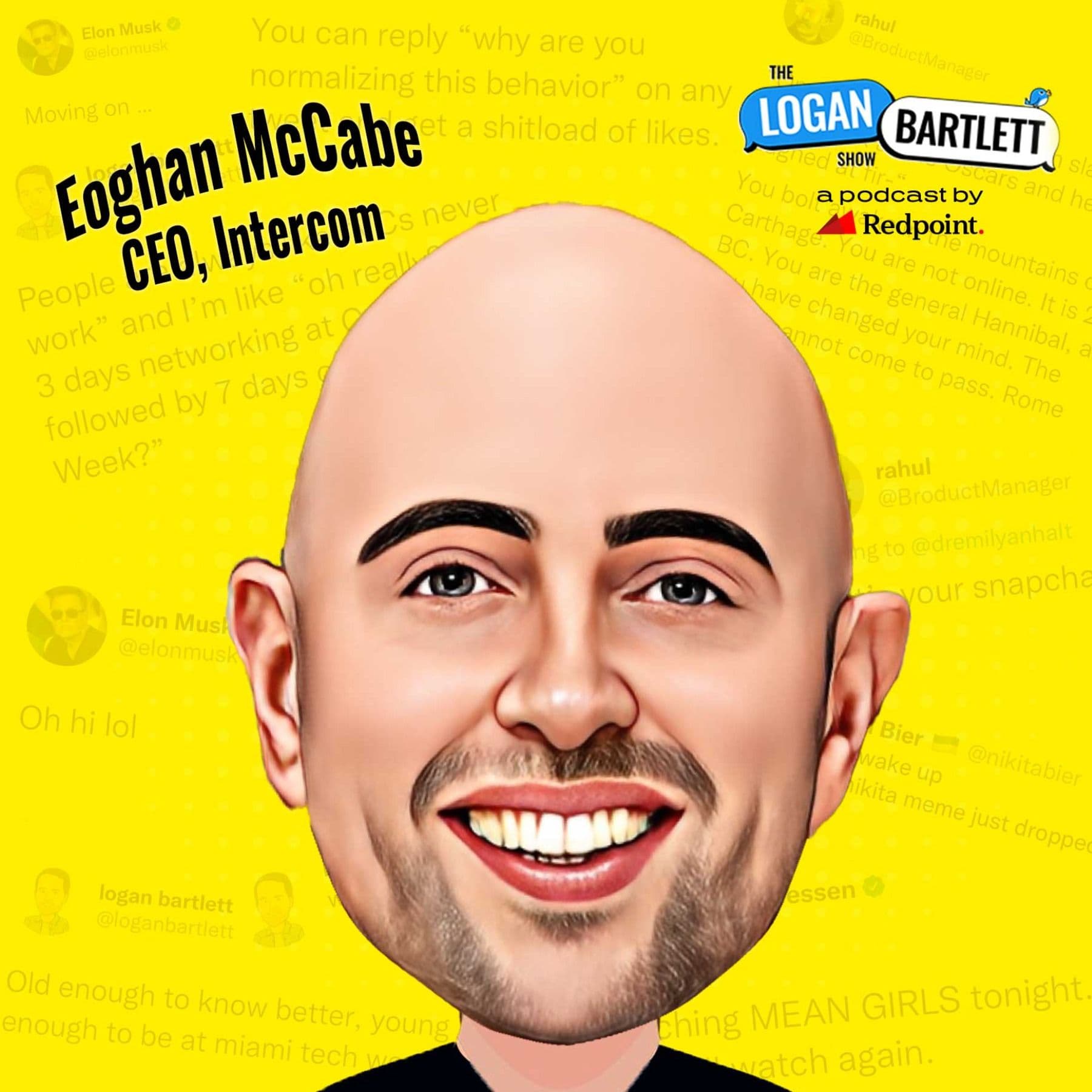
Intercom CEO on Endorsing Trump, Reinventing The Company, and the Future of AI in Software
Episode Description
Eoghan McCabe returned to the CEO seat at Intercom with a mission to shake things up. Over the past two years, he has been reinventing the company's culture, leading with zero apologies, and transforming Intercom into an AI-driven powerhouse. This episode dives into Eoghan's journey back to Intercom, his blueprint for becoming an AI leader, and his thoughts on personal freedom and controversial endorsements.
---
Key Discussion Points
Introduction
- Logan Bartlett introduces Eoghan McCabe, CEO of Intercom.
- Eoghan's brief background on Intercom and his return as CEO.
Eoghan McCabe's Return to Intercom
- Timeline: Eoghan stepped back in June 2020 and returned in October 2022.
- Reasons for Leaving: Health issues, business fatigue, and damaging media narratives influenced his decision to step down.
- Learnings from Absence: Eoghan realized he cared deeply about Intercom and its direction.
Cultural Reset at Intercom
- Upon returning, Eoghan found a company disconnected from its identity; the culture was seen as soft and distracted.
- Eoghan's approach included:
- Unapologetic Leadership: Leading with authenticity and focusing on business fundamentals without needing approval.
- Performance Management: Implementing a system that ranks employees based on resilience, hard work, and shareholder value.
Transforming into an AI-Driven Company
- Eoghan's vision for Intercom centered on customer service, fueled by AI innovations.
- Discussion on the competitive landscape, strategic decisions, and adapting to AI market changes.
- Future of Customer Service: Transitioning to an outcome-based pricing model, charging per resolved ticket rather than fixed seats.
Reflections on Leadership
- Eoghan shares his thoughts on the challenges and rewards of leadership.
- Emphasizes the importance of being oneself in leadership roles, and how authenticity drives a better organizational culture.
Public Perception and Media
- Discussing media's role in shaping narratives about tech leaders and the impact of public perception on personal and company identity.
- Eoghan's controversial endorsement of Donald Trump and the reaction from both the public and employees.
Political Endorsements and Personal Freedom
- Eoghan emphasizes his belief in individual sovereignty and the importance of open conversations about differing views.
- He aims to build a culture at Intercom that supports personal freedom and discourages censorship.
The San Francisco Freedom Club
- Eoghan founded the Freedom Club to foster discussions around freedom and merit, countering over-intellectualization in San Francisco.
Investors and Fundraising Insights
- Eoghan shares lessons learned about the relationship between founders and investors.
- Importance of understanding the dynamics of investor relationships and the need for clarity in communication.
---
Key Takeaways
- Authenticity is Critical: Being true to oneself is vital for effective leadership and cultural alignment.
- AI is Transformative: Companies must adapt to AI developments or risk obsolescence; significant shifts in product and pricing structures are necessary.
- Engagement through Transparency: Encouraging open discussions about financial goals can foster a sense of partnership among employees.
- Cultural Dynamics Matter: A reset may be necessary when returning to leadership; leaders should anticipate pushback but remain firm on strategic direction.
- Navigating Politics and Personal Views: Leaders should feel empowered to express personal beliefs while fostering an inclusive culture that respects diverse opinions.
---
Final Reflections Eoghan McCabe's insights provide a robust framework for understanding the intersection of leadership, corporate culture, and the evolving landscape of AI in technology. His journey underscores the significance of authenticity, resilience, and adaptability in navigating the challenges of modern business.
---
Additional Resources
- Subscribe: [YouTube Channel](https://www.youtube.com/channel/UCugS0jD5IAdoqzjaNYzns7w?sub_confirmation=1)
- Follow on Socials: [Instagram](https://www.instagram.com/theloganbartlettshow) | [Twitter](https://twitter.com/loganbartshow) | [TikTok](https://www.tiktok.com/@theloganbartlettshow)
---
Listen to the full episode for a deeper understanding of Eoghan’s experiences and insights as a leader at Intercom.
Written by AI. May contain mistakes. Listen to the episode to check what was said.
Transcript
Automatic transcript. May contain errors.0:29Welcome to the Logan Bartlett Show. CEO after he resigned in 2020, and then stepping back into that leadership position in 2022. We talked about the inputs that went into that decision, including his fatigue in running the business, some health-related concerns, as well as media reporting on allegations that he says were deeply untrue. We talked about his learnings from stepping back into the business and what he set out to change in their culture. The biggest takeaway from Owen that I had over the course of this discussion was how leaders need to authentically be themselves and pursue their own true North Star.
1:08We also go into his decision to endorse President-elect Donald Trump, what the inputs into that decision were, as well as the ramifications for both himself as well as Intercom. Really interesting conversation with someone with a range of different views that are often contrarian that you'll hear now. Well, Owen, thanks for doing this. Yeah, my pleasure. Maybe for people that don't have full context, maybe give a little bit, what does Intercom do? And I guess in particular, you've stepped back in as CEO in the last... A couple of years ago. When was that? Two years ago. Yeah. So maybe give whatever the short version, elevator pitch and all that.
1:47Yeah. I'll give you just a tiny bit of extra context you didn't ask for. It's a 13-year-old company, you know,$100 million in revenue. It's like one of the late stage companies. uh we're trying to stay a startup um we are in the customer service space a deeply boring space and it's pretty sexy now and one of the largest categories in software which is about to be violently disrupted by ai and so i came back to intercom in october 2020 and chat gpt was released when? November? Yeah. Like it was a month after I came back. So yeah, our story since my return has been betting on customer service fully and completely with AI.
2:31And so you step back when? When did you? October 2020. You step back in. Yeah, I came back. When did you step back? March, summer of 2020. So I was gone just a little over two years. Okay. Summer of 2020. I'm sorry, just to get my dates right. So you step back in 2022? Yeah. I left during COVID in around June, 2020. And I came back in October, 2022. And for people that don't have all of that. So there was some health stuff, some business fatigue stuff, some media charges and all that. Can you just give the... Of course. I mean, I think it's an interesting thing that people have gone through at different levels on each of those components.
3:13Well, you tell me how much detail you want. I think it's interesting in general. Yeah, yeah. You know, Intercom started 2011. By 2013 or 2014, it was the fastest growing software company since Salesforce. We had a lot of pride in that. So when a company grows that fast, and this was back before companies grew as fast as that. I mean, everyone grows insanely fast now, but we grew from... You guys in Zenefits, I remember. Well, yeah, Slack was the next one to beat us. But yeah, Zenefits must have been somewhere in there. we went from like 1 to 50 million an AOR in like 2 point something years which I don't know I feel like there's kids in their bedroom doing that I know I know oh well it was cool back in the day so we were one of the fastest growing companies at that time Slack did subsequently beat us you know there are so many kids now that do 1 to 50 in I don't know a month with some AI thing that you and I have not heard of yet but it was a big deal back in the day probably released my job at some point like that one yours and mine yeah and so there was a lot of confidence and swagger and excitement, you know, not to bounce around too much, but whether you know it or not, basically all founders start companies out of deep insecurity to prove something.
4:25And that was not any different from that. And so having one of the fastest growing companies of all time was pretty amazing. Became part of your identity. Oh my God. And then in 2016, 2017, we had made a couple of pricing mistakes and kind of strategic mistakes. and maybe it was even by like 2018 i really took up my eye off the ball on some issues and so by late 2018 maybe 2019 revenue had started to slow a little bit it was we were still growing so fast but it wasn't the same and i started to think i'm a failure it's ridiculous as that sounds i know it sounds ridiculous but i was a younger man my all in everything was the six rapid insane success of this company.
5:10So that did some damage to my ego. 2019, I was attacked with some stories in the press and false stories in the press. I had no clue how to defend myself. I watched an interview you did with Parker and the biggest takeaway, at least for me and for any young founder that they should take from that interview you did is the importance of defending yourself and correct mistakes. He learned that the hard way, but he did a good job too. Pretty amazing he did that at the young age that he is at because I was 30 something when all this went down for me. So that was a further crushing. I had this image of myself as this particularly perfect, impressive founder, not helped by this incredible success that we had.
5:52So to be embarrassed publicly was just painful. Then I got sick in June 2018 for good measure. I will always remember in my little office i don't know what i was doing but i was typing and my finger pressed a key that i had not intended to press i'm like that's that hadn't happened before but you know that you as you get slightly older i think you're younger than me but you start to learn that funny things happen with your body that night i woke up twitching like involuntary twitching and i didn't know what it was and for years i just had this incredible fatigue twitching everything else by 2020 i some days I couldn't see.
6:35So I'd wake up and I'd see, I could see stuff, but I couldn't focus on things. And I knew it wasn't a problem with my eyes. So I was just beat up. My ego and my self image was trashed, just spiritually eviscerated. And I was ready to get the hell out of there. the business was really really hard and i just didn't have the energy or the um uh how would i say gumption to like go at it day after day um i promoted our c o o to ceo and i completely ran from the business not only was i very sick of intercom at that stage i was sick of tech and i told myself little comforting stories like tech is bullshit now and um it's so it's fake and I don't know, I decided I was doing tech.
7:27And I had taken money off the table and I had that sense of freedom. And so I imagine I do some other things, but mostly I spent that time resting. That was COVID, of course, too. So it was pretty interesting to just be free during COVID. Did a lot of thinking. Quite literally, what did you do? Quite literally, I was in my house in Berkeley for a while. I played The Last of Us 2 on PlayStation 5, which was the last video game I played and was awesome. yeah i slept in until 10 to 11 each day i imagined before i quit that i would wake up at the crack of dawn and like meditate for an hour or something i didn't do any of that stuff um i just blew every day i i realized that life is way shorter than i realized you know we're all so busy we're like wow what would i do if i was free the day is really short the days just went by isn't it crazy how like when you're in that state i took a month off uh in between jobs and you think that you just have have abundant time and there's so many things you're going to accomplish.
8:25But when your day stops being regimented in some way, I remember like thinking in the four weeks I took off, like, okay, so tomorrow I'm going to go drop off my dry cleaning. And the next day I'll pick up the dry cleaning. Like that's a full day. Like that's enough to go through. Like when you get out of the regimented rat race, it's just like kind of spirals where you end up just hanging out. Absolutely. Plus busy people are bad at not being busy. So I still had meetings and I was on the board of intercom and I check in with stuff even you know I didn't quite want to but I kind of felt like I had to and I was doing things so I did a whole lot of nothing which in hindsight is actually what I needed again I imagine this beautiful flowing zen like monastic life was none of that but it was still great drank a lot of wine I got into wine outstanding very expensive French wine it was great bad for my health it was wonderful so I did that all the while intercom was not going in the right direction.
9:17I didn't agree with how it was being run, et cetera. And I found myself much to my surprise, if not despair that I really cared about Intercom. And they changed the branding in particular to something really abhorrent. And that really got me because still my self-image was associated with this being a cool company. I built a cool, hot, sexy company. Now it looked like shit and i was like i'm not gonna stand for this so that was it my my faux retirement and escape from tech was a complete failure i ended up back as the ceo of intercom but that time away had just given me thing i didn't know so much had changed in those two years and i wasn't aware of that by the time i went back mechanically i'm curious and share what you can but like when you have that feeling, do you call your series A investor and you're like, Hey, you know, it, I don't totally agree with this and I'm recharged and ready to go.
10:20Like, how do you actually go about that? Mechanically in these situations, there is so much that happens that will never be spoken. Yeah. A lot of soft diplomacy that will never be spoken. Yeah. So you have that feeling, you come back into, uh, into the business. Um, what did you come back into specifically the, i guess the brand i'd be curious how you go about switching that and also the culture yeah i mean so in some senses i was gifted although i built it but i was gifted that was my attempt at humility and i it up i was i was gifted the same outstanding incredible r &d organization that we always had we built an r &d org in ireland and the uk all the leaders of which joined in our early one for first couple years you know in the bay area it's so hard to retain people in in in in ireland the uk it's just kind of different so i came back to this incredible r &d organization now they were building many directions so we were losing money no doubt on all of our investment in r &d but the ability of that team to build great software fast was was still there um the culture was kind of quite soft and distracted by the wrong things the company was not aware that revenue growth had been decelerating for five quarters the company didn't know anything about the revenue growth so i had to come in and be the bearer of very bad and shocking news and there was a lot of kind of pre-2023 cultural reckoning cultural artifacts that including super busy employee resource groups meeting up a lot on company time planning God knows what they had they were taking four day they were doing four day work weeks during some summer the many employees were just egregiously upset at my return they really liked the previous setup it was a lot easier sounds nice yeah fridays in the summer can be you know sure awesome and yeah you know i could i could i could really go here but i won't but there was an incredible amount of softness a significant loss in the high bar for talent that we had no focus no transparency in an egregiously dysfunctional organization that worked super hard to reject me.
13:01That's interesting. Fascinating. So that happens. And how do you go about actually doing a cultural reset? Quite literally, you were once upon a time, the heart of the organization. Now you're trying to do a heart transplant and the body's trying to reject the heart. So I'm curious, in refounding the business and coming up with a new set of values and trying to figure out who's on your team and sort of resetting a performance-oriented culture, and I'm sure a lot of the things you do, if someone's listening and they recognize, maybe they've been, you know, probably not the circumstances that you went through, but like they're trying to figure out how to do it.
13:38What was, once you got through the initial organ rejection, what was kind of the tactical or the plan from there? I will say, by the way, I know so many companies who have not had CEO changes that have the same problems. We all kind of slipped into it. It was a different time. Money was cheap and easy in 2021, 22. Business was easy. And there was just a lot of cultural turbulence. and yeah so there's so many companies still today that are have severe problems of this sort and they've been able to kick the can on it because of my industry in a lot of ways where they still have the cash well yeah I see like when you get to come in as the new CEO even if I'm the old CEO you just got all this moral room to be like everything of the last management was shit which it may or may not be true, but you're not going to do that with your own culture.
14:32You have a moral authority to do it. You know what I mean? Yeah, like we're going to change everything. We have to change everything. I have a mandate to do so. So it's a lot easier with that change. It's hard for founders who have been there. And every single mistake is of their problem and they're so damn close to it. So I had it easier in that respect. So practically and pragmatically, I referred to things that changed. What changed with me was, and this is all relative. I'm not speaking in absolutes here. I really just gave a shit substantially less. Something changed. Honestly, being embarrassed and having my ego and spirit eviscerated and burned does a lot to cleanse out those insecurities.
15:09I came back just really focused on the things I was trying to achieve in life and on business fundamentals I always knew to be important and true. So the first key to making a massive change is to do so with absolutely no apologies, to be wholly true to yourself and to never, ever ask for permission. we were thought to do this kind of inclusive um you know involved collaborative democratic style of running a business where like hey guys we have these little problems like i'd like to discuss them and surface them has anyone any ideas oh logan that's a great idea cool let's write that down we'll include that and you get this big blob of a non-decision there are ceos who run companies that way the opposite is hey folks i fucking love this company i want us to be insanely successful not just one of the greats but they're great a total leader in our category look at this opportunity look at this whole space look at what is possible you are so talented life is short we have a thousand employees there are eight billion in the world right we don't need a few people going forward we are going to only hire impeccable incredibly talented people and we're only going to keep impeccable incredibly talented people we're going to operate by these small number of values including things like resilience and hard work and shareholder value and i designed this performance management system whereby everyone will be graded in a very formulaic formulaic way every single quarter you'll be ranked stack ranked in your org org the people at the top, you're going to get a lot of salary increases, butch new equity promotions.
16:58People at the bottom, we'll wish you well, respectfully part ways. And you push that down with zero conversation, zero conversation. So even still with my exec team, I'll say, hey, I'm going to make this change. I'm really excited about it. Here's why I'm going to change it. I'd love your help with communications. I don't say, hey guys, what do you think about this idea? Unless of course i actually don't know there's often times i will not know but if i have a strong idea i'll say here's what we're doing and it is remarkable obviously i gave you a summary of what i did that that very firm top-down unapologetic approach produces incredible greatness for the best people the best people want that the best people don't want a soft environment they They want an environment with brilliant, really special people.
17:51So a couple of stats. You know, our revenue was decreasing. Our growth rate was decreasing for five quarters. We're now about to book our seventh quarter of increasing or accelerating revenue. We had massive retention problems. Now we have lower attrition than we've ever had in the company, in the history of the company. And when we recently did an anonymous employee engagement survey, we got max 1 % to 2 % people who disagreed with statements like, I agree fully with the policies. I agree fully with our new values. So we've got an insanely aligned, super happy company. People are happy. Like, I'm kind of a dick about my approach and people are super happy.
18:45we're sort of doing a post-mortem now i don't know 18 months later or 24 months later so um what how long did it take for the bottom to fall out as you sort of it was three months of really not fun pain and then like six to nine months of fun pain like cathartic firing a lot of people and then that was kind of it so i think it took you know a year to get to a much better place and then 18 months to get to like a really high charged, excellent environment. The performance management thing, do you still do that today? Yeah, I still do it. And so is it kind of the old Jack Welch like bottom? I haven't really studied much of those.
19:28I kind of invented it myself, but I'm sure it matches what a lot of people do. Basically, every quarter, every employee gets a score from one to five on their performance against their goals and their behavior against the six values that I wrote. and the values describe the type of employee and values that I want us to live by. Values on posters alone are useless. And then you plug that into a little thing and some of the values are weighted differently, et cetera, but basically it spits out a number. So there's like very little subjectivity apart from the subjectivity involved in rating their performance against their goals and their behavior against the values.
20:04But their manager, the manager's manager, reviews that. That spits out a number. And then in each org, they're stack ranked. so if we have like three or four hundred engineers there's a full list of all the engineers ordered by the score and then we have five ratings from needs immediate improvement to exceeds expectations and then every quarter we look at the curve that people fit into last quarter and i gently nudge it towards the top so every quarter we raise the bar a little bit a little bit a little bit so for any given org maybe engineer i can't remember what the numbers are the bottom two and a half percent or three percent will be forced into need immediate improvement which means that you're departing the company whereas the top i forgot what the numbers are top four percent which are forced into exceeds expectation they get a really giant raise really giant comp increase they get set up for promotions and they get a bunch of extra special allowances and rights and different things as you think about maybe the the i mean it all sounds good the negative implications of that.
21:08I don't know if it leads to competing with your fellow employee in a more explicit way or like have you seen the... Not yet. I'm sure it has negative things. That's what people say about stack ranking, right? That you're going to compete with your employees and I think Microsoft had that problem because of this. We've not seen it. We've only been doing it a couple years. Everything breaks eventually, you know? And the companies like also go back and forth. Eventually we'll be like, oh my god, this is a fucking terrible idea. Right now it's built a very high performing hard charging organization um all evenings and weekends different levels of the company are just plugging away like a startup it's amazing what did you learn about like the the founder identity in some ways like once you were able to associate it with the high growth thing thing like what what is the north star that you would have pursued had you known or that you think about today it's the most important question for anyone who would want to overcome their insecurities when i talk to founders about this they say oh i don't know if i want to lose my edge now thing is no matter how much therapy you you do and i've been doing you know 12 years of extensive therapy and spiritual work um which is both a lot of fun and and and not fun sometimes um you've still got your edge you've still got your edge and the you know the famous spiritual teachers of our time who've done 60 years of spiritual work and therapy they still have their fundamental insecurities but they just don't sting as much and drive the bus anymore so that's the first thing i'll say that working on yourself you still got these ego things that drive you and that's okay we all have ego it's totally fine and the wrong way to respond to that is to fight it or deny you need to embrace it and love it that said the dream is that instead of fighting to prove that you're lovable or valid because internally you believe that you're not.
23:03Instead of that being your driver for success, you enjoy playing to win. Like you and I might enjoy playing pool. Like if you and I were playing pool, I'd want to win. I might even try really fucking hard to win. I probably wouldn't because I hate pool. But if we could find something else, I don't know, to use your sport or a game that you love, I don't know. I mean, I play, pick up basketball sometimes. I don't know, basketball. Like you're really trying to win. Yeah. but it's not even going to ruin your hour if you don't. It might actually, but it's not going to ruin your day. And I think that that's where we need to get to, where we're playing to win and it fits into your life in a far healthier fashion.
23:42I think beyond that though, there is service. I think there's an opportunity to build for the world and to build for yourself and your family and your coworkers. And if you're playing to win and you're building something you think is really cool and should exist in the world, And you want to make money and you want to make money for your family and for everyone that works with you. I think they're a set of really healthy motivations. And I think outstanding, brilliant companies, particularly those that stand the test of time, end up being run that way. I think. when you think about um where to trust your intuition versus where to draw on precedent or or what's been done before so you're not reinventing every comp scale ladder necessarily or whatever it is like where did you think about the line of like this is worth breaking and reinventing versus this is standard practice um part of that is stylistic actually um i just I like inventing and I think if you find some of the greatest companies do that you know if you look inside a Stripe or an Airbnb they found their own way of doing things so part of it's stylistic part of it's actually humility and pragmatism a lot of young founders reinvent the fucking wheel we did you'll probably see that that's okay sales comp's the one all the stuff all the stuff it's like no you actually don't have to you should reinvent what makes you unique I think that's the answer reinvent the stuff that makes you unique and when it comes to intuition it's like on the decisions that don't matter that much now i've learned to just be like this is probably the right thing let's just go for it even like a billboard design this is awesome don't overthink it and on the really hard decisions if your intuition is telling you that the answer that's not the obvious answer might be worth considering considering then you consider it i think what you'll learn is if you've had some degree of success over time and you respect yourself as an artist,
25:43you give yourself the benefit of the doubt with still a large amount of humility that, huh, when I have that feeling, I might actually be onto something. Young founders, they have intuition and they just blindly go for it. And it turns out they were right, but a lot were wrong. But when you get a little on in your career, I think, and I'm still, perhaps I'm midway in my career. Maybe I'm early in my career. We'll find out. you're not as dogmatic and arrogant about it, but you know that there's parts of this system that I own that I don't have full cognitive or conscious awareness of that when I get a certain feeling or for some reason I doubt a thing, it probably means something.
26:29When you listen to other founders or people in the industry at large that have good insights, board members of yours or whatever, I heard you, I guess it was specific to Mark Benioff, but not just listening to the recommendations or the answers that he has, but actually the thought process or what the inputs were into that rather than just trying to form the answers. It's always the why is the interesting part, right? And so how do you think, or how do you go about doing that when you're hearing someone speak or you're asking for advice? I don't have any kind of formula or any kind of secret sauce there.
27:09But, you know, recently I was speaking to Benioff. I'm immediately uncomfortable about dropping that name, but I'm speaking to Benioff and I'm asking him about operations. It was Sean Benioff, not Mark. Yeah, it was like David Benioff. It's my old friend from Ireland. and asking him about certain operational questions it's something on Bada who should do that etc and he said oh that's your CFO your CFO should do that I'm skipping a lot of steps here but that instantly made me think like why would it be CFO and that made me want to understand how their organization is structured and who owns what so it's just about poking holes a little bit and you know this whole industry is defined by people doing things for the new doing things for the first time the reason that there are such incredible returns available and that people can get rich super fast is because we're in the world the wild west of like highly innovative technology and innovative ways of going to market and so reinvention is really really important but that means you need to take advice with just massive doses of salt and And so when I see young founders, like sometimes they'll ask for advisor where I'm chit-chatting and I'll say something and they'll be like, right, got it.
28:32And I'm like, no, stop it. Don't, maybe don't do that. I'm just saying that's what worked for me. And so I think, yeah, the only wisdom here is just always ask the why. Why, why, why? Understand the why. Really what you're trying to build is like a model of how the world, of truth. You're trying to build a model of the universe. Your goal is not to figure out what a Mark Benioff wants to do. That's not actually useful. That's 25 years ago. or even if it's in a totally different company or whatever that your your your your your goal is to build a model of the universe and you know you ask mark you ask a bunch of other people and that knowledge will eventually overlap and you'll have then abstractions that map onto how the universe works or how certain instances of the universe works and then you'll have a wisdom so it's the why you you came back in 22 right before gpt was yeah 3.5 yeah that was kind of the main unveiling i would say was a big big kickoff in a meaningful way um was there a light bulb moment that you said that oh shit this might have a ton of implication for us um not particularly for me um i i was a little slow to start shouting from the amount of tops that everything is different because i've been through many hype cycles right yeah and um you know a great gift of youth is the naivety that stops you from doing that which means that oftentimes you'll be wrong and sometimes you'll right.
30:08So that's why a lot of these AI companies are started by very young kids, you know, because they don't know it might be the wrong thing to do or dangerous or it's not going to work out or someone's going to disrupt you. And some of them will be wrong. Some of them will be right. I like took my time a little bit, but we had an AI group in the company for five, six years. We were working with LLMs and built our own machine learning systems. And they started to They experimented with GPT 3.5 and built a very early version of our AI agent, a very simple thing. And it just demonstrated that, oh shit, there's actually probably a product to be built there.
30:46And so pretty early, like November or December, we realized, wow, this probably is going to disrupt all of customer service, not just the software category, but actually all humans who do service far bigger category yeah far bigger category yeah so it was it was in 2022 still but i wasn't the first to see it necessarily yeah and and so you ended up rethinking pricing obviously all different elements of product marketing but once you once you sort of had this realization and you decide to go all in uh what are the the knobs that you ended up tuning? There's so many really. Oh, in the fullness of time, all software that supports humans doing work will be disrupted by AI because AI will do the work that the humans do.
31:40So the only way to survive as a software company is to become an AI company. The only way to survive as a company that sells software to be used by humans who do the work is to build technology that does the work. so we needed and need to turn all the knobs that turn us from a company that provides that thing and in the future we'll provide that thing there's so much involved in that it's everything from the amount of ml engineers we need the way we work and certain speeds and in certain ways where we're less focused on polished ui and more on the performance of the the ml engine that we've built
32:24even in the way in which we iterate how close we work with customers this AI agent market is so early that customers need a lot of hand holding it's not ready for off the shelf solutions the biggest opportunities are in the mid market and enterprise where there's high volumes of work being done so we needed to change our segment focus so frankly everything You know, the reason this is such a great opportunity for early stage companies is that most incumbents will be unwilling and unable to make all of the changes needed to become an AI company. You probably need to change about everything or certainly 80 % of the company, including the revenue source upon which you're dependent.
33:11if you're a company whose growth is dependent on seats over a long enough time you're toast because those seats go away if you want to get if you want to be the company that disrupts yourself and does the work you're gonna have to get started now and you're gonna have to start selling software that is very different from the seat-based software you're gonna have to damage your seat-based revenue. You're going to have to advertise products that are quite new and different from the bread and butter products. Basically, most companies won't make it, I don't think. So, I don't know. I'm not giving you very good specific examples, but I'm trying to say everything must change.
33:52You thought about going public in 22, filed and all that. Were you, in retrospect, are you glad to have been able to do this in the private markets? I mean, I kind of I've never been a public company CEO, but the sheer thought of trying to do what we're trying to do in the public markets is enough to make me say, nope, I would never have gone back. I would never have attempted to do it. I don't know how you do it.
34:20We're very much betting all of our legacy revenue on this new AI revenue. It's the only way you can do it. And I don't know how you do it under the glare of quality earnings. I don't know how you do it. So it was a big blessing in hindsight. That's why you see these companies going private again because the wild pivots and changes required are just so dramatic. Yeah, but I would bet on the companies to do that too. Do you think that shift your point on anyone that's seat-based pricing and being in the fullness of time that's going to be disrupted in terms of the business model maybe for people that don't appreciate you guys are pricing how you were what and you're pricing how today?
35:08Yeah, we used to charge receipts and also like messages sent because with intercom you can also send out bad messages. We used to charge receipts and then we charge for work done. So we charge for resolutions. Every time we resolve a ticket for you, a customer service ticket, we'll charge you 99 cents. So we don't make any money ever unless we're doing work for you. And that's analogous to humans that you might employ. At Intercom, we pay our human reps, I think,$26 per ticket resolved. Our research in the market says that it's more typically$15. And if you outsource to some offshore companies, you can get it down to dollars.
35:55So 99 cent is highly competitive with that human work. So that's a big change we made. But there's a lot of education in that. The customers need to think differently. Part of the problem is the price is not predictable. So it's like, how much am I going to pay? If I buy 100 seats, I know how much I'm going to pay you. But if you're just going to charge me for how much your bot decides to do work, how much am I paying? So there's new challenges, but I don't see it working any other way. it seems that a few people in the market have moved in this outcome based pricing model as well I want to take this opportunity to say we were first even though that Zendesk says they're first okay so we can prove it yeah okay well that was actually one of the implicit questions but in having those conversations with customers what's the paradigm of transition with them I'm I'm sure you get all different flavors.
36:50Some people are like, oh, this is amazing. And some people are like, what the hell are you talking about? We like our fixed fee pricing. Most people are like, this is amazing. Yeah. Yeah. Most people buying right now are early adopters. So they're kind of sold on it. And they're already thinking about it. The market is waking up to this. In the very near future, like in a year or two, all businesses are going to have AI agents working for them, doing customer service and then sales and marketing stuff too. so the market is about to really switch on it's i've never seen anything in my career um but it's the outcome thing is actually working the outcome based pricing is actually working so there's not a big road that we need to take people on you need to basically help people understand how much they're a lot of people don't know how much it costs to resolve a ticket today which is interesting so you need to help people think about how much they're currently paying their humans and then show the human work versus the ai agent work the remarkable thing about but these AI agents, Fin, our product, but you're going to say this across all AI, is that Fin is better than the humans.
37:53It's faster. It's more consistent. Never makes a spelling mistake. Speaks a lot of languages. Speaks all the languages. Beautiful formatting. Great sourcing. Patient. I mean, it's always better. Sometimes it doesn't have the answer and so it'll escalate to humans. Some of our competitors will just guess. We don't like that. But it's always better. the analogy I use these days is the Waymo cars. The Waymos, when they were being driven by humans, to train them had 3.5 times more crashes than the actual automated Waymos. AI is just better than humans. It's wild. So when you can show these businesses that it's clearly cheaper, it's clearly faster, and it's clearly better than humans, it's a no-brainer on three counts.
Read the full transcript
38:40Implicitly, you said this has kind of changed elements of the end market or who's ready to buy AI. Can you elaborate on what you've learned actually being out there in the field? Yeah. There's fear out there still. There's a lot of people that are very conscious about the experiences that their customers have, which is understandable and fair and good. There's a lot of crappy competitors in the market that are actually miss setting expectations about what these bots can do. there were previous generations of bots that required a lot of setup and were really really bad they were effectively phone trees and chat bots and kind of like chat interfaces so there's a lot of kind of like education and people kind of getting up to speed with what's possible most people haven't seen these things in the wild yet so fear uncertainty doubt um and that will just that will melt away over the next 6 to 12 to 18 months as people just see these in the wild consumers and then as companies get demos it's the most obvious epic transformative software category i've ever seen from an underlying model standpoint you guys were using open ai now claude or yeah we use a bunch of things we still use a bunch of open ai we use claude from anthropic we experiment with different models all the time different versions of models from these companies.
39:59We get heads up on the things they're working on. We worked with Llama. We run a lot of experiments. We're very science-based. That's when I said that developing AI software is a little different. When you're developing workflow software, it requires designers and product managers to be like, that's a nice way to solve that problem. When you're developing AI agents, if you're doing it right, you're going to be very scientific. And you're going to run these agents on all these different models on all these different types of questions and different scenarios and you can prove all the different ways in which it's superior we've run well over 100 different ap tests on many different configurations and fin is like seven different llms strung together in different complex ways so yeah we're on cloud for one of the things but we'll move around a lot so it's going to be really interesting to see what happens with these models if if you're a founder and your business hasn't been as, as, uh, at the forefront of the bleeding edge within artificial intelligence, like yours has, um, you, you said obviously all elements of your business or 80 % of your businesses could change in some way, but if you're trying to instill some type of, um, I don't know, lessons having lived on the front lines or, uh, things that you would say, if you're setting up this infrastructure, you're somewhat down the path with it, were there things that you wish you had known early on?
41:21I don't think so. I don't think I have any great wisdom. I would just say that there's a lot of people overestimating how important it is to their business and there's a lot of people underestimating how important it is to their business. A lot of people getting carried away with the timelines involved here. It takes time for products and technologies to be adopted. And there's a lot of people building shitty, useless AI things into their products because they don't know what else to do and it's hot right now. So, you know, in that respect, while so much changes, good old-fashioned product strategy thinking has not gone stale.
41:53and thinking really carefully about does the technology today enable someone in the market to solve the problem you're solving in a fundamentally new way? If you're able to answer that question well, that'll tell you whether or not you should bet on this or not. The answer may be no, but again, to go just back to our situation, we're in service. All white collar work is going to be done by AI. It's going to start with the simplest white collar work, the simplest white collar work of service. so service starts first and it's going to get eviscerated and totally ripped apart and changed we have to go there but there's so many other instances like if you're making workflow tools for construction workers mobile workflow tools tools for construction workers I think Procore does that I think right I don't know a thing about their business so they're probably going to laugh if anyone here is just going to laugh at me but I don't know if they need AI for that not yet not yet I'm probably wrong I'm probably wrong Most people, when they talk about AI these days, are probably wrong.
42:55So actually, the real wisdom is educate yourself and think deeply about it. That's all. It's been a hot category for net new startups to go after as well. Brett Taylor's business, Sierra, there's Decagon, there's Maven, there's a handful of other players that are going after this space. a new customer is thinking about working with you who's been in the space for a while or someone that started two years ago or whatever to go after this what advantages do you feel you have for that net new customer that isn't an existing intercom one yeah so obviously i'm thinking about this there's meta advantages that they have which is their smaller square per year and hungrier you know when that that offers a lot of benefit um compared to these like old boys now that like they made their money and people have families and they're tired and stuff, you know?
43:45So that's why startups win. That said, if we can use our size to our advantage and the fact that we've been in this space, even building LLM bots for years, I'd be quite bullish on us. and I am what we can offer is just maturity in the platform you know you got these early stage companies they're doing a really really good job of like throwing things together quickly a lot of them have big security vulnerabilities we've found serious scary holes that we will now show customers in bake-offs a lot of them are great crappy experiences for end customers we've really sweated the details for like nearly two years now about creating seamless, beautiful customer experiences.
44:38A lot of them don't have the fine grain control that we have because we've built control and workflows for previous versions of bots. And I could go on, we've built a lot of different functionality that they're kind of catching up on, whether it's an ability to provide tone of voice functionality so that the bot can speak for, you know, in your brand, certain guidelines to allow that your bot to follow certain business-specific instructions, etc. Beyond that, what we offer is a seamless consolidated platform. So you can buy FING just all on its own and it competes head-to-head with these guys and we're winning deals against these guys because they see the depth of our platform and our ability to kind of go in.
45:21These companies, they've got 20 people, 30 people. We have like 500 people in our R &D organization, 80 % of which are focused on building this AI agent so it's really hard to compete with that so we're selling it standalone but a lot of these companies they want consolidation the biggest feedback I hear from customers is we want less software we don't want all of this work of stringing all of these tools together it's exhausting and it's messy and it creates a crap experience for the end user who's bounced amongst these different kind of experiences and his email is coming from one app and chat from another app and for the users of the tools they have to have multiple tabs open and the products don't really work well together either.
46:01So what you've seen a lot of people is doing is getting excited about our bot. We'll sell our bot all day long and work seamlessly with Zendesk and Salesforce. No problem. But then they'll look at our platform too and they'll say, actually I want it all. And that wasn't something that was happening a year ago but people are now leaving Zendesk for the intercom platform. So like if we win and if I was to bet on any one of these companies, I'd bet on us. I have to say that, but that's how I'd currently bet. It will be because we take advantage of the fact that we're big. These guys have the advantage that they're small.
46:39We can't be that, so we shouldn't try and play their game. So we'll take advantage of the fact we're big to have just a much more mature, fulsome product that's broad, that caters to humans as well as AI. Because humans are going to be around at least for 10 years, I think. Even if in a marginal capacity. I know you mean service. Hopefully they're around period for a longer period of time. Hopefully beyond service, we're here for more than things. Yeah, I hope it's reasonable time for other stuff. I'm curious then from the mid-market or the end-market standpoint, is there more receptivity to buy or the use cases better at like kind of the mid-market-ish enterprise within AI applications?
47:19Yeah, but I think people shouldn't sleep on the SMB market too. Every single business is going to have an AI agent working for them. Every business, every business, every single business. Like, it may take a lot of time. There are still some companies that don't yet have a website, although you'd be surprised even the crappy companies that do have websites. eventually every single business will have ai agents working for them even if you're a nail salon with three employees the person that picks up your phone and makes all the appointments is going to be an ai agent so everyone will have ai agents however because we're charging per outcome for the work done there's more work happening in the bigger companies and so it's far more profitable to sell to the mid-market and the enterprise.
48:09And so that's where we're getting a lot of traction and getting a significant amount of revenue growth, but we will serve SMB to enterprise. And you don't need a comment on product roadmap, but I assume there's a belief that this stuff will all be multimodal within a single platform. Absolutely. We will do all of that. We have working versions of all of these things. you'll have the one agent that will already fin is on email already fin is on chat we have a really nice technology that's not public that has it on phone it'll do voice messages it'll be in all your messengers it'll be on video calls there'll be instances where you'll want to join a video call to talk to the agent so that's all coming and it's actually coming in a number of short years that's not a decade thing as you maybe think about the higher abstraction of this, there's not society or humanity ending, but the implications for society with some of these things ultimately playing out.
49:16Do you take time to think about that or are you so focused on actually solving the problem? I do. Maybe the following is the tech bro's excuse for playing in a new field that he believes is going to make him a lot of money. But here's what I say to myself and others about that. Technology has always, always saved humans from demeaning and shit work. Whether it was people on factory floors who would lose limbs or children in mines who would suffocate, technology has done away with that. Technology has taken their jobs all the while the world's population has increased GDP has increased longevity has increased crime in most cities has decreased right that's been the story of technology thus far the rate of change in technology has been increasing and that has remained true and so I'm going to believe that that's going to also be true in the future with AI also people don't like customer service work Some do because some customer service work is deeply rewarding.
50:30Most customer service work is insanely robotic and shit. Terrible. People hate the work. You're answering the same damn questions to the same damn angry users. It's not fun. We haven't fired. Obviously, we're really big proponents of this type of automation. We use our own AI agent in extreme ways. we've not fired a single customer support person but we've stopped growing the customer support team and so what's going to happen over time is that the ai agents will cater to new growth on met demand kind of you know the cheapest and easiest work and over time those jobs in service will convert from the repetitive demeaning crappy work to the more rewarding interesting work that requires your humanity, creativity, and the things that you would want a human to spend their life on.
51:31Yeah, it's interesting. I don't have any good answer to this, but you just think about the length of time the industrial revolution took to play out. You think about the amount of time internet took to play out and you compress it even further for AI. And I don't know what the social implications of it all are. Yeah, I don't know either. But there have always been social implications in technology. Every technology can be used for good or bad. You know, a knife can be used to prepare a delicious meal or bad things too. But you're right. The acceleration makes this interesting and it makes it hard for all of us that are in AI.
52:12Just the pace of change is, yeah, it's a lot. Are you having fun now with all this? It's the type of fun where you're fucking exhausted every week. But I used to be exhausted every week running a big company and not having fun. There's a type of big company work where you're going to the meetings, reviewing the new employee policies, working on budgets for next year, shaking hands with all the right people, investor relations, saying hi to the new employees. It's pretty exhausting. Or there's a type of work that requires you to change your whole strategy, change your whole culture, bet the company, spend a bunch of your working capital, play in new markets, take risks.
53:04And the people who will be successful at that are the people who enjoy it. So super challenging. It's not what I thought I was signing up for. When I went back, I'm like, clean things up, take the company public, pat on the back, offer Gantar Freedom, start a new thing. no one knew we were signing up for this but me and all the founders there's three founders of intercom still at the company we are and i'm not just saying this because i'm on a cool podcast we are now invigorated in a way that we haven't been for a really long time and there's like two minds we're like it's 13 years oh my god when do we get a break but we're working seven days a week we're taking big swings we're locking in wins we're getting on customer calls i mean it is invigorating in a new and a cool way.
53:50If this time is invigorating like that for you, get out. That's what I would say because it actually is going to kick the shit out of a lot of people that could easily do so. I'm not praising myself as some hero in that respect. It's apparently what I needed. But unless you're really up to that, because we've had to change our strategy six times in the last two years, unless you're up for that then I think it's going to be very hard. And that's why a lot of the bigger incumbents are going to lose. In coming back in and resetting elements of the culture and sort of being at this wartime CEO mindset.
54:23There's been, we talked about some of the organ rejection or like, you know, that, but there's been elements of re-instilling hard work as a first principle and pushing out. I think you said, did you say there was a, this is our wartime document and you got pushed back from people? Yeah, people didn't like me saying war. War. People are like, there's an actual war happening. Yes, yes. Oh my God. Yeah. Okay. As you tried to reinvigorate the organization and reset the work hard culture outside of the performance management stuff, outside of these galvanizing speeches I'm sure you give to the company, what have you found about people's desires for hard work and fulfillment?
55:09They love it. Great people love it. the the cheap little secret for success as a leader here is that great people love the things you love great people love good old-fashioned business fundamentals hard work a focus on shareholder value massive ambition a focus on work and not politics and bullshit like the best people find your best people the people who are going to be superstars and produce 10x better than everyone else they love that stuff so you're not making a compromise there you're only compromising on the worst people there's this interesting element of um how much mediocre and excellence like the people with an organization both both hate each other for very different reasons and if you don't solve for for one of the constituents you're going to end up gravitating well hopefully what you have is a cohort of brilliant people and a cohort of high potential people who can be brilliant who aspire to be part of that cohort of brilliant people the wrong way is where that the non-brilliant people are like actually not that ambitious not that high potential they've topped out they're not aligned with the company so the you can find a thousand people or ten thousand people who fit the definition of brilliant and high potential that's what you need we touched on this a little bit earlier but um you talked about owning your own narrative and getting the truth out there um i'm curious what you what you learned about media and reporting i guess it was specific to the tech sector for the most part but i'm curious i feel like you probably have some opinions sure i have opinions yeah of Of course.
57:04These things I'll say have been said so many times before. For the longest time, the media has hated tech and hated success and ambition. They've hated people who feel high agency and a lot of it's resentment and a lot of it's deep insecurity about what they can achieve themselves, which is really, really tragic because there's a lot of intelligent people there too. this is not exclusively everyone in media there's obviously some great people there I'm saying that to try and sound chill about it make for a pithy sound bite oh yeah thank you but what changed is that they overplayed the hand they were given which is incredible influence they I.
57:57published enough mean-spirited pieces and told enough lies that people tuned out and others started to serve that market. And so now we have new media. You never would have thought of yourself as media. You never would have thought I'm getting into media. You did this actually out of passion, excitement to promote yourself, your business too, all the good healthy stuff. But missing in there is, fuck these successful guys. Who do they think they are, et cetera. And so a new media was born and it's fundamentally changed the dynamic. And it's a new style of media that's adapted to the channels and mediums we have.
58:44So we now have long form conversation. You know, you might read a headline about this guy called Alan McCabe and he sounds like a dick. Hopefully, if you look at an interview with him. You listen, then you know he's a dick. You know for certain he's a dick, but he has some moments of charm. I certainly did not. I never intended to be a media entity in the same, or media property in some ways. I just, honestly, the reflection of it all was, I think the venture job can be a little abstract at times where you're sort of making two, three decisions a year and then opining once a quarter for each of those decisions or whatever, once a week, whatever the time is, but you're not, there's no ownership or agency in actually making the decisions.
59:31And so I think it was some element of self-promotion and also, um, personal interests, some desire to move something forward, helping other people. I mean, all the good stuff. There was all the altruistic stuff as well, but it is interesting. I never expected in a million years for it to dovetail with, um, um, actual news stories and stuff. And I, I've, it's funny that sometimes we'll have a conversation and then there's, uh, a press entity report on the conversation, which I'm sure happened a million times with Joe Rogan or whoever, but it is an interesting sort of circular thing that happens all the time.
1:00:10I'm curious, do you, the, they, and that, if we back up to the, they, I assume it It sounds like you believe there's a higher order they and all of that. But specifically the they in this case that we were talking about was sort of the tech media landscape. Yeah. Is that sort of who you were looking for? Yeah. And media generally. I mean, you know, mainstream media generally got themselves stuck in that place. So, you know, there's a lot of new tech media, but there's a lot of new media also. Oh, for sure. Yeah. That's what I assume. You had to view that there was a higher order bit. All of it.
1:00:39As well. I guess that transitions a little bit into one thing I wanted to ask you about, which I think you've been asked about before. but you endorsed a presidential candidate. I could forget what happened there. Yeah, it does not. It was a long time ago. Let me remind you, it was a couple months ago and you tweeted a picture of you with a certain presidential candidate that I think people probably wouldn't have expected you to support. What was the reaction? What was the thought process in going into it? I love that he's like the candidate that shall not be named. Well, that's good. It's fine.
1:01:11It's good. I was more just being tongue in cheek because I think people totally know. uh president elect as of this week donald jay trump uh okay and you tweeted a picture with him after a banquet yeah like a fundraiser fundraiser thing um maybe take me through uh what the and i i mean at a very literal level of like the thought of of posting that picture and you know were you purely thinking in terms of personal were you thinking in terms of intercom like and maybe what the reaction was to it that was surprising versus not it was you know so before i posted it i sent it to my co-founders and a few others and like this is gonna hurt and they knew presumably where your political oh yeah yeah yeah yeah but i i like i knew this is gonna cause some trouble sure in the moment it was maybe majority fuck you i don't i'm saying the f word no that's fine yeah we're clear we're this will be the last time i'll ever say Yeah, no, no, we're in the clear.
1:02:13It was majority F you to the people that say you're not allowed to hold that position, or you're not allowed to say that thing. For whatever reason, I grew up with a sense of individual sovereignty and hated people telling me what I could or could not do. That's why I love America so much, because it was born on people with high agency that went and sought freedom to live their one beautiful life. yeah there was just so many people saying this is you know tech wouldn't support this or like this is a bad guy and I'm like you have no idea you've not done your homework most of the people who would say this is a bad guy who maybe gave me the most trouble were people in Ireland or people in Europe I'm like you don't know what you're talking about you've not studied your politics you're not even interested in this as a topic
1:03:03and so part of it was just no I'm going to say what I want to say And then the other part was, hey, I think it's really important and healthy that we can have good, open conversation about our beliefs here, that we don't have to censor ourselves. I knew that there was a phenomenal amount of people supporting that candidate. There's only one of my friends who wasn't, and that guy just didn't vote. Everyone I knew is telling me, I'm supporting Trump. And I decided I was going to also. and I just thought it was like really important that people started to feel a little more comfort here. So I wanted to play my tiny part in helping open the Overton window.
1:03:42There are much more high profile people than me but for my knowledge, I was the only Silicon Valley CEO who did it and I just wanted to show, there was a lot of younger founders and I wanted to tell them like, you can build a great company as a good person and hold alternative views. i'm a big believer in um the power of independent thinking people get caught in this group think and it dramatically incapacitates them from a business perspective and personally in their lives and so the more that young founders in particular can think independently the better so i wanted a model for them that like it's okay and it was okay i sure i assume the the immediate blowback it sounds like was was negative the immediate blowback was twitter stuff yeah twitter stuff it wasn't there was no real stuff but i assume the uh that had dissipated dissipated people get over get over these things one of the big things i learned through the war various wars i was in in the past is that it's really hard to kill a company like crises come and go no matter what your crisis du jour is it's gonna be okay whatever employee is upset or customer or someone says something about you on Twitter, it's going to be okay.
1:04:58And so after that happened, or after you published it, I say happened like it was terminal cancer or something, after you posted that picture, the employee side as well, you were doing it at a personal level, not an intercom level. I know there were many Silicon Valley CEOs that posted, I'm sure, pictures of the other side. I actually don't know, but I'm sure there were. Well, they actually did, which was interesting. I think that was part of what happened, was actually a lot of... Everyone sort of went insane. Yeah, because there wasn't a lot of excitement about the other side this time. So what was the...
1:05:31The employer reaction? Yeah. So when I came back, I made it clear to people that we don't do politics and work. We don't do social activism because there was a lot of that when I came back and I told people, we're just going to talk about our mission. And I also told people, I will never tell you what you can or cannot think or say or do in your personal lives because i'm a big believer in proponent in personal freedom and free speech and so i made it clear someone asked that in all hands about my posts i made it clear that hey if you post about political issues particularly political issues that um uh are are differing from mine i i will be the first to defend you if anyone tries to cancel you it's not happening at intercom you have the full right and freedom to go and say whatever you want publicly and i demonstrate that for them too i think the other important point is and i don't know how effectively i've done this but when people know that the place from which you come is a desire for health and society and peace in the world i think it's hard to disagree with that.
1:06:44Part of the sickness of our time is that the media still has a great degree of influence. And so they've told a lot of people who don't really follow politics or how the world works that this certain candidate is evil, etc. So they get very upset about it. But the people I know who voted for Trump, they really want like safety in the streets. They want freedom for everyone to be able to speak um they want you know safety for kids in school around trans issues uh they don't want war in the world like really wholesome things they never once i'm talking about actual billionaires who supported trump they never once talk about taxes so when when when the place from which you come is wholesome and and it is one of love and respect i think it's i think it's inappropriate to attack that.
1:07:40So as long as you're grounded in those fundamentals, I encourage people to just be themselves and be open and be free. And I think that's what made it possible for me to do this. You just alluded to a lot of the inputs into it, but I'm curious, like coming to that view, and I guess it was implicit in what you just said, but what were the main considerations for you? Was it the ones you just listed? Were there other ones that were ones i listed but because particularly the other side are proponents of all of the opposite things like war in ukraine pushing a nuclear power us the united states against the nuclear power russia um if anyone's interested they should read um nuclear war scenario a new book um it's really horrific um the chance of nuclear war is extremely high five billion people will die um so peace loving people are just opposed to that other side and i would have voted for anyone who was opposed to that.
1:08:38I'm not like a big Trump guy. Yeah, which I think is actually important to tease out as well. This is much more policy than personality. It's all policy. January 6th stuff weigh on you at all or was that sort of... That's like a character thing for me. It's not a policy thing. You know, I didn't like what he said. Ultimately, he did leave office. So, I wish he didn't kind of behave some of those ways. but I also think that the degree to which he was responsible for that is mostly invented. But the other thing is you only get to choose two people. Yes. So when someone says, how could you choose a guy who did XYZ?
1:09:17I'm like, wait a sec. I'm not choosing the CEO of my company. I'm not marrying this person. I'm not marrying them, making them my best friend. Theoretically, I have 8 billion people to choose from in that exercise. I'm choosing one of two people. it's completely different they're both going to have things we don't like san francisco freedom club yes what is that what was the um background in that coming to be well look there's a lot of really smart people to get together in this town and elsewhere they have salons and they have these big intellectual conversations it's great i happen to think san francisco is over intellectualized i like the highbrow chats as much as anyone else but i think it's over intellectualized culture has probably a much bigger impact on society than six guys at a dinner talking about the future of the human race and so i wanted to find a way to influence culture in a very influential part of the world and so the freedom club is big fancy quarterly parties which i hope you'll come to the next one for you need to tell me more about the parties okay and its goal is to simply celebrate freedom values like growth and merit and humanity things that were under threat and still are under threat in the West I wanted to get the young and the not so young people of San Francisco excited about it and behind it and yeah the specific strategy was to try and make the coolest party that would happen in San Francisco and you can get into it and you can get into it as long as you're actually down to celebrate free and so what is the actual party?
1:11:09it's just a big party I've only done one massive demand there was like 3 ,700 people on the wait list for the first one we invited 600, 500 came up that night. The next one's on the 13th of December, which I've not announced yet. We do it in big historic buildings in SF. Can we announce that now? Yeah, it's announced. Will you do bigger, same size? We'll do the same size because it's not just, we're not just trying to do big. We're trying to do high quality. We had some of the most interesting people and some of the most successful people at the last one. Presumably it's a night, a weekend night?
1:11:44Yeah, it's a night thing. The last one's a Friday, the next one's a Friday. And yeah. that's it it's it's just silly and fun are you sold like are there other people behind it with you no it's just me oh yeah yeah it's just me one big expensive party do you actually you actually pay for it yeah oh nice maybe i'll try and fix that someday well i would i i've got to think there's a uh there are except i don't want corporate sponsors yeah and um once people pay for a thing they have opinions about what it should be and they have feedback and actually have a vision for what this is going to be and it's my gift to the city the city that doesn't have enough fun i think and is a little too shy about celebrating american value so let's see eventually i'll decide it's really about financial move yeah the last one costs like 120k wow transitioning some operating stuff uh one interesting thing i had heard you say i don't know if lambast is the right term but you talked about um people that are in hr functions and how, I don't want to see it meeting comments from HR people here, but maybe those aren't necessarily the best people to make HR decisions.
1:12:50I don't know if I'm characterizing it appropriately. What I did say was quite often career HR executives will know a lot about the mechanics of HR game, but compared to the people and the leaders you've got in your company for years and on the ground they'll struggle to be deeply in touch with the culture as you built it and so you know for some certain roles i'd rather someone who knew hr things but wasn't a super senior hr leader but definitely knew the company be our person rather than someone who was a tried and true prove an HR executive but knew nothing about intercom, try to come in and be useful.
1:13:40And I did that when I came back and I gave certain people, I even gave our CTO pricing, because I trusted the person who was there a very long time and knew all of our values and principles rather than some pricing expert who knew abstract things about pricing but not intercom. That's all. And I guess that ties into a more general belief of yours that generalists are most effective or the people that can transition between different jobs or some of the most effective leaders within your company? All I'm trying to say is knowledge of a company and its values and principles are at least as valuable as knowledge of the esoteric domains, specifically domains like pricing or HR, because I don't think they involve rocket science.
1:14:30There is specific knowledge required. And so for me, if I have the opportunity to bet on someone in the company who I know and trust and love and who knows Intercom, but has a little learning to go on the HR stuff, I'll do that all day long before I'll run a big exec search, find a really impressive HR person, but has to start from zero on Intercom. So we'd rather have the depth of company knowledge. I like that. And you mentioned pricing and HR. is that true for other functional areas? I'm sure it's true for other functions. I'm trying to think of areas where I've done that. I mean, product engineering, I assume, is like...
1:15:08Yeah, they're like pretty deep. But, you know, we've been really blessed and lucky to have long-tenured people. Really, the master wisdom here is bet on tenured people. Keep your tenured people, bet on tenured people. Until, of course, it's not working. But all day long, I would much rather find someone within the org than have to bring someone in from outside which i'll totally do when it's needed but i like people from within the system i've heard you talk about um how the abundance of raw and experienced talent um can lead to great things being produced but perhaps in a messy way i guess um can you reconcile that point with the the tenure and making sure you still have the talent edge or the young people coming in that that's your early stage startup the likes of which we're competing with you know they're young raw super intelligent people that'll produce great things but in a highly messy way um it's not that that can win that can win that can win often we're still pretty down messy we'll bring in inexperienced people in large functions so sales you'll bring in inexperienced people where there is a lot of repetitive work and sometimes with engineering maybe we'll bring in interns customer support will do that too so where we have the space to train people we'll try to find individuals with x factor and let them rise through the org but more and more as we get older and i get older i appreciate grown-ups and so there's tension you can't have all the things you have to choose what flavor company you want to be and so i choose big tenured grown-ups and I challenged them to act in scrappy fast intense ways but we know we'll never be the young naive kids we once were um so you always have to play to the strengths that you actually have um yeah that's what we're doing now I guess as you reflect on the early days of of intercom you picked a handful of um things that were against conventional wisdom i i think in the target market you serviced how you distributed it maybe there's a bunch of other things that come to mind but if if you could go back and we've talked about a bunch of reflections and lessons learned but is there anything that um you would tell yourself then about this journey that maybe we didn't touch on?
1:17:35It's impossible advice to take because people have to go through the type of journey I went through to authentically get there. But the more you can be yourself, the better. Just trying to be anyone else is just a failing strategy. So just authenticity is key. Authenticity is key to great leadership. And people follow authentic leaders. Everyone knows, even young employees, maybe they can't verbalize it or consciously point to it, but they know when someone's being insincere or are lying.
1:18:12Being deeply true to yourself is just a power move, and it's very, very, very, very rare. But the trust and passion and energy that comes from that is remarkable. And then the self-satisfaction. So I don't know. if there's anything i could go back to tell myself it's just like find you be you trust your instinct and so like there's big and small ways in which i didn't do that even in company communications try to say what you thought people wanted try to cheer up employees when you said something authentically that they didn't like rather than saying sorry i was being me or following conventional wisdom you know i always thought you know we changed so much better go to market we like forced people to talk to sales the sales organization because we thought that would net and yield bigger bigger bigger accounts but we we were never those guys we were always a self-serve guys we went against our intuition in all the ways the more you you can be the better it actually will cause more pain it's easier to take someone's advice it's more comforting but then you're just kicking the failure down the road but if you can if you can take the pain up front being yourself and having your authentic self make contact with the world sooner it the the sooner you will find who you are.
1:19:24As you reflect on the role that investors have had, both, I guess, as board members or being a part of the journey as well, any lessons or things that you've internalized about that that you would impart? To investors? Well, I guess both, but I was thinking two founders and picking investors. I see, I see, yeah. the vast majority of investors are harmless and some are helpful i think fear the investors who want to be very helpful it's great in my opinion to work with investors who know that they are your capital partners and yours is a beautiful collaboration of talent and ambition and momentum with capital and maybe some lessons about how the capital markets work, maybe some connections to other capital partners or some other talent.
1:20:33There's things that VCs can do there. But once investors want to advise you on things that they've not done themselves, you're in dangerous territory because like i said earlier i will tell founders who are ceos who i'm 10 plus years ahead of to not take my advice i think it's really really dangerous for them to take wholesale the advice of a vc even if a vc has seen many patterns at play and the very best ones the most senior ones even if they haven't been you know deeply operational in their time they will have some wisdom to impart so that's kind of the first thing i would say just like be scared of people who want to be deeply helpful i think that how can i help is that kind of like trite and funny thing to say the best way an investor can help is knowing where their ability to help stops and starts and i think a great relationship can be being in this fight together being really excited to be super successful together, growing each other's names and reputations and making each other a shit ton of money.
1:21:41That's a really beautiful relationship. They don't have to be more than that. So if there's one thing I would say, I would say that. And it's tough for younger investors because younger investors are the ones that are most trying to make their name, trying to win the deals and offer the most help and the promise of help, particularly to younger founders that know that they need help. But I think a superpower for great younger investors is to back off all of that and to, like I said, know their role in which they play. This is not me trying to reduce their role or demean investors at all, not at all.
1:22:24They clearly play a very important role, but just everyone needs to know their place and position. and um i would say that there are probably 10 or 20 truly brilliant investors and getting to meet them and getting their feedback alone even if they don't invest as a privilege because they've seen a lot of cool different types of things and just like i spoke about with benioff if you ask them why there's great things to be learned even if you figure out oh they actually don't know the full answer but they've told me a couple little because what they've seen there's guys out there you know mamoon hammy led our series a he's on 20 something boards don't think that he's not seeing all these crazy patterns so mamoon was operational in his very early days i believe he was an engineer but he was never a ceo but if mamoon can tell you three companies where he's seen x y and z happen before now you're set off in your journey and you can go and find the ceos and founders of those companies.
1:23:25So I think it's really just about seeing investors for what they are and investors seeing themselves for what they are too. It's a really hard game being an investor because your money is the exact same color as everyone else's. But the winners here have the deep confidence in that. They're like, yep, my money is exactly the same, but I choose the very best companies and the very best founders. I'm there as their capital partner if and when they need more money. And they're when they want to meet other capital partners and I'm never going to get in their way. Like someone who says that, that's kind of actually rare.
1:24:02And if someone says that in a really confident way, I don't know, that's very attractive to me. Yeah. There's an unintentional element on the helpful side. And I guess to tease it out a little bit from your point is the people, everyone tries to differentiate in some way. And so it's - It's an impossible challenge. It's a very, being helpful is viewed, you shouldn't diminish someone's desire to be helpful. And by the way, founders are asking, oh, what are they helpful with? Correct. You have two different term sheets that are the exact same price. And how do you try to differentiate between the two and customer intros or talent intros or whatever it is.
1:24:43I think that's good. Feels like one mechanism of doing it. But it does, I mean, to your point on this, like if someone can be fired based on their investment in you, and it's hard to know the internal dynamics of a company, but that can put a lot of pressure on them. Totally. And therefore that can lead to a lot of unnatural behavior towards you. Or natural behavior. So maybe what needs to happen is like most young founders don't know how the investing game works. they don't know the internal dynamics within partnerships they don't know that people can be fired they don't know how it feels to be an investor how scary it is they don't know how much they bet their career in every single deal they don't know that they only going to do a couple good deals they don't know any of this and so there's an opportunity for an investor to go to a founder to say hey i do this with all my new founders which is basically a 101 on how the hell is invest in work.
1:25:43It's going to really stand to you for all your other deals and it'll help in our relationship. I made this like five page deck, have it, share it. But here's how it all works. If ever I come to you and I say, hey, fuck, when are we going to hire that head of sales that you said you're going to hire? Just know that that's me being anxious and scared for our mutual success. And because I'm one of three board members and because I only represent 14 % of your cap table, you can tell me to fuck off now obviously that's going to be not helpful for our relationship so a better thing to say is to say i hear you i'm sorry you're stressed i'm stressed too i'm trying and you can say that and know that i don't even have the power to fire you or imagine you do have the power to fire them you explain to them that firing you makes everything worse for me like so i think good open communication can actually resolve all these things it's really hard and the thing that makes it triply difficult for investors is that they play in this world of reputation and they're so scared of damaging that with any of their founders such that they're basically never real so i think there are like one percent of all investors maybe there's one in a thousand investors who are able to have that conversation and somehow they're able to have that at a young age and they just end up being killers but if you can traverse all of that you can be real you can be vulnerable um you can empower your founders you can get in the mix you can fight with the fact all of it it's all okay but you have to be able to have that conversation i've basically never i'm talking about a not only a perfect investor here but a perfect person none of this really exists, but striving for that, I think is the goal.
1:27:37And I think that there's still an opportunity in venture to be that level of Mitch. Yeah. There's a, there's a, there's a point in that, that I think, I think about a lot. And I actually, I mean, similar to you in that you can't be what you're not anymore. You can't be the young upstart. And so you've leaned into the, you know, tenured and the experience that you have and the people you're going to bring around the table for that. Similarly, it's funny you say this, but I'll always pitch like, listen, I don't know. I'm career finance and then investing. I will never tell you how to do your job.
1:28:11My entire career is giving some probabilistic recommendations to people and then having them make decisions. And so if I feel really strongly about something, I'll tell you. I feel really strongly about this. And you can still tell me you disagree, but I'll tell you where in the calibration I am. And I think sometimes founders want the more declarative, like, this is how you do this. And I'm not great at doing it because I always get the nuance. I don't think they're good founders. Yeah, that's maybe fair. You know, great founders have this internal sense of right and wrong and have a conviction in their own ideas.
1:28:48That often leads to really ugly things, but at least a beautiful things too. if you're a founder and you're asking people what should i do particularly investor good luck no hate but like good luck that's tough how have you uh you have three founders currently active yeah yeah have they have everyone has anyone been there all the way through do people leave when you left um we had four founders at the start one left after like five years or so then i left then one of the guys left and there was one left then i came back then one of the others came back so and everyone's everyone's active we're super active yeah yeah well interesting yeah i guess i guess fundraising itself was the other thing we were gonna like any any lessons learned or anything you take away from yeah i mean i was you know it's been a while since i actually raised money i you know the last we raised money was in late 2017 so it's been a long time geez super long time we've been profitable most years since um so maybe my advice is stale at this point but you know i invest in a lot of companies too um you know i i think good fundraising is an interesting mix of or a compelling pitch is an interesting mix of a highly credible ambitious vision so someone explains to the few to you here's what the future is going to look like here's why i believe that um and and paints the picture for you in a way where you're like i could totally see that and then is able to take it down to earth and say here's the size of the market here's how many customers are in it here's how many people in that segment here's the products they currently use here's how they pay here's how we get to them here's the pitch that's working here's why we're better and can really break it down so you as an investor are like okay they have helped me understand the opportunity and helped me believe that this person really gets it that on its own is highly compelling and they've now given me the belief that they can mechanically get after it and that latter piece is actually pretty rare i think i don't know if you find that rare but for someone to be able to come in and show you a deck and say here's the market here's the customers here's who we go after first here's how we get them here's the magazines they read here's a bunch of costs here's the cocktail tv you know if someone really breaks down you're like huh they've got a full plan yeah and the idea of business plans was kind of denigrated uh is that the right way to put it like i think that's right you know because people knock mbas and they're like business plans that's so, you know, kind of, it's imaginary business.
1:31:42But I actually think if you've got vision and a business plan, that's highly investable. Yeah, there is something about the ability to speak at different aptitudes or different levels of the business. And some people can operate at the five years out point, which is super compelling. That's ultimately what we're investing in five, eight years in the future. But if you can't go down to the, what are we doing tomorrow point to get there, then it means you can't actually operate the business. And so there's, it's, it's rare to have someone that can storytell across both of those sectors. Exactly.
1:32:18So I think that that's like the real X factor founders and pitches. So if I, if, if, if someone has asked me like, what's a recipe for fundraising? Well, it's figured that out. Both sides. Did you ever have, was valuation ever like a metric that you, in the hype of growth days and all that, did it ever become? Yeah, a little, yeah. And when did, obviously you haven't raised in seven years, so I assume it's no longer the metric that you think about. I mean, we all have imaginary valuations for like, here's how much we're worth now. Sure, sure. Did you shift to just revenue at some point along the way and that's just been the easier heuristic?
1:32:56You know, interestingly, in the early days, I would just talk about success and our mission and the thing we wanted to build. Then in the later days, I would talk about revenue and revenue targets and goals. And then recently, I would talk about, here's how much this opportunity is worth in the market. here's how we can obviously be a 100 billion dollar company if we crack x y and z and so i now speak about that in a way in an open way that i never did before i used to be scared to talk to the company about money i think a lot of ceos are i kind of had some shame about it and thought it was dirty and a lot of people do actually you know in in the bay area we don't we pretend like money's not a motivation um but i realized it was everyone's really excited about it and that's totally fine you can be excited about building cool tech creating impact in the world making a shit ton of money having fun doing it you can be excited about all those things that's that's fine and great and so in recent years i've started to talk about our employees as partners in the business my my my share my co-shareholders um and talk about creating great wealth for ourselves and for our families and that is remarkably uh motivating people want to do they're not you know they don't feel like they're in some sort of like get rich quick scheme they're excited about what we're building and they believe in the mission and the vision and in the values and the culture but um they are putting the pieces together in a new way where we're like if we hit this target we'll be worth this amount we'll do a secondary other options will be open we could go public etc it starts to treat the company at large as insiders these are the things you usually only talk to with the board never mind your exec team but i i think that that's actually a way to be super transparent and include everyone, not just as employees on a mission, but actually as business partners and shareholders too.
1:35:13So that has worked out a lot. Thanks for doing this. Of course. It's awesome. Good questions.
1:35:22Thank you for joining this episode of The Logan Bartlett Show with CEO and co-founder of Intercom Owen McCabe. If you liked this episode, we'd really appreciate it if you subscribe to us on whatever podcast platform you're listening to us on, as well as share with anyone else that you think might find this interesting. We look forward to seeing you back here next week on another great episode of The Logan Bartlett Show. Have a good weekend, everyone.
From the publisher
Eoghan McCabe returned to the CEO seat at Intercom with a mission to shake things up. Over the past two years, he's been reinventing the company’s culture, leading with zero apologies, and transforming Intercom into an AI-driven powerhouse.
In my latest conversation, we dive into Eoghan’s journey back to Intercom after a two-year break, his blueprint for turning a software company into an AI leader, and the tactics he uses to keep Intercom running like a high-intensity startup. Eoghan also shares his thoughts on personal freedom and his controversial endorsement of Donald Trump.
[0:00] Intro
[1:33] Eoghan McCabe's Return to Intercom
[3:01] Challenges and Learnings
[10:44] Cultural Reset at Intercom
[29:23] AI and the Future of Customer Service
[31:11] Adapting to AI and Market Changes
[43:00] Competitive Landscape and Strategy
[48:29] Future of AI in Customer Service
[50:24] The Evolution of Work
[52:18] Challenges and Rewards of Leadership
[56:45] Media and Public Perception
[1:00:40] Political Endorsements and Reactions
[1:10:11] Freedom Club and Cultural Influence
[1:12:33] HR and Company Culture
[1:29:35] Fundraising and Investor Relations
[1:33:01] Final Reflections and Advice
Executive Producer: Rashad Assir
Producer: Leah Clapper
Mixing and editing: Justin Hrabovsky
Check out Unsupervised Learning, Redpoint's AI Podcast: https://www.youtube.com/@UCUl-s_Vp-Kkk_XVyDylNwLA
🎥 Subscribe on YouTube: https://www.youtube.com/channel/UCugS0jD5IAdoqzjaNYzns7w?sub_confirmation=1
Follow on Socials
📸 Instagram - https://www.instagram.com/theloganbartlettshow
📱 X - https://twitter.com/loganbartshow
🎬 Clips on TikTok - https://www.tiktok.com/@theloganbartlettshow
About the Show
Logan Bartlett is a Software Investor at Redpoint Ventures - a Silicon Valley-based VC with $6B AUM and investments in Snowflake, DraftKings, Twilio, and Netflix. In each episode of The Logan Bartlett Show, we sit down with the people behind today’s most important startups and extract the tactics, lessons, and frameworks they’ve learned the hard way. Conversations span hiring to GTM, product, growth, fundraising and everything in between - collectively forming the ultimate playbook to make you a better CEO, investor or board member.
Tap follow and enable notifications to stay ahead of the game.