
In short
The Logan Bartlett Show - Episode Summary
Podcast Overview Title: The Logan Bartlett Show Description: A podcast focused on learning from the experiences of startup founders, investors, and board members, covering various topics such as hiring, growth, fundraising, and more.
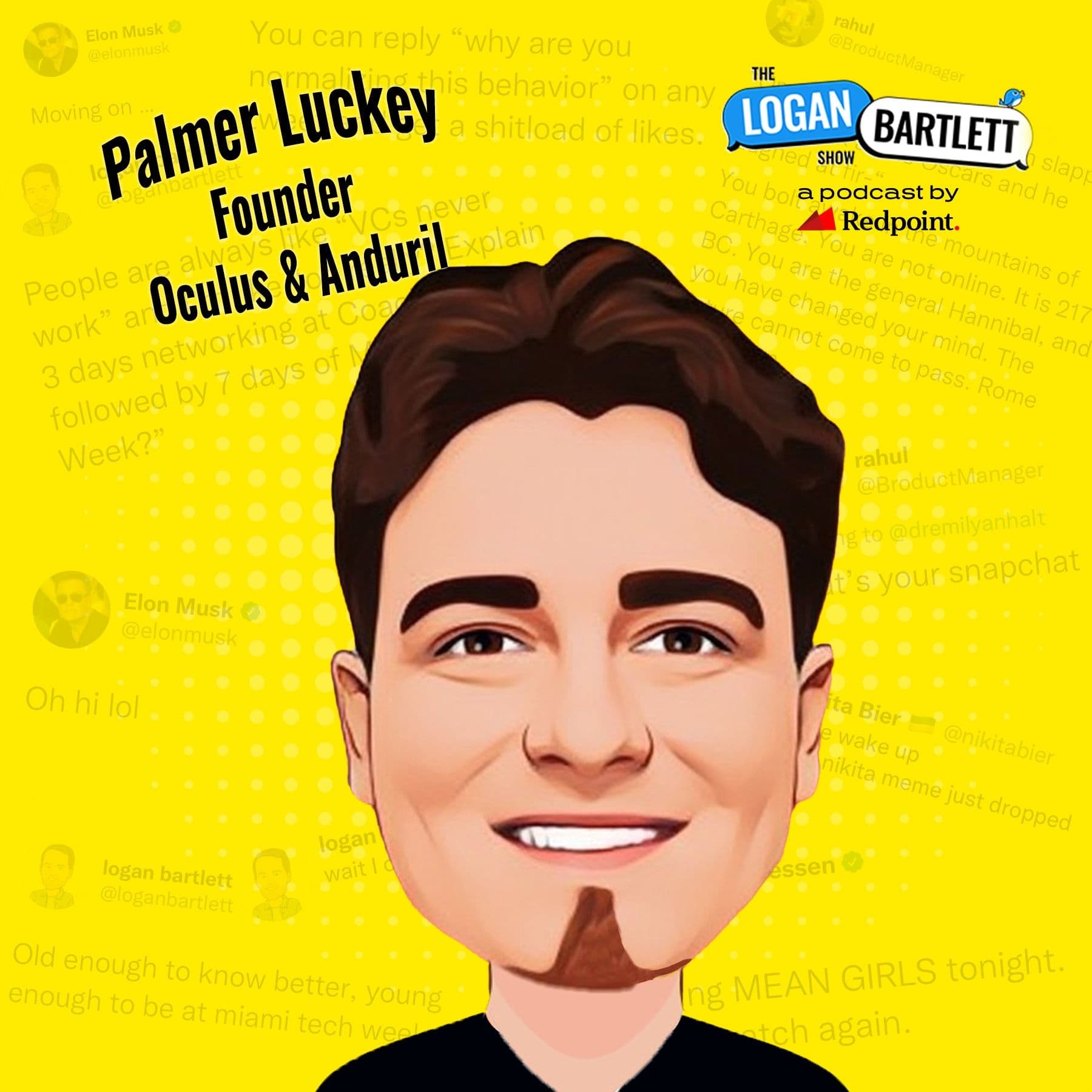
Episode Details Title: Palmer Luckey (Founder, Oculus and Anduril): How He Got Fired For Making a $9,000 Donation in Support of Trump Description: Palmer Luckey, founder of Oculus and Anduril, discusses the circumstances surrounding his firing from Facebook, insights into the VR industry, and perspectives on military technology and ethics.
---
Key Takeaways
Introduction
- Palmer Luckey discusses his journey with Oculus, Anduril, and the impact of a $9,000 political donation on his career.
- The podcast explores the media's portrayal of Luckey and the realities of the tech industry.
Media Misrepresentation
- Misunderstanding of Luckey's Intentions: Luckey highlights how media distortions affected his reputation.
- Incident with Ars Technica: A six-year-old false claim about Luckey was recently retracted without a formal apology or correction.
Firing from Facebook
- Political Donation Fallout: Luckey donated $9,000 to a pro-Trump organization, leading to controversy and ultimately his dismissal.
- Game Studios Responses: Claims that game studios were dropping support for Oculus due to Luckey's firing were exaggerated; most continued their relationships.
- PR Strategy Issues: Luckey criticizes Facebook's PR team for failing to effectively manage the situation.
Reflections on the Experience
- Takeaways from Firing: Luckey emphasizes the importance of proactively correcting misinformation.
- Career Impact: He discusses how the false narratives hindered his ability to start new ventures.
Founding Oculus and Anduril
- Oculus Journey: Luckey founded Oculus as a hobby that grew into a successful company, ultimately sold to Facebook for $2.3 billion.
- Transition to Anduril: After leaving Facebook, he founded Anduril, focusing on defense technology with an emphasis on ethical warfare.
Anduril's Mission and Technology
- Building Autonomous Systems: Anduril aims to create advanced military technology to deter conflicts, using AI and sensor technology for defense.
- Cultural Perspective: Luckey argues that cultural values influence the effectiveness and ethics of military operations.
Overarching Themes
- Deterrence through Technology: The podcast discusses the necessity of investing in technology to prevent wars and enhance ethical military practices.
- Cultural Superiority Debate: Luckey rejects the idea that all cultures are equally moral, advocating for Western values centered around individual liberty and democracy.
Luckey's View on Leadership
- Role as a Founder: Luckey reflects on the challenges of being a CEO and the importance of delegating responsibilities to those more qualified.
- Hiring Philosophy: He emphasizes hiring individuals who are better than oneself in every capacity to ensure company growth.
Conclusion The episode provides a deep dive into Palmer Luckey's experiences with media representation, his journey through the tech industry, and his vision for the future of military technology—all framed within personal anecdotes and broader industry observations. Luckey's blend of pragmatic insights and personal reflections offers valuable lessons for aspiring entrepreneurs and leaders in the tech space.
Written by AI. May contain mistakes. Listen to the episode to check what was said.
Transcript
Automatic transcript. May contain errors.0:04Welcome to the Logan Bartlett Show. I am your host Logan Bartlett and what you're going to And this episode is a conversation I have with Palmer Luckey. Now, this discussion happened last year, but it was a personal favorite of mine. And so we decided to use August as an opportunity to rerun it. Now, you might know Palmer Luckey as the founder of virtual reality headset maker Oculus, which sold to Facebook for$2 billion, or as the founder of Anderol, which was most recently valued at$8.5 billion and makes defense a technology for America and its allies. Or you might know Palmer for a controversy that happened while he was at Facebook when he donated to a entity that was in support of electing Donald Trump.
0:44And that made national headlines and was wildly warped and ultimately led to his firing from Facebook. Palmer and I discuss that story in detail in a way that he never had before and give the real inside look at what actually happened from his perspective. We also talk through why selling Oculus to Facebook was still the best outcome for virtual reality. And then we go into Anderil and what it's like to try to build a new modern defense prime that competes with companies that are over 100 years old. And why building these autonomous systems actually can lead to more ethical wars, as well as why it's a moral imperative that we do so today.
1:26Now, before we get into Palmer, a brief plug that we have launched a newsletter that sends out transcripts every week of the conversations that we have, as well as a summary of that week's episode. If you want to subscribe to that, please go to theloganbartletshow.com and enter your email. Now, without further ado, here's Palmer. Palmer Lucky, thank you for doing this. Thank you for having me. I'm very excited. I wanted to do this in person. I've been an admirer of the companies you've built and how you've gone about it, not without different controversies that have popped up along the way. And I think we can talk about some of that stuff.
2:05But the media portrayal of you versus, in prepping for this, who the person that I've heard a bunch of things about, it seems a little incongruous, I would say, to say the least. Yes, the media lies. Yeah, well, we'll talk about that. What's about a time you were aspiring tech journalist? Well, yeah, people actually don't understand this, mostly because it just didn't come up all that much during the Oculus days. I was a journalism major. I went to journalism school for three years. At 15, right? Yeah, I started attending college when I was 15, and I dropped out when I was 19 to start Oculus. And I was actually the online editor of the school paper, the Daily 49er.
2:45So it's not like I have this internal bias against journalism. If anything, I'm generally inclined to be charitable and favorable and to see the value in good journalism. I actually just dislike specific journalists and specific outlets probably more than a person who didn't have such a background of journalism would. I thought it would take us a while to work up into this, but it's interesting. I mean, this has been true even in the early days of Oculus. There were a lot of like little details about who did what at CES, right? Like misrepresenting like the whole story of your tech career has like little.
3:24I mean, there's one big one that we can talk about, but like there's little anecdotes about how like journalism can be misrepresented at times along the way, right? Oh, yeah, absolutely. And I think, you know, I kind of dealt with that a lot at Oculus, but the reality is you don't have to deal with it when everything is going well and when you're being treated generally fairly. You know, I wasn't going to go out and nitpick that they got some small thing wrong or some small attribution incorrect. The issue is when they started to just say things that were completely untrue, totally fabricated, and then refused to correct them for years and years and years on end.
4:03I mean, that was really, for me, very surprising because I knew people made mistakes, but I didn't quite understand the extent to which they would protect their careers over correcting the truth. Actually, there was one of them, there's an Ars Technica article about me where it said that I was funding racist, anti-Semitic memes that were being spread all over Twitter and Facebook. The whole thing was actually just a completely fabricated claim. Nothing like it even happened. And they refused to remove or even edit the article for six years. And they actually removed it just a few months ago without telling me.
4:40No retraction. I wish I could see behind the scenes, what caused them to finally, after, because for years I asked them to correct it. I was like, this is obviously false. You have no sources. It's contradicted by many other credible sources. You're clearly in the wrong here. And they just refused to even respond. And then finally, six years later, it disappears. And I've been through that, similar things, literally dozens of times. I sort of thought we would build up into this. Yeah, that would have been better, right? We're diving right in. I think one of the interesting things, as I sort of poked around, there actually isn't a great verified version of how all that stuff sort of played out, right?
5:26Sure, sure. History of the Future, which is a great book about the Oculus story, and it goes into a little bit of this stuff. But I mean, I don't know. Most of the time, when people want to learn things, the default isn't like, hey, go turn to page 300 of this 550-page book, right? Right. No, we're a soundbite world, a headline world. I mean, and that was sort of the problem. It was pithy headlines. So I realize there's restrictions on some of the things that you can say. So you were very clear that, and you like making this explicit, you were fired from Facebook. Correct. And thank you for calling out that I'd like to make it clear.
6:01I'm not trying to make myself overly victimized here, but there's so many times where executives are pushed out of their own companies and then everyone agrees to play by the rules. I mean, you've seen this. Totally. They've decided to spend more time with their family. VCs are excited to move on to the next great adventure. VCs are excited to get back to operating or go spend time with their families. There we go. Oh, get back to operating again. That's a good one. It's like, oh, well, eight straight years of zeros on investments and now you're ready to go back to operating. Yeah, exactly. I think that that is not a healthy thing.
6:36I think it's not a productive thing. I would like to see the industry be more honest about this, if only because it minimizes the... We all hear about the successful acquisitions. We all hear about the ones that go well and how they made the money and how it's great. But then the other side of it, the part where they potentially are getting forced out of their companies, where control is seized beyond the limits of what was agreed, those parts often get smoothed over by the corporate messaging. And the problem is then future people deciding what they're going to do with their company only see that positive side.
7:09And they don't understand. They don't have the real world experience to know that things don't always or even often go that way. So I think it's productive for people to see both sides of the coin. The Oculus story, one of the things that I was most worried about is it would be taken as very much a success story of mine, where it was like, you know, I did this thing, I built this company, I sold it, it went great for me. And then I moved on to my next great adventure. I would hope that people could learn something from not just the good parts of what happened, but the bad. You also, I mean, you have this very pragmatic view in a lot of ways.
7:45And it's a dichotomy, I think, in some where you've said, like, it still fills you with rage to this day, right it's true of like what happened but also you have this um in some ways piece that that i've heard you talk about about like hey ultimately what i care about is the vr industry becoming what it is and it's in good hands for doing that and so i i can't let my personal views uh of what happened to me get in the way of like the mission that i actually wanted to support or or like hey i actually believe in the system at which people can maybe not be fired for political views uh but I believe in the system at which at-will employment exists.
8:23That's something that I believe in. And so I actually think that I have a right to be fired for my company if they give me a few billion dollars. Absolutely. And I've had to make this clear to people. They say, I can't believe that you were fired for your political views. And actually, I'll go even further. It's not just at-will. This is not legal. I'm not saying that I break the law here, just as a disclaimer for whoever's listening. But I actually think you should, in certain situations, be able to fire someone there for their political views. Imagine that I work at Citibank, and we hire as an executive somebody who comes in, and then shortly after hiring them, they are publicly out on the record as saying, my life's work is to dismantle central banking and the capitalist apparatus.
9:08It is a moral imperative that I return the world to the people and that we nationalize all banking and industry. That's very much a political belief. And I think it would be fair for Citibank to say, you know, I think Citibank is not the right place for you. I think you should go somewhere else. But to the letter of the law, you would have to continue to employ that person and allow them to be out there using their Citibank job as a platform to get recognition and say things that are fundamentally opposed, not just to what Citibank is doing, but what the entire industry that you're operating in is doing.
9:46And you couldn't possibly be an effective executive in that situation. And so that's one of the things I actually, I kind of wish that it was legal for Facebook to just say, yeah, we fired him for his politics. He didn't fit in. We didn't like what he was doing, so we got rid of him. Instead, you have to make these ridiculous constructs where like if you ask them, you know, was Palmer's politics any part of why he was fired? They have to insist not only was it not why he was fired, we didn't even consider it. It wasn't even part of our thought process. It's like saying that the sky is green, especially if you see the contemporary evidence.
10:23You know, like if you've read some of the stuff from the family, it's extraordinarily obvious that it was at least in some part motivated by politics. But instead, everyone has to lie. Everyone has to say these nonsensical statements and argue that they're telling the truth. And it's just so bad for everybody to have that happen. We're dancing. And of course, I'm at peace because if I wanted to, I could just go and try to... You've seen me go off on a few of the people who have wronged me. There's a lot of people who have wronged me where I've never gone after them because I've done the calculus and it would be bad for the VR industry.
10:58I'm not going to do anything bad for the VR industry. And people often will say, oh, you know, the press should be fair and they shouldn't be cheerleaders for the VR industry or tear it down. But I'm not a journalist. I'm a techno bro. And so I can do whatever I want, including choosing to not address major issues because I think it'll help the industry that I care so much about. So there's a lot of people who escaped my wrath only because it would be terrible for the VR industry. Sorry. Sorry for that. No, no, no. So we danced around it a little bit. But I guess maybe I took it down. It's actually kind of hard to find a canonical record of what even kind of transpired that's synthesized in a way.
11:38So let me do it in my words. All right. Sounds good. You correct me on anything that you want to. All right. Let's do it. So you gave$9 ,000 to a pro-Trump political organization called Nimble America. It was a self-described social welfare 501c4 nonprofit. That's right. With a goal to shitpost for Donald Trump as the I mean, it was for a broad set of candidates against Hillary Clinton, I guess, theoretically, because that's the structure of the 501c4 or whatever. But like for Donald Trump and the specifically to bring shitposting to the real world was, I think, there was, I think, the quote there.
12:14got it people always could they quote shitpost out of there and then they say oh that means that he was trying to flood the internet with with memes and posts like well no actually in fact they explicitly were saying it's shitposting but not in that venue yes which was very frustrating for me at the time and so the distinction you're drawing is like not just uh doing digital ads of shitposts and well it's not even just doing digital ads all they did was run a physical bill i was gonna get there one what and so that was the distinction you were drawing was so so So ultimately what happened - And in the description of the organization, they're making that distinction.
12:45Yeah, got it. If you were doing it on the internet, you would just be a shitposting organization. Yeah. You just wouldn't say our goal is to bring shitposting into real life. Yep. And so there was one billboard that was run. It said, too big to jail for Hillary Clinton. It was a picture of Hillary Clinton alongside the text, too big to jail. Too big to jail. And so there was one billboard that - Referring at the time that it came out, this was when there was a lot of controversy about handling of classified material and whether or not she was being treated the way that other people had been treated by the legal system for handling data in similar ways.
13:18And so how it came to be is interesting for journalists, journalistic integrity and all that, that you were ultimately tied up in all this. And I think that's a interesting thing if people really care about about how it came to be. But you did not your original intention wasn't to be public with this. Right. It was the founders, I think, of the sub forum. subreddit. Not even the funders. They just used to be moderators of it. Moderators of it. Yeah. That's the thing. They weren't even moderators. They, at one point, were moderators of the subreddit for, like the de facto subreddit for the Trump campaign.
13:51Which has ultimately got banned by Reddit. I don't even really know. Years later. Years later, 2020, I think. And some of the stuff that, at least the Daily Beast article that was the big one that broke out said was to become a, maybe it was a moderator. It said, is there a difference between white nationalism and white supremacy was 9-11 an inside job so there was the interesting thing there you're right they did they mentioned oh it's this horrible place for example they ask you you had to answer if 9-11 was an inside job but they don't say what the right answer was and the thing is those questions they imply that you basically had to be a crazy conspiracy nutter in order to even be allowed in it was actually the opposite they implemented those questions to keep out all of the nutters that were trying to become moderators It was like, if you said 9-11 was the inside job, you were not allowed to become a moderator.
14:37They basically said, okay, yeah, that's like, if you think that the U.S. government did this, you should not be moderating this political forum for a current U.S. president. And so that was the actual really interesting thing is how they actually completely flipped it by acting like you had to answer one way. And in fact, it was the other way. They were trying to filter out exactly the people they're implying they were. That's interesting. And so and obviously there was a period of time at which it was popular and then it branched off and different, you know, whatever ties to different groups and all that.
15:12But so so this ultimately came out through some very weird series of events that Daily Beast, it seems like didn't respect journalistic integrity behind, you know, verifying things off the record. That's right. Was at least the way. Well, they confirmed in writing that it would be off the record. Yeah. And then later, when I pointed that out, the editor said, oh, no, while you were on the phone, you confirmed that it would be on the record. It's like, wait, wait, wait, wait. That's not how any of this works. Why would I have done such a thing? It's actually the Occam's razor of this situation.
15:47Why would that have been how you would want to reveal in this big breaking thing? And people do make mistakes being on the record, off the record. I mean, it happens, especially when they're not familiar with the rules. I went to journalism school. I was a journalist. I was an editor. I very well understood the rules. I worked in the tech sector for years. I did literally thousands of interviews. I understood the rules, and it was in writing that it was off the record. And so they don't argue that, oh, this was of such journalistic import that we're breaking the rules. It was just, no, no, you agreed on the call that it was on the record.
16:24Yeah. It's like, which, of course, was untrue. Yeah, totally. So they did that. A bunch of controversy followed. This was prior to the actual presidential election. That's right. So a bunch of Facebook doesn't— It was late September of 2016. Late—oh, wow. September 22nd. Okay, got it. And so you're asked to take a leave of absence as this shitstorm is brewing. People are internally within Facebook signing different things. And game studios are saying like, oh, we might not work with Facebook. So actually, that's another bit of misinformation. There were a lot of headlines that said game studios are dropping support for Oculus until they remove Palmer Luckey.
17:05so there were three companies that said on their twitter that they were not going to work uh with oculus until the situation resolved they didn't actually say that they needed to fire me uh one of them was a trading a paper trading card game company that later said that they were the whole thing was just a joke they're like no no we thought it was a joke we said we're dropping oculus support we literally make paper trading cards uh that the joke was that we were dropping you're like ha ha So that's one of them. And then the other two had never released a game. And in fact, neither of them ever released anything.
17:41They were two independent solo developers who never released the games they were working on. Which, like, they weren't Oculus partners. They hadn't even been approved to be on our store. How could they be dropping support for us when, in fact, we had no relationship with them, had no plans of hosting their game one way or the other? But instead, people turn into this huge thing saying developers are dropping support for Oculus, which really bothered me because as a business guy, that's an accusation of material impact, saying his actions had a material impact on the Oculus business. And it was just completely false.
18:16Not a single developer we had ever worked with did anything of the sort. And so how much like... Or if you really want to go the other way, every single developer we worked with kept working with us despite the controversy. Yeah. I don't know if you can say that lack of action is an affirmative action. But if you're going to skew it one way, the way to skew it is every single partner we had stood with us. How much of after all that stuff happened, then it starts brewing on itself? And I've never been... For people who aren't listening, for who haven't followed this, I gave money to this. And what the report said is that I was funding anti-Semitic, racist, white supremacist troll farms that were attacking Clinton supporters all over the internet on Facebook and Twitter and posting these vile, horrible memes all over the place.
19:10So I just want to be clear. The thing that I was getting attacked for was not what I did. It was I did one thing. It was reported as a completely different thing. and on all the controversy was in response to that. Did the Daily Beast, so the Daily Beast reported that? So that's actually the other interesting thing. The Daily Beast did not report any of these things. Now what they did is, they did like what I talked about earlier, where they made, they implied that you had to, that you had to support white nationalism in order to be a model. They implied you had to think 9-11 was an inside theory, but they didn't actually explicitly say it.
19:40They just did it so that any reasonable person would read it and assume much worse. The other articles were actually the ones that were much worse. The Daily Beast, for all of the journalistic malpractice they engaged in, they were not the ones who actually elevated these claims to saying, you know, he's funding Donald Trump's anti-Semitic meme machine. He's flooding the internet with Nazi propaganda. Like, those were just made up by other outlets like Wired and Washington Post and the New York Times and Boing Boing. I mean, like the gamut of credible to non-credible. It was all completely false reporting.
20:14And was it was it actually reporting or was it skimming aggregation? Like, how much do you think it was malintent? It was original reporting. Of course, everything is just aggregation. Sure. But no, these were like like this. This wasn't just like they posted a link. It was like, you know, all like all like five plus paragraph articles putting their own spin on what had happened, reporting mostly what people on Twitter had were saying about it as if it was fact. And it was, it was, it was, it's hard to stress this without sounding like a nutter, but like the claims they were reporting had no sourcing, were totally untrue.
20:47There was no source whatsoever. And anyone who tried to point that out was immediately smeared as, oh, they're a neo-Nazi Palmer Luckey apologist. In fact, actually, for example, like the NeoGAF forums, which are major game industry development community, they actually made it policy that anyone defending me was instantly banned from the forum. I mean, like that was that was the level of pushback on correction that there was. What do you think? I mean, it's actually it brings so many different questions to light in all of this. But so this whole controversy starts brewing. The election happens.
21:24That's right. The person that I think all the people that were against you were supporting and who I also voted for in full disclosure didn't get elected. That's right. And the person that you were supporting did get elected. And then that's when it actually went from like, this is crazy annoyance, but probably going to blow over to like, holy shit. Well, I mean, I was explicitly told after the election, you can come back to the office. Yeah. Like, we're just going to let this blow over. um and but you're right it's because trump won they decided that strategy was non-viable and did you ever get i mean it seems in reading the book it seems like implicit that they're and you're so pragmatic about a lot of these things that actually from like uh had it been a business decision right it seems like hey listen if game studios were actually going to drop oculus and i was the impediment to it like i totally understand why that would have to be a business decision oh I would have done it in a second.
22:22You would have fired yourself if you were Mark Zuckerberg in that situation, if game studios were going to drop Oculus. That's right. Yeah. But that wasn't what was actually happening. No, it isn't what was happening at all. And I think also, like, you know, it's very much the palace intrigue thing where the tech reporters were all over this fascinating drama. Gamers, gamers, gamers are not, you know, they're not, they're not, they're not following the exact political views of every executive in every company and every studio. I mean, look at Bobby Kotick. He's an outspoken Republican. He's donated to Republicans for many, many years.
22:58And he's running Blizzard Activision. And they're one of the, if not the most successful game studios in the world. So clearly, voting for Trump is not this thing that makes a company disqualified. It would be specific things like you mentioned, game developers dropping Oculus. That would be the equivalent. So I don't want to ask you to speculate on other people's intentions, because I realize that's just that's a hard thing to do. But what what do you think led? I mean, obviously, some leadership desire to not push back on all of this. Was it just a loud group of people that this seemed like the easiest way to make this whole thing kind of blow over within Facebook?
23:38What was the rational, Palmer Luckey, the detached analytical person of like, hey, everyone's sort of acting in their own self-interest, which I think you believe at the end of the day incentives and self-interest drive a lot of these things. And so if you were to speculate why it actually happened, what's your speculation on it? Well, I mean, the playbook that they followed was more or less exactly the playbook that you would learn in crisis communications training. I mean, to let it blow over, not give them more fuel. What they did was actually pretty by the book. I don't think it was the right move.
24:15I think we were an unconventional company in an unconventional situation that you couldn't have done things in that way. In particular, because it would have been so easy to at least camp down on the worst of it. Again, the reason I'm highlighting that all this reporting was false is because I want to be fair to people. It's gotten boiled down to in the modern day as, oh, they were upset because you gave money to a pro-Trump group. But it's not quite true. That's unfair to the people who are angry. They were reading media that I was funding neo-Nazi propaganda farms run by anti-Semites who were flooding social media with personal attacks and trolls against Hillary Clinton's support.
24:53Like, that's what was getting reported. That's why people were angry. We could have easily taken the edge off of that and been like, whoa, whoa, like, you know, that's not what's happening. And instead, there was a refusal to even do that basic crisis control. Like, hey, this reporting is outright false. And there were a few reasons for that. One, one of the things that was going on during the election was it was it was kind of it was kind of a it was considered unthinkable to question the press if you are left leaning press. Like the act of saying the press is lying to you was considered an attack on democracy itself.
Read the full transcript
25:26That was you. I mean, you remember 2016. And so there were a lot of people like we cannot actually say the press is lying to people because that's what Trump says about the press. Like, right. But we all agree that's obviously what's happening right now. They are they are just fabricating a story like, yeah, but we can't say that because it'll look so bad and anti-democratic as if the press enjoys this special. position in government that makes them unassailable. So that was part of it. The other reason that I think, the thing that really mixed things up, do you remember Correct the Record? Vaguely, yes.
26:03Vaguely. Nobody really talks about it these days, but it was very relevant at the time. It came out that ActBlue, ShareBlue was funneling millions of dollars to Correct the record, which was an actual campaign to pay people to post on the internet to say nice things about Hillary Clinton and bad things about Donald Trump. It was an actual astroturfing campaign, and it was actually funded by the DNC and major left-wing organizations. And my whole controversy came out about a week after that was revealed that they were doing that. And so I think in some ways, I was being framed as kind of the mega millionaire financier of the right wing equivalent to correct the record.
26:45It was kind of a, oh, well, look, we're doing this, but also the other side is doing that. And I think that's what set it partially out of control and why there was so much mainstream media coverage. The Washington Post story wasn't about Oculus or video games. It was about how astroturfing troll farms are funded and operated. And they basically talked about correct the record. And they're like, oh, and Palmer Luckey's doing this on the right too. He's paying people to troll people on the internet too. That kind of made it very difficult because to go out and try to correct the record as it were on that would have also been seen as kind of picking the right wing side of the debate.
27:20And so that was, I think, fundamentally why I ended up in such a bad spot is I assumed that the people making communications decisions were looking out for the company and for me. And typically the way that it works is you let the company handle the strategy and in exchange, you get protected. That's the hope. It's like, look, I'll let you call the shots and I'll be a team player as long as we're all on the same team. What I did not divine is that there was no intention of keeping me on the team. And in fact, it was just a poorly run PR strategy that didn't help the company or me or anybody. Yeah.
28:01So you kind of understand from an incentive standpoint in a lot of ways how you ended up in that situation. I mean, just to put it in one sentence, if they would have just fired me and said, we're firing him because we don't think he can be an effective leader because so many people here hate Trump and his supporters, I would have been unhappy about it. But ideologically, I couldn't have found much rage in myself about it. I'd be like, okay, that's at least a reasonable concept to hold. You have the right to fire me. The problem was where I wasn't allowed to correct these really awful stories, and I was thrown under the bus at the end of the day.
28:42I got fucked at both ends. Yeah, it's almost like the principled element of it is what was so frustrating. It was like all different things that could be screwed over ended up cutting you the wrong way on this. And also making it, it was very clear that one of the reasons I was so angry afterwards is because the way that the initial situation was handled made it much harder for me to start a new company and to get started again. You know, like basically the fact that all these stories had been allowed to go uncorrected for the better part of a year, more or less cemented them as truth, which is why to this day, you still have press repeating those same claims, which are just, they're obviously false.
29:30But if you put in no effort, then it's easy to re-report them. And honestly, I mean, I think about myself until I sort of went down this rabbit hole of doing all this. It's actually a very natural thing. You want to believe what you're being told is true. And going back to primary research on every topic, isn't a tenable way to live your life on this? It's tough. Yeah, you can do it on one or two topics you care about, but to do it every time, you're right, there's not enough time in the day. It's just like, oh, it seems like the pearl's not worth a dime for me to figure out exactly what happened to Palmer Luckey.
30:04Easier for me as a venture capitalist to not invest in his next company just because I would have to go talk to so many different people to figure out all these different things. Well, especially because you go to Wikipedia and it says a bunch of stuff and it cites a bunch of stories. And the way Wikipedia works is if a credible outlet reports that it's true, it's true. Now, that's true even if primary sources directly contradict it. Wikipedia says primary sources are not to be trusted. It's actually third parties that are reporting on that are the ones that are actually weighted higher. So you can have a primary source that directly contradicts, let's say, five major media outlets saying something.
30:41And Wikipedia is going to say, no, no, the version that the media outlets said is true is true. and you can't edit it because the admins will come in and say, no, no, this is a settled fact. And so for you, the venture capitalists, you're going to look and say, wow, this is a well-sourced claim. Many credible outlets have said so. This must be true. It's the only reasonable thing that someone could do, which is why, by the way, I'm not angry at people who read these stories and were aggressive against me. This is why I'm so angry, particular at the reporters, because the people who were misled were misled.
31:12This is not their fault. They were told something that wasn't true. And they got really angry about something that didn't happen. And that's not their fault. I can't really hold. I can't say, oh, well, you should have gone to the primary sources. Yeah. Because to your point, that's not reasonable. But I can hold the people who made that happen accountable. Which, which, so what's the better takeaway from you in all of this? Like, obviously, it's a very unfortunate situation. You're the company you founded was taken away from you. And I know it's going to bother you. You know, I mean, you seem to be well.
31:41Anderil seems to be... We're doing great. Yeah, great. And it seems like you're in a pretty good place with all of that. But I'm sure it still hurts. I mean, the biggest takeaway is do not underestimate the long-term impact of not correcting falsehoods about your company or yourself. A lot of people, they say, oh, it's not that big of a deal. I'll just let it be said. And we don't correct it. They don't want to go toe-to-toe with the press. And they don't understand the long-term impact of that because that thing that was said can now get re-reported. Like there was a New York Times story that reported a quote and they put it in quotation marks and said that I said something.
32:14Well, I never said that. And in fact, I had the written quote. They were quoting a written quote. I said, hey, your quote is literally inaccurate. I said something totally different. Here is the written quote. He said, oh, we don't think the meaning is all that different. And I explained it. I said, well, that's not how the New York Times style guide works. You don't get to decide. We put in quotes what we think the general meaning of something was because it actually is important to note what it was. Actually, what it was is we were talking, I was talking about why I donated to Nimble America and the original sentence said, you know, I donated them to put things on this billboard because X and they just removed on this billboard.
32:48It just, they just removed what I actually did. I'm like, no, no, this doesn't work because you're removing the context in a way where it's going to get misreported. And then what happened? I fought it a little bit. I stopped fighting it. And then that quote, the one that I didn't say ended up being endlessly quoted by dozens of stories over the course of three years. And so a lot of people don't understand the value of taking the hit at the beginning, going toe to toe with the press. And if they will not correct the story, like I've been pretty effective at using newsletters and interviews and even Twitter to say, hey, this is wrong.
33:24This is false. This particular reporter, this particular outlet is derelict in their duties. And that actually seems to work pretty well in getting stories correct. What's been the most... So in getting the story out there, I mean, when this all came on my radar was really the Jason Calacanis all-in thing. And we were talking about it before we started. You've been recognized in Ukraine for that. What's been the most effective means of actually dissuading people from thinking that narrative? You have to get out and you have to actually tell them your story. If you don't tell them, then they're not going to dig themselves.
34:01You have to make it so that the real version of what happened is as easy to find as the false version. You need to make it where a person doesn't have to go deep into the primary sources of what happened in the distant year of 2016. And instead, you just have to keep talking about what you're doing now and also what happened then. And that's actually worked out pretty well for me. I think me being very aggressive has gotten myself and by extension and roll into a much better place. Interesting. Which is not what anyone in any crisis communications PR firm will tell you. They will tell you... I'm like, yes, the way to solve misreporting is to immediately, aggressively attack the journalist who is lying about you.
34:45They'd be like, oh no, you can't do that. But it turns out that in the modern dynamic, that's often the only way you can defend yourself. After you went through all this stuff, you came out the other side and now have Andrel, which I promise we'll talk about at some point. That's right. Finally, we get to talk about your current company. But it seems like going through something like this, inevitably... I will note, it's pretty incredible that I've spent hundreds of hours of my life, maybe thousands dealing with a$9 ,000 donation. Honestly, without putting that much thought into it, I don't want to sound like a rich guy here, but I had just sold my company for billions of dollars.
35:28This was a relatively small donation to a relatively innocuous cause. It was one billboard in Pittsburgh that had Hillary and the word too big to jail. It's incredible how that was turned into like this defining thing that has to be addressed every single time anyone does a story about me. But I think what's interesting about that is, or at least you're crossed the bear in this. And again, I don't know if you see it this way and actually having gone through it, I'm sure easy for me to say, but is that you are like how many people have gone through something similar and aren't willing to talk about it in the way that you have or come out the other side around it, right?
36:04Although most of them just have their careers destroyed and they never have a second chance. Exactly. That's the reality. I'm lucky. Yeah, I'm lucky to be able to deal with it. But at the same time, where I don't feel it should be my cross to bear is you have many, many other entrepreneurs donating much larger sums of money to their political candidates of choice. The reality is it isn't Trump and it wasn't misreported. And so that's like, oh, the real problem is Palmer donating to political organizations. It's like, wait a second, the people working above me, even at Facebook, donated literally hundreds of millions of dollars to political organizations to almost, you know, first of all, not very much coverage, but certainly no scorn.
36:44Yeah. And that's always, that's all, that's all, you know, and I'll get to find like, oh, Palmer, you know, outspoken, right, you know, right wing propaganda funder. It's like, wow, is that really all it takes these days? $9 ,000 and all of a sudden you're outspoken about your politics and you're funding right wing propaganda. it's like nobody would ever be like oh this democrat he gave a few thousand dollars to uh planned parenthood so he's he's an outspoken well-known uh left-wing political political anonymously and got doxed into doing it therefore you're outspoken right wing yeah this is another thing yeah i've i've i've had rallies with like you know you're you you were very outspoken about your political beliefs during the election like wait wait wait let's be clear i was i was doxed out of yeah and and the reason that's important is from a business perspective, if you are being outspoken is a very different business position than like, I'm going to have my politics and keep it to myself, which is basically what I was doing.
37:37You know, the only alternative beyond that is I'm going to have my politics, keep it to myself and do absolutely nothing to support anyone that I support. Yeah. Yeah. Which is, which is a tough thing to advocate for. Listen, for any, for any side of the path, a lot of people end up taking because of all this. It's a smart one, honestly. Well, so we dove right into that and I want to touch on a few different things. And I appreciate you going through all that. Hopefully that serves as at least something of a primary document on all this. It took me, even as you heard, I made mistakes along the way in talking that through.
38:07And that's after you've read books on it, you've read interviews on it. Yeah. I knew directionally what it was. So you are how old now? 29 years old. Wow. Death's door. It feels that way sometimes. Yeah, you were the boy wonder at 19 starting Oculus. So you grew up, we're in Orange County right now. I grew up in Long Beach, California, which is actually technically LA County, but close to the port. So right on the line. So your father was a car salesman? That's right. Mother homeschooled you? That's right. And did you have an inclination? It seems like you had a bunch of different interests. I mean, going into journalism, you were also deep into tech and VR and gaming and all this stuff, being homeschooled.
38:54It sounds like also you were a little bit of a pain in the ass as a kid. You got kicked out of your house at least twice, once into a trailer, once into your garage at some point. Yeah. I mean, some would say I'm a pain in the ass today. Yeah, listen, aren't we all? Yeah, not all too much has changed, I guess. Aren't we all? So take me through how you got into Oculus originally. And I think one of the interesting things as we ultimately take it back to the company you're now a part of and founded. I think it's interesting to talk about how accidental versus purposeful the two different companies were as you contrast them.
39:29Well, like the thing about Oculus was VR was my hobby at the time. And so I started Oculus because I really liked VR and I wanted to make a run. I had a few good ideas for basically how to make a better VR headset and how to replace certain high-end hardware functions with much cheaper software functions, make it easy to use for game developers. but I started working on VR when I was 15 as a hobby because I was building PC gaming rigs and I had built a really really nice PC gaming rig and as I started planning out my next round of upgrades it just wasn't exciting and it was clear that the future of gaming was not going to be more monitors and more graphics cards and just you know incremental improvements it was going to be something radically different and as a science fiction fan it was apparent to me that virtual reality was not just the next step in gaming but the final thing you know what once you have perfect virtual reality.
40:17Like that's it. The ability to simulate anything a human could experience or imagine experiencing. That's the holy grail. And so I decided that I was going to work on that as a hobby. And Oculus kind of came out of that, not because I thought that VR was going to be the best business ever or because it was going to make me a lot of money, but because I loved working on VR. It was very interesting. I had a lot of fun working on it. And it turned out that I was doing the right thing at the right time. And the technology was in a place where I could build a multi-billion dollar company out of those insights and ideas from a hobby.
40:49To the point you just mentioned, I've often said Andrel was different because I started from the beginning saying, I am going to build this and to be a major company so that I can have a big impact through the size and through the influence, which is very different from, let's make my hobby into a thing that pays the bills so I can move out of this 19-foot camper trailer and into a real apartment. Following your passions generally doesn't lead to being a billionaire or founding a multi-billion dollar. Oh, no, not at all. I mean, one of my contrarian pieces of advice to people is to never follow your passions, follow your talents, because those often are not 100 % aligned.
41:23So many people, they get this false advice where they're told, follow your dreams, follow your passion, whatever you love doing. That's the thing that you really should do with your life. the problem is that most of the things worth loving are not things where you are going to be able to make money or certainly have an impact. And this is especially true for, I think, kids and teens. Kids and teens are called follow your passions. Like, no, no, no. What you're passionate about when you're nine years old has very little correlation with good life decisions. It is bad advice for kids, in my opinion.
41:56That's how you end up with the number one most desired job for children being a YouTuber or a Twitch streamer rather than being an astronaut or an engineer or a writer or whatever stereotypical great profession you want to lay out. You say children, I'm 34 years old and I'm a YouTuber now. So I don't think it's just children that are aspiring on that. But I think it's interesting. I mean, the point about - Oh, it's fine to have good YouTubers. And I think your success in this space shows that you do have at least some talent that lies there. The issue is when it is by far the most desired job in the whole country.
42:34We can't have a country of YouTubers. Yes. Yeah. That's very much true. It's interesting. I mean, it sort of goes to the... I've heard you talk about the people wanting to be lawyers or when artists or whoever within a company go to the engineers and say, this isn't fair. You guys are getting paid more than me. Maybe you can speak a little bit about those. I know you're, yeah, I mean, I've, I experienced this, especially at Facebook, you know, there was, there was this interesting, interesting dynamic where you, there was this idea that some people have that all work is of equal value. And like, this is a thing people say, they say all work is of equal value.
43:10And so you'll have someone whose days consist of like brainstorming and sketching flowers and thinking about how they're going to do a sticker in the Facebook chat. And then you'll have them complain and say, why is it that engineers are valued more more highly at this company. We live in a culture that values certain things over others. And the reality is all of our work has equal value. And I'd say like, you know, the, the, the autismo super engineers would be like, no, you are wrong. Your work has less value by all definitions of the word value. Uh, that's why you're paid less. That's why there's less prestige.
43:43That's why there's, there's like that. That's why it's easier to get a job doing it. Uh, and people People are like, how could you say that? Everyone is equal worth. They're like, no, there are certain jobs that create more value in the world for myself and for everybody else. And while wages are not a perfect reflection of value disparity, certainly everyone should be able to agree that there are jobs that create more value for mankind than others. And that was – yeah, there's people who would always say that that was unfair. And the thing is, some of that is due to lawyers. They have to go to law school and go through a really painful grind.
44:20But also, their jobs really are terrible. And you'll even hear this from lawyers who love practicing law. Nobody will say, this job makes you feel good. It activates all the serotonin and dopamine on a regular. It's like, no, this is a tough job. And one of the reasons I'm paid more is because it sucks. And you have to pay people more if they're going to do shitty jobs. And it's just very interesting that huge gap, because I've always been someone where I've always thought myself as pretty rational. And even when I wanted to be a journalist, I never would have dreamed of going and being like, yes, my job as a writer is equally valuable in terms of salary as an engineer.
45:04I would have to be like, oh, well, maybe I'm making a bigger impact in the world. But it's definitely not worth as much money as the guy who had to go to school and be an engineer. It's interesting. You're making me think that maybe not all lawyers are just in it for the love of law. Oh, not at all. And a lot of lawyers aren't and a lot of doctors aren't. That's not to say that they don't find meaning and worth and value in it. And before anyone says that I'm attacking doctors and lawyers, I have a lot of doctor and lawyer acquaintances, friends and colleagues who will say the exact same thing.
45:31Like, look, you don't get into you don't get into law. If if law didn't pay well, I probably wouldn't be doing it. Yes, I think that's. Even if they love the law. Even if they love it. If we cut lawyer salaries in half, I think there's going to be less of them. I just, it's a theory of mine, but I think that's true. Well, I mean, this also gets to being in executive positions. People often are saying, oh, CEOs are paid too much, and CCWeed is paid too much. I know this sounds like such a stereotypical rich executive thing to say. Having been on the other side of that, where you are responsible for everyone's well-being, You're the final backstop for legal and compliance and fundraising.
46:10And if you don't perform, everyone's out of a job and the company's gone. I think a lot of these guys are not paid enough, especially the ones who already have a lot of money. If we took CEO salaries and dropped them to be remotely like what it is to be a worker, I think most of these people would be like, man, peace out. I am out of here. It is not worth the extraordinary stress and demand. And also, I mean, they're seeing most of these people, they're not seeing their kids. They're not seeing their families. They have to give up on so many holidays on so many occasions because they have to put the company first.
46:45You couldn't pay me enough to do the job of some of these executives that I've seen, especially in companies that are going downhill. They're like, oh, how's this company failing? And they're paying the CEO$10 million a year. It's like, you know why they're paying$10 million a year? Because the company's failing. Yeah, you want that job? You want to go work in the place where every day your job is to try to attempt the 10 % probability chance of a turnaround? You couldn't pay me to do it with any amount of money. It's interesting. Yeah. I mean, it's all these things. It sort of goes back to the incentive point between dollars and prestige.
47:21And it's sort of like, hey, listen, everyone's like, well, why don't we have better people in politics? And I'm like, well, listen, that's a pretty fucking shitty job. And you don't get paid very well. and like people said for many people in politics it's the best job they can have too like there's there's a lot of people where like like yeah like it isn't that great of a job and people like oh it pays 170 000 a year and you get benefits like yeah but you spend all your time traveling you're basic you're fundraising all of the time you get death threats all the time your family is now on is now is now being attacked by by press by random people on twitter you and that never goes away even after you're a politician.
47:59It's like, why are so many politicians sociopaths? It's like, well, listen, it takes a sociopathic person to want that job. And I think a lot of the best politicians I've seen are the ones that get out of politics eventually. So they'll get in because they really want to make a difference. And then they just can't take it. If you're able to survive in politics for decades, it either means that you are truly a believer in your mission, or you are broken in the brain in some way. Yeah, I think that's right. That's right. So Oculus, so VR, you started it at 19, sold by 21 for billions, two to three billion, depending on sort of how you - Depends on how you count.
48:43What's a billion between - Depends on the accounting. Yeah, what's a billion between friends, right? But - Specifically, like the reason for the confusion and just for anyone who's listening, the official number was$2.3 billion. dollars. But the way that it worked out is there was also a$700 million employee retention package because that was a lot of the value of Oculus was the employees. And some employees had more equity than others. But you really had to make sure that people who did not necessarily have a lot of equity ownership at the time of the acquisition were sufficiently motivated that they were going to continue working.
49:15And that's also true for some people that did have a lot of equity ownership where you had to make it worth hanging around instead of just immediately piecing out. That's one of the downsides of a rich tech market is sometimes you have great people brought together, they've accomplished something extraordinary, and then they make enough money to go spend time with their families. And who can blame them? But it's a loss for the industry when you'll have a successful company. I mean, you've seen this before, company IPOs, and then it's right after the lockout period, half of the most talented people, they're gone, not just from the company, but from the workforce forever.
49:48I'm not saying that people shouldn't make money. I love it. It's one of those things where if you want to paint the whole picture, you got to look at the downsides too. But that's why there was a$700 million retention package. Make sure that those people stuck around for a few years to see through what we were doing. And so it was 75 people when it was acquired, right? And by the time you left, and as we touched on in 2016, or I guess beginning of 2017, how many people were at the company? About 1 ,400 people. do you regret april 1st 2017 april 1st 2017 uh do you regret having yeah exactly do you regret having uh sold the business to facebook not at all yeah it was definitely the best thing for vr because of the industry itself because of the financial outcome everything it was we got the resources we needed to get the rift out the door and to fund so much content that never would have gotten funded otherwise so much of the vr content and especially in the very early years you have to understand could never have survived organically uh the the market was too small nobody could possibly have invested the money that we did to start that self-sustaining flywheel of people wanting to buy the headset so that they can play the cool games uh which then you know leads to money then leads to more cool games which leads to more sold headsets like to kick off that flywheel takes billions of dollars i mean look at what it took even just to start uh xbox that took billions of dollars.
51:11And that was a game console. People understood that they were able to have ports from other consoles to their platform. Like starting a new platform takes billions of dollars and Facebook put in the money. Now, I don't agree with every tactical decision they've made, but broadly they are putting more into VR than anybody else in the world. And people often point to other companies, especially at the time they did. They said, well, why not Google? Why not Microsoft? All those companies have dropped their VR initiatives. Facebook's the only one that has the singular God King leader who has the power and the money to continue investing in virtual reality, no matter what anyone says about it, shareholders, board of directors, or otherwise.
51:49And it's really hard to be unhappy with that outcome as someone who wants VR to happen. Now people say, oh, but do you really want in the hands of that particular corporation? Do you really want this particular model of advertising to take hold? And my view is the really hard thing is getting VR to the mainstream. It's not necessarily going to happen. You have to make it happen. Seeing that happen is my life's work, was my life's work anyway. It's hard for me, no matter how angry I am about how it all turned up, it's hard for me to turn around and say, because I got screwed, this was bad. That's just not how it is.
52:27It was good and I got screwed. yeah that's interesting so um so now finally uh so andrew we're sitting in your office and i made a bunch of money yeah i don't want people to act like you know i did not walk away walk away poor uh so that that certainly just realistically does make it a little bit easier to to rest to rest easy i uh i no i i can i can only imagine that i'm told i'm told you have a wonderful house here with a lot of cool interesting stuff i'd say i'm like i'm probably not going to go on the path that you've seen with other people where they've departed Facebook and then been very aggressively against Facebook.
53:03And we talked about this earlier. I'm not going to do that because it'd be bad for the VR industry. It'd be personally gratifying. Huge, hugely bad thing to do if I want VR to succeed as it's currently structured. Yeah, interesting. So you took some time off after you were fired and started thinking about what you were going to do next and you landed on Andrile. I basically decided more or less immediately. We officially founded the company June 6, 2017, which is the anniversary of the D-Day invasion. But I had already actually purchased some warehouse space and started buying machine shop stuff.
53:38So I knew I was doing it actually before I was – it took Facebook a while to fire me. They told me in January that I was being fired. And then it takes a long time to fire somebody who's so deeply entangled with the company. It's not just like some random person where you move over their project. It takes a while. Yeah, they don't give you a box in the same way. They don't give you a box and walk you out the door. But yeah, I mean, as soon as I heard I was being fired, I knew that this was what I wanted to work on, working on national security. National defense. And so you've said or I've heard that the problem that existed within national security is those who can won't and those who will can't, right?
54:21That's right. So maybe talk a little bit about what was the insight that you saw in the industry that presented an opportunity for Andrel? Well, it was three things. And it's kind of the reason I started Andrel was because I saw an opportunity and also a big problem. The problems were the major defense primes in the United States, Lockheed, Northrop, Raytheon, were not equipped with the talent and incentives they needed to build autonomous systems. uh the core technologies like sensor fusion and mesh networking uh they were not equipped to build the systems that i thought were going to define the future of warfare and deterrence and equipped from a talent within the organization standpoint meaning like the the best ai experts in the world are not inside defense companies they are inside of companies like facebook or google like actually i've lost people to snapchat who are excellent they genuinely have one of the best computer revision teams in the world.
55:16People laugh because they think it's just a funny social media mustache emoji AR overlay app. They have excellent technologists. But all those excellent technologists are working on problems that I don't think matter all that much. Advertising optimization, getting a little bit more engagement in the photo applications. And so that really... Profitable, but not meaningful in the same way. And also profitable only in the sense that, yes, they're doing something that is worth more than their salary but like you know how you know if you're making a particular ad you know 0.1 percent more effective you know one ad product 0.1 percent more effective that'll pay your salary but profitable at a personal level uh profitable at organizational level exactly we can bait well what what the meaning of life is here in a little bit but but uh so so and then the big in the big the tech companies where all these people are uh are not working on defense for a variety of reasons Some of it's ideological.
56:10Most of that is a smokescreen for the executive intention, which is to preserve access to Chinese markets, Chinese capital, Chinese manufacturing. For example, Apple, they couldn't work with the DoD even if they wanted to because 95 % of their manufacturing is in China. They're investing another$275 billion in Chinese manufacturing capacity. If they even try to move out of China, they'll be swiftly punished by the Chinese government as an example and deterrent to other companies that might try to do the same. And so you have the largest, even the largest companies in the world are totally dependent on the Chinese Communist Party.
56:43And there's never been a point in history where anything was remotely like this. Imagine if during the buildup to World War II, if the most valuable technology companies in the world in the United States and said, we can't work with the DoD because we need access to imperial Japanese manufacturing. Or imagine if during the Cold War, if we'd said, ah, I don't think we can help the Department of Defense because we really see the Soviet Union as a huge revenue opportunity for us. We're in a position like that today, except it's even worse. Because back then, we could have changed our mind had a conflict broken out, and we could have pivoted into it.
57:17Well, IBM serviced Germany back in World War II, right? So they did. And I'll get to that in one second. But that is an interesting one. Right now, we're in a position where in the US, we couldn't change our minds because we outsourced all of our manufacturing and industry. So if a war did happen, we would just be totally screwed because our big tech companies have divorced themselves from duty in a way that's never been seen in US history. Now, IBM was interesting because you're right. IBM did service Germany, including under the Nazis. And it's a very complicated issue. IBM, I think, today is a very good company.
57:54Their official excuse is that they didn't understand the extent of what was happening in Nazi Germany and that when they were required to by the government that they did comply with the rules and stop supporting things. Whether or not that's true, even in the case of IBM literally supplying technology to the Nazis, even when they were supplying the Nazis, they were also working with the U.S. military. And so that's why when I say we're in a worse position today, these companies will sell technology to China because they need China to be happy. They will not sell it to the U.S. military for exactly the same reason, because they need China to remain happy.
58:28So at least IBM was willing to sell to both sides of the war instead of just the wrong side. so so there's two different buckets there's the there's the lockheeds and the raytheons and the north of grumman's and then there's the apple the google's the i don't know who else is in that microsoft uh and and so there and there's been uh at different times google's tried to work with microsoft by the way they're a shining light they have said their president brad smith said that u.s war fighters will always have access to their best technology they did the ivass program building ar glasses for the u.s army it's like microsoft actually is is one where i think they're doing the right thing and they are getting penalized in in in china and other markets for i'm so glad that they're doing that they're making the right call so i just wanted to call them out out of that list they're they're one of the good guys in my opinion it's so i guess apple google are specific i think apple and google really apple is kind of my favorite go-to example because they're so dependent yeah i mean without chinese manufacturing apple ceases to exist people talk about Apple cash reserves as if it's the lost treasure of Atlantis.
59:32It's$100 billion plus in cash sitting in the bank. They talk about that like that'll allow them to weather anything. It couldn't weather this. $100 billion is not enough to completely reset up all manufacturing for all Apple products, many of which require components that can only be made in China at present. Their company could be destroyed with the stroke of one pen, and they're the most powerful, largest corporation in the entire world. So that's the best example. And their business is hardware. And so that lends itself to being sold into China a little bit easier. Exactly. Yep. Exactly. And so the insight...
1:00:07China's a market as well as manufacturing. Yes, exactly. As well as manufacturing. So those who can won't, those who will can't. That's right. And so you wanted to build a Silicon Valley style philosophy. We can debate Silicon Valley as a literal place, but as a mentality that was servicing the United States and our Western allies. Is that right? Yeah. And people have had this idea before to start defense-focused startups and try to be a prime, but they've never been successful because of the failure of the U.S. government primarily. If you look at the last 35 years, and you've probably heard this before, because you've seen my podcast, but for people who haven't heard it, 35-year period, there were only two unicorns in the entire defense space, Palantir, SpaceX, both founded by billionaires, which means investors write them off.
1:00:53And the issue with that is if you try to start a new defense company, most investors will say, or would say rather, look, I don't have to understand this market to understand that you can't be successful in it. There's dozens of examples of success in enterprise software, dozens in social media, dozens in gaming, dozens on the move. There's all these unicorns in all these other industries. Clearly, the government is incapable of turning small defense companies into big defense companies. And for that reason, I'm not going to invest. because investors wouldn't invest in new defense companies, smart founders wouldn't start defense companies.
1:01:25Smart employees wouldn't want to work for defense. It's all a pattern matching feedback loop. And VCs in general, to the credit of the industry, it's a very rational way of operating to defend myself. And we do this a lot internally. Hey, what's the precedent or comp for if this becomes big, what do we think it can be? And you draw analogs against, hey, well, we think it can be a XYZ type company. And it's a lot easier to point to, hey, we think it could be 10 % of Google rather than, hey, we don't really know, but we just think it can be really fucking big. And that's really hard when there isn't any precedent.
1:02:07And we're talking about today that there's SpaceX and Palantir, like five years ago, those were still, I mean, SpaceX still is paper gains, right? But like back then it was even more paper gains, right? And so it's actually, it's very rational. And if the government isn't willing to fund and work with these startups, then you can't really get the flywheel spinning at all. That's right. And I think like the success of Andreil at raising money and then also succeeding and winning billions of dollars in government contracts has changed the game for a lot of other companies. I think other companies have raised more on our success than we have, which is great.
1:02:48I love it. I think it's much better for the industry to set that as the norm. But we were able to do it because we started with a great team. I had a lot of money, so we didn't have to agree to bad terms. And also, we had investors that believed in our vision. I know that sounds like a cliche at some point, but it's true. I mean, we were asking a pretty crazy thing of our investors. Like, yeah, you know, there's never been, like in the modern era, there are no examples of building the equivalent of Lockheed or Raytheon, a true defense prime building military hardware and weapons. But we believed that it was possible.
1:03:26We came to them with a vision of how we were going to pull it off, and they believed in us. And our first investor in Anderle was Founders Fund. And it's worth noting Founders Fund was also the first institutional investor in Oculus. They were the first one to agree to write a check for, I think it was$1 million. And it was similar back then. Lots of people saying, oh, this will never work. There's never been a successful VR company in history ever. And... Getting the right investors on board who do believe in your vision is, as cliche as it sounds, absolutely critical to succeeding and raising future capital.
1:03:55One of the things that I think is fundamental to Andrel and your founding tenets of this, not just the philosophy of how to bring these two together, but is that cultural equivalence is a lie. Right. And that and I think at times and not to bring it back to the media thing, but in times we've we've sort of jumped to, hey, every culture has its own unique uniqueness to it and everything's special in its own way. And to not understand that is to judge other cultures or other people and all that. You fundamentally reject that notion in starting this company, correct? Yes. Every culture is different.
1:04:41But in particular, people will say, oh, no, every country is different and no country is better than one or the other. You can't put a value on a culture and say that one is better than the other. That's crazy to me. There are cultures, there are countries, and there are governments that are better or worse than others. Some people are like, oh, saying a culture is inferior is racist. It's like, no, this isn't about race. In fact, culture is the least race-tied thing there is. Culture definitionally is mostly about behaviors and activities. It is the furthest thing from geography or race. There are cultures that do not value free speech.
1:05:18There are cultures that do not value individual liberty. There are cultures that do not value the idea of being able to decide for yourself what you will do with your own life. And there are many cultures that recognize use of force as an appropriate way to determine leadership. and I think that it's absolutely okay to say, you know what, that is not good. It is better to have democracy and human rights and a recognition that people have the right to choose for themselves what they want to be and what they want to do. And I know that sounds almost like cliche, but that's what you have to boil it down to when you're talking about values of one culture, one country, one government being different or better than others.
1:06:02And in particular, I think our system and the system that our allies have adopted in different levels of success is superior to what you see, for example, in Russia or in China. And what they have built, people say, oh, well, what you really mean is like, what you really mean is the Chinese government. You don't really mean the Chinese people or their culture. I'm like, no, no, no, their culture also has an element of it being okay to rule through application of force, to be an empire that rules over people, and that people don't have individual liberty to choose their own destiny. Like, that's not even a government thing.
1:06:40That is also a cultural thing. So I know it's a bit controversial, but you're right. I believe that cultures can be better than others in terms of the level of morality and decency. So we've sort of set the backdrop for all the things that led to your current company. What do you actually do? So what we build is tools for the United States and our allies to deter war from happening in the first place. And if it does happen, to win quickly. We focus primarily on artificial intelligence and autonomy-enabled systems. So we build hardware that is powered by artificial intelligence, really high-end networking, high-end sensor fusion technology, really kind of software-defined, hardware-enabled products that are able to solve complex missions.
1:07:29So we build products that defend military bases from ground, air, and undersea incursions. We build systems that protect U.S. bases from air attacks. We build things that are used to find targets and mark them so that we can destroy them if need be. We build a whole bunch of stuff I can't talk about today. And we also build software systems that tie together not just our hardware, but also dozens of existing military systems into a single command and control interface that allows you to use every sensor in the mesh as a sensor for every effector in the mesh. So tying together manned fighter craft, naval destroyers, ground vehicles, ground weapons platforms, all into one user interface so that all the people and all the machines have access to the important data all of the time as quickly as possible.
1:08:20I know that covers a lot of ground, but that's what we're building. We're building small drones that go in backpacks, large drones that go in the back of big trucks. We're building sensor towers that are deployed along the border, a bunch of critical infrastructure, a bunch along of U.S. military bases, a lot of counter air systems for knocking air vehicles out of the sky before they are able to attack U.S. and allied forces. And we're deployed not only here in the US, but also all around the world on combat footprints that are seeing real action every day. And there's two other things I think that are interesting that it feels like you've done.
1:09:01One is that there was an opportunity to shortcut your way into some of these contracts by willing to kind of go at risk, right? And put your balls on the table and say, hey, we're going for this. And we're going to use our own money, which is not the way that the primes traditionally operate, right? Well, we use our own money and we decide what to build, how to build it, and how to build it and when it's done. And then we sell a product to the government. You're right. Most government contracts are on what's called a cost plus basis where they get paid for time and materials, which incentivizes them to actually work slowly, to pick expensive solutions rather than cheap solutions.
1:09:37And it means - Because there's just a little bit above, you're going to get your time and then you're going to get a little bit of profit margin on top. Exactly. You get paid typically a few percent on top of whatever your materials are. So you're actually incentivized to make your materials cost as high as possible, your hourly cost or your number of hours as high as possible. Because if I'm getting 20 % on$500 million and it's a$500 million project, it's better if it's a billion dollars. And it won't be 20%. It'll be like 4%, 5%. And so people often misunderstand the severity of the issue. It would be, people think, oh, that means that they're going to just work on a project slower because they want to kind of milk it for money, but it's worse than that.
1:10:18Even at the very beginning of the process, they will architect things in such a way that it has to be expensive to build. Because let's say that you could solve the problem for$10 ,000. At that point, it's not even worth doing the paperwork. You will never architect a system that is so cheap that you can't make significant money in this model. And so what we've done is say, you know what, we're going to try to solve the problem for first principles, and we're going to try to build it using our own money. And then we are going to do better than everyone else and sell it to the government. Often we're selling to the government for a small fraction of the price of competing systems and performing better.
1:10:53And we still make more money, both in terms of absolute amount and percentage, because we are able to build cheaper systems that are still higher margin because we actually did it in an intelligent way that it was trying to be efficient from the very beginning. Like the first page of our first pitch deck said, Andrel will save the government hundreds of billions of dollars a year by making tens of billions of dollars a year. And I mean, we're well on our way, but we're not quite there yet. And one of the other, I mean, you're going at risk, but then you're also not doing the incrementality of how the government typically operates of let's make a slightly, you know, this one goes to 11 or faster horses or whatever the right analogy is, which is how You're doing it more from a first principle standpoint of how we can solve this problem, correct?
1:11:40Internally, we always say to always trust that the customer knows what their problem is. Never trust that they know what the solution is. Meaning these are the guys who are actually getting attacked, getting killed, having to carry out these missions. They know where they're struggling. They know where they are not winning. But you cannot count on them to then come to you and say, and this is the thing that we think you need to build to solve the problem. because a lot of times they don't have exposure to the full set of technologies you can bring to bear. They're not experts on autonomy or artificial intelligence.
1:12:10They don't know what new sensor technologies might be possible if you invested more money into it. And so what we usually do is listen to them about what the problems are and then try to come up with better solutions than anything that they've ever thought up. And we maintain close communication as we build the thing. I like to say we can't just build a Batmobile and show up and say, hey, hey, what do you think of this thing out of the blue? But if you keep them in the loop, then you can make sure you're building the right thing, even though the government's not paying you to do it. Which is something you personally, and I think you encourage your employees to do as well, is to try to know a lot about a lot, but at a minimum, know a little about a lot.
1:12:47If you know a little about a lot of different things, then you can reach outside of your domain to do totally different solutions that you never would have come up otherwise. The government solution to an aircraft not having enough range would often be like, okay, we're going to iterate on the compression ratio of this engine, or we're going to spend a year trying to make the aerodynamics 5 % better. But if you have people who are in a totally different world, they might say, well, actually, you could just have better flight path planning that is taking advantage of reading the air, you know, the weather conditions in real time as you're taking off out 100 miles.
1:13:23And it could be just through that you achieve your 5%, you know, 5 % improvement. Oh, and guess what, all you needed was a cheap sensor and a couple weeks of development. And a person who's an aerodynamicist never would have even considered that as the solution to the problem. Someone who's an expert in building new engines never would have even considered it. And you know who really wouldn't have considered it? The guy who's in charge of funding that airplane. It's not even on his radar as a possible solution to his range problem. And so we try to think of it from first principles. What's really the best way to solve a problem?
1:13:53Not the best way within one particular industry. And I make sure that we have employees who have a broad experience of things from different industries, not just experience in the defense sector. And that manifests itself in interesting ways, I think, where instead of like autonomy, for example, in flight, the failure rate, if you're trying to build it with a person flying a plane, right? The failure rate that you want to maintain is astronomical, right? Because if it fails, then the person is going to die. But if it fails one out of every 1 ,000 flights and it falls off, then you can design it cheaper and have it be more effective.
1:14:33And actually, if it falls off, then it's not actually a big deal. No one's dying, right? Well, and not only are you able to make things cheaper. Like you could say, okay, we don't need the life support systems. We don't need to have triple redundant oxygen systems. We don't need to x-ray every bolt because it's okay if one out of 1 ,000 airframes ends up failing. That's just fine. It's easier to get reliability through multiplication of numbers than multiplication of reliability of each airframe. But you also actually get better capabilities. You've probably seen the new Top Gun. You remember the part where Tom Cruise was flying and they talked about how he bent the airframe flying it beyond its limits.
1:15:09So the thing is, when they're talking about those limits, that was actually a really clear example. The airframe was capable of much more than they would willingly allow a human to normally operate it at. Because if a person operates that aircraft that way and something goes wrong, then it's going to potentially rip apart, explode, and he dies. But if you have autonomy, you can say, you know what? We're going to have all these things operating at the limit where maybe there's even a 50 % chance the aircraft is going to destroy itself during the mission by operating so hard. That's okay. Not acceptable with people.
1:15:44Totally acceptable if it's part of your plan with autonomous systems. And autonomy is going to enable so many advancements in cost reduction, in capability advancement, and also in the number of systems you can manage. You can't manage thousands and thousands of airframes at the same time in an area if they're manned. It just doesn't work. People are bad parallel computers. You literally cannot communicate over a radio fast enough to coordinate. But with autonomy, you can have a thousand airframes all working together to do missions that are literally impossible for people to do. Ultimately, the systems in war that get used will kill people.
1:16:22That's right. That's what happens in war. So one of the things I've heard you talk about is that optionality presents the opportunity for morality and that actually having these opportunities... Yeah, the way I usually frame it is technological superiority is a prerequisite for ethical use of technology. Can you elaborate on what that actually means to you? Now, people obviously say, well, that's not technically true. You could choose to use technology in a moral way, even if you're losing. But history suggests that doesn't happen. When you have worse technology and less power than your adversary, you will fight dirty to survive.
1:17:04If you want to basically use technology in the most ethical way in war, meaning you want to have the lowest amount of collateral damage, you want to have the lowest amount of friendly fire, you want to have the least suffering possible while still defending your country, it's much easier to do that when you are so immensely powerful and so immensely perceptive, meaning your intelligence apparatus and surveillance apparatus for watching your enemy systems. is so good, you can basically fight with your hands behind your back. You'd say, you know what? We're not going to take a pot shot at that thing when it's rolling by a civilian building because we know we're going to be able to kill it at any instant that we choose.
1:17:44We're going to wait until a different moment. It's when you have limited capabilities, when you're on the wrong side of the technological curve that you start to say, you know what? We have to take whatever shot we can get. Oh, is that an enemy soldier or is that a farmer? I don't know and I'm not willing to risk those five guys over there, I'm going to take the shot. A lot of the worst ethical decisions that we have made as a country in war have been when we are not in a good position to win. And I think that's true for almost any other country that wants to survive. And so the reason I say technological superiority is a prerequisite for ethical superiority is because it's only when you have the technological high ground that you can be reasonably expected, us or anyone else, to take the ethical high ground and take a strategic hit because you believe in doing the right thing.
1:18:35And there's this uniquely American complex of, and it's probably manifested from movies and journalism and all this. In terms of cultural superiority, I will say one of the things I love about American military culture is the mentality of not leaving your troops behind, not abandoning them, even when it is extraordinarily costly in treasure and in additional life to recover people. I think that is something that many cultures do not have. And I think it's a very positive thing that treats the value of human life appropriately. There's a lot of places where the value of human life is treated as less.
1:19:10And I think it deprives them of so much in the long run when they treat human life as a cog in the machine that can be thrown away rather than another chance for a brilliant person to make a big difference. So I know that's not what we're talking about, but it's another one of those things where when I think about ethical superiority. It's not just about winning the war. It's about like, I want to kill as few of their people as possible. I want as few of my people to die as possible. And I think that for us to value life that highly, you have to be in a position to act on it. Yeah. Technological superiority leading to ethical superiority or the opportunity for that leads to - It's very much the opportunity.
1:19:49It's not necessarily - Yeah, yeah. It's not inherent that that's going to be the case as China and Russia will present. But there is this uniquely American philosophy with how we operate in almost everything. It could be a pandemic. It could be any crisis that we're ultimately faced with that, hey, if we galvanize and pool our resources to something, we can will something into existence. And actually, your industry now doesn't exactly work like that. And I'm sure it's manifested itself in some ways and become more commonplace with what's going on in the Ukraine. But why do we need to build way ahead of the need for these solutions that are actually practical from a war standpoint?
1:20:37Why is actually prepping for what could happen the best way to prevent stuff from happening? Because you want to build the things that you need before the war happens. The whole point of the war machine is not to win wars it's to deter wars you want to build tools that are so powerful that you're up and like most wars happen when one or both sides uh misestimate the strength of their adversary if they know that they're going to lose it's possible they'll go to wars and you know as a matter of honor but but rare uh usually if you know your adversary will win then you will fight him. If you think that he's weaker than he is, then you might fight him.
1:21:18And if you know he actually is weak, you also will fight him. So it's not just about being strong. It's about making sure that the other side knows how strong you are so they can factor that into their calculus. And what I always tell people is if what happens is you'll have like Ukraine gets invaded. Everyone says, oh my God, I want to do something to help. I want to build drones for Ukraine. I want to try to help as much as I can. The time to help is not after the invasion. At that point, you're already screwed. There's already people dying. There's already cities being leveled. You want to build things long ahead of that so that you can deter that conflict from ever happening in the first place.
1:21:52And that's especially true when you're living in a society like the United States, where we've given away so much of our manufacturing capacity that we can't afford to pivot in after the fact. I mean, World War II, we pivot our entire industrial machine to being a war machine. and our industrial machine is not nearly as powerful as it once was. That's not an option anymore. And so it's not even if you don't believe in the deterrence factor, if you want to win the war, you also have to start building these things far ahead of time. So that's kind of my principle here. The reality is to stop the conflict, you have to build things long before the invasion happens.
1:22:32And this is the case for like Taiwan as well. If Taiwan gets invaded, it will because we did not build the right things to make sure that they're too... Taiwan doesn't need the power to beat China in a war, right? That's not what Taiwan wants. That's not what Australia wants. They want the tools that they need to make themselves too prickly to step on. That's all they want. And if they do get invaded, it's because we gave them the wrong tools and they weren't prickly enough. I've talked many times about if Taiwan gets invaded and then everyone says, oh my God, how could we have predicted this if only someone had known that this would happen?
1:23:08It'll drive me nuts because it's very apparent today that they are not prickly enough. So you went over to Ukraine when? That's right. It was pretty recently. So I've talked with Zelensky a few times, but that was the first time I've ever been to Ukraine. What's your opinion on the state? I assume you keep up with it pretty closely and what you can disclose. Very, very closely. Yeah. What's your view on the state of play as it stands in, you know, whatever, mid-September 2022? I think that there is a decent chance that this is going to turn into a very long, long-term conflict, which is not what anyone wants.
1:23:42It's not what the U.S. wants. It's certainly not what Ukraine wants. And then, obviously, it's not what Russia wants. They thought this was going to be easy. They roll in, they take the country, they parade through the streets and they'd be done. The Ukrainians are fighting incredibly well, given the tools that they have. They have shown immense courage in going into danger, not because they have to, but because they want to stay and defend their country. And that's something that we haven't really seen in recent times, is a well-armed, modern-ish fighting force that's willing to put themselves in that situation.
1:24:24I think that in the long run, they are going to be able to push Russia out of Ukraine. The biggest issue that they're going to have is keeping some of these eastern parts of Ukraine. I mean, when Putin says that these parts of Ukraine are Russian, I don't want to give him a propaganda victory, but to some degree, he is correct culturally. You do have places in Ukraine that identify as more Russian. They speak Russian. They actually like Putin. There's probably no equivalent quite like it in the United States. Imagine if in the United States there were a bunch of people in Alaska who actually wished that Alaska was still part of Russia.
1:25:08That would make it a really tough, tough place to hold. And so I think the toughest thing they face in the long run may not be the Russian armed forces proper, but rather a kind of insurgency that is armed and funded by the Russian government over the long run. In the near term, I think they're going to be able to push Russia back out and take most of that territory back. I'm very optimistic. So you're on your second wildly successful company. Andrel was most recently valued at? We're in the middle of raising a round right now, so we'll see. Okay. So billions - Our last round was about$4 billion.
1:25:49Billions and billions of dollars. Actually,$4.6 billion. $4.6 billion. Exactly twice the purchase price of Oculus. Yeah, well, amazing how those coincidences work out. It's amazing how those numbers work out, isn't it? It's almost like the numbers are arbitrary. Yeah, yeah. Or that the CEO has some pride in the numbers and continuing to prove doubters wrong. A lot of - I mean, it's true. I've talked about this many times. I have a chip on my shoulder and so I cannot help, but I mean, I want to show people that I'm somebody, that I was not a one hit wonder because I was kind of terrified that that's what would happen post Oculus, that I would be the thing that I did.
1:26:28You know, I'd be the music artist that had that one hit and was never able to recapture the magic. And it's not even just about proving that I'm somebody. It's also like that would, for me, be very sad if I had to confront that within myself and realize that that's all I'm good for. So I'm in a much better place having done well again. But you haven't actually, or for brief periods of time, you've been the CEO of, what's been your role between Oculus and Anduril? I actually started Oculus in April of 2012. And for a while, it was just me. and that was the case through announcing Oculus and the launch of the Oculus Rift but I think that was when it was just me very, very shortly afterwards I think in September of 2000 we launched our Kickstarter in August of 2012 we raised a million dollars in about an hour and then we ended up closing about 2.4 million dollars by the end of the campaign and then at some point in early September was when I gave away the job of CEO to somebody else.
1:27:42And it seems like, I mean, you have a - Being CEO, it's a tough job. It's not the one that I want to have. So I guess as for my role, I basically have operated in both cases. My title is founder and I operate in a quasi CTO capacity, except I also get to meddle with everything that's not technology, which most CTOs get shooed away from. So what is it? I mean, the CEO job I know is hard, but also it takes a certain level of both self-awareness and ego lists to not want that title to some extent. People want to wear that crown. Is that something that you've always had? Was it something you realized in doing the job itself?
1:28:23I mean, you could also call yourself CEO and delegate these responsibilities and just be like, well, I'm the CEO, but I don't really do that stuff, which I know people do as well. How do you think about it? People are the result of their social programming to a huge degree. Free will is, I think, real, but hugely, hugely conditioned by what you've been exposed to in life. And I've cleared, like, in my value system, being a CEO is not a thing that makes me egoful. I've always liked, like, in media, I like the crazy, weird, mad scientist guy who builds all the tech. I like the guy who makes everything go.
1:28:59You know, maybe he's the guy who's getting yelled at by the CEO, to, you know, to the now's not the time for his latest, latest crazy thing. And those are the people that I've always, always thought were the most interesting. Now, you do a good job of, you know, the Hawaiian shirt and the shorts and all that you lean into this, like Tony Stark, you know, LARPing as a eccentric, you know, bad genius here. Well, I mean, you know, that's, and the thing is, this is how I dressed all through high school and all through college. So put to a certain degree, it's just me saying, look, I refuse to change.
1:29:30I refuse to have been changed. I want to believe that I'm still the same person. But I've often pondered if I really had any choice but to start Oculus. People are like, oh, you had these breakthroughs in VR tech as a hobby, but why did you decide to start a company? Because in History of the Future, it mentioned that Sony had a standing job offer to run a VR lab at PlayStation Group. And people are like, why did you start your own company instead of taking that job? And looking back, I think I literally couldn't have made a different decision because I've seen so much media. Like, what do you do when you're placed in this moment where, you know, it's this one time where you can decide to do it on your own and you make this incredible impact?
1:30:12You have to do it. I had no choice but to drop out of school. I had no choice but to start my own company. But I didn't necessarily want to be CEO. That wasn't part of my fantasy. The fantasy was, you know, taking that leap and starting the company. um and so i i i think probably we talked earlier about how there's people who before before we were on we talked about how there's people who uh they wanted to you know they want to they want to they want to get into vc and it's really interesting i think a lot of people they think it's like really cool to be a partner at a vc firm uh and it's it's not good to get into a role because you just want that ego boost right you shouldn't be a ceo because you want that ceo name tag you shouldn't be a venture capitalist because you want that venture capitalist name tag.
1:30:54You have to want to do the things that those jobs entail. And I see a lot of people who want the ego part more than the other part. Well, and if you chase, especially what I've seen is whatever... But when you talk about me being egoless and giving up the CEO, it's not egoless. It's just whatever, however my mind... It's narrative centric of what you've heard. Exactly. Oh, it's totally narrative centric. My life is a story and I like the story better when I'm not a CEO. Yeah, it's interesting. Now, what about you mentioned that you saw, you recognized that at one point you were the bottleneck.
1:31:28You were the best at doing a lot of things within your company. You thought that was cool. And then you realized, actually, that's fucking terrible. Yeah, this was a really kind of painful thing for me to go through in the Oculus days where I realized that in order to be successful, the job of an executive is to make themselves obsolete. Your job is to hire people who are better than you at everything, not just the things that you hate doing. Everyone does that. Oh, they love to hire someone to be their admin who handles their schedule because they hate doing that. You have to be the guy who hires someone who's better than you at doing the things you like doing.
1:31:58That sucks. It's very painful because for a time I was, you know, there was a time at Oculus where I was the best and only optical, you know, optomechanical engineer. And I realized as time went on that as much as I liked working on the optical systems. And as much as I liked designing hardware, I was basically playing house. I was just doing it because it was fun. And it was to the detriment of our customers. It was to the detriment of my team. It was to the detriment of my investors. Like, look, I like electrical design too. I can lay out a board, but I'm not that good at it. I should obviously hire somebody who's much better than me at electrical design to that.
1:32:37And any time that I spend doing that instead of things that I am uniquely capable of doing is time where I'm just doing it for myself and hurting everyone else. And that was really painful to go through, to realize that the job of a tech company founder is not to build the technology. It's to build the company. When college kids ask me about, they say, oh, Palmer, I love programming. What's your advice on starting a tech company? I say, if you want to work on tech, you need to go work for somebody else. Yeah, don't do it. If you want to work on nonstop bullshit, start your own company, because that's actually what you're signing up to do.
1:33:10And I'm okay with it now. I went into this with Anderil, eyes wide open. I knew what was happening. But I'm glad I got to go through that at Oculus and realize that your job is to hire people who are better than you at the things that you like doing. And you just have to be okay with that. And if you're not okay with it, I highly recommend, if not working for somebody else, at least not trying to build a company, like be an independent contractor or work for somebody else. But don't build a large organization around yourself if what you really want to do is, you know, type, type, type code into the keyboard or, uh, you know, lens into the ZMAX.
1:33:51Well, Palmer lucky. Uh, that's all I got. Thanks for doing this, man. Thank you so much. It's been a blast. This is a lot of fun. And, uh, thanks for being authentically yourself and answering all these questions for people's benefit. Uh, Palmer walked in sort of sight unseen to all the stuff we were going to go through and, uh, kind of, uh, just riffing here. So, um, yeah, really, that's always way more fun than having going to go through a bunch of prep. Way more fun. Thank you, sir. Sounds good.
From the publisher
Palmer Luckey is the founder of Oculus (VR headset maker that sold to Facebook for $2.3B) and Anduril (an autonomous military technology company valued at $8.5B).
In the episode, Palmer uncovers the real story of why he was famously fired from Facebook in 2017. He also shares his thoughts about the virtual reality industry and discusses why building these autonomous military defense systems leads to more ethical wars.
This discussion originally happened in September 2022. Thanks to all of the engaging details, we’ve decided to reshare it!
(0:00) Intro
(1:43) Welcome Palmer Luckey
(2:19) Being misrepresented by the media
(7:39) Choosing advancement of the VR industry over personal views
(11:24) Palmer’s donation to a pro-Trump group and the fallout
(16:42) Game studios “not” working with Oculus
(23:17) What the Facebook PR team got wrong
(31:27) Palmer's biggest takeaways from the firing
(38:14) Palmer’s background and founding Oculus
(41:09) Why you should follow your talents over your passions
(48:31) Selling Oculus
(53:15) Founding Anduril after being fired from Facebook
(1:06:51) What does Anduril do?
(1:12:38) Knowing a little about a lot
(1:14:05) Autonomous military systems
(1:16:16) How AI can improve war ethics
Mixed and edited: Justin Hrabovsky
Produced: Rashad Assir
Executive Producer: Josh Machiz
Music: Griff Lawson
🎙 Listen to the show
Apple Podcasts: https://podcasts.apple.com/us/podcast/three-cartoon-avatars/id1606770839
Spotify: https://open.spotify.com/show/5WqBqDb4br3LlyVrdqOYYb?si=3076e6c1b5c94d63&nd=1
Google Podcasts: https://podcasts.google.com/feed/aHR0cHM6Ly9mZWVkcy5zaW1wbGVjYXN0LmNvbS9zb0hJZkhWbg
🎥 Subscribe on YouTube: https://www.youtube.com/channel/UCugS0jD5IAdoqzjaNYzns7w?sub_confirmation=1
Follow on Socials
📸 Instagram - https://www.instagram.com/theloganbartlettshow
🐦 Twitter - https://twitter.com/loganbartshow
🎬 Clips on TikTok - https://www.tiktok.com/@theloganbartlettshow
About the Show
Logan Bartlett is a Software Investor at Redpoint Ventures - a Silicon Valley-based VC with $6B AUM and investments in Snowflake, DraftKings, Twilio, and Netflix. In each episode, Logan goes behind the scenes with world-class entrepreneurs and investors. If you're interested in the real inside baseball of tech, entrepreneurship, and start-up investing, tune in every Friday for new episodes.
Executive Producer: Rashad Assir
Producer: Leah Clapper
Mixing and editing: Justin Hrabovsky
Check out Unsupervised Learning, Redpoint's AI Podcast: https://www.youtube.com/@UCUl-s_Vp-Kkk_XVyDylNwLA
🎥 Subscribe on YouTube: https://www.youtube.com/channel/UCugS0jD5IAdoqzjaNYzns7w?sub_confirmation=1
Follow on Socials
📸 Instagram - https://www.instagram.com/theloganbartlettshow
📱 X - https://twitter.com/loganbartshow
🎬 Clips on TikTok - https://www.tiktok.com/@theloganbartlettshow
About the Show
Logan Bartlett is a Software Investor at Redpoint Ventures - a Silicon Valley-based VC with $6B AUM and investments in Snowflake, DraftKings, Twilio, and Netflix. In each episode of The Logan Bartlett Show, we sit down with the people behind today’s most important startups and extract the tactics, lessons, and frameworks they’ve learned the hard way. Conversations span hiring to GTM, product, growth, fundraising and everything in between - collectively forming the ultimate playbook to make you a better CEO, investor or board member.
Tap follow and enable notifications to stay ahead of the game.