Ask ChatGPT
 The Louis Theroux Podcast
4 Nov 2026 · 1h 20m · 29 chapters
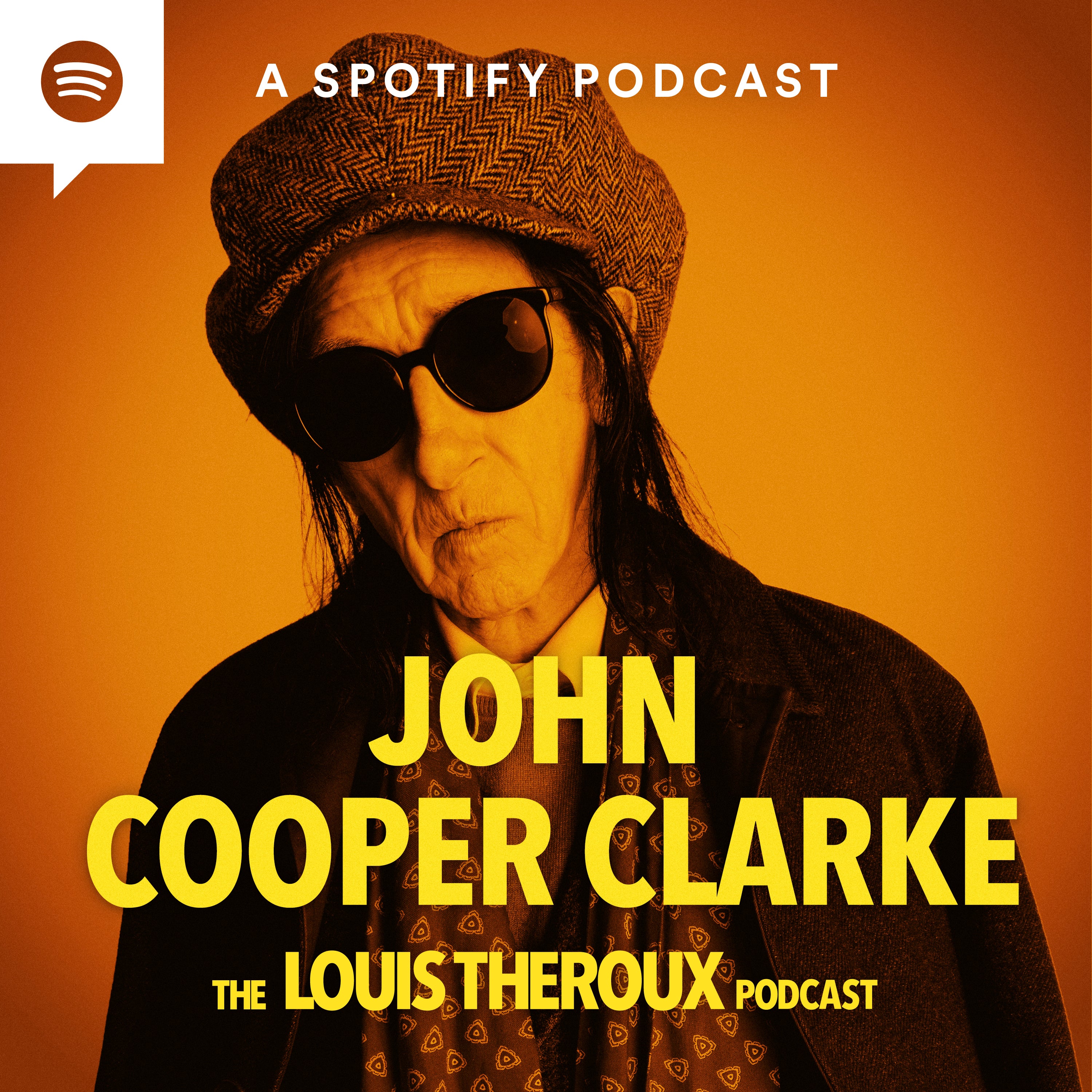
Dr. John Cooper Clarke discusses his punk-era rise as a performance poet touring with the Sex Pistols, The Clash, and the Buzzcocks; his addiction period; his fashion/style philosophy; writing rhyming poetry; and how his poems reached new audiences via TV and music. He also covers meeting Chuck Berry, doing advertising work (including the Sugar Puffs Honey Monster), and his newest collection Have It.
John Cooper Clarke is a 1970s performance poet known for humorous, surreal, socially satirical verse. He later wrote the memoir I Wanna Be Yours. He became closely associated with punk through touring and recitations, and he has worked in advertising and cabaret-style performance.
His poem “I Wanna Be Yours” was adapted by Arctic Monkeys (Alex Turner) into a song with billions of streams. “Chicken Town” appeared in The Sopranos. Punk’s “politics” were retrofitted rather than intrinsic. Art should be “useless,” unlike propaganda or promotional work.
Morton garden peas advert repetition; Sugar Puffs Honey Monster; MC build-up for Jerry Lee Lewis and Chuck Berry at Manchester Opera House; “Chicken Town” (including his “bloody/fucking” lyric origin); “I Wanna Be Yours” lines; his “Salome” couplet used to win a spot with Bernard Manning.
Written by AI. May contain mistakes.
John Cooper Clarke shares his humorous encounter with Louis Theroux's lookalike.
“We're here because we have reason to believe there are more victims.”
Discussion on Clarke's memoir I Wanna Be Yours and its contents.
“There's a funny story in your book about which more later in the episode, because I loved reading your memoir, I Want to Be Yours.”
Clarke discusses his fascination with advertisements and pop culture.
“You quote one, I wish I'd brought the book with me, but there's one, there's a quote from an advert, and this was the slogan, you'll remember, and it's just the same word repeated over and over again.”
Clarke recounts his experience working with the Honey Monster in an advert.
“In fact, Sugar Puffs had a rival, didn't they?”
Clarke shares a memorable experience meeting Chuck Berry and miscommunication.
“That's why the money was so handy, because I was an addict.”
Clarke expresses his admiration for Chuck Berry's lyrical genius.
“Manchester, I'm writing myself as the MC for this event.”
Discussion on Clarke's language style, including Yiddish influences.
“So I figured at the time I was wearing, I needed a haircut, so I was wearing a bandana around my head.”
John Cooper Clarke discusses his admiration for Chuck Berry and the impact of his lyrics.
“And they're all like Americans, you know how polite they are.”
Clarke explores the relationship between poetry and rock music, emphasizing their differences.
“A human cartoon, a gentleman punk, a man who has stayed the same for 30 years but never grown stale.”
A discussion on the punk aesthetic and Clarke's age in relation to the punk movement.
“And it was a pleasure to do so, may I say.”
Clarke shares insights about his personal style and influences from musicians like Rod Stewart.
“Yeah, I would also include Ronnie Wood in that.”
Clarke discusses his approach to poetry as storytelling and its accessibility.
“storytelling, unapologetically populist in the sense of it's not particularly enigmatic, is it?”
Clarke reveals the origins of his poem 'Chicken Town' and its transformation over time.
“Let's shout out a couple of your best-known verses.”
Clarke explains how his work was featured in The Sopranos and its impact on his career.
“And I didn't have any representation at the time.”
Clarke discusses how Arctic Monkeys adapted one of his poems into a song, highlighting its success.
“To be involved with such a seminal show as The Sopranos is...”
Learn about the connection between John Cooper Clarke's poetry and Arctic Monkeys.
“And I Want to Be Yours, and as a part of his GCSE studies, it came to the attention of a young Alex Turner.”
Explore John Cooper Clarke's childhood experiences and family dynamics.
“Galaxy features require a network connection and a Samsung account login.”
A poetic exploration of the significance of Elvis in music and culture.
“So the pressure's on the guy who doesn't love Elvis.”
Discussing the impact of comedian Bernard Manning on John Cooper Clarke's career.
“We should talk about coming to fame, that you put the journeyman years, you have odd jobs for a while, right?”
John Clarke shares his journey into the world of cabaret and performing poetry.
“So I thought if I get a gig at the embassy club, I went in the afternoon because I knew he'd be there then, you know what I mean, and there wouldn't be any other distractions.”
Transitioning from cabaret to punk rock and the influence of the Buzzcocks.
“which was like the worst case scenario for a poet, I was met with the poet's worst enemy, indifference.”
John discusses the tension between art and political messaging.
“It was some idiot at the NME or sounds that purported the idea that spitting at the act was a sign of respect, you know, because it fitted in with that ugly is pretty, you know.”
Explore John Cooper Clarke's experiences creating jingles and advertising copy.
“For a night of unrequited sin, drop your inhibitions in the inhibition bin.”
Discusses the relationship between creative writing, chaos, and drug use.
“But my daughter has, and she lives in our house, so I'm not entirely...”
John reflects on his life experiences and the role of humor in storytelling.
“I like a, I do like an ordered life, but you can't have that and be messing about with heroin.”
John Cooper Clarke discusses his views on life, mortality, and his experiences with tragedy.
“But I don't feel that tragedy would tell the proper story really.”
John performs a reading of his poem 'A Cheap Agnostic Funeral' and discusses its themes.
“And there's a preoccupation in a couple of the poems with mortality.”
Discussion on living life to the fullest, taking risks, and the concept of deferred gratification.
“Me and my cryogenic crew, Walt Disney, Michael Jackson and me too.”
John shares a humorous closing remark and reflects on the interview experience.

Get the gist, explore an idea or ask about something said.
 Claude
On The Louis Theroux Podcast, what are the key points of this episode?
Searching your listeningAutomatic transcript. May contain errors.
0:05Hi there. I'm trying that out. Hello there. A few different greetings. Hey, y 'all. Welcome back to the Louis Theroux podcast.
0:22In this episode, I'm joined by the Poet Laureate of Punk and evergreen fashion icon, Dr. John Cooper Clarke. John came to fame in the 70s as a performance poet touring alongside the Sex Pistols, The Clash and The Buzzcocks. His poetry intertwines humour, surrealism and razor sharp social satire. All of it chronicled, well his whole life is chronicled, in his brilliant memoir, I Wanna Be Yours, which I highly recommend. I read it cover to cover, from soup to nuts, from forward to afterward, as preparation and enjoyed every minute. his greatest hits poetry wise are evidently chicken town which was featured in the penultimate episode of the sopranos over a kind of montage setting up the final denouement of the series it's a bleak dark it's poetry but with a musical backing description of a a kind of dystopian urban cityscape.
1:24Beasley Street and his poem I Wanna Be Yours, which gave its name to his book, and decades later found a whole new audience when the Arctic Monkeys turned it into a song that's now passed four billion streams. I wanna be yours. No, Millie's shaking her head. Through the 80s and 90s, John was a lower profile figure, sidelined by an addiction to heroin, a period we speak about in the conversation. We recorded this interview in September this year at Spotify HQ. In fact, this was the new studio's maiden voyage. I'm looking around at the new studio, liking what I see. It's so simple, it's classic.
2:06It's sort of Bauhaus in its aesthetic. Walter Gropius, you know what I'm talking about. Keep it simple, form and function. I'm just throwing out random words, phrases. John joined me to promote his newest poetry collection, Have It. It's actually just written Have It, but I think that's how you might say it. Which came out in October. Do check it out, it's brilliant. A quick warning, this conversation contains strong language, adult themes and discussion of addiction. All that and much, much more coming up.
2:45This episode is brought to you by Apple TV. We all love a suspenseful TV show about true crime or serial killers, don't we? Well, Nocturne, the newest crime drama series on Apple TV, is a really, really good one. When a victim of notorious serial killer Eurek Walter unexpectedly turns up alive, Detective Jonah Lynn has to race against time to find the one person still missing while his protege Saga Bauer goes undercover to get answers from the killer himself. Yurik Walter has been locked in the basement of a Riverside Psychiatric Hospital under six feet of concrete. But people are disappearing again.
3:26Just like before. Nocturne stars Stephen Graham, Liev Schreiber and Zazie Beetz, and it's based on the international best-selling book series by Lars Kepler. Don't miss Nocturne, a new crime drama series streaming 30th of October on Apple TV. Subscription required. We're here because we have reason to believe there are more victims. No. They're here because I brought you here.
4:10It's a pleasure to meet you. We've not met before, I don't think. No, I don't think so, although I did meet your double once on a flight to New York. Yeah, I embarrassed myself, you know. Did you? What did you do? I'll give you the thumbs up. I was walking back from the lavatory down the middle of the plane and there you weren't. There I wasn't. But little did I know that. So I tapped him on the shoulder and went, Louie. Nice. Simply that, you know. I didn't want to get too familiar. You know how it is on a long flight. Yeah. You don't really want to make any new pals, do you, on a plane? Do you fly business or first these days?
4:53I go business if it's, say, to the States, eight hours and over. I would go business. There's a funny story in your book about which more later in the episode, because I loved reading your memoir, I Want to Be Yours. Oh, Vantra, really? You've read that? Genuinely. And there's so many funny things in it. I'm going to try not to geek out on it too much because I want to reflect more than just that one particular cultural product. Yeah, fair enough. I can't believe how much I left out. For real. It's quite long. And that's quite a chunky book, isn't it? It's an easy read, but it's three. I counted the pages.
5:34Well, they were numbered, I'll be honest. It was 250 pages before you got on stage to recite any poetry, and it was on page 300 that you enjoyed some success. But everything before then is just growing up in Salford and adverts, movies that you liked, style, fashion, haircuts. It's a deep dive into cultural esoterica. Well, that's my world, I think. I'm a scratcher of the surface rather than a digger in the depths, if you say. Style of the content guy. Put it that way, I think. I look for the kind of the universal in individual personal style and things like that, I suppose. I thought you were going to say you were a magpie of the detritus.
6:25Yeah, that's a better way of putting it. See, you put it better than I did. Of the commercial age. Yeah, that's fair enough, yeah. Because you seem to take huge amounts of pleasure in the verbatim wording of adverts from 50 years ago. Yeah, that's right. Right? Yeah. You quote one, I wish I'd brought the book with me, but there's one, there's a quote from an advert, and this was the slogan, you'll remember, and it's just the same word repeated over and over again. Oh, it was a firm called Morton's. Is it peas? Who specialised in canned garden peas. Yeah, Morton, Morton, Morton, Morton, Morton, Morton garden peas, Morton, Morton, Morton, Morton, Morton garden peas.
7:08Why does everyone love Morton garden peas? because Morton tastes better. Morton tastes better. And it fades out with Morton tastes better. So what was that name again? Morton. Why do you think... The success of advertising. See, that was a great... That was good right there. Repetition. You did... While we're on the subject, shall we do this now? You did an advert to some success with the Honey Monster. Yeah, that's right. That was my first taste of the advertising world. Not many people can say they worked both with Nico from The Velvet Underground and The Honey Monster from Sugar Puffs. None, I don't think, apart from me.
7:49Plenty of people have worked with The Honey Monster, don't get me wrong, Kevin Keegan. Really? I'm sure there were others. He had quite a few partners, actually. He didn't work on his own, maybe. He needed a plus one. He needed a sidekick. Because I went back and watched it. It can be found, you won't be surprised to hear, on YouTube. Holds up quite well. It's surreal. It's sort of garish, lurid, as most children's adverts are, I suppose. A lot of wobbly camera. It's directed by someone called Willie... Willie Smacks. Smacks. Yeah, he was... It sounds like a serial. Yes, it does. Or sexual abuse.
8:27Or sexual abuse. In fact, Sugar Puffs had a rival, didn't they? Kellogg's brought out a rival to Sugar Puffs. They were exactly the same, but they were called Sugar Smacks. That's right. Yeah, as a rival to Quakers did sugar puffs and Kellogg's came up with sugar smacks, exactly the same thing. Have you heard of puffer puffer rice? Yeah. What was that? Was it like, it had a kind of Hawaiian sort of jingle that went with it on the TV, I remember, yeah, sort of oceans of energy. Here, here, puffer puffer rice. Yeah, and that kind of... Why do you remember that? Well, because adverts are made by experts, trained in the art of fixing something in your mind that won't go away.
9:19So, you know, these people are good at their job. I was on my way somewhere. I've still got it in my mind. But what I wanted to reflect is that on the morning of the taping of your Sugar Puffs advert with the Honey Monster. With the Honey Monster, yeah. Do you have to sign an NDA swearing not to reveal who's under the, I'm assuming there's a man under the costume. Yeah, yeah, there is. There is. I think I had to, you know, go with the, sign the official secret sacks on that one. That's big. But you, that night, you had quite a rough night. Oh, what went, narcotic-wise? Yeah, you were in the throes of, well, you should say.
9:58Well, yes, I was in the throes of drug addiction when I made those adverts. That's why the money was so handy, because I was an addict. Overdid it, had an injury. Yeah, that's it, yeah. Worried about it. You don't want to meet the honey monster with a claret all over your face. Exactly, claret all over my boat race. I know what you mean, yeah, but they had the best makeup department in the world. They made me look like Johnny Depp's better-looking kid brother. even though I was, you know, only 20 minutes before. Yeah. Covered in claret. They patched you up. Yeah, that's showbiz though, eh? Showbiz with the lid off.
10:48That's your game, isn't it? I like that. I hadn't thought about it like that. Yeah, lid on and off. You want to admire the packaging and then you want to see the factory. Bit of both. Well, I put it like this. Everybody likes sausages. Nobody wants to visit the factory. No. I wouldn't mind visiting. I'd be curious. What, a sausage factory? Yeah. Do you eat sausages? Yeah. You don't want to go to the factory. Where I was going was, you said you were on a plane and you saw someone who looked like me. You've told the story about meeting Chuck Berry. Oh, yeah, I haven't seen for Chuck. He seemed to radiate a sense of recognition at you.
11:30That's right, yeah, yeah, yeah. Yeah, my ex-manager was, I was in Manchester just for one night. It was a long time ago now. I mean, Chuck's been dead quite a while. And Tony Wilson, the late Tony Wilson and my late ex-manager, pulled up at the curb and said, hey, Johnny, get in, we're going to see Jerry Lee Lewis and Chuck Berry on a doubleheader on Opera House, in Manchester Opera House. So I said, what tonight? He said, yeah. I said, as Mr. Manchester, I'm writing myself as the MC for this event. So, yeah, okay then. So I did a really good job on it. I mean, I love those guys. I love their work anyway.
12:18So I remember how I brought on Jerry Lee. It was, ladies and gentlemen, all the way from Faraday, Louisiana, 99 pounds of industrial strength rock and roll radioactive dynamite the greatest piano player that ever lived they call him the killer his name is jerry lee lewis what kind of year are we talking mid-80s yeah yeah late 80s really yeah 88 maybe so uh you know that did the business there and then it was it was chuck's turn to go on i was in a crowded green room full of uh americans you people that were on Chuck's payroll. And Chuck Berry walked across the open door and he was ready to go on.
13:02I could see that. He had his Gibson 335 slung around his neck and he was almost doing that duck walk thing that Chuck was known for. So I thought he's stage ready. And then he came back and did a kind of cartoon, Looney Tunes, exaggerated double taking, in my direction, you know. So he said, hey, how you doing? So I figured at the time I was wearing, I needed a haircut, so I was wearing a bandana around my head. So I figured he thinks I'm one of the Rolling Stones or something, you know, he's mistaking me for somebody else. How would I be on the radar of Chuck Berry? So I did the business. I said, no, I'm your MC for this evening, Mr.
13:47Berry, you know, the great admirer of your work. I brought him on and gave him the big build-up. And while he was on, I went around all his pals, you know, and I was like, listen, who does Chuck think I am? And they're all like Americans, you know how polite they are. Oh, he knows who you are. He loves your stuff. You know, and I'm like, well, you know, why would he? You know, you don't know who I am. Why would Chuck? So I said, listen, I need to know who he thinks I am because I'll be that guy.
14:20anything for the likes of Chuck Berry. So a lyricist that I've long, long, long admired, by the way. Let's factor in my oeuvre here. You know, I've always admired his lyrics as being, I've always thought, there's a rock and roller with a library curb. Yeah. We should talk about your oeuvre. Did you use that word? Oeuvre, I did, yes. I love your use of language. You throw in quite a few Yiddishisms as well, I've noticed. Oh, yeah, it's from the neighbourhood, from the old neighbourhood. I found this quote on the internet, I'll try and credit in the outro because I'm not sure who came up with it.
15:00They described you as a poet who writes about darkness and decay but makes people laugh. A human cartoon, a gentleman punk, a man who has stayed the same for 30 years but never grown stale. I love the human cartoon. Yeah. You're happy with the term poet? Absolutely, it's what I do. But you have a rock star aesthetic. Well, only in the wardrobe department, I think. You know, poetry is not often found in the world of rock and roll. It's a contemplative kind of pursuit requiring reflection and achieving some kind of sedentary reverie. whereas rock and roll is a world of instant gratification or the desire for such.
15:51They're not natural bedfellows, poetry and rock and roll. But, you know, you can find the poetic in rock and roll. If you refer to something as poetic, it doesn't actually have to be poetry, does it, if you're talking about any kind of art form. No. You know, if something stays with you and you remember it for the rest of your life after the first exposure to it, it's said to have a poetic quality. But, you know, you get that in the world of fashion, movies, rock and roll, you know, the poetic quality. But your actual poetry, there's not much of that in the rock and roll world, really. Although punk rock was an aberrant period in that regard.
16:36I think for the first time in pop music, lyrics were of equal importance to the tune. Well, you'd have to ignore Bob Dylan, wouldn't you? Well, yeah, absolutely. The Beatles' later output. Oh, yeah, yeah. I mean, I wouldn't deny that. I mean, if you read those lyrics, it would come across like poetry, wouldn't it? You know, obviously I've done my prep. God forbid I shouldn't. Blimey, you've really crammed it in there. I hope I have. And it was a pleasure to do so, may I say. Oh, thank you. But I'd always thought of you as kind of a creature who'd come to fame, which you did, in fact, as part of New Wave and punk in the late 70s.
17:21But as you say yourself, you were slightly older than a lot of those guys. You were born in 49. Yeah, I was. And every time one of them, you know, an old punk rocker kicks the bucket, you know you get their real age I'm the only one that didn't lie about my age it turns out yeah no but it was a young man's thing you know you can't be a punk and over 21 is that what they said those were the rules punk is a worthless petty crook isn't it or a there's lots of definitions of the word punk a jailhouse catamite it's I think technically the original definition It's a definition, yeah. It's someone who's been so humiliated and degraded, quote unquote, that they've been subjected to sexual pleasure of the dominant males in the cell.
18:14So it's not exactly a compliment. So the punk thing was its own aesthetic that you happened to chime in with, or at least you kind of fell into step with having come up as part of the 60s generation. you talk about style in the 60s um and again like as we said earlier you're known for your style you sort of hit on a style in 65 or thereabouts yeah that's right um when you would have been 15 16 years 65 i've been 16 yeah and more or less stuck with it you said in fact you say here's a quote the way i dress has always been the same since 65 my only nod to the whims of fashion has been in the hair department.
18:56The gold standard is Rod Stewart circa 66 when he got a bit more messy, choppy, coupe sauvage. That's it. Yeah, I would also include Ronnie Wood in that. Ronnie Wood. Yeah. In fact, Ron was a big influence. In 1965, I went to see a group called The Birds, not the same ones that did Mr. Tambourine Man, the English Birds, pre that. B-I-R-D-S. In fact, that's why they spelt it with a Y, you know, because of The Birds, which was Ron Wood's band, a kind of R &B moddy group. And they were on at a local club called The Oasis in Manchester, so I was a member of that club. Out comes Ronnie Wood, and you could immediately see why they were called The Birds, because of that sort of crested hair.
19:46Cockatoos are coming to mind. That's right, and he was a bit beaky like me, you know, skinny guy with a big nose and messy hair. so I thought well he looks alright on it you know if I make him my kind of template I can settle on it actually it's not that easy to maintain that kind of hairdo no you've got to put the work in it takes a lot of work to look that bad how do you describe the kind of poetry that you write you know I'm pretty old school most of the stuff I write rhymes, not all of it, but most of it. So I'm pretty old. I see myself as part of a tradition, which is no bad thing, really.
20:31Who else is in the tradition? Anybody who writes rhyming first. Sir Henry Newbolt, Rudyard Kipling, Chuck Berry. Chuck Berry. Do we go all the way? John Betjeman. He's my governor. I was thinking of Betjeman. You don't name him in your book, but... Do I not? No, but it is very much... storytelling, unapologetically populist in the sense of it's not particularly enigmatic, is it? Well, no, it's populist. I mean, put it this way, these are the twin poles of his fan base. My mum, a cleaner, and the King of England. Yeah. It must have been doing something right. Miss Joan Hunter Dunn. That's the one, everybody loves that one.
21:17Miss Joan Hunter Dunn, furnished and burnished by Aldershot, son. Beautiful, beautiful. The thing about that one is when they mention, because he's obviously a man from another time, even when I saw him in the early 60s on those TV shows, those travelogues he did for Shell Oil. Did he do that? Yeah, yeah. Well, they were the kind of sponsors of these programs that he did on ITV in the early days of ITV. And wow, he made that medium his own, even though he was a shambolic sort of old school, antique kind of guy. He wasn't phased at all by this new thing of commercial television. And he was terrific.
21:57But when he did that Joan Hunter Dunn poem, the bit that puts it in the modern world, just that mention of the car park, just give it that suburban resonance that was like, I'd never heard that in an English poetry before. Maybe most famous now for the poem about Slough, come friendly bombs and re-enact Slough. Oh, yeah, that's great. see there's you know Morrissey could have written that line yeah I bet he's a big fan I can't prove it but I bet yeah I bet he's a mega fan I read his memoir we're getting way off this is supposed to be about you yeah Moses did you no I've not read it yet it's a good read he shouts out a lot of poets I can't I don't think Betjeman's mentioned we'll come back to that on perhaps when we get Morrissey on as a guest well I love his I love his lyrics do you know Mozza fellow Mancunian I've met all the other Smiths, but not Mozart.
22:51But I love his work. It's fantastic. I love his songs. I love that line, I've seen this happen in other people's lives, and now it's happening in mine. What a line. Who hasn't thought of that? Who hasn't had that thought? You know what I mean? That's populism. Let's shout out a couple of your best-known verses. Chicken Town is a big one. I love that. It's internationally famous. It is. Thanks in part to The Sopranos. Big style, yeah, absolutely. Used over the outro, the end sequence of apparently... The penultimate episode, actually. In fact, it's the last time they used music over the back credits on that show, so quite memorable.
23:36Would you be comfortable doing maybe one or two stances? Probably the whole wouldn't be too much. What, the fucking cops are fucking keen to fucking keep it fucking clean, the fucking chiefs are fucking swine, who fucking draws the fucking line up, fucking fun and fucking games. The fucking scum he fucking blames is nowhere to be fucking found. Anywhere in Chickensound and then the bridge. The fucking train is fucking late, you fucking wait and fucking wait, fucking lost, fucking found, stuck in fucking Chickensound. But when I first recorded that, I did it bloody. I did it bloody. And the reason is that I stole that.
24:09Instead of fucking, you mean? Yeah, I stole the whole thing really from a song written by a squaddie who was stationed in the Orkney Islands during the war. And of course there was nothing to do up there. He was a guy from, I don't know, Newcastle or one of the main cities. And there he was in the Orkney Islands, nothing to do. And it was like the bloody flicks are bloody old. The bloody seats are bloody cold. You can't get in for bloody gold in bloody Orkney. and it goes on like that, you know, bemoaning the lack of facilities and entertainment in Orkney. I just turned it into Manchester, where I was living at the time, Manchester, but it doesn't have a specific...
24:55It's not identified. It's not identified. You might have just revealed something that you've kept quiet for 30 years. Well, you don't want to mention that it's Manchester. It would take away its international reach. Anywhere's Chicken Town on a bad day, isn't it? Yeah, that's right. Of course it is. Yeah, it has an international reach. What's the chicken town, do you think? Well, actually, I pinched that off one of Bob Dylan's. Is it stuck inside a mobile? You're revealing all your secrets. Yeah, stuck inside a mobile. With the Memphis blues again. What's it to you, Moby Dick? This is chicken town.
25:29That's the line. Really? Yeah, yeah. So it seemed like a reasonable name for a town that has nothing going for it. Yeah. And there you have it. So anyway, I wrote it bloody. and then I went to the States about a year after I'd written it you know I was just about to deliver this number and I figured you know bloody ain't a swear word in America you know it's merely a description of a scene of carnage sanguinary quality wars and what have you bloody bloody war so I thought I better change it to fucking while I'm in the States and then as soon as I did it I thought why didn't I do this in the first place you know fucking is miles better than bloody gets lots of bloody you know but fucking that's a percussive kind of hard consonant hard driving word you know anybody can make a mistake that's why they put rubbers on the end of pencils but I was right I wish I'd recorded it as fucking that's all I'm saying so that's one of my big regrets how did it come to be on the Sopranos did they call you?
26:35is it David Chase the big Sopranos guy? It is, isn't it? HBO, David Chase, yeah. Great series. I was already a fan. And I didn't have any representation at the time. I didn't have any management at all. I just used to do shows that came across over the phone, over my house phone, which thankfully always came at an opportune moment. But most of the time I was broke. So when I heard that they'd used it, I'm glad they took that executive decision and went ahead and used it. You know, it's only been good. They must have paid you a little bit for it. No, I don't think so. What? I didn't have any representation of any kind.
27:17But surely, I'm not trying to be mercenary about it, but I would have thought there's a small pecuniary advantage to be derived. Well, as things panned out, you know, I would have paid them. Don't tell them, you know, it's okay to tell them now, but I don't think there's any money coming from that. But, you know, with regards to the profile, fantastic. To be involved with such a seminal show as The Sopranos is... You're on GCSE Syllabuses. Twat is another one. That's not on the GC. I don't know. It's not on the GC. I've written it down. Maybe it isn't. It's a great favourite, yeah. And I Want to Be Yours, and as a part of his GCSE studies, it came to the attention of a young Alex Turner.
28:08Exactly, yeah. Future lead singer and artistic prima mobile, that's not the right word, but main mover of Arctic Monkeys. Arctic Monkeys, yeah. And he set it to music. So that was another pinnacle, wasn't it? Oh, absolutely, yeah. That's sensational that he did that. I can't thank them enough for doing that cover. And it's not exactly, I mean, he's brought something to the table as well. He has actually. There's a big difference, as we were saying earlier, between a poem and a song. But he's taken a poem and completely converted it into a song. It might be Arctic Monkeys' top song, according to Spotify.
28:51Four and a half billion streams. Stop it. Yeah. Where have you got that from? I've got people who ring me up and keep me updated on that sort of thing, you know. yeah four and a half billion I want to be your vacuum cleaner breathing in your dust I want to be your Ford Cortina I will never rust I'll do one more stanza this is me doing if you like your coffee hut let me be your coffee pot you call the shots which is a double entendre yeah right yeah because a shot is also a portion of coffee that's true yeah yeah yeah I just want to be yours I want to be yours You know what? I never spotted that.
29:34Yeah, shot of coffee. No, come on. You're winding me up. No, I'm not winding you up. But I'm going to pretend I did now. Cut that bit out. It's in my act now, that.
30:03This episode is brought to you by Samsung. Nothing feels worse than coming up with a great idea when you're miles away from your laptop, an office, or even a pen and paper. Thankfully, the Galaxy Tab S12 Ultra with smart tools and a long-lasting battery gives you the freedom to create anywhere. With a stunning dynamic AMOLED 2X display, complete with Dolby Atmos surround sound, you can be truly immersed in the creations you love while smart built-in creative tools help you bring your ideas to life faster. Now the creatives listening will love this. For the first time on an Android tablet, Adobe Photoshop comes preloaded and ready to go, combined with the included S Pen.
30:45Your ultimate workday, your ultimate escape, all in one tablet. Head to samsung.com. Adobe Photoshop subscriptions are required and sold separately. Galaxy features require a network connection and a Samsung account login.
31:08let's talk about you've had a complicated life like i mean i know you've described it as you know a bower of pleasures in many respects you feel very appreciated i'm sure there's been ups and downs but going back what one of the striking things is and i'm going back to your book again now is you've got nothing but nice things to say about your parentage and family although they're not vivid in the book they're not vivid no they don't come completely to life that you say a lot more about hairstyles and different kinds of fashion than you do about mum and dad and in fact one of the lines one of the things you say is bear with me i was a mystery to my parents and they were a mystery to me that's on page two is it but when i was sick as i got I spent a lot of time in hospital, you know.
31:57Tuberculosis. Yeah, yeah. I think, you know, it's only a theory, this. You know, don't act on it or anything. But I think, you know, if you're seriously ill as a kid, I think, you know, you develop an inner life. Right. A personality that thrives in silence and loneliness. Yeah. you know so I think that might might have a lot to do with it I don't know but I read a lot you know I was I wasn't I had a most of my life has been quite sedentary so which calls for a lot of watching of the tv and the reading of books and comics tell me about where you were growing up and what it was like and and and you know your dad was an engineer right mum was basically at home was she or yeah most of the time she was a part-time cleaner you know some of the time and then she worked at a high-class uh confectioners and tobacconist for a while you know i think she liked to get out of the house yeah but you weren't hard up it was like you were well provided for but not living high off the hog oh not not at all no no no what you would have called you know without any qualification, working class.
33:12You know, we went on holiday for a week in the summer and stuff like that. If they were ever broke, it wasn't made apparent to me. Apart from one time. Apart from one time when my dad, my dad liked to bet. It was okay when he kept it to horses. Yeah. But they opened a casino on the corner of Salford Dog Track and he started hanging out there for a little while but I think he got in over his head to the point where our electricity was cut off and the bitter irony of my dad wiring up entire cities and us having no electricity I think it got to him and he stuck to the horses after that and we never knew a moment's penury.
34:06Were they readers? I liked it when we got the electricity cut off. It was before we got a telly or I would have moaned about it. But, you know, it was before we actually had a TV. So it was quite fun, you know, with the paraffin lamps all over the place, cooking beans on an open fire. You know, what with my love of the Wild West. It was quite enjoyable, really. American culture spoke to you a lot. Oh, absolutely. That was all there was. you know even in my teenage years everything I liked seemed to be from America. What was it do you think that it resonated with you? Did it feel escapist or glamorous?
34:49Yeah glamorous I suppose yeah that's the best way to describe it. Before we got a TV I you know I would go to the movies four times a week and sometimes even more and I was kind of my mum's movie date because my dad was you know he would be in Inverness you know wiring the joint up and my mum wanted to go to the movies I guess she thought you know if she takes a kid with her she's not going to get mithered by any geezers mithered approached by a bloke you know because she was you know for a while she was quite cute my mum I know you can't sort of see your mum in those terms but you know I can see it now now that I'm older than she was then yeah so you came up I can see that she was quite cute you were whatever the male equivalent of a cock blocker is maybe that is a cock blocker a cots blocker cock blocker what's that oh is that what it is to keep guys away from a a just a guy whose job it is to keep guys away from the shit I think it's usually the other way like why did you cock block me I think it's used in that context like one man to another it's quite ugly it is ugly because it's got that kind of penile dimension doesn't it it's the opposite of a wingman I suppose yeah so that was her movie date which meant that I had to have an arrangement with her but if she came with me to see a cowboy picture I had to go and see three what they actually unashamedly referred to as women pictures that would be kind of frothy romance yeah kind of thing but I even like them because you know those American film stars you know they they had access to clothes that weren't even in the shop windows in England you know so it was always there was always some kind of eyeball candy going on on those those outings.
36:56So, yeah, I enjoyed just going to the movies. Why do you think school and you didn't get along better? I don't know. I'm not a team player. It was on all my reports. No team spirit. So I don't know. It was too loud. It stank. People were pushing you around the whole time. You know, it just wasn't the world that I was used to, really. it's sort of mystifying in a way but maybe it shouldn't be that your talent went well did it go unnoticed or was it noticed and while I was at school in the last year it had become noticed because we had a very inspiring teacher called John Malone who he was a real athletic outdoor type on the one hand you know but he also had this that side of him that was fond of the romantic poetry of the 19th century.
37:57And he infused the whole class with an enthusiasm for poetry and increasing one's vocabulary. It pays to increase your word power, as the Reader's Digest used to say. And he really kind of made that happen so that, and it wasn't even a posh school, believe me, it was, put it this way, we had our own Koran.
38:23forget about it but no he infused the whole class with there was a kind of competitive atmosphere and that's when I realised an epiphanous realisation that poetry was you know primarily a phonetic medium you know reading it to yourself really isn't the full experience you know so even if I'm reading the poetry of another poet I would read it aloud even if I was in a alone in a house you know because to me since that realization poetry for me is a phonetic medium and that's why public recitations of my work is my favorite part of the job really you give Edgar Allan Poe quite a big Yeah, yeah, I love him.
39:12Yeah, yeah, yeah. I got into him because of that movie, The Fall of the House of Usher starring, Roger Corman. Yes, directed by Roger Corman. That's right. Is he in it as well? No, he's not in it. Vincent Price is the main guy. You know, he was in them all, actually. So I went to see The Fall of the House of Usher. Scared the life out of me. I was technically too young, but how old would I have been? 11. So I sneaked in for that one. and frightened the life out of me, obviously. You know, it's a very lurid and horrific film. And then I got interested in Edgar Allan Poe and who would write this sort of stuff.
39:53So I went to the library, got Tales of Mystery and Imagination, the works of Edgar Allan Poe, and then I discovered that he also wrote poetry. So I read his poetry. I was struck by the strict metre of it all, not a syllable out of place. And it kind of had an instant effect on me. And then I discovered that Charles Baudelaire had put his own poetry to one side in order to translate the entire catalogue of Edgar Allan Poe into French. So then I figured I'd better look into this, you know, Charles Baudelaire. You know, he was my kind of guy. It turns out he was a bit of a, you know, flaneur. Yeah, boulevardier.
40:43Yeah, yeah, you know. So what, 19th century French bohemian dandy. That's it, careful dresser. Yeah. Yeah, yeah. And his kind of views on poetry was, you know, he seemed like a modern guy. Yeah. You know, he just wanted to kind of reflect the entire citizenry of Paris somehow. now. Les Fleurs Dumas. That's it. Is his big one, his collection. I don't think I, I haven't read it. I haven't read it. Oh, it's terrific stuff, yeah. I only know it in translation, of course. So, yeah, big, very important, two guys, very important there. Edgar Allan Poe, Charles Baudelaire. Chuck Berry. Elvis. You, Elvis, you've got a poem about Elvis.
41:24America. Do you want to do your Elvis poem? How does it go? Yeah, uh, uh, oh, Oh, how does it go? The man who didn't love Elvis. Opinions. It's like something about opinions. Yeah, what is it? I should have brought it. Shall I have a quick look? It might be, is it in one of these ones? I can't remember which one. Yeah, I think it might be. I think it's in that one. Let's have a look. Because I have this tradition where I write an Elvis poem every August. Do you? You know, on the anniversary of his day. Why does Elvis mean such a lot to you? Well, let's ask anybody in the world and see what they say.
41:59And that goes for me double. no no the greatest I mean crikey the best thing that can happen to a song is to have Elvis sing it the man who didn't love there it is yeah I got it for you a sad sack sitting in a sickly groove the band kicked off he couldn't move what was he trying to prove the man who didn't love Elvis the man who didn't love Elvis is not as other men condemned to miss the point time and time plus time again from which benighted neighbourhood whose golden vision is a colour of mud and what does he have instead of blood the man who didn't love Elvis when all his opinions fade to grey six feet under the frozen clay we will forget what he had to say the man who didn't love Elvis.
43:01So the pressure's on the guy who doesn't love Elvis. Well, I get it. Nice. Thank you for that. We should talk about coming to fame, that you put the journeyman years, you have odd jobs for a while, right? You do various things. I have toiled at many tasks. One of your early opportunities was brought to you by club comedian, no longer with us, Bernard Manning. Oh, yeah, right. The first guy to pay me for what I do. Yeah. So that's an important guy in one's development in this flaky world. Yeah. And I should probably contextualise it again. He kind of fell out of favour, didn't he? Because he did unapologetically, racially charged, to put it somewhat euphemistically, material.
43:45Yes, absolutely. He blotted his copy book many times by modern standards. But he was a river to his people. Right. He was a river to his... There are many tales of his extravagant generosity. Right, and I think no one... His largesse grew evermore. His munificence, but also a bit like Mussolini and his trains. Yeah, I see what you're saying. He kept the jokes running on time. That's a very modern and apposite summation of Bernard's position in the world right now. But he was a very popular performer. And again, going back to Elvis, you know, he was very finger on the pulse in many ways, out of time in every way now.
44:34How did he talent spot you? Well, I approached him, actually, you know, and it went like this. I was looking for, I was looking to somewhere I could declaim my work, you know, and that place really didn't exist. And obviously everybody was trying to put me off, but the idea of becoming a professional poet, you know, it's the only gift I have. The only thing I was any good at ever, even at school, you know, it was that or nothing. So I was determined to sort of make a living out somehow, become a professional poet. But obviously everybody tried to put me off doing this because poetry has never been a recognised engine of wealth.
45:11So all my family went, I'll keep it as a hobby, you know, and all this, you know, get a job. Took your shirt and get a job. But I thought, you know, no, this is the only job I could really do with any skill. So I thought, who would my dad recognise as a northern bloke with a degree of show business success? One guy and one guy only in this town, Bernard Manning. His club was the sort of go-to place for people like my dad. Not that he was any kind of racist or anything like that, but he had other arrows in his quiver. it was a club that Bernard didn't just perform at he owned it didn't he owned it that's what he spent his money on when he left the Oscar Rabin Orchestra he opened his club in Harper Hay he had some business now so like he basically owned the factory as it were didn't he that's right he did and he developed his comedic skills as an MC really yeah and you know it became like the main event of his own club in a way.
46:17So I thought if I get a gig at the embassy club, I went in the afternoon because I knew he'd be there then, you know what I mean, and there wouldn't be any other distractions. So I said, you know, hello, Mr. Manning, you know, my dad's a big fan of yours, and have you got a spare 15 minutes any night this week? He said, why, what is it you do, kid? So I says, poetry. He says, oh, they don't like poetry, eh, kid? Half of them can't fucking read. So I said, well, it's not that highfalutin. So I gave him two lines from a poem that I knew called Salome, and it's about a punch-up in a dance hall, predating Sophie Ellis Beckstorne by several decades.
47:05Right, author of, or certainly practitioner of the song Murder on the Dance Floor. Yeah, but this one, it's about a punch-up on the dance floor, and it contains this couplet. When the ambulances came, she was lying on the deck. She fell off her stiletto heels and broke her fucking neck. He says, yeah, that'll do. I'll give you a quarter of an hour. I'm not going to say I was a screaming success on this. It wasn't really my demographic, the customers at the Embo. They were much older than I was for a start. Plus you would have been rocking a kind of modernist aesthetic. Yeah, like I say, I've dressed like this since 1965, but I went there in a suit.
47:49I didn't have long hair. I was dressed like I imagined a cabaret performer ought to look. So you were able to find an audience. In that world. In that world. Because you're out of step with the hippies and you've got a few things. I liked some of your phrasing about hippies. Your first wife, she was part of the hippie scene. Could we say that? Yeah. Was she Christine in the book? Christine, yeah, yeah. Anyway, here's the relevant quote. This is you speaking. I didn't like the clothes, the music, the attitude, the lifestyle advice, and especially the food. Think Weetabix. Oh, Weetabix. I like Weetabix, but never mind.
48:33the disgruntled offspring of the bourgeoisie irreparably traumatized by their luxurious childhoods back then I was quite the little working class warrior I was simply too chippy to be a hippie yeah yeah I'll go along with that so then punk comes along tell me how did that all happen in your world well that works in my favor because I was trying to make it in the world of cabaret and there was a which was a flourishing area back in the mid-70s, especially in Manchester, you know, unbelievable amount of cabaret joints. You know, Bernard's Place, the embassy, is a bit out of town. You know, it's in a place called Collyhurst or Harper Ray, you know, very deprived neighbourhoods.
49:23But I was trying to make it in there. Having appeared at Bernard's Place, which was like the worst case scenario for a poet, I was met with the poet's worst enemy, indifference. You know, they just spoke to each other. At the Embassy Club? Yeah. Not hostility? Not hostility, even worse, indifference. So I was trying to make it in central Manchester clubs like Fagins and Sinatra's, and there was a whole bunch of clubs then, the Golden Guards. You know, I dragged my sorry ass around the cabaret joints of central Manchester to a greater or lesser degree of success. Like I say, I was clad in my sonic suit.
50:14Yeah. I was doing all kinds of, plus I had very short hair as well then, so I looked like anything other than a hippie. But if you have any memory of 1975, 76, even the middle-aged guys were wearing floral shirts and sprouting louse ladders and various facial furniture. Yes, of Anchorman, Ron Burgundy aesthetic. That's it. You've got it. I looked like I was unfashionable to that world. but it was just what the poet world required. If you listen to that song about the Sex Pistols, I'm a lazy sod, there's that line, we don't care about long hair, we don't wear flares. So I thought, well, if they're the only two rules, I've ticked both boxes.
51:07I had short hair and I wore a suit. And then I went to see them at the Lesser Free Trade Hall that had been organised by the then singer with the Buzzcocks, a guy called Howard Devoto, who is still with us now. But it was him that got me involved in punk rock, and he was sort of saying, you know, you shouldn't waste your time around these cheesy cabaret joints, Johnny. You know, why don't you get into punk rock? You know, you'd fit right in. So I said, all right, I'll give that a go. So I started going around with the Buzzcocks, you know, varying around the provinces. and it just went from strength to strength.
51:45At first it was a bit leery, but it just, once they knew who I was, you know, and I was a regular fixture in the punk rock world, you know, it quickly got more amenable. So that was great advice and I can't thank Howard enough for talking me into that. You said the celebration of all that was negative. You said everything ugly was beautiful. yeah it's a good way of putting it yeah deliberately deliberate ugliness yeah yeah yeah well it's like brutalism you know you can see what when you look at it through that prism now with the time lapse you can see that there was a lot of style in that world at the beginning yeah but then you say that also led to spitting at performers as a mark of respect so what would you do like people would be flobbing at you.
52:43Disgusting. It was some idiot at the NME or sounds that purported the idea that spitting at the act was a sign of respect, you know, because it fitted in with that ugly is pretty, you know. You don't applaud them. Spit on them. So what would you do if it happened to you? It was terrible. It did happen to me, obviously, you know, but I had to change my wardrobe for a start. Did you not tell them to stop doing it? Well, I said, no. What would be the point? They'd have done it more. And it led to my adoption of the leather jacket. I stopped wearing suits at that point, you know, I just thought, you know, the dry cleaning bills were prohibitive.
53:29So I got a leather jacket simply wiped with a damp cloth. it brings us to this question of like politics in music and you suggest that punk sort of got retrofitted with a political message that wasn't really native to it or intrinsic to it i stand by that yeah absolutely what's the problem with politics with the politics the politicization of something like punk rock or yeah or art in general i suppose Well, because art is meant to be useless. That's an Oscar Wilde quote. I totally agree with the uselessness being the defining feature of all art. As soon as something becomes useful, it's not art anymore, is it?
54:16Generally speaking. I mean, if I was to apply my poetical skills to the endorsement of a political party, then it would be propaganda. or if I was to use my poetical skills in the service of a particular consumer product, then it would be another kind of propaganda. It would be promotional. Yeah. So it would have a use. I mean, I'll tell you, doing adverts, I'm better at that than politics because I've written poems for products, you know, jingles, that have been rejected and they're just too good to throw away. So provided I don't use the product's name, you know, they've become standalone pieces.
55:07Well, go and tell me. All right. I recently did a bunch of jingles. Took me hardly any time at all. It wrote itself as soon as I got an angle on it. My first question is always, is it 30 seconds or 60 seconds? And this one was 30 seconds. and it was for a gin manufacturer. So I came out with a bunch of them and a bunch of jingles. You know, it's a 30-second ad, for instance. When the working week gets under your skin and the afternoon is wearing thin, it's 5.30 somewhere, let the evening begin with gin. I'm not going to give you the name because they didn't pay me. There was that one. At the public bar of any welcoming inn, he's the geezer with the goofy grin.
56:00What got him into the state he's in? Gin. Chin, chin. They were rejecting all of these. What was the other one there? For a night of unrequited sin, drop your inhibitions in the inhibition bin. Take on the world and win with... So I had a bunch of these like that. The best one was, my favourite was, From a nerve-grinding red mist to the pink haze of the optimist. It's a short step from that to this. Oh, yes, it gets you pissed.
56:45So they didn't like the fact that I was suggesting that it got you inebriated. Yeah, I could see why. I wanted to promote responsible drinking. Yeah, because you'll probably, they always put that little thing on saying, like, please drink responsibly. Drink responsibly, yeah. So I wasn't really giving it that. Bit of a mixed message. I wasn't really taking that approach. Well, this is the problem with the marketplace. They're very risk-averse. They are risk-averse. They're risk-averse. Why does anybody drink gin? Yeah. Doesn't taste particularly nice. Put that in the rhyme. Doesn't even taste that nice.
57:18Drink, well, well, well, gin. Right, yeah, yeah. Not even with ice. Not even with lemon and ice. It doesn't sound. Never really leaves you. But it still gets you pissed in a trice. Fucking hell, man. You're going into business for yourself. I can't improve on that. And similarly, I took up a job for an insurance company. So, you know, same thing, three-line jingle. But I got that one. but I had to rewrite them all. I thought, I can sell insurance. How do you sell insurance? You scare people. Nobody thinks about insurance unless they're at least anxious about some minimum requirement. Right, house burning down, floods, tsunamis.
58:07That's it. So I sent them a few like this one, for instance. The banana peel on the high wire, the puncture in the spare tyre, the danger of a deep fat fryer fire you need insurance and it went on like a few of them a piece of ice about the size of a pie hits your face from out of the sky that's exactly why you need insurance and they went on like that they got more and more horrific as it went on but my thing was scare them into it anyway I sent them off expecting them to say well done fantastic stick these. Actually, we worried you might scare the customers off. Too strong. So I was like, no, I'm trying to scare the customers on.
58:58But anyway, they didn't like that approach. What's your process in general and has it changed? That's an intelligent question and no, it's just grafting on it. You stop with an idea. Yeah, I suppose so. But I will answer you in the same way that the late Bill Withers answered someone. The writing of songs requires a particular kind of magic that I don't want to get involved, you know, I don't want to kind of mess with. You don't want to cock-block the muse. Exactly, yeah, yeah. It involves a kind of magic that he didn't want to analyse it out of existence. I think that's a very common, if it is a superstition, it's a very common one amongst artists.
59:52You know, I never leave the house without a pen and paper or anything. You know, I'm pretty old school about that. Really? Have you got one with you? Yeah. Anything on it today? Not today. I know you're not big on technology. You don't have a phone, is that right? I've got a phone in the house. What I don't have to put in my pocket. And computers? No, I haven't got one of them. But my daughter has, and she lives in our house, so I'm not entirely... We're in the age of... It's almost this sort of binary approach to subjects where everything becomes a zero-sum game. Are you in favour of it or are you against it?
1:00:33And everyone's throwing red meat to their respective tribe, right? Yeah, you're right there. Shades of meaning and nuance are a thing... Gone out the window. No, it's a thing of the past, aren't we? And then you've, some of the punks, the older punks, have gone quite right-wing. Some have gone or stayed left-wing. Well, a lot of them were right-wing in the first place. Right, the Ramones were Republican voters. Well, Johnny was, yeah. Joey was a Democrat lefty. The Jam, when they first came out, were conservatives. Really? But now they're the darlings of the left now. So, yeah, he's sort of...
1:01:10You've never identified politically in the narrow sense. No, I leave it alone entirely. I think so anyway. I can't think of any... I think you're political in the broad sense. Well, yeah, broad enough to make no difference, I think. I'm certainly not party political in any way. But I think that was the great thing about early punk. You know, they didn't have a blueprint for a better society or anything like that. You know, it was sort of whingy and complainy, you know, without having any kind of set of apparatus to create a better society. It was nothing to do with that. It wasn't programmatic.
1:01:53And I think when you're an under... Very well put, that's the word I was looking for. When you're an underculture, you have the luxury of impotence. That's right. Yeah, the luxury of impotence. You're good, man. You're good. I like that, the luxury of impotence. Because it doesn't really... Yeah, who cares? It's a punk. You're a punk. You're a punk. You're a punk. Who cares what you've got to say? You're a punk. Shut the fuck up, you punk. You knocked off a chemist chucking a brick through the window and stole a huge bottle of what turned out to be laudanum. Are you all right talking about this a little bit?
1:02:25Drugs? Yeah, drugs and the heroin. Well, I'm not an expert. That's the trouble. You know, it's the last thing... You only need to speak to your experience. I'm not asking for any policy pointers. Well, absolutely. You know, rotten, really. In retrospect. What you're saying is at some indeterminate point, heroin somehow made itself indispensable and eventually you were shooting up three times a day. Yeah, that's quite abstemious in a way, you know. That's the thing with that stuff, you know. You have to be kind of a bit careful because every lot you buy, every time you buy some, It could be twice as strongly as the less stuff you had.
1:03:08So, you know, you can't be careless with the opiates. What was it doing? I mean, I know it's such a basic way of asking it, but... What was it doing for me? What was it doing for you? No idea what I was looking for there, if anything. Because it doesn't sound like it was part of a scene, especially. You were keeping it secret from... Even your close friend Steve, you say, like, I wasn't telling him. No. He would have been judgmental. Well, he would have been worried. Worried, quite. He would have been disappointed, probably. Disappointed, worried, all them sort of things that I didn't want to kind of inflict on anybody particularly.
1:03:49but, you know, sleep has his house and that's what it provided for me, a kind of buffer zone between me and everybody else. I mean, I always wonder whether with a gift, like a poetic gift, there's an ancillary or a kind of symmetrical downside, right? Right, and a partness that allows you to see things clearly or gives you a distance that makes you appreciate aspects of life that other people don't see. But along with that, a sense of, I don't know whether it's oversensitivity, aloneness, it's kind of a romantic cliche, but there might be something. There might be something in it. Cliches are cliches for a good reason.
1:04:39and they catch on because there's a great deal of accuracy in them. But I think the main requirement, I think this is possibly where opiates kick in, the main requirement of writing poetry is idleness, and it's very good for that. And yet really the life of a junkie is not idle. In fact, it's... Very purposeful. It is. never an idle moment which explains why I didn't write anything for 10 years in the 80s for instance You were dedicated to maintaining Yeah, yeah, that's right and that's a very chaotic life People who think chaos is desirable I don't think I've ever nothing more tedious actually than chaos I don't remember when I didn't rely on routine.
1:05:38You know what I mean? I like a, I do like an ordered life, but you can't have that and be messing about with heroin. Are you tired of talking about the Nico years? Can we open up on that just for a second? There's not much to really say. You know, we led a very sedentary life, you know. Let's bring the audience with us. For a couple of years, you and Nico were housemates in Brixton. Nico being the lead singer. The Velvet, well, she wasn't the lead singer, actually. She only sang on two or three. She was a featured singer. Featured, yeah. Introduced after their formation, really. But sings on Femme Fatale, one of their big hits.
1:06:18Yeah, oh, great. The stuff she did with them. It sort of embodied the Femme Fatale, which was part of the mystique. But I liked her before she joined the Velvets, even. You know, she brought out a couple of records before she ever went to the States. I remember reading about an album coming out of the Velvets featuring Nikon. I thought, oh, I wonder if it's the same. How did you come to be living with her in Brixton in the 80s? Well, we shared a manager for a while, and she was living in Manchester. I was living in London, and she went on a tour of Italy. She had a few shows in Italy, but she neglected to pay her rent while she was away from her apartment in Manchester.
1:07:00so when she returned all her luggage was stacked up and they'd rented her apartment off to somebody else therefore her manager who had been my manager said alright if Nico moves in with you for a while indefinitely I said yeah sure no trouble because we had met before that a number of times and I'd just got out of a drug clinic so it didn't help my recovery any. Right. Put it that way.
1:07:39So she didn't do me any favours on that score. She was using it at the time. Yeah, yeah. She came back with a bunch of Neapolitan heroin. Shanghai Sally. Oh, lovely. The Chinaman's Nightcap. So I wasn't at that point. Harry the horse. Yeah, you got it, baby. So that wasn't much of a help in that regard. But having said that, you know, our time together, no, she was fine, fabulous, yeah. I was a big fan of Nico. She did a great version of a Bob Dylan song, pre-Velvets. I'll keep it with mine. That's a great, I know the one you mean. It's beautiful, isn't it? Yeah. We'll link to that in the show notes, as they say.
1:08:26Her version of the Jackson Brown song these days is also exquisite. Oh, yeah, wonderful, yeah. There's a book been written about Nico in the latter years, and there's a couple of tableaux of you and her in this slightly disordered house with crumpled tissues around, and you kind of collapsed in front of a TV. I was watching that. It's like four in the morning. People won't remember when there was nothing on TV. There was no TV, so it's just a snow. Yes, no, that's like a blizzard of interference on the screen. Yeah, the visual version of white noise, and someone switches it off, and then you're kind of catatonic on your knees, and you sit up and go, yeah, I was watching that.
1:09:06Yeah, exactly, that's right. I probably was as well.
1:09:13We've got to arrive somewhere, come on. Where have we arrived? Here's where we've arrived. what strikes me is this is is your book is so great and also that there's there's a there's a missing piece which is part of maybe what makes it interesting there's a suggestion of that much chaos and and and disorder and kind of brilliantly entertaining avoidance if i may because given how much you go through it's amazing how good you are at not making it grim and bleak. Oh, thank you for saying that. Yeah, well, that's obviously my... I see myself as really part of the entertainment business. And it's written in the key of comedy, but it could have been written in the key of tragedy, I guess.
1:10:00I suppose, yeah, yeah. But I don't feel that tragedy would tell the proper story really. Right. You know, I've always been... I can't remember when I wasn't able to crack a joke or, you know. You died twice. Yeah. Oh, well, yeah, that's true. In Australia? Yeah, Australia, yeah.
1:10:31And only in retrospect do I feel that that wasn't at all like me. I do value being alive. You know, I've never had a suicidal thought in my entire life. And I'd like to stay alive as long as it's humanly possible. I think that's why I avoid anything remotely. I can't even think of anything that I would say would be a kind of interesting tragedy other than the death of my friends, you know, which is something that you have to get used to but never will. Well, and that's a helpful segue to the new collection, Have It. Yeah. And there's a preoccupation in a couple of the poems with mortality. There is a bit, yeah.
1:11:26And feeling a bit out of time maybe. Oh, definitely that, without a shadow of a doubt. I'm not a modern guy, no way. I'm antediluvian. by today's standards, incredibly so. Do you want to do, what do we think? Two stanzas of a cheap agnostic funeral? Yeah, that's... Go on, that's right where we're at, isn't it? Yeah, I'm very... Can you read it? It's quite small. Yeah, no, I can manage, yeah, yeah, yeah. A cheap agnostic funeral by Dr. John Cooper Clark. Me and my fading team in a gated accommodation scheme where luxury living is the paramount theme cohiba smoke and oaken beams sentimental magazines miasmic in the extreme with a fragrance to furnish any feverish dream kiwi polish and brilliancing senior service and shaving cream standards mate, know what I mean?
1:12:30Muzak backing up every scene for me and my fading team. Jack, those cats were clean, my fading team. Wait a minute. Me and my cryogenic crew, Walt Disney, Michael Jackson and me too. The frozen chosen few. Enough already with the boo-hoo-hoo. In a thousand years, we'll be good as new. What's a kind of happy-ish ending? Yes, part of the techno-baron elite. I like a happy ending. I don't think Michael Jackson is frozen. I think he is, isn't he? I'll check that. What about this, though? This is you. Looking back on it now, I see that although I like to think I've led a charmed life, I never took the safe route.
1:13:17I always thought it might not be good right now, but it's going to pay off later. This gets me that. And every time I've been proved right in the fullness of time. Deferred gratification, huh? that's an old fashioned concept isn't it yeah quite religious certainly not rock and roll concept live fast die old yeah slow down die old leave a lousy looking corpse I was going to say leave a wrinkly corpse yeah yeah well that's my limited ambition from now on
1:13:59nice one thanks John really appreciate it hey no it's been I could keep going I hope you've got enough yeah I'm sure we've got loads well I'm gonna say to you what I say everybody that interviews me go on and you're no exception Louis don't make me look like a cunt that's it I'll do my best is it a deal deal shake on it brother shake on it yeah nice one I know I can trust you
1:14:36and welcome back wanna be yours i'm better in the higher registers wanna be yours i haven't dialed it in it's early check out his new collection have it and of course i want to be yours the book one of the great things about john's book is his love of language um using terms you might not even i hadn't heard before you know it's it's often it's not money it's shrapnel or kaplinky or just phrases that make you laugh i literally laughed out loud several times reading the book which for me is a lot so yes uh millie said afterwards i was showing off peacocking about long words. Maybe that's true. Sometimes you're just like your kids in the playground, you know, showing each other your shiny words.
1:15:30I just threw in munificence at one point for no very good reason. I don't think it even worked in the context. It wasn't even funny. It's not even a cool word. It's a stupid Latinate word. John's one of those people who think, oh, I would love to have him as a friend, right? but we didn't swap numbers and I generally don't do that. If you're coming on the podcast, don't ask me for my number. It's going to be awkward. I don't want to be your friend. That's a joke. John Sugarpuff's advert is still up on YouTube. Not still. It hasn't been up since he recorded it in the early 80s but it's been put up on YouTube and you can watch it and it's very amusing.
1:16:07There's a bit where he gets knocked into something and then they've created these spindly arms and legs. There's some puppeteering going on. it's just a very weird mashup and massive props to John for running with my dimly remembered puffer puffer rice reference from nowhere he conjured up fragments of the original advert I googled puffer puffer rice like it was decommissioned as a cereal sometime in the mid 70s I think they figured out it had less nutritional value than styrofoam peanuts right he's got this amazing almost is it an eidetic memory like this memory for um the detritus the culture anyway i said that to him in the chat his amazing recollection of everything that was on tv he must have been watching a lot of tv if you've been affected by the topics discussed in this episode spotify do have a website for information and resources visit spotify.com slash resources.
1:17:08Thanks for sticking around. Until next week.
In this episode, Louis speaks with the Poet Laureate of Punk, the Bard of Salford, the Doctor: performance poet John Cooper Clarke. The pair discuss John’s time touring with the Buzzcocks, meeting Chuck Berry backstage, and how his poetry inspired Alex Turner to form Arctic Monkeys.
Warnings: Strong language and adult themes.
Links/Attachments:
Book: Have It, John Cooper Clarke (2026)
https://www.panmacmillan.com/authors/john-cooper-clarke/have-it/9781037404191
Book: I Wanna Be Yours, John Cooper Clarke (2020)
https://www.panmacmillan.com/authors/john-cooper-clarke/i-wanna-be-yours/9781509896127
Advert: Honey Monster & John Cooper Clarke (1988)
https://www.youtube.com/watch?v=5ced-0BwY9E
Poem: A Subaltern’s Love Song, John Betjeman (1940)
https://allpoetry.com/A-Subaltern's-Love-Song
Poem: Slough, John Betjeman (1937)
https://allpoetry.com/poem/8493391-Slough-by-Sir-John-Betjeman
Song: That Joke Isn’t Funny Anymore, The Smiths (1985)
https://open.spotify.com/track/48veRDsAEBOJJnVnnabV99
Poem: Evidently Chickentown, John Cooper Clarke (1980)
https://open.spotify.com/track/3bJxvUhRN4nJgab71HkIjc
TV Show: The Sopranos (1999-2007)
https://www.imdb.com/title/tt0141842/
Poem: TWAT, John Cooper Clarke (1979)
https://open.spotify.com/track/0yEZiblovbuepAogvzSe2w
Poem: I Wanna Be Yours, John Cooper Clarke (1982)
https://open.spotify.com/album/2etRijq79Wz2U9TIy9ZpdM
Song: I Wanna Be Yours, Arctic Monkeys (2013)
https://open.spotify.com/track/5XeFesFbtLpXzIVDNQP22n
Film: House of Usher (1960)
https://www.imdb.com/title/tt0053925/
Book: Tales of Mystery & Imagination, Edgar Allen Poe (1839)
https://wordsworth-editions.com/product/tales-of-mystery-and-imagination/
Book: Les Fleurs du Mal, Charles Baudelaire (1857)
https://dauntbooks.co.uk/shop/books/the-flowers-of-evil-les-fleurs-du-mal/
Poem: The Man Who Didn’t Love Elvis, John Cooper Clarke (2018)
https://www.panmacmillan.com/authors/john-cooper-clarke/the-luckiest-guy-alive/9781509896066
Poem: Salome Malone, John Cooper Clarke (1978)
https://open.spotify.com/track/597ALlSF9Zz08DmYaTrKAr
Song: I’m A Lazy Sod, Sex Pistols (1977)
https://open.spotify.com/track/760CNZQRrfO7Dse1mkYVn6
Poem: A Cheap Agnostic Funeral, John Cooper Clarke (2026)
https://www.panmacmillan.com/authors/john-cooper-clarke/have-it/9781037404191
Producer: Millie Chu
Senior Assistant Producer: Maisie Ellen Williams
Junior Production Manager: Rosie Pender
Production Executive: Francesca Bassett
Original Music: Miguel D’Oliveira
Video Editor: Scott Edwards
Audio Editor: Tom Guest
Executive Producer: Arron Fellows
A Mindhouse Studios Production for Spotify.
Learn more about your ad choices. Visit podcastchoices.com/adchoices