In short
The Master Investor Podcast with Wilfred Frost
Episode Summary
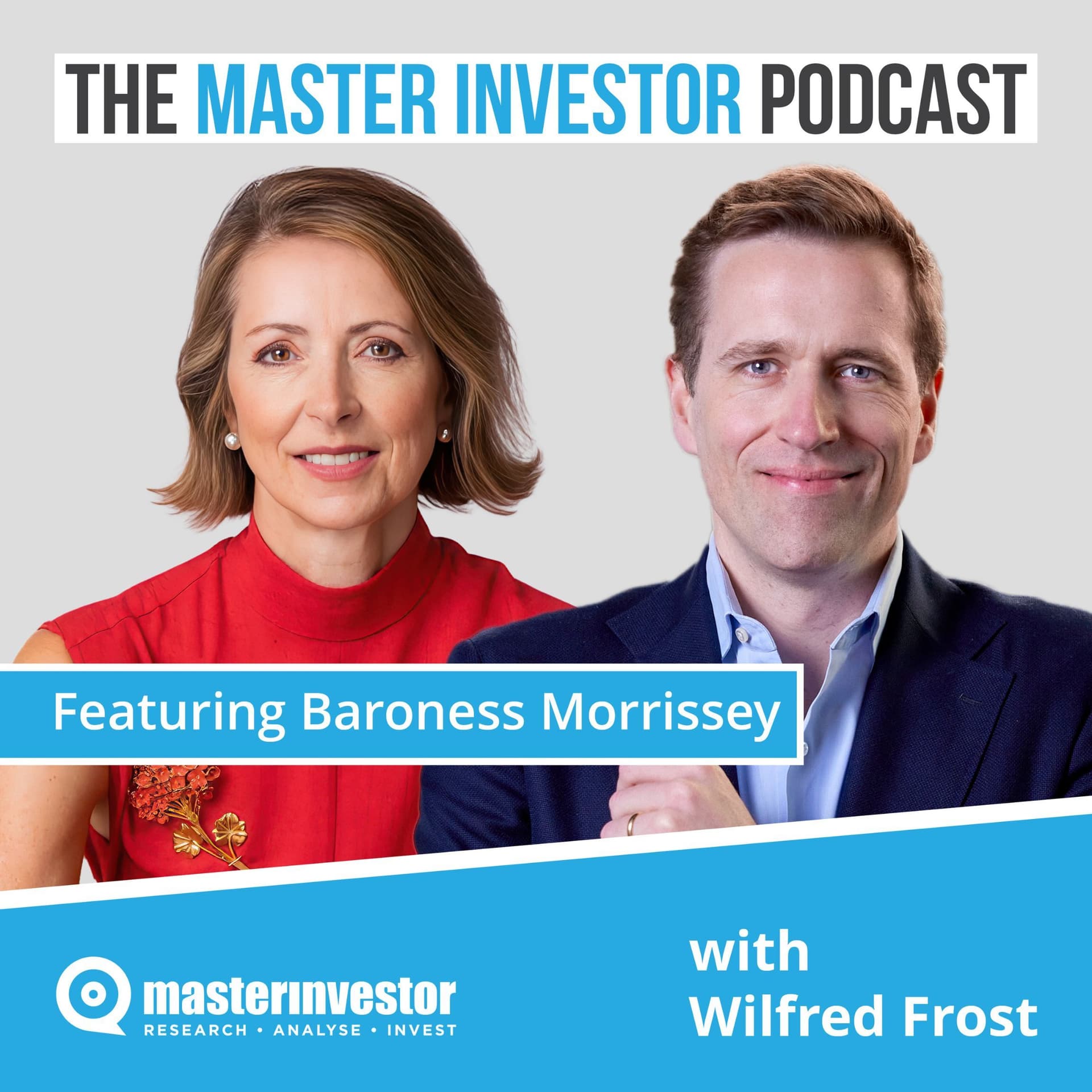
Baroness Morrissey: Seize The Moment - My Tips For Investing & Life
Guest Introduction
- Guest: Baroness Helena Morrissey
- Former CEO of Newton Investment Management, where she doubled assets under management from £20 billion to £50 billion in 15 years.
- Founder of The 30% Club and Chair of The Diversity Project.
- Known for her success as an investor and her advocacy for diversity in business.
Key Themes and Discussions
- Seizing Opportunities
- Helena reflects on her pivotal career moment where she successfully invested in UK Gilts in the late 90s before the Bank of England gained independence.
- Key Takeaway: Emphasizes the importance of taking calculated risks and seizing the moment in investment and life.
- Diversity in Investment
- Discusses the shortcomings of the Diversity, Equity, and Inclusion (DEI) movement.
- Argues that the focus should be on the improved outcomes associated with diversity of thought rather than simply meeting quotas.
- Key Point: Diversity is not only a social issue but a critical factor for better business performance.
- Market Insights
- Provides insight into current market conditions, expressing concern over the complacency in the US and global markets, which she believes are in bubble territory.
- Stresses the importance of understanding market dynamics and the risks associated with high yields and government debts.
- Advice for Women in Business
- Helena encourages women to "leap before you look," advocating for taking chances despite the fear of failure.
- Key Point: Many people, especially women, tend to overanalyze opportunities to the point of inaction.
- Challenges for London as a Financial Center
- Reflects on the decline of London’s status as a leading financial hub compared to its position 15-20 years ago.
- Highlights the impact of high taxation and regulatory burdens on London's competitiveness.
- Suggestions:
- Short-term: Reduce taxes to stimulate growth and retain talent.
- Long-term: Foster a culture that encourages innovation and risk-taking in financial institutions.
Career and Investment Philosophy
- Helena shares her unconventional path to becoming CEO with no formal management training, emphasizing the significance of belief in one’s vision and the value of collaboration.
- Investment Philosophy: Advocates for a balanced approach to investing—staying calm during market volatility and being prepared to act decisively when opportunities arise.
Conclusion
- Helena concludes by reiterating that many more people regret not taking risks than failing after trying.
- Final Thoughts: Emphasizes the importance of cultivating a culture of open dialogue about financial matters and the need for a more responsible approach to democratizing investment.
Additional Information
- The podcast is for informational purposes only and does not constitute financial advice. Listeners are encouraged to seek independent financial advice before making investment decisions.
- Next Episode: Guests include Cathy Wood of ARK Invest.
Resources
- Full video available on [The Master Investor YouTube Channel](https://www.youtube.com/@TheMasterInvestorPodcast)
- Follow Wilfred Frost on [X](https://x.com/wilfredfrost?lang=en) and [LinkedIn](https://www.linkedin.com/in/wilfred-frost-279667374/)
Production Credits
- Produced by Paradine Productions and The Master Investor Podcast Ltd in association with Bird Lime Media.
Written by AI. May contain mistakes. Listen to the episode to check what was said.
Transcript
Automatic transcript. May contain errors.0:00It was a very uncomfortable place to be, if I'm honest, because I was dead wrong for a while. and every day my colleagues would challenge me, reasonably so. Everybody thought I was mad and that was not conjecture, they told me so. But it was a great taste of, you know, testing the courage of my conviction and it was genuinely the making of my career. And when I started buying those gilts, they were over 8%, even higher than they are today, Neil. And I didn't sell them, I sent myself, you know, I thought, okay, can't be greedy. But we ran it for multiple years and we sold them when the handle got below 3%.
0:29I do worry now, I think there is the danger of complacency. I mean, we get the situation where nothing seems to unnerve markets. And I'm an optimistic person. I believe in America. I believe in capitalism. But we need to pull back, I think. Leap before you look. And I know that's the opposite of what the normal saying is. But so many people, especially women in my experience, they look and they look and they look and they never leap. They never take the chance. They let the fear of failure put them up from trying something. And my grand old age, I'm 59, I know many more people, my peers, who regret not trying something than trying and failing.
1:09Welcome to the Master Investor Podcast with me, Wilfred Frost, where we celebrate and learn from the success of the greatest investors, business leaders and politicians in the world, giving you, our listeners, the edge. My guest today is a titan of the finance industry here in the UK. She's currently chair of Fidelis, Altum Group and the Eton College Endowment Fund, but shot to fame as the CEO of Newton Investment Management, a role she took on at the age of just 35 when the company had £20 billion in assets under management. A decade and a half later, when she stepped down, assets had more than doubled to£50 billion in assets under management.
1:53And it was at Newton where we first met. She was CEO of the company I started my career at. Helena, it is such a treat to welcome you to the podcast. Thank you, Wilf. Well, congratulations on your escape from Newton. You went on to great things. It wasn't an escape, but it was a career pivot that I guess has worked out, if I'm lucky enough to have you as a guest here. It must have done. And you also worked in government fairly briefly. Maybe we'll come to the hat. And founded the 30 % Club and a chair of the diversity project today as well. So much to get to. Wanted to start though with your kind of snapshot on the markets because before you became a CEO in the asset management industry, you were initially a bond trader by profession.
2:40What is your snapshot on where we stand today in global G7 bond markets and the kind of risk that we have a proper fallout at the long end of the bond curve? Well, I'm with Lord Mervyn King on this subject. He's just pronounced, he thinks, you know, we're all in a mess. Fiscal room for manoeuvre for governments is incredibly thin. And obviously, you know when you look back at say the financial crisis the global financial crisis there was a lot less government debt out there and lots of tools were available like quantitative easing and so forth we really are you know in a very difficult position I think now and I don't want to start off all doom and gloom but clearly here in the UK we are really suffering as well as people kind of try to work out what is the escape route from this doom loop that we seem to be getting ourselves in In the short term, I mean, assume there were no major policy changes.
3:38Just looking at the market dynamics, the 30-year bond yield here, is it a 27-year high or there or thereabouts? Is there a chance that we suddenly hit sort of escape velocity and yields gap up in a significant way? Yeah, I mean, the bond market, obviously yields have backed off a little bit since, you know, about a couple of weeks ago when since then we've had weak economic data from the states and everything has sort of calmed down a bit and people have sort of perhaps moved away from the abyss. But we're really vulnerable, I think. There is this idea, obviously we've never seen it before, but bond markets can decide, or bond participants can decide to cut off the credit line for governments and say, we're not going to lend the money.
4:17We're not going to finance the debt unless we paid an awful lot more for it. And we haven't seen yet any real spike in the long-dated yields. We've seen a gradual rise and we've seen, obviously, a real upwards movement. But apart from perhaps in Japan, we have seen, you know, it's been quite gradual. We haven't seen a Liz Truss kind of moment where it just sort of collapses and it becomes a bit of a vicious spiral. And I do worry about that. I think governments, as I say, have got very limited room for manoeuvre if the markets decide to cut them off. There's obviously a Fed decision imminently and a Bank of England decision imminently.
4:51both are starting to get, particularly in the US, a little bit political. How important is central bank independence? And in the US in particular, is it just talk or do you sit here and think, you know, that question of independence of the central bank is genuinely worth asking at the moment? No, I think it is a worry that it's being interfered with. I mean, I'm speaking as someone who basically had their career defining trade by buying long-dated gilts just before the Labour government got in in 1997. And obviously then the next day, Gordon Brown made the Bank of England independent for monetary policy anyway, and it unleashed the biggest rally ever.
5:32So I'm obviously a fan, but it does depend who we've got in charge. The reason why I think it's so important ultimately is because obviously governments are often elected for a pretty short length of time. The electoral cycle is just not long enough, and you'll get huge decisions being made for political expediency, potentially, if you haven't got that independence. I do think everyone needs to work together well, and that's obviously not happening, particularly in the States. There needs to be a great triumvirate or dynamic between here, the Treasury, and the Bank of England, and then the rest of government policy.
6:06So that's critical. It's not that you're independent and don't pay any attention to what the others are doing. I didn't know that you made that trade. So was that a political prediction you got right? or good positioning for other reasons? So it was, I mean, you were at Newton for a few years. So I was tutored by Stuart Newton, basically, who was very much a contrarian investor, lateral thinker. And I realized that, and it's perhaps pertinent to today's situation, because I don't think this is the case now, that actually, however bad things got me, people were really worried about tax and spend labor coming in.
6:37And this was way back, you know, 1996. People get nervous about that happening. So this was just before Tony Blair came through. Exactly. And I mean, we can laugh now because they were worried that there might be 50 billion pounds worth of gilt situants in the 97-8 fiscal year. I mean, that's a drop in the ocean today, obviously, isn't it? And it turned out to be 17 and a half billion. I mean, the market's got it completely wrong. So earlier, it wasn't just the day before, but, you know, six months or so before, I started to build a position because I felt it was all discounted in the price. And it was a very uncomfortable place to be, if I'm honest, because I was dead wrong for a while.
7:13And every day, my colleagues would challenge me, reasonably so. Everybody thought I was mad. And that was not conjecture. They told me so. But it was a great taste of, you know, testing the courage of my conviction, but also going back to the analysis and keep on testing it. What would happen if? And on any which way I did it, I couldn't get to a worse position than we were in at the time in terms of guilt yields. So I just kept doubling down. and it was genuinely the making of my career. And when I started buying those gilts, they were over 8%, even higher than they are today, Neil. And I didn't sell them.
7:45I sent myself, you know, I thought, okay, can't be greedy, but we ran it for multiple years and we sold them when the handle got below 3%. So that was, I mean, that made my career as a bond fund manager and it showed me so much about the important things of investing well as, you know, to keep your head when all about you are losing theirs with apologies to Roger L. Kipling. And yeah, it was a great lesson in life, really, particularly when I was going wrong at the beginning. And I was seen as a bit of a failure there because, you know, sometimes those moments are when you learn, you know, strength of character and resolve.
8:18Wow. I mean, I didn't know that background. I knew you'd obviously made your name at Newton as a bond trader, a very successful one. And it led to you not that many years later then. In 2001, you were asked to become CEO of the company. Yeah. and I'm fascinated and you're only 35 so was that a surprise to you when you were asked to become CEO? It was the biggest surprise to me than anybody I think so I had no management training no business background I was literally running money and I had I have to admit this or mention there's five smallest children I mean the youngest had just turned one two and three um so it was not a textbook path to being the CEO um but I really believed in what Newton was doing in terms of how to invest.
8:59And I realized, even though I had no idea what the job entailed, if I'm really honest, I knew it was a really once in a lifetime opportunity. I still don't quite know why I was asked, I suppose. But I think my rationale for it is that I think at the time, the company had just been taken over by Malin Bank. That turned out well in the end, but obviously there was a lot of friction in the short term. And I think my colleagues wanted somebody who would kind of more pull them together rather than sort of tell them what to do. And I had always sort of led sort of, I don't know if you call it first among equals, but definitely trying to bring people with me.
9:36And they asked me to do the job. And obviously you did a brilliant job. It didn't start well, but it ended up okay. It did well, fantastic. On my five years there, it was very clear leadership bringing people with you. And as we said already, AUM went from 20 billion to 50 billion during your tenure. You kind of alluded to that there already a bit, But asset management is a very interesting industry where most of the people who make money for the company and who have careers that rise quickly are because they're very good at making investment calls in stocks or bonds. That's a very different skill set to then being a CEO, is it not?
10:14Yeah, I mean, I'm going to agree and disagree if that's okay. Because I do think that, you know, leading in the context of investing and leading a team and trying to, you know, you're a great team member, but bringing out the best in people, those skills are very similar in a CEO role. The trouble is that in fund management, in particular, I would suggest, people usually get no time and attention spent on how to manage, how to lead. It's almost assumed that if you're good at managing money, you'll be good at managing people. And so you often get, I'm not going to name names, but for example, we had somebody at Newton who you will remember, I'm sure, who ended up ahead of a desk.
10:50Please name names. He had no, no, I'm not going to, I always get in trouble for that. He had no interest really in managing people. But one of his colleagues was brilliant at it. And so I said to him one day, I said, do you mind if we kind of move those responsibilities? You'll still be caught at the desk, but she's going to look after the people, do all the, you know, career development, bring, you know, making sure that people's voices are being heard. and he actually was totally chilled about it because he found it very stressful you know doing this sort of people stuff but that doesn't usually happen people sort of regard it as data symbol and i do think that's a problem um and i'm very keen we just did some work at the diversity project on cognitive diversity and the impact on investment team performance and the answer basically is that it can really add but only if you have a really skillful manager who bring out the differences in a really good way amongst people.
11:38So I think the need is even greater. And I'm now puzzling over how to bring, you remember, fund managers sometimes, and you talk to them a lot now, have quite significant egos. And you can't say, I'm going to train you how to lead. You have to say, I'm going to give you a masterclass and bring a brilliant leader. So I'm thinking carefully about how to position this and persuade them to come to the table. We should talk because master investors is a slightly different title, but it's not different from Masterclass. I want to talk to you about the diversity project and the 30 % Club in a second, but just still dwelling on this leadership of an asset management company, how much of a successful asset management company comes down to pure and simple, the investment performance of the underlying fund and how much down to marketing?
12:24And I'm really interested in this today more than ever, where people can reach investors purely by social media and the arguments they're making perhaps rather than just the underlying kind of performance of the fund? So I do think there's definitely both wonderful marketed companies out there and wonderful performing companies out there. And obviously the ideal is to have both. I know personally, I couldn't preside over a company that was just, you know, very good at selling itself and not very good at managing the money or doing the insurance policies or whatever the nature of the business is.
13:00That's just how I'm wired. But I'm pretty confident there are people out there who start with what's the story going to be and then sort of reverse engineer into it. What I think we're seeing now is actually, if you're a big-ish company or a large company, then you have the resources to really sell yourself and to give this sense of real solidity and almost like certainty about what you're doing. And of course, trustees, pension funds, for example, then they think it's a low-risk decision then to put their funds in with a big house. so it makes it incredibly difficult then for smaller players to come up and you know make a headway even if they've got a better product it's just not it just makes it and I don't think that's a good thing I think that makes it very yes it's a high barrier to entry but also it means that you're not necessarily putting your money with people with the best performance and we're seeing a bit of backlash now I mean Phoenix has taken away 20 billion from Aberdeen because they're bringing that in-house I know BlackRock lost a big mandate recently from a Dutch pension fund particularly over ESG issues, there's got to be substance as well as style.
14:05And particularly in the UK, maybe in the US, but I'm sure more in the UK, how much of the marketing that is necessary is actually convincing people to invest in the first place? And it's a hard thing to do because you're kind of then almost encouraging people to take risk. And with that comes responsibility. Definitely. I mean, obviously, culturally here in the UK, in the retail space, We just don't have that culture of investing. We briefly had it when Margaret Thatcher was around and privatizing things and people were buying those shares. I started my career in New York, actually, and I spent two years with Schroeder's in Midtown.
14:43And the first day I walked in, someone asked me, what did I make? And, you know, I wanted to reply. I'm British. I don't talk about these things. So I do think we need to get a bit of that American approach to being responsible for our own financial destiny. And obviously a lot of people haven't saved enough for their pensions, etc. here. But with that, as you say, comes responsibility. And I think it's really important that the democratization of investing, which I think is really a critical thing for this country to achieve, is done responsibly. and that people realize that actually the worst thing you can do is to just convince people to part with their hard-earned savings and invest not diversified or not gradually.
15:24And I'm always saying to people, just don't put all your eggs in one basket and start slowly. You know, just get used to it. But there's a lot of work to be done on just socializing, talking about money. Let's talk a little bit about that early part of your career. So it's briefly in New York, then back to London. And I think it's before you joined Newton, You found it, understandably, I would imagine, for the industry back then, but you found it very hard to sort of break through as a woman. Yeah, I mean, I have to admit, it's probably both as a woman and as someone who didn't have city connections.
15:55I went to state school. I started philosophy. It makes me sound like I have no qualifications for it at all. I did do maths, other maths and physics at A-level. But, you know, I felt a fish out of water in many senses. And I was, when I came back to London and started managing money, I was the only woman in a team of 16. And were you made to feel that as an outsider? Well, I worked with really lovely people. But at the time, this was an environment, you know, which shows that we have made progress on culture. This is a time when no one thought anything twice of taking clients to lap dancing clubs, or there would be what we might describe nicely as banter across the desk.
16:33You know, it was not necessarily a very comfortable environment. And then I had my first child relatively young, age 25, and came back from a short, by British standards, maternity leave. And I got passed over for promotion. I mean, this is a long time ago. That baby is now 33 with a two-year-old of his own. So I'm not in any way criticizing the company now. But then, you know, that put me at a real disadvantage. And I was passed over and I was told it was because there was some doubt over my commitment with the baby. I was told my performance was great. Now, nobody would say that now. There's laws against it for a start.
17:08But obviously they might think it. And that's still why I think one of the reasons why it's still quite difficult for a lot of women. And of course, that's one of the reasons you founded the 30 % Club. And I remember that because what year did you found 30 %? 2010. So it's now 15 years old. Yeah. And so I joined Newton in 2009. I remember it very clearly. And everyone at Newton was, myself included, was very proud that our CEO was leading this charge. But what I think is so fascinating compared to the debate today around DEI is, well, firstly, the target was 30 % of women on boards, obviously not 50%, which I guess speaks to it not being an arbitrary target.
17:49But more to that, I remember the argument was this will improve outcomes. This isn't just an arbitrary we have to hit this level, but diversity of thought will improve the outcome. And it was a very powerful argument because all the banks had just gone under during the financial crisis had been led by men. I think we'll have to recruit you as ambassador for the 30 % club message because that is exactly – I mean, it was a moment to seize. I had run actually a women's initiative. It was a bit broader than Newton. It was within BNY Mellon as we were then our parent company. And it was reasonably successful, but we weren't seeing any improvement in the numbers.
18:26And then we had the financial crisis. and then having gone to an event at Goldman Sachs and first spoken and then listened as we had a small lunch after, everybody was stuck at not really seeing much progress around senior women. And I came away and I thought, but we've just seen this, that was November 2009. We've just had this almighty deafening wake-up call about having the dangers of groupthink and the dangers of people cut from the same cloth sort of all sitting around the room and not challenging each other. And that is the segue in here. The 30%, since you've mentioned it, I mean, only 10%, less than 10 % of board directorships in the UK were held by women at the time.
19:08So for a start, 30 % seemed an ambitious target. But also it resonated. I started reading very voraciously about how do groups behave. And I came across something that a male CEO at Deutsche Telekom had instigated, which was trying to set a 30 % goal for women at all levels of the organization. And he said it was to improve the thinking. but also the 30 % was the critical mass when I looked into group behavior. And that resonated with me. I've mentioned being the only woman out of 16, but when I was three out of 10, still a minority, I felt like part of the group and braver about speaking up and saying my piece.
19:43So it's now 43 % of the number of women on board. So clearly I was under ambitious, but, you know, it's very exciting that we made that progress through voluntary change as well, not legislation. And I think you brought a lot of people along with you. Do you think the argument, I don't know at which point in the last five or so years, it became too sort of almost religious in its fervor and it undid some of that good work? Or critics of DEI today do you think are missing the point? No, I think some DEI initiatives, unfortunately, ended up being sort of the opposite of inclusive. You know, they've seen, they've developed special language.
20:22They were very much making people feel part of the problem rather than part of the solution. People felt they couldn't say anything. They would be saying the wrong thing if they just spoke their mind. And it ended up being sort of very sort of prickly and I think a bit weird. You know, people, like this was a business thing for me. It was like how you should have, you know, you've got half the world's talent are women. You've got wonderful people who've got all sorts of backgrounds. You should be having all of their ideas brought into the table. And so we kind of left, we parted company from that.
20:55And I think that was, you know, now is a great moment. It's a challenge, but it's also an opportunity for DI work to reconsider and to emerge more genuine about inclusion and bringing someone like you, like back to, you know, the party, because, you know, this is for you. It's not supposed to be a zero-sum game where you're just replacing a white middle-class man with a black woman. You know, it's about making sure everyone who's got talent has opportunity. Well, absolutely. And just to round off this part of the conversation, I think it's right in saying central to all of your initiatives in this area is actually the kind of point about diversity of thought leads to better outcomes.
21:36And as is very, very important to allow that diversity of thought, as we were discussing a little bit this morning on that very sad news of Charlie Kirk's assassination. Exactly. And we've moved so far now. I mean, obviously, President Trump, people will disagree or agree with where he's coming from. But I'm sure everyone would agree that, you know, his line in his tribute to Charlie Kirk about and talking about this violence and murder of the tragic but inevitable consequences of this demonization of people that we don't agree with. I mean, that is just such a sad truth now that people who you can't have a conversation, you get afraid of being canceled and so forth.
22:15And I really hope that all the work that I do and also my colleagues at Diversity Project, which is genuinely trying to take diversity efforts to the next level to be like, let's make superior businesses. Let's make, you know, future proof our industry. Let's let's make sure that everyone has opportunity and a voice. And I think that's absolutely the way forward. I just do think we just got ourselves in a terrible spiral downwards where people just now shoot someone rather than have the argument. I mean, it's terrible. Absolutely terrible. I completely agree. Let's talk about a broader point about these initiatives, because I've also heard you say in the past that you're very driven.
22:59And, you know, I think I always say I'm very ambitious and liken the story to my dad was often labeled as being ambitious by the press in the UK. And he would say, you know, in a negative way, and he'd say, I plead guilty to being ambitious, but in the American understanding of the word. And I'm just wondering the extent to which you find it harder to say publicly, I'm driven here versus when you're in the US? Or do you think it's also maybe early in your career more than later, something that was harder to say loud and proud as a woman than for others? I think at this stage people just assume I'm driven, don't they, rather than me having to say it.
23:36But I do feel that very, you know, unashamed of being aspirational. You know, I had a modest, very loving family background, but very, you know, my parents' teachers, my sister teacher. It was always a choice between, you know, ballet lessons or piano. I chose piano. We went on holiday to a little cottage, my godmother. and, you know, we didn't have a lot of material things. And I wanted to be able to send my children to private school if I could. I wanted to just have choices. I could see that some people, and I'm not particularly money-driven. That's been to my cost, I think, actually. But I really also always wanted to be, I suppose, the best I could be.
24:18I know it sounds so cliché and I'm embarrassed saying that. I was a very driven manic brownie, if people know about the Girl Guides, the little ones at the brownies. and I had the world's, you know, the regional record rather for most badges. I mean, I did crazy things. I learned woodwork and metalwork. And to my children's surprise, I even learned how to cook to get the domestic hostess badge, which is the biggest surprise. But it's just how I'm wired. And I don't think, well, I always say, and perhaps it is being a bit embarrassed about it, but I always say I didn't choose to be this way. But now, since I am, I know I'm happier and I feel fulfilled and hope that, you know, people say it's inspiring.
24:54Sometimes they say that. And I hope it slightly rubs off on my own children. And if someone comes up to me in the street and says, I've just taken this job because of something you said, I'm so happy about that. And I think we're all put on this earth for a short time. And, you know, we should we should do the best. Absolutely. Seize the opportunities that that are put in front of us. I totally agree.
25:20Let's talk about London as a financial center. The sad you're grimacing on this. I mean, where was it 15, 20 years ago in the global financial world? Where is it now? It was absolutely top dog, I think. More than New York? Well, I was traveling back and forward between New York or Boston was where BMI Merlin's asset management businesses were to start with. And I've always found America very energizing, very can-do, very optimistic. And so I'm struggling to sort of say one is better than the other. But definitely London had the innovation and obviously the history and I suppose the global outlook.
Read the full transcript
26:01I always found America was a bit insular in comparison. When I first arrived, I went and got the New York Times on the Sunday and looked for the global, you know, the international news. And it was like a paragraph and a stack of papers about this big. Whereas we've always had a very outward looking vista. And that has stood us in good stead. So I think we were absolutely right at the top of things 15, 10 years ago. But now? And now I think we still have a lot going for us. So I don't want to sound too dismal about it. But I think why we have a lot going for us is because you've still got a lot of people, perhaps not as old as me, but maybe, you know, 40 to 50 years that are running things.
26:41And they grew up in that era. So they feel very much still empowered. And they have that mindset. sadly and I don't think it's all attributable to one thing but I do feel a lot of the city and I went to this party for the financial news a couple of years ago which was celebrating the 25 figures in the city that had had most impact in a quarter of a century up to then and we were all saying we wouldn't get in nowadays because we had too much you know personality and you know we'd be I mean it was people like Martin Gilbert and the late Sir Wimbishoff you know and people were talking and saying we all pushed the boat out we all took risks and we all um challenged the status quo and now i'm afraid it's the risk reward equation for people is is quite not quite the same obviously what do you mean by that so in people's career paths or like the politicians you mean people there's so much regulation um i mean obviously you need good regulation but i think you have got it where it strangles uh things i mean it will run events at city firms and sometimes they say we can't even know who's coming to our own events because of GDPR or something.
27:43I mean, it gets to the point where people are so afraid to speak up sometimes as well that there's no, I mean, there never was a great prize for challenging the status quo. But I feel that the balance has shifted and we need that. We need innovation. We need people to feel you can take a risk, you can make a mistake. That's a critical part of creation. So if you had two tips for Rachel Reeves to reinvigorate things, one short term. Only allowed two. Only allowed two. Only allowed two. No, I mean, just short term and long term, what do we need to do to get London back? Well, I mean, I'd only started on the challenges obviously now, and I don't want to belabor the point.
28:24But obviously, we also have very high personal tax burden compared with where people can work. So I've seen a lot of people go to the Middle East, Bermuda, all sorts of places where you can go just to have a lower tax burden. and frankly, for things to work better than they were. Now, I'm saying this having walked into the studio, having we're in the midst of the tube strikes. So there's a sense of decay about the country that doesn't help. So definitely, I mean, I would reverse all the efforts on the fiscal front, the tax, she should cut taxes to stimulate growth. I know that's not what she's going to do.
28:58But if you're listening, Rachel, please think again, because it's counterproductive at this point. You're driving great people away. And on the regulatory front, everyone can say deregulate, but what are the actual details that are needed? So I think that the suns are changing. Obviously now competitiveness is part of the statutory objectives for the regulators. But I get to see that kind of, it needs to speed up. So I think, and showing, I think you can show how and why you expect businesses to be internationally competitive. the sorts of things that actually you're not leaping on every like small thing that goes wrong we have moved a very long way and this pendulum has swung you know obviously as it should have done from the light touch regulation that was prior to the global financial crisis but we've now got to the point where you know people are afraid of their own shadows and that is going to take a while to change but there has to be we've had a few speeches there needs to be more substance there and we're not going to point to a specific regulation it's more a culture awareness and I I think culture is still something where we've obviously got a long way to go before the regular feels they can sort of let everybody get on with things.
30:07You, I think, were rumoured to be the Bank of England governor. Did you get interviewed properly? I did get interviewed, yeah. Is that a job you'd take if it came up again? Well, no one's kind of offered it. Well, not suggesting Andrew Bailey's term is going to end. Obviously, and there's no vacancy. There's no vacancy. So, I mean, it would be a great honour. And I think, I mean, I heard your episode with Liz Truss and she talked very disparagingly about the establishment figures. One thing I just want to say about the sort of circularity of the establishment or bureaucracy. So at my interview, I'm very happy to share this because I don't think it's telling any great secrets.
30:41It was a long time ago now. There were two people from the Bank of England, as it was then, and one from the Treasury. So if you were trying to ramp things up and if you're trying to change things and if you're interested in new ideas, that's not going to deliver it, is it? If you've got a panel that is made up of the existing regime. And so I think a lot of all of these institutions, you know, we need a real sort of rethink about how we attract people into them. And then when they're there, how they work with others effectively. I would frankly take a real Scorch Church policy to the civil service, for example because from my two years uh working in the foreign office it you know it's very hard to get anything done at all so as we wrap up and we we usually ask business leaders what's the what's the overriding piece of career business advice they have for people and then investors that overriding uh investing advice for our listeners but since you've done both yeah of course what what is what is your big bit of career advice for our listeners okay so i'm going to get it wrong way around people will think but i'm going to say leap before you look and i know that's the opposite of what the normal saying is but so many people especially women in my experience they look and they look and they look and they never leap they never take the chance and they're afraid of the they let the fear of failure put them off from trying something and my grand old age of i'm 59 um i know many more people my peers who um who regret not trying something than trying and failing risk taking is a clear a clear theme and what about when it comes to investing well I'm going to repeat what I said earlier the the sort of taking it from the if poem by Roger Kipling you know got to keep your head while all about to losing your theirs don't get carried away in panic in the times of you know great fear don't get carried away by hubris when you're getting it right slow and steady and then look for those moments I mean say my career was made by by seizing that moment it wasn't just sort of keeping calm and carrying on was look for those They don't come along very often.
32:45I was probably set up for it by joining the city in October 1987, meeting my potential boss in New York for an interview in London on October 19th, 1987, which you're too young to remember, Will, but was Black Monday. And I went up to the investment floor, which I had not spent any time in, thought, what on earth have I joined? because people were running around like mad. Headless chickens, all going crazy. And my boss calmly that day bought US long bonds, which made us more fortunate over the coming weeks. He kept his head while all about losing their. As you did before Bank of Independence about a decade later.
33:21It's interesting just to go off on a tangent there because I graduated in 2008 and came and joined Newton. And I remember about a year or two later when normal market moves calmed down to sort of 0.3, 0.5%. And I was like, well, this is so boring. What happened to those days where we were like 5 % up or down a day? Don't be careful what you wish. Be careful. I know. But we've had sadly a few of those moments since. Just finally to pick up on something you said there about hubris in markets. When you see like yesterday, Oracle, which is not a penny stock by any stretch, it's worth hundreds and hundreds of billions, up 40 % in a day.
33:57Are we in crazy territory here? What's your snapshot on that? We were discussing this, makes us sound a bit sad, over the dinner table, actually, about we're now in another bubble on some of these technology plays. I do worry that I lived through the dot-com bubble. I was buying credit, you know, then. And obviously, a lot of those bonds just did not make it through. I had a very good credit analyst who steered me clear of most of the banana skins. But I do worry now. I think there is the danger of complacency. I mean, we got the situation where nothing seems to unnerve markets, more in the Middle East, Russia, Ukraine, China, India, Russia, all gang.
34:37I mean, you know, it's not all plain sailing, is it? And we need a balance. And I'm an optimistic person. I believe in America. I believe in capitalism. But we need a pullback, I think. Helena, it's been an absolute pleasure. Thank you so much for coming to join on the podcast. I remember my first day at Newton back in early 2009 like it was yesterday. It was a treat to turn the tables. Thank you, Wilf. I enjoyed it. Helena Morrissey there, Baroness Morrissey, joining us here on the Master Investor Podcast. Next week, we will be joined by Cathy Wood of ARK Invest. Make sure to tune in for that and subscribe if you haven't done already.
35:15Remember that nothing you've heard on the Master Investor Podcast should be considered direct financial advice. More on that in the show notes if you'd like it. The Master Investor Podcast is produced by Paradine Productions and Master Investor Podcast Limited in association with Birdline Media. If you've enjoyed the podcast, please do subscribe on YouTube or click follow on your podcast platform, and then you'll be automatically notified each time a new episode drops. Please join us again next week with Cathy Wood. Helena, thank you again. Thank you.
35:53Thank you.
From the publisher
Baroness Morrissey is one of Britain’s most successful investors, becoming CEO of Newton Investment Management at the age of 35, and more than doubling its size over 15 years. She was also Wilf’s first CEO – he started his career at Newton.
In this episode, Helena outlines how she’s managed to be so successful, reflecting on why the trade that made her career – buying UK Gilts in the late 90s before Bank Of England independence led to a massive rally - taught her to seize the moment.
As a founder of The 30% Club and Chair of The Diversity Project, she also discusses where the DEI movement lost its way, including its failure to highlight the improved outcomes of diversity of thought. Plus, her career advice, particularly for women: “leap before you look.”
Helena also suggests what the UK government needs to do to bring London back as a leading financial centre, and expresses caution over the current US market, which is in bubble territory.
The content of The Master Investor Podcast is for informational purposes only and does not constitute financial, investment, or other professional advice. Always seek independent financial advice before making investment decisions
You can watch the full video on The Master Investor YouTube channel
And follow @WilfredFrost on X and Linked In
This podcast is produced by Paradine Productions, The Master Investor Podcast Ltd in association with Bird Lime Media.