In short
The Master Investor Podcast with Wilfred Frost
Episode Summary
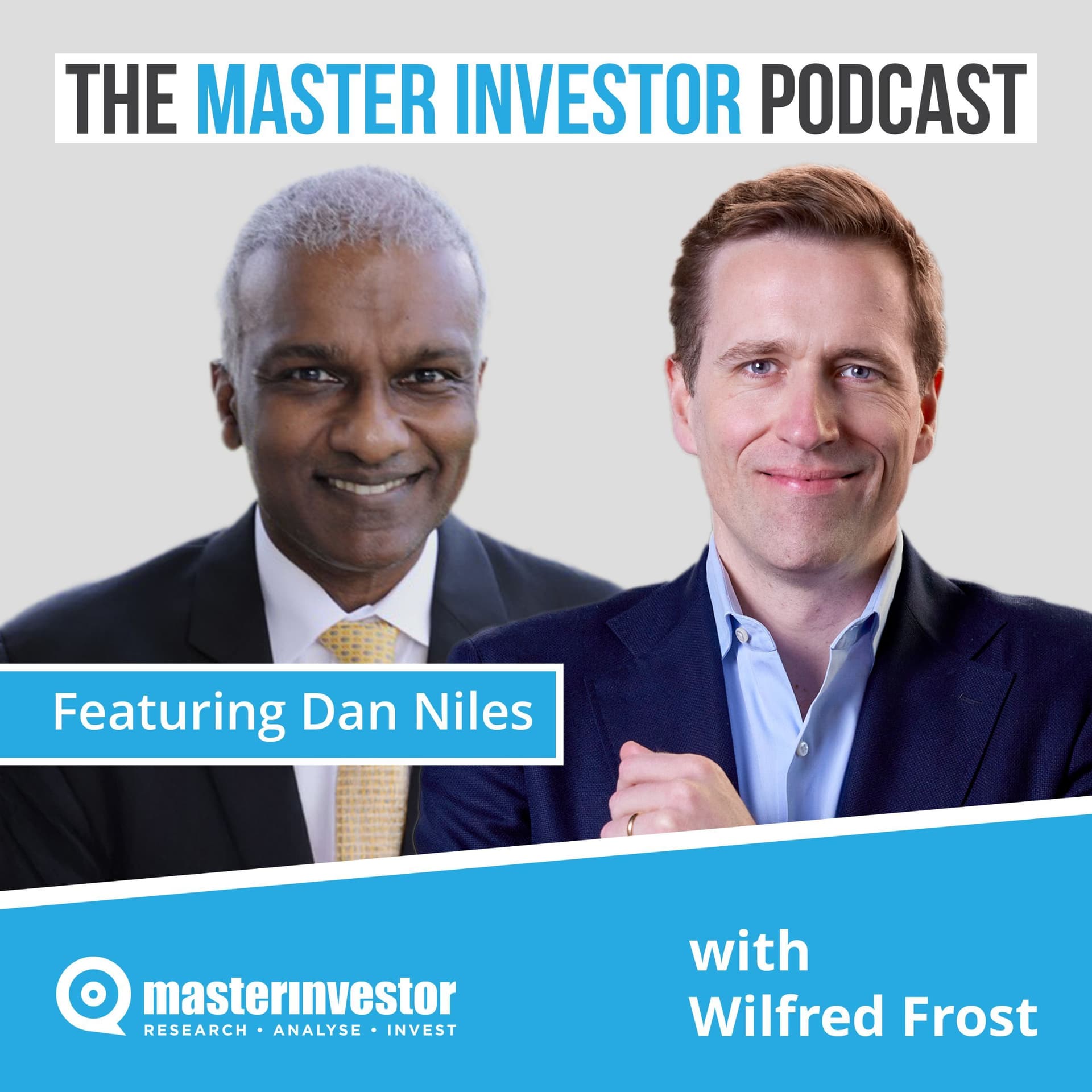
Dan Niles: Apple Is Losing the AI War — Here’s Why I’m Bearish
Episode Details
- Host: Wilfred Frost
- Guest: Dan Niles, Founder and Portfolio Manager of Niles Investment Management
- Date: June 24, 2023
- Theme: Market outlook, investing strategies, and specific stock analysis, particularly focusing on Apple and AI technologies.
---
Key Themes and Discussions
- Market Sentiments
- Dan Niles expresses a bearish outlook for the medium term due to concerns about the US debt position, despite a belief that markets might reach new all-time highs in the short term.
- He emphasizes the importance of adaptability in investing, quoting Charles Darwin: "It's not the strongest of the species that survives, nor the most intelligent, but the one most adaptable to change."
- Current Economic Overview
- As of mid-2023, the S&P 500 and FTSE 100 indices show positive growth year-to-date.
- Niles discusses the rapid changes in the economic landscape and emphasizes that investors must remain nimble and adjust their strategies as new data emerges.
- Cash as an Investment Strategy
- Niles highlights cash as his top investment pick at the end of 2022 and into 2023, noting that it can constitute over half of his portfolio during bearish sentiments.
- He believes that cash and money market funds with over 4% yields are currently good investment vehicles.
- Outlook on Apple
- Niles is very bearish on Apple, citing:
- Insufficient investment in AI compared to competitors like Microsoft and Meta.
- Concerns about Apple’s declining market share in China.
- The high valuation of Apple stock without solid revenue growth to support it.
- Perspectives on Other Tech Stocks
- NVIDIA: Niles is cautiously optimistic about NVIDIA in the short term due to increasing demand for AI inference.
- Microsoft: He sees potential for growth in Microsoft, especially with strategic changes in CapEx and positioning related to AI.
- Investment Principles
- Niles reflects on lessons learned over his career, emphasizing:
- The importance of management quality.
- The need for patience and timing in investment decisions.
- Adapting investment strategies based on market conditions.
---
Key Takeaways
- Adaptability is Crucial: Successful investing requires constant adjustment to new information rather than sticking rigidly to initial beliefs.
- Market Conditions: Current economic indicators suggest a potential rally, but underlying issues, such as rising debt, may lead to future downturns.
- Sector Focus: Technology stocks are under scrutiny, particularly regarding investments in AI capabilities, which may determine their success or failure in the future.
Top 5 Stock Picks by Dan Niles
- Cash: For stability and potential returns.
- Cisco: Believed to be undervalued and poised for recognition in AI.
- Microsoft: Optimistic about future growth due to improved business strategies.
- NVIDIA: Short-term positive outlook based on increasing AI demand.
- Apple: Long-term bearish due to lack of competitive edge in AI.
---
Conclusion Dan Niles' insights reveal a cautious yet strategic approach to investing, particularly within the tech sector. His emphasis on adaptability, combined with a nuanced understanding of market forces, provides valuable guidance for investors navigating a volatile economic landscape.
For more insights, you can follow Wilfred Frost on X [here](https://x.com/wilfredfrost?lang=en) and watch the full episode on [The Master Investor YouTube Channel](https://www.youtube.com/masterinvestorchannel).
Disclaimer: The content provided in this podcast is for informational purposes only and does not constitute financial, investment, or professional advice. Always seek independent financial advice before making investment decisions.
Written by AI. May contain mistakes. Listen to the episode to check what was said.
Transcript
Automatic transcript. May contain errors.0:00The number one thing, especially if you're a technology investor, but just an investor in general, is what Charles Darwin said. I think he gave the best investment advice of anyone out there, which is it's not the strongest of the species that survives, nor the most intelligent, but the one most adaptable to change. And what some of those stories I said in terms of my best and worst investments in terms of stocks should tell you is that you've got to be very adaptable. This market is violent. It can change very quickly. and your views should always be changing as the data comes in and you shouldn't get married to anything and those are the people that are going to be the most successful and I think you want to keep that adaptability to change.
0:52Welcome to the Master Investor Podcast with me, Wilfred Frost, where we celebrate and learn from the success of the greatest investors and business leaders in the world, giving you, our listeners, the edge. It's 4pm London time on Tuesday, the 24th of June. Markets calm despite huge volatility around the world, particularly in the Middle East. The S &P 500 is up 3.4 % year to date. The FTSE 100 up 6 % year to date. I am delighted to welcome my guest today, Dan Niles, the founder and portfolio manager at Niles Investment Management, the leading tech hedge fund manager of the last decade. Dan, a very good afternoon from London and good morning to you there in Florida.
1:40Thank you so much for joining me. Oh, my pleasure, Wilfred. It's been a while, of course, since I left CNBC three years ago. As I was prepping for this, Dan, I was reminded how we always used to end the year on Closing Bell at Christmas time with you outlining your top five picks for the year ahead. And very presciently, you put cash as your top pick for 2021. It was at the end of 2021 for 2022. It was a great call. The S &P 500 was then down 18 % that year. Your fund, amazingly, was up in 2022. And I couldn't fail to see that you did the same this past Christmas. Picking cash again is your top pick going into this year.
2:27And obviously, a prescient call again as markets sold off sharply. Obviously, they've bounced since. Take us back, Dan, if you will, to December 2021. Why did you put cash top then? Why were you bearish then? And how did it compare to the reasons why you were bearish at the start of this year? So there's a famous phrase from John Maynard Keynes, the market can stay irrational. longer than you can stay solvent. And so you look at 2021 and inflation, if I were to tell you, hey, Wilfred, I think inflation is going to go up 6 % during this year. Your first thought isn't, I'm going to go run out and buy stocks, right?
3:10Because you're going to think, oh my God, that's, you know, that's going to have to fight inflation. But if you go back and you look at 2021, inflation started the year at 1.4%, ended the year at 7%, and the stock market rallied 27%. percent, which on its surface makes absolutely no sense, except that the Fed kept telling you it was transitory. And my feeling at the end of 2021 was the Fed's eventually going to wake up and figure out when you at one point had twice as many job openings as people unemployed, and the U.S. is a services-based economy at 70 percent of GDP, there's no chance this is transitory.
3:49And so So that's why I went into 2022 with cash as my top pick. And then, of course, you know, Powell got reappointed for a second term by President Biden. And then all of a sudden it wasn't transitory anymore. And we went through the fastest rate hikes in history. You fast forward to today. And as you probably remember, when President Trump got reelected, everybody was looking at the positives, which was, oh, you know, we're going to get tariffs. So all this manufacturing is going to move back on shore. And that's a positive. We're going to get all this deregulation. And that's going to be a positive.
4:26And nobody was really looking at the negatives, which is, you know what, tariffs could be an issue. Because tariffs during Trump's first term went from 2 % to 3%. And this time, he's talking about some pretty big numbers. Because if you remember when he was running for re-election, he said, hey, 60 % tariffs on China. And I'm sitting there looking at this going, this doesn't sound good. But in this, in a lot of ways, reminds me of entering 2022 and, you know, meme stocks are going crazy and innovation funds are going crazy and everybody's very bullish and nobody's looking at the negatives. I kind of felt the same way going into this year.
5:02And that's kind of why I started cash as my top pick again. And, you know, Q1 was obviously pretty, pretty ugly. And luckily, we we got bullish in April and things got oversold and it's worked out. So let's just quickly snapshot that broad market view before we dive into all of the details. So you did turn bullish after the Liberation Day Trump tariff inspired sell off. Bullish for the long term or just in a trading way? Because it was interesting that 2022 pullback, it was significant, but then we rallied hard from then. Is the pullback we saw earlier this year mean it's done and dusted for bearishness from Dan Niles for the foreseeable future?
5:45Absolutely not. When I invest, I think about it in multiple different ways. And one of them is I use a technical overlay, which has a lot of data analytics. And what it showed is that in early April, based on all these different, there's about 18 of them, technical metrics we had, the market gotten deeply oversold. So part of what made me bullish is what are you going to do if you know tariffs are coming? Well, if you're a consumer, you're going to rush out and buy high value items that you think prices may go up in. So think smartphones, cars, personal computers. And if you're a corporation, what are you going to do?
6:30Well, you're going to pull in demand and import in as much stuff as you can to get in front of tariffs. So think of, you know, it was widely reported, Apple airlifted 600 tons of iPhones from India in front of the tariffs. And obviously, you had good Q1 results from all these big companies, even including Apple. As consumers rushed out and said, hey, you know what? The price of the iPhone is going to go up 20, 30 percent. Maybe I want to get in front of that. Or car sales, you saw that as well. Well, that resulted in 41 % growth in exports, sorry, imports in Q1 for the U.S. economy. And the U.S.
7:15economy is 25 % of global GDP, 41 % year-over-year growth. So if you're pulling forward that much in demand, you're probably going to have some payback at the end of the year when you go into the holiday season. Because if you already bought a PC, a car, a smartphone, you're not going to be buying one during the holiday quarter. And I think that's when you're going to have another sell-off in the market. Because what you're seeing right now is people wanting to believe that, hey, this is just the economy being strong. And that's why earnings aren't as bad as we thought versus there's been a massive pull-in in demand.
7:53And prices are going to go up when we go shopping around Thanksgiving through Christmas. And then you're going to have an issue. And so that's why it's this bullishness short term, because people want to believe a rational exuberance. And then I think you're going to have an issue when you approach Thanksgiving. Before we dive more into your current positioning, Dan, it's so fascinating hearing how you talk about how you think about all of these things. And it is, compared to some of the people we'll talk to, quite short term. You're very nimble. You adjust as we go and you're able to be bullish as we approach the end of Q2 when you're thinking you're going to turn bearish as soon as Q4.
8:35So for those people that don't know, just talk us through what the kind of portfolio looks like. How many positions do you have? How many longs versus shorts? And when you say like cash is my top pick, it goes up to what sort of percentage of the portfolio? Yeah, I mean, cash, when I get really bearish, can be over half the portfolio. But when you go back to 01, 02, it took the S &P, I think, 15, 16 years to regain its peak in 2000 because it got cut in half. You can get some fantastic short-term buying opportunities as well as some horrific sell-offs. And so that's how you are able to make money, even if the markets are getting crushed, whether that's in 2022.
9:22And, you know, if you're nimble enough to adjust to these things, you can get around that. So everybody's style is different. Right. I had a presentation for CNBC back a couple of weeks ago, and I was presenting to a group of investors. And I said, look, if you're young, basically investing is faith in humanity, right? You're going to get 3 % population growth because people are going to get married, have kids. I know you had a child recently, so you're contributing to GDP growth, right? You have productivity gains, whether it's harnessing fire, electricity, the wheel, semiconductors, or most recently, internet and AI.
10:07Launching a podcast alongside your day job. Absolutely. Right. That adds to that. And then you have inflation, right? If you think you're going to pay more for eggs or your rent or your car, that's another 3 % growth. And guess what? Over the last, you know, since the 1920s, the S &P has gone up about nine and a half percent a year, including dividends. And so you multiply those things together where you're getting two to three percent growth a year. And that's humanity for the long term. And so if you're just saying, look, I'm in my 30s. All I'm going to do is have a widely diversified portfolio.
10:41You're going to retire in 40 years. you're going to do great. But if you're 70 years old, that's a very different situation where you don't want to get your portfolio cut in half over a year or two because you don't have 40 years to make that back. And so that's why we have different buckets in terms of how we think about things. We have a long-term view, and then we have the tactical stuff of, I think it's going to be a problem entering the year. Let's have a lot of cash, you know, half shorts, then, you know, You reverse that, you cover your shorts, and then you start doing this again when the markets rallied.
11:17And so I'm obviously a lot more concerned now than I was back in April. So that's really fascinating, even if you don't think the pullback is going to come yet. But I need to pick up on your long-term outline there because what I'm hearing you saying is that you never bet against the U.S. economy and the U.S. stock market in the long term. And I agree with that, by the way. even as a Brit. You can't bet against America's ability to innovate. The question though, and it's worth just pausing, I know you're the tech expert, but on a big macro question, what about the US debt position? We talk about it a lot.
11:53The debt to GDP is very, very high. And obviously, the Republicans now have put to bed the idea that one party might at least try and rein it in. Are you worried about that on a one, two, three year view such that it'll be more than just a little pullback this time that you might have another repeat of whichever kind of pullback we could look at 08 or 01 or 02, which will put the S &P 500 underwater for multiple years or not? I'm terrified. Because I remember in 06, and I was doing presentations and I was talking, And I remember I was giving this presentation to one of the mega tech companies and I started off talking about the housing market.
12:39And, you know, the head of it stopped me and he said, why are we talking about the housing market? What does this have to do with technology? And I said, I think this is going to matter. And for about two years, it kind of didn't matter. And then it really mattered. So I'm looking at the debt situation today, but you saw some cracks starting to show up during that period of time. And JP Morgan had a conference where they kind of talked about some things and people ignored that. And then Bear Stearns had those two credit back hedge funds that failed and the market went to all-time record highs.
13:18And then it didn't when Lehman failed. And so if I look at things today, the cracks that I'm seeing, to your point, and I've talked about this before, you got$38 trillion in debt. If you look at a lot of the studies that are out there, they say growth starts to slow down when you have 90 % debt to GDP. And the U.S. is sitting at closer to 125 % debt to GDP. And this time around, what you've seen is as the Fed is cutting, so you have multiple things going on. If you remember the sell-off that happened earlier this year, usually the dollar is a flight to safety. The dollar in January peaked at 110.
14:01Today, it's at 98. And the bond market, when the stock market was going crazy, was not actually rallying the way it should in the US. So you look at that and you say, wow, 10-year yields are at 4.3%. 30-year yields are at 4.9%. You look at Japanese debt also, which has been selling off, driving their yields up. And you've got debt levels going up across the world. If you're an optimist, you say, oh, we're going to grow our way out of this, which is what people want to believe, right? Because the alternative is you go into what you had in 08-09. So now nobody's going to talk about that when the market's ignoring Israel and the U.S.
14:49bombing Iran and the stock market goes up yesterday, which I kind of actually figured it might. And it's up again today. And my belief is you're probably going to get to new all-time record highs soon. But remember, that's what happened before the housing market imploded. And that's also what happened before the 01-02 after the tech bubble imploded. But you can give up an awful lot of money in the short term. But remember, this is a short-term kind of tactical view because you can look at how markets react to news, and that gives you some sense of, oh, okay, people are underinvested, which they are in terms of professional investors.
15:33And unfortunately, you get into this mindset as you get closer to the end of the year where there's performance chasing. And if you're a professional investor and you weren't fully invested and you missed that Liberation Day rally of 9.5 % in the S &P 500 in one day, hey, you got a huge problem. And so I think you 100 % nailed it on the head, Wilfred. And at some point in the next three months to two years, you're going to look back on this question of yours and go, that was a brilliant question to ask, because it was. Well, let's see. I mean, I hope we're wrong, but there's certainly a lot of evidence stacking up that makes the risk reward less attractive than it was.
16:17Just to clarify as well, when you say that the Liberation Day rally, obviously you mean the kind of U-turn that the administration put on its tariffs, which led to the rally, obviously not when the tariffs were announced. Let's round off the short term then or the overall outlook on the portfolio. You called it right when the market rallied as some of the tariffs were reversed. We're now back to positive territory for the year. In your earlier answer, So you suggested bearishness to come at the end of the year, but it sounds like you might be positioned for that already, or at least in large part positioned for that already.
16:51No, I'm positioned for new all-time record highs. That's what I'm positioned for. Because I think you're going to have really good results for Q2. Again, go back to if imports in Q1 were up 41%, right? Both consumers and corporations know that you're getting some tariff level that's going to be higher than where we started the year. And so you're having demand pull forward in a big way. Now, this is much like you go back to 2021, where, hey, inflation's gone to 7%. Don't worry, it's transitory, right? And if you remember the beginning of 2022, I think the market went up a little bit, and then it just absolutely imploded.
17:38But I think it's a lot like that 2021 period where inflation is going from 1.4 to 7%. People just want to ignore it and think it's all transitory. And I think it's the same way right now. And the market's kind of telling you what it is, right? And so that's why, and again, like the market can stay irrational for a very long time. And what's going to happen is you're going to have good earnings because don't forget the S &P 500, 40 % of revenues comes from outside the U.S. The U.S. dollar was about 110 in early January. Today, it's about 98. It averaged about 107 in Q1. It averaged 100 so far in Q2.
18:19That means you've got a 7 % benefit on 40 % of your revenues if you're an S &P 500 company. And then the guidance for Q3, because obviously you've got the dollar a couple of percent lower even from that, it's around 98 right now, will really help things. So I think investors are going to want to believe that everything is good. I can invest in the MAG-7. I can have no problems. And every dip's been a buying opportunity. And it's just going to stay that way. And in the background, as you brought up, when this big, beautiful bill gets passed, the deficit's just going to keep skyrocketing. and who knows when that problem heads.
19:03But the bond market's telling you that there's some weird things going on in the background. And the dollar is telling you there's some weird things going on in the background in terms of how it's all reacting when the stock market sells off. And so I'm just sort of sitting here looking for signs. I manage the portfolio daily, right? And so I'm always looking for signs of when is this gonna actually start to turn? Because the one thing I've learned, And being on Wall Street since 1990 is crazy. Things can go on for longer than you ever imagined possible. But the goal is to make money in those environments when you get them.
19:43I want to get into individual names, Mag7 names, and maybe see if we can get you to do your top five. It's not Christmas time, but it's the middle part of the year. But let's just pause on you for a little bit, Dan, because, as you said, been on Wall Street since 1990. You've been a hedge fund manager since 2004. And obviously, during that time, you've bought the company out and now very much out on your own. And before that, you were a semiconductor analyst. You were the head of a tech team at Neuberger Berman and obviously focused on tech, but broadened out and a portfolio manager. Are there any tips for people listening that you've got in terms of career advice?
20:23Not so much investment tips, but career advice. In particular, I'm interested in that moment when you decided to go all out on your own, to have your own track record, to know that you're going to have to perform year in, year out versus to stay as a salaried, I'm sure well paid, but employee of a big company. um i think the only career advice that i would give is find something that you love doing every day no matter how hard it is and keep and obviously be in a position to support your family um so those two things have to be married um but i think that's the thing for me because i started off as an electrical engineer, worked at Digital Equipment Corporation in the 80s, which was the Google of its day for those people who don't know what a Digital Equipment Corporation was.
21:20But started investing in college with my then girlfriend, now wife. I've been with her for, it'll be 40 years in a couple of weeks. Congratulations. Thank you. I appreciate it. And, you know, started investing in college and got my master's in double E and realized, you know what, maybe I want to try this investing thing. Because if it doesn't work out, I can always go back and be an engineer. Started as an investment banker. Didn't really like it, was really good at it. Did it for four years. And I was like, well, you know what, I'd rather focus on what companies I should be buying or selling versus telling companies what other companies they should be buying or selling.
21:59and things like that. Did that for a decade, was very successful at that. But then I'm like, why am I telling other people what to buy and sell? I mean, the part I like is trying to figure out what to buy and sell, not having to go talk to hundreds of institutions and telling them my ideas. I want to just come up with the idea and then do it myself and then transition to that. and this is what I love. I mean, even in periods where things aren't going well, don't forget I was at Lehman Brothers when Lehman Brothers went to zero. And I always say, hey, Lehman didn't survive, I did. And so, because that's where I started as a hedge fund manager.
22:44How tough was it when Lehman went down? Did you always have optimism that you'd bounce back? I mean, yeah, I did, but it was rough. I mean, I expected problems. So thank God, unlike some of my peers, I was getting out of all the Lehman related stuff. As I said, I had started worrying about the housing market a couple of years ago. So that was fine. But in terms of having to say, oh my God, I'm not at Lehman anymore. I mean, everybody's different, but you go through some dark times, I think, in everybody's life, whether it's your health or helping out your children or worrying about them or whatever your career is.
23:28I think you go through those periods and then it's really how you react to them that I think determines who you are. Yeah. Well, family, I agree, Trump's career 10 times over, but I'm with you. Find something you love and the career is a lot of fun as well. Let's talk about some of those individual picks, Dan and just uh firstly wanted to pick up on I always follow you on on CNBC when you're on and on Twitter um let's talk about one or two of the mag 7 names that always love uh everyone loves to talk about Apple I you know I noticed when you turned bearish because I thought that was significant if Dan Niles is turning bearish on Apple gauge for us where you are on that now are You still bearish?
24:10How bearish are you and why? Sure. I mean, in the short term, and this is the one where I'm trying to really think about it. Long term, I'm massively bearish on Apple. And it's very simple because they are so far behind on AI, it's not even funny. And you just think about it from a what they're spending on AI perspective. They're spending less than 3 % of their revenues on CapEx. To put it in perspective, Microsoft and Meta are up over 30%. They're spending, I think it's 8 % of R &D or 8 % of revenues on R &D. And you've got, I think Microsoft's at 12%, I think, and Meta's at like 25%. So there's a reason these guys have been so late in getting AI out there.
25:02And don't forget, a year ago, they said, hey, we're going to have all this AI-related products. and a lot of related to Siri, and that stuff still hasn't rolled out, and it probably only is going to come next year for their next year's funds. So they're hugely behind. You look at the revenue growth, the combined revenue growth for the last three years is 5%. For the S &P 500, it's 26%. The stock is trading at a high 20s PE ratio. And you look at the business, and you say they're probably not going to be able to pay, they're probably not going to be able to get paid by Google to be this default search engine, which is over$20 billion in pure profits a year.
25:51The iTunes store, they can't go ahead and get that and charge 30 % or so to companies to get for people installing these apps, right? The Epic lawsuit case. So that's going to be an issue. And they're getting killed in terms of market share in China. And I talked about this when Huawei came out, because as you probably remember, Huawei at one point got restricted from getting chips. And this is during Trump's first term. And so they didn't have a new smartphone out for years. And then over a year ago, they came out with a new phone for the first time with no U.S. chips in it. And yeah, it's a couple of generations behind the iPhone, but it gained tremendous amounts of share and has put Apple under the gun, not to mention the other Chinese smartphone vendors.
26:40So Apple's got multiple issues. And then you go, why is this thing trading in a high 20s PE when the stock market is trading at like 23 times? And so you have no margin of safety in this. And so I think this is going to be a multi-year problem that Apple's going to have to deal with. And, you know, there's going to be some rallies along the way, as there always is. But I think from a longer term perspective, that valuation gives you no room for error. And given that they're, you know, incredibly far behind in the biggest technology transition we've seen since the Internet 25 years ago in terms of their positioning in AI, And once they do something drastic, like buying perplexity or something, which has been rumored to try to get themselves out of this situation, they're going to have a huge problem.
27:31Fascinating. Let's talk about the company of the last few years, NVIDIA. And I know you timed this well when we had that post-Trump election victory kind of rush of blood to the head with all things AI. And you tactically went bearish on it then. Talk us through your thinking since then as the year has unfolded. Have you got structurally bearish like you are on Apple, or are you kind of constructive ultimately on NVIDIA? Yeah, I think in the short term, I'm constructive because I started talking about a digestion phase of training CapEx in the middle of last year. And if you go back and you look, what happened?
28:14Well, Amazon, Google, Microsoft, the three biggest hyperscalers, when they reported the June quarter of 2024, the revenue estimates all went down for the September quarter of 2024. When those three companies reported the December quarter of 2024, the estimates all went down for revenues for the March quarter of 2024. And what you've seen is, especially if you look at Microsoft, which was invested in OpenAI back in 2019, before any of us had even heard of OpenAI in late 2022, Microsoft's CapEx is going from growing nearly 80 % year over year to by the middle of this year, it's probably going to be growing mid-teens because that's what they've talked about.
Read the full transcript
28:58Our CapEx is going to be growing in line with our revenues. Now, during this period of time, obviously, NVIDIA then came in. On top of this, they've got all the export control issues. They ended up taking a massive write-down in April. And that's when, tactically, I said, you know what? This is a good thing because you take the write-down. You can throw all the bad stuff in the write-down. It's going to make your margins look better going forward. And then underneath that, what was happening was training. You're training on all the data. Well, you were training on all the available data on the internet kind of starting mid last year.
29:36So if you're training on all the data, that's it. There's no more, right? Inference hadn't yet picked up yet. Now, what you saw in Q1 was at the same time NVIDIA was taking this write-off, inference demand, which means you and I are asking whatever we use. I like Gemini. I like Grok. I'm not sure what you're using, Wilfred. But, you know, I use those services probably 10 to 20 times a day now. And so inference demand underneath has been really picking up. And ultimately, inference, the amount these companies are spending on hardware for inference is going to be 10x at least what they're spending on training.
30:16And it's getting better all the time. So that's what's going to drive that demand for NVIDIA. And so that's the short-term view as you continue to inflect up on inference. But at some point, can you see what happened in 0.1, 0.2 to NVIDIA from a more structural, longer-term perspective where people think, hey, inference demand is going to keep going up 4 or 5x every year, and instead it goes up 2 to 3x and you have a huge issue? Sure, but you're in the early phases right now. And the stock is trading in a mid-30s PE. And so you look at that and you say, I'm paying only slightly more. I think, yeah, it's about 35 times.
31:00I'm only paying slightly more than I am on a multiple basis for Apple that's barely growing. Like, that's ridiculous. So I always think of stocks as risk versus reward. And for me, after that write down, after the reset lower, after people said, hey, we got to take China completely out of our numbers, which they have done, right, which is at least 20 % of the AI market. And NVIDIA has said 50 % of the AI researchers are living in China. So you could argue it's somewhere between 20 and 50. It's not 50. But I think it's probably 20 to 30 % is probably a good estimation. That's obviously not good.
31:39But with all of that having been taken out, it makes the stock interesting again. Really, really fascinating. Okay, Dan, Let's get on to your top five picks. And thank you for humoring me by doing this outside of the cycle. And obviously, you've got to still do the Christmas picks with Sarah or else I'll get in a lot of trouble on CNBC. But what is your number five pick at the moment? Well, I think cash right now is not a bad one again because the market's obviously now up year to date. As I said, I think there could be a decent-sized sell-off between Thanksgiving through the end of the year. And so I think cash and money market funds that yield over 4 % is pretty good.
32:20I think if you're going to go stock-wise to try to get through this, Cisco was one of my top picks coming into the year as well as cash. And I still like that quite a bit. You're paying a 16 PE for that. I think they're going to get mentioned in the AI conversation. When you and I did that top five picks back in 2021, I think I had Oracle in there. And I kind of think of Cisco as the next Oracle, where Oracle is like, that's a tech stock? Like, they're nowhere. And now everybody obviously talks about them. And I think Cisco has a chance to revalue from 16 to something much higher than that. I think we talked about NVIDIA.
33:00So, you know, my thoughts there, inference demand inflecting. Microsoft also, I think they're getting their CapEx under control. Unlike Google and Amazon, where growth slowed by 2 % from the December quarter to the March quarter, Microsoft, after having a problem in the June quarter, the September quarter, the December quarter of last year, they finally had actually a very, very good quarter in March. And so I think the way they've restructured their business and thought about AI and restructured their revenue association with open AI following Stargate. I think that's pretty good for them. And so those would be kind of my top thoughts between now and year end.
33:43Fascinating. And it's really interesting as well to hear like two of the Mag 7 in there, Microsoft and NVIDIA, despite that fear of a big pullback to come in the coming months. And again, highlighting how nimble you always are, Dan with your positioning. I want to come to our sort of closing section. And these are questions we're going to ask everyone that comes onto the podcast so that we can try and help give our listeners an edge. Firstly, looking back over the entire career, Dan, what was the best investment you've ever made, do you think? Dating my wife, by far, because regardless of how much money you make in this business, et cetera, if you marry the wrong person, you're screwed.
34:27And so I think that's the thing people maybe don't spend enough time on, which can make or break you over the long term. I sincerely mean that. I believe that is why. If you're talking about stocks, I think my best and worst are the same one, which is my worst investment ever was I was back in college and there was a company called Worlds of Wonder. And they made two of the top 10 hottest selling toys. One was a talking teddy bear, right, which if you think about it back in the 80s, that was a big deal. I could read kids' bedtime stories called Teddy Ruxpin. And then the other product was this thing called laser tag.
35:15And, you know, I used to run around with the toy guns and shoot my brothers and et cetera. And so this was awesome. And so I remember invested in it right before the holidays. Had finals and, you know, went into that as pre-internet. And so, you know, finishing my final exams, I come pull up the Wall Street Journal, which I just started to understand it was. I'm looking for the ticker symbol. I go, where is it? It's not here. they went bankrupt over the holidays with two of the top 10 selling toys because they couldn't figure out how to manufacture it, how to get it on the Christmas shelves, et cetera.
35:52And they literally went bankrupt over the holidays. And so it taught me the importance of management. And it's something I use all the time where, you know, obviously there's a ton of AI plays. There were a ton of internet plays back in the 2000s. You know, there are tons of companies you can invest in that all are trying to attack the same problem. And you go, what kind of differentiates who comes out on top or who doesn't? And a lot of it's the management team. And so the lesson I learned from that, that I had when I was, I think, either sophomore or junior in college is one I remember to this day.
36:33Another kind of experience, I guess, is, and this taught me to have some patience on the timing, which is why, you know, some of your viewers may hear this and say, that makes no sense. Like he's short-term bullish and then long-term bearish. And like, how do I deal with that? But I remember back during the internet bubble, I was thinking, you know, Dell's gone from mid twenties PE to this new thing called the internet comes along and they're selling PCs on the internet. And the multiple then goes from mid-20s PE to like 40 something PE. I'm going, this is crazy. And I'd had a buy on at that time.
37:16And so I took the buy off of it, downgraded to neutral. Then I watched the PE go from 40 times to 80 times during that tech bubble. And so that was a reminder of the market can stay irrational longer than you can stay solvent. And that showed me the importance of you don't want to get bearish too early. You want to pay attention. And the multiple then went from 80 times to, you know, into the teens. And that kind of got me really thinking about you might have the right idea, but if you're too early, you're just wrong. And so you want to take advantage of things while you can take advantage of the mania, whatever it is.
37:59but then have a longer term view where you can then say, hey, I'm going to get bearish and I'm just going to stay there and work it from that angle and the importance of having cash. Because when the market's melting down, if you don't have any cash, you're in a bad spot. That is fascinating to hear. And you're a brave man because it's very hard to time and you seemingly have done so brilliantly. And then just finally, Dan, what is your overriding single piece of top investment advice to our listeners? The number one thing, especially if you're a technology investor, but just an investor in general, is what Charles Darwin said.
38:41I think he gave the best investment advice of anyone out there, which is it's not the strongest of the species that survive nor the most intelligent, but the one most adaptable to change. And what some of those stories I said in terms of my best and worst investments in terms of stocks should tell you is that you've got to be very adaptable. Whether it's, you know, what happened in 01, 02, what happened during the housing market, how to think about stocks during COVID early April this year. This market is violent. It can change very quickly. and your views should always be changing as the data comes in and you shouldn't get married to anything and those are the people that are going to be the most successful and i think you want to keep that adaptability to change apart from get married to your wife and make the right choice there as you said dan uh earlier and i hope given that need for adapted ability you'll be able to come back and join us again as and when your views do change significantly.
39:49But it has been a real treat to have this extended interview with you, Dan. Thanks so much for joining us. I really miss having you on CNBC and talking to you at least once or twice a month, Wilfred. And I'm sure your podcast is going to absolutely kill it because you're one of my favorite interviewers there is. Oh, Dan, I really appreciate that. And thank you so much again for joining us. That was Dan Niles, the founder and, of course, portfolio manager of Niles Investment Management. Next week, we'll be joined by the former Treasury Secretary, Jack Lew. And please remember that nothing in the Master Investor Podcast should be considered direct financial advice.
40:28There's more information on that in our show notes if you'd like to refer to them. The Master Investor Podcast is produced by Paradine Productions and Master Investor Podcast Limited in association with BirdLime Media. If you've enjoyed the show, please subscribe and leave us a five-star review. Thanks so much for listening and see you next week.
From the publisher
This week Wilf talks to Founder and Portfolio Manager of Niles Investment Management, Dan Niles, about his latest views on the market, and the career path that’s led to his position as the most respected tech investor in the world. Dan reveals that he is terrified by the US debt position and bearish on the market on any medium term outlook, albeit believing it will make new all time highs in the short term. He reveals his top 5 picks, and explains why he is incredibly bearish on Apple. He also gives listeners a rare insight into his core investing principles while reflecting on the best and worst investments he has ever made.
The content of The Master Investor Podcast is for informational purposes only and does not constitute financial, investment, or other professional advice. Always seek independent financial advice before making investment decisions
You can watch the full video on The Master Investor YouTube channel.
And follow @WilfredFrost on X.
This podcast is produced by Paradine Productions, The Master Investor Podcast Ltd in association with Bird Lime Media.