In short
The Master Investor Podcast Summary
Podcast Details
- Title: The Master Investor Podcast with Wilfred Frost
- Host: Wilfred Frost
- Description: A podcast for those passionate about business and investing, featuring insights from legendary investors and business leaders.
Episode Information
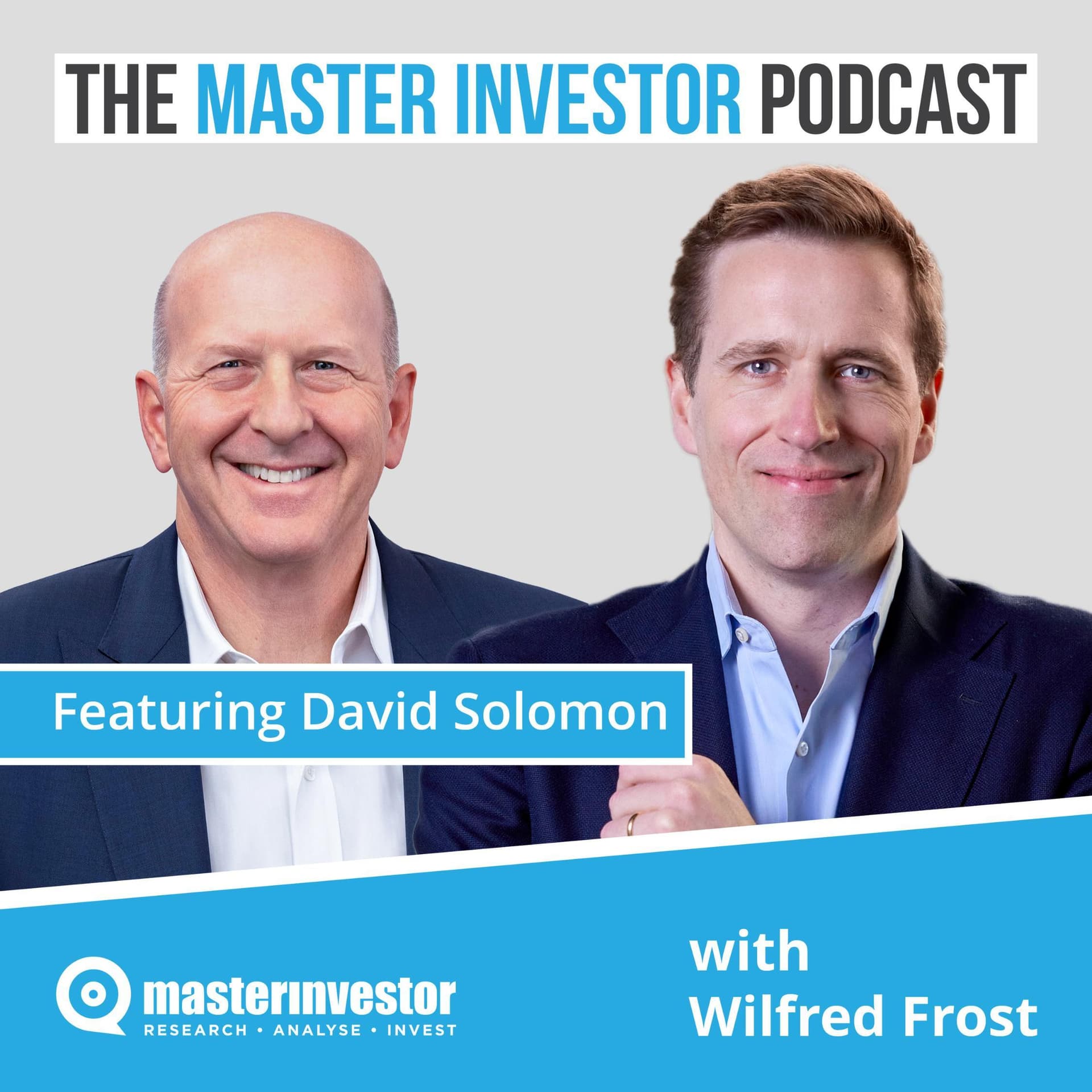
- Episode Title: Goldman Sachs CEO David Solomon on Leading Through The Noise; fragility of UK; Constructive US outlook
- Date: July 22, 2021
- Guest: David Solomon, Chairman and CEO of Goldman Sachs
- Key Themes:
- Leadership strategies and decision-making
- The current state of global markets and economic outlook
- The fragility of the UK’s position in the financial world
- Constructive viewpoint on the U.S. economy
---
Key Discussions and Insights
Leadership and Decision-Making
- Noise vs. Substance:
- Solomon emphasizes the importance of distinguishing between short-term noise and substantive policy changes.
- Effective leadership requires adaptability, conviction, and the willingness to revise decisions based on new information.
Market Outlook and Risks
- Market Conditions:
- Solomon reflects on the current market conditions, noting the all-time highs and the need to evaluate risks.
- Debt Concerns:
- He expresses concerns over rising U.S. debt levels and its implications for future growth and investment.
- Acknowledges the difficulty of reducing spending in the current political climate.
Fragility of the UK Financial Landscape
- London as a Financial Center:
- Solomon discusses the challenges facing London and the need for policies that support talent retention and capital formation.
- The impact of Brexit on London's position as a financial hub is highlighted.
U.S. Economic Outlook
- Constructive Perspective:
- Solomon is optimistic about the U.S. economic environment, highlighting potential growth opportunities in the next 6-18 months.
- Impact of Tariffs:
- He acknowledges that proposed long-term tariffs could be a drag on growth but believes the economy can absorb these changes.
Global Relationships and Diplomacy
- U.S. Global Standing:
- Solomon advocates for a cautious approach to interpreting changes in U.S. international relationships.
- He emphasizes the importance of the U.S. as a longstanding ally to the UK and Europe.
---
Key Takeaways
- Leadership Philosophy:
- Successful leadership requires the ability to listen, pivot strategies, and adapt to changing circumstances.
- Economic Resilience:
- The ability of economies to adapt and innovate is crucial for long-term growth.
- Policy Matters:
- Effective policy-making is essential for fostering an environment conducive to economic growth and maintaining competitive advantages.
---
Conclusion David Solomon's insights present a blend of cautious optimism and strategic foresight regarding the financial landscape, the evolution of markets, and the importance of effective leadership in navigating complexities. His emphasis on adaptability, the significance of sound policies, and the importance of maintaining global relationships resonates as critical factors for future economic success.
Next Episode Teaser: The following episode features Ray Dalio, founder of Bridgewater Associates, promising further insights into investment strategies and market dynamics.
*Please note that the content of The Master Investor Podcast serves informational purposes and should not be considered direct financial advice.*
Written by AI. May contain mistakes. Listen to the episode to check what was said.
Transcript
Automatic transcript. May contain errors.0:00I think that there's a lot of noise at the moment. One of my jobs running a big organization is to try to step back and be very thoughtful and think about what is substantive policy that's going to have substantive impact and what short term noise. I have sympathy. I have empathy, not just for the chancellor, but for anyone who's serving in one of these governments or one of these administrations. These are hard jobs. I think the most important thing about leadership is an ability to change your mind and an ability to make decisions, have conviction, but also be willing to constantly listen and be willing to say, nope, not working.
0:40We need to change. If you go back and you look at when we started, the market cap was between 60 and 70 billion. And now the market cap is 225 billion. And that's been a journey. It's not been a straight line. And yes, we feel good about it. It makes me feel good. It makes the team feel good. But what actually is exciting is the fact that we think we got a long way to go. Welcome to the Master Investor Podcast with me, Wilfred Frost, where we celebrate and learn from the success of some of the greatest investors, business leaders and politicians in the world, giving you, our listeners, the edge.
1:15We're recording this on Tuesday, the 22nd of July and coming to you from the London Stock Exchange in the beating heart of the City of London. My guest today is the most important person in capital markets globally. He has led one of the most storied institutions on Wall Street for the last seven years, guiding it through challenging times, including COVID, and setting it up for the long-term future, more than trebling the share price in the process. He is the chairman and CEO of Goldman Sachs, David Solomon. David, welcome to London and welcome to the Master Investor Podcast. It's great to see you.
1:55It's great to see you, Wilf. I'm happy to be here, happy to be at the Stock Exchange, happy to be with you and delighted to spend some time talking. I'm really excited about this. We've done a number of interviews, never here in London and never extended like this one is going to be. And I just have to jump straight in. Markets are all-time closing highs once again. You're in the risk management business. Is risk a little bit underpriced right now? I think it's hard to say that risk is underpriced. But whenever you see markets running in one direction, I think you always have to ask, if I looked forward six months from now and the market was 10 % lower, what happened?
2:38So we're in the risk management business to a broad degree at Goldman Sachs, and we spend a lot of time thinking about, you know, what if, what if this, what if that. A lot of the what ifs are probably small probabilities of happening. But I think it's a good time to evaluate what could break down some of the market momentum. Broadly, I'm quite constructive and positive about the current environment. And I actually think for our business and for capital markets broadly, we're probably going to have a pretty constructive run over the next 6, 12, 18 months. But I do see places where I would say markets are showing a very, very forward view of earnings and growth.
3:18And I think there are things out there that certainly could slow that, could check that to bring that back. But I'm quite constructive on the setup at the moment, particularly for a business like ours. Let's run through a couple of the risks. The U.S. debt position, does that worry you? I've talked extensively about the U.S. debt position and the change in fiscal policy over the last 10 to 15 years, particularly the last 10 years, and particularly since COVID and the pandemic. There was really a step function in fiscal change during the pandemic, coming out of the pandemic. And I think it's a very, very hard thing for governments, given the political environment we operate in, to shift or pull back.
4:00And so certainly reductions in how much we spend are very, very difficult. We continue to grow the amount that we're spending. So the question is, how much are we going to grow it? Can we constrain some of that growth? And that's countered and balanced by how well we can grow the economy. And so I do think debt levels are concerning. I do think that over time, the issue that we have to wrestle with if we continue to run the fiscal play that we're running and grow debt levels the way we are is that you've got to raise the cost of financing that debt as the debt grows, generally speaking. And as you do that, that crowds out other investment.
4:43And that crowding out of other investment slows growth. So I'm concerned about the level of debt and deficits, not just in the United States, but in most developed economies. I think it's politically very, very tough to slow that fiscal play. That fiscal play is making the growth environment quite constructive. And so that's why it's very, very hard to pull back on it. But I think when you look ahead over the next 10 years, this is going to create some speed bumps, some headwinds to growth. And probably at some point, there'll be some sort of an event that creates a little bit more discipline around the way we think about debt and deficits.
5:19There's so many countries, as you said, that are facing these sorts of debt dynamics. I mean, you used the word speed bumps there. Is there a chance of a much bigger crack in global bond markets? There always is a chance of a bigger crack in global bond markets. And when you talk about a crack, I think when people think about a crack, they think about an abrupt move or an abrupt change. That's absolutely possible. Something could spur a change. I mean, we've seen it. You could point to it. Here in the UK, there was a moment where there was a guilt crisis and there was a little bit of a panic. That I would call that as a very quick and short-term change and a perspective on a bond market.
5:59In the US, obviously, back in April, we saw pressure on the bond markets, although that pressure was relatively short-lived. I think you could see something like that. There could be an event that creates that kind of pressure, but I think the more likely scenario is we're growing our debt in the United States. The debt levels are growing. We're trying to run, or this administration is certainly trying to run a higher growth play. If we can't get growth to accelerate from here, to deal with the fact that we're spending more and we're growing the debt level, over time, rates gradually will creep up because the debt stack will grow.
6:36In rough numbers, we have$36,$37 trillion of debt in the US. As we're refinancing the current stack at higher rates than it's currently financed, we're growing it through the rest of the decade into the 40s. And if we continue to spend, you're growing it higher. So ultimately, the question is, at what price, if you want to have term treasury rates to finance that debt and not finance it all short against the policy rate. At what price do you have to raise or what investors demand to finance that term debt? And I think over time, the pressure is going to be on higher term rates, and that's going to be a secular change.
7:12And that will create pressure on growth and other fiscal issues over time. And what about tariffs? And I guess not so much the short-term negotiations and uncertainty, but it looks like we're going to settle long term with the US at least 10 % global tariffs, quite likely higher than that. Is that a bigger drag on growth and market sentiment than is currently priced in? I think it's a drag on growth for sure. I think what the market's telling you, I think you're right. The market has basically accepted that the trade regime in the United States is going to be different. And I think it's pricing in a 10 % base tariff and some specialized tariffs in certain industries.
7:56There's talk of trade deals in certain nations, but we don't actually have those deals. There's a difference between an agreement and an actual deal. I think there will be some trade deals over time, but I think we're going to operate with a base level of tariffs. And I think it's unclear exactly how much that will affect growth, But there will be an impact on growth from a 10 percent based tariff in these specialized tariffs. I think you'll get more of a handle on that during the fall. I think the forward growth prospects, if you listen to economists, including our economists, have been reduced as you look at the second half of the year and into early 26 because of the prospect of this tariff structure.
8:34But I do think it's absorbable. I don't think it pushes us into a recession, but I do think it's a change. And at the moment, it's still uncertain as to exactly how that filters through the economy. Is it a one-time step up in the price of goods and we kind of make that adjustment? Or are there other factors that cause it to actually have more of an inflationary effect as opposed to a one-time step up in the cost of goods? And that's hard to predict because we're dealing with something that's not fully absorbed yet. And what about the way that, I mean, you have tons of meetings with politicians and business leaders all around the world as you're doing this week and obviously off to see our prime minister and our chancellor shortly.
9:14Has it changed the way people view the United States? Has it changed the way they rely on America as a friend and ally? I think those are big picture questions that we should be very cautious about answering in a moment. So the U.S. has been an extraordinary ally to the U.K. and Europe for a long, long time. We're going through something, you know, at the moment that certainly is creating a lot of discussion about what's the base partnership and relationship like. But to to make bold statements about substantive change and the way these relationships, you know, will exist as we go forward, I think we should be very cautious about that.
10:02The US is an extraordinary economic ecosystem. I think one of the good things that's coming out of this is it's forcing some change in Europe, some more economic independence in Europe, which I think is good for growth in the world overall. And I would just be cautious about speculating as to significant changes in these very, very important bilateral relationships. It's really interesting because I agree some of the results have been impressive on defence spending, for example, across NATO members. But I guess the view from here from London might be maybe tariffs are the right way forward. But have they been delivered in quite an abrupt way to allies?
10:46Maybe central bank independence isn't the way always to go, but is the message delivered in a fair way to the individual? And I think the one that really baffles people in Europe is maybe Putin does have some legitimate arguments and Zelensky deserves to be criticized. But is the way that criticism was delivered fair? I guess that's what I'm getting at as to whether or not you hear that from any of your European partners, even Asian partners, that the tone with which some of the change in sentiment has been delivered by the U.S. president has caused a new perspective. Well, I mean, I certainly will.
11:23I certainly hear that from lots of people. I hear that from people. I mean, I've been in Europe six times in the last six months. And so I certainly hear it when I'm in Europe. I've been in Asia. I hear it when I'm in Asia. And by the way, I hear it in the United States. And by the way, I think it's sometimes too. So, you know, but I think you're making a point that's a very, very important point to some degree through the question you're asking. I think that there's a lot of noise at the moment. One of my jobs running a big organization is to try to step back and be very thoughtful and think about what is substantive policy that's going to have substantive impact and what short-term noise.
12:02And I think there's a lot of short-term noise at the moment. Now, I think it's very fair to talk about stylistically the way different people do different things. And I do think that matters. I'm not saying that that doesn't matter. I'm not dismissing it. But at the end of the day, when you talk about big structural changes in the economic order of the world and the way nations of the world relate, support each other, partnerships that are deep, I think you've got to be very cautious of allowing the noise in the short term to lead you to speculate to more substantive change. And I think we're going to see.
12:36I mentioned central banks there. There's been a lot of moving parts on this the last couple of weeks. Do you expect Jay Powell ultimately, all things considered, will finish his term? And if he weren't to, would that be bad for the US dollar? A couple of things that I'd say. First of all, I think that central bank independence and Federal Reserve independence, not just in the US, that's why I say central bank independence, has served us well. Central bank independence around monetary policy, Fed independence around monetary policy has served us very well. And I think it's very important. And I think it's something that we all should advocate for, fight for, strive for.
13:15I do think Jay Powell, I don't know, but if you ask me to guess, even money bet, I do think Jay Powell serves out his term, his chair term. And I would just caution people. Again, this gets to noise and substance. And again, there are things that we can say we don't like stylistically, but there's a long history of presidents trying to bully or influence central bank shares, Fed shares. Going back and go back to Lyndon Johnson. You can look at Richard Dixon. There's a long history of this. I'm not saying it's right. I'm not saying the way it's being done is right. But at the end of the day, there is a large group of people who set monetary policy.
14:04I think it should be done independently. I think the leadership of the Fed is very, very important. And, you know, I'm hopeful that the transition from Jay Powell when his term is up to the next Fed chairman will be a smooth one. There'll be somebody that the markets look to and view as competent in carrying out that responsibility to set monetary policy for the goals around price and inflation that are very, very important. And I think it's likely that that will survive just fine. Let's talk a little bit more about the UK. And of course, we're coming to our listeners and our viewers from LSEG in the heart of London for this episode.
14:48What does London still offer the world as a financial center? And what have we lost in London? Well, London, like New York, London has some deep structural advantages in the investment that the most significant financial firms in the world have made over a long period of time. But the financial industry is still driven by talent and capital formation. And those things are much more mobile than they were 25 years ago. So when we were talking in the back a few minutes ago, I was commenting to you because you were asking me about my travel schedule. I was talking about how much I move around to see our people because our workforce is much more dispersed than it used to be.
15:37I commented to you that 25 years ago, 93 or 95, 94 % of all of our employees were in four places, New York, London, Tokyo, and Hong Kong. And today it's much, much more dispersed. I think that if you look and you step back, London continues to be an important financial center. But because of Brexit, because of the way the world's evolving, the talent that was more centered here is more mobile. We as a firm have many more people on the continent in the last five years than we did five to 10 years ago. And I think that policy matters, incentives matter, and it's important that you get that balance right if you want to protect and retain the leadership position that the UK and London has in participating in the broad global financial system.
16:29And so I think it's fragile. I'm encouraged by some of what the current government is talking about in terms of supporting business and trying to support a more growth-oriented agenda. But if you don't set up policy that keeps talent here, that encourages capital formation here, I think over time you risk frame it. But it's interesting you said you're encouraged by what the government is talking about. We're a year in. Is it kind of time for rubber to meet the road? Do they need to get on with their act because of the fragile situation, I think was the word you used? I think this is something that's going on everywhere.
17:11And we're talking about it before we were talking about debt and deficits in the US and growth. governments have to put policy in place that drives growth and investment. And that's certainly the case here. I think it's important that we get on with it. And so policy matters, but politics are hard. And so I'm encouraged, for example, when the chancellor spoke here about regulation, She's talking about regulation, not just for safety and soundness, but also for growth. And now we have to see the action steps that actually follow through and encourage that. I was in Paris. We had our board in Paris a couple of months ago.
17:57And I put out a piece talking about the fact that there's a great opportunity for the European Union to take some action steps that will encourage more growth and investment. I'd say the same thing back in the United States. How do we drive growth and investment? So I do think when policy is set correctly, it encourages growth and investment. And that's the way we bring people along. That's the way people participate. And if you don't get that right, then we get to a much more difficult place. It's really interesting hearing you saying that. And obviously, Rachel Reeves gave her very high profile Mansion House speech last week.
18:36and you touched on the tone of it overall. And you mentioned as well that ring fencing is seemingly might be on the chopping block going forward. So we'll see if that materializes. It's also true she had a tough economic inheritance. The tax burden she inherited was at a post 1951 high, the debt level is at an all time high. Do you have sympathy for the job that she has to do at the moment? I guess it's not easy. And I'm not sure if you've seen this from afar, but of late, She was reduced to tears at one point in Parliament because of the pressure. Do you have sympathy for the Chancellor, the tough job that she has?
19:12I have sympathy. I have empathy, not just for the Chancellor, but for anyone who's serving in one of these governments or one of these administrations. These are hard jobs. These are people that I think want to do well and advance the nation, the economic prospects of the nation. but the politics are hard and the policy decisions and getting policy implemented is very difficult. You brought up ring fencing. Ring fencing is a very small, minute example that probably to most of the listeners, they don't even know what the specific issue is. I don't know. We have some geeky listeners. Okay. Maybe you have some geeky listeners, but at the end of the day, it's a place where the UK is an outlier.
19:53And by being an outlier, it prevents capital formation and growth, what's the justification for being an outlier? Why is this so difficult to change? Okay. And that's politics. That's not substantive policy because it's hard to make a substantive policy argument that this is like a great policy for the UK. So why is it so hard to change? So I've got a lot of sympathy and empathy for her. I've met with her a handful of times. I think she's smart. I think she's engaged. I enjoy talking to her and I'm hopeful she's going to make real progress. That's really interesting. Let's just talk about one other policy because a little bit of headlines that your former head of Goldman Sachs International, Richard Noddy, moved to Milan.
20:36And it was cited that the non-DOM rule change played a role in that. Is that another policy that will drive people away, more Goldman Sachs employees away? You said the situation was fragile. Is that something that should be revisited? I think when you look at any jurisdiction, tax policy has to make sense. Incentives matter. If you create tax policy or incentives that push people away, you harm your economy and you don't drive revenue increases. You know, at the end of the day, most economies have a barbell, you know, in terms of tax receipts. And that end of the barbell where you have very affluent people that have been successful, that pay a significant share of tax, if you push them away and you push those smart, talented people that are much more mobile away, I think you hurt your prospects for growth.
21:22And so I think all jurisdictions, whether you're talking about a nation or you're talking, if you look at the United States, you talk about states. You know, you can look at New York and, you know, California. Look at what's going on in Florida and Dallas and how they're attracting businesses and how they're attracting people. Incentives matter. And so I think this has to be done very, very thoughtfully. And tax policy has to make sense. It's got to create the right incentives. Without, and we talked about a couple of the areas there, but without being specific, without policy changes of that sort of ilk, do you think more Goldman Sachs headcount and other U.S.
21:57investment bank headcount will shift in time to the continent? I think there are different conflicting issues there. Because of Brexit, there are requirements around certain job functions and certain things that we do in our business that used to be done in London that now regulatorily are required to be done on the continent. And that's created a shift. what's interesting, and this is the point I want to make about talent mobility, Wolf, and it's a subtle point. And I'm seeing this here in Europe, and I'm seeing it also in the United States, for example. We now have very large offices with significant collections of interesting, talented people in a variety of places across the continent.
22:44So if you go back 10 years ago, I think we probably had 80 people in Paris. We have 400 people in Paris now. And so It's a real Goldman Sachs office with a lot of interesting Goldman Sachs people and partners and junior people. There's a real ecosystem of Goldman Sachs in Paris. That makes Paris a more interesting place for somebody who wants to work at Goldman Sachs to live. And so in Goldman Sachs today, if you're in Europe, you can live in London, you can live in Paris, you can live in Germany and Frankfurt or Munich, you can live in Italy, you can live in Switzerland. And we've got real offices.
23:18We've got a big, big, you know, what I'd call kind of a tech office in Warsaw. So we've got, you know, we've got lots going on. By the way, here in the UK, we've got a very, very interesting office up in Birmingham that's growing very nicely because we're finding very, very good talent, you know, up in Birmingham. But the same thing in the United States. If you go back to Goldman Sachs in the United States 25 years ago, we had 10 ,000 people, 9 ,500 of them were in New York. Today we have 25 ,000 people, 9 ,500 are in New York, but we've got 4 ,000 people in Dallas. We've got 3 ,500 people in Salt Lake City.
23:48We've got 400 people in Southern Florida. We have 1 ,000 people in Chicago. We've got 800 people in Atlanta. People can choose to live where they want to live. For us as a talent organization and the mobility of talent, we can give people more choices. And so people choose because the critical mass develops. I think for places like New York and London, you just have to recognize talent is more mobile. Talent organizations like Goldman Sachs are giving their employees more choices because we want to attract that talent. And so you've got to make sure that you've got a very, very positive stake in the ecosystem when you are in your location to retain talent and attract talent.
24:27Let's talk a little bit more about Goldman Sachs specifically. Saw the earnings last week, and there are lots of individual line items we could pick out, all of which I'm sure you were very, very pleased with. But I remember being at your investor day in New York in 2020 when you set out your five-year plan back then. I think I did the – I don't know if it was the only interview that day. I certainly did the first interview. You were there. I remember that now. And of all the targets I remember you talking passionately about, ROE was one of them. And we could talk about the great quarter in terms of earnings, but you're tracking at 14.8 % ROE this year.
25:03You're ahead of the target you had back in 2020, and you updated those targets since then. Is that the thing that pleases you most? Or in terms of that five-year transition, what jumps out to you? I think what pleases me most, Wilf, is that when this leadership team came into the firm in 2018, we really had a strong point of view about the need to evolve Goldman Sachs and set it up for growth for the next decade plus. And we spent a lot of 2019. I mean, you highlight this Investor Day happened in the end of January, the beginning of February in 2020. We spent a lot of 2019. By the way, everything changed about a month after that.
25:51About a month after it. But the Investor Day was before COVID really got going. But we spent a lot of 2019 really thinking about and talking about how we wanted to evolve the firm, what we wanted to do to our core business, how we wanted to invest in it and grow our core business, and then what were the areas of growth that we thought we could invest in and scale and really grow the business. Because I had a very strong belief that you can't run a public company. And Goldman Sachs had been on a journey where it was evolving from being a partnership to being a large public company. You can't run a public company if you don't grow.
26:26It's very, very hard to have a successful public stock if you don't grow. And that required difficult decisions, change in strategy, and an evolution. And we laid that out in 2020. And if you actually look, we've been executing on almost all of what we said successfully. And we've significantly grown the firm, significantly grown the market cap. And one of the outputs of that is higher returns, which is also helping to grow the market cap. And so the team's done an unbelievable job. People have worked very, very hard. People are very, very aligned. It hasn't been a straight line, but it's really brought us to a place where I think the firm, based on these decisions that we made five, six years ago, is set up very well to continue to grow, is extremely well positioned in its two large-scale businesses, global banking and markets and asset and wealth management.
Read the full transcript
27:15And I think the opportunity set for the firm over the next five, 10 years is really enormous. And so what we're excited about is that we had a view. We worked hard at it. We executed. There were some bumps. There were some mistakes. We adjusted. But we've got it to a place where we think it's very well positioned and the opportunity for further growth is quite strong. I mean, you mentioned the performance. I mean, the share price has more than trebled since you started, but it's more than doubled in just the last two years. And you've, over a two-year period, significantly outperformed all of the banks in the US.
27:50Does that make you feel good? You said there were some bumps along the way. Does it feel a great contrast now? You point to the share price. I'd highlight moment in time is important. The share price got into the low 400s in 2021. So it's true that over the last couple of years, it got lower. and then it's doubled. Seven tunnels. But it's a journey. The point is, if you go back and you look at when we started, the market cap was between$60 and$70 billion, and now the market cap is$225 billion. And that's been a journey. It's not been a straight line. Yes, we feel good about it. It makes me feel good.
28:28It makes the team feel good. But what actually is exciting is the fact that we think we've got a long way to go. And the client franchise is in extraordinary shape. And as you look forward and you think about the environment we're in, I actually think we've come through COVID, a very, very tough regulatory environment. Good news, no pandemic now, a better regulatory environment. We've been talking about governments running growthier plays. I think that's going to be a theme broadly across developed economies. And so I think we're in a place, AI as a productivity gainer in the enterprise, I think is a huge, huge opportunity.
29:08I think the world's set up for a period of time where the types of things we do are going to be quite active after being relatively muted for a period of time. And I think that's quite exciting because we can continue to grow our business and strengthen our position. during the speed bumps if we use your phrase you know two or three years ago i'm saying this from you know far watching as i was from london i'd moved back from the u.s some people reported it as if some of your deputies or the tenants were trying to make make a play for the for the crown as it were do you look back at that and think if you come for the king you best not miss um I think Goldman Sachs is an organization that has thrived on the value of partnership.
29:59We have four core values. Partnership is one of them. I think we've done an extraordinary job over the last 26 years since we've gone public. We are truly a public company, but we retain a partnership culture that I think is unique. And I think it differentiates a firm that allows us to attract more extraordinary talent. And there are enormous benefits. to the decisions we've made in that culture we've created. I think one of the parts of that culture is people speak up if they're not happy. And at times when the market environment is stressed and we're not performing as well as we'd like to perform, when candidly compensation goes down from higher years, there's often been noise inside Goldman Sachs.
30:42That was not the first period of time when that occurred. And I think it goes with the territory. But I think the firm is incredibly aligned at the moment. The partnership's incredibly aligned, and we're pushing the firm forward. And I think we're in a very, very good place. In terms of the strategy, two core buckets you mentioned in there, Semaphore, Liz Hoffman at Semaphore, who is often right on the money when it comes to reporting Goldman Sachs, reporting this morning that you're in the market for, it's a long article, I'd summarize the two key points, for an acquisition of size over 10 billion US dollars and in the asset management space.
31:17Is the gist of that correct? I haven't seen the article, but I'm asked constantly about our interest in doing something inorganic to accelerate our journey. You can go back and listen to the earnings call last week. I did, yeah. It's a question that is asked a number of times. And I'll say to you the same thing that I've said. I can't comment on Liz's article because I haven't seen it. But the opportunity for us to grow our asset and wealth management is a significant part of the growth strategy of the firm. Of course, if we could find something or some things that accelerate that journey and strengthen our competitive position, if you look at our asset wealth management business in aggregate, depending on how you look at it, fifth, sixth, seventh largest active asset manager, we supervise$3.3 trillion of assets.
32:07We have scale and we have a very unique leadership position because we really are in the business across the range of services from liquidity, fixed income, equity and alternatives. There's really nobody else that on a global basis has the breadth of that platform. But there are places where we'd like our scale to be more significant. And so, you know, we'd think about those things. However, acquisitions are difficult culturally. Really good assets generally aren't for sale. You can never pick the timing of when you can do something like that. If you go back, you look at Morgan Stanley, the acquisition of E-Trade was something that they talked about, thought about, wanted to do for over a decade.
32:52So you don't have the ability to pick and choose. and the bar, I think, for these things always has to be very high. And for us to do something significant, and$10 billion, by the way, would be significant, the bar has to be very, very high because at the end of the day, you've got to be sure that it's accelerating your journey and you're sure you can integrate it and deliver. It's interesting. The timing point, I guess, what's different from when I was covering you on a daily basis is, I guess, you've got the currency in the share price today that maybe you didn't three or four years ago in the valuation.
33:25a few things I want to race around I know we've got to let you get off on time because you're off to see some important people and going to Downing Street later on today we summarise I mean you've got a very positive tone despite the challenges both on Goldman Sachs specifically I think on the economy obviously the markets at all time highs which perhaps speaks for itself when you step back from it all is President Trump doing a lot more right than he's doing wrong? Well, I'm quite constructive and quite optimistic. And it's rooted just in a fundamental belief I have that the glass is half full.
34:03We live in an extraordinary world that is advancing because of extraordinary technology that candidly over time makes the world better. I think about technology and the evolution of technology. One of the things I'm super excited when you talk about this AI technology, of course. I'm excited about productivity and the enterprise, et cetera. But how about in health and medicine? What this technology is going to do for us in terms of improving quality of life, health, allowing us to continue to cure or treat disease. Just so many reasons to be very, very optimistic. And also as somebody that's been doing this for over 40 years, I've watched lots of things go wrong, lots of speed bumps, but we're an incredibly nimble society.
34:46We have an unbelievable ability to adapt, to evolve, to change. And generally speaking, we get through things and we move up to the right and we bring more people along. And I'm very optimistic that that's the direction of travel. And I happen to think at the moment we're at a relatively constructive economic period. And I do think that the regulatory burden that has existed in many nations. I talked about it when I was in Paris, in Europe, in the EU. You and I were just talking about it here. And I'd say in the US too, the last four years, the regulatory burden was very high. I think there are a variety of reasons as people get focused on growth that that regulatory pendulum is swinging.
35:29That is quite constructive. So I think there are things that the president is executing on well. There are things that I think are actually slowing growth or creating more tension. Trade would be one, but I think that we'll get through that and we'll move forward. I think getting the tax bill done was important. There are things in the tax bill that I agree with and I like. There are things that I wouldn't have put in the tax bill. The tax bill is more stimulative and that's something we're going to have to deal with. But net net, I think we're set up for a pretty constructive period of growth unless something comes along that really derails it.
36:09And those are left side small tails, but I'm pretty constructive at the moment. So next three questions we ask all our guests. And the first one is, what is the best strategic, the best leadership decision you think you've made in your career, your time at Goldman Sachs specifically? Can answer it how you like. Well, I appreciate the fact that I can answer it how I like because I intended to do that anyway. Exactly. Goes without saying. If you want to highlight a specific decision that I think has been a very important leadership decision that's been very important in my CEO tenure, and I'd also say that there have been some lessons for me in the context of this decision and looking back at it.
36:56The first day of my CEO tenure, October 1st, 2018, we put out a memo talking about a pilot for one Goldman Sachs to serve 30 significant clients of the firm. And it was an attempt by the leadership team to really set out that the client centricity of the firm was incredibly important. And we wanted to improve the way our clients experience the firm. And we decided to do it by creating a pilot for 30 very significant clients. And we They called it One Goldman Sachs. And we then put some incentives around it. Well, it really caught on. It really worked. And it has become an operating ethos that has significantly changed behavior and the way the firm operates with respect to serving clients.
37:48And I think it's materially advanced our business. And I think it's had a profound impact on our performance over the course of the last seven years. And the lesson, part of the lesson in this was this was trying something different to make sure people understood kind of where True North was on the compass. And it was simple. When someone said one Goldman Sachs, everybody might not have meant the same thing, but they understood the core value or the core principle of what it stood for. And you were able to really translate that into action. And if you put incentives against it, you really got the whole organization moving.
38:32And so I think it's a great example of how sometimes with leadership, something simple is required to move the needle. And this moved the needle. It strengthened our client franchise. It's had a profound impact on our wallet shares and our market shares broadly. And I don't know if it was the most important leadership decision I've ever made in a 42 two-year career, but it was a significant leadership decision that's had a very, very positive result for the firm and our client franchise. And very illustrative, which we love on this podcast. What about the worst? Boy, I've made a lot of mistakes.
39:12And I'm not very good at pointing to this one or that one and saying this was the worst, that was the worst. I think when you're in these leadership jobs, when anyone's in a leadership job, I think there are a couple of things that you have to understand. First of all, if you look at Roger Federer, and he said this publicly, he won 51 % of the points. So the best in the world gets things right, they get things wrong. You win points, you lose points. I think the most important thing about leadership is an ability to change your mind and an ability to make decisions, have conviction, but also be willing to constantly listen and be willing to say, nope, not working, we need to change.
39:52And, you know, I think there are places where we've really exhibited, you know, that ability to pivot or to change. And I've, you know, I've tried very hard with my leadership team at the firm to really work on a culture that says it's okay for us to say this isn't working, let's change. It's okay to change your point of view. It's okay to have a lot of conviction and change. And so, you know, I think we've made, you know, plenty of decisions that in hindsight we do differently. We've made people decisions we do differently. But when you realize that something's not been a good decision, the most powerful thing you can do from a leadership perspective is to acknowledge it and change it.
40:27And in terms of, you know, we celebrate success on this podcast. So what is the overriding piece of advice you have for our listeners that are pursuing success themselves? Well, first of all, it's a marathon. It's not a sprint. It's a journey. And I just think it's very, very important. One of the things I've learned over the course of the last, I've learned this in my career, but it's really been amplified to me over the last seven years as I've sat in this job and the seat is you have to have a North Star. You have to have a compass that's pointing north. You have to have a clear vision of where you're trying to go.
41:04You have to have conviction around that vision. of course you've got to be willing to listen and adjust but when you think about kind of north star and and the compass pointing north you've got to have a clear vision and you have to be prepared for the fact that it's not going to be a straight line you're going to be challenged on the direction of travel and you know if you've got conviction about where you're trying to go be patient do the right things be patient and ultimately performance is rewarded and execution you know on the vision And if the vision is correct, you know, we'll be we'll be embraced and we'll be rewarded.
41:39But it takes time and it's a journey. And it's, you know, there's no free lunch. There's no straight line. Hard work, showing up, persistence, resilience, all those things still matter in our complex world. And, you know, patience, patience really is a virtue. Well, David, it has been an absolute pleasure to catch up with you today and to have your wisdom and be able to share it with our listeners, particularly here in London for an extended conversation here at LSEG. Thank you so much for joining us. It's my pleasure, Wolf. It's great to see you always. And thank you so much for having me. That was the chairman and CEO of Goldman Sachs, David Solomon.
42:16And this episode was sponsored by LSEG. Next week, we'll be interviewing the Bridgewater founder, Ray Dalio. So make sure to subscribe ahead of that episode. And please do remember that nothing said in the Master Investor Podcast should be considered direct financial advice. There's more information in our show notes about that. The Master Investor Podcast is a production of Paradine Productions and Master Investor Podcast Limited in association with Bird Lime Media. If you've enjoyed this episode, please do subscribe and leave us a five-star review and see you next week with Ray Dalio.
42:58Thank you.
From the publisher
This week Wilf sits down for a rare, extended conversation with Goldman Sachs Chairman and CEO David Solomon in London, who shares his leadership advice while reflecting on the strategy that has seen his bank outperform his rivals in the last few years. He shares stark warnings about London's fragile position in the global financial system, the importance of getting policy right on both sides of the Atlantic, but ignoring the noise from the Trump administration and his constructive view on the US economy and Goldman's business over the next 18 months.
The content of The Master Investor Podcast is for informational purposes only and does not constitute financial, investment, or other professional advice. Always seek independent financial advice before making investment decisions
You can watch the full video on The Master Investor YouTube channel.
And follow @WilfredFrost on X.
This podcast is produced by Paradine Productions, The Master Investor Podcast Ltd in association with Bird Lime Media.