
In short
The Master Investor Podcast Episode Summary
Episode Title
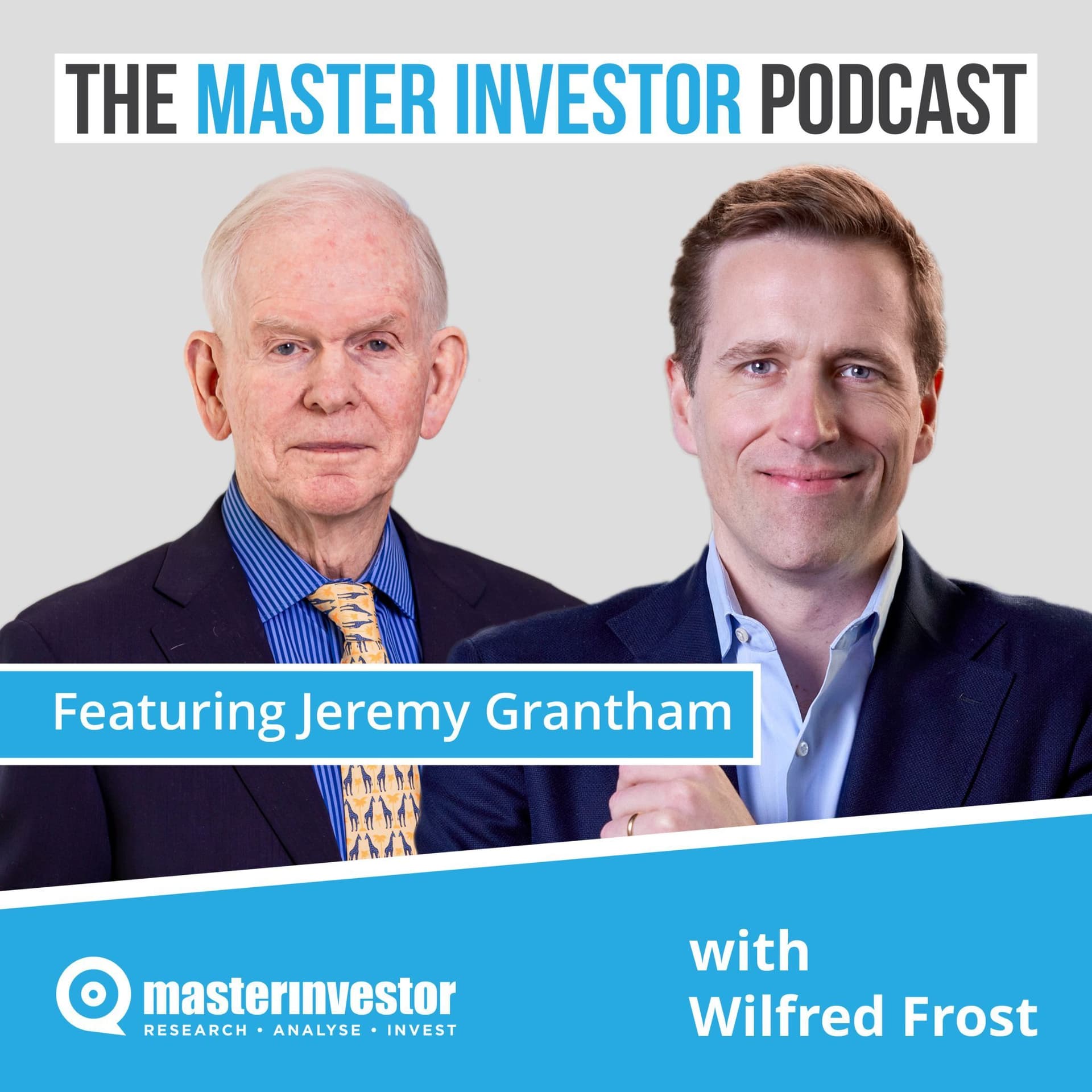
Jeremy Grantham: How to Predict a Stock Market Bubble — and Why Nvidia May Lead the Mag 7 Crash
Host
- Wilfred Frost
Guest
- Jeremy Grantham, founder and chairman of GMO, noted for predicting major stock market bubbles.
Episode Highlights
- Grantham discusses the implications of Nvidia reaching a $4 trillion market cap and parallels it to historic bubbles.
- He shares insights on market behavior, predicting crashes, and the dynamics of the current tech landscape, particularly focusing on the "Magnificent 7" tech companies.
---
Key Concepts and Discussions
Stock Market Bubbles
- Grantham has a long history of successfully predicting stock market bubbles including:
- The Japan bubble of the 1980s
- The dot-com bubble in the early 2000s
- The housing market crash in 2008
Nvidia's Market Cap
- Nvidia hitting a $4 trillion market cap is considered a signal of a nearing market bubble.
- Grantham likens Nvidia's success to the "guy selling shovels at the peak of the gold rush," indicating that while Nvidia may be thriving now, it could face severe downturns as competition escalates among the Magnificent 7 companies.
Historical Context
- Grantham emphasizes that historical patterns show that significant market highs often precede prolonged downturns, citing the following:
- Major market downturns often take years to recover from, as seen after the 1929 crash and the dot-com bubble.
Comparison with Dot-Com Bubble
- Grantham draws similarities between today's market dynamics and those of the late 1990s, particularly in tech investments.
- He notes that while tech advancements can drive initial market enthusiasm, they often lead to overvaluation and subsequent crashes.
Warning Signs and Investor Behavior
- Grantham discusses the danger of being too early in predicting market downturns and how it can lead to financial pain for investment firms.
- He acknowledges that the average investor has a unique advantage as they are not bound by the same pressures as institutional investors.
---
Key Takeaways
Current Market Dynamics
- The current market is characterized by a tendency towards overvaluation, similar to past bubbles, suggesting that a downturn may be inevitable.
- Grantham warns that conditions may appear positive in the short term but can quickly deteriorate.
Advice for Investors
- Grantham recommends that individual investors adopt a defensive posture, possibly holding significant cash reserves and diversifying into international stocks.
- He emphasizes the importance of stepping back to analyze data rather than getting swept up in market optimism.
The Role of AI in the Current Market
- The rise of AI technologies is expected to be transformative, but Grantham warns that it could also inflate valuations to unsustainable levels.
- Competition among the Magnificent 7 in AI may lead to volatility and challenges for all players in the sector.
---
Final Thoughts
- Grantham’s insights underscore the cyclical nature of markets, highlighting the importance of historical awareness in investment strategies.
- The episode serves as a cautionary reminder of the potential risks associated with speculative environments, particularly in high-growth sectors like technology.
Disclaimer
The content of The Master Investor Podcast serves informational purposes only and should not be construed as financial or investment advice. Always seek professional advice before making investment decisions.
Additional Resources
- Full video available on [The Master Investor YouTube channel](https://www.youtube.com/masterinvestorchannel).
- Follow host Wilfred Frost on [X](https://x.com/wilfredfrost?lang=en).
Production Credits
Produced by Paradine Productions, The Master Investor Podcast Ltd in association with Bird Lime Media.
Written by AI. May contain mistakes. Listen to the episode to check what was said.
Transcript
Automatic transcript. May contain errors.0:00It is the guy selling the shovels at the peak of the gold rush, isn't it? This is one hell of a gold rush. They have no magical monopoly power in the end. The history of the Mag 7 is divided into two halves. The half up until now where basically they each individually owned an area and the half going forward where increasingly they fight it out tooth and nail to see who is the biggest and best in AI. Welcome to the Master Investor Podcast with me, Wilfred Frost, where we celebrate and learn from the success of the greatest investors, business leaders and politicians in the world, giving you, our listeners, the edge.
0:47We're recording this on Wednesday, the 9th of July, with the FTSE 100 up 8.5 % year to date, the S &P 500 up 6.5 % year to date, and perhaps most notably today, NVIDIA just hit a$4 trillion market cap, the first company ever to do so. Well, I've said throughout on this podcast that we want to learn from the best, and today we really do have one of the best, Perhaps the greatest British investor around today, Jeremy Grantham. He is the founder, chairman and long-term investment strategist of GMO. At their peak, he was managing a staggering$155 billion. And he's famous for having correctly predicted some of the biggest market bubbles of the last five decades, including but not limited to the Japan bubble of the 1980s, the dot-com bubble at the turn of the century, and the housing market bubble in 2008.
1:52And he is my esteemed guest today. Jeremy, welcome to the Master Investor Podcast. Thank you. Nice to be here. Well, I mentioned there that you've predicted some of the biggest bubbles of the last few decades, and you've studied many going back for centuries. I mean, it's fair to say that stock market bubbles and the crashes that follow them are an area of passion for you. Yes. And let me say that I'm not going to be very optimistic today, for which I'm sorry, but you can't get blood out of a stone. And the good news for the listener is that I have not been responsible for portfolios for 15 years.
2:39So you are hearing my view as a long-term historian. I keep up. I'm particularly interested in the great bubbles. I've always argued that in the end, the only thing that really counts is the forming and breaking of the great bubbles. And I think you listed all of them that really matter with the probable exception of the Nifty 50 in 1972, where for the only time in history, quality stocks, boring old things like Coca-Cola, went to a 50 % premium and then became out of fashion for the next 20 years. Well, I wonder if we can do a bit of a deeper dive on the dot-com bubble at the turn of the century, because it seems like it might be the most similar to today with tech being at the centre of it.
3:34Is that fair to say, that comparison? And when did you start to call the top in that bubble and why? The market had never sold above 21 times earnings on the S &P, which it hit in 1929 at the peak. And it never got back there until that bubble, really. In 97 December, it finally reached 21. So since that was the highest PE in history, GMO and I became officially bearish, and we watched the PE rise from 21 steadily to 35. On rising earnings, this was a very painful experience, lasted for two and a quarter years, and we started out bearish. We became by 99 extremely bearish. So obviously that was a decent period of time where you, I think it'd be fair to say, were too early.
4:39Did it cause a great deal of damage to your business? Was it financially painful to you have been too early? You can't possibly call a bubble or a bust to the right day, except once every several lifetimes by sheer luck. What you can do, though, is identify bubbles that will eventually burst. And that turns out in the past to have been intellectually pretty straightforward. You can measure them. Some of them when they're way very high and all of them eventually go back to trend. And that movement from very high to back to trend has always made cash look very much better for quite a few years. And yes, we got that right.
5:26It always paid, even though we lost a lot of business, 98, 99, and early 2000. We averaged about 6%, 6.5 % annualized underperformance. People think that you don't want to underperform in a bear market, but that's nonsense. A bear market, everyone freezes. They don't fire you until they've had time to regroup at the bottom and think about it. But in a bull market, everyone's on edge talking to the people who are doing well, and they get awfully excited, and they are itching to fire you. And our ability to time the breaking of a bubble was by no means tight enough to avoid serious commercial pain.
6:13It is so difficult, in fact, that it's guaranteed that any large commercial investment firm will not attempt to emphatically call the end of a bubble. It's a terrible thing to do. It's lousy business. The odds are not in your favor. The client's impatience will make you regret it. So it guarantees that the average investor will never hear that the market is dreadfully dangerous and overpriced when it is, in fact, dreadfully dangerous and overpriced. It's fascinating to hear you say that. And, of course, a big part of that is those people that are marked against an index. And a lot of our listeners won't be.
6:55They'll be looking at their portfolios with an absolute mindset, and that might make it more legitimate to listen to some of your advice as we get through the rest of the podcast. Jeremy, I'm really interested. So last time you and I did an interview, September 2021, you struck a very bearish note then. And of course, that proved to be timely ahead of what was a significant pullback in 2022, albeit so far just a temporary one. As you look at the similarities then to the dot-com bubble and today to the dot-com bubble, are they the same as we sit here? Was that a temporary pullback of what is still to come or did we enter a new bull market?
7:45Let's make the point. Every bear market is temporary. We've lived in a world that has been growing quite nicely. That means however enthusiastic markets get, bear markets will be temporary. What the listener will not realize is that we have spent half the time since 1925 getting back to the old high, major highs, and half the time basically moving forward. So from 1929, you don't get back in real terms. The index doesn't recover until about 1958. And then when the oil crisis of 72 breaks, you don't get back until the mid-90s. When the tech bubble of 2000 breaks, you haven't made any money by 2011.
8:37These are not in significantly long periods of time. and they add up to half of all the time. And everyone thinks after having had a wonderful 17-year run of basically new high ground most of the time, the average investor thinks that this is normal, this is how we spend our time. Well, this is how we spend half our time. And the other half, licking our wounds and waiting to get back. In Japan, of course, the mother and father of all bubbles broke in 89. and adjusted for very little inflation, incidentally, adjusted for inflation, they hit a new high two or three, four years ago. That was a rather long wait from 89, 30 years.
9:24And I guess what you might be hinting at there is that the 2022 pullback was just that. It was just a short pullback and doesn't mean that the kind of bear market in the short term is done. Let me just say, it's hard to know how much the introduction of ChatGBT played. It was an introduction to the average investor, the average person, that a lot of important changes were going on in the world of AI. And most of us tried Chat out in a week or two and realized it was in its own way amazing. and most of us decided that it was going to be a game changer sooner or later. And what happened is the broad market stayed weak, but the MAG7, those seven giant global instant monopolies that we have in America, all of them American, made a huge gain.
10:29and all the way through 23 until very late in the fourth quarter, the rest of the S &P had not gone up. So it was very reluctantly leaving its bear market mindset. But those seven doubled and better and dragged the market kicking and screaming with it. And finally, they threw in the towel and decided that after all, they would also go up. So maybe without chat, that bear market would have continued on its way and finished what it started. It was about 60 % of what I would have needed to feel that it was a reasonable bear market in those circumstances. It's interesting to hear you mention the way that they sucked in the money.
11:19And obviously, as I mentioned, NVIDIA just hit$4 trillion today. Talk to me a little bit about how, on one level, the new innovation, the internet and the dot-com bubble AI today, makes you think, well, the market can keep going further and further. But the fact that they are so attractive makes the overvaluation more pronounced. Talk to me about valuations and earnings and the kind of effect that has as we near the late stage of a bubble, if indeed we're in one. People have the feeling that if something comes in that's new and brilliant, that you don't have to worry about a bubble. It's only if it's hype and it's underneath the surface, not serious, then you have to worry.
12:07And that's absolutely not the case. The more serious a new technology is, the more obvious it is that it's serious, the more guaranteed you are to have a bubble. So just think about it. You're dealing with the railroads. Everyone who isn't brain dead looks at the consequences of railroads expanding rapidly and sees that it will change everything, increase productivity, and be an enormous boost to the long-run well-being of the economy. And therefore, the ordinary person would love to invest because anything that important is bound to make them money. they think. And of course, that is absolutely true in the very long term, absolutely untrue in the short term.
12:58So what happens? They don't build one railroad track between Leeds and Manchester, two of the great industrial centers of the industrial revolution. They build six tracks, four at least of which are redundant. And the fifth one isn't that much good. And the sixth one, of course, is brilliant. And everybody loses their shirt. It was precisely the fact that it was obvious and hugely beneficial that guaranteed everyone would invest and everyone would lose money. And fast forward to the dot coms. The dot coms, again, you had to be brain dead to not realize it was changing the world. You could go click, click, click and find the cheapest item in the world of the kind that you wanted and have it delivered in a week.
13:54It was going to be amazing in many ways, and it was. But from the peak of 2000, one of the more amazing companies, Amazon, went down 92%. Okay, have you got that? Check it. 92 % decline. Yes, it had just gone up eight or nine times in a couple of years. And yes, it inherited the world after that. But I assure you, it is no fun going down 92%. And most of the others simply went out of business. The pet.coms all vaporized in three months to six months. It was precisely that people could see that dot-com was a brilliant idea that guaranteed everyone would overinvest. Everyone would start too many VCs, too many startups, and we'd get the six railroad tracks in every little area.
14:48This time, AI is at least as important, isn't it, as the dot-com. It's clearly important. It's going to be one heck of a ride. And pretty well, everyone can tell it's important. Everyone is putting their money behind it. And some of the greatest believers are the richest companies who can't buy enough of the chips from NVIDIA. The spending programs of the seven great companies, they're like, each company is like a medium-sized country. You know,$70 billion,$105 billion in a year, $40 billion, most of it ending up in the coffers of NVIDIA. So what is your reflection then, Jeremy, when we see NVIDIA today hit$4 trillion in market cap?
15:43Could it be similar to, as you just mentioned, Amazon's slipping peak to trough 90 % in the dot-com bubble? Is that possible with NVIDIA? Let's put it this way. When we talk about Amazon, we're picking the winner, right? We know we're picking the great winner. And one of the Mag 7, one of the guys spending$60 billion a year on AI. It's not just possible. I don't think it's even merely probable. I think at the very least, it's highly probable. It is the guy selling the shovels at the peak of the gold rush, isn't it? This is one hell of a gold rush. It's a much, much bigger chunk of GDP being spent on this than was ever spent on digging gold.
16:37And they're in the right place at the right time. They have no magical monopoly power in the end. And one of the things that's happening in the Mag-7 is AI is turning out to be the first suck every one of the seven in. We have watched over the last years on things like the cloud where one or two or three go in. But now all seven realize that AI is the game. And that means competition. This means the history of the Mag-7 is divided into two halves. The half up until now where basically they each individually owned an area. And the half going forward where increasingly they fight it out tooth and nail to see who is the biggest and best and hairy chestedest in AI.
17:34so their paths will not be as smooth as they were in the past. It's really interesting to hear say that about the Mag 7 which I think presumably you think are the still long-term success stories even if short-term they're going to have trouble but also allude to the fact that there'll be companies that struggle much more than that. I note, Jeremy, that in 2000, you predicted that the S &P 500 would be down by 2010. And obviously, you had some short-term pain in that moment. For the broad market, do you say the same today? In the next decade, the S &P 500 will be lower than it is today? Let's put it this way.
18:20I think it's quite likely. it's not of course certain weird and wonderful things happen but in terms of a historian i put a lot of weight on 1929 i think it's a wonderful example japan of course the mother of all of them it would be highly unlikely for this one to not be similar and at or around several years in the future, 5, 10, even 15, it's highly likely from a historical point of view that you'll reach a point where you would rather have been in cash. I know you said at the top that it's impossible to call the day, to call the moment. And I obviously wholeheartedly agree with that. But looking out for what the trigger might be, I was really interested to see some comments from Steve Eisman of Big Short fame.
19:18He was played by Steve Carell in that movie. He was on CNBC this week. And he was quite relaxed, actually, about the current market valuation. I just want to read you this quote, Jeremy. He said, what broke the internet bubble was not valuation. What broke the internet bubble was a recession that caused some of these companies to go bankrupt and do badly. So until there's something really bad happening, like a trade war, which is still a possibility, the valuation itself is not something I really pay much attention to. What do you think of that, of what Steve Eisman said? I guess, have we seen one of those potential triggers yet, or do you disagree with him?
19:57I kind of agree and disagree, but you go back to 1929, the market broke long before any negative data was available to the typical investor. They've been writing books about it for nearly 100 years. and they're not much the wiser. And my guess is that the economic data had turned down and it lagged so much up to three months before the typical investor got verified data. And the economy turned down very rapidly from some of the fastest growing quarters in the history of America in early 1929 and 28. Each one is different. You never know why did Japan go when it went? Why did the real estate market go when it went 1989, 1990?
20:54There was no overwhelmingly obvious fact. What I do agree with, though, is that the market is a kind of coincident indicator. The market, everyone thinks, is doing its best to predict the future. The aggregate market does not do that. We're just finishing a book with myself and Edward Chancellor, who is a specialist in market bubbles. And at the end of the book, we're saying, what are the lessons learned? And I have only two lessons. One of them is that homo sapiens is hugely tilted to wanting good news, a desperate preference for good news over bad news. Why not? I get that. And the other is they have no interest at all in the future.
21:44They extrapolate today's conditions forever. So if you're sitting there in 1929 and the data looks good and you're growing at 7 % annualized GDP, what the hell have you got to worry about? We never anticipate anything. They wait until they're punched in the nose. So the question is, are we being punched in the nose and do we realize it? We were being punched in the nose in October 29. We just didn't know it yet. Is the economy weakening? Has the damage from our strange changes in tariffs, has that been fully reacted to? Today's news flash was that 53 % of companies are reporting down profit margins, presumably because of tariffs.
22:41You look quite closely at the employment market as well as an indicator? Yes. The employment market suffers from very unreliable data here, there. You have to know each of the series, what their strengths and weaknesses are, and look for mistakes that occur. But net net, I'm led to believe that the employment market has been weakening for some time. The GDP has been weakening for some time. International relationships have never, have they been worse? Have seldom, if ever, been worse. Global trade, which has led us to glory since 1945, has obviously ended. A future historian will look back and say, my God, look at all the obvious signs of impending doom.
23:33And I am going to add a whole lot more to those from the fundamentals like resource problems, climate change damage, which is multiplying much faster than anyone feared. Toxicity and its effect on many things, including baby production, which is plummeting. Population growth is slowing all over the world. This has a truly profound economic effect, which has already been taking place for 10 or 15 years. You add this all up and you say, holy moly, and they were still optimistic. The average investor is not worried until the hammer lands on the head clearly and squarely. And he goes, ouch. Then he wakes up.
24:20If you add it together with my second and only second lesson about preference for good news, it means you extrapolate good conditions. You look to interpret all the data as good. You extrapolate that. And only when hit on the head every few years does the market go down. And once in a blue moon, you get hit from different directions, not only on the head, but here, there, and everywhere. And for a second or two, for a few months every 20 years, we exaggerate the bad news. We are capable because we live in the present. We are actually capable when things go really bad and really obvious of exaggerating the downside.
25:06Let me point out, 1974, being they had done that, the market was seven and a half times very depressed earnings. 1982, eight times very depressed earnings. 2000, 35 times very inflated earnings. This is not an organism trying to normalize. If it did that, it would multiply depressed earnings by high PEs and multiply inflated earnings by low PEs, wouldn't it? Tending to give you price to book, give or take. It does the exact opposite. It double counts given half a chance. So when things are bad, it'll put a low multiple on. When things are good, it will always look to put a high multiple on. So things look superficially good.
25:55The latest data is not bad. So put a very high multiple on it. Serious measures of value say that this is the highest price market in the history of the stock market of the US. This is not a good sign for long-term returns, by the way. If you go back and look at the second, third, and fourth most overpriced markets, you're looking at 1929, 2000, 1972, and the housing bubble of 07. This is an incredible bubble, but it is nothing like Japan. You know, Japan had never sold over 25 times earnings, and then it went to 65. So what was the consequence? The consequence was, A, every bear got washed out in Japan.
26:42Only a few bears in Europe and America survived, including us. We got out 100 % three years too soon. That did not cost us six points a year. That cost us over 10 points a year for three years, all of which we got back with a lot of interest. We went into the collapse, zero Japan, stayed there for five years. And Japan, as we know, spent 20 years before it hit a low and 30 years plus before it hit a new high. So the moral of the story was, we have done this in spades. The same result, it's killing to get the timing right, but the consequences are never different yet. It always goes back to reasonably priced eventually.
27:33So Jeremy, for those people listening at home who aren't professional investors and don't have a benchmark, Is the advice 100 % cash? No, but let me just point out that they do have a lot of advantages. A friend and I used to call this the amateurs advantage because they don't have the same career risk. If you're a pension fund officer reporting to a large committee of overconfident hedge fund guys and private equity guys, you're in deep doo-doo in these situations. You have to do what they want to do, regardless of how overpriced you think the market is. We knew a lot of pension fund offices who went through that in 2000.
28:21They knew the end was around the corner, but they had to keep their bosses happy. And so here we are, the most optimistic market in a way in history. And if you look for other signs, cryptocurrency is a pretty good sign. It has no dividend. You can't eat it. It won't keep you warm. It's good for nothing but trading. Such a speculative instrument is wonderful in a speculative market. And we've had the best speculative market for the last five years, or co-equal with 1929. Really magnificently speculative over a number of years. Just quickly, so if it's not 100 % cash, it's a lot of cash. And just quickly, what else should people hold?
29:07It turns out in 2000 and today that the rest of the world in equity markets were not that expensive. Sometimes everything goes together. That was not true in 2000. 2000 real estate was very cheap. Bonds were very cheap. Inflation protected tips yielded 4.3%, can you believe it, right at the market peak. And foreign stocks were not that expensive. The same is true today. You could buy a portfolio of European, Canada, Australia, and so on, and the rest of the world, and you will do okay. If the US market were to drop 50 % in the next two or three years, it might go down a while in sympathy, might go down 20%, but it will bounce very quickly.
29:59If you're feeling up for taking risk, I would put a lot of money outside the US in equities. And if you're feeling very nervous, I would have cash or some blend of those two. So, Jeremy Keene, as we've asked other investors and we plan to ask many more going through, what is the single best investment you've ever made? The single best investment advice is easy because I've only written two things that were not official quarterly letters. And one was a short two pager called reinvesting when terrified in March of 2009. And by sheer amazing luck, that was the day the market hit its low. S &P hit 666 on the day that our thing was posted, reinvesting when terrified.
30:55Reinvesting when terrified said, you will never call the low. Don't even think about it. Just look at the prices. It's the lowest it's been for 22 years. Our imputed return is double digit on the S &P and practically everything else on the planet. Make a plan. Make it today. A, present it to your bosses in the institutions. Even a half-baked plan is better than no plan because the world is going to suffer from terminal paralysis. The people with cash have learned to love it and they will be really reluctant to pay to get rid of it. And now is the time to strike. We didn't even take the advice as much as we should have done ourselves.
31:36But that was the best advice I've ever given. Do you have an overriding piece of investment advice for people listening today? Because obviously, we're not at that moment yet where one has to be brave and invest at cheap prices. I mean, for an individual, just step back and look at the data. Does it look good? Does the future look good? And don't be conned into being super optimistic by the professionals, by the industry that makes money from overconfidence, lots and lots of money. Look around for signs of crazy, bubbly behavior to the moon, to the moon sort of thing. which we have seen as splendidly in this last several years as we have ever seen in history, which is a high hurdle.
32:32Just use your own brains. And if you don't want to, follow my advice and buy international stocks and keep plenty of cash. Jeremy, thank you so much for joining me today. It has been an absolute delight. It's been a pleasure. And to our listeners, do stay tuned this weekend because on top of our episode just now on Jeremy's views on the current market, we'll be dropping some bonus content of him outlining what he sees as the biggest long -term risks, not just to the market, but to humanity more broadly. That's coming this weekend, so make sure to stay tuned for that. please remember that nothing in the master investor podcast should be considered direct financial advice we have more information on that in the show notes if you'd like to refer to them the master investor podcast is produced by paradine productions and master investor limited in association with bird lime media if you've enjoyed the podcast please subscribe and leave a five-star review and see you next week
33:45Thank you.
From the publisher
This week Wilf speaks to the man who has predicted some of the biggest stock market bubbles of the last 5 decades - Jeremy Grantham - who, on the day that Nvidia hits $4trn market cap, predicts we're nearing the top of another major bubble, likening Nvidia's success to the "guy selling the shovels at the peak of the gold rush". Striking a very bearish note on the US Magnificent 7, he discusses the pain that predicting crashes too early causes finance professionals, but how private individuals have advantages as long as they step back and look at the data, as he shares his advice for investors following a legendary career.
The content of The Master Investor Podcast is for informational purposes only and does not constitute financial, investment, or other professional advice. Always seek independent financial advice before making investment decisions
You can watch the full video on The Master Investor YouTube channel.
And follow @WilfredFrost on X.
This podcast is produced by Paradine Productions, The Master Investor Podcast Ltd in association with Bird Lime Media.