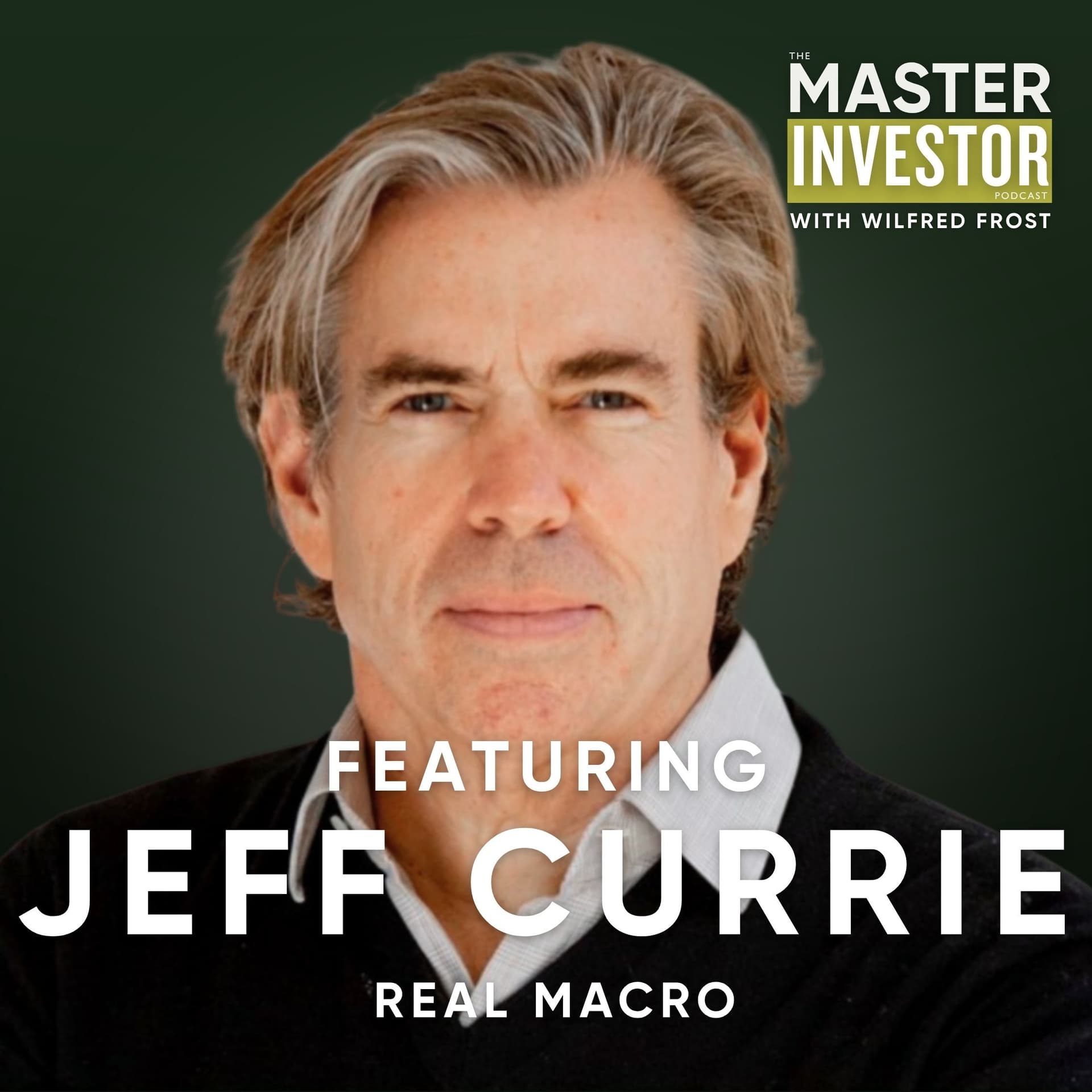
In short
Jeremy Grantham (GMO founder) explains long-term value investing, why “timing the market” is often a mislabel, how bubbles form, and why today’s macro risks (population decline, climate damage, geopolitics/trade war, live wars, and AI-driven uncertainty) make valuations dangerous.
Guest background
Jeremy Grantham, pre-war Quaker family (born 1938), Yorkshireman; founded and led GMO for decades; long-term strategist; managed up to about $150B AUM; 60-year career; says he “waits until bubbles appear” rather than predicting them.
Key claims
Win by exiting clearly overpriced stocks and concentrating in cheap ones; don’t stand ground in badly overpriced markets. Big profits require enduring painful drawdowns as valuations move from overpriced to extremely overpriced. Dividend discount “fair value” ratios guide stock selection. Momentum and quality both matter; quality is an “inefficiency” that outperforms despite lower risk. Markets extrapolate good news and ignore that high valuations predict tough times.
Notable examples
1929, 2000 dot-com, 2007 housing, 2009 “reinvesting when terrified” bottom (S&P ~666), 1973 inflation/margin squeeze, Japan’s late-1980s valuation peak. Mentions 2021 MAG-7 leadership reversal and AI’s “railroads-like” impact.
Guests
Jeremy Grantham only. Host: Wilfred Frost.
Written by AI. May contain mistakes. Listen to the episode to check what was said.
Chapters
Tap a time to open that second in VOMarket Timing vs. Value Investing
0:00 to 0:42
Learn about the importance of focusing on undervalued stocks instead of market timing.
“I don't think of it as timing the market.”
The Current Market Environment
0:42 to 1:28
Understand the risks present in today's market driven by various global issues.
“Has there ever been a more dangerous environment on every level as we began to talk about?”
The Mindset of an Investor
2:14 to 4:27
Explore Jeremy Grantham's unique investment philosophy and approach.
“He founded and led GMO for many decades and remains their long-term strategist.”
The Importance of Creativity in Investing
4:27 to 8:30
Discover the role of brainstorming and creativity in successful investing strategies.
“You also talk about your butterfly effect, how your ideas and thoughts flit around the garden like they have no concentration.”
Quality vs. Momentum in Investing
8:30 to 13:02
Evaluate the significance of quality in investments compared to momentum strategies.
“you're thinking on is fairly high level, you know, are small cap going to win this year?”
Navigating Market Inefficiencies
13:02 to 14:02
Learn about the challenges of identifying and profiting from market inefficiencies.
“You were paid for the privilege of owning the big, high-quality stocks.”
Enduring Pain for Long-Term Gains
14:02 to 16:22
Learn how enduring short-term losses can lead to long-term investment success.
“In terms of your investment approach, this quote jumped out to me.”
Market Timing vs. Value Investing
16:22 to 18:39
Discover the nuances between market timing and value investing strategies.
“Another couple of quotes before we get on to some moments in history to reflect on just on your broad investment style.”
The Performance Comparison
18:39 to 19:36
Explore the remarkable performance metrics of investing legends like Warren Buffett.
“So that run, those years I just outlined was up to 1987.”
The Impact of Indexing
19:36 to 21:19
Understand the significance of indexing in investment strategies and its historical context.
“It's just a recognition of how remarkable Warren Buffett's record has been.”
Show all 20 chapters
Analyzing Historical Investment Bubbles
22:20 to 28:00
Delve into the lessons from historic investment bubbles and their implications.
“I wanted to now focus, Jeremy, on a couple of particular moments in history and bubbles that were formed.”
Global Economic Trends and Workforce Growth
28:00 to 28:32
Explore the implications of declining populations on global economic growth.
“In some countries, Japan, South Korea, China, all dropping like a stone.”
Lessons from Historical Market Trends
28:54 to 33:08
Jeremy Grantham discusses market behaviors during inflationary periods.
“Again, talking about the 70s there, 1973 specifically.”
The Feather Analogy in Market Predictions
33:08 to 33:51
Understand Grantham's analogy of feathers to illustrate market behavior and value.
“And for me, value is a gravitational equivalent.”
Analyzing Current Market Conditions
33:51 to 37:40
Grantham evaluates current market conditions and potential future bubbles.
“This sponsorship does not constitute financial advice.”
The Impact of Geopolitical Events on Markets
37:40 to 42:07
Discussing the effects of war, oil prices, and economic conditions on markets.
“So this is the first time where something as powerful as AI, you know, it's like someone discovering the railroads in the middle of 1930.”
Market Predictions in a Dangerous World
42:07 to 44:55
Explore the current state of the market amidst geopolitical tensions and economic uncertainties.
“And things can get really bad in a real hurry.”
Reinvesting When Terrified
44:55 to 46:43
Learn about the importance of having a battle plan during market downturns and the psychology of investing.
“And famously, you told people that stocks had gone incredibly cheap and they should go out and buy them, and it was a great, great call.”
Valuation Metrics and Market Timing
46:43 to 48:40
Understand key valuation metrics and how they inform decisions about investing during market lows.
“And that's very hard to convince yourself of, I guess, in the moment.”
Lessons from Eisenhower's Farewell Address
48:40 to 50:53
Reflect on the broader implications of Eisenhower's speech on contemporary economic and social issues.
“It reminds me as well to check on the title being The Making of a Permabear.”
Transcript
Automatic transcript. May contain errors.0:00I don't think of it as timing the market. I think of it as getting out of clearly overpriced stocks and concentrating always on the ones that are cheap. And every time you buy a small stock, you could say, oh, you're timing the market, you're timing that stock. Are you or are you just in the long run always going to win eventually if you own the cheaper stocks? And so do not stand your ground in badly overpriced stock markets unless eventually you want to take it on the chin. And of course, in the meantime, other people are outperforming you. But in the longer run, you win. Has there ever been a more dangerous environment on every level as we began to talk about?
0:48Every level. Population bust, climate change, geopolitics, trade war. actual live war in two or three places. And things can get really bad in a real hurry. And how does the market reflect this? I'll tell you. By having one of the two or three highest priced markets in the history of business. And if you think the future looks one of the two or three best futures that we have ever had in the last 100 years. You're smoking dope, right? This is a fraught, dangerous, growth-limiting world.
1:37Welcome to the Master Investor Podcast with me, Wilfred Frost, where we celebrate and learn from the success of the greatest investors, business leaders, and politicians in the world, giving you, our listeners, The Edge. The Master Investor Podcast is sponsored by LSEG, Interactive Brokers, the World Gold Council and BNY Investments. Please do remember the views expressed in this podcast are for general information purposes only. Nothing in the podcast constitutes a financial promotion, investment advice or a personal recommendation. More on that in the show notes. My guest today, Jeremy Grantham, is a true investment legend.
2:19He founded and led GMO for many decades and remains their long-term strategist. At his peak, they managed a staggering $150 billion in AUM and oversaw some consistent extended periods of enormous outperformance during his 60-year investment career. Famously, Jeremy, of course, predicted all of the major stock market bubbles of his six-decade investment career and often the corresponding rallies as well. Jeremy, welcome back to the Master Investor podcast. This is our fourth interview. We did two on CNBC, one obviously on the podcast so far. It's great to see you in person. Nice to be here. And welcome back to the podcast.
3:06And I have to object to predicting. I didn't predict the bubbles. I said that they had arrived when they arrived. But they hadn't burst yet. If I could predict them coming out of nowhere, that would be very handy. All I can do is wait until they appear. They always seem pretty darn obvious. And say, look, there it is. and you're absolutely right to correct me there and I'm sure you're going to be correcting me a lot through this which is what I look forward to so we can share in your wisdom and I wanted to begin Jeremy by getting into your mindset as a person and how that led to the type of investor you are I've so enjoyed reading the making of a perma bear the perils of long-term investing in a Short-Term World, which was published in January this year.
3:59And I've learned a lot about you personally in it that I didn't know before. You're a pre-war baby born in 1938. Your family were Quakers and you're a Yorkshireman. And I love how all of those things together you point to gave you the appreciation for finding good value. You wrote that every Yorkshireman worth his salt is born with the natural understanding that cheap is better than expensive. I think that's fair to say. You also talk about your butterfly effect, how your ideas and thoughts flit around the garden like they have no concentration. Tell me what you mean by that and why that is important and why you were such a great investment thinker.
4:46Well, it's probably self-justification. I have a hard time spending too long on a given topic and tend to move on much to the irritation of my colleagues usually onto a slightly different topic or a completely different topic. But the thing is I'm quite persistent. So after a little bit, I come back. And anyone who's got any interest in gardening will notice that that is exactly how butterflies work. You think they're just here and gone, but they're not. They can stay around for a day or two. and they're constantly coming back to the same flowers. And then off they go. They don't spend long on a given flower, but they keep coming back.
5:26And I have found that that is exactly the way that brainstorming should proceed. If you hammer away too earnestly, which is a tendency, oh, stay on topic, stay on topic. And in fact, what happens is you just get stale, you're beating your head on the wall, and it's no good to anybody. The worst thing you can do is stay on topic. you know what the topics are take some time out wander around the periphery a bit come back to the original and when you come back your brain is a little open you have an insight maybe with any luck and and just do not hammer away it's seen as a virtue and i think it blocks the creative juices you also wrote in the book very hard work does get in the way of thinking because you're so busy shoveling in new data, you have little time to really think.
6:19Do investment professionals today spend too long in the Excel spreadsheets or perhaps in the AI building models today? But rather than what do you mean by really think? It's not it's not typing numbers into a spreadsheet. No, it's walking across Boston Common and having a shower before you go there and just thinking, where are we? What's going on? What am I working on? Let the brain travel at a convenient walking speed and see where it goes. I used to reckon that by the time I'd arrived at work in the good old days, of which there were maybe about 30, I would have had two or three ideas. Mostly, according to my colleagues, pretty silly ideas.
7:08And I was blessed with a colleague, Chris Darnell, who was the only human being who could persuade me that an idea was idiot in about 20 seconds. Ben Inker can do it in 10 minutes or an hour, and no one else can do it, period. I'm very hard to convince. But Chris could do it so fast that I'd hardly got my brilliant new idea out. Then I was, oh, how obvious. And that combination is absolutely formidable, by the way. have someone who's got lots and lots of ideas, mostly ridiculous or superficial, and one guy who is an idea destroyer who just looks through, points out the fatal fallacy, and you move on.
7:54And we would go through 10 or 20 ideas to find one to put into the pile for further research. And on that note, you say, again, another quote, I'm going to throw lots of your great quotes from your book, Jeremy, at you during this interview, I hope you don't mind. another one saying getting the big picture right is everything one or two good ideas a year are enough we'll come to some of the scale of your outperformance in a moment but it's really just one or two a year that leads to that investment legendary status yeah and there's plenty of years i would have settled for one um i didn't get it but um if the idea if the level you're thinking on is fairly high level, you know, are small cap going to win this year?
8:41You don't need to hit too many. Just knowing that small cap are on a roll might be a single idea that will power you through three or four years of outperformance. And when you get it right, it doesn't even that difficult. You can't really implement it badly enough not to win if you get the big ideas, right?
9:33In terms of narrowing down, and there's too often generalizations used and labels used in investing, but narrowing down the type of investor you were, the real winner, if I'm right, for you was basically a dividend discount model with your adaptations that you guys made to it. But that was at core what you focused on? Yeah, I wouldn't call that an idea. It was just how we measured the quality of our other ideas. Every stock would have a dividend discount ratio. What ratio of fair value was it? 0.79, you were 21 % cheap. 1.12, you were 12 % overpriced. And then we'd add them all together. And it turned out that the sum of all the small ones was very cheap.
10:25The sum of all the big ones on average was very expensive and so on. And it gave us a measuring kit to test whether our instinct was right and very handy. And clearly, therefore, you weighed up the value and that was much more your focus than was other factors like growth and momentum. But I guess you had an appreciation for the importance of those other factors. I kind of, you had quite a long set of chapters on this part of the book, which I really enjoyed. And stepping back from it all, it was almost as if you begrudgingly accepted that momentum was a significant factor. No, actually, I have a sneaking respect for anything that works, however ludicrous it may be.
11:19And of course, momentum is a pretty simple-minded inefficiency. It really shouldn't work. And it's worked pretty well, I'm sure, all my investment career and a lot before. And it still works in many forms. And it just says, you know, a body in motion tends to stay in motion for a while. And I remember when the market efficiency guys were saying, there is no information in pricing alone. And random walk down Wall Street guy, Burton Malkiel. And if the day he said that, you had looked back 20 years and you had asked the profound quantitative question, hands up who did best last year, and you took the 10 % best, they outperformed by three or four points the following year.
12:06Information in pricing alone. He was completely wrong and provably wrong for the last 20, 30 years before he said it. But academics can be like that. I think the biggest inefficiency was always quality. You know, quality has less debt, higher returns, more stability, goes bankrupt less. However you torture the data, you can't persuade anyone that quality is a risk factor. The higher the quality, the lower the risk. And yet, quality outperformed. It's outperformed forever. And it should be minus a point, right, a year. The AAA bond underperforms, you know, the B bond by about a point a year. and the AAA stock should do the same for the same reason, less risk.
12:52And it didn't. It outperformed by about half a percent a year. So there was a freebie return and an inefficiency of about 1.5 % a year. You were paid for the privilege of owning the big, high-quality stocks. And the academics went for decades without picking that up and making a fuss about it. So you referenced there they went for decades without picking that up. um so have markets gotten more efficient over time has your job gotten harder or not no as my career went on i tended to gravitate to bigger and bigger issues starting with stocks and then sectors and then markets and so on just because i i found them a bit different and more interesting and the critical critical question is are the are the magnificent inefficiencies the bubbles where ridiculous meme stocks go up six times in a year.
13:54Are they more now than they were? I would say, if anything, a little worse than they ever were. In terms of your investment approach, this quote jumped out to me. We never made tons of money without taking painful losses beforehand. You need to have the confidence to hold your positions when it moves against you and to increase your weighting as it gets more attractive. Value gives you that confidence. I mean, we'll come to some of the more painful bits of your underperformance in a moment, but if you've done the work and you're confident in your position, I guess you can see through those moments in time, but it must have been very tough.
14:35No, it is tough. And you do have to believe the data. And the catch-22, really, is that if you want to have a three sigma bubble, the super colossal bubbles that have occurred once or twice in 100 years, you don't get there overnight. You get there via a pretty substantial bubble of the kind that you see every 30 years. And you don't get there overnight. You get there via, yeah, it's a bubble. It's a two sigma event, the kind that occurs every 15 years. And if you want to make real money, you have to go from overpriced to very overpriced to, oh my God, extremely overpriced. And from that point, you make a fortune.
15:24But by that point, you have taken a lot of grief. You know, you bought it when it was cheap. The market moved against you by 50%. You're now cosmically cheap. And it's from those points, 1929, 2000, that you go down a lot and you outperform the market by an amazing amount if you're in the right place. In 2000, there were plenty of places to hide. The market went down 50%. Our portfolios were up quite nicely over the three years. Well, kudos to you to seeing it through as you did so many times against, you know. Well, there are not many when you think about it. You know, three or four. Three or four.
16:03Well, I've been in the business for 60 years. That's true. That's true. But, you know, particularly in the run up to the dot-com ball of buffing, you describe in the book, you know, losing a lot of the clients, some personal positions as well that you had that caused pain. Another couple of quotes before we get on to some moments in history to reflect on just on your broad investment style. And I love this because, you know, so many people say it's impossible to time the market. And, you know, I think it kind of is on any individual stock. But again, I love the sort of bold positions you take.
16:41And you say market timing, in my view, is a disparaging tag used by some buy and hold investors to put down anything that involves using your brain. These are the same people who watch the locomotive coming down the tracks and in the name of discipline get run down. And I mean, so timing the market is something for those big asset allocation decisions in particular, once a decade or so rather than daily on an individual stock you believe you have to try and do. No, I don't think of it as timing the market. I think of it as getting out of clearly overpriced stocks and concentrating always on the ones that are cheap.
17:23and every time you buy a small stock, you could say, oh, you're timing the market. You're timing that stock. Are you or are you just in the long run always going to win eventually if you own the cheaper stocks? And so do not stand your ground in badly overpriced stock markets unless eventually you want to take it on the chin. And of course in the meantime, other people are outperforming you. but in the longer run you win um on that note your performance throughout as we know those of us that are in the business or study the business know was was outstanding the scale of it across a couple of the decades i had underappreciated so six out of the eight years when you're at battery march outperformed one of them was in line one of them was behind and then your first nine years at gmo after founding it, you outperformed every single year with an annual outperformance of 8 % per annum.
18:29Yeah. That's right, 8 % per annum. 8 % per annum. So that run of performance, which was, you know, the 16 years. Would double your money, by the way. Eight, nines, and 72. Rule of 72. So that run, those years I just outlined was up to 1987. Was that the best moment? there were some great moments but that is 8 % per annum for 9 years is unheard of in a way, no it isn't unheard of, Warren Buffett has done 9 % for a whole lot longer and that actually it's that statement that makes me realise how good that sucker is I mean, that in our best 8 years out of 60 years of trying I'm sorry, best 9 years we couldn't quite equal his 45 or 50 year average.
19:20That's pretty dismal. Wait a minute, it's 35, 40, 60 years, jeepers creepers. 60 years of averaging 9 % and we can muster 9 years of adding 8. It's not dismal. No, it's not dismal. It's just a recognition of how remarkable Warren Buffett's record has been. Whilst you mention, is he the greatest of all time?
19:47Why is he so good? In terms of adding percentages to basically a buy and hold portfolio, yeah I guess he has no rivals that I can think of. I'd have to say there are other measures out there who has been the most useful. Of course it's Jack Bogle because he gritted his teeth and kept driving that idea of indexing through 30 years of little interest. And then finally, the internal logic, there's a power of the logic of that idea begins to take over. And to have an organization whose Christmas bonuses depend on how much money you save investors, this is a pretty far cry from what everyone else was doing.
20:39So yeah, Warren Buffett gets the medal for making money. A simple, entertaining goal. But Jack Bogle gets the medal for doing the most useful thing in the investment business, saving millions of people, billions of dollars, perhaps even more. But Jack Bogle credits you, which I was holding my hands up unaware of, the impact. You came up with the idea of indexing before him. Yeah. And he gives you that credit. Yes, he does. Together with Dean LeBaron.
21:19This episode is sponsored by Interactive Brokers. Building wealth starts with the right broker, and Interactive Brokers helps you reach your goals with powerful tools, global market access, low costs and unmatched financial strength. That's why the best informed investors choose IBKR. Learn more at ibkr.com forward slash master investor.
21:48Hey guys, Wilf here. I wanted to flag Jim Mellon's upcoming Master Investor Show on the 25th of April in London in person. It's always a fabulous event with 5 ,000 investment enthusiasts like you expected to attend loads of panels and speakers, including me on the main stage at lunchtime interviewing Jim Mellon. Visit masterinvestorshow.com to register or check the show notes for a special link and discount code to register for free.
22:20I wanted to now focus, Jeremy, on a couple of particular moments in history and bubbles that were formed. Starting with 1999, you are talking about how a client was giving you a lot of grief because you guys had identified the bubble early and taken a more anti-risk approach and therefore were underperforming for a number of years. Although making decent money, by the way, beating the long-term pension fund targets, perhaps as much as 7 % a year, but the market was 13%. Right. So you were identifying that. And And this is what you said you were pushing back to the client by saying. You said, I went over the pitch.
23:06I described how cheap some of the nooks and crannies of the market were, how inflation-linked bonds yielded 4%, how regular bonds yielded handsomely. Value was off the scale and as cheap as it had been in 1974. REITs sold at a discount to their NAV and so on and so forth. Could you apply all of that to today as well? No. 2000 was wonderful because it gave you many places to hide. The REITs, real estate sold at a discount to building the building. REITs sold at a discount to the properties they had bought. The 9%, you must be joking, right at the top of the market when the S &P was down to a yield of 1.6, which had never seen such a low level even in 1929.
23:57And there it was. I mean, small cap was cheap. And then you have other markets, like the housing bubble of 2007, almost nowhere to hide. That was a risk bubble. Everything risky was overpriced. There were no obviously cheap assets in 08. Now this one is in the middle. This is
24:32happily quite like 2000. So you have half the bubbles have great alternatives to the US market. half of them do not. Half of them represent a general tendency to all go together and some of them do not. And this one, I remember at the beginning of last year saying in a podcast that we had nothing against non-US equities. We wouldn't touch the US equity market. But the rest of the world, emerging markets, European stocks, Australian, Canadian, the rest of the world's equity markets were extremely reasonable. In terms of one sort of similarity to 1999, I guess it was another decade where a lot of people were talking about the potential boost in productivity and with it the potential boost in GDP that might come from a new technology, the internet then, AI this time around.
25:39Talk to me why that was a foolish point of view to have, because in all of the work you've done, GDP growth itself and productivity growth itself doesn't in fact necessarily correlate with strong equity returns. Yeah, there's been no easy relationship in the past between high-priced markets and and the growth in the future. And that's what it gets down to, right? And in every bull market, they say the future must be wonderful, otherwise the market wouldn't be so high priced. And it's quite the reverse. If you say, what are the three or four terrible times? They are not randomly distributed. They are precisely following the great bubbles.
26:25So the Great Depression precisely follows the famous 1929 peak. And Japan's last 10 years, last 20 years, precisely follows that amazing 65 times earnings in 1989. There's no example of a high PE predicting higher profits, higher growth, higher productivity in history. What they do predict is tough times. And if ever there was likely to be a case of that, it's now. You know, everything has been done wrong. We've taken wonderful post-war growth in international trade and done our best to mess it up with tariffs and trade war. And done our best to destabilize geopolitics. Our relationships with Russia, China, and so on.
27:23I'm sure they've been worse with one or the other several times. But to have both of them at the same time, this is distinctly uncomfortable. And then we have the long-term climate change, which up until two years ago was something you talked about, but no one listened. And now in the last two years, the billion-plus damages, floods and droughts and fires are so thick and fast that they may be knocking half a percent off global GDP. And they're getting worse all the time. Then you have the population beginning to decline. In some countries, Japan, South Korea, China, all dropping like a stone.
28:07And they're going to do it as far as the eye can see. So the world is going to have to get used to slower growth in the workforce. The declining populations, it's a factor we talked about at length in our first episode, and I refer people back to that and the bonus episode in particular. where we touched on a lot of your long-term risks.
28:31This episode is brought to you by LSEG, the leading global financial markets, infrastructure, data, and analytics provider. To learn more about how LSEG connects businesses, investors, and markets worldwide, visit lseg.com.
28:54you mentioned there the worst thing geopolitical situation which brings me to one other comparison i wanted to to touch on this you wrote about the 1970s um talking about 1973 in particular market the market hates high inflation and weak profit margins you wrote when those two factors become extreme the market should sell at seven or eight times earnings and it did at the trough, the S &P 500 was down 55%. Again, talking about the 70s there, 1973 specifically. I picked that out just because of the situation of the last six weeks. Are you reminded of some of the challenges of the 1970s as the Iran war has kicked off and the obvious impact on oil prices and inflation?
29:37Yes, I think we as a species have a tendency to think happy thoughts. We do wishful thinking extremely well. I believe it's a survival characteristic. I think that pessimists, that this was not a good survival characteristic for 150 ,000 years. And so we've kind of bred out the real pessimists mainly. And so we're a very happy thinking species. And certainly if you studied the stock market now and forever, you'd conclude that. Given half a chance, we will generously interpret the future and say how good things will be. If the economic data is bad, we say whoopee, this will give an excuse for the Fed to cut rates and the market goes up.
Read the full transcript
30:24And if the economic growth is good, we say whoopee, profits will be high and the stock market goes up. So it's always looking for an excuse to be cheerful and over explain the good news. we tend to extrapolate. So if the conditions are good, I get that, they extrapolate them forever. So 1929, you had perfect economics in the summer of 29. Extrapolate that forever, you expect human behavior being what it is, you'll have a ridiculously high PE. And then in 2000, the great profit margins, highest in history, multiplied by 35 times earnings. Again, you must be joking. So you had four times book. And from four times book, you can only expect what you got, as you could in 29.
31:16I mean, this is not rocket science. They're very, very obvious. The question that one should focus on most of the time is, and how come that isn't on the front page. And I've tried to answer that in the book, that it's not a business strategy. Any big corporation in finance has to tell you that everything is fine all the time and go over the cliff together and then make as much money as they can sorting things out. And that's what they do. You will never have the Goldman's, JP Morgan's, Morgan Stanley's are never going to tell you to get your tail out of the market because it's dreadfully overpriced.
31:59And they can see that it's dreadfully overpriced. So dear viewer, do not think because no one serious is telling you to sell out that this means the market is reasonably priced. It simply does not. On that note, tell me about the analogy of a feather that you came up with. You stand on the top of a high rise in Miami in a hurricane and with a bag of feathers and you them in the air. And some of them will land within half a minute, a block away, and some of them will be swept up to Maine in eight days like some poor songbird from the Caribbean. They just get caught up and they can't get out.
32:43But you do know something with absolute confidence about those feathers, every single last one of them. They will all hit the ground. So that's a classic example where you know something with absolute certainty in the long term, but absolutely no certainty about the short term. And even though the short term is followed by another short term, it's followed by another short term. Nevertheless, you know with absolute certainty that sooner or later, the gravitational effect will win. And for me, value is a gravitational equivalent. Sooner or later, being cheap has consequences. Being expensive has consequences.
33:22And it will eventually wear you down. However much you're to the moon, to the moon, and you're winning over a month or two, eventually, value will out.
33:49institutions worldwide. This sponsorship does not constitute financial advice.
34:00Let's focus in on today's markets with all of that in mind, Jeremy. This book was published in January. Obviously, you formed a lot of the ideas and conclusions in it throughout the year or so leading up to it. In the book, you talk about the conditions that are needed for a bubble to ultimately burst. There's lots of them in there. But I wanted to read this particular one, because as you describe it as it's the strangest condition of all. You say this, the strangest condition of all when the previous high beta market leaders turn strongly down, yet the market, led by blue chips, continues strongly up.
34:45This very strange condition only happened in 1929, 1972 and 2000, and never in between. I guess in the last few months, we could say that the MAG-7 has rolled over, and yet the rest of the market has held up quite well. Would you add late 2025, early 2026 to that list of when that has occurred? Maybe I should. I haven't. I've been too busy, I guess, doing book tours. But what I would add to that list was 21. And we had a podcast together in 2021. 2021, everything that didn't have earnings and wasn't substantial, that had done so well the previous year, I mean, magnificently off the low, the COVID low, had started to go down.
35:44And that was classic. And that gave me the confidence to write Let the Wild Rumpus Begin was the name of the quarterly letter, which is only the second time in my life. if I use language that said anything about timing. And gratifyingly, the S &P tanked. Worst bond market year in history ever. S &P down 25, Mag7 down 40, growth stocks down 35. And then in late October or whenever it was, chat GBT comes out. And it didn't stop the rest of the market from being wobbly, they continued to drift off for another 10 months. But the MAG-7 went up so much and they were so big already that they took the S &P with them.
36:39And then after 10 months, the S &P general decided they would throw in the towel and become bulls. And the question is how would the economy have been if we hadn't had the frenzy of investing in AI? I mean, it compares with the railroads. It's just massive and it changes the economy. And secondly, a lot of money was made that would not have been made without it. And animal spirits are very important. So you had a kick up in animal spirits and you had real help on the capex and from AI investing. And without that, my guess is we might very well have tipped into a mild or moderate recession, not a serious one I suspect.
37:32And the market instead of stopping down 25%, the S &P would probably have gone down maybe 40 % or more and we had a real bear market. So this is the first time where something as powerful as AI, you know, it's like someone discovering the railroads in the middle of 1930. It would have been a different world. And it had never happened before. And it will probably never happen again. But it nipped. So I suspect that that indicator had worked once again. And I suspect that right now it's not a fully-fledged indicator. One of the problems here is the MAG-7 are high-quality companies, so that scrambles the data.
38:18It's clearly not a picture where the strong, safe companies are doing well and the racy specs are doing badly because the MAG7 are mostly closer to being big quality stocks than they are to being flaky junk, aren't they? So it's a harder world to figure this out now. It's interesting because I guess I'd sort of thought since October, which is roughly one of the highs recently of the MAG7 and the market holding up more broadly, people talk in a bullish sense the market is broadening out as a positive factor reading your book it almost turned it on its head for me and made it thought this is actually a negative factor it's it's the the final the last hurrah before the market collapses yeah well let me let me just say i am now going to go back and and get some help and go through the data and and the downside of my job description recently is I'm not on top of market data as much as I used to be.
39:28And these are not easy issues. They're quite complicated. And I think there is a possibility that there's some information in what you say that they have begun, the leaders have begun to lose a bit of steam. And of course, you could argue that the market was broadening in each of these. In the late stage of 1929, the flakes were getting hammered. The ones who'd gone up 80 % in 28 were down in 29. And you could say, oh, well, that's because the breath has picked up and everyone's doing well. I think the phenomenon has a lot to do with Mr. Prince saying as long as the music's playing, I've got to keep dancing.
40:15What he didn't add is, but I don't have to dance with Pumatek, the most advanced stock in 99. The market is so crazy high that even though I've got to keep dancing, I think I'll start dancing with Coca-Cola, thank you. Because come the end of the world, it won't be as painful. If I dance with Pumatek, I might go out of business completely. and I think that's what causes the phenomenon and I think it's probably more right than wrong and easy enough to understand. And just on circling to the Iran war stuff again, since the start of the war, the NASDAQ 100 is actually up 1 % after a rally last week on ceasefire hopes, which now might be a bit weaker.
41:09oil prices are up 50 % odd. Can that hold? Obviously, every major move in oil up has caused a recession, without exception, just check it. And we can withstand a lot of things, but we can't easily withstand a massive increase in the price of critical fuel. It can't be done. And in a sense, nothing is ever sustained, but that is clearly painful and will create balancing effects. Market gets weak, demand gets less, etc. Has there ever been a more dangerous environment on every level as we began to talk about? Every level, population bust, climate change, geopolitics, trade war, actual live war in two or three places.
42:11And things can get really bad in a real hurry. And how does the market reflect this? I'll tell you. By having one of the two or three highest price markets in the history of business. And if you think the future looks one of the two or three best futures that we have ever had in the last hundred years, you're smoking dope, right? This is a fraught, dangerous, growth-limiting world. Now, I grant you, AI is wonderfully complicated with the caveat that nobody, from Nobel Prize winners all the way down, you have never seen such a divergence of opinion. Sometimes the Nobel Prize winners think one thing and the rank and file think the other.
43:02But this is at every level, opinion is split. It will bury us. We'll lose all our jobs. It may build a car. It may drive a car, but it will not buy a bloody car. So you're absolutely profoundly going to unbalance supply and demand here. And we are, ask anyone who deals with commodities, supply and demand when in slight imbalance and the price of copper or the price of natural gas will go through the roof or collapse. And you're now, for the first time I can think of, you're beginning to play games with the balance between supply and demand of human beings and consumption and the marketplace. and that's why no one knows.
43:51On paper, you can dream about huge productivity gains, but if those people are just sitting on the beach, what is the use of those productivity gains? Anyway, it's infinitely complicated and on top of what is already a complicated world, other than watch your tail, I think there's no material chance that it will overcome the long list of problems. It will mitigate some, it will be brilliant for some, and it will generate its own set of problems. I think it's a very, very dangerous time that we're living in from an economic point of view, from a stock market point of view, from a social point of view, and just from a geopolitical point of view, from war.
44:43Should we really be reflecting this with the highest price market in history? it seems classically illogical but that was the case in 1929 prior to the Great Depression two final questions for me Jeremy the first it's taken us a while to get here so I apologize for this but you know we've often focused on you calling the or observing the tops in markets but you've clearly done it brilliantly the bottoms as well otherwise you wouldn't have had that our performance that we reflected on earlier to the day you did it after uh the 2009 march 2009 um it might have been to the week only but the wall street journal refused to uh publish the letter you sent into them i didn't get around to studying it yeah they didn't get around i don't think they refused it they haven't read it they hadn't read it it hadn't gone into the paper such that when you then published it yourself a few days later, it literally marked the day.
45:43It was the day. And famously, you told people that stocks had gone incredibly cheap and they should go out and buy them, and it was a great, great call. It's called reinvesting when terrified. Reinvesting when terrified. And it makes the point, if you're not terrified, you're not paying attention. It wasn't that I was arguing with their terror. It was that I knew that terror from 1974, where merely getting your body to work was hard, you know, left foot forward, right foot. Oh, God. And we called it terminal paralysis. The market was so bad, so crushing, that you could hardly think, let alone have a battle plan.
46:21And we were beginning to get like that in 2009. So get a battle plan, I argue. It doesn't matter if it's a bad plan. But any plan will be better than paralysis. And this is what you write about. I mean, read the whole memo, but this line jumps out to me. Be aware that the market does not turn when it sees light at the end of the tunnel. It turns when all looks black, but just a subtle shade less black than the day before. And that's very hard to convince yourself of, I guess, in the moment. Yeah. What was... And it accounts for why no one in general... picks the bottom or the top. Picks it up or the top for that reason.
47:04There might be other reasons. I say in the book that this is the kind of thing you get right every one or two lifetimes. And I get one, which is reinvesting and terrified. I'm very happy to have one. I didn't expect any more. What was the P that highlighted to you or other valuation metric that you must be very close to that level. If we get that again after the next pullback, when it might not be the perfect bottom, but it's enough that you say, guys, go out there. There's not that much downside left. Yeah. No, that low could have been even lower. By the way, it was 666 on the S &P. So the market is now up more than 10 times.
47:48Not bad, eh? And we did it on our dividend discount model which just said on our data, the market seems priced to deliver handsomely over its long-term average. I think it was 12 real for the next seven years. So we had a seven-year forecast. It was priced about as high as it had been. It was the highest price on our seven-year forecast for 22 years. And I believed then and now that the market was not going to be quite as cheap as it had been in the 70s and so on. So even though the PE had been quite a lot lower in 74 and 82, I didn't think it was likely to get there. Possible, but unlikely. And so I was happy to to call the game when it was just very cheap.
48:46It reminds me as well to check on the title being The Making of a Permabear. It's almost as if perma bear should be an inverted commas. I voted for it. Did you? I did. I voted for it and I lost that battle and a few others. I didn't know that. The subtitle is right on target. The perils of long-term investment. That is amazing. I had that thought as well. My final question, Jeremy, we really are out of time. I've kept you for longer than we should have done. But you reflect towards the end of the book on President Eisenhower's departure speech and how everyone dwells on military comments given his background.
49:32Well, beware the military-industrial complex. I mean, give me a break. That is an amazing thing for a president to have said. It was. And then this line as well, though, is the one I picked out because it surprised me. And you were observing that people don't focus on this one enough, which was to say, as we peer into society's future, we must avoid the impulse to live only for today, plundering for our own ease and convenience the precious resources of tomorrow. We can't mortgage the material assets of our grandchildren without risking the loss also of their political and spiritual heritage. Wow.
50:07It is amazing, isn't it? Isn't it a great speech? There has never been a comment on the topic of living within our means. No president since then or before has come even close. Not the ones you like, not the ones you dislike. Not even close. It was remarkable. And the saddest thing of all is he starts out by thanking both sides of the house for their constant and considerable cooperation. Holy cow. What a great final speech he gave. Jeremy, this is a fantastic book. I really enjoyed reading it. I've really adored catching up with you again in person. And I thank you once again for joining us on the Master Investor Podcast.
50:53Thank you. What a pleasure. Jeremy Grantham, of course, founder of GMO, author of making of a perma bear in inverted commas should be. Up next on the Master Investor podcast will be Stephanie Link. Make sure to follow or subscribe if you've not done so already. And our thanks again to Jeremy Grantham. Thank you. The Master Investor podcast is sponsored by LSEG, Interactive Brokers, the World Gold Council and BNY Investments. Please do remember the views expressed in this podcast are for general information purposes only. Nothing in the podcast constitutes a financial promotion, investment advice, or a personal recommendation.
51:35More on that in the show notes. This podcast is produced by Paradine Productions and Master Investor Limited in association with Birdline Media. If you've enjoyed the show, please do subscribe on YouTube or click follow on your podcast platform and you'll be automatically notified each time a new episode drops.
From the publisher
Jeremy Grantham is one of the greatest investors of all time, and is famous for correctly identifying the four major stock market bubbles of his 60 year investment career. He joins Wilf to discuss the key ideas of his new book The Making of a Perma Bear: The Perils of Long-Term Investing in a Short-Term World and what they mean for investors today.
Jeremy and Wilf explore the factors that drove him to admire value stocks; what makes for good idea generation and decision making when it comes to investing; and the factors he identified that academics missed.
In particular they explore why quality stocks and momentum remain persistent – and often misunderstood – market inefficiencies, and why this created the opportunity for the extraordinary outperformance he delivered at the firm he founded – GMO (Grantham, Mayo, & van Otterloo). But they also discuss why value is the ultimate gravitational market force that delivers performance over the long term.
Looking at today’s environment, Grantham assesses the Iran War’s impact on oil prices, AI, meme stocks and the “Magnificent Seven”, drawing parallels with 1970s, 1999, 2007 and the post-Covid boom. He sets out the conditions he believes typically lead to a bubble bursting and also tackles longer-term headwinds – from demographics and de-globalisation to climate damage and geopolitical risk – arguing that these are fundamentally at odds with the near-record valuations investors are currently paying.
Along the way, Grantham discusses his early role in the birth of index investing; his respect for Warren Buffett and Jack Bogle; why most institutions will never tell clients to get out before a crash; and how to know when to “reinvest when terrified”.
This is a candid, insightful masterclass from one of the defining investment thinkers of the last half-century.
Recorded Monday 13th April 2026.
You can watch the full video on The Master Investor Podcast YouTube channel
And follow @WilfredFrost on X and Linked In
If you’d like to attend the upcoming Master Investor Show in London on Saturday 25 April, where I’ll be interviewing Jim Mellon amongst others, with over 5000 like minded investors in attendance, then click the link below and use code “MIPOD” for a free ticket:
https://forms.reg.buzz/masterinvestorshow-2026/mipod
Sponsored by BNY Investments, Interactive Brokers - ibkr.com/masterinvestor, The World Gold Council and London Stock Exchange Group (LSEG).
The Master Investor Podcast is produced by Paradine Productions, Master Investor Ltd in association with Bird Lime Media.
This podcast is for information purposes only. It does not constitute an invitation or inducement to engage in any investment activity. It is not a financial promotion as defined under section 21 of the Financial Services and Markets Act 2000 (FSMA). The views expressed by the presenter of this podcast are those of the presenter and are provided in the course of journalism. This podcast benefits from the exemption under Article 20 of the Financial Services and Markets Act 2000 (Financial Promotion) Order 2005 (FPO), It does not require approval by a person authorised under the FSMA. Generic information, not identifying any specific investment, fund, provider or service, about a class of investments such as shares, bonds, derivatives and cryptoassets, might be provided and/or discussed during this podcast. Such discussion falls within the generic promotions exemption (Article 17 of the FPO). Such discussion is not a financial promotion requiring approval by an authorised person under section 21 of the FSMA. Investing involves risk. You should consult a suitably qualified adviser who can assess your individual circumstances before making any investment decision.