In short
The Master Investor Podcast - Episode Summary
Podcast Title
The Master Investor Podcast with Wilfred Frost
Episode Title
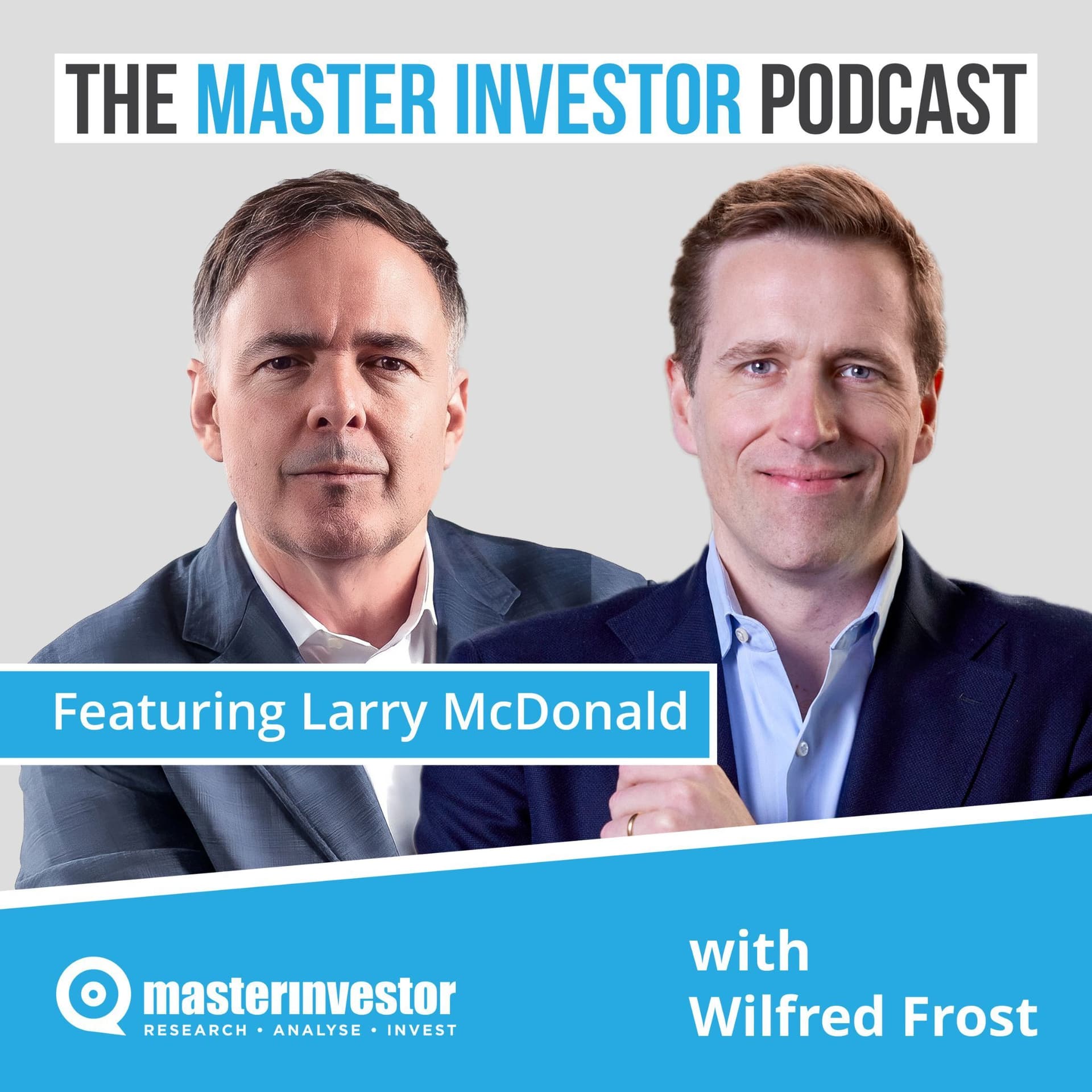
Larry McDonald: Inflation’s Not Dead, Commodities Are Just Starting, and Why Passive Investing Could Break the Market
Episode Description
In this episode, Larry McDonald—author of *The Bear Traps Report* and former Lehman trader—shares insights regarding the current economic landscape, inflation, and the implications for investment strategies. He emphasizes the importance of patience in trading and discusses the potential risks and opportunities in commodities and the stock market.
---
Key Concepts and Themes
- Inflation Dynamics
- McDonald asserts that inflation is still a critical concern and "nowhere near dead."
- Highlights the debt level in the U.S. exceeding $37 trillion, with the Federal Reserve owning a substantial part of it.
- Discusses "financial repression," where interest rates are kept below inflation to manage debt.
- Passive Investing Risks
- Over 50% of U.S. market capitalization is in passive ETFs, which can distort market dynamics.
- Concerns about a shrinking free float of stocks and potential valuations becoming disconnected from fundamentals.
- The implications for equity prices if passive strategies continue to dominate.
- Commodities Outlook
- Emphasizes a potential commodity bullish trend due to increased spending on infrastructure and energy demands.
- McDonald expects significant capital shifts towards commodities, particularly in the context of growing inflation.
- Portfolio Construction Strategy
- Advocates for a shift from the traditional 60-40 portfolio model to a more aggressive 35-35-30 allocation (35% stocks, 35% bonds, 30% commodities).
- Suggests that commodities will provide protection against inflation in the coming years.
- Capitulation and Market Timing
- Discusses the "capitulation cleansing process" which indicates market bottoms and potential new bull markets.
- Stresses the importance of waiting for the right investment opportunities rather than frequent trading.
---
Insights from Larry McDonald
- Long-Term Perspective:
McDonald reflects on lessons learned from his career, particularly during the collapse of Lehman Brothers. He suggests that many investors struggle to take a long-term perspective in adverse market conditions.
- Market Signals:
The podcast emphasizes the importance of "listening" to market trends and signals, advocating for a data-driven approach to investing rather than speculative trading based on emotion.
- Investment Advice:
- Avoid over-trading and focus on fewer, high-quality trades per year.
- Be mindful of external economic pressures, such as inflation and central bank policies, as they significantly impact asset prices.
---
Conclusion
In this episode with Larry McDonald, listeners gain valuable insights into the current economic environment, the imminent threats of inflation, and practical advice on portfolio management. McDonald’s extensive experience and lessons from market legends provide a compelling narrative for navigating today's complex investing landscape.
---
Additional Resources
- Subscribe to *The Bear Traps Report*: info@thebeartrapsreport.com
- Watch the full video discussion on [The Master Investor YouTube channel](https://www.youtube.com/@TheMasterInvestorPodcast).
- Follow Wilfred Frost on X: [@WilfredFrost](https://x.com/wilfredfrost?lang=en).
---
Disclaimer The content of The Master Investor Podcast is for informational purposes only and does not constitute financial, investment, or other professional advice. Always seek independent financial advice before making investment decisions.
Written by AI. May contain mistakes. Listen to the episode to check what was said.
Transcript
Automatic transcript. May contain errors.0:00If I can go back and give myself advice at 30 years old, I'd sit in the boat and wait for those one to two trades a year. And that's the fascinating thing about writing the book is Tepper, Einhorn and Munger all kind of saying the same thing. Sitting in the boat, you know, waiting for that great moment, that great purchase, that massive capitulation into a great new opportunity and really doing your homework instead of like over trading, over investing. These guys are in the valley are injecting testosterone into their veins. This is a$2 trillion CapEx binge on artificial intelligence. But when you really dig into it, we need another$2 trillion on the infrastructure rebuild for energy.
0:46And so it's much more commodity bullish this time around. More and more institutional investors, we respect people that were really bullish meta a year ago, really bullish, have flipped. because they just know that this is like a Manhattan Project, Dr. Oppenheimer situation. Welcome to the Master Investor Podcast with me, Wilfred Frost, where we celebrate and learn from the success of the greatest investors, business leaders and politicians in the world, giving you, our listeners, the edge. We're recording this on Tuesday, the 11th of August. My guest today is one of the best connected men in markets globally.
1:32He writes the Bear Traps Report newsletter daily, which I read avidly, and that stemmed from having written the definitive book on the collapse of Lehman Brothers, A Colossal Failure of Common Sense, which was a New York Times bestseller and has led to another book, which came out a year or so ago, How to Listen when markets speak. And even though it came out just over a year ago, it sits still number two on the Amazon finance books charts. I am delighted to introduce today the author of that book and of the Daily Bear Traps Report, Larry McDonald. Larry, welcome to the Master Investor Podcast.
2:13Thank you, Wilf, and thanks for the team. It's great to connect again. I missed you from the CNBC days. We were part of that same team, so I appreciate you. Likewise, three or four years, of course, since we've spoken there. But great also to have a chance for a longer form discussion in this podcast format. And I must say, I really did adore the book. I feel like it was educational as if it was a textbook, but it flowed like it was a novel because of the way you kind of draw on your personal experiences and your personal conversations with some of the greatest investors alive today. I also learned of your penchant for white burgundy, which there's a bottle on ice for you next time we catch up in person, Larry.
2:58But I have to say that the thing I wanted to start on is, and I'm oversimplifying this a little bit, how to listen when markets speak is the title. But a lot of people kind of want to predict what is going to happen in the world and work out what that will mean for markets and for their portfolio. But a big part of this book is turning that on its head and looking at the market and what it's doing and what it's actually telling you is going to happen in the real world. Is that a kind of fair premise of the book? Yeah, I mean, that's very fair. And I think the other part is when you take a piece of information and you surround it with other pieces of information and great intelligence, great mentors, and you can see shifts changing in the conversation with great mentors, and we can get into that, then it kind of makes that piece of information more valuable and you can kind of see trends shift.
3:56Well, let's dive into sort of a key factor of the book, and that's the debt dynamics at the moment. And we've had a number of bearish guests on this topic on the podcast in the last seven weeks from Jeremy Grantham to Ray Dalio. But I always get struck by the scale of some of the statistics. This is one of them that you point to in the book. $33 trillion in debt. the Fed owns 8.5 trillion of it already. And you're particularly pointing to how the overall ownership of the debt is changing and the problems that creates going forward. Right now, we're up to 37 trillion. So the only way out of that 37 trillion debt hole is what we call financial repression.
4:44And all that means is they want to massage interest rates below inflation to monetize the debt. And as you say, we have less international support in buying the debt now. So the Fed's going to have to eventually buy more. And that's why I think you look in Washington and we've kind of cut rates early without really killing inflation, right? We cut rates a hundred basis points so far. And the Trump team wants to cut a whole more and that beast in the market that serpent of inflation is nowhere near dead and that's what gets you into this kind of a world where the bond market needs more support than is naturally there in a free market if inflation normalizes at a higher trajectory with higher bond yields than the previous regime then that entire portfolio of instruction of the previous 20 years has to flip a little bit and that's why if you look today uh copper names or equities are outperforming uh software i mean this is just incredible by 30 over the last year i mean this is something that never happened in a in a certain deflationary trajectory that is where where the market the beast in the market can see that certainty of deflation looking forward then your kind of uh Your software growth names are going to do really well, right?
6:11But once you go into a world with higher rates and higher inflation, companies that own assets like copper companies, like natural gas, we can go on and on, on, on, uranium, those types of companies do much better because they protect the portfolio from that kind of sustained inflation and bond yield world. And so I want to get to some of those picks and the consequences in a moment. But what is a worrying level of both inflation and the US 10 year that leads to a significant need to change your perspective on how you construct your portfolio? If it's 3 % or 4%, is that already too much? The level that really, I think, gets investors is the 5 % on 10s.
6:59Now, we're way down from that now. We're back at four and a quarter or so. But once you get up near five, that's when it really starts hitting the banks. The leverage in the system just can't handle it. And so I think it's 5 % on tens. And then inflation, you know, we've had this inflation come down over the last year. But prices paid on ISM is really the rate of change. One of the things our best institutional investors are focused on right now, Wilf, is the prices paid on the ISM data. That rate of change, they meticulously measure the rate of change. And that is moving up at the fastest pace since 2022.
7:38that points to a big pop, kind of a resurgence in inflation coming forward. What I think is interesting here is clearly, particularly in the pandemic, there was an enormous amount of money printed, as there was in the decade before. But there's been less of it in the last couple of years. So I guess my question to you is the extent to which that huge amount of liquidity is still artificially propping things up. Or in fact, the worst of that is already behind us in 2021, 2022. Well, so if you think about the fiscal and monetary response to Lehman Brothers, which was the great financial crisis, it was about$4 trillion.
8:25The fiscal monetary response to covid the regional bank crisis in 2023 and then the fiscal juicing into the election uh by the biden team and i'm not blaming any politics here republicans and democrats play games in election years uh that's about a 16 trillion dollar fiscal and monetary response to uh what we call the covid the regional bank crisis and then the election so in in the four years, we're at 16. That's why economists have been so embarrassed because every time they try to look at it in potential recession, there's so much fiscal liquidity and the monetary liquidity oozing around. And that's why we have a model and we got this idea from our West Coast clients, Wolf.
9:15This is fascinating. The West Coast clients, the guys that manage the Zuckerberg family money and Larry Ellison's family money. They have a model, and this is really fascinating. This is the classic listening to Warren Markets speak. They have a model that tracks tertiary assets versus established. And all that means is, say, Solana versus Bitcoin or mean stocks versus, say, the S &P. So they have like 15 of these verticals. And when the rate of change of the tertiary assets relative to the established starts to pick up, that's bullish. But then they look for that expansion because that's where you can actually see the liquidity in the market.
10:03That's their point. And they deploy more capital as those tertiary assets are starting to outperform the established. But when that flips, as it started to about 10 days ago, when it flips the other way, that's when they take some risk down. For example, like the meme stock index that we track in our chat with our institutions, that was dramatically outperforming that it flipped negative about 10 days ago. Same thing with flying cars. You think of jobby aviation. The company's like, I think, a$14 billion market cap and no sales at all. There's a whole bunch of these stocks out there. And so all these different verticals started to flip within the last week and a half.
10:45and I find it interesting because you're coming into a period of the year where volatility is typically uh not your friend in August right the VIX best month of the year by far is August and September and October are cousins cousins of that dynamic with because people are away although both of us are at our desks Larry so we're the exception I guess the um I one other question I wanted to ask about potential turning points is, back in 2022, it was kind of more clear for this, what was a turning point? Was the Fed going to go from loose policy to tight policy? This time around, it's sort of different because they might change their stance, but it will be to cut rates as opposed to hike them.
11:33So is that bullish if they do that, or is it bearish? If they were to cut aggressively here with inflation kind of still kind of hanging out and potentially bouncing, then your silver names, your copper names, your gold, you're just all your hard asset stocks. You're going to go into like a 1968 to 81 type commodity regime. Right now, the commodity market, if you look at the BCom, say, versus CPI, it's drifting higher. And this is another potential, what we call inflation indicator. But it's more what's driving it on the metal side. Oil and, say, corn, for example, you have a lot of the ags that are still in the low.
12:18So it's not a broad commodity rally. But if the Fed cuts aggressively more than the rest of the world, if all of a sudden the Fed is now more dovish relative to the other central banks, then the dollar is going to really weaken and the commodity market is going to broaden out. And you're going to see a lot of money move from equities over to commodities. So let's touch on the commodities argument in a bit more detail. I mean, is it as simple as dollar debasement and buy the hard assets? You know, it generally is over the years, but this time you've got the AI dynamic. And so the power grid, this is one of these things where these guys in the valley are injecting testosterone into their veins.
13:05This is a$2 trillion CapEx binge on artificial intelligence. But when you really dig into it, we need another$2 trillion on the infrastructure rebuild for energy, the power grid, which we talk about in the book. And so it's much more commodity bullish this time around because the commodities are going to be needed for the Ukraine rebuild. right the la rebuild when you come out of wars one of the things neil ferguson talks about in our book when you come out of wars the reason why post-war periods create this long sustained inflation is is those type of rebuilds of gaza right um and all the copper it's going to be required and at the same time we're coming out of like a 10 15 year period where we're suppressing copper exploration politically, right?
14:00So we are in such a situation where the probability of like a real copper shortage a year from now, two years from now, like an OPEC 1970 situation, is very, very high. So talk to me about how much further these names have got to run because, you know, silver's up a lot this year. Gold has had a good run. Copper's had a decent bounce. Maybe we'll get to platinum and palladium in a second. But you also talk about in the book what you call the capitulation cleansing process. So just tell our listeners what you mean by that. And where are we in that process in terms of, you know, is there much more upside in these names on a one-year view or only on a longer-term view?
14:41You had the 2016 commodity bust. And we can get into all the reasons why. But then because of the pandemic, you had another commodity bust in 2020. So to have two like epic Hall of Fame commodity busts in a four year period after a long, long, long grizzly bear market with lower highs and, you know, all the fresh money, all the hot money that came into commodities just was destroyed over and over again. you reach a period of what we call climax seller exhaustion. And that's what happened with a lot of these commodities. That's why when you come into the new bull market, everyone owns uranium now, for example, down here, because the people that owned uranium at much higher prices have all been carted out.
15:35And that's what supports a new bull market, because nobody really owns uranium amount of loss anymore. And it's the same thing with say gold and silver, but most importantly, Wilf, most importantly, for the last like two, three years, the commodities have been outperforming the equities dramatically. And we tracked this in the chat with conversations and you can measure this on X. It was really to a point where people were kind of laughing at the commodity equities. People were like, we're not good. We're just going to own gold. We're not going to own gold miners and when those tertiary miners start outperforming like the gdxj so that's the junior miners versus gold or when gold miners start outperforming gold uh when junior silver miners start outperforming gold silver and and say more established miners that's when you know you're in the first second inning of a new bull and that's where we are right now it's it's just flipped you're you're literally there's still only right now there's still what is there four and a half trillion inside of nvidia and if you add up all the gold equities combined all the silver equities combined all the copper equities combined you're you're still not even anywhere near you say it's six hundred billion dollars right so there's just so much capital that has the potential to move into commodities and commodity equities, then it won't take much.
17:04It literally won't take much to move these names a lot. And what about the big traditional energy names, the oil majors, maybe some of the names in Europe that are at a discount to the US listed names, are they attractive? Right now, especially offshore, because the Trump team knows they have to expand offshore drilling. They want to get those barrels up 20, 30 percent in terms of offshore production in the United States. Stocks like Weatherford, you know, you don't have to own individual stocks. You can own the OIH. But the OIH right now is breaking out versus the XLE, which is the established producers, and the OIH is more services.
17:46And so that's literally coming out of a six-year bear market. So you're seeing that rate of change of outperformance of offshore services, offshore drilling, Weatherford, stocks like Weatherford are trading at three times EBITDA, 15 % free cash flow yields, buying back stock. I mean, you just have a lot of equities that nobody wants because everyone's in the index, right? There's another dynamic that we talked about in the book where so much money is in index names that great value names and energy are just massively under-owned. So that's why when you go into a new bull market for commodities, over time, these commodity equities become larger and larger and larger and larger parts of the indexes.
18:31And then that's going to get you a multi-year bull market. Let's unpack that a little bit because it's a fantastic section of the book. And again, I can't quite believe the statistics that you quote. Over 50 % of the US market cap is currently in passive ETFs. That's up from 25 % a little over a decade ago. I knew a lot was in there, but that is much more than I realized. Wilf, more and more people behind me that I trust, some brilliant mentors. One of these we do in our Bloomberg chat is we, let's just say you were at Moore Capital for 20 years, and now you're running the family money from Palm Beach.
19:11That person can say whatever he wants in the chat. We have a lot of those. And what I'm noticing is people are talking about the dark side of passive in the sense that at some point, what happens is index ARB funds, they know there are buybacks. Right now, this is a record year for buybacks. So they know there's a certain amount of buybacks, right? So they do the math. Then if the passive funds say are getting close to 60 % of the market, which actually getting up there, then they know those shares are never going to be for sale unless we're in a crash, right? So what happens is the free actual real world free flow of stocks gets smaller and smaller and smaller.
19:52And then a small cabal of hedge funds can just do the math on certain companies. They look at say Costco or Walmart, they know there's a certain amount of buybacks. They know that State Street and BlackRock and Vanguard hold, you know, huge chunks of these stocks that aren't going to be for sale unless we're in a real bear market. So the true free float becomes so tiny. And that's why you can get these wacky valuations like Walmart trading at 34 times earnings when the rest of the retail space is trading at like, you know, eight or nine or 10, 12 times earnings. You see these distortions and that's part of the evil, the dark evil side of passive investing.
20:32What ends it from continuing to build as it is now? Well, we've had an end to this with COVID. COVID started to really create this big exit. The boomers, once again, are turning 80. The oldest boomers are now 80. So they're starting to own more money market funds or bonds. So that's part of what will end it. But it takes an event. But what happened is the Fed came in and rescued things so violently that they promoted this sickness for another period of time. In 2022, we had another drawdown where the passive started to really dissipate again. But then we had this huge, huge fiscal monetary regime out of that 2023 banking crisis and plus all the fiscal.
21:21So we've had some things that prevented it. But the bottom line is, the bottom line is hard assets versus financial assets are definitely started to outperform across the board. It's just that those 15 stocks that are big parts of the index, they have not given way. There's still about 27 trillion in the NASDAQ 100. Here's an amazing stat, 27 trillion in the NASDAQ 100, 27 trillion. 10 years ago today, there was about 4 trillion in all the energy names. So 4 trillion in the energy names and just about 4 trillion in the uh in the nasdaq 100 it was maybe there's a little bit less for energy maybe 3.2 the bottom lines they're almost the same nasdaq 100 and the energy complex globally now the energy compact complex globally is down near 3 trillion 2.8 2.9 but the nasdaq 100 is up near 27 trillion so we've gone from like equal now to 27 and three and a half or three so you just have a lot of money that can really move back into commodity equities over the next five years.
22:29I want to get into what this all means for your advice on portfolio construction for the decade ahead. But just a couple of more focus points on that NASDAQ point and the concentration risk there. I've followed your tweets as well. By the way, we're going to put a link in the show notes to subscribe to the Bear Traps report, your daily note. But you should also follow Larry on Twitter because his X account is very helpful as well. At Convert Bond is the handle. And you've been getting into something in the last week or two about Facebook's accounting and looking at, I guess, the key point being that at the moment, all of these hyperscales are spending an absolute fortune on NVIDIA chips and GPUs.
23:16And at the moment, they're amortizing that over a relatively long period of time. But the pace of innovation means they're actually buying, they may have to buy chips a lot more quickly than that amortization rate. So that could suddenly change their earnings that they report quite quickly. Right. The bottom line is more and more institutional investors, we respect people that were really bullish meta a year ago, really bullish, have flipped because they just know that this is like a Manhattan Project, Dr. Oppenheimer situation. And it's very similar to the shale crisis from say 2010 to 2014. It was a real arms race, Wilf, for the shale companies because we had this new technology, this kind of like very similar situation with shale.
24:09It was a breakthrough technology and they wanted to be, each company wanted to be number one. And so there was this overindulgence in CapEx, capital expenditures. And what happens is when you go into that new regime from companies that are extremely capital producing cash cows, and all of a sudden they become capital intensive, there's a period where they don't want to show weakness. They still, they're all trying to outspend each other. Like I said, it's a testosterone arms race. So there's a period in which we've seen this in every single cycle going back decades, when companies get into this realm, there's a period where they kind of like fake it till they can make it because they need to keep up the capex spending.
24:52They want to be number one. They want to win this arms race, this Manhattan project, but yet they don't want to admit that they're getting over their schemes. They'll never tell you the truth because companies will suppress the truth. That's what they always do. And that's what we saw with the shale companies, right? And all of a sudden, you look at the shale companies today, they're all cash producing cows. They've got balance sheets that are much less debt. They're just wonderful businesses relative to the way they were recklessly spending. And the same thing is going to play out over the next decade with some of these tech stocks.
25:32Really, really going to be one to watch closely on that. Bring it back to the kind of overall advice on portfolio construction. No longer 60-40? No longer 60-40. It's really 35-35-30. That's a pretty aggressive way to look at it. But I think that's - Of what of each? Well, 35 % stocks, 35 % bonds, and 30 % commodities. It's the commodities that are really going to protect that portfolio from that elevated inflation regime. Another great stat is in a certain deflationary world, what happens is growth stocks, like I said before, software names, growth stocks, they become those net present value of all the future cash flows in a certain deflationary world.
26:25So say you have a billion dollars of cash flow over 10 years. right? The value of that cash flow in a deflation certain world is worth more. It's worth a lot more. Whereas if you're in a certain inflationary world where you're going to have inflation that's pretty certain over 10 years, that billion dollars of free cash flow over 10 years is worth a lot less. And that's what causes this DCF model. That's what causes this flip in the market from what we call financial assets, which are just bonds and growth stocks, over toward hard assets, commodities, and companies that own things in the ground, companies that can protect you from that higher inflation regime.
27:06I want to get to a bit more of your personal advice, Larry. And you've had ups and downs in your career, including being in the room at Lehman when it went down. Obviously, it led to a really defining moment in your career in your book, the first book, A Colossal Failure of Common Sense. But talk me through what advice you'd have for listeners about kind of taking a long-term perspective when you do have those low points in your career. Well, first, imagine being a Lehman Brothers and you think that this was ranked as one of the greatest companies in the world to work for. You felt like there was an amazing investment bank that had a really good market share, growing market share, a great brand.
27:57And then you realize that, you know, it was really like skull and crossbones in the middle. Lehman was never rotten at the core. That's where all the beauty was. She was rotten at the head, but it took us a while to figure this out. And so what we call establishment thinking and big narratives and groupthink you really want to challenge that passionately all times in your career because you know i was sitting on the deck of the titanic from 2004 5 6 and i didn't i didn't really see it until you know mid to late 2007 that this and it was a whole group of us that didn't see it right and um and then finally mike gelban and alex kirk in the book they were kind of the group of revolutionaries that were trying to stop the madness but it was just like a scene from the Sopranos or you know what's in the some of the great mob movies one by one by one all the good guys were shot and taken out to the woodshed and you have this moment in life where you realize that your greatest mentors the people you look up to you kind of been pushed out and you're really on the deck of the titanic and you couldn't you couldn't sell your stock and next thing you know you have to reinvent yourself in those situations.
29:12So I tell my wife, Annabella, once a month, they said, if we sell a million books, we'll break even on our Lehman stock, right? And so it was just like a reinvention. And we all have those moments in life where we have to reinvent ourselves. We have to find kind of a new path, talk to God, you know, do your prayers. If you don't believe in God, just get a vision of like, what's your new direction and then make it happen. Well, I think you're going to sell. I know you already have sold a lot of books, number two in the Amazon charts, but I'm sure you're going to sell a lot more. You should come to the Master Investor Conference in person in London next year because I'm sure there'll be a lot of takers for it.
29:57You mentioned mentors there, and I know they've been very important to you for the Bear Traps report on a short term basis. on a daily basis, but also in writing the book. And one of those mentors, I have to read this quote to you because Charlie Munger, the late, great Charlie Munger, told you this line. We're talking about a bit of equity market warnings most of this episode so far. But this, I think, is a great quote that Charlie Munger told you. Human nature is your greatest enemy at market lows. At your absolute climax of fear, you must do the exact opposite of what you want to do. And once you've done that, leave it alone because the real money is in the waiting, Larry.
30:38The hardest thing to do is stare at the screen all day and do nothing. What did that quote mean to you? A, the fact that Charlie told you that directly. But I guess my question is, when we get to that low, will you come back on and tell our listeners that we're at it? Because it's going to be very hard. It's going to be very hard for everyone. Right. And it's, there's certain indicators to those moments that we talk about in the Tepper chapter. We sat down with David Tepper and with Charlie Munger. And David Tepper is the famous as a manager for Mappaloosa. But there are some, to me, picking those bottoms or averaging into bottoms is a lot easier than selling.
31:21But what Charlie, he invited me to Omaha. and he really was like, you know, he's like, Larry, sometimes I want to go back in time because, you know, as a younger person that testosterone, you want to have a trade on, you want to be involved. And it's just what he was talking about. It's just like, and I could say the same thing, looking back, if I can go back and give myself advice at 30 years old, I'd sit in the boat and wait for those one to two trades a year. And what's interesting is that's essentially what Tepper was saying as well. And that's the fascinating thing about writing the book is Tepper, Einhorn, and Munger.
31:54We're all kind of saying the same thing. Sitting in the boat, waiting for that great moment, that great purchase, that massive capitulation into a great new opportunity and really doing your homework instead of like over-trading, over-investing. And it's one of the things that really hurts a lot of young investors. Well, I hope you'll come back on and tell us when the next moment to really ring the bell like that is. Larry, as we wrap up the big picture discussion, I wonder if you just have an overriding piece of investment advice for our listeners. Well, I always look for where the opportunity is and what I'm seeing in the conversation with the institutions.
Read the full transcript
32:37Like two years ago, maybe two and a half, three years ago, there was nobody in our conversation, we have a private club on Bloomberg, we have a private club on Discord. There was nobody that really cared about uranium and nuclear power. And so that's expanded dramatically. We've seen a lot of moves out of the White House. and that's probably in the middle innings of a bull market right so well what we try to do is figure out okay based on the narratives based on the sell side research based on the buy-in you can kind of see the birth of a new bull market and you can kind of measure its lifespan because that's the key you need to know how how much buy-in there is is this this is how well known as a narrative um today the natural gas names they're in such a bad spot in terms of the disbelief you come once again you're coming out of two vicious bear markets on the last decade and you've got this artificial intelligence demand that's creeping in for electricity and you've got stocks like intero that have 15 free cash flow yields that the company's buying back 10 % of the stock.
33:49The company's reduced debt by a billion dollars in recent years and great balance sheets. So the FCG ETF is going to be a basket of those natural gas names like the Enteros of the world, AR Equity. But you want to look for a sector that's kind of cheap, but also kind of where the uranium names were three or four years ago. There's not a lot of buy-in. There's an encroaching kind of sexy story around artificial intelligence, that energy demand. The bottom line we talk about in the book, natural gas equities are kind of the path to the green metal, right? And so when we talk about the book, say carbon neutral 2050 is really carbon neutral 2100.
34:36We know we're going to get there. We know wind and solar are going to be a much better spot 10 years from now, five years from now. But there has to be a path to that green meadow. And that path comes through natural gas equities, uranium equities, copper equities. That's the path to the green meadow that nobody really is paying much attention to. Well, Larry, it's been a pleasure to have you on. I've so enjoyed this conversation. As I've said before, I so enjoyed your book, How to Listen When Markets Speak. And in the show notes, we're going to put a link to subscribe to the Bear Traps Report, which I really do advise.
35:11I read it avidly on a daily basis. I hope we can do this again soon, Larry, maybe next time in person. Thank you, Will. And thanks to the team. Really professional. And I'm really pumped up for your start with this podcast. Keep it going. And I want to see you with the most successful podcast in finance. I can tell you're destined for that. Well, you're very kind. Please share it in your Bloomberg chats. Be some high-powered people to get the word out to. Larry, thank you again. Thanks, Wilf. Next week, we'll be speaking to Charles Schwab's Lizanne Saunders. And please remember that nothing you've heard in the Master Investor Podcast should be considered direct financial advice.
35:52More on that in our show notes. The Master Investor Podcast is produced by Paradine Productions and Master Investor Podcast Limited in association with BirdLime Media. If you've enjoyed the show, please do subscribe and leave us a five-star review and we'll see you next week.
36:25Thank you.
From the publisher
Larry McDonald, author of The Bear Traps Report newsletter, former Lehman trader, and NYT bestselling author of A Colossal Failure of Common Sense is one of the best connected men in markets globally. Drawing on lessons from legends like Charlie Munger, David Tepper, and David Einhorn — all featured in his new book How To Listen When Markets Speak — Larry explains his view that the 'serpent of inflation is nowhere near dead', what that means for your portfolio construction, why passive investing could break the market and his fears for Meta’s share price. He also shares his top investing principles: avoid over-trading and wait patiently for moments of true capitulation.
To sign up to Larry's daily newsletter - The Bear Traps Report - please email info@thebeartrapsreport.com
The content of The Master Investor Podcast is for informational purposes only and does not constitute financial, investment, or other professional advice. Always seek independent financial advice before making investment decisions
You can watch the full video on The Master Investor YouTube channel.
And follow @WilfredFrost on X.
This podcast is produced by Paradine Productions, The Master Investor Podcast Ltd in association with Bird Lime Media.