In short
The Master Investor Podcast: Episode Summary
Episode Title
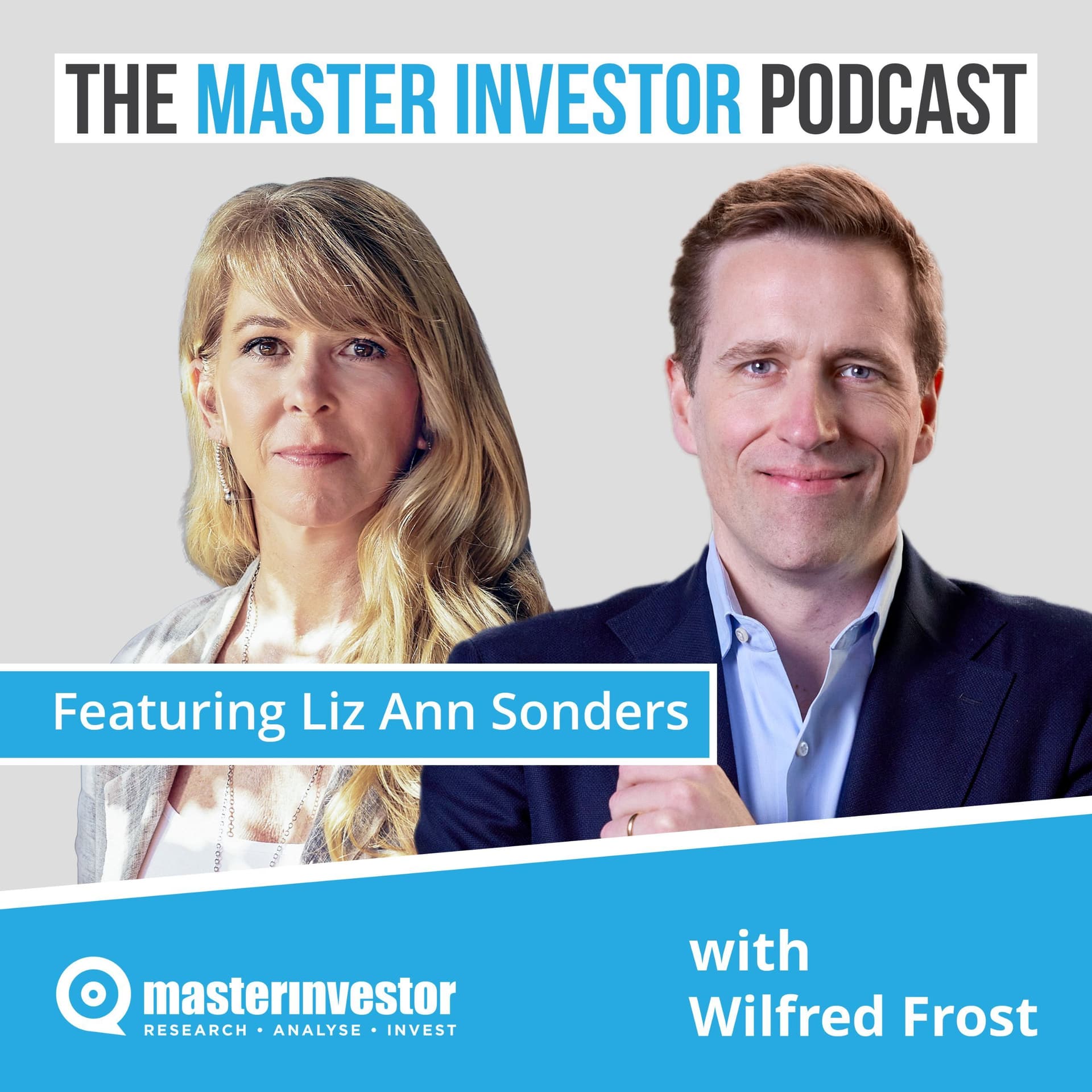
Liz Ann Sonders: Retail Investors Are Winning - Don’t Miss the Rotation Beneath the S&P
Host
Wilfred Frost
Guest
Liz Ann Sonders, Chief Market Strategist at Charles Schwab
---
Overview
In this episode, Liz Ann Sonders shares her insights on the current state of the market, the significance of retail investors, and the factors influencing market dynamics beyond the S&P 500. With her extensive experience and knowledge, she discusses market complacency, inflation, labor market data, and her investment advice for navigating today's market.
---
Key Themes and Discussions
Market Complacency and Sentiment
- Current Market Status: The S&P 500 is near record highs, with a 30% rally since April lows.
- Complacency Indicator: Liz Ann indicates that current valuations reflect more of a sentiment indicator rather than a fundamental guide for market direction.
- Historical Context: Compares today’s market sentiment to the late 1990s, emphasizing that complacency does not necessarily indicate an imminent market downturn.
Retail Investors and Market Influence
- Rise of Retail Investors: Retail traders have significantly influenced market movements, especially since April 9th, often outperforming traditional institutional investors.
- Subsector Differentiation: The retail investor demographic is diverse, with notable increases in younger, tech-savvy individuals engaging in markets.
- Performance of Retail Favorites: Investment baskets categorized by retail interest, such as "Retail Favorites" and "meme stocks," have shown strong performance since recent market lows.
Economic Indicators
Inflation and Labor Market
- PPI vs. CPI: Liz Ann clarifies the difference between the Producer Price Index (PPI) and Consumer Price Index (CPI), noting significant increases in PPI.
- Labor Market Concerns: Recent job reports reflected a weakening labor market, with significant downward revisions impacting market forecasts.
- Fed's Dual Mandate: Discusses the balance the Federal Reserve must maintain between controlling inflation and addressing labor market issues.
Investment Strategy Insights
- Valuation as a Timing Tool: Liz Ann argues that valuation metrics, such as PE ratios, are poor indicators for market timing and should be contextualized with economic factors.
- Focus on Factors Over Sectors: Rather than sector-based investing, Liz Ann emphasizes examining underlying factors (like quality and growth metrics) which provide a more stable investment strategy.
- Importance of Discipline: Highlights the significance of maintaining a disciplined investment approach, including diversification and periodic rebalancing.
Final Advice for Investors
- Risk Tolerance Awareness: Investors must recognize the gap between financial risk tolerance and emotional risk tolerance to avoid poor decision-making.
- Long-Term Perspective: Emphasizes the need for investors to maintain a long-term perspective, avoiding impulsive actions based on short-term market movements.
---
Key Takeaways
- Retail investors have been pivotal in recent market movements, challenging traditional notions of "smart" versus "dumb" money.
- Economic indicators such as inflation and labor market data are critical in shaping Federal Reserve decisions, which in turn influence market dynamics.
- A disciplined and informed approach to investing, focusing on quality factors and maintaining diversification, is essential in the current market landscape.
---
Resources
- Schwab Inflation Report: [Read here](https://www.schwab.com/learn/story/inflation-heat-is-on)
- The Master Investor YouTube Channel: [Watch the full episode](https://www.youtube.com/@TheMasterInvestorPodcast)
---
Conclusion This episode provides valuable insights into the complexities of the current market landscape, especially the rising power of retail investors. Liz Ann Sonders offers practical advice and encourages a disciplined approach to investing, essential for success in an ever-evolving financial environment.
Written by AI. May contain mistakes. Listen to the episode to check what was said.
Transcript
Automatic transcript. May contain errors.0:00I think evaluation almost is an indicator of sentiment, as opposed to some sort of fundamental guidepost for what the market is going to do. So if anything, if you wanted to still apply the dumb money, smart money, the retail traders have been, at least since April 9th, the smarter ones. But ideally, you learn not the hard way, whether you have a wide and narrow gap between your financial risk tolerance and your emotional risk tolerance. And it's the latter that tends to get us into trouble. Welcome to the Master Investor Podcast with me, Wilfred Frost, where we celebrate and learn from the success of the greatest investors, business leaders, and politicians in the world, giving you, our listeners, the edge.
0:46My guest today is Lizanne Saunders, the Chief Market Strategist of Charles Schwab, a firm with, wait for it,$11 trillion in client assets. She is the main source of investment advice to their 38 million customers. Schwab is a Goliath and Lizanne is too. And I am delighted to welcome her to the Master Investor podcast. Lizanne, it's great to see you. Oh, great to see you too, Wilf. It's been a while. It's wonderful to see your face, albeit from a distance. Well, I know we're doing this remotely and I'm actually in New York next week. So we've timed this very, very poorly in that regard. But I'm delighted that it's happening.
1:30And I just broke down that extraordinary AUM and number of clients that Charles Schwab has grown to, which is so impressive. It's quite a broad range of type of clients that you look after. Oh, absolutely. Although, for the most part, individual investors. So we don't generally have big institutions. We have clients that run businesses and we might have those accounts. But this is essentially a firm for individual investors. But you're right, it runs the gamut from do-it-yourself short-term traders all the way up to family offices, individuals that take more of a longer-term strategic asset allocation approach and those that want to be more out on the trading frontier.
2:19So with$11 trillion, well, if you're right, it does run the gamut. Yeah, it's not just one person, though there are people getting up near that level of wealth, I guess, in today's world. I want to get into the different types of investors in a little bit that you do look at. But let's just kick off and get straight into your latest views on the broader markets. Obviously, we're just off record highs, but not by much. The S &P 500 is up 9 % year to date. It's up sharply since those April lows, more than 30 % rally since then. Has the easy money been made this year? So I do think that there is some complacency embedded in from a sentiment, from a valuation perspective.
2:58But as many of us that have been in the business for a long time, I'm 39 years at this point, we'll, of course, remember the late 1990s where you could have had complaints about complacency and froth and exuberance, to use Alan Greenspan's term, and you still had a long runway ahead of you. So I think one of the rubs about talking about complacency or froth, looking at investor sentiment conditions, is that it doesn't represent a good market timing tool. And so I think that that is embedded in what the market has done, which does arguably mean you might have some additional downside to the extent that there's a negative catalyst.
3:40But in and of itself, it doesn't suggest that there's an imminent contrarian move coming in the market. It's funny you reference the late 90s because Jeremy Grantham was on the podcast and he actually spoke about the pain of being too early in Turing Bearish at the late 1990s. obviously he was ultimately right, but lost a lot of client assets during the first couple of years, he turned bearish. What about the latest data point that kind of grabbed everyone's attention last week? PPI, we just had CPI here in the UK this morning, which was a bit hot. Obviously, producer price inflation in the US last week was a bit hotter than expected.
4:20What was your take on that? How does it influence your thinking of what the Fed will or won't do in the year ahead? Sure. So we just wrote a report that just published two days ago. So it's on schwab.com. You don't have to be a client. All of our research is out there in the public domain on the public. Don't tell everyone that because it's really helpful to me. That's a differentiator on the part of Schwab that we don't hide our research behind the login firewall. So we just wrote about inflation with a concentration on the CPI and the PPI. And one of the things I wanted to point out in the report is that there's a misperception at times as to what actually PPI is measuring.
5:00And maybe more of a heightened focus on PPI last week because it was so much hotter than what was seen as a more benign report from CPI. A lot of people just think of PPI as a metric about what producers pay. It's actually a price is received measure, not a price is paid measure. So if you think about the middleman, call it a wholesaler to use an example, it's the price they receive for the products, the goods that they're selling to, say, retailers. Now, there's a component of PPI called trade services, and that essentially measures margins. And that really has accelerated over the past several months.
5:43And that is suggestive of these higher costs, many of which are tied to tariffs, are indeed starting to get passed on. And if you dug under the surface of the CPI numbers, you're starting to pick some of that up, too. It's just happened over a multi-month period of time, in part because of the fits and starts of tariff policy announcements and then delays and then implementations and then changes in what the actual tariff rate is. So I think it's still going to be kind of a choppy picture in trying to analyze this inflation data. But those were my key takeaways from last week's numbers. And quick take on your views on the labor market and what both of those points together mean for the Fed?
6:27We have seen a weakening in the labor market. Obviously, the most recent monthly jobs report was alarming, not so much the print for the month of July, but the huge downward revisions to the prior two months. Now, obviously, there was a lot of focus on the administration firing the head of the Bureau of Labor Statistics. They were outsized revisions, but it's not uncommon to see significant revisions, especially given that the response rate has come down, particularly the first read on jobs. So the BLS does their establishment survey. It's done over a span of three months. Not everybody, not every company gets their information in in the early part of that.
7:14And as response rates have come down, you're seeing a bigger spread between the initial release and subsequent revisions. It's also the case that revisions tend to be higher when you're in a slowdown in the economy, whether or not you're ultimately heading into a recession or not. If you look back at the initial prints in 2007, 2008 for payrolls and what we now know to be the reality, given subsequent revisions, they were significant at the time. So we're just at that point in the cycle where not only do details matter, but those revisions maybe carry even more weight than the initial prints. So do you expect the Fed to cut then?
7:58Well, that's what the market is expecting with 80 some odd percent probability. I don't necessarily think it's a done deal. But even though the Fed operates with a dual mandate, and unlike many other central banks around the world that only operate with a single mandate inflation, the Fed has that dual mandate of inflation in the labor market. And they're clearly not ignoring the inflation side of things. But I think if we were to see a further weakening in the labor market, specifically within the metrics that come out in the monthly jobs report when we get it for August, I think the bias will be to cut, even though inflation hasn't come down to their target.
8:35But what happened with the release of the data last week, especially in the aftermath of the PPI, is you essentially got rid of any expectation that the Fed would move by 50 basis points in September. So that percentage sort of jumped from the 50 column to the they won't cut it all column. And so I do think the labor market is really, really the key to what the Fed does in September and how aggressive they feel they might need to be after. And so bring it back to the market for us to frame the rest of the conversation. On your numbers, I know you don't think it's a good timing tool, but what is the S &P 500 on in a 12-month forward PE?
9:17PE is actually a terrible market timing tool. The market can be expensive and get more expensive. I think evaluation almost is an indicator of sentiment as opposed to some sort of fundamental guidepost for what the market is going to do. If you have a really long time horizon, then there is more of a connectivity between starting PEs and what the market does. But if you have, say, a one-year time horizon and you look back at history and you compare starting valuations using, you know, forward PE or really any metric and subsequent one-year return, there is almost no correlation between the two.
9:56Very, very shallow correlation. So there are so many other forces that impact what the market's going to do in the short term. The market is clearly on the expensive end of the historical spectrum. The good news so far this year is we're seeing some catch up on the part of the denominator or the E and the PE equation. Both quarters this year, we've seen earnings ultimately double what estimates were at the start of reporting season. So you've finally had a little bit of a help from that improving earnings. The problem is that analysts have still been pretty shy about commensurately raising second half of the year numbers, full year numbers, next year's numbers.
10:37That may mean that, yet again, the bar has been set sufficiently low that as we continue on with third and fourth quarter earnings season, you have that potential for a higher beat rate. So I wouldn't put valuation in the column of everything's great for the market, but be really careful about looking at it at any point in time and saying, okay, that's providing some signal of weakness to come in the market. It's just it doesn't work that way. It's funny you mentioned time horizon. Do you think most of your clients have a – I mean, one-year time horizon, relatively short for most investors. Do you think your investors, I mean, it's not compared to the day traders, but I guess it's hard to gauge.
11:18But do you think it's a short - Well, again, when you have$11 trillion of client assets, there's no cookie cutter answer to really any question, whether it's about asset allocation or time horizon. And broadly, it is the case, if you look at some of the studies out there from the likes of Dalbar, and you look at average holding period across the spectrum of mutual funds and exchange-traded funds, we have seen a pretty significant compression in time horizons. That's not a brand new phenomenon. That's actually a kind of a multi-decade phenomenon of shorter time horizons. clearly also on the institutional side of things, which is not our bailiwick, but something as investment strategists I need to keep an eye on, is you're seeing it in the institutional world too, where time horizons have been condensed a little, in part because of cohorts like high frequency traders.
12:12By definition, they have shorter time horizon. And then on the individual investor side, to your point, some of these retail traders, which is distinct from individual investors. So when I talk about and write about retail traders, I'm actually talking about that very specific cohort that essentially grew out of the pandemic. They skew younger, they skew male, and they certainly skew to a much shorter time horizon. And not just their activity in the equity market, but across the spectrum of other asset classes, including crypto and options. And so I think that time horizons have essentially gotten shorter, no question.
12:53Let's dwell on those retail investors a little bit, if we can. I was listening to my friends on The Compound and Friends. It's a great finance podcast last week. And they were having this debate. Not only that the size and influence of those retail investors has grown over recent years, but it's actually a much harder group to define. There's lots of sort of subsectors within it and different parts of it. And I guess basically, anyone that tries to overlook that group or tries to frame things still as smart money versus dumb money is totally missing the point. I think that's absolutely valid. And I think, you know, retail traders in general have historically been lumped into that, you know, sort of dumb money moniker with institutions and the large speculators in the futures market have been lumped into that smart money label.
13:47And I think the lines have gotten significantly blurred. And in fact, in a year like this, or maybe specifically the point from the intraday low on April 9th, retail traders' fingerprints have been all over this. And you can pick that up by looking not just at index-level returns, but components of the market, baskets. You know, Goldman Sachs does great basket work. And the baskets that have had the best performance, well double what the S &P has done this year, would be baskets like Goldman actually has one called Retail Favorites. It's a regularly rebalance. There's methodology that they use behind it.
14:30It's a fairly robust list of stocks, but it's based on retail trading interest. That's one of the best performing baskets this year. UBS has a meme stock basket, one of the best performing baskets. I shouldn't say this year, since that April 9th low period of time. Non-profitable tech is another. And then interestingly, one other basket that's done incredibly well is most shorted stocks. Now, shorting tends to be more of an institutional thing versus an individual thing. So one could posit that what's happened since the lows in early April is that that buy the dip kicked in on the part of the retail traders.
15:11And so far, they've been right, forcing some repositioning on the part of institutions, inclusive of buying to cover short. So if anything, if you wanted to still apply the dumb money, smart money, the retail traders have been, at least since April 9th, the smarter ones. Yeah, I think since my time in covering markets at CNBC, I was trained in a long-only traditional asset manager, which I think thought itself as the smart money. I'm not sure it proved to be. But anyway, actually, I have my first CEO, Helena Morrissey, coming on in the program in a few weeks. So I hope she's not listening to this episode.
15:51I don't apply it. I don't apply it to her. And it was just a joke.
15:58before we get into your specific market calls um lizanne interested in exploring whether your job has gotten harder over the course of the last decade or two uh but particularly the last decade partly in response to to what we just touched on the changing nature of the the marginal buyer or seller. And I guess the fundamental analysis that I was trained on, maybe you were trained on, and you talking there earlier about valuations, isn't necessarily the key driver anymore. I mean, how do you measure some of those other factors, whether it's momentum or sentiment, and work it into your process? So in answer to the first part of your question, Wolf, has it gotten harder?
16:47I guess if you wanted to use that simple adjective of harder, I'd probably say yes. Maybe the better word is just very different. When I think about, so I'm in my 40th year doing this, and I think about the early days I started in the business in the mid-1980s. And the access to information was obviously much more limited because that was pre-internet days. Those were the days that Wall Street research, and I was on the buy side for my first 15 years in the business as a portfolio manager managing money. The research, the provision of that research was, you know, paper research reports, and you get on the phone with your institutional salesperson so they could share what was discussed at the morning meeting.
17:39So it was less of that sort of fire hose, constant information flow. That to me is the biggest difference when I think back to my early days in this business. Now it is truly drinking from a fire hose of information. And one of the most important things to do, or at least try to do, is figure out what's valuable, what's not valuable, how to filter through all of that noise, and just how many different sources there are for information, not to mention the fact that the ability to then trade on that information has never been faster, has never been cheaper. I think Charles Schwab, I don't know, might have had something to do with commissions going to zero, if I recall correctly.
18:21So I think that's what makes it different. And at least the attempt at applying that filter, what matters and what doesn't matter. Trying to look at the market, both with a short-term lens and a long-term lens. The longer-term lens, you do still rely on those traditional fundamentals and the connectivity thereof. I think one of the benefits that we've had over the last couple of years is we have the return of the risk-free rate. We're off that zero bound in terms of short rates. It can tend to really disconnect fundamentals and prices. I think we're back a little bit more, a little bit closer to a normal environment from a price discovery standpoint.
19:05So I think that is something that has changed in the last couple of years. But you're right. The market is much more momentum driven. It's got a little bit more of those short term trends. And in a year like this, where none of us can accurately try to predict what the next, you know, true social post is going to be with regard to something as important as tariffs, what we then can do is instead of trying to gauge what these policy-related announcements are going to be, analyze the setup. That's really been an important distinction. extinction. The setup going into April 2nd, when we got the first big announcement of reciprocal tariffs, was one of heightened complacency, specifically about tariffs.
19:51The announcement came, they were much higher than what anybody expected. The markets went into riot mode. And it wasn't just the equity market. It was the bond market. It was the dollar. We had this week of activity in our market that was very emerging market-like. And that was ultimately the trigger into the administration to say, all right, we've got to step back here with the announcement of the 90-day delay. Well, the setup heading into that April 9th intraday low was the complete opposite of a week before. Market was way oversold. Sentiment was washed out. Brett had absolutely imploded. So you get what really was incrementally positive news, and the setup was one of a sharp move to the upside because you would reverse so many of those technical and sentiment and momentum and breadth factors.
20:37So that's in a year like this, the way I'm thinking maybe a bit differently about how to inform our investors without trying to forecast things like policy announcements. And how do you frame the setup at the moment? Is it closer to being stretched to the upside than is to being a buying opportunity or somewhere in between? I think that there is complacency, but I also think that there's some good news happening under the surface. We are seeing some rotation. We're seeing a shift in bias in performance. It's an interesting one. Just so far, month to date in August, you're seeing some of the best performers from a sector perspective, maybe even more importantly, from a factor perspective.
21:22The best performers were the first seven months worst performers. You're seeing some greater participation down the cap spectrum. You're seeing better performance by equal weight relative to cap weight. So it can manifest itself in the indexes starting to look a little bit weaker, but opportunities presenting themselves under that cap-weighted level. And I think a broader message that's really important to impart here is make sure you understand what's going on under the surface of these cap-weighted indexes. The fuller story is told under the surface. We still have that mega cap bias. But one misperception that a lot of individual investors have is, boy, there's no way I can do well unless I have the same concentration as what's embedded in an index like the S &P.
22:18Well, most individual investors are not being tracked on a quarterly basis against the S &P as a benchmark. That's an institutional problem. That's not an individual investor problem. And given that you have to go to the 37th ranking to incorporate any of the magnificent seven in terms of performance ranking this year, I think that's an important point to make, that there's a lot of places you can find strong performance. The only reason to be concentrated is if you are actually being benchmarked against the S &P, the mega cap names dominate that from a contribution perspective, but they're not the best performers.
22:59That's really, really important to note. And you mentioned there in the middle of that factor-based investing, because I seem to remember four or five years ago when we taught a lot on CNBC, we were always picking, or you were telling us your picks in terms of sector overweights and underweights. But I know from some of your recent research, You're sector neutral at the moment, but focusing more on factors. So just explain that a bit for us. So I think sector-based investing, overweights, underweights, outperform, underperformance, whatever terminology you want to use, is very monolithic in nature.
23:33To just say, we like the tech sector financials, it's very monolithic. And there's also been so much sector-based volatility. I gave one example of that with the best performing. In fact, healthcare is the best performer on a month-to-date basis. It was the worst performer in the first seven months a year. More volatile sectors like tech and communication services may be in contrast to a sector like energy. You can see sectors like that go to the bottom of the leaderboard one month and move to the top of the leaderboard the next month. And it's very tricky to try to navigate that for investors.
24:12Where there's been more consistency is at the factor level. So for those viewers that don't know what factors are, it's really just a not-so-fancy word for characteristics. So invest based on characteristics. And there's a wide array of factors you can look at, balance sheet related factors like strong free cash flow and high interest coverage, valuation based factors that might look at traditional, you know, PE or price to book or price to sales, momentum type factors, volatility based factors, yield based factors, growth based factors. There's been more consistency at the factor level over the past several years than there has been at the sector level.
24:55And what our message in a year like this has been is basically, to use trader lingo, fade the low-quality components of this move higher. So some of them I mentioned as it related to baskets. So weaker balance sheet, non-profitable companies, low interest coverage companies, zombie type companies. Fade that, lean into higher quality, lower volatility, stronger balance sheet, stability and profit margins. And that's what our messaging has been for some time. And even when we move off of being sector neutral and go back to having outperform or underperform, we're still going to focus at least as much on factors.
25:40I think the industry is moving in that direction as well. I'm really interested about, I guess it's not quite as technical as factor as this, but when you look at the valuations in part because of those sort of magnificent seven, those big cap tech stocks doing so well over recent years, not necessarily the last couple of weeks, the valuation difference between big cap and small cap or growth and value, it's not using the word quality that you are focusing on there, but they are as stretched as ever before. Is that talking to the same opportunity you're talking about, or is it slightly more nuanced than that?
26:16A little bit more nuanced, but valuations are stretched, certainly up the cap spectrum. Now, they've had the underlying earnings growth that is at least somewhat supportive of those higher valuations relative to, say, an index like the Russell 2000. Valuations are actually quite high there, in part because you have 40 % of that index that is some combination of non-profitable and or zombie companies defined as companies without sufficient cash flow to even pay the interest on their debt. So I think valuation analysis has to be looked at in the context of both the numerator and the denominator, but also as, say, a country or an index representing a country like the United States with the S &P 500.
27:06I always caution investors to be careful about doing apples-to-apples comparisons of valuations country-to-country, because ultimately what also defines whether as a country your stock market is on the higher end of either your own historical spectrum or relative to others around the world, it's a function of what drives your economy. We are an information technology innovation driven economy naturally affording a higher multiple than, say, Australia, where it's a mining based economy or if you're an auto based economy or you're a financials based economy. So you have to do a little bit of that apples to oranges comparison.
27:50We're looking at valuation. Very important is that underlying driver of your economy and whether that type of combination of industries or sectors tends to be afforded higher multiples. And I think that's one mistake that investors make when doing that cross-country comparison. Yeah, I'm not quite sure how we define what the UK is at the moment. But either way, the FTSE's got a cheap multiple, probably warranted.
Read the full transcript
28:21Let's start to wrap up a little bit if we can, Lizanne. And we always ask everyone this question towards the end, which is, do you have an overriding piece of investment advice for our listeners? Discipline is so important. It's maybe the less exciting stuff to talk about, whether it's on episodes like yours or doing financial media. They want the sort of bombastic comment about what the market is going to do. Get in, get out is such a common question that I get from the media. What are you telling your investors to do? Well, neither get in nor get out is an investing strategy. That's just gambling on two moments in time.
29:04And investing should always be a disciplined process over time. It's boring, again, boring to talk about. Diversification across it within asset classes, it matters a lot. Periodic rebalancing, boring to talk about. It really matters a lot because the beauty of the rebalancing discipline is it forces us to do a version of what we know we're supposed to do, which is not so much buy low, sell high, because that sometimes infers all in, all out. And that's, again, that's gambling, not investing. But add low, trim high. When left to our own devices, we tend to do the opposite or we let our winners run and We develop a concentration problem.
29:40So those pieces of advice are really essential. The last one I'd say is most people probably have done maybe an analysis, worked with a consultant or an advisor, have done it on your own, of what your financial risk tolerance is, driven by time horizon and need for income, past experiences, et cetera. But ideally, you learn not the hard way, whether you have a wide and narrow gap between your financial risk tolerance and your emotional risk tolerance. And it's the latter that tends to get us into trouble. Absolutely fascinating. Spot on. I always think the pain of a loss far outweighs the joy of a gain, like for like 10 % up or down, which can be tough to learn in this business.
30:27Hey, Wilf, can I give one other fun anecdote that I think frames this? So NVIDIA, everybody knows how popular a stock is. I don't cover individual stocks, so this has nothing to do with the stock from a recommendation standpoint. But I had a client make a comment that they were frustrated that their Schwab consultant had suggested trimming 10 % of their NVIDIA position. And they were a former employee, so they had a large position. And instead, he trimmed 5%. He said, I'll split the difference. I'll only trim 5%. And he was really, really angry because the stock over the course of the next five or six weeks went up 20 % and he was mad.
31:07And so the question that was posed back was, would you really have been happier if the 95 % of NVIDIA you still owned had gone down by 20 % in the subsequent six weeks? And to his credit, he said, you're absolutely right. I probably should think of it that way. He certainly should, but you're so right that you need to have those rules because human emotion can always trump things in the short term. I have a slightly different problem to that client in that most of my company stock was in Comcast, which didn't do what NVIDIA has done. But there we go. Lizanne, it has been an absolute pleasure, as it always has been in the past.
31:49It's been too long. I hope we can do it again soon and ideally in person. But thank you so much for joining me. My pleasure. Thanks so much for having me, Will. That was Lizanne Saunders, of course, of Charles Schwab. Next week on the podcast, we'll be talking to Fundstrat's Tom Lee. Please remember that nothing that you've heard on the Master Investor Podcast should be considered direct financial advice. There's more in the show notes on that if you want to look at it. The Master Investor Podcast is produced by Paradine Productions and Master Investor Podcast Limited in association with Birdline Media.
32:22if you've enjoyed the show please do subscribe and leave us a five-star review and i'll see you next week with tom lee
From the publisher
Liz Ann Sonders is Chief Market Strategist at Charles Schwab, which manages $11 trillion in client assets. On this week's show she breaks down the current market complacency to Wilf, and explains why investors should pay attention to what small stocks and under-the-surface factors are signaling beneath the S&P 500 and away from mega cap stocks like Nvidia. She also discusses why valuations aren’t a reliable market timing tool, the latest inflation and labor market data - with recent revisions reminding her of 2007/08. She also discusses how her job has changed with shorter investor time horizons and how retail traders are gaining influence. Finally, she shares her top investment advice and insights for navigating today’s markets.
Read Schwab’s report on US inflation here:
https://www.schwab.com/learn/story/inflation-heat-is-on
The content of The Master Investor Podcast is for informational purposes only and does not constitute financial, investment, or other professional advice. Always seek independent financial advice before making investment decisions
You can watch the full video on The Master Investor YouTube channel.
And follow @WilfredFrost on X.
This podcast is produced by Paradine Productions, The Master Investor Podcast Ltd in association with Bird Lime Media.