In short
Podcast Summary: The Master Investor Podcast with Wilfred Frost
Episode Title
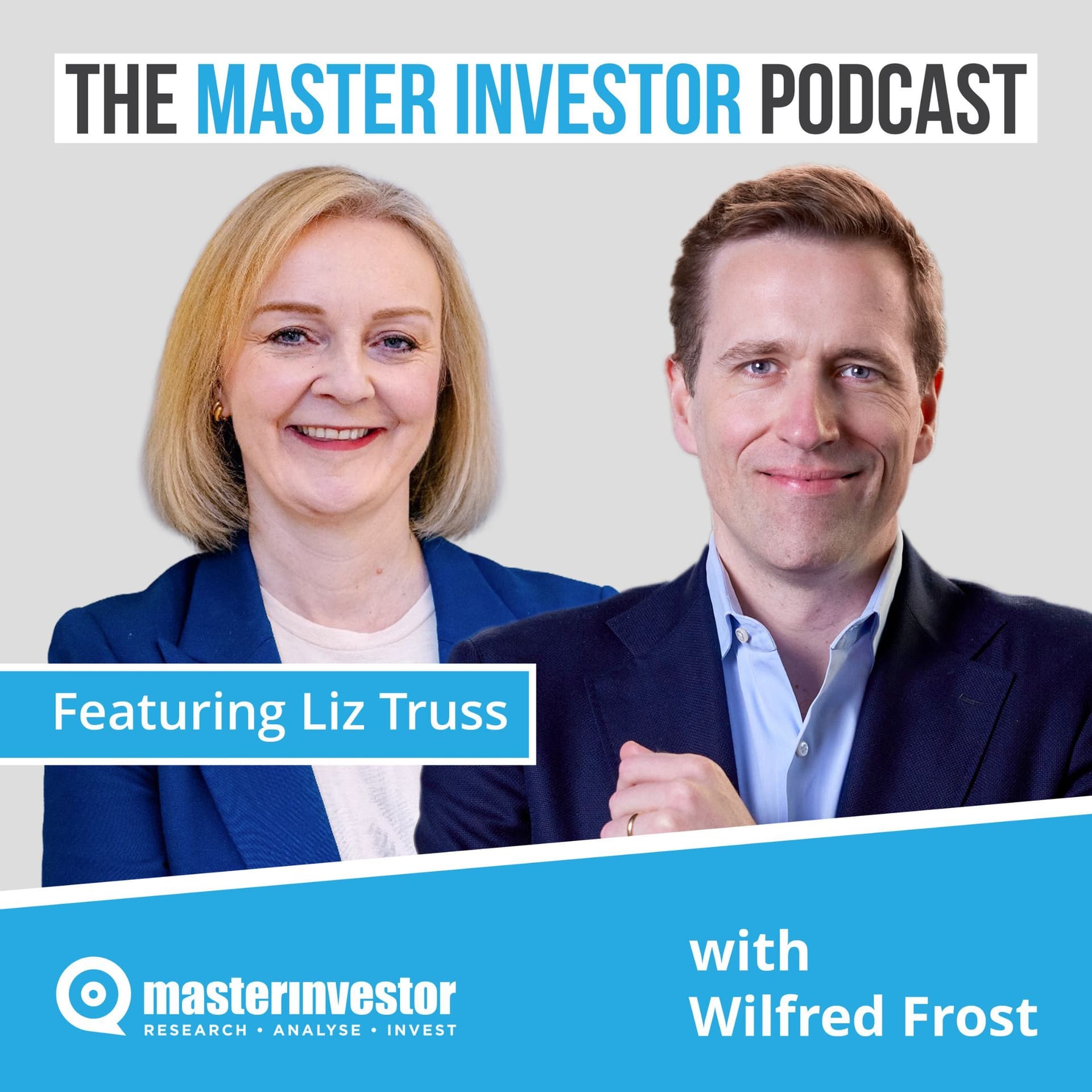
Liz Truss: UK Is Heading for Calamity, & Inside the Mini-Budget
Episode Overview In this episode, former UK Prime Minister Liz Truss discusses her views on the current state of Britain’s economy, critiques the government’s size, and reflects on the fallout from her short time in office, particularly the controversial mini-budget of September 2022. Truss defends her tax-cutting agenda and shares insights on trade deals, the Labour government, and her concerns regarding future leadership within her party.
Key Themes and Discussions
- State of the UK Economy
- Desire for Change: Truss expresses her concern over Britain’s economic decline and emphasizes the need for reform.
- Government Size and Accountability: She argues that the government is too large and unaccountable, hindering economic growth and resilience.
- Tax and Spend Philosophy
- Tax Burden: Discusses the current UK tax burden (~40%) compared to other nations. Truss advocates for a tax burden around 30% to foster economic growth.
- Spending Restraints: Highlights the challenges in implementing spending cuts and her belief that the welfare state is too expansive.
- Mini-Budget Fallout
- Market Turmoil: Truss reflects on the market chaos following the mini-budget, emphasizing that she wasn't solely responsible. She mentions factors like the Bank of England's actions and the impact of liability-driven investments (LDIs).
- Blame Shifting: Critiques the narrative blaming her for economic mismanagement, asserting that the financial institutions share significant responsibility.
- Reflections on Brexit
- Brexit Position: Truss reveals her initial support for Remain based on loyalty to party leadership and her concerns over potential distractions from domestic reforms.
- Post-Brexit Realization: Acknowledges the need for structural changes and critiques the lack of progress on repealing EU laws affecting the UK economy.
- Critique of Current Government
- Trade Deals: Commends the Labour government for securing a trade deal with President Trump, suggesting it demonstrates the benefits of agile policymaking.
- Chancellor Rachel Reeves: Truss does not express sympathy for Reeves, arguing that current leaders are part of the economic establishment that has failed the UK.
- Challenges of Political Leadership
- Cabinet Authority: Truss discusses the diminished authority of cabinet ministers and the overwhelming power of the civil service.
- Isolation in Politics: Acknowledges the isolation she faced post-premiership but highlights that there are supporters of her policies.
- Calls for Institutional Change
- Need for Reform: Advocates for a shift away from established practices within Britain’s institutions, emphasizing that they contribute to the nation’s stagnation.
- Cultural Shift: Encourages a reevaluation of Britain’s institutional frameworks to avoid future crises.
Key Takeaways
- Economic Recovery: Truss asserts that the UK can regain its economic strength through lower taxes and reduced government size.
- Institutional Accountability: Emphasizes the importance of holding financial institutions accountable for their roles in market stability.
- Public Sentiment: Suggests that there is a growing desire among the public for significant changes in the political landscape.
- Future of Leadership: Truss is skeptical about the prospects of current party figures leading effectively, expressing doubts about Kemi Badenoch's future as a Prime Minister.
Conclusion Liz Truss's candid discussion on The Master Investor Podcast offers a critical insight into her perspective on the UK’s economic challenges, the implications of government size, and the need for responsible fiscal policy. Her reflections on her time in office and the institutions governing Britain's economy highlight the broader issues she believes need urgent addressing for the country to thrive.
For more insights and detailed discussions, you can watch the full episode on [The Master Investor YouTube channel](https://www.youtube.com/@TheMasterInvestorPodcast).
Written by AI. May contain mistakes. Listen to the episode to check what was said.
Transcript
Automatic transcript. May contain errors.0:00I want Britain to be a great nation again. and I'm depressed about how far we've sunk, the dire state our economy is in and I want to help fix that in any way I can. I still believe what I put forward in 2022 and frankly what I've believed for most of my life. I think the government is too big. I think one of the big problems over the past 30 years is it's become increasingly unaccountable as well. What I feel is the broader public do want to see change, and that is the change I was trying to deliver. You said I was captain of the ship. The fact is I wasn't captain of the ship, because I wasn't running monetary policy.
0:46The Bank of England were running monetary policy. I'm very happy to take responsibility for things, provided I have the full ability to actually control them. I didn't have the ability to control them. Welcome to the Master Investor Podcast with me, Wilfred Frost, where we celebrate and learn from the success of the greatest investors, business leaders and politicians in the world, giving you, our listeners, the edge. This week, we have our first British politician on the podcast and a former Prime Minister, no less. Liz Truss is here with me, who was also a minister in the government for a decade, straddling six different cabinet posts, including chief secretary to the Treasury, minister for trade and foreign secretary, amongst other roles.
1:38Liz, I'm delighted to welcome you to the Master Investor podcast. Good to be on. There's so much we want to get to. The first question with you sitting here relaxed and smiling is the extent to which the pros of being outside of politics outweigh the cons? That's a very hard question. Politics is where things get done. But if you're just in politics, you can become almost imprisoned by it. So it's very, very draining on your entire life. It's very consuming, particularly if you're a government minister. But also, you don't have the space to think as much and connect with people. So it's difficult to make major change from within politics.
2:31So I think you need a bit of insider and a bit of outsider. In terms of enjoyment, is it nicer on the outside than the inside? I like both actually, to be honest. I always enjoy life. We're very fortunate to be here on this earth, we're fortunate to be in a great country like Britain. What is not to love? So I, I'm a very, you know, positive person who wants to wants to get things done, whatever I'm up to. Well, that's a very, a great sentiment towards life, particularly when you've had big challenges, and we'll get to some of the big challenges in a moment. In terms of snapshot where we are today, Do you believe more or less or in a different way in your general argument towards the need for a sort of smaller state, a smaller government?
3:20I still believe what I put forward in 2022 and frankly, what I've believed for most of my life. I think the government is too big. I think we're overregulated. I think the welfare state is too big. It is a drain on our national resources, but also our resilience and our ability to be successful. So I think, yes, we've got a big government. I think one of the big problems over the past 30 years is it's become increasingly unaccountable as well. So not only is it colossal, it's also very, very hard to change. In terms of the sort of tax and spend picture, you know, rough numbers here, but the tax burden here in the UK overall is approaching about 40%.
4:09The EU average is higher than that. It's about 45%. In the US, it's more like 30%. And obviously, it's steadily risen in recent years across the G7, in part because of COVID. In a perfect world, clearly spending cuts are hard to put through, but in a perfect world, what is the ideal overall tax burden for the UK? I'd say it's about 30%. I'd say you want to get to a state where the government is less than a third of the nation's GDP and ultimately tax catches up with spending because spending just either goes into debt or tax and you've ultimately got to pay back the debt. So to me, the spending figure is the important figure, and it should be about 30%.
4:54And of course, what we've seen happen in the last 25 years is back in the year 2000, Britain was almost catching up with the US in terms of our GDP per capita. The US is now 50 % higher. So what those percentages partly reflect is the lack of economic growth, because it's as a proportion of GDP. So if we'd grown faster, if the economy was bigger, the tax burden would be lower. Do you expect though long-term we will always spend a bit more and tax a bit more than the US because we have aspects of the welfare state that you would always want to keep? No, I don't want us to necessarily decide to be a higher tax country than the US at all.
5:40I'd rather we... Look, there are problems with some things and the way they run in the US. I wouldn't want to adopt the US health service. I think other countries do it better, like Japan, for example, has an excellent health service. So I'm not saying ape everything in the US, but the US is by far the most successful country economically in the West. And over the past few decades, it's completely outperformed Europe. This isn't just a British problem. The whole of the European continent is becoming a museum. Manufacturing industry is dying. growth is stagnant. Lots of countries are having debt problems.
6:21France has got a very big problem as well as Britain. Let's touch on that then, because in your book, 10 Years to Save the West, which I really enjoyed reading last week, I was really interested in when you talked about Brexit and obviously relatively well known that you backed Remain at the time. That was in part through loyalty to Osborne and Cameron before pivoting to be quite a loud Brexiteer later. But in the book, you kind of actually framed the biggest reason for why you supported Remain was it was just after a 2015 conservative majority. And that there was a lot of work you wanted to focus on on reforming the UK.
6:58And you thought that the whole departure of the EU would be a distraction, which of course it was. I was really struck by that because the same sorts of reforms you said you wanted to do pre-Brexit, you wanted to do in 2022. you still sort of talk about now, lower taxes, less regulation, less bureaucracy. So I guess my question there really is, are we the problem, not the EU? We're both the problem. So I think what I've learned about now is the, because what I was looking at, I was very involved in things like education and economic policy. So I was just seeing all the issues in the UK, like the Town and Country Planning Act, which basically socialised land planning and has made it very, very hard to build new houses for generations.
7:46It's made it hard to build new factories, facilities. It's a huge problem. Which the Labour government are trying to do more about them perhaps. They've done absolutely nothing and construction is at an all-time low. I mean, they've done absolutely nothing. They're not even willing to take on the environment NGOs and the sort of battered newt stuff. They're not really willing to do anything about it. Well, we'll see. The bill is processing through Parliament. I guess my point is I don't think the Conservative government did much about it. No, that's certainly true as well. I totally accept that.
8:21But I think you need to go back and repeal the 1947 Act. I think the way that we organise land use in our country is terrible. But that's one example. So I was looking at that from that point of view. And I hadn't really involved myself in Europe very much. It was only when I became a minister, a senior minister, I started attending European meetings, I'd begun to understand the negative impact that was having as well. And some of these things like the Natural Habitats Directive and the bats and newts emanate from Europe. And one of the big failings since 2016 is we haven't actually got any of these laws off our statute books.
8:58So we've got all the bad stuff about Europe still is with us. And, you know, that is a complete failure to really create something that is more dynamic, more entrepreneurial, because that was the opportunity Britain had. I wanted to mention one more thing about Europe, which is I think our institutions got Europeanised, and that is why they've become so unaccountable. So the idea of making the Bank of England independent, in my language, unaccountable, was started in the Maastricht Treaty, which was actually signed by the John Major government, but then it was put into practice by Gordon Brown.
9:41The idea of a separation of powers, which has never been part of the British Constitution, again, that was an idea that was promulgated through the European Union and led to Blair inventing a Supreme Court, which has made the judiciary unaccountable. So what we actually saw is the Europeanisation of our bureaucracy, which was never great in the first place. I'm a massive critic of the British bureaucracy, has made it even worse. And we'll definitely get into the Bank of England in a little bit. I guess just to round this part off, something again that comes up in your book a lot is, do you think cabinet ministers lack expertise to get things done?
10:25Do they lack the authority? Do they lack, at one point, you talk about funding. Do they need more money, not so much as a salary, but as a kind of ability to hire people? I think they lack authority. and I think they lack freedom to do things. But I also think that in reality in Britain, the prime minister has become treated as a president and the idea of cabinet government has not been a reality for some time. So I think we have to accept the fact that the prime minister is the boss, that other cabinet ministers work to him. They're not independent in the way that the whole concept of cabinet government used to be that everybody had to agree.
11:12So I think they need much more authority over the people that work for them. And this is the problem. You've got a permanent bureaucracy that isn't chosen by the ministers that has a lot of power in the system. And that doesn't work. And even Keir Starmer is struggling with it. you can see by the constant reshuffles that what he doesn't think it's working. Yeah, it's interesting that sort of growing consensus perhaps towards needing to rewire things, which we'll touch on. I want to talk about the current government just quickly. Do you commend their ability? You've done a lot of trade deals yourself as trade minister.
11:54Commend their ability to get some of the trade deals they've done at a tricky time in the world for free trade? Well, I do support the trade deal that Keir Starmer has done with Trump. And having been trade secretary for Trump's first term and dealing with a Trump administration over the tariffs they put on whiskey, I know it's tough getting a deal. So I do commend the Labour Party for that. I think they did a good job on the US trade deal. They got a deal before the EU. It showed the benefits of being able to be more nimble. But yes, I would say they've done a good job on trade overall. Are you surprised by Trump, Mark, too?
12:32Because you talk about Trump being loquacious about the opportunities for a trade deal in Trump term one. Are you surprised he's so anti-trade now or not? He's just done a trade deal with Britain. So he is. He's a global approach then. He's a deal man. He wants to do deals. But what he's done is he's completely upended the World Trade Organization. He's upended the global system. which was essentially giving China a free ride. And now he's doing bespoke deals with each country, which I think is a good strategy. And it's working. These countries are coming to the table. The EU is coming to the table.
13:14The EU has frankly had to suck it up, whereas they were fretting retaliatory tariffs. And now they're having to go along with Trump, which shows the relative economic power now of the EU vis-a-vis the US. The US is in the driving seat. In a way, it wasn't 30 years ago. Let's touch on the Chancellor, Rachel Reeves, who I imagine you're not a massive, correct me if I'm wrong, fan of DEI and initiatives like that. Correct. That's an understatement. But is politics harder for a woman? It's very hard. And I always answer this question by saying, I've never been a man. So I don't know. I mean, how do I know?
13:58I think there are all kinds of factors, where you're from, your background that affect the way people behave towards you, whether you're a sort of creature of the establishment or somebody who is rebellious. All of these things have a bearing on how people treat and deal with you and it's very hard to think well somebody acted like this because I'm a woman or they acted like this because no I'm you know not from a public school whatever you cook you just can't tell and I think if you spend your life thinking about that stuff you're gonna go mad do you have sympathy for the no none at all really I mean what about when you see her in tears no sympathy well look these are people who bought into everything the economic establishment said you know reeves herself was worked at the bank of england you know keir starmer was part of you know part of the establishment as well working working for the cps They know what happened in 2022 and politically they sought to blame me, even though the Bank of England has subsequently said two thirds of the spike in the market was down to their failures to regulate pension funds.
15:23they've used it relentlessly politically against me they've repudiated all the ideas I put forward like keeping taxes low getting on with fracking doing necessary deregulation and now you know guilt yields are higher than they were when I was in office the economy is in a much worse state debt has risen and i just see reeves and starmer as part of the the sort of economic orthodoxy that has ruined this country and we are heading for a calamity because of that and so i'm not quite sure why i should feel any sympathy i feel i feel angry that i was prevented from pursuing policies that would have been much better for this country and would have left us in a much better position now.
16:20And I can understand the lack of sympathy given what you've personally been through. I mean, just again, I was going to come to this at the end, but kind of going back to where I started, you know, you've been criticised by the government and Labour, that perhaps isn't a surprise, but also by many in your own party, many in the Reform Party and other political persuasions. I mean, it must have been incredibly tough. It must be isolating. Well, there are people who out there agree with what I tried to do. And I do get a lot of people coming up to me and saying, you were right, I supported you. So it's not like I've got nobody on my side.
17:05But it's definitely true that the establishment did not support my policies. And the establishment exists in the Labour Party. It exists in the Conservative Party. And it exists in the institutions. And I think this is why the Conservative Party got such a massive drubbing at the 2024 election. It's also why Keir Starmer is very, very unpopular, because people are fed up with it. What I feel is the broader public do want to see change. That is the change I was trying to deliver. Let's talk about the Conservative Party, because in the book you talk about the need for a bigger conservative bazooka with a small c.
17:49Is that reform? Well, what I'm talking about in talking about a conservative bazooka is the institutions in Britain need to change. The head of the Office of Budget Responsibility, who was appointed by Rishi Sunak, is Ex Resolution Foundation, the same place that Torsten Bell came from. You've got the former deputy governor of the Bank of England now working for Keir Starmer. There's an interchangeable group of people who have a particular worldview who aren't just in politics, they're also in charge of our institutions. So I would argue that much of the Conservative government from 2010 to 2024 was effectively more Blairism.
18:35And now we're in the sort of final days of Blairism where Blairism has run out of money. but the Conservative Party's big failing was not seeing what Blair had done to the constitution, to the economy and really seriously trying to change that instead people wanted to be the heir to Blair and obviously your party did have power for a long period of time but what's the point of power if you allow the country to drift to the left? I didn't want to get elected as a Conservative MP to be a Labour Party Blairite stooge, I'm afraid. Two men and my colleagues did. That's the bottom line. No, I get that.
19:16I guess that's the point in terms of the Labour v Conservative point. And obviously there was decent growth during those Blair years as well, which is a point. Economic growth is quite a lagging indicator because if you change planning laws, it takes a few years for investment to come in, for factories to get built. It takes a good five years for a lot of long-term supply-side measures to work, or taxes. If you lower taxes, you need to wait for the investment to come, the companies to establish. So what I'm saying is a lot of the early Blairite stuff was just reaping the rewards of the previous Conservative government.
19:59And what they did is basically squander all that. It did have a good economic inheritance. Just to round it off on conservatives and reform, you said in the past you would have wanted Nigel Farage to join the Tories. Would you now want to join reform? What I am absolutely concerned to make happen is that the British state itself needs to change. It doesn't matter who's in number 10, if the same people are still in charge of the Treasury, the Office of Budget Responsibility, the Bank of England, the Supreme Court, it doesn't matter. So I am very focused on how do we actually change Britain from the ground up and I want political parties to adopt that.
20:44I guess, do you think Nigel Farage is more likely to deliver that than Kemi Baden-Ock for the country? Well, I think the way the Conservative Party is going, they're unlikely to win the election because they're not prepared to acknowledge what happened over the past 14 years and the failings to really take on the what I would describe as the leftist establishment so I don't think she's going to be prime minister at this stage and are you out of frontline politics for good or would you want to be an MP again I never rule anything out why would I do that? Why would I come on this poll? What I've always been obsessed with is I want Britain to be a great nation again.
21:30And I'm depressed about how far we've sunk, the dire state our economy is in, the de-industrialization, the fact that we don't make things the same way we used to. We're not a leader in many areas. And I want to help fix that in any way I can. But what I did learn in politics is you can't just fix it from politics. And we've got a huge problem with the media. The mainstream media is, I think, suppresses stories, doesn't focus on the truth. I think we've lost a lot of journalistic capability. I mean, only, I think it was yesterday, the FT admitted in the case of the Bank of England and the LDIs that they could have avoided the crisis in 2022.
22:18It's taken the FT three years to acknowledge that. I mean, utterly pathetic for an alleged economic newspaper. I saw your tweet on that. The full article, I think, was, if anything, went the other way. It's full of FT snark. Well, I don't think the FT's conclusion in that article was that. We'll come to that after a bit in a moment. Obviously, I disagree. The point I'm making is there's not serious analysis. Even if people don't agree with me, it's full of snarky comments the snarky comments i i don't i don't support i do push back on the mainstream media here obviously i'm a fully signed up member of it and i think we do amazing work well that's what i'm working on sky news that's why i've decided to do this sky news comes first the the podcast is a bonus on the side but i really do think we do amazing to say that in your contract of course not of course not i know i really believe it and uh i think that We all get things wrong, but I think that everyone resolutely tries to do their best to be impartial.
23:20If you look at the grooming gang scandal and the way that's being covered by the mainstream media or the protests about Asylum Zika hotels, there are lots of stories that do not get good, honest coverage on mainstream media. I disagree with that, but we could spend the whole time arguing about that. and I want to focus in on economic stuff.
23:49When we look back at the mini budget, and I've listened to lots of things you've said since and obviously read your book, which I thoroughly enjoyed. I wonder three years on, if you dwell and think that politics ultimately isn't just about having good ideas, it's about delivery. And ultimately, you failed to deliver your economic ideas. Is that fair or unfair? Well, I think that if I look at it in retrospect, given the forces I was up against, including malign forces within the Conservative Party as well as the economic institutions, it was a pretty tough thing to try to deliver. But isn't it the job of the Prime Minister to overcome all possible hurdles in your way?
24:36Well, ideally, yes, but some tasks are extremely difficult. And if the people who are allegedly supporting you are not supporting you, it's very difficult as a prime minister with a parliamentary party who fundamentally don't want to change things. And that was true of the Conservative Parliamentary Party. And you saw under Rishi Sunak's premiership that they just didn't really want to do anything. And even now, they don't really want to change anything. so you might ask the question why did I bother running for the leadership knowing that I wouldn't have the support of those people but I thought it was worth I thought it was worth it because I was so concerned about the future of Britain and wanted to try and do things and I did not understand when I even though I understood that the Bank of England had a particular worldview view and the ABR had a particular worldview, I didn't realize how brutally they would brief against me, smear me, contact their mates in the Financial Times and the financial press.
25:43I didn't quite understand how ruthless they would be in undermining me. So I think my mistake, if you want to put it like that, was underestimating the sheer malevolence of the economic blob in Britain. But you see, you can argue all day long, and some would agree with you, some wouldn't, about there being a bureaucracy or the civil service or this institution maybe didn't agree with your ideas. But with the greatest respect, I don't think you can argue against the market. The market is made up of millions of participants who judge what is put in front of them. And they saw your mini-budget and they said, we're worried about this.
26:30We're not sure the country can afford this. Let's look at what happened. The night before the mini-budget, the Bank of England announced the sale of£40 billion worth of guilt, which is hardly sending a positive signal. Then, after the mini-budget took place, which was well-received by business, positive comments at the time. The following Monday, there was a concern in the Asian markets. And what happened was, and I didn't know about it beforehand, they were concerned about these LDIs. This was these liability-driven investments that pension funds had invested in, which was essentially betting on interest rates being low forever.
27:25And we all knew that they weren't going to be low forever and they were going to go up. So essentially the Bank of England's role is financial stability. They had failed to properly ensure financial stability. They'd allowed these pension funds, they'd allowed this liability to develop. And they themselves admit, and there's a report they produced in 2024, that two-thirds of those market movements were about the LDIs. So it's just not true. And this is very, very frustrating that the narrative that was pushed by Treasury officials, by the Bank of England, who are very influential with the City of London, they're very influential with the banks.
28:13The Bank of England pay the banks' interest on their deposits. You know, this is not some unconnected people. These are people with huge amounts of influence, huge amounts of briefing power on the press. And they decided to put all the blame on me. They decided to put all the blame on me. That was not true. It wasn't right. And there was a massive lack of analysis by the British mainstream media. And in fact, the Wall Street Journal had produced a documentary on the subject. They produced a number of articles which say exactly this. I find the American media, maybe because they're one step removed, is much better at being objective than the British media.
28:54There's quite a lot to unpack in there. And I've read the report the Bank of England has done. You're referring, I think, to the Bank of England staff working paper number 1089 released in July 2024. And it's as boring as the title makes out. I think it was actually earlier in 2024 than that. I think that was the summary report when it fully came out. It was drafted in May. Either way, it does say that two-thirds of the market move was down to force selling linked to pension funds holding LDI, liability-driven investments. But it doesn't absolve you from having triggered that move. And it's quite clear on that point.
29:37But forgive me just for one second, just to expand on this a second, Liz, because you say you weren't aware of the LDI problem that had built up. And that, I would argue, is biggest down to the fund managers that bought the products that carried risks more than the regulators. But the regulators have a role, albeit it's the FCA and the pension regulators. The Bank of England is responsible for financial stability. Let me just finish one second if I may, because the biggest point on this as to whether the LDI was a cause or not for the size of the move that you triggered is comes back to the point that you were captain of the ship.
30:14We'd had a decade and a half of very low rates, juiced further by an enormous amount of borrowing during the pandemic. And I would argue anyone involved in the markets knew that our finances were in a perilous state. so you have to gauge how much of a risk you take with them and to say you know the LDI problem wasn't my fault would be like the captain of the Titanic saying it's not my fault that there are icebergs out there. So this report says that two-thirds of the market movement was down to the issues with the LDIs. The Bank of England a night before the mini budget announced the sale of the£40 billion worth of gilts.
Read the full transcript
30:54Another thing that can help trigger such a market move. The markets were already moving. Interest rates were already rising. They were rising internationally. This tinderbox was going to be set on fire at some point. So shouldn't you have been more careful? The Bank of England had a meeting the day before your mini-budget. It was delayed because of the Queen's death. unfortunate that it was only 24 hours beforehand. But they did make that announcement the day before. You could have readjusted your plans. Last time I looked, it's the prime minister who is the democratically accountable person that runs the country, not the Bank of England.
31:38Of course. This is the Bank of England's role is to work with the government to ensure financial stability. And they weren't doing that. They were pursuing their own agenda. This is what, you know, you said I was captain of the ship. The fact is I wasn't captain of the ship because I wasn't running monetary policy. The Bank of England were running monetary policy. I'm very happy to take responsibility for things, provided I have the full ability to actually control them. I didn't have the ability to control them. There was information I didn't have. There was a Bank of England governor who did not take responsibility for financial stability, which is part of his mandate.
32:23He hasn't been held to account for that at all. And the fiscal announcement we made in 2022 was smaller than fiscal announcement that Rishi Sunak made during COVID. It was smaller than the spending review that Rachel Reeves made this year. The fact is, the Bank of England, whereas they go out of their way to support what Rachel Reeves is doing, and you can see that with things like the interest rate cut, even though inflation was going up, they went out of their way to blame me for what happened. even though their own report says that two-thirds of the market spike was down to the issues with LDIs.
33:12Now, we had already... But do you acknowledge you triggered that spike? Let me just... So we had been for all our numbers with officials in the Treasury, sense checking, is that, you know, how is this going to work with the markets? The Treasury officials did not know about the LDI issue. Now, I think that is a massive problem for Britain's financial institutions, for the Treasury officials who said, and we talked to them about the package, otherwise they wouldn't have signed off doing it. This package, it will cause some movement in the market, but it is not, you know, going to affect it wildly.
33:56That was the view of the Treasury officials who did not know about the LDI issue. This was not some crazy package. As I've said, it was smaller than Rishi Sunak's fiscal package. It was smaller than Rachel Reeves's. Of course it was smaller than - And it was going to generate economic growth. And we've seen the counterfactual, which is when the taxes were put up, what it did was drive business away from the UK, drove rich people away from the UK, has damaged our economic growth. So I've been proven right by the counterfactual. But at the time, the Treasury officials, whose job it is to look at these packages, did not say, no, there's this problem because of LDI fragility, it could send everything haywire.
34:44Nobody told us. I'm not sure why. But again, you've been saying the authorities should be in the elected leaders, not in civil service. It's not at the moment. But surely you take responsibility. If someone gives you the wrong advice, you still make the final decision. As you said. But I did not make the final decision to announce the sale of£30 billion worth of gilts. I didn't make the final decision to announce a cliff edge of two weeks on sorting out the LDI issue. I had no say over that. And the level of scrutiny that politicians get is immense. the level of scrutiny that Andrew Bailey has got over those decisions is zero absolutely zero he obviously he goes quarterly in front of parliament but but he obviously I accept has a long term and is unelected but but that is a sort of another debate whether the Bank of England mandate should change or not but again I just I just come back to this this point though because I do think it's a very important one as to what was triggered or not even if you say you only caused two-thirds of the market move.
35:51Sorry, the LDIs were two-thirds of the market move. Even if you say it's only one-third, you're still talking about a 0.5 % move in borrowing costs in six days. That's an extraordinary market move. The LDIs were two-thirds. One-third would be that much. The LDIs were two-thirds, but we don't know how much the announcement of the sale of gilts were, or how much contributory factor, the fact that the Bank of England didn't raise interest rates as much as the Fed. The point is, the majority of this was the LDI issue, that was the Bank of England's responsibility. Any package announced, which is a fiscally loosening package, which this was, is going to have some impact.
36:41The point is, I did not understand or know about the knock-on effect that would have. Of course, we knew that it could, in the short term, raise bond yields a bit. But we were showing and demonstrating the positive impact of having lower taxes, of making the changes we were going to be making to spending, of fracking. but the chain reaction was a result of the LDIs. And this has been acknowledged. I mean, as I said, even the Financial Times yesterday said if the Bank of England had actually done what they're meant to do, which is ensure financial stability and dealt with this LDI exposure, the doom loop probably wouldn't have happened.
37:33That's the Financial Times, which is not my biggest fan. That was one paragraph. in a long article in the FT. I don't think that sums up the gist of the whole article. By the way, Will, I don't think we've just got a problem with the Bank of England and the Treasury. We have a problem with our overall economic reporting in this country, with the positions taken by papers like the Times, the Financial Times. They are all part of the problem, and it's why this country is in an economic doom loop. And it's, as I've said, very different from the attitude taken by papers like the Wall Street Journal in the US.
38:13I think it is a British problem. I think there has been a Keynesian takeover, not just of Britain's financial institutions, but also our media. But again, I stand up wholeheartedly for the media. And again, you could say it's politicians' role to convince us of the arguments or the civil service of the arguments. I thought the journalists were meant to have the independent ability to analyze things, but they seem to have given up on that. As politicians are, despite what advice might reach you from the Treasury. I just want to dwell on one final point on this, because I am really interested if you stick to this point overall, which is, do you look back and think we should have done, because, you know, all summer you talked about a lot of the supply side reforms leading up to 2022, the fracking, childcare reform, welfare reform, other supply side reforms that would have allowed you to cut spending a lot, I guess, to offset the cuts in tax that you announced.
39:17Do you not regret, in light of everything, the fact that those LDI problems, those icebergs were under the water, whether you should or shouldn't have known about them, to have done it in a different order? Could Could you have sequenced it slightly differently, such that you made clear these spending cuts are coming too? Well, we made it clear that we wanted to reduce the welfare budget by increasing welfare only by wages, not prices. Conservative MPs objected to that. So there were political problems in spending restraint. There were political problems, frankly, with fracking, which many Conservative MPs also didn't want to vote for.
39:57So there was an issue in implementing some of the supply side policies because of the Conservative Parliamentary Party. But on the timing issue… But aren't you therefore just announcing that the market was right to look at it and say, actually, these tax cuts aren't going to be followed by spending cuts? Because you're admitting you wouldn't have got it through in that parliament. I'm saying it would have been very difficult, the welfare changes. And by the way, the Labour have found exactly the same thing. But do you not acknowledge, therefore, that the market reaction was somewhat legitimate?
40:34I want to make another point, which is related to this, which is the tax cuts were good in themselves. The biggest tax change was not raising corporation tax from 19 % to 25%. Now, I believe over a five-year time horizon, having corporation tax at 19 % would have raised more money than having tax at 25%. So regardless of the spending cuts, which I accept were difficult to get through, and things like the supply side reforms, which were also difficult because MPs don't like voting for difficult stuff, even on its own merits the tax not raising taxes was the right thing to do and we've had the counterfactual of raising taxes and the debt still going up so we've had you know we have had the implementation of the treasury bank of england obr agenda in full and we are now facing higher guilt rates than in 2022 we're facing an existential crisis for the british economy So what I'm saying is that the idea that raising corporation tax to 25 % was going to improve Britain's debt position over the medium term was wrong.
41:54And I've been proved right. But why not do just the corporate tax cut first then and sequence the others to come? Do you not look back at it and think we could have done this in a clever way? No, because what I know is that there were people and institutions actively against our agenda. That is the conclusion I've come to. They're actively against our agenda and they don't believe in the agenda. And I was not able, partly because I didn't have time to do primary legislation to do things like abolish the OBR. I was not able to challenge those people directly. But the corporation tax was by far the biggest part of the mini budget package.
42:43And if you remember, what happened after the whole market ructions was the OBR leaked the fact that there would be a£70 billion hole in the public finances. and that I was thinking about reversing the corporation tax. So that is the thing that the OBR wanted me to reverse. That is the tax that I was under pressure to reverse. I wasn't under pressure to reverse getting rid of the health and social care levy, which I did. I wasn't under pressure to reverse the energy package. It was specifically the corporation tax change that I was under pressure to reverse. And that pressure was put on me by the Bank of England, by the Office of Budget Responsibility.
43:35That's the reality. They thought I was wrong to keep corporation tax at 19 % and not raise it to do. Do you regret listening to them then? Do you regret firing quasi-quarting? Well, I had to. Essentially, I received a letter from the cabinet secretary saying there would be a meltdown if I didn't agree to this. And unfortunately, due to the way that the Bank of England had already and the institutions already been blaming me, smearing me, I thought that was a real threat. And I couldn't take that risk. I'm not going to play chicken with the nation's finances. I wasn't going to do that. So I had to accept that.
44:19and i guess that the final question in that is you don't think given that you didn't have that much time as you said you didn't have necessarily a majority that was fully behind you and we were in a fairly perilous state in terms of all the boring that had been racked up during the pandemic and the long rates we're even more parlous state now we might we might be and the guilt rates are higher i mean this is no no but this is my question to you again because there are lots of legitimate arguments you've made throughout the first half of this interview. And, you know, I've said many times on Sky News that to say you crashed the economy is misleading because for me, that definition should say we have a sharp recession to follow, which didn't happen.
45:03I think you triggered a sudden spike in interest rates, which could have had repercussions if it had remained. But if you want to make those arguments, I think a lot of people listening will be thinking, acknowledging all those limiting factors, a very short space of time in parliament, a parliamentary party that weren't going to back your spending cuts, a lot of debt already, and low rates, which would have built up problems. Do you not look back and think, I didn't have a pair of aces, and yet I went all in? There's no acknowledgement I'm hearing that you could have done things a slightly different way.
45:43What could I have done differently? You could have sequenced things. You could have done some of the supply-side reform and only some of the tax cuts in the first step and signaled to business the rest was going to come. It's not my job to come up with that. I'm just saying, if you look at the point, what was the outcome? The outcome wasn't what you wanted, and yet you're saying you did everything the only way that it could have been done. I'm saying that with the economic institutions constituted the way they are, it is pretty much impossible to deliver what I would describe as a conservative economic policy.
46:19I'm saying that what I learnt from my time as Prime Minister is these unaccountable institutions are extremely powerful. They have a worldview, which they seek to impose. and going into it, I did not realise the extent to which they would do things like blindside me by announcing the sale of£40 billion worth of gilts the night before the mini-budget. I mean, this is not the behaviour of a central bank that wants to work with the government to deliver economic policy. This is a big problem. And I'm not somebody who went into number 10 having no experience. I had 10 years of experience working as a government minister, being a cabinet minister.
47:18And I saw the way the bureaucracy behaved and the way that I constituted what we were doing in number 10 was to try and deal with that. It was to try and deal with that. And I think with all respect to people like you who have not worked in government, the constraints on ministers now are massive, absolutely massive. and the ability of officials to push their own agenda has got worse and worse and worse. And I was trying to deliver the policies that I believed were good for the country. I think the counterfactual has proved me to be correct. And what I faced was huge, huge resistance. And you're saying to me, well, why didn't you try and do it in this different order?
48:15It wasn't possible. I literally considered every possible alternative of how to deliver this. Bear in mind that we needed to alter the corporation tax cut. Sorry, the corporation tax raise had already been legislated for, and it was due to come in in April 2023. That's why we needed to act quickly, because all the investment that might have come into Britain was leaving. you don't have time to sort of you know wait until the OBR changes its mind bear in mind the OBR at the time because it is a biased institution it was predicting a 70 billion pound hole I would have been waiting until 2024 not to change you know that's that's just the reality of the situation And the reason that I want to say all this, Will, is because I want people to understand this so that we can actually change the country in the right way.
49:16Because we can see what's going on now with Keir Starmer and the constant reshuffles that he is not actually able to implement the policies he wants. Now, I don't approve of his policies, but I've got no doubt that with the machine as it is, it's pretty much impossible to get anything done. The final thing on the Bank of England, obviously, their meeting the day before the mini budget was largely in line with consensus. I do acknowledge… Sorry, what does that mean? It was not a wildcard announcement. It was in line with what people had expected to be announced. Who were the people? Various investment banking consensus.
49:52Well, you see, this is what I'm saying about this. This is, the whole economic orthodoxy is the problem. I don't want to revisit. You could have known that sort of thing was coming, is my point. But what I do accept entirely, as you said there, is I don't know what it's like to be a politician. I get to view it from the outside a bit. And I do think it looks absolutely miserable and very, very hard. And I really appreciate you. But it's not just, this is not like a sob story. This is saying we've had 25 years of economic policy that has failed. The Bank of England has failed on inflation massively, more than other countries.
50:30They've failed on financial stability. We just talked about that. We have a country that is about to possibly get into an IMF-style crisis. We've had economic stagnation. Our public services don't work. It's a disaster zone. And yet, why are people not looking at things like the Bank of England Act 1998 and whether that's been a success? Why aren't they looking at the establishment of the Office of Budget Responsibility? Has the budget got more responsible since it was introduced in 2010? No, it hasn't. and it's like well you know i i am the person who has said all this about these institutions about their failure for a very long time everybody else what's their answer well they didn't have an answer well i was i was gonna say we do really appreciate um you coming on because i know it's not always easy when you're in the job or after the job and and you're you're sharing your time with us is and your candor is much appreciated and my final question uh to you liz and as i said beforehand half our listeners are overseas for this podcast are you still a believer in britain long term yes sell it to our listeners overseas well britain is the it is the home of freedom parliamentary democracy free enterprise you know adam smith all these great great ideas came from Britain, you know, the industrial revolution.
52:11There's no doubt we've lost our way. There's no doubt we've lost our way. But I think what is happening now in Britain is the people are now realizing how bad the situation is. And I think there is going to be massive pressure. There is going to be massive pressure for institutional change in this country. And that is what we need in a similar way to Trump delivering the revolution in the US. that is what we need and I think that will happen and what I want to encourage is anybody who supports that to help us achieve those changes in Britain but it is going to take the blowing away of quite a lot of the existing orthodoxy.
52:49I noticed you didn't list John Maynard Keynes as one of the great Britons. No he'd rather let the side down. Well either way Liz thank you so much for your time. Thank you. We really appreciate it here on the Master Investor Podcast. And remember that next week on the podcast, we'll be talking to the former Facebook number two and UK number two, Sir Nick Clegg. The Master Investor Podcast is produced by Paradine Productions and Master Investor Podcast Limited in association with Birdline Media. If you've enjoyed the podcast, please do subscribe on YouTube or click follow on your podcast platform and then you'll be automatically notified each time a new episode drops.
53:34And we'll see you next week. Liz Truss, thank you again so much. Thank you.
From the publisher
Former UK Prime Minister Liz Truss warns that Britain is heading for calamity, with government too big and unaccountable. In this in-depth conversation, she defends the tax-cutting agenda she championed in 2022, backs the Labour government’s trade deal with President Trump, and explains why she has no sympathy for Chancellor Rachel Reeves. Truss also shares why she doesn’t think Kemi Badenoch will ever become Prime Minister.
Reflecting on the fallout from the September 2022 mini-budget, she debates with Wilf who was ultimately responsible for the market turmoil that defined her short time in office.
The content of The Master Investor Podcast is for informational purposes only and does not constitute financial, investment, or other professional advice. Always seek independent financial advice before making investment decisions
You can watch the full video on The Master Investor YouTube channel
And follow @WilfredFrost on X and Linked In
This podcast is produced by Paradine Productions, The Master Investor Podcast Ltd in association with Bird Lime Media.