In short
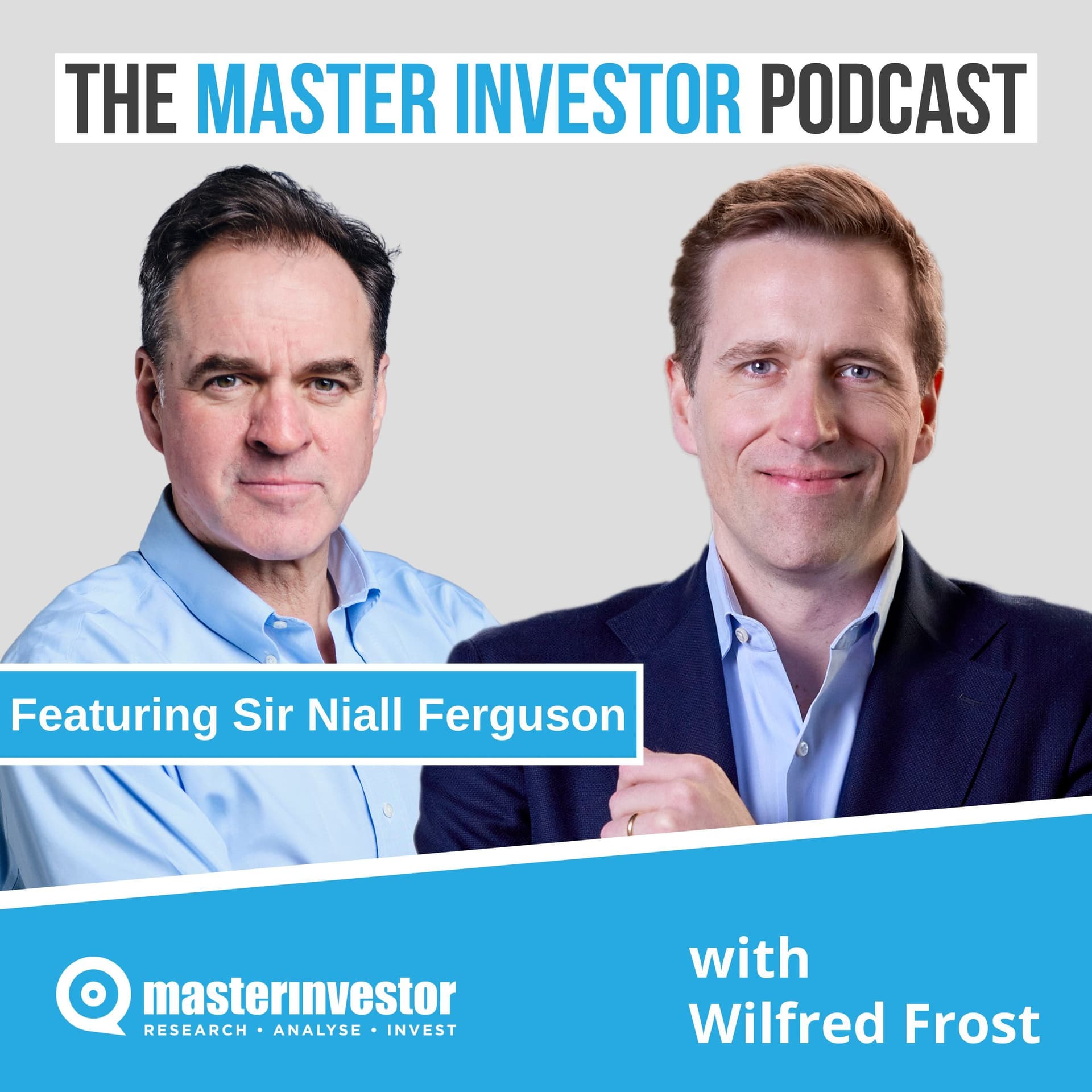
The Master Investor Podcast - Episode Summary: Niall Ferguson: Navigating The New Gilded Age - Debt, Gold, AI & China
Podcast Title: The Master Investor Podcast Host: Wilfred Frost Guest: Sir Niall Ferguson, Financial Historian Episode Title: Navigating the New Gilded Age - Debt, Gold, AI & China Release Date: [Date not provided in the transcript]
Episode Overview In this episode, Wilfred Frost engages with Sir Niall Ferguson, a notable financial historian, to explore the transformative shifts in the global economy reminiscent of the Gilded Age. Ferguson discusses pressing topics such as U.S. debt dynamics, the role of gold and Bitcoin in investment strategy, the geopolitical landscape involving China, and the challenges facing Europe amid its ongoing conflict with Russia.
Key Themes and Discussions
- Current Economic Landscape
- U.S. Debt Concerns:
- Ferguson highlights the unsustainable fiscal policies in the U.S. leading to a federal debt approaching 100% of GDP.
- Current interest payments exceed defense spending, marking a pivotal concern for the nation's economic stability.
- Impact of Policy Changes:
- Unexpected shifts, including halted immigration and increased tariffs to levels reminiscent of the 1930s, could slow U.S. economic growth.
- The interaction of these factors may maintain elevated interest rates, even as the Federal Reserve cuts rates.
- Investment Insights
- Gold and Bitcoin as Hedge Assets:
- Ferguson notes record highs in gold prices, indicating a shift in investment sentiment during periods of dollar weakness.
- He likens Bitcoin to "digital gold," suggesting a potential future where it gains value amid economic volatility, akin to gold's historical role.
- Portfolio Recommendations:
- Advocates for a small allocation in Bitcoin (initially suggested as 1%) alongside gold to hedge against inflation and potential stagflation scenarios.
- China and Global Innovation
- China's Economic Duality:
- Ferguson discusses China's impressive advancements in manufacturing and technology juxtaposed with demographic challenges and economic vulnerabilities.
- While China leads in sectors like electric vehicles and robotics, it faces long-term issues due to a declining birth rate and an aging population.
- U.S.-China Competition:
- The competition in technology and innovation continues to heat up, with China making significant strides but facing limitations in software compared to U.S. hyperscalers.
- European Dynamics and the Ukraine Conflict
- Shifting Aid Responsibilities:
- Ferguson emphasizes the transition of military aid responsibilities from the U.S. to Europe, suggesting that Europe must strengthen its military capabilities.
- The ongoing conflict in Ukraine is largely dependent on European support, as the U.S. scales back its involvement.
- Outlook on Peace and Military Readiness:
- He expresses skepticism about the war's resolution, especially given Russian reinforcements and the lack of readiness within European defense forces.
- UK Economic Woes
- Concerns Over Military and Economic Decline:
- Ferguson warns about Britain's dwindling military power and economic inefficiencies that reflect a broader malaise reminiscent of the 1970s.
- Advocates for a policy direction that encourages innovation and entrepreneurship, echoing the principles of Margaret Thatcher.
Key Quotes
- "If you have a real interest rate on your public debt that is higher than the real growth rate, you're in trouble."
- "The dollar is the thing to look at here...gold has hit record highs this year, indicating a shift in investor sentiment."
Final Investment Advice
- Diversification:
- Ferguson underscores the importance of having a diversified portfolio and avoiding panic selling during market volatility.
- Long-term Perspective:
- Emphasizes that learning from past mistakes in investment decisions is crucial for growth and stability.
Upcoming Content
- Stay tuned for a bonus episode comparing the leadership styles of Donald Trump and Richard Nixon, featuring insights from Ferguson.
Important Note The content of this podcast is for informational purposes only and does not constitute financial, investment, or other professional advice. Always seek independent financial advice before making investment decisions.
Additional Resources
- Full video available on [The Master Investor YouTube channel](https://www.youtube.com/@TheMasterInvestorPodcast)
- Follow Wilfred Frost on [X](https://x.com/wilfredfrost?lang=en) and [LinkedIn](https://www.linkedin.com/in/wilfred-frost-279667374/)
--- This structured summary offers an overview of the key discussions and insights from the podcast episode for readers interested in finance, history, and geopolitical issues.
Written by AI. May contain mistakes. Listen to the episode to check what was said.
Transcript
Automatic transcript. May contain errors.0:00The fact that gold has hit record highs this year is telling you something important about the way at least some investors are thinking about the world. It's been a long time since we had a period of sustained dollar weakness. If that's what's coming, then I think smart investors want to have gold to protect them from the nightmare scenario, which is a rerun of the 1970s. One has to be a little bit cautious here. It is astonishing that we're now looking at an average tariff rate for the United States close to that of the 1930s. I never thought I would find myself using words like that in the 2020s.
0:38But here we are. I keep asking myself, is there an 1893 moment, a kind of panic, when suddenly markets decide maybe there isn't going to be the pot of gold at the end of Sam Altman's rainbow? The pot of gold is marked artificial general intelligence. If it turns out that that's not actually there or that the returns on all of this investment are going to disappoint, then at the very least, I think markets are going to reprice the hyperscalers who are spending all this money on capex. So that's the thing I keep asking myself. Just how 1890s are the 2020s? Right now, in lots of ways, we're in a very 1890s America.
1:22Welcome to the Master Investor Podcast with me, Wilfred Frost, where we celebrate and learn from the success of the greatest investors, business leaders and politicians in the world, giving you, our listeners, the edge. My guest today is the preeminent financial historian of our age. He is the Milbank Family Senior Fellow at the Hoover Institution at Stanford and a Senior Faculty Fellow on the Belfer Center for Science and International Affairs at Harvard. He's written 16 critically acclaimed books, which range from The Ascent of Money, The House of Rothschild, Empire, Civilization, and Kissinger Part 1.
1:58And he's currently working on Kissinger Part 2, the central biography of the late Secretary of State in the US. He is, of course, Sir Neil Ferguson. Neil, it is great to be with you today. Thank you so much for joining the Master Investor Podcast. Great to be with you. I should explain that I am not a master investor. You can be a financial historian without being a master investor. I wish I were a master investor. We'll get to that later. But health warning, I am not a master investor. Well, the title actually, which maybe I have confused people with, is trying to help our listeners become master investors.
2:32So you're allowed to stay. Well, one day I'll write an essay called Why I Am a Terrible Investor. And I'll look back on some of my bad investment decisions. It is important to learn from those because the idea that investment is just a whole series of home runs. And the people who make money are geniuses who always hit homers. That's actually wrong. It certainly is wrong. And it's always key, actually, as you say, to learn from mistakes and to acknowledge them publicly as well. So it would be great to get to some of that later. I wanted to start, if we could, with the state of play in the most important economy in the world, in the US, and in particular, the macro outlook.
3:10And I personally, as we were discussing before we started recording, as you are as well. We've spent a lot of time in the US and I would never bet against the ability of the US economy to reinvent itself and lead whatever the next wave of innovation is, and certainly leading one of those now. But shorter term or medium term, do you look at the debt position today? And do you have concerns about whether they can out-innovate it, outgrow the debt problems they've got? Yes, but I've been worrying about the federal debt for more than 20 years. I wrote about it first in a book called Colossus, which was published 20 years ago on the eve of the war in Iraq.
3:53So the United States has been running an unsustainable fiscal policy all this century, but that's not good. That just means that we're getting closer and closer to a day of reckoning. If you calculate the debt relative to gross domestic product, we've now reached around 100 % if you count only debt in public hands. That's the highest since the period just after World War II. More worryingly, the United States is spending more on interest payments now than on defense. And that's really the first time that that has been true apart from a very brief moment back in the 1930s. I have a law, Ferguson's law, that states if a great power is spending more on interest payments than on defense, it probably won't be great for much longer.
4:40So there's a real issue there. And then we have a set of related problems arising from some big policy changes that have happened this year. Number one, a complete stop in immigration, illegal and more or less legal too. There'll be zero net migration to the United States in 2025, whereas it was running in the millions under Joe Biden. That's shock one. And shock two, of course, has been the imposition of tariffs, which have taken US average tariff rates back to where they were in the 1930s. So these are two big shocks to the US economy, and it's hard to believe that they won't tend to slow growth and potentially also to keep interest rates elevated even when the Fed is cutting.
5:29It's clearly, as you say, it's something that the warning signs are flashing. But I guess they've managed, as you said, since your book, Colossus, came out to kick the can down the road for a period of time. I know you're a friend of Larry McDonald who's been on the podcast, and it's a great episode people should go back to if they haven't listened to it. And he says very explicitly, he thinks Scott Bessent and Co are trying to massage interest rates below the rate of inflation to try and help them get out of this problem. Do you think that is what they are doing intentionally? And do you think that's what the outcome will be?
6:02What are the implications for inflation in the dollar, if that's the case? Well, I think the important thing to look at here is the real interest rate. If you have a real interest rate on your public debt that is higher than the real growth rate, you're in trouble. And this is a problem for a number of economies in the world today. It's not clear whether it's going to be a problem for the United States, because we see the Fed cutting short-term interest rates. That's already begun. And we also see inflation somewhat above the Fed's target, partly because of tariffs, but not only because of tariffs that President Trump's imposed.
6:45The real growth rate, however, is trending down. and it's clear that by the end of this year, growth is going to be closer to 1 % than 3%. Remember, Scott Besson said 3 % was his target. That's going to be hard to hit the way things are going. So it's a little early to conclude that the US is in a debt crisis because we've got relatively low real rates but also relatively low real growth. So that's, I think, the key way to think about this. Part two of my answer has to do with the dollar. Since President Trump came in, some indicators have gone on a round trip. The stock market, for example, had a huge hit, especially the NASDAQ, when Liberation Day was announced.
7:28April 2nd, the tariffs were unveiled. Somehow, we're in October, and markets have not only retraced their steps, but actually have hit new highs. So equities aren't the thing to look at. The thing to look at is gold and the dollar. The dollar's down 8%, 9 % since Trump was sworn in. By the standards of previous dollar depreciations, that's actually not much. If you go back to the 70s and the 80s and the most recent period of dollar weakness, you could look at, you look back at declines of 25, even 30%. So it's possible that we'll see more dollar depreciation in the coming year. But that's why people who were long the dollar but not hedged got a real fright back in April, European and Asian investors.
8:18And they've had frantically to improve their hedging to cope with the possibility of a weaker dollar. So I think part of what we're seeing here is really to be understood in the exchange rate. What I think Secretary Besant wants to do is to make the foreign bondholders pay. That was something also flagged by Stephen Mirren, who's now at the Fed, in a paper that he published before he joined the Trump administration, which became the basis for the Mar-a-Lago Accord narrative. So I think the dollar is the thing to look at here. The fact that gold has hit record highs this year is telling you something important about the way at least some investors are thinking about the world.
9:00It's been a long time since we had a period of sustained dollar weakness. If that's what's coming, then I think smart investors want to have gold to protect them from the nightmare scenario, which is a rerun of the 1970s. I mean, gold, just to focus on that, it's up 47 % so far this year. It follows a 25 % rise in 2024, which itself was at the time a very big annual rise for gold. Just snapshot what those – the reasons behind that particularly pronounced – I mean, it's trading. like Bitcoin almost, when you talk about increases of that number. It's not just a sort of low beta safe haven. Gold and Bitcoin are in a kind of interesting relationship to one another.
9:46I said in the second edition of The Ascent of Money, which was published back in 2018, that we should think of Bitcoin as an option on digital gold. In other words, if we really do enter a world of digital finance in which blockchain-based payments and coins become standard, then it's quite plausible that Bitcoin becomes the gold in that world because of its finite supply. Finite supply is part of the reason for gold's enduring appeal. Of course, it doesn't pay a return. It's a zero interest-bearing asset. So you have to kind of assume that real rates are going to be negative on interest-bearing assets.
10:28Otherwise, why would you hold gold? The same applies to Bitcoin. You're assuming some upward trend in the price, which implies some weakening of the dollar because you're pricing both of these things in dollars. And I think if you're a smart investor over the last five years, you've wanted to hold both Bitcoin and gold because you want to protect yourself against what I'll call the nightmare scenario of a second 1970s. That's a world in which you have higher inflation, but you also have stagnation. So you have the nightmare combination of stagflation. Now, that's not, of course, the plan. What Secretary Besant wants is to see a period of dollar weakness, but not elevated inflation, but actually rising growth and relatively low inflation.
11:18In this scenario, the benign scenario, you're really rerunning the 1980s. You'll remember that in 1985, there was a significant dollar weakening, the Plaza Accord, and markets took off. US equity market took off. Inflation did not take off. It was an extremely good time, apart from a little nightmare now moment in 1987. So there's a good outcome here, which is we get some version of the 1980s. The bad outcome is we get some version of the 1970s. Just to pause on both gold and Bitcoin, which is really interesting to hear you so clearly describe it as digital gold. What sort of portion should people have of those two assets in their portfolio?
11:59Well, back in 2018, I said 1 % would be smart for Bitcoin. At that point, the average millionaire didn't have any Bitcoin. And my argument was that if every millionaire in the world had 0.2 % of his or her wealth in the form of Bitcoin, the price should probably be around$15 ,000. If it went to 1%, then the price would be likely closer to$70 ,000. Well, we're now actually above 100. And so it seems to me there's been significant adoption since I did that second edition of The Ascent of Money. And adoption is really the key here. More and more people taking Bitcoin seriously and more and more established institutions, including banks, taking it seriously as an asset.
12:43It's not going to be money. We're not going to ever be paying for our coffees with Bitcoin. But it has, I think, acquired a status comparable to gold, something that you want to own, just because it's not correlated closely with other assets that you might have in your portfolio. I significantly recommend Ascent of Money. But the first one came out when? It was published in 2008 originally. I was going to say. Just after the failure of Lehman Brothers. So it was a pre-crisis book in terms of its being written. It was a television series before the financial crisis really got going. The whole point of the Ascent of Money was to foresee and explain the financial crisis.
13:23Ten years later, I thought, I need to update this. And one of the things I did was to write a chapter on crypto because that had come on the scene since the book was published. Well, and I recommend people do read it. I remember reading it then as I graduated in 2008 as one of the books, a wise old investor told me would help me in job interviews to get a job in the city. And it certainly did. And here you are. So thank you. No, genuinely, I remember it very well. It's a seminal piece on that topic. Let's talk about China versus the US because a lot of people I talked to, including recently Eric Schmidt on this topic says they're way ahead on some areas of the innovation like robotics in particular.
14:03He said obviously they're close behind in AI and in fact maybe their potential to innovate over the next decade is under price. At the same time and I know you've talked a lot about this their demographic outlook is not great. What's your outlook on China with those competing forces or perhaps other more important competing forces? Can they be quite strong for a couple of years and then struggle or your outlook as well? Far be it from me to get into a debate on technology with Eric Schmidt. But I did spend quite a bit of time in China prior to the pandemic. I was a visiting professor at Tsinghua University.
14:41I spent a lot of the last couple of decades thinking about the Chinese economic challenge. In 2020, when I was writing the book Doom, I thought China was making claims that were implausible. You'll remember that at that time, Xi Jinping said, we have the best response to COVID and you're the West completely screwing it up. Not only that, but we're going to create vaccines that we'll give to the world. And then that was the era of wolf warrior diplomacy when Chinese diplomats were encouraged to go and beat their breasts and bare their fangs. That all, I think, turned out to be heavily overhyped.
15:19Zero COVID turned into a disaster, actually, for the Chinese economy because they waited far too long to get rid of the restrictions, damaging consumer confidence along the way. They didn't develop the vaccines. That ended up being much more successfully done in the United States and the UK. And wolf warrior diplomacy completely backfired and made China significantly less popular than it had been in the rest of the world, maybe at the beginning of Xi Jinping's time and power back in 2012. So at that point, when I was writing Doom, I thought, you know what, I think the Chinese system has real problems.
15:53And Xi Jinping has made some serious mistakes. Five years on, you can see something that he got very right. And that was made in China 2025, which was a master plan to take China to the very top of the global manufacturing supply chain. And now China dominates in so many sectors. It's very, very impressive indeed. And I'm not just talking here about electric vehicles and batteries and solar cells. Those are the most obvious things, that the Chinese are simply pouring into global markets. It's broader than that. China has, for example, is now producing double the electricity that the United States produces.
16:34And that's the result of stunning investment in all kinds of forms of electrical generation. China, as you already mentioned, Wilford, is clearly at the front of robotics hardware, though it's still, I think, challengeable when it comes to software. And we're left with a software advantage. Even in software, if you think of artificial intelligence as essentially being a whole bunch of large language models harnessing huge amounts of compute, the lead that we have, the West has, i.e. the US hyperscalers, is less than I would have predicted five years ago when this race was really getting going.
17:12So despite the problems that I identified back in 2020 with the way that Xi Jinping runs China, there's no question that they are now the manufacturing superpower. And that gives them dominance in a whole range of different areas, including warfare. Because if the war of the future is a drone war, then guess who dominates drone technology? That's right, China. And so do you think if you look at Chinese equities broadly, it's bounced back a bit, but it's a lot cheaper with some geopolitical risks than the US market that needs to be in people's portfolios? Yes, I think that's been true for about a year since it was clear that Xi Jinping was going to take the tech sector in China out of the deep freeze.
17:57We've seen Jack Ma more or less rehabilitated and we see the dear leader smiling upon AI and tech generally. This is a big change because there was a period when he acted like he didn't need the tech sector and particularly the big network platforms. So I think you've got to take a more constructive view of China tech, not least because these competitors to the US hyperscalers are so much cheaper by comparison. I think China's problems don't lie there. They lie in the real estate sector, which it's proving extraordinarily difficult to sort out, rather as happened to Japan after 1989-90. Then there's the demographics, which you mentioned.
18:41I think it's reasonable to estimate that China's population will fall by about half between now and the end of this century. It might even be more than that if the fertility rate doesn't recover. It's fallen well below replacement. And so China is looking at a period of really significant contraction in its workforce. And that's a problem. It's certainly a problem if your economic model involves urbanization, building of tower blocks. Who are these tower blocks for is a pretty legitimate question. Bridges to nowhere have been replaced by tower blocks for nobody. And robots don't need tower blocks.
19:23So I think those are China's problems. They're long-term problems. They'll become more obvious 10, 20 years down the line than they are today. but they are a reason not to be too confident about where China's going with all the extraordinary achievements of its industrial revolution. There's something wrong with Chinese society that people don't want to have children. There's a gloom that hangs over the Chinese consumer market still, which the government really can't figure out. So clearly, President Trump is trying to compete back and get the US industrial sector going again and the tariffs are part of that.
20:00Are you a buyer of the domestic US industrial space as a result of this or not? One has to be a little bit cautious here for a couple of reasons. One is just my predisposition to believe Adam Smith over any challenger. Moving away from free trade rarely benefits an economy and the US has moved decisively away from free trade this year, it is astonishing that we're now looking at an average tariff rate for the United States close to that of the 1930s. I never thought I would find myself using words like that in the 2020s, but here we are. And I think that is going to lead to the things that tariffs generally produce historically.
20:43Inefficiency, less productive sectors being protected from competition tends not to be beneficial, as well as the kind of corruption that comes when big companies can come and strike deals at the expense of lesser companies. Everybody wants an exception, especially if they're Apple or NVIDIA. So I have a kind of theoretical resistance to the idea that protection can really benefit the US economy. But the other reason is that it's hard to, say, replicate TSMC, the semiconductor manufacturer in Taiwan, in Arizona. It's hard because the United States is not as easy a place to build high-end manufacturing as it was 30, 40, 50 years ago.
21:31U.S. labor costs are high. U.S. permitting costs are prohibitively high, especially in blue states. And so I think it's going to be harder than it looks to replicate the manufacturing that moved over to East Asia in the period after China to join the World Trade Organization. This is going to be difficult. And I would say if you just look at manufacturing jobs this year, they've actually fallen in number, not increased. So you have to be a little skeptical that the tariffs are going to re-industrialize America in ways that will reward efficiency and enhance productivity growth.
22:13Let's talk a little bit about Europe and kick off with the obvious top topic, Russia, Ukraine. You've been clear in recent weeks and months that you think people haven't realized sufficiently the extent to which the Trump administration has cut off the level of aid, military and financial to Ukraine that had been flowing beforehand. What is your snapshot as to what the likely outcome is off the back of that? And I guess as we look at sort of markets broadly, Do you think there will be peace, in inverted commas, whether it's very unfair on one side or the other, in the foreseeable future? And I guess I wonder what happens to risk assets, even if geopolitically the long-term implications of the settlement are quite worrying.
22:59What happens to risk assets when there is no longer any fighting? President Trump came into office saying that he was going to end this war. He's now admitted, as some of us warned at the time, that this is much harder than it looked. And he's almost washed his hands of the problem. He said on his Truth Social Media platform just last week, good luck to everybody, which I translate as I'm out of here. This is now your problem, Europe. So I think there's a big difference between the United States selling missiles to Europe that the Europeans can give to Ukraine and the United States giving missiles to Ukraine.
23:44The United States has been responsible for not quite but nearly half of all the aid that Ukraine has received since the Russians launched their full-scale invasion in February 2022. That is now over. From now on, it's going to be the EU plus the UK, maybe some others who are providing the aid that Ukraine desperately needs. Because Ukraine can't win this war on its own. It's dwarfed by Russia in terms of both population and GDP. It's just that the Europeans haven't fully grasped, I think, that this is now their war. They plus the UK are going to have to be the principal sources of support for Ukraine.
24:26Now, that's not an impossible prospect because Europe is rich. it's economically vastly larger than Russia. And it ought to be easy for Europe to step in and take over from the United States as the principal source of aid. The problem is the Europeans don't have the military capabilities that the US has. And therefore, a lot now hinges on European rearmament, which in effect means German rearmament, since it's clear that the UK and France are too fiscally constrained to do terribly much here. So So watch carefully how successfully the German Chancellor Friedrich Mertz rearms. If he uses the additional money that's now been made available since he came to power wisely, then quite quickly Europe can develop the kind of military capabilities that will really help Ukraine.
25:14And I mean by that drones. Drones are the key to this war. It's increasingly a drone war at the front. And it's all about drone defense. If the Europeans use their considerable financial resources greatly to expand their drone defenses and Ukraine's drone offensive and defensive capability, then that's serious trouble for Vladimir Putin. The problem is I don't see that happening fast enough. Last point I'll make, Wilfred, is just that under these circumstances, why would the war end? Putin can still see victory in sight. He thinks that ultimately Ukraine will run out of men and the front line will simply crumble because of the sheer weight of manpower that he can deploy.
25:59And he is extraordinarily wasteful of Russian soldiers' lives in the pursuit of additional territory. So Putin's not incentivized to settle. And as long as that's the case, the war is going to keep going. and it will all depend on how far Ukraine can hold out, given that it is David, Russia's Goliath, and it's only in the Bible that David tends to win those fights. I guess the implication of that is German defence stocks, even if they've run up a bit over the last 12 months, could have a lot further to go if Frederick Mertz really steps up to the plate. Well, I just interject that it's not clear to me that you want this to be a win for the established defence primes in Europe, Because in fact, what you really need is to see Ukrainian defense technology scaled with European and British capital.
26:48It's the Ukrainians who are now at the cutting edge of drone warfare. Their companies are clearly the best in the world. The Americans acknowledge that. They're capital constrained, though, as is the Ukrainian government. Ukrainian government can only afford to buy about a third of the drones that Ukrainian companies make. So I don't necessarily want to see established German defense companies doing well here. If this is just Ryan Mattel's war, I think Putin ultimately wins it. That's a really important and interesting take to add to it. And by the way, in terms of Trump's motivations towards his tactics on that war, we're going to talk more about that in a bonus episode coming at the weekend with Neil as we explore the Nixon versus Trump comparison with Neil for a bonus episode.
27:35Just one quick question or a couple quick questions on the UK. economically you mentioned that point about Ferguson's law when interest costs rise above defense costs I guess we crossed that threshold a while ago yes and the gap is much bigger you you concerned about the outlook here for the UK economy I am concerned I mean I'm concerned because for that reason Britain is ceasing to be a meaningful military power you probably haven't had a navy this small since Elizabeth I's reign, and the army is also an extraordinarily reduced force. So one has to worry about Britain's ability to play its part in the defense of Europe.
Read the full transcript
28:18But there is a broader problem in Britain, and that is one of relatively poor performance, extraordinary inefficiencies in the labor market, millions of young people essentially not in the labor force, subsisting on benefits because of somewhat casually diagnosed mental health problems. There are all kinds of structural problems in the UK economy which desperately cry out for fixing. Unfortunately, successive conservative governments plus the new-ish labor government respond to the problems by raising taxes. And this is, of course, only going to make matters worse. So when I look at the UK economy today, I'm unpleasantly reminded of my childhood in the 1970s.
29:04Sure, the inflation rate isn't as high and the unemployment rate isn't as high, but there is a kind of atmosphere of underperformance and low expectations that really does remind me of Britain in the 1970s. You know, if you look at who's performing well in the UK economy in recent years, It's actually pensioners who seem to be doing well and young people who seem to be faring badly. And you can't help feeling that an economy that's principally good for seniors, for retirees, probably has a fundamental structural problem right at its heart. Still a long-term believer in the UK? What's the quick bit of advice?
29:46How do we bounce back? Well, the lesson of the 1970s is that Britain could bounce back and under Margaret Thatcher did bounce back. But until we have a government that approaches Britain's economic problems the way Margaret Thatcher approached them in 1979, I don't think we're going to get anywhere. Just to be clear, the fundamental ideas of Thatcherism still hold good. You need to incentivize innovation and entrepreneurship and not punish it with higher taxes. And you need to encourage the free market and not expect the state to deliver growth. So I would like to see a revived Thatcherism. I think it's the only way out of this really rather miserable equilibrium of low growth and low expectations.
30:31But that's not going to come from Nigel Farage, who's offering, it seems to me, a completely unrealistic combination of increased state involvement and American-style policies on immigration. I would say, looking at our options today, Labour has no solution to the problems of the British economy. Reform has phony solutions. It's actually probably Kemi-Badanoff's Conservatives who are most likely to achieve the kind of reforms that Margaret Thatcher achieved in the 1980s. Of course the world is different and Britain is different from Britain in 1979. But certain things hold good and you've got to deal with the fiscal problems.
31:11You've got to deal with the excessive tax burdens on business. You've got to start encouraging innovation and entrepreneurship in a way that simply doesn't go on today. We'll, of course, see what the Chancellor comes up with in her budget in late November and be seeing as this episode drops what the Tories are announcing and if it punches through and gets a lot of coverage at their conference. As we wrap up this first part of our conversation, Neil, I wondered when you look back at history as you do better than anybody else, financial history, is there a moment that you keep thinking this could be similar to?
31:46And what does that imply to what's coming next? Or is it too hard to pinpoint something like that? Well, I wrote a piece for the free press not so long ago saying this is the gilded age. And it certainly is in the United States with this extraordinary CapEx boom around AI. data centers account for a huge proportion of investment in the US right now. In fact, you begin to think that without the AI boom, there wouldn't really be much growth going on in America. Now, the Gilded Age had its periods of crisis in the late 19th century. There was a huge financial crisis in 1893. Back then, it was railroads.
32:22And the CapEx boom around railroads and the heavy industry that went with it really was much larger in relative terms than what we see today. But I keep asking myself, is there an 1893 moment, a kind of panic, when suddenly markets decide maybe there isn't going to be the pot of gold at the end of Sam Altman's rainbow? The pot of gold is marked artificial general intelligence. If it turns out that that's not actually there, or that the returns on all of this investment are going to disappoint, then at the very least, I think markets are going to reprice the hyperscalers who are spending all this money on capex.
33:02So that's the thing I keep asking myself, just how 1890s are the 2020s. Right now, in lots of ways, we're in a very 1890s America. Well, it's a really interesting comparison and one that Jeremy Grantham made for us in one of our early episodes I encourage people to go back to and listen to. And a reminder to stay tuned for a bonus episode with Neil coming in a couple of days as we reflect on Trump versus Nixon comparison. Neil, for this part of the conversation, my final question, we ask this to everyone that comes in. What is an overriding, your key overriding piece of investment advice for our listeners?
33:38Well, I mentioned at the beginning of our conversation, Wilfred, that I don't regard myself as a master investor. In fact, I'm really quite bad at it. My favourite example of this is selling a quite large Bitcoin position right at the bottom of the market when Sam Bankman-Fried had blown up. And I thought that the whole sector, the whole crypto sector was really irretrievably damaged. I should have remembered to hold on for dear life. So that was a good example of a bit of bad timing when I'd actually got in at a reasonably good point and exited at the worst possible point. What does that teach me?
34:12Broadly speaking, you want to have a diversified portfolio and do not trade in the moments of fear. You've got to avoid selling in a climate of fear. That nearly always is a mistake. One of my strategies when I thought we would have a relatively inflationary decade in the 2020s was to load up on real estate. So I am rather long real estate on both sides of the Atlantic. Too long, if I look at my portfolio objectively, too much real estate, not very liquid, vulnerable to the vagaries of monetary as well as fiscal policy. I wasn't sufficiently diversified. I wish I had fewer bricks and mortar and more Bitcoin.
34:54So diversification is the key. And making sure that you do not liquidate a position in moments of fear is another key takeaway. These are simple principles. I'm not telling you anything original here. But I tell you, I've lived it and I've learned from my mistakes. how easy it is to bungle good positioning because you get caught up in the moment of panic. Well, we can't improve without acknowledging our mistakes. And it's very gracious and telling in an incredibly positive way that you've done it with us today, Neil, on the podcast. Thank you so much for joining us. And thank you for sticking around as well for the bonus episode.
35:30We really appreciate it. My pleasure. That was Sir Neil Ferguson on the Master Investor podcast. As I said, we'll have a bonus episode coming for you later this week. As a reminder, nothing you've heard on the Master Investor Podcast should be considered direct financial advice. There's more on that in our show notes if you'd like to refer to it. The Master Investor Podcast is produced by Paradine Productions and Master Investor Podcast Limited in association with Birdline Media. If you've enjoyed the podcast, please do subscribe on YouTube or click follow on your podcast platform and then you'll be automatically notified each time a new episode drops.
36:11And again, join us later in the week for more as we compare Nixon and Trump with Neil. Neil, thanks again. Thank you.
From the publisher
Legendary financial historian Sir Niall Ferguson joins Wilfred Frost on The Master Investor Podcast for a wide-ranging discussion that uncovers the seismic shifts shaping today’s global economy. Ferguson explains why U.S. debt, surging interest payments, and new tariffs spell both warning and opportunity, and dissects the interplay between gold, Bitcoin, and the weakening dollar in a world primed for volatility. The conversation probes China's explosive yet fragile ascent, Europe’s Ukraine dilemma amid shifting American priorities, and Britain’s recurrent struggle with stagnation—drawing bold historical parallels from the Gilded Age in 1890s America to the 1970s. Candid, brilliant, and often contrarian, Ferguson offers unflinching investment lessons from his own mistakes, and shares sharp insights on how the West must adapt as leadership and power move East.
Make sure you subscribe so you don’t miss the upcoming bonus episode diving deep into the Trump vs Nixon comparison, with the help of some clips from Wilf's Dad's famous 1977 interviews with Richard Nixon. This is financial and geopolitical storytelling at its most incisive.
The content of The Master Investor Podcast is for informational purposes only and does not constitute financial, investment, or other professional advice. Always seek independent financial advice before making investment decisions
You can watch the full video on The Master Investor YouTube channel
And follow @WilfredFrost on X and Linked In
This podcast is produced by Paradine Productions, The Master Investor Podcast Ltd in association with Bird Lime Media.