In short
The Master Investor Podcast with Wilfred Frost: Episode Summary
Episode Title
Ray Dalio: The Risks Are NOT Priced In – Here's What Happens Next
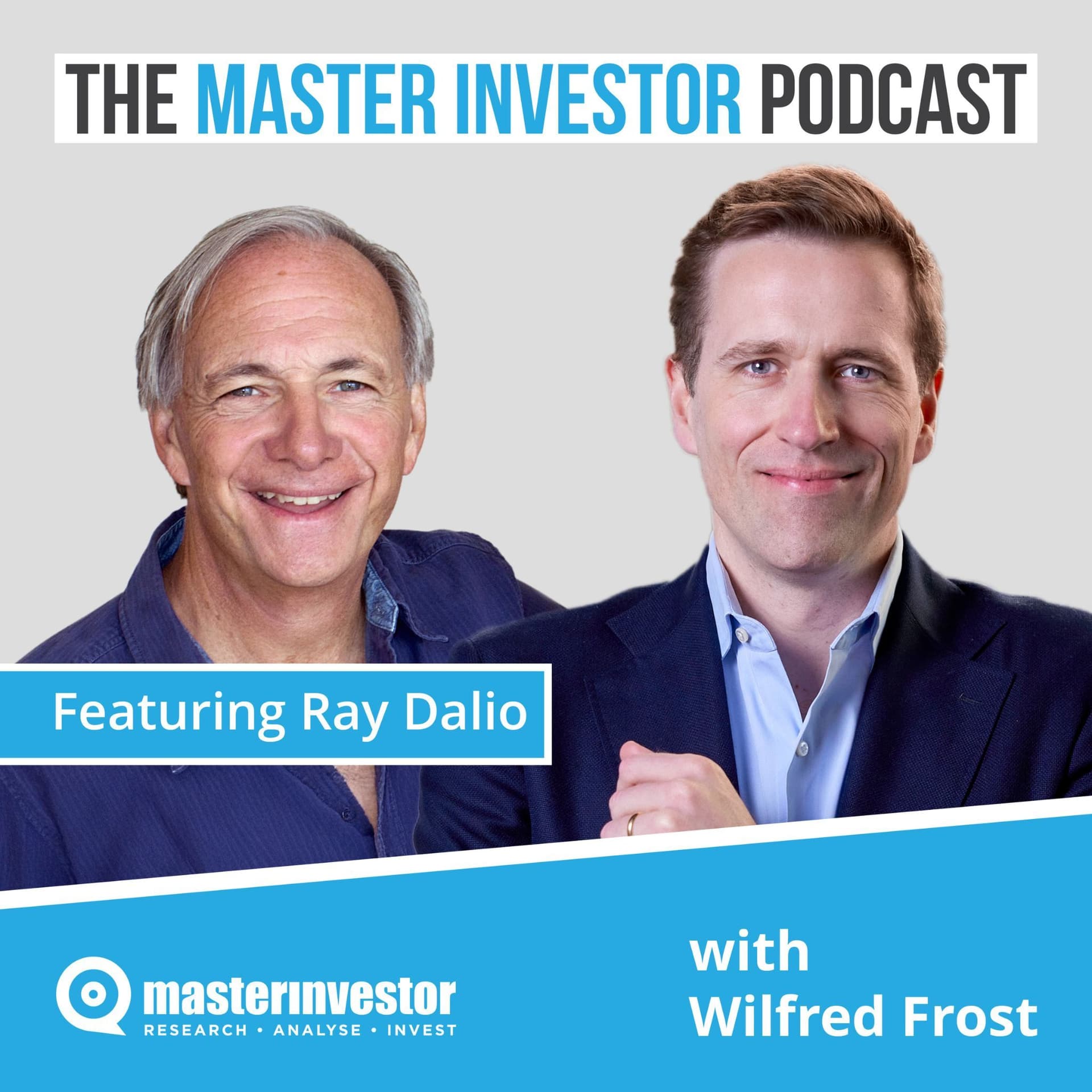
Episode Overview In this episode, host Wilfred Frost interviews renowned investor Ray Dalio, founder of Bridgewater Associates. They discuss the increasing risks in global debt markets, concerns about complacency in bond pricing, and the implications for the future of both the U.S. and UK economies. Dalio also shares insights on his investment strategies and views on the Magnificent 7 stocks, gold, and Bitcoin.
Key Themes and Concepts
- Current Economic State
- Complacency in Markets: Dalio emphasizes that current market conditions do not adequately reflect existing risks, particularly in bond markets.
- Indicators of Risk: Signals indicating economic stress are starting to emerge, including potential economic heart attacks due to rising debt levels.
- Five Big Forces Shaping Investments
Dalio identifies five major forces that drive economic and investment decisions:
- Monetary Order: The rise and eventual breakdown of debt relative to incomes.
- Internal Political Order: The dynamics between left and right ideologies affecting democracy.
- Geopolitical Order: The changing relationships between countries, particularly since 1945.
- Acts of Nature: Natural disasters and pandemics that disrupt economies.
- Technology: Innovations that can raise living standards and affect market dynamics.
- Debt Dynamics in the U.S.
- Debt Levels: The U.S. government spends $7 trillion while taking in only $5 trillion, leading to a debt that is six times its income.
- Interest Payments: With $1 trillion in annual interest payments, the U.S. faces a potential debt crisis.
- Future Predictions: Dalio predicts a need for significant government intervention (e.g., QE or capital controls) to manage the escalating debt situation.
- Comparative Analysis of UK and U.S. Debt
- UK Debt Costs vs. U.S. and Other Nations: The UK faces higher debt costs relative to its size and GDP, primarily because it no longer holds reserve currency status.
- Debt Doom Loop: Dalio describes a cycle where increasing taxes and dwindling capital flows can lead to further economic deterioration in the UK.
- Investment Strategies
- Gold and Bitcoin: Dalio recommends holding 10-15% of one's portfolio in gold or Bitcoin as a hedge against currency devaluation.
- Market Timing: He advises against trying to time the market based on fears but emphasizes the importance of diversification and thoughtful investment strategies.
- Impact of AI on Markets
- Equity Valuations: While AI is a transformative force, Dalio believes that the current valuations of major tech stocks might not reflect their potential future cash flows.
- Sector-Specific Opportunities: He suggests that sectors like biotechnology may offer untapped potential that is not yet priced in.
Conclusion and Advice Dalio concludes with key investment advice that intertwines with life principles:
- Understand your financial needs and align your career and passions.
- Develop a game plan that includes backtesting investment criteria.
- Seek environments that foster open discussion and meritocracy to voice ideas effectively.
Next Episode Preview The next episode will feature Thomas Pettyfy, founder of Interactive Brokers.
---
Disclaimer The content of this podcast is for informational purposes only and should not be considered financial or investment advice. Always seek independent financial advice before making investment decisions.
For more episodes, visit [The Master Investor YouTube Channel](https://www.youtube.com/@TheMasterInvestorPodcast) and follow [@WilfredFrost](https://x.com/wilfredfrost?lang=en) on X.
---
This summary captures the essential discussions and insights from Ray Dalio during his appearance on The Master Investor Podcast, providing listeners with a clearer understanding of the current economic landscape and investment strategies.
Written by AI. May contain mistakes. Listen to the episode to check what was said.
Transcript
Automatic transcript. May contain errors.0:00Until these things actually start to happen, you get this complacency. And so now the question for you or for your audience is, is it priced into the markets? Well, I'll answer the question and say, no, it is not priced into the markets. But yes, that mechanics is those signals. And there are a number of them in the book. Those signals are now beginning to flash or flicker. Welcome to the Master Investor podcast with me, Wilfred Frost. where we celebrate and learn from the success of some of the greatest investors, business leaders and politicians in the world, giving you, our listeners, the edge.
0:47My guest this week is quite simply one of the most successful investors of his generation. Ray Dalio founded Bridgewater Associates in 1975 and built it to be one of the most successful hedge funds of all time. He served as CIO, CEO and chairman of Bridgewater, but stepped back from all of those roles in 2021 to focus on mentoring, not just of the Bridgewater Investment Committee, but of everyone via his books, the latest of which, How Countries Go Broke, The Big Cycle, arrived just last month and is both timely and important. And today, we are incredibly lucky because he is our mentor here on the Master Investor Podcast.
1:37Ray, thank you so much for joining me. Oh, what a pleasure. Thank you. I love speaking with your audience. Well, so many places where I could start, Ray. And as our listeners already know, you are an investor, a macro investor, but you're also an avid historian. And as we sort of set up the conversation and particularly going deep into your new book on debt, I wanted you to boil down for us, first of all, the sort of five big themes, the five big factors that your studying of history has meant you focused on as you've made investment decisions and conclusions throughout your career. The five big forces are first the monetary order.
2:22In other words, there's a cycle in which debt rises relative to incomes until it can't do that anymore. And then there's a breakdown of the monetary system, the monetary order. Second is the internal order of the left and the right and populism, which changes democracy. It's something that Plato talked about in his Republic, you know, thousands of years ago. It's one of those situations in which the left and the right fight an inter-democracy. People who want things demand things from those politicians. And then as a result, there is a breaking down and a lack of discipline and they fight together.
3:12So that's the second factor, which drives the political order. And then the geopolitical order is what is the order? What countries, how does the system of countries working together work? And so, as we know, the political world order started in 1945 as an American world order, and that is changing. Studying those and then also seeing that the fourth factor is acts of nature. Droughts, floods, and pandemics, acts of nature, have killed more people and toppled more orders than the first three I mentioned. And then number five is technology. In other words, man's inventiveness of new technology has raised living standards.
4:04So everything that we're talking about or will talk about falls into those five forces interacting to create this bigger cycle. And so that is really what I want to explain and help people understand and help people navigate. And bring us up to speed then, Ray, with the kind of premise behind the new book, maybe the US in focus initially. How Countries Go Broke, of course, is the title. What is the big debt problem that the US faces right now? Well, the US debt problem is the same as the British debt problem before, when the British had a reserve currency, and it's the same as the Dutch before that, and it's very basic and very simple to understand.
5:00The credit system is like a circulatory system that brings nutrients, buying power, to different parts of the economy, And if that buying power is used to produce income, then the income services the debt and it's a healthy system. But what happens when it rises, when debts and debt service payments and interest rates rise to crowd out like plaque in the circulatory system, crowd out other spending, then it decreases. And it produces a problem that's like an economic heart attack. It's important to understand that the economics, the finances of a country are the same as the finances of an individual or a company, except the government can print money and grab money from others through taxes.
6:07So what we have is that kind of a dynamic. And when things get become so threatening that to that supply demand, then you get a selling of the bonds. And so you see that reflected in interest rates going up, the currency going down and the stock market also going down in that dynamic. That's happened repeatedly. It indicates right now when we're looking at the situation, we are coming to the end of that long term debt cycle. And you can measure it. Let me give you the numbers. For example, in the United States, the United States government, the U.S. government spends$7 trillion a year. it takes in$5 trillion a year.
6:58So it's spending 40 % more than it takes in. And it can't really cut its spending because the spending is so fixed and so on. And so it's accumulated a debt that's six times the amount of money it takes in, and it's continuing to run those deficits. and an interest payment that is$1 trillion a year, which is half that budget deficit. And so when we look forward into the next year, the supply of debt that the U.S. will have to sell is about$12 trillion. One trillion comes from interest. Two trillion comes from the new debt that has to be taken on. And$9 trillion comes from having to roll over that debt.
7:51That means that you have to have a demand for$12 trillion. And so what we have is this situation. It's like watching, I feel like a doctor, watching an MRI and seeing the plaque build up and seeing this dynamic. And we are going to be in a position where because that debt will accumulate now very quickly. We are at the point of no return because we'll be having more debt. How do you pay all this debt and all this debt service plus everything else? The only way to do that is to create debt for the government to create debt and borrow that money to pay, and the central bank printing the money. So that is how that dynamic works.
8:44And that's where we are. On that very note, Ray, I mean, it's clearly we're in the late stage of the cycle, as you said, clearly the doctors looking at the heart and very worried about how close we are to the economic heart attack. Everyone always then wonders, what's the final trigger? Or how do we know that we're in that final stage rather than just the late stage? And in the book, I note that you say this, two big final risks are another round of QE, of quantitative easing, or the government trying to seize control of the central bank. It's fascinating. You wrote this book, obviously, earlier this year.
9:21It came out on June the 3rd. Are those two final late stage potential triggers things that have materialized? Or are you worried they're materializing in the last month since the book came out? uh they're they're materializing and um and by the way they're not surprising because if somebody had studied history we would we would see that these things happen repeatedly so um yes um i gave a number of um uh indicators to look for uh also the talk about capital controls and the like Then the question is how the population deals with all of that. But yes, that mechanics is those signals, and there are a number of them in the book.
10:08Those signals are now beginning to flash or flicker. When I think about a theme, Ray, across all of your books, one of them is whether or not the news, the information is already priced into the market. And you're well ahead of the curve in talking about how important this debt cycle is. And we're clearly living that now. But I wonder whether you think it is priced in. I'm not so much talking about the equity market, but into bond markets. Are the risks that are clearly there that you've clearly outlined for us already priced in when you look at 4.5 % on a 10-year gilt, a bit less than that on a 10-year US bond?
10:51Or is this something that even though we're all talking about it now, it is yet to price into bond markets anywhere? And I'd say bond and currency markets. And I want to say that's why I wrote the book. OK, my experience has been that, no, it's not priced in. And the reason I wrote the book is to show the mechanics of it. I went to the Treasury, U.S. Treasury, in 2007 and 8, and I showed them the mechanics. And I went also to the ECB before 2009 and 10, and I showed them the mechanics. The mechanics largely being the supply-demand gap that one could calculate. And in both of those cases, they say it's not reflected in the markets.
11:54Why are you worrying about it? It's not reflected in the markets. And that is because until these things actually start to happen, you get this complacency. And so now the question for you or for your audience is, is it priced into the markets? Well, I'll answer the question and say, no, it is not priced into the markets. But don't believe me. But do read the book and see the mechanics and say, does it mechanistically work the way that I'm describing? Because if it works the way I'm describing, I'm giving what was my secret sauce of being able to anticipate these things. and so on to policymakers and readers of the book so that they themselves can make the judgments of does it work that way and then what should I do about it?
12:55Let's, if we can, Ray, move on just for a little bit of a snapshot to the UK itself. Why are UK debt costs higher than the US, significantly higher than Germany, Japan, when you look at a snapshot and our deficit is smaller than the US, our debt, accumulated debt is smaller than the US as a percentage of GDP. It's a hell of a lot smaller than Japan. What is it that means our debt costs in the UK are higher? First, I'll say it's an ugly contest. like. Hey, it's not like your picture, your financial picture is good. It certainly isn't good. And so you're right to ask the question, perhaps on a relative basis.
13:42But the relative is it's not a reserve currency anymore. Okay. It's not an effective storehold of wealth anymore. Okay. In the United States, okay, there's a certain element of I will buy dollars because I will transact in dollars and that'll be my vehicle for saving dollars. And I'm going to buy those dollars for that reason. They're not transacting in British pounds anymore. Okay. That's over. Okay. Then, and in Japan, there's again, that very strong home currency bias. In other words, they're a creditor nation. They have a lot of debt, total debt. But at the same time. They have it within themselves.
14:27They are a creditor nation to the rest of the world. And they are and the Japanese, therefore, view risk in Japanese yen terms. And so they're willing to hold the that yen that is going down so quickly. And despite the fact that they're having such a lousy interest rate, in other words, they've been brutalized by holding that debt. But since there's a home advantage, then they hold the debt. And that is the basis. So it's the basis of supply and the demand for those reasons. And when you look at the UK at the moment, you know, we put taxes up last fall. The hope was that then we wouldn't have to borrow more or put taxes up again.
15:14It's now a certainty pretty much that taxes are going to have to go up again this autumn. The tax burdens at a post-1951 high and the debt levels are at a record high. Are we in a debt doom loop at this point in the UK? We're in a debt doom loop, yeah. So talk us through that. How do we get out of it? The debt doom loop also is affecting capital flows. So the necessity for creating taxations that are then driving people away, They move for their capital reasons, a deterioration in conditions as the financial problems and the social problems worsen, having the effect of causing people to leave, people with money to leave.
16:05That's a problem because I don't know the exact numbers in the UK, but they're analogous to the U.S. Seventy five percent of income taxes are paid by the top 10 percent. So if you lose 5 % of the population in that category, half of those people, you lose 35 % or more of the tax revenue that comes as a result of that. And so you have this deterioration, financial deterioration, precedes social and economic deterioration that has caused migrations all around the world and so on. And there is only one way to deal with that. First of all, both of our countries need a strong leadership of a strong middle.
17:10I use two words there. Strong, meaning that they are going to have to do the difficult things that need to be done to bring about, to deal with this problem. I'll tell you what it means in a second. And middle, meaning that they have to have the war between those of the left and those of the right begin to end because difficult choices are going to have to be made. You know, like our countries had in World War II, difficult choices are going to have to be made in order to get through that together. Those are the things that are required. And the path is going to be that the deficits for the government, the central government, have to be lowered to about 3 % of GDP.
18:09That is what would be sustainable rather than having this compounding effect. You know, the federal government, the central government, has to do it equally in spending cuts and taxation because no one of those is possible. And if that is done, then interest rates will come down or not rise. In the book, I go through many cases, a large number of cases of how that was engineered. In the United States, it was engineered between 1991 and 1998 when the budget deficit was cut by 5 % of GDP. But unless that's done, and it probably won't be done, then it's just a matter of the mechanics that is going to lead to these results.
19:05It's funny you mentioned the 90s. We had Jack Lew on the podcast a few weeks ago, and he talked through his time in the Clinton White House of getting to that more balanced budget. And I recommend our listeners go back to that episode if they haven't done so already. Lots more little areas I want to get to if we've got time, Ray. And one of them is predictions for big picture asset classes, not individual stocks, for how some of these things might play out. And the kind of core one that it sounds like from what you're saying is dollar weakness. And typically in normal times, if you get dollar weakness, then other major currencies would appreciate against it.
19:43But your view is kind of that there's weakness due in most of the major currencies, I guess, against things like gold? Well, yes. And let me just explain. There are different types of currencies. all of the ones that we're talking about are fiat currencies that's the ones you're used to and just like in the 70s or just like in the 30s they will all tend to go down together and we will pay attention to the relative movements but they will all go down in relationship to not fiat currency, hard currencies, and that is gold. Gold is now the second largest reserve currency. It's the dollar, gold, euros, yen, and so on.
20:37So I think we're looking at something like a very classic devaluation, somewhat similar to the 70s or the 30s in which they all devalued together in relationship to non-fiat currencies. Is Bitcoin a legitimate currency to hold in that environment? That's an interesting and not easily answered question. There's a medium of exchange and a storehold of wealth, and most importantly, the storehold of wealth. So Bitcoin Bitcoin is perceived by many as a money. It is limited in its supply, and it has certain transaction benefits. Very easily, all around the world, you can transact in it, and so it has those elements.
21:34I doubt that any central bank will take it on as a reserve currency because everybody can understand and watch, governments can, who is doing what transactions on it, governments can. So there's no privacy to it. And there is a question of whether the code could be broken or things can be done to make it, let's say, less effective, including, you know, government controls of it. So I can't say exactly how effective it is as a money, but it's being perceived by many as an alternative money. My own approach is in my share of my portfolio, I have gold and I have some Bitcoin, but not much. What are they each, 10 % gold?
22:31I'm not going to describe my own exactly, but I'll say the following. If you were neutral on everything, in other words, you didn't have a point of view, and you were optimizing your portfolio for the best return to risk ratio you would have, you would have about 15 % of your money in gold or Bitcoin. I mean, I'm strongly preferring gold to Bitcoin, but that's up to you. Again, I want to say, what is the issue here? The issue is the devaluation of money. Okay, so the devaluation of money. But if you have that issue and times when it occurred, which was in times of excess debt and geopolitical problems, just go back and study history, study the British Bound, study the Dutch Gilders, study this.
23:39You would find that in all such periods, also like the 70s, it's an effective diversifier. So if you had no view, you would have about 15 % in that portfolio as a hedge against the other. I hope that that's somewhat of a guide. No, it's fascinating. I mean, I doubt most people's in normal times allocations to gold is 15%. And I guess this isn't another question, but the conclusion for most people is once they finish reading your book, Ray, is they'll go overweight that 15%. I don't want them to do that. You know, that's a bet. I want them to diversify well, okay? I don't want them to start playing the market.
24:24And I would say do half of whatever you're thinking is right, you know, so that you are at least doing something, right? And that way if you do half, you'll be kicking yourself if it goes up and you'll be kicking yourself if it goes down. I mentioned this earlier, and you didn't think in the debt crisis scenario that it was priced in. But one of the key points across your books you've always made is that consensus is already in the price. And as we consider the big theme of AI, I just wondered your view, Ray. I mean, I don't think anyone doubts that AI is a game changer for society in the years ahead.
25:08But is the scale of impact it's going to have on our lives already priced into the equity markets, do you think? I think that the pricing of super scalers, the obvious AI labels on them, particularly the ones that have done very well like them and the Magnificent Seven, have become rather expensive relative to what even optimists would say are the present value of the future cash flows. Having said that, of course, it's so revolutionary and so disruptive that it's very hard to say for sure that that's the case. I would say, however, what it will be most impactful, more impactful than the superscalers and is not adequately priced in is the effects it's going to have on applications of it, on companies' earnings, efficiencies and so on.
26:25So, for example, if you were to look at biotech companies and look at their pricing, they're very cheap and there's going to be revolutionary changes there. And certainly it'll also raise the question of are these productivity improvements going to be such that they will convert to the profits and the incomes needed to service the debt well? So I should address that point. I would say it's it's it's very unlikely in the time that is needed to for these to happen. I've measured these against other productivity miracle and changing. And I think this is the biggest. So I've made it bigger in my assumptions.
27:17I don't think it'll convert that much. But, you know, like I could be wrong, of course. And then I would say as an investor, if you think that that'll happen, then I would suggest that you skew your portfolio accordingly by if you think everything I'm saying is wrong with pricing and so on, and you still think it'll outperform. than buy some of those stocks while still being effectively short the currency value and having the currency hedge against that so that your portfolio would reflect both of those conditions.
28:03A couple of final kind of bits of advice questions, Ray, I've got for you. And one is kind of relating to themes you talk about in your earlier books at length and radical truthfulness, radical transparency, the way you built your company to encourage the discussion and sharing of good ideas. It's funny when I read it because, you know, I'm 39. I've worked for a number of big companies most of my time as a relative junior, obviously, given that I've only sort of risen up the ranks of late. And I wonder if you've got advice to junior people in big firms who feel like they struggle to get their voice heard.
28:46How does a junior person get their argument considered by the top boss? Well, I mean, the answer is either just make sure that you get what you need. You need that or get out. I mean, this is the 50th. Today, I am celebrating with everybody at Bridgewater the 50th anniversary of Bridgewater. So 50 years of prosperity. Okay, quite something. We're all together. The mantra there was to have an idea meritocracy with meaningful work and meaningful relationships through radical truthfulness and radical transparency. Okay? So, you're an idea, you have ideas. You're one of those people with those ideas.
29:46You should be humble. You don't know if you're right or wrong with those ideas. But if you don't have an idea meritocracy in which you can question things and get good answers together with people, it's the wrong place for you. Move on. What is your need? You can find a place which is going to allow you to have those thoughtful disagreements, that back and forth, to find out what's true. Otherwise, you're going to be not only suppressed, but you will not have adequate resolution of your thinking. Well, a great answer, Ray, but also happy birthday to Bridgewater and congratulations on that milestone.
30:37I wasn't aware that that was the case. And it's a great day to have you. And a great kind of lead into the final question I've got, which is, what is the single most important or the overriding piece of investment advice you have for our listeners? Well, the investment advice can't be separated from the life advice because, you know, you have to go understand what you're going after. Money only has the purpose of purchasing power. You know, so what are you going after in life? I think you have to know your nature and then to find the fit, the job fit that matches it. I have a principle which is make your work and your passion the same thing and don't forget about the money part.
31:43Don't make the money part more important than the passion. But I think know your nature, find the fit, be all that you can be. Also knowing what your strengths and weaknesses are so that you could work with people who are strong where you are weak and you can contribute by being strong where they're weak. I think that that's the path. As far as money goes, okay, so the first purpose is to take care of your needs. So I think of it as almost a two-part portfolio. What is my first part? That means that I am taking care of my family and whatever. When I'm above that level, then I can play the game to try to make the most returns relative to my risk.
32:33I'd also say have a game plan that's backtested. Don't just wake up in the morning and say, I think this or I'm scared of this and I'm now going to make this decision. If you take your decision rules, take whatever criteria you're using, write them down and think about how you can backtest them and have a game plan that you're executing. Well, Ray, it's been such a pleasure to have you with us today. I really thank you for your time and happy birthday again to Bridgewater. Thank you for joining us. Thank you. It was my pleasure. That was the Bridgewater founder, Ray Dalio. Next week on the Master Investor Podcast, we'll be speaking to the founder of Interactive Brokers, Thomas Pettify.
33:20Please remember that nothing you've heard on the Master Investor Podcast should be considered direct financial advice. There's more information in our show notes on that. The Master Investor Podcast is produced by Paradine Productions and Master Investor Podcast Limited in association with BirdLime Media. if you've enjoyed the show please do subscribe and leave us a five-star review and we'll see you next week
From the publisher
This week, Wilf sits down with legendary investor and Bridgewater founder Ray Dalio to discuss the growing risks in global debt markets, the complacency he sees in bond pricing, and the warning signals beginning to flash. Dalio shares how he's positioning his own portfolio with gold and a small amount of Bitcoin, and why he believes the Magnificent 7 stocks are looking expensive. He also reflects on historical patterns of collapse, currency devaluation, and what it will take for the UK and US to navigate what's coming.
The content of The Master Investor Podcast is for informational purposes only and does not constitute financial, investment, or other professional advice. Always seek independent financial advice before making investment decisions
You can watch the full video on The Master Investor YouTube channel.
And follow @WilfredFrost on X.
This podcast is produced by Paradine Productions, The Master Investor Podcast Ltd in association with Bird Lime Media.