In short
Robinhood CEO Vlad Tenev discusses “democratizing investing” and broad ownership, lessons from retail trading during COVID/meme-stock era, and Robinhood’s expansion into UK brokerage, crypto tokenization (Robinhood Chain), and private-market access (Robinhood Ventures).
Guest backgrounds
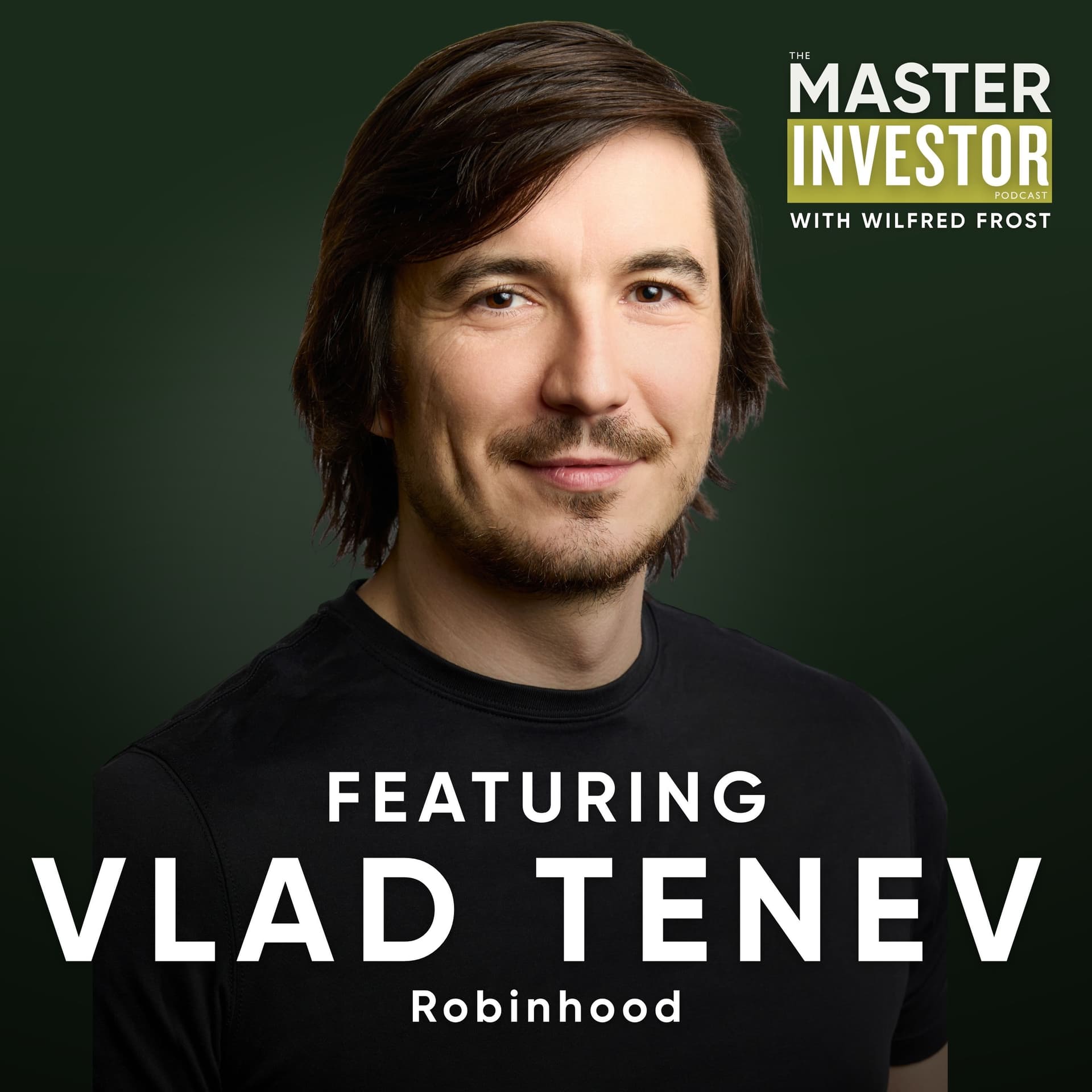
Vlad Tenev is co-founder, chairman, and CEO of Robinhood (founded 2013; IPO July 2021; market cap ~ $90B+; ~$380B platform assets). Wilfred Frost hosts.
Key claims
Broad ownership is essential for a free, stable society. COVID-era stimulus + zero rates fueled retail “bubble-like” behavior; later rate hikes made 2022 predictable. Today’s Robinhood customers skew toward frontier, earnings-capable disruptors (e.g., NVIDIA, Tesla) rather than COVID-era “nostalgia” stocks (GameStop, movie chains, airlines, rental cars). AI/agentic tools may shift value from “same AI agent” retail to human trading. Robinhood aims to raise equity participation from ~65% in the US toward the 90s via early-life accounts (Trump Accounts Program with BNY Mellon). Tokenization will be “one-to-one” and real.
Notable examples
January 2021 meme-stock timing after stimulus; Palantir sold by institutions due to macro/tariffs; SpaceX/OpenAI tokenized/gifted; Robinhood Ventures Fund One investing in Stripe, OpenAI, SpaceX, Revolut.
Written by AI. May contain mistakes. Listen to the episode to check what was said.
Chapters
Tap a time to open that second in VOThe Vision of Ownership in Investing
0:00 to 1:33
Explore the concept of broad ownership as essential for a stable society.
“In really Robin Hood, the idea was a very powerful idea because what it stands for is ownership.”
Robinhood's Journey and Market Dynamics
1:56 to 3:10
Discussion on Robinhood's growth, IPO, and market fluctuations.
“Nothing in the podcast constitutes a financial promotion, investment advice, or a personal recommendation.”
Analyzing Market Behavior Pre-Pullback
3:10 to 6:08
Insights into trader behaviors and economic indicators before the 2022 market pullback.
“bit to get into, not so much on Robin Hood's history, but the market history.”
The Impact of Stimulus on Trading Trends
6:08 to 8:25
Evaluating the effects of government stimulus on trading and investment trends during COVID.
“of the many sort of meme stock rallies, which was January of 2021, it was a couple of weeks after a large stimulus.”
Retail Investors vs. Institutional Investing
8:25 to 10:59
Comparison of retail investors' strategies versus institutional approaches.
“It's interesting, those snapshots, because again, obviously I was doing CNBC at the time and our ratings spiked during that moment because as you said, people didn't have much else to do.”
IPO Timing and Market Sentiment
10:59 to 13:03
Discussion on IPO timing and its relation to current market conditions.
“Are they increasing their profit margins?”
The AI Bubble: Market Dynamics Explored
13:03 to 14:00
Exploring the implications of AI advancements on market dynamics and investing.
“I mean, yeah, I guess there's this talk about whether we're in an AI bubble, right?”
Analyzing Current Market Dynamics
14:00 to 18:46
Explore the evolving landscape of investment behaviors and IPO trends.
“And if they start looking at ROI, will that revenue per company actually go down versus go up?”
Robinhood's Growth and Impact
19:31 to 23:12
Understand Robinhood's innovative approach to democratizing investing.
“And before getting to where you are today and the next steps, when you look back, what is the fundamental thing that helped you to gain traction early days.”
Future of Equity Participation
23:12 to 27:14
Discuss the potential for increased equity participation in the U.S.
“Bulgaria in 1997 had over 2 ,000 % inflation.”
Show all 20 chapters
UK Market Penetration Insights
27:14 to 28:00
Gain insights into the investment landscape and opportunities in the UK market.
“Well, I think the UK is a little bit further behind.”
Market Dynamics in the UK
28:00 to 31:06
Exploring the potential for a commission-free brokerage model in the UK market.
“you have the big brokers here that haven't gone commission-free yet.”
Introduction to the Robinhood Chain
31:07 to 34:08
Understanding Robinhood's blockchain strategy and its applications for real-world assets.
“No, I think the country needs to save more for the long term.”
Introduction to the Robinhood Chain
34:09 to 34:24
Understanding Robinhood's blockchain strategy and its applications for real-world assets.
“As long as the blockchain continues to operate, your tokens will be transferable and swappable.”
Tokenization and Retail Access
35:06 to 40:14
Discussing the future of tokenization and its impact on retail investors and private companies.
“I mean, I guess it's quite easy for you to do it for US equities.”
The Impact of AI on Trading
40:15 to 42:00
Examining the role of AI in trading and its potential to reshape market dynamics.
“Because Robinhood Ventures Fund One, generally late stage pre-IPO companies, they've already been.”
High-Frequency Trading and AI
42:00 to 45:20
Explore the early adoption of AI in high-frequency trading and its impact on retail investing.
“I started my career in high-frequency trading, which was one of the first use cases of AI or back then it was called machine learning.”
Balancing Youth and Experience in Leadership
45:20 to 50:00
Discuss the advantages of being a young CEO in a highly competitive industry.
“A lot of people, Mason Morfitt of Value Acton talking about BlackRock and why he started a position there.”
The American Dream and Ownership
50:00 to 53:10
Reflect on the evolution of the American dream and the significance of ownership in society.
“Well, as someone that's a year older than you, only at 40, if you're framing your position as in the Goldilocks position.”
Democratizing Private Markets
53:10 to 55:10
Learn about the importance of democratizing access to private market investments.
“Well, it's a great answer, Vlad, and we're pretty much out of time, as I always do, but what is your overriding piece of investment advice for our I got to be careful with that question.”
Transcript
Automatic transcript. May contain errors.0:00In really Robin Hood, the idea was a very powerful idea because what it stands for is ownership. A future owned by the few is a very fragile future. We want to make everyone an owner and we believe that ownership, broad ownership is essential to a free, stable and prosperous society. I think that message really resonated and made us at the time certainly the fastest growing brokerage. I think unlike 2020 and 2021, so you had retailers like GameStop, movie chains, the airlines, rental car companies, which is very different from today where our customers are by and large investing in these disruptor companies that are at the frontiers of their industries.
0:54And, you know, I think you can debate the price to earnings and all of those indicators, but I don't think you can debate that, you know, they're changing the world. I think there will always be humans making trades. I mean, if every retail trader used the same AI agent, then I think the opportunity and the incremental value of using that AI agent would probably decrease, which I think then would open up an opportunity to be a human trader. Welcome to the Master Investor Podcast with me, Wilfred Frost, where we celebrate and learn from the success of the greatest investors, business leaders, and politicians in the world, giving you, our listeners, an edge.
1:43The Master Investor Podcast is sponsored by LSEG, Interactive Brokers, the World Gold Council, and BNY Investments. Please do remember the views expressed in this podcasts are for general information purposes only. Nothing in the podcast constitutes a financial promotion, investment advice, or a personal recommendation. More on that in the show notes. My guest today is the co-founder, chairman and CEO of Robinhood, the financial trading app that really popularized commission-free trading, amongst many other things. Robinhood was founded in 2013. It IPO'd in July 2021 with a market cap of$32 billion.
2:26Nearly a year later, during the 2022 market pullback, the share price had fallen 80%, the market cap down to$6 billion. Well, today, the market cap is close to$100 billion, just over$90 billion. And the company has $380 billion of platform assets. They are back. They're bigger than ever. And I'm delighted to welcome their CEO, Vlad Tenner. Vlad, welcome to the Master Investor Podcast. I love that trip down memory lane. Yeah. Which part of it did you enjoy more than the other part? The rise rather than - Probably right now. Yeah, right now is the most fun. Let's jump into before the pullback, before the IPO, because I think it's a really interesting bit to get into, not so much on Robin Hood's history, but the market history.
3:15So 2022, you have such a great insight into what all traders are doing, but particularly retail traders are doing, obviously. Did you see bubble behavior in what your clients were doing before we saw that market pullback that you guys, your own share price got caught up in? Yeah, during COVID. I personally did have a suspicion about, I wouldn't say bubble behavior, but if you remember in 2020, the government, the U.S. government started printing a lot of money. I mean, we were sending checks to people's homes directly. And of course, at that point, if you looked at various instruments that would predict the rate of inflation, nobody thought inflation would increase.
4:20The estimates on the 10-year treasury were still roughly around 2%. And I was thinking to myself, how could this be? Keep printing money, but inflation doesn't go up. The government hasn't created some kind of perpetual motion machine. They can't violate the law of physics here. So at some point, some assumption has to break. And so it wasn't a surprise to me personally, even though I think to the market writ large, when we got into late 2021, inflation ticked up and eventually got to the highest level in decades, in over 30 years. And I think then once you start seeing the trajectory, it going from zero to 9%, 10%, there's a policy response, increasing rates, tightening that I think was very inevitable and predictable.
5:32And is it as simple as it being that inflation and the rate increases that we saw that followed? Or is there an additional point that there were signs even before that of excess valuation in the marketplace? I think, you know, the meme stock aspect in particular, I guess, is what I'm getting at. Could we have all stepped in back with hindsight and observed, yeah, these stocks aren't making money in their doubling in short space of time? I think these things are related at the end of the day. I mean, if you think about the timing of the most famous of the many sort of meme stock rallies, which was January of 2021, it was a couple of weeks after a large stimulus.
6:29So, and then we would see this in our data, right? The stimulus would come and, you know, within days or weeks, you would see that capital deployed in the market. So if you look at Robinhood's business and the amazing tailwinds we received during COVID, there were a few things. I mean, loss of lack of places to spend your money. Everything was shut down. People were cooped up in homes. So all sorts of digital activities, including investing in the markets, remained open. People had more time, right? So they could actually learn things about investing, follow the YouTubers and different influencers, rates were zero.
7:24So if you remember 2019, the Fed was hiking rates and we got to ballpark of over 2 % federal funds rate in 2019. But in 2020, we took them right back down to zero at the beginning of the COVID crisis. And on top of zero interest rates, we had the stimulus packages. So all of this was sort of geared towards stimulating the equities market, right? All of these effects. And in March, the equities market effectively crashed. It was a very short-lived, there was a V-shaped recovery. but were it not for the immediate stimulative response and the loosening of monetary policy, it might have ended up quite differently.
8:25It's interesting, those snapshots, because again, obviously I was doing CNBC at the time and our ratings spiked during that moment because as you said, people didn't have much else to do. So I think it was linked into, as you're saying, the attention turning towards the markets. Everything was closed but the markets. Yeah, exactly. Exactly. No, but I think why I wanted to start here, and we'll come to it in a moment, is whether you see the same similarities today. But it's why it's so interesting you kind of point to the stimulus checks and then the rates going up because that doesn't perhaps apply today.
8:56Before getting to that, though, I mean, the other thing I think it's fair to say, and I've seen you talk about this, that your clients, perhaps more than any others, partly because of your skew to retail clients. and so many of our guests have talked about this in recent weeks that this smart money versus dumb money, I think a lot of people now see the retail clients as the smart money. That's right. Yeah. I've always felt that. And they have bought the dips successfully, whether it was October 2022, whether it was April 25, March 2026. Is that still a trend that you see? Do your clients still seemingly know more than the rest of us and buy when things are cheap?
9:34Yeah. I mean, a lot of times the so-called smart money, I think, can be a little bit too smart in a negative way. It's like investing, institutional investing has gotten very indirect and abstracted in a way, right? Because you have these portfolio managers, they're looking at the macro, they end up rebalancing their portfolios, looking at these high-level indicators. And a lot of times, they'll sell out of a stock for reasons completely unrelated to the underlying business because of tariffs. Tariffs force them to move more capital around. And then they end up selling a company counterintuitively like Palantir that maybe is unaffected by tariffs or maybe affected positively even.
10:34Whereas a retail investor thinks about it a little bit more simply. They make companies, they're investing, they're buying and selling companies because they think that individual company is going to do well. And so you end up in these situations where they're maybe a little bit more resilient through macro events like tariffs and rates. They're just looking at, okay, is this company doing well? Do I like the products? Are the revenues increasing? Are they increasing their profit margins? What's the rule of 40 looking like? I mean, still sophisticated analysis, but it's not this sort of like, you know, Russia, Ukraine is happening.
11:20So I'm just going to dump equities and reallocate towards towards fixed income, like you see the institutions. I wanted to then touch specifically on your company during that period of time. As I said, you IPO'd July 2021. Clearly, then the market had a really tough period shortly after that. I mean, do you think you kind of got it away just in time? Because capital markets then were not particularly supportive of your type of transaction for a couple of years after that. Yeah, I think the IPO window basically shut for several years. And we have additional visibility into this because we have our IPO access product, the IPO window shut.
12:07And there was a crack a couple of years later, actually, with the Arm and Instacart IPOs. So two got in, I want to say 2023. And then there was another, you know, that was maybe a precursor to what was to come later. And really last year, it kind of reopened in full force. So what I wanted to then come to in a sort of roundabout way for this opening section is whether you feel a little sense of deja vu with SpaceX now listing, you know, that sense that you got yours away. If it had been a bit later, you might not have done. Markets had a tough year or two after that. Could there be a bit of a deja vu with SpaceX getting away?
12:55and now people wondering, can all of these companies follow OpenAI? I've now said they're probably not going to try and get theirs away. What do you think about the sort of market dynamics today compared to then? I mean, yeah, I guess there's this talk about whether we're in an AI bubble, right? And I think the difference that complicates the analysis is you have a lot of companies that are spending a lot of money on AI. And, you know, there's a business model in the AI industry around these model companies where companies and individual customers are paying for tokens. OpenAI has a subscription product that's got quite a bit of scale as well.
13:43So unlike previous bubbles where the business model was less clear, you have a business model, you have revenue increasing. So then the question is, okay, what are the dynamics? Is it possible that the companies that are paying for all of this AI start going from a mode where they're just willing to learn and aren't looking at costs very closely to now looking at ROI? And if they start looking at ROI, will that revenue per company actually go down versus go up? And is the rate of adoption by new companies, because there's a very, very long tail of companies who haven't touched it yet. And even consumers as well have that long tail.
14:34You look at Claude Code and it's, I think, on the order of low tens of millions of users. It's not hundreds of millions or billions. So there is that runway aspect of it where it still feels like we're early with existing revenue. So, yeah, I think it's a different analysis. As to timing of the IPOs of these companies, one thing I realized is it feels the time that we're in now has always felt consequential. It always feels like we're in a moment right now for which there isn't a precedent and we're kind of on the precipice of something. But if you look back, these cycles have been getting quicker.
15:24I mean, we're talking about the IPO window closing end of 2021 and starting to reopen in 2023. So if you take a slightly longer term perspective, what you're really talking about is, you know, timing a function that is essentially sinusoidal. And you can assume that none of these things are final. And if the window shuts for a little bit, it probably won't take 10 years for it to reopen. But I guess the underlying market dynamics, to go back to where we started from, that you observed in your clients' behavior before the big market pullback of 2022, you're not seeing that today. You're not seeing the kind of, look, SpaceX is not a meme stock, clearly.
16:14It's worth trillions of dollars. But there's similar comparisons of it's being driven up with a lack of earnings to crazy levels, falls back down again. I'm not comparing it to GameStop, but do you know what I mean? Are you seeing in your client's behavior anything that makes you think back to 2020, 2021, before the pullback in 2022? Well, the companies that our clients are investing in, I think by and large, are large companies that have earnings power and are at the frontier of their industries. So you mentioned SpaceX, You also have companies like NVIDIA, Tesla, the other chip makers. You know, the chip makers have been doing well as of late, and our customers have been interested in those.
17:15So I think unlike 2020 and 2021, where there was this dynamic of, I'd call it nostalgia, a lot of investors, a lot of our customers are millennials. They were investing in companies that were, in their eyes, unfairly punished by COVID era policies. So you had retailers like GameStop, movie chains, the airlines, rental car companies. You wouldn't say that these companies, even optimistically, I think, are at the frontiers of innovation. They're actually, due to the market environment and COVID and to some degree, everything going online and streaming or getting disrupted in some sense, which is very different from today, where our customers are by and large investing in these disruptor companies that are at the frontiers of their industries.
18:22And, you know, I think you can debate the price to earnings and all those indicators, but I don't think you can debate that, you know, they're changing the world. Yeah, unquestionably. Huge leading companies, huge revenues, growing revenues, I agree, even if the P multiples can be steep.
18:46This podcast is sponsored by Interactive Brokers. Building wealth starts with the right broker, and interactive brokers helps you reach your goals with powerful tools, global market access, low costs, and unmatched financial strength. That's why the best informed investors choose IBKR. Learn more at ibkr.com forward slash master investor. This episode is brought to you by LSEG, the leading global financial markets, infrastructure, data, and analytics provider. To learn more about how LSEG connects businesses, investors, and markets worldwide, visit lseg.com. Let's talk about Robinhood more broadly.
19:34And before getting to where you are today and the next steps, when you look back, what is the fundamental thing that helped you to gain traction early days. Commission-free trading was the big first step? I think that it was a combination of three things that led the product to really resonate. Number one, you mentioned it, commission-free trading. I mean, when everyone else is charging $7 to$10 per transaction and we're zero, we were both able to unlock a new market of primarily young people who didn't have the$1 ,000 or$2 ,000 you needed to get started. But later, we were able to get active traders on the platform as well.
20:25If you're an active trader and you're trading 100 or 1 ,000 times a month, you'd put up with a lack of functionality or features relative to other platforms because the value proposition economically is so strong. So the economics certainly won. Number two was in addition to pioneering commission-free trading and creating the gold standard business model of our industry now, we also pioneered mobile trading. So we were the ones that kind of led the platform shift to mobile before Robinhood. I mean, you had some brokers that had launched mobile apps, but it was very much an afterthought. But we made a bet that mobile was going to be big and in fact, it's going to be the primary way people engage with their finances because there's actual practical advantages to having it be on mobile.
21:19So we designed for that. I think Robinhood really created the mobile brokerage industry and the market, which has become increasingly the default market and has been a leader there. And then the third thing, which I think is important, is what the company stands for. So you look back at the global financial crisis in 2008, and a lot of our customers were kind of coming of age at that time. I graduated college in 2008. I went to grad school. My first month in grad school, my co-founder Beju's first month at his job, Lehman Brothers, went under. So you had the start of the global financial crisis.
22:05And the way that our generation perceived the global financial crisis was that it was a problem imposed on them by the financial industry. And the financial industry made poor decisions. The cost of it was kind of socialized to some degree. Nobody was punished. And the ensuing recovery went to the financial industry, people that were already invested and kind of insiders to some degree, the top 1%. This led to the Occupy Wall Street movement and this generational malaise in the early 2010s. And so I think people were in need of a solution. And I think what Robinhood offered was a solution that said, hey, rather than abandoning the system, because we have a really strong system in the U.S.
23:06here, compared to – I grew up in Eastern Europe, very, very different. We're talking about 10 % inflation like a disaster. Bulgaria in 1997 had over 2 ,000 % inflation. My last year in the country, there was a little pre-shock, 150 to 200 % inflation. So just staggering numbers. and in really Robin Hood the idea was a very powerful idea because what it stands for is ownership. I think a world where a future owned by the few is a very fragile future. We want to make everyone an owner and we believe that ownership, broad ownership is essential to a free, stable, and prosperous society. I think that message really resonated.
24:00And I think the three things together made us at the time, certainly the fastest growing brokerage. Oh, absolutely. I remember covering it all. And by the way, all three things together, I think were brilliantly summed up by the name Robinhood. And I want to come back to the name in a second. But I personally, I remember, I think it really resonated and caught my attention when we were covering it on CNBC, partly because of the name, summing all of that up. Come back to that in a second. Just you sum those things together. Clearly, you've taken market share and attracted some customers, as you said, that were trading elsewhere.
24:37But I think, as you're alluding to, you brought in a new set of customers that might not have been in the market at all in the first place. Where do you see penetration now in the US for not just Robin Hood, but for your broader sector? Are there more people, other than obviously generational effects, are there more people still potentially to come into the markets that haven't? Or is the last decade shift of that kind of given most of the low hanging fruit already? I think there's much more opportunity. Now the US is at roughly two-thirds, 65 % equity participation. And if you look back, the guys at Acquired podcast did an episode on Vanguard.
25:28It's a fantastic podcast. Yeah. So they plotted this and there were a couple of inflection points. There was the rise of the employer-sponsored 401k, which took equity participation from 20 % to something like 50, where it actually plateaued for a bit right after the global financial crisis. And then on the chart, you see the launch of Robinhood, which took it from the 50s to the 60s and has still been increasing. And now the question is, can we get from the 60s to the 90s? Maybe getting to literally 100 might be challenging. There's going to be a long tail there, but I think the 90s is doable.
26:13And what that requires is many people aren't eligible for an employer-sponsored 401k. So can we get them brokerage accounts? Can we get them invested? Can we do it from an early age? And that's why we're so excited about being the sole initial broker and trustee with BNY Mellon, powering the Trump Accounts Program, which is a U.S. program that gives every newborn child a brokerage account invested in a diversified group of companies from age zero. So I think that's the beginning of something that could take us to 90 plus percent equity participation in the U.S. over time, quite literally completing, well, never complete, but at least accelerating our mission and making everyone an owner in the U.S.
27:13at least. hi guys it's Wilf I hope you're enjoying this episode just a quick reminder to please hit follow or subscribe on your podcast or video app so that you never miss an episode and if you've got time please do give us a five star rating and leave us a comment it really helps other people find the podcast too now back to the episode so then snapshot for me where you think penetration is or the opportunity to grow it in a market like the UK? Well, I think the UK is a little bit further behind. Yeah, I think that one in six people have exposure to equities. And, but, you know, I see no reason.
27:58And if you look at the industry, you have the big brokers here that haven't gone commission-free yet. The full-service brokers, unlike in the US, have not adopted the business model, which I think is an inevitability, actually. I think over time, they'll have to adopt it. And the UK just hasn't had its industry shift yet. But if we look at the UK market, one of the reasons we get so excited about it, it's a sophisticated market. People understand financial services. There are similarities to the US in terms of the level of understanding and how people think about their money. There are some differences as well, but we believe that by bringing good product into the market, there's huge opportunity here.
29:02And we're seeing that with our UK launch. That's why we're continuing to invest. We're rolling out more. We're now at the stage where we're actually building UK specific products like our ISIS launch with the 2 % match. Yeah. And, you know, occasionally I'll say this and the IR team doesn't love it. And to some degree - I'm looking forward to this. Yeah. To some degree, it's aspirational, but I do aspire to be one of the largest employers in the UK. I think it's very fitting that Robinhood should be a UK company in kind of the same way it started as a US company. I mean, the legend of Robin Hood originated here.
29:52So we feel a calling to come here and serve this market. This is why I didn't want you to pick up on the name until we got to the UK section, which is, you know, obviously, as you say, it's a figure from medieval England. And look, I do think the name in the rise in the late 20-teens, early 2020s was a huge factor in the US. It will resonate here even more yeah i think people still feel by the way um the sentiment you were saying that occupy wall street embodied for three or four or five years in the u.s i think people still feel that there so i think i think there's a something to tap into there i'm obviously a believer with this podcast of um the need for growing equity ownership here and there's another statistic i'll throw out there which is that you know the gambling commission here especially 2024 i keep saying last year, two years ago, that 2024 report, over 50 % of the population placed the bet in a single year.
30:48So there is that underlying desire to take risk, but it's channeled into the wrong industry, in my eyes at the moment, rather than investing. So I think there's this huge potential upside, but at the moment, the message is not quite cracked through. Well, we'll keep working on it. Yeah, great. No, I think the country needs to save more for the long term. Let's talk about crypto because you mentioned commitment here. You've got the big announcement, which crypto is a part of. You're launching the public mainnet of Robinhood chain. For the uninitiated, what does that mean exactly? So it's a blockchain, a layer two built on top of Ethereum with Arbitrum technology.
31:35And the intent is for this to be the best chain for real world assets. And what I mean by that is for the longest time, and I think it's still very much the case, when people say crypto, they mean Bitcoin and meme coins and these assets that actually don't represent anything in the physical world. And Robinhood, for over a year now, our crypto strategy has been, can we actually take crypto technology and turn it into useful infrastructure for real world assets, assets that have fundamental utility, and in doing so, make it easier for people to own those assets worldwide. So, along with the Robinhood chain, we are progressing in our tokenization initiatives.
32:37And last year, we did an event in Cannes in the south of France where we unveiled our long-term tokenization roadmap. We said, okay, what's the value of tokenization? The value is in the same way that stablecoin has spread access to U.S. dollars to hundreds of countries worldwide, where it would have been very, very difficult for people to get their hands on dollars otherwise. and now they have a solution with stablecoin, tokenization will spread the value of U.S. equities and make it easier to own U.S. equities for people in the long tail of countries that don't have even as sophisticated financial systems as we have here in the U.K.
33:25So on the Robinhood chain, we will have stock tokens. Those stock tokens will be live in over 120 countries. So you'll be able to use a non-custodial wallet or the Robinhood wallet. We provide one for which there will be a really, really nice experience for trading and swapping stock tokens and get access to the entire universe of get exposure to the entire universe of U.S. listed equities. Right now we have 2 ,000 with our first phase of stock tokens and they'll be tradable 24-7. They'll also be portable. So you'll be less reliant on any individual broker counterparty. As long as the blockchain continues to operate, your tokens will be transferable and swappable.
Read the full transcript
34:24This episode is sponsored by BNY Investments. BNY Investments is part of BNY, a global financial services company supporting investors and institutions around the world. This sponsorship does not constitute investment advice. This episode is sponsored by the World Gold Council, the global experts on gold. They champion gold as a trusted strategic asset, provided market-leading research to help investors understand gold's role and modernize how gold is owned, traded and used, developing industry standards and market infrastructure. Learn more at goldhub.com. And let's move from that to tokenization more broadly, including of private assets, of non-listed assets.
35:13I mean, I guess it's quite easy for you to do it for US equities. You kind of obviously have a lot of stock in that and it's easy for you to own it and underwrite it. When you do any other tokenization, is it synthetic or is it always real? Do you always own the underlying asset as well? It's always real. And so does that then mean you have to have the permission? Actually, I should clarify this because there's been industry chatter. Some of our competitors also chatter about why our tokens are not the best tokens and how their future tokens will solve some of our shortcomings. they are backed one-to-one and customers should feel secure in the fact that if something happens to Robinhood, their exposure is safe.
36:07So we've also clarified the structure with this relaunch of the tokens product. And if it is of a non-listed company, I listened to your episode with the Colossons on Cheeky Pint, obviously Stripe. Yeah. You know, they haven't listed yet. But there is Robinhood Ventures. Fund One has invested in Stripe. So I did... I bet that's done well. I'll declare some victory there for getting them over the line because, you know, they were generally skeptical of this whole providing access to retail. They'd always tell me, look, we're a small family-owned, you know, Irish business. Not that small anymore.
36:52No, not that. It was tongue in cheek. Yeah, yeah, yeah. But yeah, no, we were happy to have them join the portfolio and kind of embrace retail pre-IPO. I guess my question on it, given its underlying one-to-one, can a company always block it? Or if you acquired privately for Robinhood's balance sheet, a chunk of Stripe, I guess they could in their founding documents, if you took it off an employee, they could have made it impossible going forward for that to happen in the terms of their shareholding or are you quite up for the fight if sometimes if you get your hands on the shares yeah yeah and we've had our fights in the past of course yeah not so much with Stripe but there's two things that that we do and have done one is the tokenized privates that we announced last year, again, at our CAN event in the EU, where we had stock tokens for SpaceX and OpenAI.
37:54And that was really, it was in the form of a gift. So we never actually made them 24-7 tradable between customers, partly because it's so new. And there's certain things that we have to clear up both on a regulatory side. So the tokenized offering was limited to a gift in the EU. We're still trying to figure out the best way, but we haven't yet scaled that. And now Robinhood Ventures, which is the US solution, and it's done quite well. And the mission of that is how can we actually using TradFi give exposure to these private companies. And we came up with a structure via closed end fund. So this is a publicly traded vehicle.
38:54You can kind of think of it as a publicly traded venture capital firm. So invests in a portfolio of private assets. And it invested in companies like Stripe, OpenAI, SpaceX at the IPO, Revolut, a UK company here, and a collection of others. And one of our principles is that we respect the issuer. We, of course, prioritize the shareholder. We believe retail should have ownership of these private companies. Very, very important. But we also respect our issuers. And we believe long term, we're going to end up in a place where issuers, this is going to be a common thing. We have come to the conclusion, we made a bet that having the issuers buy in is critical.
39:49And it's critical for acceptance of this product. It's also going to be where things end up over the long run. And every investment in Robinhood Ventures, the company is actually excited to participate, has been excited to participate thus far. They're filming videos. They see the benefit of having retail early. And I think that's going to be a ubiquitous thing. Where we'd like to take it is actually earlier stage. Because Robinhood Ventures Fund One, generally late stage pre-IPO companies, they've already been. I mean, relatively speaking, they're less risky than earlier stage. But I think in seed and series A, the first rounds of capital that a company raises when it's just an idea, that should be safely made available to retail investors as well.
40:43So I think that's kind of the end state. Retail is a part of all stages of capital formation, even the very beginning. I think that's really interesting. I mean, that seed in early stage would definitely be a sea change moment to get retail involved. And I also do wonder whether companies will continue to go to IPOs as late as they have been. And if, which is an if, private capital, private credit and equity have some kind of reset, then maybe the private capital that they've all had access to might be not as readily available. We'll see in the years ahead. Let's talk about AI. And you've talked in lots of podcasts about tangible examples, improving your customer interface, that it gives you, you want to build it yourself so that it gives you that edge.
41:37Do you think this will be, we talked about what led to your rise from commission-free trading to being mobile first. the company in your space that harnesses AI in the right way will take what extra scale of market share do you think in the next five years? Well, so here's the way I think about it. I think there will always be humans making trades. I started my career in high-frequency trading, which was one of the first use cases of AI or back then it was called machine learning. high-frequency traders were buying GPUs. And the first version of CUDA-powered non-graphics card accelerators, NVIDIA, rolled those out in 2010, the NVIDIA Teslas, they call them.
42:29And I think I had one of the first ones off the shelf back in my high-frequency trading days. We're using them to price different securities and to build algos. And so markets have been electronic for a long time. You've had quants writing sophisticated strategies, deploying them. Before Robinhood came in, it looked like high-frequency trading as a percentage of the market was going to eat the entire thing. And now Robinhood has led to a big resurgence in retail. Retail has come back. Humans are making trades. There's always a balance between the two. But what I think is the interesting opportunity is, can you take the strategies?
43:24And can you take some of the tools that an extremely sophisticated hedge fund or a high-frequency trading firm can deploy? And they look very different than typical retail strategies. And can we make it easier for people to do that without a computer science degree? So I think that's the promise. I think this looks much more like democratizing software engineering than democratizing retail trading. Does it ultimately end up with making markets perfectly efficient? I don't think so. And you can imagine there's already algos trading, but human decisions... But if every retail trader had access to that and said, turn it on, then would they be perfectly efficient?
44:19Well, I mean, if every retail trader used the same AI agent, then I think the opportunity and the incremental value of using that AI agent would probably decrease, which I think then would open up an opportunity to be a human trader. So these are very complex dynamic systems. They're chaotic in every sense. But I think there's going to be some balance. And what I have high confidence in is agentic trading, which we rolled out a couple of weeks ago, along with agentic credit card. will start to take share from that software engineering prosumer and maybe eventually the institutional trading bucket over time.
45:17Obviously, AI is incredibly expensive. We've seen how much money is being invested in it. A lot of people, Mason Morfitt of Value Acton talking about BlackRock and why he started a position there. And a lot of people say you need massive scale to make the necessary investment. JP Morgan invests more money than most people's market cap in tech every year. You've got the scale to compete? Well, I mean, it's a yes. But also, I guess I reject the premise that you need massive scale to compete in AI. I think that there's a lot of small startups that are building really amazing things. And you also saw the whole deep seek moment last year where, and of course, I don't have the underlying training data.
46:16And there are some rumors that maybe this was overstated, but if they trained a frontier quality model for$6 million, then you extrapolate the curves of price to performance, new chips coming out, new training algorithms. I think at the same time, companies are investing more and more, but also it's possible to get to frontier quality with lower and lower investment over time. And, you know, it's not even clear that Robinhood has to do our own pre-training. Pre-training is the part that's very expensive. RL, relatively cheaper, like to some degree, you know, doing post-training, doing reinforcement learning in-house.
47:10yeah I think cuts down quite quite a bit of the cost and can lead to performance but do we have the resources to build awesome things absolutely and I mean you're already seeing them come to market it's interesting this is like perfectly leads me to my next question last couple of questions as we run out of time but you're you're 39 years old and you manage a hundred billion dollar market cap company. Do you think you gain more from being young and dynamic and energetic and totally across these areas that we just talked about than you lose from not having the years on this planet, the experience that most people who are CEOs of companies of that size are by just being 60 or older?
48:00I mean, I think I'm kind of in the Goldilocks period to some degree because I'm no longer the 25-year-old I was when I started Robin Hood. You can see a couple of the gray hairs forming on my chin. Still got a pretty good head of hair. You're not going bald yet, that's for sure. Yeah. I think I can put on a suit and hang with extremely serious people, maybe in a way that, And, well, when I was 25, I would bask in their credibility and really, really looked a little bit less comfortable. But also, so I have, what is it, 15 years of experience in the industry, but also I'm young enough to not be completely a fish out of water with these new technologies.
48:53So, yeah, I think there's definitely a balance there. I mean, financial services industry has historically been an industry that prioritizes safety and stability, and we care about that very, very much. but also innovation is incredibly important and I think we've been a disruptor and I think the the balance that Robinhood has to get right is this balance between how can we be extremely safe and stable but also how can we lead and leading requires innovating it requires innovating requires risk taking and and can we balance those two things and I think for the company to be able to balance them.
49:43The founder and the CEO has to balance them as well because companies reflect the founders. And over time, I think they converge if done well. So if I can balance those things, I think it's much more likely that the company will do a nice job of it. Well, as someone that's a year older than you, only at 40, if you're framing your position as in the Goldilocks position. I'm happy to conclude that you're right. You feel pretty good right, too. America 250, obviously, well, days away. This drops on Monday, the 6th of July, so that'll be two days earlier from when it drops. You arrived in America in 1992 from Bulgaria.
50:29You referenced this a little bit earlier. You're obviously, as we just referenced now, the founder CEO of a$100 billion company. Do you think you embody the American dream? Yeah, I think so. I mean, for a long time, if I had to describe the American dream, it was really about home ownership, right? It was a big element of it. How can you get to the point where you can buy a house and have the white picket fence and you get the 30 year fixed mortgage. But that was kind of the funnel we were putting people into. I think Robinhood feels very strongly that everyone should be an owner. We think ownership is important.
51:24juxtaposing my time in America with Bulgaria, where, you know, when I was born, it was kind of the swan song of the communist era and nobody owned anything, right? It was everyone lived in these large Soviet era apartment buildings that all looked the same and nobody cared. So they were all covered in graffiti. And I was just back in Bulgaria a couple of weeks ago and things hadn't changed very much since my previous visit, which was more than 10 years ago. And so I saw what a society without ownership looks like. And it's a very fragile society. So I think we have something very, very valuable here in the US that we can nurture.
52:13And I think we have to evolve this idea of ownership from just real estate, which I look at as, okay, real estate is great as a part of a portfolio, but if that's the only thing, it's an illiquid asset with enormous transaction fees that you're kind of suggesting to people that they should take on a ton of leverage to purchase. So, I mean, we want to broaden that. Robinhood, of course, believes very strongly in ownership of stocks and different assets. But we've extended that to privates. With the Trump Accounts Initiative, we're extending it to age zero. And I think a future that has broad-based ownership is essential in order for us to have a free, stable, and prosperous society.
53:10Well, it's a great answer, Vlad, and we're pretty much out of time, as I always do, but what is your overriding piece of investment advice for our I got to be careful with that question. Yeah, I think the reason that I've been pushing very hard on private markets is a lot of these companies that we talked about in this conversation, SpaceX, OpenAI, Anthropic. these are companies that either have gone public in trillion dollar valuations or will likely go public in multi-trillion dollar valuations so we're in a very fragile moment right now where a lot of this value creation is accruing to a smaller and smaller group of wealthy insiders that just keeps getting wealthier and the days of you know you investing in a company like Microsoft or Amazon in valuations of hundreds of millions and seeing a thousand X or 10 ,000 X return in the public markets as a retail investor are seeming harder to come by.
54:20And so we want to make it easier for companies to go public and we have efforts there. But there's a chance those don't work and we could fail. I mean, those efforts could be successful and companies could just still be going public at trillion dollar valuations because raising capital privately will continue to be easy and get easier over time. So we have to unlock these private market opportunities. And that's why I'm so passionate about Robinhood Ventures. I really think this is our next crusade and our mission. Can we democratize private markets? Can we make it so that a retail investor has the ability to take ownership with appropriate safety and guardrails at the earliest possible stages where the risk is highest, but also the opportunity is greatest.
55:12Vlad, it's a great place to leave it. It's been a real pleasure having you on the Master Investor Podcast. Thanks so much for joining me. Likewise. Thank you for having me. Next week on the Master Investor Podcast, we'll be joined by Kara Swisher. Please hit follow or subscribe on your podcast app if you haven't done so already. Thanks again for tuning in. And thanks again to Vlad Tenev. The Master Investor Podcast is sponsored by LSEG, Interactive Brokers, the World Gold Council and BNY Investments. Please do remember the views expressed in this podcast are for general information purposes only.
55:47Nothing in the podcast constitutes a financial promotion, investment advice or a personal recommendation. More on that in the show notes. This podcast is produced by Paradigm Productions and Master Investor Limited in association with Birdline Media. If you've enjoyed the show, please do subscribe on YouTube or click follow on your podcast platform and you'll be automatically notified each time a new episode drops.
From the publisher
Robinhood didn't just survive one of the sharpest reversals in fintech, it emerged bigger, stronger and more ambitious than ever. After its market value collapsed by 80% to around $6 billion in 2022, the fintech pioneer has rebounded to nearly $100 billion, cementing its place at the centre of the next generation of finance. In this episode of The Master Investor Podcast, host Wilfred Frost sits down with Robinhood co-founder, chairman and CEO Vlad Tenev to dissect the evolution of retail trading and look ahead to the next frontiers of finance.
Vlad pulls back the curtain on the mechanics of the pandemic-era meme stock craze, debunks the myth of institutional "smart money", and shares his perspective on whether we are currently living through an artificial intelligence bubble.
But this isn't just a look back at market history. Vlad lays out his blueprint for Robinhood’s next decade of growth, covering the ongoing path for more stock ownership in the US as penetration crosses 65% and heads for 90%, and for industry growth from a lower base in new markets like the UK.
Vlad also explains his ambition to democratise access to private markets in the same way Robinhood transformed public investing, arguing that tokenisation and the company's in-house blockchain are the key to making it possible. He also reveals how Robinhood is harnessing AI to give investors more powerful tools and help them make smarter investment decisions.
0:00 Intro
3:20 Bubble Behaviour in 2020/21
8:56 Retail traders buy the dips
11:31 Robinhood IPO July 2021
12:30 Déjà vu 2026 vs 2021?
16:05 Stocks leading today are LT winners
19:33 The 3 factors that drove Robinhood success
24:45 Penetration of stock ownership
27:35 UK opportunity
31:18 Robinhood in-house blockchain
35:07 Tokenisation of private assets
41:20 AI impact on trading
43:53 Humans will always drive markets
45:17 Scale vs innovation
47:25 $100bn mkt cap aged 39
50:15 The New American Dream
53:16 Conclusion
You can watch the full video on The Master Investor Podcast YouTube channel
And follow @WilfredFrost on X and Linked In
Sponsored by BNY Investments, Interactive Brokers - ibkr.com/masterinvestor, The World Gold Council and London Stock Exchange Group (LSEG).
The Master Investor Podcast is produced by Paradine Productions, Master Investor Ltd in association with Bird Lime Media.
This podcast is for information purposes only. It does not constitute an invitation or inducement to engage in any investment activity. It is not a financial promotion as defined under section 21 of the Financial Services and Markets Act 2000 (FSMA). The views expressed by the presenter of this podcast are those of the presenter and are provided in the course of journalism. This podcast benefits from the exemption under Article 20 of the Financial Services and Markets Act 2000 (Financial Promotion) Order 2005 (FPO), It does not require approval by a person authorised under the FSMA. Generic information, not identifying any specific investment, fund, provider or service, about a class of investments such as shares, bonds, derivatives and cryptoassets, might be provided and/or discussed during this podcast. Such discussion falls within the generic promotions exemption (Article 17 of the FPO). Such discussion is not a financial promotion requiring approval by an authorised person under section 21 of the FSMA. Investing involves risk. You should consult a suitably qualified adviser who can assess your individual circumstances before making any investment decision.