In short
The Master Investor Podcast: Episode Summary
Episode Title
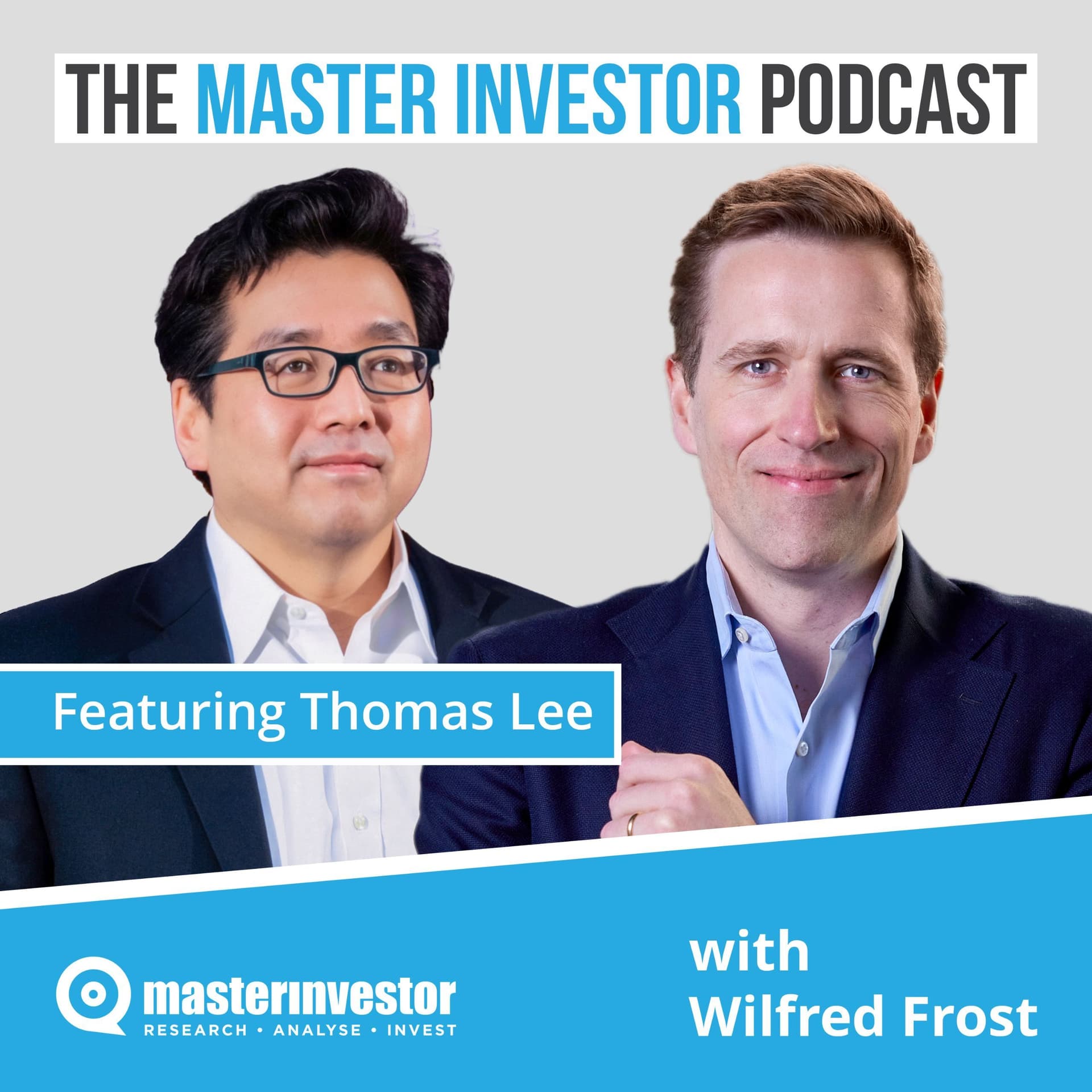
Tom Lee: A New 10 Year Bull Market Has Begun Host: Wilfred Frost Guest: Tom Lee, Founder of Fundstrat Global Advisors
Episode Overview
- Tom Lee discusses the potential initiation of a new 10-year bull market in the stock market.
- He highlights how demographics, market sentiment, and company fundamentals influence market trends.
- Lee shares insights on key stocks such as Palantir and JPMorgan Chase, emphasizing the importance of understanding individual companies rather than the overall market.
Key Concepts and Arguments
- A New Bull Market
- Tom Lee believes a new bull market has started, influenced by:
- U.S. Workforce Dynamics: A surge in the prime-age workforce (Millennials and Gen Z) is expected to drive economic growth.
- Wealth Transfer: Younger generations are set to inherit significant wealth, likely increasing equity investments.
- Technological Advancements: Innovations in AI and blockchain are predicted to impact major sectors positively.
- Understanding Demographics
- Lee emphasizes the role of demographics in market cycles:
- Historical data shows that peaks and troughs in the market align with generational changes.
- Current focus on Millennial and Gen Z trends is crucial for predicting future market movements.
- Market Risks
- Concerns about:
- Federal Reserve Independence: Lee stresses that maintaining an independent Fed is critical for market stability.
- Debt-to-GDP Ratios: While concerning, Lee notes that the U.S. has significant valuable assets that mitigate this issue.
- Interest Rates: He discusses the threshold at which rising interest rates could negatively impact the stock market.
- Investment Philosophy
- Lee advocates for investing in companies, not just the stock market:
- Understanding the business fundamentals of companies like Tesla and Palantir fosters conviction in investments.
- Long-term success is linked to discernment in selecting companies that drive growth.
Key Stock Picks
Palantir
- Described as a hybrid between consulting and software engineering.
- Lee argues that Palantir's software can significantly enhance profitability for companies by optimizing operations.
JPMorgan Chase
- Emphasized as a resilient bank capable of leveraging AI and blockchain to improve efficiency.
- Lee discusses how the bank's past regulatory challenges have prepared it to thrive under current economic conditions.
Market Indicators and Warning Signs
- Tom discusses indicators to watch for potential market tops:
- Policy Shocks: Changes in Federal Reserve policy could trigger market corrections.
- Excess Speculation: Current market skepticism suggests that we may not be in a speculative bubble.
Notable Quotes
- "When you're investing, you should really think of it more as you're buying companies, not just buying the stock market."
- "The more they believe it as a series of companies they own, the more likely they're going to hold on to their stocks."
Conclusion
- Tom Lee’s insights provide a compelling argument for a bullish outlook on the stock market, grounded in demographic trends and company fundamentals.
- The episode serves as a reminder for investors to focus on individual company performance while remaining cognizant of broader economic indicators.
Additional Resources
- Follow Tom Lee on X: [@Fundstrat](https://x.com/fundstrat)
- Subscribe to Tom’s research: [Fundstrat Services](https://fsinsight.com/our-services/)
- Watch the full episode on [YouTube](https://www.youtube.com/@TheMasterInvestorPodcast).
Closing Note The Master Investor Podcast is produced by Paradine Productions in association with Bird Lime Media. The insights shared in this episode are for informational purposes and do not constitute financial advice. Always seek independent financial advice before making investment decisions.
Written by AI. May contain mistakes. Listen to the episode to check what was said.
Transcript
Automatic transcript. May contain errors.0:27I think we are in a new bull market. But when you're investing, you should really think of it more as you're buying companies, not just buying the stock market, because then you'll have a lot more conviction about what you own. Welcome to the Master Investor Podcast with me, Wilfred Frost, where we celebrate and learn from the success of the greatest investors, business leaders and politicians in the world, giving you, our listeners, The Edge. There is nobody in markets who has predicted the last decade more accurately and publicly than my guest today, Fundstrat Global Advisors, co-founder and head of research, Tom Lee.
1:09He was JP Morgan's chief global strategist until 2014, but branched out to found his own company, Fundstrat, that year, in part to try and reach more retail investors, is something we wholeheartedly support on this podcast. Since then, he's repeatedly put himself in line for criticism with bold market calls that have at times led to short-term criticism, but almost always long-term praise his calls have proven correct. And in the last year, he's also launched an ETF that's already crossed$2 billion in AUM and more recently become chairman of an Ethereum treasury company that's triggered an extraordinary rally in the price of Ethereum.
1:51All topics that we're going to get to. Tom, it is great to see you, especially here in person. And welcome to the Master Investor podcast. Yeah, I'm glad to be here. I'm excited for your series. Well, it's really a treat to have you. And I mentioned there Fundstrap, which you founded a decade or so ago. I imagine you've got all sorts of clients, but one of your aims for doing it and leaving J.P. Morgan was to try and broaden the type of people you reach. That's right. We wanted to democratize access to institutional quality research, but really make it understandable because I do think historically institutional research was full of jargon and really difficult to understand.
2:31And I don't think it was that friendly for a dentist or my father to pick up. So when we started Fundstrat, we thought it was important to make sure we use plain language, make it really straightforward, and then not confuse people with like three or four different views, but just sort of stick to a thesis or a theme and let investors then decide if they want to act on it. And we're going to put in the show notes, by the way, how people can subscribe. And you're also super active on X, the handles at Fundstrat and well worth following. So you've basically, if we really step back, been bullish since 2011.
3:05And as I've said, repeatedly on the dips, told people to buy even at periods of great market stress. And, you know, we've been chatting on CNBC through the years where I've thought, gosh, how's he doing it again? And you've ultimately proven to be right on all of that. What stepping back do you think you have seen over the course of the last 10 to 12 years? Or what have you put more weight to than your rivals that has allowed you to get so much of that correct? I mean, I think it's a couple of things, Wilford. I'd say I think when it starts with our evidence-based work, we put a lot of weight into understanding demographics and then the role history plays, like in each context.
3:48But I think it is one of the really misappreciated things that demographics really explains almost every bull market. since 1890, actually. So if you followed every generation, the gaps between the generations are really where the bear markets exist, and the bull market tops coincide with the peak of a generation. So 99 was the peak of the boomers. 74 was the peak of, I think it was called the generation, the silent generation. Gen X peaked in 2018, and millennials will peak in 2035. So those are like rough waypoints for when actual major tops take place. I think the second thing that we found is investors, as they age, become wealthier, but then they become more skeptical.
4:39And so most of the wealth in America is held by older people, including institutional managers, right? They're over age 40. But the world and disruption is caused by young people. So I think investors tend to think their own wisdom drives the economy, and it's actually they need to put on the lens of a 20-year-old. That's what we do at Fundstret. We survey constantly. So we think about what young people are doing, and they drive ultimately the markets and economy. And the third thing is I think we don't lack recency bias. Like we turned bullish at J. Morgan on February 2009, and we identified upcoming low that would look like 29 or 74.
5:22Which was the following month, right? Yeah, it happened. Yeah, so we were a month early. So we suffered a drawdown. We'll allow you that one month error. Yeah. But what was interesting is that people were skeptical because that generation of investors just went through the dot-com bust and now the GFC. So they were now equity skeptical. So they couldn't imagine anyone would want to own equities for the next decade. But that bias is the reason why stocks can positively surprise. And even most recently, I think there's a bias now of people having a pessimism about inflation and pandemics because we did suffer through five years of that.
6:01But that's causing people to now be skeptical of the world because that's in their bias. And so I think we're judgment-free that way. People call us permaboles, but it's really more we're judgment-free. So in terms of where we are right now, I mean, you said 2035 there on the demographics. Are we very early in a new bull market? But we've obviously had an extended bull market already. Yeah, I think that's what confuses folks because I would say generally we've been up since 2020. But we've had two 20 % declines since. So in fact, this has been a really disrupted recovery since the 2020 lows. And so I think we are in a new bull market because we just had another essentially wipeout that happened February to April this year.
6:54I do think that the bigger story arc is that there is a big surge in U.S. prime age workforce. That's the millennials and Gen Z. Plus, they're inheriting a lot of wealth over the next 20 years, which is going to be transformed into more equity exposure, less credit. And the third is that the U.S. is at the center of a lot of the major structural changes taking place, AI and now blockchain. But those are going to really boost financial sector, which could re-rate to like 40 % of the S &P. And then, of course, health care could benefit. So I think there's a lot to be excited about. And 2035 sounds about right.
7:35That would be a 10-year bull run from here. That's really interesting on those sector picks, which I want to get into in a second. But sticking on the broad market for a moment, in terms of the risks that are out there, and we've had Jeremy Grantham on, we've had Ray Dalio on, so we've touched on some of these. But are you not concerned about, let's talk of the main one of the week, Fed interference, for example? Or if anything, does that spur equities potentially? Yeah, it's, I mean, Wilford, Fed independence is really important because the Fed is the single most powerful entity in the world, right?
8:12Because what the Fed says triggers an instant response across all markets and CEOs and policymakers everywhere and even governments. So that being independent is critical. I think that we're going to ultimately find that the administration does accede to what markets rationalization is, and I think the markets don't want to see a non-independent Fed. So I'm going to lean towards the idea that Fed Chair Powell serves his term. But even if it's just noise now, it is just someone who comes across as more not happy with policy, but they're not going to interfere. Similar, I guess, that the markets forced the hand after the tariffs a little bit.
9:00What about the headline debt-to-GDP aspects that we talk about a lot? Yeah, that's a problem. I mean, if you don't put governors in how spending takes place, then governments keep expanding the pie, and we don't want to crowd out private sector spending. So I think there is a lot of negative implications for a budget deficit. and then, of course, the debt burden that comes with it. But there are a couple things I would just highlight as offsets. One is that the U.S. has a really big balance sheet that's basically valued at zero. If you compare the U.S., they own a lot of assets that other countries have already privatized, whether it's the postal system or, you know, in the U.S.'s case, even how they're valuing their gold holdings, national parks, land, resource rights.
9:51I think I've seen informal calculations. This does come into the tens of trillions of dollars. So the U.S. is a lot less indebted than it looks. And the second, of course, is that if the dollar's dominance is set to grow in the next 20 years, then this is not a problem. So it really comes down to whether dollars are being more accepted over time. Well, that's something for us to discuss, particularly as we get onto the crypto stuff. But just to put those two last questions together, is there a level of longer end rates that may be more of a trading call as a short term call that makes you bearish on the stock market?
10:32Yes. So we look at the general relationship between yields and PE or risk premium, you can call it any metric. And it's not a linear or even exponential relationship. It's actually dynamic. So below 2%, when yields are below, and this is pretty true with most countries, PE tends to actually decline the lower the yields go, because it's more of a deflationary environment. But between 2 % and 6%, higher yields are associated with rising PE. Because I think that, and I've seen academic work, Generally, somewhat higher elevated nominal growth and even nominal inflation, 3%, is good for corporate earnings.
11:20Because companies can out-earn that cost of capital. So PEs tend to rise. So between 2 % and 6%, you'll actually have rising realized PEs. So as yields get to 6%, I actually think PEs would go up. But then after 6%, of course, you start to really crowd up private sector's ability to out-earn the cost of money. So the PEs should fall. So I think, yeah, I'd say between 5 % and 6%, you know, you have to start derating the stock market. And I guess the chances of that, you'd almost expect the Fed, regardless of who's in charge, to kind of step in to prevent that for other reasons. That's right. Or not.
11:57Yeah. I mean, the Fed, on the one hand, will be printing, will be yielding a lot of money on their balance sheet from 6 % rates. I mean, if the long it is 6%. But it's obviously a huge debt burden to the economy. So I think the Fed would use balance sheet expansion to probably manage rates if they had to. Let's talk about some of the particular calls underlying the surface that you have at the moment. And just give us an update for those that don't know. You launched an ETF. The ticker is GRNY. It's called the Fundstrat Granny Shots ETF. You launched this in November? November of last year, yes.
12:38And it's$2 billion AUM? It's$2.4 billion AUM. Amazing sudden growth. Give our listeners an outline of what's in the ETF. Well, the Granny Shots ETF, and it's called Granny Shots. It's named after a way of shooting a free throw in basketball underhanded. And the idea is that an underhanded free throw has a higher probability of being a successful shot because it's the best physics move. but it doesn't look cool. And so our research launched the Granny Shots portfolio in 2019 as our best ideas list. The way it was constructed is we said that the S &P is essentially driven by a handful of companies tied to the most important themes.
13:27And at that time, we identified the themes as AI, labor shortage, cybersecurity, monetary policy tilting, ISM tilting, millennials, things that we know are actually logical. And we said in order for a stock to be included in that list, it had to be tied to two themes because we figured two sales means that you can catch the wind from two different directions. And it worked really well. That's for six consecutive years, it outperformed the market. So we decided to launch it as an ETF last November to make it available to the public. And what's the performance been since November? It's shortish term, but...
14:08Well, year to date, Granny Shots is up around 18%. So it's outperformed the S &P, which is up around nine. Morningstar ranks it as top two percentile. So it's out of the 1 ,490 large cap active equity funds were top 30. And I was looking at the website and the themes are there. It's really interesting to look at how it then filters down and some of the stocks are supported by three or four of your themes, not just two. And again, we'll put some stuff in the show notes on this. But I see the following stocks, for example, are in there. Google, Apple, NVIDIA, Palantir, Microsoft. You could also just buy the S &P 500 or you could buy the Mag 7.
14:51So I guess, how will you differentiate that as time goes on? Are you going to be very active in this? Well, it's rebalanced every three months. One thing to keep in mind is that it owns 30 stocks. So it's really the 30 biggest sort of drivers of the S &P, but it's equal weighted. So it's not benefiting from just owning the Mag 7. In fact, year to date, it's outperforming even the Momentum Index, MTUM, granny shots. And it has a lot of financials in it and has some health care. So it's really a diversified fund, but I think it should be viewed as we've identified the companies that are really driving S &P.
15:34So the other 470 aren't driving earnings for the S &P or the price appreciation. So let's get into a couple of those individual names. And I'm really interested in your bull case on JP Morgan and the banks in a second. But Palantir, for example, what is the pushback? And I understand the themes and how the ETF works, but as a standalone. What is your pushback to when people point to the valuation multiple, which is obviously pretty extreme? Yes. Well, it's confusing because if you have to say, like, what is Palantir in one sentence, it's hard to say. Like, maybe one description is, you know, it's a consulting company and a software engineering company in one.
16:17Because they look into a company or a government and they figure out how to improve their operations. but then they can build the solution with the software. So it's like McKinsey plus the best software company. But then that doesn't really explain the synergy of what they do. By the way, I've interviewed Alex Karp and studied Palantir. That was the best explanation I've ever had. Yeah. Very helpful. Yeah, and then I think people put low multiples because it's like the way people put said Apple's a handset company, so they put a 10 multiple on it forever, or they said Tesla's an automaker and put a 10 multiple.
16:52Someone will say it's a consulting company or SaaS, and they try to suppress the multiple, but there's a synergy. But I've talked to some real companies, and I don't want to name their product, but they said this completely changed the profile of their business, including their profit margin profile. So in other words, Palantir, I explained it, literally took a company that had a commodity that they had to hedge, and it had like 40 or 50 touch points. It was being shipped in warehouses and actually started in a country because it was harvested and shipped. And they said they just fed all their invoices into the Palantir system, like literally just cabinets full.
17:33And suddenly Palantir was like, okay, this is what you need to do. And they started to make money on their hedging. It became one of their most profitable operations. And then their supply chain started to generate a ton of profit. Now, if Palantir was a private equity company, they should have reaped billions of dollars from just that. But all they did was said, like, use our software. So, like, if you think about it, they can, they're basically like a private equity company you can just hire, you know, to re-engineer your business. I think it's really pretty magical. What's the bull case for J.P.
18:10Morgan or some of the other banks in a world which you could look at and think they're going to be disrupted? Yeah. I think they're disrupting themselves in a way because, well, here's something to keep in mind. First of all, I know Peter Lynch famously said the reason he got out of Japan in the 90s was he looked at the top largest companies in Japan and they were all financials. And so he said to himself, like, okay, wait, if it's all just financials, like there's something wrong with that economy. And he sold Japan. But I think JP Morgan and Goldman are really different because, number one, in the post-GFC period, they were highly regulated, almost forced to not make money.
18:54And they, under those conditions, generated really good shareholder return, earnings growth. So they became essentially nimble under a huge regulatory burden. And then in the last few years, we essentially shot up the economy with inflation, Fed hikes, things that should obliterate banks, caused housing to screech to a halt that should really hurt banks, and they produced good earnings. So they've been battle-tested, but we still treat financials through a 50-year story arc of their returns, and price-to-book governs the valuation. But now they've got two big tailwinds in front of them. One is AI, which is really going to be a tool for them to better understand credit relationships and customer relationships and even customer attachment.
19:44And, of course, ways to more profitably lend and participate in markets. And the second is blockchain, which could radically reduce their cost. I know that, and I can share that, during COVID, one bank told me, and I do interact with a lot of companies, because, you know, we get asked to present to the board that during COVID, every employee had to do VPN. And they essentially have surveillance because they know who's logging in and what keystrokes they're doing. 80 % of their employees did nothing during COVID. So they still made good profits, but they know that 80 % of their employees did nothing.
20:24So the banks know they can re-engineer their entire operations around AI and blockchain. J.P. Morgan could have more profits, but the biggest cost in their business is employees. So that means if you shed employees, then it's shareholder return that benefits. So Jamie Dimon just built too big a tower in the heart of New York. Well, it might be filled with robots, right? It looks fantastic. Robots with blue suits. I just walked past it yesterday. And when I left here, it was a shell. And it's amazing to see it. So obviously, Norman Foster design looks pretty cool.
21:03Back to the broader markets, because you mentioned earlier the critics who have tried to throw mud and you've been right for 12 years, sometimes use the label perma bear. Slightly different question on that. But I wonder, and it's certainly the entire time we've known each other, being bullish has worked. and I give you 100 % credit for that. But do you think your style, your personal style and emotion is clearly relevant when it comes to markets? Do you think you'll be able to call the end of the bull market? Do you think your style is better suited to bullish momentum or not? That's a great question.
21:45I can say that in 99, when I was a technology analyst, and covering wireless, and that was living history of a bubble that really was a lifetime bubble. I think if people weren't in that period, it was five years where literally if someone said, buy the stock, it could go up 20 % in a week, you know, and then it would still keep going up. I mean, that was really a different era than anything we've seen today. But in 99, it was clear to me that we were in a bubble. And I was only in my 20s. But I was at an investment bank, and they kept telling me, Tom, there's this$5 billion IPO, and we need to be the book runner on this deal.
22:37So you need to tell them we're going to recommend this stock. And I said, there's no way. I can't. I mean, this business model makes no sense. And so I was not popular with the investment bank, but I passed on so many deals that wanted to do multi-billion dollar IPOs that would have been hundreds of millions of dollars of fees for the bank. And I would have made tens of millions of dollars because at that time they were paying you for your IPOs. So I, with my own reputation at stake, I avoided the implosion. As you know, when that telecom internet bubble burst, many people's reputations got destroyed.
23:16Mine actually rose. I became, I was still famous as a wireless analyst, but then I got promoted to be a strategist because I avoided all of that carnage. So if someone's asking me if what I know what a top looks like, by the way, I also had a very famous short, a sell rating on a stock during that era that almost destroyed my career. Because the company was so angry at my not recommending them that they even complained to the SEC. And my company at the time, it was written up in the journal so someone could look it up. I'm going to. Maybe we won't add it in the show notes, but I'm going to look it up.
23:50I don't want to name the company, but they were so – apparently the CFO said he'd wake up angry and yelling about me because I wasn't recommending a stock. So there's enormous pressure, and I still kept accelerating. So I know what a top looks like. Now, I think one of the things that helped us at Fundstrat is we have Mark Newton, who is a technician, who does really good cycle work, and he called – What's his handle on Twitter again? because he's great to follow. Yeah, at Mark Newton CMT. Yeah, it's great. Like country music technician, I guess, because he does like country music. But he was dead on in 2021.
24:30He said that we were nearing a top. I kind of didn't understand how dire his warning was because we had the 2022 drawdown. And I said, Mark, listen, next time, you've got to just really turn off my screen when you're telling me this because I didn't appreciate the level of the warning he had. Mm-hmm. Well, it's great to hear you go through those details. And if you guys turn again, everyone will be listening. I picked this up. You said this on, I think, the Compound and Friends podcast last week. Whenever the VIX has been above 60 and closes below 30, 100 % of the time, that's been the bottom.
25:06That's what you said, right? Yeah. And that's true? 100 % of the time? Yeah. We never found an instance that it didn't work. So my question is, is there a reverse of that? Do you have a statistic that would point to the top like that or something you look out for? Yeah, it's a great question. This is where I think our work kind of helps is that a lot of people say, oh, this measurement never seems to work at all. But what we do is we slice it into ribbons. And we say, well, at the extremes, is one side or the other signal? So that VIX is a great example that at the level, at the extreme reading and then flipping back is actually really good signal.
25:46It doesn't work the other way, meaning like if the VIX is suppressed and then it rises, it doesn't signal. I mean, short term, it could signal de-risking, but it doesn't signal a major top. What do you watch out for then? I mean, if the demographics and the current thesis is 2035, what would be a flashing warning sign? Well, if we're looking for a major top, the top is going to have two sources of the negative catalyst. The first is a policy shock. So at the top, the Fed could pull the rug. Sorry, not the right term. The Fed could end liquidity, and that would create a pullback, even a bear market.
26:35I mean, if we saw it in 2022, the Fed had to basically put a heart attack on the economy, and the stock market fell. So if the Fed decided that the economy was overheated, there is no bull market beyond that point. But we would both mutually see the warning signs, because the Fed isn't operating in the dark, and they're seeing the same data. the same similar shock would come from a commodity like if oil spiked to 300 well the level has to be it's a burden on household so i think it it's like now well maybe with inflation it's probably 400 oil you have to get really high oil but the second source of a negative catalyst is excess speculation and that was 99 because in 99 i was being so much money was available, people were demanding that you get on board with a view.
27:28You don't sense that at the moment? No, there's not, because there's so many skeptics. On our clients, when we meet, when we have 400 hedge fund clients, meeting after meeting, and this is interesting, someone inevitably always says, Tom, everything you're saying is fine, but I don't believe you because you're always just bullish. And so they're immediately skeptical of everything we just said. We could lay out everything for 30 minutes, and they'll say, but you're always just bullish, and they don't believe me. So there's skepticism at these levels. That's not a top. Margin debt is something we can measure.
28:02It really needs to have a meaningful leap above the prior high to signal a top, and we're not there yet either. I just want to remind our listeners, all things crypto, we're going to discuss separately. It'll drop in a day or so with Tom. Tom, to wrap up the main conversation as a flag beforehand, we always end the same three questions on this podcast. The first being, what's the best investment you've ever made? Or perhaps for you, it's the best investment call. Maybe you've already touched on it. Was it 2009? The best investment call ever made.
Read the full transcript
28:41It's hard to say. The best investment ever made is my family, of course. But - Always welcome that answer. Yeah. But in terms of the best investment, I think that we've made is, I'll say based on the feedback we get, is really people saying that we kept them in the game. So like when I run into people and they're saying, Tom, you, and they're not subscribers, there may be someone who follows Twitter, they're like, Tom, you kept me from selling everything in April, or you kept me from selling everything in 2020. And I think that that is something they're grateful for. Because as you know, once you sell something because it's a painful decline, you're so reluctant to get back in.
29:25So just keeping people invested has been big because a lot of people said now we've heard people say that their retirement plans have been moved five years forward. Or they've been able to retire because the market has really helped them save money. And you and you I've walked around, I mean, admittedly, Wall Street and New York City, but with you and you really do get stopped everywhere. It's it. People listening in the UK wouldn't quite believe that it's it's he's like a superstar on the streets. What about the worst call? Oh, well, yeah, I would say my worst call was 2022 because Mark Newton, who I was just getting to know, had actually told me, Tom, I think we're going to be down at least 10 % or no, 10 % or more.
30:13And I think at that time I said, okay, we'll be down 10 % in the first half. But it turns out Mark had detected, because markets tend to detect problems in the economy. Mark basically flagged that there was going to be this structural problem, which was the inflation that was going to rip through the market. And so it was really, he was saying 10, but maybe it was buys to the downside. And I think if I really appreciated his message, we wouldn't have, we would have played 2022 differently. Well, again, we're going to put both Tom and Mark's Twitter handles in the show notes, as well as a link to subscribe in full to Fundstrat.
30:49To wrap up this first main episode, Tom, again, we asked this of everyone, what is your overriding piece of investment advice for our listeners? uh you know i think the most important thing i'd emphasize is that when you're investing you should really think of it more as you're buying companies not just buying the stock market because then you'll have a lot more conviction about what you own you know i think when people really understand tesla or palantir and then they don't worry about tariffs and inflation because they'll know these are really smart companies. So I think if the more they believe it as a series of companies they own, the more likely they're going to hold on to their stocks.
31:33I've never heard that before. And I love it, Tom, for this first part of the conversation. Thank you so much. It's been a pleasure. Great to catch up, particularly in person. And as we've mentioned, coming in the next day or so, we'll be dropping the next part of my conversation with Tom on all things crypto. Remember, nothing you've heard on the Master Investor Podcast should be considered direct financial advice. There's more in the show notes on that. The Master Investor Podcast is produced by Paradine Productions and Master Investor Podcast Limited in association with BirdLime Media. If you've enjoyed the show, please do subscribe and leave us a five-star review.
32:11Coming up in the next day or so will be an extended part of my conversation with Tom on all things crypto. Tom, for part one, thanks so much. Thank you.
32:24Thank you.
From the publisher
Tom Lee, founder of Fundstrat Global Advisors, tells Wilf why he thinks the stock market is entering the start of a new 10-year bull run. Tom explains how demographics drive that conviction, while he thinks people are overly concerned about inflation, but that maintaining Federal Reserve independence is critical. He outlines why understanding the companies you invest in is more important than ever and shares his views on top picks like Palantir and JPMorgan Chase. Wilf and Tom also cover the warning signs he watches for when calling a market top, which aren’t flashing yet. Crypto fans, don’t miss tomorrow's bonus episode, where Tom joins Wilf again to dive into his bullish case for Ethereum and Bitcoin.
Follow Tom on X: @Fundstrat
And his colleague Mark on X: @MarkNewtonCMT
To subscribe to Tom’s research, visit: https://fsinsight.com/our-services/
And learn more about his ETF here: https://grannyshots.com/
And his Ethereum treasury company here: https://www.bitminetech.io/
Please note that Tom has personal positions in these companies, and the content of The Master Investor Podcast is for informational purposes only and does not constitute financial, investment, or other professional advice. Always seek independent financial advice before making investment decisions
You can watch the full video on The Master Investor Podcast YouTube channel.
And follow @WilfredFrost on X.
This podcast is produced by Paradine Productions, The Master Investor Podcast Ltd in association with Bird Lime Media.