Ask ChatGPT
 The Modern Manager
28 Jul 2026 · 34m · 15 chapters
Leadership lessons drawn from LGBTQ+ cultural values, framed as practical guidance for managers: authenticity, vulnerability, psychological safety, resilience, non-binary thinking (challenging either/or assumptions), verve (internally driven enthusiasm), and somatic awareness (using body signals to manage stress and boundaries).
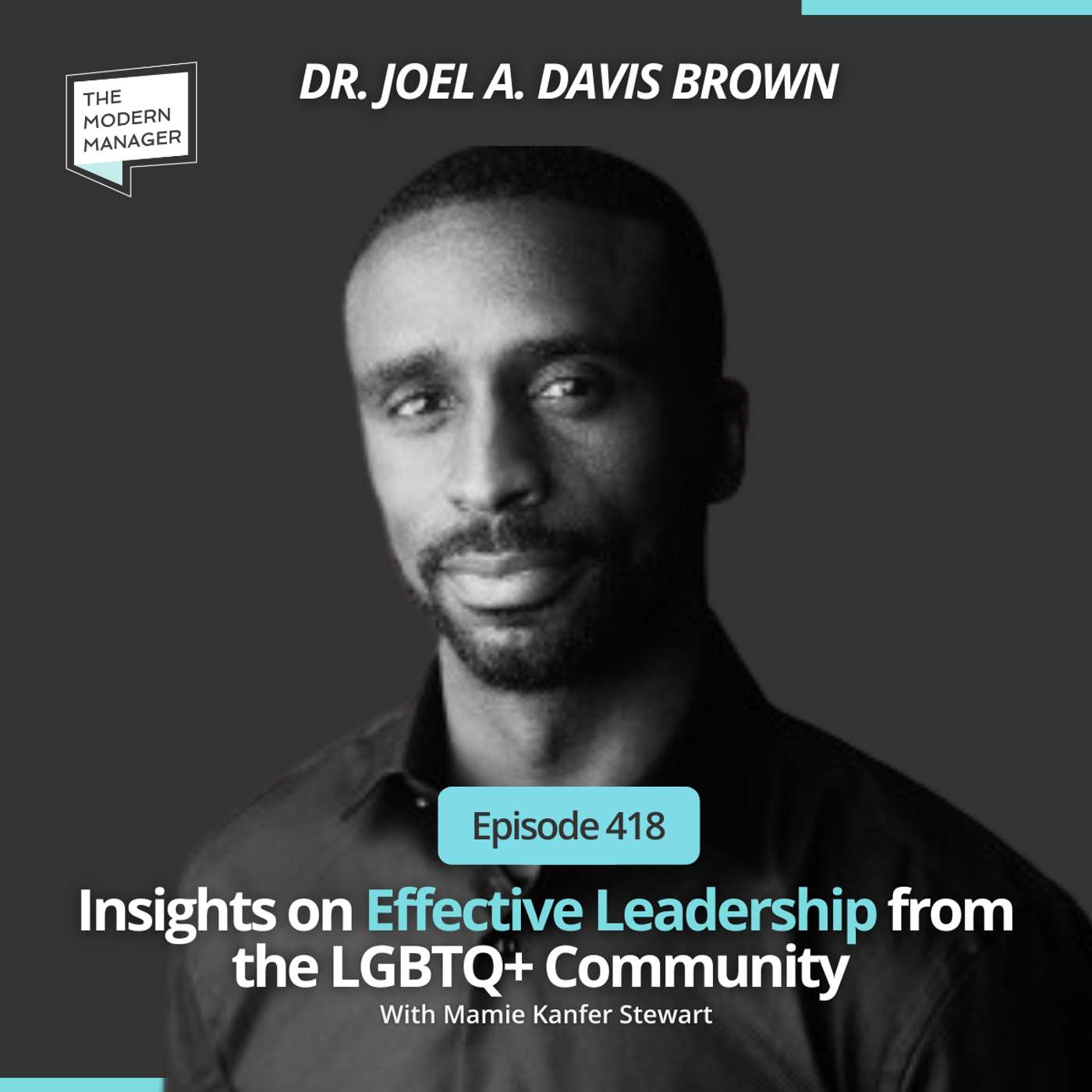
Dr. Joel A. Davis-Brown is Chief Visionary Officer at Numos LLC, a management consulting/coaching firm focused on organizational strategy and culture, transformational leadership, global inclusion, executive coaching, conflict resolution, and strategic storytelling. He authored The Souls of Queer Folk (2023), arguing LGBTQ lived experience contains leadership wisdom.
Workplace “strength” and rugged individualism can hinder collaboration; leaders should be internally aligned rather than clones of others; cultural borrowing is appropriate when done with respect; leaders should create environments where people feel safe to be candid.
A “pre-mortem” practice used by a manager named Kevin to surface concerns and build psychological safety; a personal story about noticing a “pit in the stomach” in a toxic job; phone/Blackberry/iPhone as an example of adaptive, non-binary thinking.
Written by AI. May contain mistakes.
Discover the process and motivations behind studying LGBTQ+ cultural values for leadership insights.
“I am super excited to talk with you about what you've learned around leadership and your research in the LGBTQ plus community.”
Understand the key values identified in LGBTQ+ culture and their relevance for leadership.
“So I think that's what we're supposed to do.”
Explore the importance of authenticity in leadership and how it affects effectiveness.
“And all the qualities that I saw that the LGBTQ plus community embodies, which, by the way, is informed by a very diverse group, is also are also the qualities that people want to see in their leaders.”
Learn about the need to align one's internal values with external behaviors as a leader.
“and those were notions that didn't serve me well.”
Hear about the importance of recognizing and adjusting to the disconnect between self-perception and behavior in leadership.
“I think a lot of times when people think of authenticity, they're thinking, let me just let all of me hang out.”
Explore the importance of authenticity in leadership and aligning personal identity with external behavior.
“And then what are you doing to maintain that?”
Learn about the concept of verve and its distinction from charisma in effective leadership.
“being reflective and starting with your internal self.”
Understand non-binary thinking and how it fosters creativity and adaptability in problem-solving.
“I want to talk about another one, which is the non-binary or fluid thinking.”
Discover how challenging outdated mental models can lead to personal and professional growth.
“And it's something that, again, I've always thought about and I've always asked myself about.”
Examine the role of somatic awareness in leadership and self-care practices.
“Okay, I think we have time for one more.”
Learn how a great manager exemplified vulnerability and created a safe space for open communication.
“Then think about the types of cultures that we could create if people realized that you can work and be a great professional, but you can also take care of your humanity and your physical being as well.”
Learn how modeling vulnerability can create psychological safety in teams.
“What I love about Kevin is that he gave space for us to be vulnerable.”
Explore the importance of empathy and meeting others' needs in leadership.
“My best manager, and this is a non-traditional answer, but this is someone who has been the best leader in my life, is my mom.”
Discover how to apply personal insights into leadership across various relationships.
“And I aspire to be that kind of mother and that kind of leader.”
Find out where to learn more about Joel and his work, including his book.
“And where can people learn more about you, remind us about your book and where they can find it and all that jazz.”

Get the gist, explore an idea or ask about something said.
 Claude
On The Modern Manager, what are the key points of this episode?
Searching your listeningAutomatic transcript. May contain errors.
0:00Maia Jose: Some of the best leadership lessons don't come from business books. They come from communities that had to build trust, belonging, and resilience from scratch, often without the blueprint or the safety net that most of us take for granted. The LGBTQ plus community has spent decades perfecting exactly that. How to build chosen family, how to lead through adversity, how to show up authentically even when it's costly. Today, we're pulling those lessons out and putting them to work for every manager listening, regardless of how you identify. Today's guest is Dr. Joel A. Davis-Brown. Joel is the chief visionary officer of Numos LLC, a management consulting and coaching firm specializing in organizational strategy and culture, transformational leadership, global inclusion, executive coaching, conflict resolution, and strategic storytelling.
0:45Maia Jose: As a change agent, Joel works strategically to cultivate innovative, creative, and adaptive environments where the cultural genius of everyone can be harnessed and leveraged successfully. He is also the author of The Souls of Queer Folk, How Understanding LGBTQ Cultural Values Can Transform Your Leadership Practice, a groundbreaking book that argues that an unexpected but essential source of leadership wisdom lies in the values and lived experiences of the LGBTQ plus community. Wisdom that can help refashion workplaces, reimagine institutions, and rebuild communities. Now here's the conversation.
1:23Maia Jose: Thank you so much for joining me today, Joel. I am super excited to talk with you about what you've learned around leadership and your research in the LGBTQ plus community. I don't think I've ever talked to anyone about a topic even remotely similar to this. So I'm thrilled that you are joining me.
1:42Dr. Joel A. Davis Brown: It's my pleasure. I am very excited for this conversation. So thank you for having me.
1:46Maia Jose: All right. Well, I want to lay some groundwork because I think maybe I just confused some people when I said I've never talked about anything like this. And I guess what I meant was drawing wisdom from a particular culture or community. And there are many different wisdom traditions I think some of us would say we're familiar with, mostly in like the faith tradition spaces. But we don't always look to other cultures that are currently around and existing in different ways for the wisdom of those people. And you did. So I'd love for you to tell us a little bit about why did you undergo this process?
2:19Maia Jose: Like, what were you hoping to find by studying a community? And what did you find?
2:25Dr. Joel A. Davis Brown: Very rich and provocative question. So why did I begin this inquiry or this investigation? really to learn more about myself. So as a very young man growing up as an African-American, it was very clear to me what it meant to be African-American. I learned things such as strength, community, the importance of respecting elders, the importance of looking back and studying history. So there are a number of different cultural variables that I learned from that experience. But then as I came out, there's less data and information of what it meant to be LGBTQ. So I began this inquiry. I thought about this for a very long time.
3:03Dr. Joel A. Davis Brown: And then at some point, as I went through the research, as I read through books, as I combed through articles and newspapers and I asked people, what does it mean to be LGBTQ and why is no one talking about this? at one point, a friend of mine said, the reason you're not finding the answer is because you're supposed to explore it and research it yourself. So I said, okay. All right. So I have very honest friends. So once I got into grad school for a second time, I decided to initiate an ethnographic study to study what does it mean to be LGBTQ? And initially, the reason I wanted to find that out was just again, to find out, well, how can we get beyond the stereotypical notions of what it means be LGBTQ.
3:42Dr. Joel A. Davis Brown: And in doing so, that's where I found out and verified and validated some things that I always felt, but never really had any definitive research on. And it was very eye-opening. And I think when we think about culture, we're always learning from culture and sometimes for the good and sometimes for the not so good. And so I wanted to, in some ways, reclaim a narrative. And what was interesting is that as I studied the community, as I studied the culture, I started to realize that not only was the culture rich and varied, as I already knew, but that a lot of what we stand for naturally by virtue of our journey can also be very instructive for others and for people throughout the world.
4:22Dr. Joel A. Davis Brown: And so that's how we got to where we are today.
4:25Maia Jose: I love this. I love that proactive, like I'm trying to understand this for myself. And so if I can't find the answers, I got to go find them. I got to go do the research and excellent. Before we get into what you actually found, I'm curious what your take is on kind of using wisdom from the queer culture in leadership or using wisdom from any culture that maybe you're not identifiably part of as a leader. Do you have a take on that? Well, I think it's important.
4:56Dr. Joel A. Davis Brown: I grew up in the tradition and with the belief that you can always learn from people and you can learn what to do and what not to do. And that's one of the beauties of having intercultural exchange. Right now, there are some people out there who will say to you that if you borrow or learn from other cultures, there's this thing called cultural misappropriation. I think that word and that phrase has been misused because cultural misappropriation means that you take something without giving it honor and due respect and you use it in a way that's different than what's intended. And so I think as long as people are using wisdom in a way that honors the traditions and respects the source and use it as a way to further good things in the world, I think that's okay.
5:35Dr. Joel A. Davis Brown: That's not cultural appropriation. So I think that's what we're supposed to do. We're supposed to learn from each other. I know I've learned from a number of different traditions and different people in different cultural contexts. And I would hope that just by rubbing shoulders with me, that people have also been able to do the same by virtue of my pathway, my example, and just by my presence.
5:52Maia Jose: Yeah, I could not agree more. I think it would be very sad if we were limited to only our own identities, our own experiences, right? The whole point of life is to learn from others so that we can do better in the world. So thank you for putting such fine words to that. Okay, let's dive into what you learned. What were some of the values and the findings that came from this research?
6:16Dr. Joel A. Davis Brown: Well, so I conducted the research, and I won't get too nerdy for your audience, but I conducted the research first by doing a mixed method study, which meant that I interviewed leaders within the community in the Bay Area. And these are people who, when I say leaders, people who had some demonstrable engagement with the community, whether they were involved in with a nonprofit, whether they were doing something in terms of community activism, but people who were naturally, regularly, and persistently engaged with the community. And some of them were not even LGBTQ identified. Let's be very clear about that.
6:47Dr. Joel A. Davis Brown: But most of them were. Then I took that data and I used it to create a survey that we administered to people around the world. So we use social media and we asked them to evaluate and say, which of these values do you think of all this data that we've collected? Which of these values do you think are most important to your experience of being LGBTQ? And we came up with 15 different values and we ended up sorting those into nine meta themes that reflected what people believe is the heart and the essence of LGBTQ plus culture. So let's see if I can remember what some of those are. So there was justice, which is basically a care for equity and human rights, authenticity.
7:29Dr. Joel A. Davis Brown: There was verve, which is having a natural zest for life, exuberance and flair. There was interconnectedness. There was the idea of creativity. I believe we also talked about fluidity and the idea of recognizing that it's okay to entertain both sides of a problem or an idea as a way of trying to understand complexity within the world. So those were just a number of them right there. There were, like I said, nine total. And strangely, again, or not so strangely, when I looked at the list, I realized that innately, implicitly, I always knew and assumed that these were part of what made me maybe feel closer to the community.
8:16Dr. Joel A. Davis Brown: And these were things that I use in my navigation of the world to be the best version of myself as a queer person. What I did anticipate is that as I started to look up and to ask what people were looking for in their leaders, that there would be direct symmetry and alignment between what you were seeing from the queer community and also what you were hearing that people wanted from their leaders in the world in general. So one of the things that I'm very much focused on is leadership and how people show up and transformational leadership, the kind that leaves people in a better place, but also transforms the environment, including the person or the persons involved.
8:55Dr. Joel A. Davis Brown: And all the qualities that I saw that the LGBTQ plus community embodies, which, by the way, is informed by a very diverse group, is also are also the qualities that people want to see in their leaders. And so that to me has been a huge staple in a huge realization of my work is that this wisdom, this queer mindedness, this cultural genius of the queer community is something that everybody can benefit from.
9:20Maia Jose: I have to tell you, when I was reading your book, that parallel was so clear. But also, some of the meta themes you found are not things I would find in a traditional leadership book. And I appreciated that even more because I think it brought something additional to that conversation. And it wasn't just the same old, same old, you know, 10 things that every HBR article is going to cover for leaders. So I actually want to spend some time on some of those. But go ahead. I think you want to respond first.
9:49Dr. Joel A. Davis Brown: Well, I was going to ask you which of those were, because as I now recall, some of the other values for meta themes were resilience, somatic awareness, perceptiveness, non-binary thinking. Those are the things that are really important. And so those are things that you don't typically think about if you were to go to, let's say, Harvard Business School, if you were to read the traditional journals. But the one thing I would say to people when you think about leadership is that we already are informed by cultural norms and by a particular culture. So, for example, when I was coming into the quote unquote corporate world or the business world or even the workplace, I was learning things such as or I was told things such as you're supposed to always present with this idea of strength.
10:33Dr. Joel A. Davis Brown: You're supposed to, you know, be this rugged individualist. You're supposed to speak with this level of authority. and those were notions that didn't serve me well. Why? Because I think one, if you're trying to work with a team, if you're trying to work with people from different backgrounds, it's a point to be collaborative. So you don't want to necessarily be the lone wolf in terms of always being this source of authority. Well, what if you're not the expert? So how do you create room for other people to share their knowledge and wisdom as well? And in terms of being strong, I found that people related to me better when I was vulnerable, when I was accessible, when there was some level of engagement there.
11:12Dr. Joel A. Davis Brown: So a lot of what we've learned and a lot of what I've learned, frankly, didn't serve me well. So this is why it's important to our earlier point, this is the earlier question, to learn from different cultures, because we can recognize what ways of being, what ways of working, what ways of leading are really outdated, and what ways can actually serve us better if we were to learn from the wisdom that is out there from a number of different cultures, including, yes, of course, the LGBTQ culture.
11:36Maia Jose: I'm really glad that you brought that up, because it's not to say that the way that work happens now is all bad. There are many good things that happen in the workplace now, but some of those good things just don't work for us as individuals and our personality and the culture that we were raised in. And some of them, the world has shifted away from, and we need to keep shifting with where other people are at and what they expect and what we now know makes for better decision-making or better collaboration or better outcomes. So it's really that constant evaluation of is the way that I think I'm supposed to show up really the best way for me to show up in this moment?
12:16Dr. Joel A. Davis Brown: Absolutely. Because what happens is you'll get people who are trying to become leaders. And instead of being a leader that has a certain ethic or a certain moral stance or a certain value set, they end up trying to be somebody else. And one thing that I can tell you is that when you act, you try to be a leader resembling someone else, you're going to fail. Why? Because you cannot be anybody other than yourself. So hopefully what this conversation and what other conversations like this can tell people is find the way for you to be the best version of yourself. Don't try to be Fred. Don't try to be Tom.
12:48Dr. Joel A. Davis Brown: Don't try to be Mary. Don't try to be Sarah. Don't try to be basically a clone. But think about what's best for you. And everybody leads differently. So this is not to say that there's one set prescription, but it's like any type of meal or cake. There are certain ingredients that are going to be important no matter what you make, no matter what type of leader you are, they're going to help you to be more effective.
13:05Maia Jose: Well, and that gets to one of the ones you mentioned around authenticity. If you're trying to be someone else, you're not being very authentic to yourself.
13:12Dr. Joel A. Davis Brown: Right. I think a lot of times when people think of authenticity, they're thinking, let me just let all of me hang out. Let me be my Friday night self. Let me be my Sunday night self. But what authenticity is really saying is be internally aligned with who you really are, which means spending some time to say, well, what's really important to me? And in doing so, am I living up to my own standard of what it means to be the best version of myself and to be a leader? So authenticity has an internal component before you focus on the external environment. Am I who am I and am I honoring who I am by being true to myself?
13:48Dr. Joel A. Davis Brown: And so that's really the important question. And the leaders that I work with, because I work with a number of leaders, I do a lot of coaching, I really help them to be clear. Who are you? Independent of what others might say, independent of what expectations have been placed upon you, are you clear about who that is? And then what are you doing to maintain that? And what I find is that sometimes leaders are trying to be someone else or they've never asked themselves that question, which means that they're not having the same type of impact that they really want.
14:12Maia Jose: I can actually speak to that exact point. I remember this was already quite a few years ago. where, you know, I told myself that I am somebody who like address conflict head on, like that's what a good leader does. They say the hard thing that needs to be said. And then I would notice myself in meetings not doing that. And I was like, wait a second, what's happening here? Like who I really am and who I think I am are not aligned. And it was really eye opening and really helped me figure out how I needed to shift both my internal thinking and my external behavior so that I could actually be fully aligned with myself and show up the way that I actually wanted to.
14:54Maia Jose: It was a whole thing, which I don't want to get into, but I think it's so important to just to acknowledge that like sometimes, you know, we have an idea of who we are. We have an idea of who we want to be and our behavior doesn't always align. So I love that starting with authenticity really means being reflective and starting with your internal self.
15:13Dr. Joel A. Davis Brown: Yes, absolutely.
15:14Maia Jose: I want to talk about Verve because this was one that I don't think I've seen on any leadership list, but I love so much as somebody who wears glitter every day. I was so excited to see something on this list that was really about being full of life. And I think sometimes, and you can speak to this more, we confuse that with charisma, which you might see on a bunch of leadership that people are inspiring and they're so charismatic. But Verve is different. So can you talk about this one?
15:44Dr. Joel A. Davis Brown: Yeah, Verve is having that internal exuberance, that joie de vivre, that enthusiasm and excitement for life. And again, and some of your listeners may get bored with me saying this, it is an internally driven directive. It is not you being a showman or showwoman. It is not you doing it so that you can get clicks and likes and be popular within a group. It is about making sure that you You are living in accordance with who you are in a way that shows responsiveness and, again, this level of engagement and enthusiasm for what you're doing, which can be infectious. You know, one of the things that I want to be very clear about is that we're always leading.
16:24Dr. Joel A. Davis Brown: The question is whether we're clear on the impact that we're trying to create for people. So if I show up and I have a bad attitude, I'm not in a good space. And that's also going to happen. We're all human and in the given day, in a given week, in a given year, there might be days where you don't have that magic, that mojo, that same energy. At the same time, if you can look back and say on the majority of those days, have you been intentional? Have you shown up in a way where you've exuded positivity? You've created psychological safety. You've made people feel good in your presence. That's what's important.
16:55Dr. Joel A. Davis Brown: And that doesn't mean that you have to be kind of like a Cheshire cat or a cheerleader. It means have you created the type of the environment where people feel good about The work they're doing they feel good about the environment and you it's obvious that you feel good about yourself You feel good about the work that you're doing who you are and the level of relationships that you have around you That's really important because it's infectious And so we all know that when you walk into an environment people feel happy. I liken it to when I go to a restaurant if people there are enjoying working there you can kind of tell you can kind of tell because there's this vivaciousness and this vitality and people are usually excited and you can kind of feel it.
17:32Dr. Joel A. Davis Brown: Or when I fly, when I'm on an airline where people enjoy what they do, it's obvious. And when people don't enjoy what they do, it's also obvious. And so just recognize that that verb is really important. So find your joy, which means sometimes making sure that you find either a job that you love or find some aspect of it that helps you to stay in a place of positivity and in place of happiness. That's what it really means. And so I don't want anyone to go away from this thinking, well, do I have to love everything that I do? No. But you have to be clear about how it's serving you and to be clear about what you need to do and what you can do to help your energy level still rise to the level that you're having a positive impact on those around you.
18:12Maia Jose: It's so beautiful because you really can tell the difference between somebody who is showing up with that positivity and that joy in their engagement and someone who is going through the motions and wishing they weren't there. All right. I want to talk about another one, which is the non-binary or fluid thinking. Because this is actually one of my absolute favorite concepts is getting rid of the either or way of thinking about everything. Yes.
18:40Dr. Joel A. Davis Brown: So the idea of non-binary thinking, as it suggest is not being fixed with absolutes. And so being, uh, open to other possibilities, being imaginative, recognizing that there is perhaps a middle way, a third way, or a different way of looking at things, addressing problems of, uh, thinking about how you can show up and how you can be. And so what does that look like? So let's say you're working on a particular project and someone says you're between two people who say we should do it one way and we should do it this way. do you allow those things to those ideas and those norms to stay fixed or do you allow yourself to entertain that there's a different way to do so which is important because we're in a society now as I think we've always been where there's different ways of thinking about how to do things there's different ways of being right so sometimes the ways in which the the predestined ways in which we approach problems have already been exhausted and sometimes they don't have the same level of impact that we want.
19:40Dr. Joel A. Davis Brown: So do we challenge ourselves to think about how we could do things differently? And I think if we do that, think about all the things that we've been able to benefit from in society because someone pushed the envelope and someone went beyond what was established and said, we can actually think about this differently. I think about this with my phone. And so I'll just tell the brief story. I remember when there was the flip phones and you could take pictures. And then of course it was the Blackberry, then there was the iPhone. I thought, I just want to make calls. Why do we need all this stuff?
20:07Dr. Joel A. Davis Brown: Why do we need to take pictures and scan and have all these things? But now look at how we look at telephones, both for the good and for the bad, but how we look at things such as how we travel, how we work. There's ways in which we can adjust and adapt. And I think that's the most important thing in the world that is becoming increasingly volatile, uncertain, complex, and ambiguous. We need to be adaptive. And non-binary thinking allows us to adjust in real intangible ways to an increasingly unpredictable environment. So it's really about, again, not just being rebellious for the sake of being rebellious, but saying, is there perhaps a way that we're not thinking about this?
20:49Dr. Joel A. Davis Brown: How can I question my assumptions? How can I perhaps investigate those sacred horses and say, maybe we're thinking about this the whole way. maybe there's some underlying premises that we need to investigate and let go of in order for us to get to where we really want to be. So I love that, too. And it's something that, again, I've always thought about and I've always asked myself about. But it was not something I was using intentionally until I started doing this research and realized that it's something that I can make as a fundamental part of my leadership practice. Yeah.
21:22Maia Jose: Yes to everything you just said. And as I said, this is something that I think we just get stuck in so often. And, you know, I joke that when my husband asks me either or a question, my answer is always, well, it depends. Because I just don't think that it has to be one way or the other. I'm like, you know, he's like, do you want to have Italian or do you want to have tacos? And I'm like, well, it depends. Can we make Italian tacos? Like, what would that be like? It drives me crazy. But I just feel like when we don't allow ourselves to get stuck in either this is how it's always been, so this is how it has to be, or we have to make a binary choice.
21:59Maia Jose: As you said, we just get to open up possibilities and creativity and innovation, and we can adapt to things that we didn't even know we could adapt to, but we're so resilient that we can actually get there.
22:12Dr. Joel A. Davis Brown: When I first moved to New York, for a very long time, and I still do this to some extent, I was spending summers in the fall in New York, and then I was spending winters and spring in San Francisco because I really don't like cold weather. And I remember people saying to me, how are you going to do that? What does that look like for you to be split between two places? But then I talked to more people, and there's quite a few people who are able to live this kind of bicoastal existence. So I didn't have to ask myself, what is the mental model that I'm using? And does it really serve me? And I realized that this whole mental model that I need to be in one place all the time is really outdated.
22:50Dr. Joel A. Davis Brown: And it really doesn't serve me because there's parts of the Bay Area that I love and adore. And that's parts of New York that I really need and they're part of my being as well. And so the idea of one place doesn't necessarily fit my lifestyle and fit who I am. And to employ a different model, which many people do, which actually fits me, right? Okay, so that old paradigmatic thinking is something that I would encourage us all to rethink and to revisit. And I think a lot of people are starting to do that because we realize that the world as we know it may not meet our needs and may not meet our expectations.
23:20Dr. Joel A. Davis Brown: And we can actually design, and that's part of leadership, right? That's part of personal leadership. We can design our own lives in a way to fit who we truly are.
23:28Maia Jose: Ah, I love that. Rethink our own mental models. Okay, I think we have time for one more. So can we talk about somatic awareness?
23:37Dr. Joel A. Davis Brown: I was hoping you were going to get to that one, somatic awareness. And so one of the values in the research we found is that in the LGBTQ community, there is greater respect and value for physicality. And when you say physicality, people instantly go to sex. Well, it also speaks to sensuality, but also being aware of somatics and how we hold things and what our bodies tell us. Because our bodies hold information. They also can serve as antenna for what we might be feeling, sensing in the environment. And so what can we do to pay attention and to nurture that skill? And what can we do with the information that is given to us?
24:15Dr. Joel A. Davis Brown: What can we do with the data? So, for example, one of the things I routinely notice when I talk to leaders and I coach leaders is that self-care is usually at the bottom of their leadership practice, if it is even there at all. And I remember at one point I was working for an outfit and every time I drove into this location, I had a pit in my stomach. I noticed that something was not working. I didn't feel right. That should have been my first sign and the first indication that it wasn't the best place for me. Because as I look back and as I deconstructed what was happening, I was feeling stressed because I was working in a very toxic environment.
24:49Dr. Joel A. Davis Brown: Think about how our emotional antenna could be used to help us to further greater self-care, health, and to pay attention to those relationships, those organizations, and the type of work that feeds us and restrains us. That's what our system is set up for. And so this is an opportunity for us to pay attention to what we're holding in our body to make sure that we're taking care of ourselves, making sure that we take care of our physical needs, that we're getting exercise, we're eating properly, we're resting, we're partaking in some type of leisure, that we're nurturing the type of relationships that feed us, but then also paying attention to say, what is it that I should be doing more of?
25:28Dr. Joel A. Davis Brown: And what is it that perhaps I need to pay attention to that is draining my energy that I need to set up a boundary around? And one of the things that I think is really important for leaders is to make sure that you're properly bounded. So what does that mean? Making sure that you set up a boundary so that you're able to allow some things in, including opinions and feedback, but that you're not so unbounded that you're allowing negative things in that might derail you or negatively impact you. So your somatic awareness can help you and it can help you make sure that you're living a life of vitality and vigor and strength and making sure that you're not creating a type of work or, how should I say, a work practice that leads to burnout, stress, and dis-ease, which is coming from dis-ease of the mind.
26:10Dr. Joel A. Davis Brown: That's how ailments and sickness manifest themselves in the body. And the mortal leaders thought about that and took care of that and modeled that for other people, particularly the people who they mentor. Then think about the types of cultures that we could create if people realized that you can work and be a great professional, but you can also take care of your humanity and your physical being as well.
26:29Maia Jose: Oh, yes. And I think we cannot underestimate what you said about your body having information about what is stressing you out, what doesn't feel right for you. I mean, I know like I, for a long time, I was like, oh, headaches just are part of the job. And like, oh, if I have a pain in my shoulder, it's because I worked out too hard. And I have since learned that is not, that is sometimes true, but sometimes it's actually like, no, you're getting all these headaches because this is not serving you. And you keep pushing yourself to do this thing that isn't working or that pain in the back of the shoulder, that is the hot spot of stress.
27:03Maia Jose: You are freaking out about what's going on at work and you cannot let it go. And you need to figure out how to get some good movement and all that relaxing stuff so that it can move through your body and not get stuck there. But if we don't make that connection between what our body is feeling and what's happening in our lives, we're missing the whole boat.
27:23Dr. Joel A. Davis Brown: You can't resolve what you don't acknowledge. And so the The body is there to help you to illuminate and to make visible what's invisible and to help bring to your consciousness the things that you can address and the things that will help you to lead a greater, become a better version of yourself and to lead a greater life.
27:39Maia Jose: Absolutely. All right, Joel, can you tell us about a great manager that you worked for and what made this person such a fabulous boss?
27:46Dr. Joel A. Davis Brown: Yes. The manager who comes to mind, his name is Kevin. So, Kevin, wherever you are in the world, if you're listening, this is for you. What I loved about Kevin was his level of vulnerability. So when we had projects which were hard, we had assignments that felt asinine, where clients were being very demanding, and this was in a legal capacity. What I love about Kevin is that he gave space for us to be vulnerable. He modeled vulnerability, which is one thing that I would encourage more leaders to do. It's not enough to tell people to be vulnerable. You have to model it. And Kevin would bring us together in the room.
28:27Dr. Joel A. Davis Brown: He would do what we call a pre-mortem, say, okay, this is our project. That's what we have to do. How are people feeling? What are you noticing? What concerns do you have? Where do you think we're going to be successful? What do you think we need to pay attention to? And he allowed everybody to have that level of psychological safety that they could Essentially dump they could share they could be candid. He would be candid too And by freeing and clearing that energy it allowed us in to focus on the task at hand So it wasn't something where I felt like okay I'm on an island because this project that this feels awful and kevin.
28:58Dr. Joel A. Davis Brown: I have like I have to engage in toxic positivity Um, I feel like I could be honest which therefore allowed me then because I felt seen I felt heard and I felt validated which then allowed me to still show up and do the work I needed to do. So he was a great manager. My best manager, and this is a non-traditional answer, but this is someone who has been the best leader in my life, is my mom. And one of the reasons why I cite my mom as being a great leader is mom knows how to be responsive to what's going on. And she knows how to be empathetic. That looks different. And so sometimes for example, I'll give you an example.
29:39Dr. Joel A. Davis Brown: I called up my mom I was upset about something I was in college No, I actually had just started practicing law and my mom's automatically wanted to go in to give me advice and She knows I was getting quiet and I said she said what's wrong? Why are you getting quiet? I said because I didn't necessarily need advice I just needed to share what was on my mind. So then there was another situation where I I shared something was wrong and then mom this time she said she wanted to go into again problem-solving mode or she had questions and whatnot and I she knows I was getting quiet again and she said okay what's up I said well I didn't necessarily need to go through it I wasn't ready to get in problem-solving either I didn't want to go through I didn't need to pontificate or to go through a list of generate a list of ideas and suggestions I just needed to vent I just needed to get this, my feeling out.
30:35Dr. Joel A. Davis Brown: So the very next time I spoke to her, and this took place over the course of maybe a month or two, she finally said to me, okay, what type of mom do you need me to be today? How do you want me to show up? She said, do you need me to be the ride or die mom, the inquisitive mom, the problem solving mom, the just sit and listen mom? What type of mom do you need to be? And I wish more people understood that, that empathy requires you to recognize what's needed from the person in the moment. And when you're being empathetic, you center the needs of the person who is coming to you, not your own agenda, not following your own ego.
31:08Dr. Joel A. Davis Brown: And so many times when people think that they're being empathetic, they're not honoring the needs of the person who they're speaking to. They're following their own dictates. So it becomes more of an academic exercise as opposed to a heart-driven conversation to figure out what is needed and to honor the person by giving them exactly what they want in that moment and recognize that that might be different from day to day. Sometimes I do need my mom to be ride or die. Sometimes I do need my mom to be the wise person who she is to give me some feedback. Sometimes I do need her to engage in some solutioning and to offer ideas.
31:40Dr. Joel A. Davis Brown: And sometimes it's great that she just listens and she just provides this nice container for me to share how I feel and where I'm coming from. That is the greatest lesson that I've learned and it's something that I've incorporated into my quote unquote leadership practice with my family, with my husband, with my siblings, with my friends in the community, and also with my team, is recognizing what's needed in the moment and then following suit based on the clues and the cues that you're getting from the people that you're serving, the people that you're engaging, the people that you're working with.
32:13Maia Jose: Incredible. Incredible mom. And I aspire to be that kind of mother and that kind of leader. Amazing. All right. And where can people learn more about you, remind us about your book and where they can find it and all that jazz.
32:25Dr. Joel A. Davis Brown: Sure. So you can learn more about me at joeldavisbrown.com. You can also go to my business website is numos.com. That's a Greek word. You can also follow me on LinkedIn, Joel Anthony Davis Brown online. I think it's Joel A. Brown online. And you can find my book on at any online retailer. So Amazon, Barnes and Noble, there are at least a dozen platforms that you can find it on. So my book, Souls of Queer Folk, came out in February of 2023. Please reach out. I'm a Midwesterner by birth or by, I should say, I was raised as a Midwesterner. And so I love hearing from people, love hearing success stories and also love fielding questions as well.
33:06Dr. Joel A. Davis Brown: So I hope people reach out and will say hello.
33:09Maia Jose: Excellent. Well, thank you again so much, Joel. Such a pleasure talking with you today.
33:14Dr. Joel A. Davis Brown: Likewise. Thank you.
33:17Maia Jose: All the links are in the show notes and they can be delivered to your inbox along with the free episode guide, which captures the key takeaways and suggested actions from every episode. Get on the list at themodernmanager.com. Thanks again for listening. Until next time.
Some of the best leadership lessons don't come from business books. Throughout history, different cultures have developed wisdom for how we can interact with and lead others. By exploring what different cultures value, we can identify insights into what might help us be better managers today.
Dr. Joel A. Davis Brown is an attorney, executive leadership consultant, and author of The Souls of Queer Folk. Drawing on lessons from LGBTQ+ cultural values and decades of leadership consulting, he helps organizations build more inclusive, perceptive, and human-centered leadership practices.
In this episode, we explore how the unique values of the LGBTQ+ community offer a powerful blueprint for transformational leadership. We’ll discuss how you can integrate these human-centered insights into your own team culture to create a more inclusive and effective workplace.
Conversation Topics
📚 Additional Resources:
✨ Read the full transcript: https://docs.google.com/document/d/1z2kdQnqMCcz92rq31pnfzOMH4O9df6rqYddUXwlvtg0/edit?usp=drive_link
✨Follow me on Instagram: https://www.instagram.com/leadershipwithmamie/
✨Visit my website for more: https://www.mamieks.com/
✨ Subscribe to my YouTube channel: https://www.youtube.com/channel/UC7jhYz8b16g1SsLia4EhO5w?sub_confirmation=1
Keep up with Dr. Joel A. Davis-Brown.
- Connect with Joel on LinkedIn: https://www.linkedin.com/in/joelanthonybrown/
- Follow him on Instagram: https://www.instagram.com/joelabrown/
- Visit the Pneumos website: https://www.pneumos.com/
Join my newsletter to get episodes delivered directly to your inbox: https://www.themodernmanager.com
The Modern Manager is a leadership podcast for rockstar managers who want to create a working environment where people thrive and great work gets done.
Follow The Modern Manager on your favorite podcast platform so you never miss an episode!
#Leadership #TeamCommunication #WorkplaceCulture #LeadershipDevelopment #InclusiveLeadership #Teamwork #WorkStyles #ManagerSkills #PsychologicalSafety #EmotionalIntelligence #LeadershipTips #Collaboration #WorkplaceCommunication #FutureOfLeadership #TheModernManager