Ask ChatGPT
 The Modern Manager
3 Nov 2026 · 29m · 14 chapters
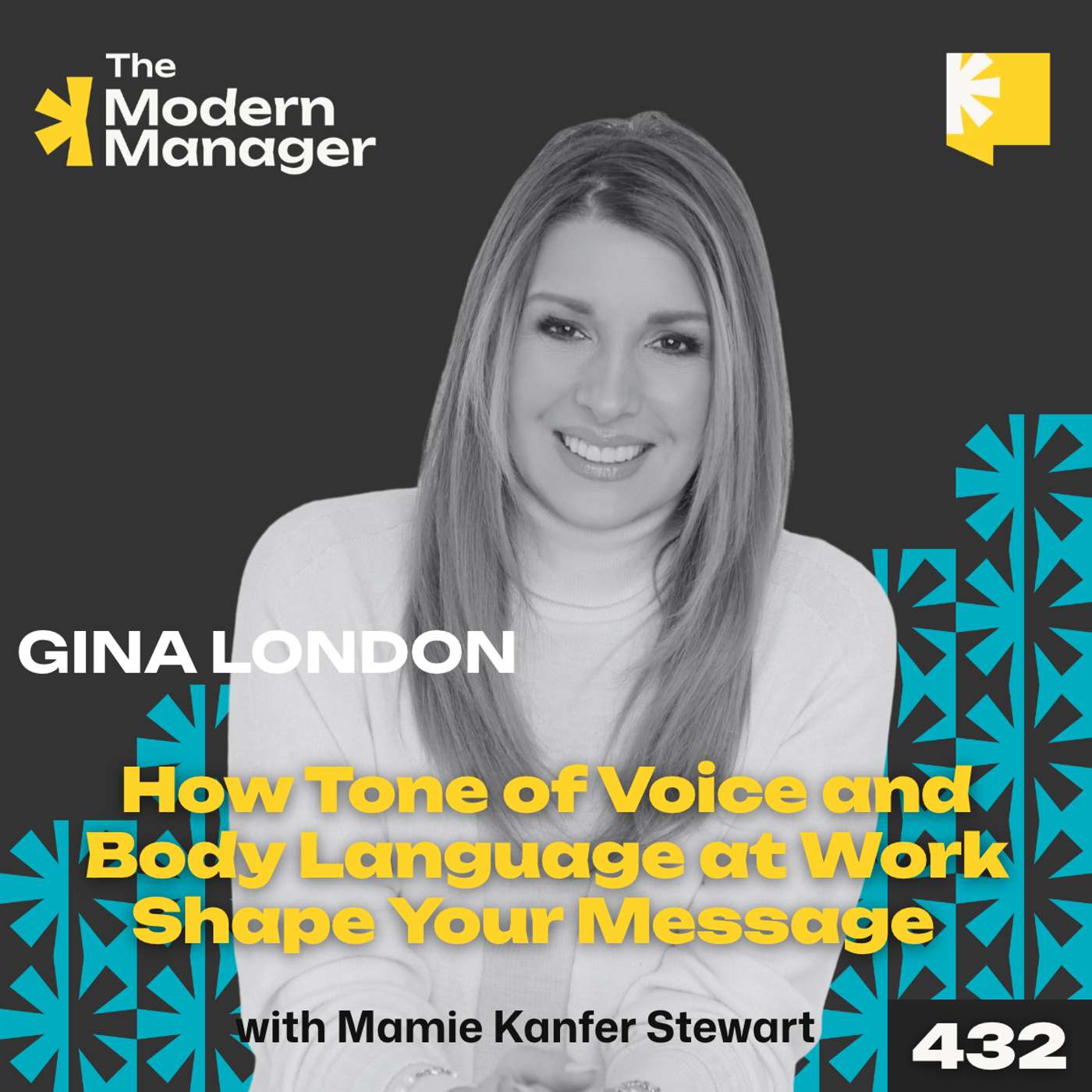
How tone of voice, facial expressions, body language, appearance, and small situational choices shape what people perceive—often even when you’re not speaking—plus how to listen and respond intentionally.
Gina London is founder/CEO of Language Leadership; a former CNN correspondent and Emmy Award-winning journalist; coaches executives, government leaders, and teams; columnist for The Irish Independent; author of Amplify You and Say It, Look It, Be It.
You’re “never not communicating” (by design or default). Perception is reality; awareness + desire + daily discipline rewires behavior. Active listening requires an “external observer mindset.” Actions change thoughts. Don’t “fake it”—skill up.
A senior leader who enters with head down/phone and signals “I’m too busy.” Phone-on-desk causing disconnection. “Listening face” that looks flat. Proximity and sitting posture (leaning forward). Dressing “one step aspirational” to match culture; not setting the wrong signals (e.g., field reporter dressed appropriately got a break). Psychological safety example: news director Gary Wordlaw encouraged Gina after a disastrous first live shot.
Written by AI. May contain mistakes.
Introduction of Gina London, her background, and what she'll discuss.
“From farmland, Indiana to boardrooms around the world, Gina has spent her career helping people find their voice.”
Exploration of how body language and tone impact communication.
“I'm thrilled to talk with you about really how we show up when we're communicating.”
Discussing the constant nature of communication and the need for awareness.
“In my book, Amplify You, I call it my ad principle.”
Examining the role of active listening and how to improve it.
“My call to action, which is why I call it amplify you, not change you, is that you can take more control of this stuff to show people what they want, which is to be seen, to be heard, and to be understood.”
How posture and physical presence affect perceptions in communication.
The impact of physical proximity and connection on communication effectiveness.
“That's why my book is Say It, Look It, Be It.”
Strategies to enhance communication and avoid common pitfalls.
“I have Michael Bungay, Sr., who's written the most prolific coaching book.”
Learn how body language and intention shape communication in professional settings.
“because they don't know me yet because I'm just getting to know them.”
Explore how first impressions are influenced by appearance and situational context.
“Take the effort to build the bridge to them.”
Discover the balance between personal style and professional expectations.
“My daughter, who's 18 now, but when she was 13, 14, she was going through a real skater girl phase.”
Understand how clothing choices influence perceptions and interactions in the workplace.
“Initially, once they get to know you and your credibility, if there's range for that, then by all means.”
Hear a personal story about a supportive manager and the importance of psychological safety.
“there about how my brother said, this shouldn't be a part of it.”
Learn about the ongoing impact of communication beyond spoken words.
“to you and maybe we can do some sort of a feature because I do write a weekly column on leadership and communications in the largest newspaper here in Ireland where I live.”
Discover why aligning your external expressions with your internal intentions is crucial for genuine communication.
“I so appreciate how Gina called out that we're always communicating, whether we're walking down a hallway or sitting with our camera on in a meeting with five other people, and we're just listening.”

Get the gist, explore an idea or ask about something said.
 Claude
On The Modern Manager, what are the key points of this episode?
Searching your listeningAutomatic transcript. May contain errors.
0:00Mamie Kanfer Stewart: I don't know about you, but I spend a lot of time planning what I'm going to say. We tend to run through presentations. We choose our words carefully before a difficult conversation. We rewrite the email three times to make sure it lands the right way. But the words themselves, they're only part of what people are responding to. Before you finish your first sentence, people are already picking up signals from your body language, your tone of voice, your facial expressions, even how you show up and present yourself. And sometimes those signals reinforce what we're trying to communicate, but other times they quietly undermine it.
0:34Mamie Kanfer Stewart: So how do you become more intentional about the messages you're sending beyond your words without feeling like you're performing or trying to become someone you're not? That's what we're digging into today with my guest, Gina London. From farmland, Indiana to boardrooms around the world, Gina has spent her career helping people find their voice. As founder and CEO of Language Leadership and a former CNN correspondent and Emmy Award-winning journalist, Gina now coaches executives, government leaders, and high-performing teams on communication, leadership, and influence. Gina is also a columnist for The Irish Independent and author of Amplify You, How to Power Up Your Connections in an AI World.
1:12Mamie Kanfer Stewart: Now, before we dive in, take a moment to follow the show wherever you listen to podcasts. Now, here's my conversation with Gina.
1:22Mamie Kanfer Stewart: Thank you so much for joining me today, Gina. I'm thrilled to talk with you about really how we show up when we're communicating. I know you have a whole book on all of the different dimensions of communication and communicating effectively. But what I really want to focus on today is the parts that aren't in our words necessarily, but more in our bodies and our appearance and our facial expressions. Because I think those are pieces that, at least I haven't covered them on the show before, and we often overlook them as part of our communication presence. So I'm really excited to dive into this with you today.
1:59Thanks, me too.
2:00Mamie Kanfer Stewart: So maybe you can start with just a general overview of when you think about communication, including the message and the words and all of that, kind of what is that holistic picture of things that we should be thinking about when we have to communicate with someone? And this could be in a meeting, could be giving a presentation to a client, could be on a stage, although I think that's a little less relevant for these folks. But really, we have to communicate a message, and we want to give it our best. One of the things that I would like to start with with everybody right now is that you're never not communicating.
2:36So former journalist, that double negative is intended to remind us that we're read constantly, not just when we're doing a presentation, not when we're giving that all hands or that weekly update. But when we're virtually meeting with our team or walking, if you're back in the office, walking through the hallways and our team is looking up around us, at us. So one example I can use from a woman that I worked with for a while, she had a senior leader who, when he would rush into the office, he walked by everybody with his head down, hand in the phone, toss his keys over to the receptionist, kind of like the devil wears Prada with her coat and would go into his office.
3:18Now he might emerge 20 minutes later and then maybe work the room and say hello, but people were still reading that I'm too busy for you. I've got other things going on. I don't even see you exist moment when he walked in. And through a variety of different mechanisms, I ended up actually working with him. And so I want to start with everybody around the awareness piece. In my book, Amplify You, I call it my ad principle. Your awareness of how others perceive you because perception is reality. A desire that you want to make a good, integrity-filled, positive, lasting leadership legacy impression.
3:59And then the other D, A, D, D, awareness, desire, and then the daily work or the discipline. Because the stuff is not a think it and do it. It's a let's start doing things a bit differently. Let's take some real intentional action. and then that, neuroscience tells you, rewires the way you think about yourself. So actions change your thoughts, not the other way around.
4:21Mamie Kanfer Stewart: I really love that you started with this whole, I need to bust the myth that communication only happens at a meeting, that it's actually happening when you're not even intending to communicate anything at all. You're always, I don't want to say like on display to your team, but in some ways they're always looking at you, right? Of course they are. I mean, this is the thing. You're either communicating by design or by default. And most people are communicating by default, but they're still communicating because people are taking your body language, your, when you are speaking, your vocality of, do I sound bored with this?
4:59Have I said this a thousand times? Is this the sixth update around our projections or our weekly to-dos or updates on projects? And it all sounds so humdrum to me. or am I bringing myself to the people I'm working with in a way? Am I actively listening? We're all taking signals from the other people around us. My call to action, which is why I call it amplify you, not change you, is that you can take more control of this stuff to show people what they want, which is to be seen, to be heard, and to be understood. But it starts with us. It really, really does.
5:37Mamie Kanfer Stewart: You just said active listening. And so I actually want to switch from when we're outwardly communicating intentionally to when we are the recipient of communications, because that feels like a really important moment when most of us are probably not really paying any attention to what it is that we are doing and how we're showing up. Can you talk a little bit about that? Yes. So first of all, what's your body language saying? And that means a lot of people we've probably heard this resting you know what face and it's non-gender specific because it can apply to anybody. Your listening face, if it looks flat, that's negative.
6:20It's not neutral. So this doesn't mean that you have to suddenly become a little bobblehead and do this, but are you looking at that person like you are genuinely trying to understand their point of view, not rushing to where you're going to come in next, but you're actually having what I call the external observer mindset, where you are trying to focus your body language in an effort to tell them that you are listening, that you are available. And this stuff takes effort because it isn't necessarily natural for some people. They might not, again, have the awareness of how to do this. So I'm going to push back on anybody who's watching or listening right now and goes, ooh, that's fake it till you make it.
7:03that's theatrical, that's performance. No, it is skilling up the muscles that we have within us. It's all here. It's just whether or we are activating it. And especially with AI and so much texting and so many people that are virtually meeting and don't even have their cameras on, if you've had the muscle and you had developed at one point, a lot of people, it's kind of atrophied. And many of the Gen Zers out there who are coming up in middle management, they've actually never had an opportunity to really practice this and before i was coming on to your wonderful podcast i was doing a little research and just recently cnbc did a survey and 82 percent of gen zers said that they are feeling isolated because of all this technology and they really desire more human connection so these are the skills of how you choose words yes but you also bring up your vocal energy, use it and play it like an instrument that it is, and you skill up your body language.
8:06That's why my book is Say It, Look It, Be It. We put it into practical application because people really are hungry for this. They know when they feel it coming to them in active listening or other interactions, but they aren't necessarily as practiced at how to deliver it. So that's where I hope this connection cookbook comes into play.
8:27Mamie Kanfer Stewart: Yeah, and I want to dive even deeper into this around what are the things we might be doing with our face or our body that even if we are active listening with our ears and our brain might not convey that in our presentation of ourselves. Well, as I mentioned before, the awareness of your face. So does it look engaged? Another thing I can share, which isn't necessarily body language, but it is almost becoming a connection of our body, is where is your phone? The number of times I've had clients say their manager sits with their phone in their hand or upturned on their desk when they're listening to the other person on their team, and immediately, I don't have my phone with me for this, but if I did, I held it up, it immediately makes the feeling of disconnection to the other people.
9:14So put your phone away, out of sight. If you've got an important call, I don't know, you've got a kid that's ill or you've got something that you do need to have that phone nearby, just tell them and make it an exception, not the rule. And then another thing is, I have this in the book too, proximity. Do you bring in one of your team members or direct report and you sit on the other end of the room or do you have a separate little table that is round, preferably, that you can sit in some proximity to them when they're coming in to talk to you. So all these seemingly little, small, insignificant choices are choices.
9:52And I want people to be able to examine them, identify what might work for them, what they haven't tried, explore that, and then put it into, hopefully, your design communication cookbook for you because it is going to make a difference to how people are being listened to. And another thing, of course, is don't rush to jump in with your solutions or your advice or your point of view. Ask follow-up questions. I have Michael Bungay, Sr., who's written the most prolific coaching book. It's the number one bestseller in this century. He's on the cover of my book as an endorser, so I'm grateful. And he talks about taming your solution monster.
10:35So we're often listening only to respond with what we think is the best answer. And that's a tricky one for managers because you have a bit more experience and maybe you can see that short distance between A and B and you want to jump and tell it. But a better manager is going to ask a follow-up question like, what would you do? What do you think is the blocker? What do you think is the best practice. Rather than jump in with your own solution, your own experience, learning how to do follow-up questions is an important tool as an active listener.
11:06Mamie Kanfer Stewart: I totally agree. And Michael was on my podcast, so I'm going to link to that in the show notes so everyone can learn even more from him. He's terrific. I also just want to share my own after reading your book and some other coaching I've gotten along the years. Two things that stood out for me. One was when I switched from an audio podcast to a video podcast, I had to learn how to look engaged when my guest was speaking. And it is what did not come naturally to me. I was used to doing an audio show where I could be taking notes and I could be kind of looking up into the corner as I was thinking and scrunching my face and kind of like, you know, fussing with my hands.
11:43Mamie Kanfer Stewart: And suddenly I was on camera and I was like, oh, I can't do all those things. I can't look distracted, even though for me, it was not a distraction. It was actually just part of my processing. But to learn how to sit, look directly at my guest, listen to what they're saying, process, and convey a positive energy to them, that was a whole new world for me. And you're right. There are skills that we can build. The second is the posture. I cannot tell you how many meetings I've been in. And after reading your book, I really noticed it, that in meetings when people sit back and they're just like getting comfortable, it actually looks like they're disengaged, even though they're probably just really comfortable with this conversation or they're tired of sitting up straight or their back is crooked and they have an ache or whatever.
12:30Mamie Kanfer Stewart: But leaning forward and sitting upright, that has the smallest little nuanced difference, but it makes a huge difference to the experience of the person on the other side of the table. 100%. You've said it so well. And again, these seem to be small things. But the point is what you're making is people don't look when you say, oh, but I was listening or, oh, I'm just more comfortable now. Great. But I also bring in this idea of your relationship architecture. So if you imagine I have an image of the Eiffel Tower in my book, if you're just meeting someone for the first time or you're being promoted and you've got a new team and you've been comfortable with that team before other people before, but now you've got that be baseline at the, before you've even gone on the first step of that Eiffel Tower.
13:18This is your beginning. You're a little more aware, a little more formal. You're really actively trying to exude the values you have. This is the whole thing about the actions that we're doing. It's not because we're faking it. It's because authenticity, the definition that I use that's in the book, is it's the degree to which you can consistently actively show through your behaviors, your internal identified values, and working toward hopefully mutually beneficial outcomes. So it requires us to go, what are my values? If my value is to be there for my team members, then I'm going to go ahead and make the effort to sit up a little bit more because they don't know me yet because I'm just getting to know them.
14:03If over time we feel more comfortable with each other, we have a little bit more casual culture, then I might sit back. I'm still going to keep my phone away from me for the reasons I've talked about, but I'm also going to maybe tell them, hey, today I've got a little back problem and I'm going to sit back this way because we want to manage expectations. We want them to know that we are there for them. So it does take awareness and desire and the discipline part. When people say to me, oh, Gina, I saw you sitting on that stage while there were those series of other keynote speakers and you're going to be doing a panel with them and you looked engaged the whole time.
14:37You're such a natural. And I say back, hey, I'm focused on this. I'm doing this stuff intentionally because I know if I'm on stage, I'm not suddenly invisible. If you're in a meeting room with your team members and someone else is speaking, you don't become invisible. If you're on, as you said, if you're on with another person and you're on a screen and there's cameras on, you're on camera too. So people can look around if they're watching that two shot and say, oh, look how Mamie's nodding her head a little bit. Look how she's cocking her head a little bit. Look how she's focusing in. It might even be the camera, might not even be the image of that person.
15:15But these are all tools that we can use not to manipulate, not to be fake, but because we are genuinely trying to make that connection to the person who's speaking and the people who are experiencing our communication event in real time.
15:33Mamie Kanfer Stewart: Yeah, and I appreciate that you connected this to matching your internal values. with your external expression. Because to me, that's where this disconnect comes up is that internally, I'm fully engaged, but externally, my body and my face are not necessarily conveying that. So it's not a fake it, you make it, as you said, because authentically, I'm trying to pay attention and I want to be engaged. Now, if you don't really want to be engaged, that's a whole other conversation we can have for another day. But I love this, that we're just trying to match the internal with the external here. And I've had a client before in a big group setting with a bunch of different team members when we were talking about this stuff.
16:12And this is not all of it, obviously. We have strategy. We have structure. We're focusing right now on the delivery, making that communication experience integrated. So our body language is matching our internal values. Our voice is matching the content of the words that we're saying. Or if we're listening, it's matching the tone of what's being said to us. If someone's exuberant about something and we're like this, or they're serious about something and we're like, we've got to be able to be really focused on what is matching. But I did have a client one time push back and go, oh, people just need to get to know the real me.
16:47I said, hold on a second. Where are you on that timeline of them knowing you? If you're at that base of that Eiffel Tower, they don't know you. They don't have time to know you. Your first impression is setting the weather immediately for them to either build from or have to figure out and excavate. Don't make people excavate for you. They don't have time. They're busy too. Take the effort to build the bridge to them.
17:14Mamie Kanfer Stewart: So, so well said. And since you mentioned first impressions, I feel like we have to talk about appearance, which can be a sensitive topic for some folks. But I feel like since the pandemic, there has been a wash of casualness in clothing and styling. And I'm really curious if you have thoughts on whether or not that is a good thing, a bad thing. Does it really matter what we wear? Does it matter how we show up on our camera if we're working from home with our team versus in the office with clients? Any thoughts on that? Yeah, I've got lots of thoughts on that. And that's why the Look at chapter doesn't shy away from this stuff.
17:52So the first thought is situational awareness. I'm not going to say one size shoe fits all in every categories. Also, where are you in your culture of your organization? Is it a big enterprise multinational? Are you in a quick startup? Is it a tech company? Is it a financial services company? All of those types of variables make a difference. But if you are beginning your leadership journey, my contention is that you want to show up for the job that you want in the culture that you're in. So, for example, take some cues from your senior leadership team. Take some cues from your CEO. If you are, when I tell the story about when I started working in local news, for example, I worked, I wanted to be an on-air correspondent.
18:44I was working in a local Fox television, a local station in Washington, D.C., Fox 5, WTTG. I was working on the overnight shift. So the overnight shift culture was you barely were out of bed, in your car, into the newsroom. People wore their jammies if they weren't on air. People wore sweatsuits. I mean, it was anything went. But I wanted to be a field producer or reporter. So I came every day or every night, we came in at midnight, with an appropriate 90s style suit and heels and a little blazer. And one day, no surprise, one of the field producers called in sick. The executive producer looked around the room with who could go out in the field with the weather guy.
19:33I was the only one that was dressed to go out. So I got my first break that way because I was dressed aspirationally. So I think, look, we would love, back to my client who says, get to know my heart. We'd love to get to know everybody. My daughter, who's 18 now, but when she was 13, 14, she was going through a real skater girl phase. And I said, that's great because I value your independence and your skating technique is great, terrific. But when you're walking around with that skateboard and those really baggy clothes and that look, please know if you walk down the sidewalk and you see maybe a senior citizen, they're going to be nervous of you because that look that you present sends them a signal.
20:11And so if you're going to offset that, I want you to really dial up your, hey, good morning, your genuine smile. And she would. So we've got to be aware that our whole body language is read in clusters, in context, and in consistency. If you're meeting someone for the first time, I would certainly say know the culture and be maybe one step or equal, at least equal, of what that attire looks like. It does matter. If I'm culturally sensitive, for example, I would never wear this dress with a lower neckline when I do a lot of work in the Gulf, in the Mideast. I wouldn't because it's not appropriate for them.
20:51I'm not there to set a trend. I'm there to show respect. So if you respect the audience that you're with or the team that you're working with, you're going to dress to demonstrate that respect. Full stop.
21:06Mamie Kanfer Stewart: Absolutely. And this makes me think about the difference between kind of amping up or kind of like putting on a show with your clothes versus finding the look that makes you feel confident and meets the situation. And I was talking with a friend about this around manicures because she never does her nails, but she keeps them very tidy. She's like, the message I'm trying to send is not like you have to have polish as a woman and it has to never be chipped or anything like that. She's like, but if you, as a woman, unfortunately in America, if you leave your nails and they're gross and you're biting them during your meeting and they're like, ugh, not looking so great, people read that as a signal that you're a little sloppy or you're a little careless or you're not kind of, you're not concerned.
21:56Mamie Kanfer Stewart: And there's a big difference between showing up in a professional, polished, authentic way and putting on clothes or makeup or stylings that meet the moment, but make you feel like you're not yourself. There's that way to thread the needle. 100%. And see, the thing here is not to make everybody a carbon cutout of everybody else. I put in that situational caveat for a reason. If you're meeting the CEO and you're aspirational, and the culture within your organization is a bit more conservative, and you want to really rock your, I don't know, limited edition high tops that are, I don't know, super on trend in one culture, but wouldn't necessarily work for that CEO, then if you've got a pair of loafers or more conservative shoes, certainly I would encourage you to wear those.
22:46Initially, once they get to know you and your credibility, if there's range for that, then by all means. We all have multi - dimension different versions of ourselves. The version of me that I'm going to, the clothing that I'm going to wear and grooming is certainly part of all this. The look I'm going to wear hanging out with my sister when I go back to see her in Ohio versus what I'm going to wear when I'm working with senior leaders, predominantly men in the Middle East or anywhere in Europe or in North America, for example, is going to be different. Of course it is. It doesn't mean that I can't wear long, dangly, cool, fun earrings if I'm going to more of an artsy event, but I'm probably going to choose not to wear them if I'm meeting people for the first time in the financial sector.
23:33So all of this stuff is not about overthinking, but it is about giving some consideration to your audience and showing that respect so you don't have to overcome it. You've got that one chance to be talking about your services, your products, you, why you need that job or that promotion, why would you not be confident and comfortable in your clothing and your grooming choices alongside your word choice, the way that you bring your credibility through your voice and your engaged body language? It's three legs of one stool. So if you have the body language, the look piece that is uncertain, it's going to not be as balanced and sturdy of a stool.
24:21So that's why we pay attention to this, not to overthink it. And I have a whole disclaimer in there about how my brother said, this shouldn't be a part of it. It shouldn't matter. And yet it does because we are human beings that make quick judgments, not because we're trying to be judgy and pejorative of you, but we're trying to make sense of you. So we take those signals So choose wisely when you're choosing them. But be comfortable, be classic, be comfortable, absolutely, but choose wisely.
24:54Mamie Kanfer Stewart: Yes, choose wisely. Good life lesson in all cases. All right, Gina, we need to start to wrap up. So can you tell us about a great manager that you work for and what made this person such a fabulous boss? One of my first news directors, when I was freelancing, I was a writer over at the ABC affiliate, WJLA, in Washington, D.C. And I had an opportunity to actually go and do my first ever live shot because, again, moist dress for success. So I was a writer, but one of the reporters called in sick. So that day I actually got to go out and do a live shot. And it was the worst live shot you can ever imagine.
25:33So I'm talking about these things where the camera came on. I thought I had all the words. It disappeared. I had complete out-of-body experience. I don't even know what I'm saying. And the director in my ear finally said, just cut. I mean, you just need to wrap. It was so bad. I did not want to even come into the office the next day. And of course, the first person I met when I did was the news director, Gary Wordlaw. If you're out there listening, I'm so grateful to you because he could have said, never again that you blew your shot. But I think the understanding of someone who says she stepped in when there was an opportunity, she didn't make it great that first time, but life goes on.
26:15And what he said to me was, you got discombobulated, no question. He didn't say that part, but that was true. But you'll do better next time. So someone who sees your intention, sees your motivation, you make an honest mistake. This is all about psychological safety. We didn't have that term really back then, but he encouraged me to keep going where someone else could have completely cut me off at the knees and I never would have tried again. Wow.
26:42Mamie Kanfer Stewart: It's so important to not just praise and uplift success, but also to see the characteristics that made you willing to jump into something and to be willing to try it and fail. And that's okay. And to see that as valuable and then continue to help advance. That's... And I'm grateful this is before YouTube, so there's no blooper of that out there. Oh, I would say I would love to see that, but probably not. All right. Nobody needs that. I just see it in my head over and over again. We all do that. All right, Gina, where can we learn more about you, get a copy of your book, and keep up with your work?
27:20Ah, thank you so much. So Amplify You, here's the book. Ta-da! It is a cookbook of communications and connection. It's for anyone, no matter where you are in your career. I promise there's great QR codes that are going to help you able to see me put some of these ideas into action as well. So it's like you get a personal coach coaching session with me. You can get it wherever you get your books online, Barnes and Noble, Amazon. You can add to Jeff Bezos's retirement account, or you can go directly to my website, GinaLondon.com. And as far as other ways to connect with me, I'm active on all the social media platforms.
27:54So I really would love to hear from you if there's a part in the book that really speaks to you and maybe we can do some sort of a feature because I do write a weekly column on leadership and communications in the largest newspaper here in Ireland where I live.
28:08Mamie Kanfer Stewart: Fabulous. And I also want to give a shout out to your book because I thought I knew a lot about communications and I learned so much from your book. And so I highly, highly recommend folks go out and get it. So thank you again, Gina. Such a pleasure talking with you today. Thank you. I so appreciate how Gina called out that we're always communicating, whether we're walking down a hallway or sitting with our camera on in a meeting with five other people, and we're just listening. We're often unaware of how the small things are conveying a message that we didn't intend. That one hit home for me.
28:42Mamie Kanfer Stewart: When we make our external expression match our internal intent, you become more genuine, not less. even if it requires a little extra effort or feels awkward at first. So follow Gino's model and become more aware of how others read you so your message lands every time. All the links are in the show notes and they can be delivered to your inbox when you subscribe to my newsletter. Find that at themodernmanager.com. Thanks again for joining us. Until next time.
Your body language at work sends messages before you say a word. A flat face while you listen, a phone on the desk, a slouch in a meeting: your team reads all of it, and it can quietly undercut your intention. Former CNN correspondent Gina London shows how to match your face, posture, and appearance to the values you hold, so you communicate by design instead of by default, without feeling fake.
Guest Bio
From Farmland, Indiana, to boardrooms around the world, Gina London has spent her career helping people find their voice. A former CNN correspondent and Emmy-winning journalist, she is founder and CEO of Language of Leadership, Ltd., and advises leaders across nearly 60 countries on communication, leadership, and influence. Gina is an adjunct professor at University College Cork, a columnist for The Irish Independent, and author of Amplify You: How to Power Up Your Connections in an AI World.
Conversation Topics
Connect with Gina London
Additional Resources:
✨ Read the full transcript: https://docs.google.com/document/d/1cMUKheY93vRvsLJ_B2Y8D1OYuTtVKc3bCHA9O4L6rgg/edit?usp=sharing
✨ Follow me on Instagram: https://www.instagram.com/leadershipwithmamie/
✨ Visit my website for more: https://www.themodernmanager.com/
✨ Subscribe to my YouTube channel: https://www.youtube.com/channel/UC7jhYz8b16g1SsLia4EhO5w?sub_confirmation=1
🎓 Build your management skills with our short mini courses for managers: https://www.themodernmanager.com/courses
Join my newsletter to get episodes delivered directly to your inbox: https://www.themodernmanager.com
The Modern Manager is a leadership podcast that helps you close the gap between knowing what good management is and actually doing it. Follow The Modern Manager on your favorite podcast platform so you never miss an episode!
#BodyLanguage #ActiveListening #ExecutivePresence #CommunicationSkills #NonverbalCommunication #Leadership #ManagementTips #PsychologicalSafety #ProfessionalDevelopment