Ask ChatGPT

 The Modern Manager
6 Oct 2026 · 29m · 14 chapters
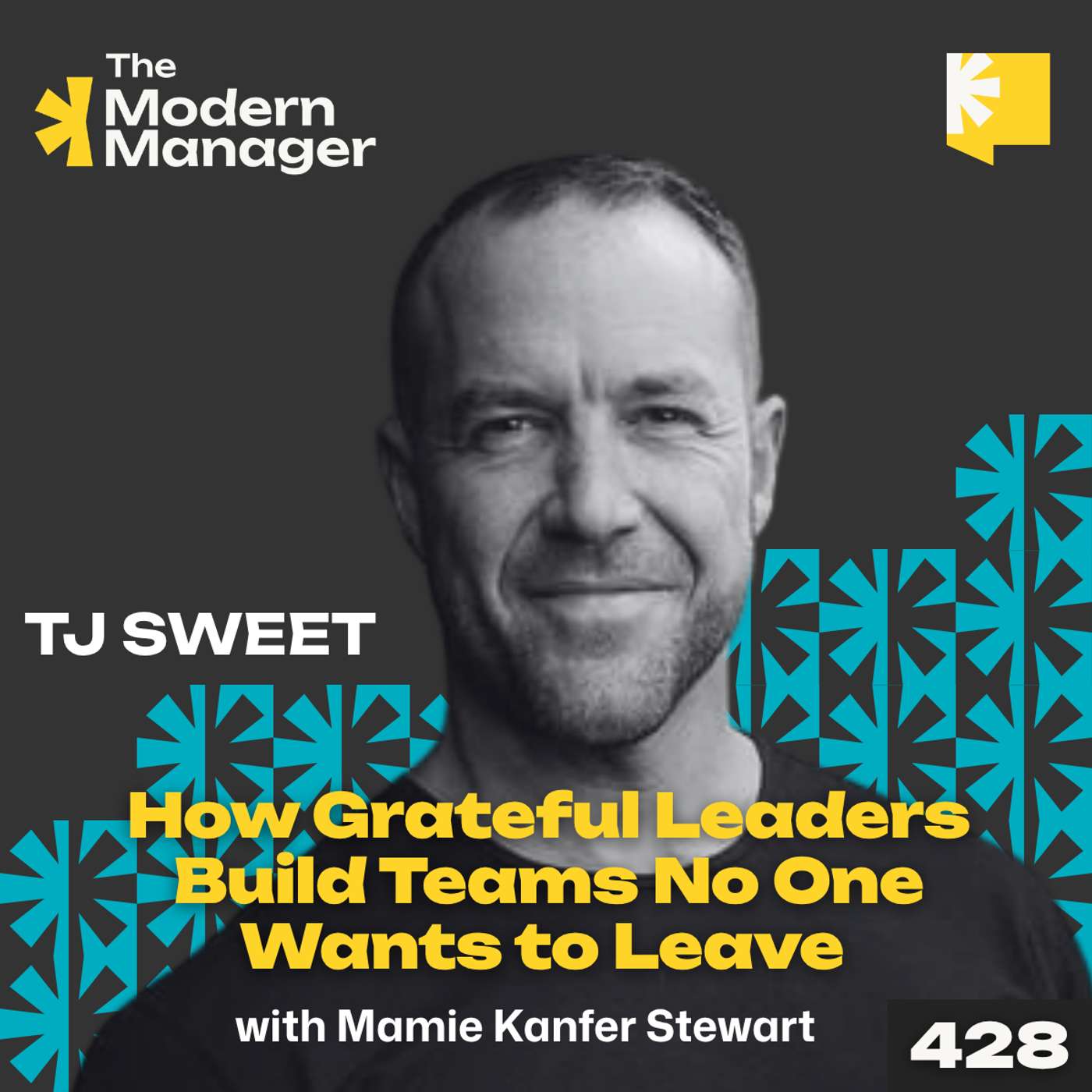
Grateful leadership—how leaders build psychologically safe, purpose-driven teams by practicing gratitude as a lens (not toxic positivity), fostering abundance over scarcity, and personalizing appreciation.
TJ Sweet is a keynote speaker, author, executive coach, and host of the Living the Sweet Life podcast. He helps leaders and high performers reconnect with what matters most to “win at work without losing what matters at home.” He previously worked in healthcare for 23 years.
Gratitude isn’t complacency; it enables ambition and risk-taking. Leaders should “talk to the person on Sunday night, not Friday afternoon” by checking how people feel about work. Culture of gratitude is cultivated through individualized recognition (ask what makes each person feel appreciated) and by having tough conversations with grace.
A healthcare wheelchair “where are they?” problem solved after a leader reframed the meeting with gratitude and possibility. A leader’s pizza recognition backfired due to gluten-free needs; better results came from asking one question about preferred appreciation.
Written by AI. May contain mistakes.
Discussion on the meaning and significance of being a grateful leader.
“Thank you so much for joining me today, TJ.”
Exploration of how gratitude affects leadership and team dynamics.
“Well, you know, the idea around being a grateful leader starts with being a grateful person.”
A powerful definition of gratitude as a mindset and lifestyle.
“And also, I love that you talked about it being more of a mindset and a lifestyle rather than a personality type or a charismatic way of showing up and being positive.”
TJ shares a personal story that illustrates the impact of gratitude in problem-solving.
“I'm wondering if you can give us a story just to make this a little bit more real for us.”
Discussion on how gratitude can coexist with the drive for improvement and ambition.
“isn't just about yourself in the moment, but what it allows you to do when you have that lens.”
Strategies for cultivating gratitude within teams and understanding purpose.
“It's now we have the creativity and the space and the autonomy to actually grow and do something incredible, but we get to do it together and be more present together, not just trying to be perfect or perform.”
Advice on handling team members who may not align with a grateful culture.
“It's not about metrics and goals and all these other things that we typically are asked to perceive or to pursue along the way.”
Learn about the importance of self-awareness in leadership and team dynamics.
“we lack self-awareness on how we're actually impacting other people.”
Discover ways to create a culture of gratitude and appreciation in teams.
“I want to shift gears a little bit because we were talking about the culture and gratitude and appreciation is something that we obviously need to live by and model for our team members.”
Explore the importance of personalizing appreciation and recognition for team members.
“I love that so much around the personalization because I've had experiences where I've thanked people in a meeting and you can just see how horrified they are for being called out and it kind of backfires in that way.”
Learn advanced techniques to cultivate gratitude beyond basic practices.
“I want to spend our last few minutes talking about how we can cultivate that sense of gratitude in ourselves.”
Understand how effective leadership can nurture employee potential and growth.
“All right, quick anecdote and then we're going to wrap up, which is, so I read your book and immediately after I went and poured myself a cup of coffee.”
Explore how gratitude can strengthen team dynamics and leadership.
“a matter of just a few months of a leadership with him, but it was like constantly nurturing.”
Recognizing contributors and sharing additional resources for listeners.
“Honestly, the story about you bringing tea to your husband means the world to me.”

Get the gist, explore an idea or ask about something said.
 Claude
On The Modern Manager, what are the key points of this episode?
Searching your listeningAutomatic transcript. May contain errors.
0:00TJ Sweet: I've had days where it feels like there is nothing to be grateful for. You have probably had them too. Your inbox is a disaster. Someone on your team dropped the ball and now that something is a huge problem and you are three meetings deep before you've had a moment to even breathe. On those days, gratitude feels like a luxury. Something for people whose lives are just calmer than yours. But that's not how gratitude works. If gratitude only shows up when life is easy, it never shows up at all. This is why it's so important to build gratitude into how you lead, not just how you feel on any given Tuesday.
0:37TJ Sweet: Today, I'm talking with TJ Sweet, a keynote speaker, author, executive coach, and host of Living the Sweet Life podcast. He helps leaders and high performers reconnect with what matters most so they can win at work without losing what matters at home. By the end of this conversation, you'll have a real way to practice gratitude and foster a culture of gratitude on your team. And I'd be grateful if you took a moment to follow the show. Now here's our conversation.
1:06TJ Sweet: Thank you so much for joining me today, TJ. I'm so excited to talk about gratitude and appreciation because it just feels like there's not enough of that in our lives. Today, maybe more than ever, or maybe just all the time, It feels like the kind of thing that we could all use a little bit more of. So thanks for coming on the show.
1:24Maurice McGowan: Yeah, thank you for having me here. And obviously, I've been listening to a lot of your episodes and hearing all of the great guests you've had and all the ways that you're pouring into leaders. And I'm grateful for the chance to be here today to add more value to your audience as well.
1:39TJ Sweet: Well, thank you. And I am grateful for you for showing up. So starting off on a note of gratitude. All right, let's start with grateful leadership because that is the foundation of what we're going to be talking about today. So can you just lay the land for us of what do we really mean when we're talking about how leaders can be grateful leaders?
1:59Maurice McGowan: Absolutely. Well, you know, the idea around being a grateful leader starts with being a grateful person. When I reference grateful leadership, I don't want it to sound like it's a leadership style. It's more of a lifestyle that then you see your team through of which then that's the catalyst for leading with gratitude. And when I say gratitude, it isn't also just positivity. This is one of those things I've heard a lot around. There are some, I will say, adversarial things that happen in the workplace. There are tough conversations. There are tough goals and expectations and external things and internal things that happen.
2:37Maurice McGowan: And so what I say grateful leadership, I actually mean seeing the whole picture and then choosing the lens of which you see it through, which when you're grateful for the people that you get to do the work with and you're grateful for the chance to impact somebody's life as a leader and you're grateful to serve the people, your customers, whoever it is, in the way that you do, you start to answer questions differently. You start to respond to adversity differently. You start to have strategic priorities through that lens. And it kind of takes you away from that scarcity mindset of we can't mess up or we have to be perfect.
3:12Maurice McGowan: It's really more how can we grow together and how do we learn together and how do we pour into each other so that we all feel psychologically safe at work? We all feel like we're connected to our purpose. We all feel like we're glad to be there. And one of the things that I talk about with Grateful Leadership is, and one of the questions I ask a lot of leaders is I want to talk to the person on Sunday night, not Friday afternoon. So how are you feeling Sunday night? If you're dreading going to work, it may be the work, but it also may be how you're seeing the work. And that's what I mean by the lens of which we see the work that we do.
3:46Maurice McGowan: And whenever you talk about a grateful leader, again, it's somebody who really, one, feels like it's an honor and privilege to be the leader, to be the person who gets to impact other people. But then it's also, how do I make other people feel my gratitude for them, not how do I make them grateful for their job? There's kind of two different strategies there, which I'm sure we'll probably get into at some point. But it really is, like I said, grateful leadership is more about becoming a grateful person of which then you start to lead through gratitude and ingratitude.
4:16TJ Sweet: That's such a beautiful definition. And also, I love that you talked about it being more of a mindset and a lifestyle rather than a personality type or a charismatic way of showing up and being positive. I'm wondering if you can give us a story just to make this a little bit more real for us. What does it look like when someone shows up with that lens of gratitude in a situation that might have otherwise been really tough? Yeah.
4:45Maurice McGowan: Well, one of the examples I even I've shared before, I was sitting in a room full of people that I knew for a long time. And we were sitting in the room trying to figure out, so I was in healthcare for 23 years. And so I'll give a healthcare example, but I was sitting in a room full of people that were tasked by one of our executives to figure out how do we, how do we solve the wheelchair problem? Cause there are more wheelchairs than there are people a lot of times in health systems, but they don't know where they are and they, we can't keep buying more because we don't know where they are. So it's not, We don't have a problem with number of things.
5:15Maurice McGowan: We have a problem with where we could find them. So we were tasked with 10 of us in the room and we'd been battling. They had been battling this thing for a really long time. And I just looked around and I, and I just said to the people that were in the room, like, I've worked with you. We've done hard things. Like, I'm glad I'm, we're in, we're in this room. And the leader of the, of the meeting said, but we've never been able to figure this thing out. and I looked at her and I said, with everybody in this room, I'm grateful to be in this room. I'm grateful that they trusted us with this challenge, but then wouldn't that be something if we were the first team to ever figure out this problem?
5:54Maurice McGowan: And then within just a matter, it gives me chills even saying it because I remember the moment the leader looked at me and said, you're right. We do have great people in this room. What if we are the first ones to figure it out. And then the whole room went from silence to chatter. What if we did this? What if we did that? Who else can we bring in? What other great leaders? What other adversity have we overcome? Like it just started to like create this blossoming of possibility because we trusted each other in the room because we were grateful to one, be in the room, but also to be grateful for those people in the room.
6:27Maurice McGowan: And then we started coming up with multiple ideas. So it was just a matter of a moment of looking around the room and being like, man, I'm really grateful I'm in here, but I'm also grateful that they challenged us enough and trusted us enough to solve this problem that the executive team couldn't figure out.
6:43TJ Sweet: Well, and it sounds like that gratitude isn't just about yourself in the moment, but what it allows you to do when you have that lens. Can you say a little bit more about that?
6:52Maurice McGowan: Yeah, well, it's a big shift from, again, being grateful doesn't necessarily mean complacent. So that's one thing I wanna kind of debunk as well as far as the myth. You know, a lot of times people say, oh, I'm just grateful for what I have. and having more, pursuing more goes against my gratitude. That's not actually what we're talking about at all. And a great friend of mine, Jack Wagner, talks about gratitude and ambition. Like I am extremely grateful for everything I have. And what that actually allows me to do is pursue more, be more creative, take more chances because I already have what I need.
7:28Maurice McGowan: So whenever you settle into certainty of here's the team I have, I know that for sure. Here's the people we get to serve and here's all the people it's going to impact. Here's all of that that I know for sure. I'm then willing to take bigger risks because I already have enough for sustainability, for comfort, for certainty. And then you start to then think bigger when it comes to bigger projects or different things, whenever you're leading through a lens of abundance instead of the lens of scarcity, of how do we not mess this up or we're afraid that we're gonna mess this up. It's now we have the creativity and the space and the autonomy to actually grow and do something incredible, but we get to do it together and be more present together, not just trying to be perfect or perform.
8:13TJ Sweet: Wow, that's an incredibly powerful thing to be able to hold that tension between I have enough, we have enough, we are good enough, and we can do more, we can be better, we can accomplish more. That's a hard thing to hold. Do you have any thoughts on how we can, I guess, first cultivate that sense of I am enough, I have enough, I'm grateful for what I have and also still feel like that sense of striving?
8:43Maurice McGowan: Yeah, well, I'll tell you the gratefulness piece is typically the starting point around who do I have, what do I have, and who are we doing it for? If you can settle into that space, and one of the things that I talk a lot about is really kind of looking around. And these days, there's a lot of leaders being asked to do more with less. The reason why I want to push back on that, the way I would rephrase it and the way I have rephrased it for 20 plus years is do more with what we have. Because less implies you're taking something away and I want you to do more with it. But if you don't change anything on your team, you don't change resources, you don't change people, you're not doing more with less.
9:26Maurice McGowan: You're just trying to figure out how do we maximize our team's capabilities without losing and sacrificing the team to reach that capability. and ultimately it's this idea of once I know for sure who I have on my team and once I know for sure why we're actually doing it, right? So kind of this sense of gratitude, but also the sense of purpose. Those two things are typically aligned. It's like, I'm grateful to do something that's meaningful. That's the ultimate thing. You know, if you stop and think about like, I'm grateful to doing something that's gonna positively impact other people, you start to then recognize, okay, what I'm doing matters, which means if I don't do it, it also matters.
10:06Maurice McGowan: Then this idea of pursuing more, it kind of, when you look around and think, okay, can we offer and do everything we need to be doing as people for each other? Because we know when during tough times, all we have is each other. And during the great times, who are we going to celebrate with? Each other. All right. So you kind of start to understand, like, I have the things that actually mean the most to me. I have those things for sure. I know those things for sure. I can cultivate. I love the word cultivate that you just used, because it's typically more in, like if you think about a planting sense.
10:35Maurice McGowan: So planting a seed isn't where the cultivation stops. So as a leader, you can't say, hey, everybody, I'm grateful for you. That's like just dropping the seed in the ground. But then the dirt, the water, the sun, the soil, the tending to it, that's actually what cultivating is actually all about. So it's just this idea of, we've been through tough times together before, and then we're gonna go after some hard things, and we're gonna learn along the way, but no matter what, we are going to be doing it together. Like that's the powerful statement that I'll say is the no matter what, I have who and what I'm grateful for.
11:10Maurice McGowan: And then that allows me to give me the courage and gives me the belief that even if we fail, we're going to fail together. When we win, we're going to win together. There's really no sense of solo or silo, as you'll hear in the workplace a lot, because you also understand that you only are going to achieve great things together. And one of the things I say all the time to people is, no one of us is better than all of us. And once you say that and you actually believe that, then you start to look around and think, you know what, I have the thing that means the most to me. It's not about metrics and goals and all these other things that we typically are asked to perceive or to pursue along the way.
11:47TJ Sweet: Yeah. I'm imagining that for people who have teams that they love and the people that they love, they're like, yes, this makes so much sense.
11:55Maurice McGowan: What about for the folks who are like, you know, I don't really love working with this person.
12:00TJ Sweet: And, you know, I kind of wish my team was a little different or I really wish I had, you know, two more people. Any thoughts for those folks who are like, yeah, I would love to be fulfilled by the people on my team and connect with them and feel gratitude for that. But maybe I don't feel so much gratitude for them.
12:18Maurice McGowan: Yeah. Well, and I'll tell you, that's part of every human experience. you know, that, and this is the thing I want to, that I referenced earlier around the toxic positivity side of it all is there are people, and this for me starts with self-awareness, but there are people that maybe don't believe in the same things that we believe in as far as the purpose of the work that we're doing. I'm not talking about external things. I'm talking about, are they here for the right reasons? Because there's a lot around mindset and attitude that is culture setting. We've all had that really, really competent person who's also not part of the culture that we're trying to build and that creates tension for the leader because you're like, man, they know so much but they're just not coming along.
13:01Maurice McGowan: And so my advice for any of those leaders is to get curious. Get curious with yourself first around why is that person creating tension for me? Like what is the actual thing? Is it something they've done, something they've said? Is it because I don't know them well enough? I haven't asked the question of, do you love working here? And if you do, tell me why. If they say the same why that I have, then maybe we just sit down and say, but here's what I'm seeing and here's what I'm feeling whenever I see you do the work or whenever you're in a meeting, it doesn't sound like that. So help me understand more.
13:36Maurice McGowan: And I've done this before. I have many different personality champions. My goal always on any team that I had was I wanted everyone to be their most true self. I didn't want them to be me. I didn't want them to be the positivity cheerleader. I wanted them to be themselves, but having them understand how they impact the workplace. Because sometimes a lot of people, and this isn't going to be a criticism, this is just, again, a human experience, we lack self-awareness on how we're actually impacting other people. And so I brought people in and say, do you love working here? Yes, I can't wait to come to work, I love it all.
14:10Maurice McGowan: Well, when you say this, this is how the team's actually feeling it. And then the behavior instantly changes. Instead of saying, you're being negative in the environment, like they're not trying to be negative. They just don't understand, you know, they're not really understanding their impact. So if you're a leader who has somebody, I would ask more questions and get curious. And if there is a somebody on your team who's not aligned with your purpose, who's not aligned with this energy, who's not focused on the same things, who, you know, the one thing as the leader that we're responsible for, which this is where I see it as a privilege, is serving the whole team, not avoiding the conversation of which I know you recently had somebody on talking about tough conversations.
14:49Maurice McGowan: the toughest thing about those conversations is as the leader you know the team needs you to have it so the longer you put it off you're actually letting down the whole team instead of you're not serving the whole team you're serving that one person you're avoiding it and sometimes it's yourself because you don't have the conversation but there are people you're going to have to have the real honest conversation around here's what we're building here and here's how it sounds and here's how it looks it can have different hows but it has to have the same why yeah and those
15:15TJ Sweet: conversations are hard, but you're right. That's part of the privilege of being a leader is that we get to have those tough conversations and do it with grace and respect and all those good things. All right. I want to shift gears a little bit because we were talking about the culture and gratitude and appreciation is something that we obviously need to live by and model for our team members. But it's also something that we want others on our team to feel and to show to each other. What are some of the ways that we can foster that entire culture of gratitude amongst our team? Yeah.
15:49Maurice McGowan: And again, that starts with, that's such a great question because I think a lot of people, I think most leaders would say that they want something similar to that. But it's a matter of how do we cultivate it authentically and again, safely and healthy and a healthy way. And really the, it has to be individualized as much as possible. So imagining, so one thing I've always said to people is I see every single person on my team as a person first and an employee second. The reason why I say that is the employee is performing a task. They're showing up and they're serving somebody else. But I have to, I had to pull back.
16:28Maurice McGowan: Again, I've had leaders who didn't do this, who saw us all as employee ID numbers and it was you're producing X amount of things and you're either hurting or helping our scores. And I've been led that way. But really, when you pour into people and just ask them, how are you actually doing? And when do you feel the most appreciated? You can do in an about me form, right? I've done this. I'm sure a lot of people have as far as what's your favorite sports team, what's your favorite snack? How do you like to be recognized? Those kinds of things. But if we ask those questions, because that's, if we want people to feel like we're grateful for them, just like love languages, right?
17:04Maurice McGowan: We have to be able to understand, is it somebody who just needs a word? Or is it somebody who needs a little bit more quality time? Maybe you bring them into the office and have a conversation around the impact they're having. Or maybe if it's just somebody who is a gift and maybe it's not that you're doing this for everybody, but it's just understanding like for the team to know this is how this person best feels appreciated. Not just you, not like you're holding it like a secret for their birthday or you're not holding it for national nurses day or national whatever day, right? It's really a matter of this is how this person actually feels appreciated and then caring enough to do something with that information.
17:43Maurice McGowan: And, you know, again, I had 40 different, multiple roles I've had, I had 40 different direct employees and people, a lot of people are thinking, when do you have time to get to know all these people? Right? So like, again, I'm not living in this sunshines and rainbows world, it's a commitment. And it really is like you do evals with them once a year, great time to ask. You probably, hopefully, interact with them in more ways than just once a year. But it's also a matter of like maybe the side conversation instead of just walking around saying, how's everybody doing? A lot of times when you ask a question like, how's everybody doing?
18:20Maurice McGowan: They give a generic answer because the depth of the answer can't, when you're asking how 13 people are doing in a room, the depth of answer is based on the depth of question, right? And so it's maybe a matter of like you see somebody in the hallway or you see somebody at lunch and just say like, you know what? I really appreciate what you're doing here. What is a way that you feel the most appreciated at work? And just that one question will give you the answer that you could use. And then when you actually use it, it makes people really feel considered and valued. But it also the team then sees, oh, that person just needs the words.
18:56Maurice McGowan: Oh, that person needs, maybe it is a monetary thing. Maybe it's in public. Maybe at a staff meeting, somebody needs to get appreciated. But somebody else, it would make them terrified to be acknowledged publicly, where somebody else just really needs that public recognition. So it really is one leading by example as the leader, but it's also then sharing that with the team so that everybody kind of knows how everybody feels appreciated. Yeah.
19:21TJ Sweet: I love that so much around the personalization because I've had experiences where I've thanked people in a meeting and you can just see how horrified they are for being called out and it kind of backfires in that way. And that's never what you want, right? You want this person to feel so seen and valued and you're kind of doing the opposite if you don't understand how they want to be appreciated. the other piece to this which you know i had a team member once who i relied on for a whole lot of things and you know i would say thank you and i would say i so appreciate you did this but but then when i finally actually asked them specifically like what are you most proud of like what what are you really like what makes you feel really good and what do you want to be appreciated for, her response was actually just like, doing all the things I'm supposed to do without you having to ask me about them.
20:14TJ Sweet: Like she just wanted to be seen for being someone who was reliable. And that had never crossed my mind as something to show appreciation for. Thank you for always just doing the things you're supposed to do. But that's actually what lit her up inside. And so all of my thank yous for getting this thing done or that thing done were nice. But when I started noticing and being able to say, hey, I realized that last week I didn't have to check in on anything. You just got everything done. Thank you. I really appreciate that. She just, her face lit up. And I was like, oh, now I feel like I have this magic key into her insides of what is going to actually help her feel most appreciated.
20:55TJ Sweet: And it was not what I thought it was going to be. So I just feel like what you're saying about go talk to your team members, ask them these questions is so, so important.
21:04Maurice McGowan: Yeah, well, and again, I would, I appreciate that example because that's like a perfect, because it fulfills your cup, right? It fulfills your need and desire to make somebody feel seen, but it also then actually makes the other person feel seen. And a simple example of this is, you know, I had a leader that would like, hey, I'll buy pizza for the team because they accomplished a metric or, you know, it was patient satisfaction scores, but they accomplished that. The manager wasn't there. They ordered the pizza and it just showed up. And the team was like, hey, is there any gluten-free crust? Right?
21:41Maurice McGowan: But what happens is it shows, it creates a disconnect. So if you're, as a leader, if you're worried like, oh, I don't want to feel disconnected to them, doing some broad brush approach shows that not every single person matters as much as you say that they do, right? Like there's a lot of show me, don't tell me in leadership. And sometimes it's a matter of just asking one specific question. Because I didn't do this early on in my career. Again, I led for 23 years, but I started when I was 23. I started when I was 20, 21 technically. And so it's really just this idea of, we don't, the greatest skill that we have as a leader is to continue to learn more about our team, not to have all the answers.
22:27TJ Sweet: Beautifully said. All right. I want to spend our last few minutes talking about how we can cultivate that sense of gratitude in ourselves. I think a lot of us have probably heard of the do a gratitude journal, write down three things every day. What are some of the more next level tasks or next level activities, things that we can do a little bit more deeply to really build that sense of gratefulness as our outlook on the world?
22:55Maurice McGowan: Yeah, well, I'm glad you mentioned outlook on the world because the writing down three things is again how I started. But when it really, you start to really understand purpose behind those people and those things. Like how does it impact me? How does it impact my life? How am I treating it? That's kind of the next level of gratitude that I say is like I'm grateful for, say I'm grateful for one of my team members. Like the reason why there's kind of that The flatness that comes with that is now what? You know, like you said, the kind of the next level is with that gratitude that I feel for that thing, what is a way that I can be proud of, of how I'm treating it?
23:41Maurice McGowan: that's the next level of gratitude is actually showing up for it and treating it in a way that you are grateful for it because that aligns more with your words and your thoughts saying that I'm grateful for it it's then like you know what I'm going to commit to it by asking more questions or getting to know it more or whatever the thing is you know getting to know the team but you know truthfully I I like to have gratitude kind of be broken up in different categories of my life as well so instead of just writing down three things in my life because that feels like an ocean. You know, like on Mondays, if you feel tension about a certain thing, maybe Mondays is work.
24:14Maurice McGowan: So maybe you write down like Mondays, I'm going to write down three things I'm grateful for about work. Because then you start looking for more things at work that you're grateful for. Maybe Tuesday's your family, maybe Wednesday's your house, maybe Thursday's your, I don't know, your car, maybe Friday's your community, whatever the thing is. But what that really starts to do is it opens your heart and your mind to possibilities around more and more and more things instead of this stress of like, I know I should be grateful, but I'm not actually grateful for this like ocean of a life that I have.
24:43Maurice McGowan: But when you start to narrow it down to say three things at work, and I do it in the mornings, because what that helps me do is it makes me see my work through a grateful lens, because I'm looking, because I know every Monday, I'm going to be writing down three things I'm grateful for. But then when you say, I'm grateful for my team, and I'm grateful for how close it is to my house, and I'm grateful for the chance to serve other people. When you go into work, your brains, right, that's the reticular activating system, part of our brain is going to go, wait a minute, these are all the things I said I was grateful for.
25:10Maurice McGowan: And then like we start smiling more and then we treat it a little bit more with love and kindness and patience and grace. And so that's kind of that next level is like the so what? Once you say that you're grateful for something, then what? And then commit to that and then you'll start to feel that deeper sense of gratitude for it.
25:26TJ Sweet: All right, quick anecdote and then we're going to wrap up, which is, so I read your book and immediately after I went and poured myself a cup of coffee. I was working from home that day and I saw my husband's tea mug sitting next to the coffee pot and he had put his tea bag in, but he hadn't put the water in. So I put the water in and then I carried it over to him at his desk and I rubbed his shoulder. I was like, here, I brought you your tea. And he looks at me and he goes, what's wrong?
25:51Maurice McGowan: And I was like, what are you talking about?
25:52TJ Sweet: And he's like, you're being really, really nice to me right now. And I was like, well, I just read this book on gratitude and you always bring me coffee. And I'm always grateful for that when I'm stuck in a meeting and can't leave my desk and you bring me coffee in the middle of the day. And I just wanted to bring you tea because you're sitting here working and I really appreciate you and how much you bring me coffee. And he was just like, what is happening? And I was like, oh, this is a good note for myself that I probably need to think about more often the things that I'm really grateful for and not just think about them because I feel like that I tend to do, but actually do something with it, as you're saying, to actually show the person, tell the person, bring it to life and not just let it live in my head.
26:35TJ Sweet: So, okay. But now we actually have to wrap up. So TJ, can you tell us about a great manager you worked for and what made this person such a fabulous boss?
26:43Maurice McGowan: Yeah, absolutely. So this was actually a CEO that I got to have a great relationship with, and I worked really closely with him. His name was Mitch Wosden. And what he did is he sat me down and said, I can see that you have a lot of potential. What are your goals and how can I help you accomplish them? One simple question. And then not just that one question, he brought me down to his office a week later and said, have you thought more about what you'd like to be doing? He said, because I have something I think you could be doing, but what would you like to be doing? Again, more questions. And then we sat down and it was, CEO of the health system was what I said I wanted to be.
27:24Maurice McGowan: and he said interesting because that's what I already wrote down on this piece of paper is you should become a CEO of a health system but he said not because I think you can but because you want to so you can see how like thought provoking this person is he's not trying to have me accomplish something for him he's really asking what do you actually want but then what he did is he said what gaps do you have in your career here's what I think you need in order to be a successful CEO but it's not because you lack it. It's because I want you to learn more about it so that you can become a better CEO.
27:59Maurice McGowan: Yeah, so that's just, again, a matter of just a few months of a leadership with him, but it was like constantly nurturing. And just I hung on to every word that he said because I knew he meant everything that he said. And it was for me, not so that I could do something for him.
28:17TJ Sweet: Another great lesson that we can take to our team members and go ask them those same questions. What do you want and how can I help you get there? Well, thank you again so much, TJ, for joining me. I am so grateful for this conversation and for you.
28:31Maurice McGowan: Yeah, I'm grateful for you as well. And I'm excited. Honestly, the story about you bringing tea to your husband means the world to me. It's tremendous, the impact of that on my life. So thank you for sharing that.
28:45TJ Sweet: In the spirit of gratitude, I want to thank Andrew and Thea for helping to make the show happen every week. You are the kind of colleagues who get things done even when I am running behind schedule. And I am truly, truly grateful for your partnership. As usual, all the links are in the show notes and they can be delivered to your inbox along with the episode guide that contains the takeaways from this week's conversation when you subscribe to my newsletter at themodernmanager.com. Thanks again for joining us. Until next time.
Some days, gratitude feels like something for people with calmer inboxes. Someone dropped the ball, you're three meetings deep, and "thank you" is the last thing on your mind. But gratitude that only shows up on easy days never shows up at all. Learn what grateful leadership really looks like, how to appreciate the team member you struggle with, why a pizza party can backfire, and the one question that reveals how each person wants to be recognized.
We could all use a bit more gratitude, so this one’s for you.
Guest Bio
TJ Sweet is a keynote speaker, author, executive coach, and host of the Living The Sweet Life podcast. He helps leaders and high performers reconnect with what matters most so they can win at work without losing what matters at home. Through powerful storytelling and practical tools rooted in connection, gratitude, and purpose, TJ has impacted more than 10,000 leaders across 48 countries. His message is simple: connection changes everything.
Conversation Topics
Additional Resources
✨ Read the full transcript: https://docs.google.com/document/d/1pWCw68mo2xN5C6-fqN1gdk_g5eXumJzi7QEBSDQUwx0/edit?usp=sharing
✨ Follow me on Instagram: https://www.instagram.com/leadershipwithmamie/
✨ Visit my website for more: https://www.themodernmanager.com/
✨ Subscribe to my YouTube channel: https://www.youtube.com/channel/UC7jhYz8b16g1SsLia4EhO5w?sub_confirmation=1
Keep up with TJ Sweet
Website: https://tjsweet.com
LinkedIn: https://www.linkedin.com/in/thetjsweet/
Instagram: https://www.instagram.com/thetjsweet/
Facebook: https://www.facebook.com/thetjsweet
YouTube: https://www.youtube.com/@thetjsweet
TikTok: https://www.tiktok.com/@thetjsweet
Podcast: Living The Sweet Life with TJ Sweet: https://tjsweet.com/podcasts/
Email: [email protected]
Join my newsletter to get episodes and key takeaways delivered directly to your inbox: https://www.themodernmanager.com
The Modern Manager is a leadership podcast that helps you close the gap between knowing what good management is and actually doing it. Follow The Modern Manager on your favorite podcast platform so you never miss an episode!
#Leadership #GratefulLeadership #EmployeeAppreciation #WorkplaceCulture #ManagementTips #EmployeeEngagement #TeamCulture #PeopleFirstLeadership #Gratitude #TheModernManager