Ask ChatGPT
 The Modern Manager
20 Oct 2026 · 31m · 17 chapters
How to overcome workplace resistance to change by treating resistance as a system tied to identity, not laziness; includes strategies for discovery, communication, and leveraging “opinion leaders,” plus guidance for AI adoption.
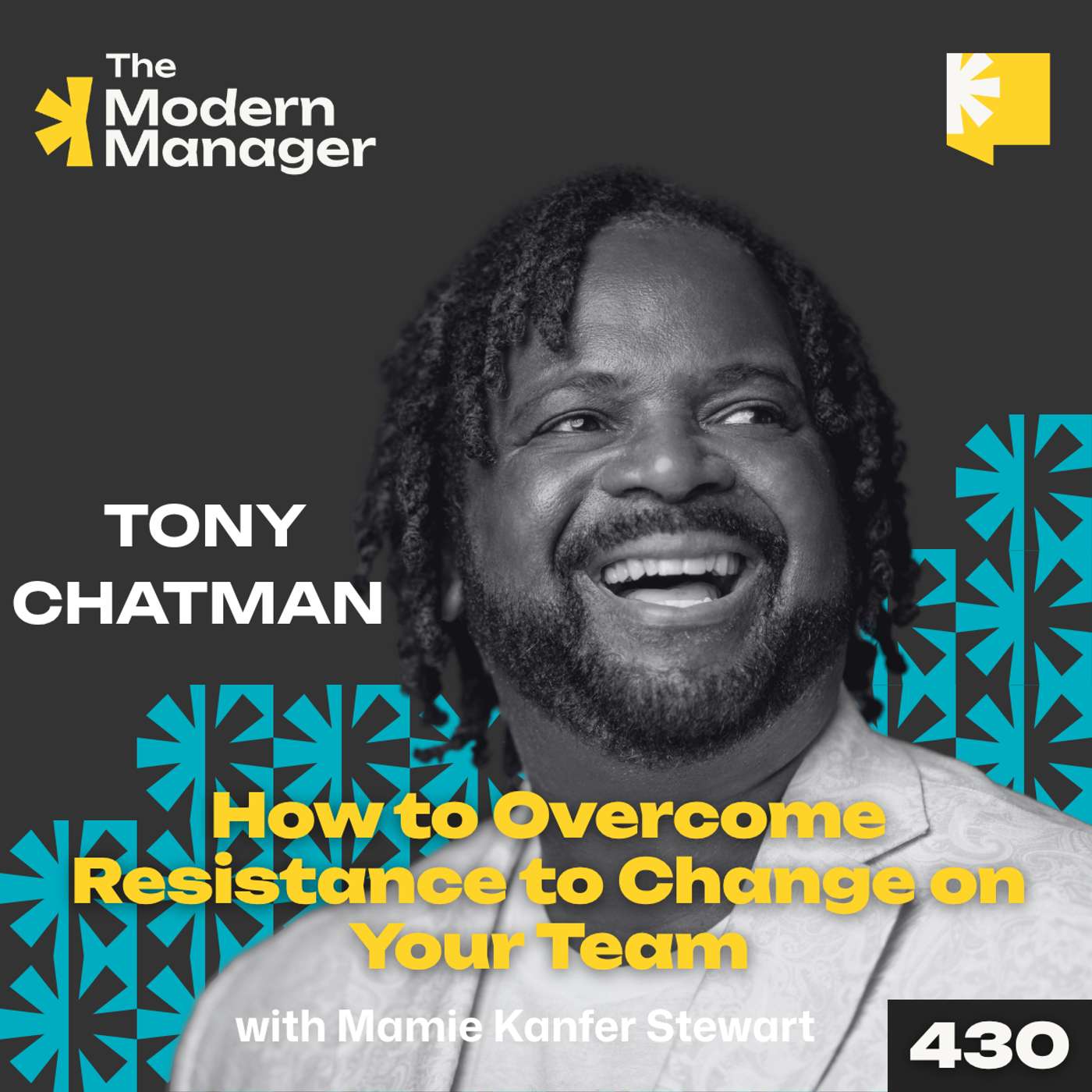
Tony Chatman (spelled Tony Chatman in transcript), resistance expert and leadership advisor; studied why smart people/companies get stuck for 20 years; author, TEDx speaker, certified speaking professional; works with organizations and advises managers.
Resistance is an internal defense mechanism protecting identity/comfort zones; resistance often looks like nodding then procrastinating; agreement ≠ buy-in; resistance can be engineered by reading/naming systems; use two-way communication (listening) and listening sessions; focus on opinion leaders (trusted social influencers), not just loud resisters or “change champions.”
U.S. military BRAC base closures (33 closed, 22 realigned) where civilians denied job endings despite countdown clocks; Fort McPherson base later became a Tyler Perry movie studio. AI resistance examples include “shadow AI,” substitution for search, and procrastination; AI should be framed as human enhancement, not workforce replacement.
Written by AI. May contain mistakes.
Introduction to Tony Chapman, an expert on overcoming resistance.
“And if you want episode guides with my key takeaways from every interview delivered to your inbox, join my newsletter at themodernmanager.com.”
Tony explains what resistance is and its roots in our identities.
“Thank you so much for joining me today, Toni.”
Resistance is often a protective mechanism that hinders change.
“That sounds way bigger than what I think a lot of us are probably thinking is what gets in the way.”
Tony shares a personal story about resistance during military realignments.
“So this is kind of how it all came together.”
Many individuals avoid acknowledging change even when it's imminent.
“And there's nothing more obvious, right?”
Discussing how resistance can manifest in subtle ways beyond overt opposition.
“People think resistance is, I'm just not going to do it.”
Strategies for managers to prepare for and address resistance during change.
“And unfortunately, people start to find the other people who feel the same way that they do.”
The importance of effective communication in managing resistance.
“When there's resistance, am I going to acquiesce?”
Identifying and engaging opinion leaders can facilitate smoother change.
“And then I mentioned people and this is, I'm going to give you like my secret sauce.”
How to convert adversaries into advocates during the change process.
“Often during change as a managers, we focus on the people who are resisting.”
Learn how to identify and leverage opinion leaders to facilitate change within teams.
“And I came back and said, that was such a great idea.”
Discover strategies for effective communication that fosters trust and engagement during organizational change.
“I want to go back to communication because you, you raise that up as such an important part.”
Explore the importance of team feedback in shaping organizational practices and improving processes.
“I'm working with a team right now on their meetings, and the first place we're starting is let's get information from everybody about how they feel about their current meetings.”
Understand the challenges of AI adoption and how to address resistance within teams.
“And so many people that I talk to are frustrated by the companies pushing AI on them, or they want to use AI certain ways, but maybe their company has a policy that they can't.”
Learn how to integrate AI into team dynamics while maintaining productivity.
“We work hard to be experts in certain areas and now all of a sudden we're starting over.”
Discover the qualities that make a manager effective and supportive.
“So Tony, can you tell us about a great manager you worked for and what made this person such a fabulous boss?”
Understand the connection between resistance to change and personal identity.
“And where can people learn more about you and keep up with your work?”

Get the gist, explore an idea or ask about something said.
 Claude
On The Modern Manager, what are the key points of this episode?
Searching your listeningAutomatic transcript. May contain errors.
0:00Change at work is inevitable, and so is resistance to it. You roll out a new process, a new tool, a new team structure, or even a small change in how work gets done, and someone pushes back. They question it, they complain, they keep doing things the old way, or they say, sure, sounds good, and then nothing changes. As a manager, it's easy to see resistance as a problem. If people would just get on board, we could move forward. But getting past resistance isn't so easy. So today's guest is here to help us understand resistance, work with it, and help your team navigate change successfully. Today's guest is Tony Chapman.
0:37Tony spent 20 years studying why smart people and good companies get stuck. He is a resistance expert, leadership advisor, author, TEDx speaker, and certified speaking professional. His work has one through line. Resistance is not a discipline problem. It doesn't mean you are lazy or broken. It is a system, and every system can be read, named, and engineered. Before we dive in, don't forget to follow the show. And if you want episode guides with my key takeaways from every interview delivered to your inbox, join my newsletter at themodernmanager.com. Now here's my conversation with Toni.
1:13Thank you so much for joining me today, Toni. I'm so excited to talk about resistance because it shows up all the time in the workplace. There are people who don't want to get on board with things and they don't want to do the thing you're asking them to do. And it is beyond frustrating as a manager when you are running up against that resistance. And sometimes it's also in us. So I'm happy to have you here to help us unpack this and figure out how we can move forward even when we or our team members maybe don't want to.
1:43Tony Chatman: Thanks so much for having me. I'm really excited to be here today. Why don't we start with just laying the groundwork around what resistance is and where it comes from? Sure. So in the simplest terms, resistance is the thing that keeps us from doing what we know we should do or we want to do. That simple, right? It's just that clean and simple. Now, where does it come from? It's an internal defense mechanism. So what happens is we form this identity, right? We live our lives. We have this identity. We call it identity. We call it comfort zones, some near the things, there are times in which we're asked to or changes necessitated where it's such a big shift that it changes our identity.
2:32Tony Chatman: And in those cases, there is a protective mechanism that's like, whoa, everything is good right here. Let's not do all this. We have lowered stress. We've made things easy. We have routines. Let's not do all of this. And so that very protective mechanism, which has served to protect our very identity, now becomes the thing that gets in our way when our identity no longer serves us. Oh, my gosh. That sounds way bigger than what I think a lot of us are probably thinking is what gets in the way. I'm wondering if you can give us a story or example that kind of shows that attack on the identity in a change process where that resistance is going to show up.
3:13Is there a story you have from your work?
3:15Tony Chatman: Boy, here we go. So this is kind of how it all came together. I was doing work for the U.S. military. There is a thing called the BRAC, Space Realignments Enclosure. And during this time, put in the simplest fashion, the U.S. government owns a bunch of land and they use a bunch of land, but they weren't necessarily using the land that they own. So Congress said, be in our best fiduciary responsibility to kind of shift everything. And this meant closing 33 bases and realigning 22 others. It was a massive shift. So my job was to come into some of these bases and help people navigate the change, primarily from the standpoint of if you're going to move with it, because although we think of military bases as soldiers, there's a lot of civilian personnel that work there.
4:03Tony Chatman: You have a choice of moving with the base if it's moving or looking for another job or, you know, another job in the military or just another job in society. How do you navigate that? How do you prepare your resume? Right. I came in with all of this stuff. And so my very first experience was at the Armed Forces Institute of Pathology, which was part of the old Walter Reed Hospital. And after three days of training, I sat down for someone. I went coaching with someone. and the first thing she said was, well, you know, my job's not leaving, but I thought this would be a good breakaway. So I just want to take some time and talk to you.
4:39Tony Chatman: I said, okay, that's odd, but okay, let's have a conversation. So we talked, I said, you know, it's always good to have a resume. So let's work on your resume, send off some resume writers. And so afterwards I called the point of contact and I said, I had this really strange thing happen. This woman's job's not leaving. And she just stopped me and said, oh, no, no, no, no, no, no, no. She's in complete denial. You would not be there if her job was staying. Like, oh. Three weeks later, Fort Knox, exact same conversation, Rock Island Arsenal, Fort Belvoir, the list goes on and on to the point where I was at Fort McPherson in Atlanta, Georgia, and a person saying the exact same thing.
5:19Tony Chatman: And I said, okay, look, go to the homepage on your website and right on the homepage is a countdown clock to the very second the base was closing. Right. And so now we have to deal with this reality, but here's the thing. People had five years notice to the exact day that their job would end. Some people took advantage of it and they said, okay, I'm going to get additional training. I'm going to get a degree. I'm going to get a certification. But a lot of people just got stuck because their identity was in this role in this location and they did nothing. And they convinced themselves that this was not reality and nothing was going to happen.
6:00Tony Chatman: And so, for example, for the gentleman at Fort McPherson, that base was bought by Tyler Perry and is now a movie theater, movie studio. So unless he was in the latest Medea movie, he didn't have a job, right? But if you're, if you're stuck in that space, your brain starts to convince you that this is in your best interest to stay in this space and in this identity in this time. Oh my gosh. And there's nothing more obvious, right? Like there's no more information you could have given those people to make it real for them. It was happening and they were just avoiding it. Exactly. And they didn't realize they were avoiding it.
6:35Tony Chatman: And I think that's the thing that really is the most insidious part of it. People think resistance is, I'm just not going to do it. But sometimes resistance looks like distraction, procrastination, focusing on other things. You know, always just whatever it is, you just never get to the thing you're supposed to do. And that's what makes it so hard to overcome. Oh, that is huge. That resistance does not look necessarily like outward resistance, right? I'm thinking about projects I've been on where there are team members who are just like, I don't like this idea. I don't want to do that. But then there are plenty of others who are like nodding their head, but then dragging their feet and saying, oh, I didn't get to it this week.
7:22And, oh, this other thing was more important. And I'll get to that when I have a chance. And it's that slow avoidance that doesn't appear as resistance, but actually is. That's what I'm hearing.
7:35Tony Chatman: Absolutely. You hit it spot on. And, you know, you made a great example because the truth is there's a difference between agreement and buy-in. And a lot of times we confuse the two, especially as leaders, right? Once we get the, you know, I call it bobblehead night where everybody's like nodding their head. Yes, absolutely. We're doing it. And then five minutes later, they're talking to each other. Are you going to do that? No, I'm not going to do that. And it all falls apart. It's just that very thing. And unfortunately, people start to find the other people who feel the same way that they do.
8:04Tony Chatman: And that even reinforces the situation. Oh, yes. I have been in those situations more than I would like to be, for sure. Okay. But one of the things that you say is that resistance always shows up. So it is something that we can prepare for. Can you talk a little bit about how we can walk into those situations where we're going to be announcing a change or we have to implement a change maybe from our leadership team. And we can be prepared for those people to be pushing back, whether it's really straightforward pushback or if it's that kind of insidious bobblehead nodding along, but then the resistance shows up as soon as they walk out the door.
8:47Tony Chatman: Okay. So let's talk about it from an overall strategy standpoint. And then if you don't mind, I'd like to dive into a couple of specific things that managers can do that aren't normally talked about in change management, but from a resistance standpoint, they make a world of difference. Great. When you're thinking about change, what I've realized in our 20 years of working with organizations, there's seven different areas where resistance can show up, right? These are areas where if you do them wrong, they cause resistance. If you do them right, there's the solutions to resistance. There's the discovery area.
9:20Tony Chatman: Where is the organization really at? That's a place where most get it wrong. And they get it wrong because they rely on surveys. and often the surveys, if there's a distrust, people just aren't honest on surveys. And surveys are often quantitative data, but not qualitative data. You're not getting the stories. You're not getting the real, here's how I feel. Here's what really happened. You're more getting data. And as a chemical engineer, I love data, but I also realize there's limitations. Then strategy. And a lot of times we do strategy, but we don't do strategy with the reality that there will be resistance.
9:59Tony Chatman: We do strategy based on hope. We expect everyone's just going to jump in and that just never happens. Commitment, the organization has to choose to fully commit. So even as a manager, okay, I'm going to do this change and buying into it. How committed am I? When there's resistance, am I going to acquiesce? I'm going to say, am I going to say it's just my job or I'm going to go full in and take ownership of this? leadership because without the leaders buy-in people follow what we do more than they do what we say or demand communication and i'm going to get into that in a moment because that's such a big one people in general focusing on the right people and learning how people move other people and then development that can be training that can be coaching those are all the different areas i said i want to go back to communication for a second the thing about communication we've all heard, we have to communicate during change, right?
10:54Tony Chatman: We hear that all the time. What we have to understand is resistance starts with stories, the stories that we tell ourselves about ourselves, the stories that we tell ourselves about the change. And what happens is when we're by ourselves, our self-talk does more damage than anything else. And so we have to think about communication less from the standpoint of just communicating, but almost marketing and for lack of a better phrase, reprogramming. I am trying to change the story so that when I'm not there, the self-talk is the correct self-talk. That is a whole different amount of communication, but it's also a different type of communication.
11:38Tony Chatman: It's not just what'll happen if we don't do it, what's in it for me. there's a lot more nuance to it when you start thinking about it from that person's perspective. Okay. And then I mentioned people and this is, I'm going to give you like my secret sauce. Okay. I'm going to let you know right now when we do work organizationally, there's one thing, no, there's probably about four things, but I'm going to say one thing because that sounds more dramatic on a podcast. There's one thing that we do that makes us stand out, right? Right. Often during change as a managers, we focus on the people who are resisting.
12:17Tony Chatman: Right. We people are resisting, resisting loud. If I can get this person on board, then we'll be fine. That rarely happens. Well, there's a thing called the diffusion of innovation, diffusion of innovation theory. Okay. And it's how ideas go through populations and it breaks people down into five different categories. There's innovators, early adopters, early majority, late majority, and laggards. Laggards are the people they may never get it, but that's who we focus on. And that becomes an exercise in futility. What I have realized is that in every organization, there's what I call opinion leaders.
13:01Tony Chatman: And the story that helped me to understand this was I was taking over a new position as a new situation as a director. And as I was turning around this group, I realized my direct reports weren't coming to me. They were coming to this other person. I thought, why you should be coming to me, but this person had been there longer. They had a lot more trust. I'm new, but I felt threatened by it. And partly it's because I was young and insecure. And so I didn't handle it well, but the change got to the point where if we don't get this thing together, people are going to lose their jobs. I was just frantic.
13:38Tony Chatman: And so in a moment of just desperation, I sat down with this other person and I started just sharing all that was really going on that people didn't understand. And they looked back at me and said, Hey, you know what? You should just try this. Just give it a shot. And I realized now they were testing me. They were seeing, you know, what I really do, what they said they would do. They want to tell me everything. So I tried it and it worked. And I came back and said, that was such a great idea. And then they started spoon feeding me more information. And over time, they went from being my adversary to my advocate and evangelist.
14:12Tony Chatman: And I realized they represent a part of the population. And that's what I call the opinion leaders. They are people who may or may not be in a leadership position, or if they're in a leadership position, they have far more influence in their position would let you realize. But their influence and their strength is strictly social and trust, but they are who moves groups. And so what we do when we're really trying to implement change, we're trying to get through resistance, is we identify who are these stakeholders and we spend time with them. We win them over. We give them great insight into what's really happening.
14:52Tony Chatman: and very quickly they begin to influence 8, 10, 15, 20 other people on their own because they have access that I don't have access to. And that is such a powerful thing. And I want to make one clarification. This is different than change champions because people always hear we need to establish change champions. Change champions are the people the organization selects to go and champion the change. Opinion leaders are the people that the people have selected that they trust. And that's a totally different game. And when you really learn to leverage them and to not be threatened by them, but to be their friend, to be their advocate, that's when the world changes.
15:37Tony Chatman: So as a leader, if you could get that one thing right, it'll make a world of difference. Oh, yes. And it is so true that the people that have leadership positions or in authority are not always the people that everyone wants to follow, right? It's the people that they trust. And sometimes that's a colleague or someone from another department or someone who they believe is gonna, you know, they give it to them straight and knows what's going on. And it just makes me think that when you're even running something with your team, that there's probably somebody on your team, if it's not you, that is the person that everyone else on the team really respects.
16:13And if that person is on board, everyone else is more likely to want to get on board too. So you've got to figure out who that person is. Are there ways we can identify who those folks are?
16:26Tony Chatman: We jokingly say they're the people with the candy dish because the joke is that what happens is you're at work and someone's got a candy dish and you come by and, you know, you start soon, you change your whole routine to pass by the candy dish. And then one day you're having a bad day and they ask you how you're doing. and you normally wouldn't say anything, but the way they ask it, you just start spilling your guts. You have a Dr. Phil moment and then they have the social equity, right? What I would say, and there is a little bit of truth to that, but that's more of kind of the joke. What I would say is that we probably know who 60 to 70 % of them already are.
17:09Question is, do we want to admit that
17:12Tony Chatman: and do we like them? that's often the bigger issue because often they feel like a threat to our authority and our influence because others are going to them. And so instead of looking at them as an asset, we're threatened by them. Most of the time, if we're just really honest with themselves, and I'm being very conservative when I say 70%, we can figure out the majority of them. There may be some challenges because of they're part of a different demographic. There's a distance between us, but you can kind of pay attention to who to, if you watch, you can see who people go to, like visually, they, they just kind of show up together.
17:54Tony Chatman: They sit in clusters. And unfortunately, part of the reason is challenging is because most of the opinion leaders are not your highest producers. And so because of that, because they're more socially oriented than production oriented, which is not a bad thing because of that, we tend to not give them the time and effort we would give someone who's the high producer. And it's really slanted when you think about that. And so they end up getting left out a bit. And so that's why it takes more time to win them over, but taking a moment and really paying attention and seeing who people talk to and, you know, who stays silent in meetings.
18:40Tony Chatman: Those things are huge indicators and will lead you to most of the opinion leaders. And then once you get to them, the opinion leaders know who the other opinion leaders are. So that's the other way. Nice. All right. I want to go back to communication because you, you raise that up as such an important part. I'm wondering if you have any tips or tricks for how we can communicate not just the information of what is happening and why it's happening, but the other dimensions that we need to be communicating to our team so that they can come on board with us? The first thing I would say is to ensure that the communication is two-way.
19:20Tony Chatman: And to do that, start with the listening aspect of it. That's why even when I said the seven resistance points, the first one was discovery. It takes a lot of listening to figure out where people really are because what ends up happening is we communicate to people believing that they are at a certain point for whatever reason. And most of the time we're wrong. Even if we're highly empathetic, we're just wrong. So opening up that door, listening a lot, and then addressing the questions that come up. That seems somewhat obvious, but that's very different than having a script of the things I know I need to say.
20:02Tony Chatman: You will also hear quite often, if you don't know the answer, go find it. A hundred percent. You don't want to destroy trust. Here's though another thing that we do, and we do it in large groups actually, that I think also differentiates us. So we start off by doing listening sessions. Before we really develop strategy, we try to listen to 10 % of the population of an organization, if possible. And so we do listening sessions in cohorts of about 50. We get a lot of information. We write a report. It's all anonymous. It's all done on our servers. No one has access to any names or any identifiable little things.
20:41And then we begin to implement. But what's fascinating is we go back and we do a follow-up.
20:49Tony Chatman: because a lot of times when we start implementing change, people don't really know what we've done. So we go back, we say, okay, here are the things we've done. Most importantly, here are the things that you suggested that we implemented and here is the results of it. Now, our credibility skyrockets. But also now we start to find out all the other stuff. and there's a level of benefit of the doubt that we now receive because by our actions we show we're listening we care and we're putting in the actual work to address the things that you brought up i know i went a little bit beyond actual communication but when you think about how human beings actually function, that is a great way to begin to address resistance through communication.
21:46I could not agree more. I'm working with a team right now on their meetings, and the first place we're starting is let's get information from everybody about how they feel about their current meetings. What is working? What is not working? What practices do they love and think we should be doing more of? Where do they feel like there are real frustrations, and and how can we get rid of them? And what can we replace that with? And we talked about how after we gather all this information, the next thing we have to do is share back, here's what we heard, showing that we're really listening and here's what we're gonna do.
22:18Here are the things that we're gonna lift up that you suggested that we're gonna roll out farther. Here are the places that we're gonna problem solve around that you guys identified as being the most critical frustrations. It makes such a difference when people feel like they are part of the process process than if they are the recipient of the process.
22:37Tony Chatman: Yeah, 100%. And the thing that happens is when you do that a few times, you don't have to do it every time, right? There's times where you can't pull everyone in just from the standpoint of urgency. But because you've done it and you have a track record of doing it, people then give you the benefit of the doubt. I'm like, okay, cool. I'm going to go in with it. You know, you don't have to tell me every time I get it, but you know, I trust you enough now that I'm going to go along with it because you said so. And that makes a world of difference. Yeah. Yeah. All right. Before we wrap up, I want to ask one more question about AI adoption, just because it is everywhere right now.
23:16And so many people that I talk to are frustrated by the companies pushing AI on them, or they want to use AI certain ways, but maybe their company has a policy that they can't. And it's kind of all over the place and we're a little bit of a mess. But when it comes to teams and managers using AI, what does resistance look like for people who are like, you know, we're not so excited? And what can we do to help push past that to really take advantage of what AI can do for us and our teams?
23:49Tony Chatman: What does it look like? It looks like some people just not using AI. It looks like some people using AI, but really using it simply as a substitution for whatever internet search that they use. It looks like some people using the AI they're most comfortable with, not the AI that is authorized by the organization, right? We call that shadow AI. And it looks like just procrastination. I don't know. I don't understand all of those things. I do need to say this about AI adoption because I think AI is different than almost every other technological adoption we've had in recent years. Number one, AI is the fastest adopted technology in human history.
24:42Tony Chatman: Look at all the charts. It's skyrocketed. It's mind-blowing. But in a lot of ways, it's happened in spite of AI companies doing a horrible job of rolling it out. What they did wrong, they gave it away for free. They did right, I'm sorry. They gave it away for free and they made it very user-friendly. And then they said, you know, by 2030, we're going to replace 30 to 50 % of all jobs with AI. Also, you can't trust AI because it makes things up. And you can't put your data into it because that's not safe. The people who built AI can't control it. soon the world's going to be flooded with deep fakes and misinformation.
25:26Tony Chatman: And over the last two weeks, we found out that AI is probably going to kill us all. And then we sit here and we're amazed that people are slow at adopting AI. You know, let me get this straight. You want me to contribute to the death of the world while training my replacement. And you're wondering why I'm not running into this thing, right? So that's the reality. Okay. I think we pretend like it's not that, but it 100 % is that. I mean, I'm on the forefront of AI adoption and I'm taking all sorts of precautions, okay? I've got, I'm running AI natively on certain machines, so I can't be spotted.
26:01Tony Chatman: It's just mind-boggling. Part of it is companies have to figure out why are they using AI? Some are trying to use AI to cut, others are using AI to create, and that is the difference. if a company is trying to figure out how do I use AI so I have less of a workforce, you're in a world of trouble because it is not perfect and the imperfections are going to blow you up. And I figured this out for a while because I'm like, I have like very mixed feelings about AI. AI is a product that everybody wants to use, but doesn't want to pay what it costs. AI is actually very expensive. It's probably more expensive than employees at this stage.
26:52Tony Chatman: So that makes it challenging. Are you using AI to create? Are you using it to take away some of the tedious work so that your employees can focus on what's most important so that they can kind of brainstorm with another entity in real time so that they can research faster so that, you know, from that standpoint, they can vibe code and do all these other things. That's where the real power of AI is. It's not a human replacement. It's a human enhancement. I think the more companies really buy into that idea, that's where the strength is going to be. We use AI in my company. We absolutely use it, but we have not reduced workforce because of it.
27:36Tony Chatman: We've just said, I want all of you to use AI. And here's what I did because going back to resistance, and I'm sorry if I'm going a little long here for a second, this is kind of a soapbox moment for me. Going back to resistance, one of the biggest reasons for resistance is fear. And it's not the fear of the unknown, it's the fear of becoming an amateur all over again, that fear of incompetence. We work hard to be experts in certain areas and now all of a sudden we're starting over. And that's the feeling with AI, but how most people learn to use AI, they got to play with it. They got to just discover it and experience it.
28:14Tony Chatman: And now they make their menus for dinner with it and they plan trips with it and they're kind of learning at their own pace. They didn't go to workshops. It wasn't a job. It was an experience. So that's what I'm doing with my team. If you know AI really well, and most of my team's really young and they know AI really well, hey, do your thing. you have space to make mistakes, but I'm not going to get rid of you because of AI. I want you to be more effective and productive because of AI, and then you'll become more valuable to me. I think that's where the difference is. So well said. And we do have to wrap up.
28:53So Tony, can you tell us about a great manager you worked for and what made this person such a fabulous boss? Sure.
28:58Tony Chatman: I had a great manager that I worked for when I went into the world of nonprofit and what made him a great boss. Number one, he believed in me in a way that other people didn't. Number two, he naturally mentored me. And we spent time after work just talking about things. We go book shopping together. We go to workshops of these great leaders who were thought leaders and leadership. It didn't feel like work to me. It felt like someone believing in me in such a way that I did not realize I was adopting his mentality and his thought processes. And it happened in such an organic way. If I were to give him one flaw, I wish he'd give me more feedback.
29:41Tony Chatman: What was fascinating is often I would go as his surrogate to something. I'd go, why am I here? And they would always say, well, he says that having you is the closest thing to having him. And I realized through other people, I was getting this positive feedback. And so, you know, having a person that fully believes in you, trains you, has a high set of expectations for you, but then gives you the freedom to implement that in a way that's fully you means the world. Beautiful. And where can people learn more about you and keep up with your work? Sure. So the first place is TonyChachman.com, C-H-A-T-M-A-N.com.
30:18Tony Chatman: You can find out everything. You can get links to all the stuff that I'm doing. I'm big on LinkedIn. I'm there every day. And I'm getting big again on Instagram and YouTube. So I would say those four areas. But start at my website. That is the conduit to everything. Well, thank you again, Tony, for joining me and talking through resistance and AI and all these fun things that we have going on in the workplace today. Thanks, Mamie, so much for having me. And it was a really great conversation. I'm so glad it was on this podcast. I love what Tony said about resistance being tied to our identity and making us feel less competent.
30:54Whenever something is changing, we have to let go of the part of who we are and be willing to be a beginner again. And that isn't easy. But as Tony shared, when you're proactive in your approach, you can minimize or avoid resistance altogether. All the links are in the show notes, and they can be delivered to your inbox along with a weekly episode guide when you subscribe to my newsletter. Find that at themodernmanager.com. Thanks again for joining us. Until next time.
Want to overcome resistance to change on your team? Start by noticing that the loudest pushback usually isn't the real problem. Hidden resistance often looks like nodding along in the meeting, then quietly sticking to the old way. Expert Tony Chatman explains why change threatens people's sense of identity, how to tell agreement from true buy-in, why the trusted voices on your team matter more than your title, and what AI adoption reveals about the fear of starting over.
💌 Get new episodes and one-page takeaways by email: https://www.themodernmanager.com
Guest Bio
For over two decades, Tony Chatman has delivered keynotes, training, and coaching that help leaders engineer their way through resistance and deliver results when change can't afford to fail. He has spoken to more than 100,000 leaders and teams in over 100 industries. Tony is a TEDx speaker, a certified speaking professional, the author of The Force Multiplier, and the number one expert on engineering results from resistance.
Conversation Topics
Keep Up with Tony Chatman
Additional Resources
✨ Read the full transcript: https://docs.google.com/document/d/1u6v4XaPR-JMS5FeKT_fgReUUemwg_jmSK0HGIOt8SC0/edit?usp=sharing
✨ Follow me on Instagram: https://www.instagram.com/leadershipwithmamie/
✨ Visit my website for more: https://www.themodernmanager.com/
✨ Subscribe to my YouTube channel: https://www.youtube.com/channel/UC7jhYz8b16g1SsLia4EhO5w?sub_confirmation=1
Join my newsletter to get episodes delivered directly to your inbox: https://www.themodernmanager.com
The Modern Manager is a leadership podcast that helps you close the gap between knowing what good management is and actually doing it. Follow The Modern Manager on your favorite podcast platform so you never miss an episode!
#ResistanceToChange #ChangeManagement #EmployeeBuyIn #Leadership #ManagementTips #TeamLeadership #OrganizationalChange #AIAdoption #WorkplaceCulture #TheModernManager