Ask ChatGPT
 The Modern Manager
22 Sep 2026 · 32m · 12 chapters
How BJ Fogg’s Tiny Habits approach uses very small, easy actions to build automatic habits and shift identity; includes workplace applications like meeting behaviors, email responses, and manager feedback.
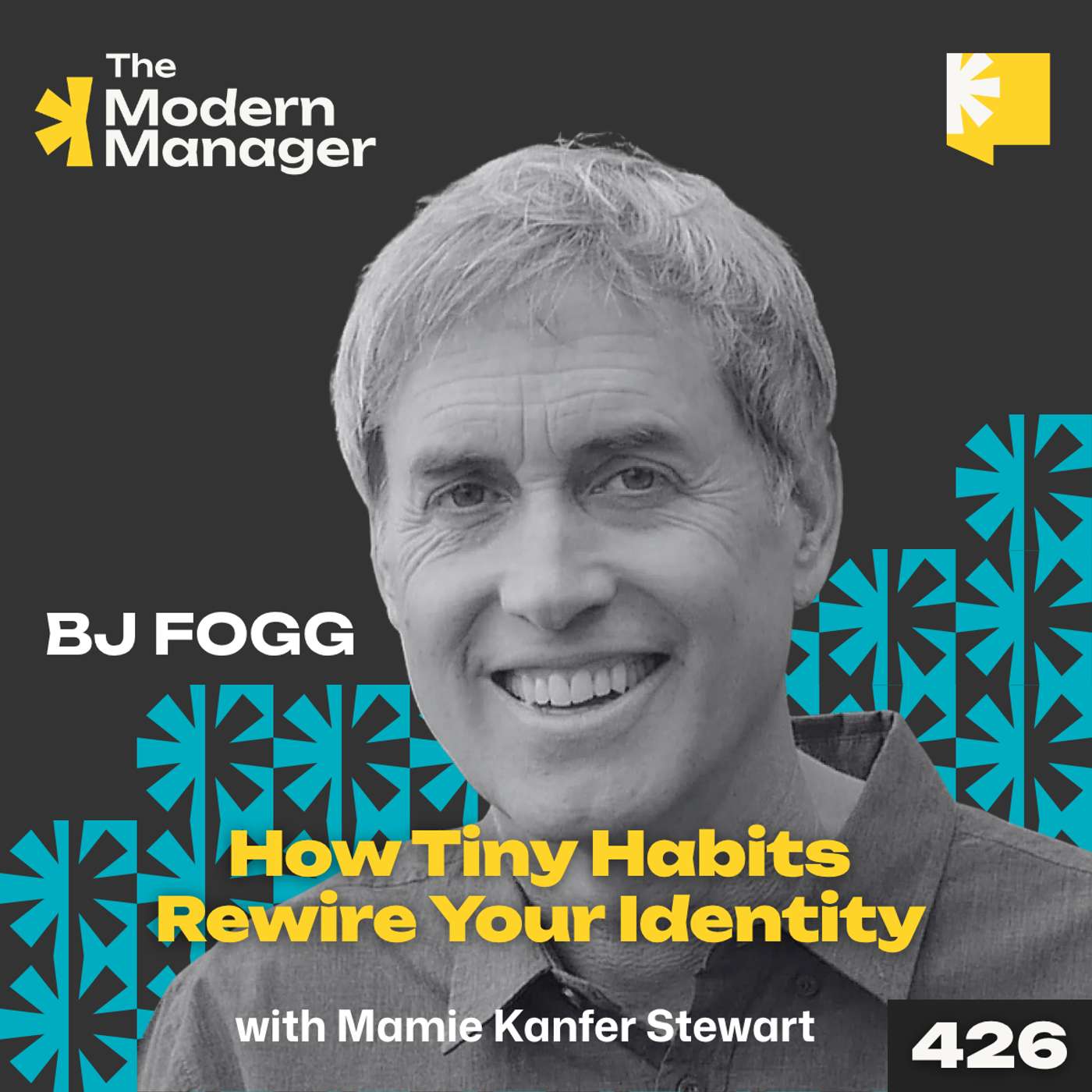
BJ Fogg is a behavior scientist at Stanford University, founder of the Behavior Design Lab, author of Tiny Habits (NYT bestseller), and creator of the Tiny Habits Academy. He teaches industry innovators and has coached 40,000+ people (claim: 60,000+ mentioned).
Good habits are easier to build than unwanted habits are to remove; there’s no single proven “break bad habits” method. Success (“shine”) from tiny wins helps habits become automatic and changes self-perception (identity). Managers can reinforce desired behaviors by giving specific, sincere praise tied to identity.
BJ lifting blinds to trigger gratitude; making the bed by only straightening pillows; flossing one tooth; manager praising the “most positive true” feedback on a draft; Bob Glass (hands-off, authentic) as a model boss.
Written by AI. May contain mistakes.
Explore how habits impact our workday and how to identify key ones to focus on.
“Thank you so much for joining me today, BJ.”
Discuss the distinction between building new habits and eliminating old ones.
“There's just so many aspects of how we work where habits will help us.”
Learn about the methods for building good habits and the challenges of removing bad ones.
“Yeah, I love the way you at least gave me some thoughts around like hoarding information.”
Hear a personal example of how a habit of gratitude can influence daily life.
“Over 40 ,000 people personally in forming habits for over the course of eight years.”
Examine the relationship between identity and the success of habit formation.
“And actually, after going through one of your classes, I do something similar where when I sit down at my desk with my coffee, as I'm pouring my coffee the first cup, I think about something I'm grateful for.”
Learn how small, specific habits can reframe your identity and encourage change.
“every day, they're going to have some healthy snack, something very specific.”
Understand the significance of seeing proof of habit changes and how it boosts confidence.
“They're seeing proof in their own lives, in their own action.”
Explore how celebrating small successes can wire in new habits and transform your identity.
“made me feel better about what I had just done.”
Discover how managers can reinforce positive behaviors and identities in their teams.
“So you do something and I call it anticipatory shine.”
Learn how to cultivate a culture of appreciation among team members.
“transcend the action and having it pull through all the way to helping somebody shift their identity in a positive way.”
Discover the impactful management style of BJ Fogg's former boss.
“I'm going to do that myself too with my own team.”
Explore where to access BJ Fogg's insights and his book.
“And where can people learn more about you, keep up with your work, get a copy of your book, all that jazz?”

Get the gist, explore an idea or ask about something said.
 Claude
On The Modern Manager, what are the key points of this episode?
Searching your listeningAutomatic transcript. May contain errors.
0:00I am a bit of a behavior change nerd, which might be obvious given I have chosen a career path where helping people change their behavior is literally my job. So it's probably no surprise that habits are part of the equation because the things that we do on default make up the vast majority of our behaviors, even if it doesn't feel like it. So today, you might hear me go a little fangirl because we are talking with one of my favorite thought leaders on the subject of habits. Today's guest is BJ Fogg. BJ is a behavior scientist at Stanford University, where he founded the Behavior Design Lab. In addition to his research, BJ teaches industry innovators how human behavior really works.
0:40He's the author of New York Times bestselling book, Tiny Habits, The Small Changes That Change Everything, and created the Tiny Habits Academy to help people around the world. If you have been wanting to change your behavior and haven't quite figured out how to make it stick, this one's for you. Before we dive in, if you're listening on your favorite podcast app, make sure you follow the show so you don't miss what's coming next. Now here's my conversation with BJ.
1:08Thank you so much for joining me today, BJ. I cannot tell you how excited I am to have you on the show because I have been a huge fangirl of yours for a very long time, and I was very lucky to get to study under you and learn from you, And I've been wanting to bring you on the show for so long, but I was too afraid to ask. And now I finally got the courage and you said yes. Well, I am so glad you reached out. I'm so glad to be talking to you in a way that's being recorded. I mean, we've talked before, but not in this kind of format. So thank you for inviting me. Yeah. So now we get to share your wisdom with my whole audience, which I'm so excited for everyone to learn today.
1:46All right. So you are known for habits and tiny habits in particular. So I want to just frame us a little bit in the work of or what habits can do for us in the workplace and in the workday. Because I think a lot of us think about the habits that we have in our home life, right? Wanting to exercise or brush your teeth or eat healthier. But there's tons and tons of habits that we have at work. So can you talk a little bit about kind of how you see the role of habits playing out in our workday and maybe a couple of thoughts on what we can do to identify some of the things that we might want to focus our energy on if we're only going to work on, you know, one or two habits to improve ourselves?
2:28Really? Good question. There's just so many aspects of how we work where habits will help us. How we run meetings, how we respond to people in the morning, how we say goodbye to people in the evening, how we respond to our emails. The way I think about it is this. Think of a spectrum. And on one side are decisions and choices where you're thinking about it very deliberately. Oh, who should I hire? Where are we going to have the company offsite? What's the most important strategic priority for the quarter or next year, right? Those are, and on the other side of this continuum are habits, so things we do quite automatically without thinking very much.
3:13Of course, it's good to have good habits. You know, the way that you interact with people, there's a whole set of habits that we already have. Some of them can be optimized, of course, the way we run meetings. I'm sure there's a bunch of good habits that people already do, but some can be, you can add to that. And certainly the unwanted, I don't really like the phrase bad habits, but I'll call it here. The unwanted behaviors, the bad habits that we may do at work, we hopefully can identify and get rid of them. It might be how you respond to bad news. It might be, unfortunately, some people have a way of hoarding knowledge or information and not sharing it, a variety of things.
3:56So, of course, we want to make it easy to do the good habits and harder or undesirable to do the unwanted behaviors. And I'll stop there. I mean, I think people can just think of their own day-to-day work life and how many things they do quite automatically. And that's what we're talking about here. Yeah, I love the way you at least gave me some thoughts around like hoarding information. That's a habit of not sharing, right? And we don't even necessarily think about that as something that we're doing because it's actually something that we're kind of not doing. So we have both habits that we need to do more of or do more regularly or improve on.
4:37And then we have habits that we have to kind of shift and replace with new, better habits. And those are different processes. Can you talk a little bit about the difference between building a new habit versus eliminating an old habit? Fast forward, y 'all. I'm an expert in creating or building new habits. Okay? There is a process for that. There's a method for that. The best method, I believe, is the tiny habits method. It's different than what came before. It's not so hard to do. You can reliably create good habits in this way, okay? And it's not tricky. It doesn't require real power. When it comes to bad habits or unwanted behaviors, the way you get rid of those, it can be tricky.
5:23I hate to give people unwelcome news, but it's not as straightforward, as simple as creating good habits. And the way I think about it, a really good way to think about habits is they're like plants. And you have like this garden of habits. Some are big and some are small and some will grow and some will stay a certain size and so on. And in that garden, you may have weeds or unwanted. So the way to get something going in your life is pretty straightforward. I mean, the old way didn't work, but if you do it in the tiny habits way, it's pretty straightforward. But removing those unwanted habits, removing those weeds depends on how they're rooted into the soil, depends how vigorous they are, depends how they serve you in maybe some unrecognized way.
6:14So when somebody says there's one proven way to break bad habits, that's simply not true. Okay? Yes, you can remove unwanted behaviors from your life, but it depends on a variety of factors, and there's no one proven way. It depends on who you are as a person, the context, and what that behavior is doing in your life. It's serving some function. It wired in for some reason. And it may no longer be serving that, but you may not recognize it. So there are more factors involved. I'm a fan of helping people create good habits and focusing on creating good habits with the impact of removing space for those unwanted behaviors, just like you might do in a garden.
7:07So that's how I think about it. And I coached over 40 ,000 people. you know this, maybe over 40 ,000, actually it's over 60 ,000, but I want to make a more conservative claim. Over 40 ,000 people personally in forming habits for over the course of eight years.
7:26And it's surprisingly simple to people to create good habits in a certain way. And they're surprised with the ripple effects that creating a few good habits has on other parts of their life and even their own identity. All right. I want to get to the identity piece in just a minute. But first, could you give us a story or an example from one of these people that you coach or from your own life of what it looks like to build a good habit and then how that's impacted beyond just that one little behavior you're doing? I'll give you one from my own life, recent one. So I'm always creating new habits and playing around just like you might in a garden.
8:04You don't want the exact same plants always in the garden year round. You want to change it up. The season changes. A plant might go through a life cycle, and you remove it and replace it. So that's how to think about habits. It's not just one stagnant thing. It's a set of habits that you're evolving. So one that I started about two weeks ago. When you move homes and live in different locations, your habits will change. And we're in a home right now that isn't where we've been a long time. So I had the opportunity to create some new habits. And so around this home, there are these blinds that you lift by hand, and there's seven or eight of them.
8:43So as I go around in the morning, I lift the blind, and I think of someone or something that I'm grateful for. Okay? So it just doesn't take any extra time. I just lift the blind, and I think, oh, I slept really great. I'm so grateful. I lift another blind. It's like, oh, my husband and I had such a good little road trip yesterday. That was awesome. I lift another blind. and say, oh, today's gonna be chocolate protein shake day. Hooray, right? And so through that process and through bringing that habit into my life, I'm uplifted by recognizing those things. And then maybe what I did without even designing it as I closed the blinds at night, I think about what went great during the day.
9:30That just happened without a deliberate design process. Yeah, creating habits is a design challenge. It's a design process. But part of it is when you create a habit and you feel successful at that habit, you naturally create other habits that are consistent with or related. So the closing of the blinds and feeling grateful for what happened during the day. And see, that just really fits for me. It's like, oh, we're closing out the day. What happened today that I'm grateful for? And then it puts you in a position or a way of thinking or a mood, whatever you want to call it, where you're going to be interacting with people differently.
10:12You're happier. You're more positive. You're looking for the positive throughout the day. So just these simple habits of gratitude can shift how you feel, not just while you're raising or lowering the blinds, and it shifts how you interact with other people. In other words, in more positive ways, which can radically influence your environment. In this case, the home environment that I'm in. Yeah, it's so powerful when you start your day with gratitude. And actually, after going through one of your classes, I do something similar where when I sit down at my desk with my coffee, as I'm pouring my coffee the first cup, I think about something I'm grateful for.
10:51Because it's a super easy way to connect something I'm going to do every single day with a gratitude practice that I had aspired to for a very long time and never quite made it stick. But that joining of those two, that habit stacking made it so simple and so easy to do and really does change how you look at life, how you look at your day in your head, all of those things. All right. I want to talk about identity because you mentioned it as one of the factors that can make it hard to eliminate a habit you maybe don't want, but also can be supportive of habits that you do want. Can you say a little bit more about that?
11:25Yeah. The way I think about identity is how you perceive yourself. And you have multiple identities. And you might be, you know, like hats that you switch around depending on the context. That's how I think about it. And in a certain context, I'm a brother. In another context, I'm a teacher. In another context, I'm a researcher. In another context, I'm contributing to the team at Stanford. That's all about good habits. and we also have identities that may not be serving us. Let me give an example that's grounded in my work. So as I coach people in the tiny habits method, I have people work on three habits at a time.
12:10People learn more and it's entirely possible to create more than one habit at once. And at the end of the five-day program that I've offered since 2011, In fact, James Clear took my course in 2014, and that got him all excited about habits. And when he signed up, he was an entrepreneur, but then he became interested in habits. So in that five-day course, what I started seeing a couple years in, I was teaching people week after week, hundreds of people a week, and coaching them and training them was people say, oh my gosh, PJ, now I feel like I can do anything, or I feel like I'm a different person.
12:48So I added to the assessment. So they did the five-day program, then I evaluate how it went. So I have tons of data. I question this, and now that I've done the five-day program in Tiny Habits, I now see I'm the kind of person who. So they could fill in the blank. So it was an open-ended question, and they can fill in negative things if they wanted, but they almost never did. I now see I'm the kind of person who can follow through. I now see I'm the kind of person who can change. I now see I'm the kind of person that can make my life better. And a surprising number of people say, I now see I'm the kind of person that can do anything.
13:26I mean, these are really big statements after just a five-day program of practicing habits. And I think the key is feeling successful. so the the insight the thing i'm really excited about and have been excited about is that when somebody does a behavior and feels successful that helps it become a habit helps it become automatic and we'll probably talk about that in a little bit but it also shifts their identity within that domain so let's say it's a healthy snacking behavior you know three o 'clock every day, they're going to have some healthy snack, something very specific. If they feel successful doing that, then they also start thinking of themselves, I'm the kind of person who eats healthy food.
14:16And that identity that they're embracing or they're living in more often or in a deeper way, then affects other nutrition-related behaviors. Now, what I saw also in the results, and I have thousands and thousands of these comments, is people level up to, I'm the kind of person who can change just by working on a few simple habits. And so many people have come to Tiny Habits, have come to other coaches like, I'm the kind of person that has no discipline. I'm the kind of person who can't change. I'm the kind of person who gets stuck. and I optimized tiny habits, especially the five-day program, to help people build confidence they can change.
15:06That was from the outside because within the context of Stanford, at Stanford University, you have a guy named Albert Bandura. He's all about self-efficacy, all that efficacy and self-efficacy. So Albert Bandura was at Stanford when I was doing my doctoral work there. We studied his work a lot and so a lot of my perspective on happiness and the ability to change and so on was like a self-efficacy. So how do I design a program that boosts people's self-efficacy? And in this case, I called it confidence. Not exactly the same, but close enough. And I optimized the program in the first few years to help people build their confidence that they could change their lives.
15:48And I didn't care what habit people worked on. Not really. Whether it's flossing or doing squats. But what I really felt, and I think I was right at this, at thinking this way, is the way I can really serve people in a program that only takes 30 minutes total over the course of five days, it's short, is to give them confidence that they can change along with skills of how to do it. Yeah. What I found so compelling, about this is as a coach, I often am working with people and their mindset about what they're capable of or who they are is so hard to change. And the whole fake it till you make it, just pretend to be the kind of person who speaks up in meetings.
16:37It doesn't work. For a lot of people, it just doesn't work because it feels inauthentic. But when you start with the behavior and you make the small changes, right, those tiny habits, then they start to compile. And now your mindset and your identity has shifted through proof, not through willpower or the desire to like make yourself a certain way, but actually through your real behavior change. And that there's nothing more powerful than that. And it's, it's incredible. I think you said it really well. And I think the five-day program in Tiny Habits gives people the opportunity to see evidence that they have changed.
17:17And I think that's one reason I like flossing as a habit to start on and just floss one tooth, because they're seeing themselves in the mirror flossing reliably when before they weren't doing it at all. And even if they're just flossing one tooth, that's fine. They're still doing something. So it's the evidence, it's proof. They're seeing proof in their own lives, in their own action. And to me, there's something about the mayor that I've always kind of liked that. You're seeing somebody who is doing a new behavior in a way they've never done it before. And I think there are ways we can help others feel that way.
17:57I know there's ways, and we'll probably get to that. There are skeptics out there that are like, oh, it really can't be that simple. All you're doing is drinking some water and flossing one tooth and putting on moisturizer in the morning. It is that straightforward. If you allow yourself to feel successful and embrace a new identity, that I'm the kind of person who can change. I'm the kind of person who can take action, okay? So you can't go into the tiny habits program and say, I'm gonna be skeptical and I'm not gonna do it, right? You need to, but then be open and embrace those feelings of success that I call shine.
18:39Embrace shine. And that's transformative. It wires in the habit and it helps shift your identity. Yeah, let's talk a little bit more about this because it's one of the pieces that I found super awkward when I was doing it, but ultimately was really, really helpful. So when I was in your program, that very first tiny little let's build a recipe and build up a bigger habit, I was like, I'm going to be the kind of person that makes my bed. Because there are all these things about if you make your bed every morning, it's so good for you to die. And so I was like, okay, well, I'm not actually going to make my bed because that takes too long.
19:12But I am going to put my pillows, like straighten my pillows on my blanket. I'm not going to tuck anything in. I'm just going to like put the pillows in the place and straighten up the blanket. And afterwards, I'm going to tell myself, good job. And I felt like the biggest idiot being like, good job. But actually, I would do it and then I'd be like, oh, I feel so good right now. And I was like, oh, this is nice. It wasn't just seeing that the bed looked more presentable, but actually telling myself good job made me feel better about what I had just done. And I think that's what we're talking about here is shine and that feeling of success.
19:46Can you talk a little bit more about how we can do that for ourselves and then how we can do that for others? Oh, I could talk on and on. We could have a whole series on this, maybe. I mean, really, I'm not kidding. Let me give a few tips to people here. And make your bed, y 'all, set the bar really low. Just maybe throw the blanket up and that's good enough or just set the pillow on the right, that's good enough. And if you decide to do more, you can, but look at it as extra credit, okay? And when you don't do the extra credit, it's still okay, you did something. Feel good, you did something.
20:23So allow yourself to feel good about it. I'll probably use that word three or four times now. Allow yourself to feel successful. And you can do something like good job me or way to go or step back and go, okay, the room actually does look better. It's not perfect, but it's better. I mean, there's over a hundred ways to help yourself feel successful. And then I list those in the Tiny Habits book. There's many ways. But one of the breakthroughs in the Tiny Habits method is just making the habits so easy, the baseline so easy, and that's all you have to do. One tooth. And if you do more, extra credit.
21:02And you don't raise your expectations. That's really, really important. And so you have this really flexible kind of habit where you do something. You can do more if you want, but if you don't want to, that's okay. And it's still a success. So that was a radically new way of thinking about habits and habit formation. But it turns out to work really well because what you do naturally, Mamie, probably with your bed making, over time you're making more and more of the bed, probably. and it feels natural and you don't feel like you're forcing yourself. And so it's like this plant that grows and you don't have to really force it to grow.
21:49You just have to be consistent. And more and more you think to yourself, oh, I'm the kind of person that tidies things up. And then you probably have other things you did naturally where you were consistent with that new identity or that identity you were bringing closer into your life. Yeah, and I think the other part of it is sometimes there's like delayed gratification. I see this with meetings all the time. Like planning an agenda is not a fun habit to build. But at the end of the meeting, when you follow the agenda, it feels so good. And reminding yourself that meeting was so great because I have a habit of building an agenda.
22:28And I found the same thing. I'd come home at night and my bed would be made And I would be like, oh, this feels so nice to enter the room because I did this thing earlier that set it up this way. So I just have, there's sometimes that disconnect is hard to bridge and we have to be intentional, build a habit of intentionality around connecting that. Exactly. And let me build on what you said. Exactly right. So let's take making the bed one. So you do something and I call it anticipatory shine. You can anticipate, oh, tonight when I walk in and look, I'm going to feel so good about this. So in the moment that you do the action, you can anticipate and call in or welcome or embrace a future emotion that you're going to have.
23:10That's how you can have the emotion in the moment. And we do this all the time for things where we anticipate things and feel good about them. We do it all the time. Now just bring it into your world of habits and forming habits. But I was just doing some one-legged squats on a stair before it does because I've been sitting a lot. And as I was doing those, even though it was kind of burning, which for me is a good sign, it's like, good. I was like, oh, the next time I get on the rower and I'm in a race, which is going to be about two weeks, this is going to be working for me, man. These quads are going to be firing, okay?
23:50I didn't mean to share that example, but that's one way of helping yourself create habits and do behaviors. Yet it's not pleasant to have your quads burn. So instead of the burning be a negative sensation, I took it as a positive one. And I anticipated me being on a rower in a race that's coming up. I thought, man, this is going to serve me. I'm going to be faster. And that happens all the time in the workplace. It's like, I don't want to do this thing, but if I do it now, it will make my life better in the future. And I love that we can connect that and notice it in the moment and cheer ourselves on.
24:31Let's talk for a second about how to support our team members in building better habits for themselves. And especially because we have a unique position as a manager where our praise can be really desirable. So I'm guessing there's something here where the way that we show appreciation might help people build better habits. Yes, so much. Ah, where do I start here? First of all, you as a manager can be the source of shine to help the people you work with wire in habits, okay? And people pretty much know the principles of this. You know, sooner is better, specific is better, point to something concrete, be sincere.
25:12Absolutely, you can't be insincere. So I won't go over that in depth. But when somebody does something and feels successful, let me take an example of, oh, let's say somebody reads a draft of something and critiques it. And they're using, so as soon as I get that, look over their work, find the most positive, true thing you can say about it and share that back with them. That doesn't mean their work was perfect. But what's the most positive true thing? And maybe it's two. Wow, you responded really quickly and you really honed in on keeping my voice consistent and this thank you so much. So then they're like, oh, I'm the kind of person that responds quickly and I'm the kind of person that identifies the quality of voice in a piece.
26:09So you, as the manager, you have the choice. What is it that you're reinforcing in the people you're working with, right? And yeah, it's not perfect, but if you come out saying, hey, you missed this, you missed that, they're like, oh, I'm the kind of person that can't do this very well. And the next time you ask, they're not gonna be super motivated. But when they feel successful, three things happen. One, they're more motivated to do that behavior in the future. Two, what they did becomes more automatic. In other words, a habit, the feeling of success. So you, in giving feedback managers, you can help create those habits.
26:45And then three, you help people recognize a new identity or strengthen an identity they already have. You might say, wow, I really want this person I'm working with, let's call this person Teresa. I really want Teresa to be a better team player. So watch and watch and tell. She gives you that little, it's true. It's like, Teresa, thank you so much for giving me feedback on the meeting. I see from that that you are a really good team player. See what I did there? It's related to what you said, Mamie, about it's true. It's based on a reality. But then you're making a choice as somebody, and it could be manager, it could be parent, it could be spouse, of what identity do I want them to strengthen?
27:39And then this team player point out how by doing X, you're showing me that you're a good team player. It's true and it's positive. And that is, I teach my tiny habits coaches, there's a very specific way to do this method, we have a very specific name. So you're not just leaving a thank you. You're helping transcend the action and having it pull through all the way to helping somebody shift their identity in a positive way. Yeah. We have to wrap up, but I feel like if anyone is listening and they're wondering like, what do I take away and do with this in the workplace? I think the number one thing we could all work on is building a habit of appreciation in exactly the model you just described, of identifying what do we want people to do more of, and then actively giving them specific appreciation that ties to the identity and the behaviors that we want them to continue.
28:34So everyone should be doing that. I'm going to do that myself too with my own team. So thank you so much, BJ. Can you now tell us about a great manager you worked for and what made this person such a fabulous boss? His name was Bob Glass, and he hired me right out of my doctoral work at Stanford and had various options. And I went with Bob and it's trying to be a great decision. Why was he so great? Because he was authentic and hands-off. Okay, I'll start with the hands-off part. I was at a tech company in the role as a scientist and innovator. And he didn't micromanage me. He was like, yeah, go do cool, interesting things.
29:14Go. And he said, oh, you don't have to tell me when you arrive at work. you don't have to tell me if you leave. I totally trust you. And so he basically trusted me and didn't micromanage me. And I love that. And then I worked even harder because it was like, oh, so this is how it works here. Boom, it's all up to me. I can make my own decisions. Like, great, awesome. The other thing I appreciated was his authenticity. He was a real human. And this might be dad, maybe for your podcast, but there was something I purposely I'm not named the company. There was something I was doing for the company where I was making personal sacrifices.
29:53And he's like, BJ, take your vacation or take your weekend or whatever. And he said this, which he says, the company will never love you back. And I was like, what? The company will never love you back. And what he was saying by that, I wasn't don't work hard. It's you have a life and have your life and your priorities be your priorities, but don't sacrifice quality of life for any company. And it's like, my boss is telling me this, but I really appreciated it. And it's true. And as managers, we need to role model that for our teams and give people permission to take care of themselves. Absolutely.
30:36All right. And where can people learn more about you, keep up with your work, get a copy of your book, all that jazz? BJFogg.com. BJFogg.com. It's kind of the dashboard for other things. If you want to go right to Tiny Habits, tinyhabits.com. And yeah, the book's on Amazon. If you are interested, it's like 11 bucks. I would buy the U.S. paperback version. There's slight differences, very slight. But that's the one that I buy for myself, that I give away, that I recommend. And I've read it more times than it's probably normal. But it's excellent. Every time I read it, I find something new that I want to try out because there's so much richness there.
31:17So thank you again so much for joining me today, BJ. This was so fantastic. Thank you. Now comes the important part, taking something you heard today and actually putting it into practice. If you want a little help with that, join my email list and I'll send you a one-page guide to every episode with key takeaways and ideas to put it into action. You'll also get access to the archive of guides from past episodes. You can sign up at themodernmanager.com slash podcast. Thanks again for joining us. Now go put something you learned today to work.
Most of what happens in a workday, from how you open a meeting to how you respond to bad news, runs on autopilot. Habits, not decisions, are doing the heavy lifting. Behavior scientist BJ Fogg explains why willpower fails, why "bad habits" aren't really the enemy, and how one tiny action, done consistently, can quietly reshape how you see yourself as a leader, teammate, and person.
Guest Bio
BJ Fogg, PhD, is a behavior scientist at Stanford University, where he founded the Behavior Design Lab. In addition to his research, Fogg teaches industry innovators how human behavior really works. He created the Tiny Habits Academy to help people around the world. He is the author of the New York Times bestselling book, Tiny Habits: The Small Changes That Change Everything. Find out more at BJFogg.com and TinyHabits.com.
Conversation Topics
Additional Resources
Keep Up with BJ Fogg
Join my newsletter to get episodes and the one page takeaways delivered directly to your inbox: https://www.themodernmanager.com
The Modern Manager is a leadership podcast that helps you close the gap between knowing what good management is and actually doing it. Follow The Modern Manager on your favorite podcast platform so you never miss an episode!
#Leadership #TinyHabits #BehaviorChange #ManagementTips #WorkplaceCulture #HabitFormation #TeamLeadership #PersonalDevelopment #ManagerLife #EmployeeEngagement