 The New Yorker Radio Hour
6 Oct 2026 · 22m

 Add vo to ChatGPT or Claude to ask about everything you hear
vo listened to this episode to put together the overview and transcript, so there may be the odd mistake.
Evan Gershkovich, a Wall Street Journal reporter in Moscow, was arrested in 2023 on espionage charges Russia said were false; he spent 16 months in Lefortova prison and was released in a prisoner exchange. The episode centers on why he was targeted, what prison life was like, and how he processed release and trauma.
Evan Gershkovich is an American journalist who reported for The Wall Street Journal and later wrote This Cursed Beautiful Land about his imprisonment. Host David Remnick is a former Moscow correspondent and a board member of the Committee to Protect Journalists.
Putin ordered the FSB to “catch a spy,” and Gershkovich believes he was “fresh meat” for a swap, likely involving Vadim Krasikov; prison authorities treated him as a “pristine package” for exchange.
rich early prison library (later culled), weekly letter system with censorship, TV mentions of “exchange fund,” and cellmate conversations (including a “Shawshank Redemption” joke).
0:00The New Yorker Radio Hour is supported by AT &T. We all love to connect via video calls or texts. Right now at AT &T, you can get the new iPhone 18 Pro for$0 with iPhone trade-in. Any condition. It has the ultimate pro camera system and big leap in battery life, so you can turn this deal into a long-lasting connection. Learn how you can trade in your iPhone for the new iPhone Pro 18. Requires trade-in of iPhone 14 or higher, excluding iPhone 16e, an eligible plan. Terms and restrictions apply. Subject to change, visit an AT &T store for details.
0:37The New Yorker Radio Hour is a co-production of WNYC and The New Yorker.
0:47This is The New Yorker Radio Hour. I'm David Remnick. In 2023, a young reporter for The Wall Street Journal, working in Moscow, was arrested by Russian authorities and charged with espionage. His name is Evan Gershkovich. For Putin's regime to lock up an American journalist on charges that were obviously blatantly false was shocking. I'm a former Moscow correspondent myself. I'm on the board of the Committee to Protect Journalists. And so I watched these threats to the press very closely. And this felt like a distinctly dangerous escalation of Putin's authoritarian tactics. in the wake of his invasion of Ukraine.
1:28Evan Gershkovich spent 16 months in prison before his release in an exchange of prisoners. He details his experience in a new book, This Cursed Beautiful Land. We published an excerpt from the book at newyorker.com, and I spoke to Evan Gershkovich last week at a live event in New York City.
1:51Why you? There are an infinite number of correspondents. Why you? Is it because you were out of town? Is it because you grew up in a Russian emigre household? Your language skills, what was it? Why you? So I think there's, I mean, I don't think I'll ever have the answer. And the book doesn't actually pose a complete answer. It's a bit of a question that's left open. And I, you know, but I think there's several reasons. One is that Putin addressed the FSB, the Domestic Intelligence Agency, formerly the KGB, at the end of 22, near the end of the first year of the full-scale invasion, and said, you guys have to catch a spy next year.
2:33He said it in more official language, like you need to do a better job of catching traders. Because they need to crack down on traders or they needed fresh meat for a trade? So I think that they, you know, it's partly he's telling them we need to, you know, shore up the war effort. So it's partly paranoia, but it's also fresh meat for a trade because at that point there was Paul Whelan in Russia, an American on espionage charges. And the Americans were trying to bring him home and the Russians were telling them, well, he's not going home until Vadim Krasikov and FSBSS and comes home from Germany.
3:11Right. He had murdered a guy in broad daylight. But they're sent from Russia on a mission. And the Americans were saying, well, this is crazy. We can't get the Germans to do this. So then I think, you know, and the kind of hostage diplomacy game had already been playing out for a few years. Like they had traded Trevor Reed, a Marine, Brittany Griner, a basketball player. And I think they were looking at how they could stack Americans, maybe do a two for one, like the way a trade works. And so you start looking at your environment. You have this order to catch a spy. You know, I think an American is the more valuable ones.
3:49But you also need a loud, a kind of somebody who's going to make a splash. And so I think you start looking at a journalist as, you know, one option. And I was up to reporting that, you know, some people might call it brave. Other people might call it reckless. What do you call it? I call it a mix, I think, to be, you know, I think it's important reporting, you know, the work that we do, the work I was doing. No, but I mean the specific thing. You were pursuing Russian military readiness, and your attempt, I think, was to get material that would tell you more about the war effort, which is utterly verboten.
4:30And you met a source in Yekaterinburg, and he turned out to be part of his setup, obviously. You get arrested. and I want to know, after you've been brought in, they've pummeled you and you realize you're not being tortured, which is good news. Right, right, right. But what did you think would happen? Did you think that this would be a couple of days? This would be a year? This would be interminable? What did you think? I thought a year and a half to three. So, I mean, they... Why? When they came in for the arrest and they announced that I'm under arrest, they say that they're with the FSB. So that's your first signal that it's not the local police.
5:11You know, they don't torture me. They don't try to get any information from me. They just present me with my charges. And so you quickly realize, oh, it's a setup, probably for a swap. And the first night I'm in prison, you know, we had a TV in prison and on the state news channel, the host said, you know, this might be cynical to say, but we've replenished our exchange fund, which is the term the Russians use as the kind of like pool of people they use for a swap. And so then you start thinking, well, okay, if it's for a swap, this isn't going to, you know, these things don't happen quickly. But you were that collected that you were able to think without excessive emotion about your…
5:48Ups and downs, like big ups and downs in the first week, two, three, and then, you know, lows. But in the beginning, you know, you're in a kind of state of shock. Like I remember the first, it took me, you know, six days to start keeping a diary. and for when I started putting the book together, I actually called my Russian lawyers and started going over some of the first memories and they remembered me saying within the first week that I think this is for a swap and I think it's for Krasikov. Krasikov being? Being the assassin in Germany. And I think they've stacked Americans, basically. The Russians desperately wanted back.
6:24Yeah. I don't think we totally know why, but it seems so. I don't think it was for his good deeds. No. What really interested me is that you end up in the iconic Moscow prison. You end up in Lefortova. Give me, in a granular way, what daily life was like in Lefortova prison. I think, you know, one thing to say is that the Russian state's gotten much more calculating about how it, you know, it keeps people in prison. And, you know, Victoria Roshan, who's a Ukrainian journalist, taken captive around the same time, she was reporting in Russian-occupied territory, and she came back in a body bag, her organs were removed so her family couldn't know what happened to her, I'm held in a completely different way.
7:09So I'm allowed to get books. I'm allowed to get letters. I can watch the TV. And so my life is more, you know, it's psychologically difficult, and it's about the drudgery. So we would read in the mornings. You might get taken on your walk during that period. Slow down on the reading. Oh, yeah, sure. What's absolutely fact, when we first met, I'll never forget, I asked you what was available in the prison library. And you said, well, you know, I read Solzhenitsyn. I read Brodsky. I read this, that. I couldn't believe, I couldn't wrap my head around that. The library is really, really rich. I mean, there's a, you know, I actually, I was surprised too.
7:49And then my lawyers, the first time they came to visit me in prison when they were allowed to come for a visit, I brought that up. And they were like, well, a lot of really smart people have been here. To them, it was obvious. It's not a question of IQ. It's a question of access. And that changed halfway through. But why are they letting you see those books in the beginning? I think a bit of Russian, this word that I bring up in the book, which means, you know, the best way to translate it, and I apologize for the French, but a mess as a result of not giving a, let's say, hoot. and it's you know the nine months in they culled the library they took away anything written by so-called you know traitors and anything that showed the state in not a good light but originally you can have anything what were the best memoirs there were books by Ukrainian authors Russian dissidents Michelle Obama's memoir was in there Arnold Schwarzenegger's too did you read that I did not it's pretty good I'm sure.
8:56So these guys around you, and you get this from the book, there's a certain, the fourth wall is broken at certain points during the course of the day. People led on in the sense that I know that you know that, et cetera. People made jokes with you. It wasn't, again, I'm not for a second saying this was a picnic. And the worst part of it sounds like your imagination of the suffering of your parents and friends at home. yeah i mean i think when you're in that situation and you realize okay they're going to treat you like this kind of pristine package uh to be traded i had this moment when uh you know early on i realized you know the warden would come in before anytime the u.s ambassador came to visit me check if everything was okay my you know the mattress was thicker than my cellmates you know they were treating me sort of as like a higher class citizen and you know you you know you start getting those kinds of signals.
9:54And then eventually, once he came to check on me before the ambassador came and I'd hurt my knee exercising and I told them, you know, like, actually, I'm surprised at how, you know, well you're treating me in a way. Then prisoners checked it, you know, checked it out, gave me some physical therapy exercises. And he goes, of course, we, you know, we care about your health. And I was like, well, the package has to be undamaged or the value will go down. And he checked his shoulder and he whispered, you know, he looked around and he whispered, you know, uh, I didn't tell you this, but yes. So it's this, it's very bizarre, this kind of like open, uh, conversation.
10:29Uh, and there was a moment actually where an FSB investigator told me that he was like, look, we gathered enough evidence against you to imprison you. Otherwise we would have poisoned you. Uh, and they do poison people abroad, but the argument I had with him sort of similar was that, no, because I'm useful in a very specific way. But then, yeah, your loved ones and your family, it's always a black box. So you can write letters to them, you can explain. This shocked me. So you were friends with Josh Yoffa, who writes for The New Yorker, and who at that time lived in Moscow. And I said, you know, I don't know Evan, but I'd like to write him a letter.
11:10I think that's probably impossible, right? He said, oh, no, I write all the time. and tell me about the system of letter writing to Russian prisoners. You know, one interesting thing about the Russian state now is I think they don't really care what people have access to or what they say because they're in complete control. So, you know, the late opposition leader Alexei Navalny published his memoirs, which you published in The New Yorker from prison, right? And he's much more of an opponent to them, obviously. But those were being snuck out. They were being snuck out. By his lawyers and so on.
11:41But the FSB knows, I think, to a degree, because we, you know, you meet with your lawyer in a room and it's bugged. We, you know, it's all open. And so I was getting letters in once a week or so. And then I would write letters and hand them in on Sunday nights. And, you know, there was a sensor that stamped the letters. But I think they were only stamping for, you know, if there was some sort of code, how to escape. But my friends, I thought it was quite, to me, it was heartwarming and cute and comical. They were trying to not write any sort of curse words because they were worried that that would mean that the letters wouldn't come through.
12:21So we were all kind of guessing at what was possible and not possible. I'm speaking with Evan Gershkovich. More in a moment.
12:38This show is supported by Odoo. When you buy business software from lots of vendors, the costs add up and it gets complicated and confusing. Odoo solves this. It's a single company that sells a suite of enterprise apps that handles everything from accounting to inventory to sales. Odoo is all connected on a single platform in a simple and affordable way. You can save money without missing out on the features you need. Check out Odoo at O-D-O-O dot com. That's O-D-O-O dot com. I'm Emily Flake, cartoonist at The New Yorker. The New Yorker Radio Hour is supported by Bombas. It's finally cozy season, my favorite time of year.
13:17That means crisp mornings, fresh cool air, and dressing in layers. Bombas makes your comfiest fall staples, so you can make the most out of this glorious time. I love the feeling of opening my sock drawer and seeing all my Bombas and knowing there's a perfect pair for wherever I'm going that day. And it's not just socks. Bombas makes t-shirts, camis, and even underwear, so your first layer can be your most comfortable. They've even got slippers if you just want to stay cozy at home. And the best part about Bombas? For every item you purchase, they donate an essential clothing item to someone facing housing insecurity.
13:49One purchased equals one donated, with over 200 million donations and counting. Head over to bombas.com slash radio hour and use code radio hour for 20 % off your first purchase. That's B-O-M-B-A-S dot com slash radio hour. Code radio hour at checkout. This is Ira Glass of This American Life. Do you know our show? Okay, well, either way, I'm going to tell you about it. We make stories, old-fashioned stories that hopefully pull you in at the beginning with funny moments and feelings and people in surprising situations, and then you just want to find out what is going to happen and cannot stop listening.
14:25That's right. I'm talking about stories that make you miss appointments and ignore your loved ones. This American Life, every week, wherever you get your podcasts.
14:40What was the hardest part? We've talked to, and I don't mean to be dismissive or in any way diminishing of this experience because there must have been periods that were immensely hard. It seems to me, if I read the book properly, possibly the lowest low was involved Alexei Navalny, who, of course, was a dissident in the modern sense and certainly a martyr in any sense, and who died, was, I think, more accurately killed in a polar camp. Tell me about what you were thinking vis-a-vis Navalny's fate, how it affected you, and how his death affected you. Yeah. So in the beginning, you know, assuming it's for a swap, assuming, you know, the U.S.
15:32government is going to be frantically trying to, you know, free me because it's a big, you know, big global uproar. And they made statements early on that they were going to try to free me. And then, you know, my my lawyers could come to the prison and bring their the interns at the law firm were translating the Western press into Russian. and so I could read it. And then there was news that actually a deal started coming together with myself and Paul Whelan going to the U.S. And you were well-informed throughout about all these machinations. Yeah. Through your lawyers, principally. Through my lawyers, yeah, yeah.
16:09But also just through the news. What was the reaction in the prison? So I'm only with my cellmate. That's the only person I actually interact with other than prison guards. They completely isolate you from everybody else. and so my reaction and the reaction of my cellmate because we had been talking about a possible swap was one of four I later berated myself kind of for not thinking of Navalny first I knew the guy the guy you've joked together with reporters knew him well he's incredibly brave and one of a generation person who would sacrifice himself for a cause like that and the next four days go by in a complete haze.
16:53Despair? Yeah. I think not really, you know, sort of not thinking much at all. Just sort of like you lay on your cot and you don't do anything. You mentioned your cellmate. One of the most spectacular aspects of this book is the depiction of the relationship between you and your cellmate. Now, you do give yourself the liberty, which you inform the reader, where you take a few cellmates and kind of make a composite of them into one. but I think one person that particularly dominates. Tell me about him and your relationship. So he's a, you know, he admitted to violating the law. He had a illegal weapons factory and, or, you know, maybe workshop, however we want to put it, and was selling weapons illegally.
17:40And so the way we got along was that he was really funny and we had a, you know, cultural touch points was, you know, I grew up in a home that was a kind of facsimile of the Soviet Union in the way we watched Soviet comedies and cartoons. And then I lived in Russia for five years and caught up to pop culture. What did you learn from him? One of the most important things I think you have to learn in a Russian prison, how you step into a cell is really important. I stepped into his cell. I reached out my hand for a handshake to introduce myself. and you know he said to me a russian phrase that he said what's the trouble uh and i didn't understand what that meant and then he explained uh you know i you know i want you to tell me what your your crime is uh and the reasoning is that you can't shake the hand of let's say a pedophile so i said and this is where i thought he was you know immediately showed a great sense of humor and pop culture awareness was you know i explained to him i said you know espionage and so he freaks I was like, you're a spy?
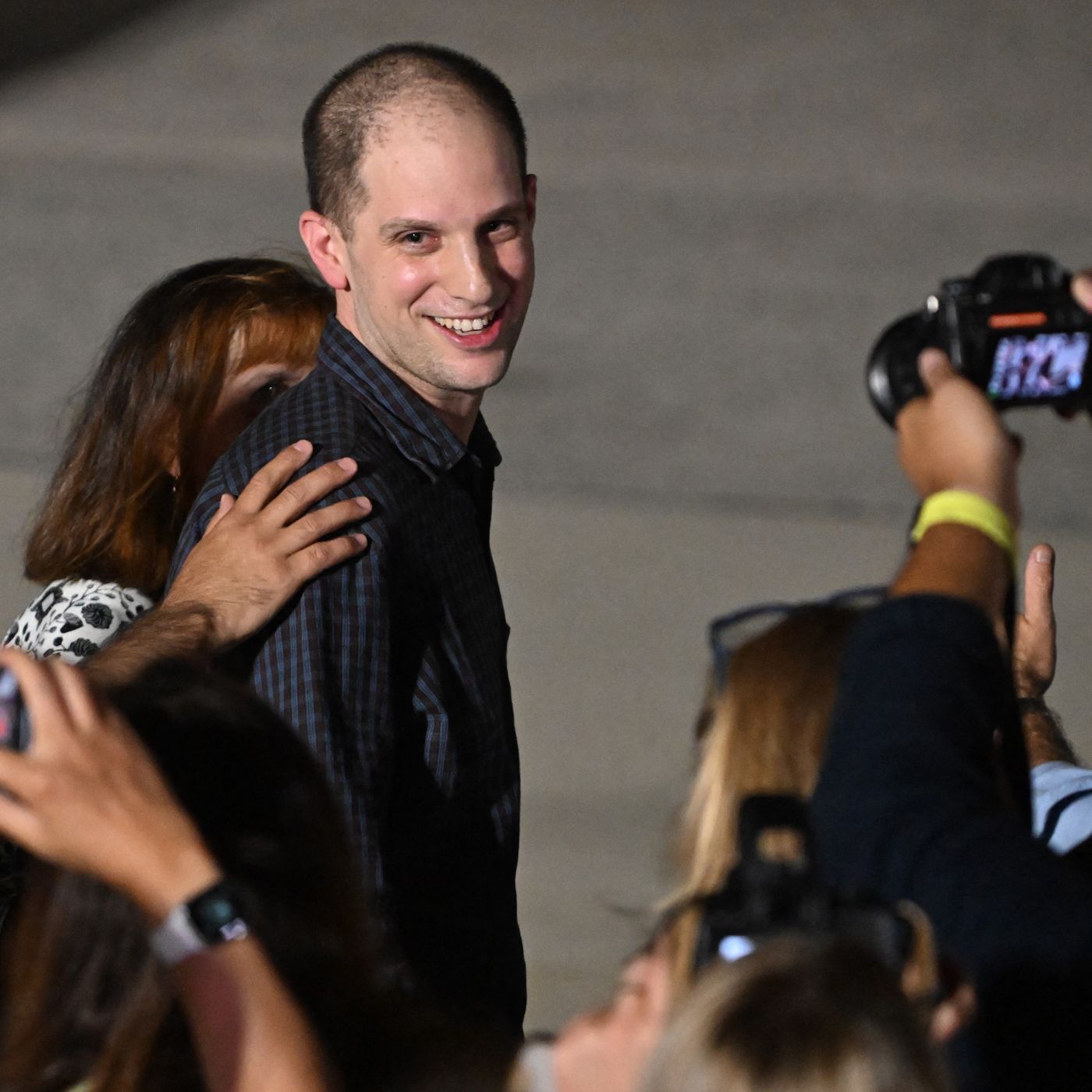
18:42And I go, no, no, no, no, no. I'm not a, you know, I'm a foreign correspondent. They set me up. It's for a swap. And he starts laughing and he goes, it's just like in Shawshank Redemption. Everyone here is innocent. So, yeah, you know, he's funny. After you got out, you would think from watching the scene at the airport, Andrews Air Force Base, there was a real happiness, relief there and exhaustion. But there's other things happening inside of you that took time. Tell me about that. Yeah, I mean, you're carried in the beginning on this sort of adrenaline, and yet pure joy. You're suddenly reunited with these people you've been missing and who've been worried about you and fighting for you.
19:32But I couldn't sleep at the beginning. The kind of prison experience I was in was really isolating. It felt like coming down from the International Space Station in a way. Suddenly, you know, there's all these faces and sights and sounds. People want things from you. People want things from you, but you've also been in kind of kindergarten. You've been institutionalized. You've lost your agency. You don't know how to say yes to things. You just have to say yes to things, and you can't say no. And so that you're relearning how to be an adult again, and you're absolutely overwhelmed. And one of the stranger feelings I had was the sort of pull to go back.
20:10not to Russia, but to prison specifically, because it's what you know. What does that mean, the desire to go back to prison? It's a desire to have that kind of structure and being able to have conversations with people who understand you. Weirdly enough... And it happened in 16 months, which is not a short period of time, but it's not 20 years. And it happened to a person who was a political prisoner, who had a good job, financial support, a newsroom to go back to, a family. And you can only imagine what might happen to somebody who didn't have all that support. That quickly went away because I got a therapist.
20:47But I started with a PTSD therapist, and I kind of graduated that in six months. And how long did it take to feel like your feet were on the ground? Maybe like eight months, seven months. And then to feel good, normal, maybe about the same amount of time as I was in. So it's almost a full term until you feel like yourself. Yep. I've, you know, I've been asked if I have Stockholm syndrome, uh, in, uh, you know, since, and I, you know, I don't know, I'm not a psychologist, uh, but I, I don't think I do. And I think part of it is because of this connection to the place, you know, people get wrongfully accused of murder in the U.S.
21:36and then they spend 20 years in prison and then they're released and they're angry at the judicial system and whoever but they're not, you know, they haven't renounced the United States and I definitely don't support the Russian state but I have sadness about what's happening to and what it's doing to and anger about what it's doing to his neighbors. Evan, would you go back? He'd have to be long gone but I would. He'd have to be long gone and he'd have to see what the government is like. But I don't think he's going to be succeeded by the second coming of Andrei Sakharov or Alexei Navalny. I mean, depends when it happens, right?
22:13I don't think so either. I guess I'm, hopefully we can all hold up, hope that it could happen again one day. There could be this moment. But no, I don't see it coming anytime soon either. And so. You miss it? Less and less. I did at the beginning. Yeah. I mean, it was the. I don't mean jail. I mean, Moscow. Yeah, Moscow. Yeah. I mean, it was the place. It was the good distinction because I did. There was a moment. Yeah, I mean, it was the place, you know, I got there when I was 25. I made some of the closest, you know, friends and people I'll ever make in life. And it was an interesting and fun place to live.
22:47And I think Russia is much more complicated than just, you know, trying to expand its borders or keep, you know, autocracy going. There's lovely people that live there and wish this wouldn't be happening. And, you know, I grew up on this kind of food and this kind of culture, and so it's close to me. And, you know, one day I would hope to be able to go back, but I don't, I just, yeah, I agree. I don't think that's happening anytime soon. Evan Gershkovich, thank you very much. Thanks, everybody.
23:21I spoke with Evan Gershkovich at the Temple Emanuel Striker Centers in New York City. He writes about his imprisonment in Russia in a new book, This Cursed Beautiful Land. And he continues to report for The Wall Street Journal. I'm David Remnick. This is The New Yorker Radio Hour. Thanks for listening. I hope you'll join us next time. The New Yorker Radio Hour is a co-production of WNYC and The New Yorker. Our theme music was composed and performed by Meryl Garbus of Tune Yards, with additional music by Louis Mitchell and Jared Paul. This episode was produced by Max Balton, Adam Howard, David Krasnow, Jeffrey Masters, Louis Mitchell, Jared Paul, and Ursula Sommer.
24:02With guidance from Emily Botin and assistance from Michael May, David Gable, Elliot Wright, Erica Huang, and Alejandra Decket. The New Yorker Radio Hour is supported in part by the Charina Endowment Fund.
24:21Hi, I'm Joey Akin, and if you care about African music beyond just the hits, I'd love to invite you into something deeper. Afrobit Intelligence is the podcast extension of my newsletter. Each week, I examine the trends, the people, and the process behind the sound with guests like Tiwa Savage, LoJ, Ruga, and Sars. Join us as we unpack how Afrobit became a global cultural force. Subscribe to Alphabet Intelligence on Apple Podcasts, Spotify, YouTube, or wherever you listen.
In 2023, Evan Gershkovich was working as a young reporter in Moscow for the Wall Street Journal, when he was arrested by Russian authorities. He was eventually convicted on blatantly false charges of espionage and spent nearly five hundred days in imprisonment. Gershkovich recounts the experience in a new memoir, “This Cursed Beautiful Land,” and in an essay in The New Yorker. He spoke with David Remnick about life inside a Russian prison, the international prisoner swap that freed him, and why the difficult process of reacclimating to his former life complicated how he viewed his incarceration.
Further reading and listening:
This segment was recorded live at the Temple Emanu-El Streicker Centers, in New York City.
New episodes of The New Yorker Radio Hour drop every Tuesday and Friday. Follow the show wherever you get your podcasts.
Hosted by Simplecast, an AdsWizz company. See pcm.adswizz.com for information about our collection and use of personal data for advertising.
Scan the code with your iPhone camera
Listen in the app.