
In short
Podcast Summary: SaaStr 818 - Anthropic, Cursor, Fal & Bessemer: The Realities of Scaling AI
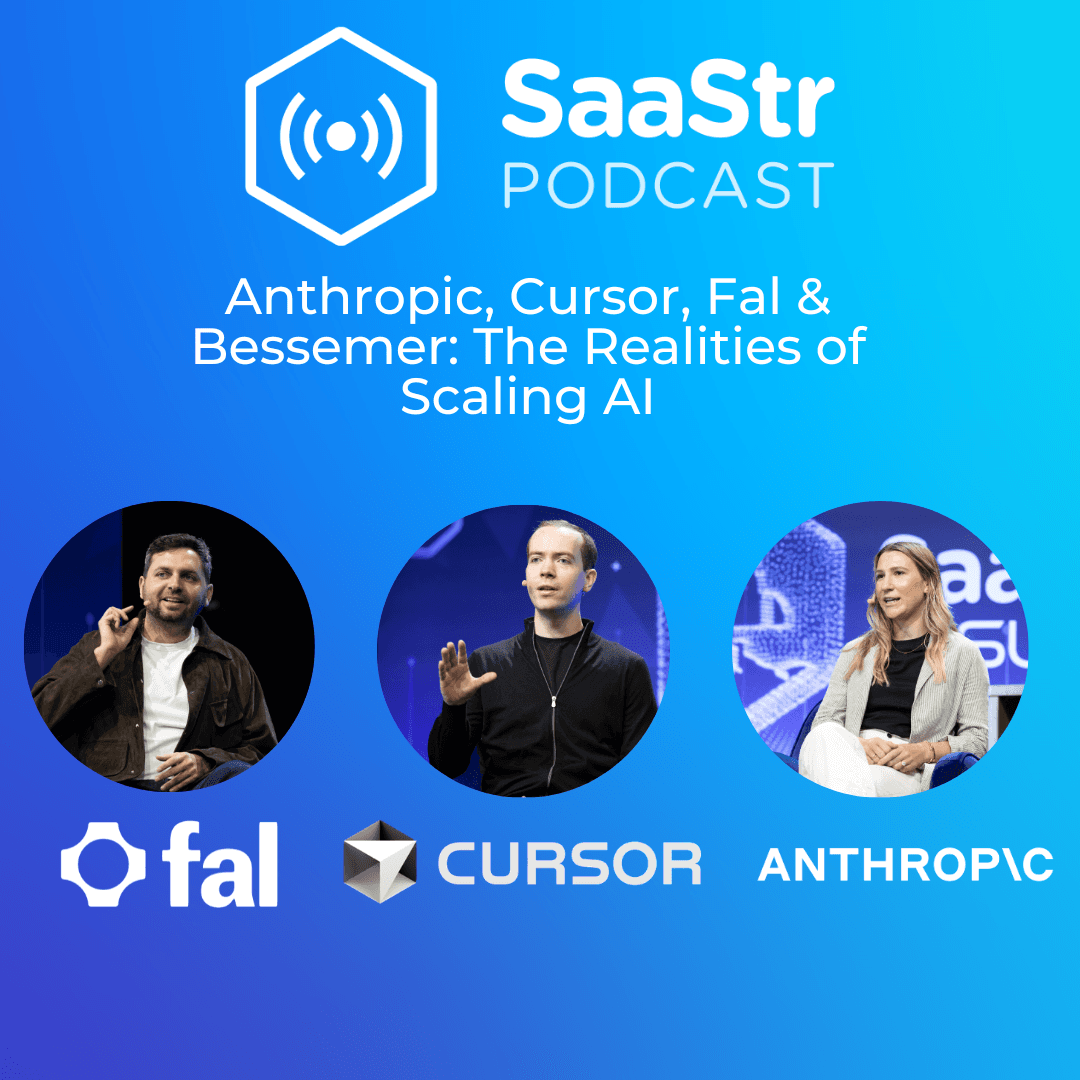
Episode Overview In this episode of The Official SaaStr Podcast, Talia Goldberg from Bessemer Venture Partners hosts a panel featuring:
- Kelly Loftus - Lead of Startup Sales at Anthropic
- Jacob Jackson - Team member at Cursor
- Gorkem Yurtseven - CTO and Co-Founder of Fal
The discussion revolves around the rapidly changing landscape of AI, focusing on the evolving business models, key metrics for success, and the future of generative media.
Key Topics Discussed
Introduction & Panelist Insights
- Talia Goldberg introduces the panel and shares her enthusiasm about the shift in metrics within the AI industry.
- Each panelist provides a brief background on their roles and experiences in their respective companies.
How AI Companies Are Changing Metrics
- Gorkem highlights that traditional SaaS metrics are becoming obsolete due to the unique challenges posed by AI, such as lower gross margins and high operational costs.
- Companies are experiencing rapid growth, often going from $0 to $50 million in revenue faster than traditional benchmarks.
The New Economics
Margins, Growth, and Pricing
- The conversation delves into how AI impacts gross margins, emphasizing that AI models are expensive to run, significantly affecting net profitability.
- The need for new pricing models, including usage-based and value-based pricing, is discussed as companies grapple with the cost of serving AI customers.
Usage-Based Models & The Cost to Serve
- The panel explores the implications of pricing strategies, acknowledging that traditional metrics don't apply well to AI-driven companies.
- Both Cursor and Anthropic are experimenting with usage-based models to ensure they capture the value delivered to their customers.
Go-To-Market Team Structures
- Kelly shares insights into Anthropic's go-to-market team, noting significant growth from 10 to about 150 individuals in a short time.
- Discussion about the absence of traditional quotas in their sales approach, focusing instead on feedback-driven targets.
Hiring and Team Building Tactics
- The importance of hiring for alignment with company values is emphasized, along with innovative strategies for recruitment.
- Cursor utilizes a research grants program to identify and hire talent based on their project proposals.
Internal AI Usage
- Each company shares how they incorporate AI into daily operations to enhance workflow and productivity, showcasing various applications from customer support to internal knowledge management.
Collaboration vs. Competition
- The symbiotic relationship between Cursor and Anthropic is explored, highlighting the balance of collaboration and competition.
- Both companies focus on mutual feedback to improve their offerings and advance AI capabilities.
Measuring Productivity Gains from AI
- Discussions on metrics that matter most for each business model, including customer acquisition costs (CAC), revenue growth, retention rates, and user engagement.
Key Takeaways
- Changing Metrics: Traditional SaaS metrics are becoming less relevant in the AI landscape, necessitating new frameworks for measuring success.
- Pricing Models: Companies are experimenting with innovative pricing strategies that reflect AI's unique value proposition.
- Team Structure: Leaner sales teams are effective in the high-demand AI market, with less reliance on traditional quotas.
- Collaboration Over Competition: Companies in the AI space are finding value in partnerships that enhance product offerings and customer satisfaction.
Final Thoughts The episode concludes with each panelist emphasizing the importance of adaptability in the face of rapid technological advancements and the need for ongoing collaboration in the AI community. The conversation reflects the dynamic nature of the AI industry and the conscious effort to refine business models, metrics, and internal practices to thrive in a competitive environment.
---
This summary captures the essence of the podcast episode, highlighting significant insights and discussions while maintaining a structured format for ease of understanding.
Written by AI. May contain mistakes. Listen to the episode to check what was said.
Transcript
Automatic transcript. May contain errors.0:01Welcome to the official Sastr podcast where you can hear some of the best Sastr speakers. This is where the cloud meets. Up today on the Saster Podcast. The way we sell software changed. Before, if you are selling a SaaS product, the marginal cost was very little to sell to another company and or to sell another product. But with AI, the new gross margins are lower because it comes with a cost to sell to another person. So that means everyone has less margins. Maybe that changes over time. Models might get cheaper. And if you can have like people have stickier workflows, maybe the margins go up over time.
0:48Hey, everybody. It's Saster. Finn is the number one AI agent for resolving complex queries like refunds, transaction disputes, and technical troubleshooting, all with speed and reliability. See how FIN can deliver the highest resolution rates and highest quality customer experience at fin.ai.saster. That's fin.ai.saster. The biggest B2B and AI event of the year is back. It's the Saster AI Summit in the SF Bay Area, a.k.a. the Saster Annual. It'll be back in May 2026. With 36 % of everyone coming CEOs, it's an incredible AI-first professional event. The very, very best S-tier folks will be there talking about sharing and learning how to scale AI and B2B in this new world.
1:36But here's the reality. The longer you wait, the higher ticket prices go up. They're really cheap at the beginning. And then, you know, just a few days before, they get kind of expensive. But you've been warned. Early bird tickets are available now, and I want to see you there. Once they're gone, you'll pay hundreds more. So book your spot today by going to podcast.sasterannual.com. That's podcast.saster.ai.com to get you exclusive discounts for Saster AI SF 2026. We will see you there. Thank you to Saster for having us. It is great to be here. I'm Talia Goldberg. I'm a partner at Bessemer, and I'm very excited to do this panel with our friends at Anthropic, Cursor, and Fall.
2:18So before we jump in, if you guys just give like your quick bios, that'd be awesome. Nice to meet everyone. My name is Kelly Loftus and I lead the startup sales team at Anthropic. I've had the privilege over the last year and a half working and scaling our startups team and so very excited to be here today. Hi everyone. My name is Jacob. I first got my start in AI making Tab9 back in 2018. Then I worked at OpenAI as a researcher and then did SuperMaven about a year ago. And then around eight months ago, we joined Cursor. And so I've been working there on machine learning since then. Hi, everyone.
3:02My name is Gertem. I'm the CTO and co-founder of FAL. FAL is a generative media platform. we host open and closed source image and video models in our platform and expose them as easy to use APIs to the end users using our inference engine. Awesome. I love having the three of you because all of these businesses are enabling this wave of AI and developers, they're always leading at every era of innovation. And so I want to start this off actually by sharing a conversation that I was having with Gorkum while we were driving up here. And Gorkum was like, gosh, you VCs, the metrics are totally broken.
3:51All the metrics, all the questions we get asked, they're wrong because the businesses look different today. And we have these SaaS metrics that looked at things like CAR and, you know, gross margin like this and had, you know, very clear, good, better, best metrics. And, you know, lo and behold, we have three wildly successful companies that have broken the norm. So, Gorgam, tell me to start, like, what is broken? And then maybe we can chat a little bit about what metrics actually matter for all of you. I think the biggest difference now is companies are growing much faster. I think it used to be triple, double, double, or if you tripled in a year, that was considered gold standard.
4:35And now it's so many companies are breaking out, going from zero to 50 million, like really, really fast. I think that's the biggest difference. But also, no one in AI really has 80%, 90 % gross margins because the way we sell software changed. Before, if you are selling a SaaS product, the marginal cost was very little to sell to another company and or to sell another product. But with AI, the new gross margins are lower because it comes with a cost to sell to another person. So that means everyone has less margins. Maybe that changes over time. Models might get cheaper. And if you can have like people have stickier workflows, maybe the margins go up over time.
5:28But currently, it seems like everyone has less margins than traditional SaaS. But everyone is growing like crazy. And there's like other implications of this to how people build sales teams. seems like there's so much demand for AI that people don't need these massive sales teams and they can get things done with much leaner, leaner teams. I want to touch on two things you said. One, we'll talk a little bit about all of your team structures and just some tactics on how you built up go-to-market and sales. But before we do that, you mentioned this concept of, wow, like the gross margins are lower and it's because the cost to serve each customer.
6:08Also, it's not, you know effectively zero as it was with the sas model it's different there's a real cost and that is there's a really weird dynamic that creates which is that your best customers in some ways become your worst customers because they're causing a lot of cost in your system and i think as a result from we've seen a lot of experimentation with pricing models and you're seeing this ideas of like value-based pricing and cap you know maybe more usage-based pricing. Maybe share with me from Anthropics and Cursor's viewpoint, because I know Cursor has been experimenting too with having a more usage-based model, not just the$20 or$40 a month.
6:48How are you thinking about that? And what do you think this looks like a year from now or two years from now? Yeah, it's really hard to predict. I mean, if you look at where things were a year ago, one year ago, there was no Sonnet 3.5. And look at where we've come since then, where just a huge number of tokens are flowing through that model. And where are things going to be in a year or two years from now? As Gorkum says, it's not like traditional software where when you receive$10 from the customer, you have to spend$0.10 in AWS costs to provide that. These GPUs are expensive and they have a real footprint in electricity and heat, and that's not going to change.
7:33the way I would think about it is just you know you look at the value that's being delivered to the customer and then you look at the the stack that produces that value and you look at you know the total value being created by the technology which is you know large and quickly growing and then you just think how can we increase that value and how can we be part of that supply chain that takes the electricity and converts it into something that is useful to people yeah so do you think there could be like uh if if the average software engineer i don't know let's make up a number let's say someone's you know gets paid 150 000 a year how much do you think you the you could charge for cursor in in a year from now or the best users, the highest value users?
8:31That's a really good question. And, you know, when I first started selling developer tools for, you know, a flat price of$49, it's like, well, how much does this need to increase your productivity to be worth it? It's like 0.01 % and it's worth it. I think when you consider it relative to a developer's salary, I think many people have been accelerated more than 2x by this technology already. And the technology is only going to get better. So I think comparing it to the developer salary is the right way to look at it. One thing we realized, I think this is true for Cursor and Anthropics case too, instead of models getting cheaper, yes, maybe running the same model got cheaper, but people trained much bigger models that are much more expensive to run now and people expect to use the best model so running inference in general maybe 100x in cost like this happens for us in our use case for video models like yes the image models we had a year ago now it's super cheap to run but now because we have much more demanding video models the margins even got actually lower because it's so expensive to run these models people demand them so the the inference costs got much larger i have a saying at bessemer that i started saying a year ago which is that cogs are the new cac which is that you could spend a lot on on cogs but it means that you also can't then be spending a lot on cac in customer acquisition because if you have low margins and really high acquisition costs.
10:17That's tricky. But the good news is all of your products, they kind of sell themselves. And so it's a little bit of a trade-off. But it is funny. I thought a year ago, we're on this cost curve of models getting cheaper and cheaper. And so I anticipated that the margins of some of our companies would actually increase and that it was okay that they had low margins. And it turns out they've stayed really low. And they've stayed low because of exactly what you said, which is the cost to serve, the models are getting better, and people are using them more, but that equation hasn't held. Advancements in software are always faster than advancements in hardware.
10:59So maybe the next generation of chips are going to make things more cost effective, but developments on the modeling side is happening much, much faster. So it is getting more expensive to run the best model. Yeah. Awesome. So, Kelly, when you joined Anthropic, I think, how many people were on the go-to-market team? Yeah. Anthropic itself was about 250 people, and there were less than 10 people on the go-to-market team. And today, how many people are there at Anthropic? About 1 ,300 at Anthropic, probably 150 or so on the go-to-market team. So crazy scaling over the last year and a half. That's crazy.
11:40And can you share with us one thing that has been really interesting to think through is like, how do you structure your go to market team? And when I joined, we did not have the concept of quotas. It's just hard to pick a number on what you want to actually measure each rep by. And so what I did when I started was let's just build a team around feedback and doing everything that is for the better, knowing that this team is going to scale from 10 people to hundreds. And so really focusing on that and keeping that in mind. And we still don't really have quotas. We have shadow targets. it's really hard and difficult to predict exactly what is happening.
12:19The adoption is fast. A lot of this is driven by the model intelligence, which you cannot predict over a long time period. So it's been extremely difficult, but really rallying people around the mission and being super clear about what we care about is getting feedback on our models and continuing to work with partners to push the model capabilities forward. And that comes from a lot of the startups we work with. No quotas at Anthropic. No quotas on Anthropic today. That might change everything in this space. I feel like as soon as you say it, it's already outdated, but just shadow targets today.
12:53Okay, so no one got, you know, no one got a commission for selling to Cursor. No one did. And actually, maybe just quickly would love to hear the structure for you as well. I have a funny story about this, actually. Beginning of this year, we were looking to hire a head of sales. And like any good head of sales candidate, people were trying to negotiate a quota system because we were growing so fast. And we thought, OK, maybe we had grown really fast until that point. And we thought, OK, maybe doubling next year would be a good target. And we said, OK, maybe we're going to double and that would be the OTE.
13:34And during the interviews and during negotiations, we grew maybe 50%. So we were like almost halfway there already. And then we decided, okay, this is useless. We are not doing quotas. It's impossible to predict. One thing now we are experimenting, maybe we can do shorter term quotas, meaning maybe quarterly or monthly quotas rather than yearly. Whereas it's more predictable. You can course correct if something changes. But right now we are also not doing code as everyone's getting on target earnings, basically. Yeah. Yeah, at Cursor, many of our first enterprise customers bought Cursor because their developers came to their management and they said, we need this tool.
14:27Or in many cases, they were already using it. But we are growing the sales org a lot because there are a lot of companies where, you know, the developers can't necessarily make their own decisions about the tool, but they can still be substantially accelerated by this. And so we need to reach everyone. Yeah. The quota system, part of the reason is there is, you know, to incentivize the behavior that you want. And there's always good incentives and bad incentives. So it's a tricky system no matter what. And one of the benefits you have is that a lot of this, there's so much demand that a lot of this for all three of you is really filling the demand versus generating it.
15:08But in getting the right team members early on that have the share the same incentives, like that is probably the prerequisite to saying we don't need a system, you know, around this because we're all aligned. And so I'm curious for each of you, are there any things, whether it's like small tactics or questions or ways that you've assessed people, not just for go-to-market, but even for R &D or any area that says, hey, like this is a person that would be a good fit at Cursor or a good fit at Anthropic and might actually not be a good fit at OpenAI? On the sales side at Cursor, we have a very technical sales team.
15:46And that's partly because it's a technical product. And so it's helpful when the salesperson understands that well. But it's also because, you know, there's a lot of ways the sales process can be accelerated with software and with Cursor. And so many people in our sales org are also building tools to help a sales org using Cursor. And I think that's a trend that will continue. Any specific examples on that of like what tools are helping automate your go-to-market team? One, we use AI to help qualify inbound leads is one thing. That's great. one thing that worked really well for us talia is we have a small research team now and most of the people we hired for that research team is through our research grants program so we it's open invitation you can basically just send us an email with a project you have in mind and we care about let's call it efficient ai it's either efficient finding fine-tuning techniques or efficient inference and if you have you know a research idea around that or maybe if you like it it could be an adjacent area as well and we give you compute for a couple of weeks for you to like submit a project and we hired maybe four people through that research grants program and has been really useful for us we have no strings attached no expectations but people have been doing great projects and we ended up hiring them.
17:29That's a genius tactic. Works. I really like that. Yeah, I like the topic on how are people using AI within their day-to-day. I'm curious on your end or what's the coolest use cases within all of our companies that people are using AI in their day-to-day to help speed up different workflows or augment them? We are trying a lot of different sales tools to automate email marketing or automate OK, you check the pricing page, now you get an email, like things like that. Maybe you don't even need AI to do those, but a lot of the next generation tools are all AI enabled. So you probably subscribe to like two or four of them, trying to see if any of them works better.
18:14But it's still on the experimentation phase. And I know some companies can do this really well. We're really excited about the background agent. But with this feature, you can give tasks to AI that it will complete asynchronously, and you can have multiple running at once. And then you can check in on the progress and easily, for example, if it's 90 % right, 10 % is off, you can very easily drop into what the AI has been doing, bring it into your editor and correct it. So it has this property that you can very easily steer and fix any mistakes, which I think is really important. because these models are really, really smart and they're getting smarter, but they do still make mistakes sometimes.
19:03And sometimes, you know, they don't really perfectly understand what you wanted. And so being able to correct it and be in-stand control is really important. Yeah, that's very cool. Across both the technical and non-technical org, one of the favorite use cases is the Slack channel that we spun up. And what this Slack channel does is employees can go in, ask questions. Claude is on the back end and uses to go search over our internal knowledge bases. and then retrieve and answer the employee's question. It's been extremely useful for productivity. So folks can get a really great in-depth answer really quickly that they would have otherwise had to ask a busy manager or busy engineer.
19:41And so it's been extremely great for time to onboard and just across, especially across time zones as well. Were there any really key decisions? You know, all of your companies, is like you've totally broken the norms of revenue per FTE. Like in such wild ways, it totally breaks the brain across all three of these companies. So obviously you've had a lot of success, but there's definitely in every startup journey, inevitably there's these challenging points in the road. I'm sure there will continue to be. But were there any key decisions that you can think of that you go back to that you were like, gosh, like this was a really critical thing and we got it right?
20:22or we got it wrong. That might be interesting for the group. So when we first started the company, we were more of a data infrastructure company and we had like a serverless Python runtime. We decided, okay, we want to focus on image and video. First of all, because we had a technical advantage in the beginning, some of our earliest customers were using image models at the time. So we decided to double down on that technical advantage. But also, everyone pretended all AI models is the same market, same companies will be running all the models. But also, we identified early that the buyers of these models are going to be very different.
21:07Therefore, this is going to be a completely different market. So, branded, we positioned the company as a generative media platform. It's actually a term we came up with or it was being used, but we kind of owned it for ourselves. So that positioning was also really, really important in our company journey and helped us with marketing, helped us with getting like really big people. And now we are trying to associate our brand more with generative media. And I think it's working very well. Yeah, I think that's that focus from what I've seen at fall has been so critical. And meanwhile, you know, a lot of people talk about AI and they're talking about, you know, broader LLMs and otherwise.
21:53And so it feels really tempting. And you see a lot of other companies trying to be everything to everyone. Okay, we only have a couple minutes left, but there's an elephant in the room, which is that Cursor and Anthropic have such an incredible symbiotic relationship. I think it's been publicly reported that Cursor is at least one of Anthropic's largest customers. Anthropic has really done an incredible job in the code vertical as well and also has cloud code. But it's interesting because Anthropic, you have these partners on the infrastructure side, like AWS, you have the application side, like Cursor.
22:34How do you balance competition versus collaboration? We want to partner with companies like Cursor to drive the models forward and push the capabilities of what is actually possible with these models. And so that's how we think about our partnerships there. And then when you look at some of the tools like Cloud Code versus IDEs like Cursor, developers use these in complementary ways. And how can we actually continue to build products that developers want and will use alongside each other that continue to push this space forward? At the end of the day, we want to build really strong models to advance forward areas like coding and development.
23:15And so that is really what we're focused on. And one of the big things we care a lot about is feedback and partnerships. So Cursor has given us feedback on our models in the coding area and had access to our models before we released them and been able to actually give us feedback to meaningfully improve the user experience on both of our ends. yeah i think if you look at the core mission of the two companies you know anthropic's mission is to build artificial general intelligence that is aligned human values and cursors mission or i don't know what i don't want to be on the record as you know our one mission we're broadly interested in making tools that are as useful as possible to software developers and i think what we want is to give people the best model.
24:08And whenever the models get better, we're very happy because it means Cursor becomes more valuable to our users. And we've been really happy that Cloud Sonnet is so good at code and we're excited for that to continue. Jacob, you said one thing earlier, which was that when we were talking about usage-based pricing and just value-based pricing, you said a lot of people are getting 2x productivity, you know, plus with cursor.
24:41What do you think I should be seeing from our portfolio company? Should we be seeing two times more products develop? Should we be seeing, you know, half the headcount? Like, what do you think is the right rule of thumb today? I think... I think these tools... There are many people who previously didn't write code, and now these models have allowed them to create great products and tools. And there are many other people who are already very experienced at writing code, but these products can accelerate them by helping with the stuff that you maybe didn't want to do before, or just... predicting your next edit and saving you some time.
25:34And we want to serve both of those demographics. And so I think to pick a single acceleration factor is difficult because it depends where you were previously. And I think compared to many other companies in the space, we very much care about making something that we want to use and that an experienced software developer really enjoys using.
26:04So I wouldn't venture a specific number, but I would say that we really want to make tools that help everyone, regardless of your experience level, and that you should be seeing substantial gains no matter where you are. Yeah. And it's a hard it's a hard to measure that productivity, but I imagine at least seeing the continued usage and adoption and the retention piece of it is really critical. Awesome. Well, one last question to bring it totally full circle with that, and then we'll take it to questions from the audience. when speaking of retention and then how all the metrics for AI companies are totally different and the VC frameworks are broken, what metric do you and each of your respective businesses, what do you care about most?
27:03We care about big logos we bring to the platform. That's definitely something we pay attention to. One really interesting thing that's happening is lots of more AI native companies and newer companies are actually spending more than like bigger enterprises who are maybe not super sure about putting things into production, but we want more of them. So whenever the models are good enough for them to say yes to a couple of the products that are currently being built, we are there for them. So big logos is one thing we care about. We obviously care about revenue, but we want to make sure it's coming from at least 30 to 35 different companies rather than being concentrated at the top.
27:51And retention matters a lot. We care about churn all the time and we are doing everything we can to make sure people on the platform are happy, they are growing with us. And if they have spend elsewhere, we want to bring that spend to the platform as well. That's why we are hiring customer success managers, making sure we get a bigger share of their, let's call it, generative media spend. Wallet share. Wallet share, yeah. I think we care the most about making a product that we personally want to use. And obviously, we care about revenue. We care about users as well. I think, you know, revenue is an indicator that maybe legs behind users and users is a indicator that lies behind of, you know, the fundamental like quality of the product and the tool.
28:48And so I think the thing we care about most of all is whether we personally want to use it or use a new feature in our like day to day life. I know you work on the tab completion model. Is there a dashboard, like number of tabs pressed on the platform that you look at every day? That's a great question. We definitely track that. But, you know, if you make the suggestion longer, like maybe adults and fewer suggestions accepted, but like more value. Yeah, it's something we think about a lot. Awesome. Well, thank you all for being the building blocks that is paving the way for so many incredible startups and companies across all industries.
29:29And so it's awesome to have all three of you. It was great to be here. And thank you to our panelists. First of all.
29:41Hey, everybody. It's Saster. FIN is the number one AI agent for resolving complex queries like refunds, transaction disputes, and technical troubleshooting, all with speed and reliability. See how FIN can deliver the highest resolution rates and highest quality customer experience at fin.ai slash saster. That's fin.ai slash saster. The biggest B2B and AI event of the year is back. It's the Saster AI Summit in the SF area, aka the Saster Annual. It'll be back in May, 2026. With 36 % of everyone coming CEOs, it's an incredible AI-first professional event. The very, very best S-tier folks will be there talking about sharing and learning how to scale AI and B2B in this new world.
30:29But here's the reality. The longer you wait, the higher ticket prices go up. They're really cheap in the beginning. And then, you know, just a few days before, they get kind of expensive. But you've been warned. Early bird tickets are available now, and I want to see you there. Once they're gone, you'll pay hundreds more. So book your spot today by going to podcast.sasterannual.com. That's podcast.sasterannual.com to get you exclusive discounts for Saster AI SF 2026. We will see you there.
From the publisher
SaaStr 818: Anthropic, Cursor, Fal & Bessemer: The Realities of Scaling AI
Join Talia Goldberg (Bessemer Venture Partners), Kelly Loftus (Anthropic), Jacob Jackson (Cursor), and Gorkem Yurtseven (FaL - Feautres and Labels) as they discuss the evolving landscape of AI, business models, metrics, and the future of generative media.
00:00 - Introduction & Panelist Bios
01:19 - How AI Companies Are Changing Metrics
02:20 - The New Economics: Margins, Growth, and Pricing
04:41 - Usage-Based Models & The Cost to Serve
06:31 - The Impact of Expensive Models on Margins
08:00 - Go-To-Market Team Structures at Anthropic
09:36 - Scaling Sales Teams & The Quota Debate
12:01 - Hiring and Team Building Tactics
14:47 - How AI Is Used Internally at These Companies
17:47 - Key Decisions & Pivots in Company Journeys
20:07 - Collaboration vs. Competition: Cursor & Anthropic
22:23 - Measuring Productivity Gains from AI
24:26 - The Metrics That Matter Most
27:16 - Final Thoughts & Audience Q&A
---------------------
Fin is the #1 AI Agent for resolving complex queries like refunds, transaction disputes, and technical troubleshooting—all with speed and reliability. See how Fin can deliver the highest resolution rates and highest-quality customer experience at fin.ai/saastr.
---------------------
If you're serious about B2B and AI, you need to be in London this December 2nd and 3rd. SaaStr AI London is bringing together more than 2,000 leaders and founders for two days of practical advice on scaling into the new year. We'll have speakers flying in from OpenAI, Wiz, Clay, Intercom, and all your favorite SaaS companies, including yours truly with Harry Stebbings for a live 20VC podcast. It'll be fun, and it's all in the heart of London. Don't miss out: get your tickets with my exclusive discount by going to podcast.saastrlondon.com --------------------- Hey everybody, the biggest B2B + AI event of the year will be back - SaaStr AI in the SF Bay Area, aka the SaaStr Annual, will be back in May 2026. With 68% VP-level and above, 36% CEOs and founders and a growing 25% AI-first professional, this is the very best of the best S-tier attendees and decision makers that come to SaaStr each year. But here's the reality, folks: the longer you wait, the higher ticket prices can get. Early bird tickets are available now, but once they're gone, you'll pay hundreds more so don't wait. Lock in your spot today by going to podcast podcast.saastrannual.com to get my exclusive discount SaaStr AI SF 2026. We'll see you there.