
In short
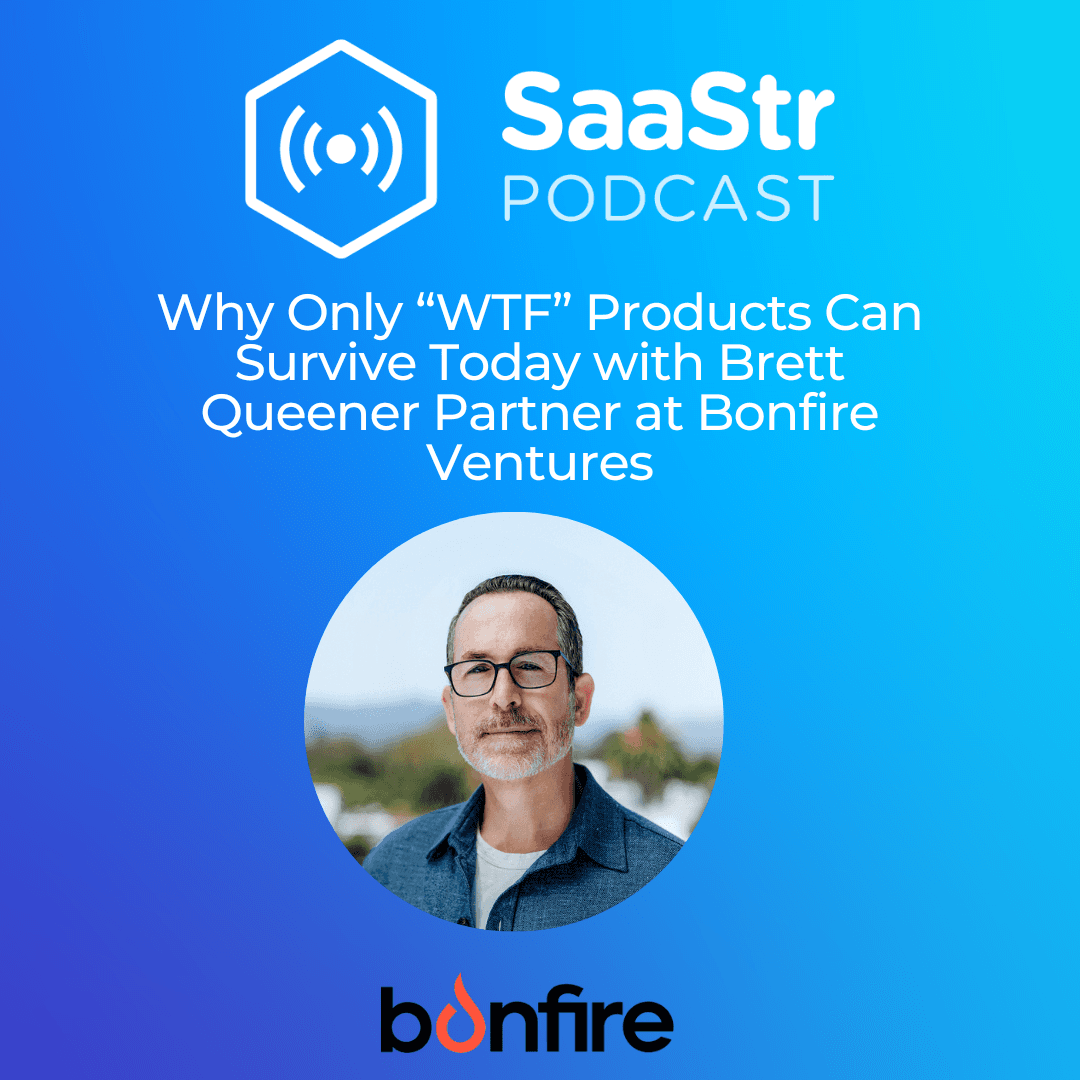
Podcast Summary: SaaStr 826 - Why Only "WTF" Products Can Survive Today with Brett Queener
Episode Overview In this episode of the Official SaaStr Podcast, Brett Queener, Partner at Bonfire Ventures, discusses the rapid evolution of the software industry, the impact of AI on product development, and the necessity for SaaS startups to innovate quickly and meaningfully. He shares insights from his extensive background at Salesforce and other tech companies, emphasizing the importance of differentiation and rapid iteration in today’s competitive landscape.
Key Concepts and Discussions
Historical Context
- Commoditization of Software: The tech stack has significantly commoditized, especially with the emergence of cloud services (AWS, GCP).
- Evolution in Product Development: Emphasizes the shift from annual product changes to needing updates every 30 days to stay relevant and competitive.
AI's Impact on Software Development
- Widespread AI Adoption: 40% of the U.S. population is using AI, and AI is responsible for writing 80% of code.
- Synthesis and Prototyping: The ability to quickly synthesize user problems and iterate on prototypes is crucial.
Founder's Perspective
- Understanding User Needs: Founders must deeply understand their users' pain points and the jobs they need to be done effectively.
- "WTF" Products: Successful products should evoke a reaction of disbelief from users, indicating their innovative nature. If users don’t say "What the fuck?" regarding a product's capabilities, it may not be innovative enough.
Product Iteration and Onboarding
- Rapid Iteration: The necessity for products to evolve rapidly to keep pace with user expectations and market demands.
- Importance of Onboarding: Onboarding is not just a one-time event but an ongoing process (“everboarding”) that adapts to continual product changes.
Agentic Solutions
- Reduced Software Friction: The goal is to minimize the software users interact with to achieve their tasks, leading to more streamlined experiences.
- Integration and Context: Using metadata and context to enhance user interactions with software, allowing for more meaningful integrations across different software solutions.
Differentiation Strategies
- Unique Insights: Success in the SaaS market relies heavily on having a unique insight that allows teams to iterate quickly.
- Talent Acquisition: Assembling a strong team that can navigate the rapidly changing landscape is essential.
Investment and Market Trends
- Seed Stage Investment: The shift in how seed-stage investors evaluate startups, focusing more on product capability and less on lengthy development cycles.
- Market Viability: Acknowledgment that many existing software companies may not survive the rapid pace of change, with predictions of 75% of current SaaS companies potentially disappearing.
Takeaways for Founders and Investors
- Adaptation is Key: Founders must remain agile and responsive to market changes, prioritizing rapid product iteration and strong onboarding processes.
- Customer-Centric Development: Engage with customers continuously to ensure products meet their evolving needs.
- Strong Go-To-Market Strategy: Clear messaging and a deep understanding of product value are essential for effective sales processes.
- Invest in Talent: Building a strong team that can innovate and adapt quickly is crucial for success in today's fast-paced environment.
Conclusion Brett Queener's insights highlight the urgency for SaaS companies to innovate continuously and focus on creating products that not only meet but exceed user expectations. The era of traditional software development is over, and those who can adapt quickly and effectively will thrive in the competitive landscape of software as a service.
Written by AI. May contain mistakes. Listen to the episode to check what was said.
Transcript
Automatic transcript. May contain errors.0:00Welcome to the official Sastr podcast where you can hear some of the best Sastr speakers. This is where the cloud meets. Up today on the Sastra Podcast. 40 % of the U.S. population are using AI. We've never seen this. 80 % of code is getting written by AI. Now, for large companies that have large legacy data code bases, it's a little harder. But you all are seeing that a lot of the coding is written by AI. And what's happening now in product development is what matters most is synthesis and prototyping. As a founder, how well do you understand the problem and the pain that your user has and the job to be done they want solved?
0:38How quickly can you synthesize, prototype, and iterate on that?
0:45Hey, everybody. It's Saster. Connect data, automate busywork, and empower teams like nobody's business with the one platform that grows with you every step of the way. Learn how Salesforce works for startups at salesforce.com slash SMB. That's salesforce.com slash SMB.
1:06Hey, everybody. It's Saster. FIN is the number one AI agent for resolving complex queries like refunds, transaction disputes, and technical troubleshooting, all with speed and reliability. See how FIN can deliver the highest resolution rates and highest quality customer experience at fin.ai slash Saster. That's fin.ai slash Saster. Hey, everybody. get excited saster ai london is this december december 1st and 2nd and we're on track to completely sell out with the playbooks for ai and b2b join 2 000 plus bi and ai leaders for two days two days of practical advice on scaling in the new year we'll have speakers flying in from open ai whiz clay intercom finn and all your favorite b2b companies including yours truly with harry stebbings and more doing our live 20 bc podcast it'll be fun all in the heart of london don't miss out.
2:00Get your tickets. You can still go. Go to podcast.sasterlondon.com. That's podcast.sasterlondon.com for a special discount just for you.
2:15Thank you for coming. So we're talking about the change economy. So just quickly, who's this guy? I'm a partner at Bonfire Ventures. We got about a billion under management. We write three to four million dollar checks at the seed stage traditional seed stage call companies have half million to million revenue think about your big institutional round before you'd go and raise a series a all we do is application software now one could ask as we ask ourselves what is application software in this age um if you think about how much has been commoditized in the platform stack. In 2003, when I was working at Salesforce.com, we took 60 cents of every dollar that we collect from customers and we bought servers and put them in our own data centers.
3:03So that was the first beginning of sort of the commoditization of the cloud at the lowest level before AWS and GCP. And basically so much of the tech stack is being commoditized as a service, especially inference and reasoning, which gets interesting. i'm on the board of some companies angel investor uh and before that was an early employee 70 at salesforce.com build out go-to-market build product launched the app exchange and a lot of their platform there um and then i ran a pre-revenue startup because i felt like it was a fraud only working for two billionaires that worked for larry ellison it was really hard which brings a lot of empathy companies now at 100 million in revenue but there were off sites of tears because I was in there running a playbook, innovators dilemma playbook that I'd use to sell to sales and marketing to sell to HR people.
3:53And this is our firm. We just raised a$250 million seed fund, which I wish somebody had told me the economics of venture capital before I got into it. But a$250 million seed fund means the return 10 billion net exit value for the LPs to get three times net. And when I got out of college, companies went public at 20 million in revenue. I don't know if going public is a thing anymore, but for those that are investors in funds, TVPI is interesting. DPI is really interesting because you're talking about 10 to 15 years. And it's the difference with Bonfire is, I don't know if it's the right model. We go deep with founders because this shit is hard.
4:33Most of my VC peers don't. They seem to be skiing or having a good time. They're doing something right. But when our founders struggle, we kind of like we feel the pain as well, but that's bonfire. And so I've been writing over the last year following chat GPT and its earliest incarnations and really thinking about how much, so much of software is fundamentally changing and our people recognizing all the changes. And what this presentation is really about is we'll get to like, How do you differentiate as founders? But what happens if product innovation is 10 times faster than ever, right? Saster, when it first started, you know, when Jason was doing this thing, it was the first vestiges of on-premise companies in existing category.
5:25There was a first winner in a SaaS version of it. But all these companies were the same, where they would have a dream force or whatever, a workday force, whatever. Once a year, somebody would be coming and be like, look at our amazing product changes. and the way in which we run these companies, full throttle across the entire organization. If we think about all the blogs that you read and all the shit about, here's how to go do this, it's all predicated in a world where your product kind of changes once a year. But what happens if your product changes every 30 days? Which, oh, by the way, if you're a founder in this room, your product has to change every 30 days.
6:00But what does that mean? No one has ever seen this pace of change. If you're sitting here as a founder thinking about differentiation and speed, et cetera. We have never, ever seen this pace of change in technology. I'm 55 years old. My first job, I got into business school because I was Jimmy Neutron. Company had DEC, VEX, green screens, and I was the first person to buy a PC. And I built a custom database on the old people in the room, like Access, Visual Basic, and Fox Pro, where I built a CRM system for sales forecasting. There was no email. I carved off a regional manager's hard drive on something called an IDO drive.
6:39I FedExed it to them. They updated, they brought it back, and that was the forecast. And that was amazing innovation.
6:4840 % of the US population are using AI. We've never seen this. And the weirdest jump in AI and OpenAI's business over the last two months is because they allowed you to do Studio Ghibli versions of yourself. Literally, if you look, they doubled their user count because people are really excited about doing Studio Ghibli versions, which is great. I love my neighbor Totoro, but I didn't know that that was what was going to drive it. 80 % of code is getting written by AI. Now, for large companies that have large legacy code bases, it's a little harder, but you all are seeing that a lot of the coding is written by AI.
7:24And what's happening now in product development is what matters most is synthesis and prototyping. As a founder, how well do you understand the problem and the pain that your user has and the job to be done they want solved how quickly can you synthesize prototype and iterate on that the other really interesting thing is agentic solutions fundamentally change this thing for 30 years i've had some degree of success but all the software i've associated is garbage because they're crud databases that somebody logs into enters information somebody else has a report that measures their performance but in doing their job and whatever they have to go do it doesn't help you do your job it just doesn't and it got worse in the cloud with rest apis when i was at siebel systems a sales rip would use one piece of shitty software now with rest apis they use 12 pieces of software and we don't understand why the hell they can't hit their number when they're alt tabbing through 11 pieces of software.
8:29MCP, if you haven't dug into it, is game-changing. It is destroying historic walled gardens from an integration perspective. If you're building an agentic solution, you're trying to think through, hey, what's the metadata I have in my database? What problem I'm solving? Because then at least from AI UX, I have context over this. but actually with MCP, your agent can actually talk to another agent for your user and have context for that. That's great. But it also means that somebody else's solution could talk to you or yours. So it's a prisoner's, it's a prisoner's dilemma, but, but every week, every month is an opportunity for delivering step fold innovation.
9:10Now what's really interesting, even at the seed stage, historically as a seed stage investor, somebody comes, they have a product. I got a team of five people. I've got two devs. Look at this wedge product I have, but if you give me money and then I get to my A and my B, I'm going to build this amazing product. Okay. The reality is with not a lot of money, you can build products. And I think you know what WTF stands for. What it basically means you walk into a customer who using all this shitty software and all their legacy systems and they see your product. They go, what the that can't work. Those are now possible.
9:46And if you build that, which I say you have to, If your product doesn't make people go, that can't work, keep trying. Because that's the bar for winning right now. And because these products basically have reduced the friction. If you think about most SaaS playbooks, if you've gone to SaaS three years ago, it'd be like, how to build a successful account management expansion and CSM team. In enterprise, how to insert SCs and have a value selling team. and I've got a piece of software that's going to help you build a business case that somebody's going to buy into, et cetera. And you had to raise all this money for venture capitalists.
10:26We had this burn rate and this magic number because you had to buy all. And as a founder, you're like, okay, raise the money. Okay. I figured it out. I'm ready to scale. I was kind of lying to you. And you go hire like 20 sales expensive people and you hope it pays off. And you're like, oh shit, I didn't have any pipeline for them. Oh, well, I'll get some SDRs to dial or email. Oh, that's not working. Why is that not working? Because you took a 22 relax, bro. and made them automate outbound emails, and nobody responded to that. So if you think about as a founder, so much of running a software grid last 10 years sucks because you have to have all these explainers in your business to your prospect.
11:03Why my product is going to help you solve your problem, how it's differentiated. Oh, I use clay with Octave, and this is a better message. And then I get in, and here's the product. And then you have a rep, and then you bring an SE, and then I have a CSM that's going to onboard. which was always ridiculous, but onboarding, even in SaaS, like your product's innovating, you want it to expand, but we're just going to have some poor CSM. They look at a cost center that somehow is going to hold up your customer. Like all of this is because when you delivered the product, it didn't deliver value. A customer would have to use your product and then go do their job.
11:37But if you have a product now with a what the fuck interface, they look at and they realize in their head, oh my God, this is going to immediately help me do this job that I need or do the jobs as people I don't need, you don't need all these explainers. What is there to explain? What is there an AE who brings donut who doesn't understand the product? The conversation is very quickly, hey, Mr. Customer, people like you tend to have these problems and these jobs are doing it. They suck. Yeah, let me show you how this does this. You don't need all... I'm the king of sales methodology. At Salesforce in 2003, I rolled out whatever the version of MedPick and value selling, and you had to go do it, and you had to do deals that wanted discovery and all that crap.
12:18Like the simplification in you running your business and the purity of running your business if you have this kind of product. As a founder, it makes somebody like me want to stop being a VC and go back into the game because I had to do it the hard way.
12:33And the ability to close deals in a few calls for six figures is something I've never seen. I have founders that have 10 people in their company. They walk to a customer, they show the product and the customer goes, hey, wait a minute. That's amazing. How much does it cost? $250 ,000. Oh, they go, okay, I want to go to this entire evaluation process. Now, I don't recommend this unless you're very bounded who you talk to and you know that you can solve this problem. It's not okay just to make your engineers work 24 hours a day because you commit to anything. The three-month out, which was a no-no, we would never do a three-month out.
13:08I'm not paying commission on an out. That's not recurring revenue. but the three months out, if you get them in and the users are in and you figure out onboarding is probably the most important part of what's changed in the SaaS playbook, you've just skipped three months of a sales process that people injected back into a sales process to handle risk. I don't know if this is going to work. How do I validate? Who can I talk to, et cetera? This is what's happening right now. Now you got to make sure your product works and it's not vibey revenue. So as a founder, while it's incredibly chaotic and oh my God, it's around the clock, it is if you have a product that's a what the fuck product that fundamentally solves a core set of jobs to be done for people that they resonate to, it is a great time to be a founder.
13:53You can tap brand new markets that you could never target before. There's an entire class of an SMB sector across many verticals that don't use software. Don't want to use software, just want to get their job done. You can't do paid search because they wouldn't even be looking for software. We have businesses that target one to five plumbers, contractors, etc. The team goes outbound with an agentic solution. They're adding a million and a half a month. and their magic number is like 1.5 and their cash burn is like 0.5 because the product does the work for the end users who don't want to... If you really think about agentic software, what are we talking about?
14:34Reduce as much software as possible that the user has to interact with just to get their job done. The ability to expand and become... I know if you're like Parker Conrad, I'm following the Parker Conrad compound startup model. Okay. Historically in SaaS, if you went to your venture capital, like, I'm doing product A, and they're interested in product B, it would be like, listen here, Sonny, you got to stick to your knitting. You need to dominate this one sector right now. You don't want to spread out your R &D team and get too distracted. And then maybe when you're series B and C, we'll go after product two.
15:06In fact, Clayton Christian's innovator's dilemma is all about how you move from product A to product two. The reality is that you're not building screens. If you have the metadata and your agentic interface understands the context, you can do it in a month. And what's really interesting because customers don't want to use multiple agents. A salesperson, an individual functional role does not want to use seven agents. No sales rep wanted to use 11 solutions. Just like on your phone, sometimes somebody, you know, you get texts, they work, but your weird friends on Android, it doesn't work with texts.
15:40So they send you a WhatsApp and then your Facebook. What the fuck? Just give me a unified feed. That's what they want. And so if you are successful, your customers are going to come to you and go, hey, can you do this? Hey, can you do this? And you're like, I don't know. Let me try, which sounds crazy. Now don't do what a lot of startups do is dev actually does. It doesn't tell success or sales and marketing releases it to the customer. The customer's like, oh, it's great. What does it cost? You're like, oh, I'm a pricing and packaging person, but you can do this. You can build more capital efficient businesses.
16:16And the last one is interesting, right? You can push your team to go super hard. The weird thing happened in the last 10 years of startups where you thought you could leave a large company, make the same money at a startup and get all the perks and have work life balance. That's a joke. Startups are war. You know, That's why at Salesforce, I gave new managers and hires two books, Sun Tzu, The Art of War, and Drive. And you could talk about work-life balance, but we know what we're trying to do is hire people that make horrible work-life balance decisions. And they can't imagine not, you know, spending more time making your work.
16:54And you can do this. You don't want to be a complete ass, but like the expectation is we're going to go hard. You're going to be in the office. We're going to iterate. Because the iteration loops are so fast in this new era. It's just not going to work otherwise. Now, what is differentiation? Now, are there technical moats? Were there technical moats in regular old SaaS?
17:24I guess in a world in which you're building a lot of screens, there are technical moats because you needed capital to build all these screens and have all these devs. You could say you have a broader product that no one knew how to use. But like, really, did you have technical moats? and the hardest thing as an investor is we're raising this$250 million fund, and I published an article that said 75 % of all application software companies that you see today are going to disappear, and 50 % of all application software categories are going to disappear. And then our investor's like, well, why are we going to give you$250 million?
17:59Oh, we'll figure out the right ones. We'll see. So you don't need large team of devs to out-code others. stop investing at the infralayer. Like the people that were investing at the infralayer in the last year, like two years ago, like, Oh, it's just a wrapper. We're building core things at the, at the infralayer to make the wrapper better. And then, you know, Claude and perplexity and, and then, uh, opening, I just built that. Like, don't do that. Um, MCP is something really to study at. It is a pretty, it's a prisoner's dilemma, but it's absolutely the way it's going. Now, what I will say, is that I do believe metadata matters.
18:40Like if you don't have enough metadata around the problem you're solving such that the context your agent provides to solve a job is more interesting than what somebody could just do with an internal set of tooling, use Glean or, you know, Anthropics partnership with Databricks, you're done. So I think metadata is interesting. Proprietary data, I think if you're in a vertical where you have enough specific data, enough customers that you actually inject good old-fashioned ML, good old-fashioned AI, which edited AI, such that what you recommend, especially if you're recommending math, if there's math involved, I think it could work.
19:20And the last one is interesting. The second R, what's the second R in ARR? Anybody want to say, what's the second R? Recurring. Hey, Bobby. the second r can no longer be taken for granted i mean it shouldn't have never been taken it for granted right we saw companies all the sales tech tools that went from 175 nrr to 70 grr in a year we shouldn't have taken this all for granted but like like what are you going to do and so what i will say when we look at startups is that this is what trumps everything the company raised money yesterday, I think Jason said, it's one of the best teams he's ever said.
19:58When somebody went to look at an owner.com, they went, we're going to build a better restaurant tech software for restaurants. They probably were like, what? That sounds hard. But if you go look at the team that they assembled and the way that they execute, they brought an A-plus team and an agentic sort of operational way to crush. I think they raised it$1 or$1.2 billion yesterday. But what has always been true, honestly, for the winners in on-premise and SaaS, and now AI SaaS, we call it is, do you have a unique insight that you can get the best talent to iterate the fastest on in others? Or you don't.
20:37That's your differentiator, especially at the application layer. And so you have to have a unique insight to a problem, and you need to sit in that problem better than somebody else. I call it 12 by six. Was that 12 hours a day, six days a week? People need to rest on Saturday or Sunday. You have to out-deliver the jobs to be done for your customer faster than someone else. Context focus is kink. Vertical as a founder is five times easier to go do than horizontal. It's very hard to win in the horizontal space. You need to be an unbelievable marketer. You need to have outsized market energy to win that battle.
21:25And I think what is true in SaaS, and it is true now, is I've always said that I think the only long-term differentiation is customer love. It's really at the application where which remote is. You need to turn that into a movement. Now, it requires new operating motions, right?
21:46This is not 80 % of the playbooks that have written over the last 10 years. Take those and chuck them. Which is, you know, Bobby and I would sit down and say, okay, what are we doing for Dreamforce? We got a big announcement at Dreamforce. We're changing the industry. There's a crack in the ground. The world has changed. Here's our new software. And then we'd all organize around this. Now, what we would launch wasn't actually GA. We had a rule where like, at least it was GA in the next six months, we can announce it. But most companies think about once a year. If you're delivering innovation, every month.
22:21Now what? If we're honest with ourselves, most companies suck and go to market explaining across their team, what is it we do for who that they give a shit about better than somebody else? Like it sits in some deck and some PowerPoint deck that maybe somebody put in like seismic that no one can go fine. But if you do this every month, now what? I was sitting with whatever AI native companies that's off to the races, went from zero to 20 million in 18 months, and I'm in their Slack feed and dev is just releasing shit like every seven days. Customer success, like, is this live? Marketing's like, have we told anybody about this?
22:59Does this work? What's alpha? What's beta? What the hell does GA mean anymore? It's complete chaos. And I try to remind them that like, just because you can ship quickly doesn't mean it's a good thing. Because if you ship something, like if a tree falls in the forest and no one's there and they don't understand, And they don't see it to the tree actually fall, which is humans could only absorb so much rate of change. And so orgs are fundamentally rethinking how they run their business. The world in which I had product and design and dev and QA, where we thought that dev and QA resources were expensive.
23:38So that product and design would have infinite time to come up with the perfect PRDs and MRDs. so we wouldn't waste, you know, devs' times. And dev would spend a lot of time trying to figure out t-shirt sizes because that somehow made us better because that's what Jira said. Those days are over. These orgs are getting munged together. And I'd say our most leading edge companies like design and product is just building prototypes. There's no doc. There's handing prototypes to dev. Success or support that we moved out of dev normally is back in dev because the iteration loops to hear from support, getting over to dev, to figure out what's working and not working, especially using AI, like the stuff you do today kind of doesn't work.
Read the full transcript
24:22And like in three weeks, it does work. Comes back in. And so what we're seeing is much smaller senior dev teams with more autonomy. Product has to use AI. The really good thing, what is AI really good at? Synthesizing stuff, right? So like if your product teams aren't leveraging AI to figure out like what the hell is going on from a research perspective and what we go do, you should rethink you need time for spike periods because there's stuff that people ask you to do like in the old world last 10 years nobody ever from a product side put an mrd together asking themselves can my dev team build this they would look okay of our dev team do i front end and back end and skill set etc but no one was coming up like here's a use case that i don't know if it's ever been done before that was never done it was in a known world it was just a matter did i have the resource and prioritize their stuff that customers are asking you to do.
25:12You actually don't know if you can do. So you got to leave time for spikes. Now, you can't have chaos. I don't care what you call it. But in your organization, at least understand what you're calling GA, alpha or beta and what your release frequency is, whatever the definition is fine, right, but at least define it. Or there's certain stages, but you can't just have stuff being shipped at different versions, et cetera. Even though in the early, we're in this weird period for the last year where customers are okay with half finished software. They get inside with you. They're kind of interested in working with you, et cetera.
25:47Those days are going to end. What I will say is very interesting having run product at Salesforce, which was we'd always say our customers are shitty product managers. They don't know how to build software. They can tell us their pains. And you get all these long lists or feature requests that you have and you'd look at it like, oh, like some bad episode of A Few Good Men. Like, they can't handle the truth. They're not product managers. And you'd prior, oh, you don't really need that. You don't really need that. What is interesting now, in a world which you're not building screens, but you're solving problems, as long as you're smarter customers, at least, they're actually very good product managers.
26:22They're giving you use cases or pain points that I want you to solve for, which at the purest abstraction, if you're building an agentic solution, is what you're building. This is a big one. Most software companies are horrible at this, right? They're just terrible product marketing and messaging. And the weird thing is, if they're terrible product marketing and messaging, the go-to-market team is inconsistent. And what has always been true in software and is true today is, if you can't explain to a buyer why they should consider are looking at you. Why this? Why you do it better than somebody else and why they need to do it now?
27:03Good luck building a repeatable sales process that works. And so we've talked about jobs to be done as a product management construct. I was a product manager. I've understood my users and I don't want to just build like screens and tabs. I have a job to be done. So I build a steel thread. I think it's an interesting framework to think about across your company. Salespeople are never talking about jobs to be done. Marketing is not talking about jobs to be done. But in the end, this is what this is. What job is important to you that you would like us to do? Can we do it better, etc.? And then the question is, is how do you iterate it?
27:36And I have some companies where I make them take a day off each month. If the release cycle is monthly, we take a day off and we refresh. Now, if there's no adjustment to that messaging, what is it we do for you that you actually give better than somebody else, then whatever. We don't tell anybody about it. It doesn't matter. Like it either hits that bar or not. What I will say is you need to invest disproportionately in product marketing talent. Most software companies, product marketing organizations are horrible. We don't know what to do with product marketers, et cetera. Like you need a kick-ass product marketer.
28:15And they need to be able to iterate very quickly. Now, the good news is that AI really helps. In the old days, what would a good product marketer do? They'd listen to four calls. They'd be like, oh shit, that's not working. We need to adjust the messaging and the rest of it. And they create a deck and they put it in seismic and no one would look at it. That's great. But what is AI really good at? AI is very good at listening to a thousand calls and figuring out pretty quickly what's resonating and what's not resonating. More importantly, there are platforms on the front end where you actually create systems of truth given all your content.
28:45What is your core ICP? Who are you targeting? What's the value prop for all the people such that when you execute at speed, so if you go use an AISDR, you at least can inject it in there, right? Reason a lot of times the AISDRs don't work is you've automated a 22-year-old Laxbro, right? Because marketing for the old people in the room, email marketing used to sit in marketing when they care about messaging. They became with outreach and sales loft that allowed you to spam people who hadn't opted in and they do it in less than 49 email segments so you don't violate can't spam laws. But we gave messaging over.
29:17You go to a company and be like, hey, who writes your emails? Jack over here. Who's Jack? Oh, Jack was the second. He's the cross captain. You know, and so-and-so. Ziva, like, you know, like that week. And so we're like, oh, outbound doesn't work. It doesn't work or calls don't work if you don't have context. Rethink your sales process. Look, I still believe deals are won and lost at discovery, but you got to get to the product as quickly as possible. your products either do or don't better job. Consider the couple months out process. I think the world of an AE and a separate SE are gone. I mean, unless like you're selling at the infra level and it's super technical.
30:02Like I can't imagine an account executive who doesn't fundamentally understand the product. And you know, across your companies, those people, your AEs that do really well, understand the product. And in this new world where the product is the job to be done, if they can't talk to the product and translate that pretty quickly, I think you're going to struggle. Really hard-won companies are wrestling through now. What is a trial? What is onboarding?
30:32Right? Are you activating? Who's doing activation? When does activation occur? And what I will say is, there's two functions that we think about in SaaS companies that we've under-invested in. we put cheap resources in and that is what i would call an enablement right where we think we're bad sales and mark people going to die but it's not true if you run a good enablement org um and onboarding onboarding with oh there's some junior people they do onboarding they click the thing on etc etc etc in this world where your product's value prop is going to change six to 12 times a year
31:11onboarding reps and most onboarding programs focus on the first like 90 days oh do they understand our product in our playbook and are they ramping but if your product is going to change five to six sites from day 91 to 365 what then so it's it's more ever boarding it's not water boarding it's ever boarding and then for the sash solution for the ai solutions i would say onboarding is one of the most strategic things to think through anybody here are you superhuman anybody were you early one where Rahul onboarded you you're like what the hell how's this sounds like number I couldn't use the product Rahul the CEO had to onboard me he got on but I understand why he did it because it was a personal utility and I either sort of grokked it quickly or I was going to churn and what's very interesting for the agentic solutions you have to understand is at a user level this is a very personal decision they're looking at your product as if they hired a dedicated assistant who sat by their side and everything about the company was there to help them work 24 by seven never went on glass door and called them mean right that's how they are going to think about your software so just like if you think about your own journey or your spouse's journey when you started using gpt and then you're like oh and then you there was a and then there was context you could create projects and then it remembered your voice and then when you went to deep research you have these like moments of like oh shit and that same thing occurs from an onboarding perspective so one of my organizations actually hired somebody from apple who was involved in their team like it's funny when you get a new iphone it's the same stupid phone with the battery now lasts right but that box is pretty cool you know like you when you open up that you're always like oh when i open this box this is a little strip it's a little magic fairy dust you need to think about onboarding as a really important thing And now, by the way, what about everboarding them?
33:02If your partner's going to charge seven to nine times a year, how is the customer going to know that? Don't tell me the CSM. It's not like, good luck with that one. So there's onboarding. Stop thinking of support and self-service as something different. The thing I hate, which is, oh, I've got this great agentic solution, Brett. Okay. Like if it's not working, there's a bug. What do I do? I'll go over to this tab over here. their support and I've got like some chat bot over here. What the hell? It's the same user. Why can't I just ask the agent I'm already talking to? Why do I have to go over here?
33:37That makes no sense, right? Like let's talk about deployment implementation. If you solve a given problem for a customer and you've done discovery, you've captured AI what their problems are. You understand the schema of your application. Why can't it onboard itself? Why can't I have an agent be like, okay, based on this information, your company done it. Yep. That's correct. Correct. Okay. 80 % of configuration is done. Like that. Don't say that to all my SI friends out there, but AI is coming for the multi-billion dollar SI industry. Customer help is not usage-based. We're always stunned. Oh, I had this churn.
34:18It was such a surprise. Their usage was super high.
34:24but i don't know could be that they had to use your product for three hours to get value out of as opposed to like two minutes it's outcome based did they ever achieve their outcome or they didn't
34:37and yeah i hate account managers somewhere in the hundred farmer model i always said i hate it companies deploy it turns into an ibm sales brass where there's seven people involved in a deal and they can't figure out their magic number and the rest of it. No account managers. So this is a great time to be a founder, right? Which is you can actually deliver an amazing product that actually delivers a lot of value to customers, which has not been true for 30 years. It just hasn't. You can make people's, you can make them much more successful at their job and you can automate a lot of the low level grunt work.
35:19So humans can do what they're generally good at, higher level work.
35:26You know, but you have to rethink how you run your company and speed in iteration. And you need to think about how are you going to run this business when you're innovating 12 times a year? you didn't create a startup to run a small business let salesforce help you connect data automate busy work and empower employees on the only platform you will ever need no matter how big you get with smarter ai and built-in collaboration tools like slack which we use and you use the sky is the limit learn how salesforce works for startups at salesforce.com slash smb that's salesforce.com slash smb
From the publisher
Brett Queener is Partner at Bonfire Ventures, a $1B AUM seed-stage fund writing $3-4M checks into application software companies. He was employee #70 at Salesforce.com, where he built go-to-market, launched the AppExchange, and helped scale the company from its earliest days. Previously, he worked at Siebel Systems (the fastest-growing software company of its era) and ran a B2B startup (SmartRecruiters) from pre-revenue to $100M ARR. He writes about the changing software industry in real-time at his Substack.
He came to SaaStr Annual + AI Summit for a deep dive on AI and Product.
This episode explores the evolution of application software, the increasing pace of product innovation, and the new challenges and opportunities faced by founders. Key topics include the commoditization of tech stacks, the impact of AI on software development, and the importance of rapid product iteration. Learn how to build differentiated products that stand out in a fast-changing landscape, the critical role of onboarding in customer success, and why staying nimble is more essential than ever. Whether you're an entrepreneur or an investor, this discussion offers valuable insights for thriving in today's tech-driven market.---------------------
This episode is Sponsored in part by Salesforce:
Connect data, automate busywork and empower teams like nobody's business with the one platform that grows with you, every step of the way. Learn how Salesforce works for Startups at salesforce.com/smb.
---------------------
This episode is Sponsored in part by Intercom:
Fin is the #1 AI Agent for resolving complex queries like refunds, transaction disputes, and technical troubleshooting—all with speed and reliability. See how Fin can deliver the highest resolution rates and highest-quality customer experience at fin.ai/saastr.
---------------------
If you're serious about B2B and AI, you need to be in London this December.
SaaStr AI London is bringing together more than 2,000 leaders and founders for two days of practical advice on scaling into the new year.
We'll have speakers flying in from OpenAI, Wiz, Clay, Intercom, and all your favorite SaaS companies, including yours truly with Harry Stebbings for a live 20VC podcast. It'll be fun, and it's all in the heart of London.
Don't miss out: get your tickets with my exclusive discount by going to podcast.saastrlondon.com
---------------------
Hey everybody, the biggest B2B + AI event of the year will be back - SaaStr AI in the SF Bay Area, aka the SaaStr Annual, will be back in May 2026.
With 68% VP-level and above, 36% CEOs and founders and a growing 25% AI-first professional, this is the very best of the best S-tier attendees and decision makers that come to SaaStr each year.
But here's the reality, folks: the longer you wait, the higher ticket prices can get. Early bird tickets are available now, but once they're gone, you'll pay hundreds more so don't wait.
Lock in your spot today by going to podcast.saastrannual.com to get my exclusive discount SaaStr AI SF 2026. We'll see you there.