
In short
Episode Notes: SaaStr 834 - Why OpenAI Doesn't Pay Sales Commission (And Why It Works)
Podcast Overview Title: The Official SaaStr Podcast: SaaS | Founders | Investors Episode Title: SaaStr 834: Why OpenAI Doesn't Pay Sales Commission (And Why It Works)
Guests
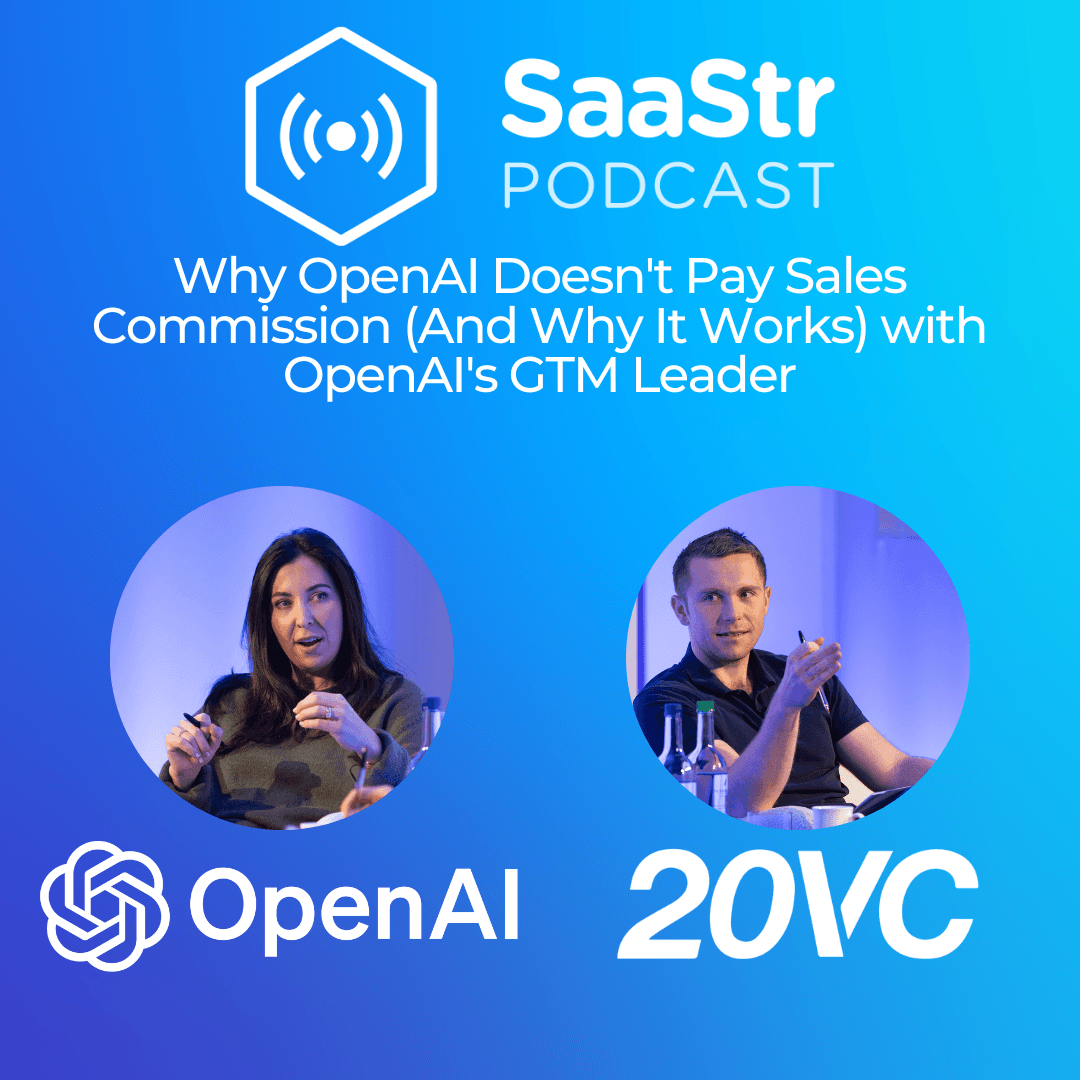
Maggie Hott (OpenAI GTM Leader) and Harry Stebbings (Founder of 20VC) Description: This episode explores OpenAI's unconventional approach to B2B sales compensation, delving into the implications of not paying sales commissions and what this means for the sales culture and performance.
---
Key Themes and Insights
Unique Sales Compensation Model
- No Sales Commission: OpenAI does not pay sales commissions, a practice also seen in early stages at Slack.
- Cultural Shift: Eliminating commissions fosters a culture where employees focus on company success rather than individual gains. It encourages collaboration and a collective mindset among employees.
Hiring and Interviewing Sales Talent
- Challenges of Hiring Salespeople: Founders often find sales hires the most difficult due to their ability to present themselves well in interviews.
- Key Qualities to Look For:
- Humility: Candidates should show self-reflection and ownership of their past performance.
- Ego Management: Successful candidates, like “Molly,” exhibited a willingness to take roles that may not seem ideal for their experience, emphasizing a belief in their potential.
Life Lessons from Personal Experience
- Life-Altering Diagnosis: Maggie shares her experience with pancreatic cancer and how it reshaped her perspective on compassion, high expectations, and self-advocacy.
- Work-Life Balance: Balancing work and personal life, particularly as a parent, has led to a more intentional approach to both work commitments and family obligations.
Identifying Promising Companies
- Choosing Companies: Advice on selecting companies focuses on joining "rocket ships" rather than fixating on titles or positions.
- Creators vs. Disruptors: Differentiating between companies that create new categories versus those that disrupt existing ones informs career choices.
---
Practical Advice for Founders and Sales Leaders
- Sales Culture Development: Cultivate a supportive environment that encourages team members to help one another, focusing on company objectives over individual commissions.
- Pilot Programs: Emphasize the need for executive buy-in and a structured approach to pilot programs. Piloting should not occur without top-level endorsement and understanding of success metrics.
- Scale Quickly: To ascend within a company, be helpful, maintain a focus on collaboration, and prioritize being a resource for others.
Future Outlook
- AI in Healthcare: The discussion highlights the transformative potential of AI in healthcare, focusing on streamlining drug development processes and improving patient care interactions.
- Emphasis on Women in Sales: Maggie calls for increased representation of women in the sales field, highlighting ongoing challenges in achieving gender balance.
---
Major Takeaways
- The absence of sales commissions can create a healthier, more collaborative work culture.
- Humility and a willingness to learn are critical attributes for sales talent.
- Personal life experiences can significantly influence leadership style and priorities.
- The future of AI holds immense potential to revolutionize healthcare and other sectors, underlining the importance of innovation and responsiveness to market needs.
---
Conclusion Maggie Hott's insights into OpenAI's sales approach and broader themes of leadership, personal growth, and collaboration offer valuable lessons for SaaS founders and sales leaders. The podcast invites a rethinking of traditional sales compensation models and encourages a focus on team success, nurturing talent, and driving innovation.
Written by AI. May contain mistakes. Listen to the episode to check what was said.
Transcript
Automatic transcript. May contain errors.0:01Welcome to the official Sastra podcast where you can hear some of the best Sastra speakers. This is where the cloud meets. Up today on the Sastra Podcast. How quickly do you know if someone's not any good? About a week. About a week? About a week. Oh God, that's an awkward first week. Yeah, you start to have the inklings. You know right away if someone's got it or not. And here's the thing, with interviewing salespeople, and I hear this from all of my founders, every single founder says salespeople are the hardest to hire because they're so hard. I think that salespeople show up so well when they're interviewing that it's really hard to tell a good one from better.
0:43You have to be a really skilled interviewer. And I actually think one of my superpowers is picking great talent. How do you do that then? If someone is a great seller of themselves, which a lot of people are, how do you unpick true quality versus facade or appearance? The first thing that I look for that sends off the absolute red flags is blame. So I'm okay that people lose. I'm actually okay if someone wasn't the top rep, if they were the second or third or fourth. But what I want to know is why weren't they the top? Do they have humility? Are they self-reflective? Can they say, you know what, Harry, he outworked me.
1:15He outperformed me. He was better at discovery. Those are the types of things that I want to hear in the interview cycle. And more often than not, sellers tend to blame. When you dig into why did you lose a deal? They blame, you know, the competition. They blame the product. They blame something else. And what I'm actually looking for is, did they own up to that mistake and what did they learn from it? And that's a really big signal.
1:41Hey, Sasser, imagine having agents for every support tapped. One that triages tickets, another that catches duplicates, one that spots churn risk. That'd be pretty amazing, right? HappyFox just made it real with Autopilot. These pre-built AI agents deploy in about 60 seconds and run for as low as two cents per successful action. All of it sits inside the HappyFox Omnichannel AI First support stack. Chatbot, Co-Pilot, and Autopilot working as one. Check them out at happyfox.com slash saster.
2:13Hey everybody, Saster Annual will be back May 2026. The world's largest SaaS and AI gathering for executives. Just as last May, we hosted 10 ,000 attendees with 68 VP level and above attendees, 36 % CEOs and founders, and 25 % were AI-first professionals. It's the very best of S-tier attendees and decision makers that come to Saster Annual and AI Summit each and every year. But here's the reality, folks. The longer you wait, the higher ticket prices get. They're cheap now. They're cheap, so just get them. Early lock in your spot today. Use my code Jason100 for exclusive savings. Get your tickets at podcast.sasterannual.com or just use code Jason100 when you check out.
2:54See you there. Sastra Annual and AI Summit 2026. It will rock.
3:03That's quite an entrance, isn't it? I feel like I'm at a pop concert. You see now I'm so old before my time. So we were talking, we had dinner last time. We're doing that. What's a boring start to any conversation you can have in this regard? And it's like, tell me, how did you get into sales? So we're going to start that. we're actually going to start with something really quite personal if that's okay um which is last year when you're actually in london you were diagnosed with cancer and you got the call in london and i actually wanted to start with that i know you well enough so i think i can how did that experience change how you live and how you lead yeah so i'll start with i'm cancer free now But a little over a year ago, I did a preventative MRI just for fun, and they found a suspicious tumor on my pancreas, which turned out to be very early stage pancreatic cancer.
4:05Never the thing that you think that you are going to get when you are, you know, a mom and in your mid-30s. So it's completely changed who I am today as a person, as a mother, as a leader in quite a few different ways. It has been probably the greatest and the harshest teacher that I've ever had. The first is I approach life with a lot more compassion. Now, you never know what someone is going through. So I was here in London. We were doing essentially an OpenAI world tour. We had these huge conferences, our very first ones in New York, London. San Francisco. We were just going back to back cities.
4:43And in the middle of this, I was diagnosed with pancreatic cancer. And then I had to go up on stage the next day and speak to a room full of executives such as this. So you never know what someone is going through. And I've now realized that as I go through and lead. However, kind of maybe the more interesting thing here is I have no tolerance for mediocrity anymore. When you're stared in your life with something like this, which is probably one of the worst things I will ever go through, and then I was able to beat it, it created this intolerance for people who do not give everything their all.
5:22And being at OpenAI, being in just this world and this generation of AI is such a privileged place for all of us that I just don't have time or patience for people who are not going to give it their all. It also taught me self-advocacy. So without getting into all the details, the reason that I was able to have a very successful surgery is because I advocated within the American health system. I realize you guys have a different health system out here. It's not great in America, and I had to advocate like hell for myself. The other thing that I learned is that we're all replaceable. I rushed back to work a month after surgery.
5:58Even Stanford was like, no one's ever gone back after a month, but we had a new chief customer officer at OpenAI, and I wanted him to know me. He'd already been there for a month, and I just needed to make sure he knew me. And in hindsight, it didn't matter. It actually compromised my recovery because I rushed back. And so there There were so many different things that I learned from compassion to very high expectations to advocate for yourself. And then also, you know, set up your teams for success and delegate. But you are still replaceable at the end of the day. Speaking of replaceable, I think Jason's trying to replace me with an AI every single day.
6:38I'm waiting for the day I'm turning out to a podcast. He's like, no, don't worry. Quality is here. Don't worry. across your career, you've done Slack, you've done Webflow, you've done OpenAI, and you've picked companies at a moment in time where it's non-obvious to the world, but it's obvious to you the trajectory, which is brilliant for your stock options. I'm thrilled for you. But the question then becomes, how do you consistently pick which companies to join at the right moment in time? And if you were advising people today on the same, what would you advise lesson. Yeah, there's a few elements to this.
7:12The first is a lesson that I learned from Kevin Egan. But Kevin Egan, for those of you who don't know him, he's currently the CRO at ClickHouse. He was the CRO at Atlassian. He was the VP of sales at Slack, at Dropbox, at Salesforce. He's had a pretty incredible career. And he gave me a lesson early on when I was working with him, and that was pick the rocket ship, not the seat. Because if you get on a rocket ship, your career will go places that you could have never imagined. But if you're so fixated on picking, am I in the captain's seat? Am I in the driver's seat? It just doesn't matter. And because when you take a big step back, what people want to know is they want to know what you saw, what you built, what you learned.
7:57They want to know how to drive that rocket ship. And you don't learn how to drive a rocket ship if you're sitting on the outside of that rocket ship. You learn nothing. It's so interesting. I remember when you joined OpenAI and I said, what title are you Maggie this is fantastic and you're like well we don't have titles and you had great titles before I remember being like well what do I put on the podcasting I well just like GTM and it didn't faze you no no and um what's funny about that is when I went to open AI so many people in my network said why would you go to this small company it was go to market was only seven people and I was going from leading an org of 50 people at webflow as a senior director to being an individual contributor at OpenAI.
8:39And many VCs, many mentors said, don't do it. Why would you give up this great management career? But you have to believe and you have to bet in yourself. And then the other thing I look for when I'm looking at companies is two categories. Are they creators or are they disruptors? So if you look, for example, at Slack or ChatGPT, those are category creators. Now, maybe Webflow or my first company, Eventbrite, that was a disruptor. Clay, Haroon, who spoke earlier today is a good friend. That is a category disruptor. And so as I'm thinking about, do I want to go to a creator or to a disruptor? There's a couple of different things, the elements that go into it.
9:15Creators, can they build a product that will move fast enough that people will love and people will jump onto? Because if you are a creator, you better bet if you're a good creator, there's going to be competition. People will come after you and incumbents like Microsoft and Google will also probably go copy you. If you are a disruptor, you better have a good enough product that is leaps and bounds ahead of everything else in the market and then you have to move fast before the disruptors or before the incumbents go and catch up there's a brilliant quote from alex rampell at andreessen and he says can the startup acquire distribution before the incumbent acquires innovation i think it's very prescient speaking like picking companies though one thing that's attractive for salespeople is commission people I don't mean to read, people say that salespeople are coin operators.
10:07You have commission at OpenAI. Can you just talk to me like, should founders listening here go, we don't need commission either? Is this a special case? And how do you reflect and advise them given no commission? Yeah. Yeah. We also had no commission at Slack for the first few years as well. So I'll only talk about this in terms of building early stage companies, because I do think you need commission as the company gets larger. It's a very different type of a profile that you're hiring for. What I love about no commission, I realize this won't work for everybody, but it creates a different culture.
10:41It creates a culture. Let's say you have commission. Let's say every hour that you spend closing a deal or working with customers is money in your pocket. Every hour that you spend onboarding or training someone else or doing some other project is quite literally money that you are not making that you could have been making. So it's at a true cost to yourself as an individual if you are doing other things to benefit the company versus benefiting yourself. So with OpenAI, with Slack, many other, Airtable, Figma, New Relic, there's tons of companies out there that all started with this model of full salary.
11:18And it's a normal living salary like you would give to any other product manager, marketer, engineer, and decent equity for the first earlier hires. you all of a sudden are incentivizing them to do what's right for the company and not right for themselves. At OpenAI, we reorg all the time. We pivot all the time. We're always doing new things, shifting teams. And I never have to worry of, oh, if I go help this person out over there with this really important initiative that we're doing, is that actually going to be money out of my paycheck? Totally understand that. Is that only applicable to OpenAI because you're OpenAI?
11:53Because you know that your stock is getting more and more valuable with every day. or can that be applied to a startup in london where they don't have commission i think it it's nuanced it depends on how much money they've raised right if you have not raised a lot of money and you can't pay everyone you know a normal competitive salary you probably need commission on top of it i mean there's i advise a lot of founders and there's founders that are just paying insane amounts of money with commission and that's also not scalable all of a sudden you You can't have one of them. Perret made$4 million a quarter.
12:25It's like an SME prep because the commission plan was so high. That's also not scalable. And that's going to be really hard to reverse that. Whereas at OpenAI, at companies that maybe don't start with commission and maybe start with a management-based objectives plan. So MBOs is what I call it. Maybe it's, you know, you close 10 logos, you get this amount of money. There's other ways to factor it in that aren't just pure you get 5 % of every deal you sell. And all of a sudden, you're going to have a lot more of a collaborative culture. I've talked about this a lot on LinkedIn, too. I believe that OpenAI and Slack and Stripes culture, that kind of these leading pioneer lighthouse companies that all started with no commission, they're all known for having the best and the brightest talent.
13:05And so much of that comes from the people that they hire. And so, again, I think that to kind of wrap that up, the early stage mentality of the builder is maybe not quite as money motivated as someone who's going to a Salesforce or a Google or a Facebook, you know, much later on in their career. A million and a quarter. Yeah, isn't that insane? Not both. It's outrageous. I know. I'm like, I should quit my job and go for it. They're kidding. Did they do it for many quarters? They're retired after two. Their most recent quarter. That's all right. I'm still top of my for an LPO. what come up in the years i'm not gonna say i wasn't expecting that well i mean how do you stand out inside a company make four million and a quarter is a freaking answer there um jokes aside you have continuously risen inside companies very quickly if you were advising people today on how to scale quickly once inside one of these companies what would you say is the cheat sheet hit list for how to scale fast inside a company.
14:08Yeah, this one's pretty quick. The single most important thing that any of us can do is to be the most helpful person possible, to have no ego and to be helpful. So I always want to be that person that if a cross-functional partner needs me to help execute a strategy or needs me to be on their interview panel. Just today I was asked, will you do the leadership chat for the SDRs that we're hiring. I don't have to do that. That's time out of my day, but I want to be the most helpful person. People remember how you made them feel. And if you inherently are helpful to them, you will make them feel good.
14:43I'll share a quick story here. You've probably heard this before, but my very first day at Slack was 2015. I was the first seller hired out of headquarters and Slack had a huge hack and we thought it was going to take the company down. What we needed, what Stuart needed is for someone to be on the phones, on the front line for all of the customers that were hacked. And so I raised my hand. This is literally day four, March 23rd, 2015. And I was like, I'll do it. So we emailed all of the customers that were hacked. I won't share how many, but these were, you know, some of the largest companies in the world because that was what the hackers were going after.
15:18And I was the very first phone call of basically, you know, Fortune 10 companies being like WTF. We just got this email thing to call because you were hacked. And that was me. And you know what? The exec team loved me for it. And I would say I had a pretty incredible career at Slack. You're like, my bad. Sorry. But again, it goes back to be helpful, right? Just like do things for other people. Now you also have to learn boundaries. That's something I really struggle with is saying no. But be helpful. Always think what can I do for others and it will pay back in dividends. you know how i build trust in people how i'm telling me i see them work incredibly hard and people know that i talk about 996 but then they meet me and they're like oh he's not joking no you're like 7 7 15 yeah absolutely that's why i'm in therapy um and other reasons do you agree with me in that or do you think you can have outperformance excellence crushing with balance what do you mean by balance
16:24crushing family as well so i'm a mom to two kids i have two little girls um they are the single most important thing to me in in my world they we just spent a week in london together they are so incredible i i wish i was there more for them but i am there enough that they will always remember that I will never miss a dance recital. I will never miss next Monday. We have a two o 'clock singing performance. You know, I'm going to have to leave the office at one o 'clock, but I'm not going to miss it because in the grand... Do you have to sing? No, no, no. My daughter, it's Disney pop princess songs.
16:56Oh, we're all grateful for that. I'll send you a recording. Five-year-old kindergarten class singing pop princess songs is actually going to be the cutest thing in our little uniforms. I will not miss those most important moments in life for my kids, for my family for my friends however what that means is most days i will work seven days a week and i will work bizarre hours and if it's you know tuesday night watching tv with my husband unfortunately that just doesn't happen like we i leave the office by 4 30 every single day but you better believe i'm on from 7 30 to midnight every single night and i think that's just the world we live in and that is the choices that you know we i think you all probably wouldn't be here if you weren't in the same kind of hustle, sass, rapid growth mindset, I have learned how to prioritize my life and my work around what matters the most.
17:46And something that I'm really proud of is I don't hide this. Like my team knows, I put it on my calendar, Disney pop princess dance recital or singing lessons. And I think as a mom, as a parent, it's important that we show up so that those who are looking up to us or those that someday hope to be parents can feel okay doing that. I have the same Disney pop princess on my calendar. But that's you performing, right? Yeah, absolutely. No kids. Winter Wonderland on the stage? None. Yeah, yeah. Meaning the wicked recital is a personal highlight. Other than just sheer hard work, what else do the best sellers have that others don't have in terms of characteristics, traits?
18:26Yeah. It's going to be different for early stage and later stage, but let's focus on early stage. I think that's what we're all here for. Let me start actually with a story, the way I'm going to answer this one. This was May 2023 at OpenAI. I was making my first hire, and my first hire was an SDR. We were in a fortunate position that we had a lot of inbounds, and we needed somebody to work the inbounds. We had no Salesforce set up. We had nothing. So I decided I didn't want a 23-year-old SDR. They're wonderful, but I wanted someone who had many years of career experience, who had an MBA. So I started scouting from Stanford and from Harvard.
19:03I talked to probably 50 different candidates and every single one other than one said, I don't want to take a job as an SDR at OpenAI. And then there was Molly. Molly had eight years of experience from Google. And then she went to Stanford and was top of her class in GSB in their MBA program. And she said, you know what? Is being an SDR ideal? No, but I believe in myself and I believe I will come in and crush it and just absolutely blow out the expectations. Within a few months, Molly was leading and building out an entire global sales dev organization. And now she's one of our top sellers globally.
19:37She then wanted to go move into sales and, you know, close some of our top largest customers out there. And that's because Molly had no ego. Those 49 other people that I spoke to, they all had an ego. They said, I'm not willing to go be an SDR. And we had even rebranded it. We called it Account Associate. And they still said, I don't want to go be an SDR when I have been, you know, a manager somewhere else. I've had no less than 40 of those people reach back out to me over the years, wanting to come back to OpenAI. And unfortunately, there hasn't been room for most of them. So it's put your ego aside.
20:07And that's what I see the best sellers have in common, is they believe in themselves. How quickly do you know if someone's not any good? About a week. About a week? About a week. Oh, God, that's an awkward first week, isn't it? Yeah. You're at the end of the week, eh? Well, you start taking... Nice for coming. Sure stay. Didn't make the first cliff. Bad luck. we're all wasting millions and you're you start to have the inklings you know right away if someone's got it or not and here's the thing with interviewing salespeople and i hear this from all of my founders you know i've made over 35 investments with 20 sales and made many personal angel investments every single founder says salespeople are the hardest to hire because they're so hard Well, hey, no, I think you'd be a lot harder to manage.
20:55But I think that salespeople show up so well when they're interviewing that it's really hard to tell a good one from better. You have to be a really skilled interviewer. And I actually think one of my superpowers is picking great talent. How do you do that then? If someone is a great seller of themselves, which a lot of people are, how do you unpick true quality versus facade or appearance? Yeah. The first thing that I look for that sends off the absolute red flags is blame. So I want to hear, for example, Harry, tell me about a time that you lost an investment. Why'd you lose it?
21:30See, VC is brilliant because whenever we lose an investment, we always go, we lost because of price. And that's like the most... Sounds like some blame. It's a total game of like, we didn't really lose, someone just paid more. When did we lose an investment? We lost to Andreessen pretty recently. and it's because founders wanted silicon valley brand and a halo effect from andrewson is there anything you could have done differently there no i literally got a tattoo of the company no i seriously i got a tattoo of the company here and and i thought like you know we're going to show that we love this company what i didn't anticipate was being on tv the next day and i was like advertising that i was chasing this business wait really yeah and then literally there's pictures of it and and we lost to andrewson no i actually quite like losing there's this masochistic element of me which is like we just need to get better and better and better yeah exactly so i'm okay that people lose i'm actually okay if someone wasn't the top rep if they were the second or third or fourth but what i want to know is why weren't they the top are do they have humility are they self-reflective can they do they say you know what harry he outworked me he outperformed me he was better at discovery.
22:42Those are the types of things that I want to hear in the interview cycle. And more often than not, sellers tend to blame. When you dig into why did you lose a deal, they blame, you know, the competition, they blame the product, they blame something else. And what I'm actually looking for is, did they own up to that mistake? And what did they learn from it? And that's a really big signal. Something that I look for and I stand by is, unfortunately job hoppers are typically going to struggle quite a bit when you say job hoppers just get some clarification is like two years enough time is this six months so i want to know why i dig pretty hard in the story to see someone that has a consistent record of you know every year every six months every two years it's not necessarily about the time it's the why and what i want i'm really trying to understand is were they running towards someone or towards something or were they running from something?
23:35I was only at Webflow for two years, but I was running towards OpenAI. When ChatGPT hit the scene on November 30th, 2022, I was like, I'm going there. I got to go there, whatever it takes. You weren't running away from Webflow? I wasn't running away. I literally got promoted to senior director and quit three days later. It was not ideal to do that. My boss was not thrilled. Not a good look, but I was running towards it. And I've never run from something. I've always run towards something. And that's what I'm looking for. And if someone is running from something, why were they running from something what what was it was it because their performance was bad the leader the company what was it so can you tell me a story of when you lost a deal at open ai and what your reflections are on it now i'm gonna get it yeah yeah we earn the money thank you so the main reason that we lose is we lose to people who just do nothing.
24:32They're thinking too narrowly. Or, in full candor, they decide to go with a large incumbent and they just flip it on. You know, they say this is free, this is subsidized. They don't look at the quality of the product. They are looking at the price point. Large incumbent, because people would say that OpenAI is an incumbent. Which is crazy to me. Crazy. After raising$200 billion, $351 billion. But how could we be an incumbent? We're a smooth startup. Feels like a startup inside. Doesn't it? Yeah. Those seven offices around the world. It's so cute. Such a jerk. Everyone just grinding away for every million dollar contract.
25:14And it was like, oh, we just signed the government.
25:20Ministry of Justice. All on OpenAI. Yeah, there we go. Fantastic. And so, sorry, incumbent is Microsoft. It is Google. Google. Okay. Yep. Basically, and same thing with, you know, with Slack, Microsoft Teams flip on a switch. And today, you know, I helped to oversee our large enterprise business. Majority of them are on Teams. I'm no longer a Slack employee, if I'm going to say this. I think Teams is a severely inferior product to Slack. I still think Slack is a world-class product. But you could argue that we did not win in the large enterprise and Microsoft won because of their distribution power.
25:54Yeah. And that's going back to startups. All of you founders in the audience are thinking about this. It's if you are going up against an incumbent, how are you going to outrun them? I actually think Clay does a really nice job of this is they have a whole strategy called Claygencies. They're basically partnerships for them. I don't know if Varun talked about this today. So what do they call Claygencies? Claygencies. Yeah. So basically different agencies that are always going out there and doing videos and TikToks and Instagrams and YouTubes about how to use Clay. And they're just creating this massive network of distribution as fast as they can.
Read the full transcript
26:27They've also built the best product on the market at OpenAI. We pretty much run go-to-market on Clay. It is infused into everything that we do. They've built an amazing product, and then they've also built an amazing team. And I'd say that's actually probably why we win the most amount of deals at OpenAI. And for all founders in the audience, I would take note of this. It's, again, going back to how you make people feel. People want to have a trusted partner that teaches them something. My goal of my team is to always understand what did you teach the customer when you were working with them? And if you're learning, if I'm learning from you, I will automatically feel respect.
27:03Totally agree with you in terms of how you make people feel. Speaking of like losing to incumbents, part of the win is how you get them over the line. And sometimes a pilot can help with that. You have quite a contrarian view of this. So what is that contrarian view? and how do you think founders should think about pilots today? So I run our pilot program. I created it and I helped to run it at OpenAI. We have a 100 % win rate on pilots and there's many different ways to think about a pilot. And I'll kind of walk you all through this. There's, you know, piloting software, buying a small purchase and just flipping it on.
27:39And then there's what we do for our largest customers, not for everyone, is the very well thought out, baked out pilots. And there's a couple of things that go into our recipes for success. And this works across the board, whatever size company you're at. First, there needs to be executive buy-in for a pilot. I hear all the time from my founders, we did three months on a pilot and then we lost the deal. And I say, well, who are you working with? The IT manager. And it's like, well, yeah, they didn't have authority. So you should not be doing a pilot should be a heavy investment of time. You should not be doing a pilot unless you have that executive buy-in and sign off.
28:16In our case, we make sure that executives are sitting through a training of chat GPT. Otherwise, we're not doing a pilot. They have to be involved in it. The second thing is to have a repeatable playbook. So we go to our customers, and you all should do this too, and we say, this is our playbook that we've done across hundreds, if not thousands, of pilots. And we ask that you follow this playbook and you trust us. If they try to deviate, which they will, and they'll say, oh, we do pilots this way. We want to do it that way. It's pretty much a non-starter. Little tweaks here and there is okay, but we have a very well thought out formula.
28:48The third thing is we need to understand really the ROI and the results from this. So we need to work together on what are the metrics of success. That typically comes with doing pre and post pilot surveys across the board for the people who are involved in that pilot. And then finally, and I'd say this is where we really do well, is it's the team we bring. We give our customers a taste of what it is like to work with us when we're doing a pilot. But most companies out there, they just flip the switch and they say, hey, we're going to give you a two week free trial. Good luck. Let us know how it goes.
29:19And then that company's surprised when they didn't win the business. Whereas we show up and we show them what it is like to have that partnership. And there is no frontier lab in the world that has as much experience as us deploying AI and transforming companies. We just announced that we've had a million businesses on our technology. There's nobody else that's at that scale. Love that as an endpoint. Subtle flex. I'm going to do a quick fire round with you now. Yeah. Short statement. And you don't know any of these, so this should be interesting. What would you most like to change about the world of sales today?
29:57I want more women. There's not enough women in sales right now. And I actually think it is getting worse. Getting worse? It's getting worse. And I genuinely don't know why. And I think that's why I feel so much passion about showing up as a mom, as a leader. If you go to my LinkedIn, you'll see half my posts are something about motherhood or parenting. I was at a dinner with a very well-known VC recently and the dinner was 13 men and two women. And I don't know why this is, but the number one thing that I want to change is getting more women into sales and into AI.
30:42Totally agree with you there. I would love to have more on the podcast as well, actually. It's something that we could do much better on. I completely agree. Okay, fantastic. What have you changed your mind on most in the last 12 months? Yeah, Maggie had no idea about these, so forgive the pauses. We edit these out of podcasts, and people have no idea. Edit a lot out of podcasts. What have we changed our mind on?
31:14that large enterprises can't move fast. So everyone thinks of large enterprises as slow, as stodgy, as hard to sell into. And they absolutely are. But when a large enterprise knows that something is coming after them, when they know that there is a small startup that has the potential to eat their lunch or take a significant journey, they will all of a sudden start moving fast. and I'm seeing this in our results. I mean, we're selling to oil, gas, energy, airlines, government. You know, everyone goes, oh, government. Ministry of Justice piloted us for a couple months and then bought. Like, that's actually not that long.
31:54And in fact, we often see large enterprises can move now faster and smaller kind of digital natives because digital natives are so busy piloting and testing everything where a large enterprise is getting pressure from the board saying, what's your AI strategy? and the CEO says we got to have an AI strategy. Final one. What are you most excited for in the next 10 years?
32:18So I'll bring this to AI related, but the single thing I'm the most excited for, which is a huge focus of OpenAI, is how we're going to change healthcare. Spending about 80 % of my time focusing on healthcare, you know, kind of naturally after last year. There are fewer things. Honestly, there's nothing more uniting in the world than health. Every single person wants to live longer, to have their friends and family live longer. Every single person in this room probably knows someone who has had cancer or passed from some sort of an illness. In my case, my dad has Alzheimer's. Your mom has MS. And I really believe that AI can change this.
32:56And I'll share, I'll actually share how and kind of how we're thinking about this. first is in the life sciences world. So right now to get a drug or a therapy through, I think it's called EMA over here, it's FDA for us in America, it can take five to 10 years. And we're working, you know, with the Amgens, with some of the largest pharmaceutical companies in the world. And part of the reason it takes so long is because of all of the data, all of the document authoring, all of the protocol amendments, all of this time that people have to spend spinning their wheels. And Harry, imagine if someone said to you, there is a therapy out there right now that could reverse your mom's MS, but you don't get it for five years.
33:32That's the reality of where we're at today in healthcare. So we are spending a lot of time, we just announced a huge partnership with Thermo Fisher where we want to redo their entire clinical trial process. And we think we can bring it down significantly. And every single day that we can get a therapy out to market faster is going to be more lives saved. And then you look at healthcare, doctors, physicians, nurses, everything. When we look at the queries that come into ChatGPT, We get hundreds of millions of healthcare queries every single week. People are turning to our tools saying, I have a rash on my kid.
34:06You know, I have this. I was diagnosed with this. What do I do here? And we have been putting so much work into that to make sure that people are getting better and accurate answers and prompting saying, you're going to the doctor. You know, here's the questions you should think about asking, which is so incredible. And actually, just recently, we shared that we now have in America, it's HIPAA. I'm not sure if it's the same out here, but a HIPAA regulated version of our technology. And we are already selling this to physicians, to doctors, UCSF. It's a top leading hospital in America. Every single person there has access to the technology.
34:40So you think about doctors who are often burnt out. They're tired. They don't have time to keep up with the latest inventions in medicine or the latest practices. All of a sudden, they essentially have a co-pilot now to turn to. And I think that is the biggest thing that we will do to change the future of the world. I just want to say, you know, Maggie is one of the hardest working. I'm fortunate to interview some of the best CROs in the world. One of the most talented, most hardest working sales leaders in the business. I so appreciate the friendship. I so appreciate you. Thank you so much for doing this with me.
35:10And you've been fantastic. Thank you. Thanks, Eric.
35:26Hey Saster, imagine having agents for every support tab. One that triages tickets, another that catches duplicates, one that spots churn risk. That'd be pretty amazing, right? HappyFox just made it real with Autopilot. These pre-built AI agents deploy in about 60 seconds and run for as low as two cents per successful action. All of it sits inside the HappyFox Omni Channel AI First support stack. Chatbot, Copilot, and Autopilot working as one. Check them out at happyfox.com slash Saster. you
From the publisher
SaaStr 834: Why OpenAI Doesn't Pay Sales Commission (And Why It Works) with OpenAI GTM Leader Maggie Hott, and Harry Stebbings, Founder of 20VC
Discover how OpenAI's unique approach to B2B sales compensation is changing the game. In this interview with Harry Stebbings, Founder of 20VC, Maggie Hott, OpenAI GTM leadership, shares her experience at OpenAI, including why they don't pay sales commissions, and what B2B sales leaders can learn from this disruptive model.
---------------------
This episode is Sponsored in part by HappyFox:
Imagine having AI agents for every support task — one that triages tickets, another that catches duplicates, one that spots churn risks. That'd be pretty amazing, right? HappyFox just made it real with Autopilot. These pre-built AI agents deploy in about 60 seconds and run for as low as 2 cents per successful action. All of it sits inside the HappyFox omnichannel, AI-first support stack — Chatbot, Copilot, and Autopilot working as one. Check them out at happyfox.com/saastr
---------------------
Hey everybody, the biggest B2B + AI event of the year will be back - SaaStr AI in the SF Bay Area, aka the SaaStr Annual, will be back in May 2026.
With 68% VP-level and above, 36% CEOs and founders and a growing 25% AI-first professional, this is the very best of the best S-tier attendees and decision makers that come to SaaStr each year.
But here's the reality, folks: the longer you wait, the higher ticket prices can get. Early bird tickets are available now, but once they're gone, you'll pay hundreds more so don't wait.
Lock in your spot today by going to podcast.saastrannual.com to get my exclusive discount SaaStr AI SF 2026. We'll see you there.