
In short
Enterprise AI “reality check” for CIOs—why AI adoption is stalled by data silos, lack of context/governance, and token-spend without measurable ROI; how Databricks positions itself for agent-ready data/AI and faster migrations.
Guests
Arsalan (Databricks co-founder and SVP of Field Engineering). Background: works with large enterprises on AI/data adoption from the field; previously discussed Databricks’ long data-to-AI evolution and enterprise penetration.
Key claims
“Vibe coding” custom apps/CRMs isn’t practical due to maintenance/liability; monopolies erode in 12–24 months as software costs fall. Enterprises are “token maxing” but struggling to get value. Context means mapping business definitions and dynamic, evolving organizational knowledge for agents. Genie Enterprise Context updates on the fly.
Notable examples
7-Eleven store staffing/restocking decisions moving from slow dashboard requests to real-time self-serve answers; “dashboard graveyards” replaced by self-service; enterprise LLM migrations to Databricks in 30 days or less, decomposed into analyze/convert/migrate/reconcile.
Written by AI. May contain mistakes. Listen to the episode to check what was said.
Chapters
Tap a time to open that second in VOAI's Impact on Business Strategy
3:05 to 6:10
Exploration of how AI shifts business strategies and the challenges faced by companies.
“What are you seeing for real from the front lines?”
Databricks' Current Offerings
6:10 to 8:27
Understanding Databricks' solutions in the context of modern AI challenges and data management.
“What's the pitch that the big problem you're solving for the stressed out CIO?”
The Future of Data Accessibility
8:27 to 13:52
Discussion on how Databricks is changing data accessibility for all employees through AI-driven solutions.
“So, look, I think that there's a couple of different ways to think about it.”
The Shift from BI Tools to AI Interfaces
14:00 to 17:47
Learn how AI is transforming the way we interact with business intelligence tools.
“it's like these long dashboards, maybe a couple of them somebody looks at, to now everybody can self-serve.”
The Bifurcation of Budget in AI and SaaS
17:47 to 20:57
Discover how businesses are navigating budgetary changes in the age of AI.
“and I talked about this a lot in the open, this bifurcation between budget dying for pre-AI, B &B and SaaS, and exploding for AI.”
The Rise of New Competitors in the AI Landscape
20:57 to 24:00
Understand how new market entrants are reshaping competition for established players.
“One, I see a Cambrian explosion of applications.”
Accelerated Migrations with AI
24:00 to 26:46
Learn about the accelerated migration processes made possible by AI technology.
“I mean, for an extreme example, these guys at Lightfield here, at Next Generation CRM, they have Mac Minis there.”
Accelerated Migrations with AI
27:45 to 27:57
Learn about the accelerated migration processes made possible by AI technology.
Transcript
Automatic transcript. May contain errors.0:00The notion that I'm going to vibe code my own CRM and I'm going to vibe code all my own applications. I think that that it's just not a reality, right? Even if you could build it, maintaining it, evolving it, liability. I think what's going to happen is, which is opportunity for many people here. I think any industry that is highly valuable, that has a monopoly today, will not have a monopoly 12 to 24 months from now. Well, and slow that down. Any business, technology or other technology that has a monopoly will lose its monopoly? I think that because the cost of building software has gone down, the ease of building it and figuring out, there will be more competitors.
0:35All right. Thanks, everybody. Thanks for Arsalan for coming. I think this actually will be a perfectly timed discussion because we have had an intense journey here this year on building agents, deploying agents, what it means. But not everyone's telling to what was Databricks, 50 % of the Fortune 500s, 110 % of the Fortune 500. It's a lot. Let's go with 110%. I like that. You know what? For real. So Databricks is, I mean, they do, even though they're not public yet, it's 5 point something in billion re-accelerating at 50 or 60 % growth. Massive penetration in basically all leading enterprises, both pre-AI and AI, if you guys haven't followed the Databricks journey, an incredible lean in to AI tailwinds, incredible budget attached to it.
1:23And no one, I think, has better visibility into what enterprises are really doing versus what they say they want to do on Twitter. And so I want to dig in on what's really happening with bigger companies, what's going to be happening, and how the world's changing. And just as a side, it's just kind of fun, and then we'll dig into it. I mean, the world, the last time we had any founder from Databricks coming, I certainly had never used a Databricks product. Today, ironically, you never know how the world changes. It is every single action at this whole event is on Databricks in a sense because it's on Neon Database and everything the Databricks brought.
1:56So every single thing we're doing, it shows how the world changes from the bottom. And we'll touch into that. It's a pretty cool story. But Arsalan, let's step back for a minute. What about AI, everything that's happening on Twitter, especially maybe less LinkedIn, but on Twitter, what are folks exaggerating, getting a little bit wrong? What are you seeing for real from the front lines?
2:17Arsalan Tavakoli:You're listening to the official Saster AI podcast brought to you by...
2:47Arsalan Tavakoli:free. S-A-A-S-T-R-F-R-E-E. Starting a tech company is thrilling. It's also really messy. Just ask anyone who's done it or anyone who's tried. Better yet, ask EY. They've seen startups in their best moments. Go to ey.com slash tech startups to learn more. What are folks exaggerating, getting a little bit wrong? What are you seeing for real from the front lines? Look, I think if you sit on X, it's kind of interesting. You'd get this viewpoint that everybody has figured out you know, AI. Everybody's building their own LLM resource agent to do everything. I think the rest of the world is definitely a little bit different.
3:24You know, still, how many of them actually properly adopted AI in the way of coding tools or like systems is pretty nascent. But every one of them, we were talking about this backstage, is realizing every CEO says, if we are not adopting AI, we are behind, right? And so now you have all of them telling their employees, if you're not using AI, we are behind. You've got to figure it out. We're going to measure your performance by it. Go use tokens. And so now we have this other problem, which is happening, where everybody's like, okay, all my employees are token maxing. My spend on tokens is going up, but I have no idea what I'm getting out for it, right?
3:57So I think everybody realizes how important AI is. Outside of though we're going to give them access to pick one of the models and we're going to start using coding in our engineering team, it's still early days for many of them. And they're all looking for how do we redesign our processes and how do we actually think about governance and data to make AI work well, right? So, I mean, that's what we at least see in many of the organizations we work with. So let's step back at the high level. Maybe a few years ago, I imagine, and correct me if I'm wrong, I imagine you're meeting with some fairly senior-level buyers, CIOs on down, and the problem they want to solve is I want a data lake.
4:33I want to do something with a massive amount of my data enterprise. I actually want to be able to access it and do something with it. I'm oversimplifying, right? Like, has that changed in the age of AI? Are they looking for something different? How has the urgency changed or the discussion changed with BIOS? I think urgency has changed significantly, right? Like, we used to joke about this that in the, you know, Databricks has been a data and AI company now for, what, like 13 years at this point. And we used to have to, we would scream the data part. We'd whisper AI because AI people were like, that means like self-driving cars and iRobot, who cares?
5:05And so everybody wanted to do it. But the answer was, look, I want to bring in my data and it's helping me replace my data warehouse or my data engineering system to be able to get good analytics and fun. Now what's happened is everybody's like, AI is a top line imperative. I need to use AI. I want to drive all of it. And they immediately run into the problem of you'll hear different words like I have data silos. I need an ontology. I need a semantic layer. I need context. Right. and what they've realized is what's actually really, really hard for in order to get AI work, I have to break down all those different silos.
5:37I have to understand, make my data high quality and be able to be accessible to agents, not human to really transform this. So the urgency of I need to kind of get my data state and order and governance around it in context has gone through the roof because people realize without that, they can't actually get AI to work in any meaningful way. So just walk me through that. I mean, back in the day, like Mark Benioff was classily great at going into a room and saying, we will solve your problem for putting your data on the cloud. We were just going to solve the problem. What's that Databricks pitch today?
6:09So they have this anxiety. They want to get ready for agents. They want to get their data. What's the pitch that the big problem you're solving for the stressed out CIO? So I think that there's a couple of different points. You talk to every organization. They're like, AI is going to transform it. I want intelligent apps. And by the way, I don't want intelligent apps, just my engineering team when it's building. I want sales. I want finance. I want my like merchandising team, all of those being able to use it, but I struggle. I can't today. And the main reasons that they say it is like, A, there's way too many things to choose from.
6:40Like I have, am I picking one of the different hyperscalers? Is the right answer going to be, do I pick Anthropic? Do I pick OpenAI? Do I pick Gemini? Do I pick open source? So one is like, which one of those do I build on to move forward. Second, like my data spread out, help me there. Third is, can you actually talk to me about context? And context is different than data. Think about it as you're onboarding a new employee. How do you explain everything that goes on in your organization so they can operate effectively? How do you get back? Because that's what agents are. And then lastly, how do I control this?
7:12Because agents sound great, but my favorite was everybody was like, open claws out. So what I did is I took a Mac mini, disconnected it from the internet and put open claw on it. And I was like, Great. Congratulations. What does that do? So how do I unleash all of these, but make sure that governance works well? And so the Databricks pitch is like, that's what you want to do and build applications on all of those pieces, right? We break down all of the different silos. We allow you to work across any of the models or hyperscalers. It automatically builds context for you. And then there's kind of world-class kind of AI and data controls like Unity catalog and gateway across it.
7:47You put that in and it's built on open source. So if after I leave that meeting, they're like, our salons jokes suck. We don't like them. We want to use a different vendor. There's not some big migration. That which says you can move fast without being locked in is huge for the organizations that we work with. I want to understand what context really means. I know what context means to me building apps. I know what. But how in 2026, what does that mean to a CIO? What do they, and maybe what that really means, I assume what that means is they want to do more with their data than they could do before.
8:23But context is super important for agents. But I want to know what does 95 % of the world mean when they want you to help them with context? Yeah. So, look, I think that there's a couple of different ways to think about it. There is one in some organizations that you have, especially if you're in a regulated industry. Like I was meeting with a large bank yesterday. And the answer is if somebody wants to, let's call it talk to their dad and ask questions, when you say, hey, show me what does my revenue look like or what is my loss? Like those are not just a table called revenue. They have very, very clear definitions.
8:55Right. And so you want to be able to map those somewhere, which is like these are our core terminologies of what it means to our industry and our world. I think that's one. The second thing is, though, there's a lot of different things that are kind of let's call it shorthand that is not captured somewhere. I'll give you a very simple answer. If I ask, you know, and I'm talking to my data and I say, hey, can you show me in the last fiscal year what basically my top spenders were on the major clouds that we support at the end of the last like fiscal quarter in EMEA? What's the answer? Sounds like a simple thing.
9:29Anybody at Databricks would know what I mean. But then it's like, what does he mean by clouds? What is fiscal quarter? What is their fiscal quarter? But how is it, what is inside of EMEA? How do you think about top spenders? Like these are all ones that you, if you were normally in a company, you're like, oh, I went and talked to them and they told me this term means X and Y. So it's like, how do you build up that glossary? But now think about that across like a 10 or 100 ,000 person organization. How many of those tidbits there are? They're usually buried in your emails, your meeting transcripts, your basically like other kinds of calls, documents.
9:59And then on top of that, you have to layer in, hey, I wanna build all this. But also, Jason, you have access to different things than I do. So your context, how I build it for you, that information is different than mine. And if all I want is I want to be able to ask a question and get a perfect answer, when I ask that question, it needs to understand all of these nuances. So how do you build that up? And that's a hard, hard problem because people have historically done it statically, but it goes stale fast. So inside of Databricks, we have something called Genie Enterprise Context that literally looks at all the questions you ask, all the data you pulls in, and figures it out on the fly and evolves it.
10:33Because the other hard part in the organization is, let's take Saster. If I say context, you're like, yeah, there's a document for two years ago. It's outdated already, right? It's like, how do you basically pull new information in and deprecate old ones? It's a really hard problem, but that's the key to actually having agents be able to work effectively. And Genie is at least like your master agent or your met agent, right? Now that you have this meta agent genie where I can ask it in plainish English how to access my data. You talked about win rate, loss rates, or whatever you do with the bank.
11:03What can I do now in Databricks I couldn't do 12 months ago? What has changed at the product level and for the buyer? What does the buyer want out of you? It doesn't have to be 12 months. It could be 18 or 6. I think the following is, right? How did you take any organization? like how do you run the business? A lot of it is you want to be data-driven in some way, right? And so you're looking at it and let's say as an example, something as simple as you want to make a decision inside of your stores, right? Like I'll take a company that we work with, like 7-Eleven. You want to make a decision of what do I have to staff in my inventory in my stores?
11:39Previously, you would have done something like the following. Okay, what are the questions I want? I have a dashboard. Somebody went out and built me a dashboard, right? And it has a fixed set of questions. when I am a that pipeline is kind of running every time I wanted something new I have to go ask somebody it's a one week turnaround and so I get something static that every week it kind of comes up I look at it if I want a new question I'm like I would really really care about now what about x but it's going to take me a while I'm just not going to do it so now inside of Databricks yeah with Genie what ends up happening is that all of the shop floor owners can just say what are the top selling things that I had yesterday at you know what discount and so what are the main ingredients that I need to restock today in the store.
12:18And it literally goes out and it gives them an answer immediately. And so that means two things, right? You're able to broaden the set of questions that you're able to ask you weren't before. And how many times have you been in a meeting and said, oh, it would be really interesting to make this decision if I had this data point, but I don't want to wake a week for it. Whereas if you can get the answer yourself self-serve in the meeting, so many of meetings, I now see people, they start the meeting, somebody has a question, somebody fires off the question and during the meeting, the answer comes back and it changes the course of the decision of what they can do, it's a huge deal of actually being data-driven and using data to make those decisions.
12:50But before the Genie agent, could the average manager or whomever at 7-Eleven access this data? Could you do it in Databricks pre-Genie? If you take a look at who are the people who understand the data and can actually write queries or code or something, let's say it's like 5 % of an organization. And so what would happen, you could get it, but you have to go find that data analyst and say, hey, can you run this for me? Can you slice up the data and get it for me? And it comes back as a dashboard. Great. And if I have another question beyond slicing and dicing, do another round of that iteration.
13:21Now the answer is in Databricks, what Jeannie says is forget the 5%, the 95%. We just had that car manufacturer just loaded on an extra 70 ,000 users. They all are going and asking their own questions of it, right? So you now mean you've cut out the latency and cut out those data resources that you need to answer every other question. They can answer it themselves in real time. And they know the business, they know the domain, they know the types of questions that matter, and they're on the front lines of actually putting it in operational, like rigor, whatever that they need. That's a big change.
13:51That's a big difference. And we've now seen the organizations, you go from those small people giving BI tools, which are, I call them dashboard graveyards, to folks where it's like these long dashboards, maybe a couple of them somebody looks at, to now everybody can self-serve. We've just seen people be able to move in a much faster way. Are you seeing folks in Genie or otherwise much more often than they used to be? Yes, we are seeing that. And look, I think that the problem happened is almost everybody I know previously said, I have a question, I get in a meeting, we talk about its action items, we'll come back in a week.
14:26Now the problem is that that same question you ask it and the answer comes back in like 30 seconds or a minute. And so you're like, okay. And it's like, you can never just, what was that? You can never just have one, right? You just need to make it. I have a follow-up question. Yeah, so it's like, now I have a follow-up And then I'm going. And it's funny. I talk to people, which is a side note, that they say that they're more stressed out in the era of AI because their utilization is higher. Right. Because now you feel if I can get an answer, I'm keep pushing it. What's the next answer? How do I spin up five different streams?
14:51So you're seeing the level of engagement and intensity definitely pick up from what it was before. Yeah. Maybe a smallish point, but I think all this BI stuff's dead. I think it's Chegg'd. What I mean is we did nothing wrong with Chegg for running textbook. We just don't need it anymore. right? What do we, do we need 95 % of these standalone BI tools when we can just talk to our data? Yeah. Now you're just going to get me in trouble with all the partners. Oh, no. I've always found BI, I've never really understood it because I've always found the tools very frustrating. For me, too hard to use, right?
15:26I don't want to wait for a week for a report. I don't have time, right? Yeah. So look, I think that there is a couple of different things because we spend a lot of time debating on this. I think, one, what is the interface for you to ask questions about. I think most people naturally believe that interface is going to go to voice, right? I think it's voice. And so clicking and dragging and dropping like BI tools, like I clicked here, I did that. I think that part is going away. But on the flip side, what I do believe is the way that our brain kind of interprets data is still very much more purpose built, not for text, but for visuals, what kind of dashboards and what the other.
16:02So I think what you're ending up seeing is that there's tools of where like you interact, you ask questions, and results come back in terms of kind of visuals, but then you can double click on it again without clicking and driving. Like I'll give you a simple example. I'll ask, tell me what's going on on kind of like what are sales, what does usage look for the last month? And I'll get a pretty dashboard because we can think through time series graphs. We can think through ups and downs. And so, and then I see that there's a spike, but instead of double clicking, I'm like, hey, there looks to be a spike here.
16:32Can you basically help me understand, why that happened and go dig? And it gives me something else. So I think that that's natural. I think the hard part for the standalone BI tools was they historically really had no semantic understanding of the data, right? You didn't extract of a data warehouse. They stood there. And when they tried to add talk to data, it was mainly just let me convert text to SQL, which doesn't work. What you really need to know is if I ask it, how do you interpret what I'm asking and connect it to what the data actually means? What's the best way to go ask it? And that's why BI tools that are connect, like in Databricks, we have these kind of business semantics that then all of the external BI tools can connect to.
17:08It makes it much more intelligent where you can visualize. And inside of Databricks, Genie, which you talked about, is integrated with the BI layer so you can ask questions. I think that's where the world is most likely to go. I just think every knowledge worker, every human that's connected to the Internet should have whatever BI they want with the agent. It almost should disappear into dashboards and answers. Like we should have dashboards and answers. And BI is almost a term. It's almost just an input. Like I shouldn't have to even understand BI anymore. It should be just part of accessing Databricks or others for everyone.
17:40Every single person should get real-time visibility into every bit and bite in their organization. Okay, one higher level thing, but that we talked about backstage that's so important is, and I talked about this a lot in the open, this bifurcation between budget dying for pre-AI, B &B and SaaS, and exploding for AI. Databricks is clearly a beneficiary over all of this trend, like unquestionably. But your point backstage is there's a murky middle where it's not clear of all of your workflows and applications which one you really are and how important it is to be on the AI side. So what's your learning advice there in general in working with customers?
18:21Look, it's funny, right? I think I say that the only question I get asked more than when are you going to IPO now is like, what do you think of the SaaSpocalypse? I think many organizations are looking at this and saying, look, frankly, you're either AI is a wave that's going to crush you or you're riding the wave. Right. And people want to spend a lot of money on the latter and they don't want to spend a bunch of money on the former. I think describing exactly why that's the case for folks is a little bit harder. But I do think a lot of folks are realizing I've got to go on the AI journey and I'm struggling to figure out how.
18:57And the notion that I'm going to vibe code my own CRM and I'm going to vibe code all my own applications, I think that it's just not a reality, right? Even if you could build it, maintaining it, evolving it, liability, I think what's going to happen is, which is an opportunity for many people here. I think any industry that is highly valuable, that has a monopoly today, will not have a monopoly 12 to 24 months from now. Well, and slow that down. Any business, technology or other, or technology that has a monopoly will lose its monopoly? I think that because the cost of building software has gone down, the ease of building it and figuring it out, like, there will be more competitors in it.
19:32Because here's what's going to happen. For sure more competitors. You will walk into, one, monopoly gives you pricing power, right? And you told me you wanted spicy takes. So this is my hot take. But like, so look, if I come, what happens right now today is if somebody were to walk in previously and say, here's your application. I'm a monopoly. Here's what you're going to pay. You'll grudge, you'll moan, you'll threaten to assume that, but you don't have a choice. Inevitably, you're like, well, I could hire engineers to kind of build that for cheaper, right? But you won't. But the reality is that there'll be many startups who will.
20:01And because they can say, we can help replace systems of record. We can look at existing code and workflows and map them and we can put things. So you're going to see many things pop up. And that's what I think of the future is going to be, is that there's going to be a lot of lower cost alternatives. And so like the incumbents in that space are going to be pushed to say, either they're going to have to reinvent themselves and innovate with true AI and figure out how to come with more places because there's going to be pricing pressures, or they're going to hold on to their lines and they're going to see from the bottom up a lot of their basically power base get eroded.
20:32So I think that's what's happening where people are eager of how many companies are coming out. They're more modern. They're basically more tailored to modern workflows. They understand that agents are going to be big users of software and building for that. I think that's a big part of the future. And enterprises are asking, everybody wants to know what will it look like in 12 or 24 months. And I want to make a bet that I won't regret in 24 months, right? So are they forward-looking as well? Yeah, I think I'd be curious. I mean, I think I see two things. One, I see a Cambrian explosion of applications.
21:00You can see them here. It didn't even exist that are great. AI is creating the SaaS maybe dead or SaaS backups, but B2B and AI is the greatest thing ever in terms of app explosion, right? Every single number. I think people get that. Although I think sometimes they miss how much competition that means, right? The second thing that took me a beat to get it is the low-end competitors are so much better. It used to be the low-end thing was crappy. At least it worked, but it only did two things. I get one dashboard that sort of worked, and that was it. one workflow, now because of AI, I see a lot of low-end competitors in B2B where the agent makes them great, especially if it's also leveraging third-party APIs.
21:39If you can pull in Salesforce or Shopify or Databricks data on top of your low-end app, all of a sudden, instead of being a crappy one workflow thing, sometimes they're great. One, you are correct, but think about the following, right? A couple of things are happening, I think. A, whereas previously, if everything was a monolithic stack, the amount of effort it took to go build a monolithic stack and convince any type of enterprise to use you is really hard. But now if you look at it and say, you know what, I've got an organization who's already using, who has Databricks, and I know that they are already ingesting data from all of their SaaS applications and into it, right?
Read the full transcript
22:15So that data already exists. They're trusted from a security principle. We have like Databricks apps, which gives me a container to build it. You know what? I can very quickly kind of walk into many of those organizations. Now it's the question of how well do I understand the domain and how well can I build this one? And then second, I've got nothing to lose. So I go into one of these big domains where you have a traditional incumbent who's charging God knows how much. I literally just set my price point at what do I need to build? 30 % of their price, 40 % of their price. And I go in and to your point, everybody always thought you get what you pay for, but in this world, no, there's modern people who it's a new market.
22:49Everything is greenfield for them. And they're like this price helps them get into there. The other thing that's changing is imagine in the old world, if you spent a lot of time building around SAP or something of those source. To migrate from SAP to SAP is like a decade long journey, right? The other thing, and that's being concerned. The other thing that AI has normalized is the speed of migrations and the cost of it. The speed has gone up and the cost has gone down, right? Because you can now use, you know, AI to understand the existing environment, map it. And lift and shift. We see that in Databricks as the number of legacy data warehouse migrations we can do.
23:25So if your cost of migrating has gone down, your willingness to give a try on a new vendor and pilot it has also gone up. So I think that's why, I think it's hard for monopolies to remain because many people can get traction fast. Just take a look at how many of the people you have here that didn't exist a year ago. And now the revenue that they have is non-trivial revenue because people are willing to give it a try and to kind of migrate off of it, I think. And not all of them will make it, But there's definitely more of a willingness to try new software in this composable web, which I think is interesting.
23:55Well, I want to, before we want to talk about, because it was on our list we talked before, I want to talk about this LL migration because people talk about it on X, but it's actually, you're right living it. It's really important. I mean, for an extreme example, these guys at Lightfield here, at Next Generation CRM, they have Mac Minis there. Yeah. And they will migrate you on site. Yeah. Your CRM on site. Now, I don't know how many people have done it, but they will do it for you and they will give you the Mac Mini for free. I don't think a year ago that was possible. I agree. It's under understood.
24:21And okay, so it's cool that they're doing it, right? Go try it for fun. But Databricks is operating at a slightly different scale. You're doing this. You're going into customers and you're offering LLM migrations that maybe a year ago were not feasible or practical. Can you just describe? Because I think it, because I'm, we're finally trying to get off our 72 year old marketing automation platform market, which I don't think was even possible for us six months ago. We didn't have the resources. Now we can do it with LLMs, right? Let's just talk about that before we run out of time because it's going to accelerate, isn't it?
24:51Oh, no, it's definitely going to. Look, let's decompose a migration into kind of its anatomy of what it looks like. Right. One, you need to go analyze that person's environment. You want you need to understand everything that it actually is doing and what are all the pieces. So that's one. You have to analyze it. What's the level of complexity? Second is that you then have to convert the code that everything was going to run and the month and converting the code. Everybody's like, I don't want to lift and shift. I want to lift, modernize and shift. Right. So you have to be able to take it and map it into kind of like the modern world of what you're doing.
25:21Third, you now have to migrate the data, whether it's the models or pieces underneath. And fourth, you have to then go and reconcile is the output of the new system the same as the old one. Right. And that used to be very, very long processes of how do you look at it? Because many of these legacy systems, the person who replaced the person who replaced the person who replaced the person who knew it just as, you know, doing their retirement party. Right. So how the heck do you find? But now you can send LLMs in because the beauty of code is self-descriptive. It goes in and understands what everything is doing and why.
25:54And then it can also very easily convert it. And then the key is like, how do you write harnesses to do validation and reconciliation? So we've spent a bunch of time on that. And you talk about it from BI tools, from data warehouses, from data engineering tools and all the like. And it's made it far cheaper and kind of far faster, too, because the other thing was you'd go and say, hey, here's a system you were spending a million on. I'll save you 50%. But by the way, the migration costs 5 million. Well, it just died on the vine. But if you can say, I'll save you that much and I can do the migration in a month and much faster, the willingness to do it has just gone up.
26:28So we do a lot of those now. We invest pretty heavily on that team. I think it's truly transformed how people can kind of migrate from code. But you can do an enterprise-grade LL migration to Databricks in 30 days or less now and commit to it. depending on specifically what it is, right? But that's a big deal. No, I think what I would say is that the time of migrations has gone down trivial. And especially like you talk about a BI tool. Think about it like I've got a BI tool. I have Tableau as an example. And it's like I have tons of dashboards and I have data models. The fact that I can just use it, map it out, migrate it to a modern one and do it.
27:02There's always elements of what do you want to migrate? What do you want to say? What do you not want to migrate? How do you process? Those are the harder parts. but the actual technical part of the migration has picked up significantly. Then maybe we'll wrap up. All right, Arsan, thanks. Thanks for going over. Thanks, everybody. This is great. Thanks so much. Thanks, man.
27:22Arsalan Tavakoli:Costs can add up quickly when you start a business, so stop paying for five different services. Northwest Registered Agent gives you a complete business identity in one place with free tools and resources to actually launch your business for real. Get more at northwestregisteredagent.com slash fasterfree. That's northwestregisteredagent.com slash S-A-A-S-T-R-F-R-E-E EY knows you don't start a company to burn cycles on regulatory hoops or discounted cash flows But you can't ignore it, that's how risk compounds What you can do is work with EY They'll help you get it right early so you can stay in builder mode Go to ey.com slash tech startups to learn more
From the publisher
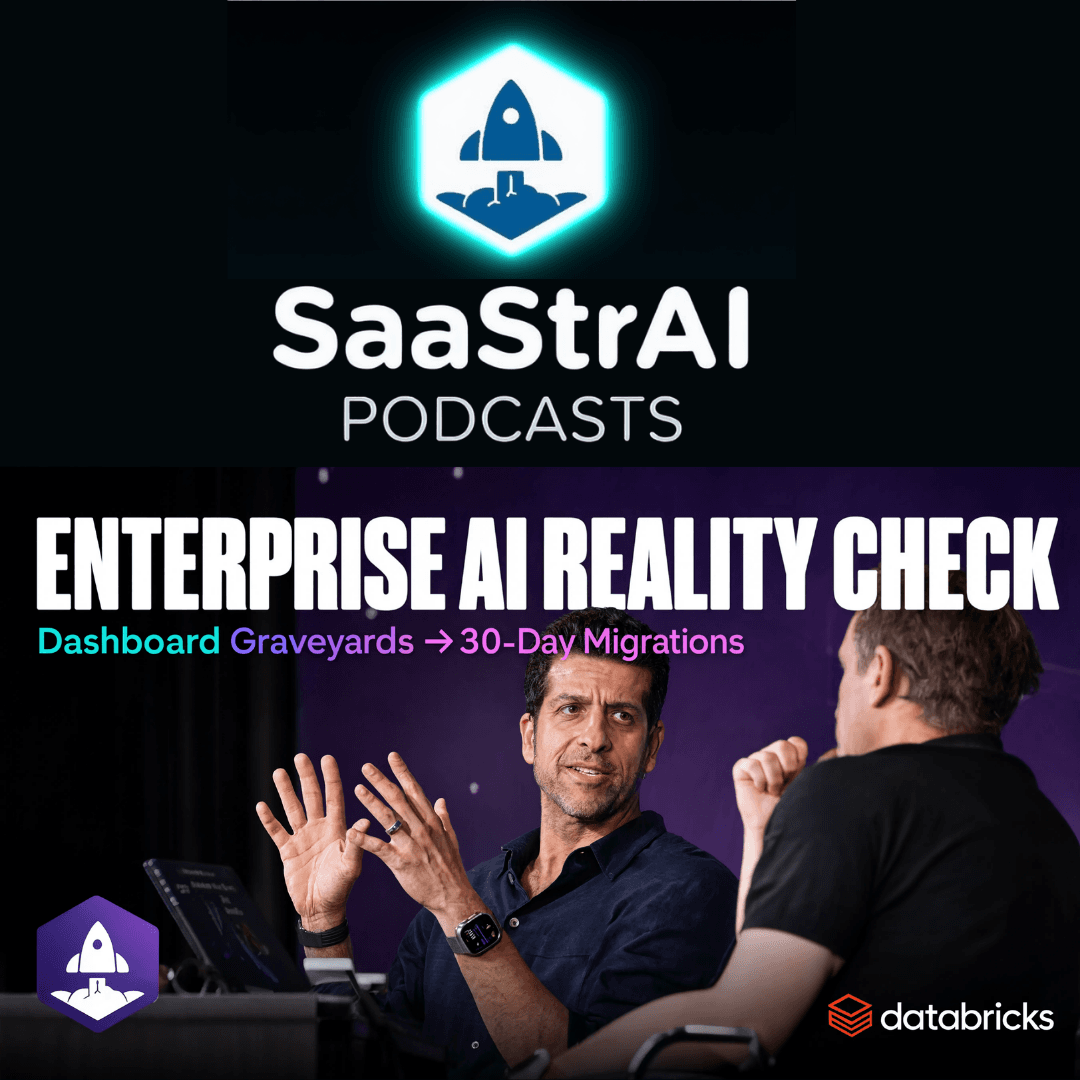
SaaStr 863: The Enterprise AI Reality Check: From Dashboard Graveyards to 30-Day Migrations with Databricks' Co-Founder and SVP of Field Engineering
Every Fortune 500 CEO has told their team that if they are not using AI, they are behind. So now every employee is token-maxing, spend is going up, and almost nobody can tell you what they are getting out of it. That is the reality Databricks sees from the front lines, serving more of the Fortune 500 than any other data and AI company on the planet.
In this episode, Databricks Co-Founder and SVP of Field Engineering, Arsalan Tavakoli, sits down with SaaStr CEO and Founder, Jason Lemkin, to cut through the Twitter noise and talk about what enterprises are actually doing, what is still broken, and why the next 24 months will fundamentally change who wins and who loses in every major software category.
You'll learn:
- Why the BI dashboard is dead and what replaces it - including how a car manufacturer just onboarded 70,000 non-technical users to query their own data in plain language with no analyst in the loop
- What "context" actually means for enterprise AI and why it is harder to solve than the data problem, using a framework that explains why agents fail even when the underlying data is clean
- Why no software monopoly survives the next 24 months, and how collapsing migration costs and low-end AI competitors are about to give every incumbent a pricing problem they cannot ignore
- How Databricks now completes enterprise-grade migrations in 30 days or less using LLMs to analyze, convert, and reconcile legacy systems that previously took years and cost more than the savings
- Why the murky middle is the most dangerous place to be in enterprise software right now, and how to know which side of the AI budget divide your product actually sits on


