In short
Parafin’s embedded SMB lending model using platform data and machine learning to offer fast, pre-approved loans without relying on traditional bank underwriting (personal FICO/EBITDA thresholds, manual cashflow models, or high CAC acquisition).
Guest backgrounds
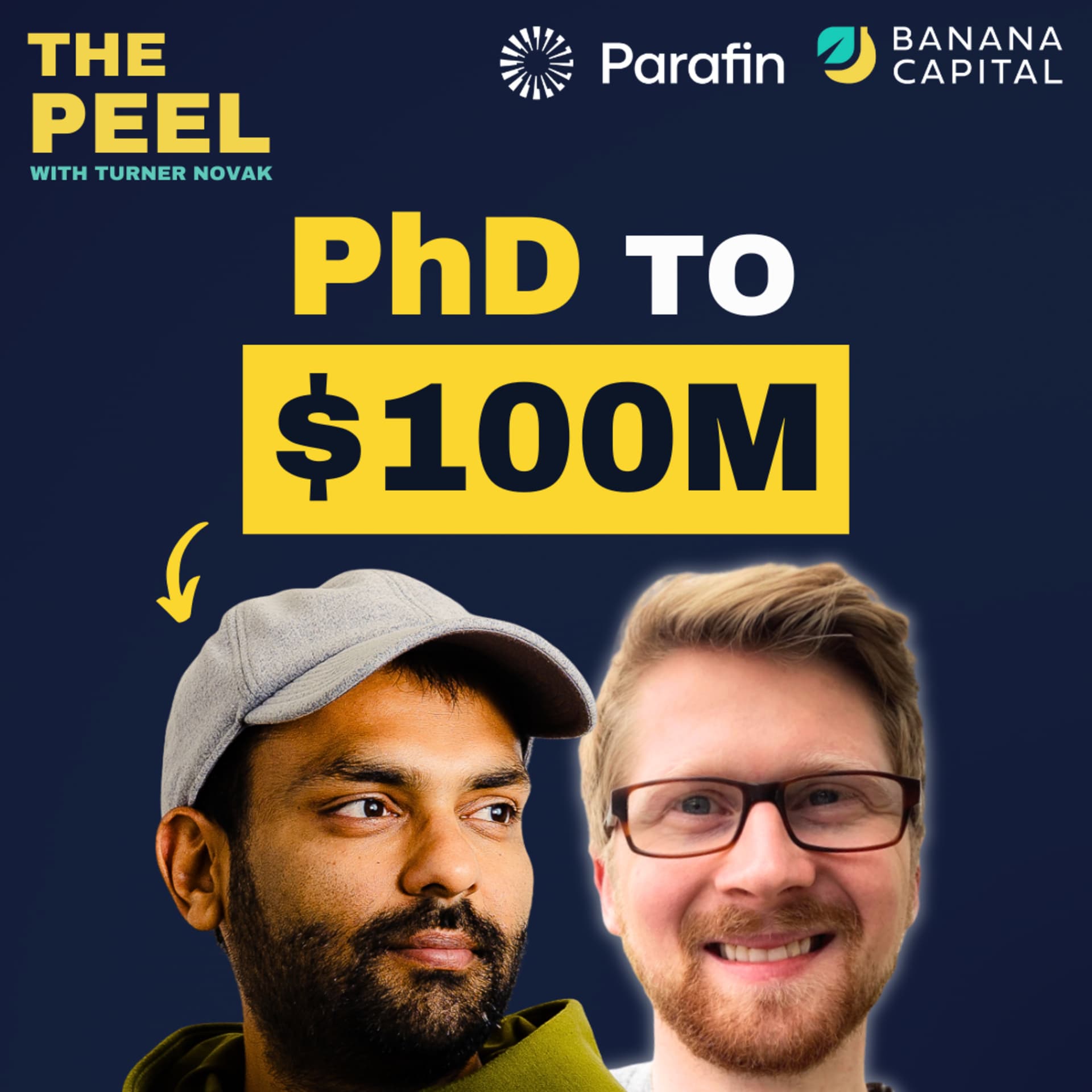
Sahil Padar is Parafin’s co-founder and CEO. He earned a PhD in particle physics at CERN’s Large Hadron Collider (worked on Higgs boson-related research and data/signal-vs-noise methods). He later moved into data science/ML roles at ad-tech (including Meta/Facebook ads) and previously led ML engineering at Robinhood.
Key claims
Traditional SMB lending is often “consumer lending masquerading as SMB lending,” excluding women- and minority-owned businesses and newer businesses. Parafin underwrites using proprietary merchant sales data from platforms, trained on 1M+ US small businesses. They avoid Silicon Valley SMB lender failure modes by not going direct-to-SMB, reducing adverse selection and making CAC predictable via platform integrations. They make 10B+ daily offers; funded 30–35k businesses; ~$100M gross revenue run rate in ~4 years.
Notable examples
DoorDash merchant portal “pre-approved” offers (e.g., equipment financing) accepted in a few clicks with same-day funding; IRR computation on loan tapes accelerated using O3 reasoning models.
Written by AI. May contain mistakes. Listen to the episode to check what was said.
Chapters
Tap a time to open that second in VOChallenges in SMB Lending
0:00 to 0:28
Learn about the limitations small businesses face in traditional lending.
“You can be a profitable seller on Etsy or Amazon and selling profitably for several years, but you may not pass the EBITDA threshold for the bank or you may not have the right FICO number for the bank.”
Sahil's Unique Background
0:36 to 1:24
Explore Sahil's background, including his work at CERN and transition to business.
“The emergence and the scaling of Marketplace's vertical SaaS point of sale solution meant that we could now tap into data sources that would allow us to build a product and sell it.”
Parafin's Mission and Growth
1:24 to 2:20
Discover Parafin's goals and the metrics behind its rapid growth.
“Laining DoorDash as their first customer before building the product.”
Accessing Capital for Small Businesses
2:20 to 3:52
Understand how Parafin helps small businesses access capital through technology.
“for their help brainstorming topics for Sahil.”
Reinventing Small Business Lending
3:52 to 6:10
Learn how Parafin is changing the way small businesses secure loans.
“I think our mutual friend, Madi, prior guest of the show, episode with Charlie and Madi from Pathlight, Madi introduced us.”
The Role of Embedded Lending
6:10 to 8:14
Explore how embedded lending can provide critical support to small businesses.
“credit scores or require personal collateral, even if the person trying to take the loan is trying to do so for their small business and not for personal use.”
Leveraging Technology in Lending
8:14 to 13:00
Discover how technology and AI are transforming the lending process for small businesses.
“So for example, if you're a restaurant on DoorDash, if you were to log into your DoorDash merchant portal, Parafin has essentially looked at your data, underwritten you for an offer.”
The Future of AI in Fintech
13:48 to 14:00
Discuss the impact of AI on fintech operations and future trends.
“The second category is improving our own operational teams and equipping them with AI tools that make them faster and more efficient.”
Automating Business Intelligence
14:00 to 15:00
Learn how automation and AI improve business efficiency in lending.
“So for example, the teams will often look at if the business borrower has any related businesses that have filed for bankruptcy.”
Challenges of Direct SMB Lending
15:00 to 17:42
Understand the pitfalls of direct lending to small businesses and how to avoid them.
“So if I'm working on a task, like how could I be more productive and get this done much faster using the best of what LLMs can offer?”
Show all 39 chapters
Innovative Lending Strategies
17:42 to 21:33
Discover how leveraging platforms and data can redefine SMB lending.
“sort of acquisition pitch to them as possible.”
From Physics to Entrepreneurship
21:33 to 22:35
Explore the transition from a PhD in particle physics to leading an AI-driven startup.
“And then you have like the venture side.”
Understanding Particle Physics
22:35 to 25:18
Gain insights into the fundamental concepts of particle physics and its significance.
“And I kind of have to ask this question first to get into it.”
The Large Hadron Collider Explained
25:18 to 28:01
Learn about the operation of the Large Hadron Collider and its role in scientific discovery.
“And why do some objects have more mass than others is explained by the Higgs boson.”
Understanding CERN's Particle Collisions
28:01 to 29:16
Learn about the process and significance of particle collisions at CERN.
“And, you know, there's particle detectors on either sides of the circle that are sort of concentric to the circle that are measuring collisions coming out of the circle.”
Spinoffs from Particle Physics Research
29:17 to 30:35
Discover unexpected innovations like the World Wide Web that arose from CERN.
“Like, what do you get out of this from like watching them collide?”
The Quest for Fundamental Physics
30:36 to 33:18
Explore the goals of CERN in understanding gravity and the Higgs particle.
“A superconductor is an object through which particles can flow through without any resistance, right?”
Transition from Academia to Industry
33:19 to 34:34
Hear about the journey from a PhD in physics to a career in tech.
“So you mentioned before, though, you were thinking about leaving, like going out of academia, more in the industry.”
Data Science at Meta: An Inside Look
34:35 to 36:58
Gain insights into how data science is leveraged at Meta for advertising.
“And so, you know, I was living in Germany back then doing my PhD in Europe.”
Cultural Lessons from Facebook
36:59 to 39:38
Understand the cultural values at Facebook that influenced company success.
“but they're able to do that pretty, pretty easily.”
The Journey to Robinhood
39:39 to 42:00
Learn about the persistence required to secure a position at Robinhood.
“And if you lose sight of that, it can be pretty dangerous.”
Journey to Robinhood
42:00 to 42:55
Learn about the speaker's persistence in securing a position at Robinhood.
“like that's exactly what I was hoping for.”
Lessons from Robinhood
42:55 to 44:16
Discover the key lessons learned while working at Robinhood, especially in finance.
“And what was the, well, probably like the single greatest lesson you learned at Robinhood?”
Product Development Insights
44:16 to 47:55
Explore how Robinhood approaches product development and market entry strategies.
“I learned how Robinhood thinks about building products, achieving product market fit, measuring product market fit.”
Cultural Perspectives on Investing
47:55 to 48:30
Understand the differing cultural attitudes towards investing in the US and Europe.
“like the freedom of choice, but then also like, you know, unlimited upside, optimism, you know, et cetera.”
The Lottery Ticket Mentality
48:30 to 49:28
Examine the mindset of younger generations regarding wealth and investing strategies.
“So fundamentally, if you're going after the millennial user base that are more likely to adopt a mobile product, you want to attract how to get rich cohort and not the how to stay rich cohort.”
Growth Strategies at Robinhood
49:28 to 55:18
Learn about successful growth frameworks applied at Robinhood and insights from Facebook.
“And I do all this research and like you got to contribute to your retirement account every month and like, you know, make really smart decisions and like go slow.”
Leveraging Advertising Networks
55:18 to 56:00
Discover how Robinhood utilized Google's ad network for targeted user acquisition.
“A second one was gaming the Google ads network.”
Leveraging User Data for Ad Targeting
56:00 to 58:02
Learn how to identify high-value users and leverage data for targeted advertising.
“Google's ability weakens to send you similar users.”
Predicting Churn in User Engagement
58:02 to 59:58
Discover methods for predicting churn and enhancing user engagement through data insights.
“And I think that is, it's a good sign that it sounds simple.”
The Journey to Founding Parafin
59:58 to 1:01:47
Explore the motivations and background leading to the founding of Parafin.
“And that's a little bit harder based on the data you have at Robinhood to predict.”
Revolutionizing SMB Lending with Technology
1:01:47 to 1:10:00
Understand how Parafin aims to address gaps in SMB lending through innovative technology.
“It's such a fast evolving world that I'd probably have similar concerns if my son was making these decisions at some point.”
Unconventional Fundraising Journey
1:10:00 to 1:12:20
Learn about the unique fundraising process faced by the co-founders of Parafin.
“is sustainable, and which can, you know, help essentially lead to a venture backed company.”
Landing Major Clients: The DoorDash Experience
1:12:20 to 1:13:35
Discover the challenges and strategies used to secure DoorDash as a customer.
“It was just a handful and literally like a couple and Rivet was one of them and the one that we liked the most.”
The Art of B2B Sales
1:13:35 to 1:17:06
Understand the evolving approach to sales and customer relationships in B2B.
“Like we're trying this thing, try our product.”
Building Trust with Customers
1:17:06 to 1:22:44
Explore effective methods for establishing trust and credibility with potential customers.
“Yeah, I think I've certainly become a deal junkie for lack of a better term.”
Lessons from Robinhood's Vlad Tenev
1:22:44 to 1:23:52
Gain insights on perseverance and trustworthiness from the experiences of Vlad at Robinhood.
“And only then can you do these materialized and meaningful relationships and meaningful partnerships and meaningful revenue for us.”
Key Takeaways on Trust in Business
1:24:01 to 1:24:25
Learn how to rebuild trust in business relationships over time.
“And I think realizing that, hey, while trust, once you lose it, it's pretty bad.”
Episode Wrap-Up and Future Teasers
1:24:36 to 1:25:09
Find out what to expect in future episodes and past highlights.
“check out last week's episode with Garrett Lord on how Handshake beat LinkedIn with Gen Z on his fast-growing AI data labeling business.”
Transcript
Automatic transcript. May contain errors.0:00You can be a profitable seller on Etsy or Amazon and selling profitably for several years, but you may not pass the EBITDA threshold for the bank or you may not have the right FICO number for the bank. Meanwhile, if you kind of look at the business performance, there's many reasons to be able to extend credit to them. And so we kind of break that mold and solve that by relying on data and machine learning and AI modeling in order to extend credit. Banks do play in the space, but they have archaic means and archaic methods to do so. And we're here to kind of reinvent that.
0:28Turner Novak:Welcome to The Peel. I'm your host, Turner Novak, founder of Banana Capital. Today's guest is Sahil Padar, co-founder and CEO of Parafin. The emergence and the scaling of Marketplace's vertical SaaS point of sale solution meant that we could now tap into data sources that would allow us to build a product and sell it. Sahil is a unique founder, getting his PhD discovering the Higgs boson particle at CERN's Large Hadron Collider. A lot of the future dreams of CERN were in some ways shattered, which led to folks like myself branching out of physics. We talked about how physics is just real world machine learning and lessons from growing Facebook and Robinhood.
1:08That particular experiment blew every other experiment out of the water and we just started pouring the fuel on the fire. A big amount of the user base was captured using this technique.
1:18Turner Novak:starting paraffin which is nearing on 100 million in gap revenue run rate four years later and how they've avoided Silicon Valley's graveyard of SMB lenders businesses that click on ads to borrow money are probably not the ones you want to lend money to anyways how they leverage marketplaces and vertical SaaS platforms to reach SMBs at scale there's essentially zero incremental tack for getting every new small business you know when you're vertically agnostic you are inherently less risky because you're not indexed on any one particular vertical. Laining DoorDash as their first customer before building the product.
1:52And they were like, what's the size of the company? And I turned around and said, we are all on the call right now. And it was just like five of us on a call with three of them. Okay, that's pretty big-ish. You outnumbered them at least.
2:04Turner Novak:And advice for tactical founders learning enterprise sales. I really try to get as analytical as possible. Behind the scenes, you're building a mass market product, but to each customer, you have to make them feel like it's personalized for them. A quick thank you to Hans Tong at Notable Capital, Nick Shalek at Ribbit, and Madi Raza at Pathlight for their help brainstorming topics for Sahil. A reminder, I publish two episodes of The Peel every week, exploring the world's greatest startup stories, just like this one. Check out the back catalog of over 100 episodes, including most recently with Garrett Lord on Handshake and its fast-growing AI business.
2:36Turner Novak:Tune in next week for a conversation with Ryan Hoover, founder of Product Hunt and Weekend Fund. Before I talk to Sahil, I have to tell you about Ramp. If you're running a finance team, you know how much time gets wasted on expense management. Chasing receipts, categorizing transactions, waiting for expense reports, it adds up quickly. Ramp handles all this automatically. Ramp is a corporate card and expense management platform that over 40 ,000 companies like Shopify, CBRE, and Stripe are using to streamline their financial operations. But here's what makes their corporate card different. Every transaction gets automatically categorized and matched to receipts.
3:10Turner Novak:No more wondering what that$47 charge was three weeks later. You can set spending controls, get real-time alerts, and even block certain merchant categories. That sounds pretty cool. It's like having a finance team member embedded in every purchase. The platform integrates with your accounting system and ERP, so everything flows through without manual data entry. Whether you're issuing cards to a few employees or managing spend across departments, Ramp gives you visibility and control without the paperwork. Stop chasing receipts. Check out ramp.com slash thepeel. get$250 and see what a corporate card can actually do for you.
3:44Turner Novak:Time is money. Save both with RAMP. Sahil, how's it going? Welcome to the show. Yeah, thanks for having me, John. I'm excited to do this. I think our mutual friend, Madi, prior guest of the show, episode with Charlie and Madi from Pathlight, Madi introduced us. He said, you got to talk. You got to have him on. So I'm excited for this. I know you haven't done very many podcasts. So for people who are not familiar with Parafin, the company that you built, can you kind of give us a real quick rundown on what you are, what you're building, kind of state of the business, and then we can kind of go from there.
4:17Yeah, absolutely. So Parafin's mission is to grow small businesses. Our sort of execution on that is fairly straightforward. Small businesses flock to software platforms every day to start, run, and grow their business. These platforms process payments, generate demand, solve a lot of operational challenges for small businesses. As a result, they sit very low in the mass loss pyramid of needs for small businesses. They have an established trust, and trust is really the bedrock of any financial transaction. And so we believe that these platforms have the right to serve more financial services to small businesses.
4:55and Paraffin's goal is to accelerate that eventuality by enabling platforms to do so in the most simple manner as possible. The biggest need, as it turns out, for small businesses is getting easy access to capital. If you think about the different ways a small business, or for that matter, any business can fund itself, it's either through earnings, through debt, or through equity. Equity is not really an option for small businesses and payment solves for the earnings use case. Paraffin comes in and solves for the debt use case. We essentially tie data that platforms have on their small businesses, the existing relations they have, and use that to start extending credit to small business sellers.
5:37Turner Novak:So maybe a dumb question, but we've had banks for thousands of years, even in the past, like the modern age. There's a lot of banks that don't they have small businesses that they lend to? Yeah, they absolutely do. But one of the biggest problems in small business credit in the United States is that it really is a consumer loan or consumer lending products masquerading as small business lending products. So what that means is that banks and credit card programs typically rely on personal FICO or personal credit scores or require personal collateral, even if the person trying to take the loan is trying to do so for their small business and not for personal use.
6:20And that basically deters women-owned businesses, minority-owned businesses, new forms of business lines. You can be a profitable seller on Etsy or Amazon and selling profitably for several years, but you may not pass the EBITDA threshold for the bank, or you may not have the right FICO number for the bank. Meanwhile, if you kind of look at the business performance, there's many reasons to be able to extend credit to them. And so we kind of break that mold and solve that by relying on data and machine learning and AI modeling in order to extend credit. And so, yeah, banks do play in the space, but they have archaic means and archaic methods to do so.
6:58And we're here to kind of, you know, reinvent that.
7:02Turner Novak:And so what sort of, I guess, before we get really deep into what's kind of like current state of the business, like when someone's like, how's it going? Like what's, how's Parafin doing? Yeah, so Parafin is doing well. You know, we funded somewhere between 30 to 35 ,000 businesses, small businesses, on nearing and on$100 million of gap revenue run rate. And, you know, we launched our product just over four years ago. And so the state of business is pretty good. We're growing pretty rapidly and we're excited about growing our existing set of products, but also launching newer products. Yeah, I think you mentioned before, there is in every neighborhood in America, there's probably a Paraffin customer.
7:41Turner Novak:You phrased it something like that. Is that the case? Yeah. So, you know, we have a map where we can see where we are actively making offers to small businesses. Today, we make like over 10 billion in offers to small businesses on a daily basis. And so there's probably a Paraffin offer available to a small business, no matter which part of the country you're in. So when I say make an offer, so this is like if I'm on my Etsy seller dashboard, if I'm in my DoorDash restaurant management thing, is it in the top of the screen? It's like you qualify for a$50 ,000 equipment. How does it usually play out?
8:19Yeah, that's directionally right. So for example, if you're a restaurant on DoorDash, if you were to log into your DoorDash merchant portal, Parafin has essentially looked at your data, underwritten you for an offer. And so it's more than just a pre-qualified offer. We like to call it a pre-approved offer because there's very few steps. Essentially on the back of a few clicks, you could be accepting that offer and getting paid as soon as the same business is.
8:44Turner Novak:Right. And that's because you have an integration with a platform and you have all the data and you are just kind of constantly as part of like the UI based on the data that you're getting. It just floats it to the merchants or to the businesses that are there in it. That's right. So the way we typically work with platforms is we approach them. We start ingesting their merchant sales data and that passes through our underwriting models, which has trained on over a million small businesses here in the US. And based on that, we either decide whether a merchant is eligible for an offer and if they are, what the size and price of that offer is, and start rendering that offer to them on the DoorDash merchant portal.
9:26So a restaurant could log in today and see what their offer is. And if they like it, if they like the terms, and if they have the need for that money to grow their business, they could accept the funds and get that in their bank account as soon as the same business day.
9:39Turner Novak:You've done other fintech financial services in the past. We'll probably talk about that a little bit later. But why lending specifically? Because I think a lot of people might say lending, yeah, there's pros and cons to a lending business. Why do you think lending was a good idea? A few different reasons. So first and foremost, I grew up in a small business family in India. So I've seen firsthand what embedded lending, which primarily happens through social networks there. You know, you know someone who knows someone who gives you money for you to grow your business. Um, this is like offline social network, off night social networks.
10:12Yeah. Off night social graphs, I think is probably the better way to put it.
10:16Turner Novak:You log into Facebook and your newsfeed, it's like, these are offline social graphs and how access to capital for SMBs can both enable and the lack of access can hinder the growth of small businesses. So in some ways I've lived that experience. And, and secondly, uh, you know, going back to my earlier point, like businesses can earn money in a few different ways or fund themselves in a few different ways, either through earnings on sales or through getting access to debt. The debt markets historically have been relatively shut for small businesses. And there's a vast opportunity to enable that for them.
10:55And at the end of the day, if you want to be playing in a large market, you have to be solving real customer problems and real customer needs. And if you were to survey, even the restaurants within a one mile radius here, or for that matter, most small businesses around the one mile radius here, the vast majority of them would say the biggest blocker in them growing their business is getting access to financing.
11:19Turner Novak:Really? Because you think it's profitable that you should be able to borrow money. I mean, is it? So it's that the, generally speaking, we're making some vague assumptions here and maybe generalizing a bit, but it's just they're too small for it to be worth somebody who who does a lot of manual work on a lending model, building like a cashflow model to, can they pay it back? And they give a sales team that needs to spend time. Is it just that some of these businesses are just too small for it to really be worth it for kind of a non-tech focused software first platform or traditional lending company?
11:55Yeah, that's exactly right. So, you know, the way, one other way to think about it is, you know, what are the different forms of leverage that exist? There's capital, code, labor, and media content. Banks are in the business of using capital and labor. In order to access their markets, we are in the business of using capital and code. And with code, you can scale things much faster than you can with human labor. And so getting the human out of the loop in an underwriting process and doing that and replacing them with code that is making smarter decisions and is able to ingest more data and have better sort of decisioning along any sort of risk reward curve is the way to access this market at scale.
12:45Because you can only get so far if you were to leverage labor versus code.
12:49Turner Novak:And speaking of leverage using technology, are you seeing any ways that AI is changing how fintech companies operate? I don't know if you're doing anything specifically inside of Parafin, but... Yeah, absolutely. So, you know, it is certainly a paradigm shift in many ways. At Parafin, you know, my background is in machine learning. I was leading the machine learning team engineering at Robinhood, and I got into the world of machine learning through a PhD in particle physics. So in some ways, data science, machine learning, AI models have been very close to, you know, me and the kind of work that I've done in the past.
13:25And the same is true for my co-founders at Parafin. So we've been using machine learning and AI since pretty much day zero. or since the very early days in our underwriting models. And that's one big area of investment in AI and AI models is in order to keep improving our underwriting and get smarter around identifying bad borrowers, good borrowers, pricing, and removing customer friction in their flow. The second category is improving our own operational teams and equipping them with AI tools that make them faster and more efficient. So for example, the teams will often look at if the business borrower has any related businesses that have filed for bankruptcy.
14:11Is this business undergoing any court cases? And almost prepare like a report card given a business owner's comma borrower, comma business. And before the advent of LLMs, we'd have to kind of go and do that pretty manually. Now we've built a tool that just, you know, enter a business and you can get that information out pretty quickly. So automating these type of processes helps us be more efficient. And so we've in-housed a lot of that sort of intelligence around underwriting funding and collecting repayments from a business using machine learning and AI. The second category is using vendors.
14:46And you obviously want to be smart around, you know, using fast-growing vendors or solving problems. So, you know, we use a vendor for customer support. We use a vendor for coding, et cetera. The third category is just on a personal productivity, but work-related personal productivity. So if I'm working on a task, like how could I be more productive and get this done much faster using the best of what LLMs can offer? And so those are kind of the three surface areas, in-house products that make our core offering stronger, being sort of very thoughtful and intentional about which vendors we use and using it as often as possible in order to get efficiency on projects that I'm working on or other team members are working on.
15:24Turner Novak:What's been the most efficiency that you've gotten from something like that? Like any specific tool or trick that you found? Yeah, I would say, you know, O3 and in general, the reasoning models have been really good in giving long-form analyses to run. So for example, you know, one analysis that we run very often is IRR computation on a loan tape. Like, you know, given a set of borrowers and given repayments, compute IRRs and portfolio performance. And yes, surely we have our own code that kind of goes through that. But O3 is able to kind of back out into similar numbers pretty fast. And so using the mathematical intelligence of something like O3 to run a deep analysis on data has been quite fruitful.
16:14And I don't have to take time away from, you know, someone internally on what they're working on. and I can just do that myself. That's right. Have you tried Julius? Julius.ai? I have heard of it. Of course, the founder was a celebrity for a day.
16:31Turner Novak:He still is a celebrity. He still is a celebrity. And I haven't used the tool myself. Oh man, you got to try it. He's also a prior guest of the show. So you got to support the Peel ecosystem, all the prior guests. Awesome. I'll try to give it a try. I think it's like a really interesting thesis around building this. about, like, I feel like there's kind of been a lot of people that have sort of tried this in the past. Is that right? Or like some approach of like SMB lending using software. Yeah. Yeah. So yes, that is right. You know, Silicon Valley is a graveyard of SMB lenders. You know, that was a better way to phrase what I just said.
17:10Silicon Valley is a graveyard of SMB lenders. There's no hiding from that fact. I think what each of the folks prior to us have gotten wrong is that they've gone direct to the small business and tried to lend to them. Why is that a mistake? That is a mistake for a few different reasons. First and foremost, when you do that, you are fundamentally not differentiating yourself on product, but rather who can reach the small, who can kind of directly reach a small business as fast as possible or make the most attractive sort of acquisition pitch to them as possible. So that is fundamentally a marketing business, not a product-led business.
17:53And that's a business that in the long term, the ad networks like Google and Facebook win, because the only way to get access to small businesses directly at scale is to run some sort of performance advertising. But guess what? Businesses that click on ads to borrow money are probably not the ones you want to lend money to anyway. It's like, help, I need a loan. Yeah. So you're kind of fighting on the edges of adverse selection, and you're constantly trying to stay away from adverse selection while being very close to it because of this direct-to-SMB approach.
18:29Secondly, there is naturally a CAC associated with this, which eats into the unit economics, and CAC is not predictable. You can go and acquire 100 users on Facebook at 20 bucks and be like, great, my CAC is 20 bucks. And guess what happens when you try to do that with 10 ,000 users? Your CAC probably blows up to 200 or 2 ,000 and you have a fundamentally very different unit economics to what you had started out with. And so these are the sort of problems that play direct to SMB lenders. There's no differentiation on product. You attract adverse selection and you're fighting CAC for unit economics.
19:01So did you specifically say, these are the problems, how do we kind of solve for this? That's right. So we focused on each one of these and let's look at them one at a time. So first and foremost, by not going direct, but by relying on platforms where SMBs are earning their paycheck, like a restaurant earns their paycheck on DoorDash, an e-commerce seller earns their paycheck on Amazon. They sit very low in the master's pyramid of needs. This established trust is much harder for a small business to walk away from, from a restaurant to walk away from DoorDash than from Sahil Capital or Turner Capital.
19:35And so by relying on those relationships, you can essentially reach many small businesses once you have integrations with one of these large platforms. Secondly, by using data, highly proprietary siloed data that's sitting in these platforms, you can start to underwrite and cherry pick which businesses you want to give loans to versus which ones are going to click on your ad and then get rejected in your flow. And then thirdly, because you know what the size of the opportunity is, you can price deals with these platforms in a way that your CAC is highly predictable and scales from one to 100 ,000 customers and does not change along the way.
20:18So it's highly predictable, highly scalable cost of getting a business. In fact, there's no CAC.
20:24Turner Novak:It's kind of, you know, like the CAC is acquiring the platform and that it's, you know, much more affordable, much more and more repetitive and sustainable. And there's essentially zero incremental CAC for getting every new small business to use the product. And that tends to be powerful. And, you know, going back to my second point, that's a very powerful point in using the data pre-approving offers because the best businesses who you want to lend to are not actually actively looking for money. However, when they log into their merchant portals of their dashboards that they're using to run their business enough times and they see a pre-approved offer, there is a non-zero probability that they will accept it.
Read the full transcript
21:05Simply because you started to plant an idea that, hey, here's$50 ,000. It's a few clicks away. And then, you know, in two weeks later, that subconscious mind has spun up ideas how to use that$50 ,000 and the business comes back and accepts the offer. So that dynamic is, you know, impossible to crack when you're going direct to small businesses, which is why many have, you know, any provider who's tried this in the past has not been successful and why Parafin is different.
21:32Turner Novak:It's like the same, the same analogy with like VC and startups, like the best, the best startups probably don't need the VC's money. Yeah. So like if you're if you're if you're constantly only relying on like the founders that are coming inbound pitching you, it's like, well, maybe there's a little bit of adverse selection there versus like the guy who's just building, crushing it, doesn't need your money. And then you have like the venture side. It's like, you know, everyone trying to talk to that guy or that girl to give them money. It's like maybe similar dynamic, different profile of business, but some parallels.
22:02Yeah, no, absolutely. And BC, I fundamentally believe, is a cottage industry, and you can actually be very successful in the cottage industry if you're very charming. So charm kind of, the best venture capitalists are very charming people, and that's how they get the right to win the deals, and they can be successful in the cottage industry. But, you know, me being charming is not going to help, you know, a paraffin acquired a hundred thousand small business. You know, that has to come through scale, through code, through mathematics and engineering more than charm of anyone individual on the team.
22:34Turner Novak:All right. So I do want to talk to you about charming people and getting big customers and then maybe some fundraising stuff, too. But I do want to not skip this. And I kind of have to ask this question first to get into it. So I'm just going back to the very early days. I think you might have mentioned you did a PhD in particle physics. That's right. How do you go from that to where we are today? How did that even come about? Yeah. So in some ways, I was born in an entrepreneurial family in India. I was almost like the black sheep trying to do academics. It took a lot of explaining to my family members as to what a PhD in particle physics really meant.
23:10What is it actually? What does that mean? Yeah. So in short, you know, there are four fundamental forces in nature that physicists like to believe exists. There's electromagnetism, which is responsible for light and electricity. There's a strong force, which is what keeps the stable together. There's the weak force, which is responsible for, you know, PdK. And you can kind of get to the age of fossils using that. And the fourth one is gravity. And so particle physics and research in particle physics is an attempt to experimentally verify theories that try to come up with one explanation for all of these forces existing.
23:50And the Large Hadron Collider at CERN, which is the largest particle collider where I did my PhD, is a pursue in that effort. You know, there's a few thousand people from all around the world, including the best U.S. universities, who are working there trying to discover the forces in nature and explain why they exist.
24:12Turner Novak:And so what kind of stuff were you working on? Yeah. So I worked on a few different things. In 2012, there was a particle called the Higgs boson, which was the last missing piece in the standard model. And the standard model basically takes three of the four forces and is able to combine them into one. That was the missing experimental evidence that ties all of the standard model together. To make it a fourth piece? No, it's like sort of one force that has three different ways in which it exists in the world, but it's really one force or one model that can hold it all. And by one model, I mean it's essentially a group theory, a Lie algebra model, which physicists like to consolidate models and have one giant model that is able to explain many different things.
24:57And so this is an attempt at that. So it takes three out of the four and is able to consolidate into one. There was one experimental evidence that was missing. that experimental evidence basically proves why objects have mass. And so why can you and I not move at the speed of light? And it's because we have mass. And why do we have mass? And why do some objects have more mass than others is explained by the Higgs boson. What's more important, though, is a PhD in particle physics is fundamentally a PhD in data science. because at the end of the day what you're doing is you're taking a very large number of data sets, crunching them through algorithms and through code, doing deep statistical analysis, machine learning, in order to separate signal from noise.
25:48So to see these type of experimental evidence for something like the Higgs boson, physicists collide billions of particles at once and try to collect billions of those collisions. happening through several years and try to look for signal versus noise. And in doing so, you end up equipping yourself with the latest and greatest in the machine learning tools.
26:13Turner Novak:And so the Higgs boson collider? Higgs boson is the name of the particle. A large hadron collider is, yeah. And this was, it's in, is it in Switzerland? That's right. Is it underground, like super deep underground or something? It's roughly, if I remember correctly, 100 meters underground. on the border of Switzerland and France, just on the outskirts of Geneva. Is it this like super long tunnel or something too? How does it work? It's circular, more or less circular tunnel. And so you kind of have to take an elevator and go down in order to view it. But most of the times when the particles are colliding, in fact, all the time when the particle is colliding, you're not allowed to go underground because it's highly radioactive and you probably get torched.
26:59So everyone's sitting up above. Everyone sitting up above in control rooms, monitoring screens, and essentially the whole system through monitoring systems that we've built that feed us back data that can be looked at using code. So does it get super hot in there, like thousands or tens of thousands of degrees? Yeah, I would say more than, there's certainly heat, but more than heat, there's radiation that would be invisible to the eye. It would be like a particle that's probably like ripping your skin or whatever, or like tearing organs because it's going so fast kind of thing.
27:36Turner Novak:Okay. Interesting. And so how does that actually work? Like when you're running the test, do you like put some material in there and like you put something on it or like put an x-ray or like some kind of beam? Like how does it all happen? Yeah, it actually starts off, you know, given the scale of the experiment, it's a 27 kilometer circumference tunnel. Oh, wow. That's huge. It's massive. It's a circle? It's a circle. And, you know, there's particle detectors on either sides of the circle that are sort of concentric to the circle that are measuring collisions coming out of the circle. It all starts off with just a bottle of hydrogen.
28:15So you have a bottle that has hydrogen in it, and you connect that. you let the hydrogen flow into the pipes and you start stripping out neutrons from the hydrogen to get a single beam of protons, which then go around the beam, around that circumference and start colliding at those concentric circles that have been established over the circumferences. Does that speed it up? Is that what that does? No, you want to get like a steady beam of protons because the collision is happening between proton-proton particles. In colliding protons, you can essentially learn about the fundamentals of it, of what, you know, a proton comprises of these particles called quarks.
28:57So a proton is like up, up, down. And so you're basically getting those quarks to collide. And proton just happens to be a really good particle to circulate in the beam because you can get it up to very high speed. and you can use what are superconducting magnets in order to get it there.
29:16Turner Novak:So let's say you get this all up and running and it's going like, what do you, what's the thing that's being studied? Like, what do you get out of this from like watching them collide? Yeah. So it's, it's a fundamental, you know, it's, it's fundamental physics. So you're trying to, we as humans are trying to improve our understanding of the very nuts and bolts of physics and physics theories. There's, you know, fundamental physics is not the person of it is not necessarily you have any immediate applications, but there are things that emerge out of it that are hard to predict. You know, one of the things that emerged out of the experiments at CERN was the World Wide Web.
29:52So the World Wide Web was invented at CERN because two researchers went back to their hometowns after having worked there. I believe it was England and France. And this person called Sir Tim Berners-Lee, who was English, he basically wanted to send data over to his French colleague and therefore invented the World Wide Web to do that. So that's kind of a spinoff effect. The second kind of spinoff that we've seen at the Large Hadron Collider is the ability to build large superconducting magnets and systems, in this case, a 27-kilometer circumference system. And what that essentially does is it teaches us how to build these large-scale engineering systems and maintaining them, right?
30:34And what is a superconductor? A superconductor is an object through which particles can flow through without any resistance, right? Which is kind of very weird, like that exists.
30:48Turner Novak:Is that what space is like? Like when you're in like deep space with nothing around, is that what the same environment you're in? Not quite. There is very little resistance there. But in this case, we're talking about like electrical resistance. So, you know, electricity, there's always resistance in the way we think power. If you try to move an electron or a proton through a circuit or any sort of space, you will start to feel some resistance. But if there's a superconductor around it, it can move without any resistance. And the reason for that is through this new sort of phenomena that was discovered by actually an American physicist, Douglas Bardini.
31:28He's the only physicist to have won two Nobel Prizes. One for discovering the BCS theory of superconductivity, and the second for inventing the transistor, which are both monumental.
31:40Turner Novak:Transistor, this is in the 50s, the reason that computers exist. That's right. Okay. Wow, that's crazy. So then what was the point of the whole CERN project? What were you guys trying to discover again? Yeah. So part of it was discovering the Higgs so we can say, hey, we understand the standard model really well. Yeah. And, you know, let's kind of put a stamp of approval and let's look for newer things. The part of the newer things was also discovering things like the existence of extra dimensions. And so the simplest way to explain that is in physics, we see that the three forces, electromagnetism, strong force and weak force, are all much stronger than gravity.
32:24One simple explanation is that the reason gravity is perceived weak to us is because it is escaping into extra dimensions. And as a result, when we try to measure it, we are only measuring its strength in the 3 plus 1 dimensions that we are aware of, which is 3 space and 1 time dimension. The mathematics of it works really well. However, not everything where the mathematics works is nature's secret. You kind of still have to experimentally test that. The test we do at CERN is to essentially measure whether graviton or gravity particle is escaping into extra dimensions. And what we really discovered there and continues to be true is that because where the Higgs was found, the mass at which the Higgs was found meant that a lot of these new types of theories are not going to be discovered at CERN.
33:17And wait, why is that? Yeah, it kind of, you know, the mass of the Higgs constrains a lot of new theories and says, you know, in order to kind of mathematically have a lot of these new theories exist, you have to let Higgs be a little bit heavier than it was experimentally observed to be. So by achieving the Higgs discovery, which was a phenomenal achievement and actually led to Peter Higgs winning the Nobel Prize in 2012, a lot of the future dreams of CERN were in some ways shattered, which led to folks like myself branching out of physics after my PhD and moving to industry.
33:58Turner Novak:So you mentioned before, though, you were thinking about leaving, like going out of academia, more in the industry. How did that come about? Because I know you were at Robin Hood. You didn't actually go right to Robin Hood. What was kind of the journey there? Yeah. So once I finished my PhD, it was pretty clear to me that the opportunities that were presented at CERN would be fairly limiting in terms of how exciting it would be for what it meant for our understanding of the universe. So I decided to look around and see where could my skills be applied. And data science was picking up as a pretty hot topic in tech.
34:33This is like early 2010s. And so, you know, I was living in Germany back then doing my PhD in Europe. And so I decided to move to industry and use my skills in the tech sector. And it just happened so that within technology, one of the largest data sets that existed, I think till today, is on advertising and how to monetize ads data for businesses. And so I worked for a few months at a startup based out of Berlin and before moving to Meta, then Facebook, and being part of their ads team in Europe and grow that business, which at the time was the fastest growing geo for Meta and Facebook.
35:17Turner Novak:So then what kind of stuff are you doing there when you're running, working with these large data sets? Like for somebody who is not aware, just like the scope or the scale of that, what does that entail inside Meta? Yeah. So what that entails is essentially using large data sets from customers interacting with ads, clicking on ads, buying behavior, and across many different advertisers. And you can imagine like a company like Facebook has essentially billions. It's kind of the floor on any kind of data set they have with this. Using that to predict what future performance for advertisers could look like and coming up with better targeting mechanisms.
36:01And so, again, not only is Facebook collecting data on, you know, what ads you're clicking on, but also what pages are interacting with. Facebook has this thing called the Facebook Pixel, which is on pretty much most websites across the world. to see how you're interacting with other websites. That's right. And so even if you have not told Facebook that you like Nike shoes as an example, but you're on Nike shoe website, Facebook knows. And Facebook knows who you're dating by virtue of the two people living together in the same house or who your partner is, et cetera. And so they can leverage that type of information to create better and better targeting.
36:40Like if you went to a Nike shoe website, they'll probably show your wife the ad as well because like, hey, as a household, they're probably interested in Nike shoes. And you have like partners in a household.
36:50Turner Novak:Like that's interesting, yeah. Oh yeah, partners in a household. I mean, you know, you have to kind of disambiguate between roommates and partners, but they're able to do that pretty, pretty easily. Their models, they can even predict if two people are going to start dating, but haven't started dating yet. Interesting. Just based on, you know, interactions and models that they have. And what helps them kind of, get a true data set is very often people will post their relationship status on Facebook back then and say, hey, I'm dating X, Y, Z, or I started dating X, Y, Z. I got married to this person.
37:24And so they can really, they have a full picture of when that happens and how their interaction started and how that evolved over time. And so you can use those type of signals to target people better, to make sure you're showing them more contextual ads, which is better than showing, you know, an ad for a random thing. It's better for the user because they're seeing something more relevant to them. It's better for the advertiser because they're reaching these users at a much more cost-efficient manner. And it's just overall better for the ecosystem. And it allows a company like Facebook to scale and spend huge amounts of money on CapEx in building things like Lama.
38:01So Facebook in particular has been exceptional in giving back to the community, you know, having built some of the best open source projects, but also So now with AI being open source, so data science is an excellent tool to help companies like Facebook, Google, et cetera, monetize their ads business and ads network by getting advertisers more efficient and by getting the ads that we put in front of customers a lot more contextual.
38:29Turner Novak:Are there any lessons from the Facebook days that have been helpful today with Parafin, like specifically on this, a lot of data science across all these different platforms? You probably have more data than just a Facebook platform at this point. Yeah, so, you know, it's obviously an exceptionally well-run company, both Facebook and Parafin. But the thing that Facebook does really well is emphasize that done is better than perfect. And, you know, the speed of getting things done. I mean, today there's other companies as well that are kind of, you know, have maybe have even taken the baton from them.
39:10But just like early 2010s, Facebook was moving extremely quickly, much faster than others in the space. And even for its own size and had a pretty low bureaucracy, fast moving culture. Done is better than perfect, was plastered across pretty much every Facebook office on their walls. And so that's one cultural trait that we value a lot. But we call it the ability to compress time and get things done since I think it's largely true that speed is the only real advantage that a venture-backed company has against an incumbent. And if you lose sight of that, it can be pretty dangerous. So keeping that as part of our culture at DNA is extremely important.
39:52Turner Novak:And so then talking about Robinhood, I know it took you a while to convince them to give you that. How did that kind of all come out? Because it wasn't like an immediate, like, bang, interview, you're hired. How did that process go? Yeah. So, you know, I happened to be in the U.S. for, you know, working for Facebook. And I was on a U.S. trip and I really wanted to move to the Bay Area and be closer to the metal in terms of, you know, being in Silicon Valley, working for a tech company. And through some stroke of luck, I met a venture investor who had invested in Robinhood, a seed fund, which now is defunct.
40:32Oh, wow. And that person introduced me to Robinhood. And even that was like extremely serendipitous because I went to this person's office. The fund was called Rothenberg Ventures. And I went to their office, and as I was talking to one of their partners, he was showing me around his virtual reality lab and talking about all these other companies. And none of them are really interesting or really relevant to someone who could do data science. And then as I was about to walk out of his office, he just said, hey, I have one more thing for you. There's this early-stage company called Robinhood that I've invested in.
41:10Maybe you should talk to them. The founders are also mathematicians and physicists. And so I was like, I'd love to. I'd just read about them having raised around. Had they launched yet? I think then probably on the cusp of launching, I think it was maybe a little bit pre-launch. And so I reached out and I got connected to who then became my manager there. He was the head of data science and data engineering and was one of the first five employees of the firm. And as I got to know him over time, I was borderline harassing him with each trip that I was making out of the Bay Area to work for Facebook and saying, hey, can you meet me again?
41:54Can you meet me again? And at some point he just turned around and said, hey, dude, do you want to just come into an interview? And I was like, yes, like that's exactly what I was hoping for. So I met them and roughly it was a few dozen people interviewed, did not hear back from them for several months. and then one fine day, I get a response from the HR saying that, hey, they've accepted me and they have an offer, et cetera. So just out of the blue. And they'd like to work on a work permit and a work visa, which by the way is also not trivial to get for the US, as I'm sure you're aware. And so in the end, it all worked out.
42:34They helped me through the process, but I think the end-to-end process took about a year of me first contacting them versus me starting working there. And so, yeah, you know, at the end of the day, persistence and perseverance paid off. They probably saw something in me that they liked. And I was very fortunate to be part of the early team there.
42:56Turner Novak:And what was the, well, probably like the single greatest lesson you learned at Robinhood? Yeah. Well, Robinhood taught me many lessons. And so before I started working for Robinhood, I knew nothing about financial services. In fact, the first time I bought a stock was after I met the Robinhood team. I went back to Germany, opened a German brokerage account and started buying stocks to even see what the whole experience was like. By the way, I was roughly 30 years old then. Today, when you look at 21, 22 years old - We got high school, middle schoolers in Robinhood and Glass. Exactly. And so I was pretty much much older than one would expect as someone dabbling into stock trading in the US.
43:43But in Europe, most people do not trade stocks, right? Like it's much more different mentality. Like it's more of cash preserving capital versus investing and trying to grow capital. And so culturally, it's a very different place. in. So yeah, many lessons learned along the way. I think everything about the U.S. equity markets that I knew until I left the company was due to Robinhood. Everything I knew about option trading was due to Robinhood. Everything I knew about building a fast-growing venture-backed company was due to Robinhood. I learned how Robinhood thinks about building products, achieving product market fit, measuring product market fit.
44:27But how do they?
44:28Turner Novak:How does Robinhood think about building products? Yeah, I think first and foremost, you have to kind of ask yourself the question, you know, what is the status quo? Where do you have a right to play? And most importantly, where do you have a right to win? And so extending equity trading into option trading, you know, in hindsight seems pretty obvious. But option trading, as it turns out, is a much, much more complex thing to enable, which is why we haven't really seen many other Robinhood competitors enable that. And, you know, you can easily lose your shirt if you get it wrong. And so how do you kind of go from a working system, which is already complex, to building something that is 10x more complex, has, you know, many different risk considerations, CapEx considerations, responsiveness considerations, entering new product categories.
45:19Like Robinhood, until very late, until very recently, was treated like the stock trading app with fun money in it. But more recently, if you've been tracking the company, they've been growing AUM very steadily and launching all these cool new products. There's a Robinhood credit card, there's a retirement account, there's passive investing, there's crypto, et cetera. And so how do you think about entering adjacent markets? By the time I joined that company, they had pretty strong product market fit on the core product, even though it was on tens of thousands of users. You could see that there was some magic happening there where each user was coming back pretty much every day to track their portfolio.
45:55Turner Novak:Interesting. And I think the thing that Robinhood got really right in hindsight with their first product category compared to competitors. So if you remember the time there was Wealthfront and taking off at the same time, there's Robinhood in this few other sort of wealth management, passive investing. Better Mint was maybe one. Better Mint is another one, yes. And both those products got to a pretty, I have pretty decent AUM over time. Yeah, I think Wealthfront just found to go public, didn't they? That's right. I think$80 billion, roughly$350 billion of revenue. So yeah, I think pretty profitable, like 40 % margins of AUM ring rise.
46:29Turner Novak:Like good business, like good profitable company, probably worth a decent amount in the public markets. Yeah, but not growing as fast as, you know, Robinhood, for example, not entering as many adjacent product categories. And if you were to kind of say who replaces, who is the Charles Schwab of the new era, I think very quickly you would deduce that the answer is Robinhood and not something like WellFront. I think what Robinhood got really right is the team there early understood fundamentally that this dream and this hope of unlimited wealth generation. And if you can kind of capture that, which is kind of ingrained in American culture, right?
47:10Like if you do the right things, there is unlimited upside potential that exists in the United States and kind of productizing that and tying that to US equity markets led to like great things. In Wealthfront, by definition, there's only sort of 10 % return you can get max on an annual basis because you're tracking the SPY or whatever your favorite index is. But in Robinhood, you are kind of in charge of your own destiny by investing in the right categories or the right stocks and doing so at the right time, you can beat the market like 10 or 100x over. And capturing that zeitgeist in the American part, zeitgeist, and tying that to US equity markets and productizing that is what they got absolutely right from the get-go.
47:54Turner Novak:Yeah, that's a very American thing of individualist ability to go and pick a la carte, like the freedom of choice, but then also like, you know, unlimited upside, optimism, you know, et cetera. I feel like Wealthfront's maybe more like the European approach or something like that where it's like, you know, neither is wrong, but. Yeah, I would say Wealthfront is pretty good on the capital preservation side and Robinhood is better on the capital, you know, it's, Robinhood is good to make money and Wealthfront's good to kind of, Robinhood's good to get rich, Wealthfront's good to stay rich or the Wealthfront approach is good to stay rich, but, you know, So fundamentally, if you're going after the millennial user base that are more likely to adopt a mobile product, you want to attract how to get rich cohort and not the how to stay rich cohort.
48:43Turner Novak:Yeah, it reminds me when I think of when I'm talking to, I don't know, like Gen Z, people like 19 leaving college or whatever. Like I feel like the mindset right now that kind of young people have is you kind of have to – it seems like the philosophy is you kind of need to shoot for lottery tickets. Like that's really the only way to get rich is like winning the jackpot. Like it's hard to kind of do the traditional American dream and like the wealth front approach of like slowly grind it. Like you just don't get anywhere. So you have to just keep looking for those spikes where like you like you win the lottery or like, you know, you buy NVIDIA call options and you get a thousand X and that's how you get rich.
49:21Turner Novak:It was just very different from the way growing up. Mine was like buying my first stock through Scottrade, right? And I do all this research and like you got to contribute to your retirement account every month and like, you know, make really smart decisions and like go slow. So, yeah, I would say yes. Yes, but there's sort of even on the lottery ticket side of things, like there's measured ways of doing things that are more repeatable that to someone on the outside might look like a lottery ticket. Yeah, venture capital right there. I mean, yeah, that's right. You know, there's like funds that have vastly exceeded market returns and done so for several decades and remain as the best in business.
50:07And that is a systematic sort of formulaic way of doing things that's repeatable versus like buying an NVIDIA call option before earnings and hoping the stock pops. That is more in the extreme lottery ticket category versus a measured way of doing things. So since the latter is not repeatable, you never know if you're going to be able to trade that same Envide option call and make those same returns again.
50:30Turner Novak:Did you learn any interesting sort of growth related? Because you were kind of on the growth team at Robinhood. Did you learn any sort of growth frameworks or things that you've kind of been able to carry through throughout your career from the time at Robinhood? Yeah, absolutely. So, you know, my time at Facebook actually taught me, and there was some great material which Facebook published internally then, but I think it was external since then, around measuring product market fit, focusing on the aha moment of why is a customer coming and what makes them stay in an app. And so we kind of ran those similar analysis at Robinhood.
51:08We were seeing extremely retentive user base, which were a clear sign of a product market fit in a large market. but we kind of take one step further and say, okay, why are these users being retained? Let's try and understand what is the action that is leading to retention. And if you do the right set of data science analyses, you can back out into the fact or the insight that when a user comes and when they buy their first stock, and in fact, when they sell their first stock is what leads to the maximum retention. Really? Because I would think sell like you're withdrawing your money. Yeah, well, the sell matters because that's when you realize gains, right?
51:48And you can kind of track actions and be like, okay, buy leads to good retention, but actually sell leads to even better retention. And there's not that much slippage between the buy and sell, right? Because most people buying a stock would eventually want to sell it. So let's try to make sure that we can make people do that buy-sell action as quickly as possible. So how do we back this into something that can help us grow the user base? And so we took that insight and, you know, one other sort of experiment that we ran at Robin, which was vastly successful, was our referral program. And so initially, the Robin referral was some flavor of if you refer a friend, you can get$10, which you can do whatever you like, where most likely you'll buy a stock.
52:31Yeah, that seems like pretty straightforward.
52:32Turner Novak:That's a pretty common growth strategy. A lot of people give out free money. Yeah. So it is a common growth strategy, but I want to say in 2015, 2016, it was not as widely adopted by the market as you would expect it to be. But that alone doesn't work as well, like giving$10, because you could be doing whatever you want with$10. We haven't really given you a quantum of the experience that we want you to have from the product. And so how can we change that into a quantum experience? So then you can kind of go one step further and say, okay, you can only buy a stock with this$10. It turns out that doesn't work as well either.
53:09What the team did then is we essentially took ideas from behavioral economics that humans love unknown variable rewards. And people love scratching a card from a lottery ticket and seeing what they got and things
53:23Turner Novak:like that. That's a great white elephant gift, by the way, is you just buy like$25 of lottery tickets and put it out. And people go crazy over that. If you ever do a white elephant party, bring lottery tickets. Always a hit. That's a great tip. That's a great tip. Or maybe an unknown stock, right? Or unknown stock. Yeah. So that's what you did at Robinhood. So with Robinhood, we went with the unknown variable reward and the reward was, it could be a stock of one of N companies, the expected value of which is call it$10. But there was a small probability that you got a stock of Facebook or an Apple, which I think around the time was like 100 plus or 200 plus dollars.
53:59But most likely you would get a stock that was like, you know,$10 or slightly under$10.
54:03Turner Novak:So you would get one share of stock and the price was like around$10. Like it might be like GE worth$9.50 or like AT &T trading at like$17 or something. You just get one share? You just get one share. And that way, what we've done is we've given you a quantum of the smallest possible experience of the product. Because now you have a stock, you're tracking it. You'll likely sell it to cash out. Yeah, because you're like, what is this AT &T? Like, I don't want this. And by the way, we know that once you buy and sell a stock, you're highly retentive. So these users will turn out to be users that eventually generate revenue and high LTV.
54:40So we took that insight and that particular experiment, just blew every other experiment out of the water in terms of performance, CAC and LTV performance. And we just started pouring the fuel on the fire. And, you know, I think it's obviously difficult to attribute how many users Robinhood has today from this. But I would say a big amount of the user base was captured using this technique. technique. That was a mix of some learnings I had from Facebook, behavioral economics, the Robinhood team's referral program, and tying that all together. And a few different iterations of that that led to the winning formula and the winning experiment.
55:22A second one was gaming the Google ads network. And maybe gaming is not the right word because it sounds like we did something - Like she did or something. Something fishy, but it was mostly like being highly scientific around how do we leverage Google's ad network to send us the best users that Google has for our product. And so using same similar techniques, we basically built a LTV prediction model very early on. And based on the user's one or two day action, you can tell Google that, you know, you really like this user. Send me more of this. There's a trade-off that if you wait for too long to send Google the signal, Google's ability weakens to send you similar users.
56:05But if you send it too early, your ability to identify good users is not good enough.
56:10Turner Novak:Isn't tested enough or refined enough. So you have to kind of build a model which relies on a little amount of data and sends what we call a post back fast enough to the Google network. So this is within like two days is what you found? Yeah, we found that actually within one to two days, there's enough traces that a high LTV user leaves in the product. And we can basically use that to inform Google's ad network to send us more similar users. Is this like lookalikes? Is that what you'd call it? These are lookalikes, but these are custom built lookalikes. These are post-back lookalikes. So we are posting back ourselves what kind of lookalike we want versus Google telling us what kind of lookalike we should get.
56:49So highly, highly customized version of a lookalike.
56:51Turner Novak:So what was the leading indicator of a really good Robinhood user, a profitable user? Yeah. So it was around the number of pages they were looking at, what kind of pages they were looking at within the product. Were they interacting with the bank linking flow? Were they initiating a transfer? What instruments, even what instruments they were buying initially led to kind of intel on their long-term LTV? So you could tell how active they would be, how much money they might have, and what kind of dollar amount might be flowing through. And then go back to Google and say, find people that have maybe this income threshold or searching for these specific types of finance or investing related topics.
57:33Turner Novak:That's right. Okay. Interesting. And then it's interesting too when you talk about the reward-based referral program. So it sounds like you basically, you figure out what the, like, what are the profitable, what are the most valuable users that you want and figure out how to incentivize getting more of those. I mean, it sounds super simple. I'm like, you know, really kind of reflecting back on it, but do people not do that usually or? No. So it is, it does sound simple. And I think that is, it's a good sign that it sounds simple. Like any sort of insight that, you know. Like it's too complicated.
58:13Turner Novak:You can't replicate it. Like, is it real? Post-hoc should sound like simple, but what actually it entails in building and experimenting and testing it is a highly scientific endeavor. But we should be able to explain it in the simplest way as possible. And, you know, as simple as it sounds, it does take quite a lot of effort from multiple different folks on the team to get there. Can you predict churn? So that's another problem we worked at at Robinhood and obviously is a big part of our modeling at Parafin is to predict the churn of a small business. Either they completely go out of business or they leave the platform that we require them through.
58:51At Robinhood, we were also predicting churn and basically measuring user activity, what pages are they looking at, how much time they're spending on the app. Did they just do a terrible trade and they lost a bunch of money, so they're unhappy, et cetera. in order to predict churn, and we were pretty good at it.
59:07Turner Novak:So then you tie that back in also to the acquisition of figuring out, can you predict what types of behaviors they might do in the future that those behaviors lead to churn? Yeah, I think the actionable on churn is there's a few different things. You can kind of fix things in the app that are broken, which are leading to customer churn. But that typically you will also get signal from your customer support teams that will hear that, hey, users X, Y, Z are complaining about this. The second category is, you know, if users are losing a lot of money and churning, you can be better around educating them around what they're about to buy and sell.
59:43You know, hey, this is a volatile stock. These are the metrics of the company. So beware what you're getting into. And doing so in a way that, you know, is in the American spirit that you are doing your best to educate but not making the decision for them. And then the third category is a little bit harder when folks are just saying, hey, I'm kind of done investing now because I have some other personal life financial goal that I want to meet. Maybe it's buying a house.
1:00:15Turner Novak:So you'll sell and withdraw. Yeah. And that's a little bit harder based on the data you have at Robinhood to predict. And you can still predict it, but get an insight into why they're doing that is a bit harder. And I think the best way to address that is to build financial tools that can help capture those transactions as well. So, you know, we've seen Robinhood get into mortgages recently. Oh, do they? I was just going to ask. Do they have that yet? Yeah, they do. I mean, I was playing around with my app a few days ago and I saw that, you know, you can apply for a home loan through Robinhood.
1:00:45They have a partnership with Sage Loans, I believe. And so capturing more surface area through products such that you can meet the user as they're doing more financial transactions is the way to stop that churn.
1:00:57Turner Novak:Okay. So then how did Paraffin kind of come about? Like, I know you're at Robin for a while. How did this whole, like, it seems like from what we described, you had an entrepreneurial family. So maybe it was like the indications were always there, but it doesn't seem like you were like growing up. I was like, I want to start a company. How did this all kind of come about? Yeah. So entrepreneurial families are certainly, you know, I think there's always been a push from the family. Hey, when are you going to start your own business? I know this academia thing, like you're messing around with stock trading.
1:01:27Like, come on. Exactly. And they were kind of disappointed in me when I was leaving Meta to join Robinhood. Or not disappointed, but rather questioning the decision. Hey, why are you leaving a well-established company like Facebook to join, like, you know. Like a startup. Like a startup. And, you know, taking a pay card, et cetera, et cetera. So there was some educating that has to be done. It's no fault of theirs. It's such a fast evolving world that I'd probably have similar concerns if my son was making these decisions at some point. So there's obviously that push from the family, hey, when are you going to start your own business?
1:02:03And then when we were at Robinhood, what we saw was we were undergoing through the mobile era a consumer finance renaissance of sorts. There was Coinbase, Chime, Robinhood, Venmo, and maybe like 50 other apps trying to compete for the U.S. consumer for financial services. However, small businesses that have been close to both our hearts, my heart and mind, was not being addressed the same way with financial technology. Yes, there was Square and Stripe to some extent doing things where they were making it easier for businesses to process payments and kind of solving for funding through earnings problem.
1:02:44But no one was really solving funding through debt problem for small businesses. with the exception of Square Capital and to some extent, Shopify Capital. Square Capital was doing a decent amount of embedded lending and Shopify had just kind of started on that journey doing embedded lending as well. Those like certain types of business,
1:03:03Turner Novak:like Shopify, it's just e-commerce sellers. That's right. It's pretty, you know, a couple of percentages, percentage of like all business in the US and like Square, it's like a physical store location. And like, again, it's not like, it's a pretty large swath that's not being served by those products. That's right. And they do what is called a first-party product in that they only serve the merchants that are transacting using Square or transacting using Shopify. But there is a vast sea of opportunity outside of those platforms, with platforms like Walmart, DoorDash, Amazon, and all the different patent processors that are out there that are not Stripe and Square.
1:03:39And so we saw this opportunity of essentially bringing a similar product to life, what Square had done in the brick-and-mortar space and Shopify had done in the e-commerce space. but doing it in a way that is more robust than what they do, and that is being vertically agnostic. When you're vertically agnostic, you are inherently less risky to your capital supplier because you're not indexed on any one particular vertical and therefore macro movements in that vertical. For example, 2021, we saw a big boost in e-commerce driven by COVID, but 20 through 23, we saw mean reversion in e-commerce. And so if you were doing e-commerce landing in 21, you could be fooled to think that this party will continue and you should be giving bigger and bigger loans
1:04:20Turner Novak:to these e-commerce businesses. I mean, if you're looking at the spreadsheet, AOV going up, CAC going down, velocity, growth rates increasing. And if you're just looking at data and numbers, they can fool you. Exactly. And if you gave out loans to e-commerce businesses in 2021 with those biases, come 2022, you were having difficulty getting that money back. I mean, probably like on average, the average e-commerce seller probably shrunk in 2022. That's right. And that's not good if you're lending them money. That's right. That's right. And by being vertically agnostic, we can essentially absorb macro movements in any one particular vertical.
1:05:00So today we work with pretty much every major US vertical that is out there. There's about, in the small business category, About 60-ish million Americans work for small and medium businesses. The single largest category in that is restaurants, which employs somewhere around 12-ish million Americans. And so naturally, the distribution of businesses we work with is indexed on their contribution to the economic activity. But we cover pretty much every major US portfolio.
1:05:37Turner Novak:So what about like McDonald's? Is that like a certain person's like excluding the big chains? McDonald's locations have taken loans on paraffin through DoorDash. Oh, because they're a franchise owned, obviously. That's right. We've had McDonald's owners take cash advances via DoorDash. We've had Papa John's. We've had, you know, both large sort of national franchises, but also regional chains that have 10, 20 locations use our product. And so I know that you, I mean, you did quite a bit of research before you kind of got into this. Like, did you know I'm going to do small business lending or was it like a process of like doing some research?
1:06:16Turner Novak:I know user research is like a really, there's a really strong culture at Robinhood. Did you learn anything there that related to how you approach this? Yeah, for sure. So one of the things, you know, which was at the time we really had to fight the urge to was write code at the beginning of starting of Paraffin. We were three technical founders when we started the business. The natural hunch was, let's get started. Let's start writing code. Let's build something that we can sell. But instead, we were very intentional about just going out there and spending the first few months talking to the market and talking to platforms.
1:06:52And I still distinctly remember we would show up in the office and the three of us look at one another and be like, hey, what are we doing? This is why we have these 10 calls lined up for the day? Customer conversations? Potential customer conversations. Many of them were not the right ICP, but we were just going one after the other, talking to these platforms and even D2C businesses trying to understand where the pain points, where they lie.
1:07:14Turner Novak:So you knew SMB lending or business lending in some capacity? Yeah. Actually, even one step before that, we knew SMB financial services. One hypothesis that we had, which was falsified, was that we could build a zero cost payment network on the back of ACH Rails. And because we were doing a lot of that at Robinhood, moving, you know, a lot of money from consumers to the brokerage and be like, hey, if we could bring this experience backed by something like Plaid to the SMB space, we can make it cheaper for small businesses to earn money. Yeah. And if you look at like Target has an ACH, do you know Target's red card?
1:07:51Yes.
1:07:52Turner Novak:Yeah. So if people are not familiar, Target has this thing called the Target red card. It's probably like 10 % of all Target's revenue is just run on basically this internal card program. It's like the Target credit card or the Target debit card. And when people pay with the Target red card, it's all on ACH. So they, on about 10 % of their, I don't know,$40 billion business, I actually don't know how big Target is today. But if you think about 10%, you're not paying any payment process fees. So that 2 % to 3%. So, I mean, I don't know how big they are today, but that's probably like$100 million in costs that you cut by just building this thing.
1:08:27Turner Novak:And it's probably mostly free cash flow. And if you capitalize that, that's like a billion dollars of market cap or maybe more than that that Target has saved by building this internal program. It's actually pretty powerful. Yeah, and it's incredible. And, you know, many countries out there like India, Brazil have naturally real-time payments. There's some version of that here in the U.S. as well. But the system that we all rely on more often is ACH. And so we were asking ourselves the question as what can you do in this space? It turns out small businesses actually don't care about the 3%. Or rather, it's not the top priority.
1:09:05They would rather not compromise the conversion in order to save that 3%. And anytime you kind of put a non-card-related product in front of the American consumer, you know, they may shy away from that or might start looking for how do I use a card to make this transaction happen. So I think over time, like someone like Apple or, you know, some version of some company like that is well positioned to break the mold there. But I don't think this is something that we wanted to pursue doing because we very quickly falsified that this was wrong. And what, in fact, mattered more to small businesses is not to make that funding through earning bucket more efficient, but being able to fund their business through debt, which was a completely untapped opportunity.
1:09:51That was a lot, solving for a much bigger need, was much more of a green field. And the emergence and the scaling of marketplaces, vertical SaaS, point of sale solution, meant that we could now tap into data sources that would allow us to build a product and sell it, you know, which is responsible, which is sustainable, and which can, you know, help essentially lead to a venture backed company. in the sense that we can raise capital and generate good returns on it for our investors because we've identified a large market where we can scale into using code and data science.
1:10:29Turner Novak:Yeah, I mean, it seems like that's been a big thing you've harped on a couple of times is like the differentiation is like helping them fund with debt versus funding with equity. Yeah, funding with earnings. With earnings, yeah. Yeah, funding through sales. Yeah. Which is what payment solves for. Payment solves for the funding through earnings and then, you know, paraffin source for funding through debt. Okay. And you, I know a lot of times people, you'll, people ask you for advice on fundraising. Did you, did you raise like a little bit of money around this time to, to start building stuff? Or did you, did you wait until you already had some customers?
1:10:59Turner Novak:How did that go? Yeah. So I want to say our seed financing was probably one that I would never advise a founder to follow. It was very unique. My co-founders and I did not have work permits to start our own company. We had work permits to continue working at Robinhood, but not to start our own company. And so we went up to Robert Investor, Rivet Capital, who's our largest shareholder. And we said we wanted to start our own company. And we had sort of half-big ideas around small business financial services. And they mentioned that we should go and have the conversation with Vlad and come out in the open and let him know.
1:11:38And once we did that, they'd be more than happy to fund the business. And so we went ahead and did that. And in doing so, you know, they got what was the best reference check from Vlad, which is when they asked him what he thought about us, he said he was disappointed that we were leaving and he didn't want us to leave. And, you know, when a venture investor hears that, they obviously want to fund you even more than they did like a few minutes ago.
1:12:03Turner Novak:That's always the best signal. It's like prior boss, like doesn't want you to leave, trying to keep you, but he's investing because like they know that you're going to be good. Yeah, that's right. Right. So Rivet ended up leading our seed round. They've been great partners ever since. We did not run a conventional seed funding process. We did not talk to too many investors. It was just a handful and literally like a couple and Rivet was one of them and the one that we liked the most. And this was because you needed some money to pay for visas? That as well. So there was a chicken egg problem in that we had to fund the company in order to get visas and in order to start working.
1:12:36And obviously, that is, you know, to a venture capitalist who you don't know well, they'll be like, well, I'm not going to really put money in your bank account if there's no guarantee.
1:12:43Turner Novak:Like, show me that you've, like, built some product, talked customers, et cetera. Exactly. At this point, we had no product. We barely had a bank account to put the money in. And so we got that set up. Rivet funded it. We ended up getting visas. That led to us starting Parafen. So it was a very unconventional fundraising round, the seed round. But it started to get more conventional from the Series A onwards, where we started to go to more investors. But in the early days, even for Series A, most of our Rolodex was existing Robinhood investors. Since we deeply trusted them, we knew Robinhood had had excellent experience in working with them.
1:13:18And some of us had also interacted with these investors as part of Robinhood's fundraising round. For example, I would pitch for investors when Robinhood would be fundraising.
1:13:25Turner Novak:And then you mentioned before that DoorDash is a customer that you work with. I know like they were, there's a pretty early customer that you had. How, how did that go? I don't know if they were the first, but like getting the first people to agree to work with you, because the approach that you took, it's like, hey, obviously going direct to the business might be easier as a startup of like, hey, random business. Like we're trying this thing, try our product. But when you go to like DoorDash, like, hey, we're a startup, doesn't exist. Like, how did you land that? Yeah. Honestly, it, there was a lot of uncertainty.
1:13:58In hindsight, there was a lot of uncertainty. And I would say, you know, huge kudos to the DoorDash team for taking a bet on an unproven company. I distinctly remember there was one conversation where we had with them and they were like, what's the size of the company? And I turned around and said, we are all on the call right now. And it was just like five of us on a call with three of them. Okay. That's pretty big, big-ish. You outnumbered them at least. We outnumbered them. But we had pitched to them early. They were very intrigued by the product. What helped us was the DoorDash team had some folks who had worked at Square, so they understood what the impact of having such a product is for their customer base.
1:14:37They were extremely scrappy, so they didn't care that we didn't have a built-out product. They were willing to do things on a very manual basis to get it up and running and testing product market fit, which typically large companies don't like to do. and after we made the pitch and presented them, they kind of disappeared for a few months and they said, hey, we are busy, we'll be back and we thought we had lost them forever and they disappeared into the ether. But what turned out to be true is that they went public at that time. And so they were not doing any net new sort of vendor deals, specifically one around like financial services.
1:15:10And then as soon as they went public, one month later, I saw them on one of my documents, I got a notification, which I shared with them that someone at DoorDash is on this.
1:15:19Turner Novak:And then a few minutes later, we got an email saying, hey, we would love to jump on a call and push this. Oh, so like a Google Docs? Exactly, exactly. I think it was Docsend or one of these other corops. Oh, nice, okay. But I saw it in the evening and I distinctly remember messaging my co-founders and we were all like, you know, giving ourselves like the rocket emoji in Slack. And yeah, that's, and they moved pretty quickly. So, you know, we got an agreement signed. They, I believe they also ran an RFP with Stripe, which was the other, which is a competitor. Stripe Capital has a competing product in the market.
1:15:52And DoorDash is one of their largest customers. And what we understood in our conversations with these large platforms is that they actually do not want to partner with Stripe for lending because lending is a way for Stripe to entrench platforms deeper into their payment ecosystem. And as you're growing, you actually want to negotiate your payments rate to be cheaper and cheaper. And you lose that leverage if you are signaling that they're willing to be entrenched in their payment ecosystem. And so by counter-positioning and saying, hey, we can actually build this in a payment process agnostic manner, we have enough ACH payments experience from Robinhood that we believe we can manage the risk here.
1:16:28We were able to offer a product that allowed platforms like DoorDash to break away from Stripe. And since then, we've actually got many other Stripe customers. MindBody, which is Stripe Connect customers, does payments with Stripe, lending with Paraffin. Jobber, which is Stripe payments customer, does payments with Stripe, lending with Paraffin. So we've been able to amass both non-Stripe customers where the larger opportunity lies, but also Stripe.
1:16:51Turner Novak:And you'd never really done sales before? I have never done sales before. So how did you get good at sales? It seems like you like it now. It seems like you kind of like this, like chasing the deal, closing it, getting the rush. What did you learn to appreciate about it? Yeah, I think I've certainly become a deal junkie for lack of a better term. Um, my co-founder jokes that, you know, I can sell a bald guy, a comb, even prior to starting Paraffin, because I would keep pitching him on, on, on various different things. Um, so I think it was just some part of the DNA. It just, it just kind of got to flourish once I started Paraffin.
1:17:30And what I've seen work is, you know, in, in our product category, buyers are typically extremely smart. They are very well informed. and with the age of AI, you have to assume that knowledge is free-flowing and all the time. So I really try to get as analytical as possible in a sales process and down to the details and getting all the details right. We've seen that really helps. Aligning incentives really helps. And showing hunger for their business really helps. Our pitch to DoorDash in the early days was, the way I would end one of the calls was, or tell our DoorDash POC that you have in front of you on the call is the DoorDash capital team.
1:18:12Turner Novak:Like we will work for like your dedicated support team. We will work as hard for this product as an internal team would. And so perhaps even more. And so feel free to push us as much as possible at any time of the day, at any day of the week. And we'll make this happen. And just going with that commitment to every single customer is important. You know, B2B infrastructure or SaaS for that matter, the way I like to frame it is it's the art of selling mass-made suits, but making the buyer feel that they're buying a custom-made suit, right? So as a B2B buyer, you want to know that this vendor is dropping everything else and just paying attention.
1:18:53Turner Novak:Like you're the only customer. But as a B2B vendor, you want to be able to build a product that you can sell to many people. So in some ways, behind the scenes, you're building a mass market product, but to each customer, you have to make them feel like it's personalized for them. So you're building a mass manufacturing suits, but you're selling it to each customer like it's a custom made suit. Is there anything else that you kind of found like secret sauce in this like partnerships go to market? So there's a few tricks that we've used in the past that have helped us in some ways. For example, when platforms, one of the questions that platforms would really come up with is like, we don't think our customers need this product.
1:19:32Interesting. I was like, all right, we can actually debunk that pretty quickly. How about I run a survey with my own money and go and reach out to your customers because I can do that in the open web and ask them questions about, do you need capital? How likely are you if platform X were to offer it? And so on and so forth. And it turns out, you know, And you will discover the same thing over and over again, which is businesses do value getting easy access to capital. They are more likely to take it from people who they know versus people who they do not know. And so we would take these surveys to them and say, hey, look, your own customers are saying that they need this.
1:20:10a second sort of aha moment for us was one day I was with my then girlfriend now wife walking out of lunch from a friend's place on a weekend and walked in we walked into an auto shop
1:20:23Turner Novak:and I told I told my wife that hey I need to speak to the auto shop like about your car well no it wasn't about the car okay so I went in there and and and you know she came along with me and I asked him hey like you know how long you've been running a business I see you only have one lift to lift cars up so you can fix them. Have you ever thought about getting a second lift? And he says, yeah, I would love to have a second lift. I say, have you ever considered taking a loan? And he's saying, no, but I keep getting flyers from all these different people. I don't trust them. I said, okay, which payment processor do you use?
1:20:50What's the software you use to run your business? And he said, well, I use this payment processor called 360 payments. And I'm like, what if they were to give you a loan? Would you then take that? And he was like, yeah, I think if they were to give me a loan, I'm much more likely to take it because I trust them. I've been running my business on them for years. And the next thing was I went back to my desk and I found a friend who knew someone from 360 Payments, harassed him till he made the intro, and they became one of the customers as well. And so there was an aha moment that went off. We had a hypothesis around it, but we've seen it time and again, and this is yet another anecdote, which proved the hypothesis without even having to build the product that small businesses are much, much more likely to engage in a product, especially one which is, you know, related to financing their business when it comes from a trusted source.
1:21:35And what source is more trustworthy than a tool they already use every day to run their business?
1:21:41Turner Novak:And it sounds like for both of those examples you just gave, it's the thing you mentioned earlier is both of those was like collecting data points to bring back to the customer to convince them that, like, you know, this is something they should consider. That's right. That's right. And so we would get I would get on a call when we got on a call with 360. we basically told them, hey, we've spoken to your customer and this is what they told us. And they, you know, they're much more likely to buy the story, not push back and want to the next part of the conversation. And that remains true till today.
1:22:09You know, a friend of mine was at a med spa recently and he mentioned, hey, I'm at this med spa and I think you should talk to the owner here. And so I got on a call and very quickly, you know, got a hang of like which vertical SaaS she was using and then would she take a loan? And then you contact the vertical SaaS and be like, hey, I've spoken to this business of yours and they want our product. You know, like what's stopping you from launching this? So I think you have to keep, you know, I wish there was like a formulaic way. The reality is you have to kind of push on a hundred different things and keep doing that on a regular basis.
1:22:49And only then can you do these materialized and meaningful relationships and meaningful partnerships and meaningful revenue for us.
1:22:57Turner Novak:Do you have a favorite founder or CEO or company that you've learned from throughout history? Yeah, I would say it's probably Vlad at Robinhood. Really? Okay. What's the biggest takeaway from that? I think the biggest takeaway is that Robinhood has gone through a very difficult time. And, you know, having IPO at 38 bucks, stock popped at 80 and then fell to like six or seven dollars. I forget what. There was GME. There was a lot of negative media, negative press about it, lack of trust. And they've been able to turn that around into, you know, massive amounts of revenue, a huge product surface area, re-earning trust, and doing so in a very short amount of time in financial services, I think is practically unprecedented.
1:23:46And what I've learned from him is just perseverance. He's not someone who gives up easily. He just keeps pushing and pushing. And I think doing that with strong first principles and having hope and enthusiasm about the future is the way to do it. And I think realizing that, hey, while trust, once you lose it, it's pretty bad. Like if you put one foot in front of the other and you do that on a daily basis, you can actually win it back if you're doing it right.
1:24:16Turner Novak:Yeah, it's probably an incredible way to end it. That was a good last talking point. There's a lot of fun. Likewise. Yeah, I really enjoyed it. And thank you for listening. Thanks to Ramp for supporting this episode. upgrade your corporate card and get$250 at ramp.com slash the peel. If you missed it, check out last week's episode with Garrett Lord on how Handshake beat LinkedIn with Gen Z on his fast-growing AI data labeling business. Tune in next week for Ryan Hoover, founder of Product Hunt and Weekend Fund, with advice on building a community around your products and everything he's learned since he started investing full-time.
1:24:52Turner Novak:If you like this conversation, please like, comment, and subscribe, and name your next AI model after me. If you don't want to miss a future episode, subscribe to my newsletter, The Split, linked in the description to get each episode plus a transcript emailed directly to your inbox every week. Thanks again for listening. See you next time.
From the publisher
Sahill Poddar is the Co-founder and CEO of Parafin, helping marketplaces, vertical SaaS, and point of sale providers offer financial services their merchants.
Sahill and his team have quietly built Parafin to nearly a $100m GAAP revenue run rate in only four years, and they've done it in an industry that's become a Silicon Valley graveyard: SMB lending.
Sahill talks about how they partnered with other marketplaces, vertical SaaS, and point of sale providers to offer financial services to SMBs at scale, landing DoorDash as their first customer before building the product, and advice for technical teams learning enterprise sales.
Sahill's a fascinating founder, as he started his career getting a PhD discovering the Higgs boson particle at CERN’s Large Hadron Collider. We talk about physics, he explains how the Large Hadron Collider works, why physics is just real world machine learning, and all the lessons he learned on the growth teams at Facebook and Robinhood (including the way Robinhood acquired most of its userbase!)
A thank you to Hans Tung at Notable Capital, Nick Shalek at Ribbit, and Mahdi Raza at Pathlight for their help brainstorming topics for the conversation.
Thanks to Ramp for supporting this episode. It's the corporate card and expense management platform used by over 40,000 companies, like Shopify, CBRE and Stripe. Time is money. Save both with Ramp. Get your $250 here.
Timestamps:
(4:06) Lending to SMBs inside marketplaces and platforms
(9:39) Why SMB lending is so hard
(12:50) Three ways AI is changing Fintech
(16:47) Silicon Valley’s graveyard of SMB lenders
(22:44) Getting a PhD in Particle Physics
(26:15) How CERN's Large Hadron Collider works
(31:49) Discovering new dimensions
(34:10) Building billion user data sets at Facebook
(39:53) Working with other physicists at Robinhood
(50:29) Growth lessons from FB + Robinhood
(1:00:57) Starting Parafin, embedded, horizontal SMB lending
(1:06:09) Why credit is the biggest problem for SMBs
(1:10:53) Raising a Seed from Ribbit pre-product
(1:13:25) Landing DoorDash as the first customer
(1:16:51) Mastering B2B sales as a technical founder
(1:22:58) Lessons from Vlad at Robinhood
Referenced
- Careers at Parafin
- Episode with Charley & Mahdi
- Julius
- CERN
- Large Hadron Collider
Follow Sahill
Follow Turner
Subscribe to my newsletter to get every episode + the transcript in your inbox every week.