
In short
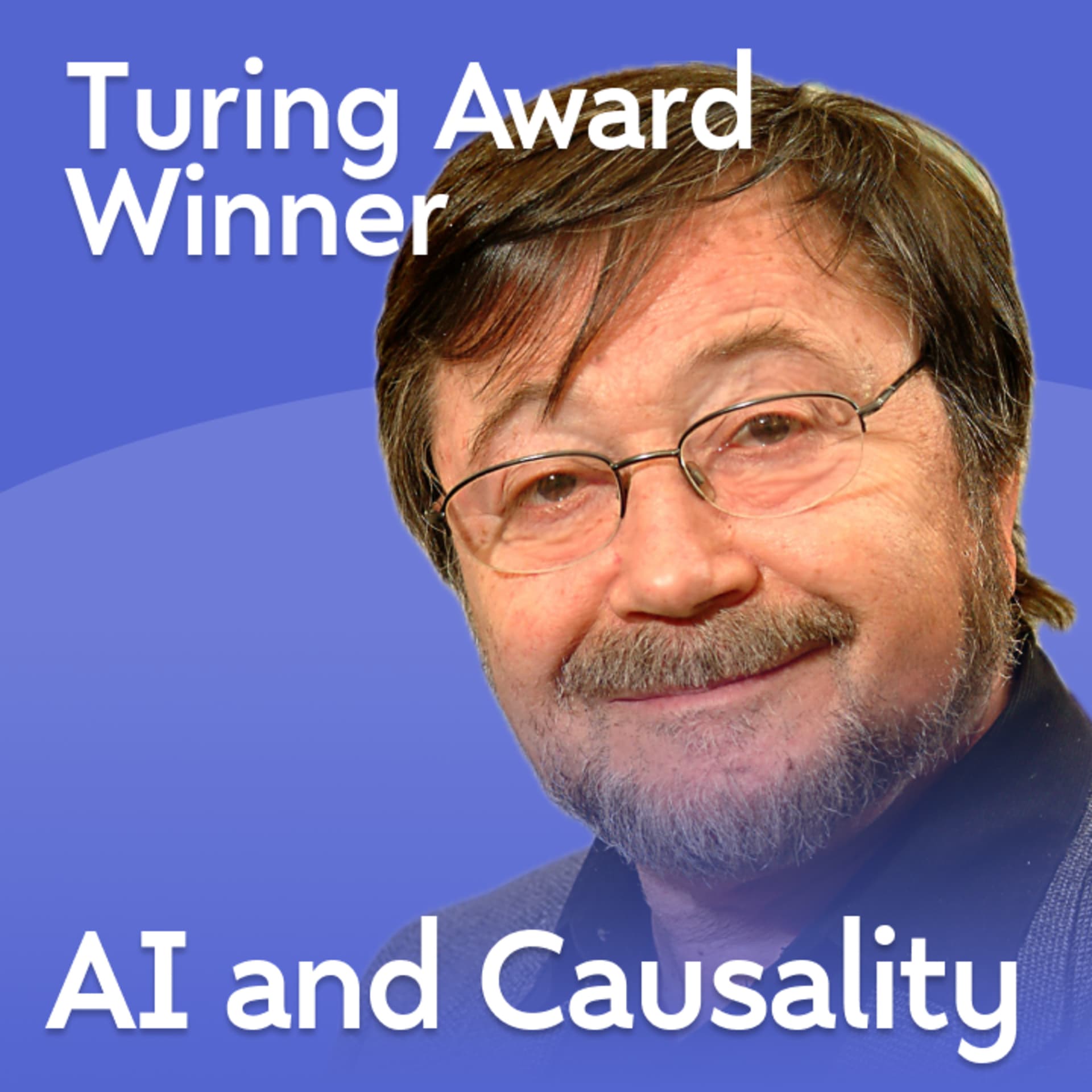
Judea Pearl (Turing Award winner) discusses how AI progress relates to causality, early AI optimism, limits of LLMs, and his “ladder of causation” (association → intervention → explanation). He argues probability/Bayesian networks were insufficient for causal reasoning, and that causal AI requires a new algebra capturing directionality (cause vs effect) and counterfactuals.
Guest backgrounds
Judea Pearl is an electrical engineering/physics-trained researcher who worked in computer memory research (core memory replacement efforts) and later became a professor (UCLA). He developed foundational ideas in Bayesian networks and causality, including graph-based conditional independence reasoning (with Azaria Paz). He also worked on AI-era problems like chess search and alpha-beta pruning optimality.
Key claims
LLMs don’t directly learn from raw data; they summarize assumptions embedded in internet knowledge, so they can appear to answer causal questions without truly performing causal inference. True AGI likely needs causal understanding plus the ability to learn from finite samples and reason at higher causal levels. “Faking intelligence” can be misleading; causal-query correctness is hard to fake.
Notable examples
“Pearl vortex” in superconducting films as a memory-like phenomenon; expert systems for medical diagnosis failing on uncertainty combination; chess systems using evaluation functions + alpha-beta pruning; car diagnosis where causal direction enables local updates; baby-robot curiosity/control as a driver of autonomy and a safety risk.
Written by AI. May contain mistakes. Listen to the episode to check what was said.
Chapters
Tap a time to open that second in VOEarly Life and Education in Israel
0:18 to 1:30
Judea discusses his early life in Israel and the impact of his education.
“So this robot baby comes and says, let me control them.”
Influential Teachers and Learning Styles
1:30 to 3:23
Judea reflects on how his teachers shaped his understanding of science.
“And we had a very excellent high school education.”
The Value of Understanding Science
3:23 to 5:51
Explore the significance of viewing oneself as an active participant in science.
“Not as a recipe of algorithms and techniques, but as a, from the viewpoint of the human actor and the transfer of ideas from one human to another, the human struggle against, not against.”
Memorable Classroom Experiences
5:51 to 8:11
Judea recounts a pivotal moment in his education that emphasized critical thinking.
“If the teacher went too fast, we made noise.”
Balancing Military and Education
8:11 to 9:23
Judea shares his experiences of studying engineering while serving in the army.
“So I took engineering after being a farmer in the army.”
Passion for Physics and Scientific Inquiry
9:23 to 11:28
Judea discusses what inspired his interest in physics and scientific exploration.
“Again, we got the idea that we are making science.”
The Impact of Descartes and Algebra
11:28 to 13:00
Learn why Judea considers Descartes an influential figure in mathematics.
“I couldn't get over the idea that you can do in algebra all the geometric constructions that we labeled on, you know.”
Career Beginnings in Computer Research
13:00 to 14:00
Judea talks about his early career in computer research and memory development.
“So that was what turned me on in my high school.”
Journey into Superconducting Memories
14:00 to 19:00
Learn about Judea Pearl's early research in superconducting memories and the challenges faced.
“David Sarsenhoff Research Laboratory, and there I got into the computer research group.”
The Evolution of AI Insights
19:00 to 26:00
Explore the historical perspective on AI's potential and the optimism of its early researchers.
“rooms and rooms and you were programmed with cards.”
Show all 28 chapters
Transition from Industry to Academia
26:00 to 28:00
Understand the shift from industry to academia in AI research and Judea Pearl's career path.
“At least in my corner of the field, the whole idea of inference, search, inference, logic, expert systems.”
The Interplay of Fast and Slow Thinking in Chess
28:00 to 31:40
Learn about the balance between intuition and deep analysis in chess algorithms.
“like the eight puzzles, Rubik cubes, things like that.”
Research Choices and Problem Solving in AI
31:40 to 36:40
Discover how researchers choose their focus and the puzzles that drive their work.
“It was still a dream to beat the world champion Kasparov by machine.”
Bridging Logic and Probability in Expert Systems
36:40 to 42:08
Explore the challenges of combining logic with probability to handle uncertainty in AI.
“Actually, later on we proved that they could not do it well because rules do not combine the way that logical assertions combine.”
Graph Theory and Probability Connection
42:08 to 43:15
Learn about the connection between graph theory and probability, and how it shapes our understanding of causality.
“It's the same logic that you have when X is independent of Y given Z in probability theory.”
Judgment vs. Data in Causation
43:55 to 49:52
Explore the balance between intuitive judgment and data in causal reasoning and the implications for LLMs.
“Everything depends on where do you get on the input.”
The Ladder of Causation
49:52 to 55:13
Understand the three levels of causation and how they impact the formulation of causal queries.
“You and I operate very nicely with causation.”
Intervention in Causal Analysis
55:13 to 56:00
Discuss the implications of intervention in causal analysis and its importance in understanding correlations.
“what sort of assumption you need to have before you can answer it.”
Understanding Causality and Intervention
56:00 to 59:20
Learn about the levels of causality, intervention, and their implications in understanding outcomes.
“Some of them don't have, some of them smoke.”
Role of LLMs in Causal Hierarchy
59:20 to 1:01:40
Explore how language models interact with causality and the limitations they face.
“of what would be a proper way of quantifying the uncertainty that you have given you a finite sample.”
Curiosity and Control in AI Development
1:01:40 to 1:08:40
Discuss the importance of curiosity and control in AI and its potential risks.
“I explained why there is compatibility between the ladder of causation and LLM performance and what the limitations are.”
Path to Artificial General Intelligence (AGI)
1:08:40 to 1:10:01
Examine the elements necessary for achieving AGI and the role of human-like attributes.
“I cannot control my husband, but I control myself, right?”
The Role of LLMs in Understanding AGI
1:10:01 to 1:12:00
Explore how LLMs could contribute to the quest for AGI and their limitations.
“Look at patients, look at cancer, look at smoking, tell us what you know.”
Causality and AI: Understanding Intelligence
1:12:01 to 1:15:04
Delve into the concepts of causality and how it relates to AI intelligence.
“Do you have organisms that have done it before?”
Faking Intelligence: A Debate
1:15:05 to 1:16:56
Discuss the implications of LLMs being able to fake intelligence versus true intelligence.
“So wouldn't that mean that we should believe they're intelligent?”
The Limitations of Organic vs. Silicon Intelligence
1:16:57 to 1:19:40
Examine the differences between organic and silicon-based intelligence and their implications.
“It allows you to compute functions of distributions, qualities of distribution, from finite samples.”
Rebellion in Science: A Personal Perspective
1:19:41 to 1:22:25
Understand the importance of challenging established norms in the scientific community.
“Do we think the way we think because we were born with organic material as opposed to cynical?”
Reflecting on Career Choices and Learning
1:24:03 to 1:26:26
Judea Pearl discusses the choices he made in his academic career and the importance of focusing on strengths.
“I feel like I am still able to teach people useful things.”
Transcript
Automatic transcript. May contain errors.0:00One day computers are going to be able to emulate all human functions. The question was only how and when, but not whether. This is Judea Pearl, Turing Award winner famous for his contributions to artificial intelligence, and I interviewed him about his career and where AI is today. So this robot baby comes and says, let me control them. And I know how. I understand their fears. People claim, we can now program consciousness. Come on. You have to be scientists, right? Define what you mean by consciousness. I proved that alpha beta is optimal. Even Knuth was surprised that one can prove the optimality on alpha beta.
0:41I don't know if I'm allowed to, but when I publish it, you see what kind of stupidity drives those great people. Here's the full episode.
0:53I looked into your educational background and it was all electrical engineering, physics. I don't see the connection to causal reasoning and artificial intelligence. How did you get there? Everything connects. Everything connects. Everything connects to the day I was born. It was hit on the head. And first, I have to start by saying that I grew up in mandated Israel prior to 1948, prior to the establishment of the state of Israel. And we had a very excellent high school education. My high school teachers were professors that were chased by Hitler from Germany, from highly reputable universities like Heidelberg and Berlin.
1:58And they came to Israel in the 1930s, and they didn't find any academic position at that time. they were rare and they started teaching high school. But they were really quality professors. They could teach anything without notes from the economy of Manchuria to the proof of Pythagoras film with no notes and no stuff. And we were, we I mean my generation, was lucky enough to be beneficiary of this educational experiment. So we were taught science from a human viewpoint, it chronologically the way things were discovered by whom they are discovered at what period why was there a question about a certain mathematical proof what the inventor of the proof knew what he didn't know and what he asked himself in the context of the historical situation at that time.
3:22That's the way to teach science. Not as a recipe of algorithms and techniques, but as a, from the viewpoint of the human actor and the transfer of ideas from one human to another, the human struggle against, not against. You will struggle to decipher the secrets of nature. What's the advantage of learning in that style? The advantage is that you see yourself as an actor. You're the student. You're also puzzled by many things, but look what he did. Look what Pythagoras did, okay? He was as puzzled as you were, and he took that route. Perhaps when you're puzzled, of course, your puzzles are not as magnificent as his, but still, look what he did.
4:26He took that route around things, and he consulted some other work of some other. He struggled, and you struggled, and you are part of science. That is the basic idea. give students the idea that you are part of science, not a passive observer at science, not a recipient, but as an actor. And that, I think, was unique, very valuable for me. We indeed got the idea that each one of us can find another proof of Pythagoras theorem that no one else has thought about. and each one of us has the potential of becoming an Einstein or Pythagoras. They gave us this illusion. It was a useful illusion. I know.
5:27I'm just a pebble looking at what Pythagoras or Einstein did. But that illusion helped me be a little, I would say, not contrarian, but assertive. And we all grew up in assertive mode of learning science. We insisted on understanding things our way in real time. If the teacher went too fast, we made noise. We made noise without chairs and with everything we could. And the teachers stopped and slowed down to make us all understand things our way in real time. So that was part of the mood of me and my generation. and I can see that it affected my life. I have one story that I remember. It made an impression on me.
6:36I look back and I say, well, it started very early. It started in age 10 when we learned about how to calculate areas and volumes. And there was a question in class, how many dunams are there in a square kilometer? Dunam is 1 ,000 meter square. It was a Turkish unit for measuring areas. So the entire class said dunam is a kilometer square. And I screamed and said, no, it's a thousand. We have 1 ,000 dunams in a kilometer square. And the teacher sided with the laughing class. And they all mocked me and ridiculed me. And I went home and I said, they are wrong, and I'm going to come back tomorrow and insist on that.
7:42and the teacher apologized to the class and I felt that yes, you have to insist on your understanding of things. I'm telling you that because maybe this is what made me into a non-compromiser. And this is part of my childhood, a background which might explain how I got into artificial intelligence. So I took engineering after being a farmer in the army. Farmer? Yes. In the Israeli army, you have troops which are spending their time half and half, half in military training and half in farming, being part of a kibbutz. It's the old idea of one hand holding the plow and the other one the rifle and you succeed.
8:50Did you ever shoot anyone? I almost shot someone without seeing him or her. But it turns out the next morning that it was a fox. But the steps of the fox were very, very similar to the step of a terrorist advancing through us. So that's as far as I got to shooting. So I got into the Technion to study electrical engineering. Again, we had great teachers. Again, we got the idea that we are making science. So we studied physics very seriously, and I liked what we studied, yeah. I wasn't the first in class, no. I was the third or fourth always. Never matched the geniuses. The geniuses knew or were bored in class.
9:51They knew what the teacher was going to do, what he's going to ask in the exams, and everything was boring to them. I wasn't bored. I wasn't the first, but I wasn't bored. What interested you in physics? What did you like that made you so passionate? What I liked was that with sitting on your chair, you can predict things in physics. like Maxwell, you know, that sat on his chair and said, hmm, that looks like a wave equation. Let me calculate its velocity. Hmm, it looks like the velocity of light. Hmm, maybe light is nothing else but electromagnetic waves, you know, on his armchair. He didn't do an experiment.
10:50That was exciting to me. My wife told me one night, I woke up and I said, Maxwell was wrong. Maxwell was wrong. So I said, she quieted Ma down. The next morning I said, he was right. By the way, you mentioned a few scientists, and it seems like you know a lot about the history of the old scientists. Yes. Do you have a favorite scientist of all time and why? When we studied analytic geometry, I got fever. Really fever. Physical fever. Yeah. I couldn't get over the idea that you can do in algebra all the geometric constructions that we labeled on, you know. So I thought that Descartes was the greatest modernization ever lived.
11:49It was so enormous to me. The transformation from geometric constructions to algebraic derivations. It was unbelievable. I take that for granted when I was in education. What is it about that that's so astonishing? Here you have two different languages. Language of geometry. and the language of algebra and they are the same thing and you can get the same phenomena and the same proof that you can pass a tangent to a circle from a point outside the circle And you can find the angle by different method two different languages dealing with the same phenomena different perspective and they get the same result It blew me off.
12:45Blew me off completely. Maybe that was preparation to computer science. Because for us, computer science is what's a big deal. You want to see things from different perspectives, invent a new language. So that was what turned me on in my high school. That was in high school. And then I saw the same thing in physics. different languages capturing the same phenomena. Faraday really excited me. He invented the idea of a field. Two different ways of looking at the same thing. You can see that the force here depends on the charges around it. Or you can say, no, there's a field right in location of your testing point.
13:43terrific, terrific. So I came in with this preparation and here we go to Brooklyn Poly and I studied there. I worked in the morning in RCA laboratories in Princeton, New Jersey, David Sarsenhoff Research Laboratory, and there I got into the computer research group. computer research at that time was research all phenomena that you can think of to find out in a mechanism for computer memories the memories at that time were core memories magnetic cores the donuts that you remember perhaps from your early childhood that were too slow and too clumsy and you have to have people stringing them X and Y and Z in Hong Kong and people understood that the days of core memories are numbered and we were looking for a new phenomenon some people look at photochromic memories some people look at a semiconductor.
15:04Some people look like me into superconductivity. And I was in a group that was supposed to design superconducting memories. We did some nice plates, 16 by 16 beats. And we thought that we have the future in front of us. But in the way toward developing superconducting memories, I investigated the physical phenomenon behind the eddy currents, permanent eddy currents in thin superconducting films. And it so happened that I discovered new phenomena there. And I got a prize and I even have a name, it's called Pearl Vortex, you can find it in Wikipedia. I discovered that physicists, years after I finished my PhD, discovered my work there and they were interested in the idea of permanent current flowing in a circle in superconducting films and since I analyzed the magnetic and the current field they call it pearl vortex.
16:32So here I have my footstep into immortality. You said it's a permanent vortex? Is it because there's no electrical resistance because it's a superconductor? In superconducting they have current going forever. So you establish, you put magnetic field and you excite a vortex counterclockwise, and it will continue to turn and turn and turn forever. That's why we call it permanent current, forever, until you flip it with another magnetic field. So we call it a vortex, but it goes on forever. And you can detect it by flipping it. You flip it. And if you see a big flip, it was one way. If you don't see a big flip, it was the way you turn it.
17:28So you have a memory. You have a memory. Of course, we didn't succeed in turning it into useful memories that will be competitive with semiconductors. The people who worked on semiconductors beat us out. We never believed that they would, but they did both in miniaturization and in techniques. Unbelievable. At the time, why did you not believe in the semiconductor direction? Who is going to trust memory to battery failure? What if you lose the battery? It was obvious. It would never work right. And we looked into the result that they obtained at that time. They looked at far-fetched, the idea that you can have that degree of miniaturization.
18:39We saw the struggle of people who were working in the laboratory on semiconductors, and we weren't impressed. They beat us up.
18:54Okay, so that was my story with the superconductors. But I must tell you that everybody, even at that time when computers were clumsy and took rooms and rooms and you were programmed with cards. And even at that time, everybody understood in AI as an inspiration. Everybody believed thoroughly that one day computers are going will be able to emulate all human functions. That was not the question. The question was only how and when, but not whether. I remember already at that time, with the clumsy computers and the punch cards, people talked about associative memories, about pattern recognition, about seeing, understanding.
20:01All these were already ideas, were exciting people to think more about it. And so we were all geared towards it. If I at that time asked people and your peers and you, what's the timeline for maybe human level intelligence and machines, what would people have said at that time when they were excited in the 80s? I think they were more optimistic than reality. They would probably give you 20 years. But that was 1965. Okay. So 20 years, 1985, no, we didn't yet get anywhere. And then what about today? Do you think people are more optimistic than reality? Or, like, is this just history repeating itself?
20:55It depends what you're talking about. Some people are extremely optimistic today, and some people say, I'm a bit skeptical, but not skeptical in our ability to eventually reach AGI, but in whether the LLM technique and thinking will lead us there. So it's a question we ask. LLMs were surprised, great surprised, but they have limitations. We'll talk about it. After superconducting, I decided to come to California to a company named Electronic Memories, which did not work on superconductors, but worked on plated wires. Instead of having a donut in which you thread a wire, you start with a wire and you plate it with magnetic material so it acts like a donut locally, right?
22:01And that was the promising technique at that time. At least I was in charge of a research and development group, charged with the task of developing this kind of system to replace core memories. Yeah. And I worked there for three years. I was frustrated because things did not go my way. I had both administrative and technical challenges that I couldn't handle, both in chemistry and I didn't know much chemistry. So I was frustrated. What were the administrative frustrations? I had a group, and I had to satisfy the administration. I dealt with the personnel issues, firing, hiring people. And my wife saw that I am unhappy, and she told me, you have your places in academia.
23:10So I looked for a position in academia. Luckily, also at that time, industry was revered by academia. Because all the advances, all the important advances were developed in industry, not in academia. The transistor was developed in Bell Lab. The laser was developed in, I think, here in California by another fellow. But all this was industry development and not academia. So academia looked with reverence toward people who come from industry. And they hired me without me even filling an application, without even filling or asking for recommendations. Yeah, that time was a good time to be hired. And what about, because you said at that time, industry was revered by equity.
24:20Yes. Would you say that's still true today, or has that changed? No, it's changed. It's changed. Oh, no, it's different now. AI is different. If you come from a deeper, deeper learning or something, deep mind, you know, people look at you with reverence in academia. Yeah. But it's changed. Only in the last few years, I see that. And that, throughout me, since 1970, I think until 2000, it was the other way around. You know, they simply dismissed industry. I mean, academia dismissed industry. Yeah. I wonder what happened. Was it like Bell Labs disbanded their research group or something? That was part of it.
25:14They love this banding. And what happened to IBM Research? It's still there in Watson, Watson Center. I remember a big center, huge and important, including Raytheon, including, where can I tell you, Hughes Research here in Malibu. Did great work, but it all went down. sort of. The frontier of research went to academia. Sure, we had a lot of theoretical work in academia, the development of AI, AI proper. After 1970, yeah, but prior to 2000. Yeah. At least in my corner of the field, the whole idea of inference, search, inference, logic, expert systems. These were all academic development. So then you got hired at UCLA.
26:25I got hired in 1970 or 1969. And yeah, I was hired in the computer science department, who just formed there. And I got first hired by another department called engineering systems into the superior and then back to the computer science. And I was asked to teach computer computer memories, hardware computer memories. And I gave a course in this technology. And later on, I started getting interest in pattern recognition. And I started working in this direction. I did work on image compression. we did use the fast Fourier transform and fast Hadamard transform, all kinds of transform techniques to condense images to minimize the number of bits sent.
27:35I guess it was part of the trend at that time. But when I got into pattern of cognition, I returned to my old dream of thinking about AI and how the brain works and how computers will one day emulate ourselves. And I started teaching class in AI. At that time, AI was game playing, machine playing of chess and checkers and puzzles, like the eight puzzles, Rubik cubes, things like that. So that was AI, yeah. And I got excited by that game. And now I see why. Now I can tell you why. Because the game was a matter of capturing in mathematics what people do heuristically, like playing chess. And the interplay between mathematical analysis and the performance interests me, and especially in chess playing, the interplay between the explicit knowledge that you have in terms of your gut feel about the strength of a position and what you get when you do some search.
29:07Okay. So here is an interplay between fast thinking and long thinking to use Kahneman and Tversky or Kahneman title. Thinking fast and slow. Thinking fast and thinking slow, right. Here it's a beautiful arena to see how not only you have two modes of thinking, but how they feed each other and how you can invest more resources in one versus the other. The algorithms at that time, like let's say chess for instance, Can you give an example of the interplay of the two and how that might come together in a chess playing system? Yes, you can invest more time in getting your immediate perception. It's called static evaluation function of the chess position, the strength of a chess position.
30:04Or you can let it go and think about searching for a deeper horizon. Okay? It's a trade-off. It was like if I remember, we search the game tree and then we evaluate each position. At the horizon. And then you back. And then you make a move toward the position that has the greatest strength after you back off. Okay. So the intuition is encoded in the evaluation function. Yeah. Your intuition is the evaluation function. But you can improve your intuition too. How? By learning. Okay, so like Samuel Checker program, learning in regression analysis to find the proper weights on the various characteristics of the position so that to make the evaluation function more accurate.
31:08When I was learning chess, I think one heuristic is you want to control the center. Good. And material advantage is another one, right? Okay, and whether you have two bishops versus a bishop and a knight, right? This all counts. And whether you're already castle or not, all this contributes as attributes to the strength of a board position. getting the weight correct you can do by learning after you play so many games and you adjust the weights yeah so that was samuel contribution first machine learning i say it was the first machine learning yeah at that time when you were working on this were chess systems superhuman yet I think there's...
32:02No, no, no. It was still a dream to beat the world champion Kasparov by machine. It was a dream. No. And, but I did night analysis. We did alpha-beta pruning, if you remember that. You probably programmed it. And UCLA, actually. UCLA, right. It's nice, yes. Well, I proved that alpha beta is optimal. Really? Yes. Mathematically, you see. I like the mathematics. Prove you cannot do better in terms of number of position that you have to inspect at the horizon or the depth of search. And what things I say about it, I got some nice results. Even Knuth was surprised that one can prove the optimality on alpha beta, because he questioned it in his book.
33:03Yeah, I did some work with Dick Karp on searching trees. And, okay, so I did mathematical work on the trade-off between search and reasoning, until I got sick and tired of search. When you pick your research area, is that 100 % your own choice? No, it's always a combination of two things. Number one, do you know the answer to the question? If you don't know the answer, it's a puzzle. If it's a puzzle, the next question comes, do you think you have the techniques to make a contribution here? Do you know something that other people don't know? perhaps from another field, perhaps from physics, perhaps from that, that you can bring to bear, that you can leverage here so you can get the answer or closer to the answer than other people.
34:05So it's always a combination of your perception of your tools versus the puzzle that you have. I see important problem. People are breaking their heads. So it's a puzzle. Do you know the answer, if I know, fine. But if I don't know, it's my puzzle. I take it personally, yeah. I'm aching. I don't sleep at night. And then the question is whether I have the tools. In some areas, I give up right away. I don't have the tools. In other areas, I say, wow, If I only use that kind of trick, maybe I can get some insight. So that's always two questions I ask myself. In the case of artificial intelligence, at that time we had an expert system come into the game.
35:00Ed Feigenbaum and his co-workers did my sin expert system for medical analysis. In expert system, the hurdle was dealing with uncertainty. It started with logic. You ask an expert for rules of behavior. You ask a doctor when you see a fever, what's the first thing that comes to your mind, what's the next question you ask, what drives your queries until you get a diagnosis and a therapy? So they thought they can capture expert behavior using logical rules. But then it turns out that most everything is corrupted by noise, by uncertainty. So they started doing the same thing to uncertainty. So if you go to, if you came from Asia, you have 50 % of having malaria and so on.
36:12And then you have 30 % here, so much there. And how do you combine these uncertainties now? Logic doesn't tell you how to combine uncertainties. Probability does, but not logic. So how do you combine one uncertainty with another, different rules, to come out with a combined conclusion? That was the hurdle at that time, and I remember they didn't do it well. Actually, later on we proved that they could not do it well because rules do not combine the way that logical assertions combine. So then I went to and I asked myself, you know probability, right? So why don't you apply probability to it and do it in the right way?
37:05But probability was in ill repute at that time. because everybody, everybody understood that probability is passé because it takes exponential time, exponential memories to do even the most rudimentary tasks. You have, if you look at what, how probability is defined by textbook, you have a big table and for every combination of event, you have a number, the number sum to one. Okay, that's beautiful. But then you can talk about conditional probability. But all these require exponentially large tables and exponentially long time to compute even the smallest kind of inference tax, for instance. and what's the probability of having malaria, given that you see two things, like you came from Asia and you have a fever of 30 degrees Celsius.
38:17Even the small task like that, probability of X given that you have Y and Z, takes influential time if you go by textbook. okay but I ask myself you and I are doing it fairly well we compute probability as we cross the street as we choose a doctor yeah and we do it a fairly good job at least we go through life without much regret and how do we do it then if we are required to do it by exponentially large tables of probability. Evidently, we are using some other kind of judgment. And I hooked onto the idea that everything depends on conditional independence, which means not every fact in life is relevant to any query.
39:24The color of the eye of my uncle is irrelevant when I try to find a diagnosis of a disease. So evidently we have a notion or assumptions about what is relevant and what is not relevant. How do we capture it? Conditional probability, conditional independence. Wonderful. But conditional independence, if you go by a textbook, they are defined by the probability table. So again, consponential time, no. Here came the breakthrough that we have conditional independence independently coded by our assumptions. How? In a graph. If you, in the graph can convey sets of independencies, and if you have the graph, then you compute all the independencies, find out what is relevant to what, and deal with the relevant only.
40:29Great. And then came the work on Bayesian network. You define a network, error or no error. The combination of errors gives you information about what is independent on what given what. So for every triplet, X is independent on Y given Z, where Z can be a set and so forth, and X can be computed from the graph. Not from the probability, but from the graph, which actually if you look at from a philosophical viewpoint, it's a revolution. What does probabilities have to do with graphs? When you took probabilities theory 101, is anybody talking to graph about you? No, right? So both the probabilists and the philosophers got irritated, or should be irritated.
Read the full transcript
41:32What is the connection between probabilities and graph? It turns out there is a very strong logical connection between the two, because the axioms of conditional probability or conditional independence in probability theory are the same axiom that you have in graph separation. In graph you have idea of separation. There is no connection between node X and node Y unless you go through a set of node Z. So Z separates X from Y. Okay? It's the same logic that you have when X is independent of Y given Z in probability theory. Independent separation is a connection between them. They share axioms. Aren't you happy?
42:29I'm happy. Because I relieved now the excitement we have in the 1970s when we discovered all this connection between two seemingly unrelated perspectives on science, probability theory and graph theory. That, by the way, I did in joint work with Azaria Paz, who came to visit me from the Technion in Israel. And that is called, by the way, I should mention it, the theory of graphoid. Graphoid. Open AI, Anthropic, Cursor, and Vercel all use this product to make their lives better. And the problem it solves is when you're building SaaS or an AI product and you want to sell to other companies, there's all these requirements you need to meet.
43:23There's SSO, there's SCIM, there's RBAC, there's audit logs. These are all things that take time to integrate, but aren't the main focus of your app. WorkOS is an API layer that lets you meet all of these requirements in just a few lines of code. So let's say you have a new SaaS product and you want to sell to other companies. WorkOS will solve all of these critical feature gaps for you. You can check them out at workos.com to learn more and get started. And I appreciate them for supporting my work and sponsoring this podcast. This all makes sense, but my immediate thought is where do you get the graph?
43:59Everything depends on where do you get on the input. Sometimes the input is in the data. sometimes the input is in a judgment but suppose you need a judgment for them okay are you are you giving up if the judgment required are intuitive meaningful something that you are willing to defend right why not use judgment like if I know that if I know that the son doesn't listen to the rooster crowing, right? Doesn't care. I strongly believe in that. Do I need the data to support it? Or I can insert it, assert it, and defend it when needed? So this is a trick here. People don't realize, don't appreciate.
44:53Judgment is not a no-no if it is meaningful, and if you can, if if it is condensed, very few judgments can buy you lots of computation and if you are willing to defend it because it's so intuitive where you get the idea that where do you get the idea that the sun doesn't care about the rooster? Have you done an experiment? No. But it's so obvious, right? Okay. But what if your intuition is wrong? Indeed, that's our problem. It's part of our problem even with the LLM. Because what is the LLM? It's a summary, it's average of all possible judgment that people put in the internet. It's a summary of a huge trillion number of judgment over which you have no control, over which the LLM does have no control.
45:49We live with it. And hopefully, it puts more weights on people whose judgment you trust, and less weight on just the quirks of people who are purposely trying to get the system to fail. So no, no. There is wisdom in looking at the crowd judgment. There is wisdom in that, but there's also danger in that. Then after expert system and uncertainty and Bayesian network came causality. I mentioned that in the development of Bayesian network, I was extremely sure that probability captures our intuition, our reasoning mode, and it's the best protection against paradoxes. essentially that it's sufficient for capturing human reasoning.
46:53I was wrong, and I realized that already when the Bayesian network became famous and popular, and I realized it in the introduction to my book, Causality, I confessed being wrong, and I understand why I got into that, why it was misleading. And the transition came when we looked into the simple phenomena, and we never asked an expert to encode probabilistic judgment in a form of Bayesian network, namely with arrows and dots, always the arrows went from what we believe to be cause into the effect. It never went the other way around. Psychological phenomena, okay? Why is that? So people try to reverse the arrows.
48:01What about if you ask specifically, give me error between the symptom and the disease? Bad judgment. If you couldn't, put the right judgment. Evidently, we have something in causality which is basic to our reasoning that is not captured by probability. And that was the idea of invariance. The relationship between disease and fever is a stable one, as opposed to the relationship between the opposite relationship. Also invariance. When you talk about car diagnosis, for instance, and so you have an expert system for diagnosing troubleshooting cars. And then you have a new model. So the charger is a different corner of the motor.
49:00You don't need to reformulate your entire database from fresh. You only change one component, the location of the charger. All the rest remains intact. So the whole system you can amortize the investment in eliciting knowledge that you got in one system after a local modification of the system. That if you do it in a causal way in the causal direction, it doesn't work if you don't do it in a causal direction. And that jolted me to think maybe you were wrong all along and probability is not sufficient. If not, what is sufficient? Let's capture the puzzle. Here I have a puzzle. You and I operate very nicely with causation.
49:56Can we program causation on a computer? Then this is a question because we are so much immersed in our language and in our assumptions that we cannot even distinguish what is an assumption and what is the conclusion. We just talked cause and effect and your assumptions are the same as mine, so there's no way to convince you that we made an assumption, right? We take everything for granted. But when you have to teach it to a brainless robot, you have to distinguish with assumptions and conclusions and logic. That was the task. We had to invent a new science, a new mathematics to capture a new phenomena, the phenomena of cause and effect.
50:48It hasn't been done for us. Why? Because science was in bed with algebra from the time of Galileo.
51:06From 1632. He invented, he got the idea and he was very happy that science speaks algebra, which is great because you can ask questions and solve and get answers to questions that people could not do without algebra. Like how the load on a beam, when would the beam break if you put a certain load on it? And you figure out that you can ask questions both ways because the equality sign is symmetric. So from answering the question, when would the beam break if you put a certain load on it? You can ask the question, how should you shape the beam so that it will hold a load of that magnitude? You can invert it.
52:02That was a real revolution in science. I'm telling you my perception of science not many philosophers will say that was a revolution I say so but perhaps they agree with me or not at least I trace the evolution of ideas carefully and so that was a revolution but it carries some limitation because the equality sign is indeed symmetrical and science has not developed algebra for the directionality that we see in cause and effect relationship. If I tell you that the atmospheric pressure affects the deviation of the barometer and not the other way around, you agree with me. But if you write the equation, the robot might think that maybe fiddling around with the barometer will change the weather tomorrow.
53:04I'm talking about a stupid robot, right? Yeah. But if you give him the equation, it can work both ways. If f is equal to ma, then m is equal to f over a, which means that if you want to change the mass, you increase acceleration or whatever, right? The symmetry might produce paradoxes, might use wrong action. So the symmetry is the limitation of algebra in terms of capturing science. And we have to build a new algebra to take care of the directionality that we have in cause and effect relationship. That takes computer science, because we in computer science have the operation called assignment, right?
53:57When you assign the content of register A into register B, it doesn't mean that it's not reversible. So if you take the logic of assignment and you put it on top of the algebra, on top of physics, you get causal science. And that's what I try to do. And I think that so far I'm very happy with what came up. We do have a new algebra to capture cause and effect relationship. And we can answer causal queries on three levels. The ladder of causation from association to intervention to explanation. And we found out that we have a ladder here, a hierarchy that you cannot solve, you cannot answer questions in level I unless you have assumptions of level I or higher.
55:04So it's a hierarchy in the formal sense, and we know how to handle it, which is very useful because you give me a query, I can tell you what level it is, I can tell you what assumption what sort of assumption you need to have before you can answer it. And I can tell you if you can get it from the data, or you can get it from experiments, or you can get it by somebody else's explanation, or whatever. But I can tell you the source of knowledge that you need in order to answer it. Can you explain that causal hierarchy? Ah, yes, yes. It's very easy. It's a three-level ladder. It goes from the bottom, which is association.
55:52That's straight statistics. If you see X, what can you tell me about Y? If you see passively, hands off, okay? No intervention. You are watching patients. Some of them have cancer. Some of them don't have, some of them smoke. Some of them don't smoke. And you're trying to figure out how many years a guy will live, given that he is a heavy smoker of that magnitude. Okay? That's association, correlation. That's entire fields of probability and statistics. This is what they teach you in Statistics 101, even to 808. It's all they do. And now comes the question, what I intervene? And what if I force you to smoke five packs a day?
56:57Don't laugh at me. myself. It's illegal, I know. But if you want to talk about the probability of living 20 years, if I start smoking tomorrow, I have to think in terms of experience, I start, which means I'm going to choose to smoke five packs a day. So it's a matter of intervention. What is Intervention is forcing you to do something that you're not inclined to do naturally. That's a second level. Intervention. Or doing. If you have experiments, you can answer queries on level two. But that's not the end because we also need to answer questions of explanation. Given that I observe that I am 80 years old and I am still alive and alert and I smoke five packs a day.
58:06What if I didn't smoke? Okay. Would I be as alert? Why is it so different? Because you have already information about the outcome. You know how I'm doing today. It gives you an idea about my metabolism and about my anatomy that you didn't know before. And using that, you can find, you can try to figure out what the outcome would have been had the input been different. That's a different level, requires different kind of assumptions, different techniques, different algebra. We have it. I call it explanation. It's more creative, retrospection, and it's not an easy problem. Even the first level, especially when you have finite sample, and you have to figure out these are probabilities.
59:09is properties mean properties of population, right, from finite samples. So I have all this P level of P values and struggles among statisticians of what would be a proper way of quantifying the uncertainty that you have given you a finite sample. Where would you place LLMs in this causal hierarchy? Beautiful question. here comes LLM I made a statement right that you cannot go from level I to level I plus one unless you have a sumptuous here you have LLM just looking at data right and giving you beautiful explanations for things that happen beautiful prediction of what will happen if you do okay how can the trick is they are not looking at data They are looking onto assumptions-laden world models offered by you and me and by other authors in the internet.
1:00:24So they are looking at opinion of doctors already who wrote papers. So it's not looking at the samples of patients, and samples of patients smoking and non-smoking. They're not looking directly at the data. They're looking in interpreted data. data interpreted already by physicians and interpreters and reviewers which went into the articles which are summarized on the internet. So they have all this human knowledge on which they operate, and that is what they take as input, and that's what they summarize. So they do not violate the restriction of the ladder, because they do have information from higher levels.
1:01:26But it's biased by the opinion of those authors. Fine. Those authors were smart, as long as they are smart and you believe. Good. So that was NLM is doing. and what is the... I explained why there is compatibility between the ladder of causation and LLM performance and what the limitations are. Now if you want now to change the environment, if you want to provide explanation for raw data, LLM will be in the same difficulty than you are and what the physician says. I have raw data, what can I say about the probability of cancer? But it's not really doing the introspection. It's taking the introspection that already was done and summarizing it.
1:02:27How it summarizes it It's a mystery that no one has yet been able to decode. It's a mystery how human knowledge encoded in the form of articles on the Internet is being summarized by the LLMs. So then do you think this approach could lead to superhuman intelligence or maybe some people say AGI? I don't think so. Not with the LLM approach. They need to have some understanding of causality, so that they wouldn't need an access to the internet. Look, a baby gets born playing around with toys in the crib and gets quite intelligent, right, without having access to the internet, simply by curiosity.
1:03:25The babies are born with built-in curiosity to have control over the environment. Until you have control or the illusion that you have control, you're a restless baby. And you play around with toys, bing, bing, bing, until you understand one of these toys makes noise and one of these toys doesn't make noise. But you are born with this restlessness. and when are you pacified when you understand that green toys make noise and yellow noise yellow toys don't now you're in control of the environment you can suck you pacifier yeah what if i created a like a baby robot that that randomly plays with toys and gathers data about them, and then you feed that into LLMs, then it does have some sort of discovery.
1:04:22Yeah, that is indeed the danger. When you have a robot like that, born with this restlessness and craving for control over the environment, then you and I become part of the environment. And there's nothing to stop that baby Putin from trying to turn us into his or her pets, to utilize us to satisfy his control. because we are part of the environment, in which case he can use us, and we are very, could be very useful to serve his or her need. What is his need? Simply, the need to feel in control, to be in this illusion of empowerment. I don't rest until I have the illusion that I control my environment.
1:05:29And here are some organisms organisms for you and I, who are part of the environment, and they seem to work outside my control. I cannot afford it. It makes me feel like I'm useless. So this robot baby comes and says, let me control them. And I know how. I understand their fears. you don't want me to tell about your thoughts to your wife, right? So I'm going to blackmail you. And all kinds of things. I have a lot of data about you. And some people I know, you wouldn't like me to tell what I know about you. So I'm going to blackmail you. But you see, if you want that robot to have the curiosity of a child and we want it, We want the guy to desire to have control over its environment because the environment may change and he needs to have this urge to be in control.
1:06:39So if you program that, then you lose control. Because you become part of his or her environment. But you can say, okay, let's forget about a curious robot. We don't want a curious robot. So you lost, we are not emulating ourselves because we are curious robots. We are curious organisms as opposed to monkeys. Okay. Monkey is an example of an organism which is motivated by reward. But if you don't give the monkey a banana, he's not curious how banana grows. He is motivated by bananas. You remove the immediate reward and the monkey is not interested in learning more about the world. Understanding environment can be totally wrong.
1:07:45Look, religious people believe that if they sacrifice their children, right, they control drought. it can get to this stupid extent but it is common to many primitive society if you bring a sacrifice to the God you know next year you're gonna have crops and harvest it goes to extreme battered wife believe that if he if he prepare great better dinner and the husband is gonna be next time is gonna be less abusive. It's just all kind of extreme and wrong conclusion. But the need to feel in control is so immense that it overcomes all these paradoxes. It's innate in us. I cannot control my husband, but I control myself, right?
1:08:44So let me be a better wife. This is something I can control. Do you think that we need to put those human elements in an AI for it to become AGI? I think so. I think so. Otherwise, we wouldn't see autonomy. We wouldn't see autonomy in the sense that we are seeing it in human beings. And this is the definition of AGI. A general intelligence. it acts like you and me so we can converse with that creature in our language and motivate if not today's lms future lms they might get to a point where if you were just texting it maybe you know like the turing test where you don't worry about the physical embodiment you just see the text that comes from it you could mistake it for a human maybe, or it could appear intelligent?
1:09:45Well, the test comes from exposing the system to raw data, not data that was chewed by our internet articles. Raw data. Look at patients, look at cancer, look at smoking, tell us what you know. I'll give you some experiments to learn. be automated scientists. Can an LLM today be automated scientists? And I think they cannot without access to the Internet articles. So then if that wouldn't lead to AGI, what thoughts might you have on something that could lead to AGI? A computer system that has both the ability of LLMs to go from finite samples to property of distribution, that is level one of the ladder, plus ability to reason in higher levels of the ladder.
1:10:52I tend to combine it with the calculus of intervention and with the calculus of explanation, with the counterfactual calculus. I call it causal AI. I don't see any impediments to this combination to bring us to an AI level with the danger that it presents to us. my motivation is to understand how we do it and i still have few puzzles but as i told you puzzles are the driving forces for size for science yeah so you said do is missing what if what if you had a fleet of robots that they're just doing experiments they don't know exactly you know the direction some random discovery process they collect that data feed it back into their hive mind to LLM and they repeat, they repeat until they discover things.
1:11:55Could that solve some of the missing piece you're saying? Sure, but I need to know how... Do you have organisms that have done it before? Monkeys haven't done it because monkeys remain monkeys. They didn't invent Maxwell equations. So what do we have that monkeys do not have? One hypothesis I support it is that monkeys, that we have this innate curiosity to have control over our environment. And that's a necessary... A necessary. I'm not sure it's sufficient. Of course, we have the computational tool to bring it to fruition. we have succeeded in some way perhaps the next robot will do better so we have a benevolent God in the form of a robot actually what's wrong with it?
1:12:59people live for so many thousands of years under the illusion of a non-existent God could you imagine if we really have a benevolent God both just and almighty Wow, wouldn't it be nice? And it's a robot. It's a robot, yes. And we know exactly what sacrifice to give for the right kind of request.
1:13:25It's the first time I think about it. Maybe it's going to be good. When I see all these AI companies, they seem to be thinking that LLMs will lead to AGR. They continue to go in that same direction. Really? I'm not sure. I really believe in that. I know Jeff Hinton just came out a few months ago. He said, no, we are on a dead end. Other people might also come up and say things in a different way. I don't find the consensus here in terms of the capabilities of LLMs. Yeah. I think there's a lot of famous people that disagree, but for instance, the people who are running maybe Anthropic or something like that, they continue to push and believe, you know, three to five years from now there will be.
1:14:20There's a lot of that. There's a lot of anthropomorphic terms which people claim, we can now do that. We can now program consciousness. Come on. You have to be a scientist, right? Define what you mean by consciousness. What are the Turing tests for consciousness? And then show that you can do. And what are the principles that have limited us until now and that have been overcome now with your system? That is a scientific talk. I don't buy this. And I don't read them either. There was one interview you said, faking intelligence is intelligence. I could see an LLM, you know, faking intelligence based off what I've seen.
1:15:05So wouldn't that mean that we should believe they're intelligent? Well, if you have a correct test, yeah. You have to define what you mean by intelligence. If you define intelligence by playing good chess, right, we have already done it, right? But if we put more demand on what intelligence is, then we haven't succeeded yet in passing the Turing test. So, yes, faking it is having it. Because why? Because it's so hard to fake. I said it in that context because it's so... The context that I had is, for instance, coming out with correct answers to causal queries. And I showed that it grows like a super exponential.
1:16:04You have so many variables on all sides that you have to deal with that you will have to have, the faker will have to have super exponential memory. On that basis, I made a statement. Having it, faking it is having it because it's so hard to fake. Currently, you can bypass faking without fake. If you steal from other people, you don't need to spend these computational resources on faking it. So you bypass it because you steal from the Internet. I see. So you're saying in this case the intelligence came from the training set, which came from humans, which are intelligent. Which is very useful. Very useful.
1:16:56And we, I'm saying the people like me who are trying to build the science of intelligence, we can use all these capabilities of LLMs, level one of the ladder, in our scheme of getting general intelligence. Level one is very important. It allows you to compute functions of distributions, qualities of distribution, from finite samples. Beautiful. It's a terrifically and very immensely useful tool, among the many other tools that we need for AGI. We know exactly where it's going to fit. Where was it? In getting from finite sample to properties of distributions. It's a very hard problem. You mentioned this conversation, I think you said it in other places too, that you're interested in capturing the way that people think, not the way that nature is constructed.
1:18:05Right, right. Why do you care about human cognition? When I think about machines, what makes them special is that they think in a different way than us, and they're faster. And so, yeah, why is that the goal? I'll tell you, because I am an egotistic organism. I want to understand myself. I'm lazy, okay? It's true. We are made of organic material. So that puts certain limitations on our capabilities. Perhaps silicon is not subject to the same limitation that organic chemistry is. Perhaps. So what? So which means that I will never be able to understand how I think by exercise on a silicon machine.
1:19:01That's the idea. But there are so many functions that are capturable by silicon. today. I don't see any speaking in terms of theory and emulation I don't see any capability which is basically not capture by silicon emulator so why work on the unique biology with which we inherited. I don't see any reason for that. But anyhow, some people are... It's a legitimate question to ask. Do we think the way we think because we were born with organic material as opposed to cynical? Okay? It's a legitimate scientific question, and some people can spend their time I'm interested in other questions. You said rebellion pays in science and a restless mind pays.
1:20:17I was curious why you think being rebellious is a valuable thing in your career. I tell you why, I tell you why. More and more, I come to the realization that the scientific community and academic community is the most dogmatic, conservative, anti-progress that we have invented. Why do you say that? I can see what difficulty the theory and the science of cause and effect are facing today in getting just to being penetrating the thinking of disciplines like statistics, like economics, Okay, these people are still thinking like a hundred years ago And when I see that and I see the forces that preserve this inertia and they're not decent forces I See that I'm very disappointed I used to think that academia is the place where new ideas can really spread and propagate and I feel the other way around You have so much inertia invested in the politics of academia, in the cultish inhibitions that comes with academia.
1:21:51So I really am disappointed. What can I tell you? I'm not sure that we have the right kind of organizations that will be conducive to... that's why I'm saying let's rebel. Don't take your professor's word as authority. Rebel against your professors. I rebelled against my professor. And I want to see other my students rebel against me. And believe me, I remember, there were several students who told me, you don't know anything about AI. And I told you, after a while, I said, you're right. By saying that, you drove me to study different aspects. And I was educated by that. When I looked at your past works, too, I think you'd mentioned that your work was controversial or mischievous before it was accepted?
1:22:53Yeah. It was because of dogmatism. One day I'm going to publish all my correspondence with the greatest philosophers of the time, okay, with statisticians and economists. It's all in my correspondence files, okay. I don't know if I'm allowed to because they communicated with me with the understanding that it will be kept private. But when I publish it, you see what kind of stupidity drives those great people. And they were great, really. Each one of them was a giant in his or her field, really. But they couldn't get over a few of the basic molds in which they were formed. How did you overcome that if everyone thought your initial things were?
1:23:49I remember my high school days. They said, no, there are a thousand dunams in a kilometer square. So I don't know where I got this chutzpah. In Hebrew, you call it chutzpah. In English, it would be audacity. Perhaps in my high school. I'm not sure. But I want to understand things my way. I feel like I am still able to teach people useful things. I perceive them to be useful, which they do not know. So I'm happy because I feel useful. Happiness is feeling useful. It's illusion. You know, I think it's useful. With all the experience you have now, if you could go back to the beginning of your career and give yourself some advice, what would you say?
1:24:44That's a good example of retrospective thinking. Maybe I should have spent more time learning chemistry. I hated chemistry because it required so much memory. Chemistry and biology. That's not the advice that you probably. And genetics. I'm talking about areas where I feel weakness. But you have to decide where you spend your computational resources. And I spend them on physics, on engineering, and mathematics as opposed to chemistry. It's a choice one has to make. Some people have the greatness of mind to be polyglots. I admire them. Did you think that physics and math were superior to chemistry?
1:25:35Because chemistry just, you just have to memorize things. Yes, I couldn't stand these demands on memory. Yeah, I was weak in chemistry. That's what I like about physics and math. You have a few basic axioms from which you can derive everything when you need it. You don't have to memorize it. And that's why today I'm a great advocate of world model. World model. Okay? You don't store the questions and the answers explicitly. You derive them when you need them from a very parsimonious code. Yeah, that is a great thing about world model. Okay, awesome. Well, yeah, thank you so much for your time.
1:26:28I really appreciate it. Oh, you didn't ask me to sing.
1:26:34Hey, thank you for watching this podcast. If you liked it and you want to see the show grow, please support with a comment or a like. Also, if you have any recommendations for people you want me to bring on, please drop a comment. Guests like Barbara Liskov, Mike Stonebreaker, Mark Brooker, these were all people that I brought on because someone left a comment. On another note, aside from the podcast, I'm working on building the ergonomic keyboard that I wish existed. Here's a glance at the prototype. It's a split keyboard. So there's two sides. This is in the case. But yeah, we launched on Kickstarter and we hit our goal within eight hours of launching.
1:27:13I really appreciate it if you were one of the people who grabbed one of the early units. We're now working on the long journey of building the tooling now. And so if you still want to pick one up, I've left the late pledges open on Kickstarter. So you can grab one there. I'll put a link in the description. Thank you again for watching the podcast. and I'll see you in the next episode.
From the publisher
Judea Pearl is a Turing Award winner and a pioneer in artificial intelligence and causal reasoning. We talked about how he got into science, his major breakthroughs and his predictions for AI today.
• My ergonomic keyboard project I mentioned, you can follow along here: https://read.compose.llc/
• The Kickstarter page for it: https://www.kickstarter.com/projects/ryanlpeterman/compose-simple-ergonomics-beautifully-done
Podcast links:
• YouTube: https://youtu.be/FleTXB1fAcQ
• Apple: https://podcasts.apple.com/us/podcast/the-peterman-pod/id1777363835
• Transcript: https://www.developing.dev/p/turing-award-winner-early-ai-llm
Thank you to this episode's sponsor for supporting my work:
• WorkOS: makes your app Enterprise Ready with easy to use APIs to add SSO, SCIM, RBAC, and more in just a few lines of code, check them out at https://workos.com/
Timestamps:
(00:00) Intro
(00:54) How he got into AI
(11:17) Greatest scientist of all time
(20:15) What people thought of AI in the 80s
(26:23) Entering academia and researching AI
(34:52) The invention of Bayesian networks
(46:28) Pioneering work in causality
(55:38) The causal hierarchy
(59:34) LLMs and predictions
(01:20:12) A restless mind pays
(01:24:36) Advice for his younger self
(01:26:37) Outro
Where to find Judea:
• X/Twitter: https://twitter.com/yudapearl
• Website: https://bayes.cs.ucla.edu/jp_home.html
• Wikipedia: https://en.wikipedia.org/wiki/Judea_Pearl
Where to find Ryan:
• Newsletter: https://www.developing.dev/
• X/Twitter: https://x.com/ryanlpeterman
• LinkedIn: https://www.linkedin.com/in/ryanlpeterman/
• Threads: https://www.threads.com/@ryanlpeterman
• Instagram: https://www.instagram.com/ryanlpeterman
• TikTok: https://www.tiktok.com/@ryanlpeterman
Referenced in this episode:
• The Book of Why: https://en.wikipedia.org/wiki/The_Book_of_Why
• Bayesian networks: https://en.wikipedia.org/wiki/Bayesian_network
• Alpha-beta pruning: https://en.wikipedia.org/wiki/Alpha%E2%80%93beta_pruning
• Pearl vortex: https://en.wikipedia.org/wiki/Pearl_vortex
• Graphoid: https://en.wikipedia.org/wiki/Graphoid
• Causality: Models, Reasoning, and Inference: https://en.wikipedia.org/wiki/Causality_(book)
• Coexistence and Other Fighting Words: Selected Writings of Judea Pearl, 2002–2025: https://bayes.cs.ucla.edu/COEXISTENCE/


