Ask ChatGPT

 The Rest Is Politics
12 Nov 2026 · 1h · 18 chapters
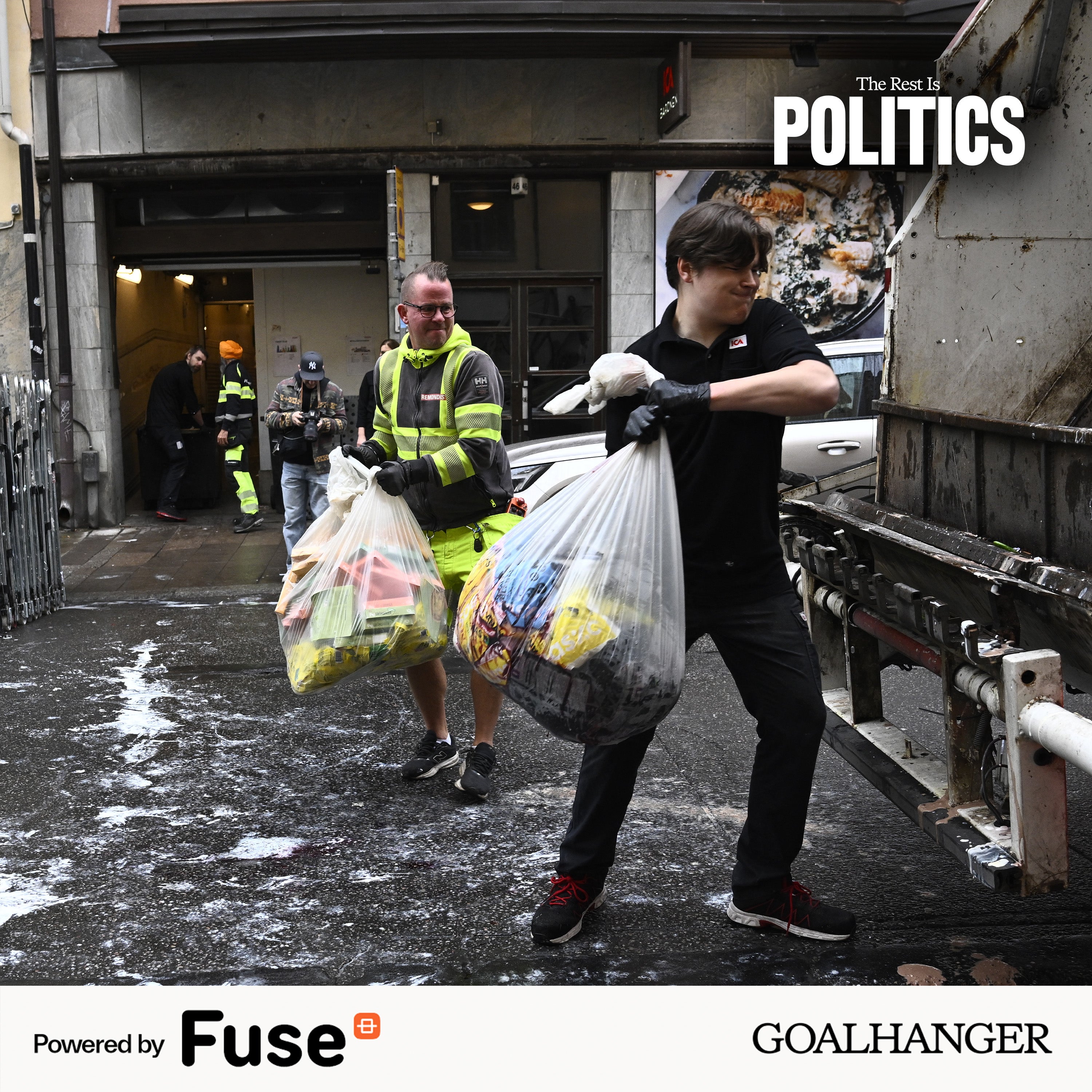
Cyber warfare and “hybrid war” risks (fridge hacks, aviation bomb scares), UK preparedness (Be Ready campaign), AI-driven escalation of cyber attacks, and the under-discussed race to replace UN Secretary-General Antonio Guterres. It also covers South Africa’s ANC losses in local elections and a discussion of King vs UK Prime Minister influence.
No external guests are introduced; the episode is hosted by Rory Stewart and Alistair Campbell, with “Kate and Dan” referenced as contributors in the cyber segment.
Iran is blamed for supermarket fridge cyber attacks that reportedly changed temperatures and ruined food; passwords were allegedly left as default (e.g., 1234/12345). Bomb threats show how easily hybrid disruption can spread. AI will accelerate cyber attack capability via swarms of automated attempts. The UN leadership race is portrayed as geopolitically “stitched up” by P5 powers, with concern that the UAE candidate Lana Nusseibeh could undermine a rules-based order.
Remote supermarket refrigeration hacks; plasma temperature manipulation for blood donations; Estonia 2007 cyberattack; China’s 2015 US record theft; Stuxnet (2010) against Iranian centrifuges; North Korea/China cyber capacity; South Africa ANC vote collapse to under 1/3 in local elections; Democratic Alliance near 25% with most support from Black voters.
Written by AI. May contain mistakes.
Learn about recent cyber attacks affecting food safety and aviation in Europe.
“France has directly blamed Iran for hacking into fridge systems, changing the temperatures, rendering the food inedible and unsellable in no time at all.”
Explore how cyber attacks on refrigeration systems have impacted food supply.
“huge momentous decision, which will determine the next 10 years of the United Nations and the international order that almost nobody's talking about.”
Examine the broader implications of cyber warfare on public services and safety.
“Well, the fridge threat, the fridge thing was, I mean, really, I found it really sad because he, the, I was, don't ask me why, I was watching Belgian television.”
Discuss the UK's preparedness and defense strategies against cyber warfare.
“What would you put in your emergency supplies?”
Understand how AI is changing the landscape of cyber threats and defenses.
“But still, it's a hell of a difficult thing to do.”
Analyze the ethical implications of state-sponsored cyber operations.
“I've been predicting this for three years.”
Discussion on the implications and preparedness for cyber warfare in Britain.
“Now, the response from the AI companies is that's why you need to put your foot down on AI, because the only way of stopping that is through ever smarter defensive AI.”
Discussion on the UK's position within the UN and the implications of US actions.
“is actually very unlikely to want to veto this.”
Examining the ANC's decline in South Africa and the implications for democracy.
“Hey, have you always been so big, tall, and handsome?”
Discusses the significance of the monarchy in contemporary British politics and international relations.
“The British royal family kind of worked that out in about 1688.”
Shares a humorous account of reading during a long road trip and its dynamics with the team.
“and I just love this image of you reading as you were driving along you had a collection of books you were reading to the team as you drove along I want to know about that what was it?”
Analyzes themes in literature about rural America, mining, and social issues while on a book tour.
“It takes me at least a week to read just one.”
Discusses the impact of journalism and storytelling in shaping political narratives and public perception.
“who's written a beautiful book again on Ohio What proportion of that did you read?”
Alistair shares personal anecdotes and announces changes related to the podcast's scheduling.
“And if you praise Alistair, you get a shout out, your podcast gets a shout out.”
The hosts introduce a segment discussing various books and their themes.
Discussion on the political themes present in 'The Things We Never Say' and 'Reading Genesis'.
“So, the first one, a lot of people will have heard of, The Things We Never Say by Elizabeth Sprout, which I think was up for the booker but didn't get it.”
Discussion of various existential threats facing humanity in the next century.
“is a one in six chance of human beings being wiped out in the next hundred years?”
Examination of geopolitical tensions and their potential implications for international conflict.
“We are getting a statement from Number 10 on that flight with 350 passengers on board.”

Get the gist, explore an idea or ask about something said.
 Claude
On The Rest Is Politics, what are the key points of this episode?
Searching your listeningAutomatic transcript. May contain errors.
0:00One of the saddest sights of recent weeks was of millions of pounds worth of food being destroyed in different parts of Europe because of a cyber attack on supermarket fridge systems. France has directly blamed Iran for hacking into fridge systems, changing the temperatures, rendering the food inedible and unsellable in no time at all. Then we've had the bomb scares, which have been causing mild chaos to European aviation. aviation. All signs that hybrid war is alive and well and doing real damage to our economic and social fabric, which is of course why the Iranians, the Russians and other bad actors do it in the first place.
0:32It partly explains why the British government has launched the Be Ready campaign to prepare for emergencies and disruptions. And the public do seem to be listening, which is why last Friday saw record withdrawals of cash, would you believe, from ATMs. So are we ready for what's apparently about to hit us. This episode is powered by Fuse Energy. Most energy companies are counting on you doing absolutely nothing. Not questioning what you're paying, not switching, just letting your tariff roll on, which is costing you hundreds of pounds every year.
1:03Rory Stewart: But the apathy goes deeper than our bills. We've almost given up on energy itself. We seem to all be accepting energy is expensive, the system's outdated, but that complacency is costing us. Fuse Energy does not accept that because the energy transition is not something that just happens somewhere else. Fuse is building an energy company which is designed to bring down the cost of energy and right now its tariffs are up to£100 below the off-gem price cap. So switching isn't just about paying less, it's about expecting more from your energy company and it only takes you three minutes. Switch to Fuse at fuseenergy.com slash politics.
1:42Rory Stewart: Use the code politics and you'll get a free TripPlus subscription allowing you to hear all the extraordinary members content that Alistair and I are now producing for you. Visit FuseEnergy.com for full terms and conditions. Hi, this is Gary Lineker from Goalhangers. The rest is football. This episode is brought to you by Wise. It's only when you start moving money between currencies that you really think about the exchange rate, the fee and what might be hidden away in the small print. Whether you're living abroad, paying someone overseas, or just trying to manage your money across borders, you want a fair exchange rate, an easy transfer, and no surprises along the way.
2:20Rory Stewart: Wise keeps things simple. Wise is a smart way to move the currencies you need around the globe. It works in more than 160 countries and with over 40 currencies. Most transfers arrive instantly. Wise uses the mid-market exchange rate, like the one you see on Google, with no markups or hidden fees. So when money needs to move, you can see the rate, know the fee and get on with it. Join millions saving billions on hidden fees by downloading the Wise app today. Be smart, get wise, T's and C's apply. For adults with Crohn's disease or ulcerative colitis symptoms, every choice matters. Tremphaya offers self-injection or intravenous infusion from the start.
3:04Rory Stewart: Tremphaya is administered as injections under the skin or infusions through a vein every four weeks, followed by injections under the skin every four or eight weeks. If your doctor decides that you can self-inject Tremphaya, proper training is required. Tremphaya is a prescription medicine used to treat adults with moderately to severely active Crohn's disease and adults with moderately to severely active ulcerative colitis. Serious allergic reactions, increased risk of infections or lower ability to fight them, and liver problems may occur. Before treatment, get checked for infections and tuberculosis.
3:36Rory Stewart: Tell your doctor if you have an infection, flu-like symptoms, or need a vaccine. Explore what's possible. Ask your doctor about Tremphia today. Call 1-800-526-7736 to learn more or visit TremphiaRadio.com.
4:00Rory Stewart: Welcome to The Restless Politics Question Time with me, Rory Stewart. And me, Alistair Campbell. And Alistair, let's start you with, we've got a lot of things to cover, some fascinating questions this week. Thank you to listeners and to TripPlus members who've come in. We've got a lot of questions around cyber threats, a lot of questions around the big new run for the new UN Secretary General. huge momentous decision, which will determine the next 10 years of the United Nations and the international order that almost nobody's talking about. And then we've got questions about elections in South Africa and much more.
4:33Rory Stewart: But let's start with cyber threats. So Kate and Dan might be a good way to start. Kate, can you talk about the bizarre fridge hacks over the last few weeks and what that means about defense investment in the modern age? And Dan, what would someone have to gained from the European aviation bomb threats. So, Alistair. Well, the fridge threat, the fridge thing was, I mean, really, I found it really sad because he, the, I was, don't ask me why, I was watching Belgian television. And there was these pictures of just tons of food just being thrown away. And what had happened, and the French foreign minister has come out definitively and said, this was the work of Iran.
5:10One assumes that they have discovered a way to know that. And so this was a deliberate cyber attack on supermarkets and supermarket refrigeration systems in several European countries, Belgium, Luxembourg, and then a smaller number of stores, Sweden, Ireland, the Netherlands, Estonia, and Finland. But millions and millions of euros of food has just been literally thrown away.
5:35Rory Stewart: And these, just sort of quickly to explain to people, these are fridges which can be remotely, that the temperature can be adjusted and monitored remotely. The idea is if you're a big supermarket, you get your engineer presumably in headquarters to check what's going on in the fridge. And the problem is that in this particular case, as usual, people have left their passwords as 1234. So it was a very, very easy hack. Well, one of them, the defaults username was supervisor and the password was 12345. And they'd never been changed on some of them. And some of them are, and of course, this suits maybe the fridge companies, but they're saying these are older models that didn't get their software updates and all this sort of thing.
6:14Rory Stewart: But as we have more and more smart devices, more and more devices that can be controlled through the internet, it's easier and easier to do what happened here, which was not a ransom demand, right? It's not someone making money. It's somebody thinking it would be disruptive or amusing or just wind people up to essentially turn a fridge into an oven. I mean, they were heating them up to 50 degrees centigrade, weren't they? And then the other thing that was happening in France, which I think they managed to foil, was that they were changing the temperature where plasma was being kept for blood donations.
6:48So, look, this is serious stuff. And it relates to the concept of hybrid war. Now, this could be, the truth is, we don't yet know all of it, but it could be that this involves a state like the Russians, like North Korea, like Iran, and the intelligence agency will say that is happening and it's happening more and more. Or it could also be some clever kid in his bedroom at home just able to work it out. But the point is that this is partly what has led to our government launching this Be Ready campaign. I found this really interesting, actually. So the government launched the Be Ready campaign, which is basically, it said, you know, make sure you've got some cash stored away, get some wind-up lighting and all this sort of stuff.
7:36My mother has a wind-up radio, which she keeps showing us. She's taken this very seriously. A lot of people, last Friday was the record for ATM withdrawals in Britain, which shows this idea that people don't listen to governments. It suggests they do.
7:49Rory Stewart: Well, my mother, though, I'd be interested to hear from listeners what other people have got on their preparedness setup. So, Mrs. Stewart has, I noticed, bought a huge lot of bottles of water, some tuna fish. She's got her wind-up radio. But she also bought five bottles of brass polish. She clearly thinks when the Armageddon comes, there's going to be a shortage of brass polish. You've got quite a lot of things around the house. I've been in that house. You have got quite a lot of brassy type stuff. Yeah, she clearly thinks when Mad Max is happening and all these guys are going around on their motorbikes, like stealing our cattle, she'll be able to polish the brass as well as eat tuna fish.
8:28Rory Stewart: What would you put in your emergency supplies? Oh, God, I must admit, Roy, this is provoking a real angst in me because I had a technological disaster at the weekend. Oh, no. So, as you know, if your owner is the best person in the world. Yes. I wrote a chapter about her, Percivillians, to that effect. You do? Yeah, yeah. And I interviewed you about that, yep. And she gave me a cup of tea Saturday morning while I was sitting at my laptop, variously writing my column for The New World and researching for this episode. Wait, and the cup of tea went over the laptop? Well, worse than that, I mean, do you think we could afford a new mug?
9:01We have hundreds of mugs already. Fiona had decided to glue a handle that had come off the mug. Well, it's impressive. Is it? Yeah, I really like people mending things. Well, that's fine. But it wasn't properly mended because I'm just holding it like that and the thing fell off and went all over the laptop. So, you know, I hate tech anyway. I hate it so much more. Did you manage to turn the laptop over and get the tea out quickly? No, not quickly enough because I was shouting and ranting and raving. My son Callum found a really nice guy in Archway who was able to get it back on, but I've lost a lot of stuff.
9:35Anyway, so what these guys are doing is, so if they can hack fridges in big supermarket chains. and then we also had the um this thing about the and nobody's got to the bottom of this surprise i can work out these persistent bomb scares on planes which have been getting planes grounded cancelled diverted one of them having to be escorted by the hungarian military out of somewhere so it just shows that where there's a a will on behalf of state actors or just people who want to mess around. This stuff is quite easy to engage in. And what I want to know is whether we do it to them and whether we should.
10:14Rory Stewart: Well, we have, oh, that's a really big question. Let me just pause that for a second, because I think you're already tempting me into an amazing ground there. The answer is we have something called the UK Defence Cyber and Electromagnetic Force under Major General Mike Fares. And we've got the Cyber and Specialist Operations Command under Rob McGowan, General Rob McGowan. So we do have thousands of people that are supposed to be able to do defensive and offensive cyber. We also have the UK National Cybersecurity Center within GCHQ. So there's been increasing investment trying to do this stuff.
10:47Rory Stewart: And the government had a preparedness plan and 200 million. But still, it's a hell of a difficult thing to do. If you look at the details of that plan, I think they're going to be behind schedule. But I just wanted, before we got into that, just to take people back on the cyber story. So the real question around cybersecurity actually begins with the internet. I mean, until sort of 1988, 1989, there really wasn't much to do in cyber because we weren't all connected. We didn't have smart devices, computers weren't connected. It really gets going in the 90s when people realize, criminals, that your credit cards are being stored, your address is being stored.
11:27Rory Stewart: And you start getting really big attacks, it's not a new thing. 20 years ago, Estonia, 2007, the Russians mounted a massive attack. And they became percivilient and became the most digital country in Europe on the back of it. Absolutely. They responded to that. And 2015, the Chinese stole 22 million US government records. By 2014, there was something like 4 billion transactions taking place a year on PayPal. 200 million records were stolen from Target. I mean, this is like 12 years ago. So ever since then, we've been in a world in which there's been an endless race, obviously, between the poachers and the gamekeepers.
12:08Rory Stewart: But the thing that's changed it all is, of course, my favorite thing, which is AI. So it's going faster. There's more of it. Absolutely. Because something that you, Alistair, sitting there in your bedroom, hacking something... I wouldn't know where to start, but anyway, yeah. But you're now replaced by thousands of agents. So I was just looking at a recent attack. Microsoft found that there were, thanks to AI agents, 2 ,900 login attempts against 2 ,250 organizations in under a minute. So the point is that AI is now able to explore simultaneously with multiple agents in a few seconds, every combination of Supervisor 1, 2, 3, 4, 5.
12:51Rory Stewart: And in particular, they are finding vulnerabilities that nobody expected. One of the reasons why Anthropics, Mythos and Fable were not released is that they discovered vulnerabilities on iPhones that no human had ever discovered very, very quickly. And although there is a huge debate around this, I am in what I would call the Azim Azhar camp. Azim Azhar is a British tech and analyst who I admire and follow. Does he know he has a camp? I think he should now. He now has a camp. Azim, you have a camp. Because he described what's been happening during Black October, which is a number of these attacks, as the Wuhan moment.
13:33And this is the moment where I think we may see that the first real negative impact of
13:41Rory Stewart: AI on the world will be a massive proliferation of cyber attacks. I've been predicting this for three years. It's completely logical, right? if they can just mount millions of attacks and try and try and try and try every different thing. And every time you respond, they try another thing. You can imagine a swarm of AI agents doing incredible destruction. Now, the response from the AI companies is that's why you need to put your foot down on AI, because the only way of stopping that is through ever smarter defensive AI. Yeah. But so let's just say you're, because we've been talking about this hybrid war for years.
14:13Okay. And we know that the Russians do it. We know the Iranians do it. We know that North Korea is very, very good at this cyber stuff. And the answer is we do do it. We do it, but we don't do it. We have a greater propensity not to want to break our own laws or other countries' laws. Is that not fair?
14:29Rory Stewart: That is true of Britain. But if you talk about British and American allies, the most famous example of an attack ever mounted was not by the Iranians or the Russians. It was Stuxnet, which was an Israeli attack against the Iranian centrifuges in 2010, where they literally got all the centrifuges going. My point, though, is that we've been talking about it, and it just felt, and I'm not criticizing the government for this, but it just felt when they came up and said, you know, get a few more candles, get your wind-up radio, put a bit of cash away under the mattress. It didn't feel to me like it was, are they setting us up?
15:06Are they teasing the wage, you think, to actually warning us? Because West Streeting said, you know, we're probably 1 ,000 days away from possibly being under attack.
15:13Rory Stewart: So my sense is, and I'd love the government to correct this as we're acting now as government communications, is that the UK government, like the European government, want everybody to be able to survive for three days without internet, electricity, and supermarkets. And the governments are gambling correctly, I think, that within three days, they'll be able to get stuff to you. We're not setting ourselves up for kind of Mad Max, you know, living for 10 years with no government support because it's amazing what governments can do you know i've seen it even in places like somalia how quickly they can get emergency supplies through to people if you properly organize yourself but yeah the governments want three days to be able to sort themselves out and they want you to be able to look after yourself for three days that strikes me as being extraordinarily optimistic um you just imagine right you've just described something where you get these thousands of agents going in so if they if you're sitting there in uh north korea or you're sitting there in the Kremlin, or you're sitting there in one of these kind of units that exist to do this stuff, and they've got thousands of people doing it.
16:16And they decide, let's absolutely wipe out the effectiveness of the NHS appointment system. Okay? Yep. Not least with Palantir's involvement. I'm sure they could work out how to do that. Let's say that they then go and they work their way through all our traffic light system. Let's say they then work through and do the fridges thing here. It wouldn't take you long before you have absolute chaos and meltdown. And I think what the hybrid, the impact of this or the purpose of this is, this goes back to a point I keep making about the difference between democracy and dictatorship, is that the dictatorships who are doing this know that the instinct of the population in the democracies is actually to point the finger at their own governments as opposed to point the finger at the people who are doing this.
17:06Because they just come out and deny it anyway. And the Kremlin says they're paranoid, this has got nothing to do with us, it's because they haven't invested over time. And they were doing that, the Iranians would do that as well. So I just wonder whether we don't have to be a little bit more upfront about what might happen in the future and how, and then try to explain what you might do to defend it. Because I didn't feel terribly confident in just being told.
17:32Rory Stewart: Well, so do you think the government should say, listen, let's take North Korea as an example. They've got 8 ,400 specialized trained staff being put through three years of advanced training on cyberattacking. They've just stolen$6.4 billion in crypto from Binance. They've stolen$12.8 billion since 2017. And that the Chinese have invested, you've covered this before, massively in this, you know, tens of thousands of people working on this. I went to this M.O.D. place that does some of this stuff a couple of years ago now. And they were saying that, you know, I think the reason they wanted me to go there was not necessarily to talk about it, but then to emphasize to government.
18:14So I said to them, how many of these have you got in the UK? And they said, well, this is it. And I said, how many have the Russians got? They said thousands. so i i just think that that if this if this threat is real if this hybrid war is the future of modern warfare if it's about technology if it's about infrastructure if it's about destroying morale and creating division which is why they invest so much in the social media bot space are we are we responding in kind and i don't just mean responding in kind as in do we do it to them which i think we should have a proper conversation about but also are we responding in kind in terms of preparing ourselves as people, as citizens, as a country for what might come.
18:59Because what you're describing is a Mad Max hellhole down the track.
19:04Rory Stewart: Well, this is something that we're going to have to get into in our Existential Threats miniseries. And again, do sign up to follow all our miniseries. There's a lot of interesting ones coming down the line at the moment, but we've just done the latest installment on this. We'll move on to cyber later. But we're about to get an interview with Umar Mohammed describing what Mosul was like. This is really looking at terrorism, terrorist groups, the rise of the Islamic State, the experience of living in Mosul during Islamic State occupation. But so much more to be done because I think we shouldn't just be doing the way that AI is increasing cyber threats.
19:44Rory Stewart: We should also talk eventually about how AI will increase bioweapon threats, how it could create, in effect, a combination between, let's say, Ebola, as lethal as Ebola, as spreading as COVID. There's a bit of a paradox there, which biologists will point out. But anyway, the way in which not just finding medicines that cure drugs, but actually creating viruses could be something that comes out of AI. Let's talk about United Nations Secretary General. Antonio Guterres is leaving at the end of the year and there is a race on to replace him. Toby, who do you think is most likely to replace Guterres as UN sec?
20:21Jen, Simone, the UN is in dire need of strong leadership, but with the race to replace Guterres as chaotic as it is, do you think it's going to get the leadership that it needs? Well, let me... Rory's got his head in his hands.
20:32Rory Stewart: Yeah, well, I mean, I'm putting my head in my hands because the first thing is where the hell is the reporting coverage and focus on this in the British Parliament, for example? I mean, And I've discovered sort of two references to this in Parliament. And we are a P5 member. We're a member of the Security Council. We can be boasting about this. We have incredible power in this. If we issue a discouragement as a permanent member of the Security Council, we can steer this whole thing. Instead of which, the whole thing is being steered basically by Russia and the United States working together at the moment, right?
21:08Rory Stewart: It's really nasty. And this will determine the next five, 10 years of the United Nations at a critical moment for the rules-based international order. So where the hell is the discussion about this? I mean, it's unbelievable. And just to set it up, this was supposed basically, and it's not a formal rule, but informally, supposed to be Latin America's turn. And probably people were expecting a woman. Because there's never been a woman headed to the U.S. And people were thinking Rebecca Greenspan from Costa Rica would probably come through or not, if not her, Rafael Grossi, Argentinian from the IEA.
21:44Rory Stewart: And people thought maybe Rafael Grossi, you know, because Trump likes a melee, the Argentinian candidate could come through. But it feels as though, and this is going to happen very soon on Thursday, there's going to be an indicative vote. Well, I've heard there might not be, which makes me even more worried. Because if there isn't, what that says to me is that America and Russia, this sort of trilateral that is pending with Xi Jinping later this month, that is when they try to stitch it up. Okay, well, let's then get to the elephant in the room. The elephant in the room is the UAE candidate, Lana Nusebe.
22:25Rory Stewart: So Lana is a very, very bright, able woman who was the UAE ambassador to the UN. She's highly educated. Her father was a minister in the UAE. Her grandfather was a Jordanian minister. Her great-grandfather was a senior Palestinian politician. Her family, the Nusebis, held the key to the Holy Sepulchre since the time of Saladin. I mean, this is really going some in terms of, you know, the Arab, the grandest Arab aristocracy imaginable. And she's charmed a lot of people. So this is not a personal particular attack on Lana. But there has never been a UN Secretary General who hasn't come from what was at least theoretically a democratic state in the whole history of the United Nations.
23:15Rory Stewart: And say what you like about the UAE, that is not a democratic state. More than that, if you look at what the UN Association has just said, you're looking for a UN Secretary General who's going to uphold the rules-based international order and international humanitarian law. The UAE is absolutely at the center of the conflict in Sudan, where they are supporting a genocidal rebel faction against the government in the army of Sudan. And Lana, for all her merits, has refused to accept a UN independent neutral investigation into what's happening. She's actually challenged the UN inquiry into what's happening.
23:59Rory Stewart: She also, as the ambassador, refused to openly condemn Russia's invasion of Ukraine. She led UAE's abstention on the Russian-Ukraine issue. So as Secretary General, if Lana wants this job, she's going to have to say, what is the independent investigation she's allowing into Sudan? What is her position on Russia's invasion of Ukraine? How can she be standing up for the rules-based international order and international law? And finally, and maybe most uncomfortable, is she actually really independent from the government of UAE, and particularly from Mohammed bin Zayed, right? Because if she is simply a proxy, for better or for worse, for MBZ, you are putting the autocratic leader of, to put it politely, quite a controversial Middle Eastern state, essentially in charge of the whole United Nations.
24:54Rory Stewart: And that may suit Russia. Why does it suit Russia? Russia, Ukraine, you know, the UAE position on that. Why does it suit the US? Impunity. Right? And it might even turn out to suit China. And France has huge equities. And Britain, and this is the challenge to Britain, right? We have a foreign secretary who has said, you know, well, what's his great phrases? Enough is enough, or we're going to do something this time. Let's see him stand up. Let's see Britain take a position on this. Is Ed Miliband really saying he's happy for the United Nations to effectively be run by the United Arab Emirates, given what the UAE is doing in Sudan, and given what the UAE took as its position on Russia, Ukraine.
25:36Rory Stewart: Come on it. Right. And the answer to that question, I am relatively confident, would be no. Right. Ultimately, this will become a very big decision for Andy Burnham as prime minister. My fear, and I could be wrong, because there have been several straw polls, and just we talked about the electoral systems in Israel and New Zealand in the main episode. The system, somebody at the UN said to me, the system to get the Secretary General is more complicated and more opaque than getting the Pope. You have these straw polls where the Security Council vote, and you have white polls and colored polls. And the white poll is where all 15 say, encourage or discourage.
26:19Now, Rebecca Greenspan has led every single one, apart from one, when there weren't many people there because it was the middle of the summer. So it looked like, based on the fact it would be a woman, based on the fact it's meant to be Latin America's turn, that she was out there. For some reason, and it doesn't appear to do with her views, because Costa Rica is actually a pretty close ally of the United States, the United States just decided it's not going to be her, but don't necessarily want to veto. But then when we get to these colored votes, the P5, they have a red ballot. So you know if somebody is going to potentially use the veto.
26:56So the question you're putting is if at this summit, Trump and Putin, and as you say, we can understand why Putin wants this because it's a country that he can do business with and it's a country that has not begun from over Russia, Ukraine. Trump probably fit it in, just fit it in with the fact that he did the diesel deal, he did the sanctions deal. Let's be truthful. He quite likes being on the same side of arguments as Putin because they're the big strong guys in their minds together. They get Xi on board. The Chinese have said, by the way, that they think it should be a woman and they don't like the idea of going against the rotation idea.
27:33Africa, of course, hates the idea of going against the rotation idea because they should be next. So all that's been in the midst. But if the three of them get together, and the French, by the way, so the P5, just remind people, USA, China, Russia, France, and UK. The French, I think, despite my understanding is the French foreign minister is very against Lana. Lucebe. Despite all the French equity and UAE and their very close relationship with the MBZ. But the president, because of what you just mentioned, is your friend Emmanuel Macron, is actually very unlikely to want to veto this. So as you say, that then leaves the UK.
28:15So...
28:15Rory Stewart: Come on, Britain. Your last chance. Rules-based international order. People question why you're on the p5 in the first place well you're there yeah this is your last shout to stand up for and and hold on let me let me okay let's just see you're andy burnham you're sitting there looking at all the papers and then throw into the mix the manchester city yep situation absolutely and the role of the uaa in investment in manchester and all that so this is a big call okay so let's say you're andy burnham um i think i'd say to you firstly do you care about the un Does it actually matter? Because you could take the position, I think, be horrible.
28:53Rory Stewart: It doesn't really matter. Let the UAE run it. The UN's irrelevant anyway. That is a terrible statement. I agree. And also, you didn't have the UAE-controlled United Nations alongside the Board of Peace as the two sort of overarching things. No, not good. So let's assume he still thinks it matters. Then what kind of UN do you want? Do you want a Secretary General whose good offices allow you to intervene? Do you want a UN as a development entity? Do you want a UN as a guarantee of the rules-based international? I mean, there's some strategic choices because one of the things that seems to be going on with America is they claim that the reason they're against Rebecca Greenspan and others is they don't want anyone really, and Grossi, is they don't want UN bureaucrats.
29:33Rory Stewart: They want, surprise, surprise, somebody more like a property developer coming in. In other words, they want some kind of outside - Kushner. Kushner. to come in and run. One of the American papers said that Trump was trying to put Orban forward. Ah, you can see that. I think we'd veto that. And what worries me more though, it's not that they're trying to send in someone disruptive to reorient the UN bureaucracy and make it suitable for the 22nd century. More likely, actually, Trump and Russia probably just want the UN to be completely irrelevant and marginalized because they're not interested in a rules-based international order.
30:12Rory Stewart: Everything the UN does annoys them. get rid of it entirely by appointing somebody who will either make it do what they say, or make it completely irrelevant. Or make it irrelevant. Look, Trump is, over the two terms, and particularly this term, Trump has had a strategy to, I don't know if this word exists, derelevantize the United Nations. And it's been effective. Look at how little the United Nations, apart from the wonderful stuff they try to do on the humanitarian front, but where have they been on the politics of Israel-Gaza? So that has been a deliberate strategy. That's what the Board of Peace is all about.
30:44Or Russia-Ukraine. And so you can see why they want to be there. And it is extraordinary. We are basically hanging our hat here on the hope that China will want to get involved. Just on the voting, by the way, I've just looked it up. So there was a straw poll on October 30th. Rebecca Greenspan got 11 encouraged votes and four discouraged. okay yeah lana was in fourth place with seven in courage and six discourage and two no opinion yeah so that is not an overwhelming mandate at all but if you've got america and russia working together yeah leaning on the chinese with the french they think yeah just wanted to park it then i think this is going to become and it's amazing you talk about it's not being discussed in parliament etc it's amazing it's getting so little media coverage this because this could become one of Andy Burnham's first really big foreign policy decisions.
31:41And ultimately, these decisions, you can talk about Ed Miliband all you want. And look, you know Ed Miliband well enough. I think you'll be, you know, I think you know where he might be on this, but I think this is going to be tough. And the other thing, by the way, this is the other thing that the derelevantization has done. I suspect it has put a lot of people off thinking that they might want to go for this job. Because the truth is, one of the reasons they're struggling, and there's been no stellar candidate.
32:07Rory Stewart: It's not an amazing range of candidates, is it? It's weird that, isn't it? And I think there's also a risk that we could end up with no secretary general at all, that you'd end up with a sort of acting secretary general, so the deputy secretary general or one of the other senior UN figures in office indefinitely, in which case you have no leadership, you have no voice. I think that's the other risk. Yeah. Shall we take a break? After the break, we're going to talk about the South African election, which has been an extraordinary upset for the ANC that's dominated South African politics since the end of apartheid.
32:38Rory Stewart: We're going to talk about the King and Andy Burnham as different models of international British presence. We're going to talk a bit about reading, and I think Alice might get around to plugging a rival podcast.
32:56This episode is brought to you by Barclays Premier. Now, you might look at your pension as some sort of end goal, but there could be a lot of future left to plan for.
33:04Rory Stewart: A lot could change from personal circumstances to new rules around how you save or how you invest and pass on your wealth. So we're aware of things like policy changes well in advance, but you cannot predict everything. And that's where planning and advice exclusively for Barclays Premier customers comes in. A dedicated wealth planner builds you a personalised plan around your goals, while your wealth manager helps it evolve as life and the world change. They're here to help you navigate your next steps because it pays to be a step ahead. Search Barclays Planning and Advice today to learn more.
34:03Rory Stewart: for a spin. Only the best for you, Mr. Shaq. Hey, have you always been so big, tall, and handsome? Not always. I was 6 '10 once. Seven days to love it or return it, Mr. Shaq. Not that I would. You never do. No, I never do. So buy your car today on Carvana. Delivery fees may apply. See our seven-day return policy at Carvana.com.
34:27Rory Stewart: Welcome back to The Rest is Politics Question Time with me, Rory Stewart. and me, Alistair Campbell. Now, Alistair, question from Dylan. The ANC has eventually lost support in South Africa. How did we get here? What does it mean for South Africa? So South Africa is a country you've been very, very interested in, all the way back to apartheid, Nelson Mandela. Tell us what you make of what's happened to the ANC in South Africa. Well, they've just had a huge defeat in their local elections, under a third of the vote. So if you go back 65 % a couple of decades ago, 46 % five years ago, and the Democratic Alliance is on the move.
35:08Now, this is a party that has generally been seen as very much a party of the whites for the whites, but they do appear to have picked up a fair share of the black vote as well.
35:18Rory Stewart: You're absolutely right. And perhaps the best illustration of the fact that the Democratic Alliance is no longer simply a white party is that they got nearly 25 % of the vote and whites are only 7 % of the population in South Africa. So the overwhelming majority voting for them will have been black South Africans. What's happening in the ANC is bucking a general trend in Africa where the big liberation parties, the sort of ANC equivalents in almost every other country, often get a commanding position and then just hold on to it. And it's actually quite encouraging for South African democracy, that the ANC has seen its vote share go down, and that there is pluralism, and that there is a rule of law, and that parties like democratic alliance are growing.
36:02Rory Stewart: And I think the ANC is going to be pretty pragmatic around the country. So in some areas, they'll probably go into alliance with the DA, in Zulu areas, they may go into alliance with what's effectively now Zuma's party. And they may go into alliance with the EFF, led by Julius Malema, which is this more extreme party as well. I mean, people who are interested in South Africa, do listen to this week's leading with Paul Van Zell, who is a guy who's at the age of 25 was executive secretary of the Truth and Reconciliation Commission. And I loved the stories of how that commission came together, how it worked, some of the evidence sessions that he described the day that Mandela went there.
36:38It's a really beautiful conversation, I think, about how they went. You talk about Percivillians, going from something so bad as the apartheid regime to within across a period of four years to have. And he kind of admitted there was reconciliation, but not necessarily full truth. and I thought that was a very interesting insight. But I asked him, I said, you know, what do you think the two kind of giants of that process, Mandela and Desmond Tutu, what do you think they would be feeling about South Africa today? And he said they would have their head in their hands in total despair. And he was also, I thought, brutally frank about the way that corruption, back to, I'm afraid, the old issue of corruption, has really damaged the ANC.
37:27And he says, this is a guy who, you know, devoted his kind of youth and his young adulthood to delivering South Africa, helping to deliver South Africa from apartheid rule. And he said, maybe it's a good thing for the ANC to be out of power because when you're in power for too long, it does corrupt and it's been corrupted. Actually, Paul said that when Tutu died, he worried that this was the path that South Africa was on already. But Mandela must have thought South Africa was going to be better than this.
37:56Rory Stewart: I'm recommending here a book by Sigrid Roussing called Ghosts, which is a book partly about her husband, Eric Abraham, who was a big ANC figure and a director and very interested in developing theatre and speaking up as a young journalist in South Africa. But it's an account of her spending time in South Africa and experiencing, I think it's done very beautifully and very sensitively, both the sense of hope, but also some very practical things. I mean, you know, I was talking to someone this morning who's in Johannesburg, who says they basically lose water and electricity every single day at the moment.
38:32Rory Stewart: I mean, the inability to deliver the most basic municipal services. That is just a fact of everyday life. And so you'd have to think that the time that they've had since the end of apartheid, not to being able to deliver those basic functional public services has got to be ultimately damaging the government. And again, I had this sort of cliche in the main episode where I said that the big theme across the world for the last seven years has been cost of living. Actually, interesting in South Africa, it's unemployment more than cost of living. Maybe that's the kind of small difference, but it really, it's 74 % named unemployment, 21 % cost of living, and then quite a lot on corruption.
39:11Well, Paul was saying, he was talking about the NEATS crisis in the UK, Alan Milburn's report's coming out on Tuesday. He was saying it's six times worse in South Africa. So these are economic challenges that simply haven't been met. And if you have corruption on top of that, it's no surprise that the government is taking a big hit.
39:27Rory Stewart: Energy, infrastructure, electricity. And then the final thing that we've discussed previously with South Africa, which is the rise of populist anti-immigration sentiment, particularly directed against people from, for example, Malawi and Zimbabwe. Yeah. So they're dealing with a lot of the same problems, but they've got coming from a base of far bigger challenges, which just don't appear to be being met by a party that I guess did think, given they delivered what they did, probably did think they could be in forever. Nobody should be in forever. Not even new Labour. Nobody should be in forever.
39:57Well, do you think the country's been a better place for the fact that we had austerity and the Tories, etc.?
40:03Rory Stewart: Question from Ben, which I'm going to direct at you. Who's more influential on the global stage, Alex? Do you think the king or the prime minister? I'm going to throw that right back at you. Who do you think? The king or the prime minister? I think they both have different levels of influence. But I think the king, because he's been around for so long, not as king, but because he's been such a part of the global furniture for so long. And because, as you know, I've written a chapter about him in Per Civilians, because I think he has really cemented his authority. Could you have like a kind of strategic theory?
40:33Rory Stewart: If you were the prime minister thinking about what things the king leads on, what things the prime minister leads on. Are there certain kinds of issues which are kind of easier for the king to lead on? Would things like AI and climate be those kind of things? Or I mean, other sort of global, I mean, how would you sort of, or I don't know, dealing with Trump and state visits, how would you sort of divvy it up? Because they are a team, right? I mean, I think the nice thing about it is it's not like Poland, where the head of state and the head of government are on opposing sides. The king, I think, is very comfortable being part of the prime minister's team, whatever party there Yeah, which is, yeah.
41:05I thought it was amazing watching the cenotaph ceremony on Sunday. I mean, God, they're going to have to extend it down as far as the gates to Downing Street, aren't they? There were 10 prime ministers. And I actually thought of him as he sort of went to lay, the king's there setting off to lay his wreath. He has to walk past his line of politicians. And of course, Farage got in there because he's finally crossed the threshold of the MPs you need. It would have been funny to have seen him and Polanski going alongside each other together. That would have been better. I think in a way, this all depends upon the character of the person.
41:41Because, you know, we talked a lot when Johnson was prime minister that so much of our constitution depends on the good chaps theory. Well, the same goes for the monarchy. If you had a monarch who actually decided, no, I'm more important than the prime minister. Yeah, that would not work. I walk into the room before he does. They bow down to me, not to him. They sing my name, not his. If that was translated into policy, that would become very, very difficult. The British royal family kind of worked that out in about 1688. Yeah, but it doesn't mean you don't get one person who comes along and actually thinks, you know, I'm different.
42:08The Queen, who's been there for all of my lifetime, and then the current King, they're not like that. So that means then, if you're the Prime Minister, you're probably sensible to think, right, well, they've got all the constitutional stuff that they do. So he does lay the wreath on November the 11th. He does do the state opening of Parliament. The Foreign Secretary does accompany them on state visits. We decide where he goes, but the government goes with. And I thought it was interesting to watch at Chogham. There were actually some really nice pictures, Commonwealth Heads of Government, which was in the Caribbean.
42:34So Andy Burnham wrote a piece in The Guardian in advance where he said he was open to the possibility of the country, the state, eventually having a process of dialogue and perhaps issuing a formal apology. On slavery. on slavery. And immediately, most of our media went into a position of wanting to say, this is embarrassing to the king. Whereas in fact, the king had already gone considerably down that path himself in previous iterations of the issue. I don't believe that, I could be wrong, but I don't believe that Andy Burnham would have committed that thing to print without the palace knowing that was coming.
43:11So therefore, I think that was part of a kind of a tag team going to the Chogham summit.
43:16Rory Stewart: Then you need pretty good teams in number 10 and with the private secretaries in the palace, making sure all this stuff is sorted and coordinated quite carefully. But if you get that coordination right, you can be more than the sum of your parts, right? You can get a really interesting technique. And also, I thought, you know, again, I've said to you, I thought his speech to Congress was extraordinary. And he was saying things which Keir Starmer, then Prime Minister, would have found very hard to say. Yeah. So I think that was another example of where the The king would not have been saying things without, you know, we were involved when we're doing all the state visits.
43:48Okay, America's a bit different. But for example, when we had, it was a Chinese state visit, I remember here, where the king, when he was Prince of Wales, refused to have anything to do with it because of human rights and all that stuff. Now, I don't think at the king level, he'd be able to do that. So I think it's, you're working out, you know, famously the letters that he's spider writing and all that stuff. And I think ministers and prime ministers, they use those to work out what really matters to it. I think on the environment, I think on biodiversity, I think on some of the stuff that he's done over time, you're pretty clear about what he really, really cares about.
44:25And as you know from your, what's called the King Rory Stewart Jensen Huang Summit at Dumfrey's house, now he's got this particular interest in AI. It is interesting. You're right. I think the way to think of it is as a sort of tag team. And the other thing, the other difference, of course, is that the king, the head of state sort of pops in and out of the debate. The politicians are in the debate all the time, day after day after day after day. So I don't know. I don't know the answer to that question. I'd say right now, possibly the king has greater international influence, but that could change.
44:57Did Tony Blair and Margaret Thatcher have less or more international influence at the time than the queen? I'd say Blair and Thatcher. I think the queen also played it very differently, didn't she? Now, Rory, I mentioned in the main episode the really nice newsletter that Bella wrote and allowed you a few quotes along the way. and I just love this image of you reading as you were driving along you had a collection of books you were reading to the team as you drove along
45:26Rory Stewart: I want to know about that what was it? Well it's an amazing vision I mean the first thing huge shout out to Bella who was actually driving us all the time and it's a lot of driving Do you have a driving licence? I do have a driving licence So why did you not drive? Because I was reading Okay Reading and pontificating it was terrible and Bella was taking I mean you know she was driving on the wrong side of the road from our point of view and doing an amazing job. And she was just continuing. We went all the way down from Ohio into East Kentucky, East Kentucky, the West Virginia. And did you read the whole time?
45:56Rory Stewart: Actually, Celine has a driving license too. And Daisy, I think, doesn't have a driving license. But anyway, there were four of us in the car. Bella was doing all the driving as well as producing, as well as being our bosses. It saved love for a 10-hour car journey. How much of that time were you reading aloud? Quite a lot of the time. And it's quite difficult, I mean, with Daisy and Celine in the back to work out quite how much they're listening to of this. Occasionally, I noticed that Daisy would sort of put her head on a pillow on the window. And she would very sweetly say, I find your voice relaxing, just I'm just resting a little bit.
46:21Well, we both get people telling us that they fall asleep to us. So anyway, listen, Wendy wants to know this. I read your road trip report with interest. There's one thing I need to know. How did Rory manage to do all that in six days while reading seven books? It takes me at least a week to read just one. What are both of your top reading tips right now? But I've seen you read. You read books like most people read newspapers. You're dipping in and out all the time you're on a kindle i i have books okay well this time i did i had seven books so
46:50Rory Stewart: the whole floor of whatever it's called it's called a car no no there's a there's a what's it called the foot hollow the the anyways there's a technical word for it around my feet in the passenger seat the front of the car i had a massive pile of books yeah but they were i mean it's a very most of them not published in britain and you can't actually get them on uk kindle okay because they are Americans generally, without being rude, progressive left-wing Americans heading off to East Kentucky, West Virginia, and writing about poverty in those places. And sometimes, I mean, it's a wonderful book that I was really enjoying called Stolen Pride by Arlie Russell Hosschild.
47:30Rory Stewart: But Arlie Hosschild is a lady of a certain age who is a professor of anthropology at UC Berkeley. and one wonders what happens when she turns up in East Kentucky and says I'd just like to interview you about your support for the neo-Nazi party and what you think about this right so there's quite a lot of that going on wonderful book by Stephen Sowell called Ramp Hollow and some of the stuff you would have really loved I mean the devil is here in these hills is about the miners and the union movement and what was the devil? the devil was everything it was the companies particularly corporations okay wasn't the devil?
48:07Rory Stewart: No, but it's corporations blowing off the top of the mountains, polluting the water, driving children underground, the black lung. Didn't it make you feel that maybe rampant American capitalism isn't all it's cracked out to be? Absolutely unbelievable. I mean, by the 1920s, they were deploying private security teams who were gunning down miners in the streets. They were sending in planes dropping poison gas on demonstrating miners. I think Elon Musk would go for that. It's unbelievable. Yeah. Right. I mean, it's no, this is the real stuff for the American labor movement, which I think was probably, some bit, I don't know, probably crushed in the anti-communist witch trials of the 50s.
48:45Rory Stewart: But this was the beginning of this stuff. But it was also a hotbed of corruption as well. Also a hotbed of corruption. So there's something about American corruption as well. Right, seven books. Okay. Yeah. What percentage of the words in those books have you actually read? Arlie Russell, Hosschild, 25%. What Are You Getting Wrong About Appalachia, 95%. Dispatches from Rural America by Wendell Berry, 20%. Factory Man and Dope Sick by Beth Macy, 50%. Okay, okay, not bad. I feel if I like a book, though, I want it to be 100%. Would you really? I mean, I think you might find if you've read seven books about earnest progressives going around talking about the story of mining and opioid crises, in Appalachia.
49:31You'd be flicking by the end.
49:32Rory Stewart: Yeah, I mean, they're beautifully written, but every story begins, you know, Jeff is sitting on the front deck of his trailer, you know, he's 45 years old. And then there's, you know, four paragraphs, a description of the Appalachian mountains. And then we get three pages on his family story and his grandpa with a black lung. I mean, I don't want to be mean, but, you know, and I also read, I mean, there's a wonderful reporting, Larissa McFarker, George Packer brilliant reporting in the New Yorker shout out to a wonderful guy who came to me to St. Ohio called Alec McGillis who's written a beautiful book again on Ohio What proportion of that did you read?
50:07Rory Stewart: I read probably 40 % of that because I was going to meet Alec Did you say to him I've read your book? Yeah I probably misrepresented the amount of the book that I'd read yeah I'm afraid yeah but it's remember people like George Packer are foreign correspondents so they're people who I knew from Iraq and Afghanistan done who are going into West Virginia. Sabrina Tabanasi, who does this stuff for the New York Times, sort of, you know, well over a decade now of reporting of Trump America, was somebody who I knew from Iraq, Libya, places like that. So there is something, if you wanted to be a bit cheeky, if you were from the Republican right, you might question, is there a slight sort of anthropology of the poor American, as though these people almost travel writers or going into war zones?
50:49Rory Stewart: J.D. Vance did a version of that himself. I mean, I know it's his area. Yeah. And of course, hugely popular. I mean, it's a real thing. But as I say, this isn't a genre which breaks through to the US anymore, to be fair, than my book Middleland really breaks through into the US market because deep descriptions of rural Cumbria maybe are not things that Americans tend to read. No, whereas I think perseverance is what America needs right now, don't you think? Final shout out to you because I very rarely praise you enough on this. There was a moment on the tour when we were sitting around the table in a diner.
51:22Rory Stewart: And I think Daisy said that somebody was Persevilliant. It was a woman that we just interviewed in May to one in West Virginia. And I went, no, come on, surely we can come up with another word. And the four of us around the table were unable to come up with a better word than Persevilliant. So in the end, you filled the gap there. Now you've got to come up with a good word for blue green, because, well, you know, Orange describes red-yellow. We got a single popular word for red-yellow, which actually was a really revolutionary... You'd be interested in this etymology. It was a revolutionary discovery in the Middle Ages.
52:00Rory Stewart: We didn't have a proper word for orange until that thing, the naranj, came over from Asia to Europe. The fruit arrived, and then we found this color called orange. We never really developed a popular word for blue-green. Is there not? No. And you've got to develop it, and that could be a new word. book number 23 next year's it's not the word the world needs now though it doesn't need that word yeah one bit you get that you get think about the word orange whoever introduced that i mean you imagine getting through your life without the word orange for the color i must give a shout out to a rival podcast no what why would you do that yeah i must i must i must do this no what were you talking about i'll tell you why because harriet harman yes who is one of the presenters of electoral dysfunction.
52:44Ah, yes. They were disguising this new word, mogging. And Harriet, in the discussion, said, I don't like that new word. My favourite new word is perseverance. And she explained why. So Harriet, I love you. I thank you. And if you praise Alistair, you get a shout out, your podcast gets a shout out. No, because I get praise from so many people. Shall I tell you the praise that most touched me this week? Talking of books. I was in Westminster yesterday going to the launch of this wonderful Back Young People Now, Back Young People Now, six guarantees that we want all the parties to go for and i'm coming out the tube with this young guy who's looking after me for the campaign and this a young woman walks by me and nods and i say hello and she says hello and then she runs past me then she turns and she shouts alistair and i look back she comes to me she said look i've seen you going to the lido goes swimming and i've never i've always been too sort of embarrassed to talk to you but do you mind if i say to tell you something you changed my life.
53:37She said she picked up, but what can I do? My previous book. As a result of which she said, I've got to get involved. I've got to do something. She's now a spad in number 10.
53:46Rory Stewart: Well, there we are. It's good. An encouragement for anyone listening to write books because you can genuinely change people's lives. And an encouragement for anybody to go into, apologies. Just after your podcast plug, I should plug my friend Ben Goldsmith, who just had his birthday Rewilding the World podcast, where he and I get into a massive row. As usual, I'm standing up for small farmers in Cumbria. He's standing up for reintroducing wild cats and lynx. But anyway, if people want a good rural Britain environment farming exchange. I watched it. I thought it was quite agreeable. Oh, good. I mean, you weren't too bad tempered.
54:18Weren't too bad? Okay, good. You weren't nearly as bad tempered as you were with Kevin Rudd. Very good. Okay. Or Jonathan Powell or Sidney Kahn. Yeah, yeah, yeah. That's it. Can I plug a couple of novels?
54:27Rory Stewart: I've been going through a bit of a novel phase. Just to describe, for those of you who are listening as opposed to watching, Alistair is holding up. back young people now the six guarantees about making young people's well-being a national priority and winning the changes that will improve it which are uh light school being more than exams teaching live schools looking after mental health tech something to do youth clubs etc and apprenticeships and rory i want to give you a little lesson in presentation there's the slogan yeah okay yeah my contribution to the slogan yeah was that full stop so it's back young people now good as opposed to back young people now well that's the thing people underestimate punctuation as power yeah punctuation can be very powerful yeah so i've been going through a novel phase i don't know whether it's because i've been having all these kind of accidents to me and you know dropping tea on laptops and having a couple of diary malfunctions and doing too much in australia which is by the way psa for the first time since the launch of this podcast, I will not be appearing for the next two weeks because we've just not made it work.
55:34It's impossible. From Australia. It's just been impossible. The time difference and the commitments of both of us have not been possible.
55:40Rory Stewart: Well, let's have a little competition on who people think we're not going to reveal. I'm going to bring in... Instead of... Instead of... Will it be Michael Gove? Let's find out. Well, it won't be Michael Gove. It won't be Michael Gove, no. I'll tell you that now. But anyway, let's have a little competition. But you've got to get Labour people, surely. I always go for Tories. I know Medihan Medi-Asand didn't I can't say that yeah well let's let's see what's the prize let's see what's the prize for the first person how many people are you going to have over two weeks well here we are sign Percivalians and sign Middleland to the first person who accurately guesses one of the four no no two two of the four two of the four will have guessing one's too easy two out of the four and you get a signed copy of both I think it's quite hard Anyway, tell us about your novel.
56:25So, the first one, a lot of people will have heard of, The Things We Never Say by Elizabeth Sprout, which I think was up for the booker but didn't get it. It's just absolutely brilliant. And even though it's not a book about politics, there's a lot of politics in it, because included in The Things We Never Say, it goes a little bit to what you discovered in America. It's basically a story about a relationship, and relationships more generally. But The Things We Never Say include, in this book and in America, people not wanting to talk about politics. And there's this extraordinary bit where the guy, the husband, develops this friendship with somebody who helped save his life and as the friendship develops it's they're sort of months into it before somebody says to him you realize that guy's a massive trumper and they've just never ever ever talked about politics and then there was called the green highlander which is actually the name of a of a fishing hook um and it starts as a story about Robin Coupland, who's an old friend of mine.
57:21And it starts as a story about family fishing holiday, but it becomes a kind of geopolitical murder mystery. So I read them both in a day.
57:28Rory Stewart: Oh, that's very good. Okay, my little shout out, which is a bit niche. Marilynne Robinson, who people will know for Gilead, has written a book called Reading Genesis, which is quite serious, but is a wonderful tribute in a sense to Judaism. And I think that there is a tendency with all the conflict in the Middle East to forget just how much the Old Testament and Jewish belief enshrines such extraordinary, inspiring, humane, loving vision of man, woman, and God. And what a universal message the message of the Old Testament is. So, yeah, Marilyn Robinson, reading Genesis. Very good. All right, Roy.
58:19See you next week. No, I won't see you next week. I'll see you in two weeks.
58:21Rory Stewart: See you in two weeks time. Have a great trip to Australia. And apologies to listeners in New Zealand that Alistair can't make it this time.
58:34Rory Stewart: What if I told you that there is a one in six chance of human beings being wiped out in the next hundred years? One in six. We're facing a crunch point in human history. A handful of threats could end life as we know it. It might be nuclear war. There is high risk in a confrontation between Europe and Russia or between United States and China. There will be no food, ears without sunshine, but the catastrophe will be global for artificial intelligence. At the highest level, there are risks of AI takeover. Even Hitler had to sleep because he was an organic entity. AI doesn't sleep. This is the moment that we completely lose control.
59:12Rory Stewart: It could be engineered pandemics. If every five days I infect 10 and then 10 infect 10, it would take about 39 days to get to 70 million people, which is about the population of Britain. The jump from 70 million to 8 billion is just another 10 days. Or is the greatest threat we face actually less tangible? Could it be economic warfare or the collapse of our political systems? You know, the choke point of all choke points in the global economy is the US dollar. All it takes is Donald Trump taking out his Sharpie in the Oval Office and signing a document. And that's it. You could send another country into a recession if you wanted to.
59:47Rory Stewart: Or perhaps are we the real existential threat? The strange ways in which humans convince themselves to do very, very awful things. The question is very simple. How do we continue to live together? To hear my new series on Thinking the Unthinkable, sign up at therestospolitics.com.
1:00:10Rory Stewart: We are getting a statement from Number 10 on that flight with 350 passengers on board. The great game. Strategic struggle between Britain and Russia. We assess our Prime Minister with high confidence it was Russian. Holding the Russians accountable is World War III. They took down a British passenger jet containing 350 people. The man in the Kremlin is playing, Alex. You've got to ask yourself, do you want to play or not? You're the Prime Minister. You've done nothing!
1:00:51We would need to understand the policy context. All the relevant context will be structured as a framework today. And disseminated into an operation order, or FRAGO. A FRAGO that says to kill the President of Russia. Yes. New from Goalhanger. Who is going to be able to pull this off? You're my soldier, are you? Sergeant Tom McDuff. Duffy! An audio drama journey like no other. Men like Duffy, they are our most valuable weapons. Devised as a technically rigorous geopolitical action thriller. We have two times friendly key. Where Britain plays its strongest hand. He's the best. Against its strongest foe.
1:01:33Don't do it, Duffy! Bear Hunt. Available now wherever you get your podcasts.
As supermarket fridges are hacked and bomb threats are called in, how is AI accelerating the rate of cyberattacks, and can Britain’s defences keep up? Who is in the running to become the next UN Secretary-General, and what will the appointment mean for the future of the organisation and the international order? Following the ANC’s worst-ever performance in South Africa’s local elections, has corruption finally caught up with the ruling party, and can it tackle the country's deepening unemployment crisis?
Join Rory and Alastair as they answer all these questions and more in this week's edition of Question Time.
__________
Enjoy Rory and Alastair’s interview with Paul van Zyl by searching ‘Leading’ on Spotify, Apple, or YouTube.
Join The Rest Is Politics Plus. Start your free trial at therestispolitics.com to unlock exclusive bonus content – including Rory and Alastair’s miniseries – plus ad-free listening, early access to episodes and live show tickets, exclusive newsletters, discounted book prices, and a private chatroom on Discord.
Go deeper into the world of The Rest Is Politics by signing up for our free newsletter HERE, featuring exclusive interviews, analysis and weekend reads from Alastair and Rory.
Give The Rest Is Politics Plus this Christmas. Treat yourself or a fellow fan to a membership: bonus episodes, ad-free listening, early access, a members’ newsletter, and more. Annual gifts come with a special edition T-shirt.
The Rest Is Politics is powered by Fuse Energy. Stop overpaying for energy. Switch at fuseenergy.com/politics and get a free TRIP+ subscription.
🌏 Upgrade your online protection with an all-in-one security app! Get an exclusive NordVPN deal + 4 months extra here ➼ nordvpn.com/restispolitics It’s risk free with NordVPN’s 30-day money-back guarantee!
__________
Instagram: @restispolitics
Twitter: @restispolitics
Email: [email protected]
__________
Social Producer: Celine Charles
Video Editor: Caroline Kaye, Adam Thornton
Assistant Producer: Jake Preston, Daisy Alston-Horne
Producer: Evan Green
Exec Producer: Bella Soames
Learn more about your ad choices. Visit podcastchoices.com/adchoices