
 Ask ChatGPT

- Podcasts
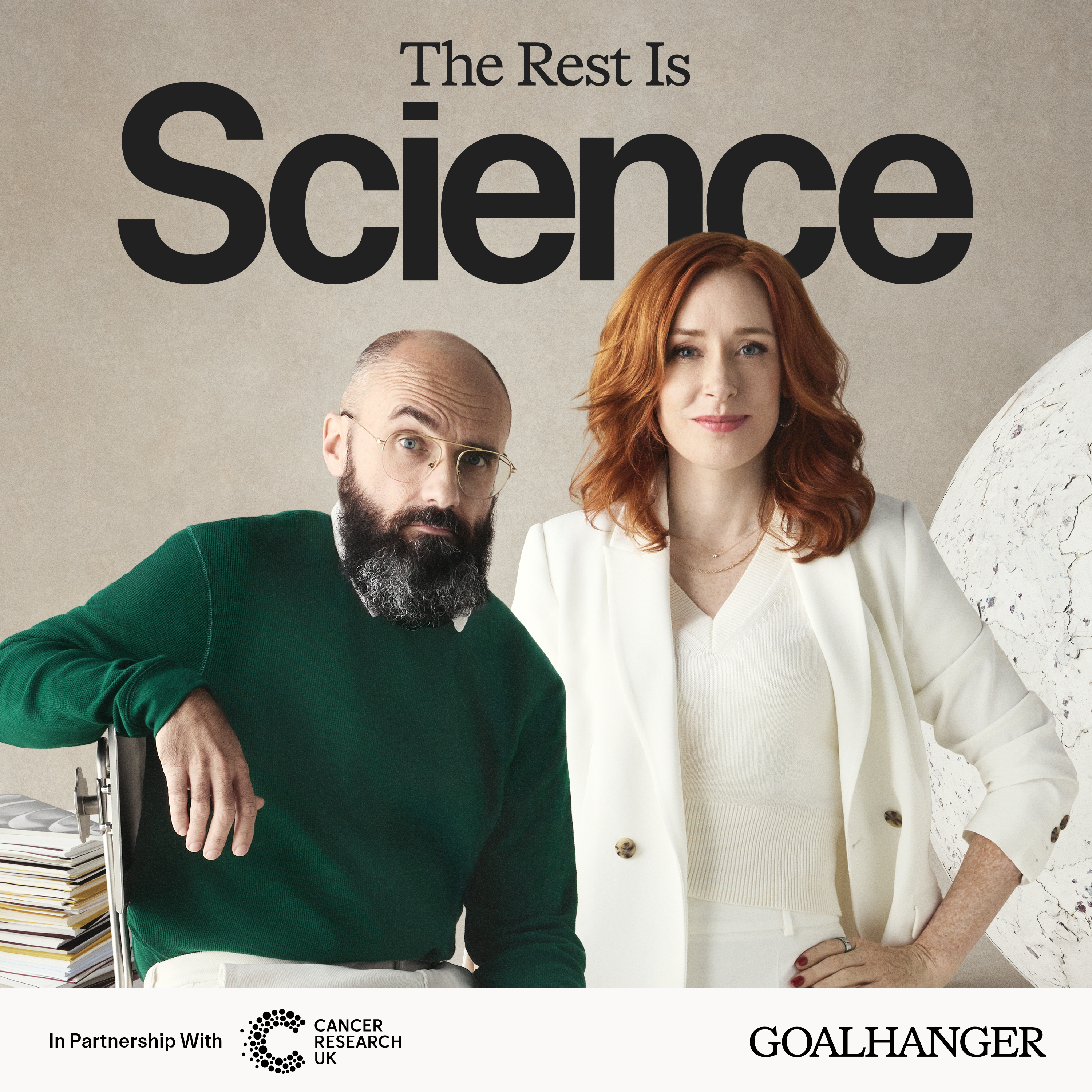
- The Rest Is Science
- Mapping Cancer’s Life Story
In short
The episode “Mapping Cancer’s Life Story” focuses on how cancer is studied across its full timeline—from early immune evasion to metastasis and treatment resistance—and highlights one major unsolved problem: cachexia (cancer-associated wasting). It argues that cancer’s complexity requires multidisciplinary, long-term research and community support, ending with a message of hope.
Guests (and backgrounds)
Professor Mariam Jamalhanjani, Cancer Research UK scientist, lung cancer specialist, and the charity’s chief clinician. She studied physics, then moved into medicine; she describes lung cancer care evolving from chemotherapy-only options to precision targeted therapies, immunotherapy, and improved radiotherapy.
Key claims
Over a million UK lives have been saved since the mid-1980s, but cachexia affects ~80% of advanced cancer patients and can cause death; eating more often doesn’t reverse it because metabolic “machinery” is disrupted. Team CanCan is mapping cachexia biology and testing targets like GDF15. Autopsy research (PEACE) and blood-based evolution tracking (TracerX) can reveal how cancers spread and evolve.
Notable examples
microbubbles for drug delivery across the blood-brain barrier; “tears” as a window into brain activity; naked mole rats; LungVax (a prevention vaccine for early-stage lung cancer patients post-surgery, plus a high-risk/no-cancer cohort); eCDNA (extrachromosomal DNA) as a marker in aggressive cancers; PEACE autopsies showing some metastases are “evolutionary dead ends.”
Written by AI. May contain mistakes.
Chapters
0:25
Innovative Approaches in Cancer Research
Discussion about creative solutions scientists are using to tackle cancer.
“I especially love how much knowledge we get.”
1:40
Understanding Cachexia: A Cancer Mystery
Exploration of cachexia, its effects on cancer patients, and ongoing research.
“Here's the thing though, Thanks to progress in cancer prevention, diagnosis and treatment, it means that over a million lives have been saved from cancer in the UK since the mid-1980s.”
2:52
Introducing Professor Mariam Jamalhanjani
Introduction of the guest expert in cancer research and her background.
“And because every single one of us is completely unique and every single cancer is unique, it means that scientists have to get really creative when they're trying to come up with solutions.”
4:40
From Physics to Medicine: A Personal Journey
Professor Jamalhanjani shares her journey from physics to cancer research.
“I mean, you are literally one of the world leading experts on cancer research.”
7:20
Advancements in Lung Cancer Treatment
Discussion on the evolution of lung cancer treatments and precision medicine.
“When I think back to medical school and being a junior doctor and the two main types of lung cancer, small cell and non-small cell, the only treatment options patients had was simple chemotherapy.”
10:10
The Complexity of Cancer and Cachexia
Insight into the relationship between cancer and cachexia, and their impact.
“But, you know, layer upon layer, I think people are making discoveries that are meaningful.”
13:20
The Metabolic Impact of Cachexia
Exploration of how cachexia disrupts metabolic balance in cancer patients.
“Should we be thinking in a similar way about cancer, that it sort of wants to spread and that the things that are happening to your body either help it or hinder it?”
14:00
Understanding Cachexia in Cancer Patients
Learn about the complexities of cachexia and its impact on cancer patients' health.
“and they become weak and they're functionally compromised, those are the patients we can't give the treatments we want to.”
17:10
The Role of Autopsy Studies in Cancer Research
Discover how autopsy studies contribute to understanding cancer progression and treatment resistance.
“So there have already been clinical trials.”
21:46
Exploring Early Stage Cancer and Immune Evasion
Examine the early stages of lung cancer and the mechanisms of immune evasion.
“Yeah, I mean, for me, without a doubt, we are able to sort of retrospectively work backwards.”
Show all 16 chapters
24:19
Innovative Approaches: LungVax and Cancer Prevention
Learn about the LungVax trial aimed at preventing lung cancer recurrence and development.
“that same lung cancer from coming back or a new lung cancer developing or another cancer that isn't lung.”
26:47
Understanding eC-DNA in Cancer Treatment
Investigate the role of extra chromosomal DNA in cancer and its implications for treatment.
“They need a lot of sort of building blocks to keep replicating and replicating.”
27:40
Optimism in Cancer Research
Hear about the hopeful advancements in cancer treatments and research.
“There's so many different research projects, so many different potential avenues.”
28:00
Harnessing the Immune System
Discover how understanding the immune system has changed cancer treatment.
“but the way that you're describing this is like, actually, there's so many fronts.”
29:46
Personal Impact of Cancer Research
Hear a personal story that highlights the importance of cancer research advancements.
30:53
Messages of Hope for Cancer Patients
Learn about the hopeful messages aimed at patients and the importance of community.
“What is your message to everyone listening out here?”

Ask about this episode
Get the gist, explore an idea or ask about something said.
 Claude
On The Rest Is Science, what are the key points of this episode?
Searching your listeningTranscript
Automatic transcript. May contain errors.
0:00Michael Stevens: What is your message to everyone listening out here? What do you want them to take away? You must leave with hope. You've got to think big, think ambitiously, be inventive, think laterally, build a community. Cancer is complex. I know we've talked about that a lot today, but it's not something we can't beat that we can't conquer together.
0:24Hannah Fry: we are very excited today to bring you a very special episode of the rest of science which has been produced with our lead partner cancer research uk as many of you know over the last
0:34Michael Stevens: year we have learned a lot by working with the cancer research uk team we've explored the ways scientists are tackling cancer with drug-laden micro bubbles smart bras cancer-sniffing robots.
0:46Hannah Fry: I think my personal favorite was about looking at tears in order to try and get a sense of what's going on inside of the brain just because the eyes are so deeply connected to your brain tissue and beyond the blood-brain barrier.
1:00Michael Stevens: I've enjoyed them all. I especially love how much knowledge we get. Like, even if it's just the true size of DNA, you know? Kind of visualizing this stuff and the complexity of what's going on. I think the micro-bubbles blew my mind the most because penetrating the blood-brain barrier has always been such a wall. And seeing that we found such creative ways to deliver drugs to places we usually couldn't get them without something really invasive was both cool and it made me feel really excited for the future.
1:29Hannah Fry: Yeah, me too. And also, let's be honest, who can forget naked mole rats? I mean, that was a memorable, a memorable.
1:36Michael Stevens: I know, I wasn't going to mention them because I think they're almost overexposed.
1:40Hannah Fry: By us, specifically by us. Here's the thing though, Thanks to progress in cancer prevention, diagnosis and treatment, it means that over a million lives have been saved from cancer in the UK since the mid-1980s. And there's millions, millions, millions more all around the world. But there is still a lot further to go. And any of you watching this who have been personally affected by this, you will know that there are still so many mysteries that we haven't yet solved. Take cachexia. This is a wasting syndrome that burns through fat and muscle tissue and ends up causing dramatic weight loss in people who have it.
2:15Hannah Fry: It develops in 80 % of people who have advanced cancer and can lead to people's bodies just becoming really way too weak in order to be able to continue treatment, which then ends up being very life limiting.
2:29Michael Stevens: That's right. And in fact, some people actually die from cakexia rather than from the tumor itself. and we still don't know what causes it. We don't know why it only affects some people and not others and why eating more doesn't reverse it.
2:43Hannah Fry: It's challenges like cachexia that just demonstrate how hard it is to end up beating cancer because it can reshape the body of our entire body. And because every single one of us is completely unique and every single cancer is unique, it means that scientists have to get really creative when they're trying to come up with solutions.
3:01Michael Stevens: Which is why Cancer Research UK has funded Team CanCan, a group of scientists working to understand the mysterious cacexia and develop what is basically an anti-ozempic to help people regain weight and muscle they've lost.
3:17Hannah Fry: But here's the thing. Michael and I love this stuff. We lap up as much information as we can possibly absorb. However, we don't want to go into the detail of this ourselves because there are other people out there who are so much better qualified to talk about this than us. And this is one of the reasons why when we work with Cancer Research UK, the normal recordings that we bring to you involve days and days and days of brainstorming, of scripting, of talking to the Cancer Research UK experts to come up with the best stories and narratives to bring to you. So let us introduce you to Professor Mariam Jamalhanjani, who is a Cancer Research UK scientist, lung cancer specialist and the charity's chief clinician.
3:57Hannah Fry: Mariam, thank you so much for joining us. Michael, I don't know if you know this, but the last time that Mariam and I saw each other was actually in St. James's Palace with the king. This is how important our guest is today. This is where she hangs out, you know, just with the king. Thank you so much. What a pleasure to join you both. And a very good fallback reference for when we first met, Hannah. Thank you.
4:16Michael Stevens: It's true, it's true. Those of you listening, you don't get to see this part of it, but when Hannah and I talk about Cancer Research UK, it's so much because of their help. People like Mariam, her team, they put together these amazing documents that teach us stuff. And then when we record them, they're on the call and we ask them questions beforehand for like an hour to really get it. And then we're like, man, you guys need to come on the show. And finally, it's happening. So, Miriam, welcome. Thank you for being here.
4:43Hannah Fry: OK, here's the thing, Miriam. I mean, you are literally one of the world leading experts on cancer research. But didn't you want to be a physicist? I did. Don't make me sad. I still occasionally miss those days. I did. you know both my parents are mathematicians and I always thought I ran my rationale was that I'm just about five foot tall my center of gravity is very close to the ground and I thought in primary school that I had to be an astronaut and I needed to study astronomy theoretical physics I thought this is the thing for me then I think I was pretty young when I needed spectacles and I thought well that's out the window now but I always loved numbers and I always loved maths and physics and understanding the symmetry and the beauty of how one can explain nature and how the world works and operates through mathematics and physics.
5:31So I think I was one of maybe two women. This was the mid-1990s in the year, but I really enjoyed it.
5:39Hannah Fry: You and me both, Mariam. There you go. There you go. We can relate on that. But, you know, I felt that I also missed human interaction that was meaningful to me. and I always loved physiology and human biology. And I think when you know of the body and you know of ailments, it naturally sort of makes you think, well, how does one heal? And that's kind of my route to medicine, which was after I studied physics at university.
6:04Michael Stevens: So first of all, I love to hear that because it's so similar to my story. I was going to be an astronaut when I was a kid. I went to space camp for three years. I earned my gold wings and then I needed spectacles. There you go. And I was like, dang, I'm going to have to just be a podcast host. So was there a moment specifically that made you switch to medicine? When did that happen? Was it a slow process or were you like, oh, my gosh, you mentioned the human interaction part. Were you just like, it's too lonely talking about physics alone? Do you know, Michael, it was a bit lonely. And I think for those who know me, my nickname in primary school was Chatterbox.
6:43So I just got to a point where I thought I'm a little bit lonely. And I don't really quite understand what my contribution will be. And this sounds so trite, but what will I do for humanity? What will I do that will make me feel good about sort of the career that I take on? And that's kind of when it wasn't that medicine came out of the blue. There's a lot of physics concepts in things like cardiac function, how lungs work. And so I felt it was not such an unnatural pivot to med school.
7:16Michael Stevens: What specifically made you interested in lung cancer? When I think back to medical school and being a junior doctor and the two main types of lung cancer, small cell and non-small cell, the only treatment options patients had was simple chemotherapy. And we knew that one of those lung cancers would respond to chemotherapy typically and the other would not. So the outlook was quite bleak for patients then. But I think of now in the clinic and as a lung oncologist, I have so much more that I can offer my patients. And then I think you suddenly had this sense that you could do more for one of the most common types of cancer globally through the advent of precision medicine, where we now understand the genetic makeup of lung cancer better, such that we can give what are called targeted therapies.
8:04These are often oral drugs that are better tolerated in terms of side effects, and they target specific genetic changes. We see better responses. We also have immune therapy, so we're harnessing the body's immune system so that cancer cells are recognized as foreign entities. And also there are these combinations between chemotherapy, immune therapy, radiotherapy. radiotherapy has really advanced especially in terms of offering localized treatment so that it's less harmful and less toxic for patients and I think that there's a bit of a misconception
8:36Hannah Fry: with lung cancer that it's actually you know it's only people who smoke who end up getting it yeah I this is something that I'm you know it's known to many but the sort of the public facing view sometimes isn't as it should be yes smoking is still the most common cause of lung cancer but we're also learning an awful lot about those people who've never smoked and in particular younger people who develop lung cancer. But we're also learning an awful lot about the environment, air pollution, other what we call carcinogenic exposures that mean you may not smoke and you may not even be exposed to secondhand smoke however you go on to develop a lung cancer.
9:14And then of course the corollary of that is that many people do smoke for decades and they don't develop lung cancer and we don't understand that either.
9:23Hannah Fry: So okay if I can distill your entire career into a few statements what are the really big questions that are driving you? What are the questions about cancer that you have sort of been wondering about for all of this time that's been pushing you forwards? What do you want to answer? I think everyone wants to know who gets it and why. How does it come to exist in the first place? How can we stop that process? Why does it spread? How do we stop that? But it's more complex, I guess, than sort of these unilateral, isolated questions. Because as we often think about the cancer cell, we call that a very cell-intrinsic view of cancer.
10:01Then you think about the environment in which those cells exist. And then you think about the organ. Then you think about the whole body. And now we are increasingly thinking about the whole body, the person, the patient, and the environment in which they exist. So it's complicated. But, you know, layer upon layer, I think people are making discoveries that are meaningful.
10:22Hannah Fry: And what about, I mean, because there are other mysteries that along the way, every single step of those processes for every single individual, for every single different type of cancer. But then I guess there are some of these unifying themes that appear. And one of the ones that Michael and I were talking about in our introduction is this idea of cachexia, the sort of the atrophy of muscle and fat tissue as somebody goes into advanced stage of cancer. I mean, is that something that you have spent time and attention on during your career? Yes, I'd say the last seven, eight years, we've been looking at that in the laboratory.
10:53And then we've been very lucky and fortunate to be part of a cancer grand challenge and challenge being emphasized because, you know, it's a global team. We've come together to try and understand the biology of it. And that's team CanCan.
11:07Michael Stevens: What do we know about it now? Like what's happening in the body? Because eating more doesn't reverse it. So it's very different than a typical calorie deficit or surplus kind of thing. Exactly that, Michael. It's very different to calorie restriction going on a diet. So we think it's like a slow biological unraveling that goes far beyond weight loss, because that's the most discerning and objective feature of cachexia, that people lose weight. Often people lose weight before they even have a diagnosis of cancer. So the healthy body, in the absence of cancer, has a really good balance that's constantly working in the background between building and breaking down tissue.
11:53Muscle is rebuilt in response to injury, alongside growth. Fat is stored. It's a good source of energy. And this sort of balance between energy in, energy out is really well balanced. But then cancer comes along. And cachexia, when it develops and it can develop in somewhere around 80 % of patients, at least at some point, regardless of what type of cancer, it really disrupts that balance. And the body almost starts to dismantle its own muscle and its fat at an accelerating rate to the benefit of the tumour. What's driving it in the body is essentially the body's response to the existence of a cancer, a tumour.
12:31Somehow, the cancer existing is doing something to other organs, for example, liver, and metabolism is hijacked. Bottom line, it does something to the muscle and the fat. They break down faster than they can be rebuilt. So you start sort of developing this negative balance. But when I said it's complicated, we think of it as a syndrome. So multiple factors play a role. The brain, for example, you lose your appetite. energy regulation centres are disrupted your heart and breathing muscles can be affected I think you said Michael that it can directly cause death and it really can because it can cause wasting of your breathing muscles respiratory muscles wasting of the cardiac heart muscle so some of these patients will have a direct correlation between having cachexia and a cancer and why it causes death.
13:22Hannah Fry: Should we be thinking of cancer in a similar way that the way you might if if there's a pathogen or a virus, that it's sort of like, you can't really anthropomorphise this stuff, but it's like, oh, the virus sort of wants to take over your body, right? Should we be thinking in a similar way about cancer, that it sort of wants to spread and that the things that are happening to your body either help it or hinder it? Or is that an unhelpful analogy? Do you know, I struggled with this, but to say that the tumour starves the body to the point of, you know, no return, I don't think is an understatement because I think when cachexia does dominate and the patient has lost muscle, lost weight, and they become weak and they're functionally compromised, those are the patients we can't give the treatments we want to.
14:08So that has an impact on their survival and their quality of life.
14:12Hannah Fry: I mean, it's sort of, it's fiddling the kind of existing switches and knobs within our own regulatory system within our body. It's not just like eat more and you can fix it. It's something much more fundamental. Michael asked, why does eating not reverse it? I think perhaps the most important aspect of it is this and I would say the most distressing for patients and their loved ones and relatives because that machinery of using your calories is broken. So even if you eat more, the metabolic signals driving muscle breakdown prevail. They still remain active and they're actively destroying tissue regardless of nutritional intake.
14:50And even And, you know, there's some evidence that the gut becomes less efficient at absorbing nutrients. And then there's the changes in taste and nausea and what we call early satiety. You feel full having eaten very little and the psychological impacts of that. And so much of the efforts in the Cancer Grand Challenge Can Can team is before that happens, when in advance. Why can't we consider how one might detect those signals very early on before it physically manifests? why can't we do something before you get to that point of no return?
15:25Hannah Fry: Okay, here's the thing. I mean, so you've done a really amazing job here at sort of describing what's going on in the body when you are under this condition. But we also do understand a lot about the metabolism, about the sort of the existence of GLP-1s, a Zempic-like medication sort of demonstrates our understanding of these mechanisms. So why is this particular mystery ended up being so difficult to solve? I think it sits in a very complicated place, if you like. If you think of the body as a system, the intersection here is between metabolism, your body's immune system, the cancer itself, the nervous system, psychology, muscle biology, gut function, the brain.
16:05So you see, it is multiple systems within one big system, i.e. the whole body. And I think that sort of makes it very hard for us all.
16:13Michael Stevens: All right. So is it getting any easier? Like, are we getting closer to finding an answer? Can team can can? Can they? Oh, no, I feel like I'm going to have to say it now, Hannah. They'll kill me. But yes, team can can can. I really think there's there's momentum now. There are sophisticated tools now to measure cachexia in the body. We do that in our team. We can use scans to look at muscle and fat. We can look at it 3D in the whole body to get a measure of how muscle and fat changes because it's dynamic it goes up and down in relation to treatment in relation to how much disease the body is is having to sort of tolerate in terms of the cancer and so i think overall the fog is lifting on cachexia the more we understand the biology the more likely we are to have treatment options for patients but ultimately i mean we're not
17:02Hannah Fry: talking about treatments just yet it's like the first step is understand the mechanisms and at that point then you can start to intervene? Well we're doing it all in parallel. So there have already been clinical trials. There are already drugs in clinical trial development through later phases where we've seen some evidence that at least weight can be stabilised and patients are able to tolerate treatment. We begin to map some of the specific molecular signals in the blood. There's something that you can measure in the blood. We've measured it. It's called GDF15 and it regulates and manages appetite.
17:36It correlates with who does and doesn't develop cachexia, and there are drugs that can target it. So there are clinical trials involving patients who are given this sort of antibody against GDF-15. The thing that's really complicated, not to be negative, but to sort of say, this is why you need sort of a multidisciplinary global team to look at it from many angles, is that GDF-15 is not the only target. There's a ceiling to how many targets there could be, because there's a ceiling to human biology, I believe, but we're not there yet. So there are multiple trials looking at different targets.
18:11Hannah Fry: I mean, there's an understatement of the century, but it feels like there's a lot that we don't understand here, particularly about advanced cancer. But I mean, I know that you're also making great progress in finding ways to study, particularly the later stages of the disease, right? Tell us about some of those studies. So this study over a decade ago, again, it was a risk at the time for Cancer Research UK when we started to think together in the lab, how are we going to understand why some cancers spread in the body, why some cancers don't respond to certain treatments, how does drug resistance develop.
18:46And really it comes from the angle of understanding or wanting to know how cancers evolve, literally from diagnosis to death, from early stage to late stage. And also something else that I think is quite personal for me in terms of my experience in the clinic and looking after patients, we don't really know why many of our patients stop responding to treatment and ultimately why they die of cancer. So although the beginnings of it may seem to you somewhat morbid and depressing, actually there was a huge amount of hope and drive behind it, especially from our patients and our patient advocates, because ultimately we knew, we understood, if you really want to understand cancer spread, We needed to look at the cancer.
19:29You can't do that in patients who have advanced disease, who may have other medical conditions. It's unethical, it's invasive, and especially you want to understand cancer spread to really difficult areas to treat, like the brain, like the bone, areas that you can't do a biopsy from. And so this really is the beginnings of what's called the PEACE Research Autopsy Study. It's a national study in the UK, but the collaborations have been international. And these are essentially patients who develop advanced disease, but they want to contribute to cancer research by donating their bodies. The legacy of our patients has been this huge resource where after death, we can collect tissues from the entire body to understand both the cancer, how it spreads, what the environment of the cancer looks like across different organs, and especially those very tough to reach and sample areas in the brain and elsewhere.
20:24Michael Stevens: So the PEACE study is about autopsies of cancerous tissues from people who, with consent, have given their bodies, donated them to researchers. What have we learned from autopsies of their bodies? It's incredibly meaningful, even one autopsy. We've learned in lung cancer, but we've also looked at this in other cancers, skin cancer, kidney cancer. We're currently looking at prostate cancer. We've learned, for example, in lung cancer that from the origins of the lung cancer within the lung, the route to spread can be quite complicated in some, but not all. I think one of the most interesting findings, we're not the first to show it, but I think it could have real implications for how we treat advanced disease, is that we find that some organs will have secondary disease or what we call metastases, where those metastases go on to disseminate or continue to evolve, whereas some metastases don't.
21:20They're almost an evolutionary dead end. And we don't really know what dictates that. But it makes me think that when patients have advanced disease, there may be a nuance to how we treat them. It may be that profiling where the disease is and the genetic makeup could dictate how you might treat the patient.
21:38Hannah Fry: So has this changed then how you think about advanced cancer? I mean, just having access to those, I mean, incredibly generous donations by people who passed away from their disease. Yeah, I mean, for me, without a doubt, we are able to sort of retrospectively work backwards. So once you look at the genetic makeup of the cancer autopsy, the advanced disease, you can then say, well, these are these sort of specific genetic changes that we know meant the cancer spread to the liver or the brain. Can we detect them in the blood? And we've got blood that's collected well in advance of the cancer spreading.
22:12And that's through another program called TracerX. But it means when you start to look backwards, you can see sometimes these genetic changes in the blood many, many months, even longer in advance of the cancer appearing on a scan.
22:27Hannah Fry: Of course, the big motivation of this is that you don't want the cancer to be there in the first place. You don't want people to get to that stage. Just talk us through how you can possibly approach cancer when it's in its earliest, earliest imaginable stages. One of the things we learned early on in TracerX was that lung cancers have the ability to escape recognition by the body's immune system or what's called immune evasion. And lung cancers can do this even before they're subjected to any treatment. So when cancer cells have certain mutations or genetic abnormalities, they can code for these abnormal proteins that sit on the surface of the cancer cell called neoantigens.
23:08And we understood that some of these abnormal proteins were present in all cancer cells and some of them were present in some but not all. And we thought, OK, so some of these neoantigens or these proteins are present in every single cell. How can you target that? Is there some mechanism by which you take advantage of a feature that's in every cancer cell? And that's where the idea of LungVax came from. And so the LungVax study is a first in human clinical trial where we will be offering patients a vaccine. It's the first ever lung cancer prevention vaccine. We'll be offering a vaccine in the hope that we prevent the cancer from coming back.
23:45And then I hope moving forward, we prevent the cancer from ever existing in the first place. So lung vax, I think it sort of beautifully demonstrates long-term thinking and long-term investment, sort of planning ahead for how we might be able to truly understand the origins of lung cancer. Wow.
24:04Michael Stevens: Okay. So you'll be giving this vaccine to people who are in remission? Good question, Michael, because this isn't quite what we call primary prevention. So our twist on this is that we'll be giving it to patients who've had a very early stage lung cancer. They've been cured with surgery and then we offer them the vaccine to try and prevent that same lung cancer from coming back or a new lung cancer developing or another cancer that isn't lung. And we've learned that that is you're at higher risk of developing other cancers if you had a lung cancer to begin with. That's half the study but there's another half of the study where these will be patients who've never had a lung cancer.
24:44And so that's where we want to say well if it's safe and we can give it to patients who are post-surgery, in remission, but also patients or participants who've not had a cancer, we might move closer to saying, well, can we give it in the primary prevention setting?
25:01Michael Stevens: You could just give it to people who were at high risk. Exactly. Do you
25:05Hannah Fry: think that we might get to a point where you can have a vaccine for everything? I mean, if it works for this one, do you think that we could have a vaccine for all cancers? I mean, that's the dream, And I think as long as the technologies allow to develop those sort of vaccine, then why not? That definitely is the dream. You know, the same way that you think about vaccination against developing cervical cancer. Why couldn't there one day be a vaccine against at least the most devastating or the most common cancers? Absolutely. OK, so, I mean, we've talked now about late stage cancer. We've talked about early stage cancer.
25:37Hannah Fry: Are there other characteristics of cancers that you can exploit here?
25:40Michael Stevens: I'd love to hear more about extra chromosomal DNA, EC DNA, little genetic material that floats outside of the normal chromosomes. What has the discovery of that, what could it mean for new treatments and what is it? So these are small circular fragments that are rogue genetic material and they float outside of the normal chromosomes. They're in the cell, but they're not on chromosomes, which is where you would expect DNA to reside normally. And so ECDNA typically will hold oncogenes, genes that are playing a role in tumour initiation and tumour progression. So that's the distinct biology. And then you would say, well, how does it lend itself to sort of new treatments that we could leverage?
26:26Well, that sort of self-sufficient replication and transcription we can block. There are drugs that can block that specifically for the ECDNA and the machinery that they use. You can disrupt the mechanisms that eCDNA have to maintain themselves that allow them to segregate and divide. And we also know that eCDNA often occur in cells that are under a lot of stress. They're replicating very fast. They need a lot of sort of building blocks to keep replicating and replicating. And you can starve them of those replicating blocks. So this is sort of bespoke treatment tailored to cancers that have eCDNA.
27:04because not all cancers do, but we're increasingly finding out that the very aggressive cancers will have eC-DNA in them.
27:11Michael Stevens: Interesting. So highly aggressive ones tend to be not caused by, but they involve eC-DNA more than others. How many cancers can we pinpoint eC-DNA playing a role in? Many, including lung, including brain, including breast, ovarian, colorectal, gastric or stomach. So sarcoma, it's very common in sarcoma, for example. So many tumour types is the quick answer.
27:37Hannah Fry: Mariam, I have to ask you, OK, I mean, there's so much going on in this field. There's so many different research projects, so many different potential avenues. It feels like, I think from an outsider perspective, you sort of see it's very easy to fall into this trap of seeing cancer as this like single unifying kind of monolith that needs to be attacked. but the way that you're describing this is like, actually, there's so many fronts. There's so many different areas. Do you feel overall, knowing what you know, that you're ultimately optimistic about our chances of really changing our relationship with this disease?
28:14Do you know, I mean, I do. And I genuinely mean that. Not just because I'm, you know, I look after patients. I'm in the lab and I have a team that make discoveries always with the patient at the heart of the work they do.
28:28Hannah Fry: Has there been a discovery over your career? that really stands out for you as a way that completely changed your view of cancer? Do you know, you want to be self-reliant, self-sufficient. You want to think of, you know, we are all inherently, I think, problem solvers. At least I like to think we are. And how can you harness the body? How can you harness the immune system? So that's what I would say is the discovery that I think has changed the view as a field. Because, you know, it was in the late 1800s, this concept of somehow harnessing the immune system to recognise cancer cells as foreign entities.
29:05And then, of course, through the 1900s and into the 2000s, early 2000s, this idea of sort of taking your foot off the brakes and sort of heightening the immune system. Obviously, there's a balance to be had there, but just using the body. The body is adept at knowing this was not there at the beginning it's not meant to be there even though cancer cells can evade that recognition which i think just that discovery was huge because it led to the field of immunotherapy it doesn't mean that we can't find ways to circumvent it and that's the
29:36Hannah Fry: field of immunotherapy can i tell you one for me yes um just i think the the news about the cervical cancer vaccine i mean i've mentioned this on this podcast before but i had cervical cancer it was it was honestly the most horrendous horrendous horrendous time of my life and I think the idea that now I mean the new statistics Mary you know this much better than I do but are that essentially that is a disease that women might no longer have to suffer and I just think that everything you're talking about you know as I said at the beginning Michael and I are endlessly endlessly fascinated by the mechanisms by the sort of weeds of it by the science of it but the ultimate thing that we're talking about here really is the impact on individual people so many of the things that you've described are just little moments that could potentially grow into that same story that the suffering that people have have had in the past needn't be a story that people need to suffer from in the future i completely feel that so you know we've we've done it for cervical cancer i see no reason why we can't do it for other cancer types some may take longer than others but without a doubt the drive and the motivation is there and and you know you mentioned yourself and i think of my patients i think of my loved ones who've experienced it who i've had to witness that is you know the essence of what keeps us going because as i said at the heart of it we
30:59Michael Stevens: will want to make a difference and we want to do good i mean on that note we we've talked about a lot of things and and literally every single one of us will be affected in some way by cancer whether it's personally or a loved one or just the stories, the world that we live in. What is your message to everyone listening out here? What do you want them to take away? Hope, really. You must leave with hope. You've got to think big, think ambitiously, be inventive, think laterally, build a community. Cancer is complex. I know we've talked about that a lot today, but it's not something we can't beat, that we can't conquer together.
31:36And to all the patients and volunteers that support cancer research, this is their legacy. And it's a privilege to be part of and to play a small role. So I think that we feel the hope. Our patients feel it. That's why, you know, volunteers and supporters do as much as they do, because we'll never lose that. That's what will keep us going.
31:55Hannah Fry: I think the privilege today was all ours. Yeah. Likewise. I really do. Likewise. Thank you. You are such a badass. My goodness me. One absolutely phenomenal, phenomenal tour de force. Yeah, that was so fascinating and so profoundly important and engaging at exactly the same time. Thank you so much for joining us. Thank you so much. It was a pleasure.
32:14Michael Stevens: Thank you. Wow. This is amazing. Maybe I should be a cancer researcher, Hannah.
32:20Hannah Fry: I know, right? I tell you what, we'll definitely get more people on the podcast because that was the first interview that we've done. And it certainly won't be the last. That was amazing.
32:27Michael Stevens: It certainly won't be the last. That was great. From what all we've heard, you know, there's so much ongoing research and it really is helping us outsmart cancer. You know, we're achieving more than ever. Just the ideas themselves are cool, but they're actually being enacted. And I think it really makes me feel great that we are truly in this golden age of cancer research.
32:47Hannah Fry: Yeah, we are. And I think it's important to remember through all of this that the life-saving research that Mariam is talking about here is only possible thanks to the amazing people who support Cancer Research UK. Because over the last 50 years, their work has helped to double cancer survival in the UK. and they are continuing to turn radical ideas into tests, into treatments and into prevention measures that will save and improve lives.
33:11Michael Stevens: And for more information about Cancer Research UK, about their research, their breakthroughs and how you can support them, visit cancerresearchuk.org forward slash rest is science.
33:34Thank you.
From the publisher
Why can’t eating more stop someone with cancer from wasting away?
In The Rest Is Science’s first ever interview, Professor Hannah Fry and Michael Stevens (Vsauce) sit down with Professor Mariam Jamal-Hanjani, lung cancer specialist and Chief Clinician at Cancer Research UK.
Cachexia is a wasting syndrome that affects around 80% of people with advanced cancer. Some patients die from it rather than from cancer itself. Professor Mariam explains how cancer hijacks the body’s metabolism, and how Team CanCan is working towards an “anti-Ozempic”.
They also explore what the PEACE autopsy study reveals about how cancer spreads, how the TRACERx study led to LungVax, the first ever lung cancer prevention vaccine trial, and the rogue extrachromosomal DNA (ecDNA) found in aggressive cancers.
Along the way: lung cancer in people who’ve never smoked, how immunotherapy changed cancer treatment, and Hannah’s own experience of cervical cancer and what the HPV vaccine could mean for future generations.
Could we one day vaccinate against the most common cancers? Mariam says that’s the dream, and she wants everyone to leave with hope.
-------------------
For more information about Cancer Research UK, their research, breakthroughs and how you can support them, visit https://cancerresearchuk.org/restisscience
Cancer Research UK is a registered charity in England and Wales (1089464), Scotland (SC041666), the Isle of Man (1103) and Jersey (247). A company limited by guarantee. Registered company in England and Wales (4325234) and the Isle of Man (5713F). Registered address: 2 Redman Place, London, E20 1JQ.
-------------------
Find The Rest Is Science all over the internet by clicking here.
-------------------
Video Producer: Adam Thornton + Oli Oakley + Jack Meek
Animator: Sam Benson
Video & Social: Bex Tyrrell
Producer: Simona Rata + Lucy Lipscombe
Senior Producer: Lauren Armstrong-Carter
Chief Digital Officer: Samuel Oakley
Exec Producer: Neil Fearn
Learn more about your ad choices. Visit podcastchoices.com/adchoices
More from The Rest Is Science
All episodesWe use cookies.They keep VO running smoothly and help us improve it. Privacy policy