
 Ask ChatGPT
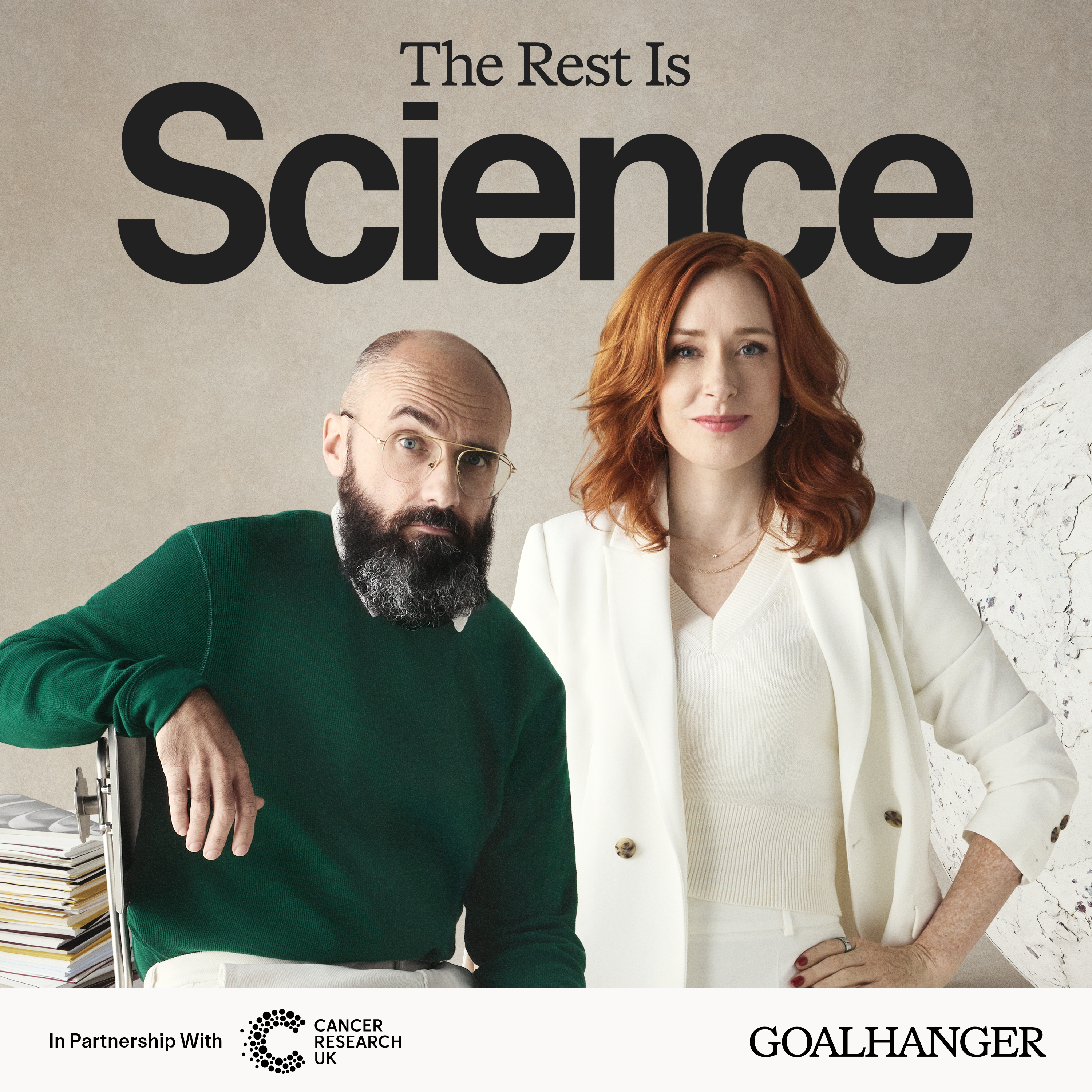

- Podcasts
- The Rest Is Science
- The Secrets Michael Keeps From Himself
In short
Michael Stevens shows Hannah Fry “things he owns but won’t look at,” then the episode shifts to listener questions about anesthesia and language, and “carrier bag” theory of human evolution.
Guests/backgrounds
Hannah Fry (host). Michael Stevens (host; runs science/oddities content). No other guests appear; later segments are Q&A with listeners.
Key claims & notable examples
- Michael’s “three color pentomino puzzle” (made by Physics Fun’s Raymond Hall) is kept unopened/unsolved because the plastic-wrapped solution is visible and would ruin the challenge; colors must not touch.
- “Comet Vomit” vial: a museum-made scent replication of comet tail compounds; Michael refuses to open it to preserve it.
- “Wet Hot American Summer” prop can of vegetables: unopened, old, with a small hole; Michael won’t open/eat it. He’ll open and eat if a YouTube comment reaches 5 million likes.
- Q&A: rare “foreign language syndrome” after anesthesia (example: Dutch patient speaking English only; Dutch returns after ~24 hours). Another case: counting switches from English to Hindi.
- Carrier bag theory: containers (e.g., buckets/bags) enabled gathering, reduced constant foraging, and helped enable society; archaeologists find containers ~500,000 years ago.
Written by AI. May contain mistakes.
Chapters
0:45
The Mysterious Puzzle
Michael reveals a pentomino puzzle he has never attempted to solve.
“And I've met him a few times, and he sent me gifts, and I've given him some stuff from the Curiosity Box.”
5:35
The Comet Smell Experiment
Discussion about a vial that replicates the smell of a comet.
“sort of like almost like a frame where you can fit shapes inside that will perfectly match the rectangular shape of the frame that it sits in.”
8:09
A Prop from Wet Hot American Summer
Michael shares a can of vegetables used as a prop in a movie and its significance.
“Oh, well, you know, he's into more than just physics.”
11:43
The Mystery of the Can
A discussion about the contents and potential opening of the can from the movie.
“I mean, look, that's, that's my position.”
17:48
Reflections on Sentimental Items
A conversation about personal sentimental items and their meanings.
“Do you have anything like that in your own life?”
22:33
Anesthesia and Unexpected Skills
Exploring the phenomenon of waking up from anesthesia with new skills.
“And it got me thinking, are there instances of people waking up from anesthesia to a new skill or something they could previously not do?”
28:01
The Effects of Anesthesia and Honesty
Exploring the surprising level of honesty patients may exhibit after anesthesia.
“You know, they put on an EEG monitor and a hundred is where you're fully awake and conscious.”
29:20
The Importance of Containers in Humanity
Discussing how containers have shaped human behavior and society.
“So I really loved this one because I love Ursula Le Guin and I actually have not read this.”
34:29
Humor and Cultural References
Examining the humorous aspects of human invention and cultural references.
“and really what came first because containers back then and even today are so often made of materials that do not last forever.”

Ask about this episode
Get the gist, explore an idea or ask about something said.
 Claude
On The Rest Is Science, what are the key points of this episode?
Searching your listeningTranscript
Automatic transcript. May contain errors.
0:01Michael Stevens: Welcome to the rest of science. I'm Hannah Fry. I'm Michael Stevens. And today on field notes, I've brought some things that I own, but I've never looked at. Ooh, yes, please. Thank you very much, Michael. Right. So those of you watching on video will get to see one of the items that I've never seen. And I will hate you for it because I will never trust you again. Those of you listening on an audio, however, you can be my friends forever, or at least until I finish the puzzle. So what is it? It's a puzzle that was invented by, like designed by and made by Raymond Hall from Physics Fund. That fantastic Instagram account.
0:41Michael Stevens: He's also on YouTube and TikTok. Obsessed, obsessed, obsessed with Physics Fund. Awesome stuff, right? And I've met him a few times, and he sent me gifts, and I've given him some stuff from the Curiosity Box. but he made this puzzle and I'm like, I got to have the puzzle you made. I've never attempted it because I just haven't had the time, but it also freaks me out because it comes solved. Okay. And what it is, is it's a, it's a three color pentomino puzzle. What's a pentomino? Well, it's like a domino, except instead of being made of two squares, each shape is made of five, five squares, pentomino, not domino.
1:18Michael Stevens: And you have to fit them all. They're, they're flat little acrylic pieces. You have to fit them all into this rectangular space, but it's wrapped in transparent plastic and you can see the solution right there on the front. And I know that if I even take a peek at it, I'm going to remember, Oh, um, the square pieces in the corner. And then I'll just know that forever. I'll never be able to forget it. And it will give me an advantage. So I've kept the puzzle on my desk on various other clutter upside down like this. I'm showing it now to the camera, you can see that it says, it's got engraved on it, three color pentomino puzzle at physics fun.
1:57Michael Stevens: And it's a thin piece of wood. It looks like an envelope. Oh yeah. It's about the size of an envelope. Yes. It's, it's a piece of laser cut wood and I'm going to turn it over and I'm going to close my eyes and show it to the camera. So you can all see what I have never seen, even though I've had this for years. Okay. So essentially what you've got here is in the top left hand corner. I'm joking. I wasn't going to tell you that every single, every single pentomino and how it's arranged.
2:27This episode is brought to you by Cancer Research UK.
2:31Michael Stevens: We know that DNA holds a lot of information, but here's a way to visualize it. If we encoded all the movies ever made in all of history into DNA, that clump of DNA would be smaller than a sugar cube. It is packed with data. And so Cancer Research UK scientists are analysing cancer DNA to understand what makes every cancer different. They're even searching through what was once considered genetic junk. That's because uncovering these differences could lead to more personalised and precise ways to prevent, detect and treat the disease. Over the last 50 years, Cancer Research UK's work has helped to double cancer survival in the UK.
3:12And today, it's continuing to save and improve lives around the world.
3:16Michael Stevens: For more information about Cancer Research UK, their research, breakthroughs, and how you can support them, visit cancerresearchuk.org slash rest is science.
3:46to manage your money across borders, you want a fair exchange rate, an easy transfer and no surprises along the way. Wise keeps things simple. Wise is a smart way to move the currencies you need around the globe. It works in more than 160 countries and with over 40 currencies, most transfers arrive instantly. Wise uses the mid-market exchange rate, like the one you see on Google, with no markups or hidden fees. So when money needs to move, you can see the rate, know the fee and get on with it. Join millions saving billions on hidden fees by downloading the Wise app today. Be smart, get wise, T's and C's apply.
4:27For adults with Crohn's disease or ulcerative colitis symptoms, every choice matters. Tremphaya offers self-injection or intravenous infusion from the start. Tremphaya is administered as injections under the skin or infusions through a vein every four weeks, followed by injections under the skin every four or eight weeks. If your doctor decides that you can self-inject Tremphaya, proper training is required. Tremphaya is a prescription medicine used to treat adults with moderately to severely active Crohn's disease and adults with moderately to severely active ulcerative colitis. Serious allergic reactions, increased risk of infections or lower ability to fight them and liver problems may occur.
5:07Before treatment, get checked for infections and tuberculosis. Tell your doctor if you have an infection, flu-like symptoms, or need a vaccine. Explore what's possible. Ask your doctor about Trimphia today. Call 1-800-526-7736 to learn more or visit trimphiaradio.com.
5:34Okay, so what you have here then is it's one of those borders, sort of like almost like a frame where you can fit shapes inside that will perfectly match the rectangular shape of the frame that it sits in. And each one of these pieces is five squares big. Is that right? Yes. That's right. Each one of them is five squares. So for example, you've got one that's just a line that's five sort of squares long. You've got one that forms a cross with one square in the middle and four around the outside. You've got one that's sort of an S shape. You've got various kinds of T shapes. You've got an L shape and they all fit very nicely together into this beautiful rectangle.
6:14You would remember that. It's too distinctive.
6:16Michael Stevens: I think the pentominoes come in three colors, right? They do. Correct. So you've got yellow, green, and blue. Okay. I'm wondering if one of the challenges is to put them together so that the same two colors don't touch each other anywhere. Is that true? That's absolutely right. Yeah. There's no point in two of the correct colors touching each other. So I'm going to put this down so I can open my eyes again. Okay. Now, it feels weird to have this thing that I can't ever turn over. Well, not ever. If you just empty it out, then you'll be able to look at it. I literally just realized that right now, Hannah, that I could just unwrap it and have them all fall into like a bag and then store it that way.
6:59Michael Stevens: But storing it all together is a little bit more convenient for storage. but it also means that I can't look at it or else it won't be as hard to solve. You're also, you are really giving your own memory a lot of credit here. I'll be honest with you, I think I could try and do the puzzle now and I wouldn't remember any of the pieces where they were. Actually, is that true? Actually, I can remember a couple of them. But your memory is much better than mine. It might be that, or it might be that I have this really strong ironic process theory where if I tell myself, don't think about that, I will think about it.
7:33Michael Stevens: don't remember that I will remember it and if I see a shape I'll remember where it is and then I'll punish myself internally cognitively for remembering that and I will never forget it because the whole experience of of seeing a thing that I want to not know will make it stay forever so you know what maybe I'll do it on the airplane tonight I'm flying to LA this could be my little airplane activity and then it'll be done with and I can finally like look at it and have it on display because I treasure it. It's not only a cool puzzle, but it was made by Raymond Hall. Why did that one appear on Physics Fun though?
8:10Michael Stevens: What's physics-y about it? Oh, well, you know, he's into more than just physics. He shows off a lot of things that are mathematically interesting. He's probably shown off a few biological specimens that are neat too. He just kind of has a museum of oddities. It's very much like me, except it's organized. And he's got like cases and it's wonderful. And - Well, he been around his house. No, but he's shown me photos of it. And I have this standing invitation to go and visit his collection. I just haven't been in his part of the country for a while. Okay, next item up for display is not a visual item.
8:52Michael Stevens: The rest are not visual. So this is a little package, basically a blister pack, and on the top it says Comet Vomit. And here in this little window, we have a tiny little vial that's like a turquoise blue color with a white lid on it. You can kind of see into it. It contains harsh chemicals, do not eat, avoid contact with skin and eyes, flammable. That's what the package says. What is it? it is a semi-scientific version of what an actual comet smells like wait what was the what was the theme that you said that tied all these things together right at the beginning stuff that you cannot look at yeah it's stuff that i own that i have not looked at or in this case smelled at okay yeah i haven't experienced it um i saw this in a museum for it's from the freaky but true Peculiarium Museum.
9:46Michael Stevens: I don't even remember going there, but they had these. And what is it? Well, after NASA investigated the composition of some comets that they landed devices on, we knew what a comet was made out of, and therefore we could deduce what it would smell like. And so they replicated the smell of a comet inside this container and sold it in a museum. So you could buy this, open it up and smell what a comet in outer space would smell like if you were on it. You know what I'm going to ask you today? No, no, no, no, no, Hannah, you're not. I'm not going to do it. And I'll tell you why. I knew this was going to be a problem.
10:26Michael Stevens: Once I open it, it's going to outgas and it's never going to work again. So I bought two of them. Okay. And the first one I have smelled and I smelled it on camera. I made an entire episode on the Ding channel about it. This is the second one that I don't need to open because I've already had the experience. Yeah, but what are you saying? The Ding channel is more important than us. I'm saying that this item remaining in a pristine collectible state is more important than you is more important than me. How dare you? And it's more important than the show. All right. What did it smell like? I don't remember.
11:03Michael Stevens: I guess you could go back and watch the episode and I probably say, but I personally don't remember, which is kind of the opposite problem. I'm afraid of happening with the puzzle, right? I feel like it's good that I don't remember. I don't think it was sweet. I don't think it was, I have no idea. And so I don't even want to watch that video. I just want to now live not knowing, or I guess I could watch the episode. That'd be fine. I just don't want to open that container. I want maybe like my, if my daughter wants to smell it, I will let her open it. If you want to smell it, I would open it. However, you're not here.
11:37Right. Okay.
11:38Michael Stevens: I don't need to smell it again. I've had my once in a lifetime chance. Okay. All right. Yeah. I mean, look, that's, that's my position. Uh, the last thing I wanted to show off is it's very weird. Um, okay. So there's a movie called wet, hot American summer. And this movie really played a pivotal role in my life. It was on like Comedy Central one day when I was homesick from school and I couldn't believe that this was a real movie. It was just so strange. The comedy was so like, at least at that time, it was just, it was so important to me. And I wound up meeting someone who had worked on the Wet Hot American movies and Netflix show.
12:18Michael Stevens: And he gave me this can of vegetables, which if you're familiar with the movie, This can of vegetables, it was used in the movie for the talking can of vegetables that's in the movie, voiced by H. John Benjamin. And this is one that was actually used in the movie. So it's like a movie prop, you know, collectible. But it's just a real can that they put a new label on, like a label that they had the rights to use. And so it's never been opened. And it's quite old. Has it got mixed vegetables inside? Is it full? Is it full of something? It's full of something, but neither of us know what it's full of.
12:58Michael Stevens: It's not mixed vegetables. I mean, it could be, but it's not what the label says. Michael, Michael, you let me down on the comment, but don't let me down on this one. It's a real can. I think they just went to the store, bought some cans and put different labels on them that they could film. On the bottom, it says best by December 2015. Michael, let's open it and eat it. When he gave this to me, which was, gosh, like at least seven years ago, it was like a regular can. But now it feels really light. Something's happened. What do you think's happened? I think that somehow moisture has gotten out and it's like dried.
13:40Michael Stevens: It doesn't slosh and it's definitely not full. It feels like it's empty all the way from the top to the midpoint. And then there's like a clump at the bottom. So it has changed. It somehow has access to the outside world and has changed. Come on, let's open it. Come on. We're not going to open it. Hannah, this episode is not Michael looks at, experiences, smells and eats stuff. It is Michael shows off the stuff he will never look at, smell or eat. Wait, just show us the top and the top. I want to like, I want to dox this can basically. I want to see if we can work out what is in it. Just show me the top and the tail.
14:17I wonder if there's something that we can.
14:19Michael Stevens: There's the top. Notice that there's some corrosion on the lid. And then here's the bottom. What's underneath the label? Nothing. You can't look. Hold on. Look really close. Is that a hole? There's a hole in it. It hasn't been leaking though. It's been only in like two spots ever since I got it. And there's never been a stain. Maybe little ants have been going in. Having a little leak. Getting back out. yeah i've got a question what does the hole smell like can you smell that hole i will smell the hole yeah i'll smell the hole oh wow it well it's very metallic okay can you get botulism from smell hey look we're about to find out yeah it smells like the way um like blood smells or tastes it's kind of it's like rusted.
15:11Michael Stevens: Um, but it doesn't, it doesn't smell like decaying matter probably because the ants took away most of the organic stuff. So what would be left though? I don't know. Uh, dead ants. I am so curious. I think if I'm on my deathbed, I might open this up, but it's, it's important to me. And I, it, it appears in some of my episodes, some of my shorts, you'll see it like here or there. And a few people get it and they're like, wait a second, why is Johnny Benjamin talking to me. And I love that. But yeah, it's very important. It's been up on my shelf behind me for a long time. And it's really the only screen used movie prop I own.
15:50Michael Stevens: So it's kind of a special part of my, the nouns that surround me, but I'll never open it. If someone leaves a comment and it gets to 100 ,000 likes, will you eat the, will you open up the vegetable can? No. Here's the thing. I'm afraid that it would happen and I'm not ready mentally for that to happen. Okay. I do think now that you mentioned it, it could be fun someday to do a video that like kind of preserves audio visually, the destruction of the can and the opening of the can. And maybe I should wait until like 2035 when it's 20 years old. And when Wet Hot American Summer is a classic. Okay.
16:31I'll tell you what. Okay. I've just looked it up. And apparently the most liked comment on YouTube ever has got like 4.8 million likes, right? Which is on the first ever video that YouTube posted. If we beat that, if suddenly someone does a comment, if someone does a comment, eat the can, Michael. If it ends up being the most liked comment on the whole of YouTube, would you eat some? I would eat some.
16:57Michael Stevens: Yeah. Yeah. I'd bloomin' eat it for that. Here's what I will say. for the good of knowledge and of spreading awareness about Wet Hot American Summer. If a comment on this video gets 5 million likes or more, I will open the can on camera and eat some of it. Chewing, swallowing and everything. Can you imagine your poor daughter trying to negotiate with you? Absolutely hilarious. All right. Well, look, Michael, I absolutely love working with you. You come up with some of the best ideas of anybody on the planet. It is an absolute delight to sit across the microphone from you Week after week after week with all of the amazing things that you come forward But this week, Michael A puzzle that's already solved A comment that you refuse that you're not going to smell And an old tin of food from a movie that we're not going to look at Do you have anything like that in your own life?
17:51Michael Stevens: Where you're like, I'm never going to drink this bottle of wine Or I'm never going to use this knife because it's what my wedding cake was cut with or something like that. So actually, I did get a really nice bottle of rum for my 21st birthday. Oh. And I decided on my 21st birthday that for my 50th, I would drink it. Oh man, well, that's still like 30 years away. Nice try. But I still have that. It's still there. The only thing I would say is that what counts as a nice bottle of something for me personally has changed quite substantially from when I was 21 to now. And so actually I think it's sort of comparatively not that special or expensive except for the fact.
18:36Did you ever do this when you were younger? I remember when I was 14, I wrote a letter to my older self asking myself all of these questions. And then I like sometimes go back and read it. And it's sort of, it's really nice to have a conversation with the historical version of yourself as it were. Yeah. Um, but it's a similar thing. I would do this. I have done this a few times over the course of my life. It's been a moment and it's been like, okay, but I'm going to throw forwards to the future version of me. Cause when you're 21, being 50 is like, well, you're ancient, you know, it's like never going to happen.
19:08Michael Stevens: Yeah. Yeah. I know. And now I still got a little while, not, not ages, but a little while. That's a really cool thing to do. You got something to look forward to. And you also like you have a reason to open it that you've agreed with yourself on. Whereas I don't have any of that for this stuff. So it's kind of just sitting there alone in a way, you know, unused, but like tempting the puzzle I can do the comet vomit. I don't know what to do. Like as soon as I smell it, I won't have any comet vomit anymore. I think you can save that one for your daughter though. I think, I think that's completely fair enough.
19:43Michael Stevens: Uh, you know what? I want to clarify that it's, it's not based on like the surface of a comet. It's based on what's in the tail of a comet. That's why it's called comet vomit. We sampled the tail of a comet, the gases and ices and stuff that's blown off by the sun. This isn't the exact same stuff, but it has the same compounds in a comet tail that have detectable smell to humans. That's what it is. Let's take a quick little break. When we come back, we're going to look at questions from you all, which we will look at and will experience and engage with.
20:24are you looking for support in your weight management journey zetbound terzepatide may be able to help zetbound is a prescription medicine used with a reduced calorie diet and increased physical activity to help adults with obesity or some adults with overweight who also have weight related medical problems to lose excess body weight and keep the weight off ZepBound is approved as a 2.5, 5, 7.5, 10, 12.5, or 15 milligram injection. ZepBound contains terzepatide and should not be used with other terzepatide-containing products or any GLP-1 receptor agonist medicines. It is not known if ZepBound is safe and effective for use in children.
21:04Don't share needles or pens or reuse needles. Don't take if allergic to it. Or if you or someone in your family had medullary thyroid cancer, or if you've had multiple endocrine neoplasia syndrome type 2. Tell your doctor if you get a lump or swelling in your neck. Stop ZEPBound and call your doctor if you have severe stomach pain or a serious allergic reaction. Severe side effects may include inflamed pancreas or gallbladder problems. Tell your doctor if you experience vision changes before scheduled procedures with anesthesia. If you're nursing, pregnant, plan to be, or taking birth control pills.
21:35Taking ZEPBound with a sulfonylurea or insulin may cause low blood sugar. Side effects include nausea, diarrhea, and vomiting, which can cause dehydration and worsen kidney problems. Talk to your doctor. Call 1-800-545-5979 or visit zepbounce.lily.com.
21:54Michael Stevens: Shaq here. What's it like to buy a car from Carvana 100 % online and get it delivered to your door? Let me tell you. Your car is here, Mr. Shaq. Thank you, Mr. Carvana guy. Can't wait to take it for a spin. Only the best for you, Mr. Shaq. Hey, have you always been so big, tall, and handsome? Not always. I was 6 '10 once. Seven days to love it or return it, Mr. Shaq. Not that I would. You never do. No, I never do. So buy your car today on Carvana. Delivery fees may apply. See our seven-day return policy at Carvana.com.
22:32Michael Stevens: Discover the new Myself Eau de Toilette Intense, a masculine and long-lasting fragrance for every day a bold scent with sensual musk and woody notes myself Yves Saint Laurent
23:03Okay time for your questions First up we've got an email in from Nora Who said I woke up from spine surgery Having memorized all of the dialogue Of a two and a half hour movie that I'd only seen once the night prior. And it got me thinking, are there instances of people waking up from anesthesia to a new skill or something they could previously not do? I mean, what an amazing question that is, Nora. That's freaky. And that's really freaky. Okay, so there is a bit of a neurological phenomenon that is potentially going on here. I'm not sure. I sort of want to really test you on how many of the words of the two and a half hour movie you could really remember.
23:43Michael Stevens: Yeah, me too. However, at the same time, our brains are recording this massive amount of data. And what happens is we have this sort of higher order executive function that filters out a lot of it. And when you take anesthetics, it can end up shutting down different parts of the brain at different rates. So some strange things can end up happening when you wake up from an anesthetic. So not that you magically learn the script of an entire movie, but more that your brain could temporarily forget how to hide some of the bits that you had remembered, if that makes sense. So it is possible that there's sort of something going on there.
24:23I don't know. Are you skeptical, Michael?
24:25Michael Stevens: You know, I am skeptical, but that feels so unfair because it's based on nothing. Like I haven't done any deep research into this, but I've heard these stories before. And I guess I do sort of believe them, but they're very rare. I don't know why it's so rare. They're extremely rare. It probably doesn't get the attention that it should because it is so rare and it's so hard to study because like the researchers who are ready to study it just aren't there when it happens. And then there's very little about it. But I would love to hear more. One of the things that happens that is documented is that some strange things can end up happening with language.
25:04So there's one case in 2022. This is in the Journal of Medical Case Reports, where there was a 17 year old Dutch boy who had this, you know, routine knee operation. And then when he came round, he had forgotten how to speak his mother tongue, but he could only speak English. Which he was also convinced he was in America, by the way. and I think that he did have some grasp of the English language before so it wasn't like he'd never spoken any English before and then he'd suddenly woken up and he was fluent it was more that he just had a better grasp of it than he he otherwise would have and then had forgotten how to speak Dutch and it took about 24 hours before his his Dutch language started to come back this is called foreign language syndrome by the way there's only about nine cases in the medical literature, but that is more than one.
25:55Okay. There was, there was another guy who was in his seventies who had to put under an anesthetic for a broken leg. And then, um, he was asked to count to 30 and then he started counting in English and halfway through, he switched to Hindi. Huh. This is, I think, because he'd picked up a few phrases during the Second World War, but it was like 50 years earlier.
26:15Michael Stevens: Yeah. Yeah. And then afterwards he couldn't remember any of it. He couldn't remember any of it going on at all. I definitely think that the unconscious is legitimately capable of and does a lot more than we are aware of and are even willing to study. I think that things like automatic writing and hypnosis and Ouija boards and having memories like this where you're suddenly bringing back counting words in Hindi that you could not access while you were conscious is something that can teach us a lot about how the mind works, but it just feels so woo-woo. So like, oh man, do you really believe in that?
26:59Michael Stevens: That's like, you know, magical thinking. It hasn't gotten the attention it deserves. Right. Totally. But exactly as you say, this does, these strange and unusual cases do end up just opening out our opportunity to look at what the brain is actually doing and how it's actually working um and in all of these cases all of these you know documented cases it's not that people are learning anything new it's that they already have that information somewhere in there buried in their brains you know you had already watched the movie and and the the sort of best explanation for this is that anesthetic doesn't switch the brain on and off in one go it's sort of different systems come back online at different speeds and so you know it might be that while you're awake enough to talk the system that's sort of controlling what comes out of your mouth isn't quite online enough yet to really control it.
27:48By the way, doctors call this emergence delirium. Have you had general
27:52Michael Stevens: anesthetic before in your life? Never in my life. Oh man. I'm terrified of it. It just sounds like it's too similar to death. I mean, it is quite similar to death, frankly. You know, they put on an EEG monitor and a hundred is where you're fully awake and conscious. You can go higher than that, by the way, when you take something like ketamine, separate conversation. But usually, you know that people are out cold when they're 40 or below. But you can basically get to the point where there is nothing going on in your brain. Literally, you are essentially equivalent to being dead and your body is physically absolutely fine.
28:31But it's true that when you come round, especially if... I've had general aesthetic a few times, but one time I was on some very strong pain medication um i think it was actually fentanyl uh anyway and i don't remember what i said or what i did but i do remember being in this sort of bay where they wake you up where they take out the respiratory yeah the tube that's done your throat to help you breathe and i remember it was like the person who was helping me come around i don't know what i said to them. But I remember feeling embarrassed that I just been way too open and honest and just like spilled out my entire soul to them.
29:10Yeah. But they must get it all the time. They must get it all the time.
29:14Michael Stevens: All the time. And I think those people know so much more about humanity than anyone ever will know that they are a gifted class. Absolutely. Absolutely. Okay. Next question. So I really loved this one because I love Ursula Le Guin and I actually have not read this. Here's the question. Hi, Michael and Hannah. I was cooking dinner and I thought, wow, humans must have been stirring food with wooden spatulas for millennia without much change to the design. Then I thought, I wonder what item still used today has stayed roughly the same for the longest time. What do you think? My best guess was my net grocery bag, but maybe that's my guess because not a day goes by that I don't think about Ursula Le Guin's The Carrier Bag Theory of Fiction.
30:03Michael Stevens: I have not read The Carrier Bag Theory of Fiction. I probably have it in one of my collections. I would have read it though, if I have it. But anyway, I looked into it and I still haven't read the whole thing, But I found it online and I was like, oh my gosh, this is what I read in Marilyn French's The Book As World when I was in college. Good ones. Now, there's a book that Marilyn French wrote that is very much about James Joyce's Ulysses. And so I read Ulysses and I read some like Gilbert. I think that was the author's name. I read his guide to Ulysses to try to understand it. It's not known for being the easiest book to understand.
30:45Michael Stevens: And then I also read Marilyn French's The Book is World, and they helped me appreciate the book. But Marilyn French goes on and on in that book about the container and how the container is the piece of technology that most radically started and changed and defined humanity. She's like, it's not the lever. It's not the spear. It's not fire. It's the container. Because the container was the beginning of the end of what it meant to be a early human versus a human as we know them today. Like the invention of the bucket. Are we talking about the invention of the bucket here? Yeah, exactly. Exactly.
31:29Michael Stevens: That you're a dog and you want to carry some stuff somewhere. You don't even have opposable thumbs and free hands to carry a bunch of stuff. You can't do this with your paws and then walk back to your home and put it down. You've got to just stick it in your mouth. That's it. And you don't have nearly the dexterity that a hominid has with a hand. But we don't see other primates using containers like we see humans use containers. and the ability to contain more stuff than you can hold and carry it around is epic making. Okay, so from what I've gleaned from some summary here from our producers, in the carrier bag theory of fiction, Le Guin talks about the exact same thing Marilyn French did.
32:16Michael Stevens: And funny enough, I've mentioned this Marilyn French fact all the time, but I'm sure now that she was referencing Le Guin and I just missed that reference and whatever. So I gotta read this now. But the basic idea is, okay, we say that humans are, you know, originally they were hunter-gatherers. But before hunting, we weren't – I mean you can't hunt with a naked human body, okay, without a tool, without something to cut like a sharpened rock. But you can gather. And of course you can scavenge. I think humans did a lot. When I say humans, I mean our early hominid ancestors did a lot of scavenging.
32:53Michael Stevens: Hey, look, there's some meat left over on this mammoth after it was eaten and we're going to chew on what's left. But before the hunting and the spear and the sharp edge, you are gathering things. Even scavenged meat, you can gather up. You want to bring it back to where everyone is. And you can do that with what? Like a big leaf? maybe some twigs and leaves kind of stuck together with whatever, pine sap or vines. And now you've got a container. And that radically changes. In fact, almost created society because now you didn't have to be like every other animal on the planet and spend all day looking for food and energy sources.
33:39Michael Stevens: You could collect more than you would even need today, go back home, and then be fine for the rest of the day or the next two days, and you're left sitting around going, well, what the heck am I gonna do now? Guess I'll invent some laws. Guess I'll - Construct a society. Yeah, I'll construct new inventions. And how about currency? That could be a fun thing. What about gender norms? What about a hierarchy of authority? And like suddenly everything is made possible because we're not having to expend every hour of the day looking for gathering and scavenging food. So the container can predate a lot of this.
34:19Michael Stevens: Sure enough, archaeologists have found that we were using, or our ancestors were using containers a half million years ago. We'll probably never really know how early the container started and really what came first because containers back then and even today are so often made of materials that do not last forever. Okay. As soon as I say that, I want to take it back because containers now, especially plastic bags, plastic grocery bags do last a long time. They don't biodegrade away. Future historians will find a lot of them. It reminds me of some joke I heard, and I wish I could remember. I think it was just a tweet where someone was like, man, in thousands of years, historians will unearth our society and they'll be like, man, these people really, really honored dog poop.
35:14Michael Stevens: They thought it was the most holy and sacred substance. They didn't just let it bury and decay. They encased it in these non-biodegradable bags so that it would stay the way it was forever. They treated it like King Tut was treated by the even more ancient Egyptians. Yeah. So, yeah, Annabelle, I think you're spot on. I think the container just probably cannot be beat in terms of a concept and item that we haven't needed to change very much. We can still use the same containers that could have been used back in the day. Like, I'm just going to take this material of animal hide or whatever. And it led to what it means to be human today.
36:00There's this other podcast that I listen to called Finn vs. History. Anyway, on that, it's very funny. It's very silly. On that, there was one point where they were trying to date something and they were like, okay, so it is between the invention of the bucket and Lizzo's second album. Anyway, I thought that was the most beautiful sentence. It really, really made me laugh. I love that. But so as a result, the invention of the bucket as a sort of starting point for humanity has been a running joke in my house for a really long time. But it turns out, Michael, actually the invention of the bucket really was the beginning of humanity.
36:39Michael Stevens: I think in a lot of ways, maybe not biologically, but in terms of cognitively modern humans, I think that it's hard to beat the bucket. Does that mean that Lizzo's second album is the end? It does. It does. That's an era of Earth's history and we are now in the next era. We're contained within it, Michael. That's what we are. Yeah, future comedians will say, well, from Lizzo's second album to the conquest of Z-Bor, and people will go, ha, ha, ha, ha, ha. Yes, that's very true. That's a definite era. Just like the bucket to Lizzo's second album was an era. Okay. And from an end of an era to an end of a podcast.
37:18Thank you very much for joining us for Field Notes. We will see you next week. Bye-bye.
37:33Michael Stevens: It's officially the holiday season, and Abercrombie's new collection has outfits for everything on your calendar. It's the busiest time of year, and between shopping and party invites, I don't have time to plan every look. But Abercrombie's always got me covered. Their sweaters are the perfect easy layer for low-key plans, and on a nice night out, I'm reaching for their classic trousers. Fill your closet with the pieces you'll need all season long. Have a very Abercrombie holiday. Shop in the app, online, and in stores.
From the publisher
Is it better to own something amazing, or to actually experience it? Michael has built a collected a whole shelf of things he refuses to look at, smell or open, and he's about to defend every one of them.
Professor Hannah Fry and Michael Stevens (Vsauce) are back with Field Notes, a show-and-tell where the star attractions stay firmly sealed.
Is a puzzle still a puzzle if the answer is staring you in the face?
What does the tail of a comet smell like, and why will Michael never find out? And what is hiding inside a mystery can that's been sitting on his shelf for years?
Then it's over to your questions.
Can you wake up from surgery knowing something you never learned? What is the oldest everyday object we still use, and where does Lizzo come into it?
------------------
For more information about Cancer Research UK, their research, breakthroughs and how you can support them, visit https://cancerresearchuk.org/restisscience
Cancer Research UK is a registered charity in England and Wales (1089464), Scotland (SC041666), the Isle of Man (1103) and Jersey (247). A company limited by guarantee. Registered company in England and Wales (4325234) and the Isle of Man (5713F). Registered address: 2 Redman Place, London, E20 1JQ.
-------------------
Find The Rest Is Science all over the internet by clicking here.
-------------------
Video Producer: Adam Thornton + Oli Oakley + Jack Meek
Animator: Sam Benson
Video & Social: Bex Tyrrell
Producer: Simona Rata + Lucy Lipscombe
Senior Producer: Lauren Armstrong-Carter
Chief Digital Officer: Samuel Oakley
Exec Producer: Neil Fearn
Learn more about your ad choices. Visit podcastchoices.com/adchoices
More from The Rest Is Science
All episodesWe use cookies.They keep VO running smoothly and help us improve it. Privacy policy