
 Ask ChatGPT

- Podcasts
- The Rest Is Science
- What Are These Unsettling Sounds?
In short
Halloween-themed “creepy but not dangerous” sounds, explained as real-world phenomena and early audio recordings.
Guests/backgrounds
No recurring guests. Hosts are Hannah Fry (science communicator) and Michael Stevens (host of the show). A referenced expert is Christopher Fox (NOAA) for the “bloop” explanation.
Key claims
- The earliest known human voice recording (1860) was made with a phonautograph by Edward Leon Scott de Martinville, later reconstructed to sound like “Claire de la Lune.”
- A wax-cylinder recording by Thomas Edison captures thousands singing Handel at the 1888 Crystal Palace.
- Mysterious deep-ocean “bio-twang” (2014) was identified in 2024 as a Bryde’s whale call.
- Several “monster-like” ocean sounds are iceberg events: “Julia,” “slowdown,” and the “bloop” (likely Antarctic ice calving).
Notable examples
“ACDLH” (phonautograph voice), “IIE” (Handel crowd), “WPB” (bio-twang), “MW” (minke whale call), “Julia sound” and “slowdown” (icebergs), “bloop” (1997 NOAA).
Written by AI. May contain mistakes.
Chapters
0:46
Exploring Creepy Sounds
Hosts discuss unintentionally spooky sounds and play the first audio clip.
“And try to put your guesses in as well when you listen to these.”
2:42
Earliest Recording Revealed
Hosts reveal the first audio clip is the earliest known recording of a human voice.
5:54
The High-Pitched Voice
Discussion on the early recording's high-pitched voice and its implications.
“So hang on, I'm going to play it again one more time just to really do it.”
7:59
The Myth of Recovering Ancient Sounds
Exploration of the challenges in recovering ancient sounds from artifacts.
“And so what we're hearing is the voice of Scott DeMartinville singing A Claire de la Lune.”
11:52
Creative Pottery and Sound
Artist's unique approach to integrating sound into pottery creation.
“It's sad that we can't recover these old sounds.”
13:13
Recording a Crowd Singing
Hosts analyze a historic crowd recording from the Crystal Palace.
“Most of that is just noise, but can you hear what's happening under or over it?”
14:02
The Oldest Known Recording of Handel
Exploration of the historic recording of Handel's music from 1888.
“It is a crowd of people singing Handel in 1888 in the Crystal Palace in London.”
16:37
Breast Cancer Research Breakthroughs
Discussion on the history and discovery of breast cancer risk genes.
“The very first suggestion that it might even run in families was back in 1866 when a French surgeon noticed that a surprising number of women in his wife's family were affected by the disease.”
24:24
Exploring Creepy Ocean Sounds
Analysis of unusual underwater sounds and their origins.
“But why don't you pull up the clip called WPB Okay Oh, creepy All right, I've got a guess Do you want to hear my guess?”
28:01
Exploring Strange Ocean Sounds
Discover the eerie sounds of the ocean, including what causes them.
“No, these are unintentionally strange, creepy sounds.”

Ask about this episode
Get the gist, explore an idea or ask about something said.
 Claude
On The Rest Is Science, what are the key points of this episode?
Searching your listeningTranscript
Automatic transcript. May contain errors.
0:01Welcome to The Rest of Science. I'm Hannah Fry. And I am Michael Stevens. We know it's Halloween. Michael's got something up his sleeve. We're just going to keep it focused. We're going to do one little episode Halloween themed.
0:15Michael Stevens: So get your ears ready because we're going to be listening to some of the most unintentionally spooky, creepy sounds. These are sounds that sound scary, but aren't like actually dangerous, scary, disturbing things. They might be big things. Okay. Here's a little spoiler there. But I've emailed you a little zipped up file of audio files, and I want to play them for you and for our audience. And then we're going to talk about what they actually are. And try to put your guesses in as well when you listen to these. Some of them you guys might know. We're talking sort of like cute scary. Yeah. Ominous, but not horrifying.
1:00Michael Stevens: That's right. These sounds are not actually disturbing, but if you were going to score a horror film, you should use them because they sound scary. Okay. Let's begin with the file called ACDLH. Okay, here we go. I'm listening now.
1:29Okay, I actually think I know what this is. Okay, what is it? Is this one of the very earliest gramophone recordings? Or maybe not even gramophone, maybe pre-gramophone. One of the earliest recordings of a voice.
1:40Michael Stevens: That's it. It's the earliest known recording of a human voice. It didn't involve a gramophone. It involved a phonautograph. The phonautograph was invented by Edward Leon Scott de Martinville, okay? A French dude who, after learning about the way the ear worked, after learning about the eardrum, said, I think I could build a big eardrum out of like a trumpet bell and like a membrane. And I could get it to shake because of sound. But then, you know, if I put like a little stiff thing at the end of that membrane, like I think he used a boar's hair or something. I could get that little hair to move back and forth.
2:18Michael Stevens: And then I could drag it as it vibrated across a piece of paper covered with like smoke particles. And I would get myself a little jagged line and I could turn sounds into visuals. Now, he never intended these recordings to be played back. And he was doing this in 1860. Wow. Yeah. Wow. 1860.
2:53This episode is brought to you by Cancer Research UK.
2:56Michael Stevens: All right, here's something really cool. The earliest written description of cancer that we've ever found is from an ancient Egyptian papyrus that was around before even Cleopatra was on the throne. It described tumors being removed by a tool that they called the fire drill, which we think was used to burn off disease tissue. Beating a disease that's so ancient and complex with over 200 different types, it's not going to happen overnight. But thanks to research, cancer treatment has advanced a lot. And Cancer Research UK is driving further innovations like cancer-sniffing robots and drugs made from gut bugs that could change the future of medicine.
3:35Michael Stevens: Over the past 50 years, Cancer Research UK's work has helped double cancer survival in the UK. And today it's continuing to save and improve lives around the world. For more information about Cancer Research UK, their research and breakthroughs, and how you can support them, visit cancerresearchuk.org slash rest is science. Hi, this is Gary Lineker from Goalhangers. The rest is football. This episode is brought to you by WISE. It's only when you start moving money between currencies that you really think about the exchange rate, the fee, and what might be hidden away in the small print. Whether you're living abroad, paying someone overseas, or just trying to manage your money across borders, you want a fair exchange rate, an easy transfer, and no surprises along the way.
4:21WISE keeps things simple. WISE is a smart way to move the currencies you need around the globe. It works in more than 160 countries and with over 40 currencies. Most transfers arrive instantly. wise uses the mid-market exchange rate like the one you see on google with no markups or hidden fees so when money needs to move you can see the rate know the fee and get on with it join millions saving billions on hidden fees by downloading the wise app today be smart get wise t's and c's apply for adults with crohn's disease or ulcerative colitis symptoms every choice matters Tremphaya offers self-injection or intravenous infusion from the start.
5:06Tremphaya is administered as injections under the skin or infusions through a vein every four weeks, followed by injections under the skin every four or eight weeks. If your doctor decides that you can self-inject Tremphaya, proper training is required. Tremphaya is a prescription medicine used to treat adults with moderately to severely active Crohn's disease and adults with moderately to severely active ulcerative colitis, serious allergic reactions, increased risk of infections or lower ability to fight them, and liver problems may occur. Before treatment, get checked for infections and tuberculosis.
5:38Tell your doctor if you have an infection, flu-like symptoms, or need a vaccine. Explore what's possible. Ask your doctor about Trimphia today. Call 1-800-526-7736 to learn more or visit trimphiaradio.com.
6:02So hang on, I'm going to play it again one more time just to really do it. Because I seem to remember, I mean, you can sort of vaguely hear the sound of somebody singing. There's a lot of static, a lot of like underground, you know. Noise. Underlying noise in the audio. But they're singing something. Is it Mary Had a Little Lamb or something?
6:21Michael Stevens: No, it's Claire de la Lune. Right. That is so wild to me. That is the sound of somebody who was born 1840s, maybe earlier. Yes. So Scott de Martinville was born in 1817. Is it him singing? And that's him singing. But you might say, why is the voice so high pitched? Right. It sounds like a woman. Exactly. So there's a whole story behind this recording. For a long time, we thought that the earliest recordings of a human voice were done by Edison. Okay. In the 1880s. But in 2008, these phonautographs were discovered that had just been in an archive in France. And some researchers, some like audio historians from this group called First Sounds, they said, I think that we can take these pieces of paper with squiggles on them, scan them, and then convert them to audio.
7:20Michael Stevens: We can derive from the squiggle what sound caused a hair to move like that. Because it's etching in the physical sound wave, essentially. Now, Edison, of course, did this with wax cylinders. And he actually pressed into the wax with a vibrating needle. And the whole purpose of those was we can play them back. But the same technique should, in principle, make it possible for us to recover the original sound, even from the phonographs that Scott DeMartinville made. And that turned out to be possible. So we moved the earliest known human voice audio recording from the 1880s to 1860. Wow, wow, incredible.
8:05Michael Stevens: And so what we're hearing is the voice of Scott DeMartinville singing A Claire de la Lune. But they didn't think it was him at first because that voice is so high pitched. They thought it was a woman. It was a child. And then they realized that they had misunderstood an included reference frequency and they were playing it at like double speed. So go ahead and play the next file I sent you. Yes, please. High and low. That's what the H and the L stand for. Here we go. That's right. That's my code. You cracked it. So this that you're hearing is Scott DeMartinville's true voice. And he sang the song very slowly, probably because he wanted the squiggles to be easier to see.
8:59You know what? You're absolutely right. This would make an amazing soundtrack for a horror film.
9:04Michael Stevens: And that's what I'm saying. Like these sounds, like there's nothing actually menacing about what he did here or why he's doing it. Freaky though. But out of context, it's kind of creepy with all the noise. But to think that we lifted this sound off of squiggles on a piece of paper and we recovered an audio recording of someone's voice, a person who was born in 1817. It's just incredible. It's wild. It's also I just think there's something so deliciously rich about the physical representation of a sound. You know, it is a physical phenomenon, but we don't think of it in that way. And that idea to translate it into something that is visual is really amazing.
9:49Love that.
9:50Michael Stevens: So, yes, I love that idea. And of course, we've probably talked about this before, but this eventually led, or I guess it didn't lead to, but this is very much similar to one of the ideas in Archeoacoustics where we say, you know, Scott DeMartinville purposefully made these etchings, but what What about someone thousands of years ago who is turning a clay pot on a wheel and they're using a tool to make a little spiral design on the pot? And while they do that, someone's shrieking in the background. That causes micro vibrations in their tool that are then implanted in the clay pot. So we should be able to put like a little record needle on this pot, spin it around and hear sounds from thousands of years ago, from prehistory even.
10:44Michael Stevens: That idea is very cool. However, it's very, very unlikely to ever give us anything. Well, you need it to be a completely clear recording effectively. You need them to have only gone over the area once. You need to have to have been sort of the correct amount of sounds, sort of the correct energy of wave in order to impact on the needle. That's right. There's just way, way too much precise fine detail that you're you're not trying to capture because you're just trying to make a pot. But also clay pots aren't known for being like microscopically stable. They can crumble and turn to dust in very slow ways that completely destroy the sound.
11:31Michael Stevens: The Mythbusters famously tried this out by making a fresh pot and they just could not recover anything satisfying. I think a really big noise could be recovered that like something happened at that point in the making. Some audio event happened. but what it was is just unrecoverable. Unfortunately. So it's sad. It's sad that we can't recover these old sounds. However, it has inspired artists. In fact, there was an artist named Adrian Goldner who about maybe 12 years ago or so created some clay pots using a tool connected to a big microphone. It was actually just like a big cone and had a child speak into the cone while the design was carved into the clay and had different poems read and made all these clay pots and then never, ever even tried to get the sound back off of them and just said, this is a clay pot created with the influence of this sound.
12:36Michael Stevens: So they have names like vase with sound of child's voice. another he made while someone recited Keats' ode on a Grecian urn. And now they're just art objects. Wow, that's cool. And I kind of love that, like, in a way that piece of sound, that audio was part of their creation. And he's kind of admitted you probably can't recover it. And I'm not even going to try, but maybe you could. Like, how does that change how you look at this vase? But let's move on to recordings of, well, I won't give you any more clues. I'll just say, let's move on to a different recording. Yes, please. Go ahead and play IIE.
13:17IIE. Okay, here we go.
13:22Oh.
13:27Sounds like a train. Oh, no, it's not. Because there's a... Most of that is just noise, but can you hear what's happening under or over it? Yes, it's like an orchestra singing like Handle or something. Did you say Handle?
13:49Michael Stevens: Yeah. Okay, do you know what this sound is or are you just that good at classical music? I mean, I said it was a train first, Michael, so. Oh, true. But you were just doing that to hustle us, to throw us off. Is it actually Handle? It actually is. It is a crowd of people singing Handel in 1888 in the Crystal Palace in London. Wow. That's so beautiful. Thomas Edison's responsible for this recording. It was recorded onto a wax cylinder and it is the oldest known recording of a crowd of people singing. Thousands of people are singing on this recording from 1888. And hence why it sounds like a train because it's the revolving of the cylinder.
14:34presumably.
14:35Michael Stevens: You hit that, any imperfections keep, so it was recorded on Friday the 29th of June at 2pm, 1888. Oh gosh, that's actually quite moving. It's really amazing. Isn't that beautiful? But also, when you say the Crystal Palace, are we talking about the Crystal Palace that was built by Prince Albert, Queen Victoria's husband, to celebrate science and technology and the amazing new era that had been created as a result of the industrial revolution and the scientific boom that followed. Yes, we are. I love it. I love it. You love it. And I think you're right. It is pretty beautiful. I can imagine in the right context in a film, it could be kind of creepy, mainly because of all the noise in there, but also just to know there's something eerie about looping time back on itself and allowing us to hear so far back in time.
15:34Voices of the dead. It is. It's voices of the dead in one of what must have been what their most memorable and glorious moments of each of their lives. I mean, if I had been there with thousands of people singing in unison, the most, I mean, heaven sent music in beautiful tone in the Crystal Palace, I think it would have been like genuinely one of the peak moments of my entire life. And it must have been the same for these people.
15:58Michael Stevens: And for these people, they knew they were being recorded. You know, they know that like, yeah, in a way they're achieving an immortality because of this weird machine. And they did. Yeah. Unlike the first recording, they knew that the first recording is of a guy who was just trying to make, I mean, he wasn't just trying to make art, but he did not think, ah, this will be saved for posterity. My actual voice. He just thought that this visual representation of my sound could exist for a long time longer than me.
16:36This segment is brought to you by Cancer Research UK. Research has come a long way. Look at breast cancer risk. The very first suggestion that it might even run in families was back in 1866 when a French surgeon noticed that a surprising number of women in his wife's family were affected by the disease.
16:54Michael Stevens: So they had a lot of questions. Like, how could the increased breast cancer risk be passed down? And how could they stop it? Now, by the 1980s, scientists from all over the world, including those at Cancer Research UK, figured out that this increased risk must be caused by a variation or a fault in a gene. The problem was nobody could work out what that gene was. So today we're asking, how did a London lab help solve the mystery of breast cancer risk? The method is let's compare DNA from people, from families with a high number of cases of breast cancer to find patterns. And back in the 1990s, scientists had to analyze DNA manually, which is a major task because your cells each contain like two meters of DNA.
17:45Michael Stevens: And the little base pairs that DNA is made up of are tiny. So two meters of it has 6.4 billion base pairs. If you were to type all of those out, it would take you 40 years if you worked nonstop. Now, let's talk about Professor Sir Mike Stratton. He is a Cancer Research UK scientist who sets up a research group in a London laboratory to take on the challenge of finding the genes responsible for breast cancer risk. And as soon as he gets his lab set up, he's late to the party because a different Cancer Research UK international team has at least found the location of the gene, like the neighborhood that it is in.
18:24Michael Stevens: And by neighborhood, I mean the chromosome. And they're scouring the chromosome to find the gene. and a US team of researchers found it. And it is now known as BRCA1. Here's the thing. Mike was, he was convinced there must be more to this story, right? The search wasn't over. So back by Cancer Research UK, he set out to see if there was a second breast cancer gene. And a lot of people just dismissive of this whole possibility. They were like, it was funded. It's done already. But there was some evidence that suggested that just one faulty gene wasn't going to be enough to explain all of these breast cancer patterns that you end up seeing in families.
19:03So what Mike did is he went out and worked with the families that are affected by breast cancer and he manually searched through the DNA in these donated blood samples for a second breast cancer gene, a second BRCA gene, until one day one of Mike's team runs up, knocks on his office window, he's in the meeting by the way, he's like I'm with a guest, go away, leave me alone. But the person on the other side of the window is waving this x-ray film at him. So as soon as his guest leaves, Mike rushed to the lab to go and see. And this x-ray contained proof that this second breast cancer gene existed.
19:41They knew that it was on chromosome 13 of our DNA. The only problem is that, you know, chromosome is sort of like, oh, this is in the neighborhood. The exact gene is like the single door in that neighborhood, right? And what they had to do next was figure out what door in that neighborhood to knock on, essentially.
19:58Michael Stevens: And to find that door, that gene, Mike and his team had to turn the section of chromosome 13 from the DNA molecule into a million letters of code. That's called sequencing. But sequencing at the time was new and it was expensive and it was slow. When Mike phoned up one of the only places at the time that could sequence DNA, they agreed to help. And so Mike's team scoured through the code, looking for anomalies that might reveal the faulty gene. And one day, they spotted a tiny bit of code with six letters missing. And they had found the BRCA2 gene. And now we know that around 1 in 400 people carry a faulty BRCA gene, which increases their risk of developing breast cancer as well as other cancers like ovarian and prostate and pancreatic cancer.
20:45But thanks to this discovery, it has completely transformed how we prevent, how we diagnose and how we treat these cancers.
20:54Michael Stevens: Yeah, Cancer Research UK scientists were at the forefront of that discovery. And now they're continuing to uncover how BRCA genes work to find more ways to beat BRCA-related cancers. And whether that's through genetic testing or more frequent screening or preventative drugs and vaccines for people who are at high risk, Cancer Research UK scientists have even helped to develop PARP inhibitors, which is a groundbreaking class of drugs that destroy cancer cells with faulty BRCA genes. Already, they have treated thousands of people globally. Over the last 50 years, Cancer Research UK's work has helped double cancer survival in the UK, and it is saving and improving lives around the world.
21:37For more information about Cancer Research UK, their research, breakthroughs, and how you can support them, visit cancerresearchuk.org forward slash rest is science. Did you know that psoriatic arthritis may progress over time and could cause permanent joint damage if left untreated?
21:57Listen to what it sounds like to be a million miles away.
22:06Trimphaya gusocomab, taken by injection, is a prescription medicine for adults with active psoriatic arthritis. Serious allergic reactions, increased risk of infections or lower ability to fight them and liver problems may occur. Before treatment, get checked for infections and tuberculosis. Tell your doctor if you have an infection, flu-like symptoms or need a vaccine. Imagine being a million miles away. Explore the possibilities. Ask your doctor about Trimphia. Tap this ad to see new joint data and learn more about Trimphia. including important safety information. Are you looking for support in your weight management journey?
22:49ZepBound Terzepatide may be able to help. ZepBound is a prescription medicine used with a reduced calorie diet and increased physical activity to help adults with obesity or some adults with overweight who also have weight-related medical problems to lose excess body weight and keep the weight off. ZepBound is approved as a 2.5, 5, 7.5, 10, 12.5, or 15 milligram injection. ZepBound contains terzepatide and should not be used with other terzepatide-containing products or any GLP-1 receptor agonist medicines. It is not known if ZepBound is safe and effective for use in children. Don't share needles or pens or reuse needles.
23:28Don't take if allergic to it. Or if you or someone in your family had medullary thyroid cancer, or if you've had multiple endocrine neoplasia syndrome type 2. Tell your doctor if you get a lump or swelling in your neck. Stop ZEPBound and call your doctor if you have severe stomach pain or a serious allergic reaction. Severe side effects may include inflamed pancreas or gallbladder problems. Tell your doctor if you experience vision changes before scheduled procedures with anesthesia. If you're nursing, pregnant, plan to be, or taking birth control pills. Taking ZEPBound with a sulfonylurea or insulin may cause low blood sugar.
24:01Side effects include nausea, diarrhea, and vomiting, which can cause dehydration and worsen kidney problems. Talk to your doctor. Call 1-800-545-5979 or visit zepbounce.lily.com.
24:23Michael Stevens: I don't want to give you context for each next clip, But why don't you pull up the clip called WPB Okay
24:36Oh, creepy All right, I've got a guess Do you want to hear my guess?
24:41Michael Stevens: Yeah I wonder whether this might be a satellite It's got a hint of the electronica about it Something artificial in the signal That's very, kind of cuts through you But yeah, that would be my guess I reckon it's something like SETI or something like that. That's a great guess because it only enhances the creepiness. That sound was first recorded in 2014 by a hydrophone listening down into the Marianas Trench. Whoa! No! Wait, I want to listen to it again. That's a sound from the ocean.
25:25Michael Stevens: whoa what is it do we even know we know now it is an explained sound now but at first you can imagine it was very scary because it didn't sound like anything we would expect it wasn't an earthquake it wasn't um iceberg related and it sounds so sci-fi so so technological like you said But it's not a satellite in space. So the only guess was that a living organism was creating that sound. And so the researchers who first heard it called it the, because of where it was found, they called it the Western Pacific Bio-Twang. The Bio-Twang, what a great name. The Bio-Twang. That's a great band name right there.
26:14Michael Stevens: So 2014, this sound was heard. And for 10 years, for a decade, no one knew what was causing it. And a lot of speculation happened, as you can imagine, including, you know, aliens. It's some advanced civilization living beneath the crust of the earth. Yeah. Well, in September of 2024, using actually machine learning and like Google's help, they figured it out. And now we've got like very clear confirmation that it is the sound of a Brutus whale. A what whale? A Brutus whale. Brutus. How do you spell it? That is a great question because believe it or not, it is spelled like bride's whale. B-R-Y-D-E apostrophe S.
27:03Michael Stevens: It looks like bride's whale, but it's pronounced Brutus, Brutus whale. No, that's what they sound like. Yeah. What? That was amazing. I mean, look, this is going to be absolutely great for the part in the horror movie when the whale turns out to be the ultimate killer. Yeah. And all it has to do is work out how to get its body on land and then we'll wreak havoc amongst all populations. On that note, I want to see how much this has been sped up. The next sound I'm going to play for you. So go ahead and open up MW. Okay. Now, I want to preface by saying that this has been sped up 10 times. Okay.
27:51I mean, it sounds like a guitar, Michael. Mm-hmm. But it's not.
27:57Michael Stevens: It's not a guitar. There's no way that you would play me a guitar sound. No, these are unintentionally strange, creepy sounds. And someone playing a guitar, they know what they're doing. This is, you want me to tell you? Yeah, absolutely. This is the sound of a minky whale. Right. Sped up 10 times. It's called their Star Wars call. Because when researchers first heard it, they were like, this is either a lightsaber because of the like, indie. Yes. But then I just watched another researcher talk about it and say that to him, it's Beethoven's fifth. Because you get these three beats and then a sustained beat.
28:38Michael Stevens: Yeah. Got it. The minky whale. That one I feel is less creepy and just more surprising. I mean, it's also pretty cool. To be honest, it's also pretty cool. Okay. Let's get scarier though. I want you to open up. I've got some that begin with the letter O. Why don't you start with B, O underscore B?
29:07I mean, I would have guessed that one sounds like it's underwater. I think that sounds like it's underwater. You know, had you not already given me the two whale sounds, I would have guessed that was a whale underwater.
29:17Michael Stevens: Yes. Well, you're right. These are underwater, but this is not a whale. Is it a mechanical whale? By which I mean a submarine. It's not a submarine. We know what it is though. So keep guessing. Do you know what? It sounds like a sad alien. It's something underwater. It is something underwater. Is it something biological? No. Something human made? Nope. Is it a meteorite landing underwater? No. Volcano? Nope. Something not biological, something not human made, something geological? Yes. At all? Yes. Something geological. Is it an earthquake? Not quite. Go on, tell me. It's an iceberg scraping along the surface of the ocean.
30:05Whoa. It's called being grounded.
30:07Michael Stevens: Yeah. Whoa, let me listen to it again.
30:12Michael Stevens: So that sound is called the Julia sound. And it was recorded by hydrophones in the water recording ocean sounds. And this one comes up, they name it Julia. It has also been sped up about 16 times. Right. Okay. So a lot of these sounds, if you were just in the ocean, you would not go, oh, that sounded like some monster elephant or walrus going. But we couldn't explain them for a long time, these kinds of sounds. So I'll show you another iceberg sound. There's another one called SD. Try that one. This one is a very much like a horror movie score.
30:56Okay, so it still very much feels underwater. Is this one, this one's not a submarine, is it?
31:03Michael Stevens: No, it's an iceberg. I'm not going to make you guess. It's another iceberg. This particular recording or event was called slowdown because it's got this like kind of sound. Now, in reality, again, it's been sped up about 16 times, so it wasn't quite so dramatic and quick. but again that's another iceberg that has just floated into some shallower water and it's now grinding at a magnificent scale against the bottom of the ocean floor creating this infrasound this low sound that in this case happens to go down in pitch over time and these are these are absolutely amazing i think there's only one now that we haven't listened to right ob for real it's called yes okay here we go okay it's another old north one
31:54Michael Stevens: it sounds like the ocean has gas yes it does right it sounds like the earth farted underwater is burping yeah needs a little bubbly tummy this sound it's been sped up 16 times because it's a very ultra low frequency sound but high amplitude it was this big moment and it is named the bloop what where was it recorded so it was recorded in 1997 by the national oceanic and atmospheric administration so it's been triangulated because multiple sensors picked this up some even 5 000 kilometers away and they detected this uh probably happening in the south pacific ocean west of the southern tip of south america so it was very like loud okay it could be heard 5 ,000 kilometers away from where it originated.
32:49Michael Stevens: So it could be an ice quake. It could be ice calving, like breaking apart. So Christopher Fox from the NOAA, he says that he believes that it's just ice calving in Antarctica. That is by far and away the spookiest thing that you have said. Thank you for sharing those spooky sounds with us, Michael. if you want to use any of those sounds. You can play them out during trick or treating. You can watch people recoil in horror and then reassure them that it's okay. Mostly they are just icebergs or dead people singing. And occasionally it's an ominous noise from the bottom of the ocean that's completely unexplained, but is biological in origin.
33:32So sleep well, everybody.
33:35Michael Stevens: Yeah, we're going to leave you with this. I'm not going to even tell you what this sound is. It is not something scary or disturbing, but I want to know what you guys think. Can you figure it out? See you later. Bye-bye.
34:09harvest is back on the menu and the season's most overlooked little green vegetable is dressed to be devoured. You know what to do. Order on the Sweetgreen app.
From the publisher
Some of the creepiest sounds ever recorded aren't from horror films. They're real.
From mysterious noises from the deepest parts of the ocean to the eerie voices of people who died more than a century ago, the world is full of sounds stranger than anything we could dream up.
But what on Earth is making them?
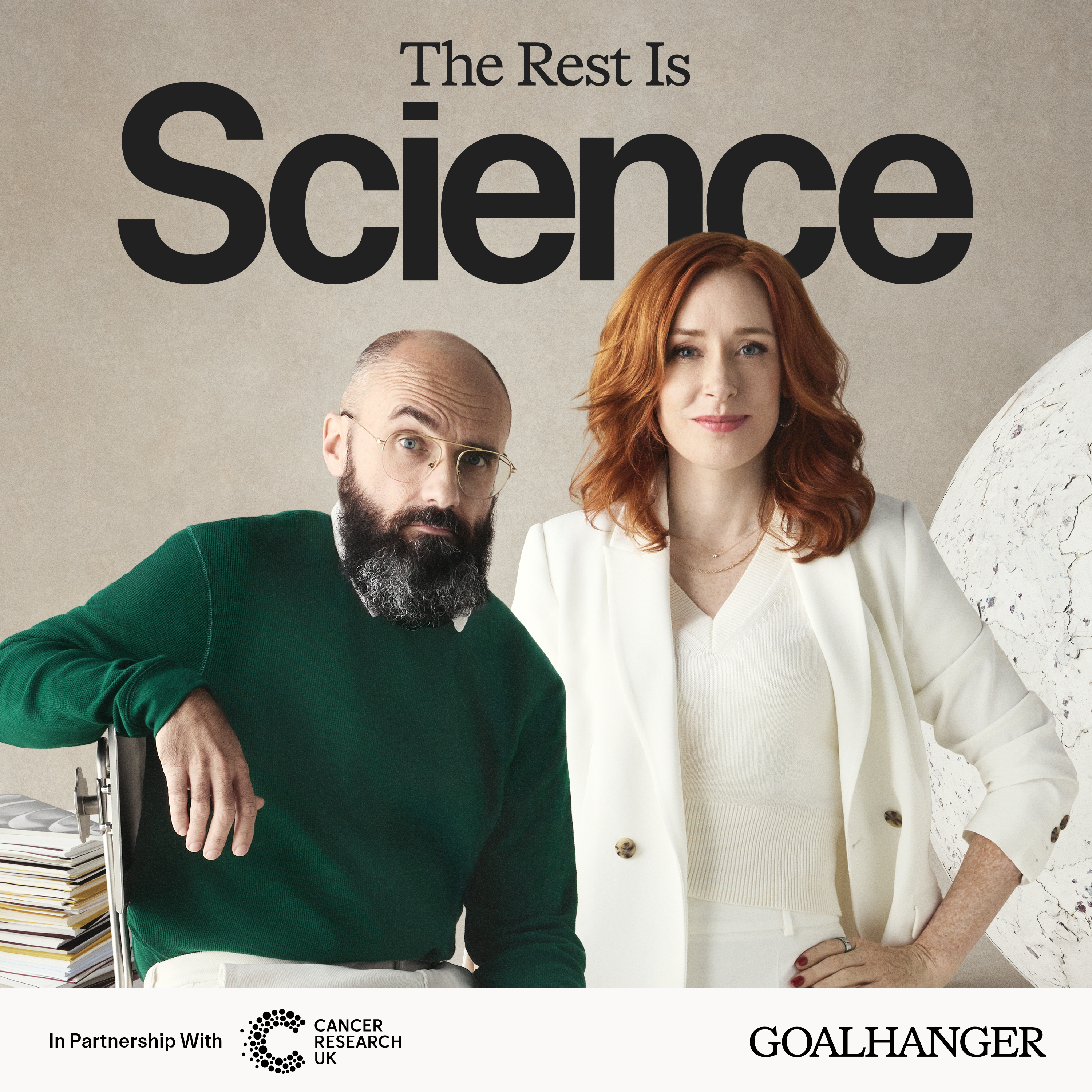
In this Halloween special of The Rest Is Science, Professor Hannah Fry and Michael Stevens (Vsauce) listen to some of the world's most mysterious and unsettling recordings, attempting to identify their origins and uncover the surprising science behind them.
They travel back to 1860 to hear a voice that was never intended to be heard again, investigate a bizarre underwater noise that baffled scientists for a decade, and encounter a sound so strange that Hannah suspects it might have come from outer space.
Turn up the volume, put on your headphones, and see how many you can identify…before Hannah does.
-------------------
For more information about Cancer Research UK, their research, breakthroughs and how you can support them, visit https://cancerresearchuk.org/restisscience
Cancer Research UK is a registered charity in England and Wales (1089464), Scotland (SC041666), the Isle of Man (1103) and Jersey (247). A company limited by guarantee. Registered company in England and Wales (4325234) and the Isle of Man (5713F). Registered address: 2 Redman Place, London, E20 1JQ.
-------------------
Find The Rest Is Science all over the internet by clicking here.
-------------------
Video Producer: Adam Thornton + Oli Oakley + Jack Meek
Animator: Sam Benson
Video & Social: Bex Tyrrell
Assistant Producer: Lucy Lipscombe
Producer: Simona Rata
Senior Producer: Lauren Armstrong-Carter
Chief Digital Officer: Samuel Oakley
Exec Producer: Neil Fearn
Learn more about your ad choices. Visit podcastchoices.com/adchoices
More from The Rest Is Science
All episodesWe use cookies.They keep VO running smoothly and help us improve it. Privacy policy