

- Podcasts
- Mathematics
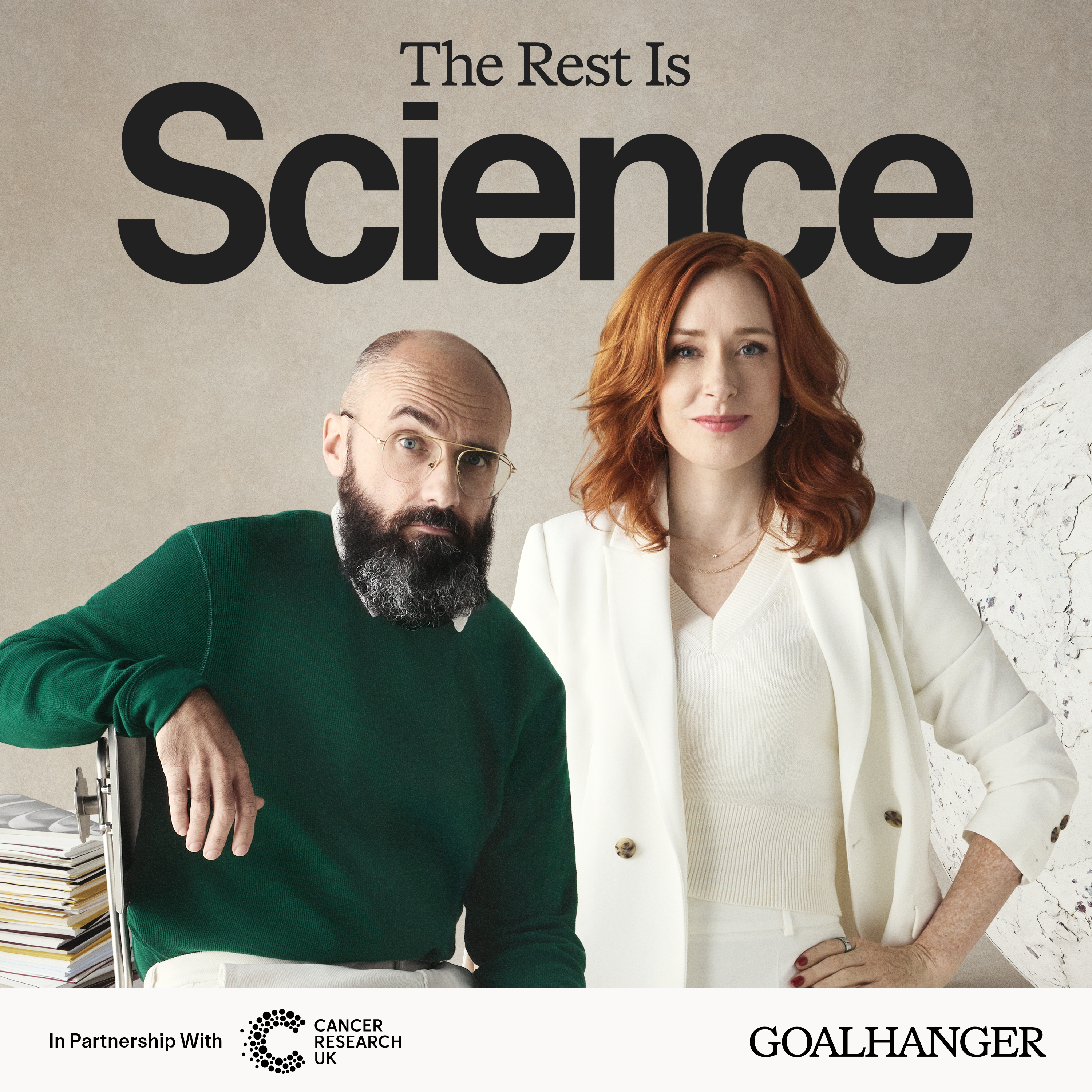
- The Rest Is Science
107 episodes
The Rest Is Science, page 2
by Goalhanger · English
Join Maths Professor, and Celebrity Traitors star Hannah Fry and science creator Michael Stevens (Vsauce) as they dig into the weird scientific questions that often go unexplored. Welcome to The Rest Is Science, a show that sits in the fascinating space between what we think we know, and what we actually know. Why do we assume we understand things like time, randomness, or even gravity? Once you start questioning these familiar ideas, reality becomes astonishingly strange and completely fragile. Whether you're a lifelong science fan or just naturally curious, The Rest Is Science will change your perception of reality, and prove that the biggest questions are always the most fun.
 Ask in Claude
 Ask in ChatGPT
All episodes, page 2
How Does Language Change What You Smell?
Whether language changes perception—using a Persian “leftover smell” example to discuss the Sapir–Whorf hypothesis (words shaping what we notice and categorize), with supporting cases from color…
26 Aug 2026 · 46m · 15 chaptersSpace Elevators, Skyhooks, and Space Fountains
Ways to reach “space” (defined around the Kármán line ~100 km) and how different methods compare as fastest, cheapest, and worst; includes far-future “just wait” scenarios and non-rocket concepts…
23 Aug 2026 · 1h 6m · 21 chaptersBizarre Watches and How They Work
Michael Stevens shows a collection of novelty “bizarre” watches tied to timekeeping history and math, then the hosts answer listener questions about Bayesian reasoning, syllogisms/wordplay, and math…
19 Aug 2026 · 54m · 17 chaptersWhy Your Brain Thinks You're Full (Even When You're Not)
How the body keeps blood sugar in a narrow safe range (~4 grams of glucose in the bloodstream at any moment) using insulin and glucagon, and how GLP-1-based drugs (e.g., semaglutide/Wegovy/Ozempic)…
16 Aug 2026 · 47m · 14 chaptersThe Lake At The North Pole That Stops Europe From Freezing
Hannah reports from the Arctic on unusual “fresh” water sources tied to sea-ice chemistry and a massive North Pole freshwater system (“Beaufort Gyre”) that helps insulate the ice sheet but may affect…
12 Aug 2026 · 47m · 13 chaptersThe Science of Putting Sunglasses on The Sun
A playful “how could we make the sun look like it’s wearing sunglasses?” episode that turns into real astronomy/optics.
9 Aug 2026 · 1h · 23 chaptersWhy Is It A Colour Wheel & Not A Line?
Why color is taught as a wheel (artists) instead of a line (physics), using Crayola crayons to demonstrate spectral vs psychological colors, camera/screen limits, fluorescence, and infrared.
5 Aug 2026 · 47m · 17 chaptersWhy Lithium Batteries SUCK
The hosts argue lithium-ion batteries are “pathetic” due to low energy density and major safety problems (flammability, thermal runaway, hard-to-extinguish fires).
2 Aug 2026 · 54m · 15 chaptersWhat Happens Inside Earth's Forbidden Zones?
“Forbidden zones” where humans can’t safely enter, and what happens when people leave nature alone—especially the Korean DMZ, plus nuclear/chemical exclusion areas worldwide.
29 Jul 2026 · 46m · 15 chaptersIt Wasn't A Hoax After All
The “2012 apocalypse” myth is traced to Mayan calendar math and later reinterpretations, then contrasted with how 2012 became a real-world tipping point for smartphones, social media, digital news,…
26 Jul 2026 · 1h · 17 chaptersHack Dog Vision To Keep Your Bones Safe
Color vision across animals, using dog dichromacy to “protect bones” with a shirt/sticker set; then Q&A covers DNA/RNA data storage, free will/determinism, and whether animals could biologically…
22 Jul 2026 · 46m · 16 chaptersThe Hole In Your Brain That Makes You Doomscroll
Curiosity as a brain “information gap” that drives learning and can be exploited by clickbait and doomscrolling; history of curiosity as a vice/virtue; how curiosity affects memory, attention, and…
19 Jul 2026 · 49m · 14 chaptersA Man-Eating Tiger Found In London
A “Field Notes” story about a taxidermied tiger head found in an ex-mother-in-law’s loft, used to explain how “man-eating” tigers are identified and dealt with, plus listener Q&A on pleasure, ratios,…
15 Jul 2026 · 41m · 11 chaptersAll The People You Don't Know
How different kinds of “not-quite-relationships” shape health and behavior, focusing on (1) familiar strangers and sociometric stars, (2) consequential strangers and “fringeship,” (3) intimate…
12 Jul 2026 · 56m · 24 chaptersAn Honest Dad Ranking (Out Of All 2 Billion)
A “dad ranking” mug story (math from a 6-year-old’s line-drawing), plus science Q&A: using fans to power sails, future “Manhattan Hinge” eclipse totality, and why people fear running up dark stairs.
8 Jul 2026 · 42m · 15 chaptersYour Brain Invents Pain. Here's Why.
Pain is constructed by the brain, not a direct readout of tissue damage; it can be altered by context, stress, and perception.
5 Jul 2026 · 51m · 23 chaptersThe Most Dangerous Rock In Hannah's Collection
A mailbag episode covering (1) whether humans could detect gravitational waves from black hole collisions, (2) why “space junk” is hard to see in photos from the ISS, and (3) whether walking up an…
1 Jul 2026 · 56m · 13 chaptersThe Audio Illusion That Proves We Don't Experience Reality
The episode explores how perception turns physical signals into experiences—arguing that “reality” is constructed by the brain.
28 Jun 2026 · 58m · 22 chaptersWill A 25 Year Old Space Pen Still Write?
This episode of The Rest is Science (Field Notes) centers on whether a Fisher “space pen” can still write after decades, and what that reveals about writing in microgravity.
24 Jun 2026 · 48m · 15 chaptersA Paleontology Of The Future
“Space archaeology” and the legal/ethical limits of preserving human-made sites off Earth, using Apollo 11’s Tranquility Base as the centerpiece.
21 Jun 2026 · 55m · 17 chaptersWhat Are The Odds You'll Become A Fossil?
The hosts examine a suspected fossil “reindeer” bone found in the Dordogne, France, and explain how fossils form (rarely: ~1 in a billion bones), including rapid burial, decay, mineral-rich…
17 Jun 2026 · 39m · 8 chaptersWhy Feet Are Weirder Than You Think
Why human feet are “weird,” focusing on evolutionary differences (between hooves/paws/monkey-like grasping feet), shoe-wearing, and the biomechanics of foot arches and stiffness; plus a detour into…
14 Jun 2026 · 46m · 12 chaptersHow Many Words Do You ACTUALLY Know?
The episode (Field Notes) is about estimating how many English words you know using a website called Vocab Owl (inspired by a prior discussion on vocabulary size).
10 Jun 2026 · 52m · 12 chaptersWhy You Should Stop Using Face ID
Whether police can compel or use information from your mind/phone, and how that changes with biometrics and brain-scanning tech; includes Fifth Amendment “no self-incrimination,” biometrics vs…
7 Jun 2026 · 44m · 15 chapters