Ask ChatGPT

 The Travel Diaries
8 Jul 2025 · 50m · 19 chapters
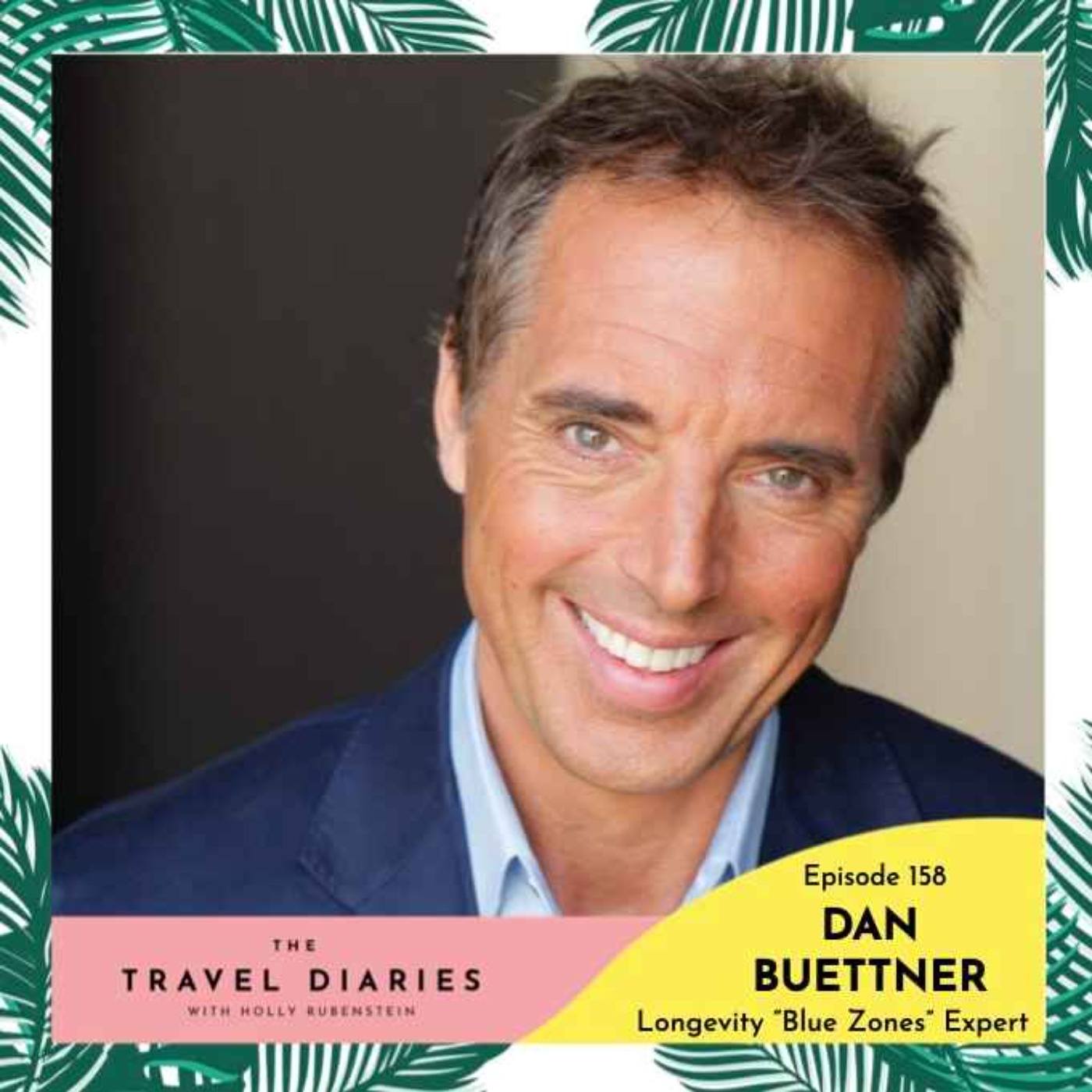
Dan Buettner discusses his “Blue Zones” research on why people live longest and healthiest lives, tying longevity to everyday environments and habits (whole-food/mostly plant-based diets, daily movement, strong social ties, purpose, walkable communities, and extended family caregiving). He also shares travel-diary chapters from childhood nature trips to endurance cycling across continents, plus a 10-day Vipassana meditation in Oaxaca and practical takeaways like improving your social circle.
Dan Buettner is a National Geographic explorer, New York Times bestselling author, Emmy-winning Netflix host, and record-breaking endurance cyclist. He holds three Guinness World Records for cycling across 70+ countries.
“No pill” stops or reverses aging in humans; Blue Zones add years by preventing avoidable diseases. Blue Zones children are “contributors,” not the center of attention. Longevity is engineered by environment, not hacks.
Cycling routes (Arctic-to-Argentina; Minneapolis-to-St. Paul via the Soviet Union; Trans-Saharan Africa). Blue Zone regions: Okinawa (Japan), Sardinia (Italy), Ikaria (Greece), Nicoya (Costa Rica), and Loma Linda, California (Seventh-day Adventists). Vipassana: silent meditation (4:30am–9pm for 10 days). Favorite destinations: Lake Atitlán (Guatemala), hidden gem Chetumal (southern Mexico), bucket list Angkor Wat (Cambodia).
Written by AI. May contain mistakes.
Dan shares his background as an explorer and author, discussing the Blue Zones.
“In a world where AI is changing every role in every industry, knowing who actually has deep expertise matters more than ever.”
Dan shares his background as an explorer and author, discussing the Blue Zones.
“Hello and welcome to the Travel Diaries podcast.”
Dan reflects on his childhood travel experiences and their impact on his life.
“It is so great to see you coming to me from Minnesota, to USA.”
Discussing how children are contributors in Blue Zones, contrasting with Western norms.
“I mean, zooming ahead, we're going to obviously come on to chat a lot about blue zones and longevity.”
Dan talks about his cycling achievements and the motivations behind them.
“That also brings a certain sense of all the happiness research.”
Exploring Dan's experiences cycling through remote and harsh environments.
“And what was the motivation for taking on such kind of epic challenges?”
Learn about the challenges and experiences of cycling in extreme environments like Alaska and the Sahara.
“And I mean, you have cycled through some of the harshest environments.”
Explore how the harshness of the Sahara led to profound personal reflections and mindfulness.
“To have seen so much of the world as well, it's incredible.”
Discover the extreme difficulties faced while biking through the Congo and Siberia, including physical and mental challenges.
“And we thought we were going to perish of hypothermia many times.”
Discover the extreme difficulties faced while biking through the Congo and Siberia, including physical and mental challenges.
“Ernesta creates designer-quality rugs, custom-fit to the exact size of your space, so every room feels beautifully pulled together.”
Understand the concept of Blue Zones and their significance in longevity research.
“but we must move on to chapter two of your travel diaries, Dan.”
Learn about the lifestyle factors contributing to longevity in Blue Zones.
“They're kind of a geographic sweet spot where they can be outside most of the time, getting their sunshine, their vitamin D gardens two or three times a year.”
Discuss misconceptions around longevity hacks and the power of environment.
“Then you have Brian Johnson on Netflix, the man who wants to live forever, touting himself as the world's healthiest man.”
Consider the importance of public health measures and dietary choices.
“I was at his 60th birthday party before COVID and he got into politics and that.”
Discover how cooking and dietary patterns from Blue Zones can enhance longevity.
“So was that one of the main motivations behind your forthcoming new book, Blue Zone Kitchen, One Pot Meals, 100 Fast Plant-Based Recipes to Help Us Eat Like the World's Healthiest People?”
Gain insights into the self-awareness benefits of Vipassana meditation.
“to bring a hundred recipes together that will give you an extra decade.”
Learn about the transformative effects of Vipassana meditation and its insights on desire and aversion.
“And the best expedition I think anybody can take is Vipassana meditation.”
Discover how your social circle impacts your health and longevity, emphasizing the importance of friendships.
“knowing who actually has deep expertise matters more than ever.”
Explore Dan Buettner's favorite travel destinations and hidden gems, including future blue zones.
“Recently, there's some very nice little resorts that have popped up, some of which attract the hardcore, you know, the real travelers who are been gone for three months.”

Get the gist, explore an idea or ask about something said.
 Claude
On The Travel Diaries, what are the key points of this episode?
Searching your listeningAutomatic transcript. May contain errors.
0:00In a world where AI is changing every role in every industry, knowing who actually has deep expertise matters more than ever. Upwork connects you with the highly skilled freelance professionals with proven track records, so you can hire with confidence. Upwork gives your business fast access to highly skilled specialists with deep expertise, so you can fill critical skill gaps, launch projects faster, and scale support up or down without committing to full-time headcount. With Business Plus, you can access the top 1 % of talent on Upwork. AI-powered shortlisting delivers a curated shortlist of top freelancers matched to your goals in under six hours.
0:36No endless searching required. Thousands of growing businesses already trust Upwork to hire highly skilled freelance professionals for everything from one-off projects to ongoing support. It's free to sign up, and posting a job is easy. Visit Upwork.com right now and post your job for free. That is Upwork.com to connect with top talent ready to help your business grow. That's U-P-W-O-R-K dot com. Upwork dot com. Why can't we get AI to production? Our competitors are all ready. How do we keep data secure? When do we actually see ROI? All this talk about AI. But talk doesn't transform businesses.
1:12AWS AI cuts through the noise. Making AI easier to securely deploy and scale. With ready-to-use agents and the broadest set of AI tools and services, you can build, buy, or partner your way. Stop overthinking. Start building. AWS AI is how.
1:38Hello and welcome to the Travel Diaries podcast. I'm your host, Holly Rubenstein, and here each week I'll be speaking to a very special guest about the seven chapters in their life's travel diaries. From their all-time favourite destination and their hidden gem to their worst travel experience and what's at the top of their travel bucket list, we'll be uncovering their adventures around the world and the travel experiences and destinations that have shaped their lives. My guest today is a National Geographic explorer, New York Times bestselling author, Emmy-winning Netflix host, and a record-breaking endurance cyclist, Dan Buettner.
2:22In fact, he holds three Guinness World Records for distance cycling, having peddled across the globe to over 70 countries. Travel isn't just a passion of his, it's the lens through which he's viewed, explored and helped reimagine how we live our lives. It was during these epic adventures that Dan's curiosity about longevity began to take shape. And that curiosity eventually led to one of the most fascinating and impactful projects of our time, the Blue Zones. Working alongside National Geographic and a team of medical researchers and demographers, Dan set out to discover the secrets of the world's longest-lived people.
2:58What he found were five extraordinary regions in Japan, Costa Rica, Italy, Greece, and a religious community in California, where people weren't just living longer, they were thriving into their 90s and 100s. What's so remarkable, I think, is that these individuals weren't pursuing health, They were simply living in environments that naturally supported their well-being. Think plant-based diets, daily movement, strong social ties and a deep sense of purpose. His findings became international bestsellers and his Netflix documentary Live to 100 introduced Blue Zones to a worldwide audience. And he's back this summer with a new cookbook, Blue Zones Kitchen One Pot Meals, to help us all cook like the world's healthiest people too.
3:42His travel diaries today take us from the jungles of the Congo and the plains of the Sahara to the lakes of Guatemala and the islands of Japan. There was actually so much to cover and I was so fascinated by all of Dan's insights that we actually lost track of time and we didn't complete all of his travel chapters. So one day maybe we'll have to do a part two where we go a little deeper into his hidden gem and find out his worst travel experience. But nevertheless, I can't wait to dive into his story with you today. I've wanted to interview Dan on the podcast since I saw his Netflix documentary series and it was great to finally make that happen.
4:21I hope you enjoy it. Here is Dan.
4:37Dan, welcome to The Travel Diaries. It is so great to see you coming to me from Minnesota, to USA. It's been an episode that I've been excited to record for a really long time. Thank you for joining me on the podcast today. You know, you're very special because this is the first time ever that I broadcast it live from my childhood bedroom. So you're very special. Yeah, we kick off the travel diaries with your childhood. We go right back to the very beginning. So this is very apt. It's going to help to conjure those memories, maybe transport you to chapter one, which is your earliest childhood travel memory.
5:19We may as well kick off because there is so much that I want to ask you, Dan. Can you take us back to your kind of first ever memory of travel as a child? Where were you? What do you remember most? My dad, who was a great outdoorsman, he worked for the Forest Service. I was five years old and he and another friend and his five-year-old son, we paddled into the vast million acre boundary water canoe area between Canada and the United States, through rivers, over portages, across lakes, and inhabited a tiny island. and I was five and, you know, we had to catch our own food and cook it over a campfire and it rained most of the time.
6:02And, you know, that got me appreciating nature, but also revering it. That sounds very wholesome. Yeah, I mean, there was, you know, I think a child who grows up in nature as opposed to growing up in Disney World, you know, arrives at adulthood in a different place. And do you think that that gave you that enduring taste of adventure that then led you on to begin your cycling expeditions and everything then that followed? Yeah, we went into the woods every year and were pretty self-sufficient. And it certainly gives you a resiliency and a capacity to endure hardship and sort of take care of yourself in difficult situations, which was very useful on the bike rides.
6:48I also sold newspaper subscriptions beginning at age 14 and won about 10 trips to Spain and Africa. And, you know, we come from a lower middle class family. And nobody in my family had been on an airplane until I won a trip selling subscriptions. So that sort of took it to the next level. And, you know, for those of you who have children, there's no greater gift. I think, number one, get them out of your immediate surroundings or out of your country and take them to another country so you can look back in. But also let them go alone. They'll be okay. I was doing it at 14, and I worry we overcoddle children and don't let them explore on their own.
7:36And it's just so valuable that my parents let me take off at 14, and I came back. And in fact, 64 years later, I'm back in the bedroom, alive. Yeah, it's interesting. I mean, zooming ahead, we're going to obviously come on to chat a lot about blue zones and longevity. But in your research in that capacity, then, what did you find about childhood? Because, of course, the focus has been on longevity and centenarians and so on. Were there any trends in terms of how the younger generation were treated? In blue zones? Yes. They are not the center of attention. Interesting. Like at least in America here where the family revolves around the child here.
8:27You know, I was just in a home yesterday where there were music lessons and dance lessons and play dates. And every kid was out for three sports. And there's a calendar that's just jam packed. And the parents are spread thinner than mayonnaise on a 10-cent sandwich, running their kids around. And in Blue Zones, children were contributors, not receivers. They were contributors to the family. So at age five, they were helping in the kitchen or helping in the garden or looking after grandma or cooking with grandma. uh so you know they they i mean it's not that they they were loved just as much if not more but the script was flipped instead of the child being the recipient of all care love and resources the children were a source of care love and resources so it's more of an active role in the general household yeah and i would say you know the big idea i think is instead of sucking all the attention from the family.
9:37They were there to contribute. Yeah. And that brings pride. That brings self-sufficiency. That also brings a certain sense of all the happiness research. And I've written two books on happiness. We'll point to gratitude and people who contribute, altruism, as dependable sources of happiness. You don't get that when you're constant from age to one, you're told that, you know, every one of your needs will be cared for before you even think of it. And it's flipping it around and saying to little children, I need you. You need to help the family. And of course they do it not because they're necessarily smarter than we are.
10:22It's just because, you know, blue zones are typically pretty poor places and therein lies their advantage. That's fantastic. My listeners are very big on slow travel and I was fascinated to read that before you became the longevity guy and you were the face of Blue Zones which is how I got to know you, you hold all these incredible world records for cycling, cycling across continents for National Geographic And before we get on to the next chapter of your life, I would just love to chat to you a little bit about that, because what you have done is so incredible, such a feat of endurance. What drew you to the road in the first place?
11:08And what was the motivation for taking on such kind of epic challenges? Well, I was obsessed with the bicycle as a kid. so ages 12 and 13 I was biking 100 kilometers to see my grandma on her farm and my circle of friends all had fancy bikes you know we'd work all summer long and make$500 and buy the best bike you could buy but I had this after college I met George Plimpton who was a writer editor of the Paris Review. And he got me thinking big. And I decided to marry my passion for cycling with trying to do something that was big and cool just because it seemed fun. So I wrote Guinness and I asked him if a bike ride from Minnesota, where I lived, to Argentina would be considered a world record.
12:04And they wrote back and they said, well, we like your idea, but for a world record, you You have to start in the Arctic Ocean in northern tip of Alaska and go to the southern tip of South America. And it took a year and a half of planning. It took a miracle to get on the first 800 kilometers, which is from the Arctic Ocean to Fairbanks, Alaska, because that's off limits. And we we we got the permission and off limits in what respect was was that? Well, it's owned by the oil company. There was the pipelines there, and they're very careful. They don't let people on that road because it's 500 kilometers long, 500 miles, one of the two.
12:50But there's no gas stations. There's no petrol stations. So people drive their car up there, and they run out of gas, and they die. Or the other problem is the pipeline is a major source of oil for the lower 48 states, and it's a terrorist target. So they want to keep, they guard it. So they don't let people up there. The only way we got up there, a little quirk in the law, if you have a gold mine, they have to let you to your mine. And we realized this, and we just found a little plot of land near the Arctic Ocean. and we registered it as a gold mine and we paid a$25 fee. And once we had the permit for the gold mine, then we went and registered with the Bureau of Land Management and got all the paperwork.
13:42And all of a sudden, four bicyclists show up at the checkpoint and they say, you can't go in here. And we said, yes, we can. Here's our gold mine claim. And they let us on. They had to. Oh, my God. That's genius. That is one way of working around a problem. That is absolutely amazing. You give me a problem. I'm like a, you know, a carrier on your pant leg and you're not going to get me off. And I mean, you have cycled through some of the harshest environments. I mean, the Sahara, Siberia. But actually, you know, just starting there with Alaska, I mean, what was it like cycling through such a remote state and getting an insight more so than so many other people would get?
14:27because you are cycling, you're traveling slowly-ish through somewhere like Alaska. Yeah, so the Brooks Range kind of marks the Arctic Circle. And beyond the Brooks Range north, it's tundra. And there's several challenges. First of all, the weather is ferocious there. Secondly, you don't see anything. It's like a desert, but a cold desert. So if you run out of something, you're chumped. The third problem is there are grizzly bears and there's no hiding from them. And it's a real challenge, especially when you're carrying food. You know, you can't put your food up on a tree like you normally do for bear.
15:15So, I mean, I guess it took us five or six days to cycle that first tranche. Yeah, it was scary. We hung our food on the Alaska pipeline, which actually is about 10 feet high. So we got our food up there every night. And then another trick people don't realize, urine repels them. So there are four of us. We took turns peeing around the perimeter of our camp, which provides some protection, maybe not from a bear that's too hungry. We've been trying that with foxes in our garden here in England, actually. Send me the video. We do it at night when no one's looking. So out of all of these cycling expeditions, can you just take us through, firstly, what the routes were that you did?
16:11Because they were extraordinary. Yeah. Alaska and Argentina was along the West Coast through the Darien Gap of Central America, and then the West Coast also of South America through the Atacama Desert, over the Andes, through the Atacama Desert, driest desert on Earth. Left at the southern tip of Chile to Comodoro Rivadavia, and then down to Tierra del Fuego, Ushuaia to be precise. and that was about 25 ,000 kilometers. The second ride was the Soviet Union was just opening up and I managed to convince two Soviet explorers that were well wired in the government. We got one of the first, if not the first, carte blanche visa to go through the Soviet Union.
16:59This was 1990. You could barely get into Moscow and we got a visa to go from Odessa all the way to Vladivostok. So our ride technically was from Minneapolis, Minnesota to St. Paul, Minnesota. They call it the Twin Cities, except we went the long way, about 20 ,000 kilometers through the United States, Western Eastern Europe, the whole Soviet Union, and then around the other side. And then the third trip was across Africa. And the challenge of biking across Africa, The first challenge is getting across the Sahara, which not only provides logistical challenges and you've got to have water and you can't get lost, but the year we were there in the Western Sahara, there was a big revolution going on.
17:47Then in the Eastern Sahara, there was another political upheaval happening in Chad and Southern Egypt. We went right down the middle. We went down the Trans-Saharan Highway through Algeria, which a big Al-Qaeda country at the time. It wasn't safe either, but it was the least dangerous. You run out of road about 1 ,300 or 1 ,400 kilometers in, and you got to go just go across the sand. And we made it to Timbuktu, took a lap through Nigeria, crossed the entire continent along the equator. I guess it kind of goes like this. through the Congo and then Uganda. And then we went down to the southern tip to Cape Agolis, which is the southern tip.
18:36So we started in Bezerty, Tunisia, northernmost extreme of Africa. We ended in Cape Agolis near Cape Town, the southern tip. And notably, these rides were unsupported before cell phones. Well, the very last trip to Africa, we had a rudimentary GPS. But, you know, in the Sahara, you know, just because you know you're lost or you know where you are doesn't mean you're out of danger. And remarkably, you know, I guess it's probably 45 ,000 miles later, I'm still alive and still biking. Yeah. I mean, wow. To have seen so much of the world as well, it's incredible. It's a gift. It's a gift. When you reflect on those trips, is there one route or a stretch of road that just lives in your memory as the most impactful, whether it was breathtaking or dramatic?
19:38Is there one that you think about the most? Well, the Sahara for all its austerity and difficulty became the most beautiful in my mind. Why? Because every place else, you go through the Amazon or you go through the Maya area or the jungles, you're just overwhelmed with stimuli. And in the Sahara, it's like learning how to meditate or something. As the days and weeks go by, as you get deeper in the Sahara. and you know you may you maybe go all day and maybe see a tree or you know a beautiful rock formation or something like that but your brain gets so attenuated to or your senses to of appreciating small things I remember stopping one day and it's probably four or five in the afternoon and I was drinking water sitting on the side of the road in the Sahara and seeing a dung beetle roll a ball of who knows what kind of poop.
20:46But I was completely transfixed. Or another day, you'd stop and you'd see a solitary tree in the distance and then this horizon. And you kind of move your eye around and you could compose this perfect picture. And it's a small detail that that you'd develop a profound appreciation for the simplicity of the aesthetic as opposed to the overwhelming. It's like mindfulness kind of being played out on a bike. Rolling mindfulness, yes. Yeah. And then conversely, one of the hardest, in far eastern Siberia, near a place called Chita, Yeah, we hit a, there wasn't a road and for about 800 miles, almost a month, we walked through a bog and we were up to our hips often and wallowing in mud all day long, poured rain for days on end.
21:47And we thought we were going to perish of hypothermia many times. Again, you know, there's no, when it's pouring rain and you're just on a bike, after a few days of it, even your tent and sleeping bag, there's just no refuge from the wet and the cold. And we were living off of pig fat and buckwheat, which is the only food we could find. Struggled to make a fire because everything's wet. That was really, believe it or not, that was the hardest. Well, it sounds like the environment. Yeah. And crossing the Congo was hard too because, you know, there's no roads. So, you know, we have 45 kilo bicycles and no roads.
22:29So we're on game paths or dragging them through rivers or through the bush. And when that goes on, you know, you can do it for a day or two, but when you do it for a month, we're getting malaria and giardia. We had intestinal worms, dysentery. and were you then taking breaks to recover or did you just have to keep going we were hell-bent across these areas because it was so miserable and we had in our heads um you know in siberia was blagovations which you know we knew we'd find food and and uh in africa it was um kampala and uh we would push our bodies to and you know your bodies oddly enough in both of those places they would put out, they would get us through.
23:18And I think we all possess this reserve that we rarely call upon it. But in every case, when we hit our destination, everyone on our team got sick when we got to our destination and slept for about a week. And in my mind, that was the reserve saying, all right, you have a break now. We're going to replenish the reserve before you're going anywhere. And we just basically eat and sleep for a week and then fix our bikes and keep going. So interesting. A rug shouldn't just fit your room. It should make your home feel finished. Ernesta creates designer-quality rugs, custom-fit to the exact size of your space, so every room feels beautifully pulled together.
24:12Explore Ernesta's range of options, all ready to be custom-cut, finished, and delivered to your door in as little as two weeks. Start with five samples for just$10 and get$50 toward your rug when you order. Visit Ernesta.com today. That's E-R-N-E-S-T-A dot com. Polon cancer is on the rise. It's the second deadliest cancer and the number one cancer killer of people under 50 in the U.S. Yet it remains one of the most preventable cancers. If you're 45 or older and at average risk, it's time to talk about screening. Cologuard Plus is a non-invasive at-home collection kit that requires no prep, can be completed in about 15 minutes, and is 95 % effective.
24:53If you've been putting it off, you're not alone. But timely screening matters. Let's talk about what isn't talked about. Talk to your provider or request ColoGuard Plus online, Rx only. I mean, I could ask you, I could do a whole podcast just about those trips, of course, but we must move on to chapter two of your travel diaries, Dan. And that is the first place that you fell in love with. Where comes to mind for that? Well, I had a company that solved mysteries and I had a full-time staff, a scientist, and subscribers that voted digitally to decide where my scientists went and how they gathered clues to solve mysteries.
25:39And we did about 15 of them before we stumbled upon Okinawa, Japan in 1999, which at the time, according to the World Health Organization, produced the longest-lived population in the world and also longest-lived population without disease. And I thought, you know, that's a very good mystery. And we did one of our many expeditions there, and it was not only enormously popular, but it was also personally fascinating to me. And that's really what led a few years later to this whole Blue Zones expedition or phenomena, I guess it is today. What is a Blue Zone, and where can they be found? A blue zone is a geographically defined, demographically confirmed area with the highest concentration of people over 90 who have lived over the past 150 years.
26:37I know that's a mouthful, but you can't just take a point in time. You have to have a geographic definition, and especially you have to do the age verification, which we at National Geographic did very carefully. And then we found the longest-lived women in Okinawa, Japan, the longest-lived men in the highlands of Sardinia, a very specific area. We found an island in Greece, Ikaria, where people enjoy about eight extra years of life expectancy over people in the UK. And those years are without dementia. and then in Nicoya, Costa Rica, a place with the lowest rate of middle-aged mortality. In other words, people our age have the best chance of reaching a healthy age, 95 or so in the world, much better chance that we do in our respective countries.
27:35And then in the United States, I'm on the Seventh-day Adventists, which are conservative Christians living in and around Loma Linda, California. So we were interested in the common denominators. And that's what most of the project focuses on. And the same patterns and trends kept surfacing within these communities, despite them being completely spread out around the world. That's right. Yeah. So, you know, they were poor. They were at about the 20th parallel. So they're not in the tropics. So they're not getting blasted by heat. They're not in cold climates. They're kind of a geographic sweet spot where they can be outside most of the time, getting their sunshine, their vitamin D gardens two or three times a year.
28:24They're getting most of their foods from their gardens. They were eating peasant food, no superfoods, no supplements. You know, they didn't run down to Central America for stem cells. They were eating beans and grains and old ladies were out finding 70 or 80 varieties of wild greens and steaming them or baking them in pies. They're drinking herbal teas from endemic plants that grow in and around their houses. They had a sense of purpose, vocabulary for purpose. They lived in walkable communities, which we think is much more important than we realize. lives. They lived in extended families. So in America, if you put your aging parent in a home, that means their life expectancy drops by about six years.
29:20So in blue zones, they kept them at home where they not only were cared for, but more importantly, like our point with children, there was an expectation of them. They didn't lie around all day and watch TV. They got up and they managed the garden. Grandma was in charge of the food tradition. Mom might have had to gone off to work or was busy with little children. Grandma picked up the slack and helped with childcare, which in turn helped with the survivability of the infants and the children in that home. This beautiful virtuous circle. There's all these subtle forces that put upward pressure on the life expectancy that we never hear about in our pursuit of anti-aging or longevity.
30:09Why? Because people can't make any money at it, but they're far more powerful than any pill or supplement or genetic intervention that's even on the scientific horizon. And those are the lessons of Blue Zones. I was kind of thinking about it in preparation for today about the aim like long life versus quality of life and then kind of extended beyond that kind of biohacking versus longevity because I feel as though like I was just scrolling through the top podcasts here in the UK you know you've got the Huberman Labs you've got Mark Hyman you've got the Zoe podcast you know there's a lot about kind of living well and longevity and so on.
30:57Then you have Brian Johnson on Netflix, the man who wants to live forever, touting himself as the world's healthiest man. Where do you stand on all of that? Because you've said the people in the blue zones, they don't set out to live long lives, do they? It's kind of like an innate affectation of their society. Well, first of all, Tim Spector and the Zoe podcast is the best one. Uh, that's real evidence. And Tim Spector is a, he's a, the most, one of the most cited scientists in the world. He and I are very much aligned. Those other ones, those are marketing organizations. Um, that when you come up, there is no pill, no supplement, no genetic intervention, no longevity hack, no plasma exchange, no stem cells that have ever been shown to stop, slow or reverse aging in humans.
31:51Zero. So every time you try those rapamycin or metformin, all these other longevity, you are undertaking a dangerous experiment with your own life. My neighbor down in Miami died trying to get stem cells. So on the other hand, it's not as sexy. We have real people in the blue zones and it's black and white mathematical. At age 60, They're living 10 years longer. Why are they living longer? Not because they have a better body than you, me, or anybody else listening here. It's because they're avoiding the avoidable diseases that foreshorten our lives. They're not getting cardiovascular disease and type 2 diabetes and dementia and about 40 % of cancers that we suffer.
32:39Why? Because they're socially connected. They're eating mostly a peasant food, whole food, plant-based diet. They are moving every 20 minutes unconsciously. They live in strong families. They live close to the earth. They have a strong spiritual component to their lives. So they're relieving stress by going to church or temple a few times a week and the fasts that go along with this. And they're not doing this because they heard some podcaster and they're on some fad diet. They're doing it because their environment engineers their unconscious decision. That's the big idea. And I'm going to repeat that.
33:23Their environment engineers their unconscious decision. So they're nudged into eating better, moving more, de-stressing, sleeping well. And that adds up to 10 years. And that's the big idea. It made me actually think, if you don't mind me asking, what do you therefore think of RFK Jr. and his approach to healthcare now? You know, I've known RFK for 20 years. I was at his 60th birthday party before COVID and he got into politics and that. And he's a smart guy and he comes from a good family. I think ultimately he's trying to do the right thing. And as an individual, I think some of us, I'm a big believer that we ought to look at public health.
34:15And if qualified public health officials tell us we ought to get vaccinated, we ought to get vaccinated, quite honestly. And vaccinations have eradicated tuberculosis and polio and whooping cough and all these scourges. But enough people have to do it. If a few people say, well, I want my freedom and I'm not going to do it, you don't get the herd immunity. But where RFK is taking on big food companies, that's the right direction. I don't know if he'll be able to muster enough political equity to take on the real problem. The real problem is not Red Dye 25. The real problem is we have too much sugar, too much ultra processed food, too much meat, cheese and eggs in our diet.
35:08And the Blue Zones food pattern will, I think, convince you that that's the case. And until we change our food environment, we're going to continue to see very high chronic, levels of chronic disease. And we're going to see life expectancy decelerating here over the years and decades to come. So was that one of the main motivations behind your forthcoming new book, Blue Zone Kitchen, One Pot Meals, 100 Fast Plant-Based Recipes to Help Us Eat Like the World's Healthiest People? I had a good browse through the PDF proof I was very lucky to see ahead of time and what I found really I suppose exciting about it is that my diet is admittedly definitely meat heavy and I've always found my excuse to be that plant-based meals are kind of boring or tricky to make as tasty I suppose and looking at the recipes I found that I was like screenshotting them and thinking to myself oh I could do that that sounds yum that sounds really delicious.
36:20And I guess it's that in a way that will really help people to be incentivized to cook in a plant-based way. Yeah. So the Blue Zones aren't vegan, by the way. People in Blue Zones love their meat. But in Blue Zones, if you look over time, which we did 155 dietary surveys, you'll see they're eating about 10 kilos of meat per year. Americans, and I'm guessing the UK as well, it's about 100 kilos of meat a year. That's a bathtub full of dead animal. And all the responsible science will show you your chances when you're eating like that, your chance of cardiovascular disease, type 2 diabetes, and cancers of the GI tract about triple.
37:10So we don't tell people they can't enjoy their meat, but we just point out that your chance of dying young and being obese and suffering from diseases is a lot higher. What we found though, if you actually take the time, people in Blue Zones spent 500 or so years of culinary evolution to learn how to take very simple and expensive ingredients like beans and grains and vegetables and make them sing, make them taste fantastic. And when you go out to eat in America, and I'm sure Great Britain is the same, you consume about 300 extra calories without realizing it. Those calories tend to be laden with fat, sugar, ultra processed foods.
38:01Very few people go out to eat and eat the vegetable goulash. They're eating the steak or the kidney pie or the fish and chips or whatever. This book posits that the most powerful thing you and your family can do to add years to your life is cook at home. If you're eating a mostly plant-based diet, not 100%, you know, meat once or maybe twice a week and very little processed food, it's worth about 10 years of extra life expectancy for a 20-year-old. It's worth about six extra years of life expectancy for a 60-year-old. So think about that. Imagine you've just retired, you got some money, you know, you want to see your grandkids, and you want to see your daughter walk down the aisle, whatever it is, those years become very valuable.
38:54If you learn how to cook at home, if you move towards a whole food plant based diet, you're going to get those years or you're more likely to get those years. But more importantly, I think what the Blue Zones kitchen one pot book shows us that you can do it with a single pot. It can take you less than 20 minutes. It costs you less than a couple pounds per serving. And it's maniacally delicious. We're harnessing a half a millennia of culinary genius to put these recipes together. And also AI from Stanford University who helped identify the flavor patterns that Westerners like the most. And this is a very scientific, it's the perfect blend of cutting edge science and ancient wisdom to bring a hundred recipes together that will give you an extra decade.
39:52And I can say that with a straight face. I love that. And I love that, like you said, that you're bringing in your own research and that history and then you're combining it with this ai tool that was what was it amount kind of um amount helping to curate the recipes and the best flavors that people really resonate with so uh stanford uh statistics lab did it so we scraped 650 000 recipes uh we isolated all the recipes that had more than a 100 five-star review so the favorites and then we analyzed them for the flavor profiles and there were seven of them. And then we took those seven flavor profiles and that guided all the recipes.
40:38So we know that people love it. These are the same ingredients that have fueled real people in five parts of the world to 100. We made sure you can do it in one pot. We made sure it was cheap. We made sure it's fast. So I think it's, you know, more so than going and buying some pill or supplement. This will do more to add yours to your life than any of these quote unquote longevity hacks. Absolutely. Absolutely. Well, we move on down to chapter three of your travel diaries, and that is a place where you learned the most about yourself. Where would that be? Sitting in a room for 10 days in Oaxaca, Mexico, I went and did something called a Vipassana meditation.
41:24And it's 4.30 in the morning until 9 at night, silent meditation for 10 days in a row. And you're guided on how to fine tune your self-awareness, internal self-awareness to identify the things that you desire and the things that you run away from and get very clear on what those are and get very clear that you're not going to let those govern your conscious mind and your behaviors. And the best expedition I think anybody can take is Vipassana meditation. and by the way that's not a religion they don't charge you any money they don't try to convert you it's an amazing amazing experience is it guided I mean as in the those kind of things that you're learning about yourself is there somebody guiding you through that or is it simply the act of being still and being silent that allows those thoughts to kind of unravel you're guided on Yes, you are somewhat guided on how to do it.
42:32And one hour a day, you're sort of taught what's going on. But the basic premise is that all pain comes from desire and aversion. You know, we can't be happy with the present because we want some imagined future, or some partner or some job or whatever it is, or sex or drugs or alcohol or whatever it is, or rich food, or we're running away. We hate that person or we want to get away from that job or we want to get out of this neighborhood, whatever it is. And when you sit for 10 days, you realize that that aversion and that desire starts as this tiny little seed in your consciousness. And if you let that seed go, that seed of aversion or desire, it becomes a thought.
43:29Then there's a hormonal reaction. It's cortisol or it's endorphin, depending on whether it's desire. And then you act in the real world. And ultimately, having your desires accomplished, you just want more and getting away from your versions well there's just gonna be another one behind that so what you get good at after a few days of meditation is you see that tiny seed of desire aversion before it becomes before the cascade happens and you just observe it and goes away and and then you get very good at desire pops up goes away aversion pops up it goes away and so once you sort of get rid of that or or quell that desire and aversion all of a sudden you're in a you're in a space of i'm in present and um your concentration goes up and you get very clear on what's important in your life and what's not and i hate to say it that i learned more in those 10 days than i did biking across five continents about myself and also about You know, we don't need 10 commandments or anything else to tell us the difference between right and wrong.
44:43It's inside of us. Just got to learn how to listen. yeah yeah wow what an incredible experience um and I guess you know you came home from that with um something that you can then implement into your ordinary daily life outside of the environment in Mexico and an extension of that going back to the blue zones um I mean you've talked about we've already chatted about the the the key things that make a blue zone a blue zone but when you're asked I imagine you're asked on a daily basis about the lessons that you've learned is there one thing that you'd urge someone to start today that has like it's a small but a small change but a high impact change yes first of all to remember that unless you're going to do unless whatever you do is going to impact your behavior for decades, don't waste your time because it's not going to impact your life expectancy.
45:49Your friends tend to have a very long-term impact. And we know that your friend's behavior measurably impacts your own. In other words, if your three best friends are obese and eat junk food, when you're with them, you're going to eat the way they do. If your friends smoke, you're more likely to smoke. If your friends do drugs or drink too much, you're more likely to do it. If your friends are toxic and lonely, you're more likely. This has been very well captured in a book by a Yale professor named Nicholas Christakis. So by thinking about who in your immediate social circle eats healthy, mostly whole food, plant-based, if any, who in your immediate circle whose idea of recreation is bicycling or walking or gardening, who in your immediate social circle has academic curiosity?
46:44They like going to museums as opposed to sitting around watching football all the time. Not that there's not a place for football. And who in those social circle would actually care about me on a bad day? And the most powerful thing I think you can do for your happiness and your longevity is take stock and proactively reasonably, re-friend or befriend in immediate social circle.
47:35faster than water alone. Whether you're exercising, playing outside, or simply surviving a summer heat wave, it's an easy way to stay hydrated. Shop now at liquidiv.com. Liquid IV, hydration that goes wherever life takes you. In a world where AI is changing every role in every industry, knowing who actually has deep expertise matters more than ever. Upwork connects you with the highly skilled freelance professionals with proven track records, so you can hire with confidence. Upwork gives your business fast access to highly skilled specialists with deep expertise, so you can fill critical skill gaps, launch projects faster, and scale support up or down without committing to full-time headcount.
48:15With Business Plus, you can access the top 1 % of talent on Upwork. AI-powered shortlisting delivers a curated shortlist of top freelancers matched to your goals in under six hours. No endless searching required. Thousands of growing businesses already trust Upwork to hire highly skilled freelance professionals for everything from one-off projects to ongoing support. It's free to sign up and posting a job is easy. Visit Upwork.com right now and post your job for free. That is Upwork.com to connect with top talent ready to help your business grow. That's U-P-W-O-R-K.com. Upwork.com. well let's move on Dan to chapter four and that is your all-time favorite destination the the big question here which place comes to mind Lake Atitlan Guatemala uh it's uh yeah it's hard to get there it's a a lake one of the deepest lakes in the world surrounded by 12 villages named after the 12 apostles, three active volcanoes.
49:20Recently, there's some very nice little resorts that have popped up, some of which attract the hardcore, you know, the real travelers who are been gone for three months. And, you know, they know all the cool places on a backpack. I like traveling on the cheap, though I can afford to stay in a Four Seasons. And there are places like that in Lake Otitlan. And how about Chapter 5, Your Hidden Gem? That's a place you love that's a bit off the beaten track that maybe my listeners wouldn't know so much about. I love a place called Chetumal in southern Mexico. It's at the very southern tip of the Maya Riviera.
50:01Largely overlooked and uncorrupted by the vanguards of junk culture, which are the American tourists. Sorry about that. It's true. Well, Dan, it has been absolutely fascinating chatting to you. We are on to the final chapter of your travel diaries. And that is the destination that is at the top of your travel bucket list. Where would you like to visit which you've not been to before? Angkor Wat in Cambodia, that ancient civilization, the ruins. I've never been there. It's one of the few places I can't wait to go. I'm an archaeology buff, though I love longevity, and I love Southeast Asian food.
50:45So it's the perfect combination. And finally, before we wrap up, are there going to be new blue zones emerging? Is there scope for future blue zones in our future, would you say? I am writing a book right now where I've identified the four parts of the world where people live the longest lives in full health. And they're not blue zones, they're new places. and you can think of them as new blue zones if you want but uh it'll be coming to a book near you within the next year or so it gives us hope that there are people keeping this long longevity and happiness alive that well yeah you know the the new blue zones are manufactured and there are enlightened governments around the world they're not your government or my government but there are enlightened governments around the world that are manufacturing healthy life expectancy.
51:35And this new book, which will be called 12 Good Years, will reveal how they do it. And if anybody has any other questions of me, I'm at Dan Buettner on Instagram. And I'd be happy. I answer all my own. With people direct message me, I answer them at Dan Buettner, B-U-E-T-T-N-E-R. And it's been a delight to talk to you. I love talking travel. Thank you for being there. And and also providing this wonderful service to people who not only want to travel, but who want to do it vicariously. So it's really been a pleasure. Thank you so much, Dan Buettner. Those are your travel diaries. It's been a pleasure.
52:23Well, there we go, Dan Buettner. A really fascinating conversation. I'm really thinking about it. Maybe the real lesson there is that longevity isn't a goal. it's you know it's a side effect of a life well lived and it'd be fascinating to visit some of those particular blue zones wouldn't it because it's not just it's not the entire country it's these specific pockets within them that seem to have that perfect formula and I just hope that there will continue to be places like that around the world can't wait to find out what will be the new blue zones having listened to him chat on a few other things I know that Singapore is definitely going to be one which makes sense and that there's going to be a Scandinavian country in there as well if you want to dive deeper into Dan's work his latest book The Blue Zones Kitchen One Pot Meals is available for pre-order now it's out in September and his Netflix series Live to 100 is streaming globally thanks so much for listening today if you'd like a reminder of any of the destinations that we chat about on any of the episodes just open up the episode show notes on your podcast app and there's a destination recap list in there or you can visit my website the traveldiariespodcast.com if you'd like to find out who is joining me on next week's episode come and follow me on instagram i'm at holly rubenstein and i'm also on tiktok at holly rubenstein too if you can't wait till then remember there's the first 14 seasons to catch up on that's about 155 episodes to keep you busy if you enjoyed today's episode and you fancy leaving a little rating or review on your podcast app, that would be fantastic.
54:01It helps other people to discover the podcast. In the meantime, wishing you guys all safe travels, a wonderful week, and I'll be back on Tuesday.
54:29Hello, I'm Monica Reinagle, host of the Nutrition Diva podcast. Summer is here and with it, the hot and sticky weather. A morning working in the garden or maybe on the golf course can leave you more depleted than you realize. And plain water isn't always the most efficient way to restore the balance. That's where liquid IV comes in. Its science-backed formula is clinically proven to hydrate faster than water alone. Whether you're exercising, playing outside, or simply surviving a summer heat wave, it's an easy way to stay hydrated. Shop now at liquidiv.com. Liquid IV, hydration that goes wherever life takes you.
My guest today is Dan Buettner, a National Geographic Explorer, New York Times bestselling author, Emmy-winning Netflix host, and a record-breaking endurance cyclist. In fact, he holds three Guinness World Records for distance cycling, having pedalled across the globe to over 70 countries. Travel is not just a passion of his - it’s the lens through which he’s viewed, explored, and helped reimagine how we live our lives.
It was during these epic adventures that Dan’s curiosity about longevity began to take shape. And that curiosity eventually led to one of the most fascinating and impactful projects of our time: The Blue Zones. Working alongside National Geographic and a team of medical researchers and demographers, Dan set out to discover the secrets of the world’s longest-lived people. What he found were five extraordinary regions, in Japan, Costa Rica, Italy, Greece and a religious community in California - now famously known as the Blue Zones - where people weren’t just living longer, they were thriving into their 90s and 100s.
What’s so remarkable is that these individuals weren’t pursuing health - they were simply living in environments that naturally supported well-being. Think: plant-based diets, daily movement, strong social ties, and a deep sense of purpose.
His findings became international bestsellers and his Netflix documentary Live to 100 introduced Blue Zones to a worldwide audience. and He’s back this summer with a new cookbook, Blue Zones Kitchen: One Pot Meals, to help us all cook like the world’s healthiest people.
His travel diaries today take us from the jungles of the Congo, and the plains of the Sahara, to the lakes of Guatemala, and the islands of Japan. There was so much to cover, and I was so fascinated by all of Dan’s insights, that we actually lost track of time, and so we’re going to have to do a part 2 one day to find out his worst travel experience and hear a little bit more about his Mexican hidden gem. But nevertheless, I can’t wait to dive into his story with you, let’s buckle up and get started.
Destination Recap:
Dan's new book Blue Zones Kitchen One Pot Meals is out on September 2nd in the US, and September 8th in the UK.
With thanks to Airbnb for their support of today's episode.
Thanks so much for listening today. If you want to be the first to find out who is joining me on next week’s episode come and follow me on Instagram I’m @hollyrubenstein, and you’ll also find me on TikTok - I’d love to hear from you. And if you can't wait until then, remember there’s the first 14 seasons to catch up on, that's over 155 episodes to keep you busy.
Hosted on Acast. See acast.com/privacy for more information.