 Ask ChatGPT


In the final episode of the year, host Holly Rubenstein interviews actor, writer, and podcast host Richard E. Grant, who shares his diverse travel experiences that span across continents and decades. The conversation journeys through seven key chapters of Grant's travel life, exploring his childhood memories, favorite destinations, and future travel aspirations.
Written by AI. May contain mistakes.
Richard discusses his upbringing in Swaziland and the impact it had on his curiosity for travel.
“It's such a pleasure to meet with somebody who is clearly such a passionate traveller.”
Richard recounts his first trip to England at age seven and the memorable experiences he had.
Richard shares his love for London, describing it as the epicenter of the world and its unique humor.
“And what was the first flight like actually kind of getting out and up into the sky?”
Richard describes a thrilling and frightening experience while vacationing in Mozambique at age eight.
Learn about a harrowing childhood experience with a shark in a lagoon.
Discover how early experiences with puppetry led to a passion for acting.
“Did you go down to the coast and spend a lot of time out in the water?”
Explore the challenges faced when pursuing an acting career amidst skepticism.
“So were you kind of teased for it then as an ambition?”
Hear the story of discovering a special place in Provence and its significance.
“Yeah, that must have felt very, very nice.”
Learn about the challenges and realities of living in a foreign village.
Delve into the joys of collecting antiques and the stories behind items.
“I should be divesting, according to the experts, of all my goods and chattels.”
Discuss the impact of grief on travel and the emotional journey it entails.
“because Joan was coaching as a dialect coach on films and plays in London or on location herself, that the habit of being a traveler on my own has been something that I haven't had to readjust to.”
Exploring personal preferences in food and travel experiences.
Insights on self-discovery and humility from a safari experience.
Discussing the allure and personal impact of safari experiences.
“I thought it was, you know, it's very, very good.”
Exploring the charm and allure of Mustique Island as a travel destination.
“But it does seem extraordinary when you're sitting in an open-sided thing.”
Delving into the fascinating stories behind iconic hotels.
“I've rented houses and I've stayed in friends' houses and I've also stayed in the one hotel that's there called the Cotton House, which I think has something like only 16 rooms.”
Highlighting the exceptional experiences at the luxurious hotel Pazolacqua.
“It was like human greed at its most jaw-droppingly vulgar in a way that you think that you can imagine what it's going to be like.”
Discover why Naturhotel Pfosthofgut in the Austrian Alps is ideal for families.
“I've been very thoughtful about choosing the right place for that getaway.”
Explore the unique experience at Imkaya Game Reserve in Swaziland.
“Well, Chapter 5, Richard, is your hidden gem.”
Richard shares emotional memories connected to the Imkaya Game Reserve.
“I haven't been back for, I haven't been back since my wife died.”
Richard recounts a harrowing travel experience in Israel that shaped his view.
“Well, our penultimate chapter is the place that you would never go back to.”
Explore Richard's dream of visiting the newly opened Giza Egyptian Museum.
“You think that you might be on their wall, someone to look out for if you come back?”

Get the gist, explore an idea or ask about something said.
 Claude
On The Travel Diaries, what are the key points of this episode?
Searching your listeningAutomatic transcript. May contain errors.
0:02Today's episode is supported by Citalia, the UK's leading Italian holiday specialist. On today's episode, Richard shares his all-time favourite hotel, which happens to sit on the shores of Lake Como. And honestly, it's impossible not to fall in love with Italy when you hear him talk about it. The scenery, the elegance, that feeling of total timelessness that Italy does so well. Whether it's Lake Como that captures your imagination or another pocket of the country entirely, Italy just has a way of getting under your skin. And that's exactly where Cittaglia comes in. With over 95 years of experience, they truly know Italy inside out.
0:42Their Italy experts craft bespoke itineraries with hand-picked hotels in all of the best locations, and they're brilliant at helping you discover the real Italy, the Italy beyond the guidebook. Plus, with Cattaglia's Travel with Confidence promise, you'll have 24-7 support, free amendments, and a refund guarantee, so you can simply relax and enjoy La Dolce Vita. So if Richard has inspired you to make Lake Como or anywhere in Italy your next escape, visit chatalia.com to start planning today. That's chatalia.com. Thank you to Chatalia.
1:26Hello and welcome back to the Travel Diaries podcast. I'm your host, Holly Rubenstein, and here each week I'll be speaking to a very special guest about the seven chapters in their life's travel diaries. From their all-time favourite destination and their hidden gem to their worst travel experience and what's at the top of their travel bucket list, we'll be uncovering their adventures around the world and the travel experiences and destinations that have shaped their lives. Well it's so lovely to be back with you guys I hope you had a great Christmas If you missed my festive episode with Rick Stein before Christmas Do make sure you go back and have a listen It is a perfect fireside companion And today for our final episode of the year I am joined by someone whose life story reads like an atlas The actor, writer and now podcast host Richard E.
2:22Grant Born in Swaziland, now known as Eswatini in Southern Africa Richard grew up in a world of big landscapes, no TV and endless imagination. From there he moved to London in the early 1980s and very quickly became an unforgettable figure on stage and screen. From his iconic role in With Nell and I, all the way through to Gosford Park, Jackie, Star Wars, Saltburn and his Oscar nominated performance in Can You Ever Forgive Me. Throughout it all, running beneath the red carpets and film sets, there has been travel. He spent 33 summers at a beloved farmhouse in Provence with his late wife Joan. He's had close encounters with sharks while scuba diving off Mozambique, checked into seedy hotel suites in Las Vegas and floated on the still waters of Lake Como.
3:11And now his travel stories are being told in a new way as the co-host of the brilliant new podcast Hotels with History with travel PR Jules Perrone. It's a series that dives into the scandals and intrigue, glamour and ghosts of some of the world's most legendary hotels. So sit back, pour something festive and join me as we step inside the seven travel chapters of Richard E. Grant.
3:45Richard E. Grant, welcome to The Travel Diaries. It is so lovely to meet you. How are you? How's your day going? Thank you very much. All good. Thank you. It's such a pleasure to meet with somebody who is clearly such a passionate traveller. I've been following your travels on Instagram over the last few years. And it seems like something that is something that you genuinely adore. Yeah, it's, you know, I think that because I grew up in a small country in the Southern Hemisphere, Swaziland, it was then called, now called Eswatini, everything, there was no television and there was one cinema. So everything beyond the border seemed very exotic and extraordinary.
4:32And I suppose that has remained with me for my entire life. So I've always been hyper curious and I have travelled as much as I possibly can and continue to do so. That's so interesting. So because, I mean, for people who don't know where Swaziland is or Eswagini now, it's a very small, geographically contained landlocked country in southern Africa, isn't it? Yes, it's Southeast Africa and it's between Mozambique and South Africa, below Zimbabwe. And how would you kind of paint a picture of it for somebody who hasn't been there? The highlands where I grew up, the capital of Mubabani, a very lush, subtropical, forested landscape that has a wonderful temperature.
5:21and then the southern part of the country is sort of scrub bush bush kind of land with thorn trees and very flat and not very interesting so you know it depends where you where you go in the country but it is tiny it's 120 miles long by about I think 100 miles wide so it really is a tiny tiny place and what would you say that a traveler if they were visiting there could could find there what they could seek that they might not find anywhere else in southern africa what is that special about it especially for you as well the umkaya game reserve which is real old school safari in that it's tented and there's a fire in the in the evening for people to sit around in the campsite but it's very very small scale and intimate in a way that the big luxury safari companies which have now dominated in eastern southern africa this goes back to how it sort of used to be um before high-end luxury came in so it's much much simpler and you feel that it's a kind of authentic not sushi on tap kind of experience so you get that kind of more connectedness to the to the land and to the to the wildlife as well i imagine it depends on what you want um you get what you pay for i suppose and so and so we go on a journey on the travel diaries through the seven chapters of your life's travel diaries through the different key moments that have played an important part for you and we start with your earliest childhood travel memory now so you're saying that you uh didn't have the tv and it was kind of this unusual you know fairly isolated upbringing so what what were your early childhood travel memories and where did they take you first trip was to England in 1964 when I was seven years old because my father had been granted a Carnegie scholarship to lecture on African education around the USA for six months and I went to live on my godparents farm so which was a cattle and cotton farm and I went to school there and then in May 1964 my parents flew me from Swaziland on my own to London and we stayed in a hotel in Richmond that was owned by people that used to live in Swaziland.
7:56So my earliest memory was of being obsessed with Bill and Ben the Flowerpot Men on television which I'd never seen before and Battersea Park in London had a permanent funfair Big Dipper and rides and Dodgham cars and all those things so I remember going to that very, very clearly. And what was the first flight like actually kind of getting out and up into the sky? How did that feel? Was it exciting? It was exciting in that you have to have a I don't know whether they still do that now for kids, but you have a sort of small placard around your neck saying, unaccompanied child. So I had that. Yeah.
8:44And also because the flights couldn't do the entire haul without stopping, we had to refuel in Luanda in Angola halfway through in the middle of the night. I remember getting out of the plane and the intensity of the humidity and the heat being on the equator was absolutely extraordinary. And then getting to Heathrow, and it was a prop, you know, it was a propeller plane, Boeing, BOAC. And the air hostess, as we were to breakfast, said, you have to eat these scrambled eggs. And I said, I don't like scrambled eggs. I remember that very clearly. She said, you eat them. And they all came up into one of those brown paper bags.
9:30It was in the seat. Oh, no. The back of the seat. Come on. God, that's a long way to go on a prop plane, isn't it? Goodness. Yeah. Yeah. Double prop. You know, it's had two props on each side, on each wing. So, but, you know, I didn't know anything else. I didn't have anything to compare it to. So I found that very exciting and informative. and my parents and we went to Kensington Gardens to see the statue of Peter Pan because I obsessively read Peter Pan when I was a boy and also seen the Disney film. So those things made a great impression on me. They took me to the theatre and kid-friendly things.
10:12You could still feed pigeons in Trafalgar Square, which is now no more. I didn't know that. Has that been banned? No more pigeon feeding? Oh, yeah, no, it's been banned for about two decades. Yeah, they have hawks that fly over that part of London to make sure that they don't colonise. There you go. I've lived in London also for like 25 years and had no idea that there were hawks guarding Trafalgar Square. But it's interesting because I know that you've spoken in other interviews about how much London means to you. Do you think from that very first trip that you kind of fell in love with it? Yeah.
10:57And I just thought that it was, you know, the epicenter of the world. And I still do. I've been in all these different countries, all these different cities. But the one that I think has just an astonishing variety of everything. is London. And the sense of humour of the city is something that you can't sort of bottle or go and see it as a sight and say, well, that's the Eiffel Tower of humour. But I just think the sense of humour of the Brits is unsurpassed. I tend to agree. Today's episode is in part supported by Beaverbrook Hotel. So I've just got back from a night at Beaverbrook. regular listeners of the podcast will know how much I love this hotel it holds a special place in my heart we stayed there on the night of our wedding and every time I return there it just still feels like my happy place Beaverbrook is in the Surrey hills just outside London so it's incredibly easy to get to if you're based in the south of England but the moment that you arrive you just feel completely removed from everyday life surrounded by this rolling countryside you You can stay either in the main house, which is magnificent, or in the garden house, which I did for the first time this time.
12:17And I really loved it. It was calm and private. You could hear the owls twit-wooing in the night. It just felt very peaceful, a lovely place to switch off. And the whole estate was looking magical too, with gorgeous Christmas decorations everywhere. They've even got their ice rink up, complete with a hot chocolate stand, which is, you know, exactly as cozy as it sounds. the food is always incredible at Beaverbrook the Japanese Grill is a destination restaurant genuinely one of the best restaurants in the UK as far as I'm concerned and I even managed to squeeze in a bit of time at the spa there which is a perfect place to reset and has an outdoor heated pool which I think year-round is a rarity and a real indulgence so if you're looking for a really special UK escape head to beaverbrook.co.uk to find out more thank you so much to Beaverbrook well our second chapter is the first place that you fell in love with beyond London I suppose is there another destination that really captivated you early on in your life I think going to the Indian Ocean in Mozambique was absolutely extraordinary experience because when I was eight we went to stay at a place called San Martino which is a lagoon up the coast from Maputo which was then called Lorenzo Marx during the Portuguese colonial era prior to the Marxist revolution in 1975 and this lagoon the the mouth of the lagoon closed up for with the sandbanks for a few months of the year and a zambesi shark which is one of the most aggressive sharks had been trapped in the lagoon and hadn't been able to get out and the outboard motor that i was on with my father and this little boat uh failed and this shark kept bashing up it circled the boat you know i'm sure now that i know so much about sharks out of curiosity but it kept bashing up against the boat and my father tried to beat it away with an oar oh my god yeah we were screaming the top of our lungs and luckily because it's a um lagoon vast as it was the sound carries across that that water and so eventually Portuguese fishermen came and rescued us so that was very frightening experience but then that was followed by seeing the shark was then finally killed and strung up on the quayside and when we saw how long it was I think it was over two meters there was a picture of my father who was six foot standing next to it and which he kept on his desk in his office um and that really brought home how vulnerable we were that if the boat had sunk or had you know we'd have been shark bait god that was that was my that was my you know strongest travel memory from from my pre-teen childhood.
15:41Did you go down to the coast and spend a lot of time out in the water? Was that a place that meant a lot to you? Yeah, because the Indian Ocean is so warm all year round and it wasn't very deep. You had to go quite a long way before you got into deep water. So for a child, it was the safest place. I've contradicted myself because the Liguit had a shark in it. On the rest of the coast, it was amazing and I think it still is I'd love to go back there yeah and how about in terms of we're in the chapter of falling in love what when would you say you fell in love with acting uh I think that it doesn't I don't know that you fall in love with it so much as it chooses you I made shoebox theaters when I was a little boy and then made glove puppets and then string puppets and then bought string puppets and I got given them pen and puppets every Christmas and birthday had a full-sized marionette theater in my parents garage which i did shows for kids during school holidays um so this impulse of where that comes from there's nobody in my family it's been a performer to my knowledge so i think that it's i don't know how you explain that or whether it's just basically showing off probably a mixture of the two and so beyond beyond the puppet shows and what were your first forays into the stage?
17:07I was cast in a play when I was 12 at the end of primary school and then I joined the Amateur Theatre Club, which existed and was in every single play that I could possibly be, as well as school plays. But the idea that you could become a professional actor from that was so improbable and unlikely that when I did stupidly tell somebody that that was my dream to do as a career, as an adult, I was so derided and mocked for it that I shut up about that very, very quickly until I went to drama school. Really, really. So were you kind of teased for it then as an ambition? Oh, yeah. Yeah, people thought that it was, you know, along with having puppets, I was accused of playing with dolls and doing something that wasn't very macho or manly as a career choice.
18:04And my father said to me, he found out the statistics of actors are 98 % unemployed most of the time. And he said, you know, I dread that you're going to be destitute and spend your life wearing makeup and tights. So all of which has come true. Yeah. And did they get to see your success? Yeah, my father died when I was halfway through university, but he saw that I had already had success there as a student in directing plays and being in them, one of which he came to see. And my mother died a year ago, so she did live to see that I had made a good living out of doing this job. Yeah, that must have felt very, very nice.
18:56And I know that also in terms of a place that means a lot to you, that Provence, you've talked about a lot as being a very special place to you. Can you tell me a bit about how you discovered your special place there and how that has played a part in your travel diaries? uh we uh i had done i think three or four films in one year um in 1988 and that my accountant said oh you should get life insurance or whatever and i said no no i'm not doing that i understand insurance i'm going to buy a house and we looked around england um and my late wife said having growing up in scotland she said everything is too we need to find a place uh that's in the sun so it just happened to be at the exact moment that peter male's book a year in provence had come out and the sunday times had an article saying if you're genuinely interested in finding a remote property in provence call this number so we did and went to nice and were met by an estate agent called Jan Grossi, who then took us to a village called Ops in the VAR, 88 miles inland from Nice.
20:18And we went and looked at, I think, 16 different properties and realized that most of them were so isolated we have to spend all the time in a car. We also at this point had a six-week-old daughter that we brought along with us. And just as the sun was setting, it was March 1989, we found, he said, oh there's one more property there's an edge of the village have a look at that so we did and my wife said there and then we're buying this so that's what happened and we spent 33 summers there oh that's so special and the idea of a kind of home in Provence is a very like you know it's obviously a very romantic notion for anybody who's kind of tempted by that dream because you also kind of worked on the house over the years didn't you and kind of the reality is very different from the dream that um as a foreigner my experience was because it was a small you know provincial village you're never entirely accepted and i think it's because a you're foreign and b you don't live there full time so i think if you live there all the time that would make a big difference but um getting anything done was literally a nightmare every single thing that went wrong you were either told we don't work in august which i understand because that's the holiday um if it's easter oh no we're on holiday if it's the winter oh it's too cold if it's summer oh it's too hot there was always an excuse whatever work or work that you had to have done you were just fleeced so um i think unless you go and live there permanently the reality is uh an uphill struggle which of course you don't want to you want to harp on that because the benefits outweigh the the problems that i just mentioned but um it's not it's not the honeymoon ride that's you know that you thought when you bought it maybe yeah exactly yeah what would you say were some of the kind of small discoveries though along the way there like a favorite market or a restaurant or even just a walk that made it feel like a home rather than a holiday the triumvirate of the trio of uh brocans drunk uh antique fairs that are in bezier montpellier and ilse la salle are absolutely unmatched in my experience and if you're a sort of antique hoarder hunter as my wife and I my late wife was and I still still am then it is the ideal place to to go because the excitement of going in a van empty and then coming back at the end of the day with crammed with stuff that you never needed or you never knew that you wanted um is something that has never gone away from me and I still have that now and I know that the age that I am now, I'm two years off 70.
23:21I should be divesting, according to the experts, of all my goods and chattels. And I'm reverse. I collect and accumulate stuff as though I'm going to live till I'm 150. I love that, though. I mean, that's so special, isn't it? Because these are all like storied items that have then, you know, have, yeah, they have a story behind them that means something. yeah is your house is your house in england full of full of special treasures as well yeah absolutely rammed rammed to the gunwale so when when i sold the house after my wife died in france this house that i'm in now has had to accommodate all of these extra all these extra gubbins and stuff and i also gave a whole lot of stuff away to people that had helped us oh that's really nice and you mentioned your wife passing away and i and no she died she didn't pass away she died okay yeah yeah when she drives me nuts when people say the person passed away because they didn't pass away they died boom end of yeah yeah very emphatic about that that's it that's interesting so so is it because of the sudden nature of it that it kind of feels like passing away kind of like that that term that just feels a little bit soft for what the impact of it i think passing away is a euphemism just say just say what it is you know the person's died don't be embarrassed about about saying out i find it yeah i feel a zealot about that the use of that word so sorry that you've had the full brunt of it no no it's it's it's actually really interesting because my my um husband's dad just died a few weeks ago and um he says he says um he says that he passed and I I think it's interesting how people use different kind of terms to sounds like you're no disrespect sounds like you've passed wind or passed out or fainted or whatever no you're dead you're dead past is another thing well I I just wanted to say given the context I've just shared with you that what what you know and I know that so many people have said the same thing to you the way that you have shone a light on how to work through grief has changed so many people's lives and it has been so impactful to people and meant a lot and I wondered you know having spent so much of your life traveling with Joan and you know clearly the love of your life how has the shift traveling as a solo traveler been for you has travel been therapeutic for you in that way yes and I also think that because of the nature of my job, I've spent so much of the last 40 years of my career being on location filming in different places where you're on your own because Joan was coaching as a dialect coach on films and plays in London or on location herself, that the habit of being a traveler on my own has been something that I haven't had to readjust to.
26:28It's very familiar. So I suppose, weirdly, in going away somewhere, the expectation is, oh, well, Joan's at home. Whereas I think for many people that have lost somebody who have been bereaved have said they find going away on their own on holiday much more difficult. And I realize that the difference is I've been really helped inadvertently because of the profession that I'm in. so I'm so used to doing that it doesn't it doesn't feel odd or unusual yeah because acting I guess is innately nomadic yeah it is you know I'd love her to be with me now to enjoy all the places that I have visited you know I've been to eight countries this last summer but um I'm used to it so it's not something that I've had to get hugely readjusted to to answer your question would you would you have any advice that you would offer to somebody who hasn't had that kind of experience as an actor in terms of um ways to in in to rediscover a love of travel if i don't think you can give anybody any advice i think that people do exactly what they were always going to do when somebody said to me oh could you give me advice about this I think the risk is that as soon as you say you know the caveat is always I love this place I love this movie I love that opera um inevitably you know you're setting yourself up like in a coconut shy because somebody's going to say well I went there and it rained the whole time or I didn't have this service or I thought that was really boring or whatever so I guess it's also very tricky when you're in the public eye and everybody's listening to you that there's always going to be somebody like you say who is going to there are going to be lots of people who agree with you and then a few that disagree yeah you know i don't eat cheese and i hate chocolate so that already alienates you know 99.9 percent of the population so somebody said you know where would you go well you have to put a nose peg on you to walk past the cheese section in a french market you know they think you need locking up which i probably do but um you know so how could I recommend you know it's so personal yeah well this was my experience and hopefully somebody can either chime with that or not we can't pass over the fact that you hate chocolate though I mean what's going on there I think it's absolutely disgusting smell of it the taste of it the tagginess all of it you know but that is in your DNA you have no control over there what did you love to eat when you were in Provolce and if no cheese and no chocolate are you a bakery guy oh yeah every you know a french bakery absolutely wonderful anything with a raisin in it and panarezza any of those things i would you know drive miles out of the way to go and get the best one so and the fruit and vegetables that that are available there are astonishing the seafood and all those things the produce just so lovely and so fresh yeah just not the wine not the cheese or the chocolate this is great this is why you look so good so chapter three is the place where you learned the most about yourself that would be the Masai Mara in Kenya and Tanzania I went on a triple whammy luxury safari in three different places 10 years ago and it was I think that what what being on a safari does is that your sense of how totally insignificant you are and the size of you are in the world is against all your ego that says you you know you are important some shape or form uh you go there and the the the sense of being under that dome of sky which is so vast and where you are literally surrounded by a nose arc of animals with very few humans is a kind of real life-changing, life-enhancing, resetting of everything in your head and your heart in a way that I've not experienced anywhere else quite like that.
30:56That humbling. Yeah. That you're just an ant. I like that feeling. I thought it was, you know, it's very, very good. especially in my profession where you can you know you get to a point where the world says yes in a way that is not realistic you know you get you get favors or privileges that's even a small amount of fame which i have um i enjoy enormously because the benefits are extraordinary but at the same time where you actually are in the universe you go on a safari like that and you're as squashable and risible as an ant I like that, very good What kind of game drives are your favourite?
31:47Do you like getting up at the crack of dawn and having a hot chocolate and getting going? No, not the hot chocolate Obviously, Holly's I have a hot chocolate. Going on the dawn drive at five o 'clock and then the evening one again is unbeatable for me. But then I met somebody last week who really shocked me. He said they couldn't think of anything worse than going on a safari. They said the border of just seeing animals. And I was absolutely – That's so surprising to me. I was flabbergasted. I did not know what to say. You know the actor Eugene Levy? Yes, I do. I know him. Yeah, so he actually said precisely that on his episode of my podcast as well.
32:28I mean, he is a reluctant traveller, but I find it so hard to understand. But he hates safaris. Yeah, well, yes, yes. He said exactly what you said. In fact, I wondered if it was him that had said it to you. But yeah, he was like, I just don't understand it. Why couldn't you just go to the zoo? And I was like, it's just not the same thing. Yeah. he needs to be taken taken and taught the ways that were but you see there it is you know it's so personal so of all the safaris that you've been on the Masai Mara taught you a lot but do you prefer the Masai Mara to like Kruger or some of the kind of ones in South Africa yeah the Masai Mara is absolutely unbeatable yeah it's not tar roads and it's not camps every other 10 miles or whatever and i just think that it's an astonishment of the place so unbeatable to me i still do not understand i know that there's all this theorizing that you know they don't see they see a jeep as something that is foreign to them and they're not going to jump in and bite the bait that's sitting inside them with a camera in their hands I still find it astonishing that the animals have not attacked.
33:49Maybe they have done. I just don't know about it. Or they keep it hidden. But it does seem extraordinary when you're sitting in an open-sided thing. And if you reached your hand out, you could touch and then be chomped by one of these, the big five, as they're called. It's just thrilling. Yeah, it's absolutely thrilling. Well, I mean, it sounds like the Masai Mara is one of your definite all-time favorites. Chapter 4 is your all-time favorite destination of all the countries, all the cities stamped into your life. Is there one that rises above the rest, would you say? Mustique Island, I would go to in a heartbeat because it's very, very small and it feels completely private.
34:32You don't feel any danger that somebody is going to attack you or steal from you or any of those things, which some people, you know, I understand, think that living on the edge is what they want in a tourist destination. That's not what I want. And the beaches are absolutely incredible. Climate is perfect all year round. so yeah that that would be the place that would be my number one if i could if i could have a house there that's that's where i would have one it so it's a quite an enigmatic destination isn't it musty so it's in the caribbean for people who don't know and it's um what's the nearest other islands to it where would you fly into uh you fly intost lucia or barbados and then you take a tiny plane because the airport and runway is too small musty to get to and it has a real history doesn't it it has the the royal connection it was an uninhabited island and bought by uh an englishman in 1958 um i think he paid 45 000 pounds for it and it was called mustique obviously because it was mosquito ridden um and then didn't have running water or electricity or anything like and then he introduced all those things.
35:47People started building houses there. And I think there are a total of something like 130 houses, which is not very much. No. So you tend to know a lot of people. I've got to know a lot of people there. And the familiarity of it and just the sense of hospitality is something that is very attractive. You can play tennis and horse ride and do all those things. and the water is a sublime temperature. So, yep, that's it. My number one destination. Do you stay in a hotel or in a house? I've rented houses and I've stayed in friends' houses and I've also stayed in the one hotel that's there called the Cotton House, which I think has something like only 16 rooms.
36:33It's tiny. Oh, wow. It sounds like such a stunning destination and one that I would have liked to have seen through the decades in its kind of various different eras because it's you know it does attract um interesting characters doesn't it as a destination exactly which actually in a way although um as you say the cotton house is a very small and intimate hotel it kind of leads me on to to chat to you about hotels with history and and um and your tv show also hotel secrets in the sense that if walls could speak type vibe, it would be very, very interesting. So you've turned your passion for hotels into these kind of two separate fascinating series.
37:18On the podcast, you focus on these iconic hotels like Claridge's and the Gritty Palace. From your hotel travels, which hotel's history has really surprised you the most? What story have you really been interested by that's left an impression on you? I think that the hotels in Las Vegas were extraordinary in that they have the level of wealth required to stay in the presidential suite in some of the hotels that I visited was so astronomically exorbitant. and the services they offer for gamblers and the setup that they have where if people die, they're just removed and feted away in secret. All of those things.
38:18It was like human greed at its most jaw-droppingly vulgar in a way that you think that you can imagine what it's going to be like. But when I actually saw it and experienced staying there, it was one of those things where I was grateful to have the experience and the opportunity, but have no desire to ever go back there as long as I draw breath. so not entirely a positive way of spinning on that but the hotel that I've loved and is a very recent discovery is on Lake Coma called Pasalacqua and it's privately owned and it's just won the I think best It was number one in the world's 50 best for two years as well.
39:12There you go I thought that was just absolutely amazing. And Bellini also wrote Norma, his opera, when he was staying there, excuse me, in the last century. I'm a big opera fan. So all of those things combined, plus the combination of the food that they have, it's setting on the lake, it's proximity to Milan, the ease with which you can get there from London. I'd go back there in a heartbeat, and I intend to. Yeah, me too. I've stayed there as well. And I can see the appeal in the sense that the design is very classical and you can feel that heritage and you can picture Bellini there. But it's like juxtaposed with all the modern amenities that you could ever want for as well.
40:03So in this very tasteful way. I loved the TV that kind of in our room kind of came out of this antique trunk that rose out. there's almost like a real sense of humor to it in a way as well that that blend and it's so lovely isn't it um to discover a family run hotel that is off that kind of you know level yeah it isn't family running like faulty towers the opposite yeah yeah exactly very much the opposite yeah it's a hotel that i have mentioned a couple of times on the podcast actually because um who left such an impression on me. And obviously it had this huge accolade being a new hotel being awarded the number one hotel in the world when the world's 50 best list launched.
40:50So how did you spend your days there when you were there? Eating, swimming, reading, walking. That was it. Eating being the main activity. So I'm very, very greedy. And I was going to ask you, what's the one hotel anywhere in the world that you've been that you'd happily move into for a year? Would that be it? Move into for the year, I think it would probably be the Ritz in Paris or the Mark Hotel in Manhattan. If I had to live there for a year. Yeah. Much as I love Pazolacqua, I couldn't spend a whole year on a lake somewhere. Yeah, it's quite remote. I like to be in a city. So what is it about the mark that you love?
41:39I think it's beautifully designed and its situation, all of those things, the restaurants, the whole shebang of it.
41:50Today's episode is supported by Natur Hotel Forstofgut. Next month, I'm taking my very first trip now that we are a family of four. Feels like such a milestone. I've been very thoughtful about choosing the right place for that getaway. So we're heading to Naturhotel Pfosthofgut in the Austrian Alps. And this really feels like a hotel that truly understands families and what makes travelling with little ones feel joyful rather than stressful. It's a family-run hotel and you can really feel that warmth and care in everything that they do. Their sustainability approach is so impressive, from the materials they use to the way that they care for the surrounding landscape.
42:29And their childcare offering is one of the biggest reasons that we chose it. They have an amazing kids club for two and up with thoughtful activities, a real sense that children are happy, safe, entertained, which gives us as parents that rare chance to actually hopefully relax. And then there's everything else. Beautiful indoor and outdoor pools, peaceful spa facilities, adults only spaces if you want them. And the setting in winter, the whole landscape turns snowy and magical. And in the summer, it's completely different, but equally stunning with green meadows and mountain views. It's really a true year-round destination where you can experience harmony with nature.
43:05Check out forsthoffgoods.at to find out more. And you can also find them on Instagram.
43:15Well, Chapter 5, Richard, is your hidden gem. And that is a place that you absolutely love, that maybe my listeners wouldn't know so much about. Oh, the Imkaya Game Reserve in southern Swaziland is the place that I would recommend it. and they have recommended it to people because it's, you know, lanterns at night, there's no electricity and it's paraffin lanterns sitting around a fire, living in a tent, going on a game drive every morning and in the evening. I think it is an absolutely unbeatable way of going back to a feeling of being child where it's unfettered by any form of lardy dance sophistication.
44:03When I was last there, they didn't have internet or any of those things. So I think that if you want to genuinely unplug from life as we know it, certainly in the West, it is a way of doing that that is unbeatable. So that would be my hidden gem. That sounds amazing. and do you go back there much yourself? I haven't been back for, I haven't been back since my wife died. So I haven't been back in five years, but I intend to go back. Yeah. Do you have family there still? No, none. Everybody's dead and gone. So you'd be taking... They didn't pass. They didn't pass. They died. As your daughter can be, and as I will.
44:53Oh yeah, yeah, she has done. Yeah. And it was amazing because the first time I went there, when she was six, she just instinctively, because it was so hot as well, she took all her clothes off and just ran around, you know, stuck naked in this campsite at the game reserve. And I so re, I thought that's exactly what I did when I was a boy. So it was very sweet to see that, her doing exactly that, just without any prompting or. yeah she just did that makes me think that there must be something very freeing about it as a as a as a place you know like you're just out there connected with nature so why wouldn't you why wouldn't you yes except that you you know you can't go beyond the campsite stark naked running around because you will be your life will be in danger because you'll be surrounded by wild animals Are there particular animals that you're in with the best chance of seeing there?
45:55Oh, the Mkaya game reserve has rhinoceros, which you can see at very, very close range. And as they are so highly endangered now, it is astonishing that you can still see them. Oh, that's so special. Well, our penultimate chapter is the place that you would never go back to. Where would you just have no interest in returning to? I was doing a TV series in Israel in 1987. And I foolishly took an internal flight from Tel Aviv to Elet on the Red Sea because I love scuba diving. and I went with a carrier bag with a speedo costume in it, flippers, goggles, and some money. I didn't take my passport because it was an internal flight and I should really have known better.
46:55And when I left to fly back on the Sunday evening back to Tel Aviv to start filming on Monday morning, I got accused of being a spy who had swum in from Egypt. oh my gosh and they they i was strip searched and it was a very very uncomfortable and i don't blame the israeli authorities one iota it was entirely my my fault um for not i know that you travel light but did you have a did you just literally have a plastic bag with a few bits literally had a plastic bag yeah slippers goggles and a speedo swimming costume yeah that's that's all i had so So my stupidity. So I have not been back to Alat since.
47:39Oh, my gosh. And you were strip searched. Were you terrified? I was because they were very determined that I was not who I said I was. And because I had no papers and I had nothing to prove, I was there. And they said, you know, it's very easy. You could have swum directly from the Egyptian coast just along the way into Alat and be spying. So I should have known better. So that is the reason why I have not been back. You think that you might be on their wall, someone to look out for if you come back? Yeah, go scuba diving somewhere else. So our final chapter, Richard, is the destination that's at the top of your travel bucket list.
48:28It's called Jem. It's the Giza Egyptian Museum, which has just recently opened. Because I've been to Cairo a couple of times and I found the museum there just absolutely astonishingly crammed with everything that's ancient Egypt that they've collected. But apparently every photograph and documentary that I've seen about the new one is extraordinary. So that is where I would really love to go. That's a great choice. And I have to ask, you said that a few years ago that you also had a dream of going to outer space. Oh, yeah. And I wondered, have you taken any steps towards making that one happen?
49:14Are we going to be seeing you out there? No, because I don't know. I don't know Elon Musk and Richard Branson hasn't offered me a ticket to go on his trip. But yeah, I would love to go. So, you know, the land on the moon, near Armstrong, land on the moon in July 1969 when I was 12 years old. And I have ever since then longed to go into space and I still would love to do that. But I think that the likelihood of that ever happening is so remote that I have a better chance of getting to Cairo. Get to Cairo. Yeah, to go to Jem rather than trying to get close to Mars. oh thank you so much richard thank you very much those were your travel diaries what a pleasure what an honor thank you lovely to meet you very much
50:06oh well a big thank you to richard e grant he's someone i've wanted to have on the podcast for a very long time and it was great to hear his travel diaries if you'd like to hear more from him do check out his memoir, A Pocketful of Happiness, and his fantastic new podcast, Hotels with History. Thank you so much for listening, everyone, and for your support this year. It's been a fantastic year, a fantastic load of guests, and your support has meant the world. I'm heading back into maternity leave for a little while now. My little one is 17 weeks, and we're doing very well, getting ready for our first big trip as a family of four and I'll be back in the spring with a new full length season can't wait for that if you'd like a reminder of any of the destinations that we chat about on any of the episodes just open up the episode show notes on your podcast app and there's a destination recap list in there or you can visit my website thetraveldiariespodcast.com come and follow me on instagram I'm at holly rubenstein and I'm also on tiktok at holly Rubenstein too.
51:12If you enjoyed today's episode and you fancy leaving a little rating or review on your podcast app, that would be fantastic. It helps other people to discover the podcast. In the meantime, wishing you all a very happy new year and safe travels.
51:41Thank you.
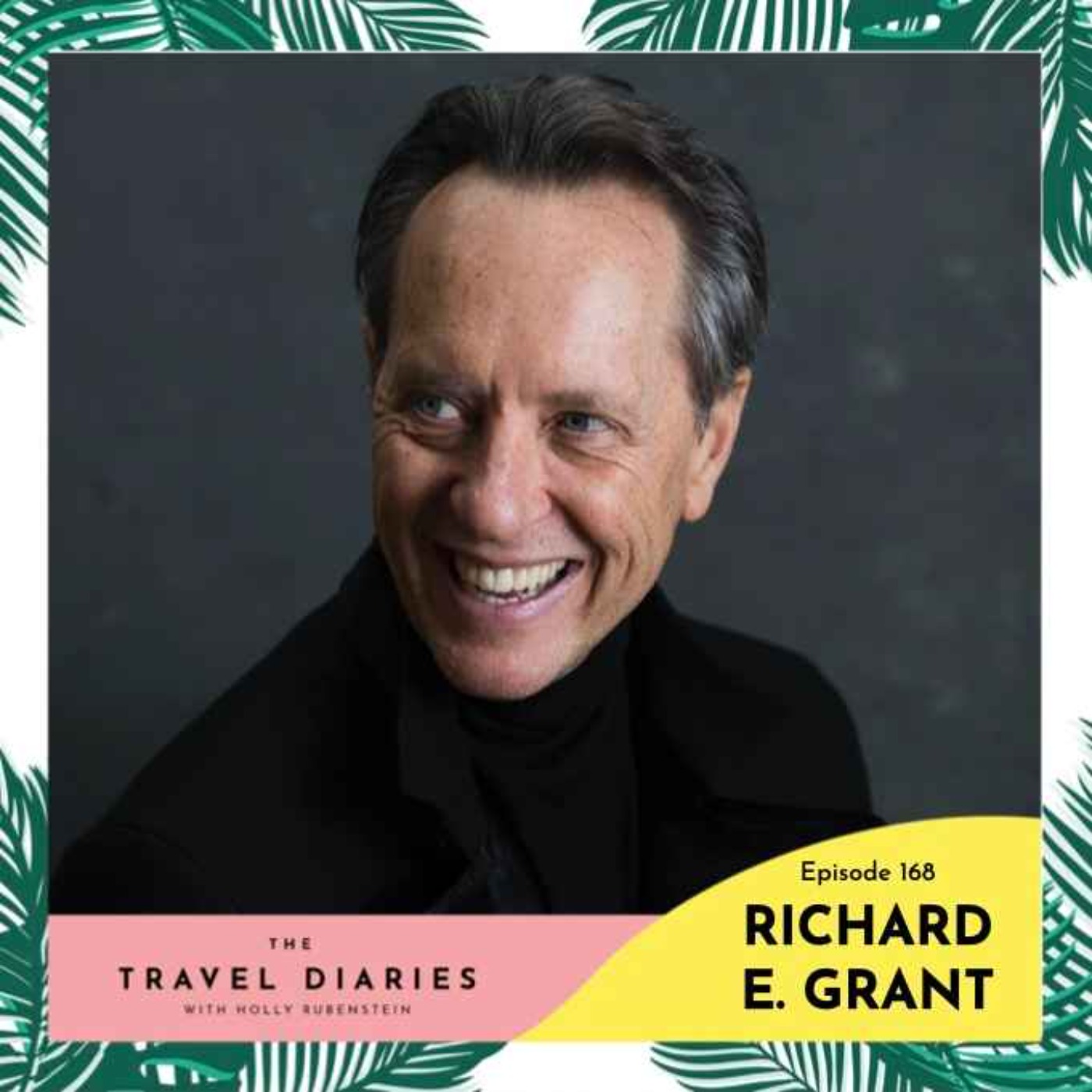
Today, for our final episode of the year, I am joined by someone whose life story reads like an atlas: the actor, writer, and now podcast host, Richard E. Grant.
Born in Swaziland, now known as Eswatini, in southern Africa, Richard grew up in a world of big landscapes, no television, and endless imagination. From there he moved to London in the early 1980s, and very quickly became unforgettable figure on stage and screen - from his iconic role in Withnail & I, all the way through to Gosford Park, Jackie, Star Wars, Saltburn, and his Oscar-nominated performance in Can You Ever Forgive Me?
Throughout it all, running beneath the red carpets and film sets, there has been travel. He spent 33 summers at a beloved farmhouse in Provence with his late wife Joan, brocante shopping and watching the seasons change. He’s had close encounters with sharks while scuba diving off Mozambique, checked into seedy hotel suites in Las Vegas, and floated on the still waters of Lake Como.
And now, his travel stories telling them in a new way. Richard is the co-host, of the brilliant new podcast Hotels with History with travel pr Jules Perowne - a series that dives into the scandals, intrigue, glamour and ghosts of some of the world’s most legendary hotels.
So, sit back, pour something festive, and join me as we step inside the seven travel chapters of Richard E. Grant.
Destination Recap:
Richard is co-host of the Hotels with History podcast, Season 1 out now
I'll be back with a new season of the podcast in the Spring.
With thanks to...
Citalia - If you’re dreaming of your own Italian adventure, visit Citalia.com to start planning today.
Naturhotel Forsthofgut – if, like many of our guests, you’re dreaming of an alpine escape rooted in harmony with nature, visit forsthofgut.at to start planning today.
Beaverbrook Hotel - Escape the everyday and discover Beaverbrook for yourself, a truly indulgent country-house retreat just outside London. Find out more and book your stay at beaverbrook.co.uk.
Thanks so much for listening today. If you want to be the first to find out who is joining me next time, come and follow me on Instagram I’m @hollyrubenstein, and you’ll also find me on TikTok - I’d love to hear from you. And if you can't wait until then, remember there’s the first 14 seasons to catch up on, that's over 165 episodes to keep you busy.
Hosted on Acast. See acast.com/privacy for more information.