 Ask ChatGPT


Ruthie Rogers’ travel-and-food “life chapters,” arguing that food memories and travel memories both unlock emotion, identity, and human stories. She shares childhood Cuba, first love with Florence/Tuscany, Mexico’s layered culture, her ongoing “age of discovery” in Italy (especially Sicily/Southern Italy), a Maine hidden gem, her worst trip (a seasick Europe cruise), and her top bucket-list restaurant in Kyoto.
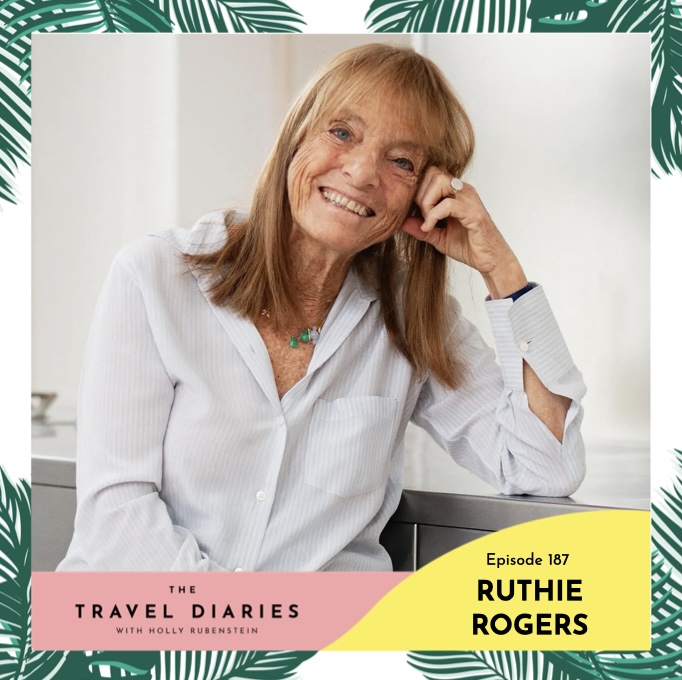
Ruthie Rogers is chef and co-founder of The River Cafe (opened 1987 with Rose Grey), Michelin-starred Italian restaurant in Hammersmith. She’s an influential British food figure, author of cookbooks, and host of the podcast Ruthie’s Table 4.
Celebrity fades when conversations turn to family cooking and restaurant moments; food “humanizes” people. Regional Italian food disproves one-size-fits-all stereotypes (e.g., Sicily vs Turin). Mexico’s appeal is “layers” of culture and art.
Cuba during early post-Castro hope; Florence bruschetta with early-season olive oil; Mexico City/Oaxaca markets, huevos, Contramar; Palermo museum by Sostas; Maine lobster at York, Maine; Kyoto’s Shimmon Sen by Tadao Ando. Guests mentioned (Table Four): Paul McCartney, Elton John/David Furnish, David Beckham, Tony Blair, Nancy Pelosi, plus Patrick Radden Keefe, Al Gore, Vikram Murphy, Tracy Emmons.
Written by AI. May contain mistakes.
Holly introduces Ruthie Rogers, discussing her influence in British food and her new book.
“really helping the show to grow and to continue to bring you fabulous guests.”
Ruthie describes the vibrant and collaborative atmosphere at The River Cafe.
“Ruthie Rogers, welcome to the Travel Diaries.”
Ruthie discusses how food memories connect with travel experiences.
“Yeah, it's a really, really fun atmosphere.”
Ruthie shares her experiences interviewing celebrities and the impact of food on those stories.
“I never heard, you know, so obviously you don't hear all these stories anyway from lots of interviews, But I do think that memories of meals, of food, of, you know, independence when you could, you know, entertain.”
Ruthie recalls her significant childhood trip to Cuba with her family.
“One of the most moving interviews I did was with Vikram Murphy, who was the Surgeon General of the United States.”
Ruthie reflects on her trip to Cuba's beauty and culture, both as a child and later with her husband.
“And it was just after Castro had won the revolution and was there as leader.”
Learn about Ruthie's travel experiences and family holiday traditions.
“And I like the food, you know, it was beans and rice and beans and rice.”
Ruthie shares her deep connection to Florence and its culinary wonders.
“Where captured your heart first, would you say?”
Explore how Mexico has shaped Ruthie's understanding of culture and identity.
“Would you say, do you feel like there are parallels between your design philosophy and your food philosophy?”
Learn about the unique dining culture and personal experiences in Mexico City.
“I lived in Mexico City for four months when my husband had an accident and so he was in the hospital and I lived there.”
Discover the regional diversity of Italian cuisine and travel experiences, focusing on Sicily and the Amalfi Coast.
“Now, I know it's hard to pick, but where would you choose for today?”
Hear about favorite hotels and travel tips while exploring scenic destinations.
“And Vinatza is a town that my husband in 1965 discovered with his first family.”
Explore beautiful lesser-known spots in Maine and their charming atmosphere.
“So we found a little beach and we just sat there.”
Ruthie shares her worst travel experience and a dream destination.
“that you would never go back to well I think for me I can't think of a place that I'd never go back to I thought a lot about this question but I would say that when the very first trip my parents took me to Europe.”

Get the gist, explore an idea or ask about something said.
 Claude
On The Travel Diaries, what are the key points of this episode?
Searching your listeningAutomatic transcript. May contain errors.
0:00Before we get started today, a quick thank you to our sponsor, Citalia, the UK's leading Italian holiday specialist. Now Italy's going to come up quite a lot in my conversation with Ruthie today, which probably won't surprise you. Florence was the first place she fell in love with. Tuscany is somewhere she still returns to every summer. And she talks so beautifully about how that first experience of proper Tuscan food completely changed the way she thought about Italian cooking. and what I love is that even after all these years of travelling Ruthie still feels there's so much of it to discover which is exactly why Citalia is such a great place to start if you're planning your own Italian trip they've been helping people discover the real Italy for over 95 years and their experts can put together a holiday that really suits you with hand-picked hotels in their best locations and bespoke itineraries if you want to explore a little further you can also travel with confidence with 24-7 support, Abita and Atoll Protection, plus Chitalia's free amendment and refund guarantee.
0:58Terms and conditions apply. So whether Ruthie inspires you to book Florence or Tuscany, head to Chitalia.com. That's C-I-T-A-L-I-A dot com. Thank you to Chitalia.
1:14Hello everyone and welcome to the Travel Diaries podcast. I'm your host Holly Rubenstein and here each week I invite a special guest to take us through the defining chapters of their travel life from their all-time favorite destination and hidden gem to what's at the top of their travel bucket list. Before we get started if you enjoy the podcast please remember to hit follow or subscribe wherever you're listening it's completely free and it means you'll get a fresh dose of wanderlust in your library twice a week now and by doing this you're really helping the show to grow and to continue to bring you fabulous guests.
1:49Today's guest is one of the most influential figures in British food. Ruthie Rogers is the chef and co-founder of The River Cafe, the legendary Michelin-starred Italian restaurant in Hammersmith, London, which she opened with Rose Grey in 1987. Over nearly four decades, The River Cafe has completely transformed the way that we eat and think about Italian food in this country, and its kitchens have helped launch the careers of some of Britain's best-known chefs like Jamie Oliver, Hugh Fernley-Whittingstall, Theo Randall and April Bloomfield. But Ruthie's influence extends far beyond the restaurant.
2:27She's the author of numerous much-loved cookbooks. She's the host of the hugely successful podcast Ruthie's Table 4, where an extraordinary guest list has appeared from Paul McCartney, Elton John, David Beckham, Tony Blair, Nancy Pelosi and they come on and they share the food memories that have shaped their lives and the podcast has now inspired her new book which she's here to chat about Table Four at the River Cafe, conversations about food and life and no surprises it turns out that food memories and travel memories have so much in common they transport us instantly back to a particular person or place or moment in our lives that is so powerful So I chatted to Ruthie in the summer this year at the River Cafe, which was the most beautiful setting.
3:13And we had a wonderful time uncovering her travel diaries from Cuba, Italy, Mexico, Maine and Marrakesh. So much more as well. So let's buckle up and get started. Here's Ruthie. Ruthie Rogers, welcome to the Travel Diaries. Thank you. I'm so glad you're here. I'm glad that you travel to Hammersmith to do this. it's so exciting do you know i was just saying to my producer that the vibe arriving here today it reminded me i used to do theater when i was younger and that kind of excitement just before the curtain is about to be raised you know that everyone was in a great mood the staff were milling around it must be such an amazing atmosphere to come to every day i feel very lucky you know I walk into this into the river cafe and first of all I think it's very beautiful inside but it's also now that the sun is shining and people are outside and the flowers are blooming and the grass is green the team that work here is so great that it's it's a big up for me to come here yeah it's such a such a lovely and it's theatrical you know I think the reason actors probably like doing jobs as waiters is that you know it's quite similar the curtain goes up and your script has to be memorized and the floor has to be clean and the stage has to be set and the food has to be cooked and the rehearsals have to have been done you know there's a very big overlap i think and that sense of team teamwork and camaraderie as well i would say that it's a very collaborative uh job and because you know if you if you're late for work it's not your necessarily your boss who'll be upset it's your colleague who thought they can't start cooking until you've you know, prep the peas and you can't stop the person down and the floor isn't clean.
5:01And so it's good. Yeah, it's a really, really fun atmosphere. And, and we're here to celebrate your book, Table Four at the River Cafe, beautiful coffee table book, so many stories to get stuck into. And of course, it grew out of your incredibly successful podcast as well. And what's interesting and that I found kind of reading it, and of course, listening to your podcast is that parallel between how food memories unlock something within people and travel memories too. You know, there really is. So what do you think it is about food that opens people up so quickly? Well, I think, first of all, as you say, I think there is a, you know, you look at people's memories through the lens of travel and I look at people's memories through the lens of food.
5:50And I think that when you ask someone, you know, I always say, If I'd asked David Beckham, I said, would you do the podcast and we'll talk about football? Or Paul McCartney, would you do the podcast and we'll talk about the Beatles? Or Nancy Pelosi, we'll talk about the House of Representatives. They would have been kind of been there, done that. But when you say, we're going to talk about, did your mother cook? Did your father cook? If your mother had a job, would she shop, you know, before she came home to work? Or would she order it over the weekend? Did you go to restaurants? And did you do that for special occasions?
6:22And then they start remembering, oh, yeah, there was a time that we went to a restaurant because, I don't know. Or I remember the first time. Most of the people that I interview are not grown up entitled, you know. And they see food as they might see travel as a measure of their success. And so they see, you know, when they could afford to take somebody to a restaurant, when they could actually pay for a bottle of good wine, when they could go to a market and buy a white truffle. That kind of said, I've made it. Look at me, I can do this. Probably in the same way of getting to get a ticket on an airplane to go visit a city they'd never been to.
7:03Yeah, and both food and travel hold so much emotion as well. Yes, they do. Remembering going back through that nostalgia, it instantly unlocks something that, like you say, those kind of standard chats don't in the same way. We interviewed Elton John and David Furnish, and at the end of it his chief of staff was there, and she said, you know, I've listened to 20 years of Elton giving interviews, and I never heard that story about his grandmother shelling peas with him. I never heard, you know, so obviously you don't hear all these stories anyway from lots of interviews, But I do think that memories of meals, of food, of, you know, independence when you could, you know, entertain.
7:52Food is a seduction, how, you know, you wanted to impress a woman or a man and cook something. So all that is part of the conversation. Well, I mean, you've mentioned an absolute who's who already. I know, sorry, I don't mean to be name dropping. I don't mean to. I love it. I love it. I wondered when you have spoken to so many fascinating people from all walks of life, are you ever starstruck now? Has there been any interviews that actually you've kind of been excited by? Yeah, there are people that I've been so interested in learning more about too. There was a writer called Patrick Madden-Keefe who wrote London Falling.
8:40and I'd read the book and I just so wanted to understand what how he wrote it what he felt when he was writing it and that anticipation was not overwhelming but you know I was curious but then also I think you know obviously having Al Gore who ran for president you know telling me how he would make a tomato sauce and political people interest me you know the Tony Blair rolling out a pizza and talking about leadership. So I'm not overawed by celebrity as such. One of the most moving interviews I did was with Vikram Murphy, who was the Surgeon General of the United States. And, you know, talking to him about life as Surgeon General and medicine and progress and poverty it's it's moving tracy emmon was another one who went through such a struggle i i kind of um i'm drawn to people who struggled self-doubt struggle it's much more interesting to me than self-confidence and you know self-esteem it is interesting and now i guess talking about food and that like you say making a pizza or making a tomato sauce just instantly humanizes people yeah like because we all do that at home like yeah yeah when they say peel you know you hear somebody you admire saying how to peel a clove of garlic or how to smash you know basil into a pesto yeah it's an equalizer isn't it yeah absolutely well we are going to go on a journey today through the seven chapters of your life's travel diaries and we all start at the very beginning and that is with chapter one which is your earliest childhood travel memory.
10:27I think really the memorable trip for me was when I think I probably was 12 around 12 years old my father who was a doctor and very political and his not his actions but his his values decided to take me and my mother, my sister and brother were in college by then, to Cuba. And it was just after Castro had won the revolution and was there as leader. And he felt, you know, he was right that the time would be very short in which he could take a family to Cuba because the relationship between the United States. And he was right. There was an embargo on Cuba very soon after. So he just put us on a plane.
11:16And I remember his sister, my aunt, calling him up and saying, you can't do this to Ruthie. You can't put her in danger. You're taking her to this country where, you know, there's just been a revolution. And he said, no, we're going. And we got on a plane at Kennedy and flew down to Havana. And I don't remember many details, but I remember it very well. Wow. Wow. And were you aware of the political significance of your being there at that age as well? Yes, I was. And I think it really left a mark on me because it was beautiful. Havana is a beautiful city. We went to the beach and I remember being talked to by some of the guides or people who were there, who he met maybe doctors, who described life under Batista and a fascist dictator, who was so hopeful about what was going to happen.
12:17I think that's always stayed with me. And I remember they showed us the DuPont estate, which I remember so well. I closed my eyes. We were walking down the beach. They'd say, there's the DuPont estate, which has now been turned into a home for children. And this is the Rockefeller estate which has been turned into offices for for health and safety you know there was a feeling oh wow you know the wealthy people can you know be displaced for the social good you know and I think it's a simplification and we know what happened in Cuba and we know all the problems but at that point it was it was full of hope and excitement and I think that has always stayed with me.
12:57Yeah, and were you seduced by the atmosphere, the music, the color? Does that stick in your memory? It sticks in my memory. I think that the, and also it's overlapped with the experience that I had later when I went with Richard and my children to Cuba probably 10, 15 years ago. The music is incredible. Have you been to Havana? No, and it's one of these places, isn't it, where, again, I don't think it's so, you know, there's no direct flights from the UK anymore. It became somewhere that was accessible. And now, again, it's feeling less so, obviously. So I guess the second time as well, I was lucky because then we went and, you know, my husband was an architect.
13:41And so we had architects taking us around. And there's an incredible model in one of the museums of the whole city of Havana, made in wood and incredible detail. And then, you know, at night, just listening to the music and these wonderful cars that still are the American cars that are still there. And people who are just so kind and open and fun. And I like the food, you know, it was beans and rice and beans and rice. But that was fine. It was delicious. yeah there's a real allure I think about about Cuba and and you mentioned obviously traveling with your husband Richard yes and I wondered did you always together have conversations about the architecture and design of the destinations that you were visiting like was that something that you would always kind of hone in yeah always yeah I think it was always part of it you know food and architecture and nature and art and culture.
14:39Richard was the kind of person who, on the way home from a trip, was planning the next one. Like me. Like you, like me. He was, you know, people used to say, somebody once asked me, and it sounded insulting, but I didn't mean it when they asked me, what's your favorite place in London? And I said the departures lounge of any airport, which sounded like I wanted to get out of here. But it also hit me that we always wanted to go. The country I know least of all probably is Britain because we always headed to. We went away. In the early days of our relationship, we had our whole family Christmas here.
15:19And then we would take off Richard's parents because I have stepchildren. And we thought that the best thing would be is if we went away at Christmas with Richard's parents. so there was no, you know, division and everybody was happy. And we would just go. That was our exploring holiday. That was when we went to Sri Lanka, when we went to Mexico, when we went to India, we went to Fiji, we went to Australia. That Christmas holiday was the exploring with our two children from our marriage. And then that was Christmas. I'm not sure if I'm answering your question. Then February would be skiing. We'd all go skiing, all the kids, all five children, and have a ski holiday in France.
16:00And then Easter would try to be Morocco because we both love Morocco. We love Marrakesh. And there's something about, you know, late spring in Marrakesh and going down to the desert. And then the summers were we would just decamp, and I still do, even after the death of my husband. We go to Tuscany for the month of August, which he was born in Florence, so it was like going home, but it was exciting. and then peppered in between that would be trips to New York, trips to Miami, trips to Venice for the Biennale. So we were, you know, getting on a train to Paris and trains. And so I didn't think of it like that, but even now when I describe it, yeah, we were explorers, we journeyed, we loved to stay places and we loved exposing our children to that world.
16:52Yeah. I'm going to Marrakesh actually in a couple of months. I've been a couple of times, but somebody who was obviously going there most years, what are your favorite spots? I love that city. I love the art. I love the culture. I love the architecture, the markets. It's changed. When we first went there in 1970, maybe 76, you could go to the square and get your tooth pulled. You could go to the square and listen to somebody reading a story. You could go to the square and have, you know, so many, I hate snakes, but snake charmers. And I think it's still that way now, but it's cleaned up. It isn't anything like it was, but it was so exotic.
17:42And then we would take a Jeep and go down to Taradont or to Tafrut. one year we went to Esarira which is incredibly beautiful on the sea we went to Fez so we've kind of gone there but I think if I was going for the first time I would absorb Marrakesh so vibrant so colorful it is and also the French um you know colonized it which was not good but the uh effect of the French on kind of hospitality may I say you know the hotels are amazing The restaurants are incredibly sophisticated, even if it's just serving a tagine and nothing else. There's a kind of pleasure that I think comes from France. I'm not speaking out for colonization, but I am saying that they did leave a mark, certainly on, I think, that part of Morocco.
18:35And it's so elegant. Today's episode is brought to you in partnership with Airbnb. There's always so much to organize before a trip. The flights, the packing, the itinerary, and in my case, usually a fairly ambitious list of restaurants I'm hoping to visit. We have a trip coming up to Marrakesh and the number of recommendations I'm currently wading through. At this point, I think we'd need to be there for at least two weeks just to eat our way through the list. But one thing many of us don't give much thought to is the home that we leave behind. Whether you're heading away for a weekend, travelling for work, or taking a longer family holiday, your home may simply be sitting empty throughout that time.
19:13listing your space on airbnb while you're away could be a practical way to make more of it without hosting becoming a full-time commitment and i already know what i could put the extra money towards if we listed our home during that trip a hot air balloon ride over the desert it's been on my bucket list for years and then when i heard my guests on my morocco destination special talk about that i knew we have to make that happen so if you already have a trip in the diary it may be worth finding out what hosting during that time could make possible your home might be worth more than you think. Find out how much at airbnb.co.uk forward slash host.
19:46Thank you to Airbnb.
20:11That's what growing feels like. And that's exactly what Grow Therapy is here for. Grow is therapy that works, covered by insurance. Sessions average$21 with insurance, and some pay as little as$0, depending on their plan. There are no subscriptions, no long-term commitments. You just pay per session. Grow connects you with thousands of high-quality, licensed therapists across the U.S., offering both virtual and in-person sessions, nights and weekends. You can search by what matters, like insurance, specialty, identity, or availability. And you can book a therapy session in minutes and begin in as little as two days, not the national 48-day average.
20:51See if you could pay as little as$0 for therapy in seconds at growtherapy.com slash start now. That's growtherapy.com slash start now. growtherapy.com slash start now. Availability and coverage vary by state and insurance plan. Our second chapter, Ruthie, is the first place that you fell in love with. Where captured your heart first, would you say? Well, I think the first time Richard took me to Florence. I'd never been to Florence before. His family were there. Food-wise, it was a revelation because I'd come from the United States where Italian food was quite heavy and, you know, spaghetti and meatballs and field parmigiani.
21:38And it was all that image of Italian food. And then I went to Tuscany and, you know, I remember people often ask me what started me on this journey of food and ingredients. And I remember having, and it is the truth, a piece of bread that was toasted, a bruschetta, that was very, very lightly rubbed with garlic. And then with the new seasons, and the new seasons, it must have been in November, olive oil drizzled over it. And I thought, this is the most delicious thing I've ever eaten. And I couldn't believe it was just the ingredients because, you know, that first olive oil is very peppery, very strong.
22:15Yeah. Because it's the first of the season. It's the first pressing, yeah. Interesting. And it's, yeah, it's very there. So I think Florence really, really, it was, you know, I think it was kind of deep love and a place that I just wanted to go back and back and back to for so many reasons. And the first place then you fell in love with food as well, would you say? I'd say I've always loved food. I said I've always grown up with good food. Not in that way. But, you know, I grew up in upstate New York. And so we had my mother's a librarian teacher. My father, as I said, was a doctor. so it was simple food but it was good but I think it's I thought that the Italian food that I had there was something that I wanted to go home and cook and I didn't at that time have any idea I'd ever have a restaurant but it's the food that it's like a first song that you know you know it's stays with you for the rest of your life and what was it about Florence in particular aside from the food that you know were there particular buildings was there particular streets that you walked that that etched in your memory.
23:20I think Florence, you know, for Richard also, who was born there and was an architect, you know, to see the roof of the Duomo by Brunelleschi, to see the paintings of the Renaissance, to go to the Uffizi, as you say, to wander down those kind of very dark streets, but in the autumn with the lights on and truffles and having a great Negroni before dinner and just wandering the streets. The Arno is such a beautiful river. And we stayed in this little hotel called Lungarna, which is right on the river. Having family there made a difference because I had a cousin, Lucia, who really influenced me in terms of food.
23:59And they were both architects. They were very radical architects. So I think the world of architecture, history and culture, the Renaissance with the Uffizi, the architecture with Brunelleschi was enormous for me. Is that hotel still there? Yeah, it's better than ever. It's a great hotel. I really recommend it. The Longarno. The Longarno. Would you say, do you feel like there are parallels between your design philosophy and your food philosophy? Definitely. I was trained as a graphic designer and I was married to an architect. And Rose, my partner who started the River Cafe with me, was an art teacher.
24:39And I think the way, obviously, the important thing in eating a meal is the taste. But for us, the way we plate a plate, the way we put ingredients together, whether we chop the basil or put it in whole, whether we have it marinated in olive oil before we put it on a dish, it's visual as well. You know, I think it's not that kind of strict plating one carrot here and one artichoke here, but it's the way you put food on the plate. And it's very authentic and it's very honest. So we played our food so that you see the main ingredient. You know, the turbot isn't covered with a lot of other ingredients.
25:18You expose the raw materials. You know, you can see what you're eating. We did that with the cookbooks as well, that all the photography is done in a way that is totally honest. Well, Chapter 3 is a place where you learn the most about yourself. Where comes to mind for that? It's an interesting question. I think that I've found myself in Mexico. Interesting. Yeah. I think that for me, the revelation of Mexico, and I've been going there now since the first discovery, which I think was in 1993. In what part of Mexico was that? Well, we've been to various areas, but over and over again. We go to Mexico City, Oaxaca, and then down to the coast to Puerto Escondido or Huautuco, that area.
26:04and what Mexico means to me are layers, that you have incredible culture, contemporary culture. You have great art, music, and vibrancy. Mexico City is a great city. But then you go to Oaxaca. We also went to the Yucatan, which has Chichen Itza and Ishmael. And I sort of connected so much with the culture of those monuments and made me really think about what I look for. And for me, Latin and South America are my continents. You know, I've been to India, I've been to Asia, I've been to Africa. But for me, the compelling continent is Latin and South America. And when you say what you look for, what do you mean?
26:58What do you look for in terms of the destination? For instance, the art, the forms and the visual identity of Mexican culture is very clear, whether it's a Frida Kahlo or whether it's a statue from the pre-Columbian era. I have empathy. I think it's kind. It's sort of even the Aztec, which are quite tough and kind of warlike, have a dignity and a beauty that I collect when I can. And we have some of the pre-Columbian statues in our home. And I love them. They're very human to me. How would you spend a perfect day if you're in Mohaca? What would be your perfect day? I would go to the, I'd wake up and I'd go to the market and have breakfast in the market.
27:44Yeah. The street markets are so good. So you get breakfast actually at the market itself. Yeah, you can get. So what would you pick? What kind of things? I would probably have the hot chocolate because they do this wonderful hot chocolate. and then I'd have one of their local pastries or cakes or whatever. Also, when I'm in the countryside, when I'm down to the beach, then we always have eggs. We always start the day with eggs. Huevos. Yeah, huevos. I lived in Mexico City for four months when my husband had an accident and so he was in the hospital and I lived there. And breakfast was, I love the way Mexicans eat.
28:19You know, you wake up and you have a very late breakfast, about 11 or 10. Well, I did anyway with my friends. And then you have lunch at about 4, and that goes into early evening. And then you have an apple or something for dinner. You know, I like that. It's a healthier way of eating as well. Yeah, and it's kind of – I don't know if you have a 9-to-5 job, if you can do it. But it's – I love that way of food. And I'd walk around the market. then I would go, I would definitely go up to Montalban because every time I go I see something different. And then I would spend the afternoon probably maybe just resting and then going, there's some wonderful, wonderful museums in Mohaca.
29:02And I'd go there and then I'd go shopping because I also like to collect the little figures that they do in Mohaca that are special to that can culture and then have a dinner there are lots of good restaurants in Oaxaca yeah is your house a treasure trove of your travels yeah I don't collect a lot of things I don't have a lot of sort of bits and pieces but the one thing we do have is these Mexican figures of people of animals horses people they're beautiful yeah so being forced to live somewhere in this unusual situation to live in Mexico City while he recovered in in a way you know that that's such an upheaval but was it it in its own way also uh it was very calm I would say it was the most unhappy time in my life because my husband wasn't well although he was being treated so brilliantly in this in the hospital that he was in but there was no conflict for me you know it was being away I had two rooms in the hotel I had one and then one of my family would be in the other the children or friends would come and stay and it was a kind of exploration of a city it was being in a city where I had friends and so they they were incredibly kind to me and it was also there was no I say there's no conflict should I be at the river cafe should I be with my grandchildren should I be at home should I by doing this or that I was just either with family and friends or I was in the hospital with my husband and so in a way it's a very calm time and if I had to think of a city to be you know stuck in as you can use that word for four months there could be no better city than Mexico Mexico City, yeah.
30:52I guess now with the World Cup, it's being put on people's radar again. And there's been, you know, a funny chat about Mexico City, obviously, in terms of its safety. Some people feel like they wouldn't feel comfortable going there. I felt completely safe. I walked by myself places. My son, you know, he was quite young, went on the subway. I didn't feel, I mean, I was careful. Yeah. I'm not as careful as probably I should have been because I know the area around the hospital was a bit dicey. At one time I went, I'd forgotten something and I wanted to get out of the car to get something. The driver was nervous, but I was never afraid.
31:35I loved it. I felt safer then than I have in many cities in the world. I didn't have a great time, but I just felt energized, comforted, and interested in the city that I was in. And it's a real culinary destination. Yeah, now it is particularly. There's so many restaurants in the 50 best list. Yeah, yeah. What was the one dish, do you think, that takes you back there? Oh, well, I love, there's so many. I love the quesadillas. I love a simple taco with avocado and spicy chicken. I love the, I suppose the dishes that I really liked were the going to a restaurant called Contramar. And they had, it was rather like the River Cafe.
32:19and they just had fantastic fish. They had langoustine, they had a flat fish, which was actually a bit like a sole. And they filleted it so it was open and then they put a sauce, a green sauce on one side and a red sauce on the other. And I would go every morning to breakfast at a place called Nido, N-I-D-D-O, which is this great cafe. I recommend anyone to go there. And we'd always have eggs, as I said. Oh, making my stomach crumble while also watching everybody sit down and get ready for their delicious lunches here. Chapter four, Ruki, is our big chapter, and that is your all-time favorite destination.
33:04Now, I know it's hard to pick, but where would you choose for today? For me, I think I still feel there's so much to learn about Italy, so I keep going back. Tuscany is where my family is and where every summer we rent a house. But for me, the age of discovery is last year I went to a party in Sicily and I went to Palermo. And, you know, Italy did not become a country until very late. And so I think the regionality of Italy is so interesting that you go to Sicily and you have food that you would never find in Turin. I met a woman in Venice years ago who said that she came from quite a privileged family.
33:48And she said that, you know, when she went to Naples when she was a teenager, that was the first time she'd ever had spaghetti with tomato sauce. And we think that all of Italy eats spaghetti with tomato sauce. But because she came from the Veneto, she'd had risottos. And so for me, it's a voyage of discovery. Palermo was amazing, and I'd really like to go back to Sicily and discover the wines, the food, the architecture. There's a beautiful museum in Palermo by Sostas, which opened my eyes to art and architecture. And so, you know, I'm really quite interested now about southern Italy, about Puglia, about Naples.
34:30I went sailing along the Amalfi Coast a few years ago, stopping in at small restaurants and ending up in Capri, which I adored, you know. And I think that there's something about the life of the South which entices me very much. Any recommendations for the Amalfi Coast? Very popular destination. Well, everybody knows Los Colos now, which is a restaurant. They're friends of mine. and they've been here and I've been there and that is definitely worth a visit. We rented a house once in Amalfi, which I loved. I love the sea, you know, being somebody who grew up in the woods in northern New York State, north of New York City, and going to Tuscany every year, which is quite far from the sea.
35:16I yearn for the sea. I love Sardinia and being on the coast. So I would just, for me, I would just stop in the small towns. I'd like to know more about Naples. I was talking to a friend of mine last night who came back from Naples and absolutely loved it. Oh, actually, you've just gone to Naples rather than using it as a launch pad to go somewhere else. Yeah, no, just go and stay in Naples. Yeah. And then I would head up the Amalfi Coast. Ravella was very beautiful. We used to stay there with a friend, Ravella. One of our favorite places in the world and the town that I feel incredibly connected to is Vernazza, which is a small, there's an area called the Cinque Terre, which are five towns on the coast of Liguria between Genoa and Pisa.
36:01And Vinatza is a town that my husband in 1965 discovered with his first family. And we've gone back there every year. It's changed because of the boats, you know, which now take people off the cruise ships and bring them for day trips. But it is still as magical. There are no cars, there are no hotels really. My son was married there by the mayor, so we have a very deep, deep connection. The best restaurant in the almost in the world is called Trattoria Franci, F-R-A-N-C-I, Johnny Franci. It's really, the pesto there is phenomenal. Wow, okay guys we've got to make a mental note of that. Don't want to flood it, but that's a good recommendation because I guess so many people just head straight to Portofino.
36:47Yeah, no I know Portofino, know the town that I like very much is Santa Margherita I love Santa Margherita it's a bustling town you know it's it's it's obviously a summer tourist place but I think it's very Italian and I love being able to go out and get a piece of pizza or an ice cream at 10 o 'clock at night and are you scoping the kind of culinary scene always yeah always always always always yeah you're always eating and thinking and thinking and eating and seeing what everybody's doing So each bite can lead to a conversation and evolution. Well, sometimes they can. You know, some bites you don't, but I think it's what interests you in terms of learning.
37:27Yeah. And do you have an all-time favorite hotel in the world? In the world, I love the Camino Real in Mexico City. That's where I lived for four months. If I have the possibility of staying there, I adore the Cipriani because it's, you know, just such a beautiful hotel. So the Cipriani. Yeah, I love the Cipriani. One of the most famous Venetian hotels. It's incredibly expensive, so you can't stay there. Well, maybe some people can for very long. But my uncle once told me, Ruthie, I always take the smallest room in the best hotel rather than the best room in the smallest hotel. Really? It's not the size.
38:08That's interesting. But there is something so beautiful about coming home after trudging around the streets of Venice to that swimming pool. You know, the story about the swimming pool. at the Cipriani was that an American architect designed it and he specified feet but they built it meters so it's three times the size it should be but I don't know if that's mythology if it's true. That's an amazing story if it is true I've not actually stayed there but what a place to have a pool of that size as well. In the middle of Venice. So rare. Yeah. Yeah well chapter five you've mentioned a few hidden gems already but is there a place that you love that you think that my listeners might not know that much about I went to Maine uh just last week to Maine yeah to Maine in the United States and my son had was picking up his daughter from camp and I was going back to New York so we had one night overlap and we went to a town called York in Maine and it was just so beautiful.
39:11It was small. It was a little gem. We went and we wanted to have lobsters and it was lunchtime so we found this little place just outside on the water and they actually boiled, they show you the lobsters and then this young teenager kind of boiled them and when we went to pick it up there were no knives or forks. I guess everyone takes them home. So we found a little beach and we just sat there. We got a big rock and we cracked the lobsters with the rock and ate it with our fingers and washed our hands in the water and for me that was a beautiful discovery of a small place that I loved yeah very quintessentially all-american yeah very yeah you know the white churches that you see that you can't really quite tell if it's a house or a church that were built by the tradition you know even pre-revolution so they're from the 1770s I'd say 60s and they're so domestic in their scale it's very beautiful not that dissimilar to Woodstock would you say uh no no no Woodstock is a bit less this is the place where the pilgrims actually landed you know Massachusetts and Maine that area so it's older but no Woodstock was very beautiful as well is Woodstock where you grew up yes it is yeah one of my favorite places yeah it's a fun place yeah and now I guess you know back then very creative and arty and still now the same.
40:36Yeah, no, I think so. That ethos still fades, doesn't it? When we moved there, I moved there when I was 10. It was still known as an artist colony. And then Bob Dylan came and Peter Paul married. So it became much more of a music place. But I think now it kind of combines both. Therapy's biggest impact doesn't show up in some dramatic breakthrough. It shows up in the smallest moments. You bite your tongue instead of escalating. You put your phone down instead of firing off that text. You say what you actually mean instead of what would hurt someone else the most. Nobody applauds those moments, but they quietly change your life.
41:15That's what growing feels like. And that's exactly what Grow Therapy is here for. Grow is therapy that works, covered by insurance. Sessions average$21 with insurance and some pay as little as$0 depending on their plan. There are no subscriptions, no long-term commitments. You just pay per session. Grow connects you with thousands of high-quality licensed therapists across the U.S. offering both virtual and in-person sessions nights and weekends. You can search by what matters, like insurance, specialty, identity, or availability. and you can book a therapy session in minutes and begin in as little as two days, not the national 48-day average.
41:55See if you could pay as little as$0 for therapy in seconds at growtherapy.com slash start now. That's growtherapy.com slash start now. growtherapy.com slash start now. Availability and coverage vary by state and insurance plan. Hey y 'all, Kelly Clarkson here with Wayfair. You know my favorite compliment during the holidays? Your house feels so cozy. That's when I know everyone's comfortable enough to kick off their shoes, grab more dessert, and stay a little longer. Wayfair makes it easy, with everything from dining furniture to festive guest room essentials all in one place. So whether you're hosting for an afternoon or all weekend, everyone feels right at home.
42:37Get holiday guests ready at Wayfair.com or on the Wayfair app today. Wayfair, every style, every home. our penultimate chapter Ruthie is chapter six and that is your worst travel experience or the place that you would never go back to well I think for me I can't think of a place that I'd never go back to I thought a lot about this question but I would say that when the very first trip my parents took me to Europe. I was probably nine or ten, and they booked us on the SS France because my father loved big ships, and we went. And I was, from the minute I got on that ship, ocean liner in New York Harbor, to the time we landed in Southampton, I was seasick.
43:28And I was so sick on that trip that I never left the cabin. My father read me all of Dickens, Tale of Two Cities. And I just was so, I could, I just couldn't believe how ill I was. And I think that is, you know, I've often read that nauseousness is the least tolerable illness. So I think the only bad memory I have to do with travel is being on that ship and not being able to get off for seven days, five days. Any more cruises? No, never, never. I'm not surprised. Well, Ruthie, it has been such a lovely pleasure chatting to you. We're on to the final chapter of your travel diaries chapter seven and that is the destination that is at the top of your travel bucket list you've been all around the world but where would you like to go i am dying and i i'm really really want to go to a restaurant called the shimmon sen in uh kyoto in japan it is designed by a great architect taro ando it's in the most beautiful city um you know, Kyoto in Japan.
44:32I've been there, but the hotel wasn't done then. It's owned by a friend of mine, Patrick McKillen, Patty McKillen. And he does his hotels with such details, such generosity, such attention to what you will want as a traveler to stay in. And I have so many friends who've come back from there saying, Ruthie, you know, it's great architecture, which you love it's great food which you need and you know the person who created it why haven't you been and I have no answer to that question it's just a real community of having an artist artistic community in Kyoto having incredible architecture and and the attention to detail would make me it's really been on my list and I'm not going to go anywhere else until I can go there wonderful I hope you get there soon I hope so thank you so much Ruthie Rogers those were your travel diaries it has been such a pleasure oh well what a joy that was to speak to Ruthie and in such a magical surrounding like the River Cafe is one of the most beautiful spots in London and it really feels as though travel is just in her bones don't you think you can listen to Ruthie's brilliant podcast Ruthie's Table 4 wherever you get your podcasts and her new book, Table 4 at the River Cafe is available now.
45:52I'll be back on Sunday, of course, with another episode of Unpacked, this time with the fabulous travel writer and photographer, Luke Abrahams. If you'd like to find out who's joining me on next Tuesday's episode, come and follow me on Instagram and TikTok. I'm at Holly Rubenstein. I would love to hear from you. In the meantime, wishing you guys safe travels and I'll see you on Sunday.
46:46We'll see you next time. Get holiday guests ready at Wayfair.com or on the Wayfair app today.
47:16If you've been putting it off, you're not alone. But timely screening matters. Let's talk about what isn't talked about. Talk to your provider or request ColoGuard Plus online, Rx only.
Today’s guest is one of the most influential figures in British food. Ruthie Rogers is the chef and co-founder of The River Cafe, the legendary Michelin-starred Italian restaurant in Hammersmith, which she opened with Rose Gray in 1987. Over nearly four decades, The River Cafe has completely transformed the way we eat and think about Italian food in this country, and its kitchens have helped launch the careers of some of Britain’s best-known chefs, including Jamie Oliver, Hugh Fearnley-Whittingstall, Theo Randall and April Bloomfield.
But Ruthie’s influence extends far beyond the restaurant. She’s the author of numerous much-loved cookbooks and the host of the hugely successful podcast Ruthie’s Table 4, where an extraordinary guest list, from Paul McCartney and Elton John to David Beckham, Tony Blair and Nancy Pelosi, share the food memories that have shaped their lives. The podcast has now inspired her beautiful new book, Table 4 at The River Cafe: Conversations about Food and Life.
And it turns out that food memories and travel memories have a great deal in common. Both can transport us instantly back to a particular person, place or moment in our lives.
I joined Ruthie at The River Cafe on a gloriously sunny summers day. Her travel diaries today take us from Cuba and Mexico to Maine and Marrakech, as well as her beloved Italy and the beautiful rhythm of family life she created with her late husband, the architect Richard Rogers, with summers in Tuscany, winters exploring the world and an almost constant desire to plan the next adventure.
Destination Recap:
You can listen to Ruthie’s Table 4, wherever you get your podcasts.
Her new book, Table 4 at The River Cafe: Conversations about Food and Life is available now.
I’ll be back on Sunday with another episode of The Travel Diaries: Unpacked.
If you’d like to find out who’s joining me next Tuesday, come and follow me on Instagram and TikTok, I’m @hollyrubenstein and I’d love to hear from you.
With thanks to...
Airbnb - Your home might be worth more than you think. Find out how much at airbnb.co.uk/host
Citalia - Discover the real Italy with Citalia, the UK’s leading Italian holiday specialists. Let the Italy Experts craft the perfect holiday for you and experience Italy like a Citalian.
Hosted on Acast. See acast.com/privacy for more information.