Ask ChatGPT

 The Two Matts
13 Aug 2026 · 57m · 16 chapters
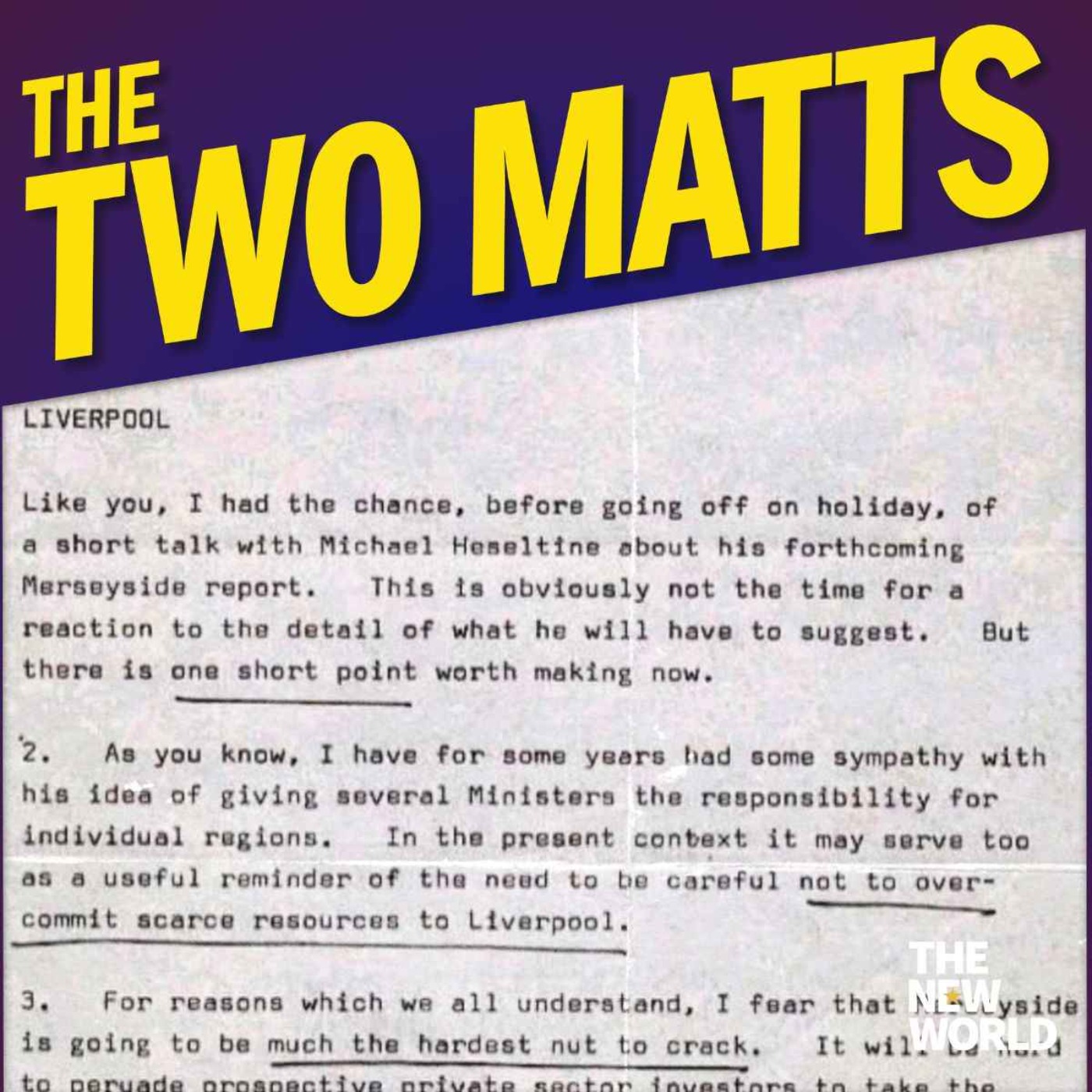
The episode discusses two main political/cultural stories. First, it debates Andy Burnham’s “Politics of Place” approach: the hosts argue Burnham’s key claim is that government should listen to communities and distribute social responsibility fairly (including insisting middle-class areas take asylum seekers), rather than run a “spreadsheet” technocratic economy. They connect this to a 45-years-ago letter by Geoffrey Howe to Margaret Thatcher about “managed decline” for Liverpool, quoting Howe’s warning not to spend scarce resources there and the idea of “stony ground.” The hosts claim Howe’s logic reflects a long-standing Westminster triage mindset, and they argue Burnham’s empathy-based touring and delivery will be the acid test. They also discuss early prison-release controversy involving Jesse Cole and Albert Bowers (manslaughter in the killing of PC Andrew Harper), arguing Burnham’s stance seeks flexibility within existing law while warning it shouldn’t distract from broader prison capacity and rehabilitation reform.
a Cambridge sociology professor accused of plagiarism/fraud in academic work, with media and institutional failures highlighted.
the episode has two hosts (Matt and another host) rather than named guests. Notable examples include Alan Rusbridger’s Oxford Foundation Year as a contrast to Arday’s alleged shortcut, and media coverage by outlets like the Daily Mail, Times Higher Education, and Carter Ruck.
Arday’s defenders are criticized for excusing dishonesty via race/neurodiversity; the hosts argue Cambridge’s vetting and humanities “critical theory” methods enabled the situation.
Written by AI. May contain mistakes.
Discussing predictions and insights about a significant by-election.
“Do you think we'd be talking about Jason Arday like this if he was white?”
Exploring Andy Burnham's recent tour and its implications.
“So if you're in Clacton and you've got a ballot, do the right thing.”
Analyzing Geoffrey Howe's letter to Margaret Thatcher and its impact.
“Do you know what's funny is this is a letter that I think a lot of our listeners will be familiar with the fact that the letter exists.”
Discussing the importance of empathy in politics and its relevance today.
“And let's talk about why after I've read the letter.”
Debating the placement of asylum seekers in middle-class areas.
“I mean, Liverpool, I mean, all credit to Michael Heseltine.”
Discussion of Burnham's bold proposal for fair placement of asylum seekers.
“Now, the Telegraph's gone berserk about that today, Thursday.”
The hosts introduce the discussion about the unfolding story of Jason Arday.
“The one thing that I feel confidence about, which I never I decreasingly did with Starmer, is that these kind of things, you know, he knows everything.”
The hosts dive into the details and implications of Jason Arday's academic fraud.
“Onnit's Total Human brings key research-based vitamins, minerals, herbs, and amino acids together in convenient day and night packs.”
The hosts explore media reactions and the impact of critical theory in academia.
“And if universities aren't about the truth, you know, we talk a lot about the truth in respect of the populace and mask and so on.”
A discussion on the implications of Jason Arday's auto-ethnography approach in academia and its consequences on perceptions of black academics.
“And you look at some of the titles of what he wrote and they were, it's agony to see the names of the papers that were being put into journals and dismantling power and privilege through reflexivity.”
Exploring the responsibility of media and academic institutions in handling claims against Jason Arday and the impact on black academics.
“I think Jason Arday, and you're right, he's got the agency and he wanted this and he got it and he dissembled his way into it.”
A call for maintaining academic standards and the dangers of prioritizing emotions over facts in university settings.
“That is where social decay and destruction.”
Discussion on the necessity of independent inquiries in universities to maintain credibility.
“But this if Cambridge is to save its reputation, it needs to get an independent inquiry going.”
Speculation about potential political events and their humorous implications.
“Well, listen, that's been very instructive to me.”
Anticipation and humorous commentary on the upcoming election results.
“You know, since you raised that possibility on our chat, right, I have to say that I've not been thinking about Jason Arday at all, right?”
Encouragement for listener questions and promotion of the magazine.
“Right, anyway, so maybe we'll speak to you tomorrow, dear listeners, depending on the results.”

Get the gist, explore an idea or ask about something said.
 Claude
On The Two Matts, what are the key points of this episode?
Searching your listeningAutomatic transcript. May contain errors.
0:00500 orders a month was manageable. 5 ,000 is madness. Embrace intelligent order fulfillment with ShipStation, the only platform combining order management, warehouse workflows, inventory, returns, and analytics in one place. What used to take five separate tools, ShipStation does in one. Automate fulfillment and rate shopping to ship up to 15 times more with up to 90 % savings. Go to ShipStation.com and use code AUDIO to try ShipStation free for 60 days. Mod.com is changing the way people battle excessive fatigue. Ever hit a wall in the middle of the day and a third coffee just doesn't do it anymore?
0:40Here's what's actually happening. Coffee only briefly blocks adenosine, the chemical that tires you out. When it stops working, your system is flooded and you crash. Modafinil is a prescription treatment that works in a completely different way. Modafinil works by stimulating multiple receptors in the brain associated with wakefulness, including dopamine, serotonin, norepinephrine, histamine, glutamate, and orexin. It's a more complete solution that gives you 10 to 12 hours of steady focus and energy. To learn more, go to mod.com. Fill out your intake form, meet with a licensed provider, and if approved, ModAlert ships straight to your door.
1:22Go to mod.com to get started. That's M-O-D dot com.
1:54fails that test. To go around the country before Parliament is in recess and talk to people and see what needs to be done and then to act upon it, again, as you say, it sounds incredibly simple, but like lots of very simple ideas, no one's done it. Let me ask you a more direct question. Do you think we'd be talking about Jason Arday like this if he was white? Hello and happy Thursday everybody Happy Thursday, what an all big day today, by election day In Clacton, Binface versus Frogface Binface versus a comedy candidate, who knows it'll happen Gosh, it'd be amazing, I mean I can't, what's your prediction Matt?
2:42Well I mean obviously there's a large part of me that longs for him to be I mean, bin face beats Farage really would make my century. But I actually think that, I mean, in a way, Farage is already lost because the mere spectacle of him and, I mean, the biggest by-election ever is it in terms of candidates, I believe. 36 or something like that. So there's going to be some, it's going to be him and an array of comedy characters. It's going to be like that, do you remember that Python sketch whereas the silly party the slightly silly party and you know it's gonna be that so you know from from the off before single vote has been counted he's he's a loser he looks like an idiot so he looks like a mad person in a long bus queue of idiots doesn't he 100 and i but i do suppose there there is a kind of serious point which is if there's any i mean if if if bin face gets anything being above 15 % of the vote.
3:42I mean, that's really bad. Yeah, yeah. It's probably wrong to name an actual figure, in fact, because the whole thing is embarrassing. But it will be interesting to see how many people come out to make the point they don't want Farage, you know. And, of course, once this is out of the way, then the standards inquiry picks up again, doesn't it? Yeah, we just carry on, you know. And likely, I mean, as you said from the start, And I think you're right that this whole five million quid and Farage boasting about his Ferraris is very sticky. And I think that it will inevitably lead to something like a recall and probably another by-election, which is preposterous and embarrassing and, you know, hard on the people of Clapton.
4:25But to be honest, you know, anything which erodes Farage's national position is good as far as I'm concerned. Yes. And a civic duty. So if you're in Clacton and you've got a ballot, do the right thing. Yeah, vote early, vote often. And vote bin. Vote bin. Vote bin. Right, how's Mr Burnham doing? Because we've been away. Actually, we got a few emails from people who didn't get the memo. So apologies to those who missed us last week. But yeah, I was away in Spain and you were working on something intellectual. In my own way, yes. At least that's what it said on the sticker. We're back now. We're back.
5:11Mr Burnham, he's been on holiday, hasn't he, as well? Yeah, he went away for a week, which I think is very sensible. But he's back and he's doing a tour, a sort of itinerant kingship tour of the country to talk about standard and living things, which sort of segues nicely into what I really hope we talk about first up today, Matt, which is inspired by an excellent piece you wrote, which I hope people will go and read if they haven't already, on the New World website, which relates incredibly closely and intimately to Burnham's Politics of Place theme. But it's inspired by an anniversary I wasn't aware of.
5:53Do you want to talk through that? Because it's really interesting. Do you know what's funny is this is a letter that I think a lot of our listeners will be familiar with the fact that the letter exists. It was 45 years ago this week, and it did occur to me that the anniversary was worth noting, mainly because of the absolute contrast with what Geoffrey Howe wrote to Margaret Thatcher. Then-Chancellor. The then-Chancellor of the Exchequer, 45 years ago this week, a month after the Toxteth riots, which everyone will be familiar with, Liverpool's in a state of absolute turmoil, and how, as Chancellor, was trying to work out how to deal with the fiscal realities of the day and questioning whether Liverpool was worth the effort.
6:45And what's funny is that I've been familiar with phrases in the letter about managing decline and you can't make water run uphill and all of that. But I've never actually read the full letter. It was released 30 years ago. I think I must have done, but I'd forgotten it. But somebody posted it on Instagram. And I've got to say, mate, when you read the whole letter, and people indulge me. It's not that long, but I will read the whole thing. Read the whole thing. It still has the capacity to absolutely make the blood boil. And let's talk about why after I've read the letter. Anyway, read the letter.
7:22Yeah. Yeah. Prime Minister Liverpool. Like you, I had the chance before going off on holiday of a short talk with Michael Heseltine about his forthcoming Merseyside report. This is obviously not the time for a reaction to the detail of what he will have to suggest. But there is one short point worth making now. As you know, I have for some years had sympathy with his idea of giving several ministers the responsibility for individual regions. In the present context, it may serve, too, as a useful reminder of the need to be careful not to overcommit scarce resources to Liverpool. For reasons which we all understand, I feel that Merseyside is going to be much the hardest nut to crack.
8:04it will be hard to persuade prospective private sector investors to take the opposite view even so we do not want to find ourselves concentrating all the limited cash that may have to be made available into liverpool and have nothing left for possibly more promising areas such as the west midlands or even the northeast it would be even more regrettable if some of the brighter ideas for renewing economic activity were to be sewn only on relatively stony ground on the banks of the mersey i cannot help feeling that the option of managed decline which the cprs that was a think tank um that did a study rejected in its study of merseyside is one we should not forget altogether we must not expend all our resources in trying to make water flow uphill jeffrey howe Amazing.
8:56As an abrogation of the only job a politician has got to do, which is to improve the lives of the citizens who voted for he or she. That to me, I don't think there is a single document in British political history, certainly not in modern times, that so abjectly fails that test. Yeah, no, I mean, it's I hadn't read it. I was familiar with the sort of broad capsule content, as it were, but I'd never read it like yourself. And I must say, my jaw did drop. It's extraordinary. I mean, some of the phrases are just incredible. But the only thing it has in its favour is it is absolutely candid about something that has been swirling around British politics for a long time.
9:47And indeed, the last time it came to my attention was during before and during the very brief Liz Trust premiership, because her view was and I suspect remains. Absolutely. The way you deal with a country governing a country is you identify the place. it's very darwinian you identify the places that you think and we can come back to you know the fact that how was dead wrong but you think are worthy of investment and attention and care and ideas and which ones will fall on what he calls stony ground unbelievable uh and those where you just basically let them quietly die away and so that idea has is still around and i i think it's It's one of the values of that.
10:39You go on to talk about it in the piece, you know, is that this idea is a part of the British political economy. And it's a wicked, it's a wicked one. You know, there's no other word for it. It's a it's a it's a calculus that puts to one side the people that you're there to serve, which is it's disgusting. You know, it's well, it's it's triage. What it does is it says it says this place, you know, we can save. That place is beyond saving. Now, even if that was acceptable, the fact is that, you know, to carry on the medical metaphor, as you say in the piece, how was completely wrong? Yeah. Yeah.
11:21I mean, Liverpool, I mean, all credit to Michael Heseltine. Again, people will know much of this, but Heseltine had a totally different view and, you know, an archetypal Tory in so many ways, but really took to Liverpool and was instrumental in, you know, launching a garden festival, which started to give it a sense of esteem and paying attention to the place and listening to the people. and that really to me is the most you know these these sound like such simple things but that to me seems to be at the very heart of Burnham's message is that he'll go and listen and he'll go he will go and he'll listen that's the point you know and this is where I think you can chase the attitudes in that letter which which obviously is so stark that it almost feels anomalous but I don't believe it was anomalous no I think it was inherent in the way Westminster thought and really thinks to this very day and i think you can trace matt you can trace the sentiment in that letter to there's a straight line to the rejection people felt where they were asked to vote on the brexit issue yeah and they felt bugger this they this it doesn't work for me and i think if if at the very heart of what andy burnham is saying which is to take an empathic approach to to people's challenges then which is totally at odds actually also with kia starmer's view which is to take a kind of um clinical bureaucratic official technocratic view i think this is an age that is crying out for empathy that's what the missing link has been and it's been it's not a new problem it's been there from well before how how like is a is a massive example of it but if burnham can move that dial a little bit he will succeed and it's very important i think your use of the word empathy is is very well placed sometimes that word can be misused just to apply to a sort of sentimentality this is not sentimentality at all it's about acknowledging that every part of the country matters and the people who live there matter too that is not a sentimental idea that's a fundamental democratic concept and I think it's absolutely at the heart of Burnham's politics and the heart of his appeal and so I've noticed some quite sneery pieces about this tour he's doing and I couldn't disagree with them more because I think actually doing a kind of very early in his premiership I mean you know let's let he we're not even up to you know a month since he became prime minister to get to go around the country before while parliament is in recess and talk to people and see what needs to be done and then to you know act upon it it again as you say it's it sounds incredibly simple but like lots of very simple ideas no one's done it and um and i think that also he's he's willing to take some risks so a sub set of this which i think is you know really bold of him and all power to his elbow is him insisting that middle class areas do their bit in the placement of asylum seekers.
14:34Now, the Telegraph's gone berserk about that today, Thursday. Of course it has. Of course it has. But this breaks what has been an unspoken convention, which is that asylum seeker facilities, whether they were in the old days hotels and now they're using army camps and other facilities, are always in areas which are deprived. And the reason for this is there's a rent cap for private contractors, which means that inevitably and politically easier they put it in areas that have less of a voice less political oomph and so on and burnham has said well why and i was really pleased to see because it shows um a bit of audacity that in the lobby briefing um or whenever it was that what spokesman was talking to the press they acknowledged yeah this might cost a bit more but we think there's a principle here of fairness of geographical distribution of the social responsibility.
15:30I know it's only a small, well, it's not a small, but I know it's only one policy, but in that, impacted in that, is a massive change in the way that national policy is enacted. That's 100%, 100 % right. And there's also, of course, there's a huge warning from history about what happens if you're not empathic to communities, which, of course, you know, in Liverpool, You know, despite Hesseltine's interventions and the Bloody Garden Festival and all of this business, you know, two years after that memo was written, Derek Hatton and Militant were in power. And that was a response to a community of 500 ,000 people, I might add.
16:12You know, this isn't this isn't a place in the middle of nowhere. You know, this is one of the major cities of of the nation. And one of the by the way, one of the great I mean, you know, this is not just some village. right this is a great industrial city with a massive history yeah right right and and huge opportunities ahead of it which the european union helped put in place and and people often say you know what's why did the northeast vote for leave and the northwest voted for remain and i've always said you will go walk around liverpool and see to this day all of the blue flag plaques on things and they understand liverpool is a city with massive problems still to this day and huge Huge areas of poverty that would shock a lot of people, frankly.
16:55But the point is, it's a city with a positive trajectory. And that has been borne out through a hard struggle from local people, but also with the hand from supranational organizations like the European Union and a little bit from national government. Now, the main point is that the view which has become prevalent, I think, that it is a spreadsheet economy. We live in a country where, and you can see this through Rishi Sunak, even in his thinking about STEM subjects and stuff like this, he was better on the books. You know, these are strategies driven by by economics, not by human empathy. They're driven by statistics rather than people.
17:46Exactly. And of course, you know, every government has to pay attention to statistics. That goes without saying. But statistics are just they're really just symbols and code for what happens to human beings. And I think that that what happens when you have power centralized in an elite in one place, which is basically how government is still done in this country, that those codes and those symbols that are statistics achieve more valency and more power than an appreciation for the people that they represent. And of course, here's the bitter irony to it all. Where did this lead after the crash around the world and not just here?
18:29It led to vast parts of the West feeling totally left behind, totally ignored and voting counter productively, but with an emotional, you know, comprehensively for populist parties. now one hopes that that is now unravelling but Burnham is right in order to address that root cause you have to go to these places you have to speak to them you have to you have to undo frankly a lot of damage that has been done to the trust between these parts of this country and indeed elsewhere in the world and say we really you know when I say we're listening I'm not just trotting out the usual political bromide I actually am and of course that then leads to a daunting task of delivery.
19:17But again, he's only been in the job three or four weeks. You know, it's it's exactly the right place to start. Yeah. And we should say that, you know, the delivery is the acid test. Of course. And he's got he you know, he's got hard decisions to make. Talking of hard decisions, what have you made about the the saga of the early release from prisons? Well, it's a very interesting one, because obviously there's a debate over whether or not it's proper for a prime minister to intervene in a specific case. Yeah, because there is, you know, separation of powers and so on. It's not a complete separation of powers.
19:57So one doesn't want to over-ick the pudding. But I think that so the specific case is that there are two individuals, Jesse Cole and Albert Bowers, who were jailed for manslaughter in the in the killing of PC Andrew Harper in 2020. And this is a case which naturally is a horrible death, has great emotions about it. and because of a sentencing act in I think 2026 sorry in 2024 this there is now a possibility they might be released now what Burnham has said to the justice secretary is I don't want this to happen so that then raises the question what is you know it's not up to the prime minister who does and doesn't stay in jail but I don't think digging in as far as I can work out to get it I I don't think that's what he's saying.
20:49He's not saying I don't care what the law says. I want them to stay locked up. He's saying, actually, if you look at the scope within the existing law, maybe there's room for some flexibility or, you know, before the new regulations come into play, play on I think it's first of October, we might have to pass some primary legislation. Yeah. And I think that's fine. I mean, that's what governments are for. So I don't I don't have a problem with it. And I do. I also like as long as it is that. I like the fact that he is responsive to something that is clearly undermining public confidence. There is a broader problem, and it's not going to go away, about the capacity of the prison estate.
21:32And we need more space, irrespective of whether you think prison works. And we need more space just to accommodate the existing numbers of prisoners there are. So that, again, to your point about delivery, that is that is not going to be solved by this particular crisis. is that's my i mean that's my fear is that i don't i don't want this to sound uh un-compassionate or whatever but the the case around these two uh people um becomes as a distraction from actually the bigger challenge which and it's to me i i don't think and we should get somebody on who really understands these issues but you know policy yeah the it's it can't just be about the cost of building new prisons no no you know if put it try an analogy or a metaphor if you know if the population is suddenly you discover there's huge amounts of a certain type of cancer you don't the immediate response is well let's not build loads more cancer wards it's let's fix the cancer you know and i think that the cancer of crime and rehabilitation has that's got to be it's time somebody took a wholly fresh look at that I think but I'm a bleeding heart liberal so you may have a slightly harder view I don't know no no I mean I think that what if you look at the the form that public debate takes it's actually more nuanced than I think we give the public credit for which so I think on a certain kind of crime everyone is of the view that the less people can be in prison the better right so for let's say for minor drug offenses okay you know does it really make sense to put people in prison for 10 years where they'll make lots of connections and then just come out and start dealing again you know probably a short custodial sentence then followed up by some sort of rehabilitation which at the moment probably doesn't exist is better i think where it becomes really you know it starts to catch fire in the public imagination is when it does involve people who've been involved in murder manslaughter sexual violence rape and so on and i think for those categories it is sensible to talk about you know prison meaning prison and and and and i think you know as we endlessly say on the pod two things could be true at once and so what i would like to see is is is it were a multi-track approach to punishment you know oftentimes Sometimes governments say, oh, prison works.
24:08That was the Michael Howard line. Or they say, actually, the best thing is to get everyone out of prison. Well, neither is true, really. And the thing about the violent and those involved in sexual crimes is that the truth is the public wants to know that they are sequestered from the community. I mean, that's their primary concern. They want to know they're behind bars. And that's not an unreasonable expectation because managing sex offenders in the community. Actually, the commissioner of the Met was on the radio this morning talking about this precisely is a nightmare. You know, it is it is very hard.
24:44Now, that's not to say every sex offender has to serve life as life. But it does mean that the public's concern about that is, I think, reasonable. Whereas I don't think every burglar has to be in prison for 30 years. you know no that's right one thing i am worried about is that notwithstanding these two villains and and what happens then and i'm sure they'll find a way there will always be somebody's got to get released early and there will whoever gets released early the daily mail and the telegraph and the sun they they will find stories of of people who i know and it will it will become My prediction is this is going to become a perennial cry of outrage of quite, you know, with some ground, but essentially manufactured outrage to destabilise.
25:35You know, let's let's say how we see it. I mean, the truth is that these case studies, especially for the titles you mentioned, if the convicts are people of colour or ethnic minorities or, you know, are, you know, they're catnip. and they present them as, you know, how can the system be letting these people out on the streets, you know, who will protect our nation's youth and that. So I think you're right that there will be a drip drip of these cases. And there's not a lot one can do about that. But I think what Burnham, again, I think he has very good preemptive instincts, which is he was fast on this, which is, you're right, there is a risk that it distracts from the broader problem.
26:15That's always the case when a prime minister gets involved with a specific case and it's not to be dismissed that risk but I think early in his term there are a number of things where he needs to send he's connecting with the public a lot of them for the first time and I think that signal he's sending to the public on this is again it's empathic it's I hear you I get it this is not easy but I understand now the question of course to your point is what comes next you know what what is the strategy rather than the tactic and on a whole daunting range of subjects you know not least the october budget and then to as i always do at this point in the podcast reiterate the necessity of the kelly plan does he think about the general election you know because it's gaining gaining some traction the kelly plan it's unacknowledged but i was delighted to see that the financial times in its lofty way came came loftily on board and dough on bar you know um we shouldn't we should say the kelly plan is to have an early election while farage is on his heels and yeah and i think with each passing day i i think it becomes more more more more germane but but i you know even if we follow the kelly plan that he's got to put some strategy in place if only so he can take a strategy to the country when he when he goes to the country and i think that that So I think what we'll see until Parliament returns, or at least till conference season, it will be these quite tactical retail interventions.
27:47He's touring the country and that's fine. But but come late September, October, he is going to have to start talking about the long term more. And he knows. But I mean, you know, Andy Burnham knows all this. The one thing that I feel confidence about, which I never I decreasingly did with Starmer, is that these kind of things, you know, he knows everything. He knows everything we've said, whether he can deliver it or not is another question. But what we're not dealing with is someone who doesn't understand and recognize the problem. Correct. Absolutely correct. Right. in terms of what comes next what comes next on this podcast is a discussion around one of the most extraordinary stories of the year so far which kind of bubbled up while I was on holiday I was following it with absolute disbelief as it unfolded and it's the story of Jason Arden and it's still a story so I actually don't know we might end up disagreeing on this one who knows, stay tuned
28:54Mod.com is changing the way people battle excessive fatigue. Ever hit a wall in the middle of the day and a third coffee just doesn't do it anymore? Here's what's actually happening. Coffee only briefly blocks adenosine, the chemical that tires you out. When it stops working, your system is flooded and you crash. Modafinil is a prescription treatment that works in a completely different way. Modafino works by stimulating multiple receptors in the brain associated with wakefulness, including dopamine, serotonin, norepinephrine, histamine, glutamate, and orexin. It's a more complete solution that gives you 10 to 12 hours of steady focus and energy.
29:36To learn more, go to mod.com. Fill out your intake form, meet with a licensed provider, and if approved, ModAlert ships straight to your door. Go to mod.com to get started. That's M-O-D dot com.
30:19and use code podcast for a free welcome gift. Taxes and fees apply. Your daily supplement routine doesn't need to be managing a handful of different bottles. Onnit's Total Human brings key research-based vitamins, minerals, herbs, and amino acids together in convenient day and night packs. One all-in-one product designed to make supplementation easier. The day pack supports cognition, focus, and cellular energy production. At night, the night pack helps you wind down and supports a calm, relaxed state. Less time managing your supplements, more support for your day and night. Shop Total Human now at onnit.com.
31:02Welcome back, dear listeners. Well, Matt, while I was away and you were sweltering in, it was actually cooler in northern Spain than it was here. So that was a pleasant relief. The story of academic Jason Arday, former professor Jason Arday, bubbled up and then exploded. And it has been one of the most incredible stories I can remember this year. Yes, it has. of of a man who uh was made a professor at cambridge um and of sociology um education education education excuse me excuse me and and because it's important to get our facts right on this because that's one thing conspicuously absent in his story yes who's got a book out this week and in the states and next week in the uk i think um called uh great and unfortunate things which was perhaps the most accurate thing he's ever done.
32:11He could possibly have given to it. He says he's got an advance of 1.4 million for. It didn't say dollars or pounds. It may not be the case. Maybe that's bullshit. Who knows? Lira, possibly. Turkish Lira. Turkish Lira. But as you watch this story unfold, my first question to you is, did your opinion on what was happening change dramatically no no I mean no I mean I I have to preface this by I'm not a well I hope I'm a reliable narrator but I don't always have a dog in this fight in a story but I do in this case for the simple reason that I used to be an Oxford College fellow and so I have some knowledge about how you know I used to be personally involved in the decision making for senior appointments And I saw routinely and it was heartbreaking sometimes how world class candidates didn't even make the interview shortlist.
33:11So when I saw the extent of his fraudulence and and then the in the first phase, the speed with which, let's say, a certain kind of commentator and public figure was rushing to his defence. I was annoyed because in academia, the plagiarism charge of which I think it's fair to say he is now being convicted is the original sin. I mean, it's the point of research is originality, both of ideas and of prose. And to copy and paste either, which he did, is a grave transgression. It really is. I mean, and I have to say, reading a fair amount of his stuff, as I did, you know, when I was there at Oxford, not Cambridge, admittedly, you know, But if a student had handed in work of that quality, I would have sent it sailing back across the desk.
34:14I mean, you know, let alone a professor. And it does it does occur to me that, you know, we're doing this on Thursday, which is a level results day. And I did a sort of back of the envelope calculation this morning. and I think I'm right that between three and four thousand kids will know now but will have been waiting to find out if they've made the grades to get into Cambridge okay now those kids would have gone off to be taught by someone like him so the whole thing became about him you know and how he was being treated and whether it was fair to him and whether it was racist and And whether it was, you know, whether his hardship and his the difficulties he faced, some of which are less clear than others, was being acknowledged.
35:02And but actually a university is a community, you know, and a professorship at Cambridge is which is routinely one of the top five universities in the world, is one of the most prestigious roles anyone in the world academic community can have. so it is it is not just a sort of fancy that story i think because i think universities if we're going to keep them we throw six billion quid of public money at them every year every kid that goes through university if they take out the loans will leave with debt between 50 and 65k right so a lot of people invest in this financially in you know intellectually and their careers and And I felt, you know, I'm aware that there were lots of sensitivities around, you know, his race, his neurodiversity and so on.
35:55But I thought that the first and most important point in all of this, just to establish before anyone got into the issues of representation and so on, was this was a fraud. And if universities aren't about the truth, you know, we talk a lot about the truth in respect of the populace and mask and so on. but you know it matters as well that universities uphold truth that's what they're there for and excellence but so matt when you say it was a fraud it wasn't i mean as you said he he he is such a crap writer it's on you know it's dreadful you know i mean he so so my question is who who was perpetrating the fraud i mean he he he should he how did he get in well that's my question okay well let's separate two things we should never ever deny him agency right one of the things that happens oftentimes when white people discuss people of color is they're desperate to to imply that they are the in some ways victims right he did you know he applied for all these jobs right he wasn't a kind of you know no one said you've got to be professor of cambridge and all right then you know so there's that but but but the second thing and you're absolutely right is that i saw that the the vice chancellor of cambridge uh was speaking to i think it was the times um deborah pierce and she said it was yesterday wednesday that they published it and she said oh it was an aberration and i thought well how bloody convenient is that you know you have these academics who now talk about absolutely bloody everything in humanities departments in particular a structural systematic you know institutionalized right but the one thing they're not willing to admit was structural and systematic was the system that created this disaster yeah and it's quite clear you only have to look at the video of him being welcomed into the um uh into the fold by his departmental head that they were chuffed to bits to have him is that is that because where they chuffed so they were chuffed to bits let's say it's straight they were chuffed to bits because they'd found a black man who who uh they could put with a with a you know a big profile and you know a penchant for publicity and enormous stories and they would he would make cambridge look good look how worthy we are and and because i mean there are two elements this one is that people love shortcuts right and the shortest cut of all is to appoint someone to a prominent job who will be prominent and go on the today program and be interviewed by krishna guramurthy and you know have a book deal by the way how many professors writing their life story have a ghostwriter I just put that one out there right yeah yeah you know kind of unusual isn't it um but just to put it in context because I think sometimes the people who do good work on this front get forgotten and and here's a good story I bet you he won't tell it himself because he's a he's he he he doesn't um actually show off about it but but I think we should pay tribute to him is our colleague and editor-in-large Alan Rusbridger who was the very successful principal of Lady Margaret Hall at Oxford yeah for a long time and Alan introduced a absolutely brilliant scheme there called the Foundation Year yeah and what they did was they brought in kids who from backgrounds where there was very little chance of them getting into Oxford but were obviously very able and they they put them in situ and gave them a year's tuition and then at the end most of them stayed on and became undergraduates in Oxford that's right and most of them went on to perform disproportionately well to get high degrees it was a it was such a successful scheme all down to Alan that two things happen the first is that it's now been folded into a cross university scheme right it's now across oxford and secondly people come from all over the world to see how he did it now that's how you solve these problems not by you know pushing someone out to be lead singer of the band that's right aren't we marvelous so matt that that is that's actually a very interesting um point to talk about another aspect of this story which has been the media reaction to Jason Arday now in Alan's case he quite recently was absolutely lambasted by the Daily Mail who obviously have got a long-term drudge against anybody who's not you know Paul Dacre think of thought uh for the fact that Alan had taken money or convinced Max Mosley right the uh son or is he the son of the grandson, he is the son of Oswald Mosley, taking his money to help fund that extraordinarily good cause.
41:04And, of course, there has been this enormous glee amongst right-wing press at the Jason Arde story. Of course, of course. And that one thing occurred to me in the response to it is that I haven't seen anybody anywhere writing, well, you know, Jason Arde is just one bad apple. you know which is that's entirely the defense you would have got if it was a white professor well well actually there's racism in the reaction well i'm not sure that's true i mean for example our friend david ronovich wrote that and did he i didn't see that yes and and you know cambridge itself just the the vice the vice chancellor has said that and and and also i think there there is a bigger problem here which is not not just related to um who actually gets hired which is what is actually taught which is that humanities departments in in not just oxford and cambridge but have been absolutely taken over by critical theory slop right and you know that so for example what jason arde's specialty if that's the word was auto ethnography right which basically meant that instead of the kind of evidence-based research that ever since universities were, modern universities were found has been the basis of research, you just basically talked about your lived experience.
42:32Now that's not scholarship. And you look at some of the titles of what he wrote and they were, it's agony to see the names of the papers that were being put into journals and dismantling power and privilege through reflexivity. And, you know, there's a kind of jargon explosion. Sure. OK. Let's just just for a moment, just let me ask you a more direct question. Do you think we'd be talking about Jason Arday like this if he was white? Well, I would. You would. But do you think this? Do you think it's a story if he's a white professor? yes i do right now the daily mail and the no no no no no okay no but this is what i'm talking about the whole story here's the problem is that where what happens in a situation like this is that you're right of course do i think a lot of the people who've been expressing uncommon glee shall we say have done so from a racist position i'm absolutely sure that's right okay yeah but in logic and rhetoric there's something called the genetic fallacy which is that just because someone has a bad motive doesn't mean that what they say isn't true right yeah right yeah so so i don't think that the poor motives of a section of the media means that we should be any less tough on jason our day i'm not saying you know that's my view i might i agree with that completely but i I think there's another element to it, which is that the damage that this story will be doing to other black academics.
44:16Yeah, well... Now, that is a consequence of the way that the story's been handled by a lot of the media. Some of it... Let me... Afua Hersch wrote a really... I thought it was a really good piece in The Guardian about... She was talking about Benjamin Zephaniah, actually, about when he was offered. You know, with that... Yes. He was very open. Obviously, I've got no credentials. He was offered a university professorship and was absolutely taken to pieces by the son of the time, you know, who ran a headline saying, would you let your daughter go out with this man or something like that? Oh, that's horrible.
44:50Incredible stuff. And so we, you know, obviously there's been a lot of progression since that. But the point AFA was making was that a lot of black academics had long had suspicions and troubles about Jason Arde, but weren't really listened to. Or certainly the climate wasn't there to identify this one bad apple because of all the, well, you can't because he's, you know, he's part of, he's black, he's DEI. It's like we can't throw out these people in these times, you know, and I find that really troubling. Yeah, maybe. I mean, I also think that another aspect of our day that needs to be, you know, kept in mind is that he was pretty tough when the going got tough.
45:44right so you know i mean you know poor old jason well jack grove yes very very good reporter for the times higher really good story getter yeah you know our day still presenting himself to this day as the victim he set the police and carter rock yes on on jack grove right yeah and it was only after four months of invest four months of investigation that they told jack grove that the cops that he would he'd been cleared he didn't know he was under investigation right um the same thing happened with there was a guy called david harris who was an emeritus professor at clemouth margin university um and he looked into these plagiarism charges what happened jason arday reported him to the metropolitan police yes okay so you know no it's terrible mate it's terrible no but no but but what i'm what i'm saying is that i understand what af was saying and i understand the prison which says bad mail bad telegraph and of course that's true but we it we must never keep you have to keep your eye on the main event which is we cannot have this kind of nonsense in universities and there's there's no i mean i don't exaggerate there is no point in having universities if this sort of stuff gets tolerated and you know you talk about black academics and neurodivergent academics being under under suspicion now and that's true but whose fault is that predominantly jason arde's right yeah it is no jason arde jason arde and and and just to finish his enablers because he was surrounded by white liberals who were having the time of their lives saying look how brilliant we are and they are at least as much as to blame as the male well i well to be i think there's i think to circle back a bit i think the the most culpable people in all of this are the cambridge uh uh people who should have vetted him and done diligence and said, no, I'm sorry, you do not fit the standards.
47:54I think Jason Arday, and you're right, he's got the agency and he wanted this and he got it and he dissembled his way into it. And we can say what we like about him. And I think he is a bad apple. That's absolutely clear. No, he's a bad man, not a bad apple. He's a bad man. Bad apple is a metaphor for a bad apple. But also bad apple has that resonance of when the cops would say than just a few bad apples, right? Because what it does is it destructuralises the problem. Yeah, he's a bad guy, right? And also the things, you know, blaming his obvious dishonesty on his neurodiversity is an absolute joke.
48:36And setting Carter Rook on journalists, and by the way, the Times Higher Education supplement, or it's not a supplement anymore, the paper magazine, didn't run the story. No, they didn't. So Carter Rook should be investigated for the use of slap letters because they just processed all of this guy's bullshit and then sent it in a letter. They didn't do any due diligence because if they would, they'd have found out it was a load of bullets. And they threatened to pursue Times Higher Ed and Jack Grove. And it's a scandal. And Carter Rook should be investigated by the Solicitors Commission, wherever it is, and absolutely taken to the cleanest, terrible behaviour.
49:21But my point is that Arday has done what he's done, but Cambridge allowed him to do it. And that, to me, is... That's the real structural failure. Well, but don't you think that that should cause some... I do, anyway. 100%. Serious reflection on the Liberal side of the House. Yes, 100%. Because I do worry. And, you know, we talk occasionally on what is, you know, it's a silly word, actually, is called wokeness. It includes too much and omits too little. But, you know, not every form of discernment is racist. Right. Not every form of accountability that involves people of colour is racist. right you know and and not every racist daily mail piece means that you can't speak the truth yeah about a case and it's we just end up going around in circles if we keep up we fail to keep our eyes on the prize and the reason i feel so passionately about this is not just because of you know university life but also because i think that at the heart of the the battle that lies ahead of us all is the defence of the truth is the misinformation economy is the idea that feelings matter more than fact because that has migrated to the right it started on the left but now it's on the right if the left doesn't clean its house up right and stop this kind of idea that oh you can't go there you can't go there you can't go there because that's you know let's be honest that's why this happened this went on for so long because you look at Liverpool John Moores They looked into the plagiarism charge and what they came up with was, yeah, that, you know, he did do this, but it was because he didn't have enough supervision.
51:10Right. Yeah. That's ridiculous. That is just ridiculous. But the point is that people reach they become desperate. And one of the things that does trouble me about all this is that. The older I get and the more situations I look at, the more case studies I look at from everywhere, the more I worry that people can convince themselves that anything is true. The less surprised I am that what happened in the middle of the 20th century in Europe happened, because I think people talk about soft totalitarianism and they're right. You know, people on left and right can persuade themselves that Donald Trump is a really good president or that it's OK to put professors at Cambridge University who are, you know, who are actually fit to be undergraduates, let professors, because it serves some sort of higher ideal.
52:00That is where social decay and destruction. Yes. And the problem with that is we know the people that always benefit from that are the populists. Our job is to keep on the straight and narrow, even if it's uncomfortable. Discomfort means the thing is working. If you're feeling comfortable, it ain't working. I mean, I guess one valuable outcome from this absolute fandango is that people, I think there's a lot of people on the liberal side of things who instinctively and without even garnering the first bit of evidence leapt to Jason Arby's defence, who have come out of this looking a bit stupid.
52:45Some have admitted to it and some have sought to defray the stupidity that they've brought on themselves. But they'll think twice next time. I hope so, because, you know, it's very rarely that I would say this because I usually don't know what I'm talking about. But on this one, I do. I agree. You know, it's a kind of what this is a special episode, listeners, you know, Matt knows what he's talking about. But I do. And I have seen it from the inside. And I cannot tell you how, I mean, my predominant emotion was, I remember vividly watching people who were much cleverer than me, not even making the cut for professorships, right, where I was involved.
53:30Well, tell me, because I didn't even go to university, so I'm out of my depth here, but tell me, it was all souls, right? You were a fellow. Yes, and so... What would have happened? What happens? What is the procedure? What would normally happen in those cases would be a panel that would make recommendations and then the college where the professorship was based would vote on it. And I was at the time a member of that body. And so I would have a vote. and I you know I just remember and it's a while back now but um I remember thinking as I looked through these crazy CVs from people from all over the world you know these schools in in um you know some of them in Africa some of them in in Asia many in America Europe everywhere people of of unbelievable caliber and you think oh god they're not even making the the final four you know um and and I was you know uh beyond privileged to be in that number and and And still kept myself incredibly lucky to be there in that position.
54:31But, you know, I felt very humbled by it. And so to see this charlatan, and there is no other word for him, strolling in and shaking hands with that idiot woman who was head of his department, you know, making a mockery of that. And I do think it matters. And people, you know, there are people's careers here. You know, it's not just, you know, universities, no more than human resources, than companies, are not creches. You know, they're not they're not there just to make adults feel good. Yeah. And we should remember that somebody didn't get the job he did get. Well, this is, of course, the thing that is always missing.
55:08Yeah. From, you know, I heard Hindi Andrews, who's usually wheeled out to to to do the defence in these cases on the Today programme. And he was saying, and this is true, that a lot of black academics face problems right in the British system. And that's fair. But he also implied that all the difficulties that Jason Arday was facing were the consequence of racism. And that's not true. And it makes me annoyed because that was on the 810 on the Today programme. And so, you know, the air was being filled with this. If you feel that Jason Arday was rightly pressured into losing his professorship, you're a racist.
55:47Well, I'm not. And, you know, I'll I'll I'll go to the wall on that one, actually. you know i'm perfectly willing to accept that all sorts of things i'm you know as a white middle class heterosexual male i've got unconscious biases and all of that but on this one bad man kicked out of university right and university by the way needs this an internal inquiry will not do this and i'm really sorry to say because one of the great things about universities used to be that they they looked after themselves they were independent they were independent institutions It's one of their glories. But this if Cambridge is to save its reputation, it needs to get an independent inquiry going.
56:29It really does. You know, you cannot solve this one. It's running like a train in America. Yeah. I mean, John McWhirter, who was one of the first black academics to really say where the damage that the white wokery was doing to black academics, has fired off a series of fusillades over this saying, I told you so. This is what happens. Would you please listen now? You know, and it's really interesting. It's global reach as a story. This is you're right, Matt, to say that, of course, a lot of the people who jumped on it with glee are racist. But it isn't just that. It's actually that there is a there is a structural problem here.
57:09And if we don't address it, a will be doing no favours to higher education and cultural institutions, but also we'll just be handing easy wins to the bad guys, you know? It's not a good idea. All right. Well, listen, that's been very instructive to me. Thank you for that. And I hope the listeners have enjoyed the conversation. We'll go back next week to things I don't know about, right? No, no, no. In case anyone is worried, that was a one-off special episode, right? You can look forward to a resumption of dilettantism. No, no. It was absolutely brilliant. Thank you very much for that. Thank you, dear listeners, for listening.
57:47If something mad happens overnight in Clacton, we'll be back. I mean, I would so love to, it would be my favourite episode of all time, if we can come back and say, Bin MP. You know, since you raised that possibility on our chat, right, I have to say that I've not been thinking about Jason Arday at all, right? Give Count Binface his credit. He is so clever, this guy. He's so funny. He's playing a blinder. Absolutely brilliant. But you know what I mean? You know when there's something just utterly magical glistening in front of you? Yeah, yeah. You know, right? And I just thought that would be my favourite episode of the two mats ever.
58:31So no doubt we'll all dream of the – I don't know what time we get the result, but in my dreams tonight. Well, they're saying it's going to be – they're saying that everything about it is funny okay as well as as well as well as serious um is that there are so many um there are so many candidates that it's going to take longer than normal so it we might not get this so funny we might not get the result until breakfast time you know you know now i i hope you know i hope for my own sleeplessness that we get it sooner but you know it it's everything about it what what a glorious breakfast the thought of farage standing there sweating bullets They're still counting at 7.30 in the morning.
59:13It's in itself a lot of fun. Oh, boy. Whatever happens, it's a win-win for the good guys. I think it is a win-win. I think it is a win, yeah. Yeah, for sure. Right, anyway, so maybe we'll speak to you tomorrow, dear listeners, depending on the results. But at latest, at latest, we'll talk to you on Sunday. And there's still time to get a couple of questions in, so email in your questions to 2MATS. that's the number two m-a-t-t-s at t-n-e publishing.com email your questions in and let us know what you think about jason arday in the conversation we just had loads of controversial opinions bubbling around on that one so do fire those uh emails in please subscribe to the new world um it's what pays the bills and it keeps these conversations going and it's a bloody great magazine and you can get it posted to you first class or hand delivered in many cases on Wednesday mornings, all for an absolute giveaway.
1:00:12In fact, I think it's far too cheap, but the marketing department insists that we give people great value for money. So take advantage of that. Go to thenewworld.co.uk forward slash two mats. That's the number two M-A-T-T-S. Thank you as ever to the third Matt, Matt Withers, for producing the show. Thanks, Matt. And until at latest Sunday. It's goodbye from me. It's goodbye from him. Goodbye.
1:00:49Still waiting in line? Again? That's time you'll never get back. Save time and money with Stamps.com. Over 4 million businesses have skipped the line with Stamps.com. Join them to save up to 90 % off carrier rates from your computer or phone right now. Print postage for certified mail, registered mail, and packages in seconds. Then schedule a pickup right from your home or office. For a limited time, go to stamps.com and use code podcast for a free welcome gift. Taxes and fees apply. Your daily supplement routine doesn't need to be managing a handful of different bottles. Onnit's Total Human brings key research-based vitamins, minerals, herbs, and amino acids together in convenient day and night packs.
1:01:33One all-in-one product designed to make supplementation easier. The Daypack supports cognition, focus, and cellular energy production. At night, the Nightpack helps you wind down and supports a calm, relaxed state. Less time managing your supplements, more support for your day and night. Shop Total Human now at onnit.com.
The Matts remember an astonishing letter of 45 years ago which provides stark contrast with Andy Burnham’s politics of place. Also - how the Jason Arday saga has shamed not just one academic but an entire university… and much of the liberal establishment whose instinctive rush to defend Arday is indicative of a deeper problem. Enjoy!
Produced by Matt Withers
OFFER: Subscribe to The New World for just £1 for the first month. Head to https://www.thenewworld.co.uk/2matts/
Hosted on Acast. See acast.com/privacy for more information.